






Abstract
Academic spin-off entrepreneurs operate at the intersection of scientific research and market commercialisation, navigating multiple contexts and diverse stakeholder expectations. While previous research has examined entrepreneurial judgment and hybrid ventures, little is known about how entrepreneurs exercise judgment across contexts as they pursue both economic and non-economic objectives simultaneously. Drawing on qualitative, inductive research with 32 academic spin-off entrepreneurs, we develop a processual framework conceptualised as the entrepreneurial judgment cognitive process. It explains how entrepreneurs iteratively exercise judgment through three interdependent mechanisms: identifying, adjusting, and managing judgment. Our findings demonstrate that entrepreneurial judgment is not a static cognitive act but a dynamic, context-dependent process through which entrepreneurs interpret value propositions, align with stakeholders, and reconfigure their actions under uncertainty to calibrate hybridity throughout the venture lifecycle. We contribute to the judgment-based approach by unpacking the micro-processes through which judgment is exercised in action, and to hybrid organising by explaining how entrepreneurs sustain dual objectives simultaneously across contexts.
Introduction
Entrepreneurs in hybrid ventures (HVs) must allocate resources under conditions of uncertainty while navigating fundamentally different evaluative contexts, such as scientific impact and business profitability (Hahn et al., 2025; Shepherd et al., 2019). In HVs, founders frequently pursue multiple objectives simultaneously within a single organisational form (Dorobat et al., 2024; Hahn et al., 2025; Topan et al., 2025). Hence, entrepreneurs develop cognitive mechanisms that guide their actions and resource allocation decisions when prioritising economic and non-economic objectives (Foss et al., 2025, 2026; Reynolds and Holt, 2021). Managing such situations requires entrepreneurs to exercise their judgment under conditions of uncertainty (Foss and Klein, 2012; Townsend et al., 2018). Exercising judgment involves an intentional commitment to resource allocation and stakeholder engagement throughout the entrepreneurial journey (Foss et al., 2025). More recent studies of entrepreneurial judgment have begun to examine the micro foundations of judgment and its cognitive aspects in hybrid entrepreneurial contexts (Dorobat et al., 2024; Foss et al., 2025, 2026), including academic spin-offs (Hahn et al., 2025). Existing research, however, has largely focused either on the organisational manifestations of hybridity or on discrete entrepreneurial decisions, offering limited insight into the micro-level processes through which judgment unfolds across contexts (Dorobat et al., 2024). This limitation is salient in HVs, where founders must continually interpret shifting stakeholder expectations, reconcile diverse sources of value, and coordinate actions across scientific, market, and institutional environments (Alvarez and Sachs, 2023; Battilana and Lee, 2014). The literature does not explain how entrepreneurs in HVs exercise entrepreneurial judgment to calibrate hybridity throughout the venture lifecycle, while pursuing both economic and non-economic objectives simultaneously across contexts. As a result, it remains unclear what mechanisms entrepreneurs use to maintain coherence in their actions as they transition across contexts that demand different judgments and levels of engagement.
This article aims to explain how HV entrepreneurs use cognitive mechanisms to exercise entrepreneurial judgment in action while calibrating hybridity (the simultaneous pursuit of dual objectives) across contexts. In so doing, they allocate resources in pursuit of both economic and psychic profit (Topan et al.,2025) while engaging with diverse stakeholders (Bosse et al., 2023; Foss et al., 2026). We conducted qualitative research through in-depth interviews with 32 academic entrepreneurs from 25 spin-offs, operating in diverse industries (e.g., Biotech, Health techs, Data science techs, Agri techs, Renewable energy tech, and Water treatment), and who held primary responsibility for venture-level decisions and resource allocation. Given the exploratory nature of the phenomenon under study, our approach gave voice to participants, who provided rich insights into their entrepreneurial experiences (Gioia, 2021; Gioia et al., 2013). Specifically, we argue that HV entrepreneurs rely on cognitive mechanisms that enable them to identify, adjust, and manage judgment as they transition across contexts.
We develop a processual framework, “entrepreneurial judgment cognitive process,” to explain how entrepreneurs calibrate hybridity. It describes how entrepreneurs recalibrate judgment across contexts. Rather than representing a mechanical sequence of decisions, our framework captures the dynamic process through which entrepreneurs shift between different modes of judgment as they interpret stakeholder expectations, contextual conditions, and venture priorities. More specifically, this process helps entrepreneurs transition across contexts, pursuing dual objectives simultaneously by identifying which mode of judgment is required in each situation when making resource allocation decisions; adjusting their judgment to respond to scientific, technological, social, or market demands; and managing judgment to maintain alignment across scientific, social, and economic dimensions of the venture. At the individual level of analysis, we show how entrepreneurs use a cognitive process to exercise judgment according to different criteria as their ventures evolve. These actions are not merely reactive; they constitute a forward-looking form of judgment that enables entrepreneurs to decide not only how to allocate resources but also when and how to move across contexts, while responsibly engaging stakeholders (Bosse et al., 2023; Foss et al., 2026).
Our contribution to entrepreneurship research is twofold. First, we extend the judgment-based approach (Foss and Klein, 2012, 2015; Foss et al., 2025) by unpacking the micro-processes through which entrepreneurs recalibrate judgments as they pursue economic and non-economic objectives simultaneously across contexts. To do so, we develop a processual framework – the entrepreneurial judgment cognitive process. Second, we contribute to research on HVs (Hahn et al., 2025; Topan et al., 2025) by explaining how founders actively manage the evolving balance between economic and non-economic objectives throughout the venture lifecycle. Our model shows how the cognitive process emerges in academic spin-offs and extends to broader HV settings that pursue both economic and psychic profit. These insights show that entrepreneurial judgment is not only a decision about resource allocation but also an ongoing process through which entrepreneurs interpret contexts, engage stakeholders, and continuously adapt their actions under uncertainty. In this sense, our findings reinforce the view that entrepreneurial judgment is not merely a cognitive process, but a form of action embedded in entrepreneurial decision-making and resource commitment under uncertainty (Packard and Bylund, 2025).
The remainder of the article is organised as follows: First, we review the theoretical foundations of hybrid organisations and discuss academic spin-offs as a distinct entrepreneurial context. We then introduce the judgment-based approach and develop a model that explains how entrepreneurs calibrate hybridity throughout their venture lifecycle. Next, we present the research design and empirical findings that support the proposed framework. Finally, we discuss the implications of our findings and conclude with suggestions for future research directions.
Theoretical background
HVs and academic spin-offs
Hybrid venture entrepreneurs must exercise judgment to balance the challenge of simultaneous diverse demands of multiple stakeholders at each stage of the venture’s lifecycle, a process that may require operational responses to conflicting expectations (Ávila et al., 2024), while pursuing economic and non-economic objectives (Dorobat et al., 2024; Shepherd et al., 2019). For example, a social entrepreneur running a health clinic may need to decide whether to prioritise low-cost services demanded by underserved communities or revenue-generating activities required by impact investors, even though both are essential for the venture’s survival and legitimacy (Battilana and Lee, 2014). In academic spin-offs, this involves integrating scientific and market objectives and clarifying how entrepreneurs exercise judgment to sustain multiple objectives over time (Abootorabi et al., 2024; Minola et al., 2025).
The intensity of hybridity, the extent to which these objectives are pursued and coordinated, depends on how founders interpret uncertainty and evaluate alternative courses of action (Hahn et al., 2025; Shepherd et al., 2019). These judgments shape which opportunities entrepreneurs pursue, which collaborations they establish, and which trade-offs they accept over time (Foss et al., 2025). Academic spin-offs are typically based on advanced and complex scientific knowledge and often develop technologies through research in fields such as medicine, engineering, chemistry, biology, physics, and mathematics (Budden et al., 2021; Romme et al., 2023). These ventures often aim to address grand societal challenges and must first secure legitimacy with stakeholders to create and scale their innovations (De Apodaca et al., 2023). A central early challenge is demonstrating that scientific discoveries can be transformed into viable businesses (De la Tour et al., 2017). Once legitimacy is established, founders are more likely to align stakeholders claims and preferences (Bosse et al., 2023; Clarkson, 1995) by structuring and prioritising their entrepreneurial actions (Rapp and Olbrich, 2023).
Hybridity venture decisions emerge through interactions with interdependent stakeholders, including investors, research institutions, public agencies, and early clients, whose expectations influence both strategic direction and legitimacy (Alvarez and Sachs, 2023; Foss et al., 2025, 2026). For example, entrepreneurs of academic spin-offs use specific language (e.g., research projects) to explore and give meaning to scientific discoveries among scientific stakeholders (professors, master’s and doctoral students, research funding agencies, universities, and research centres). They also adopt different vocabulary (e.g., minimum viable product (MVP), pitch) to facilitate dialogue with other startups, partners, and investors. Founders must make or delegate decisions to appropriate stakeholders (Rapp and Olbrich, 2023), recognizing that they cannot predict the outcomes of those decisions (Foss and Klein, 2012; Foss et al., 2025; Packard et al., 2017). Therefore, they act with consideration of their venture’s simultaneous dual objectives: economic (business) and non-economic (scientific; Hahn et al., 2025). In this sense, stakeholder interdependence may constrain hybridity when they privilege a single objective; yet, it may also enable hybridity when collaboration supports the co-creation of scientific, social, and economic value (Bosse et al., 2023).
The judgment-based approach in HVs
The judgment-based approach defines entrepreneurship as decision-making under conditions of Knightian uncertainty, in which outcomes cannot be predicted from probability distributions (Foss and Klein, 2012, 2015). From this perspective, entrepreneurial judgment refers to the authority to allocate and recombine heterogeneous resources to create value. Rather than relying on calculative optimization, entrepreneurs interpret uncertain situations and commit resources based on their expectations about future outcomes (Foss et al., 2025; Packard and Bylund, 2025). Entrepreneurial judgment is inherently action-oriented, as it unfolds through resource commitment, experimentation, and interaction with stakeholders (McMullen and Shepherd, 2006). Entrepreneurs often lack a full understanding of the attributes of the resources they control and the evolving expectations of stakeholders (Ehrig and Foss, 2022). As a result, they must continuously interpret signals, revise their assumptions, and adapt their actions over time.
Within the judgment-based approach, entrepreneurial decision-making has often been described through the Beliefs–Actions–Results (BAR) cycle, which explains how entrepreneurs interpret uncertain situations, act on opportunities, and update their beliefs based on the outcomes of their decisions (Foss and Klein, 2020). This cycle highlights the iterative nature of entrepreneurial judgment, as beliefs guide actions and results reshape future interpretations. While the BAR framework clarifies how entrepreneurs act under Knightian uncertainty, it offers limited insight into the mechanisms through which founders recalibrate judgments across different contexts and stakeholder expectations. Building on this, prior research on HVs highlights that entrepreneurs often pursue multiple objectives simultaneously, such as economic and societal outcomes (Abootorabi et al., 2024; Battilana and Lee, 2014; Minola et al., 2025). From a judgment-based perspective, these dynamics can be understood as the entrepreneur’s subjective evaluation and prioritisation of multiple simultaneous objectives over time (Foss and Klein, 2012; Foss et al., 2025). In this sense, what is often described as hybridity reflects how entrepreneurs exercise judgment to sustain and reconcile multiple objectives simultaneously across contexts (Dorobat et al., 2024).
This strengthens the idea that exercising judgment in HVs is particularly challenging (Battilana & Dorado, 2010; Packard and Bylund, 2025). In this context, founders pursue not only economic profit but also psychic, understood as the personal meaning and satisfaction derived from acting according to one’s own interpretation of value (Dorobat et al., 2026; Topan et al., 2025). To cope with these challenges, entrepreneurs rely on cognitive mechanisms that guide how they interpret situations and exercise judgment in action. These mechanisms help them maintain and, at times, redefine the venture’s identity as they respond to evolving stakeholder expectations and contextual demands (Bosse et al., 2023; Foss et al., 2026). When actions become misaligned with these expectations, entrepreneurs experience judgment misfit, which requires them to reassess and recalibrate their decisions (Dorobat et al., 2024). In this sense, we understand judgment misfit as a lack of contextual adequacy between the entrepreneur’s judgment and the specific conditions in which it is exercised, including stakeholder expectations, governance structures, and value propositions. Rather than a simple mismatch between elements, judgment misfit captures situations in which judgments developed in one context are inappropriately transferred to another, requiring entrepreneurs to reassess and recalibrate their actions.
Hybridity, therefore, reveals additional layers of judgment, cognitive, relational, and identity-based that influence how entrepreneurs maintain dual missions simultaneously over time. HVs emerge through a series of entrepreneurial judgments that reconcile market and non-market principles (Dorobat et al., 2024) or social missions into market feasibility, maintain legitimacy among diverse stakeholders, and balance the dual objectives of social progress and commercial sustainability (Bosse et al., 2023). These dynamics suggest that hybrid entrepreneurs must continually recalibrate judgments as they pursue diverse simultaneous objectives and stakeholder expectations throughout the venture’s lifecycle. In this sense, psychic profit helps explain why entrepreneurs pursue opportunities that may seem uncertain or unprofitable from a purely monetary perspective. Even when financial returns appear dominant, the motivation to create, innovate, or contribute to society remains deeply rooted in non-monetary satisfactions (Bosse et al., 2023; Dorobat et al., 2024). Despite recent advances, we still lack an understanding of how entrepreneurs exercise judgment across contexts while pursuing both economic and non-economic objectives simultaneously. It remains unclear which cognitive mechanisms founders use when they face contexts characterised by distinct practices, modes of action, and stakeholders with diverse expectations. This lack of understanding is especially relevant in HVs, where entrepreneurs must continually recalibrate their decisions as they pursue simultaneously dual objectives while transitioning across contexts. Therefore, it is an open question in the literature how entrepreneurs in HVs exercise entrepreneurial judgment to calibrate hybridity throughout the venture lifecycle while simultaneously pursuing both economic and non-economic objectives across contexts.
Methods
Research design
We aim to explain how academic spin-off entrepreneurs exercise entrepreneurial judgment to calibrate hybridity throughout the venture lifecycle while pursuing both economic and non-economic objectives simultaneously. To address this question, we adopt a qualitative, exploratory, inductive research design based on multiple case studies (Yin, 2009). This approach is appropriate for investigating complex, processual phenomena in which existing theory is limited and where rich, contextualised insights are required (Eisenhardt, 1989; Eisenhardt and Graebner, 2007). We combined an inductive case study design (Yin, 2009) with a Gioia-inspired analytical approach to generate grounded theoretical insights (Gioia, 2021; Gioia et al., 2013). Our research design embraces the multifactor, multilevel, and temporal nature of entrepreneurial judgment, allowing us to capture how founders interpret situations, allocate resources, and adapt their actions over time. By focusing on both failures and pivoting actions identified in our interviews, we developed an emergent processual framework (Eisenhardt and Graebner, 2007; Van Burg et al., 2022).
Sample selection
We used a theoretical sampling approach to select cases, following established qualitative research practices (Eisenhardt, 1989; Ott and Eisenhardt, 2020). Our objective was to capture variation across contexts, sectors, and stages of venture development to better understand how entrepreneurial judgment is exercised in HVs.
We identified academic spin-off entrepreneurs from four public Brazilian funding agency databases (Programa FAPESP Pesquisa Inovativa em Pequenas Empresas [PIPE FAPESP] 1, 2, 3, and PIPE FAPESP Invest). These databases provide relevant context for studying science-based ventures, as they include startups that have received public funding to develop technological innovations based on scientific discoveries. Four criteria guided our sample selection. First, we selected academic spin-offs formally listed in these funding programmes. Second, we focused on science-based startups led by academics affiliated with research institutions and universities. Third, we purposefully selected ventures at different stages of development, creation, and market phases to capture variation in entrepreneurial processes. Fourth, we included ventures across multiple industries to enhance the generalisability of our analysis (Yin, 2009). This variation allowed us to observe how entrepreneurs exercise judgment across different contexts and stages of venture development.
Data selection
We collected data through a combination of primary and secondary sources. Primary data consisted of semi-structured interviews with founders and co-founders of academic spin-offs across sectors. Using a snowball sampling technique (Agarwal et al., 2020), we identified additional participants through entrepreneurial forums, summits, and professional networks, resulting in a final sample of 32 entrepreneurs. Our sample includes 12 ventures in biotechnology, nine in health tech, 11 in agriculture and natural resources, three in technology, and one operating across multiple sectors. Most participants hold PhDs in Science, Technology, Engineering, or Mathematics (STEM)- related fields, with a smaller number holding master’s degrees, and one participant holding a bachelor’s degree as their highest qualification. Table 1 presents the entrepreneurs, their backgrounds, and the sectors in which their ventures operate.
Sample list.
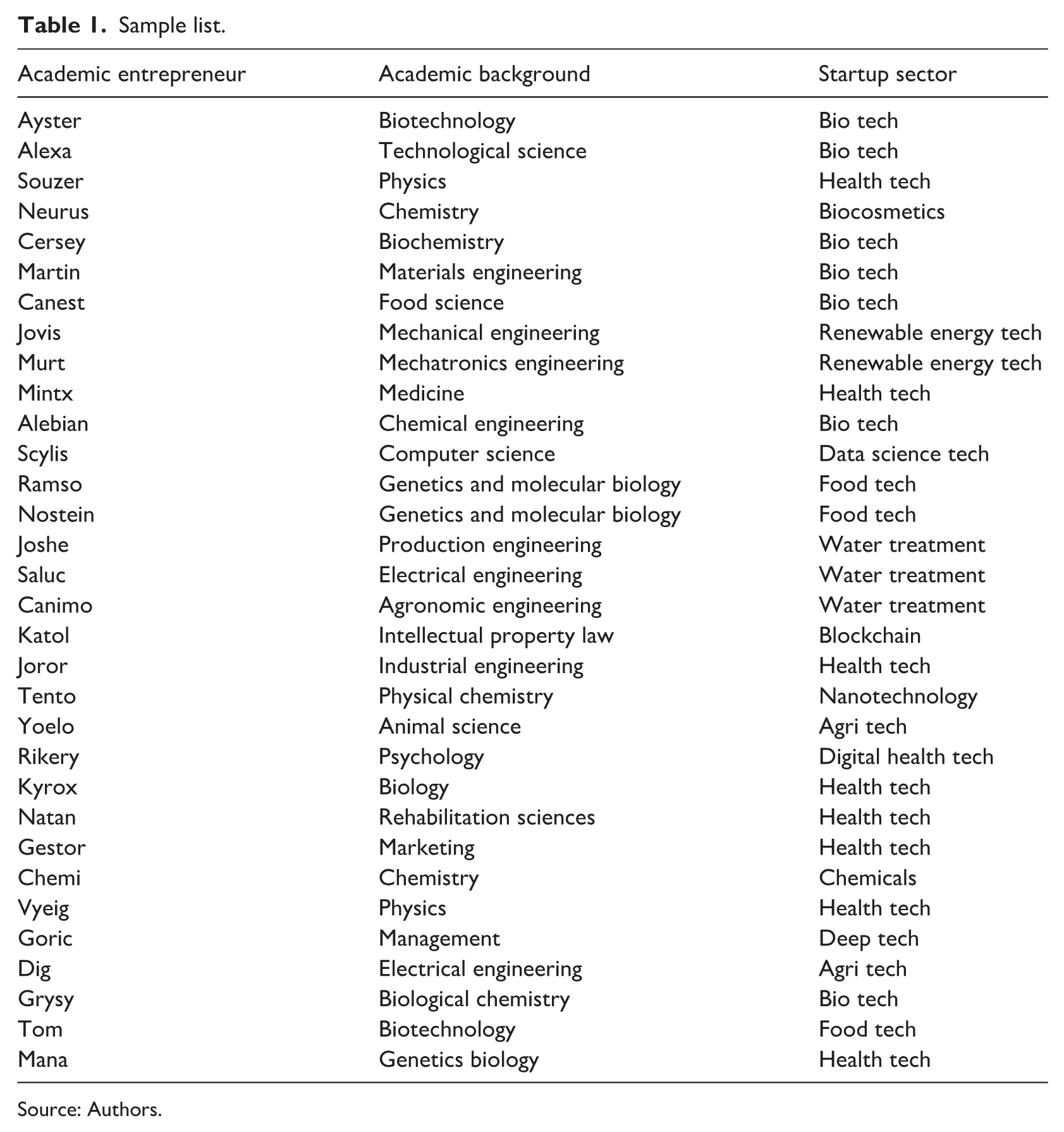
Source: Authors.
Each interview lasted approximately 60 minutes and was conducted between March 2023 and June 2024. All interviews were conducted in Portuguese by at least two researchers to enhance reliability. With participant consent, we recorded and transcribed the interviews. To translate the transcriptions into English, we used Google Translate, then Grammarly to correct spelling and improve coherence. When recording was not permitted, the interview was excluded from the dataset. To ensure confidentiality, all names used in the study are pseudonyms.
Data analysis
Our data analysis followed a Gioia-inspired approach comprising three iterative stages (Gioia, 2021; Gioia et al., 2013). In the first stage, we conducted a first-order analysis to identify significant themes and recurring expressions grounded in the language of the participant. This involved a close reading of interview transcripts and the assignment of descriptive codes to text segments through constant comparison. In the second stage, we developed second-order themes by comparing emerging patterns in the data with existing theoretical constructs. This abductive process allowed us to move between data and theory, refining our interpretations and identifying broader conceptual categories. In the third stage, we aggregated these themes into overarching dimensions, resulting in a grounded theoretical model. This process enabled us to identify patterns related to how entrepreneurs interpret contexts, adjust their actions, and manage judgment across situations.
Figure 1 presents the data structure that illustrates how first-order concepts were aggregated into second-order themes and the overarching construct, the “Entrepreneurial Judgement Cognitive Gearbox.”
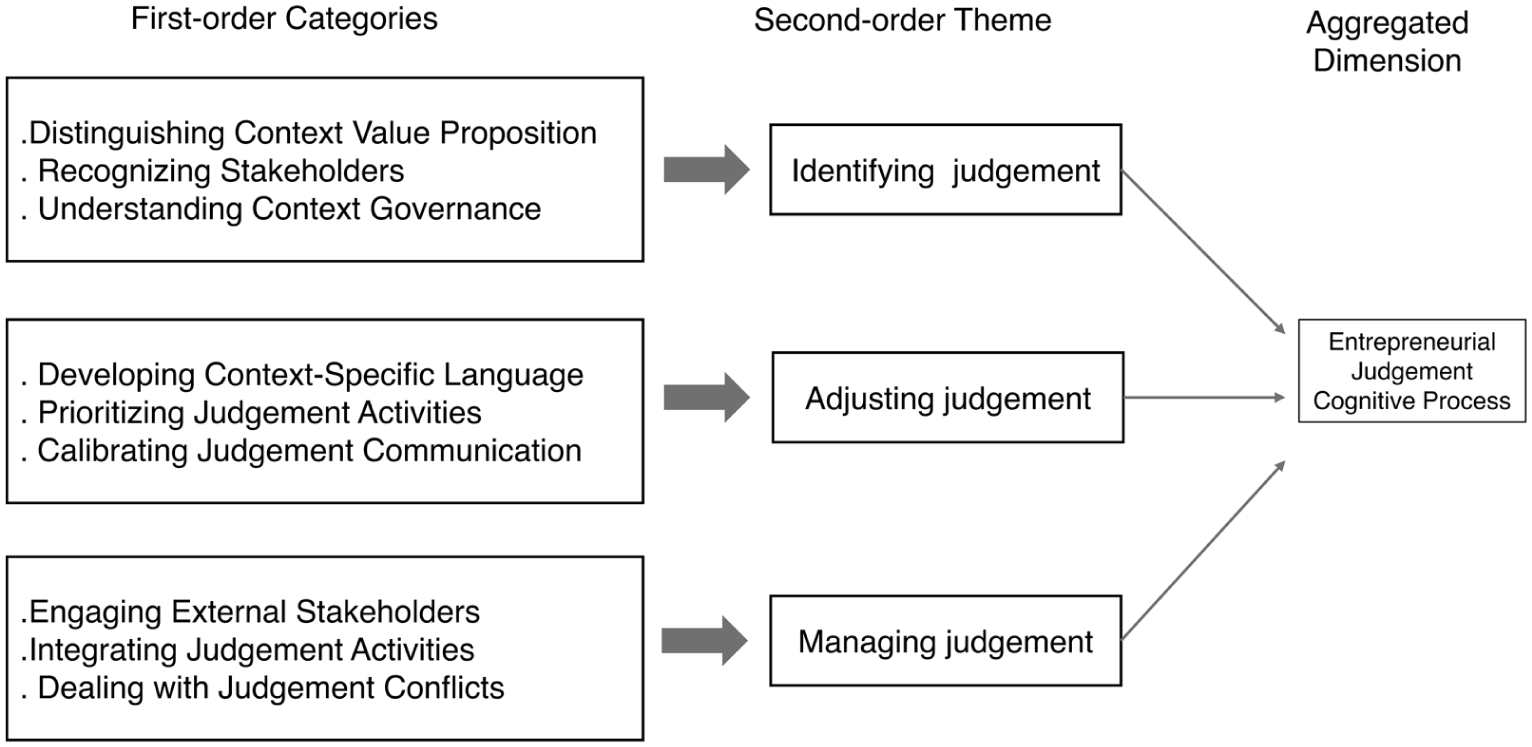
Code structure.
After the initial coding rounds, we conducted in-person and virtual meetings to review and validate the coding and emerging findings. Using axial coding logic, we identified patterns (similarities and differences) among the emerging codes and progressively reduced their number from approximately 1600 (an average of 50 per interview transcription) to 178 in the third stage of analysis (Gioia et al., 2013). At this point, our analytical focus shifted towards identifying critical moments of failure and pivoting actions, including changes in product, market, business model, partnerships, or investor relationships. We deliberately focused on these situations, as they make entrepreneurial judgment more visible. Through several rounds of discussion and refinement, we reduced the codes to nine categories, which were further consolidated into three second-order themes: identifying, adjusting, and managing judgment. These themes led to the development of the aggregated dimension, the entrepreneurial judgment cognitive process, which explains the processual framework through which academic spin-off entrepreneurs exercise judgment during venture creation and growth.
Findings
This section presents our empirical findings on how academic spin-off entrepreneurs exercise entrepreneurial judgment when creating and growing HVs. Based on our inductive qualitative analysis, we identify three mechanisms through which entrepreneurs exercise judgment: identifying judgment, adjusting judgment, and managing judgment, while pursuing both scientific and business objectives simultaneously.
Identifying judgment
Our analysis indicates that academic spin-off entrepreneurs exercise judgment across multiple contexts as they transform scientific discoveries into marketable innovations. When engaging with stakeholders in different settings and identifying the primary driver of their ventures, a market “pain” or unmet societal need, entrepreneurs rely on the identifying judgment mechanism. This mechanism explains how entrepreneurs determine whether a particular context supports or limits the exercise of their entrepreneurial judgment by distinguishing context value propositions, recognising stakeholders, and understanding context governance.
Distinguishing context value proposition
Distinguishing context value proposition refers to the entrepreneur’s recognition that each context offers a distinct source of value and requires different forms of engagement. In our sample, scientists working in academic contexts were more inclined to exercise judgment towards scientific discovery. However, when exploring the commercialisation of technology and forming entrepreneurial teams, they often engaged with stakeholders outside the academic context, most frequently investors and incubator representatives, who conveyed different expectations and value propositions. Dr. Kyrox illustrates this shift. As an experienced researcher in cancer and genetics, her early judgments were shaped by the academic knowledge ecosystem, where value was associated with knowledge creation, research funding, laboratory development, and scientific output. She explained that only when she decided to develop a drug for cancer treatment did she realise that commercialisation required a different path.
In the same way, we are looking for funding and someone who encourages research. There was a crucial moment when I understood that to turn this into a product, I needed to set up a company, establish it, and follow through.
Similarly, Dr. Vyeig described how moving from the academic to the entrepreneurial ecosystem required recognising a different value proposition. While academic projects were evaluated in terms of knowledge generation and publications, private-sector actors focused on the company’s ability to create value for clients. She emphasised that science also had economic and social value.
Every time you write a project for FAPESP, the return is not financial; the value lies in knowledge generation. The return is knowledge, relevant knowledge. Moreover, FAPESP will measure this achievement with the articles you publish. However, in the private sector, the metrics are different. You have to understand the company’s needs, and they ask, for example, what we will give our clients.
Several participants described similar realisations when confronting non-academic ways of organising innovation. Dr. Vyeig recalled attending an international symposium in the UK, where she saw for the first time that a private company could finance and enact scientific trajectories differently from research funding agencies.
Suddenly, this was a company in Ireland, and it took me a while to understand. I had such an academic bias. It was an epiphany for me. I said, “It is a business!” That was the moment the idea emerged. In parallel, I started to think about what would happen if I were to do it.
These accounts show that entrepreneurs often struggle to distinguish the value proposition of the context in which they operate. Acknowledging these differences helps them understand when academic, entrepreneurial, or market contexts require different judgments, thereby reducing the risk of judgment misfit.
Recognising stakeholders
Finding stakeholders involves the identification of the key individuals or groups of individuals with whom the entrepreneurs interact in each context. Our participants reported difficulties in identifying the stakeholders committed to creating and growing their ventures, particularly when transitioning between contexts. Dr. Natan, a physiotherapist and spin-off founder, described how understanding the market required a long learning process: “It was two years of learning and understanding this market.” Her experience demonstrates how entrepreneurs assume multiple roles across contexts. In the academic context, she acted as a scientist, researcher, and professor. In the entrepreneurial ecosystem, however, she took on managerial responsibilities and engaged with partners, investors, and employees.
Similarly, Rickery, the co-founder of a health venture, described how he and his partners mapped the stakeholders in the medical ecosystem as they developed their business. They attended dermatology conferences and interacted with physicians to better understand the actors shaping the market.
When you go to these dermatology congresses, there are stands, giants, and many pharmaceutical industries. They have many of those things to support their visits to doctors, to present the products, so I started to understand more.
Rickery’s account illustrates how direct interaction with stakeholders helps entrepreneurs understand the structure of the ecosystem in which their ventures operate. Through these encounters, entrepreneurs identify who influences the development, adoption, and commercialisation of their innovations.
In contrast, Jovis, the founder of Renewable Energy Venture, explained that he identified the relevant stakeholders in the innovation ecosystem only after a project failed due to regulatory changes.
Entrepreneurs still do not understand this, and, even worse, neither do researchers. Technology can be exciting, and it does not depend on him to make it work. It depends on the market, government, market timing, ecology, and who it is interesting to.
Across interviews, participants noted both the importance and the difficulty of identifying relevant stakeholders when navigating different contexts.Finding actors who perceive value in the venture’s solution is essential for exercising entrepreneurial judgment effectively. Failing to recognise critical stakeholders often leads entrepreneurs to make ineffective judgments when selecting partners, employees, or research collaborators; assessing potential stakeholders, therefore, becomes a key step in identifying the context in which entrepreneurial judgment must be exercised.
Understanding context governance
Understanding context governance involves entrepreneurs learning how different contexts operate and which rules govern interactions within them. When scientists decide to transform scientific discoveries into products and services, they often move from the academic environment to the entrepreneurial ecosystem, where the dynamics of decision-making and value creation differ substantially. In this new context, entrepreneurs must interact with startup founders, investors, partners, clients, and public funding agencies while navigating the expectations of universities and research institutions. Therefore, launching a spin-off requires entrepreneurs to understand how governance structures shape venture development. They must define organisational elements such as location, team structure, roles and titles, and company identity while simultaneously learning how stakeholder relationships influence decision-making. Beyond identifying stakeholders, entrepreneurs must understand how they interact and which institutional rules govern the system, the “rules of the game,” to operate effectively within it.
In academic spin-offs, these governance arrangements often include the role of universities as knowledge-originating institutions that may retain partial intellectual property rights over scientific discoveries. However, our data indicate that entrepreneurs remain the primary agents exercising judgment, as they hold decision-making authority over venture resources and are responsible for allocating, recombining, and mobilising them during venture creation and development.
Dr. Kyrox described how learning these governance dynamics took several years. She gradually came to understand how both knowledge and the entrepreneurial ecosystem structured expectations regarding research, funding, and venture leadership. One critical realisation emerged when she decided to leave the laboratory to dedicate most of her time to developing the venture, while her research colleagues chose to remain in academia. This decision required redefining governance arrangements within the venture: There were five researchers, and we always divided everything into equal parts in academia. However, when it came to looking for funding, investors were bothered by the fact that the executive (me) was there because none of them (the other researchers) wanted to give up the position they had (in the university) to be an executive at the company.
Similarly, Dr. Vyeig described how navigating different governance structures required her to adopt distinct roles across contexts. She referred to these roles as wearing two “hats”: the scientist hat when collaborating with laboratory teams and academic stakeholders, and the CEO hat when interacting with investors, consultants, and corporate partners. In the academic context, she supervises researchers and develops projects grounded in hypotheses and experimental observations, while also complying with university and funding agency regulations. In contrast, when operating in the entrepreneurial context, she must demonstrate how scientific discoveries can be translated into profitable products: I took everything I had seen in England and put together something incredible that I believed was a business case worthy of Harvard. I even created a Strengths and Weaknesses, and external Opportunities and Threats (SWOT) chart. Then I went to speak with DASH [a large clinical laboratory] . . . I met with the president of DASH’s board. There were many positive aspects (of my research project) to discuss, but at the end of the day, the businesspeople asked, “How will I use this to make money?
Although participants gradually learned the governance rules that operated across contexts, many described difficulties in acting appropriately when these rules were unclear. When entrepreneurs misinterpret governance expectations, such as leadership roles, ownership structures, or investor priorities, they risk applying judgments shaped in one context to another where they no longer fit. In these situations, entrepreneurs experience judgment misfit when navigating between academic and entrepreneurial governance systems.
Adjusting judgment
The adjusting judgment mechanism explains how entrepreneurs recalibrate their judgment in action as they move across contexts. Our analysis shows that this mechanism involves three interrelated processes: developing context-specific language, prioritising judgment activities, and calibrating the communication of judgment across stakeholders.
Developing context-specific language
Developing context-specific language refers to how entrepreneurs learn, interpret, and adapt the vocabulary, meanings, and communication norms required in different contexts. Our data show that entrepreneurs must align their language with stakeholder expectations to effectively convey their ideas and intentions. This process enables them to make sense of unfamiliar environments and supports the exercise of entrepreneurial judgment as they navigate across academic, entrepreneurial, and market settings. Gestor, a co-founder and head of marketing, illustrated how adapting language was critical when interacting with investors. He explained that engaging with the entrepreneurial ecosystem required mastering the terminology and expectations of business environments, particularly when presenting ventures to potential funders.
Once we entered the investor environment, we realised that the company and the projects needed to be presented in a language investors could understand.
His account demonstrates how the norms and dynamics of each context guide entrepreneurs in selecting appropriate language. Similarly, Dr. Natan described how learning new terminology and practices was part of navigating the “valley of death,” where ventures face high uncertainty and pressure from investors: Gestor prefers not to talk, but we have navigated the “valley of death” twice. We are currently experiencing a critical period of significant change. Investors keep asking: ‘No break-even yet?’ But we are not even five years into the business.
While some entrepreneurs struggled to learn the vocabulary of entrepreneurship, others noted emphasized the importance of developing fluency across multiple contexts. Rickery reflected on how misunderstandings of key concepts, such as the MVP, affected early decisions: It was a learning experience because, today, based on my insights, all the literature I have examined, and the examples I am familiar with, I believe we got some things right and many things wrong. One of those mistakes is our misunderstanding of the MVP, the minimum viable product, which we validated quickly and cheaply.
These experiences indicate that language is not merely a tool for communication but a means by which entrepreneurs interpret and make sense of unfamiliar environments. When entrepreneurs lack the appropriate language, they may struggle to engage stakeholders effectively. Dr. Neurus described how this difficulty created isolation when he attempted to discuss entrepreneurial ideas within an academic setting: When I began discussing entrepreneurship that way, people did not quite understand; they would change the subject, leaving me feeling like I was talking to myself. So, I mentioned that sometimes I thought the idea was good and other times not, because I had no one to engage with when I spoke alone, which made it very difficult.
Through interviews, participants emphasised that even when entrepreneurs attempt to adapt their communication, difficulties persist when stakeholders cannot attribute meaning to new ideas. Developing context-specific language, therefore, enables entrepreneurs to align their communication with stakeholder expectations and reduces the risk of misinterpretation when exercising entrepreneurial judgment across contexts.
Prioritising judgment activities
Prioritising judgment activities refers to how entrepreneurs select and focus on the most critical actions when allocating their time, attention, and resources across different contexts. Our data indicate that entrepreneurs must continually decide which activities are most relevant to advancing their ventures, particularly when balancing technical, commercial, and organizational demands. Dr. Vyeig illustrated how prioritisation evolves as ventures grow and require engagement with different stakeholders. She described how certain activities, such as communicating with international pharmaceutical companies, become central, while others require more selective attention: I now have experience communicating with American pharmaceutical companies within the organisation. Other tasks, such as visiting LinkedIn and sending a message, require careful consideration.
Her account shows how entrepreneurs develop the ability to align their responsibilities based on strategic relevance. Similarly, Dr. Murt and Dr. Jovis explained how they divide and prioritise activities within their venture, according decision-making responsibilities with their respective expertise: For example, strategic decisions about the company’s direction are more in Jovis’s hands. I am here to help. However, I am most responsible for decisions regarding technical project issues. I have the biggest responsibility for this. He helps me. So, we complement each other: he seeks external partnerships, while I focus more on the operational side.
This division of roles reflects how entrepreneurs prioritise activities not only individually but also collectively, structuring decision-making processes within the venture.
In contrast, Dr. Tento described how prioritisation became clearer as he transitioned from academia to an industry-oriented role. By positioning himself as responsible for research and development activities, he focused on tasks that directly generated value for the company, while delegating administrative responsibilities to his partner: What adds value to us and generates value in the company is development. It is my intellectual work. So, what happens? My partner manages everything; let me explain. She hires people who do all the legal work. I do the more analytical part.
These accounts highlight that prioritising judgment activities reflects the ability to identify which actions are most critical at different stages of venture development. By focusing on activities that generate value and delegating or postponing others, entrepreneurs are able to exercise entrepreneurial judgment more effectively across contexts.
Calibrating judgment communicability
Calibrating judgment communicability refers to how entrepreneurs adapt the way they frame, translate, and communicate judgment to the expectations, language, and evaluative criteria of different stakeholders across contexts. Rather than merely adjusting vocabulary, this process involves strategically framing value propositions to resonate with distinct audiences while preserving the venture’s core intent.
Our data show that entrepreneurs continually adjust how they present the same underlying idea depending on whom they address. Dr. Vyeig illustrated how she reframed her narrative when engaging with different stakeholders, particularly when shifting from academic to market-oriented contexts: I am talking about the generic diversity of the Brazilian population. Then you must find some hooks and baits to get the person to give you (her time and money). Instead of talking about inequality, you talk about innovation and opportunity. The same thing happened when talking to investors and big farms. I took off my academic hat and told that same story. I said it like this: Look how valuable it is.
Her account demonstrates how entrepreneurs actively translate scientific or social issues into economically meaningful narratives, aligning their communication with stakeholder expectations. As her experience evolved, she became more confident in navigating these shifts across contexts. She further explained how she adapted her communication when engaging with academic partners: I remember turning to them [academic partners] and saying everything. I said, “Guys, I need to explain what I have in mind.” It was my first time presenting it to them, and I said, “Oh my God!”
While experienced entrepreneurs develop this ability over time, our data also highlight that calibrating communicability is difficult and often learned through trial and error. Dr. Tento highlighted the importance of speaking in terms that match stakeholder expectations when interacting with public funding agencies: I do not ask FAPESP (for huge money). I just asked for an analysis, something simple. It is very important to me that the project receives FAPESP’s seal of approval. That is, if the project is formally accepted and endorsed by FAPESP, I can present it as a promising business case.
However, failures in calibrating communicability can lead to significant consequences. Dr. Jovis described how misalignment between communication and stakeholder needs almost resulted in losing a client: It went from an overly complex idea to something surprisingly simple. It was a piece of cake to make.
In this case, the entrepreneur initially failed to interpret and communicate in line with the client’s expectations, instead attempting to impose a more complex solution than required.
These accounts show that calibrating the communicability of judgment is a critical mechanism by which entrepreneurs align judgment with stakeholder interpretations. By tuning how value is framed and communicated, entrepreneurs reduce misunderstandings, avoid misfit between expectations and actions, and enhance their ability to exercise entrepreneurial judgment effectively across contexts.
Managing judgment
Managing judgment refers to how entrepreneurs coordinate and sustain judgment across multiple contexts as ventures evolve. This mechanism involves integrating judgment activities, resolving judgment conflicts, and coordinating engagement with external stakeholders, enabling entrepreneurs to sustain alignment across decisions, stakeholders, and contexts over time. In this sense, managing judgment captures how entrepreneurs coordinate their decisions as they unfold, allowing them to navigate uncertainty and respond to emerging outcomes.
Integrating judgment activities
Integrating judgment activities refers to how entrepreneurs combine and align decisions made across different contexts to support venture development. Rather than treating contexts as separate domains, entrepreneurs must continuously connect scientific, entrepreneurial, and market-oriented activities, integrating distinct temporalities, priorities, and resource demands. Our data show that entrepreneurs make decisions aimed at different objectives, such as advancing scientific research, scaling the venture, or developing production and commercialisation capabilities, but must integrate these efforts to sustain growth. As judgment unfolds across contexts, entrepreneurs blend these elements without abandoning prior commitments, maintaining continuity between past, present, and future actions.
Participants acknowledged that they could detach from the academic context, as scientific and technological development remains the foundation of venture sustainability. For example, Dr. Neurus explained how he integrates decisions across funding and production contexts to reduce bottlenecks and enable growth: We cannot use PIPE for the factory. PIPE is always related to (funding) research, and FAPESP prohibits (any funding) applications for production. We must access Brazilian Funding Authority for Studies and Projects (FINEP), Brazilian Development Bank (BNDES), and other sources for this part of the production process.
His account demonstrates how integrating judgment involves enacting different institutional resources across contexts. Similarly, Dr. Vyeig described how she selected partners according to each stage of the venture’s development: I spent almost a year waiting, and then I said, “I think the best model is the following: I will start this without them, and when they decide what they want, they will buy from me.” Just like that, I replicated a big company’s model.
Dr. Jovis further illustrated how integration involves structuring the venture to accommodate both technical and commercial demands: I am a mechanical engineer, but I structured the startup as a company. All companies work by taking money from one side and putting it on the other side.
In contrast, Dr. Natan demonstrated an alternative path, integrating personal and professional resources by relying on family investment and internal talent to support venture growth.
My family was my first investor. We all changed our minds, but we signed a contract saying that they would be free after five years if the company did not have a return. I have another partner, one of my interns (students). He stood out during the company’s growth and has 3% (of the shares).
These accounts show that integrating judgment activities enables entrepreneurs to connect decisions across contexts without abandoning prior ones. By so doing, they maintain continuity as they transition between contexts, effectively coordinating the venture’s evolution over time.
Dealing with judgment conflicts
Dealing with judgment conflicts involves how entrepreneurs recognise, navigate, and resolve conflicts arising from differing demands across contexts. As HVs evolve, entrepreneurs must prioritise scientific, commercial, and operational demands under conditions where not all objectives can be addressed simultaneously. Our data show that entrepreneurs rely on different approaches to judgment to cope with these conflicts. In the academic context, participants are accustomed to dealing with uncertainty and failure as part of the scientific method. Dr. Kyrox illustrated how she systematically prepares for multiple scenarios when making decisions: If that does not work, I will go with B or C. I have constant feedback and the humility to listen to people from other specialties. So, what I know very well is what I do not know.
Her account highlights how scientific training equips entrepreneurs with approaches to handle uncertainty. However, participants found that managing conflict becomes more challenging when transitioning to entrepreneurial and innovation contexts, where outcomes carry financial and operational consequences and errors are not tolerated.
Dr. Tento described the difficulties of scaling production and managing larger financial commitments: A bigger challenge was getting the money to buy more equipment, start producing, and finance the research’s scalability. The reality is different.
To address these challenges, he and his partner redefined roles within the venture, separating scientific and business responsibilities to reduce misalignment in decision-making: I do not know anything about the company, so I do not worry about that. My partner, who is a lawyer, makes these decisions. For her, it was an opportunity. So, let us make a deal here. You manage and interface with the business world. I will stay in science.
In other cases, entrepreneurs resolve conflicts by identifying feasible solutions under resource constraints. Dr. Ramso illustrated how he and his partners addressed operational limitations by relocating their activities to an existing facility: We could no longer stay at the University and did not have the resources to rent ample space to store the equipment. So, we found a Startup that was closing. It was no longer in use; no employees remained, and they had a large equipment park. So we went to that place, saw the laboratory, and rented it. We moved during the pandemic.
These accounts show that dealing with judgment conflicts involves managing simultaneous demands, redistributing responsibilities, and identifying workable solutions across contexts. By so doing, entrepreneurs translate conflicting demands into actionable decisions, which can either constrain or enable the sustainability and growth of their ventures.
Engaging with external stakeholders
Engaging with external stakeholders refers to how entrepreneurs interact with and learn from actors outside their immediate operating context to inform and validate their judgments. Through these interactions, entrepreneurs access external perspectives that help them evaluate whether their ideas address relevant problems and create value. Our data show that entrepreneurs rely on external stakeholders to ground their ventures in real-world demands. Participants consistently stated that their ventures must “solve real problems” and “address a societal need.” Dr. Canest illustrated this by highlighting the importance of aligning solutions with stakeholder needs: We must consider the pain of the market, suppliers, and customers. There is no point in harping on about something that will not happen.
His account shows that external stakeholders play a critical role in shaping how entrepreneurs interpret value and refine their judgment. Because these stakeholders are not embedded in the venture, they provide more objective assessments of whether a solution is meaningful or viable.
Similarly, Rickery described how engaging with external actors helped him better understand customer needs and market expectations: What did I learn from them? There is a system for identifying who the client is, what the client’s pain is, and what is offered.
These interactions enabled entrepreneurs to move beyond internally driven assumptions and align their actions with external demands.
Our data further indicate that the composition of external stakeholders varies across ecosystems. Specifically, we identify the key external stakeholders associated with each context. In the knowledge ecosystem, entrepreneurs engage with investors, corporations, and industry actors as external stakeholders who inform applied research. In the entrepreneurial ecosystem, external stakeholders include society and scientific communities that shape the direction of ventures. In the innovation ecosystem, entrepreneurs engage with scientists and other entrepreneurs as external stakeholders who support experimentation and venture development. This mapping highlights how the sources of external validation differ across contexts. These accounts show that engaging with external stakeholders enables entrepreneurs to continuously validate and refine judgment. By incorporating external feedback, they increase the likelihood that their ventures address meaningful problems and sustain growth across contexts.
Discussion
Theoretical framework proposal: The entrepreneurial judgment cognitive process
Building on our analysis, we propose a framework that explains how entrepreneurs in HVs (e.g., academic spin-offs) exercise entrepreneurial judgment across contexts while simultaneously pursuing both economic and non-economic objectives (Figure 2). The framework conceptualises entrepreneurial judgment as a dynamic, iterative process comprising three interdependent mechanisms: identifying, adjusting, and managing judgment. Rather than operating as a linear sequence, these mechanisms are continuously reconfigured as entrepreneurs move across different contexts and engage with diverse stakeholders. Through this process, entrepreneurs allocate resources, interpret signals, and make decisions under conditions of uncertainty, balancing scientific and business objectives. The model positions entrepreneurial judgment as an evolving action that is constantly recalibrated through learning, feedback, and adaptation. By iteratively engaging in these mechanisms, entrepreneurs enhance their ability to navigate residual uncertainty and to transform scientific knowledge into sustainable innovation.
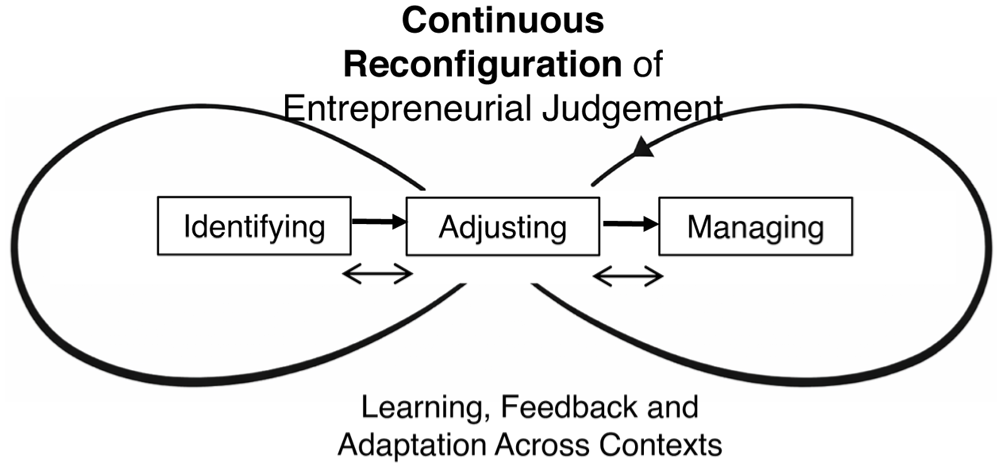
The entrepreneurial judgment cognitive process: iterative across contexts.
We illustrate how these mechanisms operate through the trajectory of a HV entrepreneur developing a cancer treatment solution, based on the empirical case of Dr. Vyrus, whose transition from PhD researcher to CEO of a venture in cancer treatment exemplifies the dynamic exercise of entrepreneurial judgment across contexts. To launch the venture, the entrepreneur sought financial resources to support scientific research. Her initial judgment activities involved formulating a research hypothesis and securing funding, thereby activating the identifying judgment mechanism. At this stage, she distinguished the context’s value proposition, noting that research funding agencies provide non-dilutive grants aimed at generating scientific and societal impact. She identified key stakeholders, including professors, students, and agency representatives, and developed an understanding of the governance structures that shape funding decisions. This enabled her to craft a research proposal aligned with institutional expectations.
To align stakeholder expectations, the entrepreneur adjusted her judgment. She developed context-specific language to communicate effectively with academic and funding stakeholders, calibrating her communication to match their evaluation criteria. Misalignment emerged, for example, when she initially requested salary funding instead of scholarships to recruit students as employees. This resulted in a judgment misfit, requiring her to reconfigure her approach. At this stage, she focused upon key activities, such as structuring the research team, securing laboratory space, and defining a research agenda aligned with grant requirements. As the venture progressed toward execution and scaling, she activated the managing judgment mechanism. She engaged stakeholders, including customers, suppliers, and investors, to validate the value of her research and the integration of activities across contexts. This involved aligning scientific development with operational, financial, and commercial functions to ensure that research investments were translated into marketable outcomes. At this stage, she assumed the role of CEO and faced conflicts arising from misaligned stakeholder expectations across contexts. Importantly, the outcomes of her entrepreneurial efforts extended beyond commercial performance. The venture culminated in protocols for developing a cancer vaccine in Brazil, reflecting the entrepreneur’s deliberate choice to focus primarly upon national scientific and societal impact. Despite having the opportunity to pursue international patenting and commercialisation, she chose to retain the intellectual property in Brazil, ensuring that the benefits of the innovation would primarily serve Brazilian patients and institutions.
This decision illustrates how entrepreneurial judgment in HVs entails pursuing both economic and non-economic objectives simultaneously. Rather than reflecting competing institutional logics, this choice reveals the entrepreneur’s subjective valuation of alternative courses of action, in which financial returns are balanced against what the judgment-based approach conceptualises as psychic profit, derived from contributing to societal and scientific advancement. Our framework highlights that entrepreneurial judgment in HVs is inherently dynamic and context-dependent. Entrepreneurs continuously move across contexts, iteratively reconfiguring judgment as they encounter feedback, misalignments, and new opportunities. When judgment misfit occurs, entrepreneurs step back to reassess contextual conditions and realign their actions. The three mechanisms, identifying, adjusting, and managing judgment, operate as an interconnected system that enables entrepreneurs to navigate uncertainty across contexts. By engaging in this iterative process, HV entrepreneurs balance simultaneous scientific and business objectives to sustain venture growth over time.
Theoretical and practical implications
This article contributes to the growing body of research on hybrid organisations and entrepreneurial judgment (Hahn et al., 2025; Foss and Klein, 2012, 2015; Foss et al., 2025, 2026) by explaining how entrepreneurs exercise judgment in the pursuit of simultaneous dual objectives across contexts and interact with diverse stakeholders throughout the venture lifecycle. Our findings show that HV entrepreneurs actively govern stakeholder relationships by continuously recalibrating their actions as they transition across contexts, sustaining both organizational value and stakeholder benefits. In so doing, we respond to Bosse et al.’s (2023) call by clarifying how responsibility-taking is exercised through entrepreneurial judgment in HVs.
Our analysis further demonstrates that entrepreneurial judgment is shaped by how entrepreneurs interpret contextual characteristics, which may be perceived as enabling or constraining action. Building on this insight, we develop a processual framework, framed as a cognitive process, composed of three interdependent mechanisms, identifying, adjusting, and managing judgment, that enable entrepreneurs to navigate transitions across contexts. Rather than representing a mechanical system, the framework captures a dynamic and iterative process through which entrepreneurs continuously reconfigure their judgment across contexts. In this sense, our framework can be understood as a refinement of the BAR model (Foss and Klein, 2020), specifying the mechanisms through which beliefs, actions, and results are practiced. It highlights the exercised, situated, and temporal nature of judgment (McMullen, 2015; Packard et al., 2017), showing that judgment is not merely cognitive but deeply embedded in entrepreneurial action and resource mobilisation (Foss et al., 2025; Packard and Bylund, 2025). In this sense, our framework advances two core premises of entrepreneurial judgment: subjectivity and uncertainty. First, we show that entrepreneurial action is shaped by the entrepreneur’s subjective interpretation of contexts, stakeholders, and opportunities. Second, we demonstrate how Knightian uncertainty, understood as the inability to predict outcomes (Foss and Klein, 2012), is addressed through judgment in action. Rather than reducing uncertainty ex ante, entrepreneurs develop context-specific understanding and stakeholder awareness that allow them to act despite it. In so doing, we offer a more fine-grained account of how judgment unfolds in practice and extend research on the exercise of different forms of judgment (Rapp and Olbrich, 2023).
Our central theoretical contribution is to show that entrepreneurial action under Knightian uncertainty enables HV entrepreneurs to actively shape their trajectories across contexts. Instead of waiting for uncertainty to resolve, entrepreneurs engage in iterative, experimental actions that generate new information and continuously refine judgments (McMullen and Shepherd, 2006). These actions allow them not only to allocate resources but also to decide when and how to move across contexts while engaging stakeholders appropriately (Bosse et al., 2023; Dorobat et al., 2024). In the context of academic spin-offs, entrepreneurs aim to create value for both scientific and business stakeholders. Our findings show that entrepreneurs interpret different contexts, delineated by distinct stakeholders, structures, and expectations, and act upon them accordingly (Dorobat et al., 2024). These contextual interpretations interact with entrepreneurial judgment, shaping how entrepreneurs assess feasibility and desirability as they transition across contexts.
From a practical perspective, our framework highlights the role of entrepreneurial responsibility in guiding action. By conceptualising judgment as a cognitive process, we illustrate how entrepreneurs can develop and refine mechanisms for identifying, adjusting, and managing their decisions across contexts. In so doing, we reveal that entrepreneurs exercise judgment to transform scientific knowledge into innovation and societal value. Through this process, they allocate resources, engage stakeholders, and remain accountable for the consequences of their decisions (Foss et al., 2007, 2026). Ultimately, our framework highlights how responsible entrepreneurial action supports the translation of science into sustainable innovation.
Limitations and final considerations
This article explains how HV entrepreneurs exercise entrepreneurial judgment to create and grow ventures as they transition across various contexts, using three main mechanisms: identifying, adjusting, and managing judgment. Despite contributing to research on entrepreneurial judgment and HVs, this study has limitations that open avenues for future research. Our analysis does not focus on a single industry or technological domain. Although this broad scope enhances the analytical generalisability of our framework, it may overlook industry-specific dynamics. For instance, academic spin-offs in biotechnology and energy technology often differ in terms of technological maturity, development timelines, and regulatory constraints, which may shape how judgment is exercised across contexts. Also, our sample includes entrepreneurs with diverse educational backgrounds, experiences, and behavioural orientations. While this heterogeneity strengthens the robustness of our findings, future research could examine how individual-level differences influence the enactment of entrepreneurial judgment. Future research may extend our framework by examining its applicability across different types of HVs and institutional settings, and by employing longitudinal and quantitative designs to further assess its explanatory power. In so doing, scholars can advance understanding of how entrepreneurial judgment evolves across contexts and over time.
Footnotes

Funding
The authors disclosed receipt of the following financial support for the research, authorship, and/or publication of this article: This work was supported by the National Council for Scientific and Technological Development (CNPq-Brazil) under Grant 420767/2022-3.
Declaration of conflicting interests
The authors declared no potential conflicts of interest with respect to the research, authorship, and/or publication of this article.