






Abstract
While the value of a founder’s emotional support is widely acknowledged, its impact on new venture performance remains underexplored. Advancing a culturally embedded view, we draw on East Asian contexts where emotional support from family and friends is culturally salient to propose that such support drives firm performance through the mechanism of relational indebtedness. Building on the optimal matching model, we construct a context-sensitive need-support-fit framework, examining how this relationship is moderated by support demand intensity and substitution availability, shaped by face logic. Using survey data from 2747 new ventures in China, Japan and South Korea, we find that emotional support is positively associated with new venture performance. This association is stronger for female and older founders, but weaker for founders with more leadership experience or incubator affiliation. This study advances entrepreneurship literature by revealing the firm-level impact of emotional support and the key contextual boundary conditions that shape its role.
Introduction
Emotional support, manifested as encouragement, empathy, listening and affirmation (Cohen and Wills, 1985), presents a complex theoretical landscape in entrepreneurship research. Most studies highlight its benefits in helping entrepreneurs cope with stress (Cohen and Wills, 1985; Hobfoll et al., 1990), and strengthen commitment (Treffers et al., 2019) and persistence (Klyver et al., 2018). Some studies, however, document negative effects, including added emotional burdens (Gudmunson et al., 2009; Hobfoll et al., 1990) and work–family tensions (Greenhaus and Beutell, 1985; Gudmunson et al., 2009). These inconsistent findings have motivated recent work that examines when and for whom emotional support is helpful, revealing multiple boundary conditions such as founder gender (Welsh et al., 2021), life stage and timing of support (Klyver et al., 2018), social skills involved in relational interaction (Nielsen and Klyver, 2020) and the alignment of role-relations between providers and recipients (Klyver et al., 2020). By comparison, much less is known about the effect of the emotional support afforded to founders upon firm-level outcomes. As the primary decision-maker, the founder exerts significant influence on new venture strategy and outcomes. Unlike established organisations that are buffered by bureaucratic structures, nascent ventures largely reflect the founder’s cognitive and motivational states (Baum and Locke, 2004; Cardon et al., 2009; Mathias et al., 2015). Emotional support that helps sustain founder commitment is therefore, likely to shape firm behaviour and performance. However, most extant studies stop at the individual level and do not consider such firm-level implications. The limited evidence shows that the impact of emotional support on new ventures is unlikely to be uniformly positive. Specifically, over-reliance on family ties can lead to over-embeddedness, constraining strategic adaptability (Arregle et al., 2015). This pattern mirrors broader findings that individual-level psychological drivers do not always produce positive organisational outcomes (Baron, 2008) and often exhibit a curvilinear relationship with firm performance (Hmieleski and Baron, 2009). These insights highlight the need to identify specific boundary conditions under which emotional support enhances or impedes new venture outcomes.
In this study, we adopt a two-step approach to address two interrelated research questions: (i) what is the overall effect of the emotional support given to founders on new venture performance and (ii) under what conditions is this relationship strengthened or weakened?
Given that the impact of emotional support at the firm level remains unclear, we begin by specifying the source of emotional support and the cultural environment in which it occurs. Founders can draw on emotional support from various sources (Klyver et al., 2020); we focus on emotional support from strong ties; that is, from family and friends (Granovetter, 1973), which prior studies identify as the most prevalent sources (Edelman et al., 2016; Nielsen and Klyver, 2020; Xu et al., 2020). We further situate this study in the East Asian context (China, Japan and South Korea), where Confucian relational norms emphasise a differential mode of association (Fei et al., 1992; Kim, 2010; Rozman, 1991). In this cultural context, face logic serves as a gatekeeping mechanism that discourages public expressions of vulnerability (Hwang, 1987). Consequently, founders are highly selective in their support-seeking, turning primarily and often exclusively to an inner circle of family members and close friends for deep emotional support. Within this inner circle, such support is interpreted not merely as personal comfort, but as an emotional “favour” (Luo, 2011) that generates strong reciprocity expectations (Hwang, 1987; Hitokoto, 2016; Shen et al., 2011). This culturally rooted sense of indebtedness motivates founders to exert greater effort to repay the support (Peng et al., 2018; Xu et al., 2020), transforming emotional support into a performance-enhancing force (Su et al., 2023). Drawing on the main effect model of social support (Thoits, 2011; Viswesvaran et al., 1999), we hypothesise a positive baseline relationship between emotional support from family and friends and new venture performance in the East Asian context.
To examine contingencies, we apply the optimal matching model from social support theory (Cohen and Wills, 1985; Cutrona, 1990). This argues that support effectiveness depends not only on its availability, but also on its fit with the recipients’ specific stressors and needs. Building on this logic, we construct a context-sensitive need-support-fit framework that integrates the previously isolated and fragmented contingencies into two core dimensions: (i) support demand intensity; that is, the level of emotional stress and psychological strain the founder faces (Bakker and Demerouti, 2007; House, 1981), reflected in factors such as founders’ gender and age; and (ii) substitution availability; that is, access to alternative resources of support (Cohen and Wills, 1985; House, 1981), including a founder’s leadership experience, access to external finance, and incubator affiliation. The positive effect of emotional support is expected to be stronger when demand intensity is high and when substitution availability is limited. Using survey data from 2747 new ventures across China, Japan and South Korea, we find support for our hypotheses. Our results reveal that, overall, emotional support given to founders from family and friends is positively associated with new venture performance. This relationship is stronger when founders face heightened demand intensity, such as for female founders who experience additional gender stressors, and for older founders whose unspoken need for support becomes more pronounced once being met. The relationship is weaker when substitution availability is higher among more experienced founders and for those affiliated with incubators that offer alternative support.
This article makes three theoretical contributions. First, it advances emotional support research by leveraging the East Asian context as a theoretically generative setting, where the culturally induced structural selectivity of face logic enables us to precisely isolate how strong-tie emotional support translates into new venture performance. Second, it advances the literature by introducing relational indebtedness as a culturally embedded mechanism that bridges a founder’s emotional support and firm-level outcomes. Third, by integrating demand intensity and substitution availability within the cultural face-saving logic, it identifies important boundary conditions, offering a unified understanding of when and for whom emotional support most effectively enhances new venture performance. Overall, the study advances a culturally embedded view of entrepreneurship by demonstrating how macro-cultural norms transform micro-psychological support into tangible new venture performance.
Theoretical background
Founders’ emotional support
In entrepreneurship studies, researchers have sought to identify the factors driving new venture performance (Chrisman et al., 1998; Dencker and Gruber, 2015; Soto-Simeone et al., 2020). The importance of the social dimension to the entrepreneurial process has long been acknowledged (Bacq et al., 2022; Brüderl and Preisendörfer, 1998; Penrose, 1959). By framing entrepreneurship as a dynamic process embedded within the entrepreneur’s social, cultural, political and economic environment (Uzzi, 1997), studies have predominantly focused on the significance of social capital derived from their social networks (Jack et al., 2008; Lans et al., 2015) and social ties (Ma et al., 2018; Pruthi, 2014) as a pivotal antecedent of entrepreneurial outcomes, leaving the role of social support largely underexplored. Social support refers to the emotional encouragement, informational guidance and instrumental assistance that individuals receive through their social relationships (House, 1981). Such support does not emerge in a vacuum; it is derived from an embedded process through substantive social relations, such as the trust and intimacy found in strong ties.
While different aspects of social support are potentially valuable, emotional support is particularly important for new venture founders. Founders frequently struggle with self-doubt, fear of failure and social pressure, that practical guidance or financial resources alone cannot alleviate (Stephan, 2018; Wiklund et al., 2019). In these moments, emotional support affirms personal worth and provides empathy, enhancing entrepreneurial passion, resilience, and self-efficacy (Huang et al., 2024; Stenholm and Nielsen, 2019). Such psychological strength is vital in early-stage new ventures, where uncertainty is high and feedback is often ambiguous or negative (Klyver et al., 2018).
Emotional support offered by family and friends
Founders may draw upon emotional support from various sources, including family members, close friends and business contacts (Klyver et al., 2020). The effectiveness of such support is determined not only by the level of support received but also by its alignment with role-based cultural expectations; that is, what founders receive relative to what they expect (Klyver et al., 2020). For example, founders may expect unconditional acceptance and care from their family, mutual encouragement from friends, and pragmatic, interest-based interactions from business associates. When support aligns with these role-specific norms, it generates positive emotional reactions. In contrast, misalignment, such as critical judgement from a family member or an unexpected emotional reassurance from a businessperson, can raise disappointment or irritation, thereby diminishing its benefits. This highlights the distinct roles of family and friends as the primary and most normatively appropriate sources of emotional support in entrepreneurship (Edelman et al., 2016; Nielsen and Klyver, 2020; Xu et al., 2020).
Emotional support for founders from family and friends in the East Asian context
The seeking, provision and outcomes of emotional support are deeply shaped by cultural context (Kim et al., 2008; Taylor et al., 2004). Cultural norms influence both the legitimacy of expressing psychological distress and the reciprocal obligations embedded in social exchanges (Ishii and Eisen, 2016; Miller et al., 2017). In entrepreneurship, these cultural forces determine not only to whom founders turn for support, but also how that support is interpreted and mobilised in the pursuit of entrepreneurial goals. Prior research conducted primarily in Western contexts has documented that emotional support is often sought from a broad range of ties comprising mentors, colleagues, and acquaintances (Kim et al., 2008; Klyver et al., 2020) and is characterised by being relatively voluntary with more flexible expectations of reciprocity (Hitokoto, 2016; Kim et al., 2008; Taylor et al., 2004). Extant studies have increasingly recognised the reciprocal nature of social support (Chen et al., 2021; Maier et al., 2015). However, these dynamics operate with greater intensity and cultural centrality in collectivistic Confucian-influenced East Asian societies. Here, founders tend to be highly selective in their support-seeking, prioritising family and close friends while largely avoiding non-intimate professional or business contacts. This selectivity stems from two interlocking cultural logics: face and relational indebtedness.
The cultural logic of face, that is, an individual’s public self-image, social prestige and moral integrity (Ho, 1976; Hu, 1944;), strongly discourages open expressions of anxiety or distress toward outer-circle relations (Fei et al., 1992). Maintaining face is essential to preserve relational harmony and social legitimacy (Hwang, 1987; Yang, 2016). In entrepreneurial contexts marked by high uncertainty and the risk of failure, business setbacks are viewed not only as commercial challenges, but also as threats to personal honour (‘face’), particularly in East Asia where business failure carries greater social stigma than in Western societies (Begley and Tan, 2001; Chua and Bedford, 2015). Consequently, founders avoid confiding in relationships governed by performance expectations and public scrutiny, for example, from investors or industry peers, to prevent being seen as incompetent or unreliable (Chua and Bedford, 2015). Instead, they turn to their inner circle of family and friends governed by high trust, long-term loyalty, and unconditional regard (Fei et al., 1992). Within this close-knit circle, emotional vulnerability is socially accepted because support is decoupled from business outcomes. However, even within these close ties, emotional support is not purely gratuitous. It is embedded in the cultural logic of relational indebtedness, a core principle of guanxi (interpersonal networks) that frames interpersonal exchange within a moral economy of reciprocity (Hwang, 1987; Yang, 2016). Acts of emotional support, such as encouragement, empathy, or affirmation, generate a binding sense of obligation to reciprocate (Barbalet, 2017; Hitokoto, 2016; Xu et al., 2020). This obligation, which is rooted in deep-seated loyalty to inner circle members, transforms emotional support into a powerful motivational force that compels founders to exert greater effort so as to repay the debt.
Impacts of emotional support from family and friends: Main effect versus buffering effect
The culturally distinctive relational structure and norms in East Asia suggest that emotional support from family and friends may operate through particular mechanisms that are more salient than those typically emphasised in Western entrepreneurship research. Originally, the main effect model of social support was developed in Western contexts (Cohen and Wills, 1985; Viswesvaran et al., 1999;) where studies have examined how main-effect and buffering mechanisms operate interdependently in everyday activities (Cogan et al., 2022). However, it is the buffering hypothesis that has remained the dominant explanatory framework in much of this literature (Klyver et al., 2018; Powell and Eddleston, 2017). In this framing, emotional support from close others is often conceptualised as a protective buffer activated primarily under high stress: when founders encounter failure, pressure or burnout, understanding and acceptance from close others help to restore emotional energy, alleviate anxiety and preserve mental health (Bowlby, 1988; Shepherd, 2003). This enables founders to persist through adversity (Klyver et al., 2018), continue entrepreneurial action (Cogan et al., 2022; Edelman et al., 2016) and sustain commitment (Treffers et al., 2019). In many Western contexts, such support is also typically offered with flexible expectations of repayment, and entrepreneurial failure tends to be viewed more as an individual learning experience rather than a collective moral failure (Powell and Eddleston, 2013; Jaskiewicz et al., 2015). The Confucian-influenced East Asian context makes the main effect mechanism particularly salient. Here, emotional support from family and close friends is frequently interpreted through the lens of favour-giving and relational indebtedness (Barbalet, 2017; Xu et al., 2020). Acts of encouragement, empathy or affirmation generate a binding moral obligation to reciprocate. This culturally rooted reciprocity transforms emotional support into a continuous motivational driver, even in the absence of an acute crisis, that aligns closely with the main effect model of social support (Thoits, 2011; Viswesvaran et al., 1999). By making explicit the normative obligations and motivational force embedded in strong-tie emotional support, the East Asian context provides significant theoretical clarity to these mechanisms, with broader implications for social support theory beyond cultural boundaries.
Optimal matching model
Recent advancements in social psychology research emphasise a contingency-based perspective known as the optimal matching model, also referred to as the matching hypothesis. The core tenet of this model is that the effectiveness of support is not determined solely by its availability or quantity, but by the degree of fit between the type of support provided and the recipient’s specific needs, or the demands of the stressor (Cutrona, 1990). As Cohen and Wills (1985) articulate, the benefits of support are maximised only when there is a precise match between the support dimensions and the specific demands of the situation. For example, emotional support is particularly effective for addressing uncontrollable, emotion-focused stressors for example, loss or chronic uncertainty, whereas instrumental or informational support better suits controllable, problem-focused challenges. A mismatch in support type, intensity or timing may render the support ineffective or even counterproductive. Although the optimal matching model has been successfully applied to explain outcomes in high-stakes environments such as organisational change (Schlicher et al., 2022), elite sports (Balk et al., 2020) and medical crisis (Merluzzi et al., 2016), it remains under-theorised in the entrepreneurship literature. Entrepreneurship, with its chronic uncertainty, high emotional demands and evolving stressor types, constitutes a particularly relevant context for applying this framework. Recently, Klyver et al. (2020) implicitly highlight the importance of the fit between need and support by emphasising the alignment between support type and role-based cultural expectations. Following their work, we make this idea explicit by proposing and empirically testing several contextual factors as boundary conditions of the emotional support–performance relationship in the East Asian context.
Hypotheses Development
Impact of emotional support on new venture performance
Building on existing research and the main effect hypothesis of social support theory (Viswesvaran et al., 1999; Thoits, 2011), we propose that emotional support from family and friends drives new venture performance through two primary pathways: cognitive and behavioural.
First, emotional support expands the founder’s cognitive bandwidth (Baron and Tang, 2011). Positive emotional interactions with family and friends enhance attentional resources (Baron, 2008) and broaden thought-action repertoires (Baron and Tang, 2011). This enables founders to better recognise business opportunities (Walsh et al., 2020), process complex information and make rational strategic decisions under uncertainty (Foo et al., 2009; Walsh et al., 2020), all of which ultimately contribute to superior new venture performance (Guo et al., 2017; Shane and Venkataraman, 2000).
Second, emotional support from family and friends acts as a powerful mechanism for motivational reinforcement. As documented by Treffers et al. (2019), affirmation and encouragement from strong ties reinforce a founder’s commitment and persistence in the face of setbacks. Furthermore, in the East Asian context, the behavioural pathway is amplified by relational indebtedness. The cultural logic of face leads founders to seek emotional support primarily from family and close friends. Within this inner circle, emotional support is interpreted as an emotional favour that creates a binding obligation to reciprocate (Xu et al., 2020). Founders interpret emotional support as an emotional favour that must be repaid, preferably through the success of their venture (Peng et al., 2018). This sense of indebtedness generates a powerful motivational force: founders persist not only because they believe in themselves but also because they feel morally bound to deliver results for those who first believed in them.
In combination, the cognitive and behavioural pathways provide founders with both superior decision-making capability and heightened motivational drive. In the distinctive cultural settings of East Asia, the culturally embedded mechanism of relational indebtedness makes this positive relationship particularly salient and impactful. Accordingly, we hypothesise:
Moderation effects
While Hypothesis 1 establishes a foundational positive relationship between emotional support from family and friends and new venture performance in East Asia, the strength of this relationship is unlikely to be uniform across founders (Cohen and Wills, 1985; Klyver et al., 2018, 2020). This heterogeneity arises because the effectiveness of emotional support depends on the fit between the support received and the founder’s specific needs, a core tenet of the optimal matching model (Cutrona, 1990; Cohen and Wills, 1985). In this study, we operationalise the need-support-fit mechanism along two dimensions. The first is support demand intensity, which reflects the level of emotional challenges, stress, or psychological strain a founder experiences (Bakker and Demerouti, 2007; House, 1981). The second is substitution availability, which refers to the availability and ease of access to alternative sources of emotional support beyond family and friends (Cohen and Wills, 1985; House, 1981). In general, we propose that the positive effect of emotional support is stronger when demand intensity is high and when substitution availability is limited. We further propose that in the East Asian context, this need-support-fit is shaped by the cultural logics of face and relational indebtedness. Face concerns raise the threshold for expressing vulnerability, so founders typically seek emotional support only when demand intensity becomes particularly acute; once received, however, this support carries heightened moral weight. Relational indebtedness then acts as a powerful amplifier: under high demand intensity and low substitution availability, the resulting obligation to reciprocate intensifies the motivational drive to repay the emotional favour through superior venture performance. Conversely, when substitution availability is high, the normative pressure of indebtedness is diluted, weakening the performance-enhancing effect of emotional support from strong ties. Thus, these two cultural logics jointly determine when and how strongly the need-support-fit translates into enhanced new venture outcomes.
Integrating these mechanisms (see Figure 1), we propose that several founder characteristics act as proxies for the two dimensions of need-support-fit. Gender and age serve as proxies for support demand intensity, while prior leadership experience, access to external finance, and incubator affiliation serve as proxies for substitution availability. These factors moderate the relationship between emotional support from family and friends and new venture performance in East Asia. Together, these boundary conditions illuminate how the cultural logics of face and relational indebtedness operate differently across groups of founders, thereby shaping when and how strongly emotional support translates into enhanced new venture outcomes.
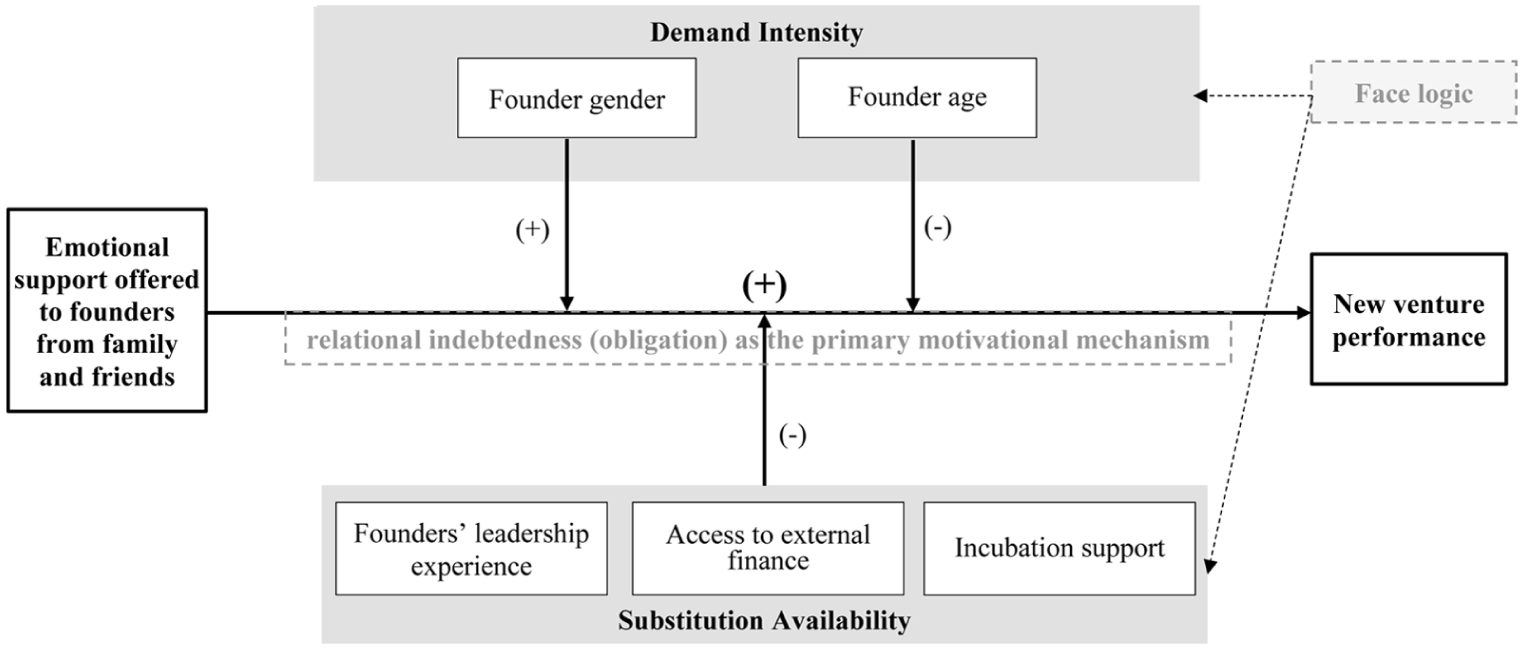
Research model.
Gender as a Demand Intensity Moderator: Female founders in East Asia face heightened demand intensity for emotional support. Traditional Confucian norms prescribe distinct gender roles, subjecting women who pursue entrepreneurship to greater social scrutiny, and stronger familial expectations (Franzke et al., 2022; Xu et al., 2023). Business failure is frequently interpreted not only as a commercial setback but also as a violation of familial duties (Franzke et al., 2022). These pressures, compounded by face concerns that discourage public expressions of vulnerability (Heine, 2001), make emotional support from family and friends especially critical. When received, this support carries heightened moral weight and generates intense relational indebtedness. The resulting obligation to reciprocate creates a stronger need-support-fit, motivating female founders to exert greater effort to justify the trust placed in them. This culturally amplified mechanism makes the positive relationship between emotional support and new venture performance stronger for female founders than for male founders. On this basis, we hypothesise:
Age as a Demand Intensity Moderator: Age is another important proxy for support demand intensity. As founders grow older, they tend to develop greater emotional maturity and more effective internal coping strategies, which reduce their reliance on external emotional support (Charles and Carstensen, 2003; Klyver et al., 2018; Vauclair et al., 2015). In addition, Confucian-influenced societies place strong emphasis on seniority and gravitas (i.e., a synthesis of seriousness, dignity, and authority; Tan and Barber, 2020), viewing public expressions of vulnerability or requests for emotional support as signs of weakness that risk significant loss of face. Consequently, older East Asian founders are less likely to seek or fully accept emotional support from family and friends, resulting in a weaker need-support-fit. Thus, the positive relationship between emotional support from family and friends and new venture performance is weaker for older founders than for younger founders. Accordingly, we hypothesise:
Leadership Experience as a Substitution Accessibility Moderator: Prior leadership experience serves as a proxy for higher substitution availability. Experienced founders develop stronger internal coping capabilities (Haynie and Shepherd, 2009; Shepherd, 2003) and possess a track record of achievement (Singh and DeNoble, 2003), reducing their reliance on external emotional support from family and friends. In the East Asian context, cultural expectations of leader gravitas and self-reliance further discourage dependence on strong-tie emotional support (Redding, 2013; Tan and Barber, 2020), which may be perceived as a sign of weakness. As a result, the need-support-fit of emotional support from family and friends weakens as leadership experience increases. Accordingly, we hypothesise:
Access to External Finance as a Substitution Accessibility Moderator: Access to external finance may act as a functional substitute for emotional support from family and friends. It offers financial security which mitigates the survival-related stress that dominates early-stage new ventures. It also provides objective market legitimacy that fulfils a founder’s fundamental need for identity recognition as a legitimate entrepreneur (Stuart et al., 1999). In the East Asian context, this substitution effect is particularly pronounced (Ahlstrom and Bruton, 2006). In societies where entrepreneurial success is deeply intertwined with family honour and social face, obtaining external financing serves as a powerful public signal of achievement, alleviating the constant pressure to prove oneself and live up to collective expectations. More importantly, external finance directly dilutes the motivational force of relational indebtedness (Yan, 1993): when success is validated by independent market actors rather than solely by family approval, the moral obligation to repay emotional support through superior venture performance is significantly weakened. As a result, greater access to external finance reduces founder dependence on strong-tie emotional support, leading to a poorer need-support-fit and a weaker relationship between family and friend support and new venture performance. Accordingly, we hypothesise:
Incubation Support as a Substitution Accessibility Moderator: Incubator affiliation serves as an institutional substitute for emotional support from family and friends. In this study, we use “incubators” as an umbrella term that also encompasses accelerators and science parks, which serve as integral nodes within the regional startup ecosystem (Cheng et al., 2026; Hemmert et al., 2019). Over recent decades, China, Japan and South Korea have developed extensive networks of incubators. Beyond tangible infrastructure, these settings provide founders with access to professional support communities, including mentors, peer entrepreneurs, and industry experts (Ebbers et al., 2026; Wang, 2025). The emotional support available in incubators is often more functionally matched to the needs of founders. When facing technical setbacks or market rejection, founders can confide in peers who have experienced similar shocks, receiving empathy that is grounded in shared professional experience, which family members who lack industry context cannot replicate (Scillitoe and Chakrabarti, 2010). Moreover, structured mentoring relationships create safe spaces where vulnerability and help-seeking are normalised as learning processes rather than personal weakness or failings. In Confucian-influenced societies, consulting a respected teacher or senior (i.e., mentor) is framed as a virtue rather than a sign of weakness (Hwang, 1987; Lang et al., 2012). Thus, when founders have access to incubator-based support systems, they possess viable institutional alternatives for obtaining emotionally resonant and functionally matched care. In such cases, the relative contribution of emotional support from family and friends to new venture performance may diminish, not because this support becomes harmful, but because its role is supplanted in part by professional peers and mentors who offer contextually relevant empathy without triggering face-related concerns or relational indebtedness. Accordingly, we hypothesise:
Methodology
Data collection and sample
To test our hypotheses, we conducted a large-scale survey of new ventures in China, Korea and Japan. The target population comprises firms operating for less than 10 years (Covin and Slevin, 1990) within technology-intensive sectors. We chose to focus on technology-intensive firms because these ventures operate in highly volatile, high-uncertainty environments (Eisenhardt, 1989) where founders face severe pressure and their internal state strongly shapes organisational outcomes (Freiberg and Matz, 2023), all of which makes this setting particularly salient for addressing our research questions.
We used company registries and comprehensive databases to compile the initial lists of our respondents in each country. In China, a sample frame of over 300,000 firms was identified from the National Enterprise Credit Information Publicity System, from which a random sample of 10,000 firms was extracted for contact. In South Korea, we used the complete registry of new ventures maintained by the Korea Institute of Startup and Entrepreneurship Development. In Japan, a comprehensive list of new ventures was obtained from INITIAL, a leading startup database. Given the smaller overall sample frames in Japan and Korea, all firms listed in the respective databases for these two countries were included in the survey.
Using the official contact details from company registrations, we contacted the named firm representative of each new venture as the key informant. For firms that provided only telephone contacts, our research team conducted brief screening calls prior to survey distribution. During these calls, we (i) confirmed that the venture remained operational and (ii) verified that the respondent was the principal founder; that is, the individual who played the most central role in establishing the new venture. Only after positive confirmation did we send the online questionnaire to an email address provided by the respondent. For this subset of the sample, respondents are identified as the focal founders. For firms with available email addresses, survey invitations were sent directly to the registered primary contact person. In the survey instrument, all respondents were explicitly instructed: “If your company has multiple founders, please refer to the one individual who played the most important role in founding the company when answering the following questions.”
Consistent with methodological recommendations (Kumar et al., 1993; Phillips, 1981), relying on key informants yields highly reliable and valid data given their comprehensive knowledge of the firm’s operations. Moreover, following Hambrick and Mason (1984), who argue that organisations reflect their top managers, informant reliability is expected to be particularly high when respondents hold senior positions in small firms (Homburg et al., 2012). These conditions characterise our sample. Furthermore, nearly 90% of the new ventures in our sample are 5 years old or younger (see Table 1), and East Asian entrepreneurs tend to remain as leaders of the firms they have founded rather than engage in serial entrepreneurship (Ahlstrom and Ding, 2014; Cheng et al., 2026). Thus, the majority of our respondents can be expected to be the firm’s principal founders. These research design choices ensure that our data specifically reflect the experiences of the venture’s key founder.
Sample characteristics.
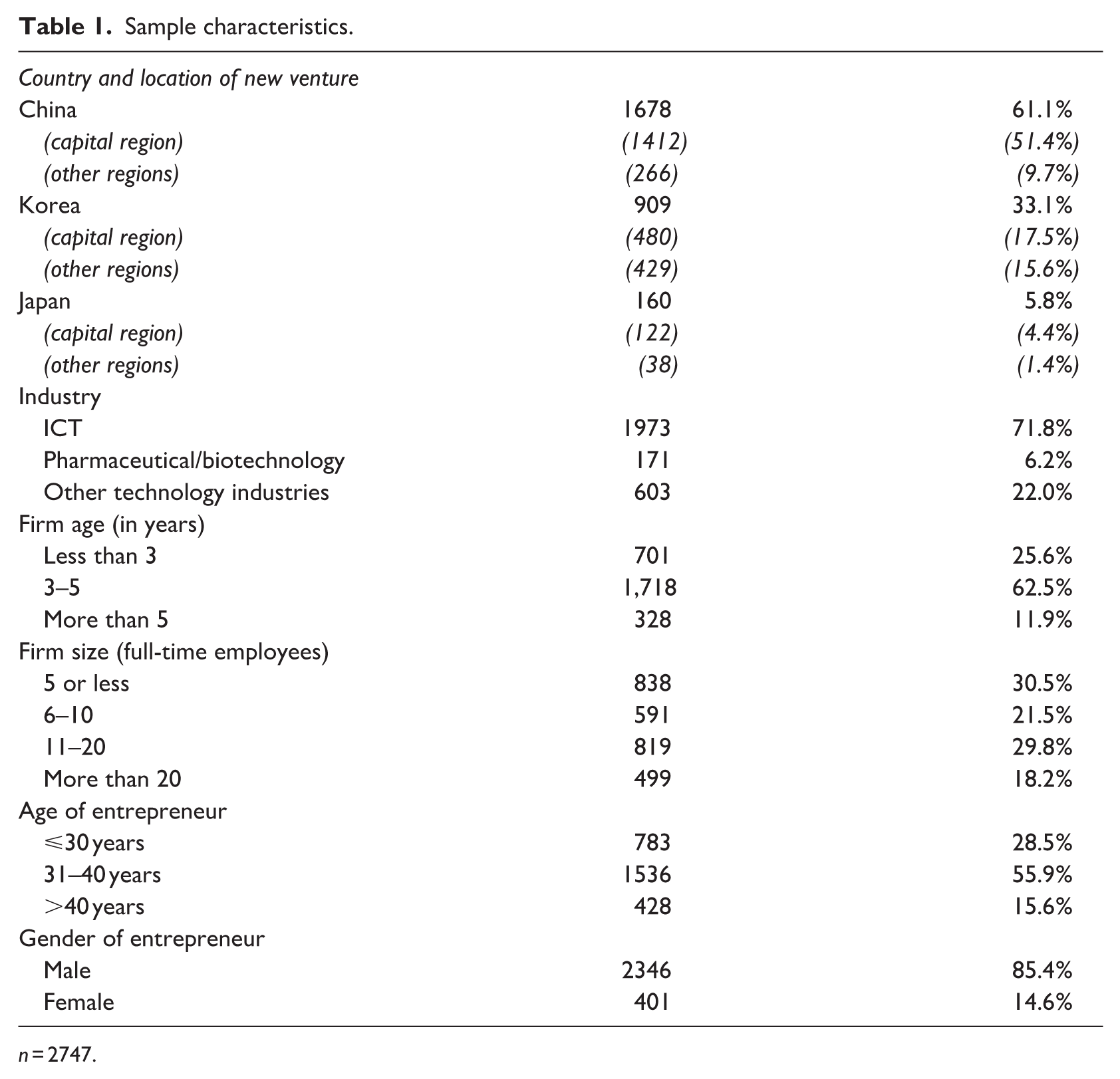
n = 2747.
The survey instruments covered firm and founder characteristics, business environments, managerial approaches and outcomes, and were written in the native language of the respondent. To ensure measurement equivalence across the three countries, we followed the translation back-translation procedure recommended by Hult et al. (2008), and we pretested the questionnaire with panels of new venture founders in each country. The survey was conducted between October and December 2019. From the firms contacted in China (9804), South Korea (10,270) and Japan (2080), we received 2793 initial responses, yielding country-specific response rates of 17.3%, 8.9% and 8.8%, respectively. After data cleaning, we excluded 17 responses with missing data on key variables and 29 responses from non-native founders. This resulted in a final sample of 2747 firms for our analysis. Table 1 presents the descriptive statistics for our sample. The sample is characterised by a high concentration of firms in the information and communication technology (ICT) sector (71.8%) and a strong representation of early-stage new ventures, with 88.1% being <5 years old. Demographically, the founders are predominantly male (85.4%) and relatively young, with 84.4% of them under the age of 40.
Measurement of variables
All multiple-item measures used seven-point Likert scales, drawing upon existing scales whenever possible. A summary of the key variables, including detailed descriptions, can be found in the Appendix.
Dependent variable: We capture the multidimensional nature of new venture performance using a nine-item scale adapted from Wiklund and Shepherd (2011). This approach recognises that new venture success is not defined by short-term profit alone but by a holistic set of growth, innovation, and market indicators (Murphy et al., 1996). Our measure departs from the competitive frame of reference (i.e., comparing to competitors) used in the original scale by Wiklund and Shepherd (2011), adopting instead a temporal frame of reference (i.e., comparing to two years prior). We consider this scale adjustment not merely as a methodological choice but as a necessity for the specific context of new ventures, for three reasons. First, new ventures, especially technology-intensive ones, often operate in nascent markets with ambiguous competitive landscapes, making direct competitor comparisons unreliable or impossible. Their primary challenge is instead achieving internal growth and validating their value proposition (Blank, 2013; Sarasvathy, 2001). The temporal measure captures their own growth trajectory and hence, more accurately measures their performance. Second, our scale ensures a tight alignment between our theory and measurement. This study focuses on how emotional support helps a founder to be more resilient and effective, which in turn drives new venture performance. A temporal measure captures the outcome of this internal dynamic, whereas a competitive measure would introduce confounding noise from exogenous market factors such as, for example, a competitor’s strategic blunder. Finally, our measure offers methodological robustness. By assessing performance change over the previous 2 years, our dependent variable considers each founder as an expert on their own firm’s development, controlling for heterogeneity across industries and initial conditions. This enhances the comparability of performance data across our sample.
Independent variable: We measure a founder’s emotional support through two direct questions on the extent to which they have been emotionally supported by their families and close friends when their new ventures were founded. This direct, perceptual approach was deliberately chosen to achieve higher construct validity over the indirect proxies common in the literature. For example, while previous studies have employed various proxies, such as family cohesiveness (Edelman et al., 2016), or specific reactions to the venture such as gauging whether family and friends were “excited” about the startup (Klyver et al., 2018), we consider that these proxies capture the potential environment for support or the approval of the venture, respectively. The theoretical focus of our study, however, is on the assessment of support provided to the founder, which is conceptually distinct. The direct measure we use, therefore, more validly and reliably captures the construct at the heart of our study.
Moderators: We use a dummy variable to measure gender, with a value of 1 if the founder is female and 0 otherwise. Age was measured as the founder’s age in years at the time of venture creation. Leadership experience was measured based on the duration of prior business leadership experience before establishing the focal new venture, categorised into four categories ranging from “zero” to “more than 10 years.” Access to external finance was assessed using three questions concerning access to external financial capital, funding opportunities, and governmental funding that were partly adapted from Grichnik et al. (2014). Incubation support was measured with a dummy variable (1 if the new venture was located in a business incubator or science park, and 0 otherwise).
Control variables: To account for various factors that might influence new venture performance, we included various control variables. These encompass firm age, measured by the natural logarithm of the number of years since the firm was founded, and firm size, measured by the number of full-time equivalent employees across seven categories ranging from 1 = less than three to 7 = more than 100. Environmental hostility, reflecting the competitive environment to which the new venture was exposed, was measured based on three questions drawn from Grichnik et al. (2014). Entrepreneurial family background was considered using a single question on parental business ownership (1 for yes, 0 for no). Financial background and social family background were evaluated using two newly developed questions on family financial wealth and societal standing, rated from 1 (poor/modest) to 7 (wealthy/highly esteemed). Additionally, financial support from family and friends during venture establishment was assessed using two questions adapted from Edelman et al. (2016). Finally, we controlled for country-specific effects by using dummy variables for Japan and South Korea, with China serving as the baseline. Moreover, industry-specific effects were addressed through dummy variables for the pharma/biotech industry and other industries, with the ICT industry as the baseline.
Reliability and validity
Table 2 presents bivariate correlations and descriptive statistics. All multiple-item scales demonstrated composite reliabilities (CR) above .80, and the square roots of their average variance extracted (AVE) exceeded correlations with other variables, indicating satisfactory convergent and discriminant validities (Fornell and Larcker, 1981).
Bivariate correlations, means and standard deviations of variables.
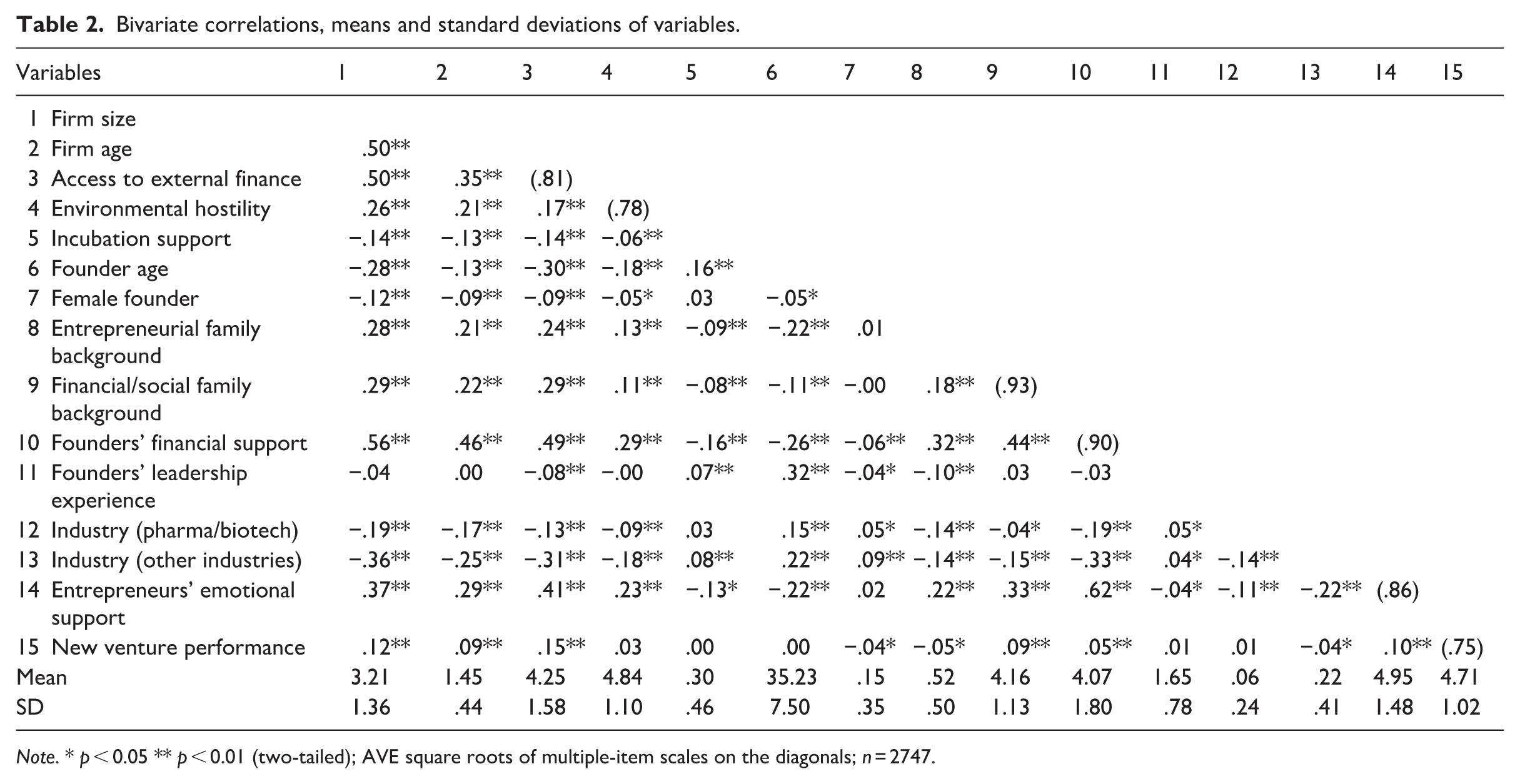
Note. * p < 0.05 ** p < 0.01 (two-tailed); AVE square roots of multiple-item scales on the diagonals; n = 2747.
To mitigate common method bias, we employed several strategies (Podsakoff et al., 2003): (i) emphasising neutral survey instructions, (ii) avoiding normative language, and (iii) introducing a marker variable (enjoyment of working in the venture) as a proxy for social desirability. Adjusting for this variable did not alter our primary findings, suggesting minimal common method bias in our study. Additionally, all variance inflation factors were lower than 5.2, indicating low multicollinearity and confirming the suitability of our data for hypothesis testing. To address potential endogeneity, we established temporal precedence by measuring emotional support at new venture creation and performance in the last two years preceding the survey.
Results
We tested our hypotheses using ordinary least squares regression analysis of new venture performance. The results are presented in Table 3.
Regression analysis for new venture performance.
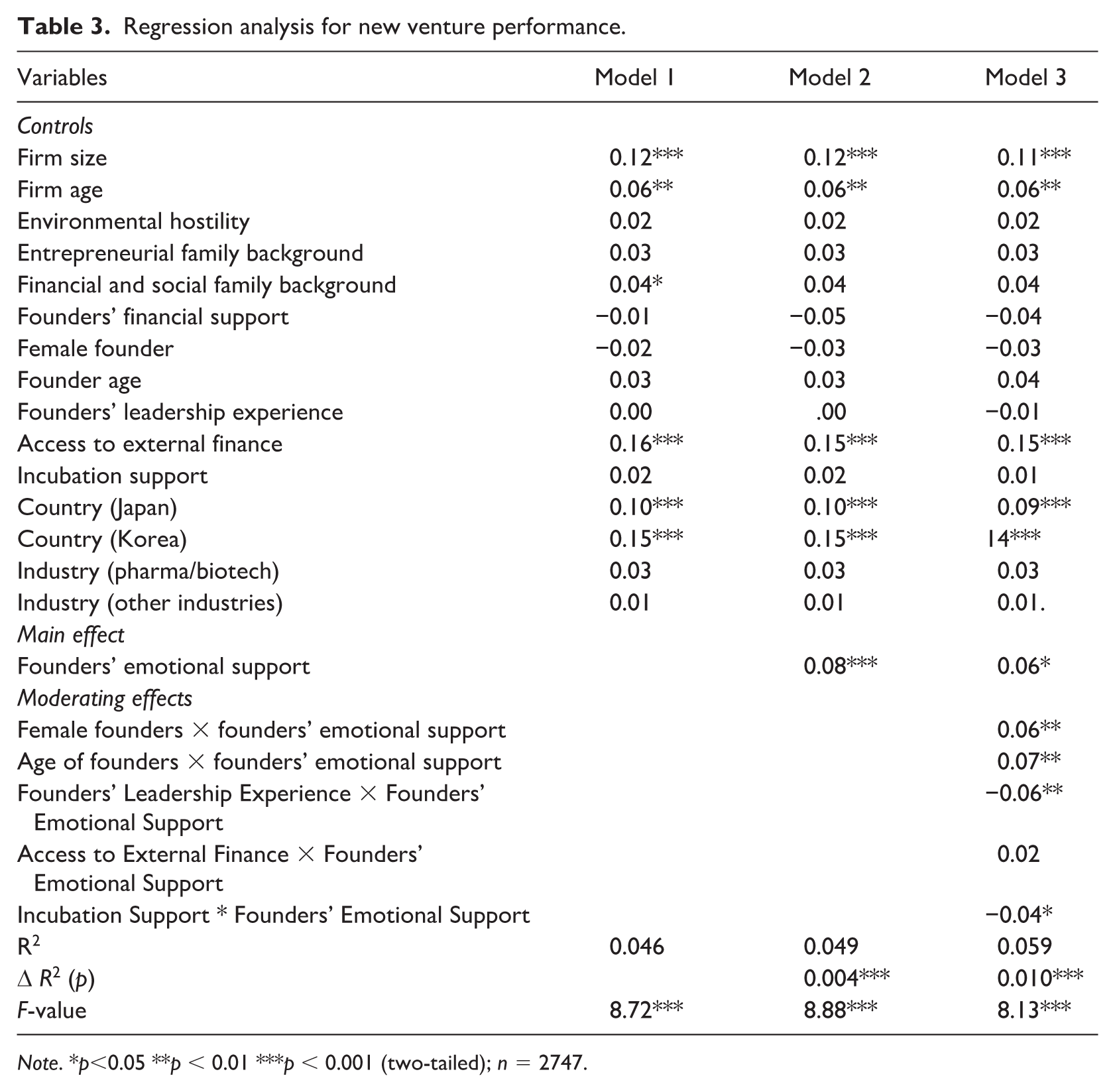
Note. *p<0.05 **p < 0.01 ***p < 0.001 (two-tailed); n = 2747.
Model 1 included control variables, revealing positive associations between firm size, firm age, financial and social family background, and country dummies with new venture performance.
Model 2 introduced the main effect of emotional support, which was positively related to new venture performance (β = 0.08, p < .001), supporting Hypothesis 1.
Model 3 added interaction terms. The interaction between gender and emotional support was positive (β = 0.06, p < .01), supporting Hypothesis 2. The interaction between age and emotional support was positive (β = 0.07, p < .01), rejecting Hypothesis 3. The interaction between leadership experience and emotional support was negative (β = −0.06, p < .01), supporting Hypothesis 4. The interaction between access to external finance and emotional support was insignificant, rejecting Hypothesis 5. Finally, the interaction between incubation support and emotional support was negative (β = −0.04, p < 0.05), supporting Hypothesis 6.
Discussion
This study investigates whether and for whom the emotional support received by founders from family and friends affects new venture performance in the Confucian-influenced East Asian context. Our findings reveal a robust positive main effect of such support on new venture performance (Hypothesis 1 supported). In addition, this positive relationship exhibits systematic heterogeneity: it is stronger for female founders and older founders (Hypothesis 2 supported, Hypothesis 3 not supported), weaker for founders with greater leadership experience and those situated in incubators (Hypotheses 4 and 6 supported), and shows no significant substitution effect from access to external finance (Hypothesis 5 not supported).
While extant entrepreneurship research has primarily focused on the buffering role of emotional support under conditions of stress (Edelman et al., 2016; Klyver et al., 2018; Welsh et al., 2021), growing evidence points to its direct main effect (Cogan et al., 2022; Huang et al., 2024). Our study extends this emerging line of work by demonstrating a robust main effect on new venture performance in East Asia. We theorise that this effect operates through two primary pathways: the cognitive pathway (Baron, 2008; Huang et al., 2024) and the behavioural pathway (Treffers et al., 2019). Crucially, in Confucian-influenced East Asia, the behavioural pathway is significantly amplified by the cultural logics of face and relational indebtedness. This cultural embedded mechanism transforms support into a powerful motivational force: founders exert greater effort because they feel morally bound to repay those who believed in them, making this underlying motivational pathway far more applicable and impactful than in Western settings. Ultimately, our empirical results robustly support the theorised positive relationship.
These findings make important contributions to the social support literature, particularly extending Cogan et al. (2022) who conceptualise emotional support as an ongoing, interactive mechanism that sustains individual entrepreneurial persistence. Our study leverages the East Asian context to build upon this foundational perspective in two significant ways. First, we provide further theoretical clarity regarding the drivers of the main-effect mechanism. By highlighting the normative obligations embedded in strong-tie networks, we demonstrate that relational indebtedness serves as a culturally specific motivational engine for founders. Second, we explicitly link this motivational drive to firm-level outcomes. By doing so, we extend the theoretical focus from individual persistence to articulate how the emotional support given to founders ultimately translates into tangible new venture performance. Furthermore, building on the optimal matching model (Cohen and Wills, 1985; Cutrona, 1990), we construct a framework need-support-fit, consisting of demand intensity and substitution availability, to systematically explain heterogeneous effects of emotional support. While previous research has mostly focused on “how much support entrepreneurs receive,” Klyver et al. (2020) took an important step forward by highlighting the need to explore the specific conditions under which support effectively delivers value. Drawing inspiration from this insightful work, our study extends this inquiry of support alignment by explicitly conceptualising and empirically testing the core dimensions of need-support-fit. Our findings reveal that the performance-enhancing effect of emotional support is most pronounced when founders face high emotional demands or lack alternative support sources. Thus, our results clarify the boundary conditions under which emotional support drives new venture performance, offering a contextually embedded theory of emotional support effectiveness.
Our findings also offer nuanced cultural insights into individual differences. In terms of gender, we find that the effect of emotional support is significantly stronger for female founders in East Asia. While prior research suggests that emotional support aids women entrepreneurs primarily by mitigating work-family conflict (Welsh et al., 2021), our findings reveal a deeper, legitimacy-based mechanism. In East Asian societies governed by stronger patriarchal norms such as the “good wife, wise mother” ideal (Franzke et al., 2022; Sechiyama, 2013), women’s entrepreneurship deviates from traditional expectations, creating a severe normative legitimacy deficit (Xu et al., 2023). In this restrictive environment, emotional support from the inner circle goes beyond providing comfort, serving as a critical normative authorisation for an unconventional choice. Crucially, this vital validation generates a profound sense of relational indebtedness, powerfully driving female founders to reciprocate through superior new venture performance. Surprisingly, we find that the effect is also stronger for older founders (contrary to Hypothesis 3). We argue that this can be explained by the Confucian age-face dilemma. Age-related face concerns compel older founders to actively suppress their support-seeking behaviours, prompting them to “report only good news” to protect their self-image and avoid burdening others (Hitokoto, 2016; Zhang and Cheng, 2024). This suggests that older founders typically only seek support when pressure reaches extremely high levels. In other words, while ageing reduces the frequency of support-seeking, it amplifies the unspoken intensity of the demand. When these deeply suppressed needs are met by close ties, the support carries disproportionate moral weight. Viewed through the cultural lens of relational indebtedness, this triggers a uniquely powerful motivational force to reciprocate through superior new venture performance. This finding extends Klyver et al. (2018)’s discussion on the life-stage contingencies, suggesting that in face-sensitive cultural contexts, ageing may actually amplify, rather than weaken, the motivational impact of emotional support.
Leadership experience and incubator support are found to weaken the linkage between emotional support and new venture performance. Prior research argues that accumulated experience enhances self-regulation and reduces reliance on emotional support, often relying on chronological age as a proxy for such maturity (Klyver et al., 2018). Our study follows this dialogue but directly measures leadership experience. Consistent with theoretical expectation, our results reveal a negative moderating effect: experienced leaders, equipped with accumulated coping resources and professional networks, utilise their well-established self-regulatory capacity to substitute for inner-circle emotional support. However, this diminished impact of support for experienced founders provides a stark contrast to the amplified impact found for older founders. This result highlights that the conversion of support into new venture performance stems from the moral weight carried within age-related social norms, rather than general professional maturity. Similarly, incubator support provides an effective institutional substitute for emotional support from family and friends. While Klyver et al. (2020) offer a valuable distinction of emotional support across different relational spheres, and note divergent reciprocal norms across social ties, their focus is largely confined to traditional interpersonal ties. We extend their framework by conceptualising incubators as a unique institutional support source. We highlight that incubator-based emotional support differs fundamentally from family-based support due to its exemption from traditional face constraints and relational indebtedness. This structural difference creates a distinct substitution effect that attenuates the performance benefits of strong-tie emotional support.
Moreover, contrary to Hypothesis 5, access to external finance did not show the expected substitution effect. This unanticipated finding indicates that financial capital and strong-tie emotional support operate in distinct, non-fungible domains. Even when adequately funded, founders must navigate profound psychological and cultural pressures, such as identity validation and relational obligations, making strong-tie emotional support irreplaceable. This perspective structurally extends the foundational work of Edelman et al. (2016), who conceptualise emotional support as a crucial enhancer of instrumental resources. Building upon their logic of complementarity, our results specify why external finance cannot substitute for family and friend support: emotional support is not merely a supplementary boost to financial capital, but rather an independent, indispensable requirement for navigating the culturally embedded challenges of new venture development.
Implications
Theoretical implications
This study offers three interrelated theoretical contributions to social support theory and entrepreneurship research.
First, we advance emotional support research by leveraging the East Asian context as a theoretically generative setting. As Klyver et al. (2020) acutely point out, existing literature frequently conflates the effects of different sources of support, such as strong-tie family emotional support and weak-tie professional support, treating emotional support as a universal, homogeneous construct. While research in institutionally weak environments such as Africa and other emerging markets has increasingly recognised the indispensable role of family-centric support (Neneh, 2017; Welsh et al., 2021), this body of work primarily attributes this reliance to institutional scarcity. We move beyond the institutional scarcity perspective to reveal that the East Asian context offers a clean cultural analytical lens. Specifically, driven by a profound cultural emphasis on face-saving, East Asian founders strategically avoid professional channels when experiencing psychological pressure, seeking support almost exclusively from their trusted inner circle. This culturally induced structural selectivity effectively mitigates the cofounding effects of weak ties, allowing us to precisely isolate how strong-tie emotional support translates into new venture performance. In so doing, we respond to Arregle et al. (2015)’s call to assess the value of family ties across differentiated social network structures, providing a robust reference paradigm for future research in transition economies or institutionally distinct environments.
Second, we advance the social support literature by introducing relational indebtedness as a culturally embedded mechanism that links emotional support to firm-level outcomes. We demonstrate how, in the East Asian context, emotional support functions as a relational favour that generates normative obligations to reciprocate. This sense of indebtedness is channelled into heightened entrepreneurial motivation and sustained effort, ultimately enhancing new venture performance. Building on recent work showing that main-effect and buffering mechanisms operate as an ongoing, interdependent process (Cogan et al., 2022), we make explicit the motivational pathway at the firm level, thereby enriching the understanding of the main-effect model with a culturally grounded mechanism.
Third, we provide a more nuanced understanding of social support by developing a context-sensitive need-support-fit framework that systematically identifies the boundary conditions of emotional support. While previous research has confirmed that the effects of emotional support vary significantly at the individual level, it has predominantly treated individual characteristics such as gender (Welsh et al., 2021), age and experience (Klyver et al., 2018; Nielsen and Klyver, 2020) as isolated contingencies, without articulating a unifying theoretical framework to uncover the underlying logic behind these disparate findings. Furthermore, building on Klyver et al. (2020)’s insights that the effectiveness of support depends on its alignment with entrepreneurs’ needs, our study advances this dialogue by theoretically formalising and empirically testing two unifying core dimensions of need-support-fit: demand intensity and substitution availability. By deeply integrating the Western-origin optimal matching model (Cutrona, 1990) with the cultural logic of East Asia, we reveal how face concerns and relational indebtedness jointly shape the strength of these two dimensions. Through this framework, we actively answer Klyver et al. (2020)’s call to move the literature beyond the traditional focus on the sheer volume of support received (i.e., “what they get”) to a systematic understanding of the core question of when and for whom emotional support most effectively enhances new venture performance.
Limitations and future research
While our study offers contributions, it also has limitations that open promising directions for future research.
First, regarding the underlying mechanism, while our theoretical model proposes that emotional support enhances new venture performance by creating relational indebtedness and enhancing motivation, we do not directly measure these cognitive and behavioural constructs. Instead, we infer this process based on established entrepreneurship literature and the cultural norms of the East Asian context. This indicates an important avenue for future research. For example, scholars could employ empirical designs that explicitly capture the perceived obligations and goal-directed efforts founders use to validate our mechanism using techniques such as structural equation modelling. Furthermore, scholars could examine the potential “dark side” of relational indebtedness, exploring how excessive normative obligations might lead to burnout or suboptimal strategic decisions, thereby illuminating the delicate balance between relational norms and business rationality.
Second, our results are culturally bounded, presenting opportunities for cross-cultural comparative studies. We argue that the observed effect is driven by the structural selectivity of strong ties combined with the normative pressure of face and relational indebtedness in East Asia. Future research could extend this logic to other emerging markets, such as sub-Saharan Africa, where family and kinship ties similarly function as the dominant source of entrepreneurial support but operate under different social contracts (Neneh, 2017). Such comparative studies would help disentangle whether the performance impact is primarily driven by the institutional necessity of strong-tie support or by the specific cultural meaning (i.e., indebtedness) attached to it.
Third, our unexpected findings provide fertile ground for future exploration. The amplified effect for older entrepreneurs indicates that face culture shapes emotional needs and support-seeking behaviours in ways not yet fully understood. Future longitudinal and qualitative research could delve deeper into the intricate dynamics among ageing, face concerns, and the mechanisms through which emotional support is experienced and converted into entrepreneurial motivation. Additionally, the lack of a substitution effect from external finance suggests that emotional support satisfies profound psychological needs that financial capital cannot replace. Subsequent research could further explore the boundary conditions under which instrumental resources fail to substitute for the motivational role of emotional support. A promising direction would be to examine whether abundant external finance and strong inner-circle emotional support create conflicting normative obligations, potentially amplifying founders’ distress.
Fourth, our findings are derived from technology-based new ventures. While this focus allows us to examine the support–performance relationship in its most pronounced form, it raises questions regarding generalisability. As firms mature and transition toward professionalised management, the founder-firm link may gradually loosen, potentially attenuating the impact of founder’s emotional support. Future research should investigate how this relationship evolves across different industry sectors and subsequent firm life-cycle stages.
Finally, future studies could benefit from methodological refinements. While our approach utilises the key informant technique with rigorous screening, future research could explicitly verify the respondents’ specific founding roles (e.g., lead/principal founder versus co-founder) to account for varying levels of psychological pressure. Moreover, employing a dyadic design that collects data concurrently from both founders and their support providers would offer a more nuanced, multi-perspective understanding of how emotional support is mutually perceived, exchanged and converted into entrepreneurial effort.
Practical implications
This study offers several practical implications for key stakeholders in the startup ecosystem.
First, founders must recognise emotional support not merely as a personal comfort. In the East Asian context, emotional support transforms into a strong force for achievement motivation through the mechanism of relational indebtedness. Therefore, rather than avoiding the social expectations of family and close friends, founders should actively internalise these normative obligations, channelling them into sustained entrepreneurial effort. Crucially, founders must distinguish between business and personal resource needs. Our finding that financial capital yields no substitution effect highlights that securing external funding cannot replace the distinct motivational role provided by intimate relationships. This suggests that, for example, for founders facing acute face concerns, proactively cultivating a stable emotional support network should be prioritised as a core entrepreneurial task. Conversely, founders who lack strong family support due to practical constraints such as geographic separation, should actively seek functionally equivalent alternatives, such as incubator communities, to build support structures.
Second, this research validates the vital role of the founder’s personal networks. The support provided by family and close friends possesses tangible strategic and economic value. Particularly in East Asian societies, the inner circle should recognise that their ongoing emotional validation is not peripheral to the business, but rather a strong driver that stabilises the founder’s motivation and directly contributes to new venture performance.
Third, investors, incubator managers and policymakers should acknowledge the limits of purely instrumental support. Since external funding cannot fully replace the culturally embedded emotional needs of entrepreneurs, startup ecosystem builders should adopt a more holistic approach that pays greater attention to the founder’s psychological well-being and motivational drivers. Beyond financial capital and physical infrastructure, policymakers and incubators should develop and strengthen peer-to-peer networks and intensive mentorship programmes. Cultivating these cohesive communities can provide emotional validation that functions similarly to family support, serving as a crucial substitute for founders who may lack their own strong personal support networks.
Conclusion
In conclusion, this study advances a culturally embedded view of entrepreneurship by demonstrating how macro-cultural conditions shape micro-psychological processes to ultimately drive new venture performance in East Asia. Moving beyond traditional social support theory, which typically emphasises “what entrepreneurs get,” we reconceptualise it as a dynamic psychological transformation process. We reveal that the value of emotional support does not lie in the support behaviour itself, but in the recipient’s culturally bound interpretation and the resulting psychological transformation. The effectiveness of this transformation depends on the alignment between the support received and the founder’s actual needs. By constructing a context-sensitive need-support-fit framework, we integrate macro-level cultural mechanisms (face logic and relational indebtedness) with micro-level contingencies (demand intensity and substitution accessibility). This framework illustrates that identical support can generate different or even opposite effects across varying cultural contexts and demand states. Emotional support becomes a strategic asset only when it is culturally and psychologically aligned with the founder. Ultimately, this reconceptualisation moves the field from a structural focus on “what entrepreneurs get” to a mechanism-driven understanding of “how support is interpreted and converted.” By illustrating underscoring the critical necessity of contextualising emotional support, this research provides a robust theoretical paradigm for future entrepreneurship scholarship that is deeply context-embedded.
Footnotes
Appendix
Acknowledgements
The authors wish to thank the editor, Susan Marlow, and the two anonymous reviewers for their constructive comments and suggestions, which have significantly improved the quality of this manuscript.

Ethical considerations
This research was conducted in full compliance with internationally recognised ethical standards.
Rigorous data anonymisation procedures were implemented to safeguard participant privacy, with all original datasets sourced from authorised and ethically approved channels. The study explicitly excluded any unauthorised use of confidential or proprietary information and maintained alignment with the FAIR data principles (Findable, Accessible, Interoperable, Reusable). The authors affirm unwavering adherence to academic integrity norms, having proactively addressed ethical considerations in both methodological design and analytical interpretation to ensure responsible knowledge dissemination.
In preparing this manuscript, we used artificial intelligence language models, specifically, the Gemini and Perplexity large language models, to assist with language editing and refining the logic flow of the text. Their use was limited to improving the fluency and grammatical accuracy of the English writing. They were not used to generate research data, core arguments, questionnaire designs, or reference citations. All AI-assisted revisions and suggestions were carefully reviewed, verified, and finalised by the authors to ensure scientific rigour, factual accuracy, and academic integrity, as well as stylistic clarity and consistency. Every cited reference has been manually checked for authenticity and relevance.
Author Contributions
Funding
The authors disclosed receipt of the following financial support for the research, authorship and/or publication of this article: This study has been supported by the Chongqing Social Science Planning Project (2024NDYB089), by the Fundamental Research Funds for the Central Universities (2024CDJSKXYJG09), by the National Science Foundation of China Project (72572022), by the JSPS KAKENHI (18K12847) and by the Korea University Business School Research Grant.
Declaration of conflicting interests
The authors declared no potential conflicts of interest with respect to the research, authorship and/or publication of this article.
Data availability statement
The datasets generated during the current study are available from the corresponding author on reasonable request.