







Abstract
Knowledge networks are an organizational form with which to support knowledge sharing and creation. Few studies have been undertaken to understand the interaction among these variables and to develop a hierarchy of knowledge network variables model. The main purpose of this article is to identify a set of variables to implement a knowledge network and then to analyse and to rank them using the approach Interpretive Structural Modelling. Variables are identified through the literature review. To analyse the contextual relationships among the suggested variables, experts from academia and industry were consulted. The research shows that there exist two groups of variables, one having high driving power and low dependency requiring maximum attention and of strategic importance (such as organization environment factors, managerial processes and IT infrastructure) and the other having high dependence and low driving power and are resultant effects (such as knowledge, culture, organizational structures and communication processes).
Introduction
In a ‘knowledge society’ in which individual and organizational knowledge can make a difference in gaining a competitive advantage, the management of knowledge is essential for all companies. It is critical to stress on the importance of the appropriate form of governance with which to create new knowledge. The example of the World Bank, as used by Wood and Hamel (2002), shows how a network structure could facilitate internal innovation immensely and what is required to follow the networking strategy successfully. Knowledge networks focus on the members’ knowledge. They are social networks that can be defined as ‘a specific set of linkages among a defined set of actors, with the additional property that the characteristics of these as a whole may be used to interpret the social behavior of the actors involved’ (Lincoln, 1982). The term network focuses on the social relationship between the members. Furthermore, the word of knowledge network is therefore used to signify many people, their resources and the relationships between them and also, who are assembled to accumulate and use knowledge – primarily utilizing knowledge creation and sharing processes – for the purpose of creating value for the company. Researchers have found the knowledge network as a key factor to the perception of the process through which knowledge is produced. Networks indicate not only the relationship among members but also the accessibility and exchange of knowledge in networks. Therefore, knowledge networks should exist in order to produce and share knowledge. Knowledge networks can be regarded as instruments for knowledge management, since the network structure includes the ability to connect those knowledge agents (knowledge owners and experts) within a company who – due to the hierarchical and functional view of the line organization – are not connected. In short, networks as communities provide a platform for knowledge sharing among their members. In studies of organizational learning, the ‘network forms’ of the organization have been defined as a source of value for the firm. Organizations may be expected to generate new forms of collaboration, in which network partnerships will be based on maximizing resource utilization subject to the equitable distribution of returns rather than on individual firms maximizing their profits. The implementation of a knowledge networks has two advantages; the economic advantage is that it reduces organizational expenditures through reducing reworks. Secondly, it plays an important role in developing and increasing the competitive advantage of organizations and results in an increase in organizational learning through converting personal knowledge into organizational knowledge and thus an increase in success of research and development projects (Raidén et al., 2004). Structural equation modelling (SEM) may not be applied individually. However, the merely the statistical validation tool for Interpretive Structural Modelling (ISM) model is SEM, and therefore ISM model has to build first. Hence, this is perhaps the first study in this direction to address the pointed gap.
The present study attempts to identify variables in knowledge network through extent literature survey and experts’ opinions and further develops the contextual relationships among these identified variables through the ISM approach. Survey and experts’ opinions further develop the contextual relationships among these identified variables through the ISM approach. Although from the view of the integral whole, knowledge network can enhance the managing of knowledge within an organization, yet, little attention has been paid to the relationship between variables of knowledge networks. In actual practice, managers’ critical issue would be questions like ‘what are the primary variables for setting up knowledge network?’, ‘Are all variables equally important? If not, which variables are more important?’ Alternatively, ‘What is the structure of these variables?’
This article contributes to filling the research gaps by providing the answers to these questions. It will be very helpful for organizations to focus on relevant and important variables for successful implementation of a knowledge network and achieve operational excellence in knowledge management. The central aspect of the article is to expose the hidden structure of primary variables of knowledge network using ISM. However, the remarkable characteristics of the research are as follows: (i) it represents the crowded wisdom of experts from academia and industry practitioners using Delphi technique to confirm variables to set up a knowledge which identified through literature review; (ii) it expresses the collective wisdom of experts from the academia and industry practitioners in the form of interpretive structural model to map contextual relationships among the variables; and (iii) it offers to prioritize structure of the central and important variables to set up the knowledge network based upon ISM, therefore that managers can prepare an action plan to set up knowledge network. The primary objectives of the research are to identify variables that affect a successful implementation of knowledge networks and to discover contextual relationships among the distinguished variables by developing a structural model using ISM technique.
This article reminder has been prepared as follows. The further part provides a review of the literature and discusses the identification of knowledge network variables. Discussion of research methodology follows this and the next section presents the results of Delphi method and development of the relationships model using ISM. Matrice d’impacts croises-multipication applique' an classment (MICMAC) analysis of developed ISM model is carried out subsequently. Finally, the discussion and conclusion of this research study are presented, which is followed by limitations and suggestions for future studies.
Literature review
Knowledge networks
The term networks can be interpreted as those of groups, peoples or businesses, as well as within cooperatives of organizations (Gupta and Polonsky, 2014). In all these cases, the network construct requires that description and analysis do not focus merely on a division of the relationships existing between the network associates and network relationships (Alkhuraiji et al., 2016) but also comprehends the network in its entirety. Taking a very broad perspective, one could assume the work of Fayol in 1916 to be the origin of research on network structures (Back et al., 2005). Consequently, the term knowledge network designates a relationship between knowledge workers (Phelps et al., 2012). Knowledge workers in a knowledge network can be persons, groups and also collectives of organizations, communities or even societies (Singh and Fleming, 2010). Knowledge network plays a necessary role in knowledge management of organizations because the key to obtaining long-term competitive advantage is not to be found in the administration of existing knowledge but in the experience continuously to regenerate, flow and apply new knowledge to pass on to new products and services (Van Donk and Riezebos, 2005). To make efficient use of knowledge, a network must be built up in which the knowledge and experience of employees are available. What is of prime importance is that creations, sharing and flowing processes are encouraged, not just the accumulation of data as in a data warehouse (Phelps et al., 2012).
Knowledge creation and transfer can occur at different real (e.g. in the office, with the customer), virtual (e.g. distributed team rooms) or mental (e.g. common values, ideas and ideals) places. Despite the fact that practices related to successful implementation of a knowledge network have helped in achieving the desired goals of knowledge management. The major function of knowledge networks is to acquire and share the inter- and intra-organizational knowledge and make it accessible. The process of producing knowledge has been attached to a complicated network of activities, institutes and diffusion factors. Network building can help organizations to find the necessary knowledge and use it to accomplish successful innovations. Studies performed in organizations show that one of the major challenges facing knowledge management systems is the individuals’ low inclination for documenting and sharing the knowledge. Hence, organizations try to increase sharing knowledge through launching knowledge networks.
The above-listed variables (Table 1) are often cited in the knowledge network literature and are found to be frequently used by different researchers in their studies which suggest that these variables are critical for the implementation of a knowledge network. Hence, these seven variables are assumed to be the major variables for implementation of a knowledge network.
List of variables from literature review.
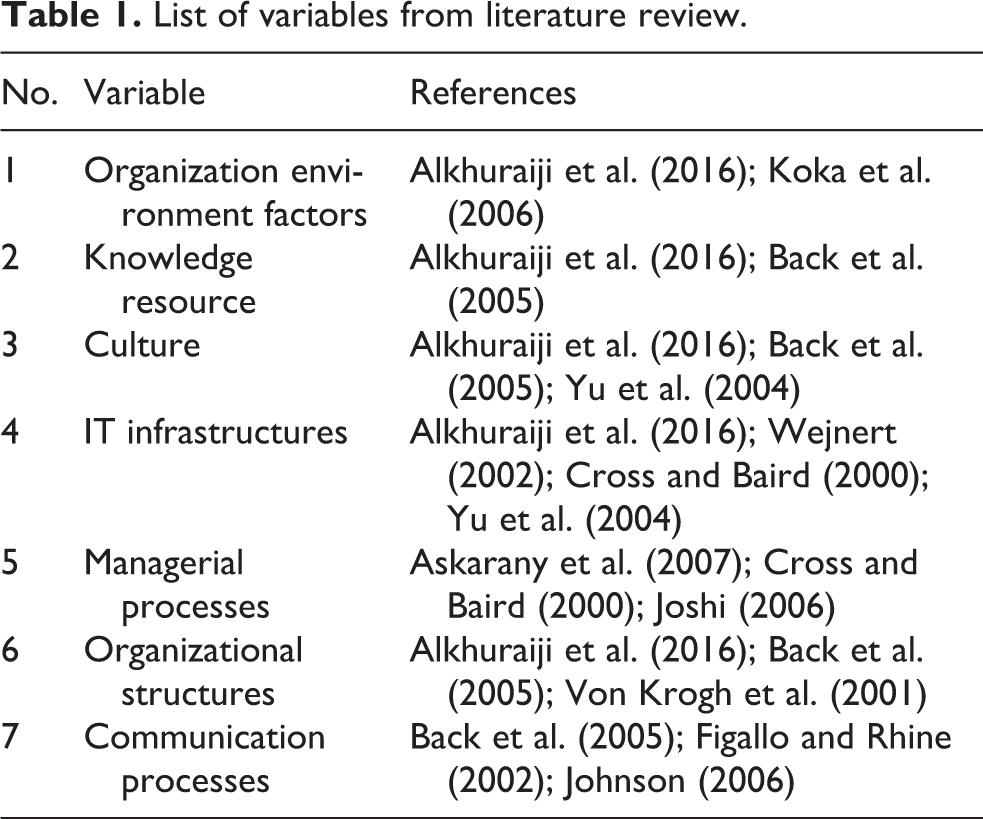
Variables
Organizational environmental factors
Organizational theorists emphasize that organizations must adapt to their environment if they are to remain viable (Duncan, 1972). To an organization, environmental determinants can be both internal and external. The internal environment consists of those relevant physical and social factors within the boundaries of the organization. Some internal factors of business consist its value system, mission and objectives and internal relationships. External environment consists of those relevant physical and social factors outside the boundaries of the organization. External factors of business involve competitors and competition situation and economic and technological factors. This distinction between internal and external environments is more comprehensive than the definition of the internal environment as including the interpersonal relation of members and their interactions with each other and the external environment as including other individuals, groups and institutions. The development of knowledge relations occurs in the context of the environment. These relations pave the way for sharing the personnel’s best activities. Given that the environment plays an important role in formation and development of knowledge relations among the personnel of an organization, it was chosen from the literature as a factor influencing the successful implementation of knowledge networks. This factor can include customer orientation, competitive.
Organizational structures
An organization should analyse not only its organizational environmental factors but also its organizational structure. Organizational structure is a system that includes of specific and implicit institutional rules and policies designed to define how various work roles and responsibilities are assigned, controlled and coordinated. Based on Miller and Dröge (1986), organizational structures are defined as capturing centralization of authority, formalization, complexity and integration. The structure of the organizational similarly determines how information flows from level to level within the company. This factor formalizes the activities in knowledge networks. The organizational structures should be adjusted such that it can account for the production, storage, circulation and diffusion of knowledge in different parts of knowledge networks. Organizations with flexible processes and organizational structures tend to be better at output and managing knowledge than more rigidly structured organizations (Utterback and Abernathy, 1975). The knowledge changes as a product passes through its life cycle and these changes are related to changes occurring in the competitive emphasis of an organization (Moore and Tushman, 1982). This implies that the appropriate organizational structure can change through time and, hence, must be explicitly managed by the organization. An organization that sets out to manage knowledge needs open channels of communication, decentralization and informal decision-making and flexibility in processes and procedures for this purpose organizations need to set up knowledge network. Hence, organization with a more flexible structure will have higher rates of knowledge than other organization.
Culture
In the last few decades, management scholars have proposed various definitions for the concept of organizational culture (Martin, 2002). In this article, organizational culture has represented as a collection of shared mental assuming that direct description and action in organizations by defining appropriate behaviour for various situations that implies organizational features that improve the conditions of knowledge sharing in knowledge networks; knowledge culture should involve mutual. Each organization has its unique culture (Ismail Al-Alawi et al., 2007) that explains overtime to show the organization’s character in two dimensions: visible and invisible. The noticeable aspects of the culture are indicated in the supported values, philosophy and mission of the firm while the invisible dimension rests on the unspoken set of values that guide employees’ actions and perceptions in the organization (Nunn, 2013). These largely tacit assumptions and beliefs are expressed and manifested in a web of formal and informal practices and of visual, verbal and material artefacts, which represent the most visible, tangible and audible variables of the culture of an organization.
Communication process
Another important factor as influential in the implementation of knowledge networks are communication processes, which play an important role in formation and development of knowledge relations in organizations’ knowledge networks (Figallo and Rhine, 2002). The description here refers to human interaction by oral discussions and the use of body language while communicating. Human interaction is considerably enhanced by the existence of social networking in the workplace (Ismail Al-Alawi et al., 2007). This method of communication is fundamental in encouraging knowledge transfer. Communication processes form personnel’s relations in knowledge networks and facilitate knowledge relations in organizations (Back et al., 2005). It may include knowledge forums, think tanks, knowledge workshops, brainstorming sessions and effective listening. An increase in knowledge relations in knowledge networks accelerates the flow of knowledge in organizations and thus increases the reproduction of knowledge in networks. Communication processes shape the relationships between personnel via the social network, community of practice, community of interest, and problem-solving group.
Knowledge resource
It is professional intellect and expertise, which reside in the minds of individuals and remain embedded in the processes, products and services of the organization. Organizations are viewed as bodies of knowledge. The capabilities of organizations for creating and transferring knowledge are being identified as central element of organizational advantages. Knowledge embedded in the business processes of organization and employee’s skills provides the organization with capabilities to deliver customers with a product or services. Although the terms in the literature are different, three kinds of intellectual capitals proposed by Stewart (1997) include total knowledge resource. The first is human capital refers to as the capability to solve a problem and is a source of creativity. Human capital is similar to the terms employee knowledge, employee competences and professional intellect as suggested by Sveiby (1997). This relevant to employees as know-what, know-how, know-why help self-motivated creativity. The second intellectual capital is structural capital. It is the organizational capability of an organization to satisfy the needs of market. The organizing capability refers to organizational structure, process, systems, patent, culture, documented experiences and knowledge and the ability to support knowledge within sharing and transferring. The third kind of intellectual capital is customer capital, and it concerns the relationship between organization and its stakeholders, such as supplier or customer relationship, brand and reputation (Sveiby, 1997; Stewart, 1997) called it external structure.
Managerial processes
Another factor chosen from the review of the literature was managerial processes (Askarany et al., 2007; Joshi, 2006). According to Hammer and Champy (1993), management mechanisms can be defined as a series of activities involving one or more types of input and production of outputs valuable for both the company and the customer. This factor includes processes that helps to better knowledge management some of these processes are performance management, succession management, innovation management, also this factor is also the basis of the value chain concept that was used as an analytical instrument for founding a company with relevant strategic activities, according to Porter’s (1996) managerial processes and mechanisms can be connected to a business function. Considering that managerial processes implement major activities of knowledge management in the knowledge network and increase the flow of knowledge in the knowledge network, they were chosen as important factors influencing the successful implementation of a knowledge network in organizations (Von Krogh et al., 2001).
IT Infrastructure
This factor facilitates the codification, conversation and management of knowledge (Gresty, 2013). There are wide varieties of IT tools to managing knowledge. The knowledge management process depends on the IT. The major benefit of IT usage in knowledge management is the speed and accuracy. IT tools are divided into two main categories: software and hardware. The current networks, work based on information and communication technology tools, facilitate the communication among people in the modern world. Of the best ways to transfer knowledge among individuals in knowledge, networks are the use of virtual networks developed within information and communication technology tools. Regarding the importance of information and communication technology tools, the software and hardware were selected as two important factors in the implementation of knowledge networks. Knowledge networks can be supported with IT in two ways; the first is to directly support the knowledge work process occurring in knowledge networks with so-called knowledge work process services. The second possibility is network support systems from network life cycle services that support the life cycle of a network.
Research methodology
After reviewing the literature, the important factors of operating knowledge networks have been identified. Within the means such as online computerized search engines similar Science Direct, Emerald, Taylor and Francis, Google Scholar, Springer Link, Bing and so on, first relevant literature reviewed by use of using primary keywords such as knowledge network, ISM and secondary keywords like knowledge sharing, knowledge management and seven variables has been selected, then have been prepared for modelling within ISM methodology. The ISM methodology is used for developing a hierarchy of system variables to represent the model. The ISM is interpretive in that the judgement of the group decides whether and how the variables are related. It is structural because an overall structure is extracted from a complex set of variables by relationship. It is a modelling technique in that the specific relationships and overall structure are portrayed as graphically. The ISM methodology helps to impose order and direction on the complexity of relationships among the variables of a system (Sage, 1977). For complex problems, such as the one under consideration, some factors may be affecting the knowledge networks. However, the direct and indirect connections between the determinants describe the situation far more accurately than the individual factors taken in isolation. Consequently, ISM develops insights into collective understandings of these relationships. Figure 1 shows the flow chart of research methodology adopted in this article. By MICMAC analysis, all variables have been classified into four classifications. The statistical population of this study included university professors of management and industry experts selected using the non-probability sampling, a combination of purposive and chain methods, the snowball method for ISM phases. The important criteria for selection of members for ISM are brainstorming: selected members should be from the academia (professor of management is preferred) or the industry that has several years of experience in the field of management from academia and industry. At first, 12 people the researchers considered appropriate for the study were selected. These people were then asked to choose other experts, and thus seven experts were selected using the snowball method. Finally, 19 experts have been selected for ISM brainstorming.
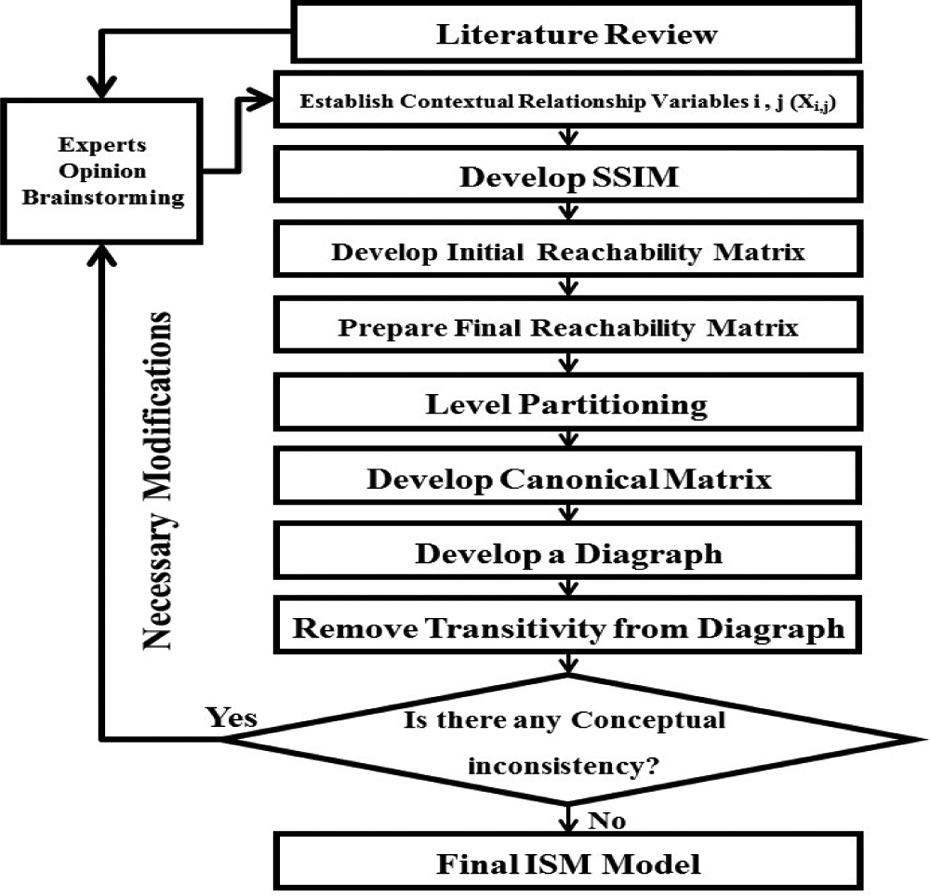
Flow chart of research methodology.
Findings
In a nutshell, the contextual relationships among the variables have been consulted from a team of 19 experts both from industry and academia, as shown in Table 1A. Further, final reachability matrix has been achieved from an initial reachability matrix (shown in Table 1C) that is developed from the Structural Self-Interaction Matrix (SSIM). In the following, the level of the variables has been identified from the final reachability matrix, achieved through three iteration cycle (shown in Tables 1D to 1F). After that, determined levels applied in building the diagraphs and final model. However, the final ISM model will be reviewed to check the conceptual inconsistency and necessary modifications. The final ISM model has been showed in Figure 2.
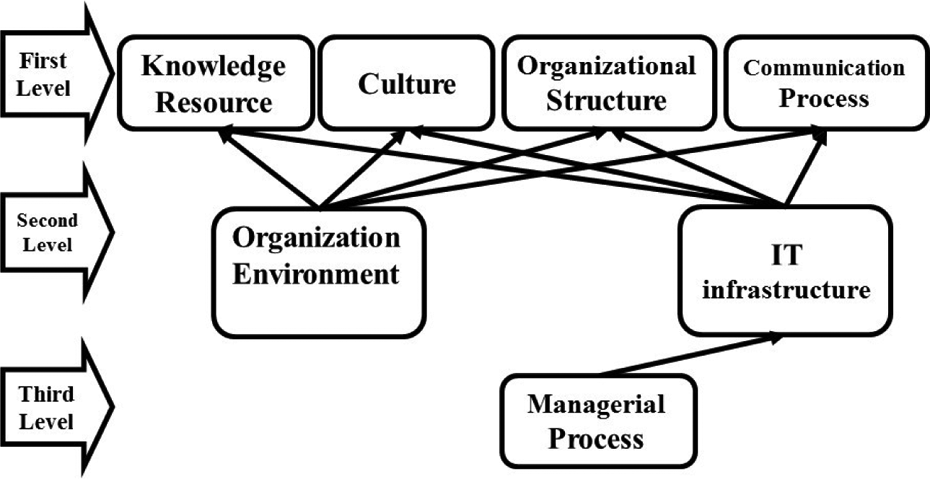
Final ISM model. ISM: Interpretive Structural Modelling.
Further to the already models, in the MICMAC analysis, the dependence power and driver control of the variables are analysed to understand the final ISM model better. Variables in MICMAC analysis will be arranged into four clusters as, independent, dependent, linkage and driver/independent which is shown in Figure 1A. It shows that there are three independent variables (organization environment factors, IT infrastructure and managerial process). These variables in the present study indicate that all of the considered variables play an essential role in the robust implementation of a knowledge network. Finally, Figure 1A indicates that independent variables are at the bottom of ISM hierarchy, having strong driving power and weak dependence.
Discussion and conclusion
Knowledge network variables have been recognized as an important approach for improving the knowledge management. Seven variables for successful implementation of a knowledge network have been classified through related pieces of literature. ISM methodology has been used in finding contextual relationships among various variables. A model has been developed from ISM methodology. ‘Knowledge resource’, ‘culture’, ‘organizational structures’ and ‘communication Processes’ have been identified as top-level variables and ‘managerial processes’ as the most important bottom-level variable. The main objective of this research is to analyse the interaction among the various variables of knowledge network which hinder in the successful implementation of a knowledge network and to develop a hierarchy of variables that would help in understanding. Therefore, an ISM-based model on knowledge network variables has been developed. These variables assume important because they hinder the knowledge network implementation programme and pose considerable challenges both for managers and practitioners of knowledge network. The present research emphasizes that there is the need to prepare these variables for successful implementation of a knowledge network to better managing of knowledge and improve knowledge relations and applications of knowledge to gain organizational goals. MICMAC analysis has also been carried out. The driving power, dependence control diagram helps to categorize various variables for effective knowledge network.
Limitations and suggestions for future research
Finally, it would be useful to suggest the direction of future research in this area. The knowledge network implementation issues may be slightly different. The effects may vary from country to country, work culture of the organization and geographic location within the country. The present model is an interpretive structural model and has not been statistically tested and validated. Thus, the model is required to be statistically tested and verified using different approaches, one of them is the ‘SEM’ approach, and also referred to as linear structural relationship approach. Statistical software like Lisrel 8.7 and Amos 23.0.0 can be used in future to build correlation matrix, confirmatory factor analysis and diagramming to validate the relationships. Comparing ISM and SEM, SEM has the capability of statistically testing an already developed theoretical model whereas ISM, on the other hand can develop an initial model through managerial techniques such as brainstorming, nominal group techniques and idea engineering. In this way, ISM is a supportive analytic tool for this situation. However, it may be suggested that due to complimentary nature of both of these techniques, the future research may be directed to first developing an initial model using ISM and then testing it using SEM. ISM also helps in the classifying variable into dependent, independent, autonomous and link categories. Senior managers may use their resources over identified factors. Thus, optimization of the resources may be accomplished. Further, the systemic framework proposed in this study has broad application and can be used to improve performance, administrative abilities and effectiveness of the organization. Comparing ISM and SEM, SEM has the capability of statistically testing an already developed theoretical model whereas ISM, on the other hand, can develop an initial model through managerial techniques such as brainstorming, nominal group techniques and idea engineering. In this way, ISM is a supportive analytic tool for this situation.
Footnotes
Declaration of Conflicting Interests
The author(s) declared no potential conflicts of interest with respect to the research, authorship, and/or publication of this article.
Funding
The author(s) received no financial support for the research, authorship, and/or publication of this article.
Appendix 1
ISM has the following steps (Sage, 1977):
Step 1: Identified variables from literature review and experts’ opinion. These variables are identified through literature review and experts’ opinion.
Step 2: Structural self-interaction matrix: From the variables identified in step 1, the contextual relationships among the variables the SSIM has been developed in Table 1A. By relating each of the variables with the other variables, one by one, pairwise, through rows and columns. A contextual relationship is thus established among variables regarding ‘V’, ‘A’, ‘X’ and ‘O’. In this stage, a team of 19 experts both from industry and academia has been consulted in developing the contextual relationship among the variables. The following four symbols have been used to denote the direction of the relationship between the two variables (i and j):
V = is used for the relation from variable i to variable j (i.e. if variable i ‘will help achieve’ or ‘will help alleviate’ variable j).
A = is used for the relation from variable j to variable i (i.e. if variable j ‘will be achieved by’ or ‘will be alleviated by’ variable i).
X = is used for both direction relations (i.e. if variable i and j ‘help achieve each other’).
O = is used for no relation between two variables (i.e. if variable i and j are not related).
Step 3: Initial reachability matrix: To develop the reachability matrix from SSIM, two sub-steps were followed. In the first sub-step, the SSIM is converted into the initial reachability matrix by transforming the information of each cell of SSIM into binary digits ‘0s’ and ‘1s’ in the initial reachability matrix. The rules for the substitution are as follows: If the cell (i, j) is assigned with symbol ‘V’ in the SSIM, then this cell (i, j) entry becomes ‘1’ and the cell (j, i) entry becomes ‘0’ in the initial reachability matrix. If the cell (i, j) is assigned with symbol ‘A’ in the SSIM, then this cell (i, j) entry becomes ‘0’ and the cell (j, i) entry becomes ‘1’ in the initial reachability matrix. If the cell (i, j) is assigned with symbol ‘X’ in the SSIM, then this cell (i, j) entry becomes ‘1’ and the cell (j, i) entry also becomes ‘1’ in the initial reachability matrix. If the cell (i, j) is assigned with symbol ‘O’ in the SSIM, then this cell (i, j) entry becomes ‘0’ and the cell (j, i) entry also becomes ‘0’ in the initial reachability matrix.
Following these rules, initial reachability matrix for the variables is developed and is shown in Table 1B.
Step 4: Final reachability matrix: An initial reachability matrix is developed from the SSIM, and the matrix is checked for transitivity. The transitivity of the contextual relation is a basic assumption made in ISM. It states that if a variable ‘i’ is related to ‘j’ and ‘j’ is related to ‘k’, then ‘i’ is necessarily related to ‘k’. Thus, a final reachability matrix is obtained (Table 1C).
Step 5: Level partitioning: Based on the suggestions of Sage (1977), the reachability and predecessor set for each variable is defined from final reachability matrix. The reachability laid down for a particular variable consists of the variable itself and the other variables, which it may help achieve. Similarly, the antecedent set consists of the variable itself and the other variables which may assist in achieving them. After finding the reachability set and antecedent set for each variable, the intersection of these sets is derived for all the variables. The variables for which the reachability and the intersection sets are the same are given the top-level variable in the ISM hierarchy, which would not help achieve any other variable above their level. After the identification of the top-level variable, it is eliminated from the other remaining variables. This iteration is continued till the levels of each variable are determined. The levels so defined help in building the digraph and the final model of ISM. The variables along with their reachability set, antecedent set, intersection set and the different levels are shown in Tables 1D to 1F.
Step 6: Developing conical matrix: On the basis of the levels partitions obtained from step 5 and a final reachability matrix (step 4), a conical matrix is constructed (Table 1G). A directed graph or digraph is drawn and transitive links are removed.
Step 8: The final ISM model developed in step 7 is reviewed to check for conceptual inconsistency, and necessary modifications are made.