







Abstract
This research study looks at the role of Business Information Services (BIS) within financial services and what its future may look like in light of changing internal and external environmental factors. The research is gathered from global investment banks and equity houses and considers the role technology is playing in the development of the BIS department of the future. We review different operating models, how these are affected by internal and external changes and look at future drivers and future scope developments. We also consider the influence of knowledge management services on BIS and discover that although there are some links, there is very little strategic interaction between the two.
Business Information Services (BIS) play a key role in supporting investment banks and other financial institutions, ensuring that information, data and insight are accessible in a timely and efficient manner to bankers, analysts and other operational stakeholders.
BIS teams often also play a key role in ensuring that budgets for market data and third-party information subscriptions are managed effectively and align to overall corporate strategies for growth.
Following the 2008 financial crisis and accelerated further by technological advances, banks have needed to dramatically adapt their organizational set-up, aggressively challenging internal costs. This pressure has been compounded because of increased capitalization costs, and the resources needed to meet an increasingly complex regulatory environment.
Strategies for meeting this challenge include making greater use of digital services; outsourcing non-core business activity; as well as reviewing the location and geographical markets in which they offer their services. Economic factors have also intensified competition, with banks not only competing against their peers but also against big and small providers in the insurance and financial start-up industry. An array of non-traditional offerings are emerging as innovative new contenders.
So, how are these changes influencing the manner and scale of BIS operating in the wider banking and financial services sector? And, how will they shape future models of delivery over the next 2–3 years? It’s always wise to look ahead, but difficult to look further than you can see. (Winston Churchill)
The research methodology used included a background literature search, a semi-structured survey (where the members of the CIMBA Group were used as subject matter experts to help build up a picture of future scenarios), as well as two follow-up sessions with members of the group.
The approach being similar to a forecasting process, through which inputs (including: assumptions; data; insights and judgements) are analysed using a set of structured tools in order to generate different outputs and scenarios to help support future decision-making (Twiss, 1992).
Although we are not in a position to divulge confidential information, we are keen to share the broad trends that emerged from the survey.
Operating models
To explore the operating model of the future, we first needed to establish a broad definition and picture of the current operating models.
An operating model is the link between strategic goals and routine service delivery. Over the last decade, the BIS operating model has changed dramatically to better align with the key attributes and behaviours of the organizations they serve.
Within BIS operations, our respondents are seeing a shift in user demands towards a concentration of value-added service provision.
This emerging trend continues to evolve and is pushing financial organizations to better adapt to the needs of banking and procurement professionals within the industry as well as to comply with ever-changing market regulations.
The current BIS operating model, as mapped in our survey, comprises two distinct but almost equal segments – value-added research being completed onshore, which comprises 49 per cent of total volume, and volume-driven research, some 51 per cent of total volumes, which is completed offshore in either a captive or outsourced setting.
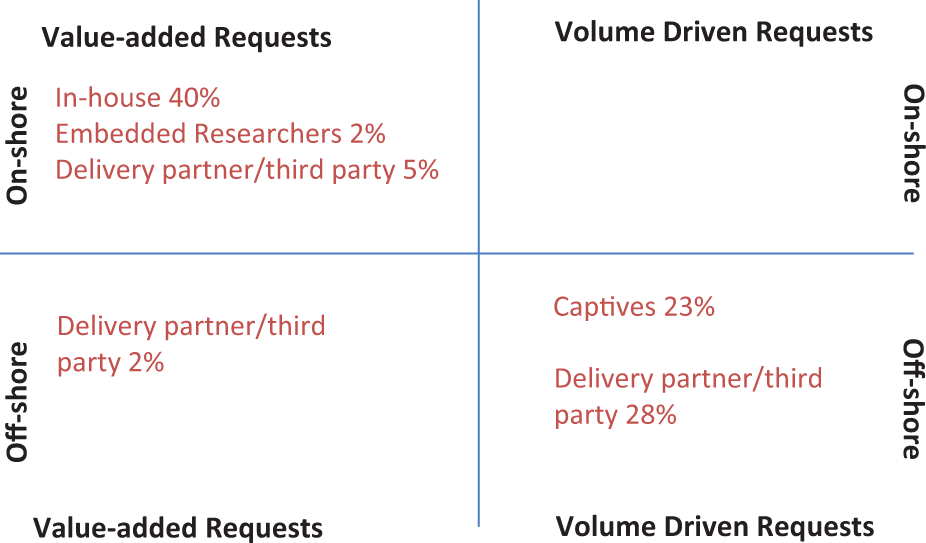
Further discussion among the CIMBA Group, however, added an additional layer to this high-level pattern. While acknowledging the overall split, and in particular, the tendency for an increasingly high proportion of volume work to be undertaken offshore in order to deliver financial efficiencies, it was also highlighted that nearly all researchers, irrespective of location, had moved beyond information gathering and retrieval to supporting enquiries at higher levels.
Information specialists possess a command of numerous information sources. Market data vendors hold more and more data across an array of technological platforms.
Are these two core elements of the profession about to enter their next development phase? Times and conditions change so rapidly, that we must keep our aim constantly focused on the future. (Walt Disney)
Future drivers
What are the critical forces, both technological and non-technological that are reshaping the current operating model?
The majority of our respondents agree that the two top key non-technological drivers that affect BIS service delivery are market data products and vendors management.
The 2016 Business Information Survey established that: budget and vendors are inextricably linked and there is room for improvement in the areas of innovation, customer relationships and pricing.
These results are further reinforced a year later with the majority of our respondents seeing a challenge in the imbalance of power within the market data vendors landscape and the tracking and management of data usage and data quality.
The market data landscape is also being revolutionized by the exponential growth of the availability of data and the consolidation of market data providers, gaining market share and narrowing the competitive market, thus creating certain inefficiencies for customers.
Banks and other financial institutions are pushing vendors for new or more innovative models of data consumption, which focus on paying for value-add content rather than being forced to consume or pay for a fixed menu of data sets, irrespective of business need.
As automation and aggregation tools become more sophisticated, it becomes more viable for organizations to seek out and build their own data sources, protecting remaining budget for critical or core to business sources.
Most investment banks and private equity firms have already been continually streamlining their market data portfolios, but moving forward, there could still be further specialization, channelling information needs towards specific subjects and sectors.
On the technology front, all our survey respondents agree that the two top technological drivers for the future of BIS are artificial intelligence (AI) and secondary monitoring tools. These forces in turn will have a powerful impact on the industry workforce globally.
In a research context, the starting point on the pathway to AI is often robotic process automation. This can be used to translate or read requirements from a structured enquiry form or assist the researcher in gathering and collating data and information in a smart and time-effective manner.
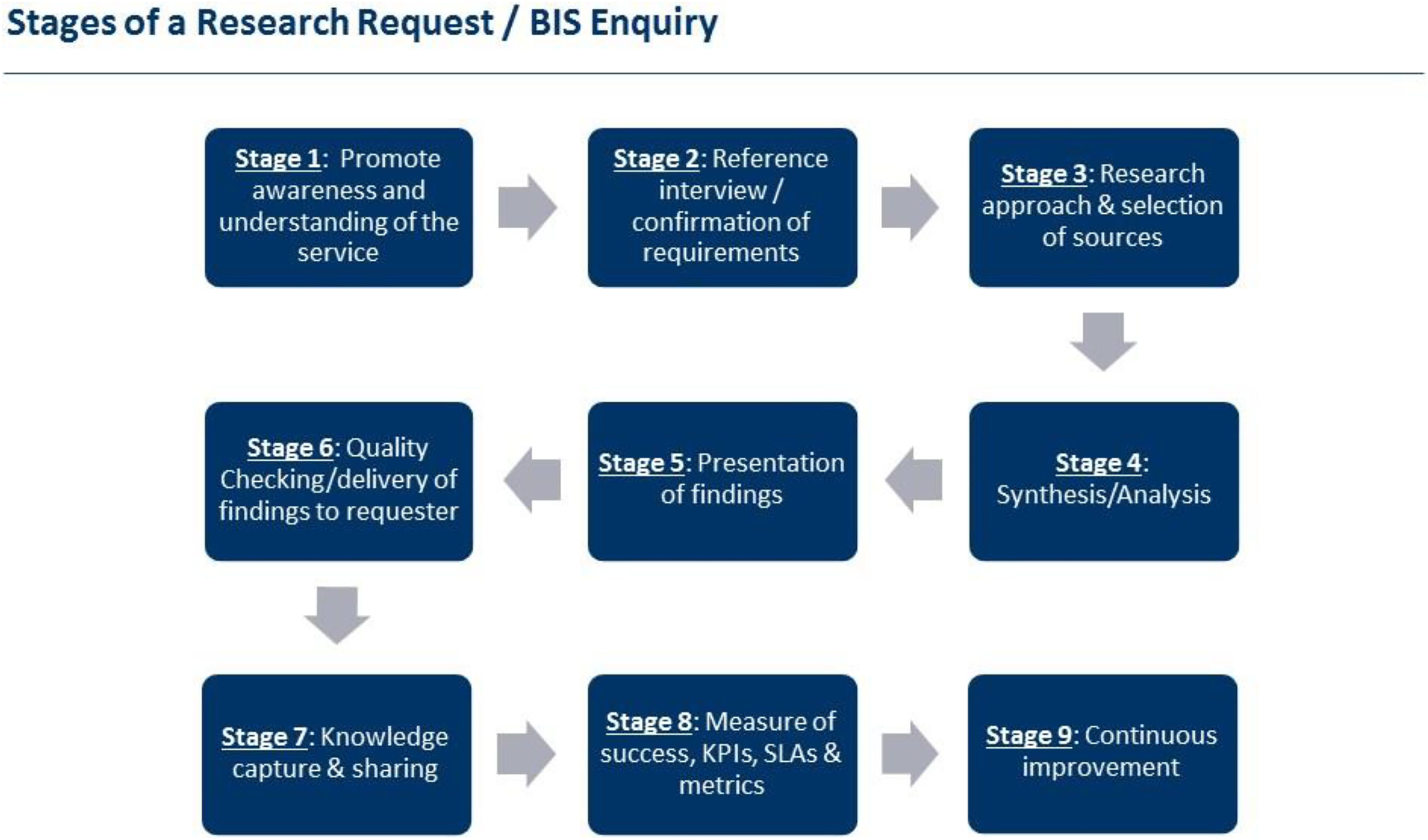
We believe this will often be more effectively applied, where the researcher still retains overall control and ownership of the enquiry process (see Stages of a Research Request), authorizing the robot to proceed to the next step once a check or review of contents has been undertaken.
So although not all low-end, non-complex research requests will be fully automated through technological solutions, automation of a number of the steps involved will improve productivity, enabling staff to concentrate on the high-end, value-added research that requires use of the grey matter.
Secondary monitoring tools are a pre-requisite for firms wanting to set up pay-as-you-go data consumption models to inform future purchase decisions. They also provide a potentially valuable source of information to feed into business cases when looking to measure the benefits to support a purchase or renewal.
Future scope of BIS services
Seventy-five per cent of respondents believe that the scope of BIS work will increase over the next 2 years. This does not necessarily mean that the overall scale or volume of work will grow, but that BIS functions will need to support a potentially broader range of stakeholders and also a more diverse set of enquiries or support requests.
What does this all mean for the operating model? Technology can only deliver so much. There is a strong people element here too.
As a result, we believe that offshore teams will abandon much of the volume-driven information research which is most ripe for automation and focus their development into some of the areas that are currently still processed by information specialists onshore. This will give offshore operations the possibility of creating much-needed career structures that will allow workers to progress, helping with the retention of staff and allowing onshore teams to focus on their own development needs.
However, these changes will further expose the looming skills gap within onshore teams already identified by our respondents. The traditional librarian skill set is based on the ability to extract relevant information from multiple sources using extensive search techniques and long-standing professional expertise. This skill set is widely undervalued, in a world in which data is readily available online, but difficult to assess.
Nonetheless, these practitioners will be forced to upgrade their skills as offshore teams and technological evolution pulls away some of their historical core functions. Their focus should switch to supporting IT developers in crafting relevant algorithms to power AI tools and strengthening their ability to deliver basic analysis to better support key business goals. These skills will drive them towards becoming data scientists.
Knowledge management
Another key function within Corporate Organizations is knowledge management (KM). We decided to include a question on this topic in the survey. [Is your BIS operation currently at the centre of your organisation’s knowledge management efforts?] Knowledge management is a discipline that promotes an integrated approach to identifying, capturing, evaluating, retrieving, and sharing all of an enterprise’s information assets. These assets may include databases, documents, policies, procedures, and previously un-captured expertise and experience in individual workers. (Gartner)
Do these results point towards another potential area of development for BIS teams? In our view, it certainly open the debate around BIS’ ability to expand their scope of work to further support/tighten the KM processes within their organizations.
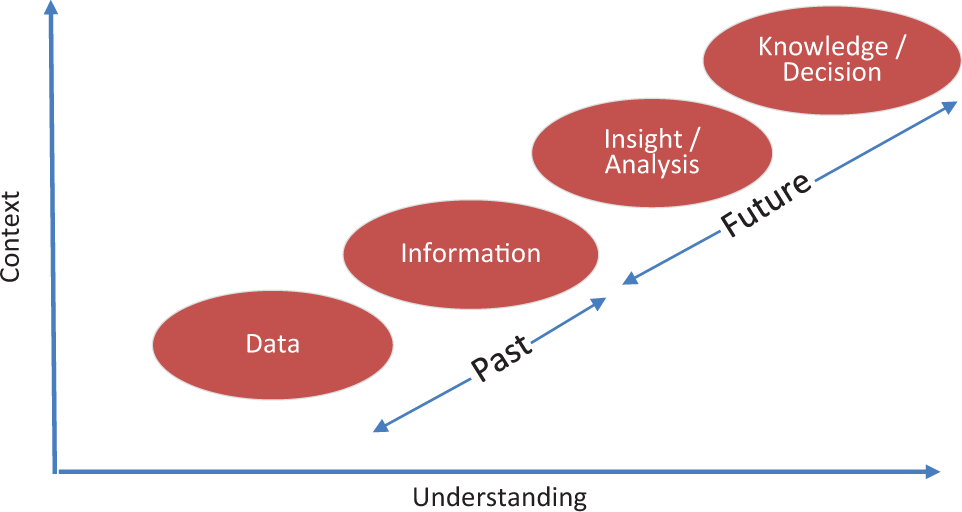
The key to a successful transition of the profession is the permutation of the researchers’ role from a knowledge provision specialist to a base analysis one, moving away from providing raw information to providing a recommendation derived from the gathered information.
In conclusion, despite facing continual budgetary pressures, and a need to support an often-growing range of enquiries, the technological and non-technological forces highlighted above present BIS teams with a range of opportunities through which to expand their role and value proposition to the stakeholders they support.
The operating models and set-up will continue to evolve, and the underlying demand for a core skill set of information and knowledge professionals (or the possible data scientists they will evolve into) will remain.
The ability to expand the scope and meet these opportunities will be contingent on the ability of both the staff and services to change, embracing, rather than being threatened by automation. For some roles, this journey may well move towards a skill set more commonly associated with business or process analysts.
When describing their vision for the future of the service, one of our respondents said: [Using and applying content to create insight with the help of new productivity enhancement tools such as NLP, web scrapping and AI.]
Irrespective of your current model and set-up, there are a number of practical steps and actions that can be taken to help prepare BIS services for the future. These include: ensuring existing processes and enquiry handling guidance are effectively documented and set-out with logic rules or decision points (a pre-requisite for introducing any automation technology); that research teams continue to build up their own source maps, capturing where free or new sources of data are available and can be accessed; to extrapolate from their existing enquiry patterns, the two or three most likely future scenarios in their own organization for future research requests (and then producing a skills matrix and conducting a gap assessment to check how far they are from being able to support these needs); to monitor either through use of technology, and/or feedback captured from end-users of the service, which data source or content add value or support differentiation and improved decision-making; and to conduct a demand assessment, looking at which requests or research questions could be scheduled as: repeat requests that need to be undertaken on a more frequent or recurring basis; pro-active alerts that could be met in future through an automated news or content alert; and cluster requests that’s could be of interest to other stakeholders or colleagues in a similar role [not withstanding constraints on disseminating information internally in line with regulatory requirements]. The best way to predict the future is to create it. (Alan Kay)
Footnotes
Declaration of Conflicting Interests
The author(s) declared no potential conflicts of interest with respect to the research, authorship, and/or publication of this article.
Funding
The author(s) declared no potential conflicts of interest with respect to the research, authorship, and/or publication of this article.