







Abstract
Confusion has long existed between knowledge management (KM) and information management (IM). To the uninitiated, the difference between KM and IM is unclear – largely because there are no universally accepted definitions of ‘knowledge’ and ‘information’. But the confusion is not limited to the uninitiated. KM and IM specialists argue over the meaning of explicit and tacit knowledge, over the difference between information and data, and over the difference between codified knowledge and information. Why? And does any of this matter? This article explores the confusion between KM and IM by reflecting on the origins, development and current state of the two disciplines. The words we use to think and talk about KM and IM directly influence the way we practise KM and IM: and in some contexts, confusion between KM and IM has serious adverse effects on understanding and practice. The solution might lie in closer future development of the two disciplines – as long as practitioners appreciate that KM and IM are distinct but complementary, we talk to each other, and we pay attention to the words we use.
Keywords
Confusion, confusion, confusion
As knowledge management (KM) and information management (IM) practitioners, we regularly encounter situations where confusion between our two disciplines leads to practical difficulties, conversations at cross-purposes and missed opportunities. Even in the world of standards (we are both involved in KM and IM standards development) we can say with confidence that KM and IM professionals do not understand or communicate with each other as well as they might.
Here are a few anecdotes, all from the last two years, to illustrate the confusion today.
We don’t need to share knowledge
Senior manager with ‘knowledge’ in their job title: we don’t need to share knowledge because everyone can find all the knowledge they need using Google.
The job search
A KM colleague had the bad luck to be made redundant three times in three years. When he searched for KM jobs, most of those he found were concerned with managing content – with little consideration for how this was connected to organizational strategy, and even less consideration for people.
KM by stealth
KM by stealth is a tactic for winning support for KM initiatives by labelling them ‘IM’ or starting out with a focus on IM. Occasionally it works, but often it backfires. If the IM has low impact, why would anyone support doing more of it? If the IM is successful, why would anyone support a change of direction to include more KM?
What do we want?
A ‘knowledge based’ organization asked for a ‘knowledge strategy’. When delivered, although there was some interest in lessons learned, it transpired that what they really wanted was an Enterprise Content Management (ECM) system.
Mixing it up in a good way (mostly)
A conference presenter was congratulated for delivering ‘the best KM case study for a long time’ and ‘an excellent example of good IM’. In conversation, it transpired that the presenter understood the difference between KM and IM very clearly; appreciated the need for both; and did not think it necessary to make the distinction clear to everyone. This worked well in the context of the organization – but relied heavily on the clarity of the presenter’s understanding. What would happen if the presenter left the organization?
Mixing it up in a bad way
For many years, a professional association’s definition of KM started with ‘KM is the systematic management of information…’. This reinforced the existing confusion between KM and IM and made it very difficult to introduce ‘real’ KM thinking. The definition and description of KM has now been updated, but the confusion lingers on.
The ISO online browsing platform
ISO, the international organization for standards, maintains an open-access database (https://www.iso.org/obp/ui/) that includes definitions from all its published standards. Fifteen standards define ‘knowledge’. The definitions include: maintained, processed and interpreted information; facts, information, truths, principles or understanding acquired through experience or education; outcome of the assimilation of information through learning and human or organizational asset enabling effective decisions and action in context.
Only the last definition (from BS ISO 30401: Knowledge Management Systems – Requirements) reflects current KM thinking.
Eighty-four standards define ‘information’. The definitions include data recorded and/or stored in a system; knowledge concerning objects, such as facts, events, things, processes, or ideas, including concepts, that within a certain context has a particular meaning; facts, concepts or instructions; data, documentation and other relevant knowledge organized to inform and describe and any type of knowledge that can be exchanged.
However, the majority of ISO standards that use the word ‘information’ do not attempt to define it. ISO does not require definitions for ‘common terms’: it is assumed that users of standards have a shared understanding of their meanings.
Siblings
Imagine that KM and IM are siblings. IM was born in the 1970s, KM in the 1990s: into two different worlds. By the time KM came along, IM had left home – so the two have never been very close. Despite the age difference, to passing acquaintances, IM and KM look very similar – and they have more in common than they choose to admit. Both are interested in knowledge, information, people, organizational culture, technology and strategy. Both operate at different levels, from the philosophical to the minutiae of tactical detail. Both feel misunderstood, which might explain why they continually reinvent themselves and change their names.
On a good day, KM and IM work well together: each respecting the other. On a bad day, sibling rivalry takes over – and KM and IM engage in a struggle for supremacy. Each is supported by a group of like-minded followers. With the exception of a few boundary-spanning individuals, the two tribes rarely meet – and when they do they find it difficult to understand each other.
KM and IM don’t have much to do with each other these days. How did they reach this point?
The early years
The 1970s–1990s
IM is an umbrella term that covers a multitude of sub-disciplines. IM as we know it today was born in the late 1970s or early 1980s, when it was called data management. Random access storage (which was replacing the old methods of sequential processing) made it possible to store and distribute huge volumes of digital information and led to a focus on the arrangement and management of digital information in order to improve processing efficiency. The focus was on the structuring and storage of data rather than on how the resulting information might be used.
As the 1980s progressed and organizations grew larger and more complex, a new discipline of document management emerged: the management of paper (and later electronic) documents through workflow and other processes to deliver the right information to the right person at the right time. By the late 1980s, as these more structured methods of managing documentary information proved valuable, there was growing recognition of the strategic importance and value of information to organizations. Information was a key strategic ‘asset’ (originally an accounting term) or ‘resource’ (an organizational studies term). Either way, information was a source of value and competitive advantage. As such, it required the attention of strategists and senior managers as well as information and technology specialists.
By the mid-1990s, in response to the explosive proliferation of electronic documentation, a new IM discipline of records management developed to separate important information assets from the merely disposable. Records management is IM with a focus on maximizing the evidential value of information about business activities and transactions throughout the information life cycle, which includes a tacit understanding that not all information is of equal value, and that its value may change over time. This developing understanding fuelled the shift towards strategic IM in the 1990s, supported by a flurry of Government and business reports including the Hawley report, which charged board members with the identification, management and effective use of organizations’ information assets (see Ward and Carter, 2019). This was the era of divisional, matrix and networked organizations where delegation was a key capability. The combination of delegation skills and developments in technology made it possible to share market, customer and technical information within and across organizations so that everyone could focus on their core competencies (Miles et al., 2000). The link between IM, strategy and organizational capabilities had been established.
KM first appeared in the 1990s, while IM was finding its strategic feet. Peter Drucker (1988) had already written about the need for knowledge in information-based organizations, and in 1991 Harvard Business Review published an article by Ikujiro Nonaka (1991) that introduced the concept of tacit knowledge to a wide business audience. Early 1990s KM was strategic: knowledge was seen as an important strategic resource and the most valuable of an organization’s intangible assets. Kogut and Zander (1992) went even further than this, stating that the reason organizations exist is to create, integrate and transform knowledge into goods and services. ‘Knowledge’ included hidden, tacit knowledge and know-how held by individuals, in relationships and in organizations. Managing knowledge, therefore, included managing people, relationships and organizational culture.
These illustrious origins and the strategic thinking of KM pioneers such as Leif Edvinsson, Karl-Erik Sveiby and Hubert Saint-Onge attracted the interest of academics, and KM was quickly recognized as a new strategic discipline. Like IM, KM grabbed the attention of the UK Government. In 1998, the Department of Trade and Industry published Our Competitive Future: Building the Knowledge Driven Economy and committed to investing in business capabilities, supporting collaboration and modernizing markets.
The stage seemed set for organizations to adopt KM as a strategic discipline and set of practices distinct from and complementary to IM – but there was a fly in the KM ointment.
The fly in the KM ointment
In spite of KM’s distinguished beginnings and strategic focus, many early mainstream KM practices bore a remarkable resemblance to IM practices. As early KM practitioners, we already understood the difference between knowledge and information. We understood that KM was a means of reaching goals and outcomes, and not an end in itself – although making connections between what we did and what happened was far from easy. We introduced ‘real’ KM such as communities of practice (borrowed from education); ‘people finders’ to help connect workers with shared interests (social media had yet to be invented); and storytelling. We stressed the importance of organizational culture, of recognizing good knowledge-sharing behaviour, of workplace design and time for KM. But we also adopted the mantra of making sure people could access and apply ‘the right knowledge, at the right time and in the right place’ (sometimes forgetting to substitute ‘knowledge’ for ‘information’) and created knowledge life cycle models based on information life cycle models. We used frameworks such as the DIKW (data, information, knowledge and wisdom) pyramid and DIKAR (data, information, knowledge, action and results) to explain KM – even though we were not convinced they worked for KM. And we included content management systems and search engines in our toolkits. Why? IM wasn’t on our radar. KM practitioners simply weren’t aware that IM already had information covered.
This didn’t go unnoticed. Karl-Erik Sveiby (1996) observed two distinct emerging KM perspectives: ‘IT-track KM’ in which knowledge is treated as objects that can be handled in technology systems; and ‘people-track KM’ in which knowledge is treated as processes, with a focus on human skills and behaviour. In 1996, IT-track KM was growing quickly, whereas people-track KM was not – despite the latter holding far more potential for the development and effective use of knowledge. Sveiby also observed that the two tracks had different roots (IT-track KM in information science; people-track KM in philosophy, psychology and sociology) and therefore used different languages – which caused confusion when they met.
Sveiby wasn’t the only author to sound the alarm. Liam Fahey and Larry Prusak (1998) published a landmark article called The Eleven Deadliest Sins of Knowledge Management that describes 11 ‘pervasive KM errors’ – described by the authors as fundamental errors that inhibit knowledge from being developed and used effectively. Error 1 is not developing a working definition of knowledge. More specifically, error 1 is about failing to distinguish between data, information and knowledge. Error 1 leads directly to error 2: emphasizing knowledge stock to the detriment of knowledge flow and error 3: viewing knowledge as existing predominantly outside the heads of individuals. Fahey and Prusak also observe that: If knowledge is not something that is different from data or information, then there is nothing new or interesting in knowledge management. Yet many managers seem determinedly reluctant to distinguish between data and information on the one hand and knowledge on the other; and, more importantly, they seem reluctant to consider the implications of these distinctions.
KM and IM in the twenty-first century
Once the confusion between KM and IM took hold, it became difficult to shift. From about 2000, KM practices developed to include ways of sharing knowledge by connecting people to other people, regardless of their positions in organizational hierarchies. From the mid-2000s, KM practices became more focused on collective problem solving, innovation and understanding complex issues – all ways that people create new knowledge together.
But the IT-track ‘capture and disseminate’ approach to KM persisted, supported by technology vendors selling ‘complete KM solutions’ that were essentially databases and document management applications. Some people declared KM dead. Some decided it was just a fad. Others considered the term devalued by technology vendors, and stopped using it – switching instead to terms such as organizational learning.
At the same time, many new flavours of IM were developing, including
web content management (management of the assets and information required to present complex web sites and social media to the world),
digital asset management (management and distribution of digital media and the associated intellectual property rights),
management information (synthesis and analysis of internal business data to inform decision-making),
business intelligence (synthesis and analysis of external business data to enhance competitive edge) and
business process management (management of real-time business information to maximize the efficiency of production processes).
Some organizations also began to place older related disciplines under the IM umbrella. In many law firms and other research-driven organizations, library science (the management of published information) became part of the IM family. Similarly, in many cultural institutions archival science (the management of historical records in perpetuity) was also absorbed into a wider IM team.
Despite their nuances and differences in focus, each of these IM sub-disciplines has at least one thing in common that ultimately makes them IM at heart: they are all concerned with the management of data structures (e.g. information) which are encoded into an object in either the physical or digital realm. Ultimately, they are all concerned with the management of ‘things’.
The proliferation of IM sub-disciplines makes it easy to see how organizations might view KM as just another flavour or specialism of IM.
The three eras of KM
Between 2009 and 2012, Nancy Dixon reflected on developments in KM in a series of blog posts (Dixon, 2012) where she divided KM into three eras, as summarized in Figure 1. In 2018 Dixon updated the model and placed the (then) current state of KM in era 3.
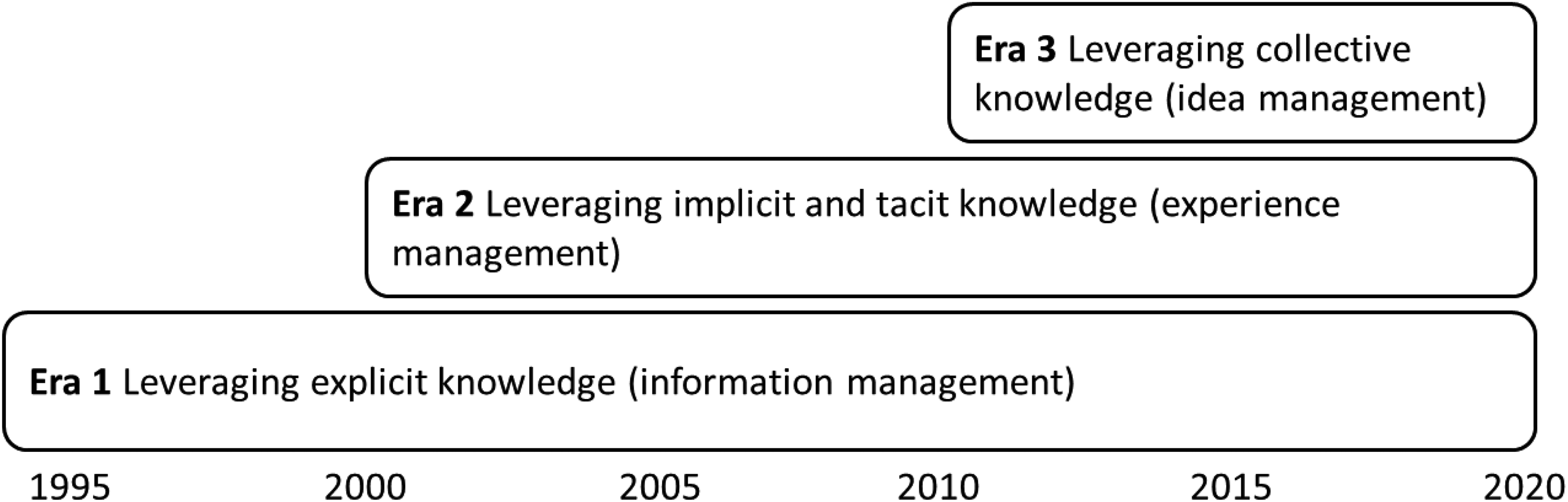
Three eras of KM (based on Dixon, 2018). KM: knowledge management.
An important feature of Dixon’s model is that although each era of KM has a start date, none has an end date. Dixon puts a positive spin on this: stating that the thinking and strategies in each era remain viable when a new era emerges. She also points out that when a new era emerges, strategies and practices from previous eras continue to develop.
This is certainly true of the first era, which is labelled ‘IM’. The myriad disciplines of IM continue to evolve, specialize, re-integrate and develop. Most recently the intellectual focus of IM has widened to include information governance, risk management, compliance and security – extending the information life cycle or ecosystem to focus not only on how information is structured, stored or transmitted, but also on how it is used, protected and exploited: areas which are more traditionally the focus of finance professionals, lawyers, strategists and senior management. In terms of technology, the trend over the last decade in IM has been to reunify its various sub-disciplines with ECM platforms – monolithic systems that attempt to manage and connect all of an organization’s information regardless of its format, location or utility.
Although the thinking and strategies of each era remain viable, this creates another problem for KM and IM. Our understanding is developing at a pace that makes it difficult to keep up. Anyone trying to understand KM and IM for the first time today is faced with a bewildering array of conflicting definitions, thinking and strategies from all 3 of Dixon’s eras, from 50 years of IM, and from recent developments in AI, data analytics and machine learning.
It is a certainty that KM too will continue to evolve. Dixon makes passing reference in her 2018 update to artificial intelligence, bots and augmented reality, but does not go as far as proposing they signal the emergence of a fourth era. It is probably too early to be sure.
AI, data analytics and machine learning
If a fourth era is beginning, is it KM? IM? Data management? None of these? Or all three?
The words we use to describe AI, data analytics and machine learning are already causing additional confusion. Rather like technology vendors selling ‘complete KM solutions’, some data analysts label their work as ‘KM’. As well as adding to existing confusion, this detracts attention from the value of data analytics and from the potential of AI to add value to knowledge work.
But developments in AI and machine learning also present opportunities for re-examining the relationship between data, information and knowledge – and the words we use to talk about them. If machine intelligence is ‘artificial’, what do we call the outcome of machine learning? Artificial knowledge? Adopting this term would make the distinction between human knowledge and that generated by machine learning, without devaluing either.
Machines can mine and analyse vast amounts of real-time data from multiple sources and in multiple formats. A machine that is rapidly analysing real-time observations, spotting patterns and getting better at doing this all the time is imitating what people do when we learn subconsciously from practical experience. Machine learning doesn’t generate human knowledge. Strictly speaking, it generates information, but information of a particular kind that we will call ‘artificial knowledge’. To become human knowledge, machine-generated artificial knowledge still needs to be understood by people, which requires the use of human knowledge (Figure 2).
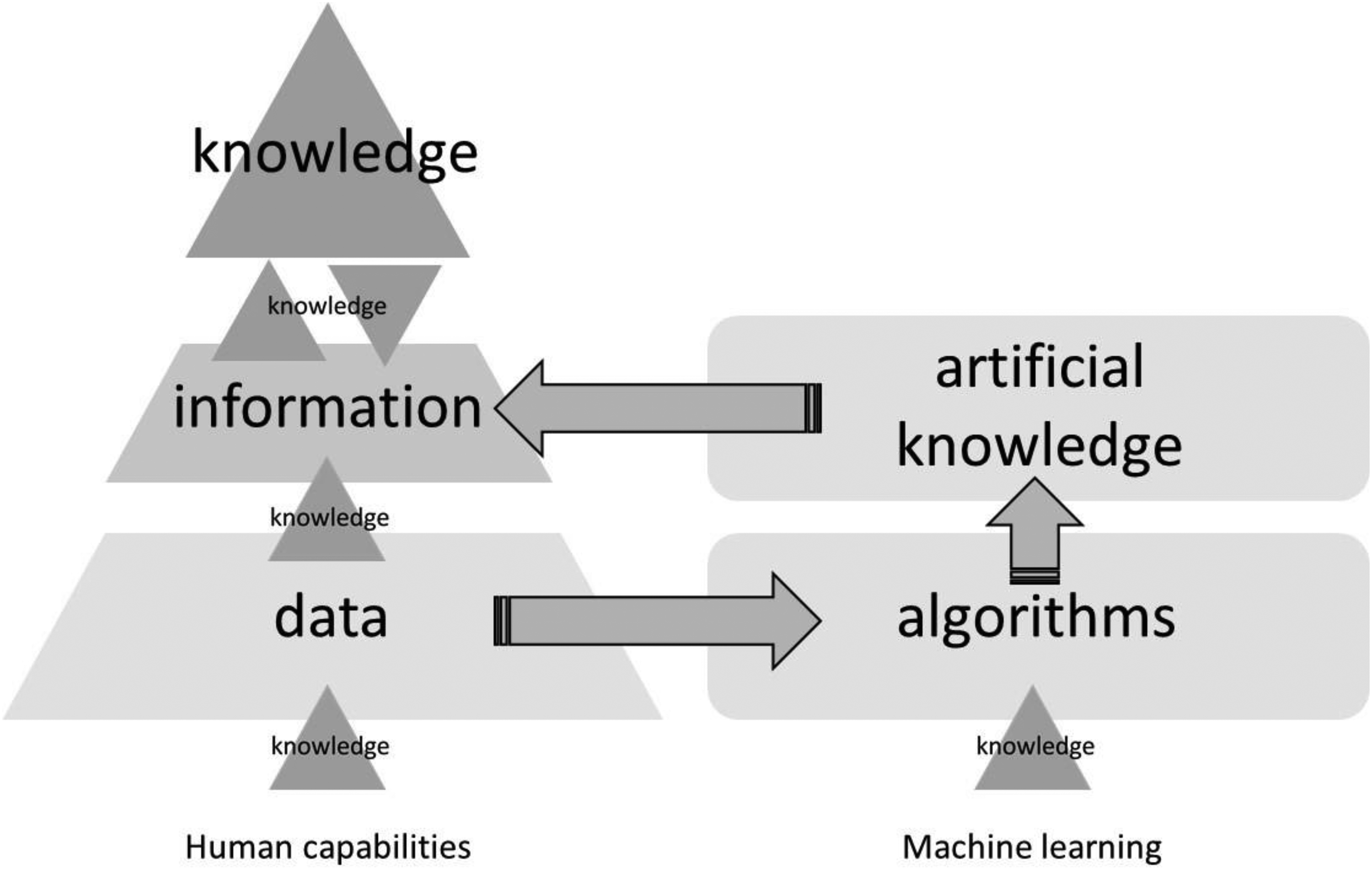
Data, information and knowledge: human capabilities and machine learning.
Machine learning is fraught with difficulties: data is regressive and full of biases (but so are we); algorithms might be wrong (because we created them). Most of all, machines don’t have feelings, judgement or creativity – they can’t decide they don’t like what they have learned, or that it is wrong. They can’t think and learn outside the box of their programming. What a machine can do is make artificial knowledge accessible to people who don’t have years of practical experience or the time or capacity to manually analyse tens of millions of data points.
What is the difference between KM and IM?
The purpose of this section is not to force our own thinking on anyone. It is to highlight differences in the meanings KM and IM experts attach to ‘information’, ‘knowledge’ and related terms – and therefore to KM and IM.
KM and IM are usually defined in terms of ‘knowledge’ and ‘information’, respectively. For example: BS ISO 30401: Knowledge management systems – Requirements (BSI, 2018) defines KM as ‘management with regard to knowledge’. BS ISO 5127: Information and documentation. Foundation and vocabulary (BSI, 2017) defines IM as ‘planning, collection, control, distribution and exploitation of information resources within an organization, including systems development, and disposal or long-term preservation’. Knowledge cannot exist without people. Information, once created, exists on its own. Knowledge is always intangible. Information is tangible in the sense that it has a physical or digital form – even though it is usually classed as an intangible asset – as previously stated, it is a ‘thing’. Knowledge is needed to make decisions and take actions. Information is usually an input to this knowledge, but understanding (based largely on existing knowledge) has to be applied to information to turn it into knowledge that can be used for decisions and actions.
These distinctions are accepted by most KM and IM experts. Deeper differences of opinion between experts become clear in the language used to describe different types of knowledge and their relationship with information.
Our view:
Codification is the process of expressing knowledge in words, pictures or other symbols to create codified knowledge.
Codified knowledge is information.
Codified knowledge is always an incomplete representation of knowledge: no-one can write down everything they know.
Explicit knowledge refers to what we know we know, and can readily codify. Codified knowledge is not the same as explicit knowledge because not all explicit knowledge has been codified: there are things we know and could write down, but haven’t.
Tacit knowledge refers to what we find difficult or impossible to codify (such as insights and experience) and might not even realize we know.
The main alternative view amongst experts is that explicit knowledge is the same as codified knowledge. Knowledge that has not been codified is tacit knowledge, regardless of whether it could easily be codified. Some also use the term implicit knowledge: usually to refer to knowledge created subconsciously through practice and experience, and occasionally to refer to explicit knowledge that has not been codified.
Experts also differ over whether codified knowledge is always information. Some believe it is; others make the distinction between knowledge and information by asking whether the codified knowledge can be used as the basis of decision-making (as in point 3 above).
Whatever view we take of the relationship between knowledge and information, for at least some of the time we all use the term ‘codified knowledge’ to refer to information. If KM is ‘management with regard to knowledge’ and ‘knowledge’ includes some information, then KM includes some IM. Or looking at it from the other direction, IM theory, tools and techniques can be applied to the tangible outputs of KM. This is, of course, another factor contributing to the confusion between the disciplines.
Does any of this matter?
It probably doesn’t matter that experts don’t agree. We can agree to differ. What does matter is the confusion between KM and IM in practice. The meanings we attach to ‘knowledge’ and ‘information’ have a direct effect on the way we approach KM and IM, and on the results of our work.
Studies of organizational knowledge have identified three common perspectives on knowledge (Figure 3). Each perspective has a corresponding approach to KM and typical associated KM practices.
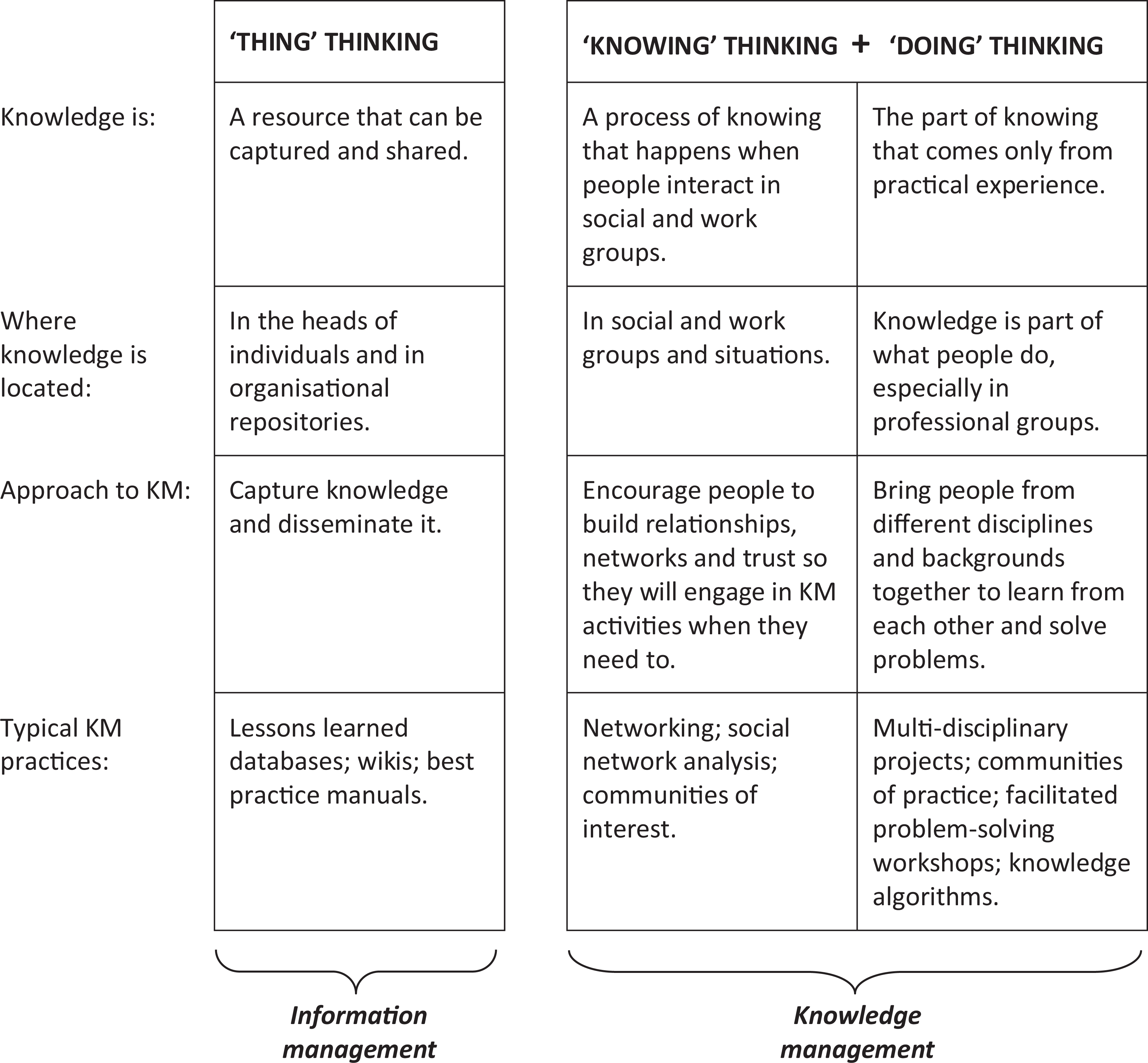
Three perspectives on knowledge and KM (based on Payne et al., 2019). KM: knowledge management.
The three perspectives on knowledge and KM bear a strong resemblance to Nancy Dixon’s three eras of KM. The extent to which the perspectives are a result of the way KM has developed is unclear, but it is unfortunate that early KM practices may well have legitimized the ‘thing’ thinking approach to KM, as this is the perspective that is the most ‘primitive’ form of KM and which arguably is (in many situations) the least effective at leveraging the knowledge of an organization. And to many KM and IM experts, the description of knowledge in the ‘thing’ thinking perspective is information, not knowledge – and it leads to IM, not KM.
To complicate matters even further: although most people instinctively know that knowledge is deeper than information, many still approach KM from a ‘thing’ thinking perspective and adopt ‘thing’ thinking practices. This can lead to organizations practising IM (sometimes badly) and calling it KM. If the distinction between KM and IM is not made, IM can drive out KM – because IM practices can be more easily seen, measured and justified. In either scenario, organizations can miss out on good KM and IM practices, on the ‘real’ KM of the ‘knowing’ and ‘doing’ perspectives and on the value good KM can add.
Ending the KM and IM confusion
How can KM and IM professionals end the confusion that surrounds our disciplines? Here are a few ideas.
Find the right words
As KM and IM professionals, we need to pay more attention to the words we use. Continuing to use ‘knowledge’ and ‘information’ interchangeably will only make matters worse.
If we can agree that codified knowledge is essentially information, at least in most contexts, then we have a way forward. We also have an opportunity to develop consistent terms for talking about data, AI and machine learning in a way that reinforces the distinction and relationship between KM and IM.
If we change the language we use, then slowly our understanding will spread to non-specialists.
Treat KM and IM as distinct and complementary
Treating KM and IM as distinct but complementary opens the door to good practices from both disciplines. To do this, professionals from each discipline need to respect and value the other. Knowledge managers need to develop an understanding of IM; information managers need to develop an understanding of KM.
This is already starting to happen within IM to some extent. In his influential 2017 blog post Michael Woodbridge (2017), a Gartner analyst, declared the death of ECM on the basis that a single system will never support the proper management of the entirety of an organization’s intellectual assets. Instead, he argues for a wide and flexible ‘content services’ strategy that can simultaneously support the management of regulatory compliance and risk management, retention and dissemination of business knowledge, cost and process efficiencies and innovation and new ways of working.
Note that this is an IM technologist setting out a new IM paradigm that does not mention the word ‘information’ once – and mistakenly refers to ‘dissemination’ of knowledge. But Woodbridge has realized that IM has reached its limit, and now needs to be integrated with KM and innovation.
Focus on common dimensions of KM and IM
Most of this article has focused on the differences between KM and IM and the confusion that leads to missed opportunities. Perhaps it helps to consider what they have in common. Both are concerned with managing strategic organizational assets (or resources); contribute to organizational goals and outcomes; can be applied at strategic, tactical and operational levels; have people, process and technology dimensions; benefit from a supporting culture and environment and are influenced by the same social, technological, environmental, economic and political trends.
Focusing on the common dimensions is potentially a valuable role for senior managers and strategists, who should also take care to maintain the distinction between KM and IM.
Talk to each other
The KM and IM siblings would both benefit from a closer relationship. If KM and IM are not on speaking terms, they will grow further apart and create more confusion.
Conversations are needed at various levels: in organizations, in professional associations such as CILIP (the UK library and information association), between academics, through publications and in the development of standards and guidance. The KM and IM boundary spanners who have a foot in each camp have a key role to play here.
We hope this article is part of a much wider conversation about KM and IM that will help to bring them closer together.
Footnotes
Declaration of conflicting interests
The author(s) declared no potential conflicts of interest with respect to the research, authorship, and/or publication of this article.
Funding
The author(s) received no financial support for the research, authorship, and/or publication of this article.