







Abstract
This paper evaluates the bibliographic and full-text coverage of 15 resources that can be used to discover and access the economics literature. It compares the coverage of conventional library databases such as Scopus and EconLit with that of 10 free, alternative discovery/access mechanisms: a scholarly search engine (Google Scholar), two web-based scholarly databases (Dimensions and OpenAlex), five academic social networks (Academia.edu, arXiv, RePEc, ResearchGate, and SSRN) and two pirate sites (Anna’s Archive and Sci-Hub). The analysis, based on known-item searches for 125 works cited in the Journal of Economic Literature, reveals that the most comprehensive alternative discovery/access mechanisms offer more complete bibliographic and full-text coverage than any of the conventional databases. Google Scholar, OpenAlex, and ResearchGate are among the most comprehensive sources of bibliographic records, while Google Scholar, OpenAlex, and the two pirate sites provide free, full-text access to more of the target documents than any other resources. Although several of the alternative discovery/access mechanisms are deficient in terms of their user interfaces, search capabilities, and metadata, they nonetheless provide excellent bibliographic and full-text coverage of the economics literature. In contrast, no conventional single-subject database covers more than 62% of the target documents.
Introduction
Economists seeking to discover and access relevant scholarly literature have long relied on specialized subject databases such as EconLit, along with large multidisciplinary databases such as Scopus and Web of Science. In recent years, however, a number of free, openly accessible alternative discovery/access mechanisms have been introduced. These are of four general types: (1) Scholarly search engines such as Google Scholar, which aim to provide comprehensive bibliographic and full-text coverage of scholarly documents found on the open web (Chen, 2010; Gehanno et al., 2013; Gusenbauer, 2019; Halevi et al., 2017; Singh et al., 2023) (2) Web-based scholarly databases such as Dimensions and OpenAlex, which combine good coverage of web-accessible documents with more structured bibliographic records, more conventional search interfaces, and more systematic mechanisms of quality control (Bode et al., 2023; Hook et al., 2018; OpenAlex, 2025; Orduna-Malea and Lopez-Cozar, 2018; Priem et al., 2022) (3) Academic social networks such as ResearchGate and Academia.edu, which allow authors and their institutions to post their work online (Hailu and Wu, 2021; Jordan, 2019; Laakso et al., 2017; Thelwall and Kousha, 2015) (4) Pirate sites such as Sci-Hub and Anna’s Archive, which operate in open defiance of intellectual property restrictions to maximize their coverage of scholarly full-text documents (Chen, 2016; Deshpande, 2019; Duić et al., 2017; Himmelstein et al., 2018; Kipnis, 2023; Maddi and Sapinho, 2023; Nicholas et al., 2019; Pastor-Ramon et al., 2023; Suh, 2024).
Although Google Scholar is widely known and used (Luftig and Plungis, 2020), many faculty and students are unfamiliar with the potential advantages of web-based scholarly databases, academic social networks, and pirate sites.
This note reviews the bibliographic and full-text coverage, within economics, of 15 discovery/access mechanisms: three conventional subject databases, two conventional multidisciplinary databases, one scholarly search engine, two web-based scholarly databases, five academic social networks, and two pirate sites. It supplements a recent study (Walters, 2025) by presenting results for five additional discovery/access mechanisms.
Methods
To evaluate the coverage of each resource, we first needed to identify a set of target documents—scholarly works that represent the economics literature. Of the 35 papers that appeared in the Journal of Economic Literature in 2023, 10 were chosen at random. We then compiled a list of the 1495 works cited by those 10 papers. Random selection from the 1495 works resulted in a list of 125 target documents: 84 journal articles, 25 working papers, 11 books, 3 book chapters, and two news items. Known-item searches for each of the 125 documents were conducted in each of the 15 discovery/access mechanisms.
Based on those searches, we determined the extent to which each mechanism provides access to (a) bibliographic records, (b) full-text papers (any version, including accepted manuscripts), and (c) final full text (e.g., the published article in its final form). Although several of the discovery/access mechanisms can be set up with links to library-subscribed full text, all were searched in “native” mode, without any such links. That is, the analysis included only the full text that is immediately accessible to a user with no other paid journal or database subscriptions.
Results
Percentage of the target documents for which bibliographic information is available through each of the 15 discovery/access mechanisms.
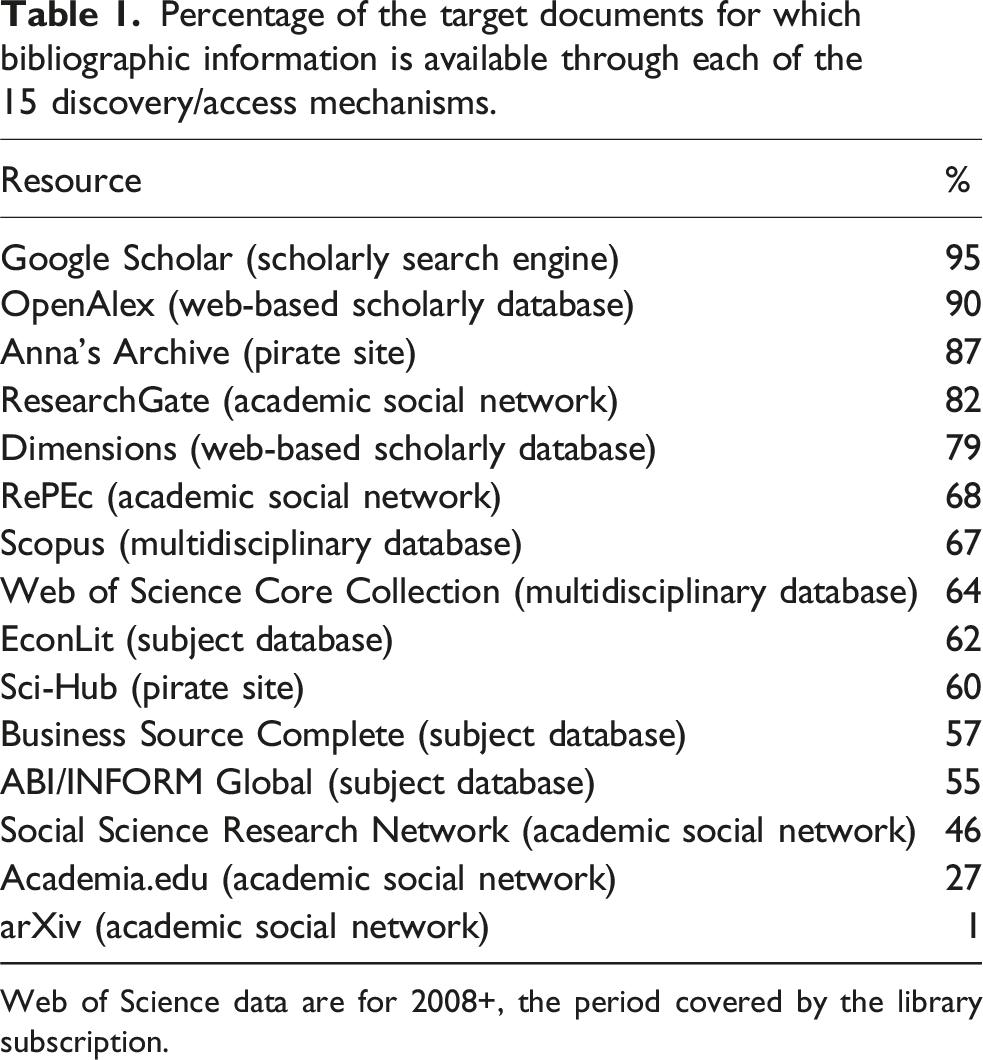
Web of Science data are for 2008+, the period covered by the library subscription.
Percentage of the target documents for which full text is available through each of the 15 discovery/access mechanisms.
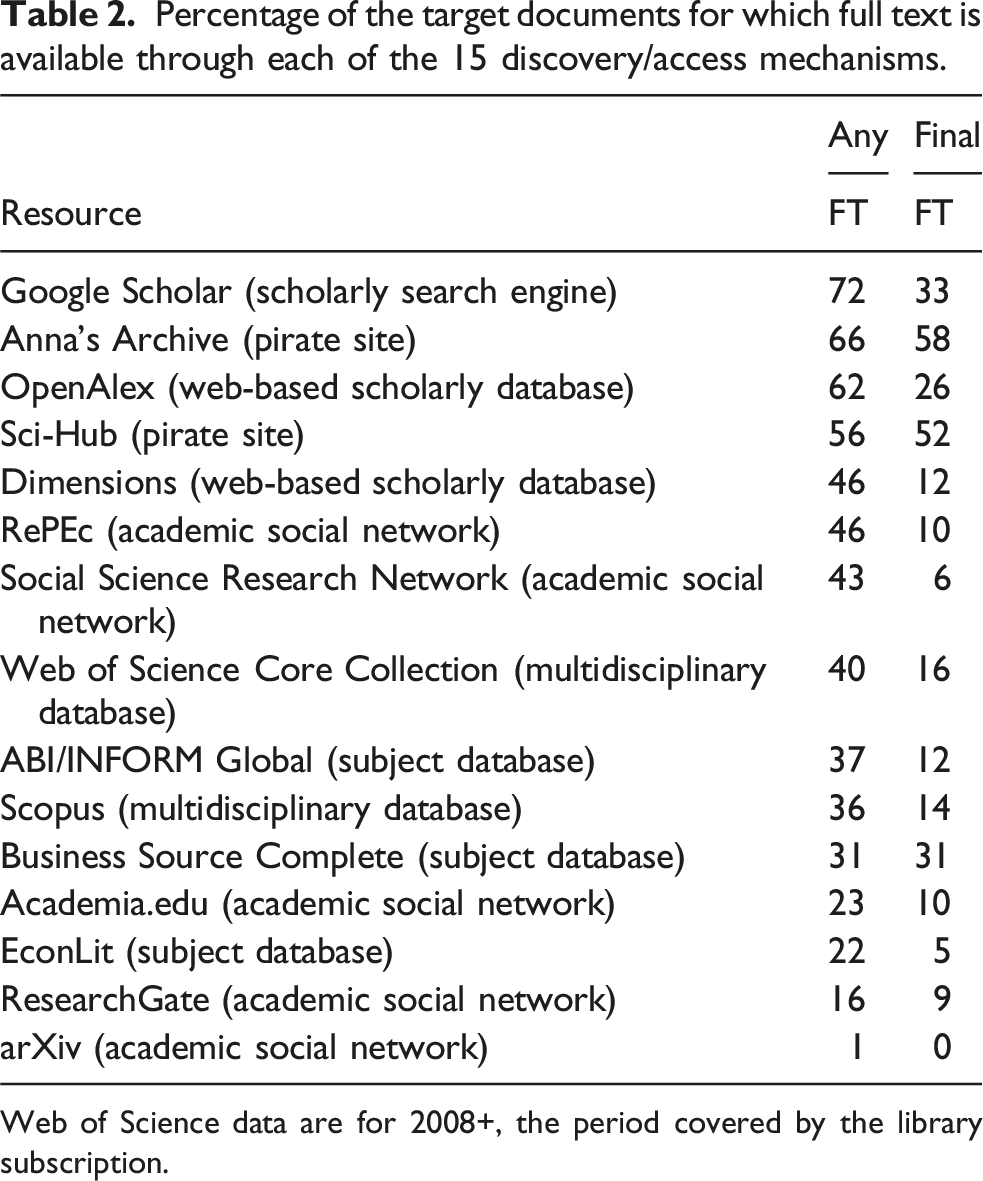
Web of Science data are for 2008+, the period covered by the library subscription.
Discussion
Although Google Scholar is known to many faculty and students, economists may want to learn more about the other alternative discovery/access mechanisms. As Figure 1 shows, several of these mechanisms are surprisingly comprehensive in terms of both bibliographic and full-text coverage. These resources, which are freely available without subscription or payment, may be especially important to scholars in developing countries (González-Solar and Fernández-Marcial, 2019; Wan, 2022) and to researchers at less well-funded institutions in Europe and North America. In contrast, conventional subject databases, including EconLit, provide relatively poor coverage of the economics literature. It may be time to consider whether databases such as EconLit are deserving of the prominence they once held. Bibliographic and full-text coverage of the 15 discovery/access mechanisms—conventional databases represented by triangles, alternative mechanisms by circles.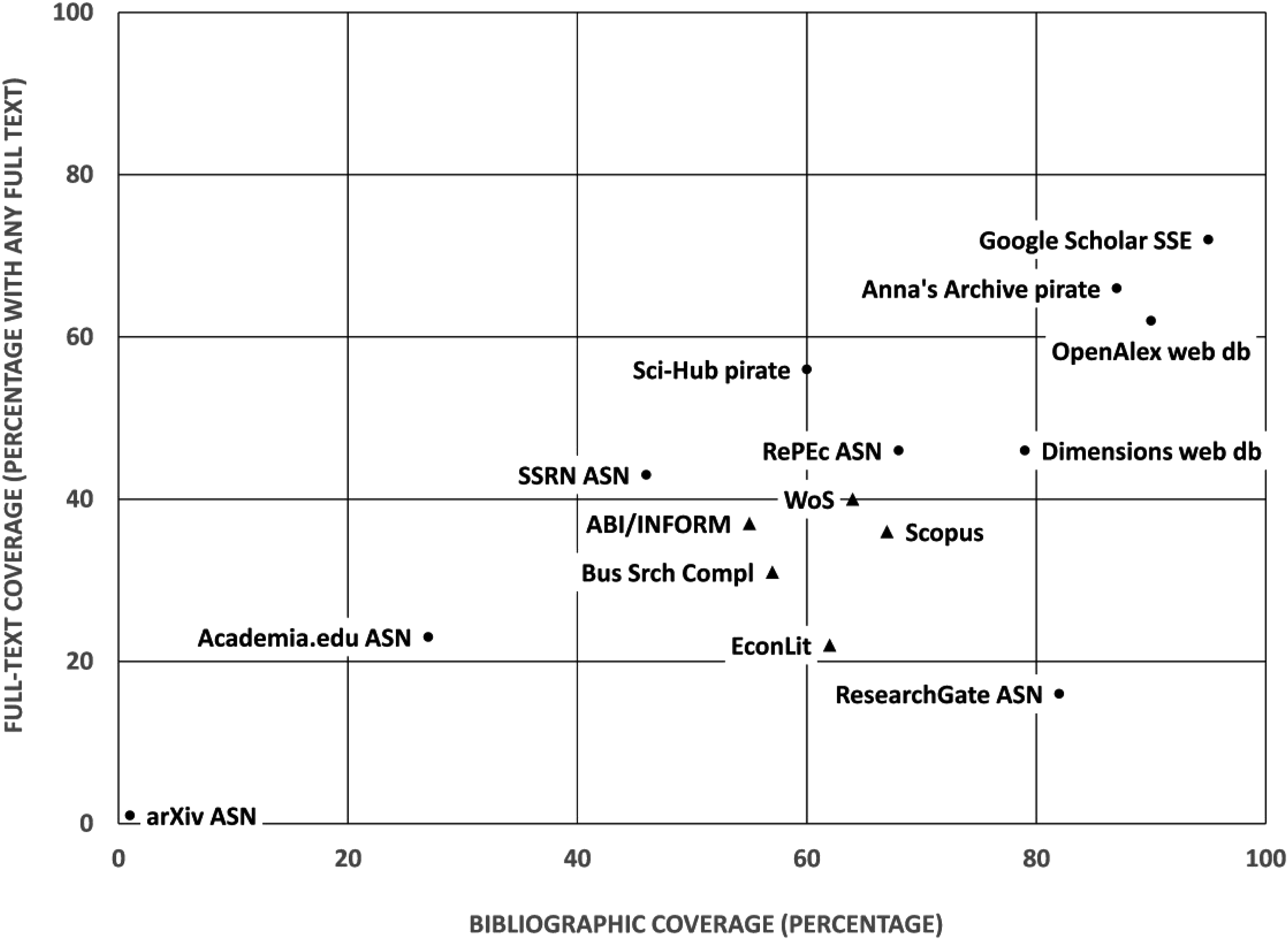
The remarkable coverage of the foremost alternative discovery/access mechanisms can be traced to the methods by which they are compiled. Conventional databases generally index all the papers that appear in particular sources (e.g., journals and book series) but make no attempt to cover the papers that appear elsewhere. In contrast, most scholarly search engines and web-based scholarly databases harvest data and documents from the entire web. This broader coverage brings in not just papers intentionally distributed as Open Access, but the many scholarly works that are posted online informally by authors, academic departments, course instructors, and students. Likewise, pirate sites can provide especially good full-text coverage because they intentionally defy the intellectual property restrictions that limit the scope of conventional databases. For discussion of the ethical issues associated with pirate sites, see Chen (2016), Deshpande (2019), and Maddi and Sapinho (2023).
It is important to recognize that the results presented here account only for the coverage of each discovery/access mechanism—the extent to which each includes, or provides seamless access to, bibliographic records and full-text documents. No attempt was made to evaluate search algorithms, subject headings, limiters, results-sorting capabilities, user interfaces, or other aspects of search performance. Likewise, these results do not consider the quality of the bibliographic, descriptive, and contextual information (e.g., abstracts) provided through each discovery/access mechanism. Some alternative resources are constrained by the low quality of their interfaces and metadata, and this is a major problem with the two pirate sites (Boeker et al., 2013; Delgado-Quirós and Ortega, 2024; Gusenbauer and Haddaway, 2020; Walters, 2025). If we account for bibliographic and full-text coverage as well as interface quality and metadata, three resources—Google Scholar, OpenAlex, and Dimensions—emerge as the most promising of the alternative discovery/access mechanisms.
Finally, changing circumstances may increase or diminish the relative advantages of particular resources over time. For instance, the legal and economic sustainability of the pirate sites is by no means assured. The developers of Sci-Hub have paused the uploading of current content in response to legal actions (Reddit, 2025; Wikipedia, 2025), and Anna’s Archive relies on Sci-Hub for much of its content. Moreover, both conventional databases and alternative discovery/access mechanisms face uncertainty due to the potential, threatened, or actual reallocation of resources by their parent agencies (University of Pittsburgh Library System, 2025). At the moment, however, the best of the free online resources surpass conventional databases such as EconLit and Web of Science in their coverage of the economics literature.
Footnotes

Funding
The author received no financial support for the research, authorship, and/or publication of this article.
Declaration of conflicting interests
The author declared no potential conflicts of interest with respect to the research, authorship, and/or publication of this article.