







Abstract
In the current business environment shaped by artificial intelligence, the relevance of information is increasingly limited by time. This paper examines the concept of expiring knowledge, defined as information whose usefulness decreases as conditions change. We identify four main types of expiries: event triggered, continuous decay, context dependent, and structural. A temporal knowledge framework is proposed to classify business knowledge according to how quickly it expires and how frequently new knowledge is created. Case examples from finance, technology, public policy, and healthcare illustrate how expiry patterns differ across sectors. The study also presents strategies for managing expiring knowledge, including temporal tagging, decay monitoring, context aware reframing, structural decoupling, and automated invalidation. These approaches aim to help organizations move from static knowledge storage toward systems that are responsive to time. By aligning knowledge management practices with the changing value of information, organizations can reduce risk, improve decision making, and maintain strategic advantage in the era of artificial intelligence.
Keywords
Introduction
In the modern knowledge economy, information is a critical driver of business performance, strategic agility, and competitive differentiation. Yet, in today’s hyper-dynamic AI dependent landscape, the value of business information is increasingly shaped by time. Information that once sustained decisions for months or years now often loses its relevance in a matter of days, hours, or even minutes (Yu et al., 2024). This accelerated rate of knowledge depreciation presents a growing risk for organizations that rely on outdated data or delay action on rapidly emerging insights.
The scale of the challenge is staggering. The International Data Corporation (IDC) forecasts that by 2025, the global datasphere will reach 175 zettabytes, up from just 33 zettabytes in 2018, with nearly 30% of data requiring real-time processing to be actionable (Patrizio, 2018). Meanwhile, a Gartner survey found that 67% of executives believe their organizations are too slow to act on time-sensitive insights, often due to bottlenecks in knowledge validation or lack of awareness that information has expired (Gartner, 2025). This indicates a significant disconnect between the pace at which information is created and the systems designed to manage it. Emergent knowledge is continuously produced by developments in artificial intelligence, real-time analytics, Internet of Things (IoT) systems, and enterprise collaboration platforms (Fitch, 2024). AI-powered solutions, for instance, can generate dynamic customer profiles, dynamic sentiment analyses, or supply chain forecasts that are updated on a regular basis. Organizations are burdened with both identifying and retiring old or erroneous information and quickly learning and acting upon new information (Altındağ and Öngel, 2021).
Traditional knowledge management systems are ill-equipped to handle this temporal volatility. They are typically structured around static repositories, designed for long-term retention and access rather than dynamic lifecycles of use, validation, and expiration (An et al., 2025). As a result, organizations often retain outdated information longer than they should, while struggling to integrate the new knowledge that is critical for real-time decisions. This leads to what we define as a temporal knowledge gap between when knowledge becomes available or obsolete and when an organization adapts to that change.
This paper introduces and explores the concept of expiring knowledge, defined as any information whose utility diminishes over time, and proposes a framework for managing its lifecycle. We also examine the phenomenon of accelerated knowledge creation, highlighting the challenges of learning and integrating new information at scale and speed. Together, these two pressures form a temporal knowledge dynamic that modern organizations must navigate. Our goal is to provide a conceptual foundation and practical strategies for businesses to manage this dynamic, transforming passive knowledge repositories into agile, time-aware knowledge ecosystems.
Theoretical background
Classifying, storing, transferring, and using knowledge have historically been the focus of organizational knowledge research. Classical frameworks make a distinction between tacit knowledge, which is found in people’s experience and intuition, and explicit knowledge, which can be recorded and stored (Nonaka, 1994; Polanyi, 2009). Although these differences are still significant, they frequently ignore the temporal aspect of knowledge, namely how it’s worth varies over time and in various contexts. Temporal relevance is increasingly emerging as a characteristic of knowledge utility as business environments undergo rapid change.
Information science and economics are the origins of the concept of information decay. More recently, researchers like Davenport and Prusak (1998) and Alavi and Leidner (1999) have highlighted how organizational knowledge becomes outdated as markets, technologies, and business models change (Alavi and Leidner, 1999; Davenport and Prusak, 1998). Shannon and Weaver (1948) information theory suggests that signal degradation affects information transmission over time. Information in dynamic environments has a “half-life,” a term from nuclear physics that refers to the amount of time that half of its initial value is retained (Shannon and Weaver, 1998). For instance, depending on consumer behavior and market fluctuations, real-time financial trading data may have half-life of seconds, whereas insights into product usage may deteriorate over weeks or months.
Concepts like decision window theory, situated learning, and just-in-time (JIT) knowledge delivery are also associated with the temporal value of knowledge (Bjelde, 2024). JIT knowledge highlights how crucial it is to provide information at the exact moment it is required, especially in high-stakes or hectic settings (McGowan et al., 2008). According to the situated learning theory (Lave and Wenger, 1991), time and place are crucial factors in the usefulness of knowledge because it is intrinsically linked to context. This is expanded by decision window theory, which pinpoints specific time periods that must exist for the best decisions to be made. Knowledge can completely lose its potential value if it is delivered too soon or too late.
Automated systems, data-driven feedback loops, and AI-generated outputs, all which function on temporal logics faster than human processing speeds are increasingly influencing knowledge flows in digital ecosystems. Knowledge can be amplified and shortened by these systems: a news headline may cause algorithmic trades in milliseconds and then lose its relevance minutes later. However, knowledge decay is not always passive; it can also be caused by organizational inattention, change resistance, or cognitive overload, which can result in blind spots or informational stagnation (Diakopoulos, 2019). Intentional or inadvertent knowledge loss is cited by theories of organizational forgetting (Holan and Phillips, 2004) as a crucial aspect of temporal knowledge dynamics.
Despite growing awareness of these issues, there is still a lack of systematic frameworks to understand and manage knowledge through a temporal lens. Most knowledge management strategies pay little attention to how accurate, useful, or safe to use, instead concentrating on knowledge retention, capture, and access. In sectors like finance, healthcare, logistics, and public policy where timing is crucial, this disparity is especially troublesome. Stakeholder trust and organizational performance may suffer in these areas if knowledge temporality is not managed.
Drivers of information expiry
Understanding why knowledge expires is critical for designing systems that can mitigate informational risk and maintain decision quality. While the decay of knowledge can be a natural outcome of changing environments, it is also often accelerated by organizational, technological, and cognitive factors (Leal-Rodríguez et al., 2015). We identify five key drivers of information expiry in business contexts: technological change, regulatory shifts, market volatility, organizational forgetting, and narrative obsolescence.
Technological change
One of the most significant drivers of knowledge expiry is the rapid pace of technological innovation. As organizations adopt new tools, platforms, or protocols, the relevance of earlier technical knowledge and practices declines (Faethm, 2024; Jacob et al., 2020). For instance, legacy software systems may require documentation and user expertise that become irrelevant after a migration to a cloud-based infrastructure. A 2021 McKinsey survey revealed that over 70% of companies undergoing digital transformation reported substantial loss of internal process knowledge as older systems were decommissioned (McKinsey Global, 2021). Moreover, emerging technologies such as generative AI often create entirely new categories of business knowledge that render older models of reasoning or data interpretation obsolete.
Regulatory and policy shifts
Social, economic, or technological advancements often lead to changes in legal frameworks and regulatory policies (Lescrauwaet et al., 2022). Previously reliable information may become noncompliant or even dangerous when such changes take place, especially in industries like finance, healthcare, and data privacy (Nicklow, 2025). For instance, many legacy data practices became illegal overnight when the European Union implemented the General Data Protection Regulation (GDPR) (GDPR, 2018). Businesses that didn’t make the necessary changes right away faced penalties and harm to their reputation. In this way, rather than deteriorating gradually, regulatory knowledge frequently has hard expiration thresholds and an inherent time sensitivity.
Market volatility and consumer behavior
Markets are increasingly shaped by fast-changing consumer preferences, geopolitical dynamics, and supply chain disruptions. These factors shorten the lifespan of business insights, forecasts, and strategic plans (Struckell et al., 2022). For instance, during the COVID-19 pandemic, restaurant and retail businesses found that historical sales data and customer segmentation models were no longer predictive, leading to poor forecasting and inventory decisions (Das et al., 2022). Similarly, viral social media trends can change public sentiment in hours, making traditional brand reputation metrics outdated by the time they are aggregated and analyzed (Dwivedi et al., 2021).
Organizational forgetting
Information decay frequently results from internal dynamics rather than being solely driven by external factors. Organizations suffer from what academics refer to as “organizational forgetting” when workers depart, roles shift, or informal procedures are replaced by formal systems (De Holan and Phillips, 2004). Both deliberate (phasing out outdated knowledge to streamline operations) and inadvertent (failing to document tacit knowledge) processes may be involved in this process. Even important information, like how previous crises were handled, the rationale behind the retirement of product lines, or the methods used to maintain important client relationships, may eventually be lost if it is not actively maintained or updated (Sucher and Gupta, 2019).
Functional misalignment
Information’s value is frequently ingrained in the story or setting in which it was produced. The original framing of knowledge may no longer be in line with contemporary needs as narratives change, either internally (such as strategic shifts) or externally (such as cultural or media changes) (Movsisyan et al., 2019; Winterbottom et al., 2008). For instance, following abrupt world events, risk assessments predicated on the supposition of a stable geopolitical environment might no longer be applicable (Jawadi et al., 2024). Likewise, training materials for employees that are based on antiquated conventions may not connect with or mislead younger generations (Jeske and Olson, 2021). Even if the basic facts stay the same, this context drift weakens the knowledge’s ability to explain and function.
Typology of expiring knowledge
Knowledge does not expire uniformly. It follows different trajectories of decay depending on its source, context, and use case. A clear typology is essential for helping organizations distinguish between types of expiring knowledge and apply appropriate management strategies. We classify expiring knowledge into four primary types based on their temporal behavior and expiration triggers (Figure 1): (1) Event-Triggered Expiry, (2) Continuous Decay, (3) Context-Dependent Obsolescence, and (4) Structural Expiry. Each type includes subtypes and sector-specific examples to illustrate its operational relevance. Typology of expiring knowledge.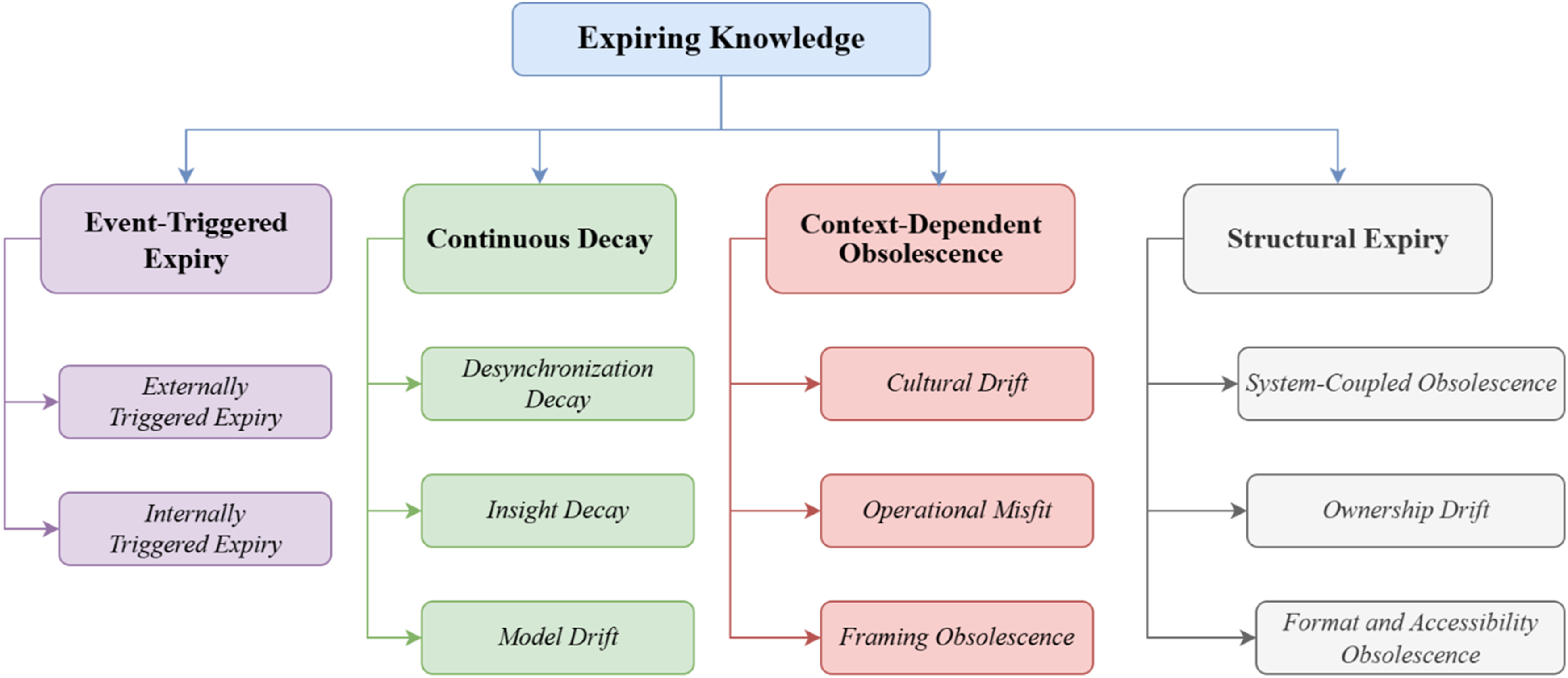
Event-triggered expiry
Event-triggered expiry happens when knowledge becomes obsolete immediately due to a specific event. Unlike gradual decay, this type of expiry is sudden, information is valid one moment and invalid the next (Microsoft, 2024). It is triggered by a change in fact, status, or context that instantly renders previous knowledge incorrect or misleading. This makes it especially risky in fields where timing and accuracy are critical. Most systems are not designed to detect such changes (Shankaranarayan et al., 2003). For example, a law passed in one country may instantly invalidate policies used elsewhere, yet the outdated knowledge may still circulate. Without real-time detection and expiry protocols, such knowledge lingers in decision-making processes, leading to compliance failures, bad decisions, or reputational harm (AEEN, 2023). Addressing this risk requires systems that are sensitive to external triggers and can act quickly to flag or retire affected knowledge. We identify two major subtypes of event-triggered expiry:
Externally triggered expiry
Externally triggered expiry occurs when knowledge becomes outdated due to events outside the organization’s control. These may include legal decisions, policy changes, market shifts, scientific discoveries, or global crises (Bates, 2025). For example, a change in tax law can instantly invalidate financial planning documents, while a pandemic or conflict can make travel policies or risk assessments obsolete overnight (Megersa, 2020). The challenge lies not only in detecting these events, but also in understanding their impact on internal knowledge. Many organizations rely on manual updates or periodic reviews, which are often too slow, especially in fast-moving fields like finance or cybersecurity (Dalal et al., 2022). Even in slower sectors, such as healthcare or education, delays in updating internal content after public guidance changes can lead to misinformation or liability. Managing this type of expiry requires formal monitoring systems, such as regulatory APIs, news analytics, and tools that compare external events with internal content to flag what may need revision.
Internally triggered expiry
Internally triggered expiry occurs when knowledge becomes outdated due to changes made within the organization, such as product launches, software updates, restructuring, or new policies (Galan, 2023). These changes often leave behind older knowledge assets like SOPs, onboarding guides, or dashboards that no longer reflect the updated reality. Although the organization initiates the change, it does not always ensure that outdated knowledge is removed or updated. In many cases, change logs are distributed, but they are not linked to the specific content they affect (Jain, 2016). As a result, some teams may continue using outdated procedures while others move ahead, leading to fragmented knowledge across departments. This form of expiry highlights gaps in knowledge governance, especially when infrastructure or policy shifts are not followed by coordinated updates to related documents and tools. Preventing this requires more than communication calls for expiration protocols embedded into knowledge systems, so that updates automatically trigger reviews and revisions of dependent content.
Continuous decay
Not all knowledge becomes obsolete immediately. Often, its value fades gradually as external conditions evolve, making it less relevant, less accurate, or misaligned with current needs (Su, 2022). This slow decline, known as continuous decay, often goes unnoticed because there is no clear moment when the knowledge becomes invalid. Instead, its usefulness erodes quietly as the gap grows between what is stored and what is current. This is common in areas like forecasting, modeling, and analytics (Knutti, 2019). A customer segment from 6 months ago may no longer reflect real behavior if preferences have shifted, and performance metrics tied to outdated goals may distort evaluations if priorities have changed (Charm et al., 2020). The danger is that such knowledge still appears valid, even when its assumptions no longer hold. Organizations often overlook this risk because their systems are built to store information, not to reassess it. Without regular review, outdated knowledge accumulates and continues to shape decisions long after it has lost its value. We identify three common subtypes of continuous decay:
Desynchronization decay
Desynchronization decay occurs when stored information gradually falls out of sync with the real-world conditions it was meant to represent. This often happens when data is collected once but used over time in changing environments (Schlimmer and Granger, 1986). Examples include outdated customer profiles, vendor data, or strategic assumptions that no longer reflect current realities. While the data may have been accurate at the time, its relevance fades as circumstances shift. A once-engaged customer may stop responding, or a trusted supplier may face new risks. Because organizations often treat this information as static, these changes go unnoticed, leading to decisions based on outdated views (Gama et al., 2014). Regular data cleaning alone is not enough. Organizations need ongoing alignment between stored knowledge and real-time signals like user behavior, market conditions, and operational feedback to avoid making decisions based on a reality that no longer exists.
Insight decay
When interpretive or analytical outputs, like dashboards, reports, strategic memos, or recommendations, become less relevant over time because of underlying shifts in context, assumptions, or inputs, this is known as insight decay (Webb, 2019). Even if a market intelligence report is founded on solid data, its initial conclusions might not hold true if consumer trends or competitor strategies change. Its erroneous sense of validity is the danger of insight decay. Even after its practical relevance has diminished, the report or analysis frequently maintains institutional trust because it was once considered credible. When strategic documents are reused for investor communications or across departments without adequate review, insight decay is particularly problematic (Tripsas and Gavetti, 2000). Insights should be treated as temporally perishable deliverables by effective knowledge systems, which should give them shelf lives and mandate regular reevaluations linked to signal drift or modifications in the source data.
Model drift
Model drift is the term used to describe the gradual deterioration of model performance in statistical modeling and machine learning, frequently brought on by modifications to the target behaviors, input data distribution, or external environment (Gama et al., 2014). A fraud detection predictive model may perform well for a few months, but its precision and recall metrics may drastically decline as adversaries change and transaction patterns change. Despite being the most technical subtype of continuous decay, model drift has broad implications. The deterioration of these models becomes a business risk as more business decisions are automated, whether through diagnostic algorithms, credit scoring models, or recommender systems (Caroprese et al., 2025). However, a lot of organizations don’t have official procedures for sunsetting, retraining, or monitoring models. Furthermore, performance indicators are frequently monitored but unrelated to expiration risk.
Context-dependent obsolescence
Context-dependent obsolescence happens when knowledge becomes outdated not because it is wrong, but because the conditions around it have changed. The information may still be accurate, but it no longer fits the situation due to shifts in culture, strategy, or operations (Levinthal & March, 1993). This form of expiry is often overlooked because the knowledge appears valid. It remains in policies, documents, and practices, even as its relevance fades. For example, an onboarding guide focused on office culture may feel outdated in a remote-first workplace. A policy memo from a past leadership era may no longer align with current values or goals. Unlike continuous decay in accuracy, context-dependent obsolescence is about a misfit between content and context. It reminds us that knowledge is only useful when it matches the environment in which it is applied (Teece et al., 1997). When that alignment is lost, even correct information can mislead. We identify three key subtypes of context-dependent obsolescence:
Cultural drift
When knowledge assets diverge from the dominant social, organizational, or generational norms, this is known as cultural drift (Schein, 2010). For example, newer employees may find training videos with outdated jokes or references offensive or hard to relate to. Expectations for diversity and inclusion change swiftly, and content that was once considered neutral may now be interpreted as tone-deaf or insensitive. Cultural drift poses a reputational as well as an operational risk. Businesses run the risk of offending stakeholders or breaking new social norms if they don’t check their internal or public knowledge materials for cultural misalignment (Thomas and Hardy, 2011). This type of obsolescence necessitates regular content reviews, but more significantly, it calls for integrating cultural sensitivity into the process of producing knowledge so that resources are created with demographic and temporal flexibility in mind.
Operational misfit
Knowledge that no longer fits the existing organizational structures, workflows, or tools is referred to as operational misfit. For instance, even if a knowledge base article accurately describes how to use an antiquated ticketing system, it loses its usefulness when the system is retired (Panda, 2025). Likewise, escalation procedures or decision-support models created for a smaller team might not be scalable as the company expands. This type of expiration is especially prevalent in businesses that are growing quickly or going through a digital transformation (Errida and Lotfi, 2021). Supporting documentation and institutional logic must be continuously modified as procedures change. Many organizations, though, fail to recognize these dependencies. Confusion and fragmentation result from the infrequent synchronization of updates to the related knowledge assets with changes to technology or workflows. Strong knowledge-governance ties to change management tasks are necessary to prevent operational misfit, making sure that each tool or structural change initiates a review of related informational artifacts.
Framing obsolescence
When the strategic narrative or interpretive context that gives knowledge its meaning changes over time, it is known as framing obsolescence. White papers, corporate messaging, decision justifications, and archival memos may all be impacted by this (Schilke et al., 2018). For example, in a time when sustainability and resilience are key, a business case that described a previous initiative as “growth-driven” may now seem out of place. Even though the facts might still be accurate, how they are interpreted and assessed has evolved. Any organization that uses knowledge as support, whether in the form of historical precedent, policymaking, or strategic continuity, runs the risk of framing obsolescence (Balachandran and Hernandez, 2018). Knowledge is always ingrained in a specific worldview because it is never neutral. Even if the content of prior knowledge remains unchanged, it may no longer be useful when that worldview changes. Organizations must reinterpret or reframe such knowledge in the new context, but they are not required to discard it. Reusing knowledge requires more than just version control; it also necessitates interpretive flexibility and historical awareness.
Structural expiry
Structural expiry occurs when knowledge becomes obsolete not because it is incorrect or irrelevant, but because the systems, roles, or formats needed to access and use it are no longer in place. This happens when organizations change their technology, restructure teams, or retire legacy platforms (Vial, 2019). Knowledge may still exist, but it becomes practically inaccessible now it is needed most. This type of expiry often goes unnoticed until a critical task reveals that the information cannot be retrieved, interpreted, or applied. Structural expiry highlights how much organizational knowledge depends not only on content, but also on the tools, people, and workflows that support it. When these supporting structures change or disappear, even valid knowledge can become unusable. We identify three subtypes of structural expiry:
System-coupled obsolescence
When knowledge is linked to a technological system that is subsequently updated, retired, or replaced, this is known as system-coupled obsolescence. This frequently occurs with custom software that has undocumented configurations, assumptions, or embedded rules (Semertzaki, 2011). The correct use of the data may rely on outdated interfaces or implicit knowledge, even if it is preserved during a system migration. The loss of interpretive context, which gives the knowledge meaning, is the risk, not just the technical one. During infrastructure upgrades, important institutional knowledge may vanish if transition protocols are unclear (Meusburger, 2015). If the tools, schemas, and workflows that give the data meaning are lost, preserving the raw data alone won’t be sufficient. Documenting system-embedded knowledge and making continuity plans prior to significant changes are necessary to prevent this kind of expiration.
Ownership drift
Ownership drift occurs when information becomes irrelevant or unreachable because of employee turnover, organizational reorganizations, or shifts in duties. Even if information was once significant, it becomes orphaned when no one is designated to update or maintain it (Azaki and Rivett, 2022). This is particularly prevalent in projects where documentation was never given priority or that depend on implicit knowledge. Because of this, organizations have gaps in their institutional memory, such as decisions that no one can explain, reports that lack context, or tools that are still in use but have unclear proof. These disparities eventually impede growth and adaptability. Clear knowledge transfer procedures, role-based access mapping, and a culture that views documentation as necessary rather than optional are all necessary to stop ownership drifting (Tian et al., 2021).
Format and accessibility obsolescence
When information is kept in file formats, media formats, or systems that are no longer readily available or supported, this is known as format and accessibility obsolescence. This includes documents on old physical media like DVDs or zip disks, as well as out-of-date formats like Lotus Notes databases and Flash-based modules. Even though the information might still be there, most users lack the technical know-how or legacy hardware needed to access it. In addition to posing significant risks to long-term archives in academic, legal, and strategic contexts, this can also have an impact on contemporary organizations that neglect format lifecycle management. Even businesses that prioritize digitalization might produce dashboards or data exports in formats that are unreadable in a few years. Future-proofing techniques, such as open standards, backward compatibility, and well-documented storage, are necessary to avoid this type of expiration.
Suggested strategies for managing temporal value
It takes more than sporadic audits or passive supervision to address expiring knowledge. It demands that companies handle knowledge differently, treating it as a time-sensitive resource that needs to be periodically reviewed, updated, or retired. Responses must be customized for various expiry types, such as event-triggered, gradual decay, context misalignment, and structural loss. To help organizations develop resilience in knowledge management over time, this section offers a multi-layered approach that integrates policy, process, and technology.
Time-stamped capture and temporal tagging
Understanding that all knowledge has a time dimension is the first step in managing expiring knowledge. Whether knowledge is recorded as a document, dataset, model, or message, it should be accompanied by metadata that details its creation date, expected validity period, and underlying assumptions (Tuzhilin, 2011). This is particularly crucial in fields where things change quickly, and information can suddenly become out of date. Businesses should incorporate temporal tagging into their knowledge systems, adding validity periods, source timelines, and version histories in addition to the standard “last modified” dates. This metadata facilitates timely updates, dependency tracking, and expiration alerts when combined with automation tools.
Decay monitoring and scheduled revalidation
Regular validation is crucial for knowledge that deteriorates over time, such as forecasts, analytics, models, and policy assumptions. Instead of considering knowledge to be complete by default, organizations should consider it valid until it is reassessed (Tsoukas and Mylonopoulos, 2004). This calls for both signal-based triggers, such as declines in performance or modifications in the external environment, and time-based reviews, such as quarterly audits. Organizations should establish feedback loops that connect knowledge performance to practical results to control this type of decay (Vial, 2019). For example, when a model begins to perform poorly, it should prompt both retraining and a re-examination of the underlying assumptions. Periodic audits, dashboards, and structured review cycles help address forms of continuous decay like insight loss, desynchronization, and model drift.
Context-aware knowledge reframing
Timestamps alone are not enough to manage context-dependent obsolescence. In these cases, the content remains the same, but the environment around it has shifted. Organizations must develop the ability to revisit past knowledge and reinterpret its value based on new assumptions, norms, or priorities (Schoeneborn et al., 2019). This requires combining contextual metadata with qualitative review methods such as diversity audits, ethics reviews, or scenario planning (Prabhune et al., 2018). Knowledge assets should include notes on the political, cultural, or operational context in which they were created. When strategies, regulations, or workplace dynamics change, knowledge managers should be empowered to revise and reframe content collaboratively, rather than simply archive or discard it.
Structural decoupling and knowledge portability
Managing structural expiry involves reducing the risk that knowledge becomes unusable when systems, roles, or formats change (Zakaryan, 2025). Knowledge tied to outdated platforms, proprietary tools, or specific individuals is especially vulnerable to becoming inaccessible over time. To manage this, organizations should design for knowledge portability by adopting open standards, enabling cross-system compatibility, and documenting key dependencies during transitions. Knowledge management must be coordinated with IT and organizational change processes, so that system upgrades, retirements, or team changes include structured reviews of affected knowledge (Dullea and Song, 1998). This means identifying what needs to be moved, re-platformed, or reassigned. Regular checks for accessibility and clarity help ensure knowledge stays usable, even as systems or roles change.
Real-time alerting and automated invalidation
In areas like compliance, security, and crisis response, where an event-triggered expiry is common, automation is essential. Organizations need real-time alert systems that detect internal or external changes and trigger immediate action (Björneld and Löwe, 2024). For instance, a regulatory update should not sit with the legal team alone, it should prompt a review of affected policies, flag outdated documents, and notify responsible staff. Automated systems can temporarily quarantine or flag knowledge until it is reviewed, preventing outdated information from continuing to circulate (Liu et al., 2022). However, automation must be balanced with human oversight to manage cases where the impact of an event is unclear or partial.
Lifecycle governance and temporal knowledge literacy
Ultimately, managing knowledge expiry requires a shift in both culture and governance. This is not just a technical or content issue, it is a leadership challenge that must be built into organizational policies and professional practices (Xu et al., 2025). Knowledge lifecycle policies should define ownership, review cycles, and retirement plans based on the type and importance of the knowledge. Just as cybersecurity training is now standard, organizations should promote temporal knowledge literacy. Employees need to recognize when knowledge is outdated, question assumptions, and follow protocols for review and revision (Saul et al., 2024). Without broad awareness and support, even the best strategies will fail to take hold across teams and systems.
Conceptual framework: Navigating the temporal knowledge landscape
Managing business knowledge today is less about storing information and more about keeping it in sync with time. As shown throughout this paper, knowledge can expire in different ways, some sudden, others gradual. To support better decision-making, we present a two-dimensional framework that helps organizations assess knowledge based on two key factors: how quickly it expires and how fast new knowledge is created. This framework acts as both a diagnostic and planning tool, helping organizations identify where different knowledge types sit, how often they need to be updated or retired, and which management strategies are most appropriate.
Conceptual dimensions of the temporal knowledge framework
The temporal dynamics of business knowledge can be analyzed through two foundational dimensions. The first is the rate of expiry, which captures the speed at which a knowledge asset loses relevance. This may result from sudden external events, gradual misalignment with evolving contexts, or structural obsolescence tied to outdated systems or formats (Azaki and Rivett, 2022). The second dimension is the velocity of knowledge creation, which refers to the frequency with which new information is introduced into the organizational environment, either reinforcing or replacing existing knowledge. Together, these dimensions form a two-by-two matrix that categorizes knowledge assets based on their temporal stability and renewal pressure (Figure 2). Each quadrant represents a distinct knowledge environment and requires differentiated management strategies tailored to the pace of informational change and the risks associated with expiry. Dimensions of the temporal knowledge framework.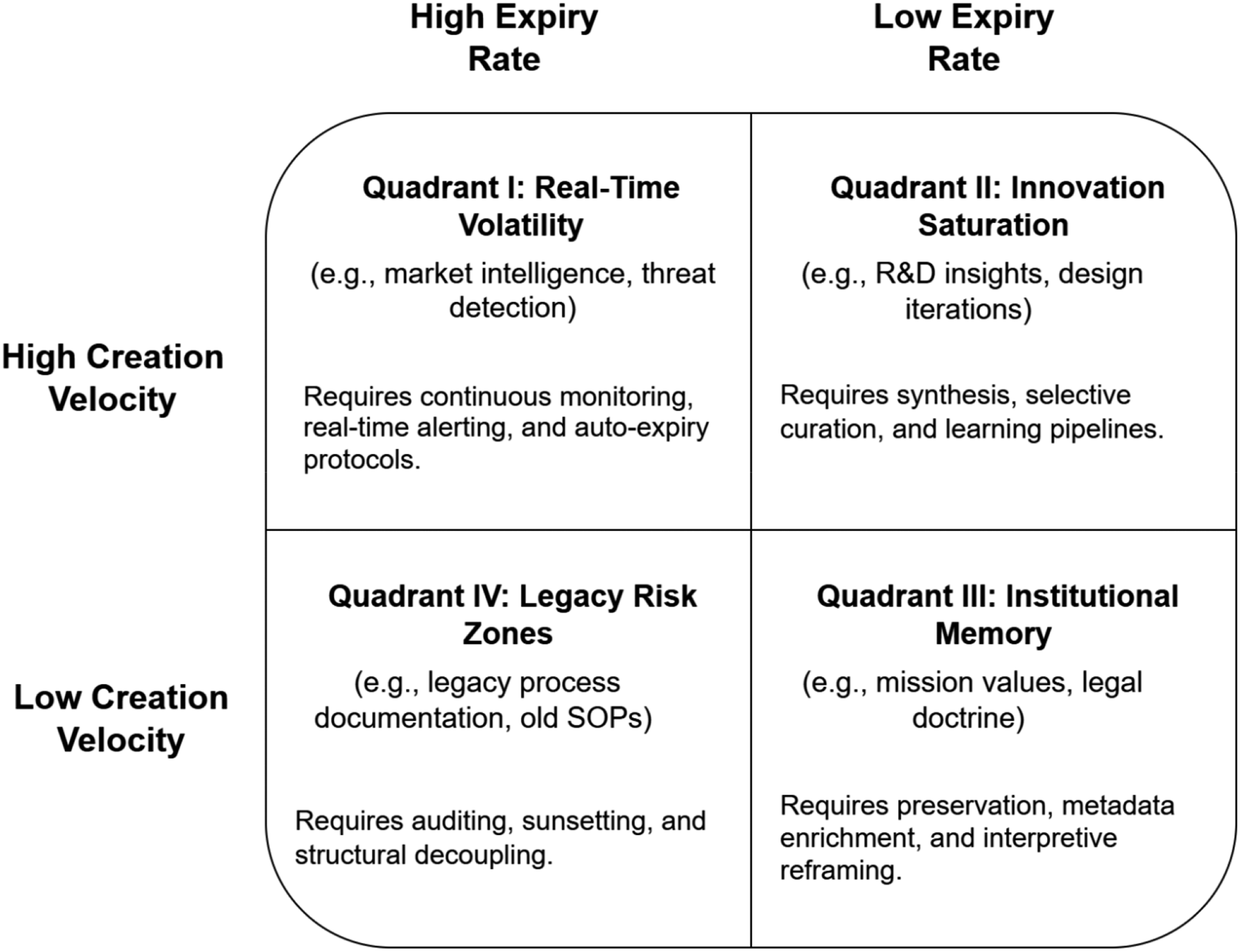
Classification of temporal knowledge contexts
Based on the two dimensions discussed earlier, the rate at which knowledge expires and the speed at which new knowledge is created, this framework outlines four types of knowledge environments. Each represents a different combination of risk and renewal pressure, requiring specific management strategies. These categories help organizations determine when knowledge should be reviewed, updated, or retired as its value changes over time.
Quadrant I: High expiry, high creation – real-time volatility
This context involves domains where knowledge is generated and invalidated at a rapid pace. It is common in areas such as market surveillance, cybersecurity, crisis response, and live policy monitoring. Knowledge assets in this quadrant may lose relevance within minutes or hours (Wang et al., 2018). Organizations operating in these environments must prioritize speed and automation, using real-time alert systems, external signal monitoring, and responsive knowledge workflows that emphasize freshness over comprehensiveness.
Quadrant II: Low expiry, high creation – innovation saturation
In this environment, knowledge is produced frequently but retains value over a longer period. It is typical of research and development, user experience research, product iteration, and customer feedback analysis. The central challenge is not obsolescence, but redundancy and fragmentation (Baptista et al., 2017). Effective strategies include temporal tagging, synthesis of overlapping insights, and careful curation to ensure that actionable knowledge is not buried in a surplus of undifferentiated content.
Quadrant III: Low expiry, low creation – institutional memory
Knowledge in this quadrant changes little over time and is seldom updated. Examples include legal frameworks, mission statements, policy histories, and core procedural documentation. While the risk of expiry is minimal, there is potential for contextual drift, where knowledge remains technically correct but loses relevance in a changing social or organizational climate (Schoeneborn et al., 2019). Stewardship in this context involves preserving interpretability, conducting periodic reassessments, and enabling reframing when institutional priorities evolve.
Quadrant IV: High expiry, low creation – legacy risk zones
This is often the most neglected quadrant. It encompasses knowledge that is rarely updated but becomes increasingly obsolete due to infrastructural or organizational changes. This includes outdated process guides, legacy system documentation, and training materials tied to decommissioned tools (Vial, 2019). Structural expiry is the dominant concern here. Organizations must focus on knowledge continuity planning, reassignment of ownership, and decoupling knowledge from obsolete formats, roles, or platforms.
Managing temporal knowledge in practice
To apply the temporal knowledge framework in practice, it is important to understand how different sectors encounter and manage expiring knowledge. Each organizational setting involves a unique combination of volatility, capacity for renewal, and structural support for knowledge management. This section presents four illustrative cases, each aligned with one quadrant of the framework, and examines how knowledge expires, what risks are involved, and which strategies have proven effective in each context.
Real-time volatility: Financial services and market surveillance
The financial services sector is one of the most volatile knowledge environments. Asset prices, trading models, investor sentiment, and macroeconomic forecasts shift rapidly and often unpredictably. A portfolio manager’s decision support system may draw from hundreds of real-time signals, including earnings reports, interest rate announcements, geopolitical developments, and social media activity. In Quadrant I context, knowledge may expire in a matter of minutes or even seconds. The risks are significant: acting too late on new information or continuing to rely on knowledge that is no longer valid. For example, during the 2022 UK bond market disruption, several firms suffered losses not because they lacked access to data, but because their internal systems continued to display outdated assumptions for hours after conditions had changed (J.P. Morgan, 2023). To address this, leading firms have integrated automated alert systems and knowledge expiry protocols directly into their analytical platforms (Patel and Palacios, 2023). Some trading desks now use natural language processing tools to monitor regulatory or policy announcements and flag relevant changes. When a predefined threshold is reached, such as an interest rate adjustment, affected models are automatically flagged for review or recalibration. In this environment, the ability to detect and retire expired knowledge more quickly than competitors can provide a distinct strategic advantage.
Innovation saturation: Consumer technology and UX research
In technology firms that prioritize user experience, new knowledge is generated continuously. A/B testing, customer feedback, usage analytics, feature telemetry, and support interactions all contribute to a steady flow of insights. However, not all this knowledge becomes outdated at the same pace. Some user preferences, such as visual layout or interaction patterns, may change quickly, while others, like accessibility requirements, tend to remain stable over time (Holmlund et al., 2020). This context reflects Quadrant II, where knowledge is created rapidly but expires more slowly. The main risk in this environment is not immediate obsolescence, but redundancy and fragmentation. Different teams may gather overlapping insight independently, leading to duplicated effort, inconsistent conclusions, and decision fatigue (Abutouq, 2025). Managing knowledge in this setting requires careful curation, synthesis, and reuse. Some firms, such as Google, address this by employing dedicated insight managers who tag and organize findings using metadata that captures the method, user segment, and date. These insights are periodically reviewed to determine whether they remain relevant or require reframing. This approach helps maintain clarity and continuity in decision-making, while reducing the noise created by unmanaged information overload.
Institutional memory: Public sector legal frameworks
Governments, academic institutions, and legal systems often operate within Quadrant III, where knowledge changes slowly and new frameworks are introduced infrequently. Foundational documents such as legal codes, constitutional provisions, and public policy statements are typically stable and revised only after lengthy deliberation. However, these knowledge assets remain vulnerable to context-dependent obsolescence. While the content may not change, its interpretation and relevance often do, particularly as social norms and political environments evolve (Nicholas et al., 2005). For instance, privacy policies or regulatory standards developed decades ago may no longer align with present-day expectations around technology or civil rights. Without periodic reassessment, such knowledge can appear authoritative while subtly drifting out of step with contemporary needs. Some legal systems have addressed this challenge by embedding interpretive layers into official texts (Rubin et al., 2022). These include annotations, cross-references, and contextual notes that guide users in applying longstanding knowledge to current conditions. In the United States, for example, the Congressional Research Service publishes updates that reframe existing laws considering recent court decisions or policy developments. Such practices extend the utility of institutional memory by supporting reinterpretation rather than relying on wholesale replacement.
Legacy risk zones: Healthcare administration and EHR systems
The healthcare sector illustrates the challenges found in Quadrant IV, where knowledge changes slowly but is often embedded in fragile or outdated structures. Hospitals, insurers, and public health agencies frequently depend on legacy systems such as electronic health records, compliance checklists, and clinical protocols that remain in place for extended periods (Amiri et al., 2023). The core issue is that much of this knowledge is tied to obsolete platforms, outdated roles, or incompatible data formats. For example, a hospital may continue using diagnostic procedures from a decade ago not because they reflect current best practices, but because the software has not been updated and no one has taken ownership of the outdated content. This represents a case of structural expiry, where knowledge remains technically intact but is no longer accessible or usable within the current operational environment. In response, some health systems are pursuing knowledge portability by migrating clinical documents into modular and interoperable repositories. These systems support version tracking, neutral file formats, and reassigned ownership responsibilities. Managing knowledge in this context requires more than system upgrades; it involves treating knowledge as a distinct and adaptable resource, separate from the aging infrastructure that once contained it.
Conclusion and future directions
In today’s fast-changing information landscape, artificial intelligence accelerates both the creation of new knowledge and the expiry of existing knowledge. This paper introduced the idea of expiring knowledge and outlined how its timely management is essential for effective decision making. The temporal knowledge framework provides a way to classify knowledge based on how quickly it becomes outdated and how often it is replaced. Examples from finance, technology, public policy, and healthcare show that expiry patterns differ across sectors and require tailored strategies. Managing knowledge in the AI era calls for both technical measures, such as temporal tagging, decay monitoring, and automated invalidation, and organizational practices that encourage awareness of information lifespan. Future work should explore ways to measure knowledge decay and assess how AI tools can support timely updates and renewal. Organizations that integrate temporal thinking into knowledge management will be better prepared to respond quickly, reduce risk, and maintain a competitive edge.
Footnotes

Funding
The authors received no financial support for the research, authorship, and/or publication of this article.
Declaration of conflicting interests
The authors declared no potential conflicts of interest with respect to the research, authorship, and/or publication of this article.
Use of AI
During the preparation of this work the authors used ChatGPT to improve the quality of writing. After using this tool/service, the authors reviewed and edited the content as needed and take full responsibility for the content of the published article.