






Abstract
The advent of big data analytics in universities libraries information management offers enormous potential as well as formidable obstacles. This study therefore examined perceptions and use of big data analytics for information management among librarians in selected universities libraries in Kwara State, Nigeria. The study adopts cross-sectional research design and questionnaire was adopted for data collection. Using purposive sampling technique, the sample size of the study is forty-eight (48). The results revealed that big data analytics can be used in planning, organising, and structuring information management. Findings showed that more than half of the librarians lowly used QlikView to process large datasets and Splunk platform for machine data analysis for information management. The results indicated that Tableau, Apache Spark, SAS Visual Analytic, and Apache Hadoop were moderately used for information management. Results demonstrated that BDA are used to analyse user data and research data. Results showed that data quality issues, complex data, epileptic power supply and diversity data types are challenges associated with usage of big data analytic. The study provides insights into how big data analytics is perceived and utilised by librarians in university libraries, while addressing unique challenges such as local technological limitations and specific usage patterns of big data tools. The study highlights a functional perspective of big data analytics, which demonstrates its practical applications in organising, structuring, and improving the quality of information handled by university libraries.
Keywords
Introduction
Mikalef et al. (2020) describe information management as a life cycle information and its generation, acquisition, appraisal, storage, utilization, control, access and archiving are all regarded as information governance. Apparently, the management of information includes decision-making positions (structural practices), decision-making duties (procedural practices), and personal growth and responsibility (relational practices). Tan et al. (2014) corroborated that the operational practices of information management focused on data movement, retention, cost allocation, and data analysis revolve around the information management. Whereas, structural practices identify important decision-makers and their roles and it facilitates effective communication, create formal connections between technical and business staff, and encourage knowledge exchange, instruction, and strategic planning.
Information management performs an essential role in libraries, and library needs to have the ability to preserve, organize, and make resources accessible to their users. Libraries need to maintain their collections with effective procedures and systems that work well with the wealth of information available today. Information assets include textual documents, data, images, recordings, and information kept in paper, electronic, and other media types (Arua and Ukwuaba, 2016). University libraries are turning information management into a learning engine by assessing user queries, resource consumption, and social media interactions using machine learning and natural language processing. Hence, the lifetime of information, include its generation, collection, storage, quality control, sharing, retrieval, and preservation are often covered by information management techniques and activities (Cox and Pinfield, 2014; Whyte and Tedds, 2011). This information lifecycle can be implemented or promoted using different technologies, which may include emerging big data analytics.
Big data analytics has the potential to revolutionize university libraries through dynamic collection, curation, personalized recommendations, research trend, and prediction by utilizing state-of-the-art tools and methodologies. Garcia and Wang (2013) demonstrated that 5 Vs model characterize big data which are large volume, tremendous velocity, great variety, low veracity, and high value. Sonawane (2018) argued that big data technologies describe a new generation of technologies and architecture and it is designed to economically extract value from very large volumes of a wide variety of data by enabling high velocity, capture, discovery and analysis of data. According to Zakir et al. (2015), big data analytics is the use of advanced computer techniques to examine large, complex datasets, uncover hidden patterns, and extract actionable insight. The authors showed that Hadoop, HDFS, NoSQL, MapReduce, MongoDB, Cassandra, PIG, HIVE, and HBASE are only a few of the essential technologies that make up big data analytics. Big data is essential for academic institutions, governments, and scientific research due to its benefits. Libraries leverage big-data techniques to improved their services, found inefficiencies in information management, anticipate needs, optimize resource allocation, and demonstrate the value of library services (Chen et al., 2015).
Hodonu-Wusu et al. (2020) posited that big data analytics is transforming library information management and this is done by examining large datasets and finding patterns, trends, and insights. However, this process aids with resource allocation, collection development, and user behaviour analysis, allowing libraries to personalize services, enhance user experiences, and make informed decisions. Qualified librarians and other information professionals need to fulfill their responsibilities in terms of gathering, maintaining, and promoting national information (Arua and Ukwuaba, 2016). Meanwhile, there is need for library resources to ensuring global information resources are effectively, appropriately, and quickly made available to various societal segments. In this age, the importance of globalization of information resources cannot be overemphasized. By this, information resources can be democratized in order to entrench their accessibility and usage.
Kitchin and McArdle (2016) demonstrated that big data analytics assists companies in finding new business prospects by using the insights generated by big data analytics. Business may make incremental advancements to their goods or services by detecting client feedback and using real-time operational monitoring. McAfee et al. (2012) show that there are improvements in organizations that use big data analytic to adjust their offers appropriately. Hence, big data analytics is used to detect new possibilities and risks of information management in the library. In this study, however, the focus is to examine the possibilities regarding the use of big data analytics for information management. Meanwhile, there are several sectors that have big data analytics. For instance, Internet service providers, predictive maintenance, and banks are some examples of businesses that use transaction data to deliver customized services (Kitchin, 2021).
Chiang et al. (2018) disclosed that big data analytics functions in information management to gathering data of guaranteeing its reliability and quality of information. The authors stated that the use of analytic is pertinent in analysis, trend detection, and legal obligations depend on the insight given by big data applications. Shabbir and Gardezi (2020) concluded that big data analytics is seen as a new paradigm for knowledge assets and it serves as “fourth paradigm of science”. This big data analytic is seen by high-achieving companies, libraries and industries; and it is pertinent as an essential way of differentiation and serves a means of expansion. Nevertheless, there is little or no connection between librarians’ perceptions and use of big data analytics to drive information management in university library, especially in the Nigerian context. In the Nigerian clime, anecdotal observation shows that big data analytics is not such that has gained general acceptability, especially for information management. Also, limited or no study has been conducted in this area, especially in the Nigerian context. Therefore, this study seeks to examine perceptions and use of big data analytics for information management among librarians in selected university libraries in Kwara State.
Statement of the problem
The advent of big data analytics in university libraries’ information management offers enormous potential as well as formidable obstacles. Limited technological infrastructure, inadequate staff training, and budget constraints hinder the effective adoption of big data analytics in libraries. Nigerian universities face challenges due to inadequate information storage, flow, and use, negatively impacting administrators’ decision-making effectiveness (Ocheni, 2015). This situation aligns closely with the “UN SDG 9: Industry, Innovation, and Infrastructure”. Inefficient data processing in libraries impedes scientific research and innovation, slowing progress in various fields. These issues hinder comprehensive information management, hindering librarians’ integration of these technologies.
Xie and Fox (2017) argued that library professionals lack expertise in big data analytics, highlighting the need for a client-centric approach to integrate the big data process and support research-based needs. Libraries face challenges in big data analytics due to lack of parent organization support, infrastructure, knowledge, and conservation initiatives (Ahmad et al., 2019). Addressing these challenges is crucial for achieving (SDG 9), which aims at industry, innovations and infrastructure to tap into the potential of technological development. By understanding selected librarians’ perceptions of big data analytics, this can unlock the ways for effective information management in university libraries so as to gain transformative potential. Against this foregoing, this study seeks to examine perceptions and use of big data analytics for information management among librarians in selected university libraries in Kwara State.
Research questions
The findings of this study provide answers to the following questions: (i) What are librarians’ perceptions of big data analytics for information management in selected university librarians in Kwara State? (ii) To what extent do librarians use big data analytics for information management? (iii) What is librarians’ purpose of using big data analytics for information management? (iv) What are the perceived challenges associated with the usage of big data analytic for information management?
Scope of the study
This study focuses on the perceptions and use of big data analytics for information management among librarians in selected universities libraries in Kwara state. Hence, the subject scope includes big data analytics and information management. The scope of the study is limited to universities libraries in Kwara State, Nigeria. The study specifically targets five prominent universities libraries: University of Ilorin Library, Ilorin; Kwara State University Library, Malete; Al-Hikmah University Library, Ilorin; and Ojaja University Library, Ilorin.
Review of related literature
Different scholars have explored the idea of big data analytics for the provision of library services. The following reviews under the different sub-headings provide evidence of related evidence from past studies in the current area of study:
Big data analytics for information management in university libraries
Kamupunga and Chunting (2019) examined the application of big data in libraries. The findings of the study revealed that big data analytics is widely understood by librarians for information management as a resource in data-driven decision making and educational analysis. The study also revealed that librarian perceived big data analytics as expensive technologies for information management which made up of high-velocity, high-variety, and high-volume information that is used creatively to improve understanding and decision-making in universities libraries. The study concluded that the application of big data analytics in information management is used to analyze conversion of text, graphics, music, and video into digital formats that computers can understand and process (bits). Meanwhile, big data analytics serves as a remarkable potential technology to drive analyses of information asset in universities libraries.
Müller et al. (2016) examined the utilization big data analytics for information systems research: challenges, promises and guidelines. The findings of the study revealed that librarians understood the influence of big data analytic for information management on the use of network enabled operations ad system wide information management (SWIM) framework. The findings of the study demonstrated that various data, pertinent information, real-time data extraction, and intricate linkages can all be done in big data analytics. The study also revealed that scalability of infrastructure, software packages’ information systems and competitive edge can be increased through the performance and competitiveness of big data analytics in information management. Meanwhile, librarians perceived big data analytic to plan, organize and structure information; and big data analytic is used to impact the quality and accuracy of information management, Anna and Mannan (2020) surveyed big data adoption in academic libraries: a literature review. The findings of the study showed that real-world application of big data analytics for information management implementation in universities libraries is still in its infancy. The findings of the study librarians perceived big data analytics for information management to support research data, improve the abilities of librarians, modernize their IT systems, and create sound big data management procedures. The findings of the study also revealed that librarians perceived big data analytics for information management in performing the roles planning, organizing, structuring, processing, controlling, evaluating, and reporting information activities. The study concluded that knowledge will be given to the appropriate audience or group of individuals through the valuable insight of the application of big data analytics for information management in universities libraries.
Ghasemaghaei (2020) examined organizational performance through the use of big data. The findings of the study perceived big data analytics in information management in the areas of improving better data collection, tailored suggestions, better digital collections, effective metadata management, optimal resource use, and increased accessibility. O’Halloran et al. (2018) carried out a survey on digital mixed methods research design, examining the Integration of multimodal analysis with data mining and information visualization for big data analytics. The findings of the study showed that information management revolves around structured data and data that is organized according to a predetermined format. The study found that spreadsheets, relational databases, and structured query language (SQL) are the instances of information management. The study concluded that big data analytics in information management is include transaction dates, customer names, addresses, and order numbers.
Extent of using big data analytics for information management
Müller et al. (2016) investigated the utilization of big data analytics for information systems research: challenges, promises and guidelines. The findings of the study revealed that the application of big data analytics (BDA) to information systems (IS) is extensively used and it is huge, varied, and dynamic data sets are a component of BDA. The study showed that social science fields like sociology and economics have effectively used big data analytics due to large of datasets that they have. The study concluded that organizations use QlikView to process the framework of large data sets to get significant insights from both structured and unstructured data by employing big data analytics in data mining, machine learning, and predictive analytics.
Mikalef et al. (2020) surveyed the role of information governance in big data analytics driven innovation. The findings of the study revealed that the era of big data analytics is changing how businesses innovation and big data analytics capabilities (BDACs) is frequently used in information governance practices to indicate the beneficial impact on both radical and incremental inventive capacities that is positively influenced by information governance. The study revealed that through the use of big data analytics like SAS Visual Analytic for data exploration and predictive analytics for information management can be used for consumer behavior patterns, customization of marketing tactics, and processing of real-time data for prompt response to new trends, the transformation enhances strategic planning, operational efficiency, and decision-making will be make in information management.
Shabbir and Gardezi (2020) examined the application of big data analytics and organisational performance, focusing on the mediating role of knowledge management practices. The findings of the study revealed that using the resource-based approach, the organizational performance (OP) and big data analytics (ABDA) can be deployed in small and medium-sized businesses (SMEs). The study also disclosed that knowledge management practices (KMP) could be a moderator in this connection by improving organizational performance and have strategic and useful ramifications for senior management, particularly in developing nations through the use of big data analytics to give insight in an organization.
Obitade (2019) investigated big data analytics, examining the link between knowledge management capabilities and superior cyber protection. The study revealed that healthcare information management consider the use of big data analytics like Apache Spark for data analytics engine for information management to forecast disease outbreaks, tailor treatment programs, and enhance diagnostic accuracy by evaluating patient data from wearables, genetic sequences, and electronic health records (EHRs). The study concluded that predictive analytics has the capability to detect individuals who are more susceptible to chronic illnesses, and facilitate prompt intervention and improved health results. Therefore, the study recommended that big data analytics is essential in monitoring the COVID-19 epidemic, maximizing the use of available resources, and bolstering vaccination campaigns.
Purpose of using big data analytics for information management
Aarthy et al. (2021) carried out a survey on big data analytics and an intelligent aviation information management system. The study revealed that the purpose of using big data is for the creation of information systems platform for the different sectors. The study also revealed that big data analytic enhanced capability for making decisions by purposefully used big data analytics for data-driven insights and enables organizations to find patterns, trends, and correlations that guide strategic decisions by analyzing enormous volumes of data. The study concluded that instantaneous insights provided by real-time data processing, big data suggests using a multi-layer network correlation analysis method to look at coupling in an aviation big data information system.
Khan and Vorley (2017) examined big data text analytics: an enabler of knowledge management. The findings of the study demonstrated that the purpose of using big data analytics in knowledge management (KM) is use to analyze user data and provide data analysis for research and are used to drive decision making and strategic. The results show how big data-oriented text analytics technologies may effectively enhance knowledge management (KM) through data visualization, showcasing the type and caliber of information produced for effective KM and creating a competitive edge. Several studies (Chong and Shi, 2015; Elgendy and Elragal, 2014; Zakir et al., 2015) revealed that big data techniques may be used practically for data visualization and knowledge management (KM) enhancement by enhancing the insights for a variety of business operations, including supply chain and marketing management.
Ragazou et al. (2023) carried out a survey on big data analytics applications in information management driving operational efficiencies and decision-making, focusing on mapping the field of knowledge with bibliometrics analysis using R. Operational effectiveness and customer experience are enhanced by big data analytics. Organizations may tailor their services and pinpoint areas for development by analyzing consumer input from various sources and understanding customer preferences and habits. Data analytics aids in process optimization, inefficiency detection, and maintenance demand forecasting from an operations perspective. This improves overall organizational performance through simpler operations, lower expenses, and less downtime.
Challenges associated with the usage of big data analytic for information management
Bansal et al. (2018) showed that the use of big data analytics in information management presents privacy and security concerns due to tracking user locations and accessing personal content. The findings revealed that accurate user requirements are essential to prevent system failures and mobile payments pose security risks. Apparently, implementing big data analytics requires substantial financial investment for data management, analytics tools, and infrastructure. Golub and Hansson (2017) revealed that maintaining the precision of extensive and varied datasets is essential to prevent analytical biases. Moreover, the findings show that privacy concerns stem from managing confidential personal data, demanding robust security protocols to thwart unauthorized breaches. The study concluded that as datasets grow, scalability challenges emerge, necessitating effective storage and processing solutions. Adeyemi et al. (2025) found that the challenges associated with the use of big data analytics include scalability limitations, complex data structures, data privacy, and power supply issues.
Chen et al. (2015) outlined numerous challenges linked to the implementation of big data applications analytics in information management. These encompass the intricate nature of privacy, the necessity for informed consent when utilizing library data, unavoidable data leaks, librarians’ collaboration with vendors’ monitoring of copyrighted information usage, direct involvement with identifiable educational outcomes, and heightened pressure to release research data despite assurances of confidentiality. Furthermore, the study revealed the significance of proactively and consistently addressing legal and ethical requirements, as well as devising strategies to tackle these challenges. Ofori and Cobblah (2024) revealed that challenges such as protecting user privacy, managing data, and a shortage of skilled personnel need to be addressed for successful implementation of big data application. Hence, Ghanaian academic libraries can benefit from big data, but they need to address challenges like privacy, data management, and lack of expertise.
Wang (2021) carried out a survey on massive information management system of digital library based on deep learning algorithm in the background of big data. The findings of the study revealed that there are numerous obstacles in implementing big data analytics in information management which include messy content, inconsistent quality, disorganized distribution of information resources, and disorganized management of information resources in university digital libraries. The study also shows that there is low current technology to separate important information from the massive quantity of data, as well as the volume, diversity, and urgency of the processing. Teets and Goldner (2013) carried out a survey on libraries’ role in curating and exposing big data. The findings of the study revealed that big data applications can be difficult due to issues with data quality assurance, privacy protection, security flaws, scalability constraints, and the requirement for specialized infrastructure and expertise.
Methodology
Population of the study.
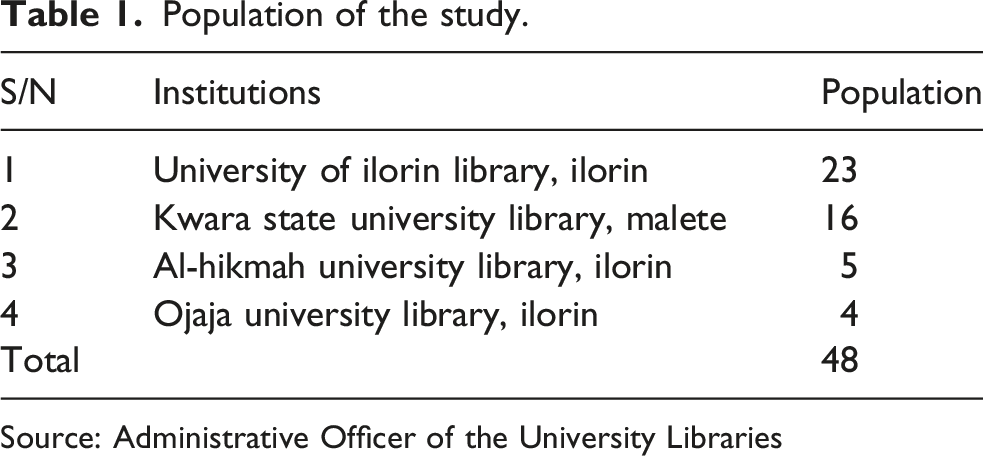
Source: Administrative Officer of the University Libraries
As mentioned, due to the small population, total enumeration sampling technique was adopted, which result in a sample size of 58 that represent the entire population. Questionnaire was used for data collection. The questionnaire is divided into six (6) parts, which consist of the respondents’ demographic information and responses to items on the research questions. The Section A elicits the demographic details of the respondents, which include gender, year of experience, and educational qualification. The Section B of the research questions focuses on the perceptions of big data analytics for information management, which has five (5) items with five-point Likert scale of Strongly Agreed = 5 to Strongly Disagreed = 1. The Section C focuses on the extent of using big data analytics for information management, which has six (6) items with four-point Likert scale of High Extent = 4 to No Extent = 1. Section D focuses on the purpose of using big data analytics (BDAs) for information management, which has six (7) items with five-point Likert scale of Strongly Agreed = 5 to Strongly Disagreed = 1. Section E focuses on the challenges associated with the usage of big data analytic for information management, which has five (7) items with five-point Likert scale of Strongly Agreed = 5 to Strongly Disagreed = 1.
Reliability of the instrument.
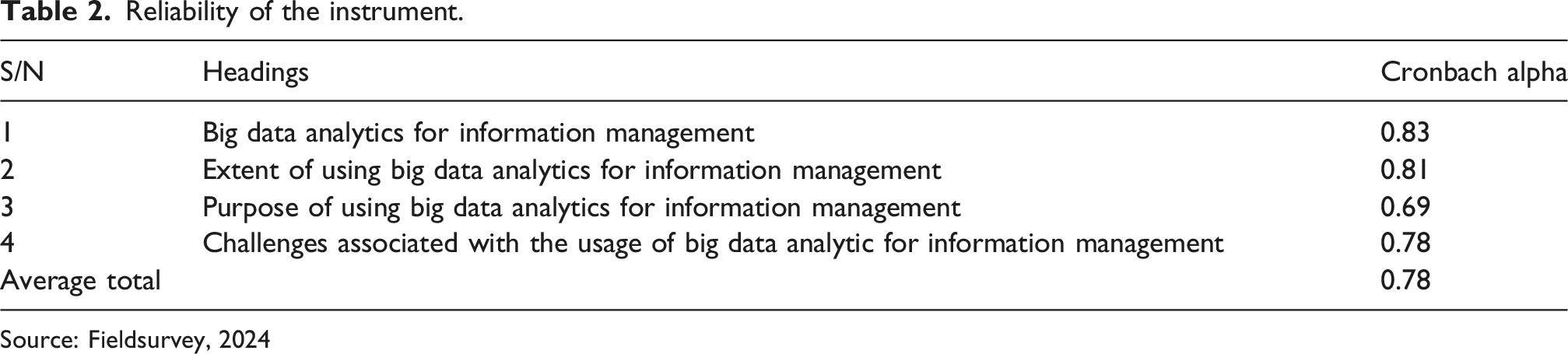
Source: Fieldsurvey, 2024
A Letter of Introduction was requested and collected from the Director for Centre of Research and Development, Kwara State University, Malete, Nigeria. This letter was shown to the heads of the different university libraries where data was collected to seek their permission to gather data for the study. The letters were approved, stamped, and signed by the different university libraries’ heads. The data was collected by the researchers physically with the help of two (2) research assistants. Each research assistant collected data at the University of Ilorin Library, Ilorin, and Ojaja University, Eyenkorin, Kwara State, Nigeria. The research assistants were trained on how to go about the data collection before giving them the letter of introduction. The purpose of the study was explained to the respondents before administering copies of the questionnaire on them.
Descriptive statistics, which include frequency count, simple percentage, mean, and standard deviation were used to analyse the collected data from the respondents. However, data collected was cleaned, coded and analysed using the IBM-Statistical Product and Service Solutions (SPSS) version 26. Upon request by the student researcher, the Ethical Approval Letter was obtained from the Director Centre of Research and Development, Kwara State University, Malete. The Reference No. of the Letter is KWASU/CR&D/REA/2024/0065. Informed consent of the respondents was sought and gotten before the administration of the questionnaire on the respondents. Participation in the study was voluntary.
Results
Respondents’ demographic information.
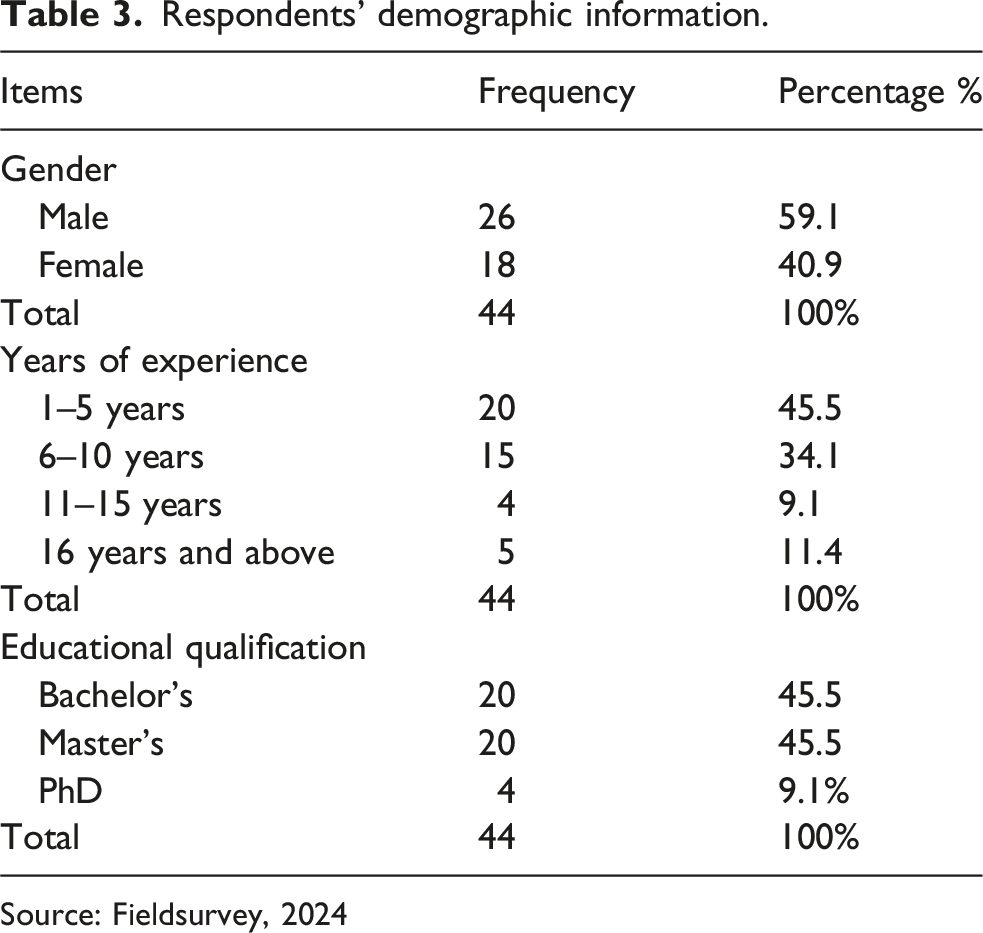
Source: Fieldsurvey, 2024
Table 3 shows the demographic analysis of the respondents, which disclosed some notable patterns across various categories. Gender distribution indicates a significant majority of male respondents (59.1%) compared to female respondents (40.9%).The Table also shows the experience levels of the respondents: individuals with 1-5 years of experience constitute the largest group (44.5%), while those with 11-15 years represent the smallest cohort (9.1%). Regarding educational background, Bachelor’s degree holders and Master degree have the highest rate (45.5%), with a notably lower representation of respondents with PhD (9.1%).
Perceptions of big data analytics for information management.
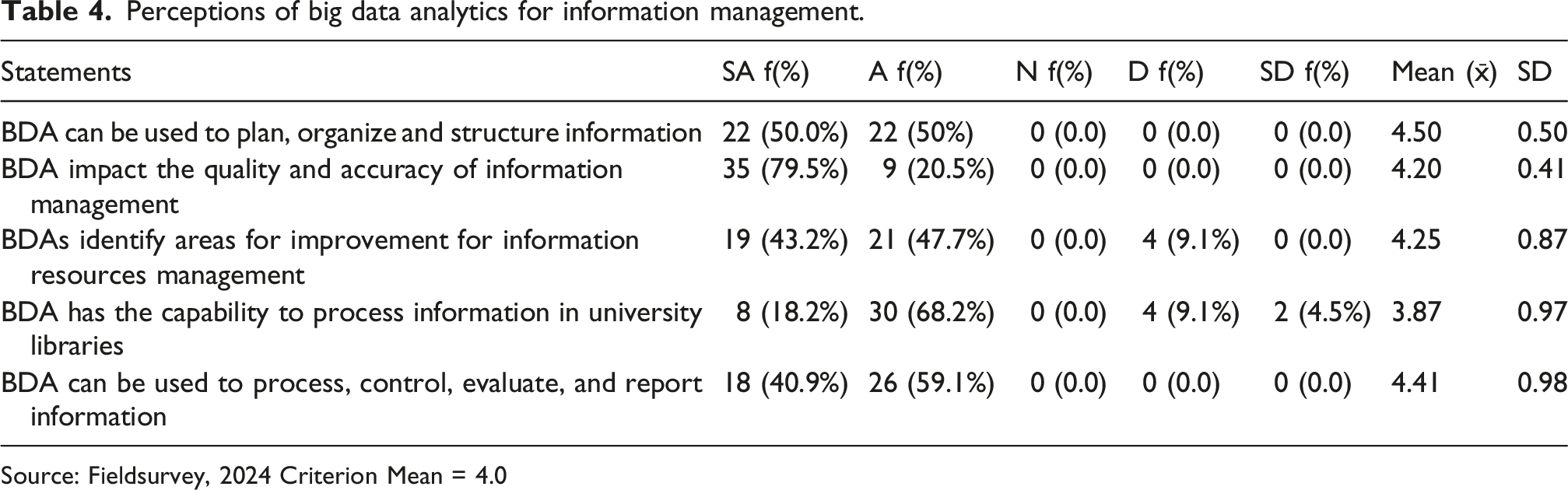
Source: Fieldsurvey, 2024 Criterion Mean = 4.0
Extent of using big data analytics for information management.

Source: Fieldsurvey, 2024 Criterion Mean = 3.0
Purpose of using big data analytics for information management.
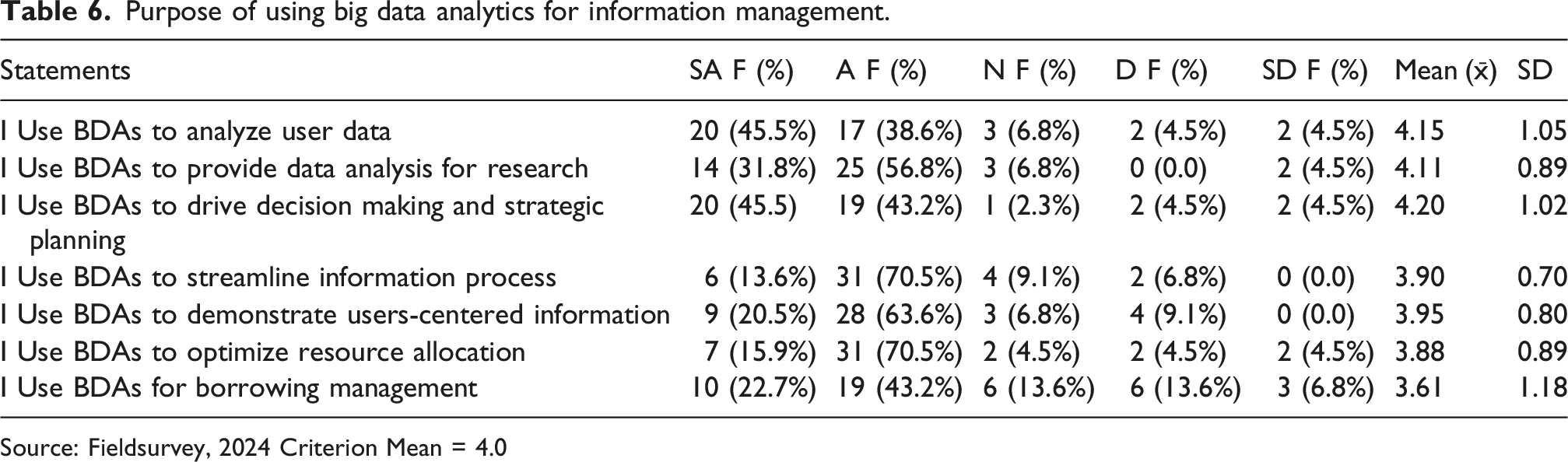
Source: Fieldsurvey, 2024 Criterion Mean = 4.0
Challenges associated with the usage of big data analytic for information management.
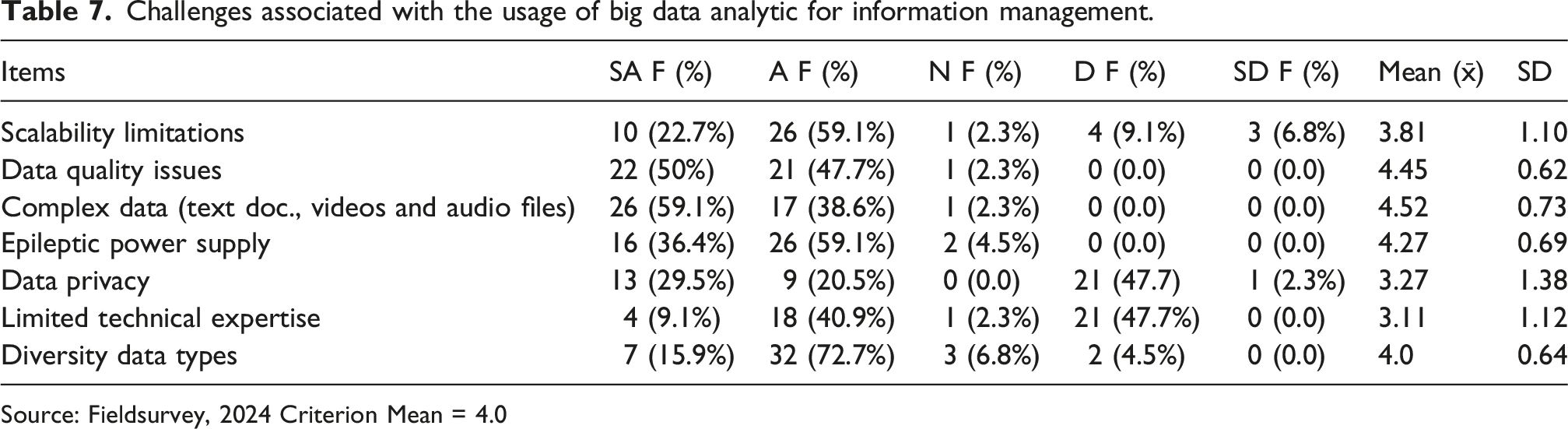
Source: Fieldsurvey, 2024 Criterion Mean = 4.0
Discussion
The findings showed that perceptions of big data analytics for information management among librarians in selected academic libraries in Kwara State include big data analytic can be used to plan, organize and structure information, big data analytic is used to impact the quality and accuracy of information management, big data analytic is used to identify areas for improvement for information resource management and big data analytic is used to process, control, evaluate, and report information. The finding is different from that of Kamupunga and Chunting (2019), which indicated that librarian perceived big data analytics as expensive technologies for information management which made up of high-velocity, high-variety, and high-volume information that is used creatively to improve understanding and decision-making in universities libraries. Meanwhile, the finding is similar to that of Müller et al. (2016), which demonstrated that librarians perceived big data analytic in information management in the areas of organising and structuring information. Also, it was shown that big data analytic is used to impact the quality and accuracy of information management.
The finding shows the extent of using big data analytic for information management. The finding indicates that less than half of the librarians lowly used QlikView and Splunk to process the framework of large data sets and machine data analysis for information management. This implies that there is a need for university libraries may to focus on providing more awareness and workshop on the use of these big data analytics tools in information management. With this, information service provision can be entrenched and service delivery would be enhanced. The finding shows that more than half of the librarians moderately used Tableau for data visualisation, moderately used Apache Spark for data analysis engine, moderately used SAS Visual Analytic for data exploration and predictive analytics, and moderately used Apache Hadoop to gain insights from structured and unstructured data. Meanwhile, the finding of the current study is different from previous studies (Mikalef et al., 2020; Müller et al., 2016), which revealed that SAS Visual Analytic and QlikView is extensively explored for predictive analytics for information management. The finding aligns with Obitade (2019), which shows that healthcare information management consider the use of big data analytics like Apache Spark for data analytics engine for information management.
The result revealed that the purpose of using big data analytics for information management include to analyze user data for research and drive decision making and strategic planning. The finding is similar to Khan and Vorley (2017), which demonstrated that big data analytics in knowledge management (KM) is use to provide data analysis for research, analyse user data and used to drive decision making and strategic planning. This indicates that big data analytics are important for information processing in the cycle of information management. This means that librarians in university libraries can provide research support service to other academic staff of universities using their expertise of big data analytics tools like Tableau, Apache Hadoop, and so on. Meanwhile, the finding of the current study is dissimilar to previous studies (Elgendy and Elragal, 2014; Zakir et al., 2015), which established those big data analytics may be used practically for data visualization and knowledge management (KM) enhancement by enhancing the insights for a variety of business operations, including supply chain and marketing management.
The finding indicated that challenges associated with the usage of big data analytic include data quality issues, complex data (text document, videos, and audio files), epileptic power supply, and diversity data types. The finding differs from Bansal et al. (2018), which illustrated that inaccurate users’ requirements, system failures, mobile payments pose security risks, and substantial financial investment for data management, analytics tools, and infrastructure serves as the pitfalls mitigating the use of big data analytics for information management. The finding is similar to Golub and Hansson (2017), which showed that extensive and varied datasets, unstable power supply and data quality issues were the challenges associated with the use of big data analytics. The finding is different from Chen et al. (2015), which demonstrated that intricate nature of privacy, unavoidable data leaks and assurances of confidentiality were challenges associated with the usage of big data analytic.
Implications
Theoretically, the findings of this study contribute to discourse on the role of big data analytics in information management within academic libraries. Contrary to previous evidence by Kamupunga and Chunting (2019), which highlighted the perception of big data analytics as primarily high-cost and complex, this study reveals a more functional perspective, emphasizing its practical applications in organizing, structuring, and improving the quality of information. This divergence suggests that the theoretical understanding of big data analytics in information management may be evolving, with a shift towards recognising its value in enhancing operational efficiency rather than focusing solely on its complexity and cost. Additionally, the study aligns with Müller et al. (2016) in identifying the importance of big data analytics in improving information accuracy and quality, thereby reinforcing theories that emphasize the role of big data in enhancing decision-making processes in academic libraries.
Practically, the study provides valuable insights for library professionals in information management. The moderate use of tools like Tableau, Apache Spark, and SAS Visual Analytics suggests that while there is awareness and adoption of big data analytics tools, there is still room for more extensive usage and integration. The study highlights the need for further training and resources to enable librarians to fully harness these technologies for information management. Moreover, the challenges identified, such as epileptic power supply and complex data types, suggest that libraries in Kwara State, Nigeria and university libraries from similar developing countries may need to prioritize infrastructural improvements and adopt strategies to manage data quality issues effectively. By addressing these practical challenges, academic libraries can enhance their information management processes, leading to better service delivery and more accurate, data-driven decisions.
From a societal perspective, the study’s findings underscore the growing acceptance and integration of big data analytics in information management in academic libraries. By highlighting the practical uses of big data analytics—such as data visualization, predictive analytics, and strategic decision-making—this study suggests that librarians and academic institutions are increasingly leveraging these technologies to improve information services. This shift has broader societal implications, as it indicates a move towards more data-driven decision-making in university libraries, which could lead to more informed and efficient management of information resources. Furthermore, the challenges identified, such as data quality issues and diverse data types, point to the need for continued investment in infrastructure and training to fully realize the potential benefits of big data analytics in academic libraries.
Conclusion
The study concludes that librarians perceived big data analytic for information management in university libraries to plan, organize and structure information The study establishes that librarians did not extensively use big data analytic for information management such as Tableau for data visualization in information management, Apache Spark for data analysis engine for information management, SAS Visual Analytic for data exploration and Apache Hadoop to gain insights from structured and unstructured data in information management. The study also recognises that librarians used big data analytic to analyze user data, to provide data analysis for research and for strategic planning. Lastly, the study highlighted that data quality issues, complex data (text document, videos, and audio files), epileptic power supply, and diversity data types were challenges associated with the use of big data analytics.
Recommendations
Based on the results of the study, the followings are the suggested recommended: (i) University libraries should implement regular training programs and workshops to enhance librarians’ understanding and skills in big data analytics like QlikView and Splunk, making them more confident and proficient in using these tools for information management. (ii) University libraries should invest in the necessary technological infrastructure to support big data analytics, including hardware, software, and high-speed internet. This will enable librarians to utilize big data tools effectively. (iii) There is a need to encourage librarians to integrate big data analytics into their decision-making processes. This includes using data-driven insights to optimize resource allocation, improve service delivery, and enhance user experiences in the library. (iv) University management should develop strategies to address common challenges such as data privacy concerns, lack of technical expertise, and budget constraints. This means, there need to provide support systems, such as technical assistance and funding opportunities, to help libraries overcome these barriers. (v) Universities libraries need to create platforms for collaboration and knowledge sharing among librarians from different institutions. This can include workshops, conferences, and online forums where librarians can share best practices, success stories, and innovative uses of big data analytics for information management. (vi) Future studies should consider examining the usage of big data analytics for research support services among librarians in university libraries. (vii) Future studies should consider expanding the scope of the study to include other categories of libraries, which include public libraries, special libraries, national libraries, with respect to their perception and use of big data analytics for information management. (viii) Future studies should consider conducting a longitudinal study on the perception and use of big data analytics for information management.
Footnotes

Funding
The authors disclosed receipt of the following financial support for the research, authorship, and/or publication of this article: This research was funded by the Centre for Research and Development, Kwara State University, Malete, Nigeria with grant number KWASU/CUR/012/00173.
Declaration of conflicting interests
The authors declared no potential conflicts of interest with respect to the research, authorship, and/or publication of this article.