







Abstract
In today’s work environments, work-life balance has grown in importance, especially for those with irregular schedules. The work-life balance experiences of librarians working afternoon and night shifts in a few academic libraries in Port Harcourt, Nigeria, were examined in this study. The study addressed lack of scholarly focus on librarians who work night shifts in urban environments that are marked by flooding, traffic jams, transportation unreliability, insecurity, and other socio-environmental stressors. The study used a qualitative design within a constructivist-interpretivist paradigm, guided by the Job Demands–Resources (JD–R) model. Semi-structured interviews with purposefully chosen library staff members (8) from three Port Harcourt university libraries, the University of Port Harcourt, Ignatius Ajuru University of Education, and Rivers State University, were used to gather data. These interviews were complemented by confirmatory follow-up interactions. Thematic analysis was done on the data, and the results show that although participants thought the university environment was generally safe during working hours, they had significant anxiety and stress due to late-night commuting, urban insecurity, transportation challenges, long travel distances, bad weather, and the removal or lack of shift-related financial incentives. While some respondents viewed advance notice and rotational scheduling as coping strategies, others characterised night duty as physically, emotionally, and financially taxing. The study comes to the conclusion that the interplay of institutional support systems, environmental vulnerabilities, and occupational demands shapes the work-life balance of nocturnal librarians in metropolitan university contexts. In order to promote healthier and more sustainable working circumstances for library employees working non-traditional shifts, it suggests specific policy changes, such as transportation assistance, staff housing choices, the reinstatement of shift allowances, and more responsive welfare and safety measures.
Keywords
Introduction and background to the study
Singh and Rana (2017), has confirmed the effect of afternoon/night-shift on disruption of functionality of humans’ circadian rhythms, is approximately round-the-clock configurations of the human body and brain, permitting variations in an internal clock that controls the sleep-wake cycle. Afternoon/night-shift duties have the tendencies to cause work-life conflict; as noted by Iskra-Golec et al. (2017), this may lead to two types of conflicts: strain-based and time-based conflicts. These have been identified as a disturbance to natural or biological rhythms and social routines, often resulting in sleeping problems and compromised health.
Another consequence of afternoon/night-shift employment is the Shift Work Sleep Disorder (SWSD) which is a situation that predominantly upsets people who perform afternoon/night duty or rotating shifts; this problem may lead to insomnia or disproportionate sleepiness, drowsiness, tiredness, lethargy and lassitude while on duty. This condition may significantly impair the sufferer’s judgment or compromise mental alertness that could lead to driving accidents or work-related inaccuracies, an increase in sick leave and mood swings (Foldvary-Schaefer, 2021).
Libraries as information centres are cultural and social institutions that catalyse the transformation of society in the role of collecting, preserving, and disseminating information, to meet the information needs of the society. Yilmaz and Soylu (2014), note that the overall well-being and ability to establish harmony between work and personal life of those who offer this important responsibility is directly proportionate to the progress and development of the nation.
Keeping a comfortable work-life balance is not merely essential for health and social interactions; it can also improve employees’ efficiency and performance. If people don’t view work as an inconvenience, they will put more effort and work harder, make fewer blunders, and are more likely to become believers in the goals and vision of their establishment. Organisations that attain a reputation for boosting work-life balance are attractive to workers (Wedgwood, 2019). Durodolu et al. (2020) confirmed that library staff undergo emotional stress, insecurity and financial strain due to their performance of afternoon/night duty in an urban centre. Durodolu and Mamudu (2020) similarly identified age as a significant cause of work-life balance inequalities, revealing that an ageing workforce has an over-bearing negative impact on adaptation, output and innovation in the workplace.
Contextualisation and statement of the problem
Together with neighbouring areas, Port Harcourt is renowned for its abundant reserve of crude oil and natural gas, representing more than 40% of Nigeria’s total output of crude oil and gas resources. Allied to that, other mineral resources like silica sand, glass and clay and other solid minerals are found in the city (Rivers State Government, 2021). Imminently, there is a lot of oil exploration and exportation taking place. This state of natural wealth has been an attraction for sustained urbanisation of the city.
There are many unavoidable characteristics of living and working in urban areas worldwide: transport system congestion, environmental problems, accommodation difficulties, inadequate urban planning, security challenges, and high population density. These are some of the predicaments encountered by urban dwellers. Port Harcourt (PH), one of the foremost commercial city centres in Nigeria, is not exempted from these complications for workers. PH is the capital of Rivers State and is statistically considered the fifth most populated urban city in Nigeria, coming after Lagos, Kano, Ibadan and Benin City. Amiegbebhor (2018) avers that vehicular congestion in Port-Harcourt city impairs mobility, which is obvious in stretching and extending transit time and loss of productive man-hour. As a result, the ability to move and ease of getting to the desired destination due to extended waiting time at the bus stations are diminished. Additional difficulties in PH include the fact that coastal cities are vulnerable to flooding due to extended periods of torrential rainfall. Port Harcourt belongs to areas prone to flooding because of the geographical location of several river tributaries and the Atlantic Ocean. Echendu (2020) identifies flooding as capable of hampering movements and paralysing social and economic activities in this state capital.
The fast growth in the population of urban cities results in momentous challenges in accommodating people, thus causing homelessness, squatting and slum areas to be common (Kio-Lawson and Dekor, 2014). Hazard factors for metropolitan insecurity include fast and disorderly urbanisation, particularly when accompanied by social and economic disparity, and power vacuums in which ethnic, political, and criminal organisations strive to control limited resources and power. The U.S. Department of State, Bureau of Democracy et al., 2021 reports that the level of insecurity in Port Harcourt is intense, with criminal organisations abducting civilians and demanding for ransom, thousands of inhabitants of Port Harcourt and adjoining villages have fled their households as a result of these clashes. Militia groups, also, with connection to the political class oftentimes incite violence, tapping oil illicitly from pipelines orchestrating violent clashes with security agents while armed robbers with dangerous weapons also constitute grave danger to the life of occupants of this city. These are the problems associated with Port Harcourt as one of the highly urbanised cities in Nigeria. The above scenario exemplifies the situation and circumstances surrounding many of those who live and work in Port Harcourt, the capital city of Rivers State, Nigeria.
Statement of problem
One of the most crucial future ideas in the evolving workplace is work-life balance. Workforce diversity is the result of historical, social, economic, international, political, and last but not least, environmental reasons driving everyone, including librarians, to work outside the box and think creatively across borders. This is a pressing issue for all categories of employees who are constantly denying themselves of family leisure due to intense pressure of their jobs. The main concern of society is for long-term healthy and sustainable development. According to Akter (2013), despite the fact that WLB is a growing concern for employees’ quality of life, there is a lack of awareness among the employees. The reason for this is because work has increased over the last two (2) decades as a result of economic uncertainty, organisational restructuring, and an increase in business competition. The best WLB practises can be brought to the workforce by raising awareness. All career levels of employees are concerned about it. This study was set to find out how librarians in the city Port Harcourt manage their work-life balance considering the level of insecurity and other hazardous elements prevalent in the city.
Literature review
Work-life balance
According to Ahmed, 2017; Jahagirdar and Bankar, 2022; Karim and Bhowmik, 2007; Tiwari and Chaturvedi, 2021, the term “work-life balance” refers to a condition of equilibrium where the demands of both the professional and personal lives are equal; and is one way to strike a balance between work and family obligations in order to get everything done efficiently and to an individual’s advantage. Each function has a unique set of requirements, and when those requirements conflict with one another, several issues arise and a great deal of tension is produced. Work-family conflict can be divided into two types: work-to-family conflict and family-to-work conflict. When an individual’s ability to complete chores connected to their family and their job conflict, work-to-family conflicts result and vice versa.
The goal of work-life balance (WLB) is to balance paid and unpaid caregiving. Men prefer flexibility in paid work with the intention of spending more time with their families, and this issue affects both men and women. The job that is done by the employees aids in the maintenance of their family life by allowing them to make plans for duties like child care, working from home, taking time off, etc. This is highly encouraging for female employees with kids who can set up their work schedules, share roles, or even take career pauses. Parental leave and working at home or from home to support their families are also included. While contending that such a synergistic condition is challenging to achieve, primarily because the simultaneous combining of work and home is likely to include some degree of role conflict, it is also considered as the satisfaction and excellent functioning at work and a home with a minimum of role conflict.
Urban city
Despite receiving a lot of attention in popular literature, there hasn’t been much library scholarship on the subject of work-life balance (WLB) and urban city. According to Townsend and Bugg (2020), living in an urban area has a number of clear benefits, such as easier access to well-paying jobs, life-sustaining and wellness-improving services, and improved health due to exposure to a diverse range of cultures. The effect of these services on WLB is contrasted in the literature in a number of ways, especially in the coverage of mental health. While there is evidence that people who live in these sizable “happy” cities are less likely to commit suicide (Park and Peterson, 2014), there is also data that suggests city dwellers are more likely to experience mental health problems (Alcock et al., 2014).
Commuting time is one of the biggest difficulties of living in an urban area. Spending a lot more time and money on commuting is a known stressor and threat to general wellbeing for city inhabitants, especially those who use public transit (U.S. Census Bureau, 2015). Small towns were also deemed to be preferable places to reside due to the cost of living and travel times by well-known sources that contrast large cities with them (Thorsby, 2016). While the effects of long commutes’ stress on different groups vary, it has been discovered that the effects on WLB are a factor in married women’s departure from the labour (Black et al., 2014; Townsend and Bugg, 2020).
With particular reference to Port Harcourt as an urban area where the pace of life can be hectic, librarians may find it challenging to strike a balance between job and family responsibilities. Long and erratic work hours, frequent transfers, shift changes, and overtime are some of the challenges librarians may encounter at work. Due to the conflicting demands of both job and family life, work-family conflict is a type of inter-role conflict. Absenteeism, stress, and the desire to leave the company are possible outcomes. Shuttling between locations, which can be time-consuming and stressful due to the large population, high workloads or high demand for professional services in dealing with a large number of library patrons, and lack of flexibility due to rigid schedules are all additional potential difficulties librarians may confront. It becomes challenging for librarians to handle personal concerns during the work period since there is little or no opportunity for flexibility.
Methodology
Focus group discussion, which has the advantage of helping to gain a detailed understanding of the participants’ worldview, was used in this study to find out respondents’ level of knowledge about the topic of Work-Life Balance in the Urban-City of Port Harcourt. A qualitative research design was adopted, and data were collected through interviews and focus group discussions. The research was guided by a constructivist-interpretative philosophical paradigm which establishes that reality is constructed by interactions between a researcher and the research subject (Harvey, 2012).
This study used a constructivist-interpretivist paradigm and a qualitative research design. Since the study aimed to comprehend the lived experiences, perspectives, and meanings associated with work-life balance among librarians working afternoon and night shifts, the qualitative approach was deemed appropriate. The study sought to reflect the richness and diversity of participants’ experiences in their actual work environments rather than quantifying characteristics.
The study, which focused on a few of the city’s academic libraries, was carried out in Port Harcourt, Rivers State, Nigeria. The Donald E. U. Ekong Library of the University of Port Harcourt; Ignatius Ajuru University of Education Library; and, Rivers State University Library were among the institutions studied. These establishments were chosen due to the fact that they provide academic library services in a city setting and that their employees work long hours or irregular schedules.
The study sample was made up of library staff members who worked afternoon and/or night shifts in the chosen university libraries. Participants who had first-hand knowledge of the topic being studied were chosen using a purposive sampling technique. Eight (8) respondents took part in the study; and allowed the researchers to find information-rich examples that could offer in-depth insights into the realities of midnight library work, purposeful sampling was acceptable.
The participants for this study were purposively selected to represent the general opinion about the study’s subject matter, which is to investigate the effects of Work-Life Balance concerning those who carry out responsibility relating to afternoon/nightshift in the urban environment of Port Harcourt. Under the prevailing circumstances, the study population is considered adequate to be used as a basis for generalisation, particularly in Port Harcourt and other parts of the country that share similar environmental conditions and other demographic characteristics.
Allied to the above procedure, randomly conducted telephone interviews were carried out as a means of confirmatory data collection method among identified staff who are involved in afternoon/night-shift duties, the cumulative data generated was used as a basis to draw conclusions and generalisation. The rationale for using the qualitative technique is to collect in-depth data through direct participation using interviews and focus group discussion on revealing the participants’ extensive personal opinions. Analyses were done by examining, comparing and contrasting, and then interpreting acquired data. This was anchored on the assumption that numerous insights to social reality will uncover the complexities of a shared problem. Due to its impossibility to accurately quantitatively evaluate personal experiences in conjunction with the nature and breadth of social reality, the quantitative research approach was thought to be appropriate for this study.
Novelty of the study
This study is one of the first to focus specifically on the work-life balance of librarians in Port Harcourt, Nigeria. The unique socio-economic and security conditions in this region provide a distinctive backdrop for the research, which has not been extensively explored in existing literature.
Most work-life balance studies tend to focus on more commonly studied professions like healthcare, corporate, and education sectors broadly. By zeroing in on librarians, particularly those working afternoon/night-shifts, this study fills a significant gap in understanding the unique challenges faced by this professional group.
The study’s emphasis on afternoon and night shifts introduces a new dimension to the work-life balance discourse. While shift work has been studied in other professions, the specific impact of night shifts on librarians in an academic setting is a relatively unexplored area.
Given the specific security issues in Port Harcourt, this study’s focus on personal safety and transportation challenges faced by night shift workers adds a unique and critical layer to the work-life balance discussion. It highlights the intersection of occupational stress and external environmental factors.
The use of qualitative research techniques, particularly interviews, allows for a deeper, more nuanced understanding of the librarians’ experiences. This methodological choice provides rich, detailed insights that are often missing in quantitative studies.
Utilizing the Job Demands-Resources (JD-R) model in this context is novel as it applies a well-established theoretical framework to a new and specific professional and geographical context. This application helps in understanding the dual impacts (both demands and resources) on the well-being of librarians working night shifts. The findings reveal culturally specific coping mechanisms, such as relying on community and familial support, which are particularly relevant in the Nigerian context. This aspect provides valuable insights into how cultural factors influence work-life balance strategies.
Aim of the study
The study aimed at ascertaining the effects of Work-Life Balance (WLB) on Librarians in an Urban-City of Port Harcourt, Nigeria, with the following research questions:
Research questions
The study was undertaken to provide answers to the following definite questions: (1) What are your opinions about your personal safety when scheduled for the afternoon/night-shift at your University Library in Port Harcourt? (2) What are your experiences with transportation to and from work when on the afternoon/night-shift duty? (3) How secure do you feel within the workplace when working on the afternoon/night-shift at your University Library in Port Harcourt? (4) How would you assess the impact of the distance of your place of residence to your workplace on your productivity when on afternoon/night-shift duty? (5) Do you consider your involvement in afternoon/night-shift duty at your University Library in Port Harcourt as having any financial effect on you? (6) What do you feel are the impacts of the afternoon/night-shift duty at your University Library in Port Harcourt on your work-life balance in general? (7) What can be done to reduce the impact of the afternoon/night-shift on your work-life balance at your University Library in Port Harcourt?
Scope and limitations of the study
The subject scope of the study was limited to the work-life balance of librarians in the urban city of Port Harcourt who are involved in afternoon/night duties, and has been thoroughly investigated in relation to personal safety, transportation, accommodation, working environment. This implies that the research examines the circumstances surrounding the working condition of the staff. This, undoubtedly has implications for other professions in urban centres in the country and across the globe. The research environment is limited to three (3) Universities based in Port Harcourt, namely: University of Port Harcourt (UNIPORT), Ignatius Ajuru University of Education (IAUE), and Rivers State University (RSU). The staff of the libraries who are involved in afternoon/night-shift duties were selected for the study. The methodological scope of the study is limited to the use of qualitative research techniques with interview and document analysis as data collection methods for the research.
Theoretical framework
The Job Demands–Resources (JD–R) model, also known as occupational stress model, first created by Demerouti et al. (2001), serves as the foundation for this investigation. According to the JD-R model, work demands and job resources are present in every occupation. The physical, psychological, social, or organisational components of work that necessitate consistent effort and are thus linked to psychological and physiological expenses are referred to as job demands. On the other hand, job resources are elements of the job that facilitate the accomplishment of objectives, lessen demands, or promote personal development. As a result of its ability to illustrate how occupational strain arises when demands surpass available resources, the JD-R model is especially useful for comprehending work-life balance among librarians working non-standard shifts. For night-shift librarians, job demands may include late hours, fatigue, disrupted family routines, commuting stress, transport scarcity, security risks, and workload expectations. Job resources may include supportive supervision, flexible scheduling, shift rotation, transport assistance, financial incentives, collegial support, and adequate staffing.
The JD-R framework has been extended by later research, which has demonstrated its applicability in a variety of occupational contexts, including knowledge-intensive careers. It emphasises that persistently high demands combined with inadequate resources can result in burnout, disengagement, and decreased well-being (Bakker and Demerouti, 2007). Recent conceptual work in libraries has also used JD-R logic to comprehend role redesign, occupational stress, and workload equity among academic librarians. Therefore, the framework offers a powerful lens through which to interpret how the lived experiences of nocturnal librarians in urban academic libraries are shaped by the balance (or imbalance) between job demands and job resources.
The authors of this study argued that the Job Demands Resources (JD-R) model can be utilised as an integrated conceptual framework for workplace observation with the goal of enhancing work engagement and preventing burnout. The JD-R model is especially well suited for this task because it: (1) combines a positive focus on work engagement with a negative focus on burnout into a balanced and comprehensive approach; (2) has a broad scope, allowing for the inclusion of all pertinent job characteristics; and (3) is flexible, allowing it to be adjusted to the needs of any organisation; (4) it also serves as a common communication platform for all stakeholders (Bakker and Demerouti, 2007; Demerouti and Bakker, 2011; Demerouti et al., 2001; Dicke et al., 2018). In contrast, earlier models only incorporated a small number of predetermined job characteristics and nearly solely concentrated on the negative aspects of the profession. The JD-R model not only enjoys significant appeal among academic researchers due to its thoroughness, breadth, flexibility, and communicative nature, but it is also well suited for practical use in organisations.
The intensities of control and demands on the employees are also revealed to impact work-life balance. Unusual work demands can increase the possibility of suffering work-life conflicts. Some studies noted that collective levels of flexibility and control improve work and family life; however, other research show that a high level of stress negatively affects work-life balance (Fagan and Walthery, 2011). Work-life imbalances and other job-related conflicts can be observed as stressful and negative for workers in different situations (Allvin, Aronsson, Hagstro¨m, Johansson, and Lundberg, 2004).
The goal of this research was to better comprehend the idea of work-life balance in an academic library environment, not to test any current theories. In conclusion, the justification for the use of JD-R model is to provide a broad, empirically supported, and flexible framework that can be used to understand the impact of job demands and resources on employee well-being and performance.
Significance/contribution of the study
The significance of this study can be understood from four cardinal areas: addition to literature/contribution to knowledge, impact to the Library and Information Profession (LIP), effect on government policy and the implication to the relevant theory. Though there is a paucity of relevant literature in the subject matter of work-life balance in the context of the Nigerian environment, the authors of this study have undoubtedly established how the study fits within a larger field of study by providing a general outline of the sources reconnoitred during the research. By doing this, new knowledge centred on the erstwhile available knowledge has been created through far-reaching and novel research.
The study makes specific recommendations that have affirmative implications for the Library and Information Profession (LIP) by creating various options available to resolve an existing problem or meet an important need. The recommendation aims to compare existing alternatives and recommend an option that aligns with the research findings. The research indeed makes a significant contribution to knowledge by suggesting areas of possible policy changes. Reforms and restructuring are integral parts of unending change processes, in this case, policy changes that will lead to better work-life balance for library staff involved in afternoon/night-shift duties. Lastly, the study adds to the value of knowledge by intensifying existing theory and throws light on the subject matter of work-life balance using the job demands-resources model (JD-R model) which is an occupational stress model that advocates strain has a response to disparity between demands on the individual and the means of dealing with those demands.
Results/responses from the interviews and discussion of findings
The responses from the interviews are presented in a discursive form and analysed interpretatively and comparatively.
Interview Question 1
When you are on the afternoon/night-shift as a library worker, how safe or protected, do you feel? Put differently, how secure are you working on the afternoon/night-shift at your Library? (For instance, at the workplace or about your family that you left for work)
With regards to question 1, bothering on how secure people felt working on the night-shift at their university libraries or about their families when at work, there was a consensus opinion from participants across the three universities that the insecurity they felt was only outside the university environment and not within it, or inside the library. The participant from RSU put it succinctly that: “In Rivers State University Library, we are safe and protected because the University has made adequate provision for security but outside the University premises no one is safe due to the security situations in Rivers State generally and Port Harcourt in particular”.
This position was corroborated by participant 5 from UNIPORT who said that: “I feel secured when on afternoon/night-shift. However, I have security and safety concerns outside the University as a result of the general insecurity that pervades the entire state”.
Participants generally felt no particular security threats generated by their absence towards their families while at work. One reason for this was the trust bestowed on neighbours who could stand in, if any threats arose. In the words of participant 2 from UNIPORT, “the family is safe because in your absence, others are in the yard”. This disposition of trusting in communality and brotherhood for stemming or handling any threats to the family is surprising, given the acceptance of all that the security situation in Rivers State in general, and Port Harcourt in particular, was porous. People generally felt insecure in the state due to certain threats. As narrated by participant 4 from UNIPORT, one of such threats is that, “due to the insecurity in the State, there is (sic) concerns about going home especially boarding taxis or buses” [at night]. The import of this scenario is that “outside the university, security is not guaranteed” as opined by participant 3 from UNIPORT. Having people leave late at work in the night time in such an environment where security is not guaranteed, potentially exposes personnel to higher levels of concern and apprehension, and ultimately the stress suffered by these staff who engage on the afternoon/night-shift.
Interview Question 2
Do you have increased concerns or apprehension about your safety when you are on the afternoon/night-shift in your assessment? (If the answer is in the affirmative, a follow-up question would be: Please explain these concerns or apprehension that you have).
Question 2 tried to assess whether personnel on the afternoon/night-shift had increased concerns or apprehension about their safety. This question tried to corroborate the earlier question and gauged the emotional or fear factors that potentially increased the workers’ stress. The participants raised a number of factors, including heightened concerns/apprehension when there was heavy rainfall, having to walk down home at night, the general porous security in the state, or even the stories told by other staff about their negative experiences. In this last regard, participant 3 from UNIPORT revealed that: “There are times such apprehension will come because of other peoples’ experience but for me, I do not dwell on that since I have not experienced any issues that are of safety concerns”.
The unsavoury experiences narrated by fellow staff strikes a chord of fear in the hearts of other staff and could then be exacerbated when faced with potential threatening situations as narrated by participant 1 from UNIPORT who said that sometimes vehicle not dropping me at a safe place and having to walk down home at night risking falling into the hands of hoodlums… [makes him feel apprehensive]. Participant 2 from UNIPORT revealed how in some cases, people come to work due to having no choice. According to him, “there is so much risk now in the South-South but you have (sic) no choice to be absent [you do not have the option to be absent from work]. This actually implies that people still had to go to work when slated for the afternoon/night-shifts even when they had genuine concerns about the risks associated with it. However, it is surprising that the two participants from Ignatius Ajuru Univeristy of Education (IAUOE) Library had no increase in security concerns or apprehensions about their safety when on afternoon/night-shift, although they had admitted the porous security situation in Port Harcourt.
Question 3:
Does being on the afternoon/night-shifts affect your financial status as a worker at the University Library in any way positively or negatively?
On question 3, the opinion was divided as to whether being on the night shifts affects the concerned staff’s financial status as workers at the University Library in any way positively or negatively. Three participants, 1 from Ignatius Ajuru University of Education (IAUOE) Library, the only participant from Rivers State University, and 1 participant from UNIPORT, maintained that afternoon/night-shift participation had no adverse economic effect on them. The rest participants accepted that the night shift duties exerted pressure on their finances in one way or another. The second participant from IAUE specifically said that “in the past we were paid shift allowance which positively affected our financial status. But in the last ten years the payment has stopped. It is only our salaries that we now receive. Our financial status is being affected negatively”. The negative impact of night shift on personnel finances was further compounded by a central means of payment for all workers in the federal government employment. As stated by participant 3 at UNIPORT: Yes. In the past, before the advent of IPPIS as a medium of salary payment, my salary used to reflect what is being paid for shift duty (shift allowance) but since the advent of IPPIS as a medium of salary payment in February, 2020 when IPPIS became the medium of paying salary being on afternoon/night shift now has negative effect on my finances such that it is now a huge task to meet up with my financial obligations towards my family. (IPPIS means Integrated Personnel Payroll and Information System introduced by the Federal Government of Nigeria as a mode of salary payment to her employees).
Another participant posited that “Before now, there used to be shift allowance to encourage staff, but it has been removed” (Participant 2 Para-Professional, UNIPORT). These opinions show that non-payment of additional stipend/allowance for personnel engaged on the night shift duty affects their finances.
Question 4:
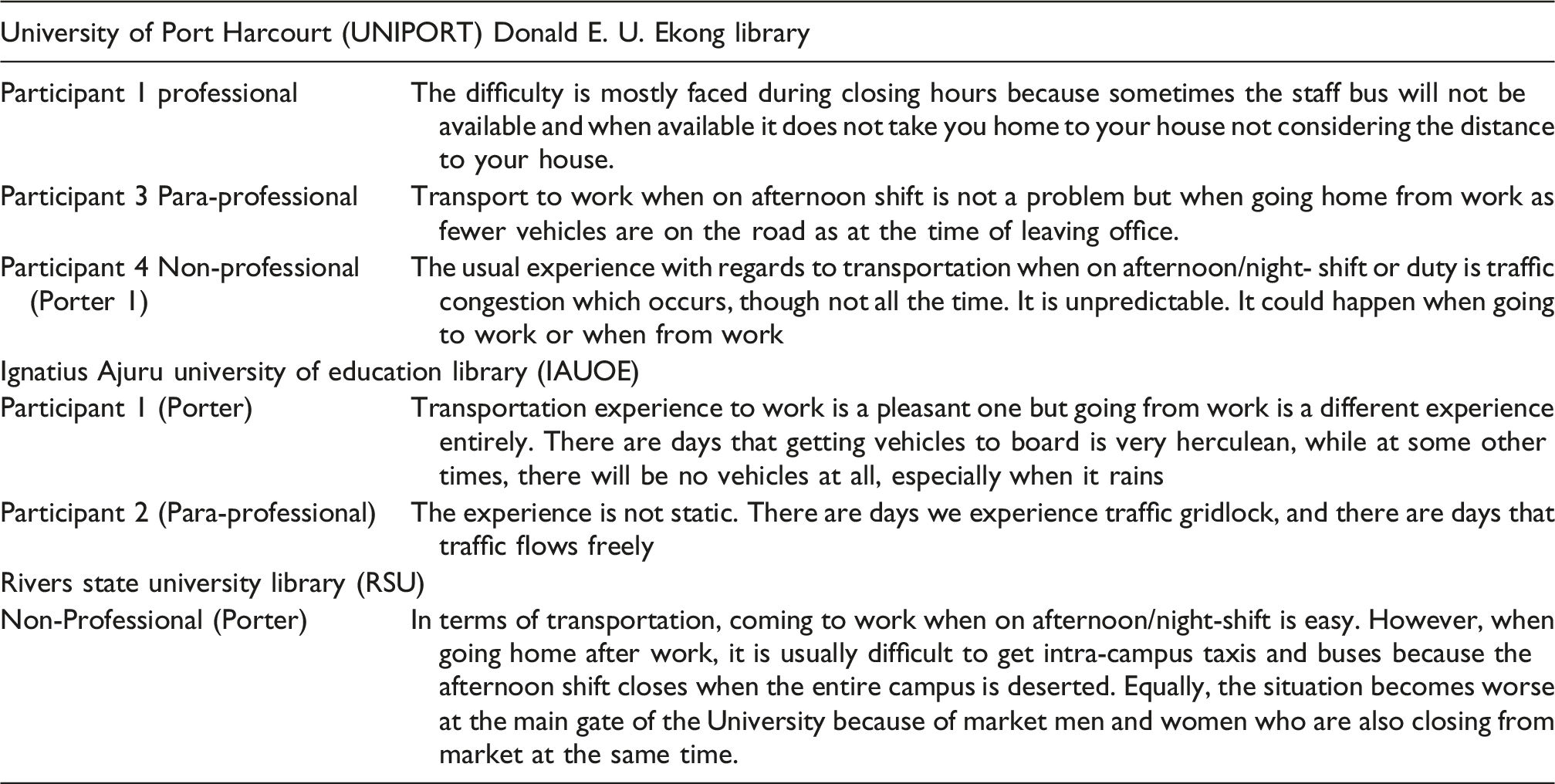
Describe your experiences with transportation to work and back to your place of abode, in terms of its pleasure or pains, when on the afternoon/night-shift at the University Library.
Question 5:
Would you think that proximity or distance of your place of abode (residence) to the University Library plays any part in your productivity during the night duty? (The follow-up question would be: Please explain the reasons for your view on this issue)
On question 5, which bothered whether proximity to the place of abode played any part in staff productivity, the views were again divided for and against. Five participants in all debunked the notion that distance from the place of work to residence played any part in productivity. One comment strongly captures this perspective: “Our productivity during afternoon/night-shift has no relationship with proximity or distance to work since we plan our movement to conform with what is required of us as if we are on normal morning duty” (Participant 2, IAUOE).
However, other views supported the notion that where staff lived contributed to their level of productivity in performing their roles during the afternoon/night-shift. According to participant 3 from UNIPORT: “The distance or proximity of my residence to the Library plays a part in my productivity when on afternoon/night-shift duty to some extent because there are times [when] I will seek for permission to close and leave earlier before the closing time”
The participant from RSU identified tiredness on arrival to work as factor that could lead to reduction in productivity: Distance and proximity of my residence RSU Library plays a part in my productivity. This is because my residence is very far from the Library and as such I get tired on arrival at my duty post which in turn affects how I perform my duty.
Considering this admission of tiredness and reduction in effectiveness, it becomes instructive to toe the line of the argument raised by Participant 2, a Para-Professional from UNIPORT in apportioning on-campus residences to staff. He said that: “in my opinion, those on afternoon/night-shift should live on campus but unfortunately, those on campus does (sic) not run shift”.
Question 6:
How does being involved in the afternoon/night-shifts alter or promote the balance between being a worker and living your everyday life? In other words, is your work-life balance as a staff of the University Library affected by your involvement in night shifts?
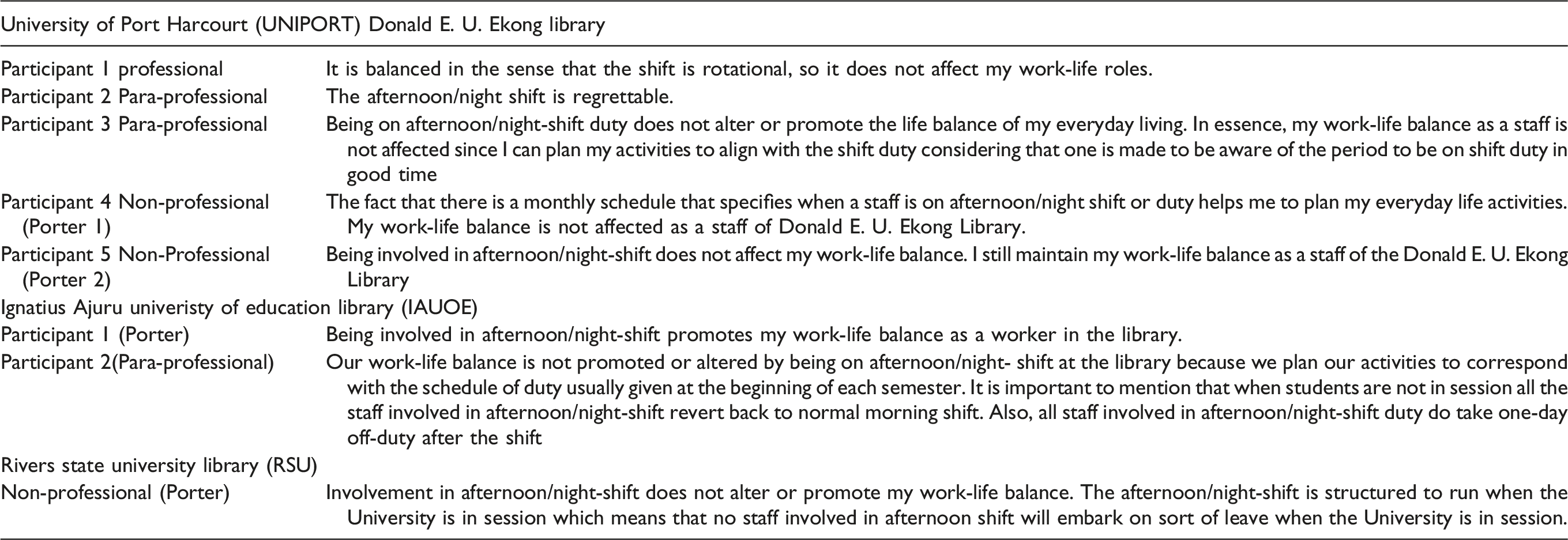
Participants were unanimous in agreeing that due to rotation of shift duty, advance notification of involvement, flexibility in the shift period to align with Semesters, and the privilege of having off-duty holidays, they could afford an unaltered work-life balance in terms of playing their social roles. In fact, participant 1, a porter from the Ignatius Ajuru Univeristy of Education Library (IAUOE) claimed rather surprisingly that “being involved in afternoon shift promotes [his] work-life balance”.
Questions 7 and 8:
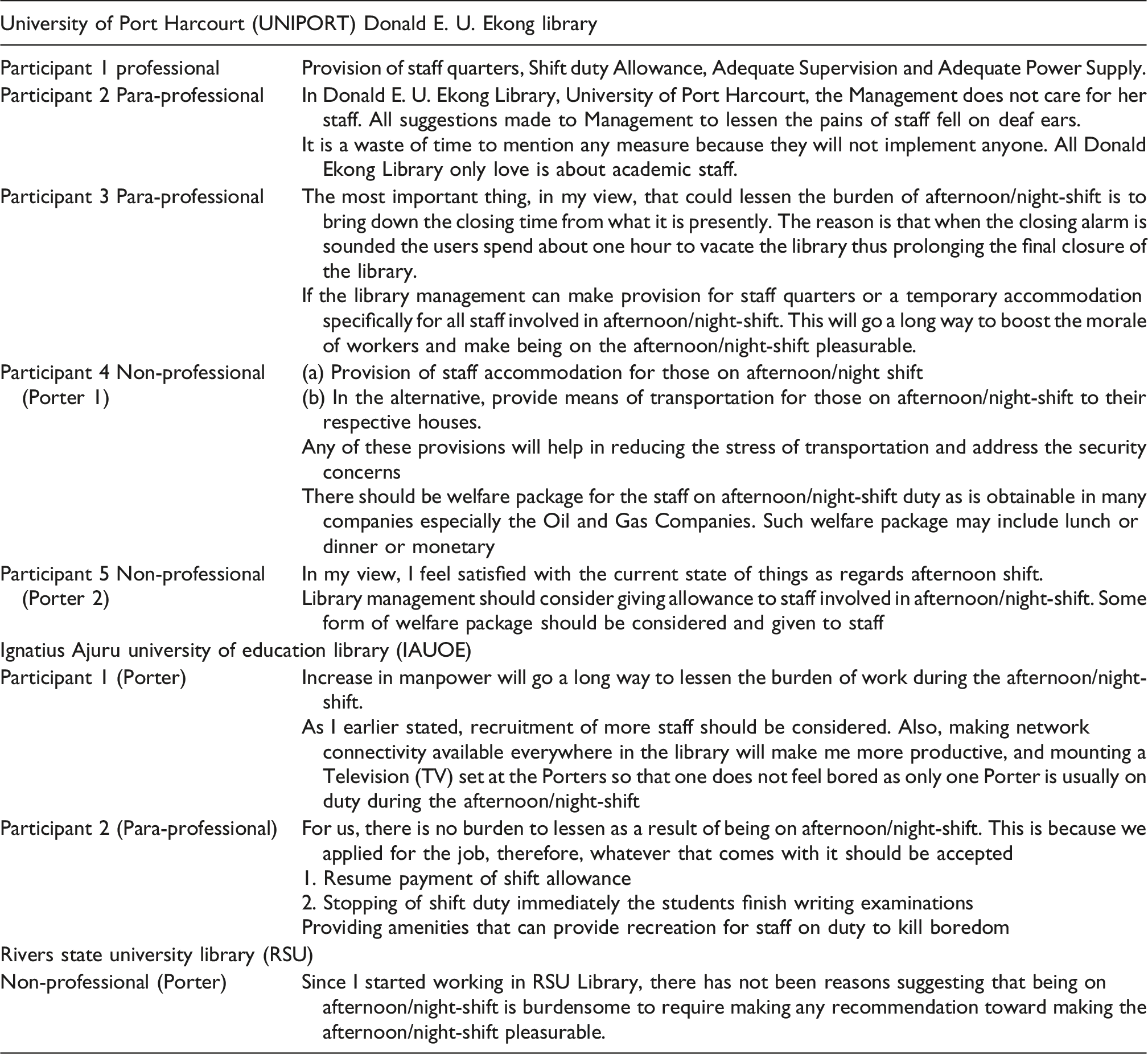
What are the things that, in your view, could lessen the burden of the night shift on you, or make your work more pleasurable as a staff, if implemented at the University Library?
Please comment freely on the provisions that would make you feel more secure, protected, less stressed and more productive as a staff during night shifts when implemented at the Library.
Discussion
The findings from the interviews reveal a patterned distinction between institutional safety and contextual insecurity, thereby underscoring the uneven geographies of security within and beyond university environments.
The findings from Interview Question 1 reveal a nuanced and context-dependent perception of security among library personnel, demonstrating a clear spatial differentiation between institutional and external environments. Within the university setting, participants consistently expressed confidence in their safety, attributing this to structured and visible security arrangements. This aligns with established perspectives in Organizational Studies and Security Studies, which suggest that formal institutions often function as “protected enclaves” where regulated surveillance, access control, and institutional governance mechanisms produce a sense of order and predictability (Loader and Walker, 2007). In this regard, the university library is perceived not merely as a workplace, but as a securitized micro-environment insulated from broader societal instability.
However, this sense of safety sharply diminishes once staff move beyond the university premises. Participants’ accounts point to a pervasive climate of insecurity in Rivers State, particularly in Port Harcourt, where risks associated with mobility, especially during late hours—are pronounced. The anxiety surrounding boarding taxis or buses at night underscores the everyday realities of urban insecurity in many parts of Nigeria. This finding resonates with scholarship in Urban Studies, which emphasizes how weak public security infrastructures and socio-economic inequalities contribute to heightened perceptions of vulnerability in urban spaces (Canton, 2021). Thus, while institutional security frameworks may be effective within bounded environments, they do not extend into the broader socio-spatial context in which workers must navigate.
The findings from Interview Question 2 reveal a complex interplay between perceived risk, lived experience, and structural constraints in shaping workers’ sense of safety during afternoon and night shifts. At a fundamental level, the responses indicate that apprehension is not merely a function of direct exposure to danger but is socially constructed through environmental conditions, institutional weaknesses, and shared narratives among staff.
First, the heightened concerns expressed by participants, particularly in relation to heavy rainfall, late-night mobility, and the broader context of porous security, underscore the situational nature of fear. These factors align with insights from Environmental Criminology, which posits that crime risks are often shaped by spatial and temporal conditions. Poor visibility during rainfall, reduced human activity at night, and unsafe transit routes collectively create what are perceived as “opportunity structures” for crime, thereby intensifying workers’ vulnerability and anxiety (Mathew and Pulugurtha, 2022).
Moreover, the data reveals a tension between perceived risk and economic or institutional necessity. Participant 2’s assertion that workers “have no choice” but to report for duty despite evident risks highlights a structural constraint that limits individual agency. This aligns with labour process theory and broader discussions in Occupational Health Psychology, where employees often continue to operate under unsafe or stressful conditions due to job insecurity, organizational expectations, or lack of alternatives (Probst, 2016). In this context, fear does not necessarily translate into withdrawal or resistance but is instead internalized, potentially contributing to chronic stress and reduced well-being.
The findings from Question 6 present a specific but largely convergent perspective on the relationship between shift work and work–life balance among university library staff. At face value, the responses suggest that afternoon and night shifts do not significantly disrupt the equilibrium between professional responsibilities and everyday life. However, a critical interrogation of these claims reveals deeper structural and contextual dynamics that merit scholarly attention.
First, the dominant narrative across the three institutions, University of Port Harcourt, Ignatius Ajuru University of Education, and Rivers State University, indicates that work–life balance is largely preserved due to institutional mechanisms such as rotational scheduling, advance notification, and periodic off-duty allowances. These organisational arrangements appear to function as compensatory structures that mitigate the potentially disruptive effects of non-standard working hours. This aligns with the broader literature in Human Resource Management and Work-Life Balance, which emphasises the role of flexible scheduling and employee autonomy in reducing role conflict (Emre and De Spiegeleare, 2021).
However, the apparent consensus that work–life balance remains “unaltered” warrants critical scrutiny. Studies in occupational sociology and labour psychology consistently demonstrate that shift work, particularly evening and night shifts, is associated with latent disruptions, including circadian rhythm misalignment, social isolation, and reduced family interaction (Baron and Reid, 2014; Díaz and Gavião, 2022). The absence of such concerns in the participants’ responses may therefore reflect a process of normalization or adaptive coping rather than an absence of impact. In other words, staff may have internalised the constraints of shift work and redefined balance within those limitations.
The findings from Question 4 reveal that transportation experiences among library staff on afternoon/night shifts are largely characterised by structural inefficiencies, temporal inequalities, and safety-related concerns, rather than individual or isolated inconveniences. While one participant reported a neutral experience, the overwhelming pattern across the University of Port Harcourt, Ignatius Ajuru University of Education, and Rivers State University points to systemic challenges associated with mobility during non-standard working hours.
A critical reading of these responses suggests that transportation difficulties are not merely logistical problems but are embedded within broader urban mobility constraints typical of many developing contexts. The recurring issues of traffic congestion, scarcity of vehicles, and competition for limited transport services, particularly during late hours, reflect what scholars in Urban Transport Studies describe as temporal transport disadvantage. This concept highlights how access to mobility becomes unevenly distributed across different times of the day, disproportionately affecting workers engaged in shift-based employment (Ermagun & Koury, 2024).
Moreover, the asymmetry between relatively smooth commutes to work and highly stressful return journeys underscores the inadequacy of transport systems in accommodating off-peak labour patterns. Participants consistently reported that while commuting to work during the afternoon shift may be manageable, returning home at night presents significant challenges, including the unavailability of vehicles and unsafe or deserted environments. This aligns with findings in Transport Geography, where night-time economies often lack corresponding transport infrastructure, thereby increasing workers’ vulnerability (Plyushteva and Boussauw, 2020).
Conclusion and recommendations
This study investigated the effects of Work-Life Balance (WLB) on librarians working afternoon and night shifts in the urban city of Port Harcourt, Nigeria. The primary focus was on personal safety, transportation, accommodation, and the working environment, exploring the implications these factors have on work-life balance. The research was conducted using qualitative methods, including interviews and document analysis, with participants from three universities: University of Port Harcourt (UNIPORT), Ignatius Ajuru University of Education (IAUE), and Rivers State University (RSU).
The findings indicate that while librarians generally felt secure within the university premises, there were significant concerns about safety outside the campus, particularly when commuting during late hours. Transportation challenges, such as traffic congestion and scarcity of vehicles, further exacerbated the stress associated with night shifts. The proximity of their residences to the workplace also played a role in their productivity and overall work-life balance, with those living farther away reporting higher levels of fatigue and reduced effectiveness.
Financially, the absence of shift allowances negatively impacted the librarians’ economic status, and the implementation of a centralized payment system (IPPIS) did not accommodate shift-related compensation. Additionally, while some participants did not perceive a direct effect of night shifts on their work-life balance, others reported challenges in aligning personal and professional responsibilities.
To improve the work-life balance of librarians on night shifts, several recommendations emerged from the study. These include the provision of staff quarters, reinstatement of shift allowances, improved transportation facilities, and adjustments to shift schedules to reduce late-night work hours. Implementing these measures could enhance the well-being and productivity of librarians, contributing to a more balanced and supportive work environment.
In conclusion, the study highlights the critical need for policy changes and practical interventions to address the unique challenges faced by librarians working night shifts in urban environments. By leveraging the Job Demands-Resources (JD-R) model, this research provides a comprehensive framework for understanding and mitigating the stressors associated with night shift work, ultimately promoting a healthier work-life balance for academic library staff. The study therefore recommends as follows: (1) A change in policy to give preference in the allocation of on-campus residence to library personnel involved in running night-shift. (2) Restoration of the payment of shift duty allowance to the staff on afternoon/night-shift duty roles. (3) Provision of transportation directly to, or as close as possible to the homes of staff involved in afternoon/night-shift duties. (4) A property and life insurance policy to be undertaken by the library management in the university libraries, in favour of staff involved in performing afternoon/night-shift duties, given the level of risk they are exposed to constantly. (5) A more responsive disposition by the university libraries’ management to the complaints made by staff about their welfare.
Footnotes

Funding
The authors received no financial support for the research, authorship, and/or publication of this article.
Declaration of conflicting interests
The authors declared no potential conflicts of interest with respect to the research, authorship, and/or publication of this article.