






Abstract
Organizations are becoming increasingly aware of the importance of knowledge sharing to survive and remain competitive. Current knowledge sharing models have been found to be lacking as they only focus on the relationships between factors that influence knowledge sharing. An integrated approach that is capable of a simultaneous investigation of the various factors that affect knowledge sharing initiatives, quality of knowledge management and its impact on organizational performance has not been widely attempted. This study aims to develop a holistic knowledge sharing model for the public sector in Malaysia that is based on an integrated approach, which combines factors that influence knowledge management (input), knowledge sharing quality (process) and workers’ performance as well as service delivery (output) that encompasses the individual, organization and technology. This study will firstly present a review of the literature of current models in knowledge sharing, which will then form the take-off point for the development of the proposed holistic model. Such a holistic model is deemed appropriate and necessary to steer knowledge sharing initiatives in tandem with forming the base for policy-making of such initiatives.
Keywords
Introduction
Knowledge sharing is becoming increasingly important as firms endeavour to enhance their performance and remain competitive. However, the notion of sharing knowledge is not a natural human trait; and instances of abuse may occur that may be detrimental to those who readily share their knowledge. Further, a review of past research shows that studies on knowledge sharing initiatives have been based on several theories, but have only focused on the relationship between and among factors that influence such initiatives. For instance, many studies have examined only the role of technology, as it is seen as the catalyst to facilitate such initiatives. While its contributions cannot be denied, technology does not exist by itself and the role of humans, notably in fostering the mutual trust which is the pre-requisite for knowledge sharing, has yet to be explored. In other words, knowledge sharing has to be viewed from a holistic dimension that embraces the individual, the organization and technology. The existing lacunae are reflected in the ineffectiveness of current knowledge sharing practices and initiatives.
To facilitate the implementation of effective knowledge management initiatives, an integrated model is deemed necessary. This proposed integrated and holistic model will not treat the initiatives in isolation, but more importantly will incorporate the elements that influence the quality of initiatives as well as the effect of quality on performance. Such a model can be used as the basis for the formulation of policies on initiatives that are much needed for the development of a community ecology and knowledgeable workers.
Knowledge sharing factors
Research on knowledge sharing has focused on three factors, namely enablers, process and organizational performance. However, such factors are usually investigated in isolation (Lee and Choi 2003). Enablers are factors concerned with how organizational mechanisms enhance knowledge in a consistent manner thereby resulting in the creation and sharing of knowledge. Process or knowledge management activity, on the other hand, consists of the creation, management, storing and utilization of knowledge (Alavi and Leidner 2001). Meanwhile, organizational performance is seen as the organizational achievement in relation to its business objectives (Elenkov 2002). While several researchers have focused on factors that influence knowledge sharing, others have enquired into the relationship between knowledge sharing and organizational performance. There has yet to be a holistic model that looks into the effectiveness of knowledge sharing (Lin 2007).
Current research studies have employed the Social Exchange Theory (SET), Social Capital Theory (SCT), Theory of Reasoned Action (TRA) and Theory of Planned Behaviour (TPB) (Liang, Lu and Wu 2008) to investigate knowledge sharing. However, such theories are limited in that they can only investigate one factor at any one time. For instance, TRA and TPB have been used to examine the individual and the organization, while studies using SET and SCT have focused on the organization.
The issue that arises is, why is an integrated model necessary? An analysis of current knowledge sharing models has revealed the following: firstly, there is an absence of a comprehensive inclusion of all aspects that affect knowledge sharing initiatives; secondly, there is no emphasis on the quality of knowledge sharing; and lastly, there has yet to be an investigation on the quality of performance. Such models thus not only examined the factors in isolation, but were found to focus only on technology. While the role of technology in facilitating knowledge sharing through its supporting infrastructure cannot be denied, such support cannot, however, disregard the role of the human individual, a critical factor in any organization. As such, the absence of any of the following critical factors, namely, the individual, technology, or the organization would result in an incomplete model that is limited and constrained its implementation.
Thus, this study offers a comprehensive approach giving equal attention to all the critical factors based on the Structurational Model of Technology (SMT) (Orlikowski 1992), and Knowledge Based Theory (KBT) (Spender 1996; Grant 1996). The proposed integrated model comprises enablers, knowledge sharing quality, and service delivery (process) as well as Knowledge Based Theory workers’ performance and Orlikowski’s technology model (output) encompassing the individual, organization and technology.
This study aims to develop a holistic model of service delivery, which is based on knowledge sharing. The objectives have been derived from the literature review that has identified six gaps in knowledge, as follows: knowledge sharing research in the public sector is scarce (McAdam and Reid 2000) there is an absence of an empirical study on knowledge sharing and a Knowledge Based Theory service delivery there has yet to be an investigation into the relationship between man and technology there has yet to be an integrated model from a holistic perspective previous research has dealt only with the sharing of knowledge previous researches were not comprehensive as they neglected the individual, organization and technology as evidenced in Orlikowski’s Model of Technology (1992).
From the six identified gaps, this study will undertake the final issue as the take-off point. Hence, this study is motivated by the need to develop a holistic model that takes into account critical factors that enable knowledge sharing initiatives, knowledge management quality, and its impact on performance. To this end, emphasis will be placed on the role played by the human factor, organization and technology.
Research method
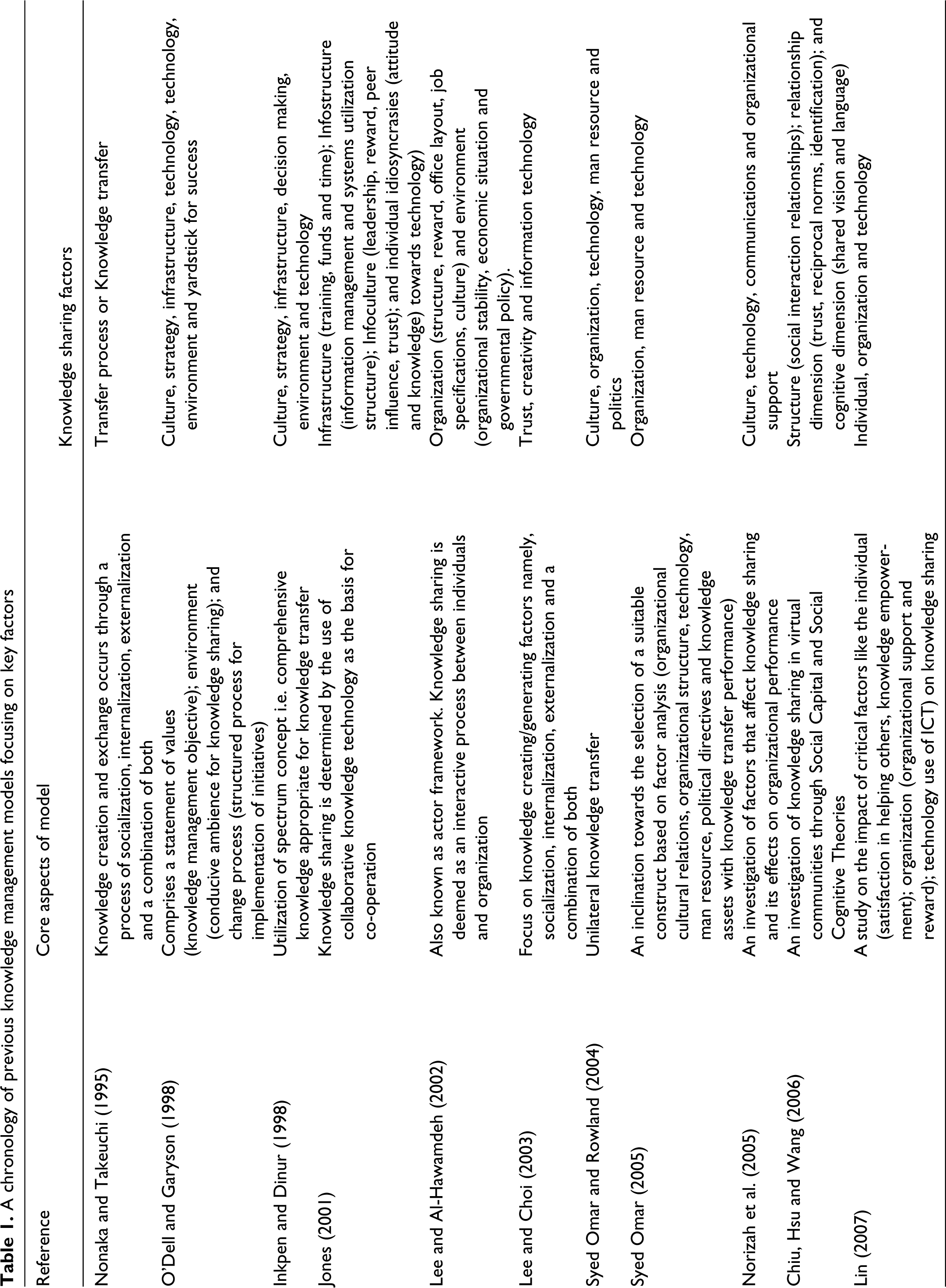
A close perusal and analysis of documents related to knowledge sharing has been employed to evaluate the current knowledge sharing model. The gaps in the current model are presented in Table 1 , and this will facilitate the analysis of factors previously studied. Such an analysis is crucial in providing the justification for the lacunae in the previous models, thus providing the impetus for the development of a holistic model. A chronological approach to the analysis of previous models has been carried out to prove that, despite a different time frame, the focus or factors attempted remained more or less the same.
A chronology of previous knowledge management models focusing on key factors
Theoretical background
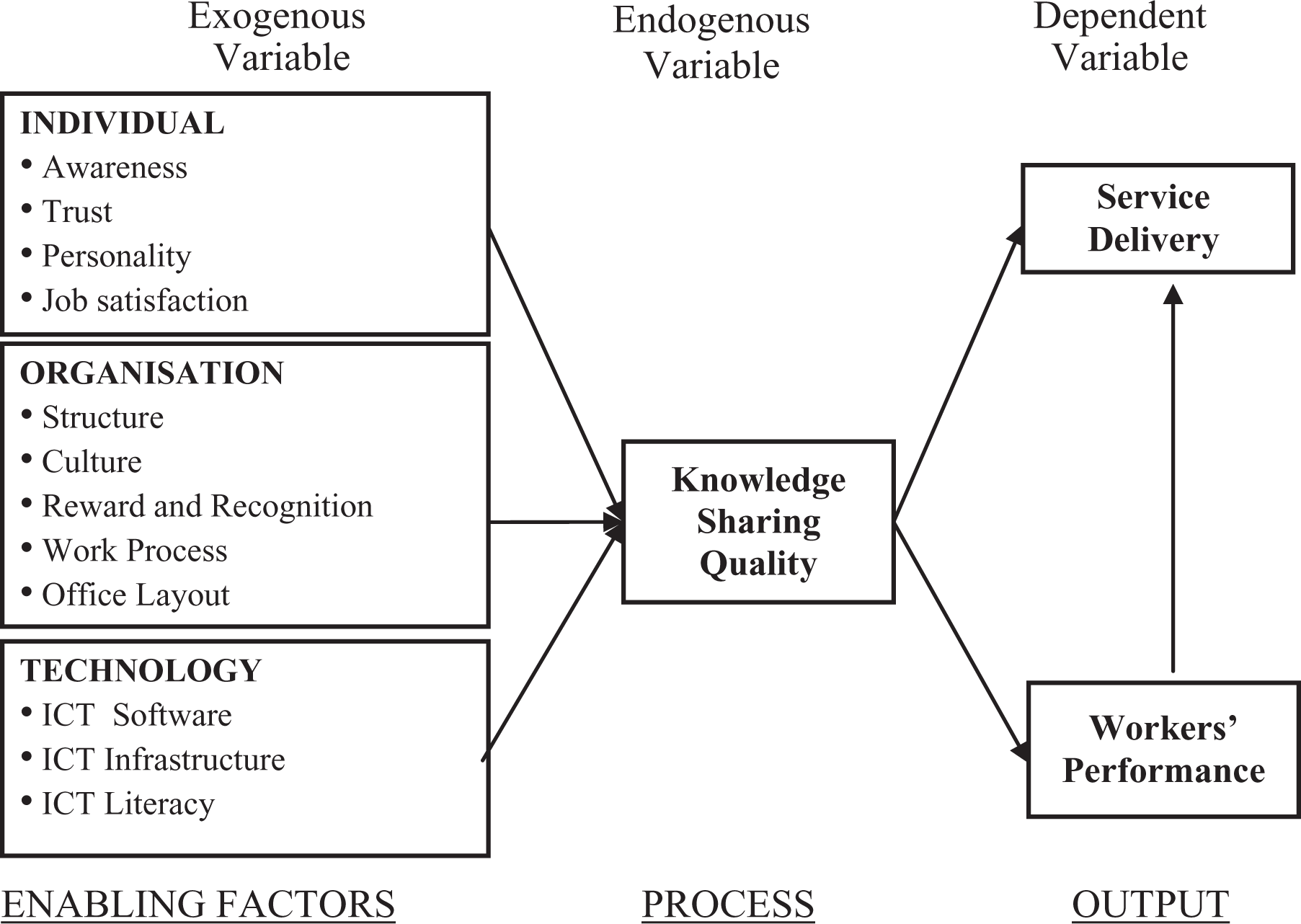
The theoretical framework for this study is presented in Figure 1 , which illustrates a conceptual model developed to show the relationship between factors identified as important to the problem investigated based on the chosen theory. Knowledge Based Theory by Spender and Structurational Model of Technology by Orlikowski are combined to obtain an integrated model. The theoretical framework shown in Figure 1 includes individual, organizational and technology factors influencing the quality of knowledge sharing, which together comprise the exogenous variable and are based on the Structurational Model of Technology
Theoretical framework
The process or endogenous variable comprises the quality of knowledge sharing. Service delivery and workers’ performance are the results of knowledge sharing and comprise the dependent variable. The influencing factors are labelled as exogenous variable while the quality of knowledge sharing is labelled as endogenous variable. The workers’ performance and the quality of service delivery are labelled as dependent variable.
Knowledge sharing model
Sekaran (2005) states that the objective of analyzing current knowledge sharing models is to uncover the gaps in knowledge as well as to identify the important constructs and then to provide the justifications for the development of a holistic model. To this end, the present analysis is limited to models that are relevant to the public sector and they comprise Nonaka and Takeuchi (1995); O’Dell and Grayson (1998); Inkpen and Dinur (1998); Jones (2001); Lee and Hawamdeh (2002); Lee and Choi (2003); Syed Omar and Rowland (2004); Syed Omar (2005); Norizah et al. (2005); Chiu, Hsu and Wang (2006); and Lin (2007). Table 1 presents the factors that have been the foci of previous research, showing the knowledge sharing factors and the core aspects investigated in each model. This is merely to demonstrate the differences of these models. These differences helped the authors of this paper in identifying the factors to be included in the new proposed model.
A proposed holistic model for knowledge sharing in the public sector in Malaysia
Generally, the public sectors in Malaysia are not ready to extensively embark on knowledge sharing endeavours. Initiatives are only taken on small and simple activities which are basically only a form of information management (Tan, Yusoff and Hamdan 2005). Syed Omar and Rowland (2007) assert that organizations in Malaysia (public and private) have yet to manage their information (the basis of knowledge) in order to be a knowledge-based society. There are agencies that claimed to be practicing knowledge sharing, but activities are essentially based on traditional ways of communicating information such as bulletins, notice boards and face-to-face meetings (Kalsom and Syed Noh 2005).
Based on the claims made by Tan, Yusoff and Hamdan (2005) and Syed Omar and Rowland (2007) it can be concluded that organizations in Malaysia have not been practicing knowledge sharing. It is evident that there can be no knowledge sharing without knowledge management. The performance of knowledge sharing depends on the availability and accessibility of the knowledge assets – i.e. the management of information or knowledge (Syed Omar and Rowland 2007). As Malaysia is now striving for a knowledge-based economy, it is timely for organizations to manage the information or knowledge they possess. The literature shows that knowledge sharing is able to transform organizations to become more productive and competitive. Knowledge is used as the basis for making timely decisions, improved quality, effectiveness, efficiency, improved integrity and collaboration. Thus, the culture for knowledge sharing ought to be nurtured and widespread. This could be achieve by proposing a model which is considered comprehensive as it provides insights into the factors that must be taken into account when implementing knowledge sharing initiatives. The approach by Rajagopalan, Rasheed and Datta (1993), Lee and Choi (2003) and Lin (2007) has been employed here (see Figure 2 ) to examine the relationship between factors that enable knowledge sharing, the quality of knowledge sharing and the impact of this quality on workers’ performance and public sector service delivery.

Enablers/input, process and output
Rajagopalan, Rasheed and Datta (1993), Lee and Choi (2003) and Lin (2007) focused on the enablers input, process and output. Enablers are mechanisms that promote individual and organizational learning and facilitate inter- and intra-group knowledge sharing. Process refers to how workers share knowledge on job specifications, skills and related information with their colleagues. Output alludes to the impact gained from the shared knowledge (Lin 2007). This approach examines the relationship between the knowledge process and its effect on the organization as well as the factors that impact on that knowledge. This approach is holistic in that it combines the enablers (input), the quality of knowledge sharing (process) and workers’ performance and service delivery (output). Thus far, there has yet to be a holistic model that enquires into the symbiotic relationship between factors that impact the quality of knowledge sharing and public service delivery simultaneously.
This study brings together the individual, the organization and the Structurational Model of Technology developed by Orlikowski (1992) and applied by Van den Hooff et al. (2003). These three categories have also been employed by Van den Brink (2003), Lee and Al-Hawamdeh (2002), Riege (2005) and Lin (2007), as well as Lee and Choi (2003). The Structurational Model of Technology has been selected due to the mutual relations between the said factors. Figure 3 shows how Orlikowski’s Structurational Model of Technology has been adapted in the theoretical construct (Part One).
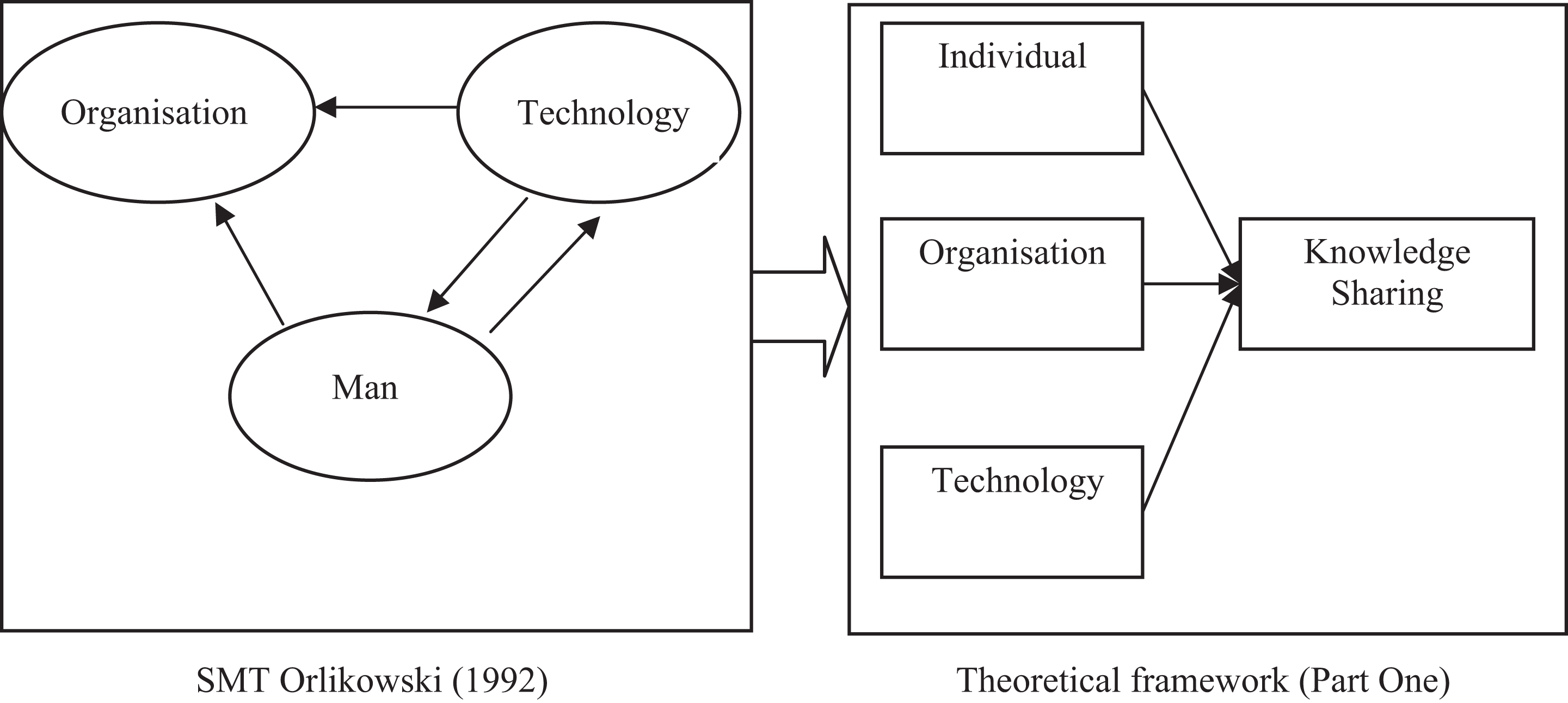
SMT Theoretical framework (Part One)
Knowledge Based Theory (Spender 1996; Grant 1996) has been adapted to identify the relationship between quality of knowledge sharing and workers’ performance in tandem with service delivery. Knowledge Based Theory is deemed to be relevant as it posits that knowledge is a significant and strategic resource for the enhancement and competitiveness of organizations. Despite its inclination towards over-competitiveness in the private sector, Knowledge Based Theory is applicable to government agencies when its scope of competitiveness is extended to that of service delivery to the general public. It is also noted that the public sectors globally are undergoing significant and robust reformation in their organizational structures that are making them comparable to the private sectors (Binz-Scharf 2003).
This study seeks to investigate the effects of knowledge sharing quality on workers’ performance and the delivery of service. The focus is on workers’ performance because on the one hand, an organization is made up of workers and organizational performance is based on an aggregate of workers’ performance, while on the other hand, the emphasis on public service delivery is due to the fact that civil servants must be able to make decisions quickly and appropriately for the good of the public. Hence, knowledge management through knowledge sharing can assist the government in improving its service delivery (Wiig 2002). Figure 4 shows the theoretical framework adopted by this paper (Part Two) as adapted from Knowledge Based Theory.
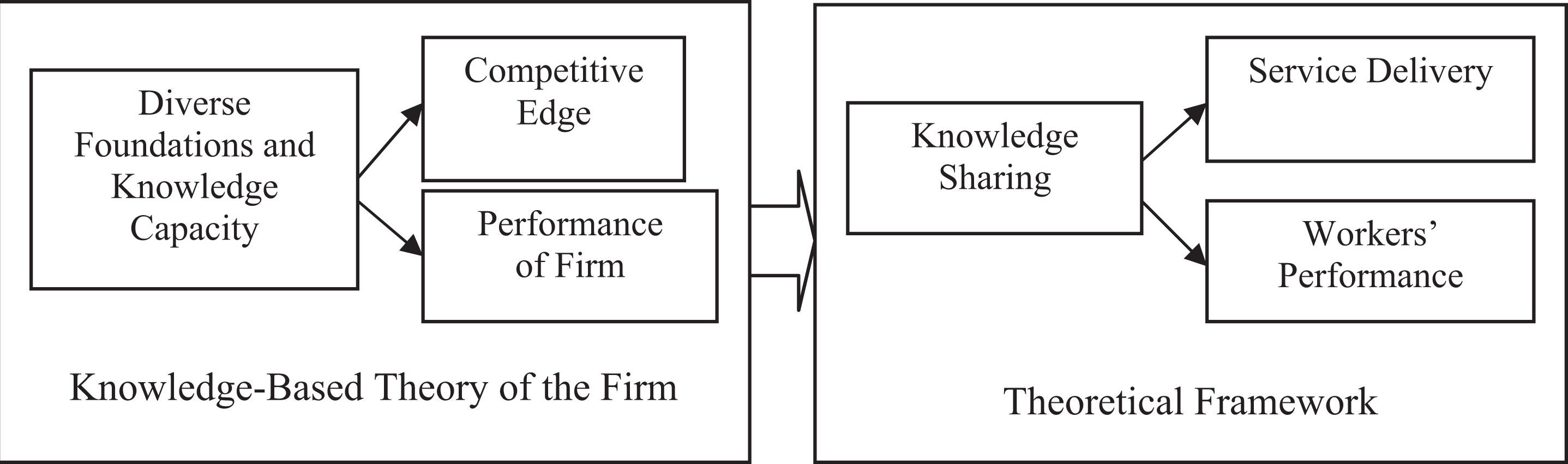
KBT Theoretical framework (Part Two)
This study combines the Structurational Model of Technology (Figure 3), which is an information system model, and Knowledge Based Theory (Figure 4), which is from strategic management, in tandem with the approaches from Rajagopalan, Rasheed and Datta (1993), Lee and Choi (2003) and Lin (2007) (Figure 2). The integration of models from two areas of specialization produces a holistic model which takes the form of a theoretical framework as illustrated in Figure 5 .
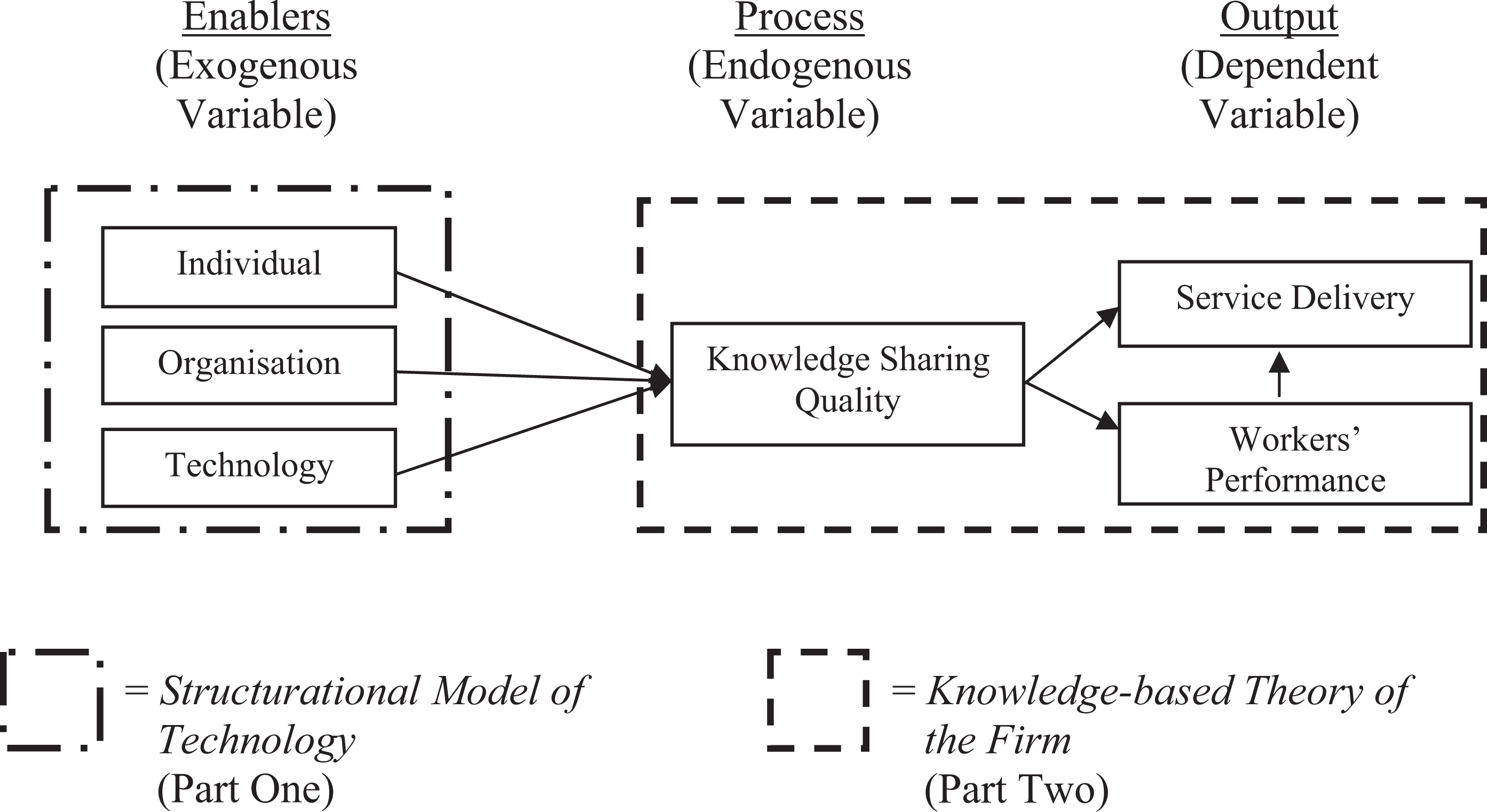
New theoretical framework
This theoretical framework consists of two parts: first, an exogenous variable that affects the endogenous variable, and secondly, the effects of the endogenous variable on dependent variables. The former examines the effect of the individual, the organization and technology on the quality of knowledge sharing. The latter focuses on investigating three relationships namely: (a) the relationship between the quality of knowledge sharing and service delivery; (b) the relationship between the quality of knowledge sharing and worker’s performance; and (c) the relationship between workers’ performance and service delivery.
The first part of this framework comprises antecedents or enablers that impact on the quality of knowledge sharing; they are exogenous variables consisting of Structurational Model of Technology -based factors, namely, the individual, the organization and technology. Meanwhile, process or the endogenous variable, refers to the quality of knowledge sharing (Chiu, Hsu and Wang 2006; McKinney, Yoon and Zahedi 2002; DeLone and McLean 2003). Service delivery and workers’ performance are the results of knowledge sharing and are known variables.
In conjunction with the Knowledge Based Theory, the effects of the quality of knowledge sharing on workers’ performance are also taken into consideration. Knowledge sharing will be able to increase performance, and improve the delivery system and customer satisfaction as well as enhance the productivity of civil servants. The review also reveals a level of significance between knowledge sharing and organizational performance.
To determine the exogenous variables (individual, organization and technology) a perusal of previous studies was conducted. Due to the large number of factors that impact on knowledge sharing, the following models were employed as a base to determine the variables for the individual, the organization and technology respectively: Lee and Al-Hawamdeh (2002) and Syed Omar and Rowland (2004). The selection of such factors was also determined by their popularity and relevance to the public sector. However, time and financial constraints have limited the number of factors examined. Despite being non-empirical, Lee and Al-Hawamdeh’s (2002) model can be categorized as holistic because it takes into account the social and economic issues that may affect knowledge sharing within an organization and attributes the impact to five factors: the actors participating in the knowledge sharing activity, the knowledge being shared, the channel used, the organization concerned and the broader environmental factors. Syed Omar and Rowland (2004), on the other hand, examine critical factors such as organizational structure, organizational culture, human resources, technology and politics, without taking into account the individual. Lee and Al-Hawamdeh’s (2002) model and Syed Omar and Rowland (2004) thus formed the basis of this study, that enquires into all three critical factors. Both models, however, did not apply any particular theory to analyze the factors that enabled knowledge sharing nor the impact of knowledge sharing on the organization. Such non-integration in Lee and Al-Hawamdeh (2002) and the gap in Syed Omar and Rowland (2004) have therefore created a gap in knowledge that needs to be addressed. Both models have also been selected as they are geographically and culturally Asian-centric compared to others that are western-centric.
Based on the analysis of previous research, a construct of 15 factors has been identified for this study, as shown in Table 2 .
A construct of 15 factors and their origin
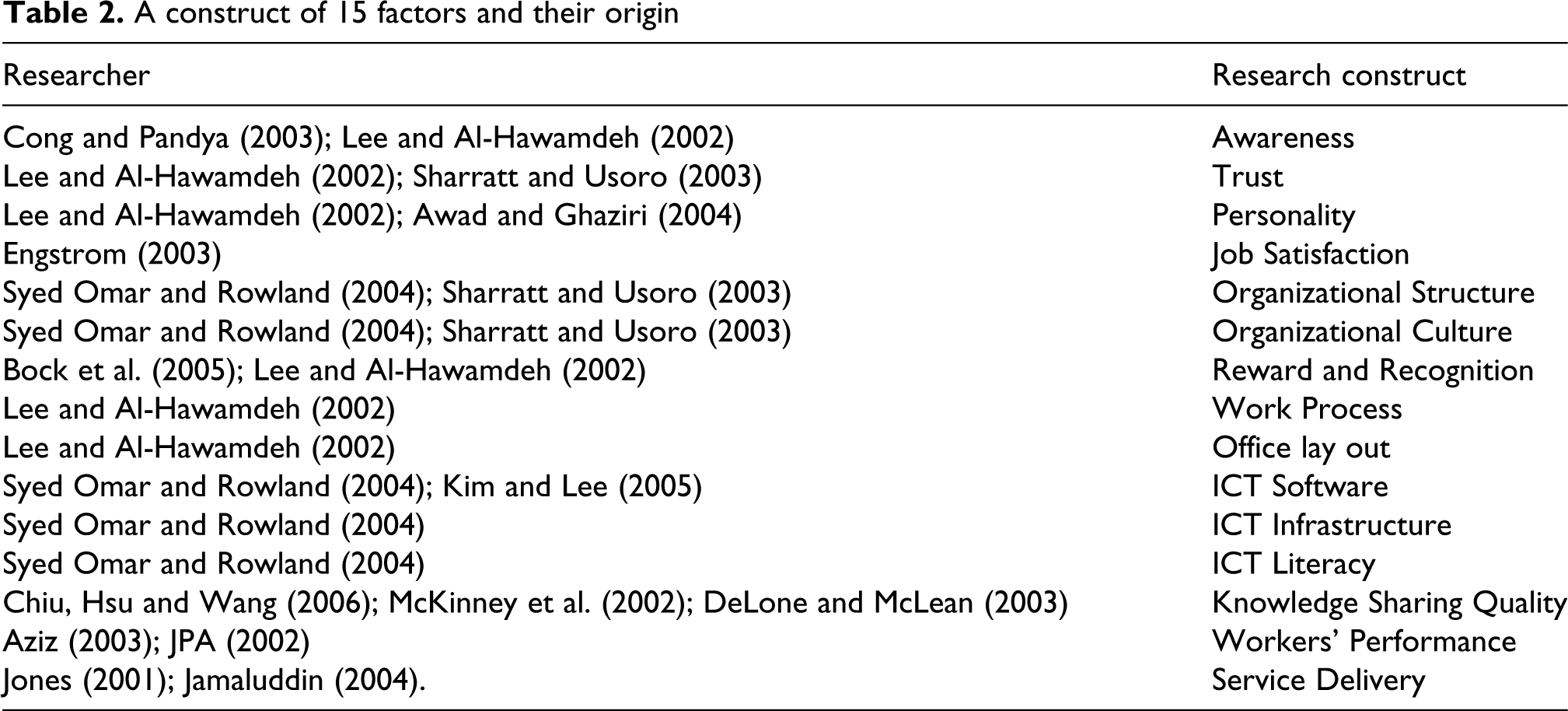
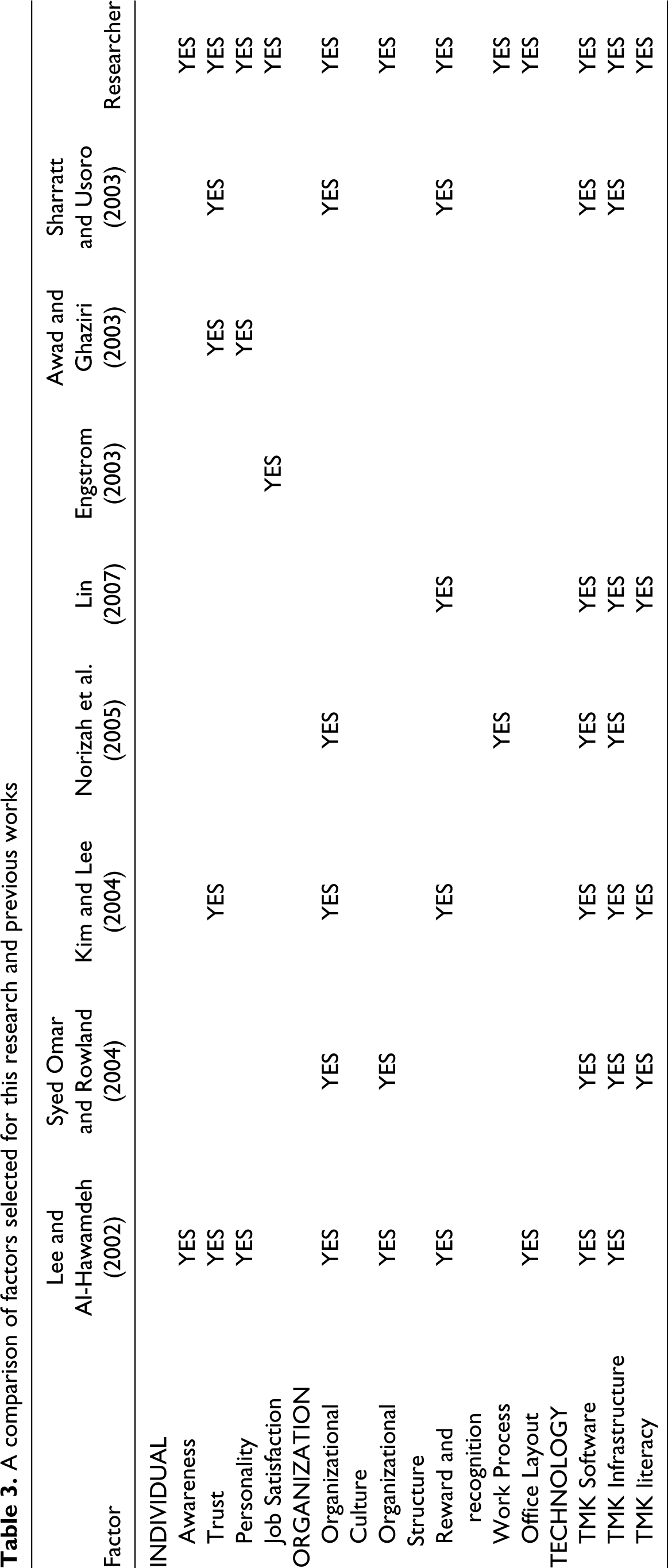
All the constructs chosen are relevant to the public sector. These constructs are identified mainly from Lee and Hawamdeh (2002); Syed Omar and Rowland (2004) who particularly researched on knowledge sharing in Malaysia and several other researchers researching in the same area elsewhere. They are such as Cong and Pandaya (2003); Awad and Ghaziri (2004), Engstrom (2003); Sharrat and Usoro (2003); Bock et al. (2005); Kim and Lee (2005);Chiu, Hsu and Wang 2006); McKinney, Yoon and Zahedi (2002);DeLone and McLean (2003); Aziz (2003); and Jamaluddin (2004). Some of these constructs (trust, culture, structure, reward and recognition, information and communication technology equipment (ICT), ICT infrastructure and ICT literacy) have been empirically tested in the researches referred to above, whilst other constructs (awareness, personality, job satisfaction, work process and office layout) have not been tested before. Service delivery and its role in knowledge sharing and workers’ performance have yet to be investigated in this study. Table 3 presents the factors that impact knowledge sharing in this study in comparison to those investigated in previous works.
A comparison of factors selected for this research and previous works
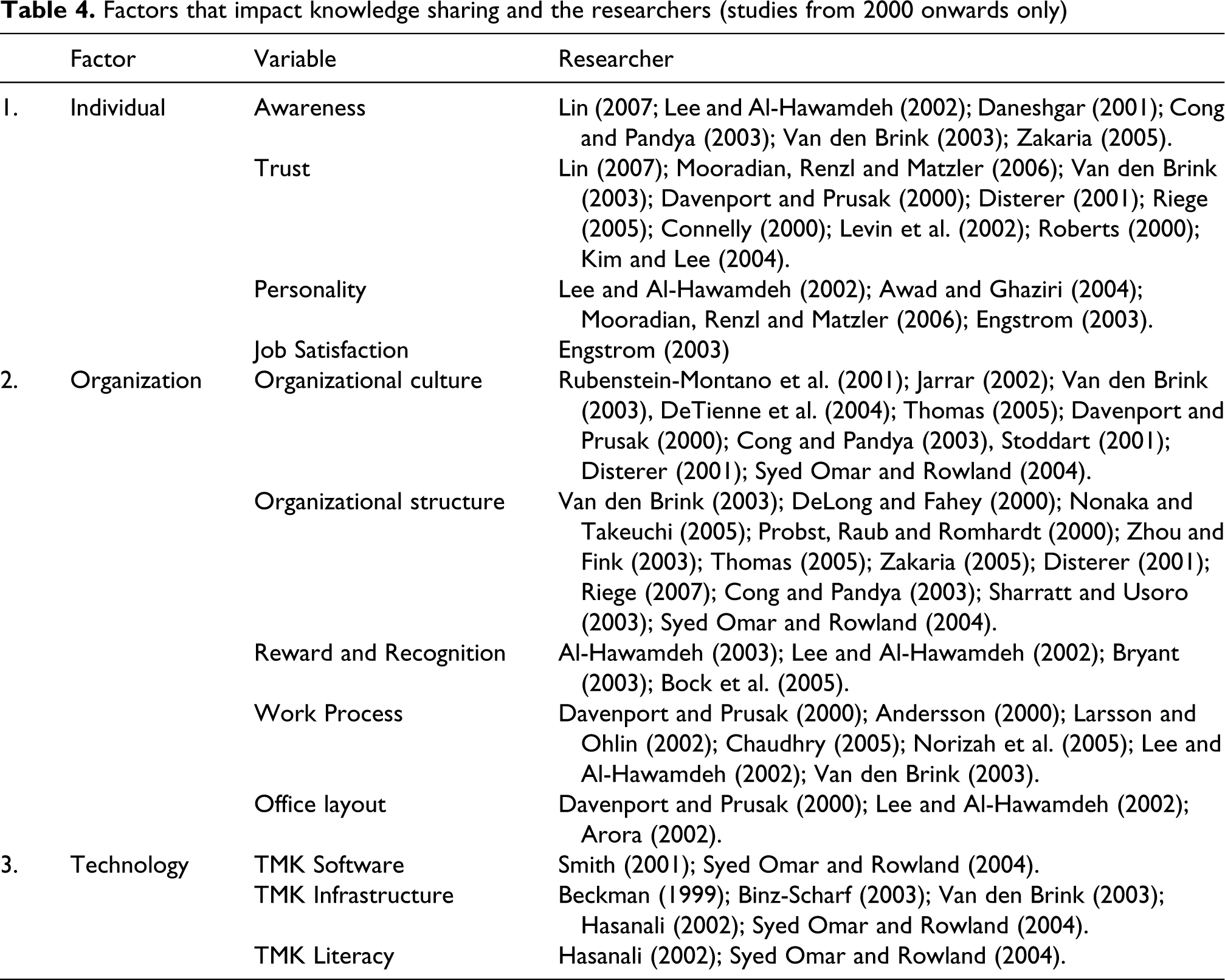
Factors that impact knowledge sharing and the researchers (studies from 2000 onwards only)
Conclusion
Several earlier models of knowledge sharing have focused only on factors that influence it, while others have examined the relationship between the critical factors that influence knowledge sharing and organizational output. This reflects the different approaches that have been employed to enquire into knowledge sharing. This study is similar to that of Lee and Al-Hawamdeh (2002), Syed Omar and Rowland (2004) and Norizah et al. (2005). The ensuing proposed model is holistic or integrated in that it has drawn together all the critical factors namely, the human (individual), the organization and technology. This endeavour is made possible by adapting several factors from Lee and Al-Hawamdeh (2002) and Syed Omar and Rowland (2004). This integrated model is able to identify the factors that impact the quality of knowledge sharing and to glean the contributions of quality knowledge sharing on workers’ performance and civil service delivery.
As the proposed model is conceptual in manner, it needs to be empirically tested for its usefulness and application in the implementation of knowledge sharing, as it is still in the conceptual stage. The model is open to debate and deliberations and further improvements and expansions may be mooted in tandem with inclusions of other suitable variables in the future.