







Abstract
Information and Communication Technologies (ICTs) are widely known as tools for poverty reduction. However, before ICTs can be utilized as tools for development, one needs to assess the various development challenges facing a country and then analyse where and how ICTs could positively impact development in a sustainable way. As technology influences the way people relate toward each other, it is important to view ICTs from an ethical perspective. This research theoretically explores the key aspects of ethics that should be applied to ICT projects in rural communities. Understanding the key aspects of ethics related to ICTs would foster the adoption of ICTs in rural communities and ensure that the integration of such ICTs is compatible with existing development strategies in developing countries. Four existing frameworks on ethical practice are explored which serve as a foundation for a theoretical framework of ethical practice in ICT4D. The proposed framework highlights four ethical themes that should be considered in rural ICT4D initiatives. These themes include: collaboration and participation, socio-economic context, cost and benefits and underlying stakeholder interests. It is suggested that further research and practical application can inform the framework.
Keywords
The application of ICTs in rural communities should not disregard the ethical aspects.
Introduction
Rural development has been an essential component of development efforts which aim to eliminate poverty sustainably. Information and Communication Technologies (ICTs) act as effective tools for rural development as they connect and facilitate information flows between rural communities and more developed regions (Huggins and Izushi 2002; Pade, Mallinson and Sewry 2008). However, although studies have shown the positive outcomes that ICTs can have on a community, there are cases were ICTs have made little or no positive contribution to the development of a community (Krauss 2009). As a result, ethics in ICT for development (ICT4D) remains a moral concept for such projects. The aim of this research is to explore the key aspects of ethics that should be applied to ICT projects in rural communities.
Ethics in ICT4D is not commonly researched; however, it remains a significant moral concept for ensuring that the outcomes of such projects are beneficial to recipients in developing countries. There is concern over the digital divide between those who are and are not benefiting from ICTs (Hosman and Fife 2008; Huggins and Izushi 2002; McNamara 2003). It is no longer merely a question of what technologies are appropriate for developing nations, but rather (Wenn 2007):
What are the cultural issues involved? What are the levels of connectivity required and which are practical? And lastly does the introduction of these technologies actually ensure the flow of knowledge?
All these questions encompass an ethical element that needs to be addressed to ensure such projects are fruitful (Wenn 2007). Therefore, the application of ethics needs to be assessed throughout a project lifecycle.
This paper explores existing literature, and reviews the underlying concepts of rural development and the implementation and use of ICTs in rural communities. The paper further explores the importance of ethics in ICT4D and provides a critical review of the current factors essential for ethical implementation and use of ICTs in development, as well as ethical practice in IT projects and development projects. Lastly, a theoretical framework is presented which provides a set of guidelines for the ethical implementation of ICT4D projects in rural communities.
Rural development
Development is the pattern of positive economic, political and social change that takes place in a society (Gabriel 1991; Gasper 2004). Essentially, it is a collection of goals that a society desires to achieve which do not decrease over time. Such goals can range from economic growth and political freedom to health care and education (McNamara 2003; Rural Development 2010; Singh 2009).
Rural areas are characterized by poverty that is more widespread, disease that is more prevalent, lower life expectancy, and lower educational and literacy levels (Gabriel 1991). It has been documented that the majority of the world’s poor live in rural areas (International Fund for Agricultural Development 2011). In 2001, it was estimated that 75% of the people living on less than one dollar a day live and work in rural areas (Ashley and Maxwell 2001; Gabriel 1991; International Fund for Agricultural Development 2001; Pade et al. 2008). In 2010, over 350 million rural people have overcome extreme poverty since 2001; however, rural poverty is still a challenge with 70% of the developing world’s extremely poor living in rural areas (International Fund for Agricultural Development 2011). Therefore, emphasis needs to be placed on rural development (Epstein and Jezeph 2001).
While there are projects created to promote rural development, there are those that have been unsuccessful. The failure of many rural development projects has led to additional research on the factors that hinder successful project deployment and impact. Developing countries are becoming aware that rural communities can manage their own development if empowered to do so (Maxwell, Urey and Ashley 2001; Kelles-Viitanen 2005). A successful rural development strategy will understand the diversity of rural areas and respond to the changing nature of rural areas. A successful strategy will be one that is aligned with the wider poverty reduction policy and will support the productive sectors in rural areas as a means to reduce poverty (Ashley and Maxwell 2001; Khene 2010).
Information and knowledge are key components which aid in learning, decision making and fulfilling the decisions made in order to achieve development goals (Heeks 2002). Sir William Arthur Lewis (cited in Capurro 2008) states that an essential cure for poverty is knowledge and not money. Information and Communication Technologies (ICTs) can contribute, as supportive tools, in sharing knowledge in Africa and other developing countries (Capurro 2008). They are known as enablers of development that can support vital development activities (United Nations ICT Task Force 2003).
Information and communication technologies for development
E-development, which is the use of ICTs to foster development, has become a common subject (Heeks 2005). Numerous donors, individuals and organizations are drawn to e-development due to financial gains or the hope that ICTs are the solution to development challenges. ICTs are recognized as tools for poverty reduction (Hosman and Fife 2008; McNamara 2003; Pade, Mallinson and Sewry 2008; Zaied 2008). ICTs not only provide information and communication means to the poor but also transmit knowledge and information from the poor to the broader community (Heeks 2002). However, before ICTs can be utilized as tools for development, one needs to assess the various development challenges facing a country and then analyse where and how ICTs could impact those challenges in a sustainable way (McNamara 2003).
The use of ICTs for digital data processing and digital data communication are the key contributions that ICTs make towards development (Heeks 2002; McNamara 2003). It is ICT support towards learning, decision making and action that contributes significantly to development (Heeks 2002). ICTs have the capacity to enable the rapid, global and efficient exchange of information and knowledge and thus hold opportunities to address the information, knowledge and communication barriers to development in developing nations (McNamara 2003).
Uses of ICTs in rural development
There are differing views on ICTs; optimists associate ICTs with wealth creation and service quality improvement while pessimists associate ICTs with unemployment and widening the digital divide (Heeks 2002; Hilty and Hercheui 2010). ICTs enable change; they do not create it (Heeks 2002). Technology itself only provides individuals with new opportunities. However, the ways in which these opportunities are utilized and the resulting impacts are dependent upon the political, economic, socio-cultural and institutional factors of a country (Heeks 2002; McNamara 2003; Ojo 2007).
The value that ICTs add to sustainable development has always been debated. The argument has been that government and individuals should rather focus on the educational opportunities, agriculture and health care divides (Ojo 2007). Developing countries are already faced with challenges to meet the basic needs of the poor and governments have limited funds which cannot accommodate for any concerns which are not at the top of the development agenda. However, the basic needs of the poor and the use of technology are not mutually exclusive and should not be seen as opposing issues (Avgerou 2003; Etta and Parvyn-Wamahiu 2003; Hosman and Fife 2008; Livingstone and Helsper 2007).
Challenges of implementing ICTs in rural communities
Many ICT projects fail to have a significant impact as emphasis has been placed on the technology itself rather than understanding the relationship between ICTs and development (Heeks 2005). As a result, ICT projects have often been implemented according to western techniques and in isolation from the broader economic, cultural, political and social changes taking place (McNamara 2003; Ojo 2007; Sahlfeld 2007). The common ICT4D challenges include language barriers (Pade, Mallinson and Sewry 2008; Sahlfeld 2007; Talyarkhan 2004); limited infrastructure and skills (Corbett 2008; Guitton 2011; Heeks 1999; Molla 2000); high implementation and maintenance costs (Guitton 2011; Matodzi 2006; Molla 2000); social and cultural barriers (Krauss 2009); and community and individual resistance (Matodzi 2006). The primary focus for ICT4D project implementation should be the design of projects with community needs in mind as well as sensitivity to the context in which they are implemented (Hosman and Fife 2008). Thus, a bottom-up approach to reveal the needs of the community is far more successful than a top-down approach (Heeks 1999; Hosman and Fife 2008, McNamara 2003; Wenn 2007).Projects should be aligned towards development goals and should provide services that are useful and more likely to be adopted. Modest efforts that are aligned to local socio-economic conditions are likely to be adopted. Thus, the technology itself must be appropriate for the environment in which it is implemented (Hosman and Fife 2008; Nikolidakis 2006).
Minimizing ICT failures
Sustainable rural development is predominantly defined as “development that meets the needs of the present without compromising the ability of future generations to meet their own needs” (Hilty and Hercheui 2010; Brundtland 1987). According to Hilty and Hercheui (2010), the above definition comprises two ethical claims:
Firstly, meeting the needs of the present generation. Secondly, not compromising the ability of future generations to meet their needs.
This is an ethical concern because extending the present consumption patterns of developed regions to the developing parts of the world, especially rural communities, would compromise the ability of future generations to meet their needs (Hilty and Hercheui 2010). Given the biological and physical limits of planet Earth, the ability to meet the needs of future generations depends on how well current economic, social and environmental needs are balanced (Hilty and Hercheui 2010). To avoid such a predicament would require a change in economic structure, which will have great impact on current production and consumption patterns (Hilty and Hercheui 2010). Thus, ethics plays an important role in ICT for development projects (Floridi 2010; McNamara 2003).
Ethics in ICTs and development
Ethics is defined as “a set of beliefs about right and wrong behaviour in society” and describes the behaviour standards expected by a group (Reynolds 2010). The growth of the Internet, the ability to store large amounts of information and the reliance on information systems have increased the risk that information technology will be used unethically (Reynolds 2010).
Technology, in particular the Internet, raises ethical issues such as: increased inequity and exclusion; exposure to offensive content; high costs; technological illiteracy and reinforcing monopolies at the expense of local small to medium enterprises (SMEs) (Basden 2009; Brunet, Tiemtoré and Vettraino-Soulard 2004). The social impact of ICTs is greater than the impact other technologies have had. This is mainly attributable to the communication component of ICTs and to humans being viewed as communicative beings (Gorniak-Kocikowska 2007). Technology influences the way people interact; it can shape institutions, the economy, and one’s moral values. Hence, “we should focus on information technology primarily from an ethical perspective” (Capurro 2008). Such a view would help identify ICT related ethical issues so that the adoption and integration of Internet technology is compatible with development strategies in developing countries (Britz 2008; Dunning 2004; Veldsman and Van Rensburg 2006; Gasper 2004). This concept can similarly be applied to other ICTs used for development, such as mobile phones, television, radio, computers and community telecentres.
Development ethics
Development is a question of values and human attitudes (Wilber, Hesburgh and Dutt 2010; Goulet 1997). A true indicator of development is qualitative human enrichment (Clark 2002; Goulet 1997). Thus, development is not the aim if it destroys the values of those experiencing the development process (Wilber, Hesburgh and Dutt 2010). According to Gasper (2009: 457), “development is intensely ethically laden – who benefits or loses, with respect to whose values; who decides, who is consulted, who is not?” Development is only deemed to be sustainable within an environment of real partnerships which take into account the real imperatives of developing regions. Too often, investments in projects aimed to support developing nations favour the interests of those making the investments at the expense of those who benefit from such projects (Brunet, Tiemtoré and Vettraino-Soulard 2004). Additionally, there are cases where development initiatives exploit new markets and establish new consumers of Western technologies rather than participators of development projects. Such actions “equate to abuse of a community” (Krauss 2009: 254). As a result there is concern for the importance of ethics in ICT4D practice.
Why development ethics?
The development ethics discipline and ethical development research has grown in importance over the years. Previously, research was conducted in isolation from the people who were thought to benefit from the research. However, now the emphasis has been placed on collaboration, participation and facilitation (Brydon 2006; Wilber, Hesburgh and Dutt 2010). Crocker (1991) refers to development ethics as the ethical assessment of the end and means of development. It is related to the value choices involved in the process of socio-economic development (Gasper 2009; Wilber, Hesburgh and Dutt 2010). Development ethics aims to assure that the costs of social change do not result in anti-development, which can destroy cultures and individuals (Clark 2002; Crocker 1991).
The use of time and material resources to produce a technology instead of using these resources for other purposes is a matter of ethical choice. Therefore, technological production should be informed by ethical judgement in order to evaluate the consequences of a proposed technology and consider the alternatives (Crocker 1991). Furthermore, development professionals need to respect and learn from traditional practices, and individuals should have the right to participate in decisions affecting the development of their communities (Crocker 1991; Hosman and Fife 2008; Wilber, Hesburgh and Dutt 2010).
The emphasis in development ethics has been on basic human needs, while little attention has been paid to people’s state of mind. Psychological achievements such as confidence, self-respect, hope, and avoiding stress are relevant in poor communities (Clark 2002; Krauss 2009). The issue of hope is often not encouraged before new development projects rollout, especially in communities where poverty and hopelessness are deeply rooted (Krauss 2009).
Ethics in information technology
Modern ICTs have transformed not only the information and knowledge landscapes but also the ethical and socioeconomic landscapes (Britz 2008). Technology itself is not the root cause of the ethical issues arising from the use of a technology. Rather, ethical issues arise primarily from human agency. An ethical issue emerges when one party, pursuing their goals, engages in behavior that affects the ability of another party to pursue their own goals (Mason 1995).
In order to be effective, ICTs should be integrated with and adapt to the local circumstances in developing regions (Brunet et al. 2004; Nikolidakis 2006). It is important to take a holistic approach to ICT4D projects where the basic needs of residents are met (Krauss 2009). Such actions are informed by ethical judgement so as to avoid restricting communities from achieving their own goals.
Ethical challenges of ICTs
There are cases where the motives of research centres and institutions are questionable. Various programmes work to promote the growth of ICTs in developing regions; however, the aims of some programmes are not always well-defined. There are cases where “aid based on the satisfaction of needs determined by the outside world forms habits and transforms consumption into a need” (Brunet et al. 2004: 10). Consequently people become dependent on donations, which hinder development, rather than being equipped to empower themselves (Brunet et al. 2004: 10; Wenn 2007: v).
A study related to the ethical challenges raised by New ICTs (NICTs) was conducted in five African countries, namely Burkina Faso, Côte d’Ivoire, Senegal, Gambia and Ghana. The majority of the survey population were concerned with the lack of technological and financial resources in African countries. The survey population considered the ethical implications related to technology less important in the development of these countries. The study raised various ethical issues (which were also confirmed by various other authors) with regards to ICTs and in particular the Internet (Brunet et al. 2004):
ICTs are tools for accessing information, yet they can enforce exclusion and inequity (Capurro 2008). The Internet provides access to the global world, yet it also unlocks a sphere of illicit content. Most people view ICTs, in particular the Internet, as a vital tool, yet financial investment, infrastructure and material costs compete with other priorities which may lead to economic dependence on developed countries (Wenn 2007). The debate whether government should play a role in the development of technology or technological development should be free of interference. ICTs can reinforce existing monopolies at the expense of resident SMEs despite the fact that ICTs contribute to the general economic development of countries. Resistance and the use of the Internet as an economic or political tool.
Stahl (2010) emphasizes three specific social issues related to ICTs: intellectual property, digital divides and issues arising from employment and work. The use of ICTs has the potential to alter the nature of work or employment for most types of organizations. Several issues, which may be considered unethical, related to intellectual property, include plagiarism, reverse engineering and the process of gathering competitive intelligence, such as espionage (Reynolds 2010; Stahl 2010). Digital divides are to some extent associated with inequality (Stahl 2010). ICTs are perceived to lessen the ‘digital gap’ between the ‘information rich and information poor’ but often ICTs deepen this divide and tend to benefit those who already have access to ICTs (Heeks 2002; McNamara 2003; Stahl 2010). Furthermore, there are problems related to the issues raised with regards to digital divides. For example, the terms ‘information rich’ and ‘information poor’ assume that more information is better, although not all information is valuable (Stahl 2010).
Studies in the area of digital divides highlight that a lack of access to technology is the main cause of digital divides. However, valuable access to technology requires the recipients to have education, be literate, and be aware of ethical concerns associated with technology. Furthermore, recipients should have the capability of evaluating information gained from a technology and not merely having access to it (Stahl 2010; Krauss 2009).
Additional issues identified within the global information society that raise ethical challenges include: the brain drain from poor and developing nations; high illiteracy levels (Britz 2008); unfair exploitation and misappropriation of indigenous knowledge and artefacts (Britz 2008; Capurro 2008); high communication costs particularly in developing nations; the threat to privacy of individuals and related information crimes such as identity theft (Britz 2008); sharing information ethically; employing the power of ICTs for Africa’s development; cultural diversity and globalization; and leading global society to excellence through technology (Capurro 2008). Making ethically informed decisions should assist in mitigating the above challenges faced by the information society.
Ethical factors to consider in decision making
Gaining the goodwill of the community, creating consistency, encouraging good practice, protection from legal action and avoiding unfavourable publicity are among the reasons for good ethics (Reynolds 2010). Socially responsible activities create goodwill and make it easier for organizations to operate in different contexts. Consistency ensures that all stakeholders involved in a new venture know what to expect of the organization or project team and create a consistent approach to dealing with the needs of other stakeholders. Local resident participation and national and global participation should be encouraged in order to manage change effectively (Stahl 2007; Wilber, Hesburgh and Dutt 2010).
Stakeholders often develop good attitudes towards an organization or a project if they perceive their values to be similar to those implied by the organization’s actions. An organization that is perceived to act ethically will often be regarded more favourably (Reynolds 2010). Similarly, ICT4D initiatives that are perceived to be ethical will often be adopted by a community and thus foster the sustainability of a project.
Current frameworks: Ethical practice in ICT4D
As part of the success factors for ICT4D projects, ethics play a significant role. In the following section four pieces of theory will be analysed. The four frameworks selected include the Ethical Model of Internet Integration, Ethical Research Practice for Community Entry, Ethical Factors in Decision Making, and Ethical Development Research. These frameworks provide a general overview on ethics and present a preliminary basis for the proposed theoretical framework. All four frameworks identify the ethical approach to implementing projects and provide useful guidelines for developing ethical practices for the implementation of ICTs in rural communities. These frameworks employ different ethical perspectives to consider in ICT4D projects, which can all be incorporated in developing a theoretical framework on ethical practice in ICT4D.
Framework 1: Ethical Model of Internet Integration
(Brunet, Tiemtoré and Vettraino-Soulard 2004)
Developing countries, especially in Africa, have different cultural and economic characteristics which make it difficult to adopt Western technologies that are poorly suited to local realities. Brunet, Tiemtoré and Vettraino-Soulard (2004) propose that governments should incorporate the Ethical Model of Internet Integration as part of their larger development strategies (Brunet, Tiemtoré and Vettraino-Soulard 2004). A study was conducted in five West African countries; namely Burkina Faso, Côte d’Ivoire, Senegal, Gambia and Ghana, to research the ethical issues raised as a result of the spread of the Internet in Africa. The study also aimed to identify the ethical issues required to ensure that Internet technology is compatible with development in African countries.
Discussion
An analysis of the information gathered led to the proposal of an ethical framework in Internet integration (Brunet et al. 2004). The data analysed was categorized into six groups according to common themes that resulted from the questionnaires and the interviews. These six groups included:
exclusion and inequity Internet content Internet costs and financing resistance and use of Internet integration political power economic organization.
The Ethical Model of Internet Integration proposed by the researchers shows that ethical Internet behaviour is related to or dependent on the number of Internet connections (penetration rate) and the awareness of various contextual elements. The model, displayed in Figure 1, consists of three dimensions: context, penetration rate and user’s ethical behaviour.

Ethical model for internet integration.
The context of the framework includes: the country’s economic structure; the cost and financing of infrastructure; culture, which is influenced by moral values especially in areas with high literacy levels; and the state and its willingness to support Internet projects financially (Brunet et al. 2004). The behaviour of Internet users was based on three variables:
the level of awareness of social inequality the level of awareness of the ethical challenges brought about by the use of the Internet the level of a country’s involvement in Internet related issues.
Internet users in the study showed low levels of involvement, due to the low penetration rate of the Internet. As a result their behaviour towards Internet-related ethical issues was inactive. The authors suggest that, for government and the population, the most ethical approach to Internet integration and other new ICTs includes the following measures (Brunet et al. 2004):
Taking into account the broader economic context. This includes the broader economic structure of the country. The cost and finances required for ICT equipment and infrastructure is one of the major constraints for integrating ICTs in developing nations.
Engaging politically. The Internet has the potential to promote transparency and good governance. It can be used for democratization purposes and the government can work towards national Internet integration.
Implementing a telecommunications infrastructure. Although the African countries that took part in the study were interested in the use of new technologies, they lacked the necessary resources, training, equipment and infrastructure to implement such technologies.
Setting up literacy and Internet-training programs. Using ICT tools such as the Internet requires learning. Learning ensures the users do not become ‘enslaved’ by the technology but rather maximize the use of that technology.
Creating Internet community centres (community telecentres, cyber cafés). Internet integration would require facilitating access to equipment in community centres.
Developing support programs for the creation of domestic Internet content. Domestic Internet content would promote local knowledge and ideas and offset the influx of unsuitable content from the developed world.
Setting up business-assistance programs. Such programs assist local telecommunications organizations to compete against those in the developed world and promote access to local Internet sites.
Encouraging international communication and the coordination of international projects. The expertise of developed countries and adequate adoption of ICTs in developing countries could lead to “development of valuable know-how at the local level” (Brunet et al. 2004: 128).
Developing an awareness-raising program covered by the media such as radio. A small number of people in the study conducted were aware of the ethical questions discussed previously. Without adequate ethical awareness, Internet development will impact the socio-cultural network of African people.
Strengths and weaknesses of the framework
The framework takes into account the ethical challenges related to ICTs and the integration of ICTs in Africa. The framework supports the production of local Internet content rather than just utilizing content from developed countries that may encourage further dependence on the developed world. The framework encourages both individual and collective ethical responsibility for Internet integration. It outlines various measures that both the government and the entire population should embark on to integrate ICTs in developing nations.
However, the framework focuses mainly on Internet integration and does not highlight other ICTs. The framework was specifically designed given the analysis of data from five West African countries and only 105 participants. This may result in a framework that is primarily applicable to West African countries excluding other developing parts of the world. Moreover, the small population sample might not represent a true reflection of Internet integration in West Africa. The emphasis on taking into account the needs and desires of the community before introducing ICTs into a community is also lacking from the framework.
Framework 2: Ethical Research Practice for Community Entry
The framework aims to reflect on the community entry phase of an ICT4D project in Happy Valley in rural KwaZulu-Natal (KZN), South Africa. Guidelines and ethical considerations for ICT4D initiatives from various literature sources are discussed in the research (Krauss 2009). The community of Happy Valley is faced with several challenges that inhibit empowerment projects. Some of these challenges include high rates of HIV/AIDS, tuberculosis, high unemployment rates, extreme poverty, illiteracy, child-headed households and traditions that inhibit development. All these challenges result in residents losing hope, especially in projects that aim to empower the community, social development and health (Krauss 2009).
Discussion
The Happy Valley study involved a number of interviews to provide perspective on social development and community empowerment in a rural South African context. The interviews conducted confirmed that communities should be encouraged to contribute to their own development and not lose hope. Issues of hopelessness and severe poverty need to be addressed before development programmes can be sustainable. According to one of the interviewees, ICT solutions cannot be provided if people’s basic needs such as food are not being met, as was the case in Happy Valley. The R.E.A.L approach to community entry was suggested (Weyers 2001, cited in Krauss 2009):
R= Respect the people and their customs, protocol, knowledge, values, views and standards. Development is a ‘social condition’, which is enhanced if one engages with people to understand their customs and cultures. E= Encourage residents to share their knowledge and ideas. This will prevent complete dependence on the developed world, whereas Heeks (2005) states “inventions of the ‘developed’ are imposed on the ‘developing’”. A= Ask questions and give feedback. Once again, participation and building relationships is important and it is often facilitated by asking questions and providing one’s opinion. L= Listen carefully. In order to fully comprehend the workings of a community one needs to listen and learn from that community.
In rural contexts, respect for community customs and acknowledging their social structures is very important for successful ICT4D initiatives. One should gain access to and build relationships with the right people before commencing with any development project. For example, in the Happy Valley community one should acknowledge the role of men and traditional leaders as leaders of the community. Only once the right people have been acknowledged will the community deem the project a success. Furthermore, one should engage with the community during and after the project is complete. According to the interviewees, one should propose to community members what is possible and give them the opportunity to respond in their own time and social structures. They also suggested that ICTs should be customized to support the specific cultural needs of the community in Happy Valley (Krauss 2009).
Strengths and weaknesses of the framework
The research highlights the importance of understanding African culture and placing a central focus on community development and less emphasis on the physical technology. The research uses the Happy Valley case study to reinforce the literature on community entry and provides a practical application of entering a community for ICT-based development purposes. However, the research places significant emphasis on community entry and the importance of building relationships. As a result it overlooks economic, technical and political factors or challenges, such as a lack of resources and understanding the overall socio-economic context of a community.
Framework 3: Ethical Factors in Decision Making
The use of information technology in society creates ethical issues that require society to make new moral choices. Mason (1995) discusses the stakeholder implications of decision making. Before implementing a decision one should ensure that the benefits of the decision made flow to all deserving parties and that no harm is done.
Discussion
When making ethical decisions the author identified four considerations to take into account (Mason 1995):
Who are all the stakeholders who ought to partake in making the decision? Before one acts, one should take into account all the stakeholders that are required in the decision making process due to their knowledge, their institutional jobs, responsibilities or the resources they control, their values and their interests.
Secondly, who should benefit from the choices made? That is, before a decision is finalized one should be sure that the benefits of the decision flow to justifiable parties and that unnecessary harm is prevented.
Thirdly, the decision should be carried out in a humane and honest manner. The manner in which a decision is carried out should be fair and carried out with respect towards all stakeholders involved.
Fourthly, sustainable procedures should be put in place. Procedures and processes should be in place to ensure that future issues are handled effectively. One should ensure that present ethical issues encountered do not emerge in the future or are at least minimized.
Mason (1995) further classified four other factors to consider when conducting an ethical analysis. Firstly, the party whose actions will result in a technological change needs to be clearly identified. The second factor is the set of alternative acts which will affect the situation under consideration and need to be known. Thirdly, an analysis of the expected outcome of each alternative act should be conducted. Lastly, the fourth factor involves identifying all the stakeholders who will be affected by each act undertaken (Mason 1995).
Strengths and weaknesses of the framework
The framework provides generic guidelines on making ethical decisions. Such guidelines can be applied to ICT4D projects and inform the decisions that entail implementing ICT projects in developing countries. However, the guidelines provided do not take into account specific ICT for development contexts and the issues faced by rural areas.
Framework 4: Ethical Development Research
The idea of ethical research has gained importance over the years. In the past, when top down approaches to development dominated and developers ‘knew it all’ and aimed to ‘develop’ the poor, most development approaches were considered good, and as a result were rendered ethical. However, such earlier ideas of ethical development research have proved inadequate (Brydon 2006). Today, emphasis is placed on “collaboration, facilitation and participation” (Brydon 2006: 26); whereby the people who are being researched are involved in the entire process of the research. The framework proposed by Brydon (2006) looks at the practices of doing ethical research.
Discussion
Brydon proposed several key features, discussed below, to be considered when conducting ethical research in development:
Informed consent. Research should only be carried out in the field once informed consent from the residents has been obtained. The researcher should explain to the community why the research is being conducted and what the intended outcomes are. Results can only be achieved once the residents are willing to partake in the research.
Funding and funders. Development work costs money and sponsors or donors of such work can have an impact on the final research results that are published. If the final results conflict with the funder’s views or principles, then it is likely that further funding plans will be abandoned by that particular funder. Where results are unexpected, it is important to consult in the research context and address solutions that are most beneficial to the community, rather than altering the results to suit one’s own needs.
Power. The researchers should be context-sensitive, honest and open about their interests and how they affect the research and the relationships they have with the community. A major problem with development research is that researchers spend short periods of time in the research community and do not fully understand the power relationships informing respondents’ contribution to the research.
Change. Development research can provide information that can lead to change, that ranges from providing electricity to more complex change, such as schemes for women’s marketing of craft products. Researchers need to consider all the consequences of their research and determine ways to deal with the consequences, from the community’s viewpoint and power perspectives.
Contexts and their importance. There are a variety of strategies for conducting research that involve social interaction. The appropriate strategy to take will depend on the context in which the research is conducted. A researcher should be aware of the context in which development is taking place, the impact of particular methods, honesty in the field, and honesty in the presentation of the results.
Doing research: before, during and after. It is important to be well prepared before going out in the field to conduct research. For example, it is advisable to learn about the area where the research will be completed and thus understand and participate with the community when they engage one in their history, customs and values.
Deviations from the ‘ideal’. There are ways in which great research plans and what might seem as appropriate may prove to have unexpected results that occur as problematic during the course of the research. An ethical researcher should be readily responsive to any situation that may arise. Researchers should get approval from chiefs and elders in the community, be honest, accountable and transparent with the community. Only then will the researcher gain some form of approval for the research being conducted.
Strengths and weaknesses of the framework
The framework discussed provides useful ethical practices in conducting development research. It covers guidelines for the various factors to take into account throughout the research process. The framework was designed specifically for development research and not necessarily for the physical implementation of ICTs in a rural community. It does, however, provide relevant facts that can be applied in any development context, regardless of whether it is research or actual development. Furthermore, a number of ICT4D projects are often linked to development research, and use research guidelines as a foundation for conducting ICT4D field work.
Critical analysis
The four frameworks discussed above and summarized in Table 1 outline the ethical factors to consider when taking on ICT and development initiatives. The Ethical Model of Internet integration in Africa framework (Framework 1) places emphasis on the ethically responsible approach to integrating the Internet in African countries. The framework is designed to take into account the ethical implications of new ICTs although it focuses mainly on the Internet. Unlike the Ethical Integration of the Internet in Africa framework, the Ethical Research Practice for Community Entry framework (Framework 2) takes a more community based approach and places emphasis on respecting communities, their customs, standards and values.
Current frameworks summary.

The Ethical Factors in Decision Making framework (Framework 3) employs a generic approach to ethical decision making. Framework 3 provides guidelines that can be applied in any decision-making situation and does not provide guidelines which are specifically applicable to ICT4D projects. However, as there have been more ICT4D project failures than successes (Krauss 2009), a more specific approach to ethical decision making in ICT4D would be appropriate.
Framework 3 and Framework 2 make mention of engaging all stakeholders in the decision making process especially, when it comes to implementing projects in rural communities. Engaging all stakeholders is important to ensure that all factors with regard to a project are taken into account. The Ethical Development Research framework (Framework 4) specifically focuses on development research and ethical practices in conducting research. It provides an overall view of the key factors to take into account when doing any development work. Not only does it make mention of involving community members in the development process but it also takes into account the role of funding and the implications of power relations in a community due to developmental change.
Framework 1, Framework 2 and Framework 4 acknowledge that local content is important and that it encourages people to share and produce their own content when it comes to development initiatives. Furthermore, these three frameworks also refer to acknowledging the broader local circumstances such as the socio-economic situation. This is a very important point, as all ICT projects should be customized to suit local conditions. This enhances the rate at which such projects become adaptable to local circumstances and become accepted by local communities. Framework 1 and Framework 2 are more applicable to ICT4D projects, as they both outline factors specific to implementing ICTs in rural areas of developing nations.
From the above analysis four dominant areas emerge: collaboration and participation, socio-economic context, costs and benefits, and stakeholder underlying interests. These areas bring about relevant factors to consider when conducting ICT4D projects in rural communities.
A proposed theoretical framework for Ethical Practice in ICT4D programmes
A theoretical framework, Ethical Practice in ICT4D Programmes, is proposed, which provides guidelines for the implementation of ICTs in rural communities. The recommended guidelines take on an ethical stance and encompass various ethical themes discussed in the literature.
An overview
Ethics in ICT4D fosters behavior that is deemed acceptable to society and provides the fundamental principles on which ICT4D initiatives are founded to yield sustainable results. Four ethical themes identified from the literature are used as a foundation for Ethical Practice in ICT4D projects. These themes are:
Collaboration and Participation Socio-economic Context Cost and Benefits Stakeholder Interest.
Figure 2 displays the four essential themes for ethical practice in ICT4D initiatives. It is vital that all stakeholders in a project collaborate and participate to ensure a smooth transition from project initiation to project completion. Through an understanding of the broad context in which a project will be implemented, project goals are more likely to be achieved and add meaningful value to the overall socio-economic development process. The various stakeholder interests and the total costs and benefits of a project should also be taken into account before a project is implemented.
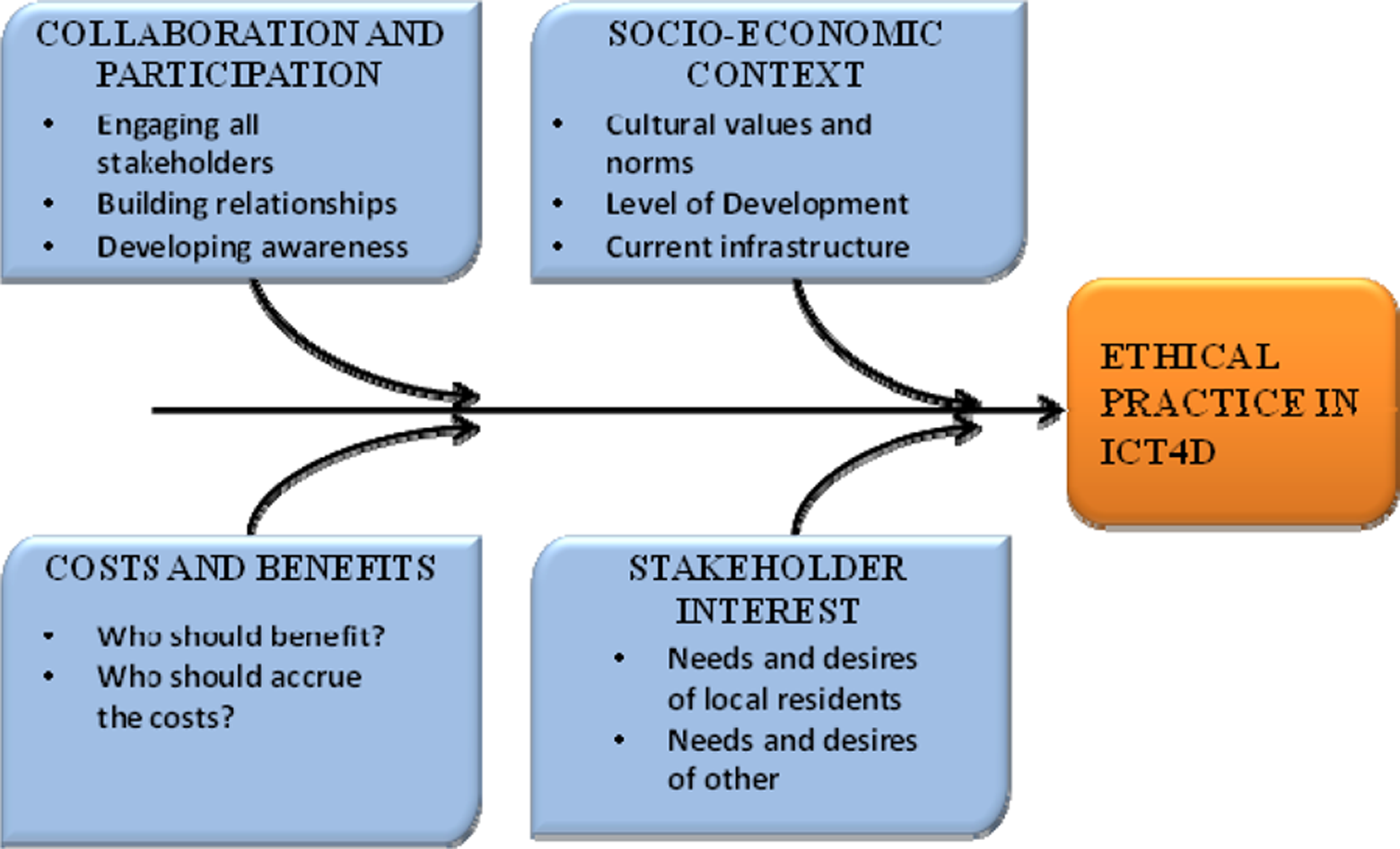
Ethical practice in ICT4D framework.
Collaboration and participation
Engaging all stakeholders
ICT4D project teams should engage all stakeholders involved in the ICT project. Community members should be informed about the purpose of the project and what the project aims to achieve; and only once this informed consent has been obtained can the project proceed (Brydon 2006; Krauss 2009). Communication between stakeholders should be promoted to ensure that different views, and the advantages and disadvantages of a particular project, are taken into account before embarking on the project. This will help identify and hold people accountable for their role in the project and prevent empty promises being made. Furthermore, local residents can also partake in sharing their knowledge and minimize their dependence on the imposition of views and opinions from developed regions. Engagement also includes the creation by project managers of partnerships with other stakeholders like the regional government (Hosman and Fife 2008; Huggins and Izushi 2002; Krauss 2009; Silvius, Shoembar and Smit 2009). Brunet, Tiemtoré and Vettraino-Soulard (2004: 4), state that “sustainable development will only happen within a real partnership” with investors; a partnership that takes into account the true needs of the developing region.
Building relationships
Fostering relationships with the community is important, especially in the rural context. Only through building relationships can researchers and project team members really engage with and earn the trust of the community and understand the community’s desires, values and customs (Krauss 2009).
Developing awareness
The major concerns of the potential and actual users of the Internet and other ICTs have focused on the lack of technological and financial resources in Africa. The ethical considerations are deemed less important (Brunet, Tiemtoré and Vettraino-Soulard 2004: 12). The integration of ICTs raises various ethical issues, such as, excessive costs, increased inequity and unethical use. When people are not aware of such issues, the sociocultural nature of the African population will be affected. Technological determinism will become a reality if users do not acknowledge the ethical issues related to ICTs (Brunet et al. 2004: 132).
Socio-economic context
Cultural values and norms
The project team should understand and respect the cultural values, norms, knowledge and views of the rural community. The social conditions of the community need to be understood in order to effectively engage with the community (McNamara 2003). A community will be more willing to accept a project if the researchers or the project team act according to community standards and follow the correct customs put in place (Brydon 2006; Krauss 2009). Moreover, acknowledging community leaders is important in many rural communities and paves the way for building relationships with the community. ICTs, and especially the Internet, provide access to numerous information resources, some of which may be inappropriate, such as child pornography. It is vital that information that results from ICT4D projects is aligned to the value system of the community and is relevant and useful to community members (Huggins and Izushi 2002). It is also important that community members are aware of the ethical challenges (as mentioned previously) brought about by ICTs and how this may conflict with pre-existing value systems (Brunet et al. 2004).
Level of development
The project team and investors need to fully understand the level of development taking place in an area and how suitable a project will be within that specific area. Projects will most likely not be sustainable if hunger and poor literacy levels are prevalent in the area (Krauss 2009). The overall social context should be suitable to accommodate ICT projects (Brunet et al. 2004; McNamara 2003). Such a holistic approach to development ensures that any technologies introduced are culturally and morally safe, renewable, and sustainable over time (Krauss 2009). Projects should also be in line with the broad development initiatives of the country (McNamara 2003).
Current infrastructure
The project team should study the available infrastructure in the community and determine whether the project will be feasible given the socio-economic situation and the available tools and infrastructure (Heeks 1999; McNamara 2003; Wenn 2007). It will prove futile to implement community telecentres, for example, if there are no electricity or Internet connections in the community. It then becomes a question of who the beneficiaries of the project really are. Is it the community, who will not be able to utilize the centre because there is no electricity currently in the community? Or is it the project team, who see the project as just another investment opportunity or an opportunity to dispose of old equipment disguised as donations? The project team should liaise with the sponsors and government to ensure that the appropriate infrastructure is in place to accommodate the project (Brunet et al. 2004; Heeks 1999).
Costs and benefits
Who should benefit?
Through collaboration and participation the project team and the community can determine what the actual benefits of the project are and determine if these benefits actually meet stakeholder expectations. ICT4D projects aim to aid socio-economic development and as a result the true beneficiaries should be the rural residents (Hosman and Fife 2008; McNamara 2003; Pade, Mallinson and Sewry 2008; Zaied 2008).
Who should accrue the costs?
The project team should ensure that all costs incurred are incurred by the person or people who were initially responsible for that cost. The team should also ensure that all unnecessary costs are mitigated (Mason 1995). For example, rural community members should not be expected to maintain and upgrade equipment in a community telecentre, especially if they have not been equipped with the relevant skills and resources to do so and are expected instead to depend fully on an external party. However, capacity building for local maintenance of telecentres should be encouraged. Furthermore, community members should collaborate to contribute towards financing the running of ICT programmes sustainably.
Stakeholder interest
Needs and desires of a community
The needs and desires of the rural community should be first priority. It would be inappropriate to implement a project that either does not meet the specific needs of the community or is opposed by the community (Krauss 2009).
Needs and desires of other stakeholders
There should be a genuine interest to assist with the socio-economic development of the community. The goals of the project should be aligned with the needs and desires of the community. Project owners and investors should be transparent about their work and their interests should not conflict with those of the larger community (Krauss 2009). For example, e-waste dumping, from developed regions to developing regions in the form of donations such as second hand computers, cause more harm to the community. These computers are often broken, irreparable and cost the community or government more money to dispose of and recycle in a sustainable manner (European Information and Communication Technology Observatory 2002).
The four ethical practice themes and their cohesive nature
The four themes discussed above are all interrelated and cannot be approached in complete isolation. To understand the full context in which a project will be implemented the project team will need to create an environment of collaboration and participation of all stakeholders. Only then will the team be able to determine the true benefits and costs involved and the actual interests and needs of the different parties. Through transparency and genuine interest in the community, participation of the community members is stimulated and collaboration is enhanced. As a result, context specific projects are likely to be more feasible and sustainable in the long term.
Conclusion and future research
Research has shown that while ICTs have the potential to contribute towards socio-economic development and quality of life, they also have the potential to hinder the process of sustainable development. The growth and use of ICTs has increased the risk that such technologies will be implemented or used unethically. Thus, the application of ICTs in rural communities should be guided by a set of principles that should not disregard the ethics involved. This research aimed to identify the key aspects of ethics that should be applied when embarking on an ICT4D project. A theoretical framework was developed which highlights four ethical themes to consider for ICT4D initiatives. Through-out the project lifecycle, ICT4D projects should apply the four ethical themes, which include: collaboration and participation, the costs and benefits, underlying stakeholder interest, and the socio-economic context of a rural community. The themes discussed are interrelated and coordinated in such a way that they cannot be applied in complete isolation, but instead should be applied holistically in an ICT4D project.
Future research
The current research was based on developing a theoretical framework on ethical practice in ICT4D which can be applied to any rural context. This research can be further explored to focus on a particular technology, such as the mobile phone, which has rapidly penetrated developing regions (Corbett 2008; Hilty and Hercheui 2010). The impact of ICT4D projects should also be assessed from an ethical standpoint to develop a framework that will evaluate the effectiveness of the ethical themes identified in this research. An empirical investigation of the proposed ethical practices in an existing ICT4D programme should be conducted. The results obtained from this empirical study should facilitate the revision of the proposed framework, so as to develop and further contextualize the current guidelines for ethical practice in ICT4D.