







Abstract
The study examines the views of architect experts and physically disabled users on the accessibility status of 14 public and university library buildings in Iran. The respondents rated on the availability of items listed in a checklist grouped under five categories: parking, ramps, interior layout, exclusive space and public space for the disabled. The checklist was based on the American Disability Act and International Federation of Library Associations and Institutions checklist for libraries for the disabled. The results indicate that the point of view of both disabled users and architects on all criteria is similar except for the ratings on the ramp and the interior layout for the disabled in library buildings. Based on the architects’ responses, 53.8 percent of libraries did not provide ramps and 63.0 percent had no exclusive space for the disabled. Disabled users who rated higher on library accessibility were frequent visitors to the library. The provision of access and equipment met minimum compliant standards on the standard checklist, but there is room for improvements.
Keywords
Accessibility for the disabled to public and university library buildings in Iran is not considered good enough by either disabled users or architects.
Introduction
According to reports by WHO (Moustakas 1994), the United Nations Children's Fund (2007) and Edmonds (2005), 10 to 13 percent of people in the world have some type of physical or mental disability. This amounts to around 650 million, of which 200 million are children. The majority of the disabled are in developing countries. In Iran this population is around 10 percent and the ratio has increased since the Iran and Iraq war (Arjomand 2001). The statistics of disabled people in Iran from 1986 up to 2006 show an increase from 453,090 to 1,577,646 as a result of the war as well as population growth, expansion of the aged population, accidents and so on. One of the fundamental rights that need to be considered for all members of a society is the right to access all facilities, sources and services, despite their varying abilities or limitations. Access to information sources is one of the rights that society cannot deny and libraries are one of the most important sources of information. Brophy (2007) categorized the function of libraries as: a) a collection; b) organizer of information sharing; c) provider of access to information; d) provider of an immersive experience catering for the senses and needs of their users. Libraries in Iran mainly fit in the first category, as a collection of resources (both print and electronic), providing access to resources they hold and finding new ways to deliver the sources to meet users’ current information needs. However, there are barriers to providing access due to lack of budgets, poor telecommunication infrastructure and limited access to high speed Internet. There is slow uptake of open access repositories and digital libraries due to low support or problems such as political boycotts. In this paper we will examine the adequacy of accessibility to selected library buildings in Iran in catering for the needs of the disabled.
Literature review
This section begins with describing the general published literatures related to library buildings, sources and service accessibility for the disabled. This is followed by studies on the disabled and libraries in Iran, which are described under three main sections: a) studies on designing buildings which are friendly for the disabled, b) library sources and services for the visually impaired, and c) library buildings and facilities provided for the disabled.
Library sources, services and building accessibility for the disabled in general
Disability activists in the 1970s have put forward a social model of disability, in which problems faced by the disabled are seen as being created by organizations or society, not by the disability itself (Finkelstein 1980; Oliver 1996). Based on this model, it is not the disability that prevents the disabled from using the library but rather the lack of suitable walk paths and ramps that limit access. As a result of the social model, libraries in various countries have been surveyed to find out the extent of their inclusion activities for the disabled. One such study was carried out in the UK in 2000 (Muddiman 2001). The findings indicated that only one sixth of public libraries advocate good practice for social inclusion and 60 percent of libraries have no comprehensive strategy to initiate activities for inclusion while many do not regard this to be a library priority area. Thus the study questioned; are public libraries open to all?
Other published studies about the disabled have highlighted the difficulties faced from different perspectives. Nandjui (2008) revealed that different aspects of the life of the disabled, such as education, economics, societal and buildings and their accessibility, have affected their quality of life. In the field of education, there have been discussions on the information needs of the disabled. Moy (1990) assessed library media center design for the physically disabled and found that students with disabilities have the same information needs as their peers and proposed some guidelines for libraries such as establishing a design planning committee, increasing awareness about standards for library buildings, and scheduling discussions with architects and library committees about the design of library buildings.
The physical dimension is the main and first barrier encountered by the disabled. In this regard, Chew and Higgins (2000) found that the disabled in Singapore have difficulties in utilizing the library due to poor access to premises when using the public transportation system, as well the inability to utilize library buildings and equipment. Barth (2005) studied the experiences of post-secondary students with disabilities when using campus space. He identified the barriers that students encounter in utilizing library space, which included the lack of signage, parking places which are far from library buildings, limited audiovisual sources, and the lack of any policies, procedures or guidelines that cater for the needs of the disabled.
Besides physical barriers, attitudinal barriers are considered equally limiting for the disabled. Forrest (2006) admitted that physical and attitudinal barriers deter good practices for the disabled and suggested the use of the International Federation of Library Association and Institutions’ (IFLA) checklist to benchmark assessment. The IFLA checklist consists of items listed under three categories, which are: physical access (outside and inside of the library building, access to sources and services); media formats (special resource formats to support the needs of disabled users according to their type of disability); and services as well as communication (staff awareness, training about disability, providing information access, cooperating with other organizations which support the disabled).
Forrest described the UK legislation based on the Disability Discrimination Act (DDA) 1995, which emphasized the need for organizations and agencies to accept their responsibilities about meeting the needs of their disabled users. He noted the attitudinal barrier, which was related to the perception of staff about disabled users. The study highlighted aspects of the IFLA checklist such as its stress on the inclusion of disabled users in the evaluation process to improve the library’s image and emphasized the role of staff awareness in providing better services for disabled users. The findings indicate the need to improve marketing, training about new technology (assistive technology) and improving the quality of facilities.
Other dimensions, such as the lack of librarians’ awareness of disabled users’ needs and lack of training on how to handle the disabled have a negative effect on their attitudes. Also, the lack of funding plays an important role in this negative chain. Scheimann (1994) surveyed 104 public libraries to identify the policies or practices used in public libraries in Ohio in complying with the recommendations issued by the Americans with Disabilities Act (ADA) of 1990. The survey covered issues such as the physical aspects of libraries, alternative sources and services, determining users’ views about the ADA Act, the availability of library funds for the disabled, the provision of equipment and the library’s solutions to meet the needs of the disabled. The findings indicated poor compliance in terms of library buildings accessibility and providing sources in formats suitable for the disabled. Some libraries demonstrated that they do not have any disabled users.
Todaro (2005) surveyed libraries which have been designed according to the American Library Association’s guidelines for providing resources, staff, building and budget for the handicapped. He noted that due to lack of funding libraries are limited in providing assistance to their special users. About 50 percent of the libraries surveyed partially conform to the standards, and their staffs are not professionally qualified. Pinder (2005) studied academic library responses to the UK disability legislation, and noted the need for libraries to train their staffs and provide accurate information about their disabled users and the type of access given to library buildings and the environment. He also noted the need to review policies and procedures related to disabled users.
Studies related to the disabled and libraries in Iran
A brief look at publications on library accessibility for the disabled users in Iran shows that more interest has emerged from 1993 to 2007. The majority of the research was in the fields of architecture and engineering. There was less coverage on studies about libraries and their accessibility to disabled users. The majority of the work related to libraries focused on services and sources for visually impaired users, while access to library buildings was poorly addressed. There were theses written about library building accessibility (Abbasi 2002; Bagerian 1993; Divan beigi 1989) yet none of the studies benchmarked the status of accessibility with available standards.
This paper categorizes research on library building accessibility in Iran into three categories; (a) those that focused on designing public buildings to be disabled friendly; (b) those related to library sources and services for the visually impaired, and (c) those assessing library buildings without comparisons with established standards.
Designing buildings which are friendly for the disabled
Divan beigi (1989) had designed a rehabilitation center for the physically disabled in Shiraz city, and mentioned library buildings in passing as an example of public buildings that should be designed with the needs of the disabled taken into consideration. Divan beigi did not discuss standards or guidelines that are available for designer reference. Bagerian (1993) introduced architectural designs as a tool for improving accessibility in buildings for the disabled. In his work on the design of the Culture and Sports Complex in Kermanshah city, Bagerian considered the library as the fundamental aspect of the complex, but he did not provide any information about building standards for designing an accessible building for the disabled. Abbasi (2002) presented a design for a cultural center which took into account the needs of the disabled in society, but again has not given any information about the standards which she used in her designs.
Library sources and services for the visually impaired
Arjomand (1993) surveyed the status of library and information centers for visually impaired users in Iran and found that the personnel who managed the libraries were not professionally qualified. As such, those put in charge of these libraries could express only basic problems faced by all users, such as the lack of collection organization based on the established world, which in turn increased the problems faced by users when searching for sources in the library. Among the difficulties mentioned were the lack of equipment to convert print to braille, unavailability of suitable audio recorders to create audio collections and limited access to the library for the disabled. Hashemi (1994) observed that the difficulties faced by visually impaired students studying medicine when using the library were the lack of special facilities and standard equipment, no documented policies with regard to providing special services, unawareness of library staff about the special needs of the disabled, untrained staff who were unable to handle or assist the disabled and physical barriers in library buildings that hindered the disabled from utilizing the library. Rasooli Amlashi (1999) studied the status of public libraries in Naft city in Tehran and found that none of the libraries considered the needs of physically and visually impaired users. Jacob Nargesi (2003) surveyed the adequacy of library sources and services for the visually impaired in public libraries in the Ministry of Culture in Tehran and concluded that the majority of library buildings, sources and services are not accessible to them.
Library buildings
Besharati (1998) evaluated the status of accessibility to library and information centers for the blind and low-sighted users in Tehran city in order to identify the obstacles and difficulties faced by the disabled. She reported the unsuitability of library buildings for disabled users and the lack of dedicated facilities for them. The study did not indicate whether the assessment was benchmarked against any standards. Mahmoodi (2002) studied the situation at Tehran’s municipality art libraries and indicated that the library buildings, equipment, audio visual sources available did not meet the needs of disabled users. However, the researcher did not indicate the standards used in her assessment.
Most published library and information literature about the disabled is from Western countries which have focused on the provision of sources and services, improving attitudes and awareness about the disabled, availability of policies, legislation and assistive technologies and websites. There is relatively poor coverage about the suitability of library buildings and equipment. This may be because in developed countries the problem of unsuitable buildings has been resolved, with new infrastructures being built after the Second World War. As such, the literature from developed countries has moved towards changing library buildings as public places for communities of users, including the needs of the disabled in the process of creating an atmosphere for integration and increasing social skills. On the other hand, literature from Iran covers the status of public places, including libraries, in providing for the disabled, but no benchmarking has been made against recognized universal standards so that comparisons can be made. Koulikourdi (2008) opined that libraries need to consider the point of view of the disabled. Forrest (2006) explained IFLA’s proposal that libraries cooperate with disabled users in order to achieve a correct and accurate schema about library situations. In Iran, all studies about library building accessibility are carried out only in Tehran and none has been carried out in other cities in Iran. As such, the status of provision for the disabled in other parts of Iran remains unknown.
Standards and recommendations for the disabled in public places
The Americans with Disabilities Act 1990 (ADA) is an approved law passed by the USA Congress in 1990 and reclaimed in 2009. It was passed in order to protect the rights of the disabled. The third section of the four-part report covers “public accommodations and services operated by private entities”. Section 3 provides a fully compliant situation according to the ADAAG (Americans with Disabilities Act Accessibility Guidelines) for all new constructions (Americans with Disabilities Act 2005).
IFLA’s Standing Committee of Libraries Serving Disadvantaged Persons (LSDP) prepared and published a checklist of conditions that should prevail to ensure good access to libraries for persons with disabilities (Irvall and Nielsen 2005). The checklist was designed to cover all types of libraries in all aspects of accessibility to sources, services, collections, programs and buildings. The checklist did not contain a quantitative measurement but lists elements that need to be considered when designing library buildings for disabled users. Items are divided into five sections: outside the library; inside the library; access to materials; media formats; services and communication.
This study combined the elements in the IFLA checklists with contents from the ADA to create an integrated guideline, which was used to formulate the questionnaire used in the survey.
Objectives
The objectives of this study are as follows:
To find out the views of disabled users in Iran with regard to accessibility to library buildings and equipment.
To find out the views of architects with regard to accessibility to library buildings and equipment.
To examine whether there are differences between the views of the disabled users and architects.
To find out whether there are relationships between disabled user’s perception toward library accessibility and frequency of library visits.
Methodology
The questionnaire was distributed to a sample of 150 disabled users in public and university libraries in Zanjan province, Iran. The list of disabled students and their contacts was obtained from the Cultural Affairs of Zanjan Province Universities and Welfare Organization. The questionnaires were distributed a) through the Zanjan Province Welfare Organization, which distributed it to members who visited regularly; b) contacting disabled users by phone; and c) distributing the survey at public and academic libraries to disabled users who visited the libraries.
A total of 150 questionnaires were distributed and 142 responses (94.7 percent) were found to be usable. The respondents comprised 53.5 percent men and 46.5 percent women. The age of participants was between 15 and 40 years old with most between the ages of 26 and 30 years. The majority (69.0 percent) of respondents were physically disabled. Most of the respondent used wheelchairs (49.6 percent), 46.4 percent used canes or crutches, while 4.0 percent did not indicate their use of assistive equipment. The educational level of respondents, varied from completing high school to university education. A total of 14 libraries were chosen for the study, consisted of seven public and seven university libraries in Zanjan Province. The public libraries were purposively chosen based on the findings of a previous study, which had revealed the public libraries with more disabled members. Other considerations included public libraries which have allocated a separate and specific space for the disabled. A total of 13 architects with at least 8 years of experience agreed to be involved in the study. The architects were asked to observe and evaluate the selected libraries based on the questionnaire designed for them.
The questionnaire was based on the library accessibility checklist prepared and compiled for IFLA in 2005, which in turn was customized according to the ADA standards. According to the IFLA checklist, the elements that need to be factored in when designing library buildings include exterior sites (parking, ramps, routes), interior sites (entrance doors, ramps), access to library sources (collections in different formats), library utilities (rest rooms, WCs), and library services (circulation desk, reference desk, children section, special section for disabled users). We used the parameters laid out by the IFLA checklist as a guide together with elements specified by the ADA (Americans with Disabilities Act). Firstly we compared factors laid out by ADA and IFLA and extracted common factors in both guidelines, then extended the details based on each guideline. For instance, for the outside section we focused mainly on factors detailed by the ADA and for the inside section, both guidelines were considered. To include more criteria related to libraries, library equipment and types of sources the IFLA checklist was used. We developed two different questionnaires, one for disabled users and the other for architects. Three expert architects were asked to check the instrument before actual distribution was carried out. The reliability of the questionnaire calculated via Cronbach's alpha coefficient was 0.84.
The questionnaire for disabled users consisted of two parts. The first part solicited demographic information from respondents (age, gender, types of disability, familiarity in using assistive instruments, educational and occupational status, type of library they use and their frequency of library visits based on daily, weekly, monthly, yearly and none). The second part comprised questions about the library building, facilities, and equipment, further divided into two sub-sections covering the exterior and interior space in the library. The exterior section consists of questions related to (a) parking space (proximity to public transportation, special parking space for the disabled, the number of parking spaces, the distance between the parking space and the library entrance, existence of a ramp to connect the parking space to main routes) and (b) ramps (the ratio of ramps, width of ramp, surface layout of ramp, handrails, height of installed handrails, handrail diameter, material of handrail, their stability and the existence of a cover on the ramp). The interior section comprised questions about (a) library interior layout (width of entrance door, surface layout and circulation desk), (b) exclusive space (shelves, a special space for disabled in the reading space, the arrangement of furniture in the reading space and the height of table and chairs) and (c) public space in the library (corridor width, the height of door handles, telephone, water cooling system, signage and rest rooms).
The first part of the questionnaire for the architects solicited information on their observed awareness about the library, including the name of the library, the name of the university, faculty name, address and phone number of the library. The second part included questions similar to the section for the disabled users.
Findings
Disabled users’ views on the accessibility of public and university library buildings
In this section, the disabled users were asked to rate five factors: (a) parking lot, (b) ramps, (c) exclusive sites; (d) interior layout and (c) public sites. The respondents rated on a five-point rating scale of: 1 = very weak; 2 = weak; 3 = fair; 4 = good; 5 = excellent. A score of 4 was considered as good and the means of all components were compared with this criterion for disabled users. The mean scores of disabled users’ ratings are shown in Figure 1. The disabled users indicated issues related to the availability of parking spaces, ramps, and exclusive space as posing the most difficulties (rated 2) for them in accessing the library building (Figure 1), while the interior layout and public space of the library were rated as less problematic (rated 3) by disabled users.
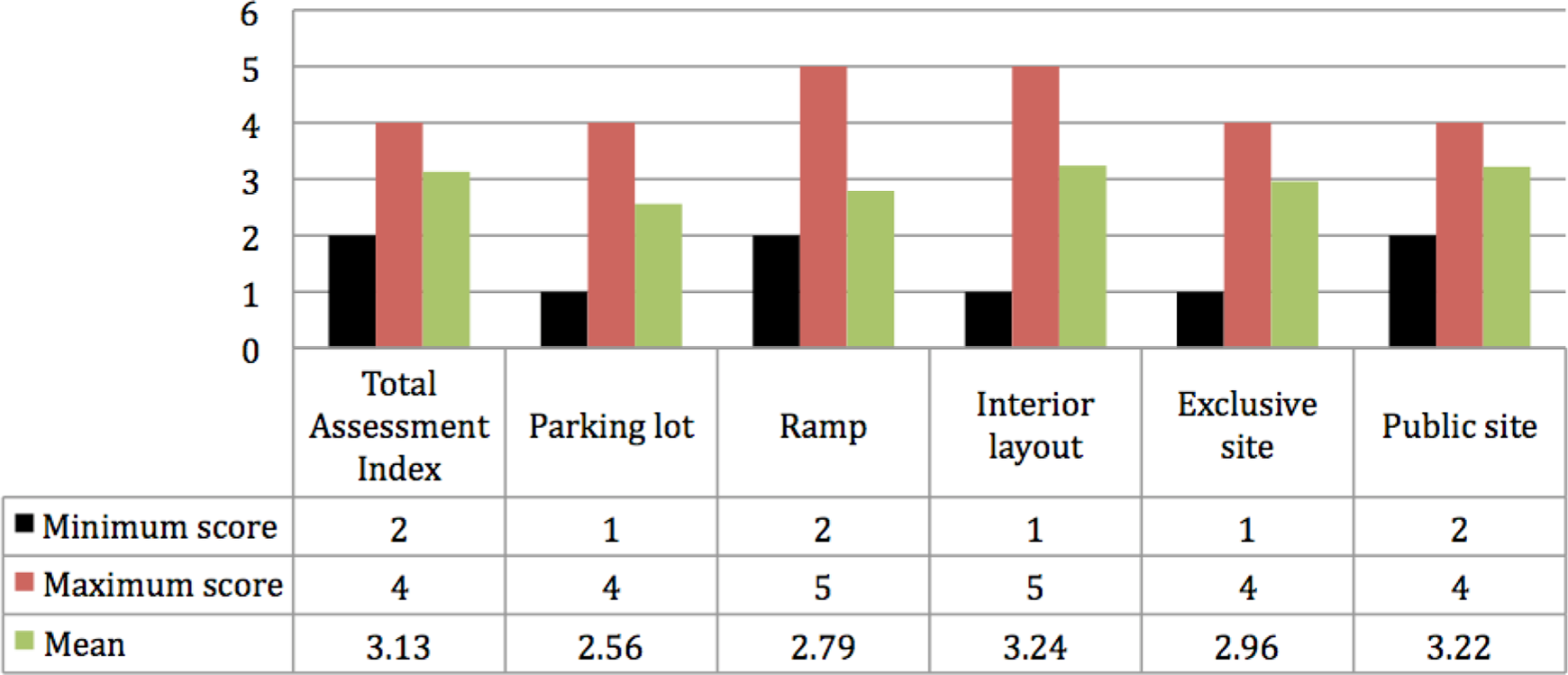
Mean score of all criteria for disabled users.
Architects’ views on the accessibility of public and university library buildings
In this section the same questions and rating scores were used by the architects. Similarly, in this context the score 4 was considered as good and all component means were compared with this criterion for architects. The results indicated that the mean of the architects’ views was 2.7 (Figure 2). The architects rated good (rated 4) on the availability of ramps and fair (3) for exclusive and public site of the library (corridor width, the height of door handles, telephone, water cooling system, direction finder, table for disabled and bathrooms). The ratings showed that ramps were available only in 53.8 percent of the libraries. Approximately 63 percent of libraries did not provide any special space for disabled users. The architects rated “weak” on the interior layout of libraries (shelves, exclusive places for disabled in reading rooms and the height of desks and chairs) and parking lot (exclusive lots for the disabled, the number of lots, the distance from the main entrance of the library and also ramps linking the parking lot to the library) and this indicates lower compliance with standards.
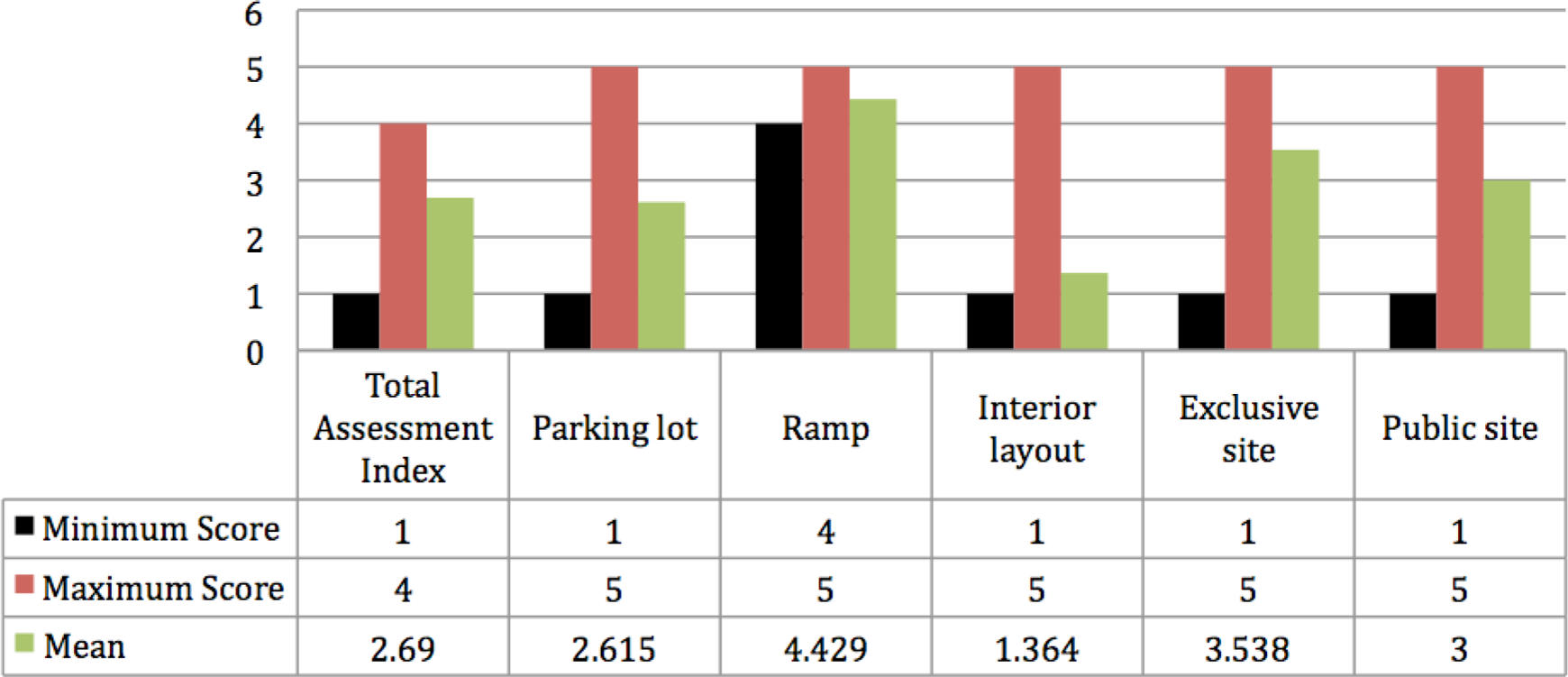
Mean score of all criteria for architects.
The difference in the views between the disabled users and architects
The results show that the points of view of both disabled users and architects were similar in respect of all criteria except for the ratings on ramps and the interior layout for the disabled in library buildings. Whilst the architects’ rated “good” on the ramp, the disabled users were less positive, rating “weak” on this facility . Also, the architects rated the interior layout of the library as “very weak”, whereas the disabled found this to be “fair”.
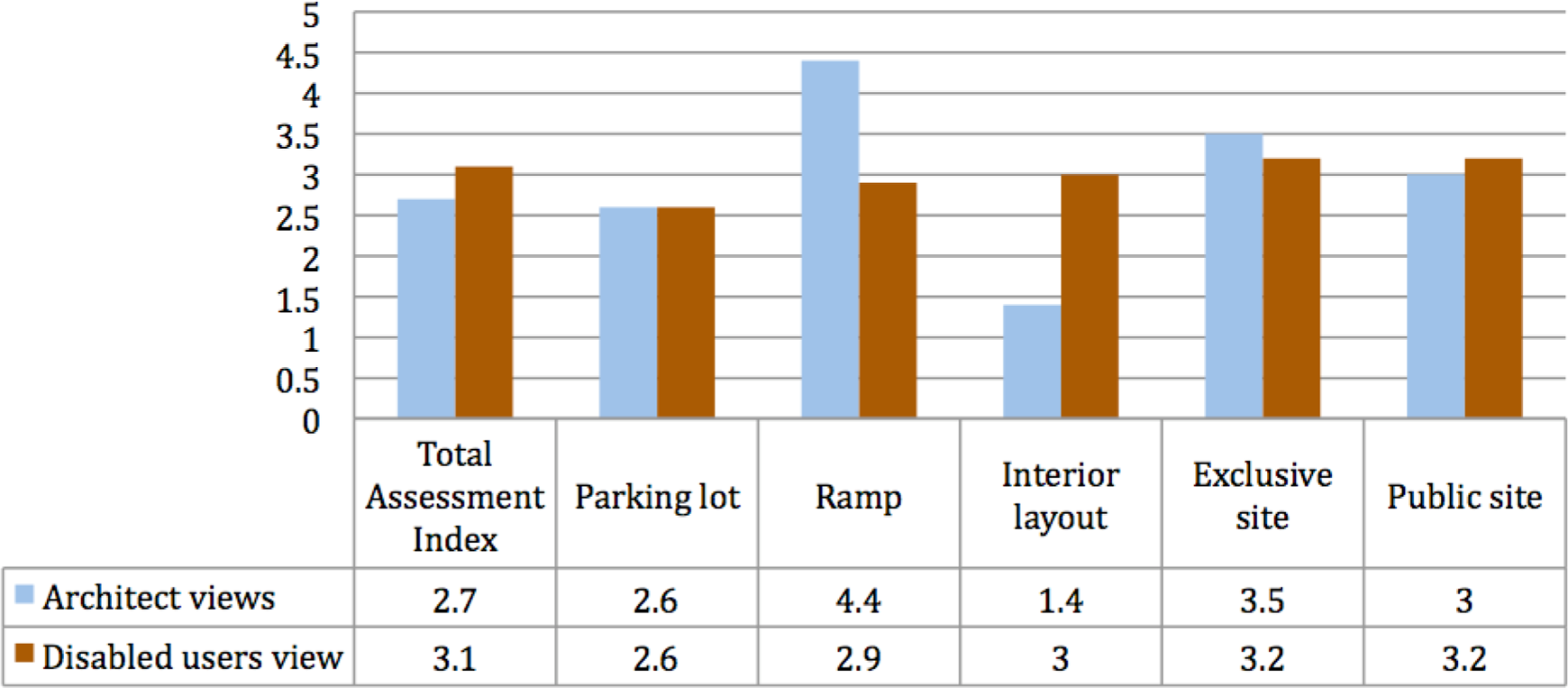
Comparison of mean score of disabled users and architects points of view.
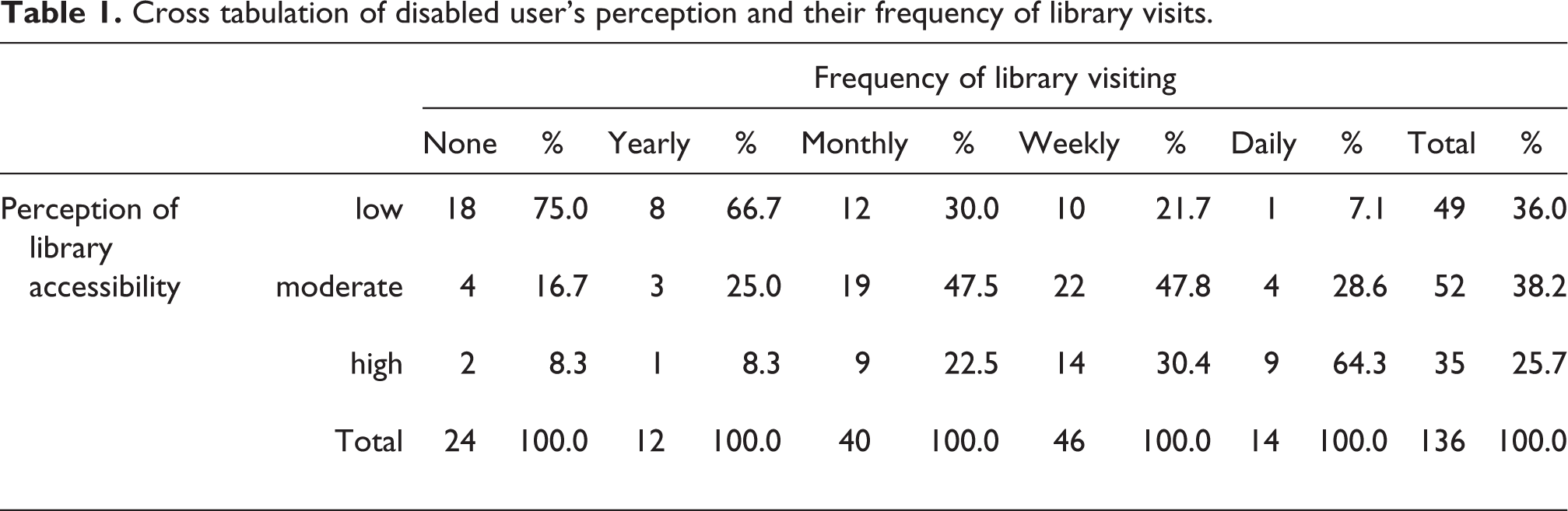
The ratings on frequency of library visits indicated that most disabled persons who never visited the library (75.0 percent) or only visited yearly (66.7 percent) rated lower on factors related to library accessibility, while those who visited the library daily (64.3 percent) gave higher ratings. Those who visited the library weekly (47.8 percent) and monthly (47.5 percent) gave moderate ratings on library accessibility. The results indicate that disabled users who rated higher on library accessibility were frequent visitors to the library.
Cross tabulation of disabled user’s perception and their frequency of library visits.
Discussion
In this study we found that the accessibility conditions of the public and university library buildings in Zanjan province in Iran were not rated as “good” enough by either the disabled users (mean index of 3.13) or, especially, the architects (mean index of 2.69). This means that optimizing or revising the design situation is necessary. The IFLA guideline has suggested that each country should evaluate their library buildings according to their own standards and on this premise it is more meaningful for Iran to formulate her own standard. There are standards formulated by the National Library of Iran such as the Standards of University Libraries in Iran (Maestas, Vaquera, and Munoz Zehr 2007), and the Standards of Special Libraries in Iran (MacDonald and Borsook 2010), but these focus on regulating the number of sources and services and library space and not on providing the right environment both outside and inside the library so that the library becomes more accessible. The disabled, like any other users, have the right to be considered when buildings and functions are planned. There are books published in Iran about library building space (Azem 2007; Parto 2007), but the focus is on basic space considerations for the disabled, which does not tantamount to a proper guideline.
International standards cannot be adopted in total as the recommended measurements for equipment and facilities may not be suitable for Iranian situations. Nevertheless, we use the ADA standards and IFLA checklist to explore the possibility of applying it to Iranian libraries and in doing so we are able to assess factors related to the accessibility of library buildings, which is poorly handled in existing Iranian standards and published resources. The available literature in Iran shows that most studies on the disabled in LIS have focused on the physically and visually disabled and overlook the needs of other types of disabilities such as the deaf, dyslexics, autistics, and those with behavioral and emotional disability. Studies in the United Kingdom for example, have covered these types of disabilities. Taylor (2005), Taylor, Baskett, Duffy and Wern (2008) and Taylor, Duffy, England (2009) highlighted the different studies about autism, dyslexia, behavioral and emotional disabled students in higher education and emphasized the role of awareness and training of library staff about the nature and types of disability to increase their understanding and improve the quality of services. Even so, the difficulties involved in providing truly accessible library services continued to be discussed through consortia of librarians in higher education which emphasized a change in approach in finding out what disabled students really want from libraries, educating librarians to meet the needs of disabled users and the impact of disability equality on library services (Bird, Health and Hine 2006).
In Iran, other factors need to be considered, such as the status of librarians’ attitudes toward the disabled, their awareness about available legislation, policies and standards for disabled users and the extent of cooperation with governmental agencies needed to activate such policies. Vitzansky (1994), Pinder (2005) and Katsiyannis (2009) have all emphasized the role of staff and librarians and the need to increase the level of awareness about legislation and policies in creating and providing an accessible environment for the disabled. Increasingly, web accessibility for the disabled is becoming an important issue for consideration, especially in view of Iran’s current move to create an electronic government, which necessitates increasing the level of information literacy, establishing virtual environments and education in universities. E-services will reduce the need for the disabled to travel or make physical visits to pubic repositories such as libraries. Chelin (1999), Schmetzke (2002), Jones and Tedd (2003) and Jacobin (2007), all discuss different aspects of web accessibility and increasing the level of access to the disabled users. The qualitative approach to studying the disabled is another aspect which could be explored in Iran, so that the needs, worries, anxiety, relief and satisfaction of the disabled could be clearly identified.
Conclusion
In this study we attempted to evaluate the current accessibility status of library buildings and equipment using the ADA guideline and IFLA checklist. Arguably, the applicability of these Western-based checklists may not be suitable in the Iranian situation, but the absence of an instrument that focuses on the building and accessibility in the Iranian disabled user environment seems to make their use viable until a similar instrument is formulated for Iran. In this direction, Iran needs a more holistic and interdisciplinary approach with physiological, ergonomic and architectural cooperation considerations, involving collaboration between the Urban and Housing Ministry and the Health and Education Ministry to produce a ‘localized’ standard for Iranians. Also, considering Iran’s political boycott situation, which has an effect on the price of equipment and allocation of funds for libraries, it seems the best solution is to apply available international guidelines to roughly elicit criteria in building accessibility through disabled users.
This study is limited since it does not cover the whole of Iranian libraries and we are aware that different results may be obtained if such coverage is carried out. However, as it stands the results hold true for the 14 libraries which we have selected. Possible future studies could include a more comprehensive study on the disabled using a wider range of libraries and adopt the qualitative approach to uncover the real needs of the disabled.