







Abstract
This paper presents findings from a study conducted in Swaziland on the role of the public library in the provision of HIV and AIDS information. Its findings resonate with the findings of other studies carried out in a number of public libraries in African countries, viz. the disappointingly low visibility of the efforts to intervene, and the failure of the librarians to leverage greater impact through partnerships with related agencies. It suggests that public libraries need to change their behaviour in order to resolve the disparity between espoused positions and actual impact. The paper concludes by giving an account of how an information centre was established in a rural area in response to the findings of the investigation which pointed out the disadvantages experienced by rural people as a result of the inefficacy of the information flows between the centre and the margins.
Public libraries need to change their behaviour to obtain maximum impact in information provision through partnerships
Introduction
A number of authors in Africa have examined the way in which the public library, exercising its mission of education and information dissemination, may play a useful role in the fight against HIV and AIDS (Mchombu and Mchombu, 2008; Schoonbee, 2005). For this purpose, the International Federation of Library Associations (IFLA) has published a manual for HIV/AIDS training in libraries (International Federation of Library Associations, n.d) arguing that the library’s intervention is an important component of the country’s strategy, alongside the provision of health and social services.
Swaziland, an African kingdom of 1.2 million people, is one of the countries in Africa most seriously affected by the HIV/AIDS epidemic. Latest prevalence figures show that 25.9 percent of its adults (i.e. people between the age of 15 and 49) are infected by HIV/AIDS, with an annual new infection rate of 2.9 percent (Lule and Haacker, 2012). The country suffers from the world’s highest death rate from HIV/AIDS and one of the lowest average life expectancies (Lule and Haacker, 2012).
Given the burden of the disease in the country, and the theoretical possibilities for the public library to intervene in the struggle, a study was undertaken by the authors to investigate the formal provision of HIV/AIDS information by the public library system in Swaziland. This paper reports on the study, its findings and consequences.
The role of information in the struggle against the pandemic
In a report on libraries as change agents in the struggle against HIV and AIDS in developing countries in Africa, the authors highlight the critical role of information and education to combat the epidemic (National Commission on Libraries and Information Science, 2005). The comprehensive report found that where libraries worked in collaboration with other information agencies, their impact was greatest (p. viii).
In developing countries, the public library has been identified as a suitable point for providing health information services, particularly to the rural population, who are increasingly vulnerable to HIV/AIDS (Ghosh, 2006). Mchombu and Mchombu (2007) confirm the view of the public library as a suitable place for disseminating HIV and AIDS information to the rural communities. They report that some countries like Uganda have managed to reduce the infection rate (Mchombu and Mchombu, 2007: 5) with the involvement of NGOs.
A number of studies show that, in spite of rhetorical agreement with the theorists who have outlined the potential role of the public library in developing countries, the record of involvement is sparse and unimpressive. In a newspaper piece in 2010, Sithole concluded that libraries in Zimbabwe have not actively participated in the information, education and communication campaigns in that country in spite of their skills to make a contribution (Sithole, 2010). Allbright in her chapter for the FAIFE report concluded that “despite the recognized importance of information in the fight against AIDS, libraries in Sub-Saharan Africa are not considered to play an important role” (Allbright, 2006: 35). This observation is echoed by Sithole who notes that the public library is not identified in any policy documents dealing with information activities in African countries (Sithole, 2010). Thus libraries are aloof from other agencies networked in the campaigns, a situation that marginalizes the library and its contribution. Evidence has shown that the most successful responses to the epidemic are found in those countries that recognize that a multi-sectoral approach is required for programmes based on “broad socialization, accompanied by clear deliverables” (Piot and Seck, 2001: 1107).
Responses to the pandemic in Swaziland
In 2001 the Prime Minister's Office formed an organization called The National Emergency Response Council on HIV and AIDS (NERCHA), established through an Act of Parliament, the NERCHA Act No. 8/2003 (National Emergency Response Council on HIV and AIDS, 2003). NERCHA was created to coordinate and facilitate the National Multisectoral HIV/AIDS response and oversee the implementation of the national strategic plans and frameworks. NERCHA is not an implementing body; its goal is rather to organize and manage the nation’s war against the AIDS epidemic. NERCHA works with organizational and community partners across all sectors to ensure that comprehensive services are delivered at the grassroots level throughout the nation.
With NERCHA’s leadership, the nation has created and implemented a strategic response to HIV/AIDS that has impacted thousands of Swazis. The response has focused on local, community-driven solutions that align with a national vision. These programmes are geared to be sustainable and to target all segments of Swazi society: the uninfected, the infected and the affected. Swaziland signed the 2011 Political Declaration on HIV and AIDS, which binds signatory countries to work towards Millennium Development Goal 6, which seeks to halt and reverse the spread of the epidemic by 2015 (Swaziland, 2012).
Kanduza (2003) provides an overview of how the Swaziland Government and NGOs in Swaziland responded to HIV/AIDS between 1986 and 2002. The strategy was to use education in various forms in order to change the behaviour of Swazi citizens and non-Swazi residents in the country. Research and subsequent research were not successful because of two major considerations. First, the Government’s own studies did not reach the intended audiences and had limited effects; and secondly, workers in companies that undertook investigations responded with anger or resistance (Kanduza, 2003).
The behavioural surveillance survey of 2002 found that sexual activity starts early among the youth (16.3 years for those at school, and 17.4 years for those out of school) and that risk-taking behaviour was common in Swaziland, among both youths and adults. Both these groups had multiple relationships (Swaziland, 2002). One of the indicators along the route to achieving the goal has a significant information component – “Percentage of young people aged 15–24 who both correctly identify ways of preventing sexual transmission of HIV and who reject major misconceptions about HIV” (Swaziland, 2012: 3). One of the methods used to disseminate accurate information is the employment of 4500 Rural Home Motivators (RHMs) found in all rural communities. They visit and encourage the people in the communities to live positively, especially those infected with AIDS (Helping ourselves: community responses to AIDS in Swaziland, 2006: 31).
A study published in 2000 showed that in eight of the 14 public libraries surveyed in Swaziland, the collections of HIV/AIDS materials were limited and out of date (Muswazi, 2000). The study recommended that in order to make a positive contribution to the struggle against HIV/AIDS, the libraries should: collaborate with partners and so influence the production and distribution of suitable materials mount displays of materials in a public forum extend information services to communities in remote areas (Muswazi, 2000).
Objectives of the study
The intention in conducting the study was to investigate the availability of HIV and AIDS information sources in the Manzini region, focusing on the role of the Manzini Public Library (MPL) in this regard. It did this by exploring the following questions: How is information on HIV and AIDS accessed by the communities in the Manzini region? What are the channels through which HIV and AIDS information can be disseminated? What are the challenges of acquiring and delivering the appropriate information? Is there any collaboration between the public library (being a recognized information centre) and the NGOs?
The reason that non-governmental organizations (NGOs), a community based organization (CBO), and a faith based organization (FBO) were included in the study was that the literature analysing strategies in Africa that have had greater success than others showed that the following factors were important: public education campaigns leadership from the government collaboration between NGOs, the Church and its agencies, state structures and agencies (Piot and Seck, 2001; Allen and Heald, 2004)
Methods
In an effort to understand the experience of the public library in providing HIV and AIDS information, and its relationship to other distribution agencies, a variety of sources of information were utilized. The respondents were selected according to their particular roles and their perspectives relating to HIV and AIDS information flow and use. The following categories of respondents were identified as capable of providing information required to answer the research questions: users of the public library the librarian service providers: organizations active in the field of HIV and AIDS residents of a rural area falling within the jurisdiction of the public library.
Data were collected using a variety of methods: a survey questionnaire, interviews and focus group discussions, as follows: users of the public library: a survey questionnaire randomly distributed to 100 users in the library; and a focus group discussion was held with eight users librarian of the public library: an interview two NGOs in Manzini involved with HIV and AIDS work: interview with the manager of each one CBO in a peri-urban area of Manzini: interviews with two Rural Health Motivators (RHMs) one FBO in Manzini: interview with the manager residents of rural Nkamanzi: a focus group discussion with eight adults.
The survey instrument was designed to elicit information from users of the library about their use of the library, their use of specific material, and their views of the library. Questionnaires were distributed to 100 randomly selected adults who visited the Manzini Public Library on 22nd August 2007 to explore their experiences in the library in general and in the HIV/AIDS section in particular. Of these, 74 completed questionnaires were returned. Eight users of the special section of the public library to house HIV and AIDS materials volunteered to participate in a focus group to discuss their experience of the library and its special materials.
Interviews were held with managers of the two NGOs, two members of the CBO, and the manager of the FBO, in order to understand the role of information in their work, and their awareness of the public library. The interview respondents were asked to comment on their work and their relationship with the public library as follows:
the roles of these organizations and the extent to which they work with local communities in urban and rural areas in disseminating HIV and AIDS information the extent to which they collaborate with other stakeholders, especially the public library, in the fight against HIV and AIDS.
A focus group discussion was held with seven members of the community of Nkamanzi to assess information needs and use in the community, particularly with respect to issues related to HIV/AIDS. The participants from Nkamanzi were selected by the Chief’s Counsellor to make up a group representative of the local community who would also be knowledgeable about the topic under discussion, viz. the resources available to inform and educate residents about HIV/AIDS. The Chief’s Counsellor was available for points of clarification. The discussions focused on issues relating to availability of time for teaching other community members, adequacy and access to HIV and AIDS information sources in Nkamanzi. Successes and challenges in the delivery of information were discussed. The survey, interviews, and focus group discussions in all the sites took place between 22 August and 7 September 2007.
Findings of the study
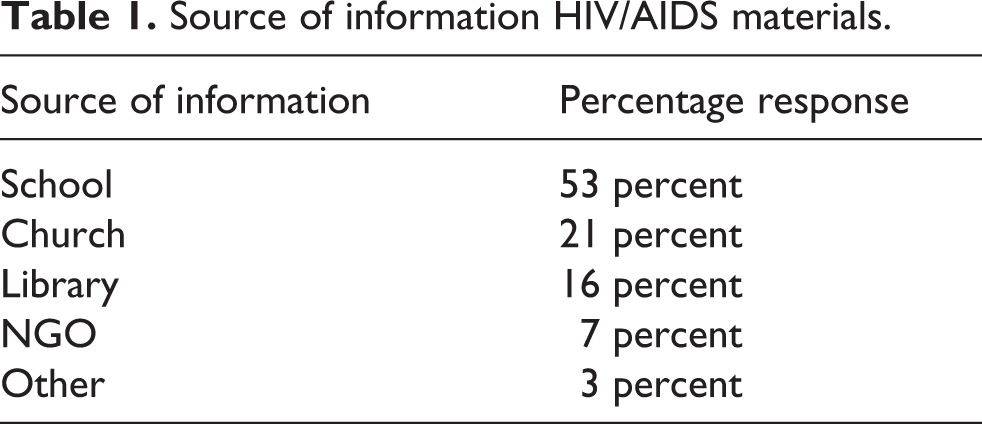
Results from the questionnaires indicated that the library’s collection of HIV/AIDS material is insufficient and inappropriate for the community it serves. This was confirmed both by the librarian who was interviewed and by 64 percent of the library users who reported difficulty in finding the information they required. The questionnaire asked the public library users where they most frequently turned to for HIV and AIDS information. The major sources of information relating to HIV/AIDS for the public library users are presented in Table 1.
Source of information HIV/AIDS materials.
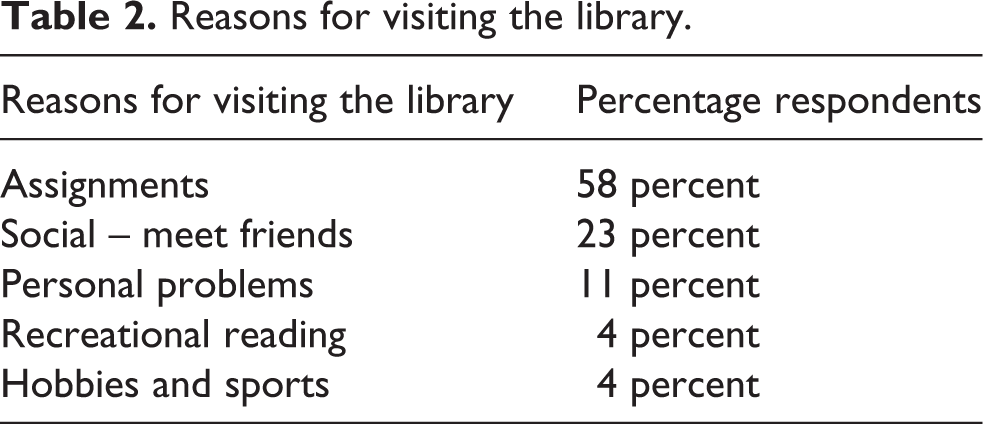
Respondents were asked about their primary reason for visiting the library (Table 2). The majority of the respondents visited the library for school assignments.
Reasons for visiting the library.
The NGOs, the CBO and the FBO reported that they had not met the library or interacted with it, and were interested to hear of the collection of materials on HIV and AIDS held by the library, and the possibility of forming a partnership. The focus group discussion at Nkamanzi revealed that the library played no role in the provision of material, but that the community relied on NGOs in Manzini to bring material to them.
Discussion of the findings
The use of the library in Manzini is consistent with findings in other African countries, viz. its importance for young people doing school assignments (53 percent), and far less use as a source of information for problem solving (11 percent), or even for leisure reading material (4 percent). It is encouraging to note the significant use of the library as a social contact point (23 percent). In keeping with experience in many other African countries, the library is not the most important source of information for issues related to HIV and AIDS, where the school and church figure more prominently (53 percent and 21 percent respectively). The responses to the question about the format and type of HIV and AIDS information supplied to communities in Swaziland indicate the urgent need for greater collaboration between the library and the NGOs. Mchombu and Mchombu explain that because of the overlap of roles in information production and distribution, libraries often do not stock the up-to-date but non-traditional information materials which tend to be generated by NGOs, and which often defy conventional library processing and treatment (2007: 6).
In summary, the picture emerging from the Manzini Public Library did not differentiate it from other African libraries which have been surveyed for their involvement in HIV/AIDS, viz. a partial approach based on a limited view of their role, restricted in the main to an information facility. This facility was, however, characterized by an inadequate collection of materials, limited interaction between the library and other agencies, and a tendency to attribute inaction to a lack of resources. Where the study did differ from the others was in the sequel. Awareness of the importance of accurate and relevant materials in the campaign against HIV/AIDS was raised by the researcher’s site visit to Nkamanzi where the community also came to realize the importance of information and reading material in their everyday lives. The manager of one of the NGOs in Manzini realized that the people in the rural area, one of the sites of the study, were suffering from an extreme lack of information materials. The study highlighting their plight became a vehicle for the establishment of an information resource centre in Nkamanzi, the story of which is recounted in the following section.
The story of the Nkamanzi Information Centre
The national newspaper announced, under the heading “Good news for Nkamanzi folks”, the launch of a community-based information centre, the first of its kind in rural Swaziland. It traced the genesis of the project to the “findings of an academic study by Joy Shabangu” (‘Good news for Nkamanzi folks’, 2012). Nkamanzi is the first to launch a community-based information centre and its establishment was in response to a community member. During the data collection phase of the study, a number of important stakeholders were alerted to the importance of accurate and up-to-date information for rural communities whose access is compromised by distance from the urban centre. Thus the researcher facilitated a meeting between Chief Gija Dlamini of Nkamanzi and the director of the Lamvelase Information Center, the first of many to discuss the idea of establishing an information centre for the people of Nkamanzi. NERCHA, K4 Health and USAID spearheaded the establishment of the Centre, while material and other support was donated by organizations such as Macmillan Books, Swaziland Water Services Corporation, Children International through Fundza, Swaziland National Library, Swaziland National Archives, and a group of Canadians, frequent visitors to the region. The decision was taken by the stakeholders to open an information centre in Nkamanzi to meet the information needs of the community, with a special focus on HIV and AIDS. The aim was to influence social behaviour change through timely provision of accurate HIV/AIDS information to ensure an AIDS-free Swaziland. The Information Centre's objective is to support the mission of the organization (NERCHA) which saw the need of providing the HIV/AIDS information centre.
Eight people – six women and two men – were selected to be trained as volunteers, by the Chief’s aide. The volunteers, who receive a stipend and travel expenses, were trained to work with computers and to retrieve information. They are now charged with this function in the Nkamanzi Information Centre, which is governed by a committee of five people responsible for monitoring the activities of the Centre. The collection of resources includes books, journals and journal articles, newsletters, video cassettes and CD-ROMS.
Most of the resources are relating to Swaziland. They include current and relevant HIV and AIDS information. These books were provided by NERCHA. There is also a collection donated by various institutions which covers all ranges of subjects. However the Nkamanzi community is happy that the collection has gone beyond that of HIV/AIDS; its
Conclusion
The study highlighted the importance of information provision and the difficult goal of behaviour change to prevent infection, concluding that public libraries will need to change their behaviour in order to leverage maximum impact in information provision through partnerships. The novel feature of the study is that its findings are directly linked to the decision to establish a pioneering information centre in a rural area where the community became aware of the important role of information provision for their health and other needs. The awareness was raised because the researcher did not confine her study to the institution of the public library, but consciously investigated relationships with NGOs active in the field of HIV and AIDS, thus extending the reach of her study to people and agencies she could work with in the fulfilment of a dream that emerged during the study. Nonetheless, this welcome and unexpected conclusion does not represent a sustainable model of delivery of suitable HIV and AIDS information and material. In our view, the potential remains for the public library to reach beyond its institutional walls to interact with other agencies who have complementary strengths. These service providers have expressed their eagerness to collaborate. Such partnerships are more likely to ensure a sustainable programme of delivery whose combined strength will be an established network and the continuity and stability of staff with the requisite skills for the collection and organization of information and promotion of its use.