







Abstract
The present study seeks to bring to the fore contextual factors that are influencing the decision-making process of corporate website adoption among micro-enterprises in the context of the developing world. We argue that the adoption of corporate websites by the decision-makers of micro-enterprises could be a strategic lever for micro-enterprises’ brands to gain visibility in the marketplace. We further opine that for micro-enterprises to gain a foothold in doing business in the present information age, it is imperative for such businesses to take advantages of the opportunities inherent on the World Wide Web. Based on our findings, there is evidence to show that aside from the applicability of the technology-organisation-environment (TOE) contexts as significant contributing factors in the adoption of corporate websites by micro enterprises, the decision-makers’ demographics equally play a significant role. The findings of the study may assist policy makers and stakeholders within the Nigerian Internet ecosystem to focus their attention on specific key areas that are aimed at supporting the diffusion and adoption of corporate websites among micro-enterprises.
Keywords
Introduction
The advent of the World Wide Web has indeed sparked a digital revolution across the face of the globe. Within the last two and a half decades, it has been consistently sweeping across all human endeavours. The emergence of the World Wide Web has not only been a game-changer in the history of human communication, but also in the globalized business arena (Gibbs and Kraemer, 2004; Totonchi and Kakamanshadi, 2011). It follows that for businesses to stay relevant and competitive in today’s hyper-connected world, the deployment of Internet technologies (or tools) in businesses is widely perceived as a competitive edge for most businesses (Fillis and Wagner, 2005; Hung et al., 2012; Jahanshahi et al., 2013; Masita-Mwangi et al., 2012; Mbatha, 2013). Consequently, firms that are more proactive are able to leverage on the affordances of the World Wide Web to strengthen their brands’ visibility and at the same time build an intriguing love bond with their growing number of customers.
A majority of micro-enterprises in the developing world have found the business environment as a very tough terrain to operate in as a result of factors such as limited access to credit facilities, low level of technological capabilities, public policy somersaults, and inadequate national infrastructure as well as the fierce competition emanating from the more established enterprises and global brands (Aziz et al., 2012; Gobagoba and Littrell, 2003; Jones et al., 2012; Khosa and Kalitanyi, 2014; Madi, 2013). Consequently, the survivability of most micro-enterprises will largely depend on how well their decision-makers are able to strategically align their businesses to take advantage of some of the opportunities inherent in their local markets, as well as the visionary capacity to see beyond their day-to-day operations. The unfolding technological trends present a great picture of what the future holds for the majority of businesses in the globe. Businesses are able to plug into the future by taking advantage of technological innovations such as the use of the Internet, and in particular the World Wide Web, to get connected with their current and prospective employees, customers, suppliers and partners. In the current study, we have chosen to empirically investigate the adoption of non-transactional corporate websites among micro-enterprises in one of the richest countries on the African continent. Although Nigeria is reputed to be Africa’s biggest economy with an estimated gross domestic product (GDP) of US$510bn (McKinsey & Company, 2014), Internet adoption among Nigerian firms is still at a low ebb, owing in part to critical infrastructure challenges, relatively high cost of Internet connection fees, and low level of information technology (IT) awareness, as well as some elements of cultural backwardness.
With the exception of commercial banking institutions in the country and a few electronic retail stores (e-stores), the majority of Nigerian enterprises that have embraced the online community only have non-transactional websites at their disposal. Nonetheless, we may argue that the contents of most of these purely information-driven, non-transactional corporate websites are infrequently updated as well visually unappealing even to attract first-time visitors to such websites. However, this is beyond the scope of the present study. Also note that within the context of this paper, ‘corporate website’ and ‘non-transactional corporate website’ convey the same meaning.
The present study seeks to close a knowledge gap in the scholarly literature by way of exploring, analyzing and explaining the technological, organizational and environmental contextual factors that significantly contribute to the adoption of corporate websites by micro-enterprises in a developing country, namely, Nigeria. In addition, the study is aimed at investigating the influence, if any, of enterprise decision-makers’ demographic variables on the adoption of corporate websites. Our justification for including demographic variables is borne out of the need to fill in a research gap that was identified by Irefin et al. (2012, p. 8). Arguably, this paper is one of the few studies in Nigeria to empirically investigate this issue of contemporary interest among academics and practitioners.
In contrast to a few related studies in Nigeria (e.g., see Apulu, 2012; Ifinedo, 2012; Irefin et al., 2012) and similar developing countries, this paper focuses entirely on micro-enterprises’ adoption of corporate websites and how these could be used as strategic marketing tools to enhance enterprises’ brand visibility in the globalized marketplace. This study adds significantly to the growing academic literature on technology adoption by micro, small and medium-sized enterprises (MSMEs). Thus, it is our hope that the research findings, albeit preliminary in nature, could open future research possibilities in this area. This paper seeks to find answers to the following research questions: How could micro-enterprises leverage on the Web to bolster their brand visibility? What are the influential factors considered by decision-makers in micro-enterprises prior to adopting a corporate website? What are the relevant factors that distinguish between ownership and non-ownership of non-transactional websites among micro-enterprises? Do demographic variables of decision-makers play a significant part in the adoption of non-transactional corporate websites by micro-enterprises? Lastly, what to do to fast track the adoption of non-transactional websites among micro-enterprises in Nigeria and similar developing countries?
Theoretical background
Micro-enterprises as potential agents of economic transformation in the developing world
There is no general consensus as what constitutes the categorization of enterprises into either micro or small enterprise (e.g., see Ayyagari et al., 2003; Gibson and van der Vaart, 2008; Jaouen and Lasch, 2013; Mbonyane and Ladzani, 2011). For instance, in Nigeria, enterprises with less than 10 employees and with an asset base of less than NGN 5 million are termed micro-enterprises (Small and Medium Enterprises Development Agency of Nigeria (SMEDAN), 2007). It is interesting to note that micro-enterprises constitute about 99.9 percent of the total of 17,284,67 registered MSMEs in Nigeria (National Bureau of Statistics (NBS) / Small and Medium Enterprises Development Agency of Nigeria (SMEDAN), 2010). Some relevant studies conducted in developing countries argue strongly that micro-enterprises have the potential of contributing significantly to the economic transformation of developing societies (Bekele and Muchie, 2009; Dey, 2009; Kuazaqui, 2013; Nasrullah, 2012). While many governments in developing countries have so far enacted policies to foster the growth potential of micro-enterprises (United Nations Conference on Trade and Development, 2001), it is still unclear on how these enterprises can realise their growth potential given their low market competitiveness. For micro-enterprises to realise their growth potential, they must first strive to gain visibility in the marketplace. The adoption of corporate websites could be a strategic springboard for micro-enterprises in the developing world to gain brand visibility as well as increase their market competitiveness. In the subsequent section, we shall look at some of the factors that are influencing the adoption of corporate websites among micro-enterprises in a developing country.
The Diffusion of Innovations (DOI) and Technology-Organization-Environment (TOE) theoretical frameworks: enterprise-level adoption context
Although the current study is largely embedded in the Technology-Organization-Environment (TOE) theoretical framework of Tornatzky and Fleischer (1990), we briefly discuss the Diffusion of Innovations (DOI) model (Rogers, 1983) given its wide applications by researchers to technology adoption at both the enterprise-level and user-level. The DOI theory was proposed and developed by Rogers (1983) to explain some of the intricacies involved in the adoption process of an innovation. The author went further to define innovation as “an idea, practice, or object that is perceived as new by an individual or other unit of adoption” (Rogers, 1983:11). Rogers was of the opinion that innovation adopters can be categorised into five groups, viz: innovators, early adopters, early majority adopters, late majority adopters, and laggards. According to Rogers (2003), the innovation-decision process within an enterprise involves five interlinked stages – from knowledge (or awareness) stage, persuasion (or interest) stage, decision (or evaluation) stage, implementation (or trial) stage to confirmation (or adoption) stage.
Rogers (2003) further theorizes that, based on five innovation characteristics, an innovation process could be either hampered or expedited. These characteristics are: relative advantage (the expected benefit of the new innovation relative to what is currently available), compatibility (the conformance of the innovation to what is readily available and potential usage), complexity (the difficulty of understanding and using the innovation), trialability (testability), and observability (the degree to which an innovation may be easily noticed by others). Over time, a number of empirical studies have underscored the significant contribution of the DOI model to the adoption of online innovations by various forms of enterprises (e.g., see Grandon and Pearson, 2004; Luqman and Abdullah, 2011; Oliveira et al., 2014; To and Ngai, 2006).
The TOE model by Tornatzky and Fleischer (1990) postulates that enterprises are not only confronted with technological factors (similar to the DOI constructs) and organizational factors (e.g., firm size, firm scope, resource availability, information intensity, etc.) but also environmental factors (such as government readiness, buyer/supplier pressure, competitor pressure, etc.). Arguably, the TOE theoretical framework is largely grounded in Rogers’ DOI model as well as the Technology Acceptance Model (TAM) by Davis (1989). Nonetheless, the TOE model appears to be a holistic model, in the sense that it takes into cognizance both internal firm-based dynamics and the external (macro) dynamics that impact on the adoption of innovations by enterprises. Moreover, a number of prior studies seem to suggest the pragmatism of the TOE model in different industries’ contexts. Similarly, more recent empirical studies have established well-founded support for the TOE model in the context of micro, small and medium-sized firms' adoption of Internet-related innovations (e.g., see Johnson et al., 2014; Kreuzer et al., 2014; Ramdani et al., 2013; Soto-Acosta et al., 2014).
Research model and hypotheses
Understanding the contextual factors influencing the adoption of corporate websites
In order to address the research questions, we have slightly modified the TOE model by including the demographic characteristics of decision-makers in micro-enterprises as an important contextual factor in the current study. Despite some arguments about the limitations of the TOE model, some recent empirical studies (Balaid et al., 2014; Jie et al., 2013; Tran et al., 2014; Xin et al., 2014) have demonstrated its applicability in some parts of the developing world. To address the research questions, we have developed a research model (see Figure 1).
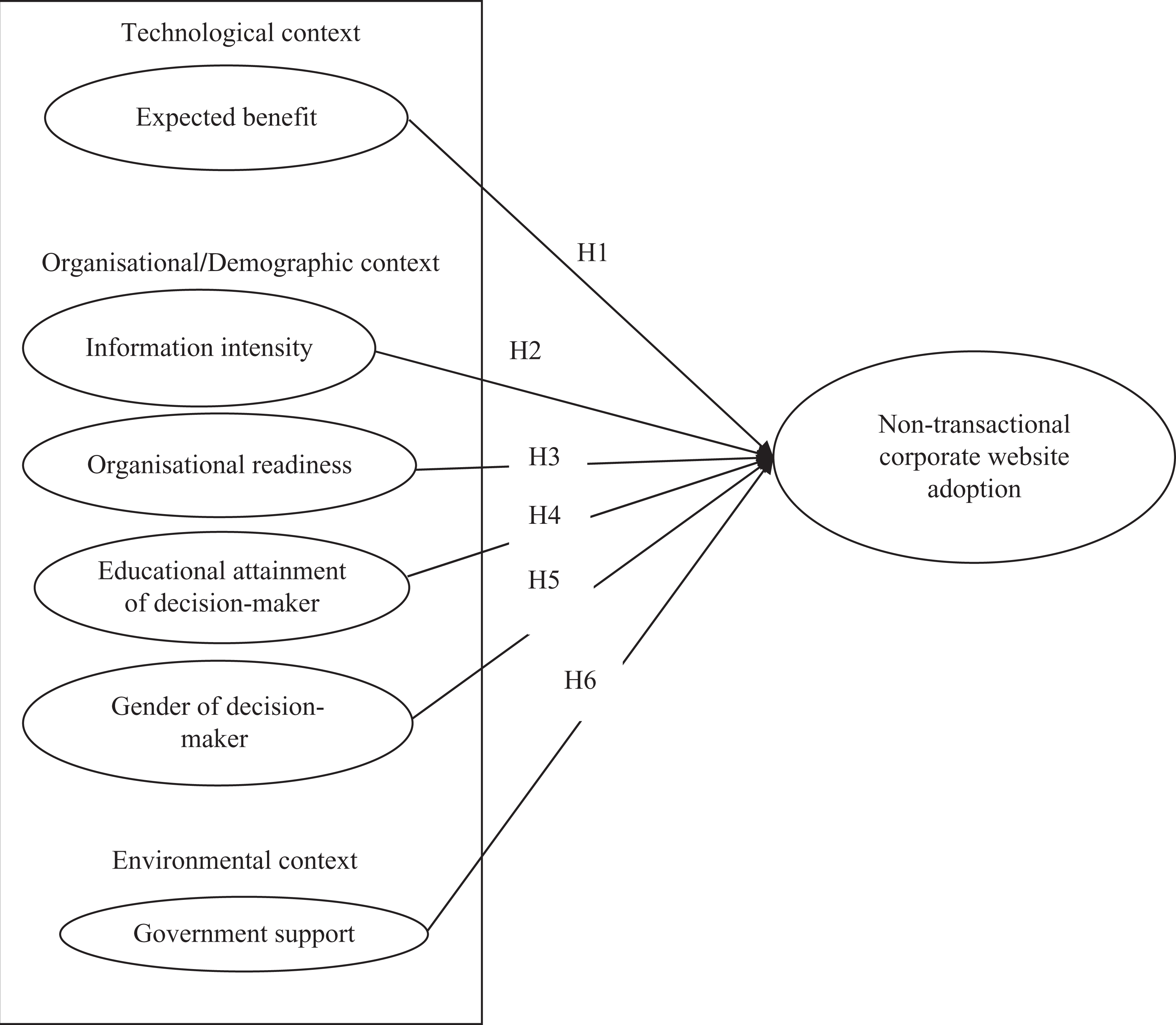
Proposed research model of non-transactional corporate website adoption among micro-enterprises.
Technological context
Existing literature on the adoption of Internet technologies by firms appears to show that the greatest motivation for firms to adopt the Internet and its related tools is the benefits that firms expect to get from using it (e.g., Ekong et al., 2012; Ghobakhloo et al., 2011). Consequently, the likelihood that micro-enterprises would adopt a non-transactional website would be dependent on the decision-makers’ perceptions that owning a corporate website would increase their market competitiveness and enhance their brand name in the marketplace. We therefore hypothesise that:
Organisational context
The organisational context can be seen from the perspectives of information intensity and organisational readiness. Information intensity implies the amount of information use and processing that is attributable to the various stages of production in a firm (Al-Qirim, 2005; Thong and Yap, 1995). Therefore, it is expected that micro-enterprises in a highly information-intensive business environment will be much more galvanized to adopt a corporate website. Such an adoption is most likely as a result of meeting a pressing need within the enterprise. Hence, we propose that:
Furthermore, organisational readiness in this instance implies the financial and technological resources that an enterprise is willing and capable of committing to the adoption of a corporate website. A number of studies argue that organisational readiness is positively correlated to the adoption of Internet technologies as well as related information systems (e.g. Chong, 2008; Gemino et al., 2006; Grandon and Pearson, 2004; Kuan and Chau, 2001). Therefore, we propose that:
Demographic context
In this work, we have considered two important demographic variables of the decision-makers in micro-enterprises. First, we wanted to investigate if the educational attainment of decision-makers has an effect on the adoption of corporate websites among micro-enterprises. In a developing country, particularly in Nigeria, we would expect those who have a university education to be better positioned to embrace technological trends than those with lower levels of educational training. The literature on Internet adoption in both developed and developing countries appears to confirm the highly educated citizens as leaders and perhaps opinion leaders in the initial adoption of Internet tools (e.g., Burke, 2002; Ching and Ellis, 2004; Madden and Savage, 2000). It is on this premise that we propose that:
In addition, we sought to investigate the influence of the gender of decision-makers on the adoption of corporate websites among micro-enterprises. It may be plausible to dismiss the notion that gender has any significant effect on the use of Internet tools in highly-industrialized countries, but this is not true of most developing societies owing to constraints currently faced by the female gender in some of these countries. There are contrasting views on the role of gender in technology adoption studies. Some studies with a focus on developing countries argue that gender does not have any significant impact on the adoption of Internet-related technologies at the firm level (Dasgupta and Gupta, 2010; Dehkordi et al., 2011; Eze et al., 2011; Lip-Sam and Hock-Eam, 2011). Other recent studies (e.g., Al-Rawad, 2009; Hilbert, 2011; Milek et al., 2011; Touray et al., 2014) posit that gender plays a pivotal role in the adoption of web-related technology by both enterprises and individuals in the developing world. A recent study by Terragon Limited (2013), has shown that females in Nigeria constitute only about 33 percent of the nation’s 48.4 million Internet users. Clearly, this is a worrisome sign of a gender-based digital divide in the country, even though female decision-makers in Nigerian micro-enterprises are quite enterprising and innovative, despite the daunting challenges facing them. In the light of the ongoing debate on the role of gender in web-related technology adoption, we propose that:
Environmental context
For micro-enterprises in developing countries to be able to compete favourably in the marketplace in this present digital age, the role of government as a facilitator is inevitable. Government support in the form of provision of critical infrastructure and friendly legislation is widely seen as a stimulus for the economic prosperity of indigenous enterprises. Prior studies on firms’ adoption of Internet applications argue strongly that government support is a sine qua non to its adoption (e.g. Hung et al., 2014; Huy et al., 2012). In line with these studies, we posit that:
Materials and method
Research design
The current study was realized in the form of a field survey by using a structured questionnaire to empirically examine the conceptualized model. With the exception of demographic variables and the dependent variable (does your enterprise have a website? – Yes or No option), the indicators in our survey instrument were all obtained from existing studies on information system (IS) adoption. The multi-items measuring expected benefits have been adapted from Gemino et al. (2006) while the measurements of information intensity were adapted from Thong and Yap (1995). Similarly, the multi-items for perceived government support were adapted from Kapurubandara (2009), Molla and Licker (2005), and Sophonthummapharn (2009). Lastly, the measurements for organisational readiness were adapted from Kuan and Chau (2001) and Teo and Pian (2003). All the items were measured on a 5-point Likert scale where the most extreme options (1 and 5) indicate “strongly disagree” and “strongly agree”. Kindly refer to the Appendix section for a list of the measurement items and scale used in the questionnaire.
Sampling and data collection
Nigeria, like most developing countries in the African continent is yet to have any known existing database on the estimated number of micro-enterprises that operate in the country. To overcome this challenge, the authors sought to personally distribute structured questionnaires by means of a ‘quasi’ multi-stage sampling technique to enterprises on an ongoing basis. Prior to the commencement of the study, we had a suggested cut-off period of three months (June-August 2014) for data collection. We had an estimated population of about 450 micro-enterprises, but were unable to reach all our target respondents. A total of 224 responses were collected from enterprises that we initially considered to be micro-enterprises. During the course of data collection and processing, we were able to identify that a number of enterprises did not meet the firm size criterion of less than 10 employees for any Nigerian enterprise to be classified as a micro-enterprise. From the total of 224 collected responses, only 127 met our final requirements, giving a usable response rate of 56.7 percent. All the questionnaires were distributed and collected by one of the researchers as well as with the aid of field assistants. We chose Enugu State in the southeastern Nigerian region as the survey locale. Arguably, southeastern Nigeria is one of the most enterprising regions in the country in terms of the growth of micro, small and medium-sized enterprises (MSMEs). The southeastern Nigerian region as a whole and Enugu State in particular is a beehive of commercial activities.
Analytical approach
In the initial stage, we set out to derive our research constructs by using exploratory factor analysis. A factor analysis using principal component analysis (PCA) with varimax rotation was carried out. The issue of common method bias did not arise because all the research constructs failed to load on a single factor (component). We conducted an independent sample t test and thereafter we proceeded with hierarchical discriminant function analysis. First, a discriminant analysis was carried out using only the interval predictor variables and it was subsequently followed up with another analysis using both the categorical predictor variables (i.e., decision-maker’s age and educational attainment) and interval predictor variables (i.e., expected benefit, information intensity, organisational readiness, and government support).
Based on the initial run of the discriminant analysis (i.e., using only interval predictors), we were able to infer homogeneity of covariance matrices in our sample survey (see Table 4). More importantly, in the second run of the test (i.e., the full model using both interval and categorical predictor variables), Box’s M test of homogeneity of covariance matrices was slightly violated (Box’s M test p-value of 0.025) owing to the introduction of the two dummies. We believe that our sample size is large enough to handle this slight violation of the assumption of equal covariance matrices (Hari et al., 2010). Moreover, the reported model shows a slight improvement in terms of the scores of the canonical correlation coefficient and overall classification accuracy when compared to the initial model (i.e., the model without the use of categorical predictors). All the computations in the present study have been done with the aid of IBM SPSS Statistics 20 software.
Results
Report of sample descriptive statistics
In total, we had 78 male and 49 female decision-makers, while 65 out of the total of 127 decision-makers are the actual owners of their enterprises. Only 56 of the 127 enterprises in our survey have a non-transactional corporate website. Regarding social media sites (Facebook, Twitter, Linkedln, Google Plus, Instagram, YouTube, etc.), most of the enterprises are yet to tap into the potential of the current wave of social sites. The descriptive statistics of our target respondents appear to indicate that corporate website adoption is slightly above the adoption level of social media. Please refer to Table 1 for more details of the sample characteristics.
Summary statistics of sample characteristics.
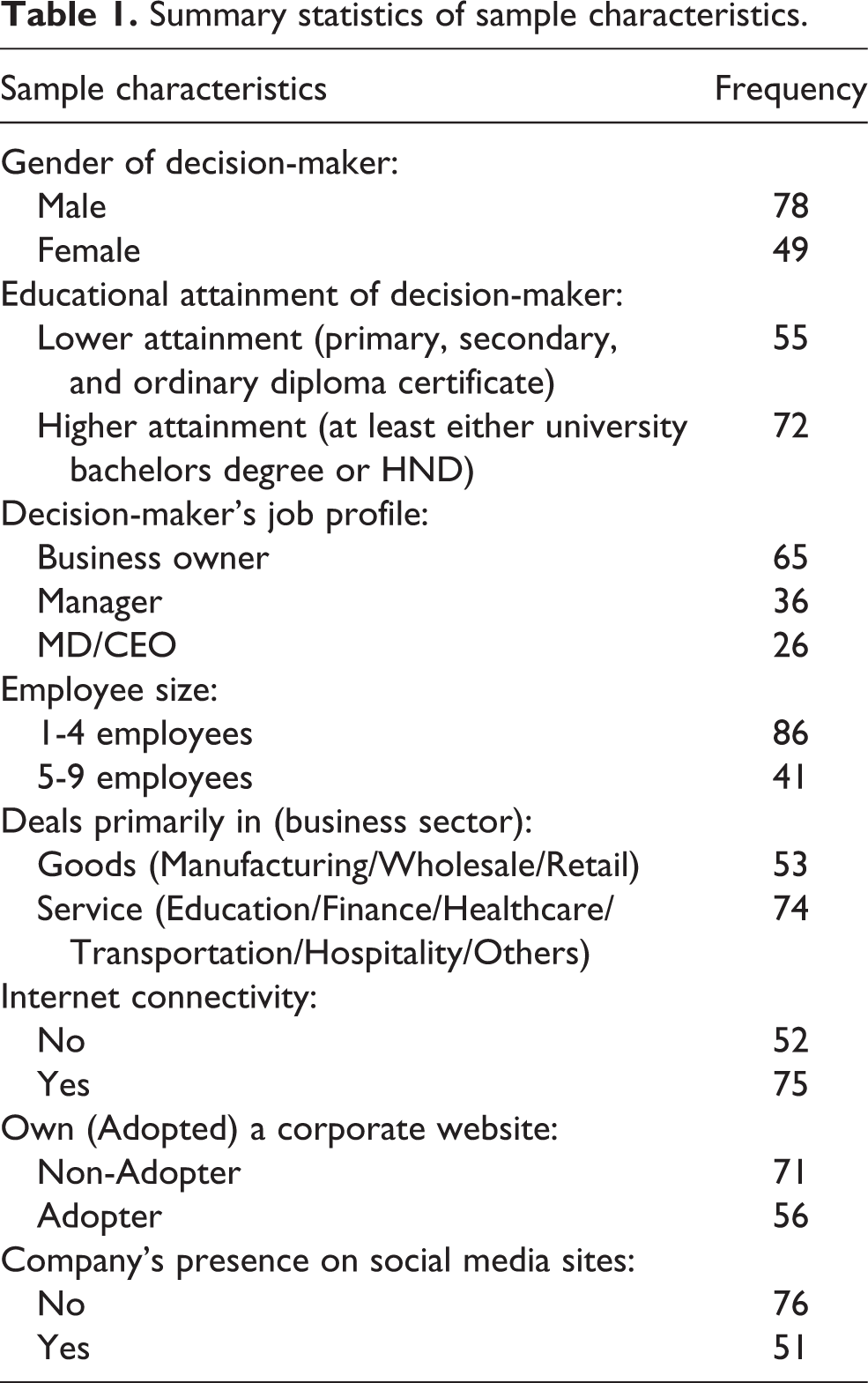
Outcome of exploratory factor analysis
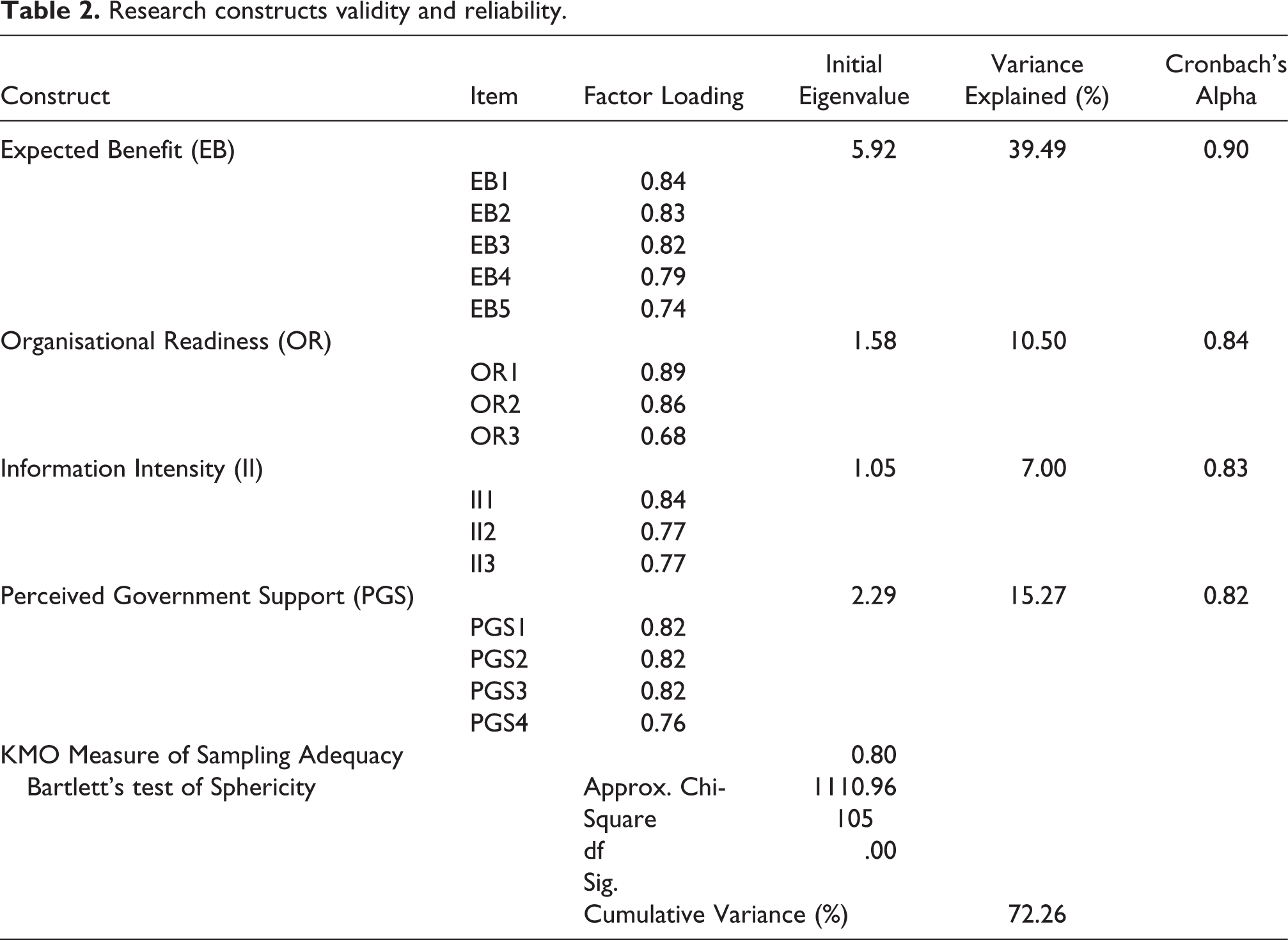
Given that the current study is largely exploratory, we opted to conduct an exploratory factor analysis. We used principal component analysis (PCA) with varimax rotation. Based on Kaiser’s suggested eigenvalue greater than one criterion, item loadings of at least 0.5, and maximum cross-loadings of 0.3, we were able to derive the multi-items that represent our constructs. Two of the initial items were dropped from the final iterative process due to insignificant loadings below 0.5. All items strongly loaded in their respective constructs, while the highest cross-loading was 0.26. Hence, it appears that our research constructs satisfy a priori validation statistics in terms of both convergent and discriminant validity. The internal consistency of the items measuring the research constructs was assessed using Cronbach’s Alpha. Our result shows that constructs exceeded the threshold value of 0.7 to be considered reliable. Kindly refer to Table 2 for the results of construct validity and reliability.
Research constructs validity and reliability.
Outcomes of independent samples t-test and discriminant analysis
The output of the independent sample t test (see Table 3) provides initial support for four of the interval predictor variables. We do not comment further on the findings from the independent sample t test since since the interpretation of this test statistic is not our primary interest, but rather, the results of the discriminant analysis model. More importantly, we report the discriminant loadings of the six research constructs (i.e., predictor variables) in Table 4. The overall predictive accuracy of the discriminant model is 72.4 percent. To assess the predictive model’s reliability and generalizability, we proceeded to do an out- of-sample test using the leave-one-out classification technique. The result shows that 64.6 percent of cross-validated grouped cases are correctly classified in the new sample. We used the Kappa statistic as a corrective measure for chance agreements. We got a Kappa coefficient value of 0.44; the model seems to have a moderate predictive accuracy. For the sake of comprehensibility, we use the discriminant loadings to rank the relative importance of the individual predictor variables (see Table 4). The discriminant loadings of the predictor variables ranged between 0.414 and 0.684. The findings suggest that all the predictor variables are statistically significant since they exceed the threshold value of 0.3 (see Hair et al., 2010). Not too surprisingly, the ranking of the predictor variables shows that ‘expected benefit’ is the most salient factor considered by decision-makers in the adoption of non-transactional corporate websites by micro-enterprises. This is followed closely by educational attainment of decision-makers and organisational readiness as important predictors. The other relevant contextual factors are the gender of decision-makers, perceived government support and the information intensity of an organisation. Based on the discriminant loadings of the predictor variables, the study’s findings provide empirical support for the six hypothesised relationships.
Results of hypotheses tests using t-test (independent samples).
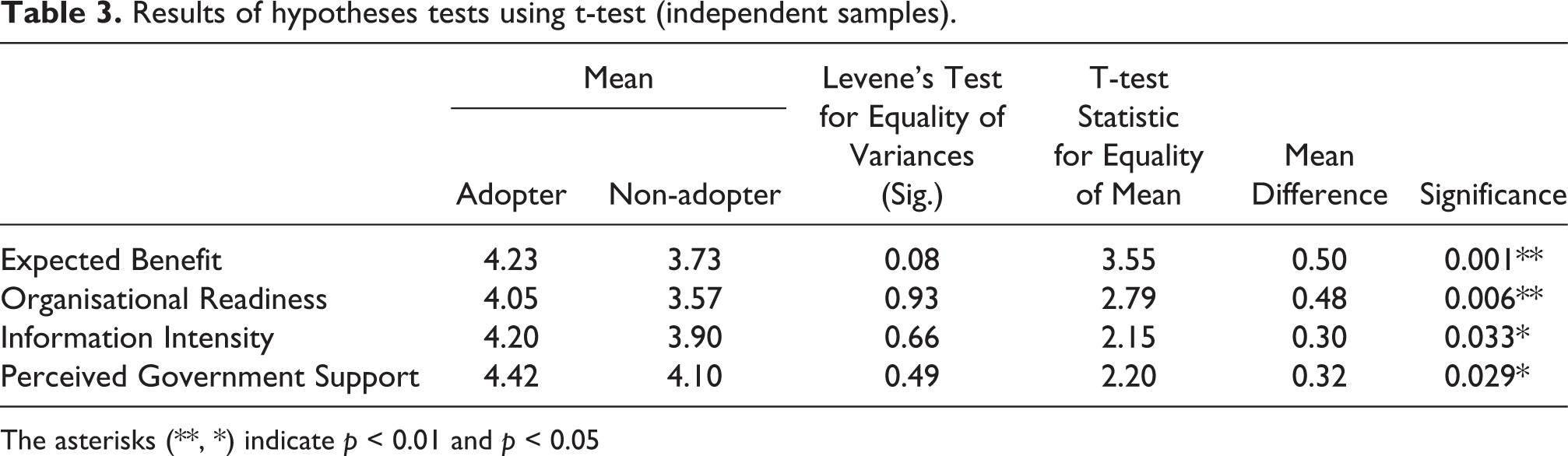
The asterisks (**, *) indicate p < 0.01 and p < 0.05
Results of hypotheses’ tests using hierarchical discriminant analysis.
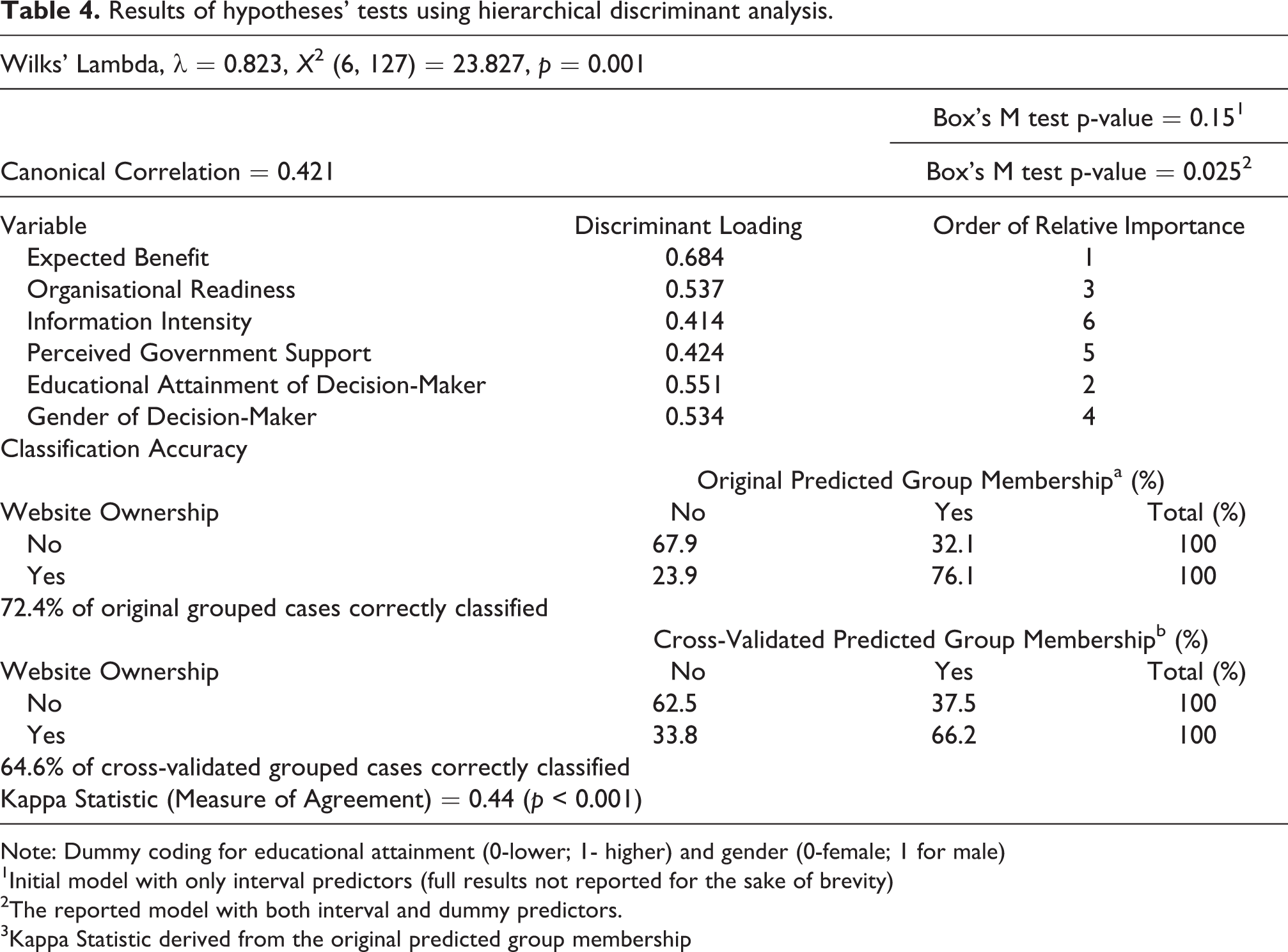
Note: Dummy coding for educational attainment (0-lower; 1- higher) and gender (0-female; 1 for male)
1Initial model with only interval predictors (full results not reported for the sake of brevity)
2The reported model with both interval and dummy predictors. 3Kappa Statistic derived from the original predicted group membership
Discussion
Key findings and interpretations
Finding 1: Providing support for the Technology-Organisation-Environment (TOE) context
The results of the current study provide ample support for the applicability of the TOE model in the context of a developing society. Most importantly, the present study has shown that the technological aspect of the TOE framework in terms of expected benefit is adjudged to be the most important contextual factor, with a discriminant loading of 0.68. This finding is in line with related studies (e.g., Prekumar and Roberts, 1999; Venkatesh and Bala, 2012; Wang et al., 2004). It reflects the belief of decision-makers that they could use their corporate websites to enhance their brand visibility and customer engagement, and ultimately gain market competitiveness in the medium- and long-term. On the other hand, this finding suggests that micro-enterprises that do not yet have their own corporate websites are either unaware of the opportunities available on the Web or are unable to afford to build and maintain a corporate website due to certain limitations, especially limited financial resources and technical know-how. Consequently, and as our findings show, organisational readiness emerges as one of the most important predictors of corporate website adoption among micro-enterprises in Nigeria. Given the cost of setting up and maintaining a corporate website, micro-enterprises have to be fully committed to invest their financial resources in one. Sometimes, they might hire a technically-capable employee who is given the responsibility of running and maintaining the website. Organisational readiness is thus considered to be one of the influential determinants of website ownership among micro-enterprises. This finding is consistent with prior empirical studies on information system (IS) adoption (e.g. Chong, 2008; Grandon and Pearson, 2004).
Perceived government support also emerges as one of the most influential determinants of corporate website adoption among micro-enterprises. This finding is akin to some related studies (e.g., Hung et al., 2014; Huy et al., 2012), and is a call for action by the Nigerian government to build the essential infrastructure for the diffusion of Internet penetration and electronic commerce in the country. The Nigerian government has a huge role to play in advancing the use of corporate websites micro-enterprises.
Furthermore, the findings suggest that information intensity is positively related to the adoption of non-transactional corporate websites among micro-enterprises. It is interesting to note that micro-enterprises that place a huge demand on the use of information in their daily work are the ones with a greater tendency of adopting non-transactional corporate websites (e.g., Ghobakhloo et al., 2011; Jaganathan et al., 2014).
Finding 2: Providing support for decision-makers’ demographics
In the current study, our results provide ample evidence of the fundamental role of demographics as it affects the adoption of non-transactional corporate websites among micro enterprises. Surprisingly, we found that the educational attainment of decision-makers is the second most important predictor (with a discriminant loading of 0.551) of the adoption of corporate websites among micro-enterprises in Nigeria. It is interesting that formal education has a huge role to play in the electronic commerce landscape of a developing nation. This finding contradicts a related study in Nigeria by Awa et al. (2011). In short, this finding has further brought to the fore the role of higher education in shaping the minds of individuals to think innovatively and adapt to changing times. Individuals who are unschooled or with lower educational status are bound to show more resistance to technological adoption. These individuals, with little or no formal education, are more likely to perceive the adoption of corporate websites by micro-enterprises as a waste of precious time and resources. This finding shows that decision-makers with at least a higher diploma from a polytechnic or a university bachelor’s degree are more favourably disposed to the adoption of non-transactional corporate websites in Nigeria. Arguably, this finding could be generalized to similar developing countries.
The result of the empirical analysis (see Table 4) also suggests that the gender of a decision-maker (with a discriminant loading of 0.534) significantly differentiates between adopters and non-adopters of corporate websites. In short, the findings indicate that male decision-makers are more likely to adopting corporate websites in their establishments than their female counterparts. This result is suggestive of the cultural undertone of Nigerian society, given its deeply-rooted masculine cultural traits. Our finding on the influence of gender on the (non)adoption of corporate websites is similar to related prior studies (e.g., Antonio and Tuffley, 2014; Awa et al., 2011; Sexton et al., 2002). Nonetheless, gender is likely to become a less important factor in the adoption of corporate website by enterprises in future given the growing number of enlightened Nigerian women-entrepreneurs.
Practical significance and implications of the study
First, our findings show that the expected benefit of owning a corporate website is the single most important predictor of corporate ownership adoption among micro-enterprises. From another angle, this clearly indicates that lack of awareness of the benefits of having a corporate website is a major inhibitor to their adoption by micro-enterprises. Therefore, it is important for stakeholders in the e-commerce ecosystem in Nigeria to sensitize enterprises to the benefits of having a corporate website. It must be remembered, however, that increasing the adoption of corporate websites among micro-enterprises in any developing society demands the provision of cheap but reliable Internet service.
The slow adoption of corporate websites among firms in developing countries is traceable to two main factors: limited access to financial capital and a dearth of public infrastructure. Although Nigeria seems to be moving in the right direction in terms of economic growth, many towns and villages are still in perpetual darkness. This poses a serious challenge to electronic commerce growth in Africa’s largest economy. The Nigerian government must organise its power sector in order to accelerate meaningful inclusive growth. The findings of this present study have shown that fast-tracking the adoption of corporate websites among micro-enterprises requires the full support of government at all levels.
Further findings from our work demonstrated the pivotal role of formal education, especially that of tertiary education, in championing the cause of new technology adoption in a society. The results of the analysis suggest that female decision-makers still lag behind in terms of the adoption of corporate websites. This may reflect the gender imbalance in the use of technology in developing societies. However, as more Nigerian girls and women are able to access formal education and training, gender influence on the initial adoption process of Internet tools will become a thing of the past.
For micro-enterprises to increase their competitiveness, they must move beyond the initial stage of non-transactional corporate website adoption. However difficult this may be for micro-enterprises to do, it is essential for micro-enterprises to engage with their clients online as well as offering their products for sale, either through third-party websites or their own small online stores. While the former may be the best initial option for micro-enterprises, those with similar product lines or business interests might agree to pool their resources by forming what we have termed a “cooperative e-store” similar to conventional brick and mortar cooperative shops. The advantages may be that it will be quicker to build trust among customers and share the risks of online transactions among a pool of enterprises than with a single enterprise. Such cooperative e-stores could foster the brand visibility of the participating micro-enterprises, and ultimately increase their market competitiveness.
Summary and conclusion
The current study has made a significant contribution to the interdisciplinary fields of information systems and strategic marketing by providing a better understanding of the factors that impact on corporate website adoption by smaller firms in the context of one of Africa’s economic superpowers. Our study has also demonstrated the applicability of the TOE model in the Nigerian context. This shows that to the TOE framework propounded by Tornatzky and Fleischer (1990) can fit perfectly into the study of innovative technology adoption in developing countries, especially in Africa. Based on our findings, we urge the governments of the developing world, particularly that of Nigeria, to enact favourable policies and provide critical infrastructure to support the adoption of corporate websites. If the right support is provided by policy makers, business enterprises – in particular – micro enterprises, will be able to easily move their businesses online. When micro-entrepreneurs are able to own corporate websites for their businesses, this will inevitably bolster the brand visibility of their enterprises.
In the light of our finding that female-owned micro-enterprises are less likely to adopt non-transactional corporate websites than those owned by men, it is imperative for key stakeholders in the electronic commerce landscape of most developing societies to constantly sensitize business women through the mass media on the benefits of using Internet tools. Similar sensitization campaigns could be targeted at micro-enterprise owners or decision-makers with less educational qualifications.
In concluding, micro-enterprise owners in the developing world should endeavour to embrace the digital age. More specifically, the adoption of corporate websites should be seen as a strategic competitive business tool for enhancing their enterprise’s brand visibility in the globalized marketplace and ultimately for boosting their market performance. Micro-enterprises producing related goods or services could collaborate by establishing cooperative e-stores to cater for their common interests. Such a pragmatic step would go a long way in ameliorating some of the challenges facing these enterprises in the pre- and post-adoption phases of corporate website adoption. The networked effects of such ‘webs of business connectedness’ could provide the economic impetus for some of these enterprises to evolve into relatively bigger enterprises.
Limitations and future directions
The results of our study are limited in at least three ways. First, the sample used in this study might not be fully representative of all the micro-enterprises in Nigeria. Hence, one should be cautious in generalizing the findings of this study. Also, as a cross-sectional study, it cannot account for any changes that might have occurred prior to the survey as they affect the adoption of corporate websites among the micro-enterprises in our survey. Lastly, it is possible that other factors, such as the decision-maker’s penchant for risk-taking, firm’s scope, strategic orientation, competitive intensity, sales turnover, and perceived institutional norm are also shaping the adoption process among micro-enterprises in Nigeria.
Nonetheless, our findings have shed some light on the influential determinants of corporate website adoption among micro-enterprises in Nigeria. To fill the gaps in the present study, other researchers with an interest in the subject could in the future incorporate some of the factors that were not included in the main study. Similarly, having a larger sample size drawn from various business sectors of micro-enterprises would improve the generalization of the current study. As such, the study could be replicated in other developing countries, but with a larger sample size that is truly representative of the entire population. Lastly, there is a need for longitudinal studies in the field to clearly ascertain the impact of corporate website adoption among micro-enterprises in both developed and developing economies.
Footnotes
Appendix: List of the measurement items in research instrument (Questionnaire)*
A multi-item scale ranging from completely disagree (1) to completely agree (5)
Acknowledgement
The authors extend their deepest appreciation to all the field assistants who assisted with the data collection in collaboration with one of the researchers who was on the ground during the survey period. Most importantly, we appreciate all the firms that chose to participate in the study. The present study is part of an ongoing research interest in the potentials of e-commerce usage among micro and small enterprises in developing societies (e.g. Nigeria with much emphasis on the southeast region). This research has been funded directly from the financial purse of the researchers with material support from the researchers’ affiliations (universities).