







Abstract
Following the narrow definition of the mobile Internet, ‘mobile libraries’ refers to digital libraries accessed by users through mobile phones and wireless networks. In order to explore users’ adoption of mobile libraries, a research model is developed focusing on two psychological factors (flow experience and innovativeness) and two factors oriented to the mobile context (ubiquitous connection and use context). Data collected from digital library users who are also users of the mobile Internet were used to test the model. The findings show that use context not only has a direct impact on users’ intention to adopt mobile libraries, but also partially mediates the effect of flow experience and ubiquitous connection on usage intention. Meanwhile, innovativeness both significantly affects usage intention and negatively moderates the effect of use context on usage intention. Findings and implications for theory and practice are discussed.
Keywords
Flow experience, use context, ubiquitous connection and innovativeness are critical determinants of usage intention of mobile digital libraries.
Introduction
Generally, the mobile Internet can be accessed through a variety of mobile devices such as mobile phones, personal digital assistants (PDAs), tablet PCs and others. In this study, we adopt a narrow definition, namely, the mobile Internet refers to the Internet accessed by users through the use of mobile phones and wireless networks to access multimedia, customized information and other data services and information services (CNNIC, 2013). According to the statistical report issued by China Internet Network Information Center (CNNIC), the number of mobile Internet users has reached 527 million by the end of June, 2014, accounting for 83.39% of the total Internet users (CNNIC, 2014). It is likely to become an indivisible part of people’s daily lives to conduct mobile activities via the mobile Internet and mobile phones (Wang, Ke and Lu, 2012).
Digital libraries can deliver information resources and associated services to their users through the use of various ICTs (information and communication technologies) (Zha, Xiao and Zhang, 2014). Recently, more and more digital libraries are adopting existing mobile technologies to provide mobile services to meet their users’ diversified and personalized needs. Following the narrow definition of the mobile Internet, ‘mobile libraries’ in this study refers to digital libraries accessed by users through the use of mobile phones and wireless networks. The typical function of mobile libraries includes collection inquiry, reservation and renewal, due-day reminder, document retrieval and download, subscription service, book commentary, personal bookmarks, search history, reading e-books, document delivery and others 1 . The special characteristic distinguishing mobile libraries from digital libraries in the web context is the ability to provide information and services without time and space limitations, which can greatly promote users’ adoption intention and usage behavior.
Mobile libraries have been developed and applied to some extent, but they are still in their infancy with limited adoption and use, inviting more research. Prior studies have explored the antecedents of adopting mobile libraries from the technology acceptance model (TAM) perspective (e.g., Goh, 2011; Aharony, 2013, 2014). In the current study, we developed a research model focusing on two psychological factors (flow experience and innovativeness) and two particular factors oriented to the mobile context (ubiquitous connection and use context) to explore the effect of both psychological factors and mobile context factors on the usage intention of mobile libraries as well as the mediating effect of use context and the moderating effect of innovativeness, which we think provides a new insight for mobile library research and practice alike in China and beyond.
Following this introduction, we review the related literature. Then, we develop the research model and hypotheses. After that, the research methodology and data collection are described. Finally, we present the findings of the research followed by the discussion and implications.
Literature review
Mobile libraries
The way people communicate and access information is being changed by mobile applications and service innovations (Li, 2013). In recent years, more and more libraries are adopting mobile technologies to provide innovative services, as well as introducing ways for users to incorporate library services into their daily lives (Wang et al., 2012). With mobile libraries, users can be freed from the temporal and spatial limitations to enjoy the ubiquity and convenience of digital libraries. The issues of mobile libraries have been examined by many researchers. Both Meier (2010) and Walsh (2010) found that students were only interested in the mobile library services when they perceived need for and immediate benefits from them. Paterson and Low (2011) provided quantitative and qualitative data on students’ use of mobile devices and considered the benefit of academic mobile library services to students. The study by Goh (2011) investigated gender differences with regard to a SMS (short message service)-based library catalog search service when adopting it. Aharony (2013) explored whether librarians are familiar with mobile services in the library and are ready to adopt them. In another study, Aharony (2014) examined mobile libraries from the perspectives of librarians and students, finding perceived ease of use, usefulness and personal innovativeness would predict librarians’ and students’ behavioral intention to use mobile services in the library.
Flow experience and innovativeness
The original concept of flow, proposed by Csikszentmihalyi (1975), is defined as the holistic experience people feel when they act with total involvement (Ku, 2011). It is also described as a feeling of enjoyment and psychological immersion, energized focus, and involvement, often accompanied by positive emotions or sense of pleasure (Csikszentmihalyi, 1997; Faiola, Newlon, Pfaff and Smyslova, 2013). Challenge and skill are two key factors of flow experience (Moneta and Csikszentmihalyi, 1996). Flow experience stems from the perceived balance between the challenges of the activity and people’ skills (Csikszentmihalyi, 1975). Only when challenges and skills have a good match can individuals experience a state of flow. In a flow state, individuals become absorbed in their activity, lose their self-consciousness, feel in control of their environment, and their awareness is narrowed to the activity itself so that irrelevant perceptions and thoughts are filtered out (Csikszentmihalyi, 1977; Ku, 2011). Since proposed, flow experience has been applied in many research domains (Wu, Lin and Lin, 2011) and is found to be an important antecedent of user adoption behavior (Novak, Hoffman and Yung, 2000; Hoffman and Novak, 2009). Following Chang and Wang (2008) and Zhou (2012), this study employs three items which reflect attention focus, perceived control and perceived enjoyment respectively to measure flow experience.
Innovativeness has been regarded as a determinant factor to predict the likelihood of new technology adoption (Lu, Yao and Yu, 2005) and postulated as an essential moderator in technology acceptance behavior (Agarwal and Prasad, 1998). Researchers define innovativeness as the degree to which an individual is relatively earlier in adopting an innovation than other members of a social system (Lu, Cao, Wang and Yang, 2011; Zhang, Zhu and Liu, 2012). It is a relatively stable descriptor of individuals that is invariant across situational considerations (Agarwal and Prasad, 1998). As a key individual difference characteristic, innovativeness is related to users’ willingness to embrace a new information technology (Rogers, 2003; Lee, Park, Chung and Blakeney, 2012). Prior research has examined the effect of innovativeness on the adoption of mobile services (e.g., Jeong, Yoo and Heo, 2009; Aharony, 2013, 2014).
Ubiquitous connection and use context
A particular feature of mobile technologies is ubiquity, which is closely related to mobility (Kim, Mirusmonov and Lee, 2010; Mallat, Rossi, Tuunainen and Öörni, 2008, 2009). With the advent of mobile technologies, ubiquity has been introduced into system acceptance and use, and becomes an important element of system acceptance (Lee, 2005). In this study, ubiquitous connection means that digital libraries can be accessed by users at any time from anywhere on the move via the mobile Internet and mobile phones. Compared with digital libraries in the web context, ubiquitous connection is a main advantage of mobile libraries, which can promote the adoption of mobile libraries.
Use context has long been regarded as a critical issue of human-computer interaction (Lee and Kim, 2005), which refers to “the very concrete environment in which a technology is going to be used” (van de Wijngaert and Bouwman, 2009, p. 86). The use of mobile services including mobile libraries is exposed to different social and use contexts (Liu and Li, 2011). Thus, use context becomes an issue in research and raises questions about the relationship between the behavior and the context in which it takes place (Dourish, 2004). Use context has been frequently reported as an essential factor affecting user adoption of mobile related technologies and systems. Mallat et al. (2009) indicated that mobile services are dependent on situations in which they are used. Liu and Li (2011) argued the formation of people’s perceptions about mobile gaming is conditional and based on the special consideration of certain use contexts.
Research objective
The objective of this research is to propose and test a model, exploring the formation of intention to use mobile libraries from the perspectives of psychology and mobile context. Specifically, the relationships among flow experience, innovativeness, ubiquitous connection, use context and usage intention are examined. Additionally, the mediating effect of use context and the moderating effect of innovativeness are explored.
Research model and hypotheses
In order to explore the adoption of mobile libraries, a research model is proposed focusing on psychological factors (flow experience and innovativeness) and factors oriented to the mobile context (ubiquitous connection and use context) (see Figure 1).
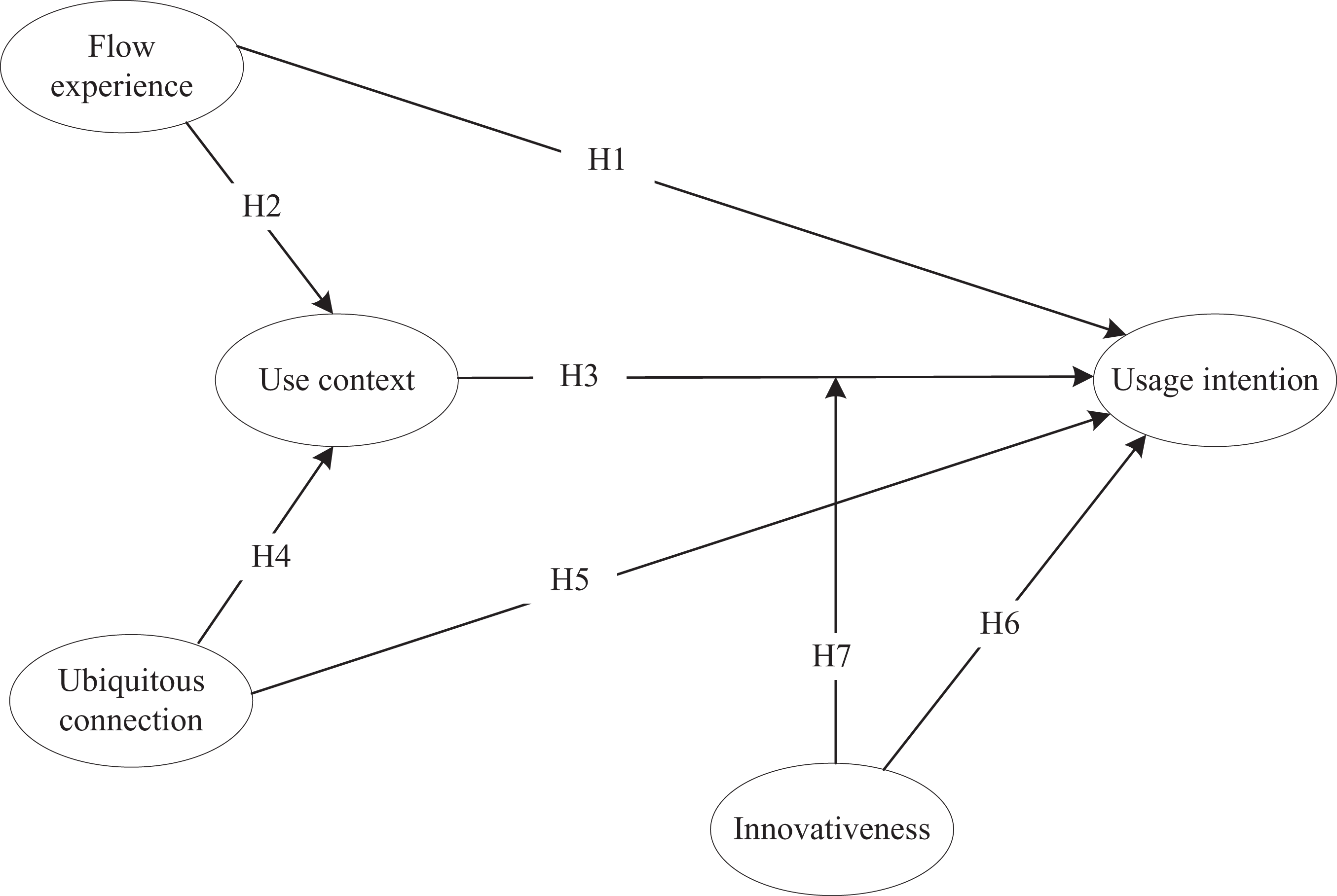
Research model.
Users immersing in a state of flow will feel great enjoyment and in control over the surrounding environment and their attention is only focused on using mobile libraries. This optimal experience may greatly facilitate usage intention. Extant empirical studies have reported that a greater flow experience can lead to the intention to use mobile services such as mobile banking (Zhou, 2012) and mobile games (Zhou, 2013c). Accordingly, we hypothesize: H1: Flow experience is positively associated with usage intention of mobile libraries.
Individuals can use mobile services anywhere via their mobile phones, but mobile services are dependent on the context in which they are used (Yang, Lu, Gupta and Cao, 2012). Mobile libraries could be particularly valuable and beneficial in situations where immediate access to digital libraries is needed but there are no other ways (personal computer, Internet cafés) to connect to the Internet. Flow experience has been reported as a significant factor of intention to use mobile services (e.g., Zhou, 2012, 2013c; Jung, Perez-Mira and Wiley-Patton, 2009). Given the consideration of use context, we suggest that when individuals can experience a state of flow in using mobile libraries, they would use/expect to use mobile libraries in various situations such as being on transport (on taxi, bus, subway, or train) and needing to access university libraries. Thus, we hypothesize: H2: Flow experience is positively associated with use context.
The positive association between use context and usage intention in the mobile context has been empirically validated in prior studies (Yang et al., 2012). Mallat et al. (2008, 2009) found that use context is an important predictor for explaining consumers’ adoption of mobile ticketing services. Yang et al. (2012) reported that consumers’ value perceptions and adoption decisions are context dependent, and that use context has a significantly direct effect on behavioral intention to use mobile Internet. Accordingly, we hypothesize: H3: Use context is positively associated with usage intention of mobile libraries.
Compared with digital libraries in the web context, ubiquitous connection is one of the main advantages of mobile libraries, which helps users transcend the temporal and spatial constraints to access digital resources and services at any time from anywhere (Zhou, 2012). Previous studies have found that ubiquitous connection has direct or indirect effects on usage intention of mobile purchase (Zhou, 2013a), mobile commerce (Lee, 2005) and mobile banking (Zhou, 2012). Additionally, use context was found to have a mediating effect on the formation of intention to use a particular information technology (Yang et al., 2012). Mallat et al. (2009) reported that use context significantly mediated the effect of perceived mobility on the intention to use the mobile ticket services. Accordingly, we hypothesize: H4: Ubiquitous connection is positively associated with use context. H5: Ubiquitous connection is positively associated with usage intention of mobile libraries.
In the early stage of new innovations, e.g. mobile libraries, people have relatively little knowledge from their internal perception and the external environment (Zhang et al., 2012). Individuals with high innovativeness are capable of coping with high levels of uncertainty and developing positive intention to accept new technologies (Lu, Liu, Yu and Wang, 2008). Aharony (2013, 2014) indicated that users with a high level of innovativeness are more likely to have high behavioral intention to use mobile services in the library. Accordingly, we hypothesize: H6: Innovativeness is positively associated with usage intention of mobile libraries.
Prior studies have demonstrated that innovativeness serves as a key moderator in the adoption of both new information technologies and mobile services (Agarwal and Prasad, 1998; Jeong et al., 2009). As suggested by Agarwal and Prasad (1998) and Webster and Martochhio (1992), traits are comparatively stable descriptors of individuals that are invariant to situational stimuli. Consequently, as an individual personality trait (de Reuver, Ongena and Bouwman, 2013), innovativeness is generally not affected by situational or internal factors (Agarwal and Prasad, 1998). That is to say, for individuals with a high level of innovativeness, they would be more likely to have the intention to use mobile libraries, decreasing the effect of use context. For individuals with a low level of innovativeness, they tend to be affected by situational factors, leading to the increase of the effect of use context on usage intention of mobile libraries. Thus, we hypothesize: H7: The effect of use context on usage intention of mobile libraries is negatively moderated by innovativeness: the effect becomes stronger when innovativeness is at a lower level while the effect becomes weaker when innovativeness is at a higher level.
Data collection
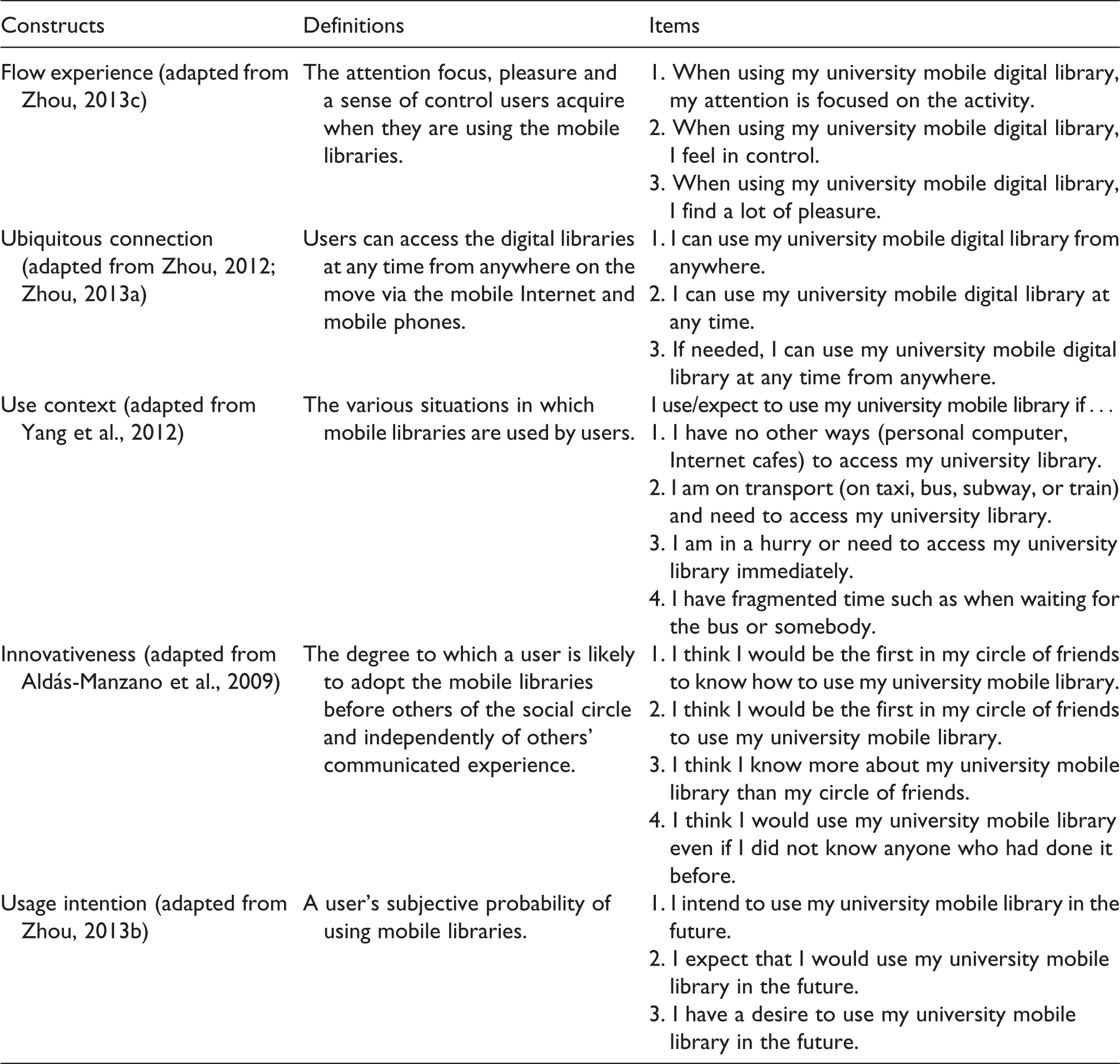
All constructs were measured with multiple items and each of them was adapted from extant literature so as to preserve the content validity (Straub, Boudreau and Gefen, 2004). Specifically, the items measuring flow experience were adapted from Zhou (2013c). The items measuring ubiquitous connection were adapted from Zhou (2012, 2013a). The items measuring use context were adapted from Yang et al. (2012). The items measuring innovativeness were adapted from Aldás-Manzano et al. (2009). The items measuring usage intention were adapted from Zhou (2013b).
After the instrument was developed, it was pretested among 20 students selected from Wuhan University located in central China. Based on their feedback and comments, the researchers adjusted some wordings to improve the clarity and understandability. The final instrument and definitions can be found in Appendix 1. All items were measured with a 7-point disagree-agree Likert scale (where 1 represents ‘strongly disagree’ and 7 represents ‘strongly agree’). Then a large scale survey data collection was conducted in Wuhan University, whose library initiated the mobile library in December 2012. In the survey questionnaire, we firstly listed several digital resources and services provided by the university library, including some Chinese databases such as China National Knowledge Infrastructure (CNKI), VIP Chinese Science and Technology Periodicals, (CSSCI); some English abstract databases such as SCI/SSCI; and some full-text databases such as those published by Sage, Elsevier, Wiley, IEEE, Springer and Emerald. Then, we described that mobile libraries refer to the digital library accessed by library users through the use of mobile phones and wireless networks. Additionally, some mobile libraries services, such as collection inquiry, reservation and renewal, short message reminder, document retrieval and download, subscription service, book comments, personal bookmarks, reading e-books, document delivery, were also listed in the questionnaire.
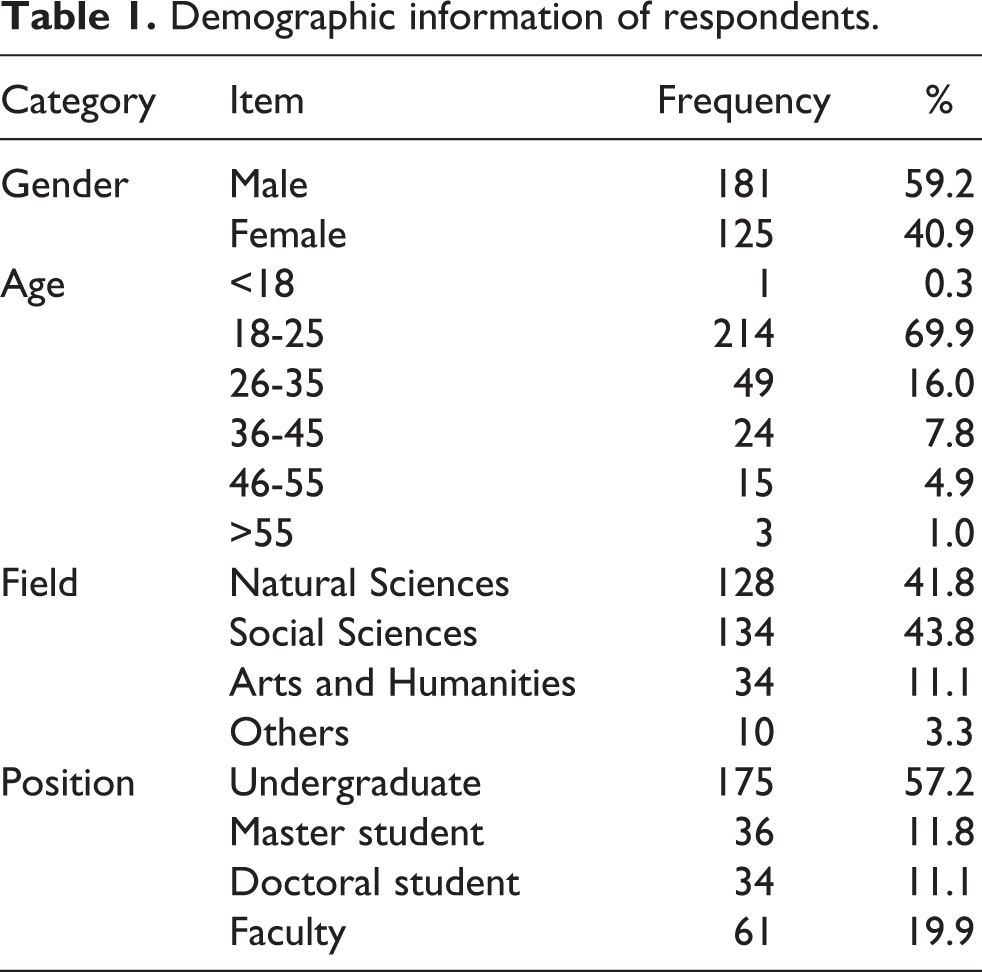
This study targeted digital library users of this university who also are users of the mobile Internet. Users were invited to participate in the survey and data collection was undertaken on a voluntary basis through an online survey website or printed paper questionnaires according to respondents’ preferences. The response rate was approximately 50%. Finally, 306 valid responses were used for data analysis after dropping those with missing values. Table 1 documents the demographic information of the 306 respondents.
Demographic information of respondents.
Data analysis and results
Following Anderson and Gerbing (1988), the researchers first examined the reliability and validity of the measurement model, and then examined the structural model to test the research hypotheses. SmartPLS 2.0 (Ringle et al., 2005) was utilized as the analyzing technique.
Validation of measurement model
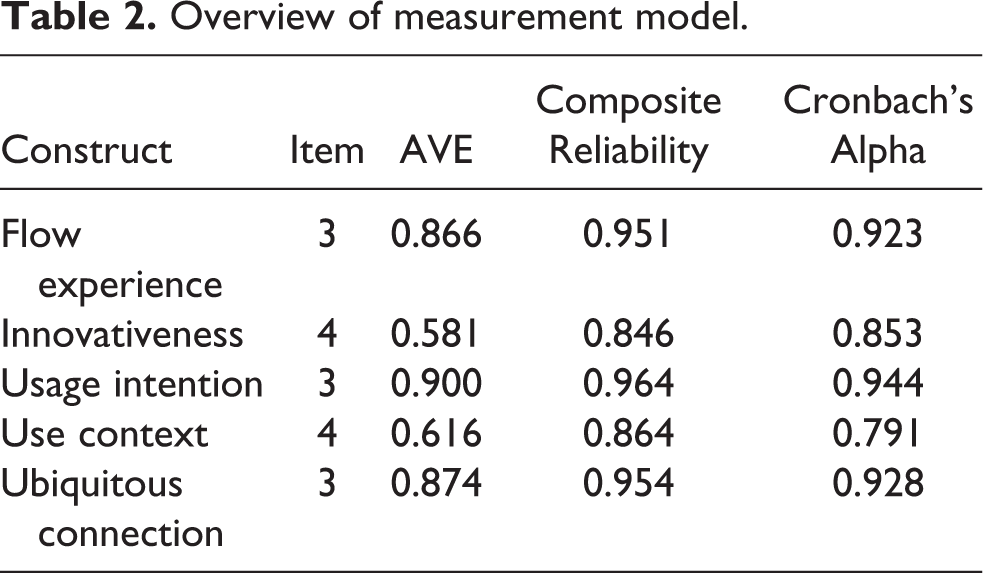
The validation of measurement model was assessed by evaluating the reliability, convergent validity and discriminant validity. As shown in Table 2, the values of composite reliability for each construct are all above 0.8, exceeding the cut-off of 0.7 (Straub et al., 2004), showing sound reliability. And all the values of Cronbach’s Alpha and AVE (Average Variance Extracted) exceed the recommendation of 0.7 and 0.5 respectively, confirming good convergent validity (Straub et al., 2004).
Overview of measurement model.
As shown in Table 3, the square root of AVE is apparently larger than the correlations between constructs, demonstrating sound discriminant validity (Straub et al., 2004).
Correlations between constructs and square roots of AVEs.
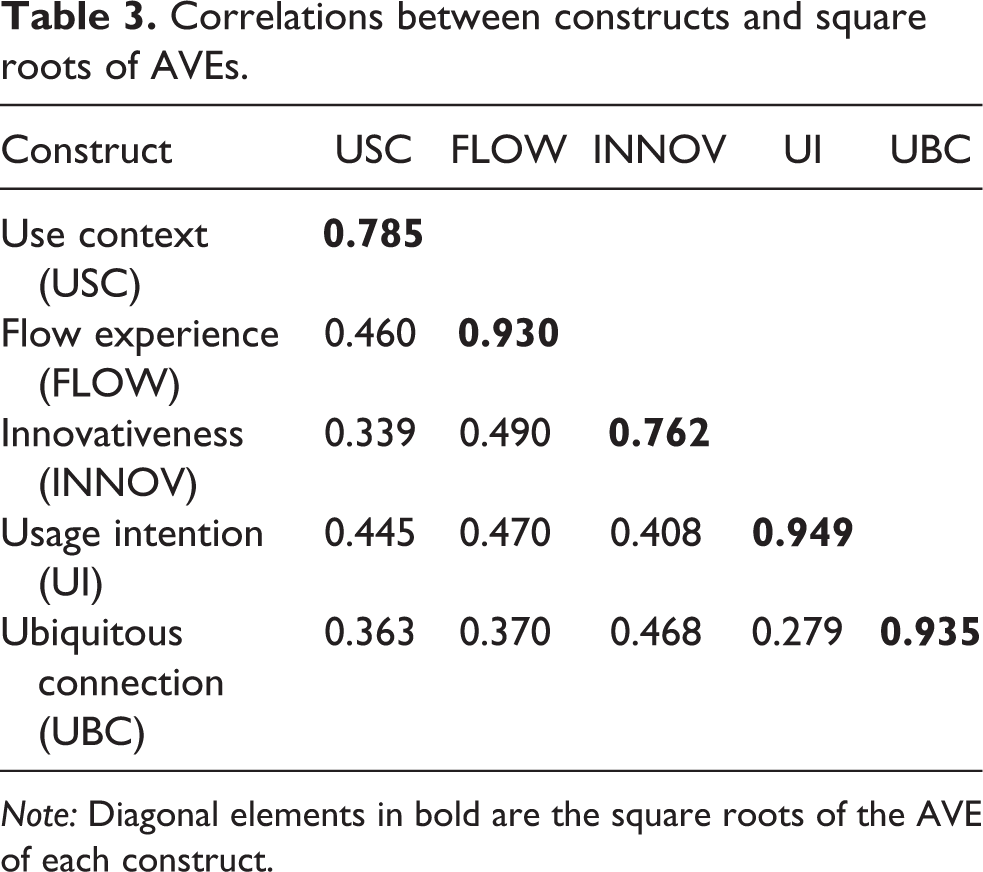
Note: Diagonal elements in bold are the square roots of the AVE of each construct.
Furthermore, due to the fact that all data are self-reported, a potential threat of common method bias (CMB) may arise. We conducted two tests to examine the common method bias. Firstly, Harman’s one-factor test, the most extensively applied approach for assessing CMB (Podsakoff, MacKenzie, Lee and Podsakoff, 2003), was employed by conducting a principal components analysis in SPSS. The results showed that the variance explained by the first factor is 17.47%, indicating that this factor does not account for the majority of the variance. Secondly, following Podsakoff et al. (2003) and Liang, Saraf, Hu and Xue (2007), we included a latent common method factor in the research model whose indicators included all the principle constructs’ indicators, and then examined the coefficients of each indicator’s two incoming paths from its substantive construct and the method factor. The results indicated that most method path coefficients are not significant and that the indicators’ substantive variances are substantially greater than their method variances. According to the results of both tests, it is rational to conclude that common method bias is unlikely to be a concern in this study.
PLS structural model
PLS (Partial Least Squares) was employed to estimate the structural model. Specifically, the bootstrapping resampling technique was used to estimate path significances. The overall results of the structural model are presented in Figure 2. As hypothesized, all hypotheses except for the relationship between ubiquitous connection and usage intention are significant. The explained variances of use context and usage intention are 0.255 and 0.330 respectively.
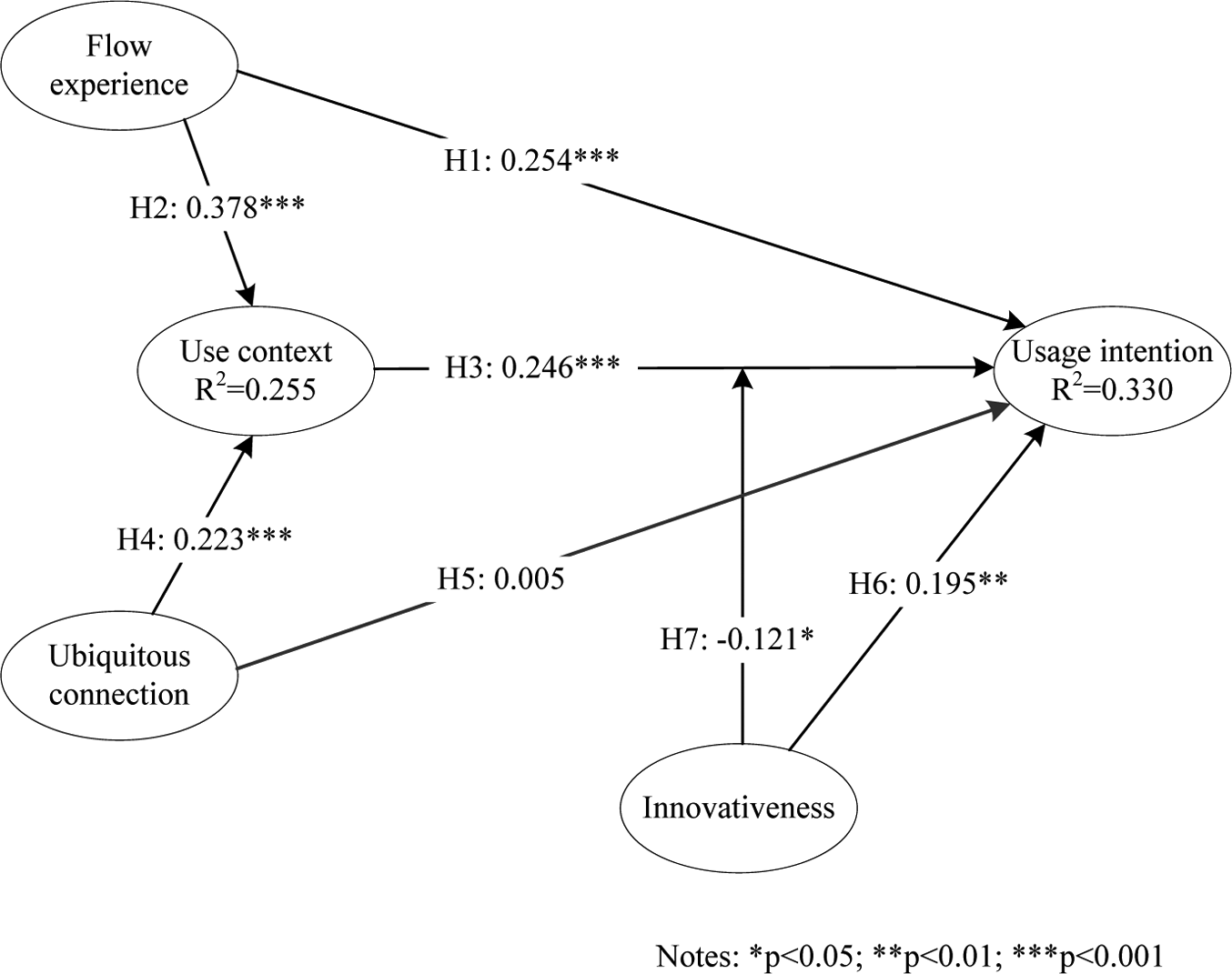
Research model with results.
From Table 3, it can be seen that the correlation between ubiquitous connection and usage intention is 0.279, with the independent effect being significant. However, from Figure 2, it can be seen that H5 is not supported, implying that the effect of ubiquitous connection on usage intention might be overpowered by other constructs. In order to interpret this phenomenon, hierarchical regression analysis was conducted. As shown in Table 4, for Model 1 and Model 2 where use context is excluded, ubiquitous connection significantly affects usage intention. For Model 3 where use context is included, the effect is no longer significant.
Hierarchical regression analysis.
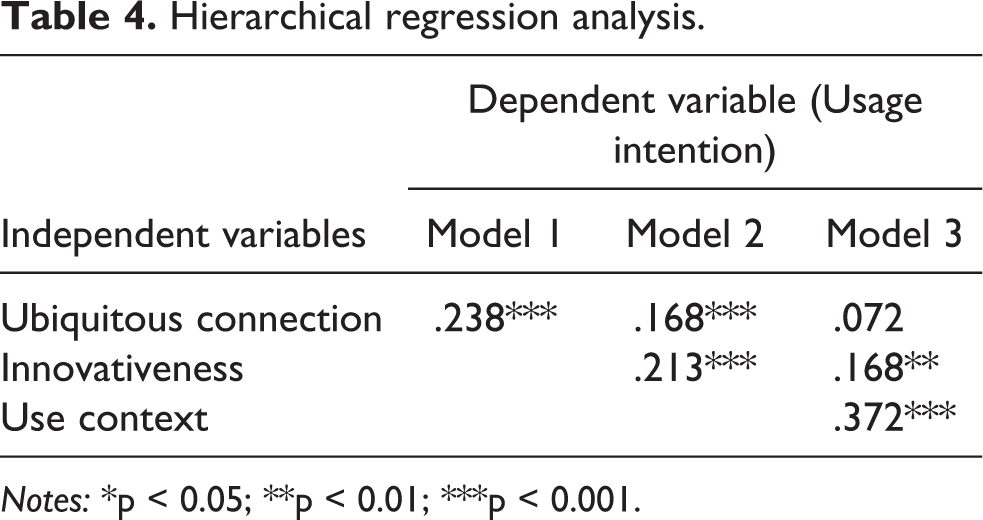
Notes: *p < 0.05; **p < 0.01; ***p < 0.001.
Mediating effect of use context
As indicated by Mallat et al. (2009), use context represents the conditions that individuals meet when they use mobile libraries in different places and times. In this study, use context is found to be one of the critical determinants directly affecting usage intention. Mobile libraries can be accessed anywhere any time via the mobile Internet and mobile phones, forming various social and use contexts. Consequently, the use of mobile libraries seems to relate more to use context. For example, when users are in a taxi, on a bus, subway, or train and need to access the university library, they are likely to use mobile libraries.
To test the mediating effect of use context in the research model, the three-step method recommended by Baron and Kenny (1986) was applied (Table 5):
Step 1: Independent variable (IV) → dependent variable (DV) is significant. Step 2: IV → mediator (M) is significant. Step 3: IV + M → DV, if both M and IV are significant, M partially mediates the impact of IV on DV; if M is significant and IV is not significant, M fully mediates the impact of IV on DV.
Mediating effects of use context.
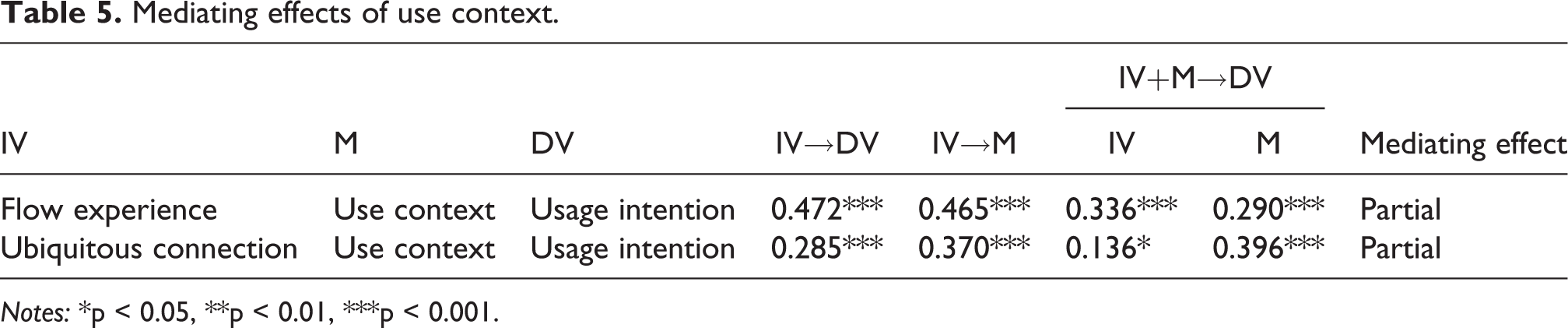
Notes: *p < 0.05, **p < 0.01, ***p < 0.001.
In step 1 and step 2, it can be seen that independent variables (flow experience, ubiquitous connection) have direct and significant effects on both dependent variable (usage intention) and mediator (use context). In step 3, it can be found that both M and IV are significant, suggesting that use context plays a partial mediating role in the effect of both flow experience and ubiquitous connection on usage intention.
Moderating effect of innovativeness
The findings of this study show that innovativeness negatively moderates the effect of use context on usage intention of mobile libraries. To show the exact nature of this significant interaction effect, we further examined the effect of use context on usage intention oriented to users with low innovativeness and high innovativeness separately. Following Stewart (2006), we employed at least one standard deviation below and above the mean as the criterion to split the sample and form low and high innovativeness subgroups. And then use context as independent variable was regressed on usage intention to form two regression equations, as plotted in Figure 3. For users with low levels of innovativeness, the effect of use context on usage intention becomes stronger with a steeper positive slope than without the moderating effect. Adversely, for users with high levels of innovativeness, the effect of use context on usage intention becomes weaker with a shallower positive slope than without the moderating effect. The results may be explained by the fact that users with high levels of innovativeness are less likely to be affected by situational factors (Agarwal and Prasad, 1998).
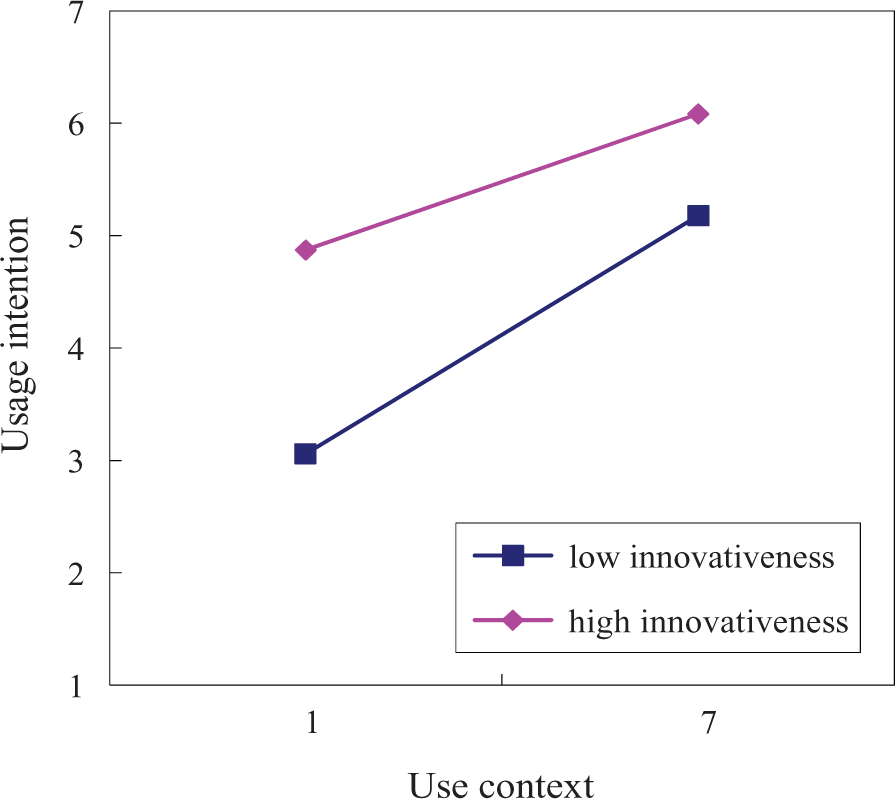
Moderating effect of innovativeness.
Findings
In summary, flow experience, use context, ubiquitous connection and innovativeness are found to be critical determinants of usage intention of mobile libraries. Specifically, flow experience, use context and innovativeness significantly impact usage intention. Ubiquitous connection has a significant independent effect on usage intention, which is overpowered by use context in this study. Additionally, use context partially mediates the effect of flow experience and ubiquitous connection on usage intention. Innovativeness is found to negatively moderate the effect of use context on usage intention.
Discussion and implications
Implications for theory
Although previous studies have investigated the determinants affecting the adoption of mobile libraries (e.g., Goh, 2011; Aharony, 2013, 2014), this study examined mobile libraries from the perspectives of psychological factors (flow experience and innovativeness) and mobile context factors (use context and ubiquitous connection), which we think provides new insights into mobile library adoption research and practice alike. The major contribution of this research is the findings that use context has a significant direct effect on usage intention of mobile libraries, and partially mediates the effects of both flow experience and ubiquitous connection on usage intention. Meanwhile, innovativeness not only significantly affects usage intention but also negatively moderates the effect of use context on usage intention of mobile libraries. The researchers believe that the present study usefully contributes to the theoretical development of structural model exploring user adoption of mobile libraries in the specific context of Chinese university libraries and beyond more generally.
Implications for practice
Digital libraries have gone from a curiosity to mainstream during the past three decades (Arms, 2012; Yan and Zha, 2014), and most digital libraries aim at catering for users’ academic needs (Kwanya et al., 2011). Mobile libraries are the logical extension and augmentation of digital libraries in the web context (Marchionini, 2000; Marchionini and Fox, 1999). Recently, more and more university libraries have adopted existing mobile technologies to offer innovative services (Wang et al., 2012), providing an environment for library users to access and use digital services and resources at any time from anywhere through the convenience of their mobile phones. This study explores the adoption of mobile libraries from the perspectives of psychological and mobile context factors. The researchers believe the findings of this study have important implications for practice.
The findings of this study suggest that flow experience, use context, ubiquitous connection and innovativeness can promote user adoption of mobile libraries. From Figure 2, we can see that flow experience has a direct and significant effect on usage intention, concordant with the research by Zhou (2012, 2013c) and Jung et al. (2009). Indeed, when users experience a state of flow in using mobile libraries, they are likely to intend to use mobile libraries in the future. Additionally, the effect of flow experience on usage intention is partially mediated by use context, suggesting that mobile resources and services provided by university libraries should not only attract users’ attention and enrich their lives with pleasure, but also accommodate some particular contexts.
From Table 4 and Table 5, it can be seen that ubiquitous connection has a significant independent effect on usage intention, but this effect is overpowered by use context. Meanwhile, the effect of ubiquitous connection on usage intention is partially mediated by use context. This can be explained by the fact that the benefit and advantage of ubiquitous connection essentially depend on specific use contexts. When users have no other ways (personal computer, Internet cafes) to access the university digital library, or when users are on the move and need to access the university library, or when users have fragmented time, they would use mobile libraries. Another reason why the effect of ubiquitous connection on usage intention is overpowered by use context lies in the limitations of mobile libraries like inconvenient input and output interface, small screens, unstable network connection, insufficient contents, and limited functionality (Choi, 2009). These limitations prevent users from experiencing the benefit and advantage of mobile libraries brought by ubiquitous connection when they have other ways such as the use of personal computers and web broadband to access the university digital library. We recommend that university libraries should take full advantage of ubiquitous connection to provide various value-added mobile services oriented to various use contexts. This would facilitate university libraries to enhance service quality to a great extent.
According to the findings of this study, innovativeness has a positive and significant effect on usage intention, which is consistent with prior research indicating that users with a high level of innovativeness are more likely to have high intention to use mobile services in the library (Aharony, 2013, 2014). This could be explained by the fact that users with higher innovativeness are usually communicative, curious, dynamic and venturesome (Kim et al., 2010), being active to try out an innovation. Additionally, innovativeness is found to negatively moderate the effect of use context on usage intention of mobile libraries. That is to say, the effect of use context on usage intention would increase for users with a low level of innovativeness while the effect would decrease for users with a high level of innovativeness. Consequently, users with a high level of innovativeness are less likely to be affected by situational factors. In this situation, we recommend university libraries should actively interact with users to identify innovative ones. Librarians should try to capture the potential needs of innovative users and develop various value-added mobile services accordingly. Given that use context is less likely to impact users with a high level of innovativeness, new mobile services can be first introduced and pushed to these users. When innovative users benefit from mobile services, they would be likely to recommend the mobile services to users with low innovativeness around them, thus promoting the adoption level of mobile libraries as a whole.
Conclusion
Compared with digital libraries in the web context, mobile libraries enable users to ubiquitously and conveniently access digital library resources and services without time and space limitations. Some academic libraries in China have developed various mobile library services to meet their users’ needs (Li, 2013). This study explores the effects of two psychological factors and two mobile context factors on usage intention of mobile libraries, as well as the mediating effect of use context and the moderating effect of innovativeness. The researchers find that flow experience, use context, ubiquitous connection and innovativeness are critical determinants of usage intention of mobile libraries. Additionally, use context partially mediates the effect of flow experience and ubiquitous connection on usage intention. Innovativeness negatively moderates the effect of use context on usage intention. Mobile libraries, which are suggested to have bright prospects, are still in an early stage (Choi, 2009). Further study investigating user adoption of mobile libraries from other perspectives is much needed, which we think would lead to more interesting findings, thus usefully complementing the current study.
Footnotes
Appendix 1. Constructs and items
| Constructs | Definitions | Items |
|---|---|---|
| Flow experience (adapted from Zhou, 2013c) | The attention focus, pleasure and a sense of control users acquire when they are using the mobile libraries. |
When using my university mobile digital library, my attention is focused on the activity. When using my university mobile digital library, I feel in control. When using my university mobile digital library, I find a lot of pleasure. |
| Ubiquitous connection (adapted from Zhou, 2012; Zhou, 2013a) | Users can access the digital libraries at any time from anywhere on the move via the mobile Internet and mobile phones. |
I can use my university mobile digital library from anywhere. I can use my university mobile digital library at any time. If needed, I can use my university mobile digital library at any time from anywhere. |
| Use context (adapted from Yang et al., 2012) | The various situations in which mobile libraries are used by users. | I use/expect to use my university mobile library if… |
|
I have no other ways (personal computer, Internet cafes) to access my university library. I am on transport (on taxi, bus, subway, or train) and need to access my university library. I am in a hurry or need to access my university library immediately. I have fragmented time such as when waiting for the bus or somebody. |
||
| Innovativeness (adapted from Aldás-Manzano et al., 2009) | The degree to which a user is likely to adopt the mobile libraries before others of the social circle and independently of others’ communicated experience. |
I think I would be the first in my circle of friends to know how to use my university mobile library. I think I would be the first in my circle of friends to use my university mobile library. I think I know more about my university mobile library than my circle of friends. I think I would use my university mobile library even if I did not know anyone who had done it before. |
| Usage intention (adapted from Zhou, 2013b) | A user’s subjective probability of using mobile libraries. |
I intend to use my university mobile library in the future. I expect that I would use my university mobile library in the future. I have a desire to use my university mobile library in the future. |
Acknowledgements
This study is supported by the National Natural Science Foundation of China (NSFC) [grant number 71373193]; and Hubei Province University Teaching Research Project [grant number 2013002].