







Abstract
The aim of this paper is to develop the findings of previous research on policies regarding online proactive information disclosure, both voluntary and mandatory. We present and analyze new evidence on the factors that influence decisions taken in this respect. This study is focused on Central America, a region that has received little previous research attention on these issues. To achieve the study goals, we analyze the online information disclosure made by local authorities, regarding both the degree of compliance with legal requirements and the volume of information provided voluntarily. Finally, with respect to the same two types of information provision, we determine the influence of environmental factors on online information disclosure. The results obtained show that transparency is more an issue of attitude than of laws, and highlight the existence of a large gap between legal requirements and actual performance.
Keywords
The culture of reticence that has pervaded Central American countries for years has not been eradicated.
Introduction
Perceptions are strengthening among many stakeholders that public funds are being mismanaged (Tolbert and Mossberger, 2006), and this situation is eroding confidence in public institutions and their credibility.
In response, significant actions are being taken internationally to make public institutions more transparent, by measures such as the adoption of new laws on access to public information (Worthy, 2013). For all countries, freedom of information (FOI) legislation is an essential element underpinning transparency (Darch and Underwood, 2010). As indicated by Saba (2004), it is of crucial importance for developing countries to regulate rights of access to public information, because (as observed by the Organization of American States, 2010) there is a relationship between this right and the promotion of human rights, economic development, good governance and the fight against corruption.
However, as indicated by Escaleras et al. (2010), the benefits obtained from FOI laws largely depend on their content and application. In the first of these respects, various organizations and researchers have emphasized the need to designate the information made available to stakeholders, either on request or offered proactively (Islam, 2006; Organization of American States, 2010). On the other hand, as observed by Cherry and McMenemy (2013), responding to information requests, i.e. reactive information disclosure, creates administration costs that may be considerable, since an individual response must be made to each such request. Consequently, these authors recommend the proactive disclosure of information.
Although information disclosure without prior request is increasingly required of public organizations, this legally-obliged proactive information is not always sufficient for the organization to achieve the goals of its transparency policy, and it must be complemented with voluntarily proactive information disclosure (Neuman, 2006). The latter voluntary disclosure arises as the consequence of a process of legitimation (Suchman, 1995) through which public managers seek continuity and therefore need to win the trust and confidence of stakeholders.
Moreover, in today’s society, technology is changing relationships between citizens and the public administration; thus, at different levels of government, new technologies are being used to interact with the population (Grimmelikhuijsen, 2010). This development, by providing a communication channel of proactive information, is facilitating the dissemination of information and enabling much greater transparency (Chan and Chow, 2007).
In this context, countries in Latin America, characterized by long periods of authoritarian rule, low levels of economic and human development and severe corruption, are now passing FOI laws as a symbol of their commitment to transparency. This change is particularly evident in Central America. Although many countries in this region are perceived as the most corrupt in all of Latin America, and despite their very low ranking on indices of human development, every country except Costa Rica has passed FOI laws, seeking to overcome the traditional culture of reticence and secrecy.
However, for many years this culture has permeated the public administration, at all levels, in the countries of Central America (Kock and Gaskins, 2014). Local governments, as the first level of participation of citizens in public affairs and the closest level at which transparency can be demanded of public management, play an important role in the daily lives of citizens (Caamaño et al., 2011). Therefore, we believe it useful to examine how the local governments in this region have addressed the situation and what policies on online transparency have been implemented.
There can be no doubt that local authorities have very disparate reasons for placing a greater or lesser emphasis on enabling public access to government information. In this respect, various theoretical frameworks have been proposed, such as legitimacy theory (Serrano et al., 2009), institutional theory (Pina et al., 2010) and agency theory (Gandía and Archidona, 2008), in which various factors are analyzed.
In view of these considerations, it would be interesting to examine, as well as the FOI policies implemented by local governments in Central America, the underlying factors that may influence these policies. Accordingly, we established three objectives. First, to analyze the degree of compliance by these local authorities with the online proactive disclosure of information required under the FOI legislation applicable in each country. Second, to analyze policies on the online voluntary provision of information by local governments in Central America. Finally, to determine the impact of environmental factors on compliance with legal requirements concerning access to online public information (legal proactive information disclosure) and on the online voluntary provision of this information (voluntary proactive information disclosure).
This study, in summary, contributes to previous work in the field of regulated vs self-regulated proactive information disclosure, and presents new evidence on the factors that influence decisions taken by local authorities on the proactive disclosure of public information to stakeholders in Central America, a region that has received very little prior research attention.
The importance of regulating access to information in Central America
The constitutions of many countries include the right of access to public information. However, previous experience has shown that this right is not effective when there is no specific legislation for its implementation (Neuman, 2006). This principle is expressed in the Declaration of Atlanta (2008), according to which all countries should enact FOI laws.
Such laws not only contribute to democratic development, but also benefit the economy, because reliable information flows have a positive impact on market trends (Islam, 2006). Consequently, regulating access to information contributes to economic development (Relly and Cuillier, 2010).
To date, 103 countries have enacted FOI laws. However, there is no universally-accepted law in this respect; each country has legislated this right individually, focusing on the aspects considered most relevant in its particular context. In consequence, there is considerable disparity in the content of these laws, although international organizations and NGOs are working to persuade governments to adopt laws presenting greater homogeneity and transparency and capable of ensuring compliance. To achieve such harmonization, these bodies have concentrated on publishing general principles, or on the development of model laws. In this respect, Islam (2006) observed that a FOI law must have a certain minimum content, and specify, among other aspects, which information should be accessible without prior request, i.e. provided proactively by Internet.
In Latin America by the early 21st century, some countries had already regulated the right of access to information. However, it was only after the judgment given by the Inter-American Court of Human Rights in the case Claude Reyes v Chile in 2006, when it became clearly established that the countries of North, Central and South America were required to adopt domestic laws guaranteeing freedom of information. Accordingly, in 2009 the Organization of American States undertook to draft regulatory measures to promote a more homogeneous culture of transparency in the Americas. This policy was seen as crucial to the promotion of human rights, to enhancing economic development, fostering good governance and combating corruption. Thus, in 2010 the Model Inter-American Law on Access to Public Information (ML) was published. This ML presented non-binding recommendations to the States addressed, which constituted a legal framework promoting a more homogeneous culture of transparency in Latin America.
Examination of the online proactive information content that is recommended by the ML reveals the importance granted to proactive information. According to the ML, an extensive body of information should be provided with no need for any prior request to be made; in all, there are 46 requirements (Annex, Column 1, ML). If we compare these requirements with those included in the FOI laws passed in Central America (Annex, “Legal” column, blank spaces), we observe a lack of homogeneity in terms of information content; thus, only two items are present in all these legislative frameworks: the Mission, Goals and Annual Operating Plan, and the Organizational Structure and Regulatory Framework. Furthermore, while in some countries (such as Panama) few requirements are made with respect to proactive information disclosure, in others, like El Salvador, extensive information in this regard is required. In addition, all the laws currently in force in this context were approved prior to or simultaneously with the adoption of the ML, and so the latter has not yet succeeded in promoting a homogeneous culture of transparency throughout Central America.
Literature review and study hypotheses
Numerous studies have analyzed the changing state of information disclosure within the public sector, offering diverse theories regarding the need for public organizations to disseminate information (Pina et al., 2010). Among the theories most often discussed are agency theory (Laswad et al., 2005; Gandía and Archidona, 2008), legitimacy theory (Serrano et al., 2009) and institutional theory (Pina et al., 2010). According to these theories, the political, historical, socio-organizational, institutional and cultural environments all influence the behaviour patterns of public bodies, because to persist in these environments an organization must justify its existence and its actions (Gandía and Archidona, 2008; Pina et al., 2010).
Thus, practices related to the online proactive disclosure of information by public bodies, both legally-required and voluntary, can be influenced by the characteristics of the environment and by the particular structure of each organization. In this respect, many factors have been analyzed, with disparate results. These include factors such as population size (Albalate, 2013; García-Sánchez et al., 2013), the influence of technology (Xiao et al., 2004), the political commitment of the population (Jorge et al., 2011), corruption (Pina et al., 2010), the political ideology of the government (Guillamón et al., 2011; Albalate, 2013), the influence of voluntary/mandatory information disclosure policies (Bajo et al., 2009; Baginski et al., 2004) or the maturity of the law in this respect (Banks et al., 1997). Taking into account the findings of our review of the literature, we propose the following hypotheses.
The maturity of the law (MATLAW)
To place information in the public eye, it must first be given a structure and be ordered and summarized. All of these functions require time, and so public organizations in countries where a FOI Act has been in force for longer will be better prepared to provide the information required by law. Therefore, the question of how long FOI legislation has been in existence can be a determinant factor in the information disclosure made by local government, as discussed in studies by Banks et al. (1997) and by Gallego et al. (2009). Accordingly, we consider the possible relationship between the maturity of a FOI law and the mandatory disclosure of public information, and propose the following hypothesis:
Corruption (CORRUPT)
Various international organizations have called on countries to adopt FOI laws to combat corruption, among other aims (Roberts, 2006). According to Bertot et al. (2010), the right of access to public information enables citizens to participate in the public process and thus reduces corruption. Therefore, it seems reasonable to assume that the greater the corruption, the greater the obstacles to transparency, both mandatory and voluntary, by public organizations. In this respect, Pina et al. (2010) observed an inverse relationship between the level of corruption and the degree of information disclosure, regardless of whether this disclosure was legally required or provided voluntarily. This finding prompted us to examine whether there is a relationship between corruption and information disclosure, both mandatory and voluntary, and so we propose the following hypotheses:
Political ideology (POLIDEO)
As observed by García-Sánchez et al. (2013), different political ideologies give rise to different styles of government and may lead to different policies on information disclosure being applied. Alt and Dreyer (2006) analyzed this question and concluded that conservative governments are less likely to provide public information than are left-wing governments. This conclusion was corroborated by Guillamón et al. (2011) and by Albalate (2013). However, the results obtained in this respect were not significant in the studies by Marcuccio and Steccolini (2009) and Grimmelikhuijsen and Welch (2012). We propose the following hypotheses.
Political commitment (VOTERS)
As suggested by Piotrowski and Bertelli (2010), when the local population is more engaged politically, greater demands for transparency may be expected. Several authors have found a positive relationship between voters’ political commitment and information disclosure by public entities (Esteller and Polo, 2012), and it has even been claimed that the greater the interaction between the government and the population, the higher the level of public information disclosure. However, the data obtained concerning this relationship are not always significant (Albalate, 2013), and there may even be a negative relationship (Jorge et al., 2011). Accordingly, the following hypotheses are proposed.
Size (SIZE)
Several authors have demonstrated the existence of a positive relationship between the size of a public institution and the amount of public information disclosed (Caba et al., 2014), arguing that governments with larger populations have larger budgets, are under greater public pressure and provide a greater amount of public information online. However, not all studies have obtained a positive relationship in this respect. Thus, for Laswad et al. (2005), and Caba et al. (2008), this relationship was not found to be significant, while Da Costa et al. (2007) found an inverse relationship. We propose the following hypotheses.
Technological development (TECH)
Once the corresponding laws have been adopted, the provision of information and communication technology (ICT) infrastructure is an important factor in their implementation (Relly and Cuillier, 2010). The online disclosure of public information requires not only political will but also technological resources. In this respect, Xiao et al. (2004) consider that technology is a determinant factor of disclosure. Similarly, Serrano et al. (2009) have observed greater transparency in countries where the technological infrastructure is better developed. On the other hand, Tolbert et al. (2008) found that technological development had a negative influence on information disclosure. Taking into account this previous research, we propose the following hypotheses.
Ensuring compliance with the law (SANC)
When non-compliance with the rules on information disclosure is associated with the application of sanctions, authorities are more likely to comply with legal requirements (Bajo et al., 2009). As indicated by Das et al. (2004), in most countries where non-compliance is not penalized, there is less success in inducing organizations to obey the rules. In view of the limited research carried out into this relationship, and in the opinion that the imposition of penalties for non-compliance would tend to encourage compliance, we propose the following hypothesis.
The level of information disclosure made (IVD/ILD)
As observed by Bajo et al. (2009), in corporate environments where managers value transparency and make great efforts in the voluntary provision of information, it is to be expected that these managers will comply with regulations requiring them to perform information disclosure. According to the above authors, companies that present a higher level of voluntary information disclosure will be more likely to comply with the legal disclosure required of them. Therefore, it seems reasonable that a greater voluntary disclosure of information will positively influence compliance with mandatory disclosure. On the other hand, Baginski et al. (2004) and Kasznik and Lev (1995) have shown that regulated entities that face high demands for mandatory information are less likely to provide voluntary information. Therefore, organizations that are legally obliged to provide more information will be less willing to offer information voluntarily. Accordingly, we propose the following hypotheses.
Method
The research method applied is based on our three initial goals.
Goal 1: Compliance with the proactive information disclosure required by law
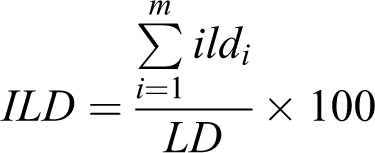
We created an index of legal disclosure (ILD), based on the online requirements set out in proactive information legislation. Since each of the laws adopted in the countries of Central America requires the disclosure of different items of information, this index takes into account the different online information reporting requirements included in the laws of each country (LD) (Annex - legal information column).
Due to the absence of clear empirical evidence on the importance of the items that constitute our ILD, the same weight was assigned in every case to evaluate them, following the criterion used by Caba et al. (2008). Thus, we assigned a score of 1 when an information item was reported and a score of 0 when it was not (ildi ). Accordingly, the ILD is calculated by the following expression:
Goal 2: Self-regulation policy on information disclosure
In line with Goal 1, we created an index of voluntary disclosure (IVD), composed of the online information items that are normally used in studies of disclosure, in accordance with our review of the literature. Based on this review (Caba et al. 2008; Transparency International, 2010), we obtained a total of 94 information items (Annex, Column 1). Because the literature does not differentiate between online legal and voluntary information, some of the items are stipulated in legal provisions while others are provided voluntarily.
Given the large number of items to be analyzed, in order to view more clearly the nature of the online information disclosed voluntarily, the items are grouped according to the classification proposed by Transparency International (2010), as follows: a) information on the municipal corporation, “M”; b) information on relations with citizens and society, “C”; c) information on financial and economic management, “E”; d) information on service procurement and town planning, “U”. Therefore, the index of voluntary disclosure is divided into four subindices, coincident with each of the above groups.
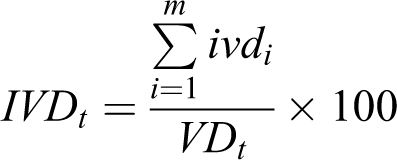
Subsequently, we examined whether the local government in question in each country reported these items voluntarily on its website, applying the same criterion as had been established to determine the ILD. Each partial index (IVDt) is determined by the ratio of the total number of items voluntarily reported by local authorities in each country (ivdi
) divided by the number of possible items of this nature (VDt). To express this value as a percentage, it is multiplied by 100.
In consequence, the IVD is calculated from the following expression:

Goal 3. Determinant factors of information disclosure
The independent variables included in the hypotheses described in Section 3 were analyzed with respect to the dependent variables. The latter were employed to create both the index of legal disclosure and that of voluntary disclosure (ILD, IVD), and so two models are created. The independent variables were assessed using the same magnitudes as have been used in previous studies in this field (Table 1).
Independent variables used for the explanatory factors.
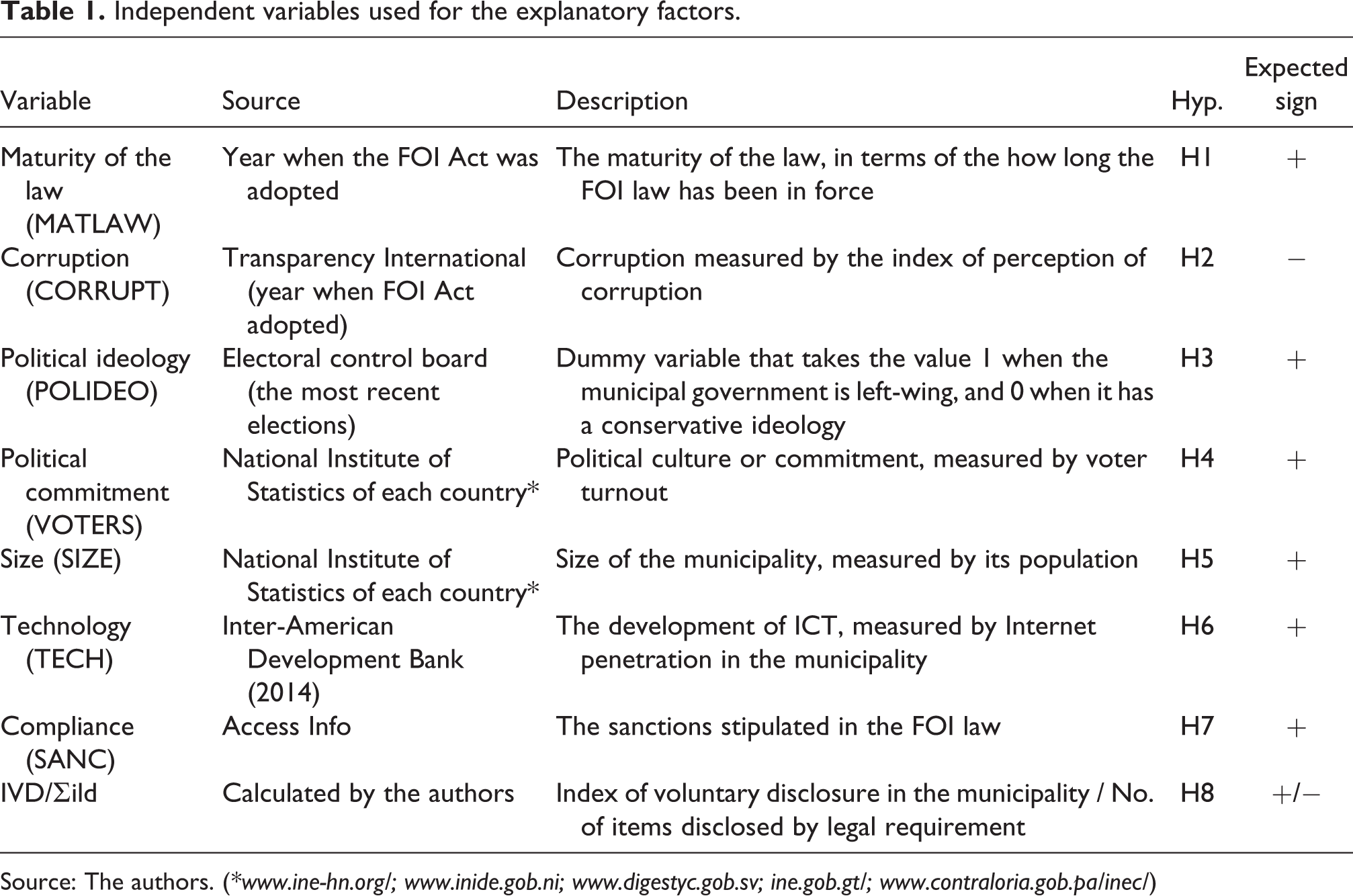
Source: The authors. (*www.ine-hn.org/; www.inide.gob.ni; www.digestyc.gob.sv; ine.gob.gt/; www.contraloria.gob.pa/inec/ )
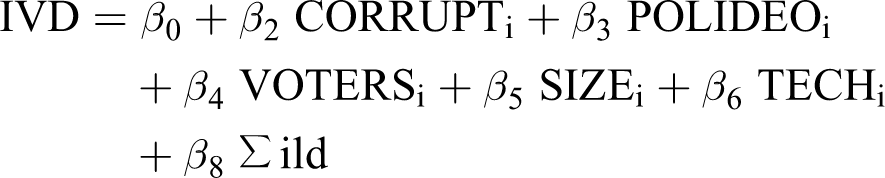
Taking into account the structure presented by the dependent variables, the association between the dependent and independent variables was tested using Tobit regression analysis (STATA version 11.1), which produced the following equations:

Study scope
Of the seven countries of Central America, this study focuses on El Salvador, Nicaragua, Panama, Guatemala and Honduras, all of which require by law the online proactive disclosure of information. Costa Rica was excluded because this country has not adopted a FOI Act, as was Belize due to the small number of web pages available.
In the empirical study, we analyzed the online information disclosed by local authorities in the above countries. Although little previous research has been conducted into online disclosure in this region, it is of considerable interest and the countries analyzed present similar characteristics in terms of population, surface area and socio-cultural characteristics, as well as increasing interest in the provision of access to public information.
The study sample was constituted of the 40 largest municipalities, by population, in each of the above countries. This criterion was adopted because larger cities have traditionally been first to adopt e-government and therefore to provide the online disclosure of information (Moon, 2002).
Our analysis revealed that, of the 200 municipalities in the sample, only 150 had an official website, representing municipalities with a population accounting for 31% of the total population of Central America. Of the 40 municipalities in Guatemala that we analyzed, 96% had a website; Honduras (85%), El Salvador (83%), Nicaragua (77%) and Panama (62%). The content analysis of these websites was carried out during November 2014.
Information disclosure by local authorities in Central America: Incentives and outcomes
Goal 1: Legal disclosure
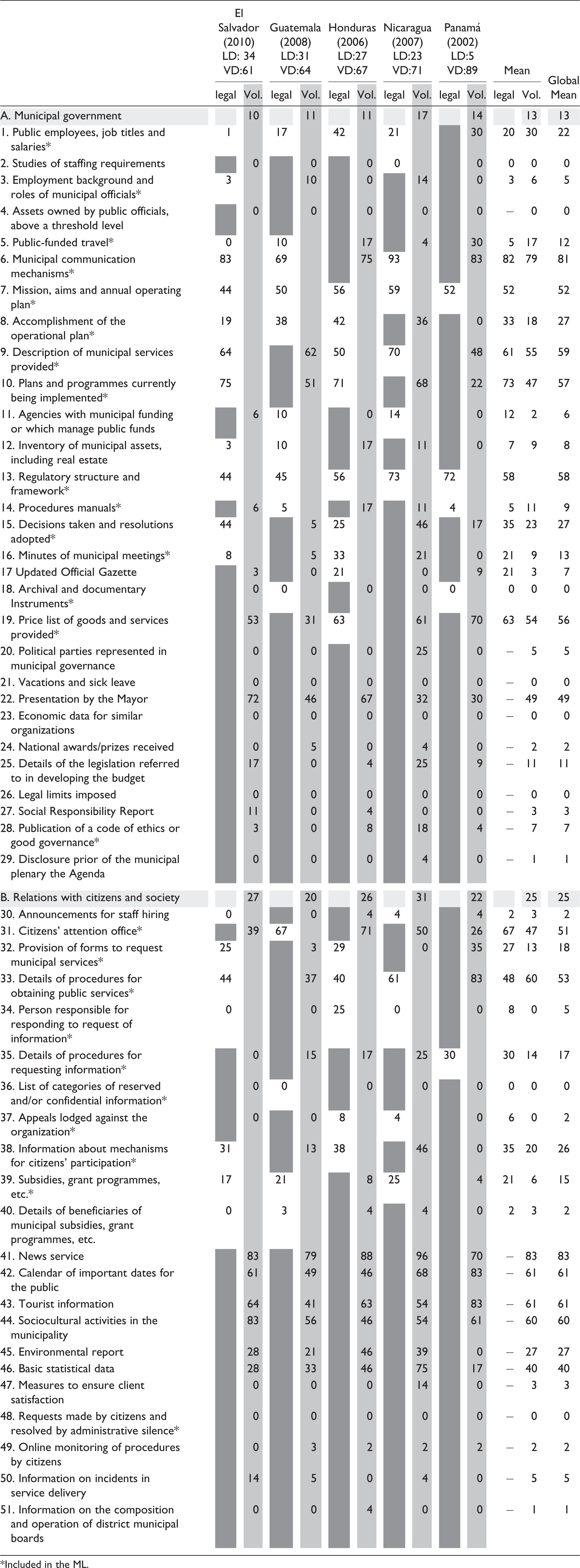
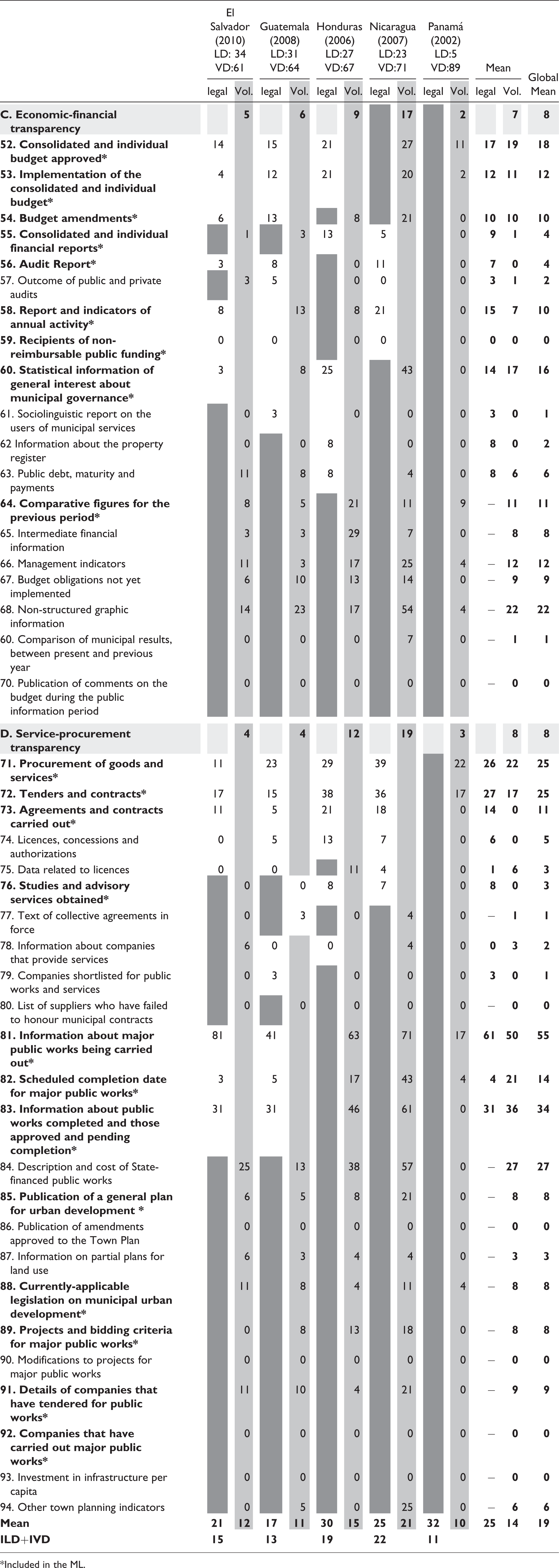
The municipalities of Central America provide barely one third of the information that is legally required to be issued proactively. Those of Panama provide most online information in this respect, with 32% of the information required (Annex). In contrast, the local authorities of Guatemala (17%) and El Salvador (21%) present the lowest levels of compliance. In Honduras, the municipalities analyzed publish online 30% of the 30 items that the FOI legislation requires to be made available.
Online information requirements vary from one country to another, and this factor may have affected compliance. Clearly, less effort is required to disclose the five items required by the law of Panama than to comply with the disclosure requirements of El Salvador (34 items) and of Guatemala (31 items).
Focusing on the online proactive information items that are required by the laws in force in these Central American countries, and bearing in mind the disparity of information items required, it is apparent that most of these local governments are forthcoming regarding their channels of communication, information on which is disclosed by 82% of the municipalities where this requirement is present. Another item that is widely available concerns the plans and programmes currently being implemented (73%), although this item is only legally required by two countries. However, most of the items that are legally required to be provided online in each country are actually disclosed by less than 50% of the municipalities analyzed. Indeed, with respect to many of these information items, the local authorities have specifically rejected the legal obligation of their disclosure.
Goal 2: Voluntary disclosure
The results obtained regarding the online voluntary disclosure of information (Annex, Voluntary column) show that it is in Panama where, although only five information items are legally required, the lowest level of voluntary information disclosure is made (10%), with an average of just 10 items. Similarly little voluntary information is provided in Guatemala (11%) and in El Salvador (12%), although in these countries the legislation is more demanding in terms of proactive information (31 and 34 items, respectively). In contrast, the political authorities in Nicaraguan municipalities must consider that the 23 items of online information that are legally required are insufficient to ensure transparency, as they make a greater voluntary provision of public information, publishing 21% of the total number of items.
The type of voluntarily disclosed information that is most commonly supplied is that concerning municipal relations with citizens and society (23%), followed by information on the municipal corporation (16%). Information of an economic and financial nature (7%) and that related to the procurement of services (9%) was the least often observed on the websites of these local governments in Central America.
In the main, these municipalities voluntarily publish information items that are related to the municipality (83%) and to the communication channels provided (79%). Although considerably less information is provided on the procurement of services, it is noteworthy that 50% of the municipalities offer information on the most important public works in progress.
Finally, our analysis of the policy applied regarding access to local government information overall, regardless of whether it is legally required or supplied voluntarily, shows that the authorities of Nicaragua (22%) and Honduras (19%) make the greatest online information disclosure effort, while those of Guatemala (13%) and Panama (11%) provide least information.
Goal 3: Determinant factors
Before performing the regression analysis, we determined the correlations between the independent variables with which our hypotheses were examined (Table 2). The matrix shows that there are no strong correlations between these independent variables.
Pearson correlation matrix.
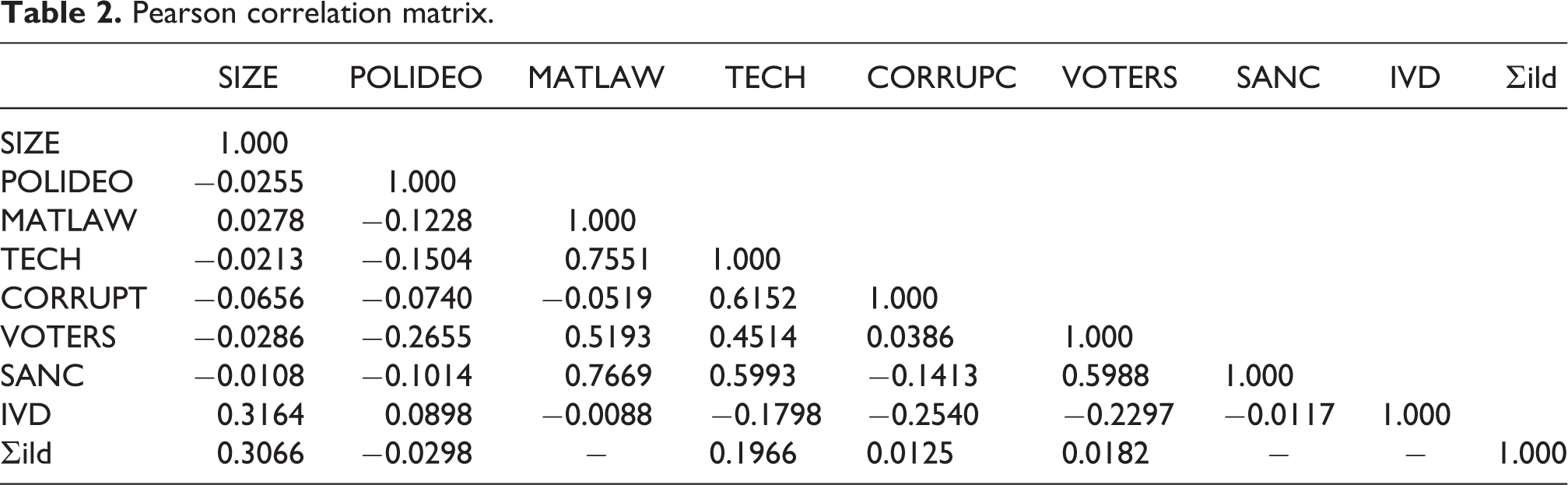
The results obtained reveal the existence of five statistically significant factors that influence compliance with the legal disclosure of information: maturity of the law, technology, corruption, sanctions and voluntary disclosure policy. The other factors examined were not statistically significant (Table 3).
Results of the tobit regression analysis.
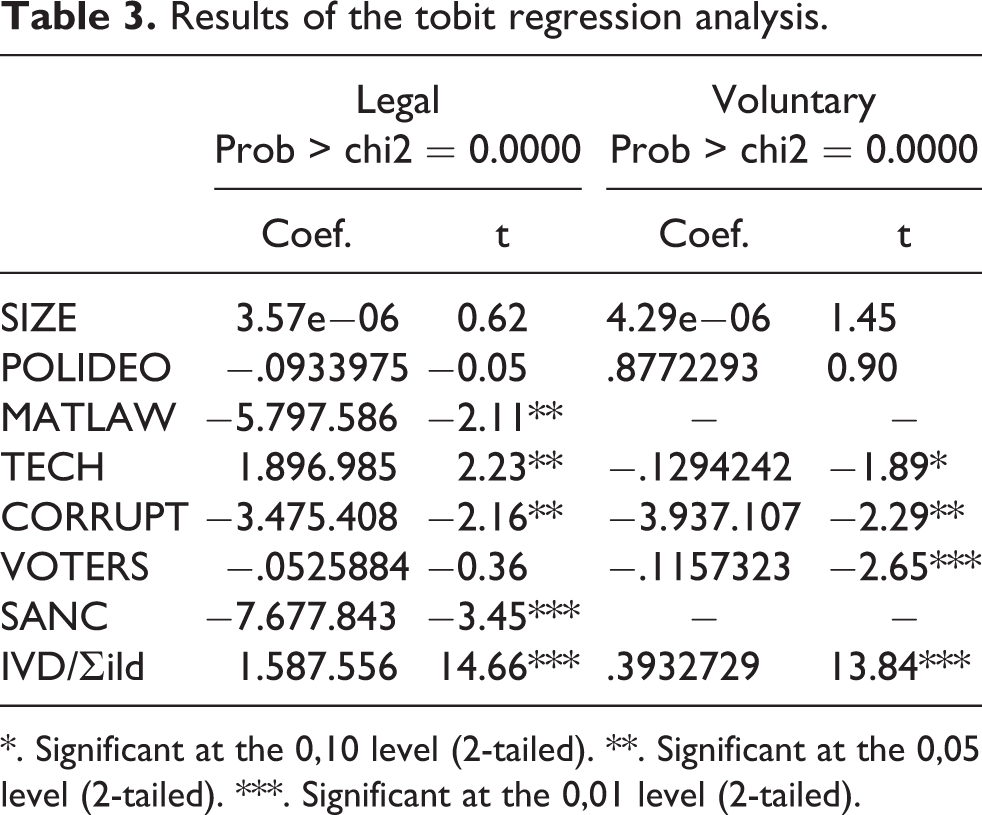
*. Significant at the 0,10 level (2-tailed). **. Significant at the 0,05 level (2-tailed). ***. Significant at the 0,01 level (2-tailed).
The length of time that a FOI Act has been in force is inversely related with compliance. This finding is contrary to that proposed in our hypothesis and to the results presented by Banks et al. (1997). However, in the latter case, this referred to the voluntary provision of information. This result indicates that as time passes, authorities become more relaxed regarding compliance with information disclosure obligations. In countries that have adopted FOI laws more recently, public managers are more aware of the importance of implementing the policy of transparency, having more recently experienced pressures from society for this legislation to be enacted.
Technological development produces a positive effect on compliance with mandatory online information disclosure, in accordance with our hypothesis, as new technologies facilitate the online disclosure of information, thereby reducing costs. These results are consistent with those obtained by Pina et al. (2007), Caba et al. (2008), Gandía and Archidona (2008) and Serrano et al. (2009).
The presence of corruption is inversely associated with compliance with online information disclosure obligations, as we hypothesized, and corroborating the results obtained by Pina et al. (2010) and Relly and Cuillier (2010). Thus, Central American local governments with higher levels of corruption are less willing to disclose online information, preferring a policy of reticence.
Sanctions for non-compliance are also relevant to the degree of compliance with disclosure requirements, although in this case the effect is contrary to our hypothesis, which had assumed that the existence of sanctions would prompt institutions to comply with their legal obligations, as has also been expressed by Bajo et al. (2009).
Another factor that positively affects compliance with legal disclosure requirements is the policy of online voluntary disclosure that is applied. Thus, local managers who are more inclined toward information transparency, even when it is not mandatory, comply more fully with legal requirements for online information disclosure. In contrast to the findings of Bajo et al. (2009) (which were not statistically significant), this factor was definitely influential, and coincident with the sign of the hypothesis.
Analysis of the results for the factors affecting voluntary disclosure (Table 3) reveals that four factors – political commitment, legal disclosure requirements, corruption and technology – are statistically significant.
As was the case with compliance with legal requirements for information disclosure, corruption was found to have a negative effect on voluntary information disclosure, coinciding with our hypothesis to this effect. Thus, it is the local governments that present lower levels of corruption which tend to disclose more information voluntarily. Similarly, technology is a determinant factor in voluntary disclosure, although the local authorities with the highest levels of Internet access are not those where the highest levels of voluntary information disclosure are recorded. This effect is contrary to that proposed in the hypothesis, which is in accordance with the results obtained by Tolbert et al. (2008).
Neither political ideology nor the population size of the municipality was determinant factors of voluntary or of mandatory disclosure. However, political commitment did influence the online disclosure made voluntarily. Nevertheless, it was not the local authorities where levels of political commitment were highest that achieved the highest degree of information, as we had hypothesized. Therefore, greater political commitment among the population does not lead public managers to be more proactive in voluntary transparency. This result coincides with that obtained by Jorge et al. (2011).
Finally, the amount of information legally required to be disclosed by the local authority (ILD) is another factor affecting its policy on voluntary disclosure. However, the sign is contrary to expectations and to the results obtained by Baginski et al. (2004) and Kasznik and Lev (1995). Thus, in municipalities where more information is legally required and provided, more information is also made available voluntarily.
Discussion and Conclusions
In recent years, there has been an increase in FOI legislation, and 103 countries have adopted laws in this respect. FOI laws are increasingly promoting the proactive disclosure of information, using websites as channels of communication. However, public managers do not always consider this legal disclosure to be sufficient to achieve their transparency goals, and complement it with their own policies of voluntary disclosure.
In this respect, the legislation enacted in Central America suffers from a lack of homogeneity in terms of the information content required to be disclosed; thus, only two reporting requirements are common to all seven countries analyzed. The amount of online proactive information disclosure required ranges from very little (Panama) to extensive (El Salvador). In general, the laws that have been adopted more recently tend to impose a greater volume of information disclosure requirements.
Our results show that local governments’ online disclosure of legally-required proactive information is still at a low level in Central America. This leads us to conclude that the culture of reticence (or secrecy) that has pervaded these countries for years has still not been eradicated, even in countries such as Panama, where very little such disclosure is required. Therefore, much remains to be done for local authorities in these countries to fulfil their legal obligations, and so further measures are needed to ensure compliance.
However, the information that is legally required is sometimes considered insufficient by local managers, with respect to their own goals of information transparency, through which they seek greater legitimacy via voluntary policies for the proactive supply of information. In this regard, local governments in Nicaragua and Honduras are providing most online voluntary information disclosure in pursuit of their policy of transparency.
The information that is most commonly supplied on a voluntary basis to enhance local government legitimacy concerns relations between the municipal corporation and the population and society. However, little information is offered voluntarily regarding economic and financial issues and the procurement of services, these areas being considered more conflictive. On the other hand, although policies on voluntary disclosure remain highly divergent, it is notable that local governments in these Central American countries coincide in voluntarily disclosing almost 20 types of information.
The municipalities in Nicaragua and Honduras are making the greatest overall effort in the dissemination of online information, whether so required by law or voluntarily. In contrast, those of Panama and Guatemala are least compliant with transparency policies. Further work is needed in this area, to make public managers more aware of the importance of implementing FOI policies, because high levels of municipal development cannot be acquired within a culture of obscurantism.
With respect to the factors that influence local managers’ decisions regarding online proactive information disclosure, our analysis of the literature shows that the most significant factors are political, social and economic-financial, although conflicting results have been obtained for their sign and significance.
Among these local governments in Central America, the development and application of ICT, together with the policies adopted on voluntary information disclosure, are factors that influence compliance with legal provisions on proactive online information disclosure. Thus, local authorities where managers are aware of the legitimacy advantages to be gained from a complementary policy of voluntary proactive disclosure are more likely to comply with legal requirements on information provision. Additionally, municipalities where there is greater access to new technologies are aware that the information provided online will reach more users, and so they are more likely to publish more information through this channel, to acquire greater legitimacy.
We found the level of corruption to be inversely related with the online provision by municipalities of legally-required information. We believe this is because the greater the corruption affecting a municipality, the more reticent its managers will be concerning information disclosure, preferring not to supply data that, while important to the population, might highlight deficiencies in municipal management. On the other hand, FOI legislation that includes penalties for non-compliance, and laws which have been in force for longer, are not associated with higher levels of information disclosure. This may be because managers do not necessarily respond positively to the pressure of threatened sanctions. Accordingly, it remains necessary for a far-reaching culture of transparency to be implemented. In recent years, this has become a recurrent topic in the media and in political discourse.
The voluntary disclosure of information by local governments in Central America is influenced by levels of corruption, by technological development, political commitment among voters and the demand for legal information. As set out in our hypotheses, corruption has a negative effect on voluntary disclosure, while the demand for the disclosure of legal information has a positive effect. However, local authorities that enjoy greater technological development and a higher level of political commitment are not voluntarily providing greater transparency. This could be explained by the fact that in municipalities where citizens participate less actively, managers are more likely to promote a policy of transparency in order to attract votes and thus remain in power.
The results presented in this paper show that transparency is an issue that is more one of preference than of laws. The fact that each of these Central American countries has a law requiring the disclosure of certain information does not seem to be enough for local managers to provide the data that lawmakers believe important to stakeholders (irrespective of whether or not supplying this information might inconvenience the local corporation).
In designing FOI legislation for each of the countries analyzed, various national and international forums have been held, and due account taken of laws governing this issue in other countries. Nevertheless, many differences between them remain. Accordingly, perhaps it is necessary to amend the existing legislation in order to harmonize online information disclosure requirements throughout Central America, and to consider whether it would be appropriate to extend the range of information that is legally required to be disclosed.
Footnotes
Annex. Mandatory Versus Voluntary Disclosures in Central America.
| El Salvador (2010) LD: 34 VD:61 | Guatemala (2008) LD:31 VD:64 | Honduras (2006) LD:27 VD:67 | Nicaragua (2007) LD:23 VD:71 | Panamá (2002) LD:5 VD:89 | Mean | Global Mean | |||||||
|---|---|---|---|---|---|---|---|---|---|---|---|---|---|
| legal | Vol. | legal | Vol. | legal | Vol. | legal | Vol. | legal | Vol. | legal | Vol. | ||
| A. Municipal government | 10 | 11 | 11 | 17 | 14 | 13 | 13 | ||||||
| 1. Public employees, job titles and salaries* | 1 | 17 | 42 | 21 | 30 | 20 | 30 | 22 | |||||
| 2. Studies of staffing requirements | 0 | 0 | 0 | 0 | 0 | 0 | 0 | 0 | |||||
| 3. Employment background and roles of municipal officials* | 3 | 10 | 0 | 14 | 0 | 3 | 6 | 5 | |||||
| 4. Assets owned by public officials, above a threshold level | 0 | 0 | 0 | 0 | 0 | − | 0 | 0 | |||||
| 5. Public-funded travel* | 0 | 10 | 17 | 4 | 30 | 5 | 17 | 12 | |||||
| 6. Municipal communication mechanisms* | 83 | 69 | 75 | 93 | 83 | 82 | 79 | 81 | |||||
| 7. Mission, aims and annual operating plan* | 44 | 50 | 56 | 59 | 52 | 52 | 52 | ||||||
| 8. Accomplishment of the operational plan* | 19 | 38 | 42 | 36 | 0 | 33 | 18 | 27 | |||||
| 9. Description of municipal services provided* | 64 | 62 | 50 | 70 | 48 | 61 | 55 | 59 | |||||
| 10. Plans and programmes currently being implemented* | 75 | 51 | 71 | 68 | 22 | 73 | 47 | 57 | |||||
| 11. Agencies with municipal funding or which manage public funds | 6 | 10 | 0 | 14 | 0 | 12 | 2 | 6 | |||||
| 12. Inventory of municipal assets, including real estate | 3 | 10 | 17 | 11 | 0 | 7 | 9 | 8 | |||||
| 13. Regulatory structure and framework* | 44 | 45 | 56 | 73 | 72 | 58 | 58 | ||||||
| 14. Procedures manuals* | 6 | 5 | 17 | 11 | 4 | 5 | 11 | 9 | |||||
| 15. Decisions taken and resolutions adopted* | 44 | 5 | 25 | 46 | 17 | 35 | 23 | 27 | |||||
| 16. Minutes of municipal meetings* | 8 | 5 | 33 | 21 | 0 | 21 | 9 | 13 | |||||
| 17 Updated Official Gazette | 3 | 0 | 21 | 0 | 9 | 21 | 3 | 7 | |||||
| 18. Archival and documentary Instruments* | 0 | 0 | 0 | 0 | 0 | 0 | 0 | 0 | |||||
| 19. Price list of goods and services provided* | 53 | 31 | 63 | 61 | 70 | 63 | 54 | 56 | |||||
| 20. Political parties represented in municipal governance | 0 | 0 | 0 | 25 | 0 | − | 5 | 5 | |||||
| 21. Vacations and sick leave | 0 | 0 | 0 | 0 | 0 | − | 0 | 0 | |||||
| 22. Presentation by the Mayor | 72 | 46 | 67 | 32 | 30 | − | 49 | 49 | |||||
| 23. Economic data for similar organizations | 0 | 0 | 0 | 0 | 0 | − | 0 | 0 | |||||
| 24. National awards/prizes received | 0 | 5 | 0 | 4 | 0 | − | 2 | 2 | |||||
| 25. Details of the legislation referred to in developing the budget | 17 | 0 | 4 | 25 | 9 | − | 11 | 11 | |||||
| 26. Legal limits imposed | 0 | 0 | 0 | 0 | 0 | − | 0 | 0 | |||||
| 27. Social Responsibility Report | 11 | 0 | 4 | 0 | 0 | − | 3 | 3 | |||||
| 28. Publication of a code of ethics or good governance* | 3 | 0 | 8 | 18 | 4 | − | 7 | 7 | |||||
| 29. Disclosure prior of the municipal plenary the Agenda | 0 | 0 | 0 | 4 | 0 | − | 1 | 1 | |||||
| B. Relations with citizens and society | 27 | 20 | 26 | 31 | 22 | 25 | 25 | ||||||
| 30. Announcements for staff hiring | 0 | 0 | 4 | 4 | 4 | 2 | 3 | 2 | |||||
| 31. Citizens’ attention office* | 39 | 67 | 71 | 50 | 26 | 67 | 47 | 51 | |||||
| 32. Provision of forms to request municipal services* | 25 | 3 | 29 | 0 | 35 | 27 | 13 | 18 | |||||
| 33. Details of procedures for obtaining public services* | 44 | 37 | 40 | 61 | 83 | 48 | 60 | 53 | |||||
| 34. Person responsible for responding to request of information* | 0 | 0 | 25 | 0 | 0 | 8 | 0 | 5 | |||||
| 35. Details of procedures for requesting information* | 0 | 15 | 17 | 25 | 30 | 30 | 14 | 17 | |||||
| 36. List of categories of reserved and/or confidential information* | 0 | 0 | 0 | 0 | 0 | 0 | 0 | 0 | |||||
| 37. Appeals lodged against the organization* | 0 | 0 | 8 | 4 | 0 | 6 | 0 | 2 | |||||
| 38. Information about mechanisms for citizens’ participation* | 31 | 13 | 38 | 46 | 0 | 35 | 20 | 26 | |||||
| 39. Subsidies, grant programmes, etc.* | 17 | 21 | 8 | 25 | 4 | 21 | 6 | 15 | |||||
| 40. Details of beneficiaries of municipal subsidies, grant programmes, etc. | 0 | 3 | 4 | 4 | 0 | 2 | 3 | 2 | |||||
| 41. News service | 83 | 79 | 88 | 96 | 70 | − | 83 | 83 | |||||
| 42. Calendar of important dates for the public | 61 | 49 | 46 | 68 | 83 | − | 61 | 61 | |||||
| 43. Tourist information | 64 | 41 | 63 | 54 | 83 | − | 61 | 61 | |||||
| 44. Sociocultural activities in the municipality | 83 | 56 | 46 | 54 | 61 | − | 60 | 60 | |||||
| 45. Environmental report | 28 | 21 | 46 | 39 | 0 | − | 27 | 27 | |||||
| 46. Basic statistical data | 28 | 33 | 46 | 75 | 17 | − | 40 | 40 | |||||
| 47. Measures to ensure client satisfaction | 0 | 0 | 0 | 14 | 0 | − | 3 | 3 | |||||
| 48. Requests made by citizens and resolved by administrative silence* | 0 | 0 | 0 | 0 | 0 | − | 0 | 0 | |||||
| 49. Online monitoring of procedures by citizens | 0 | 3 | 2 | 2 | 2 | − | 2 | 2 | |||||
| 50. Information on incidents in service delivery | 14 | 5 | 0 | 4 | 0 | − | 5 | 5 | |||||
| 51. Information on the composition and operation of district municipal boards | 0 | 0 | 4 | 0 | 0 | − | 1 | 1 | |||||
*Included in the ML.
Annex (continuation). Mandatory Versus Voluntary Disclosures in Central America.
| El Salvador (2010) LD: 34 VD:61 | Guatemala (2008) LD:31 VD:64 | Honduras (2006) LD:27 VD:67 | Nicaragua (2007) LD:23 VD:71 | Panamá (2002) LD:5 VD:89 | Mean | Global Mean | |||||||
|---|---|---|---|---|---|---|---|---|---|---|---|---|---|
| legal | Vol. | legal | Vol. | legal | Vol. | legal | Vol. | legal | Vol. | legal | Vol. | ||
|
|
|
|
|
|
|
|
|
|
|
|
|
|
|
|
|
14 | 15 | 21 | 27 | 11 |
|
|
|
|||||
|
|
4 | 12 | 21 | 20 | 2 |
|
|
|
|||||
|
|
6 | 13 | 8 | 21 | 0 |
|
|
|
|||||
|
|
1 | 3 | 13 | 5 | 0 |
|
|
|
|||||
|
|
3 | 8 | 0 | 11 | 0 |
|
|
|
|||||
| 57. Outcome of public and private audits | 3 | 5 | 0 | 0 | 0 |
|
|
|
|||||
|
|
8 | 13 | 8 | 21 | 0 |
|
|
|
|||||
|
|
0 | 0 | 0 | 0 | 0 |
|
|
|
|||||
|
|
3 | 8 | 25 | 43 | 0 |
|
|
|
|||||
| 61. Sociolinguistic report on the users of municipal services | 0 | 3 | 0 | 0 | 0 |
|
|
|
|||||
| 62 Information about the property register | 0 | 0 | 8 | 0 | 0 |
|
|
|
|||||
| 63. Public debt, maturity and payments | 11 | 8 | 8 | 4 | 0 |
|
|
|
|||||
|
|
8 | 5 | 21 | 11 | 9 |
|
|
|
|||||
| 65. Intermediate financial information | 3 | 3 | 29 | 7 | 0 |
|
|
|
|||||
| 66. Management indicators | 11 | 3 | 17 | 25 | 4 |
|
|
|
|||||
| 67. Budget obligations not yet implemented | 6 | 10 | 13 | 14 | 0 |
|
|
|
|||||
| 68. Non-structured graphic information | 14 | 23 | 17 | 54 | 4 |
|
|
|
|||||
| 60. Comparison of municipal results, between present and previous year | 0 | 0 | 0 | 7 | 0 |
|
|
|
|||||
| 70. Publication of comments on the budget during the public information period | 0 | 0 | 0 | 0 | 0 |
|
|
|
|||||
|
|
|
|
|
|
|
|
|
|
|
|
|
|
|
|
|
11 | 23 | 29 | 39 | 22 |
|
|
|
|||||
|
|
17 | 15 | 38 | 36 | 17 |
|
|
|
|||||
|
|
11 | 5 | 21 | 18 | 0 |
|
|
|
|||||
| 74. Licences, concessions and authorizations | 0 | 5 | 13 | 7 | 0 |
|
|
|
|||||
| 75. Data related to licences | 0 | 0 | 11 | 4 | 0 |
|
|
|
|||||
|
|
0 | 0 | 8 | 7 | 0 |
|
|
|
|||||
| 77. Text of collective agreements in force | 0 | 3 | 0 | 4 | 0 |
|
|
|
|||||
| 78. Information about companies that provide services | 6 | 0 | 0 | 4 | 0 |
|
|
|
|||||
| 79. Companies shortlisted for public works and services | 0 | 3 | 0 | 0 | 0 |
|
|
|
|||||
| 80. List of suppliers who have failed to honour municipal contracts | 0 | 0 | 0 | 0 | 0 |
|
|
|
|||||
|
|
81 | 41 | 63 | 71 | 17 |
|
|
|
|||||
|
|
3 | 5 | 17 | 43 | 4 |
|
|
|
|||||
|
|
31 | 31 | 46 | 61 | 0 |
|
|
|
|||||
| 84. Description and cost of State-financed public works | 25 | 13 | 38 | 57 | 0 |
|
|
|
|||||
|
|
6 | 5 | 8 | 21 | 0 |
|
|
|
|||||
| 86. Publication of amendments approved to the Town Plan | 0 | 0 | 0 | 0 | 0 |
|
|
|
|||||
| 87. Information on partial plans for land use | 6 | 3 | 4 | 4 | 0 |
|
|
|
|||||
|
|
11 | 8 | 4 | 11 | 4 |
|
|
|
|||||
|
|
0 | 8 | 13 | 18 | 0 |
|
|
|
|||||
| 90. Modifications to projects for major public works | 0 | 0 | 0 | 0 | 0 |
|
|
|
|||||
|
|
11 | 10 | 4 | 21 | 0 |
|
|
|
|||||
|
|
0 | 0 | 0 | 0 | 0 |
|
|
|
|||||
| 93. Investment in infrastructure per capita | 0 | 0 | 0 | 0 | 0 |
|
|
|
|||||
| 94. Other town planning indicators | 0 | 5 | 0 | 25 | 0 |
|
|
|
|||||
|
|
|
|
|
|
|
|
|
|
|
|
|
|
|
|
|
|
|
|
|
|
||||||||
*Included in the ML.
Acknowledgement
This research was carried out with financial support from the Regional Government of Andalusia (Spain), Department of Innovation, Science and Enterprise (Research Projects P10-SEJ-06628 and P11-SEJ-7700)