






Abstract
A sound follower base is a prerequisite for the survival of a brand micro-blog. Thus, determining how to enhance followers’ continuance intentions to follow is critical. We integrated the value-based adoption mode and social identity theory to test a conceptual model. The proposed model identified three sets of blog utilities (information, social, and service) affecting followers’ continuance intention through perceived value and brand micro-blog identification. Using a Chinese sample drawn from the Sina micro-blog, we sought to clarify why followers continue to follow a brand micro-blog. The concluding section discusses our findings in terms of implications for theory and practice.
Introduction
Micro-blogs are popular in daily life and can be powerful marketing communication tools. Many companies dedicate their resources to building an official micro-blog with the intention of establishing trust and forming closer relationships with their consumers (Coyle et al., 2012; Kim and Ko, 2012; De Vries et al., 2012). Marketers now communicate product-, promotion-, and brand-related information in their brand micro-blogs to induce focal followers to respond and spread electronic word of mouth through social links (Hsu et al., 2010). For example, Dell generated US$6.5 million in revenue in 2009 by promoting personal computers, accessories, and software through its Twitter accounts (Kwon and Sung, 2011). However, unlike Dell, many brand micro-blogs still struggle to survive because of the high follower churn rates (Kwak et al., 2011). A sound follower base is a prerequisite for a brand micro-blog’s survival (Kwon and Sung, 2011) and failure to retain existing followers will seriously endanger the subsistence of brand micro-blog services.
Up to date, few studies have systematically explored the factors and mechanisms that drive consumer continuance intention to follow a brand micro-blog. Research undertaken from a perspective on the post-adoption of information systems indicates that followers’ satisfaction and their perception of value are major determinants of their intention to continue with the technology (Bhattacherjee and Premkumar, 2004; Limayem et al., 2007; Lin et al., 2012; Zhao and Lu, 2012; Chiu and Wang, 2008; Hsiao and Chiou, 2012). In contrast, community studies suggest that social capital and identification are more important factors for followers’ continuance intention (Algesheimer et al., 2005; Dholakia et al., 2004; Woisetschläger et al., 2008; Wang and Chiang, 2009). It seems that the information systems literature has mainly emphasized the effects of the IT systems’ functionalist values while the community literature has mainly considered the social values that influence continuance intention. Although both theoretical perspectives tried to explain consumers’ continuance intention, there has been no systematic effort to develop a more comprehensive view to study this phenomenon. Taking the economic and social characteristics of the brand micro-blog into consideration, we surmise that brand micro-blogs are not merely systems that provide utilitarian and hedonic services to followers, but rather these blogs are also communities that provide followers with social platforms on which to develop relationships. In practice, two types of followers tend to follow brand micro-blogs: loyal fans of the brand who have had a good relationship with the brand micro-blog, and observers of the brand who follow because the micro-blog can satisfy their utilitarian and hedonic needs (Hsu et al., 2010). Given the vital roles of functionalist and social interaction factors that sustain brand micro-blogs, to talk of one without the other is insufficient.
Drawing on social identity theory and the value-based model, this study aims to integrate the above-mentioned two bodies of literatures to shape a more nuanced knowledge about consumers’ continuance intention to follow a brand micro-blog. Specifically, we propose a conceptual model that specifies three types of utility that function in combination to attract followers: information, social interaction, and service. These utilities determine both the values followers perceive and followers’ identification with the company’s brand micro-blog. We suggest that consumers’ perceived value and identification as two intermediate mechanisms will eventually determine whether they will continue to follow the brand micro-blog.
Literature review and hypotheses
Brand micro-blog
A brand micro-blog is a type of company-initiated online brand community. Different from the traditional brand community, micro-blogs can foster ongoing conversations between marketers and followers at every stage of the marketing process: pre-purchase, purchase, and post-purchase (Hsu et al., 2010; Kaplan and Haenlein, 2010; Labrecque, 2014; Malthouse et al., 2013). The company, in turn, can use the brand micro-blog for sales, customer service, promotions, and human resource tactics (Coyle et al., 2012; Sung et al., 2010).
A brand micro-blog’s relationship with followers is not one-to-one but one-to-many. If the brand micro-blog has one million followers, the marketer can automatically communicate messages to all of these followers (Xu and Schneider, 2011). In turn, followers can re-post, review, and read other followers’ reviews about such messages, and directly communicate with other followers. Thus, brand micro-blogs can not only deliver marketing information to followers but also build relationships with them (Hsu et al., 2010).
Continuance intention to follow
We define ‘continuance intention to follow’ as the intention of followers to maintain a relationship with the brand micro-blog, which indicates a form of post-adoption behavior. Unlike the initial decision to follow, continuance intention to follow is not a one-off act but rather the result of an individual’s decision to continue receiving information from, and interacting with, the brand micro-blog (Coyle et al., 2012; Hsu et al., 2010).
The information systems and brand community literatures have documented much research on users’ continuance intention. Bhattacherjee (2001) proposed an expectation-confirmation model (ECM) to investigate continuance intention in the IS area. This model indicates that perceived usefulness and confirmation will positively influence continuance intention through satisfaction. Bhattacherjee and Premkumar (2004) also proposed a two-stage model based on ECM to study the change in perceived usefulness, disconfirmation, and affect (i.e. satisfaction and attitude) during the course of IS usage. Venkatesh et al. (2011) investigated continuance intention using an alternative theory—the Unified Theory of Acceptance and Use of Technology (UTAUT). They found that consumers’ satisfaction with the technology mediated the combined effects of perceived usefulness, social utility, and effort expectancy on consumers’ continuance intention. Kim and Malhotra (2005) proposed a longitudinal model of continued IS usage based on the Technology Acceptance Model (TAM) and found that perceived usefulness and user-friendliness positively affects consumers’ intention to continue using IS in the next time period. Lin et al. (2012) added perceived value to the expectation-confirmation model and integrated the Value-Based Adoption Model (VAM) and Expectation-Confirmation Model (ECM) to study continuance intention in the IPTV context. In summary, the IS literature has shown that the decision to continue involves two key determinants. The first is utility-based factors, such as perceptions of usefulness, ease of use, and perceived value. The second is satisfaction, which is a set of affective or emotional responses to the use of an information system. Overall, researchers in IS have tended to examine continuance intention from a functionalist perspective.
Community researchers have mainly observed followers’ continuance intention from a relational perspective. Algesheimer et al. (2005) argued that community identification determines the continuance intention of the brand community. Wang and Chiang (2009) found that social capital factors such as social interaction, trust, and shared vision would determine members’ continual intention of the brand community. Hsiao and Chiou (2012) also proved that social capital accumulated within the community positively affects member’s loyalty to the community. Shen et al. (2010) indicated that the relationship quality between the members determines their loyalty to the community. Lin (2010) built a model based on social cognitive theory, and indicated that social support, social norm and the relationship quality combine to affect member’s loyalty to the community.
Although both functionalist and relational perspectives tried to investigate members’ continuance intention, there has been no systematic effort to integrate them to develop a more nuanced view to study this phenomenon. Brand micro-blogs are not merely information systems that provide functionalist services to followers; they are also a community that provides a social platform for followers to develop relationships. Thus, only considering functionalist factors or social values is insufficient to build knowledge about how brand micro-blogs operate. This study represents an attempt to build on both literatures of IS adoption and community loyalty to develop a comprehensive model that integrates utility-based factors and social-value-based factors to examine how they combine to determine consumers’ continuance intention to follow a brand micro-blog.
Social identity theory
Social identity theory proposes that individuals classify themselves into various social categories to facilitate self-definition in their own social environment (Ashforth and Mael, 1989; Carlson et al., 2008). It highlights the perceived similarities between other group members and their differences with nonmembers. Social identification with a group indicates the cognitive connection between an individual and a group (Muniz Jr and O’Guinn, 2001). Based on this theory, marketing research demonstrates that brand community members engage in collective behavior, e.g., brand experience sharing, to extol the virtues of their beloved brands and to help other members (Bagozzi and Dholakia 2006). Brand communities research mainly focuses on the interaction between customers who identify themselves with the same brand. Thus, the social needs satisfied in the brand community facilitate members’ identification with the community (Hogg and Abrams, 1988). These needs may pertain to the self alone or to the group.
Value-based adoption model (VAM)
Kim, Chan, and Gupta (2007) developed a value-based adoption model to investigate the likelihood of adopting mobile commerce. They argue that TAM is limited in explaining the adoption of new information and communication technology (ICT) because the users of new ICT play the dual roles of technology user and service consumer. Most of consumers use the new ICT for personal purposes and the cost of voluntary usage is borne by themselves. Thus, the value perceived by the service consumers plays an important role in their continual usage. For rational technology consumers the major concern is value maximization when they use the new technology. The model borrows the cost-benefit paradigm from the decision-making research stream assuming consumers make technology adoption and usage decisions based on comparisons of the benefits of the new invention with the costs of adopting that invention. The model applies to both consumers’ initial adoption and post-adoption, such as their continuance behavior, because consumers also consider value in the post-adoption stage (Lin et al., 2012).
Brand micro-blog identification and continuance intention
Building on social identity literature, we define brand micro-blog identification as the strength of a followers’ relationship with the blog or the degree to which they perceive oneness with the blog. Previous studies have indicated that social identification is one of the most important drivers of consumer loyalty (Bagozzi and Dholakia, 2006; Algesheimer et al., 2005). Fisher and Wakefield (1998) proposed that as identification with a group increases, members seek greater individual association with the group. In turn, greater identification results in a willingness to engage in consumption behavior that supports the group. Algesheimer et al. (2005) also found that members’ social identification is a central driver of continuance in a brand community; thus, in the brand micro-blog context, the more a follower believes that they are members of the brand micro-blog, the more likely they are to continue following. Thus:
Perceived value and continuance intention
The notion of value receives much attention in the literature on marketing and economics. Value is inherently a tradeoff assessment in terms of “what you get for what you give” (Flint et al., 2002; Ulaga and Eggert, 2006). Consumers’ values represent their cognition of the products or the relationship (Woodruff, 1997). Zeithaml (1988) defined perceived value as “the consumer’s overall assessment of the utility of a product based on perceptions of what is received and what is given”. From the consumer choice perspective, value represents an overall estimation of a choice object. Consumers decide their choice behavior based on this overall estimation (Kahneman and Tversky, 1979). Some empirical results have suggested that perceived value was an important predictor of consumer loyalty (Yang and Peterson, 2004). Based on VAM, Lin et al. (2012) also proposed and confirmed the positive relationship between perceived value and continuance intention. Consumers who surf brand micro-blogs seek both informational and social values (Zhao and Lu, 2012). For example, consumers may read brand micro-blogs to gain economic and functionalist information that benefits their consumption. Consumers can also review and re-post messages from brand micro-blogs to establish relationships online. They gain social values by following. Followers of a brand micro-blog are micro-blog service consumers who evaluate the brand micro-blog based on its benefits and costs (Coyle et al., 2012). Thus, only when consumers perceive value; that is, the value they gain exceeds the time and energy they spend, do they continue to follow. Thus:
Perceived value and identification
Members identify themselves with a virtual community because of the membership that entails significant values (Dholakia et al., 2004). Consistent with this view, social identity theorists posit that identification with social groups is derived from the group that fulfills important needs of the members (Hogg and Abrams, 1988). In other word, members identify themselves with the group because they can gain value from the group. In the brand micro-blog context, consumers initially follow a brand micro-blog trying to get rewards or useful information, or to interact with others (De Vries et al., 2012). As followers’ economic and social needs are satisfied, their relationship with the brand micro-blog will be strengthened. The more values they derive from the brand micro-blog, such as economic utilities and/or social capital they obtain from the micro-blog, they are more likely to identify themselves with it. Thus:
Antecedents of perceived value and identification
IS researchers find that mainly practical utilities, such as information quality, service quality, and system quality, motivate consumers’ continual usage (DeLone and McLean, 1992; Petter and McLean, 2009). Brand community researchers, however, posit that social interaction also plays an important role in motivating members’ loyalty (Moon, 2011; Nicolaou and McKnight, 2006). Building on these two bodies of research, we propose three sets of utilities that enhance both consumers’ perceived value of, and identification with, a brand micro-blog: information utility, such as information usefulness and interestingness, social utility, such as connectedness, and service utility, such as system responsiveness and reliability.
Information utility
Research indicates that the dimensions of information utility could be classified into usefulness of content and adequacy of information (Aladwani and Palvia, 2002; Yang and Cai, 2005). However, Finn (1985) also found that interesting content attracts readers to continue reading, as it makes them feel happy. Therefore, we measured information utility from two aspects: usefulness and interestingness.
Information usefulness
Perceived usefulness (PU) is viewed as the most important factor influencing IS usage (Davis et al., 1992). IS researchers define information usefulness as the degree to which online information provides useful content that adds economic or functional utility to consumers (Adams et al., 1992). It is understandable that consumers would use IS if the enhanced performance derived from its use could help accrue consumer benefits (Venkatesh et al., 2011). As such, brand micro-blogs that contain useful information should attract followers and encourage their continuance intention (Hassan and Li, 2007). Useful messages within the brand micro-blogs may also motivate members to re-post and share with other members, thus facilitating relationship building, which adds to followers’ social enjoyment. Therefore, information usefulness adds to both followers’ perceived value of, and identification with, the brand micro-blog.
Information interestingness
Consumers seek pleasurable and joyful experiences in their consumption of information (Rokeach, 1973). Psychology research has also indicated that interesting content motivates people to attend to, think about, and learn more about the information provided (Frick, 1992). According to Davis et al., (1992), information interestingness is the extent to which the information provided by the supplier, and received by the reader, is enjoyable in its own right, apart from the content’s usefulness. Wade et al., (1999) found that interesting content positively affects a reader’s desire to continue reading. Similarly, interesting micro-blog messages encourage members to continually follow and share the messages with other online friends due to the messages’ emotional and social utilities. In other words, information interestingness adds to followers’ perceived value of, and identification with, the brand micro-blog.
Social connectedness
A brand micro-blog also serves as a social interaction platform on which followers can build weak ties (Zhao and Lu, 2012; Hsu et al., 2010). Followers interact with one another by re-posting and commenting on others’ messages to build relationships. Such social connectedness motivates members to interact and share more in online brand communities due to their common interests in, and shared experiences with, products and brands (Lin et al., 2014). Brand micro-blogs provide a platform for people to become connected, which adds to the perceived social value of, and identification with, the micro-blog (Zhao and Lu, 2012). In other words, the more connected to a brand micro-blog followers are, the more information is shared and closer the relationships built with followers will be. Thus:
Service-based factors
Service utility research indicates that service utility includes reliability, responsiveness, and assurance (Parasuraman et al., 2004). Other research has indicated that service utility tends to be context-bounded and service-type dependent (Paulin and Perrien, 1996). A brand micro-blog mainly provides two kinds of services. The first is to answer the consumers’ enquiries and requests and the second is to distribute the benefit of the activity promoted by the micro-blog. Thus, reliability and responsiveness are the most important factors.
Responsiveness refers to the degree to which a brand micro-blog can provide prompt services (Berry Leonard L, 1990). Timely responses to followers’ questions and messages create two types of follower values. First, followers may perceive communication efficiency when they receive timely responses to their posted messages (Zhao and Lu, 2012). Second, followers may perceive a high level of respect from the micro-blog, which adds to their sense of belonging (Liu, 2003). Social exchange theory also proposes that people expect to receive some benefit from engaging in social exchange (Blau, 1964). When people receive responsiveness from others, they may feel the social exchange is fair, as what they receive from the exchange process compensates them for the cost or time taken. Such balance in social exchange will lead to a greater perceived value of, and identification with, the micro-blog. Thus:
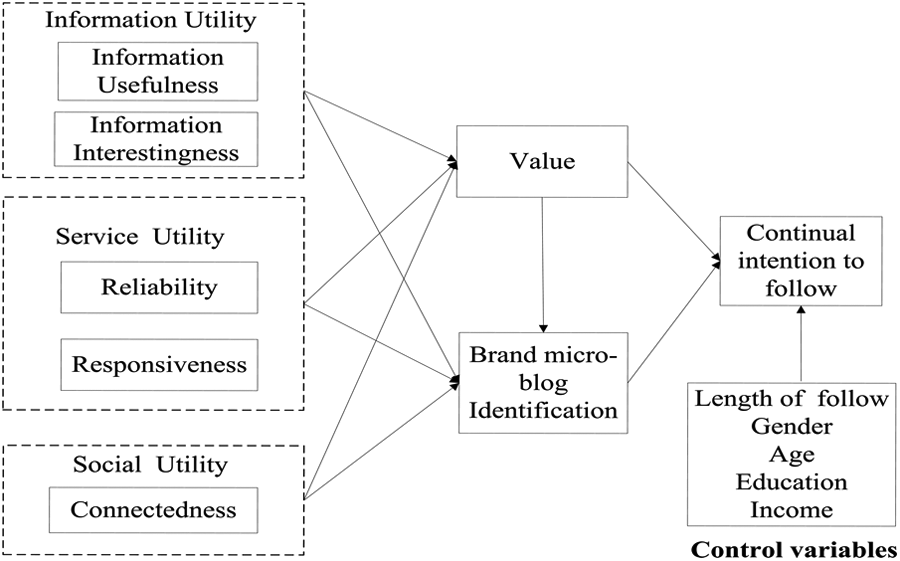
Research model.
The mediation roles of perceived value and identification
Previous studies in IS and community research suggest that the utilities, economic and social alike, of brand micro-blogs will positively affect consumers’ continuance intention to follow the micro-blog. In this study we advance two sets of hypotheses: perceived value and social identification will directly affect consumers’ continuance intention, whereas consumers’ utilities derived from the micro-blog will affect their perceived value of and social identification with the micro-blog. Thus, combining these two sets of hypotheses with the previous studies in IS and community research, we propose that
Control variables
To capture other factors that might be related to followers’ continuance intention, our empirical model included a set of control variables (i.e., length of following, gender, age, education, and income) previously suggested by the literature.
Methodology
Measurement development
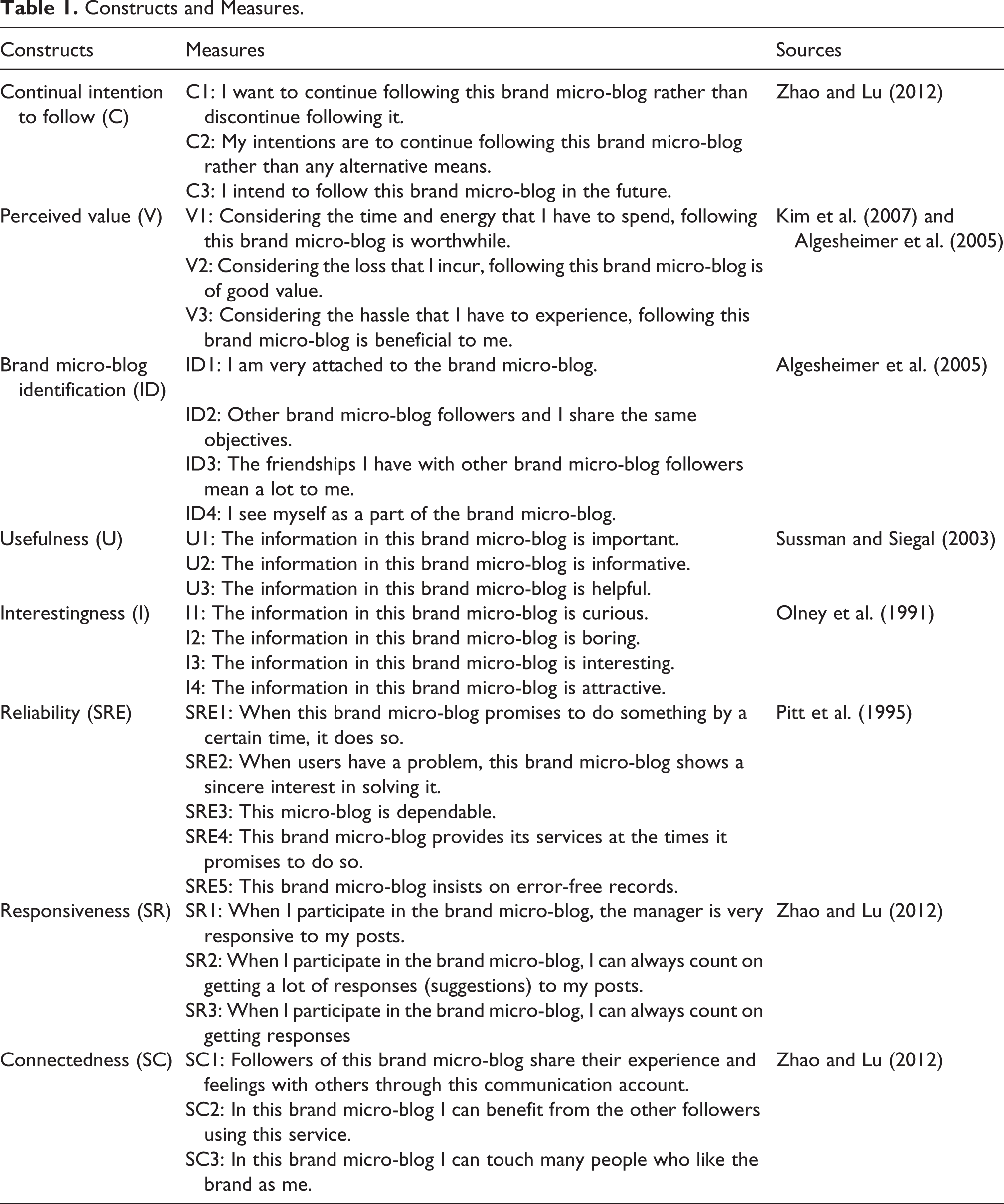
We developed survey instruments by adapting existing validated instruments when necessary. Items for continuance intention came from Zhao and Lu (2012). Items to measure perceived value and brand micro-blog identification were derived from Kim and Kankanhalli (2009), and Algesheimer et al. (2005), respectively. Items for the five utilities (i.e., usefulness, interestingness, connectedness, responsiveness, and reliability) also came from the literature review. All variables were measured in 7-point Likert scales (1 = strongly disagree, 7 = strongly agree). In total, 28 measurement items were generated (see Table1). The items were revised based on comments and feedback from 10 experienced researchers in the information technology area and from a pretest of 50 brand micro-blog followers. The formal questionnaire was based on the refined measurement questions.
Constructs and Measures.
Data collection
Micro-blogging is a new form of blogging in the Web 2.0 era. Typically, micro-blogging services include Twitter and Sina Weibo. The Sina micro-blog, one of the largest and most popular brand micro-blog service providers in China, served as the research site to conduct the online survey. Sina launched its micro-blog service in October 2009, and by the end of October 2012, the number of users had already reached more than 424 million. To encourage participation, valid respondents were offered incentives of 10 RMB to complete the survey. The respondents were users who had followed or become fans of a brand micro-blog. A hyperlink to the survey web page directed the respondents to the online version of the questionnaire. Use of a preventive measure, to avoid repetitive completion of the questionnaire from the same respondents, served to reject repetitive data with the same IP address.
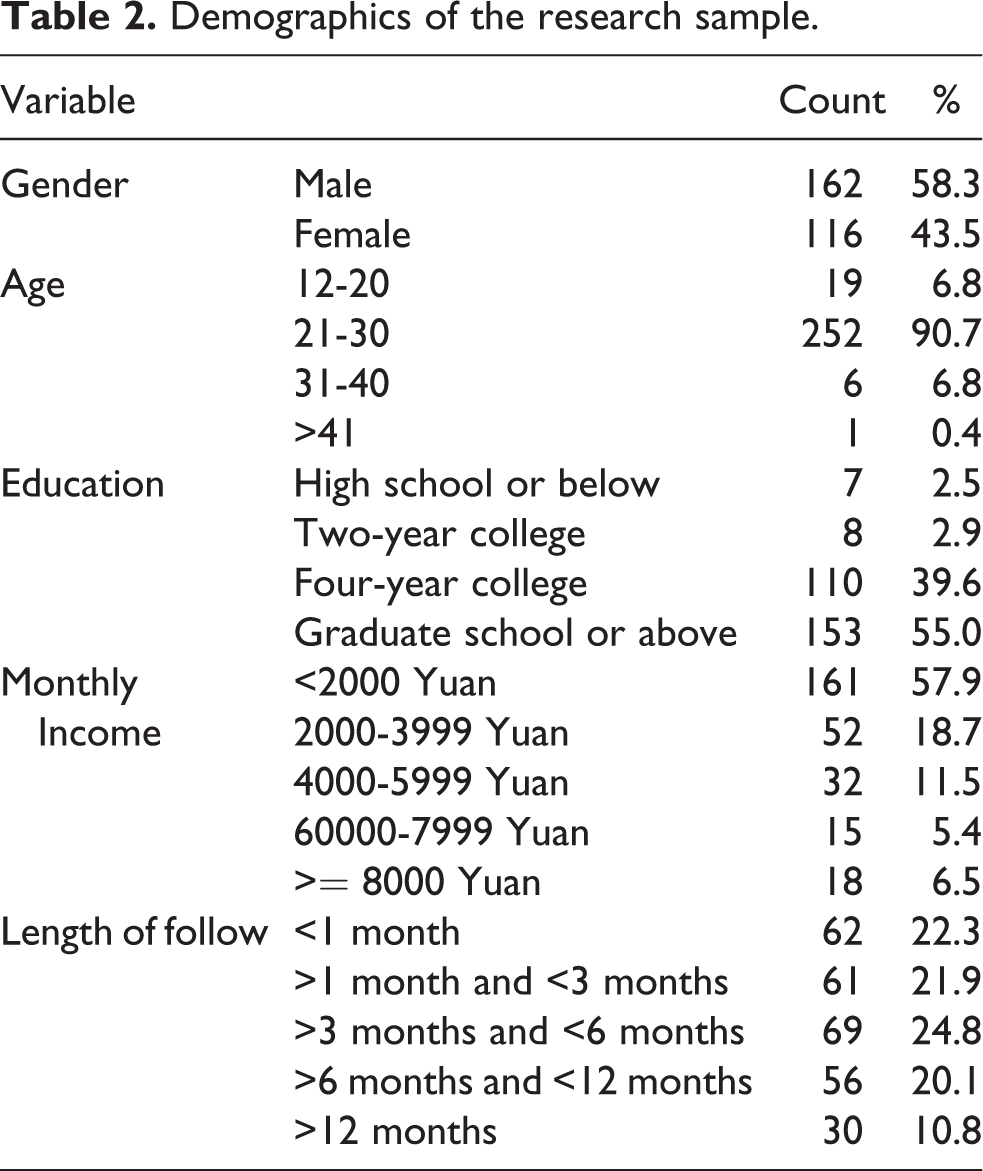
The online survey last for 1 month. In total, 309 respondents participated in the survey. After deletion of responses with the same answers to all questions and responses from those who had never used the Sina micro-blogging service, the data collection resulted in 278 valid responses. The results of t-tests found no significant differences (t < 1.96, p > 0.05) after comparing the means of all variables and the demographics for early (150 valid responses collected in the first one week) and late (128 valid responses collected two weeks later) respondents. The results indicated that non-response bias does not appear to be a problem. Table 2 depicts the demographic profile of the 278 respondents. .
Demographics of the research sample.
Data analysis
Partial least square (PLS) using SmartPLS 2.0 M3 was used for data analysis. PLS is an appropriate statistical tool when the content and variables have not been extensively tested or the research model is in the exploratory stage (Teo et al., 2003).
Measurement model test
All Cronbach’s alpha values were above the 0.70 threshold, indicating that the scales had high reliability. Internal consistency of the measurement was assessed by computing composite reliability (CR); a CR of 0.70 or greater is deemed acceptable (Fornell and Larcker, 1981). As Table 3 shows, all the items reached the recommended CR levels, demonstrating good reliability.
Scale properties.
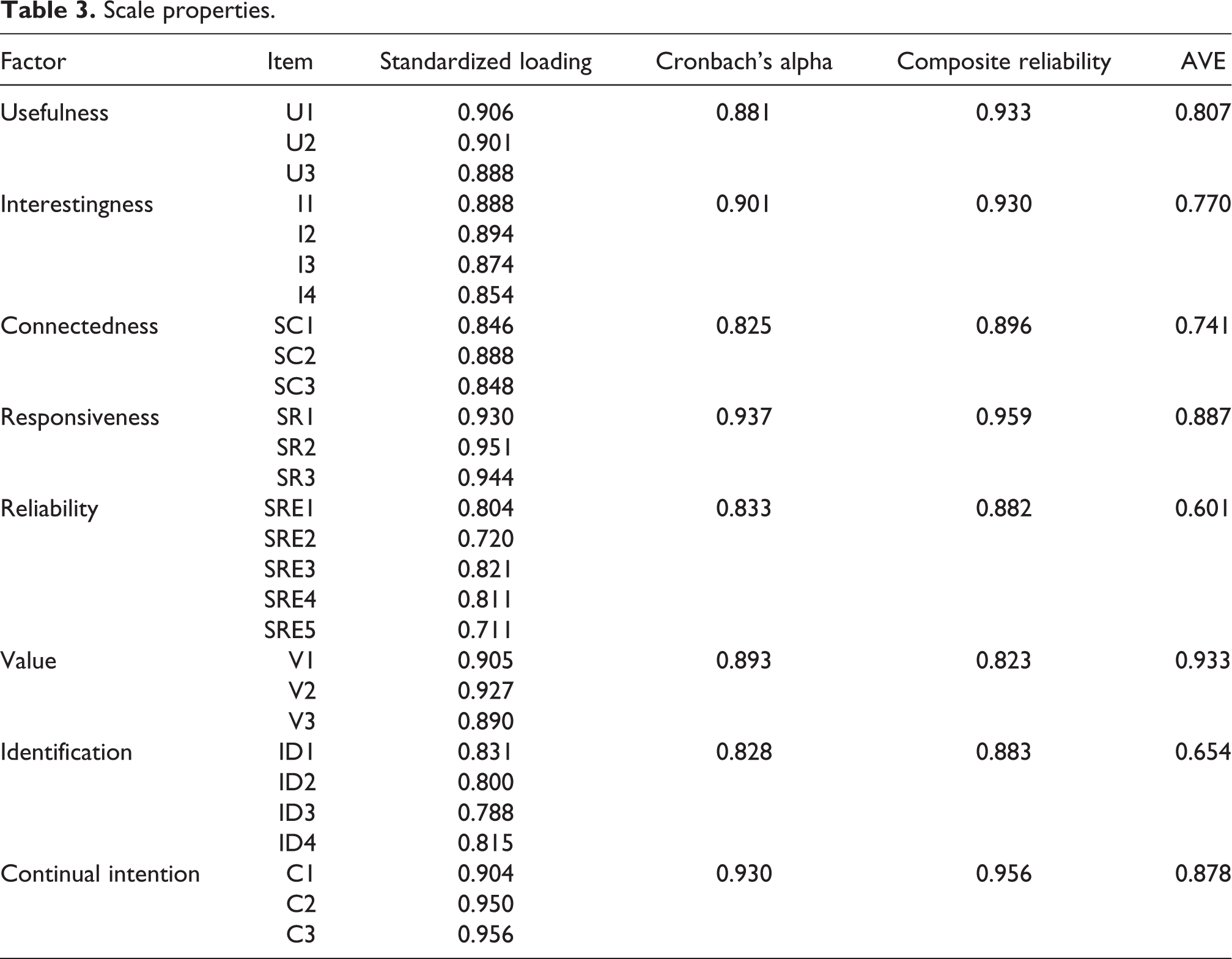
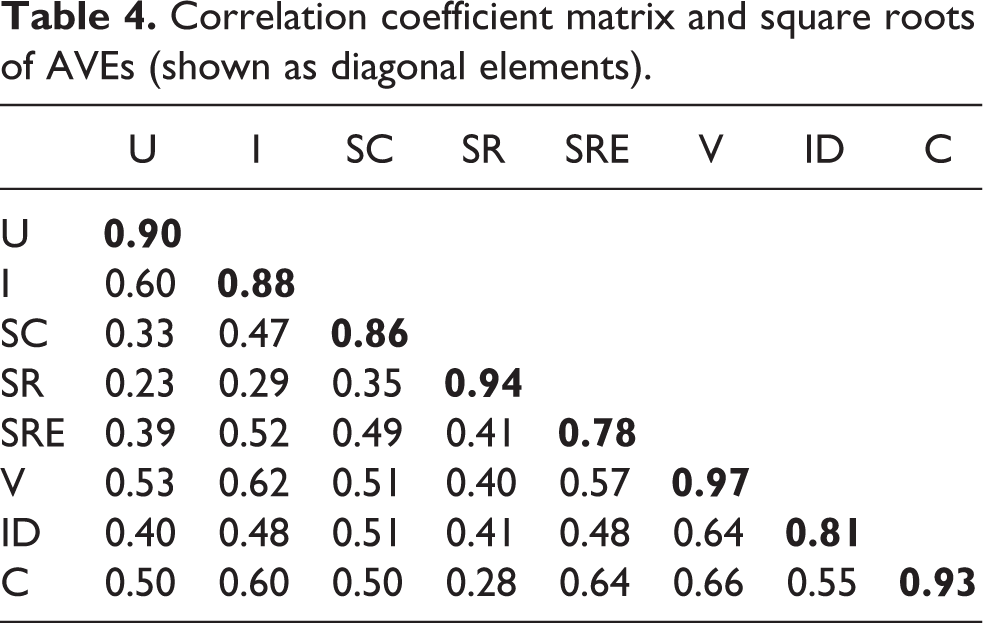
Convergent validity was demonstrated as each standardized loading of the items was greater than 0.7 and the average variance extracted (AVE) for every construct was greater than 0.5. Table 4 shows the correlation matrix and the square roots of the AVEs. The square roots of the AVEs of each construct exceeded the correlations between one construct and all other constructs, demonstrating adequate discriminant validity of all the constructs.
Correlation coefficient matrix and square roots of AVEs (shown as diagonal elements).
The study variables were collected via a self-report scale. We also checked for common method variance (Podsakoff and Organ, 1986). A Harmon one-factor test was applied to check the common method variance. The Harman’s test showed that the first factor accounts for 14.5% of the variance, which is smaller than the 50% of the variance explained by the first factor. The results did not indicate common method bias (Igbaria et al., 1997).
Structural model test
Figure 2 depicts the SmartPLS coefficients. Multicollinearity was checked in light of the threshold value of 5.00 (Cooil et al., 2007). The values of the variance inflation factor (VIF) for usefulness, interestingness, connectedness, responsiveness, reliability, value, and identification are 1.65, 2.06, 1.31, 1.71, 1.62, 2.43, and 1.75, respectively, providing evidence against multicollinearity.
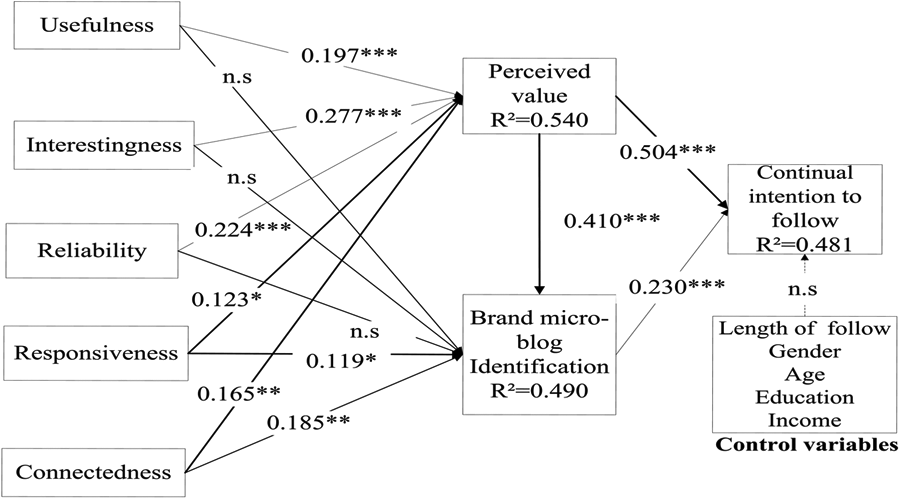
Model testing results. Note: *p < 0.05; **p < 0.01; ***p < 0.001, n.s = not significant.
As expected, perceived value (β = 0.50, t = 8.78, p < 0.001) and brand micro-blog identification (β = 0.23, t = 3.92, p < 0.001) positively affected followers’ continuance intention. Thus, H1 and H2 are supported. In addition, perceived value (β = 0.41, t = 5.25, p < 0.001) positively affected brand micro-blog identification, so H3 is supported. Similarly, the findings corroborate H5a, H6a, H7a, H8a, and H9a. The path coefficients of usefulness (β = 0.20, t = 3.36, p < 0.001), interestingness (β = 0.28, t = 4.22, p < 0.001), connectedness (β = 0.17, t = 2.80, p < 0.01), responsiveness (β = 0.12, t = 2.51, p < 0.01), and reliability (β = 0.22, t = 3.45, p < 0.001) were significantly positive, indicating that the five utilities positively enhance followers’ perceived value. Likewise, connectedness (β = 0.19, t = 4.08, p < 0.001) and responsiveness (β = 0.12, t = 2.64, p < 0.01) exerted significant influence on followers’ brand micro-blog identification, in support of H7b and H8b. In contrast, usefulness (β = 0.05, t = 0.81, p > 0.05), interestingness (β = 0.04, t = 0.61, p > 0.05), and reliability (β = 0.08, t = 1.08, p > 0.05) did not exert significant direct influence on followers’ brand micro-blog identification (H5b, H6b and H9b). In addition, the five utilities jointly explained 54% of the variance of perceived value and 49% of brand micro-blog identification. The findings for the three control variables examined indicate that followers’ age, gender, and the length of time following have no significant effect on followers’ continuance intention.
We adopted the path comparison method proposed by Cohen et al. (2013) to test H4 (See the detailed procedures in Appendix A) .We found that perceived value had a stronger impact than brand micro-blog identification on continuance intention (t = 60.77), thus, H4 was supported.
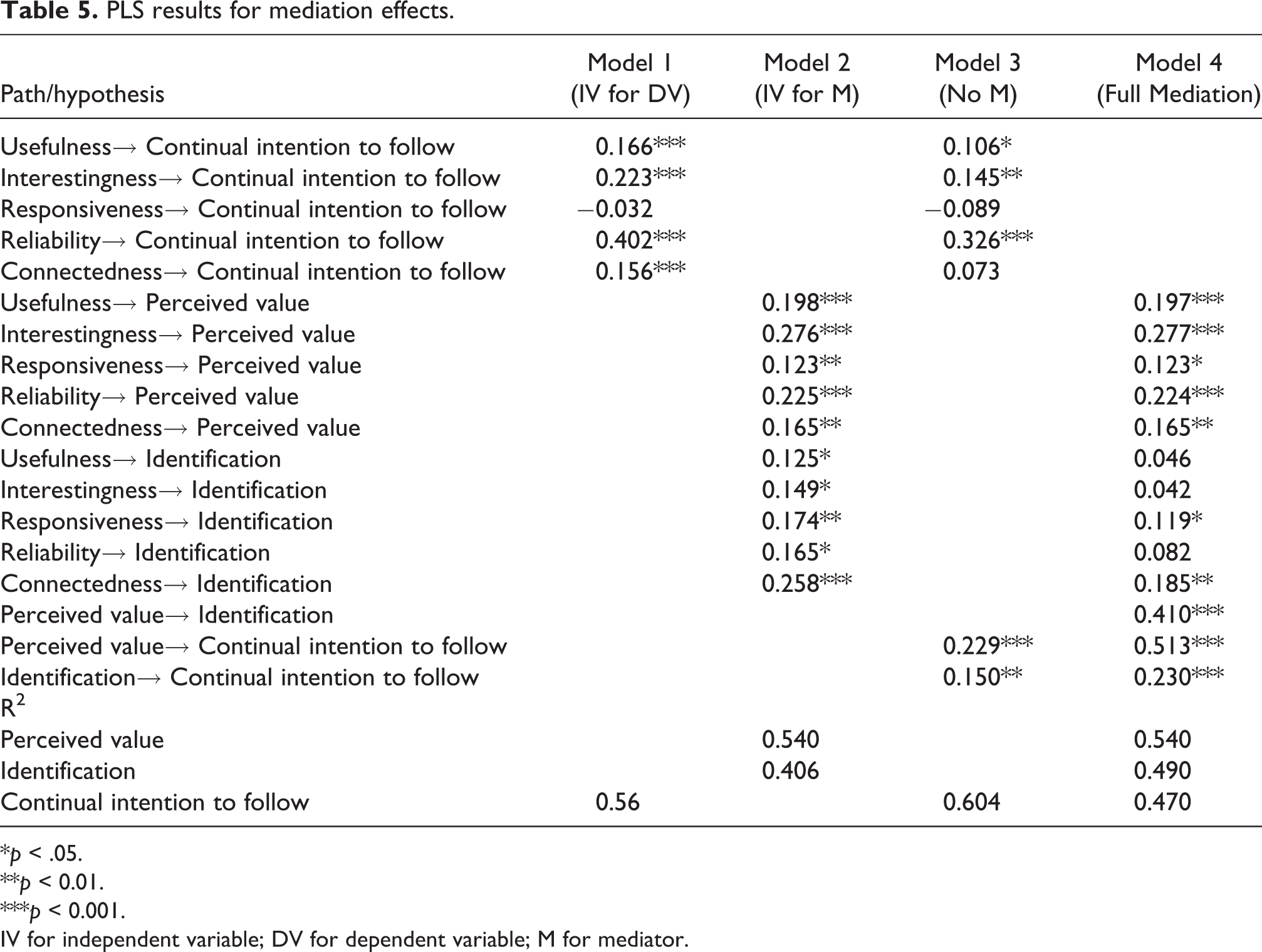
The mediating effects were tested by following the method of Andrews et al. (2004). We tested the effects using PLS analysis. In the Table 5, Model 2 showed that the independent variable significantly influences the mediator variable. Model 4 showed that the mediator significantly influences the dependent variable. The results of Model 1 showed that usefulness, interestingness, reliability and connectedness directly affect continuance intention to follow, which indicated that the independent variable significantly influences the dependent variable; whereas the effects of responsiveness on continuance intention of follow did not meet this condition. Thus, H10d and H11d were not supported. Model 3 results showed that entering the mediator of perceived value and brand micro-blog identification indeed decreased the impact of three sets of utilities from Model 1 to Model 3. In particular, the impacts of usefulness, interestingness, and reliability on followers’ continuance intention were diminished (but still significant), indicating partial mediation. Thus, H10a, H10b, H10e, H11a, H11b, and H11e were supported. Moreover, after the mediators were controlled, the impact of connectedness on followers’ continuance intention was diminished and insignificant, indicating full mediation. Thus, H10c and H11c were supported.
PLS results for mediation effects.
*p < .05.
**p < 0.01.
***p < 0.001.
IV for independent variable; DV for dependent variable; M for mediator.
Discussion
We tested a conceptual model that proposes that three types of micro-blog utility (i.e., information, social, and service) will affect followers’ continuance intention through the mediation of followers’ perceived value of, and their identification with, the brand micro-blog. The results provide support for most of the research hypotheses. For example, most of the functional and social utilities functioned to enhance followers’ intention to continue following the brand micro-blog, except responsiveness (H10d and H11d). The possible explanation might be that consumers tend to put more emphasis on the quality of the response, such as usefulness and interestingness, rather than timely responses, as their consideration of continuing to follow the micro-blog. Furthermore, these three types of utility combined to form perceived value and identification, which mediated the effects of the three types of utility on followers’ continuance intention. Specifically, all of the information utilities, social utility, and service utility directly influenced perceived value, The results are consistent with VAM, namely that utilities result in perceived value. Among the three types of utilities, social utilities (connectedness and responsiveness) were found to directly affect identification. These results are consistent with social identity theory, which proposes that social needs facilitate people’s identification with a group. However, information utilities (usefulness and interestingness) and service utility (reliability) were found to influence identification indirectly through perceived value. The possible explanation for these findings might be that these two types of utilities are the functional utilities that result in perceived value first (Ulaga and Eggert, 2006). In addition, our results showed that followers’ perceived value exerted a stronger effect on continuance intention than followers’ brand micro-blog identification. The finding suggests that the weak ties in brand micro-blogs are less important than the functional values in determining followers’ continuance intention.
Theoretical contributions
By integrating VAM and social identity theory, this study contributes to a nuanced understanding of followers’ continuance intention in a brand micro-blog context. Instead of considering functionalist utilities and/or social value separately, this study uncovers two intermediate mechanisms, perceived value and social identification, which mediate the effects of the three sets of utilities that consumers derive from their participation in brand micro-blogs on their continuance intention to follow the blogs. We propose that a brand micro-blog provides both economic utilities such as information and social values such as connectedness, and that the participants of the brand micro-blog assume the dual roles of followers and consumers. Therefore, consumers’ continuance intentions to follow the blog draw on their perceived value of and social identification with the blog. We build a model that provides a comprehensive view as to how consumer utilities translate to their continuance intention to follow brand micro-blogs through these two intermediate mechanisms. It is worthwhile to note that although community research emphasizes social identification, we find that consumers’ perceived values that draw on the economic utilities of the blog are a more important determinant of their continuance intention.
Practical implications
The results also have implications for brand micro-blog managers who want to retain their followers or translate observers into members. In general, the significant effect of perceived value on continuance intention suggests that brand micro-blogs must provide valuable information and services if they want their followers to continue to follow. In addition, blog managers must also aim at building good relationships with followers to motivate their social identification. Our results indicate that the degree of social connectedness engendered through the blog is conducive to attracting consumers to join and continuously follow the blog. However, our results also suggest that blog managers must pay more attention to enhancing consumers’ perceived value, which is determined by the three sets of blog utilities in combination. Therefore, to sustain consumers’ intention to follow the blog, managers must design and maintain the blog in such a way that enhanced utilities will effectively lead to consumers’ perceived values and social identification alike.
Limitations and future research directions
This study had several limitations that influence the generalizability of the findings. First, the study was conducted entirely within a Chinese context. Although the Sina micro-blog is the largest brand micro-blog operator in China and has a relatively large follower base, additional research using multiple national data would improve the generalizability. Second, the study examined followers’ continuance intention at only one point in time. Followers’ beliefs about the brand and technology may vary over time, and thus multi-period studies should be conducted to uncover followers’ longitudinal behavior. Third, the brand micro-blog service was quite new in the micro-blog context, and approximately 70% of the respondents had followed the brand micro-blog for less than six months when the study was conducted. Such bias in the sample might have affected the results. Thus, further research should be undertaken at another time to validate the results. Finally, the study considered only one brand micro-blog on which consumers posted and re-posted their messages, and followers might have been simultaneously active on the competitions’ brand micro-blogs. Further research should examine follower behavior in multiple brand micro-blogs.