







Abstract
This article summarizes the best practices framework known as ‘75 Lessons Learned from Information Literacy Programs at Ibero-American Universities’, drawn from the study of 301 information literacy experiences in Latin American countries, Spain and Portugal. This research involved analysis of 499 documents and data triangulation with 113 interviews and 135 surveys. This comprehensive framework is a useful Ibero-American guideline for developing new information literacy programs or strengthening existing ones at a worldwide level.
Keywords
Introduction
Previous research identified several milestones as the origin of information literacy (IL) as a research and practice field in Latin America, which emerged from the need of building increasingly complex and robust information systems, while incipient information demands generated the wish for developing more independent, informed and selective information users (Machin-Mastromatteo and Lau, 2015). These milestones presented in cited work are: the first IL conference in 1997, 1st National Meeting on Developing of Information Skills, at the Autonomous University of Ciudad Juarez (Mexico) that produced the first IL declaration in the world, predating the Prague Declaration (2003); then, the first documents on IL written by Latin American researchers date from the year 2000; the International Federation of Library Associations and Institutions’ ‘Guidelines on Information Literacy for Lifelong Learning’, authored by a Latin American researcher; and the Wiki ALFIN/Ibero-America 1 . From these milestones, various institutions, especially libraries in mostly higher education institutions, started developing in-house information literacy programs (ILP).
Within this regional IL context and tradition, the doctoral research ‘Lessons Learned from ILP at Ibero-American Universities’ (Uribe-Tirado, 2013), is considered a flagship instance of IL research, at least by Spanish- and Portuguese-speaking researchers and practitioners. What makes it special is its main results, the best practices framework ‘75 Lessons Learned from ILP at Ibero-American Universities’, which was drawn from the study of 301 IL experiences of Latin American countries, Spain and Portugal; including ILP and the inclusion of IL in university curricula. This framework has been communicated in Spanish journals (e.g. Uribe-Tirado and Pinto, 2014), but it has not been so prominent in the English specialized literature. This year, Uribe-Tirado and Pinto (2017) discussed how and to what extent these lessons are also present in the specialized literature published by researchers from other regions (Uribe-Tirado and Pinto, 2014). The version of the framework that we present in this paper has been summarized and reduced to the very minimum to disseminate it to a larger audience through this column, in its most readable form, and in view of its significance for IL research in Latin America.
Uribe-Tirado (2013) identified 1,278 documents of interest, of which 457 (35%) centered specifically on university libraries and 42 (3.4%) on higher education environments. The sum of these latter documents, given that they pertained to higher education contexts, which are presumably the best in implementing ILP, was chosen as the total of documents to be analyzed for creating the framework (n=499). Apart from a documentary analysis, this research also performed data triangulation with other research instruments, such as 113 interviews and 135 surveys that were gathered. Institutional websites were also analyzed in order to determine how many of these IL experiences were reported in them. This latter analysis detected that from 301 IL experiences, only 171 were reported on their respective websites. Table 1 presents the number of universities per country (at the moment of Uribe-Tirado’s research), as well as the number of IL experiences detected, the percentage of universities with an IL experience, the number of documents analyzed, and the number of interviews and surveys conducted.
Ibero-American Universities, Information Literacy experiences, and data collection instruments.
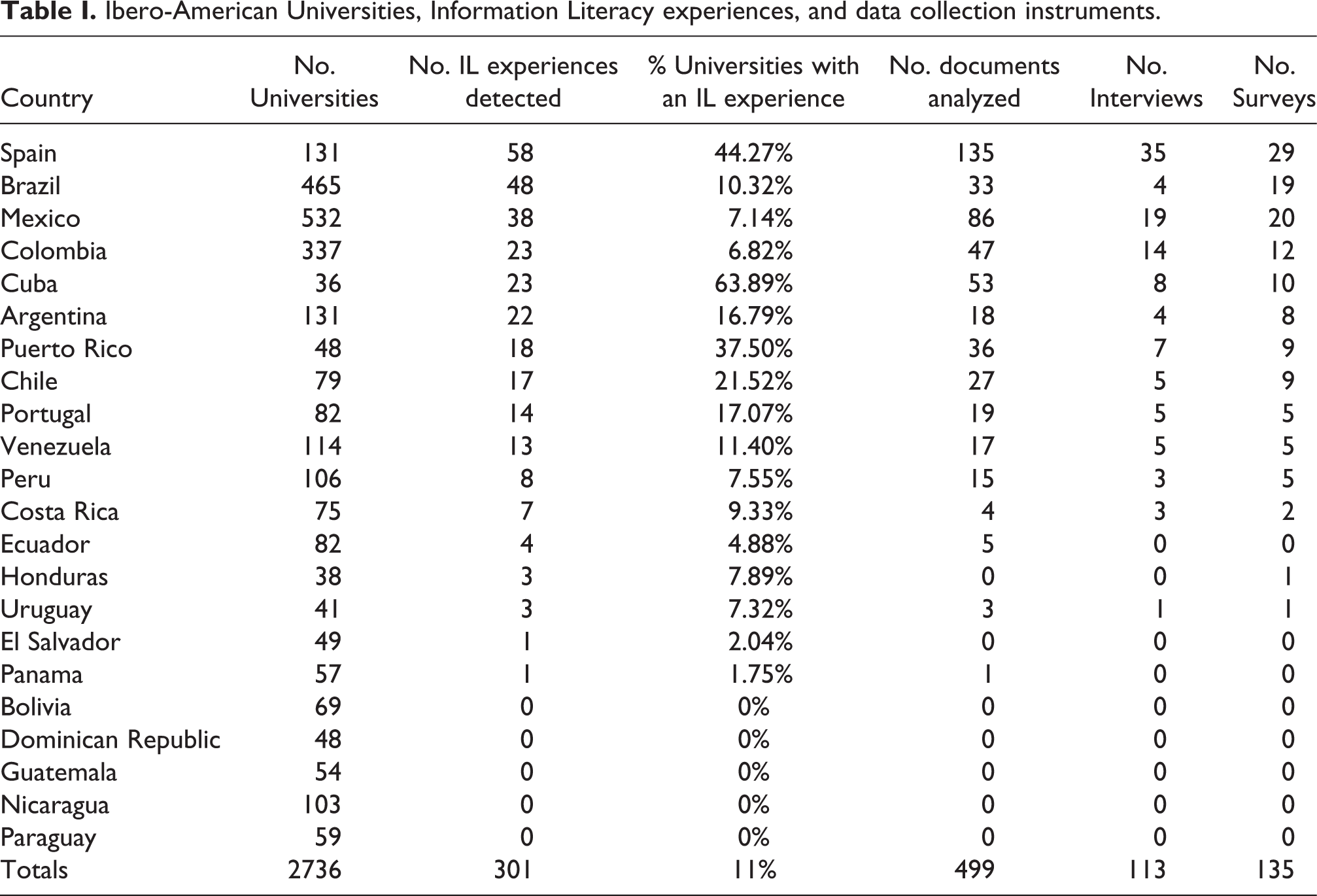
Table 1 offers an original and unpublished reinterpretation and presentation of data related to Uribe-Tirado’s (2013) research. Although the ILP registered in the table are from 2013, there has not been a significant increase worth reporting at this moment, partly due to the limitations involved in detecting new IL experiences: if they are not registered in institutional websites or reported in the specialized literature, they turn out to be invisible for researchers. However, the initiative of registering new IL experiences in the Wiki ALFIN/Ibero-America and in the ALFIN/Ibero-America Map 2 is still active.
It is evident that the percentage of universities with IL experiences is not very high in Latin America. From a qualitative perspective, when analyzing many ILP, it is possible to conclude that it would be pertinent to apply these 75 lessons to several ILP, as they have not considered or applied them. Hence, this text offers an invitation to revise the framework and, together with other Ibero-American researchers, to update it.
The following sections present a very brief summary of the 75 lessons framework, which is divided in four categories: 20 related to the specific social and organizational context, 24 to teaching and research processes, 17 to learning processes, and 14 to quality assessment and continuous improvement processes. These lessons are enunciated considering their application to ILP, specifically within higher education contexts and considering trainees’ aspects. ‘Trainees’ is the term used to refer to any participant of IL training, regardless of their educational level.
On the specific social and organizational context
1. Link ILP with institutional missions and visions, and with national information and educational policies. 2. Work as networks of university libraries to incorporate IL as a fundamental competence in educational, information and/or technological policies at the local, regional and national levels, especially where IL is not present. 3. Consider IL training in development, strategic, operational, action and teaching-research institutional plans. 4. Highlight the importance of ILP and the competences it develops among university authorities. 5. Support the planning of ILP based on a specific definition of INFOLIT, and existing models and standards. 6. Justify the importance of IL training among directors, professors-researchers and students, based on international documents that see IL as part of the higher-education that every professional must have in the information society. 7. Integrate ILP as a fundamental part in the curriculum, represented in different teaching-learning modalities and mediation forms. 8. Adapt ILP to the structural, functional and curricular characteristics of each institution. 9. Engage all university stakeholders in the appropriate development of ILP. 10. In universities with an information science school, collaborate in teaching, research and/or extension among this school, the library system and other related schools (e.g. Education, Computer Science, Communication, Languages); so ILP can grow through interdisciplinary work and research. 11. Anticipate changes, opportunities and threats that ILP might have. 12. Source new and existing financial, technological, physical and information resources necessary for the appropriate development of ILP. When under constraints, be creative and flexible. 13. Generate integrated ILP (multi-literacy) and new information and training spaces to enhance the training needed for today’s society. 14. Disseminate ILP’s benefits and achievements. 15. Develop ILP together with advertising-marketing processes, using diverse means and strategies to ensure that stakeholders are aware of ILP’s training opportunities and their importance. 16. Involve IL-aware professors in the development of ILP, to improve IL positioning and overcome reluctance or unawareness of its importance. 17. In universities with multiple libraries, identify the leading libraries and librarians regarding IL training. 18. Generate a favorable organizational climate in libraries and academic units, so ILP can be develop while avoiding disbeliefs and reluctances about its needs from some university stakeholders. 19. Position the library and its information professionals institutionally for their academic-scientific support and contributions for providing training in IL, essential 21st century education competences. 20. Update information professionals’ curricula to include IL theory and practice, including technological and pedagogical aspects. Strengthen this component through continuing education and postgraduate studies.
On teaching and research processes
21. Being aware of the history and results of past institutional training processes (e.g. library user training) and compare them to current IL practices, to learn from the positive aspects of those experiences and avoid previous mistakes; while demonstrating their theoretical, conceptual and practical differences. 22. Develop ILP considering the particular, contextual characteristics and educational levels of trainees; in order to develop it in different levels with diverse time-intensity, coverage and methodologies. 23. Consider all the stages, levels, and macro information competences (information needs, location, assessment, organization, use, communication, ethics and evaluation) of an integral ILP, both in theory and practice. The development of these competences can be articulated in different stages-periods, according to the needs, interests or knowledge base of trainees, and thus facilitates gradual learning. 24. Develop an administrative, operational, pedagogical and competences-based plan, to achieve ILP’s expected outcomes. 25. Define criteria, indicators and instruments for continuously evaluating ILP. 26. Work with teachers, researchers, librarians and academic coordinators for ILP’s planning, execution and evaluation. 27. Use different means (multimodality), spaces (physical and virtual) and student-centered teaching methodologies for conducting IL training. 28. Identify Web 2.0 tools to be used as a means of learning information competences and as sources for locating, organizing and evaluating information. 29. Integrate the expected IL competences in curricular and disciplinary training through courses, modules and/or concrete and flexible activities; mandatory or optional, transversal or disciplinary. 30. Study the curriculum of the academic programs to detect the possibilities for incorporating IL in the programs, subjects and/or IL-aware professors, so tailored training can be developed through lectures, workshops, tutorials, modules, or complete courses. 31. Harness all the opportunities that the different faculties-schools can provide for the presence, growth and/or curricular integration of ILP. This implies having flexible and innovative activities within ILP, but its general objective (acquire information competences) and specific objective (acquire sub-competences) must be clear. 32. Ensure that IL training reaches the largest number of students possible, both directly or indirectly. In large institutions, this can be achieved by training teachers and have them extend training to their students, or by using technologically-mediated training options. 33. Adapt IL training to the university community’s interests, for gathering more allies and having a larger impact with information competences training, specifically with professors-researchers and through topics related to research processes, publishing, or copyright. For administrative staff, training may aid them in doing their work more efficiently. 34. Ensure that IL training inclusively meets the needs of the whole university population, including those with disabilities or diverse cultural backgrounds, through appropriate adjustments to ILP. 35. Having a digital library implies having many digital information users, so ILP should have a digital training subprogram, adapted to these users’ characteristics. 36. IL training is achieved through formal training and daily communication with library users through many different channels. Therefore, involving all librarians and the library as an IL space. 37. Evaluate the levels IL-related competences of trainees to identify their potential to acquire them and differentiate or relate such competences to other literacy competences (multi-literacy). 38. Work on IL instructional design and learning objects, considering open access resources, so that training can be used at any time and can benefit more university students, more citizens, and thus fulfill a social role of information and training; in addition to enabling a greater exchange of experiences with other libraries and validation in different contexts. 39. Develop ILP continuously and gradually, to achieve a greater coverage in training and a significant impact by including a large number of diverse users: students, teachers, researchers, employees and graduates. 40. Constantly update ILP’s content, pedagogical-technological means of delivery and disciplinary examples provided, for appropriately responding to trainees needs and motivating them to learn. 41. Include training on managing physical and digital information sources, taking into account their potential and the contextual realities that facilitate or hinder the access and use of certain sources. 42. Emphasize IL training and the development of information competences by students will depend on the organization of specific courses and activities for such training to occur, and on the awareness about the importance given to IL by teachers and their own IL levels of competence. 43. Develop ILP from the perspective of formal education in the university, from the action of academic libraries, and also from continuing education programs required by other organizations; in order to fulfill the labor-professional-citizen competences demanded by current society and to comply with the social responsibility of any university or library. Where appropriate, have an alternative financing source for ILP’s economic sustainability. 44. Have a specific coordination in charge of ILP and ensure that trainers have a good enough professional profile, which implies possessing information, technological and pedagogical skills, as well as the motivation and potential to be a capable learning facilitator.
On learning processes
45. Identify information competences as fundamental for achieving better academic, scientific and work performance, permanent and collaborative learning, and for critical thinking. 46. Appreciate trainees’ prior knowledge, experiences and interests, as sources for meaningful learning. 47. Recognize the differences and disciplinary requirements among trainees, in relation to information and their different training expectations according to their academic cultures. 48. Conduct periodic diagnostics to recognize trainees’ rhythms, information behavior, information culture, generational characteristics, and learning styles, as well as promoting autonomous learning and adjusting ILP to these changing profiles and realities. 49. Improve trainees’ motivation for undertaking information competences training, through topics of academic and personal-social interest, and highlight IL’s importance for their professional-scientific-academic-citizen life. 50. Clearly present to the trainees the objective and scope of IL training, to avoid generating higher or lower expectations and commitments, and show that this training can be gradually assumed in different levels or sub-competences, which are all important. 51. Link trainees’ IL training with concrete work for their courses, their research or their educational, scientific and/or administrative performance. 52. Develop ILP’s training activities using active pedagogies that challenge students (e.g. learning based on: projects, problems, cases, or competitions). 53. Motivate the acquisition of IL competences through the enjoyment, challenge and scientific spirit that results from locating accurate information and using it for a personal, academic, professional or social benefit. 54. Develop an oral, textual and/or audiovisual IL language by using different modalities, means or contents, according to trainees’ knowledge, generational level and/or culture. This makes training more comprehensible and appropriate, without being excessive, too informal or too formal, which could generate some rejection toward information competences or ILP. 55. To identify that INFOLIT training courses and activities allow achieving better learning outcomes when they are developed from a more segmented and personalized perspective, involving not very large groups and working in private and disciplinary interests, although with a wide coverage that encompasses the greater number of members of the university community that requires this training. 56. Define the criteria, indicators and instruments to perform trainees’ formative and summative evaluation (optional or mandatory), and of ILP’s impact. 57. Allowing and appreciating trainees’ self-assessment (input during and at the end of training) as part of the training process. However, such feedback is not the only measure to detect if IL competences were acquired or if training was successful. Therefore, it is necessary to use other methodologies and instruments that prioritize assessing learning above satisfaction levels. 58. Provide a digital or face-to-face space where, after training, trainees can gain updated information, ask questions, or self-learn a particular competency, either at a theoretical-conceptual level or in an applied-instrumental manner. 59. Foster the creation of learning and practice communities or social networks, either face-to-face or digital, to facilitate the exchange of experiences, empower trainees with the mediation of librarians and/or teachers, and enable them to be peer-trainers, considering that thematic, generational or other shared characteristics may help develop peer-learning alternatives. 60. Facilitate one-to-one or one-to-many broadcast spaces where trainees may contribute to disseminate ILP, since the best publicity often comes from a peer. 61. Link IL training processes at the undergraduate and graduate levels with those aimed at primary and secondary education. When these are not present, conduct extension or social activities that facilitate IL training, but tailored to these earlier levels.
On quality assessment and continuous improvement processes
62. Train the trainers (librarians, computer scientists or professors) and recruit experts in pedagogy, technology and information to generate a learning community around IL training. 63. Facilitate undergraduate or graduate training of interested librarians or IL trainers, so they can obtain the necessary skills in a formal and permanent way, in addition for them to become better educators. This enables contact with other university community members, advertising the program, generating interdisciplinary work and increasing the awareness toward librarians’ new educational roles, which become more relevant under the information society’s demands. 64. Constantly monitor the progress of IL as a theoretical-conceptual and applied subject, at a global or local level. 65. Periodically share and exchange information, methods and plans with other IL coordinators or trainers from other contexts and educational institutions; and promote the generation and engagement in local, regional, national or international IL networks, consortiums, professional events, development of guidelines or policies. 66. Generate continuous benchmarks among institutions from different contexts and identify successful IL cases for an ongoing improvement, from the necessary contextual-organizational adaptations. 67. Continuously disseminate the results and progress of ILP in academic and scientific publications. 68. Generate formal follow-up processes, so new trainers systematically and strategically learn from experienced IL trainers, and use knowledge management in ILP to socialize and generate further knowledge from best practices. 69. Periodically evaluate ILP and their coordinators and trainers from an impact perspective, and in a process-results manner, in order to continuously improve. 70. Obtain regular feedback from trainees and take their relevant suggestions into account. 72. Identify the need to generate quantitative and qualitative measurement indicators to evaluate ILP and accomplish good results in the short, medium and long terms. 73. Consider external methodologies and evaluation tools to adapt them to the specific context, or continuously and comparatively generate in-house methodologies and evaluation tools between faculties-schools or universities. They evidence the acquisition of IL competences and their academic-scientific-social impact. 74. Enable IL certification processes that allow access to certain curricular levels; and in the organizational-business context, to participate in certain work-positions of importance regarding the education and production in today’s society. 75. Link ILP to quality management and accreditation processes of libraries and universities, through the generation of procedures, guides, and the permanent documentation and evaluation of IL’s processes and results. 76. Raise awareness about IL among university leaders, faculties or administrative units; while promoting ILP’s achievements and the good performance of its coordinators and/or facilitators.
Conclusion
This framework of 75 lessons is a good example of using reflective practice as a means to study the practice of different professionals at various institutions, in order to systematically advance the development of research and theory within given field. This framework represents a worthwhile contribution toward the worldwide advancement of IL research, as well as providing a useful roadmap for developing new IL initiatives or enhancing existing ones.
The research data presented show that the percentage of regional universities with an ILP range from 1.75% to 63.89%, and five countries do not have any IL experiences detected, which may mean that either they do not exist, or are not reported in the specialized literature or in the institutional websites; which is vital to make them known. We counted 2,523 universities in Latin America (obviously ignoring Spain and Portugal), 229 of these universities have an IL experience (of which 135 appear in their respective institutional websites), which represents 9.08% of all Latin American universities. This regional percentage is quite low, so there is still work to do in the IL field, both to increase the number of experiences and making sure that such experiences are reported in the specialized literature and in institutional websites as the important initiatives that they are. The 75 lessons framework is an appropriate starting point and solid basis to do so.
These 75 lessons are valuable for providing a knowledge base for INFOLIT learning and teaching within higher education contexts, which may also be transferred to basic or adult education models, as well as IL initiatives throughout the world. They can also be adapted and updated by teachers and researchers to collaboratively continue learning and researching on IL, which is fundamental for meaningful and lifelong learning in the 21st century.