







Abstract
The Audit Opinion Laboratory (AOL) from the Universidad Autónoma de Chihuahua works with government and civil institutions to study and provide educational, training and informational interventions for alleviating the social issues occurring in the State of Chihuahua (Mexico), of which violence is the most urgent. This article provides a brief overview of violence in Latin America and Mexico, four examples of the kinds of projects undertaken by AOL, and its recommendations for developing violence and crime prevention plans, from AOL’s locally-conducted work.
The Audit Opinion Laboratory (AOL) was established in 2014 at the Universidad Autónoma de Chihuahua (Mexico). AOL collaborates with government and civil institutions to detect the main issues in the State of Chihuahua through the design and analysis of data collection instruments. AOL also proposes, facilitates and coordinates educational, training and informational interventions. It develops projects and studies about: preventing violence, the needs of populations at risk, the image of public security institutions, reading skills, education, information, journalism and communication; as well as the recovery of public spaces and sport or artistic activities. This document exemplifies AOL’s work and research, specifically on the study of violence at a regional, national and state level; its engagement in studies and interventions through four examples provided; and its contributions toward developing a violence and crime prevention plan for the State of Chihuahua.
Introduction
Regional and local studies related to violence allow us to discover and compare similar characteristics between countries, by analyzing levels, indicators and indexes related to: education, literacy and information literacy, regional development, and violence. The identification of experiences, solutions or the implementation of actions, through local systematic studies on violence and crime prevention, may be useful to replicate successful strategies and best practices in other locations with similar issues.
When high rates of violence and crime emerge, these may indicate a certain degree of social breakdown, as they produce direct effects on human well-being, economic growth, and on the social development of regions, countries and their societies (González, 2017). Violence is among the main causes of death and injuries in the region (Morais and Gomes, 2017), in fact, homicide rates are equated to epidemic levels (Chinchilla, in press). Violence is a widespread issue throughout Latin American countries and there is a large wealth of specialized sources that analyze this issue, both historically and contemporarily.
In 2017, two scientific journals prepared special issues dedicated on violence in Latin America. Ciência & Saúde Coletiva gathered 30 articles with various methodological approaches to study the subject as a complex phenomenon that implies historical, social, political, economic, cultural, psychological and biological aspects (Morais and Gomes, 2017). Crime, Law and Social Change sought to rethink aspects related to: organized crime, collective violence and insecurity, stability, political order, the real politics of crime and violence, the collapse of legality, the power of informal institutions, ‘crimilegal orders’, and criminalized electoral politics (Schultze-Kraft, Chinchilla and Moriconi, in press). Violence is manifested in various facets, some of those studied recently, are: the informal pacts with organized crime that involve formal democratic institutions, especially in Mexico (Chinchilla, in press) and Bolivia, with alleged narco-state relationships (Gillies, in press) the rise of vigilantism in Mexico and the level of citizen support it raises, from the general mistrust of law enforcement institutions (Zizumbo-Colunga, 2017) the lack of the security needed by Latin American citizens to live, and its effects in the region, labelled as the most violent and unequal (González, 2017) the limited access to justice in rural areas, where the worst human rights’ violations occur (van Isschot, in press) the persecution and criminalization of civil protest by the state, under an excessive use of force, in the specific cases of Chile, Mexico and Venezuela (Doran, 2017).
The Consejo Ciudadano para la Seguridad Pública y la Justicia Penal [Citizen Council for Public Security and Penal Justice] (Council) annually updates their list of the most dangerous cities in the world, by taking into considerations the number of homicides, the number of inhabitants and a rate they calculate. This list evidences the regional problem with violence. According to 2015’s statistics, there were 42 Latin American cities in the list and 2016’s statistics increased the number to 43 (Council, 2017b). The list published in 2017 was developed with data from 2016. In the list there are 19 cities from Brazil (three more than in 2015), eight from México (one less), four from Colombia (two less), seven from Venezuela (two more), including Caracas, currently the number one city, which was number two the previous year; Honduras has two cities (including San Pedro Sula, which was number one the previous year and currently is number three); Guatemala, Jamaica and El Salvador have one city each. Port-au-Prince (Haiti) was located at number 49 the previous year and is currently off the list. In order to produce this study, the Council (2017b) uses official statistics, but it highlights that in Venezuela’s specific case it must seek alternative sources, including the press and civil organizations, as “official statistics are nonexistent or are not reliable” (p. 42). This issue is further stressed by the Council (2018), which states, in stronger terms, that “from previous years, but especially in 2017, we face a new phenomenon, which expresses the very serious crisis in every respect that is affecting Venezuela: the increasing inability of counting their dead” (p. 6). They complement this by highlighting that given the high migration of Venezuelans, estimated in four million inhabitants –half of them during the past three years-–official population estimations are not precise, nor are the homicide rates, which they state are higher.
The Council (2018) published their annual update with data from 2017 and there are still 42 Latin American cities in the list. Los Cabos (Mexico) is currently number one, which was not in the previous lists and it overtook the first position -by a marginal difference- from Caracas, which is now number two. The cities from Brazil decreased to 17, the Mexican cities increased to 12, Colombia decreased to three cities, Venezuela decreased to five, although the Council states that given the scarcity of official data, they are not completely certain about the two Venezuelan cities that are not in the current list, but that were in the previous one; Honduras has the same two cities, and Guatemala, Jamaica and El Salvador still have one city each.
Violence in Mexico and Chihuahua
Due to the 23,000 homicides occurred during 2016 (22.8% increase from 2015), Mexico is considered the second country with the highest number of murders (after Syria) and violence has generally increased, partly due to the war against drug trafficking, which leads to confrontations between security forces and criminal groups (Tourliere, 2017); the latter seek to control territories to smuggle drugs and human beings to the north, and weapons and US dollars to the south. The cost of violence and crime in Mexico ranges from 83 to 112 billion USD, approximately 10% of its gross domestic product (Patel and Taylor, 2012, cited by Secretaría de Gobernación [SEGOB], 2015). Violence largely affects societies in all dimensions. From studies gathered by SEGOB (2015), we can categorize violence’s effects in three main dimensions: a) costs: direct, indirect, non-monetary; b) multiplier effects: financial and social; and c) bio-psycho-social effects: health, thought, behavioral and emotional. Hence, establishing prevention strategies is vital for citizens’ well-being.
During 2006, the organized crime and drug trafficking were responsible for 31.9% of the homicides that occurred in Mexico, and of 63.4% during 2010 (Molzahn, Ríos and Shirk, 2012). More recently, “government, media, academic, NGO, and consulting organizations suggest that roughly a third to half of all homicides in Mexico bear signs of organized crime-style violence” (Heinle, Rodríguez and Shirk, 2017: 3).
Chihuahua, a state located in northwestern Mexico, borders with the United States in the crossing between Ciudad Juárez and El Paso. According to murder rates in Mexico, May 2017 has been the most violent month registered and the State of Chihuahua was one of the most dangerous ones (Council, 2017a). Two of its main cities (Ciudad Juárez and Chihuahua), are among the 50 most violent (Council, 2017b).
Educating and intervening violence
Given the situation of violence, government institutions, civil organizations and AOL, the latter as part of the educational sector, are acting to prevent it, especially in disadvantaged and affected communities. The following sections present four examples of the studies and interventions that AOL coordinates with government and civil institutions. AOL takes care of data collecting and analysis, and it facilitates methodological and logistical support to develop interventions. Examples such as the following are planned according to guidelines established by SEGOB (2015) to develop these kinds of studies and intervention programs.
Youth at Risk
This program involved the participation of 100 youths that had any complication with the authorities in the past, but without any conviction. A diagnostic sought to detect situations related to their vulnerability conditions. Then, AOL implemented interventions consisting in offering youths the possibility of doing paid community services (recovery of public spaces, cleaning, painting), providing them with training workshops (on carpentry, violence preventions, self-esteem, addictions and life plans), and sport activities. A survey was applied after the interventions to assess their contributions to the youths involved. Their perception toward the government’s capacity to solve issues and fight crime improved. They also expressed that the public policies that have benefited them the most were those providing grants, education and health; but their perception worsened regarding justice, food and nutrition, and housing (El Tiempo, 2015).
School Violence
This program identified two secondary schools located in areas with violence and drug dealing issues. A questionnaire was applied to a sample of 337 students from these schools, which asked students about their own situation, the status of their families, the infrastructure of their sectors and school, and the attitudes of their classmates, teachers and parents. The intervention sought to strengthen the educational environments and foster interactive solidarity, through the collective improvement of schools’ infrastructures and workshops offered to students, parents and teachers.
Community Mediation
This program implemented two mediation centers and trained a network of people responsible for their operation, serving as mediators between the community and authorities, with the objective of strengthening alternative means to peacefully solve community conflicts through such centers and any activity that may foster social cohesion (SEGOB, 2015). This program identified two areas with high crime rates and applied a survey to a random sample of 383 people to detect their issues. Issues detected included: neglect of public spaces, presence of drug addicts, gangs and drunkards, danger in the vicinity, drug dealing, property damage, threats with weapons and physical aggressions. Most of the surveyed people stated to feel fine within their neighborhoods, but data collected justifies the need for mediation. Hence, after the diagnostic, the centers started working under the guidance of mediation experts. The results of this project include the establishment of both mediation centers (La Opción de Chihuahua, 2016).
Safe Mobility
This program was conducted in four bus stops around two neighborhoods with high levels of social issues and violence. The intervention developed sought to contribute to road safety and reducing risk factors, through the modernization of bus stops and the facilitation of traffic information by trained personnel. A random sample of 382 people that used public transportation was selected to detect the security conditions that may be further improved within the bus stops and their neighboring areas; these included: the presence of abandoned lots and houses around the access roads, part of the traffic lights do not work, there is drug dealing, and the access roads are generally dangerous.
Developing a violence and crime prevention plan
A violence and crime prevention plan must propose actions related to social, community, situational and psychosocial spheres. Actions must be executed by government institutions, the educational sector and civil organizations, thus conforming with “community prevention strategies as coordinated, integral and multi-sectorial actions” (SEGOB, 2015: 79). Also, such plan must be articulated from national and local governing documents. In the case of Mexico and the State of Chihuahua, these would include: a) the Constitution; b) laws related to public security and the prevention of violence and crime; c) National Development Plan 2013-2018; and d) State Development Plan 2017-2021.
These documents establish government institutions as responsible for public security; this implies working under the principles of legality, objectivity, efficiency, professionalism, integrity and respect for human rights, in order to: a) safeguard people’s integrity and rights; b) preserve freedoms, order and peace; c) crime prevention, investigation and prosecution; d) managing the information and communication of their activities to the public; e) develop crime prevention policy; f) implement programs and actions to foster values, respect for the law, and victims’ protection. However, the State must conduct such activities in collaboration with the educational sector, civil organizations and citizens.
Considering the governing documents, AOL aligned the components of the National Development Plan 2013-2018 (Gobierno de la República, 2013) and of the State Development Plan 2017-2021 (Gobierno del Estado de Chihuahua, 2017), to outline the axes that contributed to the development of a State Prevention Program (SPP); which is currently being developed (see Table 1).
Axes and action lines for the State Prevention Program.
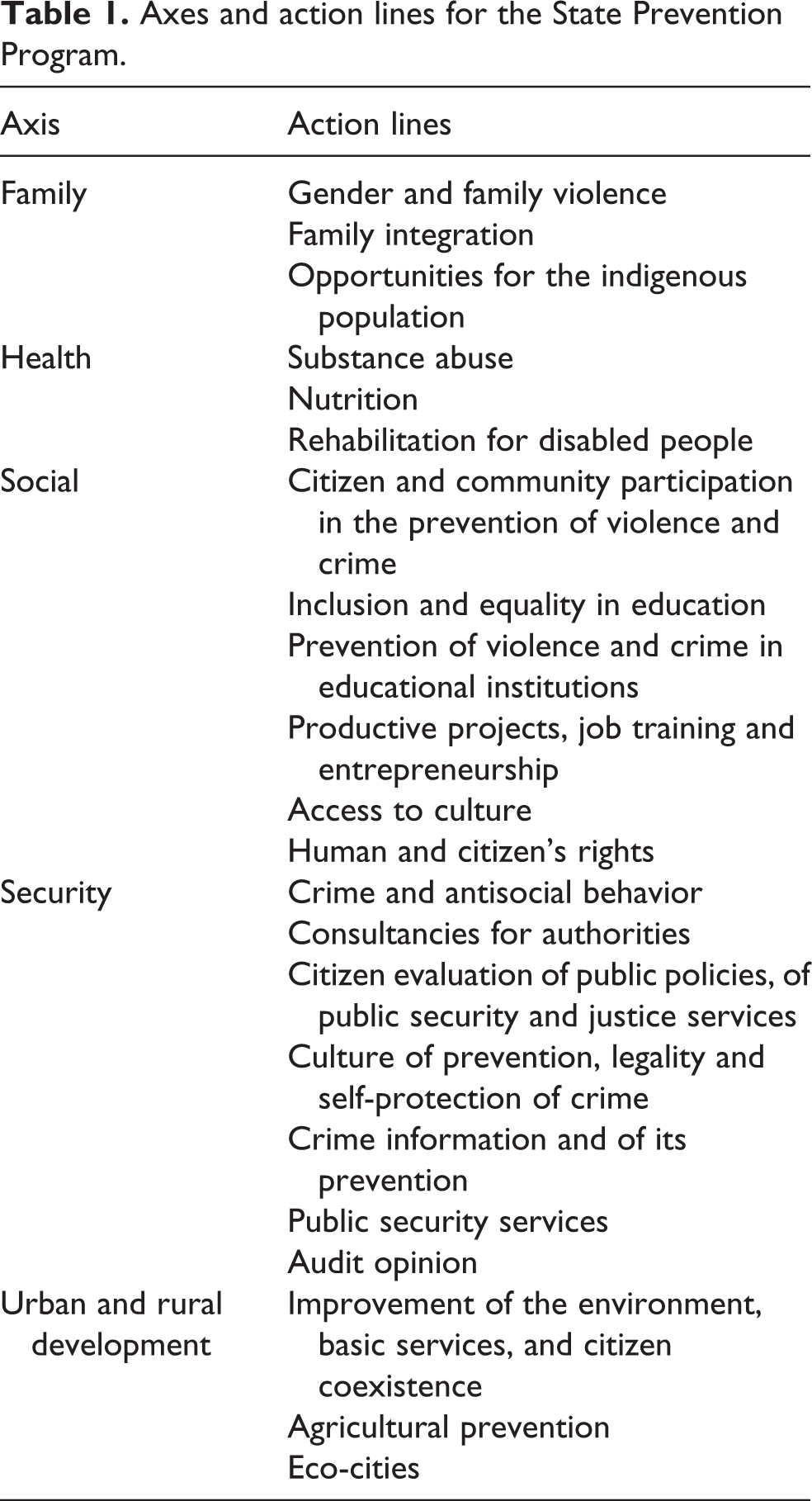
AOL gathered and analyzed the information facilitated by the various government institutions of the State of Chihuahua to develop the action lines for each axis in the SPP. It also proposed the following list of the kinds of activities that each institution may adapt to their lines of work and thus contribute to the SPP: Compile and disseminate the information about the situations that may affect or benefit citizens. Conduct citizen surveys and diagnostics to gather opinions, needs and proposals. Awareness campaigns. Psychological attention. Implement ‘legality academies’. Victim assistance, through psychological, education, rehabilitation and training programs. Conduct activities in cultural and leisure spaces. Psycho-educational workshops and selective interventions. Manage, equip, restore, improve and expand public spaces. Conduct physical rehabilitation, therapy and inclusion of disabled people. Conform citizen participation networks with all social stakeholders. Implement artistic, cultural or sports activities, festivals and contests. Arrange workshops and forums with specialists. Provide consulting services to government institutions through the educational sector and civil organizations. Collaborate among government, educational and civil institutions. Conduct systematic studies on the factors that lead to violence. Increase the academic indicators in all levels of education. Provide job training and advice for conducting productive projects or entrepreneurial activities.
Conclusion
Public policies are insufficient if they are not able to accomplish integral cooperation between government institutions, the educational sector, and civil or private organizations (Vargas, 2017). Violence and crime prevention strategies must fulfill two basic aspects: dissuade the perpetrator and address the causes of crime. The design and implementation of any prevention program must be multidimensional, joining the historical, statistical and psychosocial perspectives to identify the issues behind crime and violence. It is important to educate and inform society, as well as disseminating the results and benefits obtained from the implementation of violence and crime prevention activities; such course of action may improve trust in the institutions, and ensure that all stakeholders engage in joint efforts aimed at reducing violence in the region and achieve peace.
