







Abstract
Adaptation strategies are considered to be an effective measure to build resilience to the effects of climate change. The agro-weather tools for adaptation to climate smart agriculture were implemented as a pilot project in Embu and Ada’a Districts of Kenya and Ethiopia respectively. Random sampling technique was used to select 360 and 171 farmers from the population of project’s beneficiaries in Kenya and Ethiopia and data collection was carried out with the use of a questionnaire. The overall results show that farming experience and impact of agro-weather information were significant determinants of the use of all the tools. Ownership/access, extension contact, frequency of extension contact and extension agency were significant determinants of the use of short message service (SMS), newsletter, and radio while group membership was a significant determinant of the use of SMS, newsletter, and interactive voice response. The significance of these variables stresses their need in the planning and policy formulation for the use of agro-weather tools for information dissemination.
Introduction
Ensuring food security under a changing climate is one of the major challenges of the 21st century. There are about 870 million people in the world that are food insecure, close to the number believed to be below the US$1.25 per day poverty line. Three-quarters of these truly poor live in rural areas and depend on agriculture for their livelihood. A growing global population, changing dietary patterns, and increased competition for land and water will intensify the challenge of meeting future needs for food, fibre, and fuel. Climate change adds greatly to this challenge as agricultural productivity is highly impacted by weather (World Bank, 2016). These factors make agriculture among the most vulnerable economic sectors to climate change. Extended droughts and other extreme weather events can have devastating effects on agricultural productivity. These effects can contribute to food price volatility. The incidence of extreme weather events appears to be increasing, affecting food supply and livelihoods.
Agricultural production remains the main source of income for most rural communities in East Africa; hence, adaptation of the agricultural sector to the adverse effects of climate change will be imperative for protecting and improving the livelihoods of the poor and ensuring food security (FAO, 2012). Mitigation strategies have traditionally received greater attention than adaptation, both from a scientific and policy perspective (Cohen et al., 1998). However, more recently, adaptation strategies have gained more interest in the literature, and are considered to be an effective measure to build resilience to the effects of climate change. Tarleton and Ramsey (2008) identified three key reasons for the growing interest in adaptation strategies which are to be adopted by farmers. First, adaptation measures can be applied on a much smaller scale, which makes their effectiveness less dependent on multiple decision-makers. Second, while the effect of mitigation may take several decades, most adaptation activities are likely to take effect on a much shorter term. Thirdly, no matter how robust mitigation measures are, scientific research shows that a certain degree of climate change is inevitable due to historical emissions and the inertia of the climate system (Intergovernmental Panel on Climate Change, 2007). Most countries in Africa are particularly vulnerable to climate change because of limited adaptive capacity, as a result of widespread poverty, recurrent droughts, inequitable land distribution, and dependence on rain fed agriculture (Smith et al., 2001).
Improving performance of low-productivity smallholder agriculture and moving out of poverty in general have been the focus of recent development economics literature due to the fact that several proven technologies and improved farming practices have been impacted by farmers’ adoption behaviour and consequently low agricultural productivity (Udry, 2010; Duflo, Kremer & Robinson, 2011). Increasing the speed of technology adoption is a key requirement for enhancing food security, agricultural productivity, economic growth and reduction of poverty in economically vulnerable communities (Ndiritu et al., 2014). The adoption of information sources for agro-weather services is comparable to adoption of any agricultural technology.
Castle, Lubben and Luck (2016) found that more techsavvy producers and users of irrigation technologies are more likely to adopt a higher number of precision agriculture technologies. Mbugua (2011) stated that the number of extension contacts influences adoption because extension is a source of information regarding good farming practices and that farmers’ age can also influence adoption positively because older farmers have accumulated a lot of knowledge through experimentation. Mbugua (2011) stated that membership to farmer groups was hypothesized to positively influence technology adoption because farmers in groups can be privileged to have access to technical information regarding legume-based multiple cropping. Okuthe, (2014) revealed contact with extension and participation in training courses are effective factors on adoption of sustainable agricultural practices. Wetengere (2010) reported that the concept of selective adoption exists among farmers and it was described as the selection of some parts of a technology or modification, and re-invention may also be an option. Anasstasova-Chopeva (2015) reported that motivating factors for adoption of agricultural innovation are: Production, Economic (financial), Social, and Ecological and the group of demotivating factors having negative impact on the decision taking for innovations implementation in farms are Financial, Market; Social-psychological and Lack of necessary qualification and skills.
Iglesisas et al. (2012) stated that a typology for categorizing adaptation strategies at the production level is differentiation between crop and water management. In an assessment of practices in a farming community in Sri Lanka, Esham and Garforth (2013) have identified local crop management adaptation strategies such as: use of mulches, changing planting dates, changing crop type, shortening growing season, planting shade trees and crop rotation. In addition, water management actions were taken such as increased supplementary irrigation during droughts and rainwater harvesting during wet seasons (Esham and Garforth, 2013).
In terms of climate adaptation strategies among farming households in four East African countries, Climate Change, Agriculture and Food Security (CCAFS, 2012) reported that more than 55% of households have adopted at least one shorter-cycle crop variety and at least one drought tolerant variety; 50% of households are planting trees on their farms, which helps to stabilize eroding landscapes, increase water and soil quality, and introduced intercropping, while 25% started rotating their crops during the last decade to help maintain and improve soil fertility and enhance crop yields.
Opportunities for the use of seasonal climate forecasts arise in situations in which there is a combination of climatic predictability, system response, and decision capacity (Hansen, 2002). In those cases, climate forecasts can increase farmers’ preparedness and lead to better economic and environmental outcomes in the long run. A useful climate forecast reduces uncertainty by reducing the spread of possible outcomes for the upcoming season relative to the climatological distribution, and by conveying shifts in the central tendency of climatic outcomes. This information allows farmers to better adapt management decisions to upcoming weather conditions, thereby attenuating the moving target problem; and, because uncertainty has been reduced, it allows risk-averse farmers to relax the additional protective strategies in climatically favourable or average seasons that they would use to stabilize returns.
Farmers have to make several decisions such as which crop or variety to grow on how much land, what inputs to use, and what soil, water and crop management strategies to adopt. The outcome of such decisions is directly linked to the amount and distribution of rainfall during the season. Due to the high variability and uncertainty associated with total and in-season rainfall distribution, farmers make these decisions based on their knowledge and experience (Rao et al., 2011). In view of this, weather forecast based advisory service is a key risk management and climate change adaptation tool that play an important role in farm level decision making process.
Occurrences of erratic weather are beyond human control. It is possible, however, to adapt to or mitigate the effects of adverse weather if a forecast of the expected weather can be obtained in time. Agronomic strategies which are available to cope with changing weather are limited. Once the crop season starts, however, the resources and technology get committed and the only option left then is to adopt crop-cultural practices to minimize the effects of intra-seasonal hazardous weather phenomena, while relying on advance notice of their occurrence. Thus, medium range weather forecasts with a validity period that enable farmers to organize and carry out appropriate cultural operations to cope with or take advantage of the forecasted weather are clearly useful. The rapid advances in information technology and its spread to rural areas provide better opportunities to meet the rising demand among farmers for timely and accurate weather forecasts.
Agro-meteorological advisories “are an act of advice by experts to farmers (crop growers/livestock producers) based on possible future weather and climate conditions, regarding “what to do” or “what not to do” to maximize advantages and minimize losses in production (Sigter, 2007).” Weather and climate forecasts have little importance unless they are tailored enough to be used operationally. Any appropriate forecast on weather and subsequent advisory on it has tremendous benefits in terms of advance management of the negative impacts of weather. This is because the cost of weather-related risk reduction before the fact is much smaller than the post-facto management of the losses (Rathore et al., 2006). These advisories recommend implementation of certain practices or the use of special materials to help effectively prevent or minimize possible weather-related crop damage or loss.
All agricultural activities from pre-sowing to postharvest are influenced by weather. So, weather-based advisories to the farmers help them in day-to-day agricultural operations well in advance. Weather forecast-based advisory service can have a significant influence in minimizing climate related risks and increase productivity. Having thoroughly assessed the climate induced risk in the agricultural sector for Ethiopia and Kenya based upon expert consultation and stakeholder analysis that assessed climate information needs, gaps, and existing use of weather and climate information for agricultural decision making during post-sowing to harvest stage, a technological intervention founded on the concept of providing weather based advisories to farmers was initiated through the agro-weather project initiative in Kenya and Ethiopia. The agro-weather project was aimed at increasing the adaptive capacity of farming communities by improving their a) access to information on weather forecasting and climate patterns; and b) farm management capabilities under conditions of climate risk for selected areas in Kenya and Ethiopia.
Innovative agro-weather tools and Information Communication Technology (ICT) delivery systems were developed and incorporated into the major identified agricultural information sources in the area to provide climate-smart agro-weather advisory information to the farmers. Agricultural information channels powered by ICT such as SMS and smart phone applications, radio, newsletters and interactive voice response were leveraged upon to disseminate agro-weather information tailored to the micro-environment of the farmers to enhance their adaptation, resilience and farm management capabilities under conditions of climate change. This is predicated on the fact that digital technology is fast becoming a part of everyday life in sub-Saharan Africa (ITU, 2014). With a mobile penetration rate of 70% at the end of 2013, sub-Saharan Africa is rapidly closing in on the global penetration rate of 92%. Nigeria and South Africa still have the most mobile subscribers, followed by Kenya, the Democratic Republic of Congo and Ghana. Subscription growth in the first quarter of 2014 rose the fastest in Nigeria, the Democratic Republic of Congo, Uganda and Ghana. Sub-Saharan Africa is a prepaid market. In 2013, 99% of Nigerian subscriptions were prepaid, as were 98% in Kenya and 83% in South Africa (International Telecommunication Union, 2014). In 2008, an inventory of ICT-enabled farmer advisory services in Africa identified 120 projects, with the Internet (39%), mobile phones and SMS services (32%) and radio (14%) being the most common technologies used (Gakuru et al., 2009a, 2009b).
The agro-weather tool developed via this project incorporated internationally available Decision Support System (DSS) tools such as crop simulation models into its system to understand and demonstrate impacts of climate change and crop management practices on specific crop yields and subsequently generates climate-smart agro-advisory. DSS collect, organize, and integrate all types of information required for producing a crop. DSS then analyses and interprets the information and finally uses the analysis to recommend the most appropriate action for sustaining maximum yields. Expert knowledge, management models, and timely data are key elements of DSS and are used to assist producers with both daily operational and long-range strategic decisions. Computer-based DSS have gained increasing importance since the 1980s, and a large number of DSSs have been developed to assist extension agents, consultants, growers, and other agricultural actors in crop management. This agro-weather DSS tool which was developed with the capacity to provide accurate advisory on climate-smart agricultural management practices was disseminated to the farmers through the ICT powered information sources (SMS, radio messages, IVR and Newsletters) for their adoption and utilization.
Adebayo and Oladele, (2012) stated that the diffusion theory explains farmers’ adoption of innovations, having knowledge about an innovation is one of the main phases that determines innovation adoption and utilization of appropriate communication channels as information sources help to reduce the uncertainty about the adoption of an innovation. The adoption of the agro-weather tool was enhanced by ensuring the farmers were aware and knowledgeable about it through appropriate ICT enabled information sources utilized. This study therefore sought to determine the factors influencing the adoption of agro-weather information sources for climate-smart agriculture among farmers in Embu and Ada’a districts of Kenya and Ethiopia.
Study area and methodology
Kenya, situated on Eastern Africa on both sides of the equator between latitude 4oN and 4oS and between 34oE and 42oE, has a land surface of about 569,140 sq km (97.7% of the total area) with land boundaries of 3,477 kms (Federal Research Division, 2007). Kenya rises from a low coastal plain on the Indian Ocean with 536 kms of coastline in a series of plateaus to more than 3,000 meters in the centre of the country. In the Northwest, it occupies high lying scrub lands, Lake Turkana (Lake Rudolf) and the Kulal Mountains. In the Southwest, it covers the most fertile grasslands and forests of the Kenyan Highlands, which are the most productive agricultural land areas. In the South, mountain plains descend westward to the shores of Lake Victoria. Kenya’s principal rivers are the Tana and the Athi, both flowing Southeast to the Indian Ocean. Other rivers include the Ewaso Ngiro, flowing Northeast to the swamps of the Lorian Plain and the Nzoia, Yala, and Gori, which drain into Lake Victoria. There are two major lakes, namely, Lake Turkana (also known as Lake Rudolf) and Kenya’s portion of Lake Victoria (Federal Research Division, 2007).
Ethiopia is situated in the Eastern part of Africa and southern Red Sea region. The country is sub-divided into nine regional states with a total surface area of 1,127,127sq km (Federal Research Division, 2005). The country is characterized by varied topography. Due to its typical geographical settings, the topography determines regional variations in climate, natural vegetation, soil composition and settlement patterns. A chain of lakes lies in the southern Rift Valley and largest lake is Lake Tana in the northwest part of the country. There are numerous rivers, originating in the highlands and drain into the surrounding lowlands. Due to its diverse topography and its location in the tropics, rainfall and temperature patterns vary widely. The highland above 1500 m altitude creates a pleasant temperate climate with daytime temperature varying between 16 oC and 30 oC and cooler nights. In the areas below 1500 m altitude, daytime temperature varies between 30 oC to 50 oC (FAO, 2006).
The population of the study is all agro-weather tools project beneficiaries in Embu East Sub County and Ada’a District, Ethiopia. These are all tea, coffee sorghum and maize and beans farmers that have been reached with the agro-weather tools, namely, newsletters, radio, IVR and SMS. Random sampling technique was used in the study. In order to have representative sampling across different crops and locations covered in each country, systematic sampling with short sampling interval was used in Kenya, while in Ethiopia simple random sampling was used. This was because there is a wide difference in the population of farmers covered by the project coupled with the difference in the types of crops covered in the two locations. In Embu, Kenya, from the list of farmers in the project, systematic sampling that allows sampling with replacement was used to select every 4th name on the list of farmers reached with the agro-weather tools. The total sample size was 360 farmers. In Ethiopia, simple random sampling technique that allows sampling with replacement was used to select farmers. The total sample size was 171 farmers. The selected sample sizes of the respondents in each instance were arrived at using the Raosoft sample size calculator.
Data in Embu East, Kenya and Adaá district in Ethiopia were collected through the use of a structured questionnaire. The questionnaire was developed based on the objectives of the project evaluation. The data collection instrument was subjected to face validity among the different stakeholders for the agro-weather tools project from the World Bank Office and national stakeholders in Kenya. Data was analysed by using the Statistical Package for Social Sciences (SPSS) 21.0. Descriptive statistics such as frequency counts and percentages were used to describe the data. Tables, graphs and percentages were used to summarize the data and enhance the readability of the results; multiple regression analysis was used to determine the determinants of the adoption/use of agro-weather tools as information sources.
The explicit form of the model is specified as follows

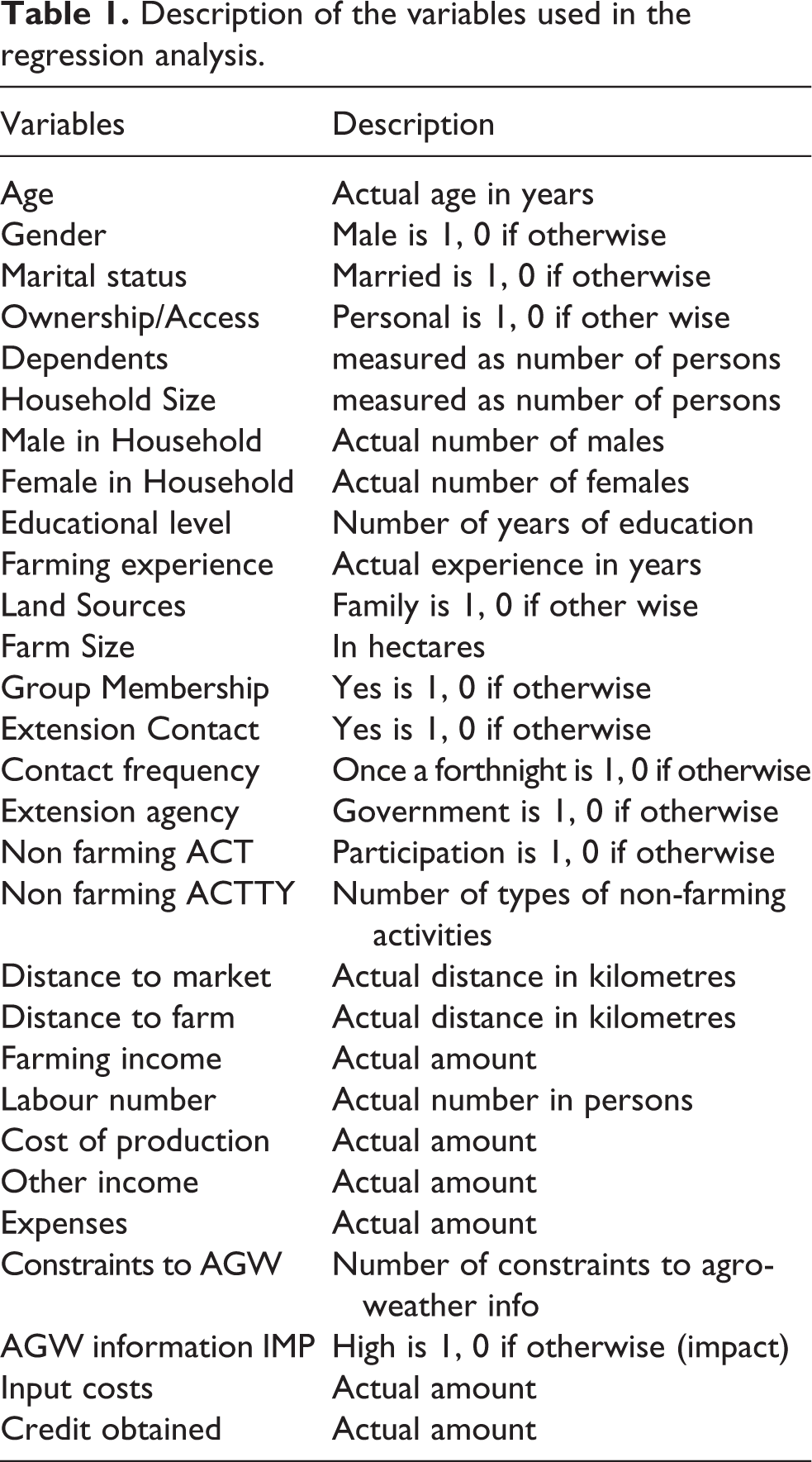
Where Y is the adoption/utilization of agro-weather tools which are SMS, Radio, Newsletters, IVRs measured as utilization as on a score of adoption scale for each of the agro-weather sources, X is the independent (explanatory) variables that were included are stated in Table 1, B is the vector of unknown parameters to be estimated and e is the error term.
Description of the variables used in the regression analysis.
Results and discussion
For Kenya, Figure 1 presents the results on personal characteristics of the farmers in the agro-weather tools project. This shows that over 60% were female, at least 56% were 30 years old, 80% married and more than 30% had primary and secondary school education level. The trend of the results may be due to the fact that, through small scale farming, female farmers are able to provide food for the households and the surplus for income and the marital status imposed a responsibility to ensure that households are food secured. The age category emphasised the ageing farming population in most rural areas of the developing world as men and youth seek for other income generating opportunities outside their rural domain.
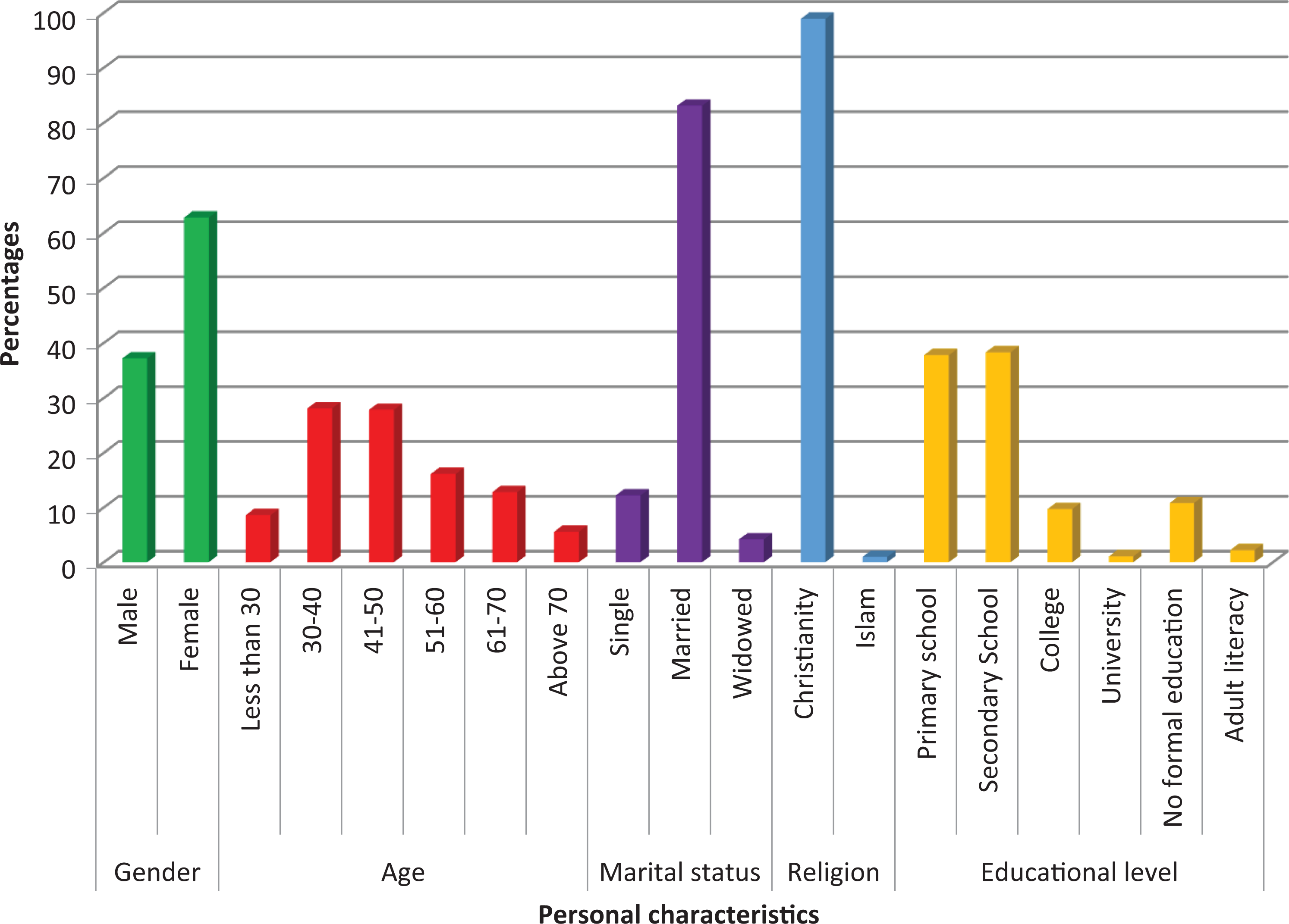
Distribution of Kenya farmers based on selected personal characteristics.
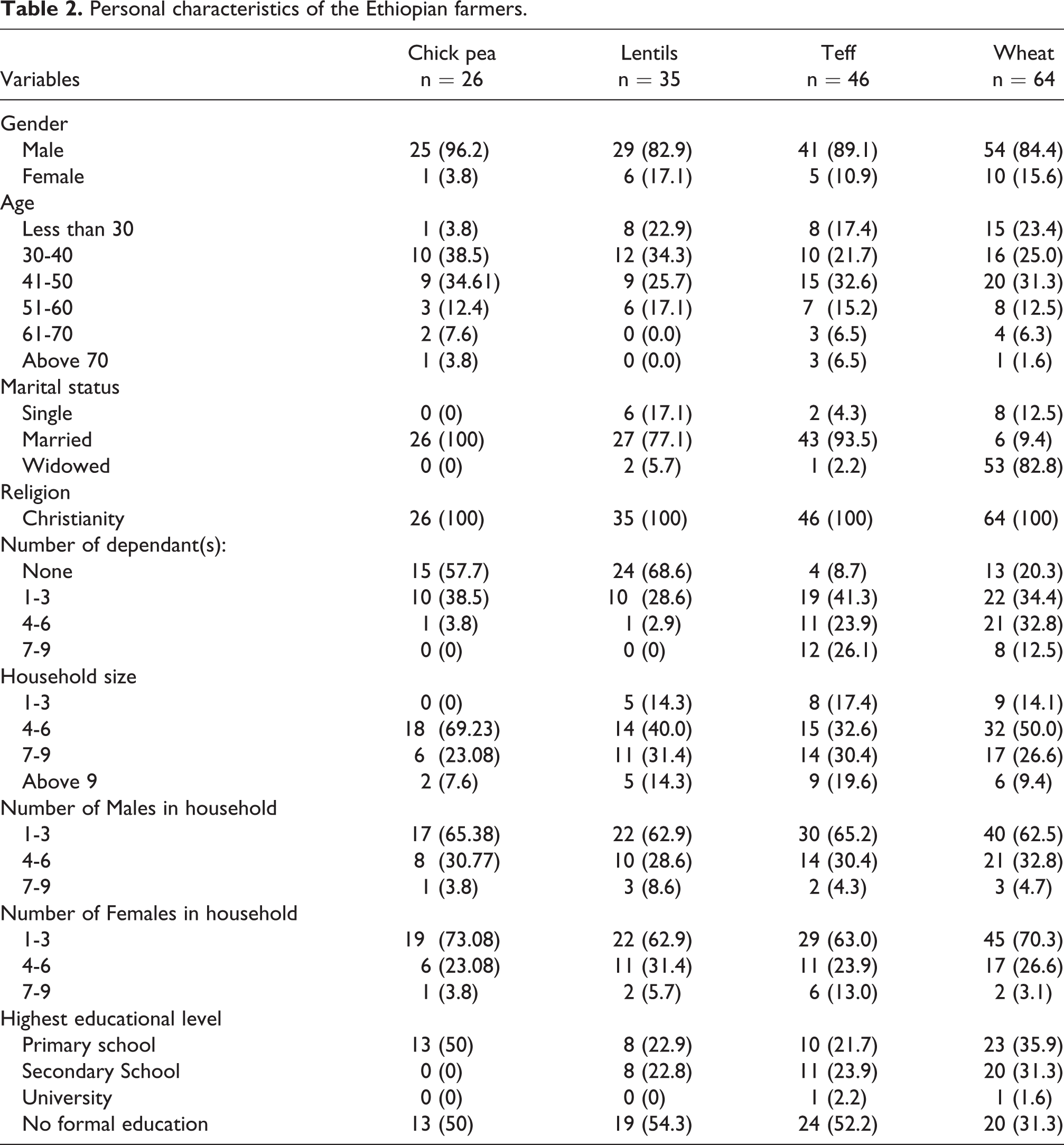
For Ethiopia, Table 2 presents the results on the personal characteristics of farmers. The majority are male across crops, with 96.2%, 82.9%, 89.1%, and 84.4% for Chick pea, Lentils, Teff and Wheat respectively. About 57%, 78%, 83%, 77% were at least 30 years old for Chick pea, Lentils, Teff and Wheat respectively. The majority are married for Chick pea, Lentils, Teff, while for Wheat the majority were widows. The majority of Chick pea (57.7%) and, Lentils (68.6%) farmers had no dependants, while the majority of Teff (92%) and Wheat (87%) farmers had between 1 to and 6 dependants. The majority have at least 4 persons per household across crops with 100%, 95%, 82% and 91%; for Chick pea, Lentils, Teff and Wheat respectively. The majority of farmers had no formal education for Chick pea (50%), Lentils (54.3%), Teff (52%) while the majority of Wheat farmers (67.2%) had primary and secondary school education.
Personal characteristics of the Ethiopian farmers.
Determinants of the use of agro-weather tools as information sources
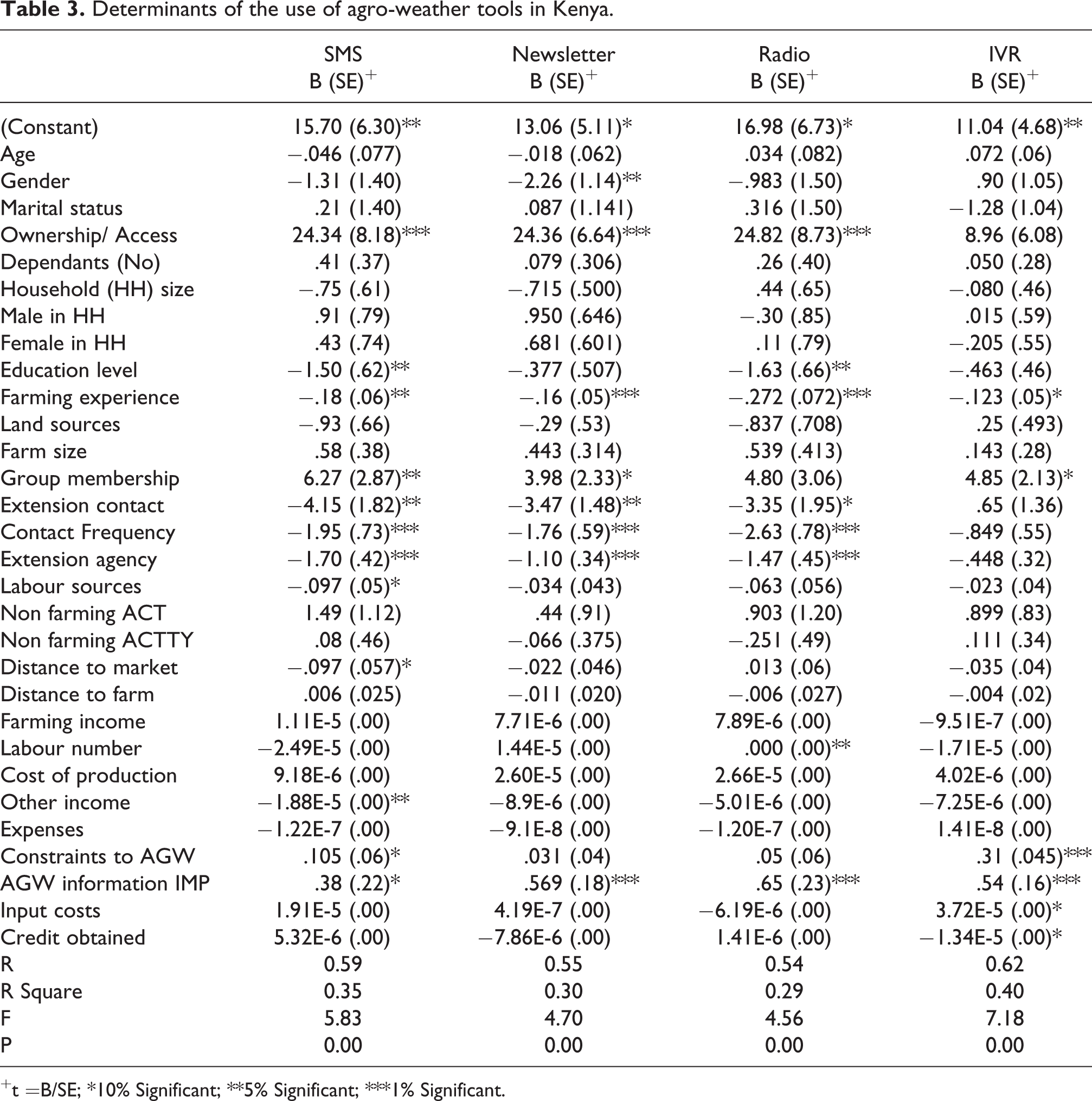
The findings in Tables 3 and 4 show the determinants of the use of agro-weather tools (SMS, Radio, Newsletters and IVR) as information sources in both Kenya and Ethiopia. The use of agro-weather tools was regressed independently against 30 independent variables. The overall result shows that farming experience and impact of agro-weather information were significant determinants of the use of all the tools. Ownership/ Access, Extension contact, Frequency of Extension contact and Extension agency were significant determinants of the use of SMS, Newsletter, and radio, while Group membership was a significant determinant of the use of SMS, Newsletter, and IVR. The significance of these variables stresses their need in the planning and policy formulation for the use of agro-weather tools for information dissemination. Wood et al. (2013) found evidence that access to weather information, assets, and participation in social institutions are associated with households that have reported making farming changes in recent years, although these results vary across countries and types of practices. Understanding these drivers and outcomes of farm-associated changes across different socio-economic and environmental conditions is critical for on-going dialogues for climate-resilient strategies and policies for increasing the adaptive capacity of smallholders under climate change. User perception of climate vulnerability and understanding user decision contexts are critical factors that can influence forecast use (Yarnal et al., 2003). Okwu (2011) stated that farmer users of mass media are therefore those who have a good level of education, belong to a relatively high income bracket, and are typically male and of a relatively high socioeconomic status. Farmers’ socioeconomic characteristics should be considered in planning mass media usage in agricultural information dissemination. Getnet, Kedir and Yousuf (2014) reported that age, year of education, information seeking behaviour and participation in trainings were significant determinants of ICT use among farmers in East Hararghe Zone, Oromia National Regional State, Ethiopia. Understanding these drivers and outcomes of farm-associated changes across different socio-economic and environmental conditions is critical for on-going dialogues for climate-resilient strategies and policies for increasing the adaptive capacity of smallholders under climate change. User perception of climate vulnerability and understanding user decision contexts are critical factors that can influence forecast use (Yarnal et al., 2003).
Determinants of the use of agro-weather tools in Kenya.
+t =B/SE; *10% Significant; **5% Significant; ***1% Significant.
Determinants of the use of agro-weather tools in Ethiopia.
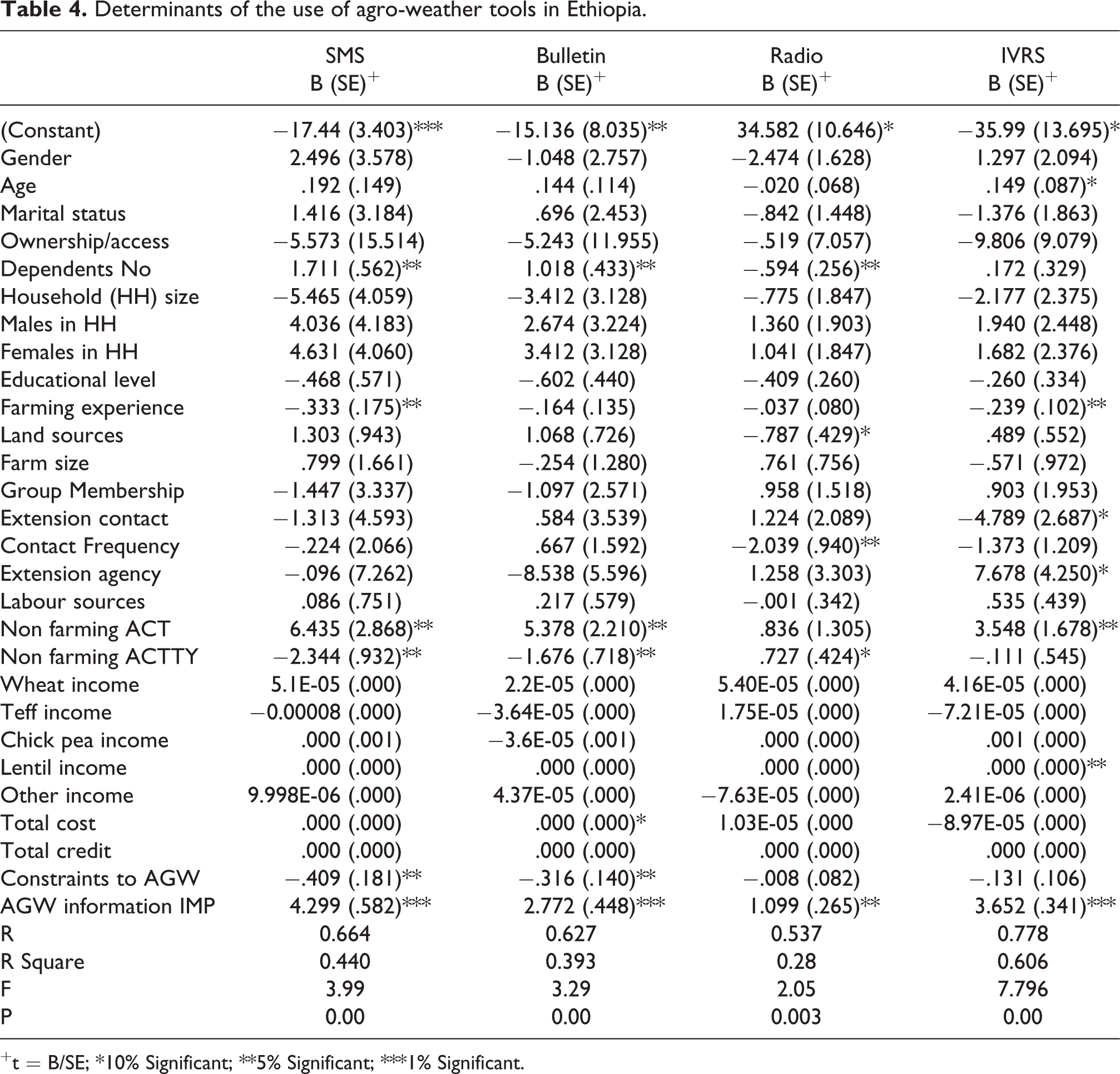
+t = B/SE; *10% Significant; **5% Significant; ***1% Significant.
The specific determinants of the use of each of the agro-weather tools are discussed in the following sections.
SMS
In Kenya, the results of multiple regression analysis of relationships between farmers’ socio-economic characteristics and determinants of the use of short message service as agro-weather information source were are presented in Table 3. The independent variables were significantly related to use of short message service as an agro-weather information source with F value of 5.83, p < 0.05. Also, R value of 0.59 showed that there was a strong correlation between independent variables and use of short message service as agro-weather information source. The result further predicted 35% of the variation in use of short message service as agro weather information source by farmers. Significant determinants were ownership (t = 2.976, p = .003), Education level (t = −2.404, p = .017), Farming experience (t = −2.716, p = .007), Group membership (t = 2.185, p = .030), Extension contact (t = −2.273, p =.024), Frequency of Extension contact (t = −2.655, p = .008), Extension agency (t = −3.966, p =.000), Labour sources (t = −1.832, p = .068), Distance to market (t = −1.707, p = .089), Other income (t = −2.209, p =.028), AGW information impact (t = 1.706, p =.089), Constraints to AGW information(t = 1.744, p =.082). Most of the variables are inversely related to the use of short message service as agro-weather information source. Chavas (2008) stated that mobile phone networks have the potential to revolutionize this service by significantly improving the efficiency of forecast dissemination, both to the individual farmer and between farmers, and by solving the evaluation problem.
In Ethiopia, the result of multiple regression analysis of relationships between farmers’ socio-economic characteristics and determinants of the use of short message service as agro-weather information source were are presented in Table 4. The independent variables were significantly related to use of short message service as an agro-weather information source with F value of 3.99, p < 0.05. Also, R value of 0.66 showed that there was a strong correlation between independent variables and use of short message service as agro-weather information source. The result further predicted 44% of the variation in use of short message service as agro weather information source by farmers. Significant determinants were Number of dependents, Farming experience, Non-farming activities, Non-farming activities Types, Constraints to AGW information and AGW information Impact.
Newsletter
In Kenya, the result of multiple regression analysis of relationships between farmers’ personal characteristics and use of newsletter as agro-weather information source are presented in Table 3. The independent variables were significantly related to use of newsletter as agro-weather information source with F value of 4.70, p < 0.05. Also, R value of 0.55 showed that there was a strong correlation between independent variables and use of newsletter as agro-weather information source. The result further predicted 30% of the variation in use of newsletter as agro-weather information source by farmers. Significant determinants were Gender (t = −1.977, p =.049), Ownership (t = 3.669, p = .000), Farming experience (t = −2.940, p = .004), Group membership (t = 1.711, p =.088), Extension contact (t = −2.340, p =.020), Frequency of Extension contact (t = −2.948, p =.003), Extension agency (t = −3.169, p =.002), AGW information impact (t = 3.145, p =.002).
In Ethiopia, the result of multiple regression analysis of relationships between farmers’ personal characteristics and use of newsletter as agro-weather information source were are presented in Table 4. The independent variables were significantly related to use of newsletter as agro-weather information source with F value of 3.29, p < 0.05. Also, R value of 0.63 showed that there was a strong correlation between independent variables and use of newsletter as agro-weather information source. The result further predicted 39% of the variation in use of newsletter as agro-weather information source by farmers. Significant determinants were Number of dependents, Farming experience, Non-farming activities, Non farming activities Types, Total cost, Constraints to AGW information and AGW information Impact.
Radio
In Kenya, the result of multiple regression analysis of relationships between farmers’ personal characteristics and use of radio as agro-weather information source were presented in Table 3. The independent variables were significantly related to use of radio as agro-weather information source with F value of 4.56, p < 0.05. Also, R value of 0.54 showed that there was a strong correlation between independent variables and use of radio as agro-weather information source. The result further predicted 29% of the variation in use of radio as agro-weather information source by farmers. Significant determinants were Ownership (t = 2.841, p = .005), Education level (t = −2.448, p =.015), Farming experience (t = −3.791, p =.000), Extension contact (t = −1.717, p = .087), Frequency of Extension contact (t = −3.352, p =.001), Extension agency (t = −3.220, p =.001), Labour number (t = 2.355, p =.019), AGW information impact (t = 2.755, p = .006). Most of the variables are inversely related to the use of radio as agro-weather information source. The use of radio as an alternative source of information to extension agent could be the reason for the inverse relationship. Similarly, less experienced farmers, would rely on other sources of information to leverage skills and competencies.
In Ethiopia, the result of multiple regression analysis of relationships between farmers’ personal characteristics and use of radio as agro-weather information source were presented in Table 4. The independent variables were significantly related to use of radio as agro-weather information source with F value of 2.05, p < 0.05. Also, R value of 0.54 showed that there was a strong correlation between independent variables and use of radio as agro-weather information source. The result further predicted 28% of the variation in use of radio as agro-weather information source by farmers. Significant determinants were number of dependents, farming experience, land sources, frequency of extension contact, non- farming activities, non- farming activities types and AGW information impact.
Interactive Voice Response (IVR)
In Kenya, the result of multiple regression analysis of relationships between farmers’ personal characteristics and use of interactive voice response as agro-weather information source were presented in Table 3. The independent variables were significantly related to use of interactive voice response as agro-weather information source with F value of 7.18, p < 0.05. Also, R value of 0.62 showed that there was a strong correlation between independent variables and use of interactive voice response as agro-weather information source. The result further predicted 40% of the variation in use of interactive voice response as agro-weather information source by farmers. Significant determinants were Farming experience (t = −2.472, p =.014), Group membership (t = 2.276, p = .023), Credit obtained (t = −2.157, p = .032), Input costs (t = 1.957, p = .051), AGW information impact (t = 3.302, p =.001), Constraints to AGW information (t = 6.981, p =.000).
In Ethiopia, the result of multiple regression analysis of relationships between farmers’ personal characteristics and use of interactive voice response as agro-weather information source were presented in Table 4. The independent variables were significantly related to use of interactive voice response as agro-weather information source with F value of 7.79, p < 0.05. Also, R value of 0.77 showed that there was a strong correlation between independent variables and use of interactive voice response as agro-weather information source. The result further predicted 61% of the variation in use of interactive voice response as agro-weather information source by farmers. Significant determinants were age, number of dependents, farming experience, extension contact, extension agency, non-farming activities, non-farming activities types, lentil income and AGW information impact.
Conclusion
The agro-weather tools for adaptation to climate smart agriculture a GOK/GoE/World Bank supported project has been implemented in Embu county and Ada’a district of Kenya and Ethiopia as a pilot project and it was widely adopted and utilized. In line with the diffusion theory, the use of prominent communication channels as information sources in the study area greatly enhanced the adoption of the agro-weather tools. This have been used as a proof of the concept that smallholder farmers are able to make more informed choices upon access to timely weather information and requisite advisory. The overall results show that farming experience and impact of agro-weather information were significant determinants of the use of all the tools. Ownership/ Access, Extension contact, Frequency of Extension contact and Extension agency were significant determinants of the use of SMS, Newsletter, and radio, while Group membership, was a significant determinant of the use of SMS, Newsletter, and IVR. The significance of these variables stresses their need in the planning and policy formulation for the use of agro-weather tools for information dissemination.