







Abstract
People always rely on a specific media environment to acquire knowledge about public affairs. This pilot study investigates gain of public affairs knowledge as an effect of media use and interpersonal discussion in China. Based on a contextual understanding of China’s press system, this study explores the mainstream and alternative forms of public affairs knowledge and the ways they are linked with use of new media (i.e., web news and social media) and traditional media (i.e., newspaper and television). An analysis of survey data first shows that television news and web news have direct positive effects on mainstream knowledge, and only web news directly contributes to alternative knowledge. Second, news from newspapers, television, the web and social media have indirect effects on both mainstream and alternative forms of public affairs knowledge through elaboration and interpersonal discussion. Third, elaboration is only associated with alternative knowledge, whereas interpersonal discussion is associated with both mainstream and alternative knowledge. Theoretical and practical implications of the findings are discussed.
Introduction
Public affairs knowledge refers to citizens’ factual understanding about a wide range of issues and topics, such as the government, political parties and leaders, scientific discoveries, social economy, and environment issues. Public affairs knowledge is desirable for both individuals and the society. At the individual level, public affairs knowledge helps citizens discern their own interests and concerns, thus connecting them to “public life” (Delli Carpini and Keeter, 1996). At the societal level, citizens’ good public affairs knowledge contributes to an informed society and deliberative culture (Galston, 2001; Habermas, 1991; Lazarsfeld et al., 1948). Given the value of public affairs knowledge in society, research has widely examined knowledge gain as an effect of media use in Western contexts (Chaffee and Schleuder, 1986; Delli Carpini and Keeter, 1996; Eveland, 2001; Katz and Lazarsfeld, 1955).
However, very few studies have been done focusing on China, where there are profound social and economic transformations. Living in an ever-changing environment, Chinese people need to acquire up-to-date information about major social issues to guide their lives and make important decisions. From the perspective of governance, it is vital for Chinese people to get informed of major policies and political decisions. Unlike the media system in many Western societies where the market mechanism plays a dominant role, the Chinese press system operates on a different logic. On the one hand, the press in China is characterized with strong state intervention (Chan, 1993; Zhao, 1998). Mainstream news media 1 restrict the scope of coverage on both domestic and international affairs, therefore presenting little variance in the public agenda (Zhao, 2008). On the other hand, the new media industry such as mobile Internet and social platforms has been flourishing in the country, spawning an array of well-known Internet companies and the largest networked population around the world (China Internet Network Information Center [CNNIC], 2017). The diffusion of new media technologies, coupled with the emergence of a virtual public space (Link and Xiao, 2013; Yang, 2009), has offered Chinese people access to more diverse information. The information environment in China is thus characterized by a mixture of technological empowerment and continued state regulation on media content.
Though the Chinese government actively brings online information into its regulative frameworks (Li, 2009), many scholars treat the Internet in China as a space for alternative information and views (Hassid, 2012; Meng, 2011; Shirk, 2011; Bu, 2012; Yang, 2009). While traditional media aim to construct mainstream discourses, the online media sector sometimes depicts the social reality differently and provides alternative interpretations. Simple logic would suggest that public affairs knowledge in China is not uniform. Immersing in China’s media environment, people may obtain two distinguishable bodies of public affairs knowledge from different media sectors.
As one of the first to systematically examine public affairs knowledge in China, this study contributes to existing literature in three main ways. First, this study probes the difference between mainstream and alternative forms of public affairs knowledge and investigates the way they are systematically linked to different media channels. Second, while their channels have become the main source for information, new media’s effects on knowledge gain are, at best, inconclusive. This study compares traditional media channels (i.e., television and newspaper) and new media channels (i.e., web news and social media) and provides new evidence about whether new media can effectively inform their users. Third, this study extends and modifies the cognitive mediation model (CMM) originally proposed by Eveland (2001) as a general framework to explain the direct and indirect effects between media use and knowledge gain. This effort not only advances the current understanding of the model, but also tests the applicability of the CMM in a different social context.
The empirical evidence in this study was obtained from a pencil-and-paper survey of college students from six universities in Beijing, Shanghai, and Guangzhou in China (N = 1,135). The next sections provide the background for the study and discuss the main concepts and theoretical arguments. The modified CMM is then introduced with the main research hypotheses. The methods are then elaborated, and the data analysis and findings are presented.
Literature review
Public affairs knowledge in China
Knowledge about politics and public affairs helps citizens understand how public policies impact their interests, promotes consistent views among different groups of people and prevents citizens from becoming alienated from public life (Galston, 2001). Chinese society is no exception. According to Chang et al. (1994), news in China is constructed in very specific social and political conditions; it not only provides the public with baseline knowledge to discern, think for and make sense of the polity and the changing environment, but also serves to build consensus in society. For a long period of time before the Reform and Opening Up’, mass media in China mainly supplied people with politically oriented information and propaganda. Media marketization in the 1980s gave rise to many mass-appeal, market-oriented news media organizations (Lee, 2000; Zhao, 1998) and a diversity of news paradigms (Hassid, 2011; Zhao, 1998). In the recent decades, rapid development of the Internet has further complicated the news landscape in China. With social media and mobile Internet, the formation and dissemination of public opinion and user-generated content have increased in velocity and scope, exerting a growing influence on public affairs (Cheng et al., 2014; Hassid, 2011; Qiu and Chan, 2011; Sullivan, 2014). The emergence of myriad online platforms has greatly enriched the types of information and news available to the Chinese audience.
Against this backdrop, this study puts forward two distinct type of public affairs knowledge in the Chinese context. The first type is mainstream public affairs knowledge, which will be referred to as “mainstream knowledge” in this paper. Mainstream knowledge is related to the way mainstream media operate in China. In most cases, mainstream news media must follow the rules and report in a politically correct way (Tong, 2009; Zhang, 2013). Many constraints are imposed on the mainstream news media regarding what can be covered and how it should be covered. Though negative news and critical opinions are not entirely absent, the mainstream news media in China generally report in favor of the government and its policies. Information provided by the mainstream media mostly contains knowledge about legitimate interpretations of Chinese society. In this study, mainstream knowledge is defined as knowledge about public affairs that 1) is legitimized by authority and 2) can be accessed through mainstream media channels.
In contrast, this study proposes what can be conceptualized as alternative public affairs knowledge, which will be referred to as “alternative knowledge” in this paper. Other studies have touched upon similar concepts. For example, Coy et al. (2009) propose the concept of oppositional knowledge, which stands in contrast with “institutionally privileged political discourses [that] not only legitimate the policy agendas of power-holders, but also de-legitimate dissent” (in abstract). Lee (2015) describes oppositional knowledge as “facts and concepts that are instrumental in the formation of critical attitudes toward dominant power” (p. 1). Differing from oppositional knowledge, alternative knowledge does not necessarily relate to oppositional attitudes, but rather it illustrates parts of the social reality that the mainstream narrative fails to present. Though the press in China is under scrutiny, opportunities exist for the production and distribution of alternative knowledge. Even mainstream media sometimes convey alternative information, especially when they report to reveal social injustice and speak for the underprivileged (Lee et al., 2007; Tong, 2011). However, alternative information receives only a limited amount of attention from mainstream media and can only be a peripheral part compared to legitimized information.
One major source of alternative knowledge can be found from various online platforms. With 731 million users (CNNIC, 2017), the Internet in China has become a vast and vigorous space for information and opinion. The online world in China has long been an “alternative” space to its offline counterpart. Many have observed that the Internet has facilitated the circulation of alternative information, given rise to critical discourses and cultivated a lively contentious online culture (Jiang, 2010; Link and Xiao, 2013; Meng, 2011; Yang, 2009). With these, this study defines alternative public affairs knowledge as a body of knowledge that 1) is not legitimized by authority, 2) receives limited coverage by mainstream media and 3) can be accessed through interpersonal communications and from various Internet media platforms.
Media use and knowledge gain
A plethora of research has tried to establish links between media use and knowledge gain. The results of early research are mixed. While some studies confirm that the use of traditional media significantly contributes to knowledge about politics and public affairs (Chaffe and Schleuder, 1986; Chaffee et al., 1994; McLeod et al., 1979), others suggest that what people can learn from traditional media is limited (Patterson and McClure, 1976; Robinson and Levy, 1986). As more recent studies adopt alternative measures of media use and incorporate mediating factors, they yield increasingly consistent results illustrating that traditional news media can be an effective source of knowledge (Chaffee and Schleuder, 1986; Eveland, 2001; Price and Zaller, 1993; Lo and Chang, 2006; Wei and Lo, 2008).
The media effects on knowledge gain become more complicated with the rise of various online information sources. Research has widely documented that the use of web news is positively related to political knowledge (Dalrymple and Scheufele, 2007; Wei and Lo, 2008; Xenos and Moy, 2007), health information and general health knowledge (Lee, 2009) and contributes to structural political knowledge (Eveland and Dunwoody, 2004). Focusing on Hong Kong society, Lee (2015) finds that the use of alternative news media online can contribute to the acquisition of oppositional knowledge. Goh (2015) has found that the use of alternative media online facilitates political learning for lower-educated voters in Singapore.
In recent years, social media has become an important source of information and news. There is research exploring the effects of social media use on knowledge gain. For example, Lee and Oh’s (2013) study on acquiring knowledge through Twitter use suggests that learning about news is conditioned by users’ need for orientation (NFO), a motivational factor related to news consumption. It is found that, within a high NFO group, long-term use of Twitter is positively associated with hard news knowledge but negatively associated with soft news knowledge. Kaufhold et al. (2010) tests the relationship between user-generated news and political knowledge and participation. Their study finds that the use of user-generated news is not associated with knowledge of national political figures. Dimitrova et al. (2014) systematically examine the effects of digital media on political knowledge and participation. Their study reveals a weak positive correlation between reading several types of online news and political knowledge. In his study examining knowledge acquisition from digital media, Wang (2011) notes that the motivation to learn about politics plays a significant role in determining the extent to which a person can learn about politics in a media-rich environment.
The Present Study
This study first pays attention to the use of traditional media and its effects on knowledge gain. Specifically, this study focuses on television and newspapers. In China, accessing information from online sources is almost universal. About 82.4% of Internet users use search engines for information, and 84.0% read news online (CNNIC, 2017). There were 257 million social network site users by July 2014, accounting for 40.7% of the Internet population in China (CNNIC, 2014). The number of microblog users in China has reached 275 million, and as many as 444 million are users of various blogs and personal spaces. In addition to social functions, social media sites also serve as channels for information and news. For example, Wei et al.’s (2014) study finds that college students in China follow microblogs to consume breaking news and uncensored information. Considering the growing influence of online sources, this study also examines web news and social media in China as information sources. Here, web news refers to online news content provided by either official websites or news aggregator sites (Wangyi News and Sina News). In China, typical web news includes websites affiliated with traditional media, such as CCTV and People’s Daily; news sections provided by major portal sites, such as Sina News and Sohu News; and professional digital news platforms, such as The Paper News and Jiemian News. Social media mainly include online applications that have a social feature, such as the Moment on the WeChat platform and the local microblogging service Weibo.
A modified CMM
This study draws from the CMM to build its theoretical framework. Originally proposed by Eveland (2001, 2002), the CMM establishes a mediating role of cognitive factors between media use motivations and the acquisition of knowledge (see Figure 1). Moving beyond the linear relationship between media use and knowledge gain, the CMM proposes that people are motivated to be exposed to media, which then leads to elaboration—further deep processing of information. The cognitive processes of media exposure eventually contribute to knowledge gain. Much work has been done to replicate and extend the CMM in various contexts. Overall, the CMM has been proved to be a robust model predicting various types of knowledge gain across research contexts (Beaudoin and Thorson, 2004; Eveland, et al., 2005; Ho et al., 2008, 2013; Lo and Chang, 2006; Wei and Lo, 2008).
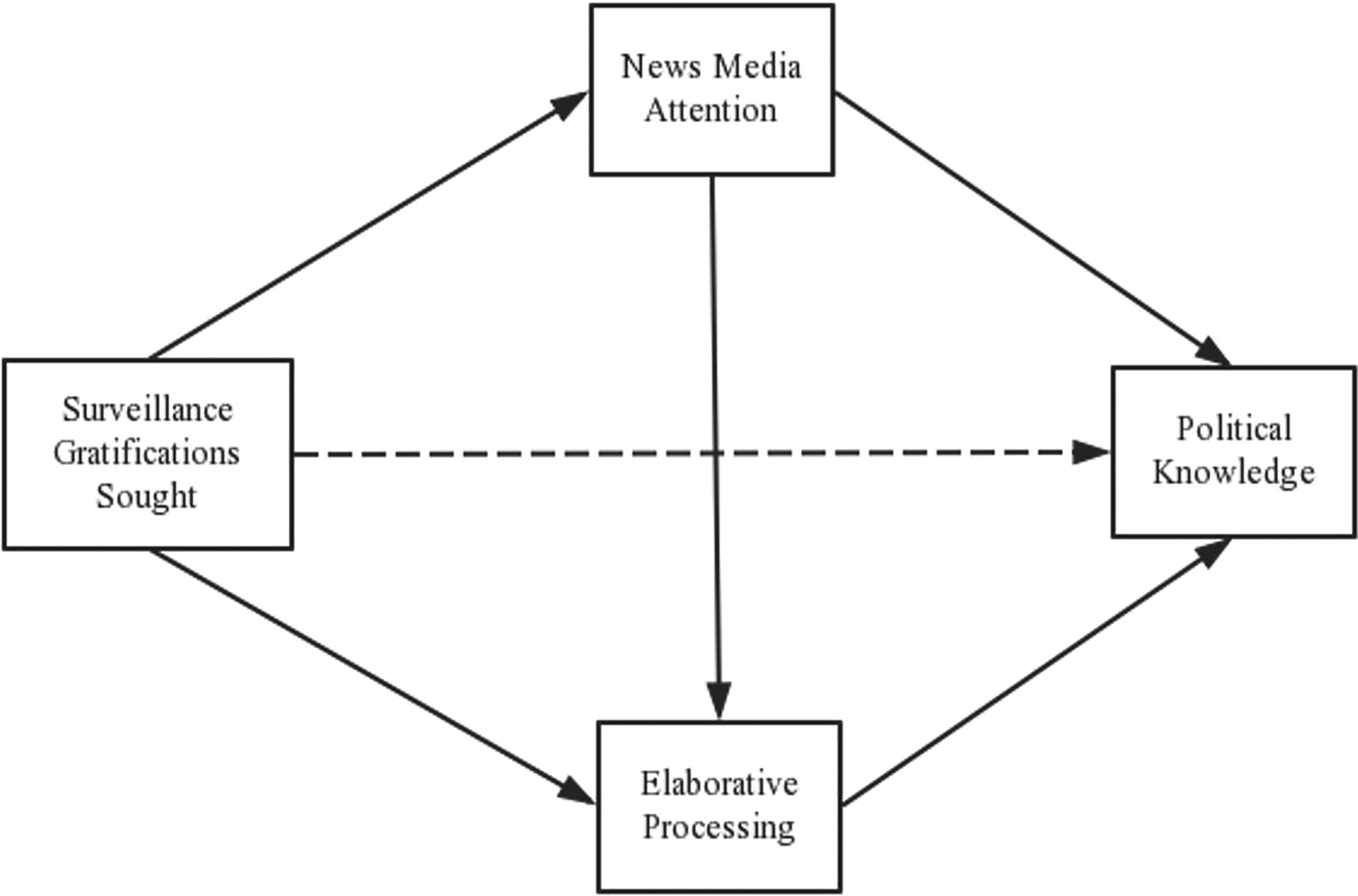
The original CMM proposed by Eveland (2001).
Media use
Media use constructs are central to the CMM. The original CMM treats media use as a unidimensional construct. Though a general media use measure generates a desirable reliability (Ho et al., 2008), it fails to tap into the differential effects of various media sources. Given the high-choice media environment in China, it is important to consider the diversity of media channels for their independent effects. Following the extended CMM proposed by Yang et al. (2017), this study disaggregates the media use construct into different channels, and more specifically, focuses on four types of media use as discussed in the previous section. It is expected that different media channels may have different effects on other constructs in the model. Considering that the two outcome variables—mainstream and alternative forms of public affairs knowledge—are covered differently by different media types, medium-specific measures are necessary to capture the effects of different media channels on outcome variables.
This study moves beyond Yang et al.’s (2017) model in two main respects. First, instead of treating media use as media attention, this study adopts a composite measure of media use that combines both media attention and media exposure. Whereas media exposure refers to “any situation in which a person comes into contact with particular events or news stories through one or another medium” (Chaffee and Schleuder, 1986: p. 134), media attention refers to the “increased mental effort paid to a medium media or a specific domain of news on a medium” (Chaffee and Schleuder, 1986: p. 78). Prior research has shown that both media exposure and media attention have significant, yet varying, effects on political learning (Chaffee and Schleuder, 1986; David, 2009; Drew and Weaver, 1990; Eveland, 2001; Lo and Chang, 2006; McLeod and McDonald, 1985). Several studies differentiate between media exposure and media attention in the CMM and find their independent effects on other constructs in the model (Lo and Chang, 2006; Wei and Lo, 2008). In a systematic comparison between media use measures, Eveland et al. (2009) suggest that combinations of media exposure and media attention are the most promising approach to tap media use. Considering the diversity of media sources examined in this study and the fact that media use involves both exposure and attention, this study adopts composite measures of media use.
Second, departing from Yang et al.’s (2017) model, this study proposes direct links between media use variables and knowledge variables. In Yang et al.’s (2017) study, four media use constructs are associated with dependent variables only indirectly through elaboration and interpersonal discussion. For both the original CMM (Eveland, 2001) and a modified CMM (Ho et al., 2013; Wei and Lo, 2008), it is important to establish direct links between media use and knowledge. Ultimately, any research on learning effects is concerned with the role of media use in knowledge gain. Therefore, this study proposes that media use is, in general, positively correlated with knowledge. As stated earlier, television and newspapers mainly convey mainstream knowledge but not alternative knowledge, whereas online sources such as web news and social media news provide both mainstream and alternative information. Consequently, different channels may play different roles in predicting different types of public affairs knowledge. The hypotheses are as follows: H1a: Use of television news is positively associated with mainstream knowledge. H1b: Use of newspaper news is positively associated with mainstream knowledge. H1c: Use of web news is positively associated with mainstream knowledge. H1d: Use of social media news is positively associated with mainstream knowledge. H2a: Use of web news is positively associated with alternative knowledge. H2b: Use of social media news is positively associated with alternative knowledge.
The CMM treats elaborative processing as an essential component of political learning. Elaboration is defined as a cognitive process where people connect new information with prior information in their memory or interconnect two pieces of new information (Eveland, 2001). According to the CMM, elaboration can thus be understood as active and deep processing of information that follows exposure to media. Prior research has widely shown associations between elaboration and television/newspaper use (Beaudoin and Thorson, 2004; Lo and Chang, 2006; Wei and Lo, 2008), Internet use (Eveland and Dunwoody, 2002; Wei and Lo, 2008) and social media use (Ho et al., 2017).
In addition to elaboration, this study also incorporates interpersonal discussion into the model. According to Kosicki and McLeod (1990), interpersonal discussion is a key dimension of reflective integration of political learning. By discussing what has been learned from news with others, people are able to further process the information gained from news and connect it with other perspectives. In this way, interpersonal discussion may facilitate learning from news (Katz and Lazarsfeld, 1955; Robinson and Levy, 1986). Prior studies have shown that media use can promote interpersonal discussion (David, 2009; Eveland et al., 2005; Ho, 2013; McLeod et al., 1999). Considering that an array of research has lent support for the positive relationships between media use and elaboration and discussion, this study also proposes the following hypotheses: H3a: Use of television news is positively associated with elaboration. H3b: Use of newspaper news is positively associated with elaboration. H3c: Use of web news is positively associated with elaboration. H3d: Use of social media news is positively associated with elaboration. H4a: Use of television news is positively associated with interpersonal discussion. H4b: Use of newspaper news is positively associated with interpersonal discussion. H4c: Use of web news is positively associated with interpersonal discussion. H4d: Use of social media news is positively associated with interpersonal discussion.
Lastly, this study is concerned with the pattern in which elaboration and interpersonal discussion are linked with public affairs knowledge. According to the CMM, elaborative processing makes connections between news content, prior knowledge and past experiences, and therefore contributes to news learning (Eveland, 2001). Many studies have established linkages between elaboration and gain of knowledge (Beaudoin and Thorson, 2004; Lo and Chang, 2006). It is expected that elaboration is related to gain of public affairs knowledge in the current study. As elaborative processing helps engage news content with existing information, it may trigger reflective and integrative thinking about information from different sources. For example, exposure to news from television can lead someone to think about related information gained from an interpersonal discussion or social media. In this way, elaboration is expected to be associated with both mainstream and alternative knowledge (Figure 2).
Research has established that interpersonal discussion is conducive to political learning (Deli Carpini and Keeter 1996; Eveland and Thomson, 2006; Robinson and Levy, 1986). As suggested by the classic “two-step flow” model of communication (Katz and Lazarsfeld, 1955), interpersonal networks can at least amplify or mitigate the effects conveyed by mass communication. A number of empirical studies have found an association between interpersonal discussion and knowledge gain (Bennett et al., 2000; Eveland et al., 2005; McLeod et al., 1999). With these, this study proposes a positive relationship between interpersonal discussion and public affairs knowledge. Differing from media content, interpersonal discussion is free from various constraints and therefore covers wider ranges of topics. It is expected that interpersonal discussion can contribute to both mainstream and alternative knowledge. Considering the array of research that supports the positive relationships between media use and elaboration and discussion, this study proposes the following hypotheses: H5a: Elaboration is positively associated with mainstream knowledge. H5b: Elaboration is positively associated with alternative knowledge. H6a: Interpersonal discussion is positively associated with mainstream knowledge. H6b: Interpersonal discussion is positively associated with alternative knowledge.
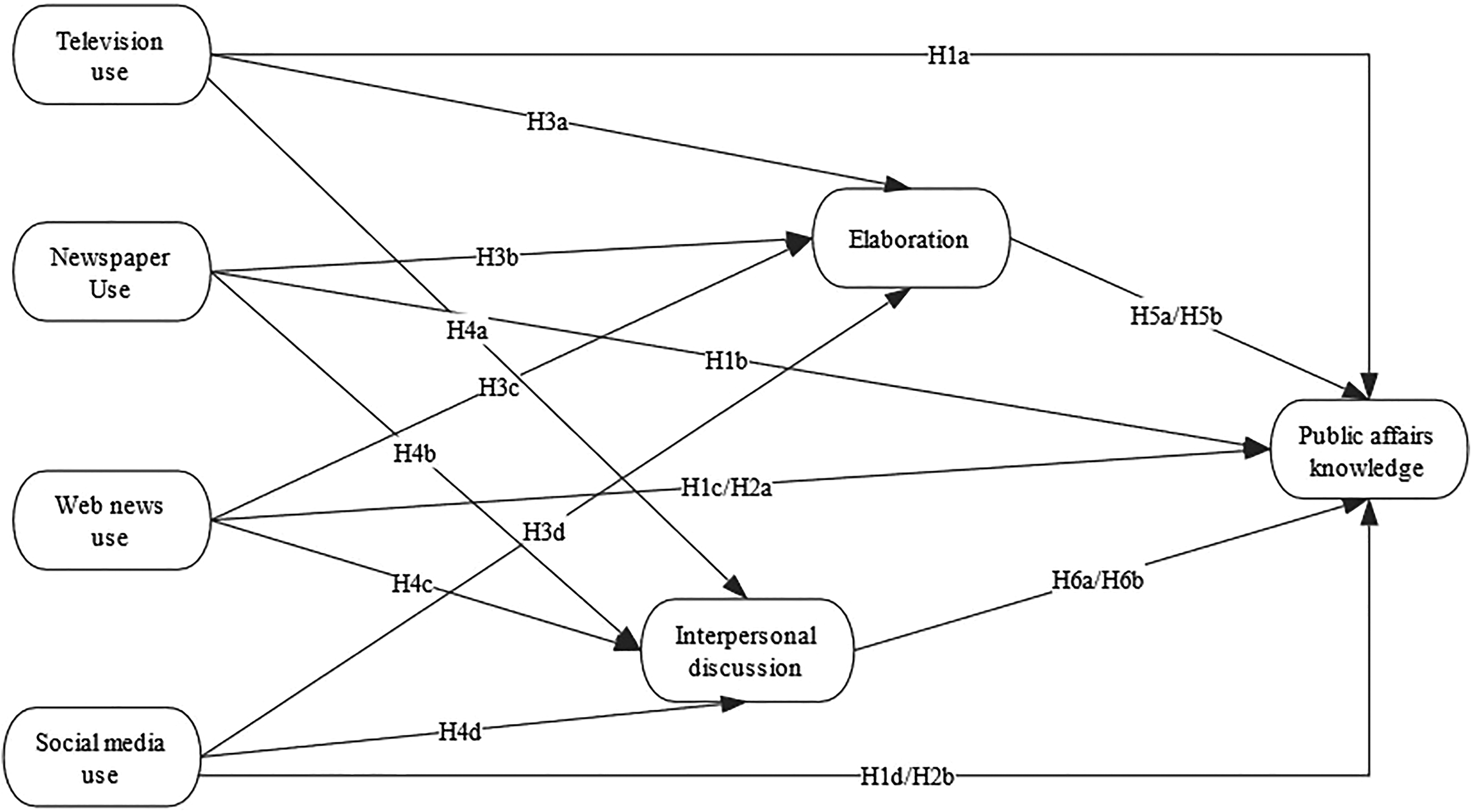
Hypothesized model.
Method
Sample
This study examines college students as a specific group of young people in China. A written survey was administered to college students in Beijing, Shanghai, and Guangzhou. Two universities were selected in each city: Beijing University and Renmin University of China in Beijing; Fudan University and Tongji University in Shanghai; and Sun Yat-sen University and Jinan University in Guangzhou. These schools were selected because they are all large-scale comprehensive universities directly affiliated with the Ministry of Education of China that integrate multiple disciplines. Main data collection was conducted in December 2015. At each university, researchers randomly selected several general education courses accessible to all undergraduate students. After obtaining approval from instructors, student helpers were sent to administer questionnaires to students enrolled in these courses.
Of the 1,456 questionnaires distributed, 1,135 (78.0%) were returned with valid responses. It must be acknowledged that the sample does not represent the general population in China. Thus, results may not apply beyond the sample of college students in the selected cities. Of all the respondents, 526 (46.8%) were male and 599 (52.8%) were female. The average age of the sample was 20.2 years old (SD = 1.43). Additionally, 283 (25.3%) majored in humanities and social sciences, 251 (22.5%) majored in business and finance, 380 (34.0%) majored in science and technology, 183 (16.4%) majored in medicine, and 38 (3.4%) belonged to other majors.
Measures
Media use
Following Eveland et al.’s (2009) suggestion, this study taps media use by both exposure and attention. Media exposure was measured by asking how often students received news from television, newspaper, websites, and social media (1 = never, 5 = frequently). Media attention was measured by asking respondents to indicate how closely they paid attention when watching or reading news from television, newspapers, websites, and social media (1 = very inattentive, 5 = very attentive).
Elaboration and interpersonal discussion
Elaboration was measured by scales adapted from Eveland’s (2001) study. Respondents were asked to indicate their agreement (1 = strongly disagree, 5 = strongly agree) with the following statements: 1) “When I’ve learned something in the news, I will often recall and think about it,” 2) “I often relate what I learn from the news to other things I know,” and 3) “I often relate what I learn from news to my own experiences”. Interpersonal discussion of public affairs was measured by asking respondents how frequently (1 = never, 5 = frequently) they discussed the following topics with family, friends, and classmates in person: recent news, hot issues and topics in society, and current affairs and politics.
Public affairs knowledge
Mainstream and alternative public affairs knowledge were each measured by six multiple-choice questions that evaluated respondents’ recall of information about recent public affairs issues. For each question that had only one correct answer; a choice of “don’t know” was provided. Respondents’ knowledge scores were calculated by counting the number of correct answers each provided (ranging from 0 to 6). Questions tested respondents’ knowledge of important political figures and settings, the macro economy, and current policies in the country. While mainstream knowledge questions focused heavily on topics reported by mainstream media, alternative knowledge questions focused on issues that were downplayed by the mainstream media but present on the Internet and in some news media. These questions focused on social movements in Taiwan and Hong Kong, environmental activism, and controversial public figures. Mainstream and alternative knowledge were moderately correlated (r = .47, p < .001). According to paired t-test, respondents’ mainstream knowledge scores (M = 3.04, SD = 1.66) were significantly higher than their alternative knowledge scores (M = 1.65, SD = 1.44) (t = 28.89, p < .001).
Analysis
This study applied partial-least-square structural equation modelling (PLS-SEM) to test the proposed model. PLS-SEM is another form of latent variable modelling technique that is different from covariance-based structural equation modelling (CB-SEM) such as LISREL and Mplus (Hair et al., 2014). As an emerging tool, PLS-SEM serves to be an ideal alternative to CB-SEM and has been widely utilized by researchers from various disciplines (Abdi, 2010; Hair et al., 2014). PLS-SEM can be a good approximation of CB-SEM when data distributional assumptions of CB-SEM are somewhat violated (Hair et al., 2011). As the proposed model included several single-item or two-item measures, PLS-SEM is suitable here because it can adequately handle these constructs than CB-SEM. SmartPLS 2.0, a statistical package specialized in PLS-SEM, was used for data analysis.
Results
Model assessment
As different types of public affairs knowledge are examined in this study, mainstream knowledge model and alternative knowledge model were run separately. It is worth noting that PLS-SEM lacks global goodness-of-fit criteria as CB-SEM does. To assess the model, a series of reliability and validity tests should be reported. Following Hair et al.’s (2011) and Henseler et al.’s (2009) suggestions, this study reports indicator reliability, internal consistency reliability, convergent validity and discriminant validity as assessments of the measurement models. Reliability and validity scores of the measurement models are summarized in Table 1.
Reliability and validity summary of outer models.
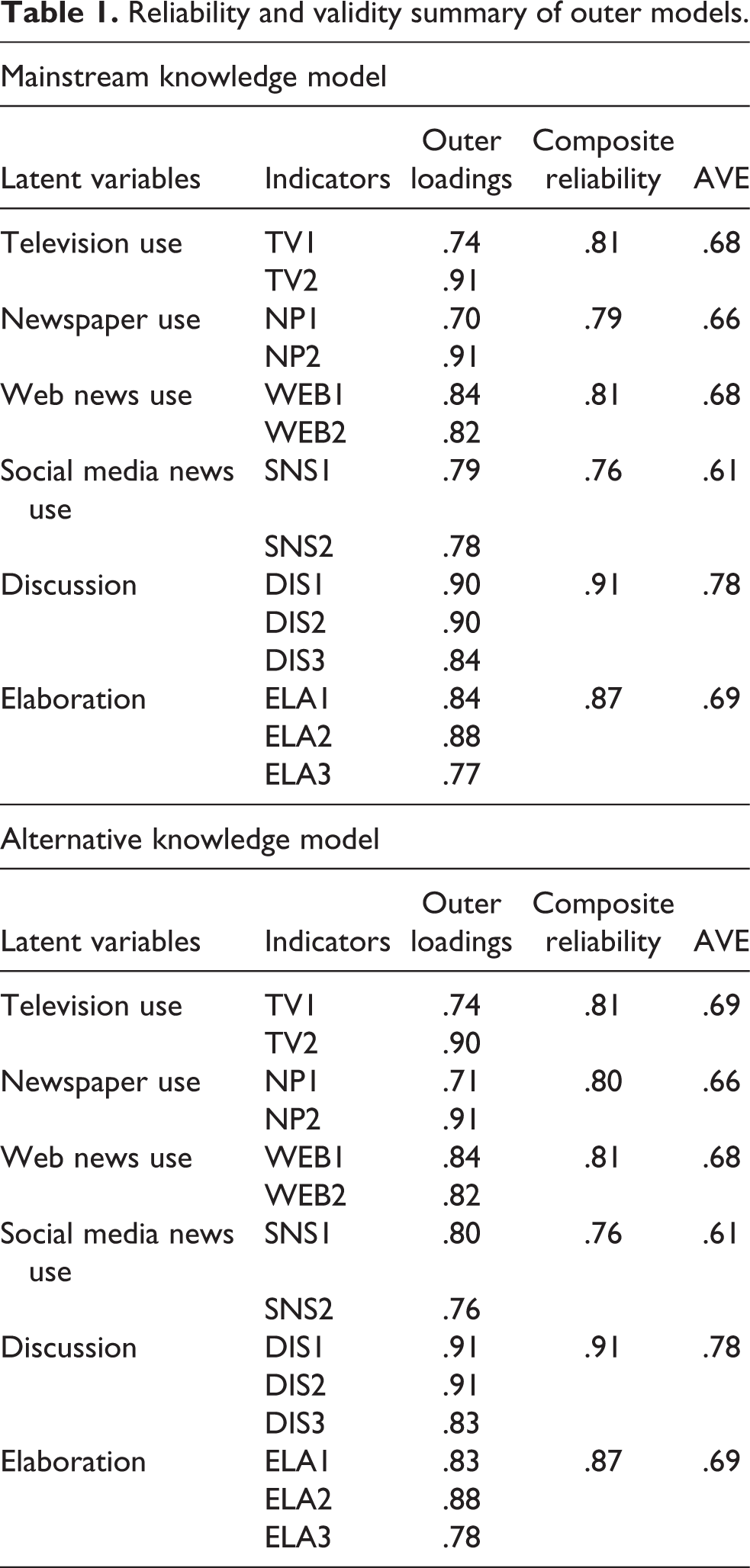
As mainstream knowledge and alternative knowledge are single-item variables, reliability and validity tests are not applicable. Indicator reliability can be evaluated by indicator loadings. According to Hair et al. (2011), indicator loadings should exceed .7 to be acceptable. The indicator loadings range between .74 and .91, all meeting the acceptable criterion. Internal consistency reliability was assessed by composite reliability, which servers to be a superior reliability test than Cronbach’s alpha in PLS-SEM (Hair et al., 2011; Henseler et al., 2009). The composite reliability of the latent variables ranges between .76 and .91, exceeding the acceptable threshold of .70 as recommended by Bagozzi and Yi (1988).
Convergent validity was assessed by average variance extracted (AVE). All AVE of the latent variables are above the acceptable level of .5 as suggested by Bagozzi and Yi (1988). Following Fornell and Larcker’s (1981) criterion, discriminant validity was determined by assessing whether a latent variable is correlated with its own measure to a greater degree than with other latent variables. In other words, a latent variable achieves good discriminant validity when the square roots of its AVE are greater than the correlation coefficients with all other latent variables. The square roots of AVE of the major constructs in the models range between .78 and .88. The correlations between latent variables range between .03 and .48, all falling below the square roots of AVE. To summarize, the two measurement models are robust based on reliability and validity tests.
Hypothesis testing
The results of structural modeling are presented in Figure 3 and Figure 4. In PLS-SEM, bootstrapping was used to test the significance of path coefficients. In the analysis, 5,000 bootstrap samples were drawn. Regarding the hypothesized relationships, television use was positively related to mainstream knowledge (β = .07, p < .05) and negatively related to alternative knowledge (β = −.06, p < .05). Web news use was positively related to mainstream knowledge (β = .10, p < .01) and alternative knowledge (β = .08, p < .05). Newspaper use and social media use were not associated with either type of knowledge. H1a, H1c, H2a were supported. H1b, H1d, and H2b did not receive support.
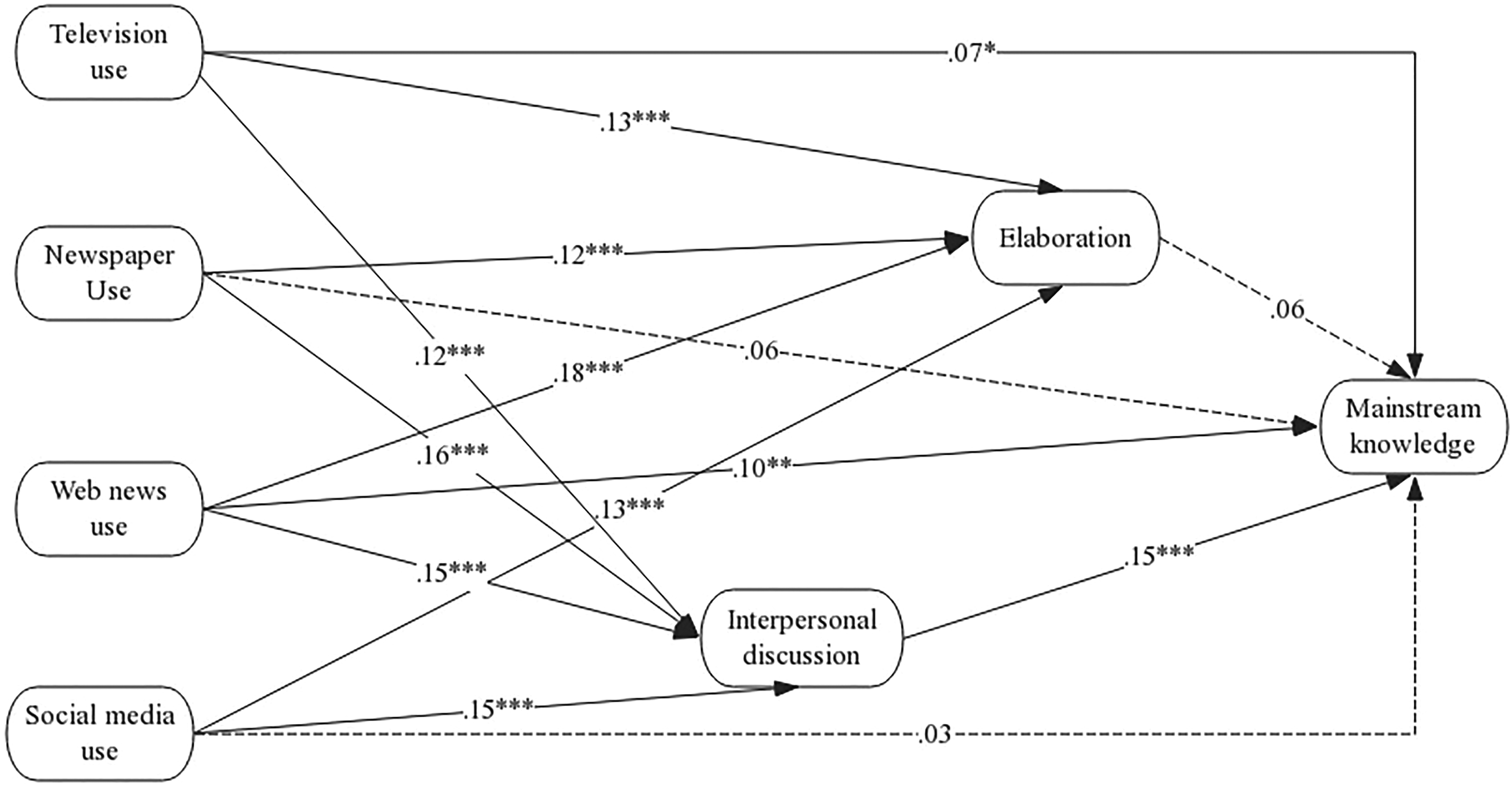
Structural equation model on mainstream knowledge with standardized coefficients (N = 1135). Dotted lines denote hypothesized nonsignificant paths.
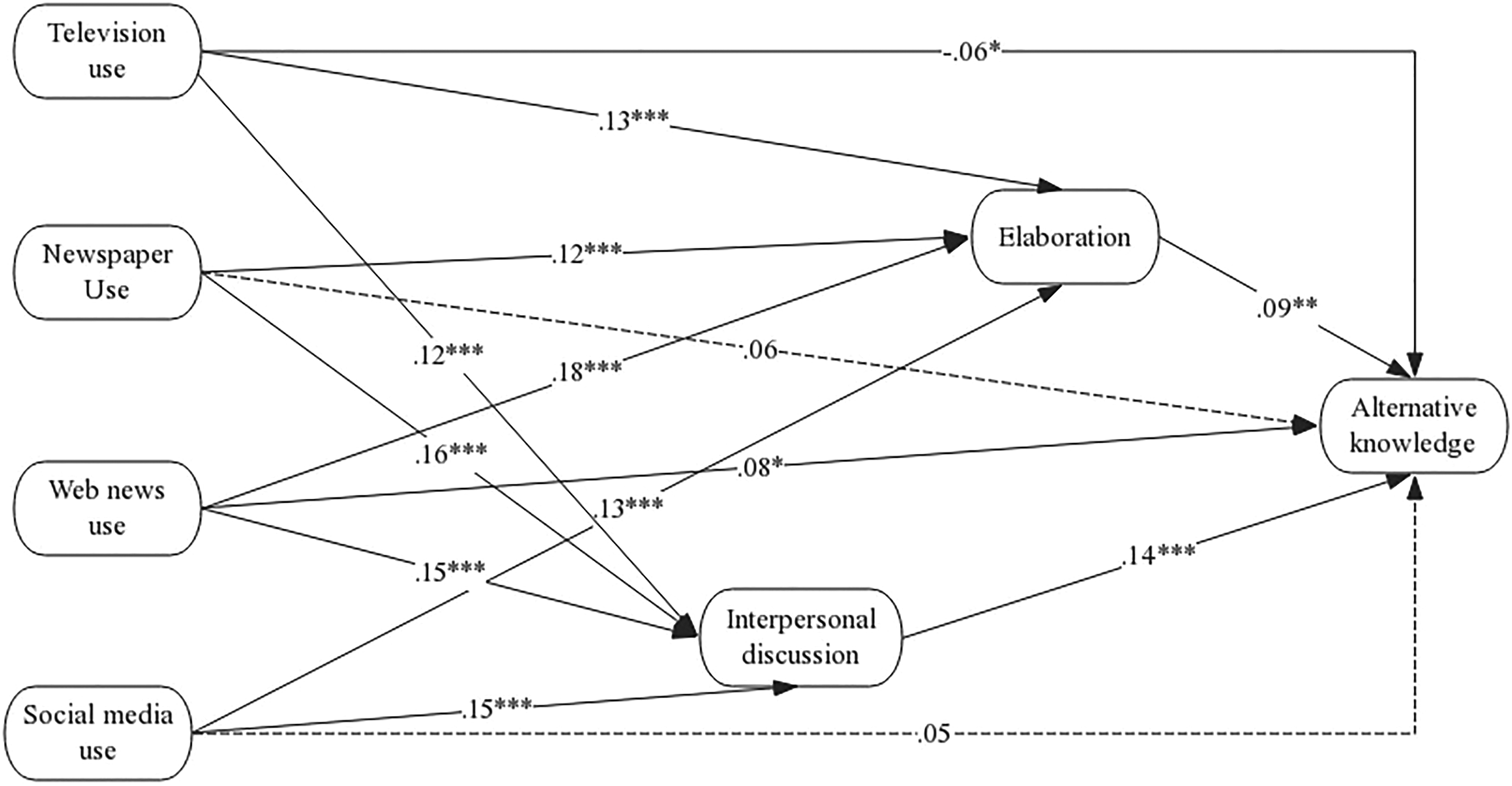
Structural equation model on alternative knowledge with standardized coefficients (N = 1135). Dotted lines denote hypothesized nonsignificant paths.
Results indicate that use of television news, newspaper news, web news and social media use are positively associated with elaboration and interpersonal discussion, as shown in Figure 3 and Figure 4. H3a, H3b, H3c, H3d, H4a, H4b, H4c, and H4d were all supported. Elaboration was not significantly related to knowledge but positively related to alternative knowledge. H5a was rejected but H5b was supported. In both models, interpersonal discussion was related to knowledge gain. H6a and H6b were both supported.
Discussion
By analyzing survey data from college students, this study has sought to understand knowledge gain in China. This study set out to compare the effects of different communication channels—traditional media, online media and interpersonal discussion—by extending and modifying the CMM. To contextualize the CMM, this study has put forward two distinct type of knowledge: mainstream and alternative public affairs knowledge. Moving beyond the original CMM, this study has also examined how different media channels are linked with knowledge gain both directly and indirectly. Additionally, this study considers interpersonal discussion in the model. The results show that the models are robust in measurement, and most hypothesized relationships received support.
One of the main contributions of this study is an examination of mainstream and alternative forms of public affairs knowledge. This distinction is based on an understanding of the current media environment in China. As traditional media (newspaper and television) and new media (web news and social media) are regulated differently in China, the content they present to the audience may also vary (Hassid, 2011; Zhao, 1998). Overall, online platforms create space for alternative information to circulate among audiences (Jiang, 2010; Link and Xiao, 2013; Yang, 2009). Even when some agendas are present in both traditional media and online media, the salience they gain can be different (Hassid, 2012). For example, it is not uncommon for a certain topic to be intensively discussed online while only receiving a little coverage from traditional media. With the prevalence of user-generated content and social media, online platforms gain opportunities to further distinguish themselves from traditional media in content provision (Hassid and Repnikova, 2016; Sullivan, 2014). Given the difference between new and traditional media sectors, this study proposes that the Chinese audience may gain two distinguishable bodies of knowledge. Results show that the study’s operationalizations of mainstream and alternative knowledge were effective. The two types of knowledge are moderately correlated (r = .47, p < .001), while respondents’ mainstream knowledge score (M = 3.04, SD = 1.66) is significantly higher than their alternative knowledge score (M = 1.65, SD = 1.44). On the one hand, this indicates that mainstream and alternative knowledge share some connection because they both reflect respondents’ understanding of public affairs. Respondents who have good mainstream knowledge are also likely to gain more alternative knowledge. On the other hand, alternative knowledge is not as easy to access as mainstream knowledge. This confirms the propositions that public affairs knowledge is not uniform and that different media sectors can provide people with different information about the social reality. The social realities as depicted by the mainstream media and by the alternative media are interrelated, yet not entirely parallel.
Results also show that different media channels have different effects on public affairs knowledge. For traditional sources, television news is positively associated with mainstream knowledge and negatively associated with alternative knowledge. The relationships are weak but significant. This result suggests that television still plays a part in people’s media consumption and maintains an influence on the audience. The pattern of associations can be explained by the fact that television as a mainstream news medium aims to construct legitimate discourses by promoting a mainstream understanding of public affairs while downplaying alternative information. Newspaper news is not directly associated with either type of knowledge. The disassociation can be largely attributed to the decline of the medium itself. Past research has found newspapers to be a quality source that facilitates political learning (Delli Carpini and Keeter, 1996; Robinson and Levy, 1986). However, newspapers are quickly losing ground to new media channels in China and many other places in the world. This is particularly the case for college students as surveyed in the present study. In the sample, only 10.5% of the respondents said they read news in a newspaper frequently or very frequently. Newspapers have become peripheral in young people’s news consumption. This may explain why the ability of newspapers to inform readers has also declined.
For new media sources, web news is significantly and positively associated with both mainstream and alternative knowledge, but social media news is not associated with either type of knowledge. In line with existing evidence (Dalrymple and Scheufele, 2007; Wei and Lo, 2008), this study’s results show that web news can be an ideal source for news learning. Web news is most often provided by professional news organizations, and the quality of news is guaranteed. Reading news through the web is compatible with young people’s media habits and their frequent engagement with online media. In China, web news enjoys greater autonomy in what it can cover than its offline counterparts. Therefore, web news is expected to present broader topics and more diverse information than traditional media. This explains why web news can contribute to the acquisition of alternative knowledge. In contrast, the results reveal null relationships between social media news and public affairs knowledge. While people have high hopes about the ability of social media to inform citizens, their effect on news learning is inconclusive. Some research shows that use of social media results in knowledge gain for highly motivated users (Lee and Oh, 2013), but other studies find limited evidence supporting the news-learning effect of social media (Oeldorf-Hirsch, 2018). According to Oeldorf-Hirsch (2018), news consumption on social media does not lead to knowledge gain, but rather its major role is to engage readers with news and trigger deep processing of the information. Since people use social media primarily for social purposes, they are less likely to be fully motivated to process news content, which, according to the CMM, is an important step of news learning. The content on social media is usually a mixture of entertainment, personal anecdotes, rumors and news, which can be a distraction for readers. These factors may explain the absence of a direct relationship between social media news and knowledge gain.
The models also reveal indirect effects between media use and knowledge gain. This study finds that news use on television, newspapers, the web and social media can contribute to knowledge gain through elaboration and interpersonal discussion. These findings confirm the CMM. Media exposure can drive people to engage in further processing of information. In both elaboration and discussion with others, people interrelate information from various sources and existing information in their memories, which in turn results in actual gaining of knowledge. It is worth noting that elaboration is only related to alternative knowledge in these results. One possible explanation is that mainstream knowledge is readily available on all kinds of media in China, since news media play the role of promoting public policy and national politics. Therefore, news elaboration is not essential for gaining mainstream knowledge. In contrast, alternative knowledge is not easily accessible on news media, so people need to put in more mental effort to process the information they encounter in order to finally acquire the knowledge. In addition, the results show that interpersonal discussion about public affairs is an important means for people to gain knowledge. Through discussions, people are not only exposed to new information and perspectives, but they also have a chance to elaborate on what is already known. The dynamics of conversations also help trigger deep processing of information and makes it easier to memorize. As in many previous findings (McLeod et al., 1999; Robinson and Levy, 1986), interpersonal communication appears to be a more consistently effective channel for news learning than media channels.
Concluding remarks
While some scholars propose that online information contributes to higher levels of knowledge because of increased availability, others doubt the role of online information as an effective source for knowledge (Mitchelsten and Boczkowski, 2010). This study has found that web news can be an effective source of information in China which enables users to gain both mainstream and alternative knowledge. In practice, media development authorities and media practitioners should not neglect the role of web news in informing the public with important issues and topics. Though it has existed for decades, the web is still an ideal means for presenting information. Web news is usually well designed, structurally presented, and integrated with interactive features. Compared with other online applications, the organization of web content fosters attentive reading. News content on the web is predominantly created by professionals but also integrated with user-generated content. Overall, web news has the potential to improve people’s understanding and engagement of public affairs. Despite its popularity among young people, social media may not directly contribute to knowledge; people use social media primarily for social and entertainment purposes. The major role of social media when it comes to news is to engage people in further processing of information and trigger discussions about it. In practice, social media designers should continue to improve the interactive features of social platforms to further motivate users to elaborate on, comment on, discuss and share information. It is likely that users’ engagement with the information on social media will eventually lead to knowledge gain. For traditional media, newspapers have become increasingly less important as a source of information. As a legacy medium, television plays a minor, yet significant, role in informing audiences. Practitioners should explore new possibilities of presenting information through television to maximize its effect on knowledge gain.
The current study has several limitations. First, the data used in this study were cross-sectional in nature; no causality could be inferred from the results. Second, though this study is based on a large sample, the non-probability sampling strategy does not allow legitimate generalization of the findings to larger populations. Third, it must also be recognized that effectively measuring media use is extremely challenging, especially considering the complexity of media practices in everyday life. Future research should examine knowledge acquisition use probability sampling to facilitate better generalizability and apply experimental design to ascertain causal links. Future research should continue developing more effective measures of media use to capture its dynamics in increasingly convergent environments.
Footnotes
Funding
This project was funded by Shanghai Pujiang Program (17PJC005).