






Abstract
Realizing the sustainability and competitiveness in the trade of medicinal and aromatic plants (MAP) resources of north India is challenging due to lack of participation from the primary producers (growers and harvesters). This is credited to their unawareness of sustainable resources management practices caused by the lack of a marketing information system (MIS) in the trade. The introduction of a MIS can supplement sustainability in the sector, while improving competitiveness. Through a qualitative research approach, this study investigates the need for marketing information among the primary producers of medicinal and aromatic plants of Uttarakhand, and offers a comprehensive framework for a provincial MIS and strategies for the MAP trade. The proposed MIS would be helpful in linking the MAP trade with sustainability and competitiveness.
Introduction
Apart from being a source of traditional medicines and household income for rural communities, medicinal and aromatic plants (MAP) are widely used in industry, being essential ingredients for herbal products and health supplements, including essential oils, pharmaceuticals, herbal health products, dyes, cosmetics, personal care products and herbal pesticides (Lubbe and Verpoorte, 2011). In the global trade of medicinal and aromatic plants, India holds a key position and is known as a hub for wild-collected medicinal and aromatic plants in Asia (International Union for Conservation of Nature (IUCN), 2008, November 24) and Traffic - the Wildlife Trade Monitoring Network (2008). The trade in medicinal and aromatic plants in India amounts to US$ 238 million, with a growth rate of 8% to 10% annually, while the global market amounts to over US$ 2.96 billion, and is estimated to reach US$ 5 trillion by 2050 (World Health Organisation, 2003) with a growth rate of 15-25% annually (Booker et al., 2012).
The contribution of medicinal and aromatic plants in the economy and livelihood of many rural communities, particularly in the developing countries, is well documented and recorded (Greene et al., 2000). According to Traffic (2008), the wildlife trade monitoring network, the collection and processing of medicinal and aromatic plants provides at least 35 million workdays every year for the poor and under-employed in India.
The wealth of Indian medicinal and aromatic plants is largely supported by Uttarakhand, the northwestern Himalayan state, where 701 species of vital medicinal and aromatic plants are used in different forms as traditional medicine (Dhar et al., 2002; Bisht et al., 2016). This is about 40% of the medicinal and aromatic plants found in the Indian Himalayan Region. The medicinal and aromatic plants of Uttarakhand also rendered valuable revenue for the state government. The trade value of medicinal and aromatic plants in Uttarakhand, from wild-harvesting and cultivation, was US$ 70 billion in 2013 (Kuniyal et al., 2015), and is increasing at the rate of 15%-18% annually. Medicinal and aromatic plants are a source of livelihood for many rural communities in Uttarakhand and contribute 17%-35% of the household income of the rural inhabitants (Chauhan, 2010). However, the growing trade and inconsistent commercialization are creating problems for the sustainability of the resources and threatening the livelihood of many primary producers (growers and harvesters), while key species have been declining (Barata et al., 2016; Kling, 2016).
The management of medicinal and aromatic plants in Uttarakhand
The policies, legal aspects and facilitation for cultivation, collection, conservation, and trade and marketing of medicinal and aromatic plants sector of Uttarakhand are mutually coordinated by the State Medicinal Plants Board (SMPB), the Herbal Research and Development Institute (HRDI), the Centre for Aromatic Plants (CAP), and other government-approved collection and sales cooperatives (Kuniyal et al., 2015). The integrated development of the sector is administered by the Herbal Research and Development Institute, a nodal agency designated by the State Medicinal Plants Board (Kuniyal et al., 2013, 2015). The HRDI is an autonomous research and development institute intended to facilitate the conservation, development and sustainable commercialization of medicinal and aromatic plants in Uttarakhand. Its activities comprise the promotion and cultivation of globally significant medicinal and aromatic plants, scientific and commercial assistance for primary producers to support sustainable trade and livelihood, research and development, transfer of technology for farmers, revitalization of traditional knowledge, quality control assessment and human resource development.
Despite the rich availability of medicinal and aromatic plants and significant efforts for integrated development, the medicinal and aromatic plants sector of Uttarakhand appears unable to achieve its real economic potential, competitiveness and sustainability in the trade (Dhar et al., 2000; Dutta, 2001; Schippmann et al., 2006; Yadav and Misra, 2012; Kuniyal et al., 2013; 2015; 2016). The inability of the sector to realize its real economic potential, competitiveness and sustainability is largely credited to the absence of a well-defined marketing system, the involvement of opportunistic middlemen in the trade, and lack of awareness about sustainable resources management and trade practices among the primary producers (Olsen and Helles, 1997; Belcher et al., 2005; Ghimire et al., 2005; Yadav and Misra, 2012; Pauls and Franz, 2013; Negi and Maikhuri, 2017).
A marketing information system facilitates making marketing and business decisions (Hess et al., 2004) for sustainable competitive advantage (Clemons, 1986). A marketing information system continuously supports marketing activities at each level and empowers the user for market monitoring, strategy development, functional integration and strategy implementation (Harmon, 2003). In agriculture-based businesses, the marketing information system is a tool to empower the farmers by advancing their negotiation skills, and expands the market for their products from local to the national and global levels (Mahaliyanaarachchi, 2003; Osei et al., 2017).
Research problem
Many previous studies (e.g. Schippmann et al., 2002; Chauhan, 2010; Booker et al., 2012; Yadav and Misra, 2012; Pauls and Franz, 2013; Kuniyal et al., 2013, 2015; Pangriya, 2015; Phiri et al., 2018) have supported the need of a marketing information system for the sector. These studies suggest that the marketing information system will enable policy makers to make sensible decisions to increase the potential and competitiveness of the sector and persuade the primary producers to take part in sustainability measures to get reasonable economic returns for their livelihood. A recent study conducted by Chandra and Sharma (2018), empirically supports the development of a dedicated marketing information system for the sustainable management of medicinal and aromatic plants resources in Uttarakhand. The authors argue that this will strategically facilitate sustainability in the sector, along with improving its competitiveness.
Research objective
The present study aimed to investigate the need of marketing information among the primary producers of medicinal and aromatic plants in Uttarakhand and offer a comprehensive framework for a provincial marketing information system and strategies for the medicinal and aromatic plants trade of Uttarakhand to provide for sustainability and competitiveness.
Methodology
To investigate the need of marketing information among the primary producers, a qualitative exploratory research design was used and a three-step methodological framework was followed (Figure 1).
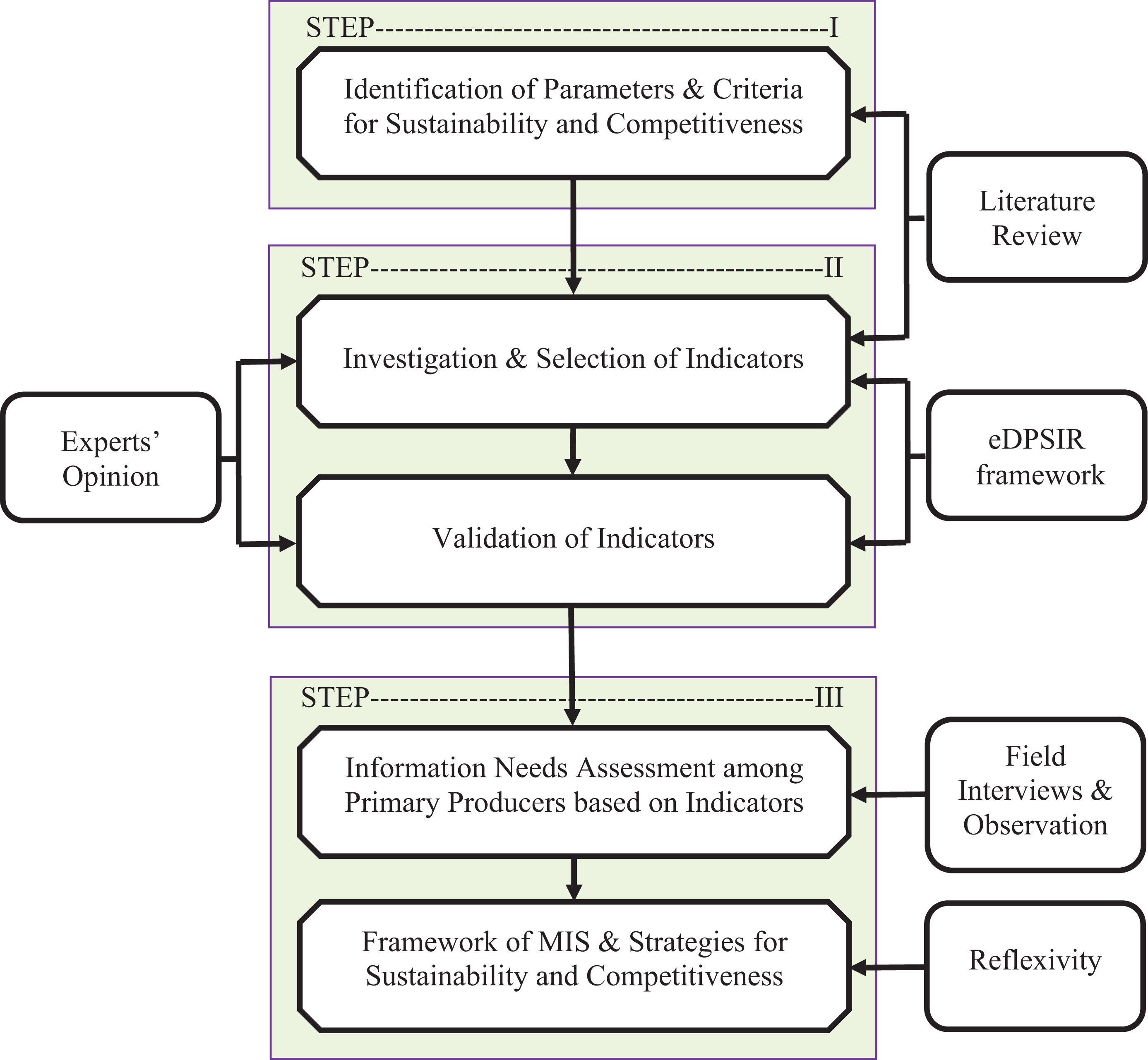
Methodological framework.
In Step I the parameters and criteria, which represent sustainability and competitiveness in the trade of medicinal and aromatic plants resources, were investigated through a review of literature.
In Step II the indicators of the key elements required for achieving sustainability and competitiveness in the medicinal and aromatic plants trade and sector from the perspective of primary producers, were explored further by a review of the literature pertaining to medicinal and aromatic plants sustainability and competitiveness, then selected and validated by expert opinions using the enhanced Driver-Pressure-State-Impact-Response (eDPSIR) framework (Niemeijer and de Groot 2008).
Conservation, sustainable trade, market participation, and market competitiveness were identified, with 10 criteria and 27 related indicators for sustainability and competitiveness of the medicinal and aromatic plants sector and trade of Uttarakhand (Table 1).
Criteria and indicators

In Step III the primary producers (growers and harvesters) were interviewed and observed. These interviews were based on a semi-structured interview protocol predominantly designed to evaluate the primary producers’ commitment to and understanding of the indicators of sustainability and competitiveness (see Appendix A). The protocol was initially created, revised, and refined in English, and then translated into Hindi for interview with primary producers. The protocol comprised questions about how aware the primary producers are about the conservation measures and sustainable trade prospects of medicinal and aromatic plants in Uttarakhand, how they understand competitiveness in terms of their participation in the process of trade and marketing of medicinal and aromatic plants resources, and what reasonable knowledge and skills they need to be competitive in the process.
The interviews were conducted in April 2017 and observations were done in May 2017. We continued data collection until we reached saturation (Mason 2010; Fusch and Ness 2015; Chandra and Sharma 2018) at 36 interviews. After this point, no further new information was observed. These 36 respondents (5 experts and 31 primary producers) represented purposeful sampling (Guba and Lincoln 1985). Because the main objective of this study was to investigate the need of marketing information among the primary producers of medicinal and aromatic plants of Uttarakhand and thereby offer a comprehensive framework for a provincial marketing information system, we purposefully selected a sample of 31 primary producers who had sound involvement with the medicinal and aromatic plants sector of Uttarakhand in terms of planning, trade and commercialization, and who could reflect the reality of the sector (Pirannejad, 2011). The opinions of the five experts were sought after the analysis and interpretation of the interview transcripts of the primary producers to verify the outcomes of this study. A reflexive methodological framework was used for data collection and analysis (Alvesson and Sköldberg 2017).
Data analysis
The interviews of primary producers were transcribed verbatim and a qualitative content analysis of transcripts was conducted (Chandra and Sharma, 2018). Based on the interpretation of the individual responses, key information about the indicators of sustainability and competitiveness was summarized against each indicator, along with key reflections that validate the need of marketing information for the sustainable and competitive medicinal and aromatic plants business in Uttarakhand. The same process was followed for the analysis of the observation notes, and incorporated with the findings of interviews data.
To ensure the rigor of the findings the interview data were corroborated by the data from the observations (Jamshed, 2014) and the criteria suggested by Guba and Lincoln (1985), namely, credibility, dependability, confirmability and transferability, were carefully considered during data collection, analysis, and presentation of the findings to maintain the trustworthiness of the study.
On the basis of the findings we devised the framework of marketing information system and strategies for sustainability and competitiveness in the medicinal and aromatic plants business in Uttarakhand shown in Figure 3.
Findings and discussion
We first present the viewpoints of primary producers on their commitment and understanding on the indicators of sustainability and competitiveness along with a description, which emerged through the data, about the competitiveness of primary producers in the process of trade and marketing of medicinal and aromatic plants in Uttarakhand. We then present the viewpoints of experts on our findings and these are illustrated as key reflections in Figure 2. Lastly, on the basis of the key reflections of this study (see Figure 2), we offer a comprehensive framework of a provincial marketing information system for the medicinal and aromatic plants businesses of Uttarakhand.

The integrative findings of the study.
Viewpoints of primary producers for indicators
The primary producers explained their commitment and understanding for the indicators of sustainability and competitiveness. The integrative findings are presented in Figure 2.
Commitment and understanding of the indicators of sustainability
An overwhelming majority of the participants (94%; 29 of 31), revealed that even though they are aware of the conservation issues of medicinal and aromatic plants in Uttarakhand, they are not really concerned about the indicators of sustainability. For example one of the primary producer reflected this belief about the commitment to sustainability as follows: We are depended on these resources for our livelihood needs and some part of basic income. However, the season nature of business and our inability to approach buyers in the open market incite us for opportunistic trade without considering its impact on the sustainability of the sector. Yes we are aware that this situation will negatively lead resources sustainability in the sector. Scientific assistance, supervision, and training is constantly offered for introducing the cultivation of selected medicinal and aromatic plants. But, we are not aware - how these plants will be sold legally in the market, when the potential buyers will come for trade, and what they will pay for it, is very much unpredictable for us, thus the cultivation of medicinal and aromatic plants for sustainability and socio-economic benefits is hardly recognized to our side. Our trade activities are totally seasonal and opportunistic, because seasonally we received the demand from our hidden trade partners and we trade. We have not specific arrangement or even idea for inventory management, no specific demand in advance. Our key dependency is on middlemen and whatever they demand for we supply them.
Commitment and understanding of the indicators of competitiveness
With regard to competitiveness all 31 participants (100%) stated that they are not aware about competitiveness and how it could be achieved. Because of their dependency on opportunistic middlemen they are remain entangled with them and do not take active market participation. One primary producers reflected this: Our 100 percent trade is seasonal and opportunistic, our trade is not based on market requirements, we are not attentive for market trends rather our priority is fulfilling’s the demand we receive from middlemen. The usage of various medicinal and aromatic plants resources are rooted in our cohorts. Therefore, we are well acquainted on their characteristics and are very much sure these plants are used for producing various herbal generated products for market needs, but it is not known for us how this herbal industry works and from where they procure the required medicinal and aromatic plants. Out first and foremost task in the trade process is just cleaning and sometime drying the collected medicinal and aromatic plants, this is our value addition. Whatever prices are offered to us for our collected materials we happily accept, because overall it is opportunistic and seasonal and we do not have much buyers for that.
Viewpoints of experts on the findings
All the experts confirmed our findings and reflected that the primary producers of medicinal and aromatic plants of Uttarakhand are experiencing a huge information gap, particularly for sustainable conservation planning. The required information on marketing of these resources is not available to them, which is impeding the enabling of the primary producers for sustainability and competitiveness in the sector. The experts also reflected that marketing data on trade, demand, and supply of medicinal plants resources is hard to get in Uttarakhand in the absence of any specific system like a marketing information system. This is again negatively influencing the sector for sustainable strategies in terms of competitiveness and differentiation. For achieving sustainability and competitiveness in the medicinal and aromatic plants businesses of Uttarakhand, the findings of our study indicate the need for marketing information system.
Framework of marketing information system
As illustrated in Figure 2, the key reflections of this study, which emerged through analysis of the interview data, firmly justify the need to develop a marketing information system (similar to the findings of previous studies such as: Maikhuri et al., 2003; Kala, 2006; Melville, 2010; Kuniyal et al., 2013, 2014, 2015; Negi and Maikhuri, 2013; Pauls and Franz, 2013), and to operationalize strategies for sustainable and competitive medicinal and aromatic plants businesses. Using the system approach, i.e. input-process-output model, which provides a useful framework for solving the problems with effective solutions (Curry et al., 2006), a framework for a provincial marketing information system for the medicinal and aromatic plants businesses of Uttarakhand is therefore presented.
To envisage the marketing information system for medicinal and aromatic plants, the input actors are categorized, based on their potential to bring in the input information in the system at various levels, into three groups, namely, provincial, national, and international. The medicinal plants board of Uttarakhand will be the processor, as it is an umbrella body for the inclusive management of the medicinal and aromatic plants sector in Uttarakhand. The output elements of the system have been conceptualized into four groups corresponding to the identified parameters of sustainability and competitiveness of the medicinal and aromatic plants sector of Uttarakhand.
Major sources of information for the MIS framework
Input actors and information element
The input actors are the stakeholders that may generate the required input information for the system. In the proposed framework the major information sources that will serve the key information at different levels are described below.
At the provincial level the Primary Producers, Local Traders and Suppliers, Manufactures of the Herbal Products, Department of Forest, Research and Development Institutions, NGOs and Cooperative agencies are the sources for input information. These are the stakeholders and institutions engaged in the management, conservation and commercialization of medicinal and aromatic plants at the provincial level in Uttarakhand. All the actors of the provincial level are capable of bringing in the required and reliable information on conservation, cultivation, resource availability, information on buyers and suppliers, price statistics at different level, demand and supply pattern, value added products and techniques, volume purchased, order frequency, monthly trade data, inventory of medicinal and aromatic plants, market requirement, harvesting pattern, modus of illicit trade, and involvement of middlemen in the trade.
At the national level the institutions of central government, i.e. the Ministry of Environment & Forests (MOEF), the National Medicine Plant Board (NMPB), the national research and development units, trade associations and nodal agencies may considered as input actors. These institutions possess the records of national level policies and interventions related to medicinal and aromatic plants and issue guidelines for provincial management of the resources, information related to national level development, such as periodic data on trade, budgetary allocation, cost-benefits reports, market feasibility reports, government policy updates, and market requirements and demand, which may be documented through these units.
Information connected to global level policy and interventions may be input by international organizations like the Convention on International Trade in Endangered Species of Wild Fauna and Flora (CITES), the World Health Organization (WHO), the United Nations Development Programme (UNDP), and the Food and Agriculture Organization of the United Nations (FAO), which are well-known sources of information at the international level. They can provide input information on conservation status and sustainability, future conservation needs, market demand for specific product or medicinal plant species, international initiatives for conservation, and trade impact analysis on sustainability of the resources.
Processor
The State Medicinal Plants Board (SMPB), an umbrella body of the Uttarakhand government, may act as a processor for the entire framework of the marketing information system. Information brought into the system by all key input actors will enable the board to devise sustainable marketing planning and strategies for the commercialization of medicinal and aromatic plants resources after careful processing, strengthening the position of primary producers in the trade of medicinal and aromatic plants.
Output elements
Output elements are the result of the processing of all input information the processor received. The key output elements, which may be generated by the processor after careful analysis and processing, are related to conservation planning, empowerment of primary producers, marketing data, market competitiveness and differentiation with various sub-elements to support sound planning and business interventions. All the output information will be useful to realize sustainability and competitiveness in the trade of medicinal and aromatic plants resources.
In order to realize sustainability and competitiveness in the medicinal and aromatic plant trade by the application of a sound marketing information system, the State Medicinal Plants Board will be required to establish a dedicated division within its own structure, for which information technology tools and information management software are essential for error free analysis, collection and processing of the information.
Strategies for sustainability and competitiveness for medicinal and aromatic plant trade
Taking into consideration the ecological, social and economic needs, criteria and indicators have emerged as pragmatic tools to support sustainable management practices (Phondani et al., 2016). To realize sustainability in the medicinal and aromatic plants sector of Uttarakhand, indicators representing conservation and sustainable trade parameters (Table 1), must be acknowledged by all the stakeholders. To ensure the acknowledgement of the indicators associated with sustainability objectives, the first two output elements of the proposed marketing information system, i.e. conservation planning and empowerment of primary producers, are significant.
The elements of conservation planning, as shown in Figure 3, help to assess the impact of trade on the sustainability of medicinal and aromatic plants resources, set priorities for conservation and cultivation, impose necessary legal control over excessive trade, and devise sensible policy and regulation for sustainable outcomes. The second output element of the proposed marketing information system, the empowerment of primary producers for participative management and sustainable trade, is central. Through this element, information about markets, the benefits of participative trade, the negative role of opportunistic middlemen, and the significance of inventory management could be disseminated among the primary producers, for example, through suitable training modules and awareness programs for primary producers.

The framework of marketing information system for sustainability and competitiveness in medicinal and aromatic plants trade.
The marketing information system for medicinal and aromatic plants trade is vital for Information propagation among primary producers for creating awareness to encourage them for participative management and trade of the resources. Visualizing sustainable economic objectives through medicinal and aromatic plants trade. Developing conservation planning and market assessment for the medicinal and aromatic plants sector Eliminating the destructive trade practices, which are currently inhibiting the sustainable management of medicinal and aromatic plants sector in Uttarakhand. The flow of information should be consistent to develop a sense of sustainable business acumen and a socio-economic perspective of the MAP resources (Hamilton, 2004).
To operationalize the marketing information system in the medicinal and aromatic plants trade, the role of commercial enterprises, which manufacture herbal products using medicinal and aromatic plants resources, is much appreciated. With their expertise, establishing the marketing information system will not only facilitate the sustainability of the resources but will enable competitiveness in the sector along with the empowerment of primary producers for enhanced income and better livelihoods.
Discussion
Efforts for the integrated development of the medicinal and aromatic plants sector are significant in Uttarakhand, but from the perspective of the primary producers, they are not well-planned and executed. To achieve the objective of sustainability, empowerment of primary producers is essential. To do this, knowledge about sustainable trade practices and awareness is essential. With the help of a sound marketing information system, policy makers and responsible authorities of the sector can accumulate, analyze and process the information to plan capacity building and awareness programs for the primary producers (Kuniyal et al., 2016). The information will also establish a way of achieving sustainable economic returns for primary producers, to raise their participation in the sustainable development of the medicinal and aromatic plants sector of Uttarakhand.
Conclusion
This study aimed to investigate the need of market information among the primary producers of medicinal and aromatic plants in Uttarakhand and offered a comprehensive marketing information system that could be linked to the sustainability and competitiveness of the sector. The findings revealed that the primary producers are facing a huge information gap in terms of resources sustainability and business competitiveness. We therefore suggest the need for a system that will be helpful in creating awareness among the primary producers about the sustainable benefit of the sector in terms of economic reliability and ecological sustainability.
Based on the present situation of the sector and need of the primary producers we offer a framework for a marketing information system for medicinal and aromatic plants-based businesses to realize sustainability and competitiveness. The framework will allow policy makers, responsible authorities and businesses in devising sustainable business interventions and policy to support the sustainability, competitiveness in the sector and the economy of the primary producers.
This is the first study of its kind, which explores the application of a marketing information system in achieving sustainability and competitiveness in the medicinal and aromatic plants trade of Uttarakhand. By investigating the need of a market information system among primary producers with the help of indicators which represent sustainability and competitiveness in the medicinal and aromatic plants trade and resource management, this study extends the existing literature of natural resource management by sustainable business interventions.
This study extends the scope for further research studies in relation to marketing information for the medicinal and aromatic plants-based business in other contexts. However, the framework offered here can be a basis for further conceptual and empirical research studies. This study is also significant for agriculture-based business in adopting sustainable management practices with indicators and a marketing information system.
Footnotes
Appendix
The semi-structured interview protocol, which was designed to evaluate the primary producers’ commitment to and understanding of the indicators of sustainability and competitiveness. The protocol comprises the following questions: How do you realize the sustainability in the medicinal and aromatic plants while trading the plants? How the cultivation of important medicinal and aromatic plants is suitable for your socio-economic objectives? How the departments engaged for the management of medicinal plants in Uttarakhand supports you for cultivating and trading? How do you perform the trade of medicinal and aromatic plants? How your own trade activities are affecting the medicinal and aromatic plants conservation and sustainability? How competitive do you feel while trading? What is your priority while trading? How do you decide the final selling prices? What value addition you do before selling the plants to buyers?
Acknowledgement
Author Pramod Chandra thanks Dr Chandra P. Kuniyal, Scientist, Herbal Research and Development Institute, Gopeshwar Chamoli for providing technical guidelines and key references on the MAP of Uttarakhand. The authors are also thankful to the anonymous reviewers, and mainly the journal editors for their developmental comments and suggestions throughout the revise and resubmit process.