







Abstract
This paper is part of a larger qualitative multiple case study that sought to explore the integration of indigenous knowledge in public libraries in South Africa. The paper draws from semi-structured interviews with selected heads of provincial library services in South Africa to determine the extent to which public libraries provide targeted resources to enhance access to IK. Results reveal that that there are no targeted resources to facilitate access to IK. Concerted efforts to facilitate access by increasing the number of libraries were noted. Notwithstanding these efforts, there seems to be a paucity of IK, which has implication for inclusive services. It is recommended that libraries look beyond enabling access to the Internet but also explore how they can further optimise ICT usage as a way of facilitating access to IK through capturing, organising and disseminating knowledge of indigenous communities.
Introduction and contextual background
Access to information is a basic human right as declared in Article 19 of the UN Declaration on Human Rights (United Nations, 1949). Signatory nations to the Declaration are under obligation to respect this right. Although this declaration was promulgated in 1949, South Africa only became a signatory after the democratic dispensation which was signalled by the first free elections in 1994. Thus, prior to the democratic dispensation, the majority of South Africans were subjected to a number of human rights violations including denial of access to information (Fourie, 2007; Mhlongo 2018; Ralebipi-Simela, 2007; Witbooi, 2007).
Historically South Africa was a country divided along racial lines. Racial segregation was also evident in the allocation of resources and provision of services to the different racial groups. In accordance with pre-democratic dispensation policies, public libraries in South Africa were differently and unequally resourced, based on racist policies of separate development. The situation resulted in fragmentation and disparities in service levels and the availability of resources in public libraries of the time (Fourie, 2007; Ralebipi-Simela, 2007; Witbooi, 2007). Whites were provided with superior, better resourced services whereas other racial groups had poor (and in some instances non-existent) services.
The ideal of apartheid or separate development was informed by the notion that for communities to grow and freely participate in their religious, cultural, linguistic and other practices they need to be separated (Prah, 2007). Blacks were the worst affected by this racial division (Mostert,1999; Nassimbeni, 2014; Owens, 2002; Rodrigues, 2006; Witbooi, 2007). The apartheid government did not see the need to develop library services for blacks as it feared that reading would be a source of “self-awareness and self-advancement” (Owens, 2002:55), which would go totally against what apartheid stood for.
A milestone in the history of the democratic South Africa was the abolition of segregation in all its forms. After 1994, when new geographical demarcations were put into place by the democratic government, the number of provinces increased from four to nine provinces. The changed political environment implied that on the one hand, there were the four pre-democracy provinces which were occupied by whites and were therefore resource endowed while on the other hand, the newly formed and racially integrated provinces differed immensely in terms of population numbers, poverty levels, wealth distribution and service provision requirements.
Most of the newly established provinces still carry the legacy of apartheid inequalities in terms of services and sources. The provision of public libraries was declared a provincial competency as per Schedule 5 of the Constitution of the Republic of South Africa (Republic of South Africa, 1996). However, because of prior inequalities in library provision, some provinces inherited a fair number of libraries while others had to start from scratch to establish library services (Department of Arts and Culture, 2009).
The outlined developments heralded a climate of equal access to information which became entrenched in the country’s constitution (Republic of South Africa, 1996). However, entrenchment of the right to access to information for all remains an ideal yet to be realised for some communities despite the intended inclusivity of services and resources. Public libraries seem to focus on supporting school curricula at the expense of other user groups (Mhlongo 2018). This situation renders public libraries inaccessible to some potential users because of irrelevant content (Chisita, 2011). It is therefore necessary to explore whether inclusion of IK in public libraries can contribute towards enhancing access to library services. Given the historical marginalization of IK (Odora Hopers 2002), it is important that public libraries provide targeted resources to address the historical imbalance and ensure epistemic justice (Medina, 2013).
Indigenous knowledge
A plethora of definitions and views on what constitutes indigenous knowledge and indigenous knowledge systems abound (Chanza and De Wit 2013; Hagar 2003; Lindh and Haider 2010; Mearns, Du Toit and Mukuka 2006; Nakata, 2002; Ngulube and Onyancha 2011; 2017; Onyancha et al. 2018; Reynar 1999; Semali and Kincheloe 1999; Sillitoe 1998; Viergever 1999). Attesting to the lack of consistency in nomenclature, Ngulube and Onyancha (2011) identified as many as seventeen labels by which this kind of knowledge is referred to although they observed that ‘indigenous knowledge systems’ (IKS) seemed to be preferred in the literature. In a later study Onyancha et al. (2018) concluded that ‘indigenous knowledge’, ‘local knowledge’ and ‘technical knowledge’ seem to compete in terms of frequency of use in the literature.
Along with the challenge of nomenclature, is the scepticism surrounding IK as ‘true knowledge’ (for example Horsthemke 2004). Using the criteria of belief, justification and truth to assess the validity of indigenous knowledge, Horsthemke (2004:31) concludes that it is “…an incomplete, partial or, at worst, a questionable understanding or conception of knowledge.” Horsthemke’s position points to hegemony of the global north in knowledge production which precludes other knowledge systems. Adopting an opposing view, Dube and Hlalele (2017) propose the promotion of indigenous epistemologies “as a counter-hegemony strategy” in an apparent attempt to position IK to claim its rightful space with other knowledge systems. These authors’ stance is in line with the IFLA statement on Indigenous Traditional Knowledge (IFLA 2002) which argues for viewing IK holistically despite existing contestations in conceptual definitions of IK.
Notwithstanding the plethora of definitions and divergent views on IK, in this paper IK and IKS are used interchangeably to refer to the collective wisdom of communities, which has been transmitted from generation to generation through language, practices, and rituals (Mhlongo 2018).
Indigenous languages
In terms of the Constitution of the Republic of South Africa (Republic of South Africa 1996) the country has eleven official languages. Among these eleven languages are English and Afrikaans which have always been privileged in various sectors including libraries. In this study, prior marginalisation of a language was used as a yardstick in identifying indigenous languages. Thus, in the context of this study, indigenous languages are all South African languages other than English and Afrikaans.
Indigenous communities
In line with the parameters of indigenous languages explained above, the paper regards indigenous communities as South African communities whose languages, cultures and religious practices were marginalised through repressive laws. Based on their ethnicity, these communities were restricted to specific underdeveloped, largely rural areas within South Africa.
Library resources and services
Library resources are assets and capabilities that are essential for the effective functioning of a library. They include infrastructure, staff, budgets and library materials. Library services refer to activities that libraries undertake to serve needs of user communities ranging from processes such as referencing, circulation, inter-library loans, information searches and current awareness services to outreach programmes. Arguably, there is direct relationship between resource allocation and effectiveness of rendered services. Service provision cannot be effected without resource provision. Lack of infrastructure can thwart efforts to provide effective services thus limiting access to knowledge created by and for indigenous communities (Roy, Hogan and Lilley 2012). Resource allocation should be undertaken with a clear idea of the kind of services envisaged.
Problem statement
The dearth of indigenous knowledge in public libraries of South Africa seems to suggest a gap in service provision. The gap could be perceived as a perpetuation of the historical denial of access to information for certain user categories. Indigenous knowledge is valuable in various aspects of community life (Agrawal, 1995; Breidlid, 2009; Briggs, 2005; Chanza and De Wet, 2013; Donnelly-Roark 1998; Gorjestani 2000; Green 2007; 2012; Hagar 2003; Mercer et al. 2010; Nakata, 2002; Nakata et al. 2007; Ngulube and Lwoga, 2009; Odora-Hoppers, 2002; Ossai, 2010; Ramphele 1998; Sen 2005; Shange 2014; Sillitoe 1998; Sillitoe and Marzano 2009; Wilson, 2001; World Bank, 2004). In spite of the documented evidence of the usefulness of IK, public libraries appear not to have taken steps to provide access to IK, thus perpetuating its historical marginalisation. As gateways to information (UNESCO/IFLA,1994), public libraries should strive for inclusive services by facilitating access to IK as part of their service provision.
The provision of targeted resources to facilitate access to IK could contribute towards addressing its historical marginalisation and ensuring epistemic justice. Resource provision has potential to contribute towards providing access to IK thus improving lives of indigenous communities.
This paper is part of a larger study that sought to explore the integration of IK into public library services. The paper examines the provision of resources to facilitate access to indigenous knowledge in South Africa. In seeking answers to ascertain the purpose of the study, the following research questions were posed:
What resources are provided to facilitate access to indigenous knowledge in public libraries in South Africa?
To what extent do existing collections in public libraries in South Africa include indigenous knowledge?
What challenges affect IK inclusion in public libraries in South Africa?
Literature review and theoretical framework
The IFLA Statement on Libraries and Development (IFLA, 2013) highlights the importance of accessibility and social and cultural inclusivity, and declares that libraries provide opportunities for empowerment and self-development. The statement further regards libraries as “natural partners for the provision of public access to information and communication technologies (ICTs) and networked information resources.” (IFLA, 2013:1). In order to live up to this expectation, public libraries need to ensure that they provide adequate resources and services.
In South Africa, efforts to extend services to all were undertaken by the democratic government by allocating funds through the Department of Arts and Culture in the form of conditional grants to all nine provincial library services (Department of Arts and Culture, 2015). Conditional grants were intended to supplement provincial budgets for libraries in order to achieve their mandate to provide public library services as per Schedule 5 of the Constitution of the Republic of South Africa (Republic of South Africa, 1996). Each province is supposed to allocate a budget towards the provision of library services. However, a review of provincial spending on public libraries reveals that most provinces do not budget for libraries but instead use the conditional grants to substitute their provincial allocation budgets for library provision (Department of Arts and Culture, 2013). The disquieting implication of this situation is that it perpetuates the marginalisation of previously disadvantaged communities in terms of public library provision.
Another important development in post-apartheid South Africa was a philanthropic initiative by the Bill and Melinda Gates Foundation which funded the Mzansi Libraries On-Line, through the Global Libraries Programme (Department of Arts and Culture, 2015). The major focus of the project was to extend services to users through the use of technology. Stilwell (2016) notes efforts undertaken by provinces to enhance access to information. Similarly, Mugwisi, Jiyane and Fombad (2018) endorse public libraries as facilitators of information. Increasing the number of libraries and installing information and communication technologies (ICTs) is an important step towards ensuring access and social inclusion. Such initiatives demonstrate the high value placed on the need to redress past imbalances and provide equitable access to information services for all South Africans. It then becomes necessary to determine what other targeted resources are provided to enable access to IK. Critical aspects of access and social inclusion are appropriateness and relevance of library collections.
Despite strides made in post-apartheid South Africa regarding library provision, there is still concern pertaining to the appropriateness of library services and resources (Department of Arts and Culture, 2014; Raju and Raju, 2009). Musing on under-usage of public libraries, Raju and Raju (2009) contend that it could be a result of the perceived inappropriateness of collections to potential users.
In contextualising the importance of resources in ensuring relevance of library services, Ranganathan’s seminal work, the Five laws of library science (Ranganathan, 1988) is adopted as a framework. The first law addresses the issue of ensuring that books (library materials) are used. As a resource, library materials can only be used if they are relevant to the needs of served communities. It is therefore imperative for public libraries to ensure that library materials are in line with needs of their users. Pertinent questions relating to relevance of library collections include the determination of user groups, their information needs in terms of content, appropriate languages and formats.
South Africa is a multilingual country with 11 official languages (Republic of South Africa, 1996) therefore public libraries have to take cognisance of this constitutional imperative to ensure that library materials are also made available in indigenous languages. In their role as cultural spaces, public libraries need to ensure that tools for cultural transmission are made available for all users. The interdependence between indigenous knowledge, culture and language is discussed by various researchers (for example, Magwa, 2010; Motsaathebe, 2010; Monaka and Mutula, 2010; Odora Hoppers, 2002; Seema, 2012; Semali and Kincheloe, 1999). Scholars have however, lamented the predominance of English and French in the economic discourse in Africa (for example, Magwa, 2010; Odora Hoppers, 2002; Prah, 2007).
Referring to the South African situation, Prah (2007) notes with concern that, despite the adoption of the national language policy and the establishment of the Pan South African Language Board (PanSALB) which was tasked with elevating the status of indigenous languages, English still dominates in business. Similarly, in Zimbabwe, Magwa (2010) observed the dominance of English at the expense of not only the three official languages, but also many of the minority indigenous languages. He goes on to argue for a language policy that puts “indigenous languages at the centre” as a way for Zimbabwe to attain its “dignity [and] cultural identity…” (Magwa, 2010:167).
Demonstrating the critical role of language in the acquisition of knowledge and values among the Basotho, Seema (2012) argues that without a good understanding of language, valuable lessons taught through proverbs, puns, folklore, myths and legends are rendered meaningless. Language issues become complex in multicultural and multilingual countries. For example, Monaka and Mutula (2010) report that a Botswana government decision to use language as a unifying tool by proclaiming Setswana as the official language left some communities with a sense of alienation and marginalisation, which was certainly not the intended consequence.
Raising a different view, Parry (2011) cites a sobering example based on a study in libraries in six regions in Uganda, where she observed that, despite the fact that even in libraries that were initiated by indigenous Ugandans, English continues to dominate at the expense of their indigenous languages. Her conclusion is that the use of English is a choice rather than something that is forced on indigenous language speakers. This observation is cause for concern in contexts that aspire to be culturally and linguistically inclusive.
The importance of English in facilitating global connectivity with the international community is acknowledged as noted by Odora Hoppers (2002) and Prah (2007); however, its potential to increase the possibility of alienation locally can result in further marginalisation and even the demise of indigenous languages and by implication indigenous knowledge. A balanced approach in dealing with indigenous languages and indigenous community issues is necessary. It is important to heed an earlier warning against neglecting local languages made by Semali and Kincheloe (1999:11) that: Jumping on the bandwagon of ignoring local languages…is tantamount to succumbing to power dynamics operating to subjugate knowledge systems of marginal people.
Public libraries also need to ensure availability of collections in different formats, covering a variety of content thus facilitating access by catering for varying needs and to explore other avenues in terms of what can be included in library collections. For example, in areas such as collection development and reference services, insight into community needs, based on their ontologies and epistemologies, is critical. Dube and Hlalele (2017) lament the hegemony of western epistemologies which, as they argue, prevents local communities from contesting dominant discourses and epistemologies. It therefore becomes important for the public libraries to be knowledgeable about their contexts including cultures and languages of their communities. Librarians have an important role to play in this regard because by failing to do so they would inadvertently be contributors in perpetuating the exclusion of some communities and promoters of elitism.
Ranganathan’s (1988) second and third laws of “every reader his or her book” and “every book its reader” respectively are critical aspects for building library collections. Collection building is a deliberate action that is intended to ensure usage and service relevance. Libraries need to ponder on what they collect and for whom the collection is intended in order to ensure continued service relevance.
Making an observation of the situation in Botswana, Moahi (2012) bemoans the fact that public libraries are used as study centres by students because, she concludes, their content does not address information needs of intended beneficiaries of these services, in particular indigenous knowledge, to which people can relate. Libraries that respond to principles of “every reader his/her book” and “every book its reader” would succeed in making library collections responsive and relevant. Hart (2010) also raises the issue of poor library usage by adults despite assertions that public libraries are accessible to all. It is crucial that public libraries embark on a continuous process of examining the profiles of their users in earnest, especially in those areas where there is a high level of migration by communities.
The fourth law of library science (Ranganathan 1988) is about saving the time of the reader. The principle is about efficiency. Efficiency relies on appropriate systems that do not hinder access to information and availability of suitable material. Ranganathan’s fifth law points out that “the library is a growing organism.” The changed political climate in South Africa as well as diverse user groups is an indication of the library as a growing organism. Providing targeted resources to facilitate access to IK taking into account its historical marginalisation would be one way of embracing the principle of growth. If public libraries fail to embrace this aspect they are remiss in their duty of ensuring that libraries are socially and culturally inclusive and are refuting the principle of libraries as growing organisms.
Methodology
This section describes the approach, design, population and sampling, data collection techniques and instruments employed in this research. The paper adopted a qualitative multiple case study design (Moore, Lapan and Quartaroli 2012; Stake 1995; 2006; Yin 2009). The population for the study constituted the nine provincial libraries in South Africa, from which four were purposefully selected based on two criteria. Firstly, predominance of indigenous language speakers. The crucial role played by language in the transmission of indigenous knowledge is noted in the literature (Magwa 2010; Motsaathebe 2010; Monaka and Mutula 2010; Odora Hoppers 2002; Seema 2012; Semali and Kincheloe 1999). The second criterion was willingness to participate in the research, which would ensure the ethical principle of voluntary participation.
Data collection techniques, instruments and process
Before collecting data, the researcher contacted the Director, Library Policy and Coordination in the national Department of Arts and Culture to seek permission. The researcher was invited to make a presentation to Directors of all nine provincial library services at one of their quarterly review meetings held in Pretoria. The purpose of the presentation was two-fold, firstly, to introduce the researcher and the project to all potential participants and, secondly, to request participation in the study by individual library heads.
After the introductory presentation, questionnaires were distributed to individual directors/managers to further explain what the project entailed and request their voluntary participation. Of the nine heads of library services, six responded and indicated their willingness to participate in the research while three did not respond. However, two of the six who were willing to participate were from libraries that did not fit the profile in terms of the predominance of indigenous languages. Thus, four cases met both criteria and were therefore selected. In multiple case studies what constitutes a sufficient number of cases ranges from four to twelve cases taking into account the ability to yield meaningful insights and comparisons as well as easier management (Moore, Lapan and Quartaroli 2012; Perri and Bellamy 2012; Stake 1995; 2006; Yin 2009). Participating provincial library services were the Eastern Cape (isiXhosa), Free State (Sesotho), KwaZulu-Natal (isiZulu) and North West (Setswana). The number of indigenous language speakers is over 60% in each of the selected provinces (Statistics South Africa 2011).
Following the introductory encounter, data collection arrangements were made through emails sent to Directors or Senior Managers who were heads of the identified provinces. Emails were followed up with telephonic requests for the researcher to visit each library to conduct interviews and each participant granted permission in accordance with their individual schedules.
A semi-structured interview schedule was used mainly to remind the researcher, who personally collected data, of the main aspects to cover. The use of semi-structured interviews enabled free flow of responses as most participants seemed comfortable to answer questions. Silverman (2013) suggests that researchers should avoid asking research questions directly as this compromises the quality of answers. Data was collected over a six-month period in the four provinces. Interviews were recorded with the permission of participants. A transcriber was sourced to transcribe the recorded interviews.
Data analysis
The researcher read each transcription and listened to recorded interviews in order to ensure accuracy. Although interviews were in English, there were a few instances where interviewees used indigenous words. In such instances, the transcriber, who was conversant in the languages, would insert the English translation in square brackets [] so as not to lose meaning. Transcripts were cleaned by correcting typographical errors, spelling and replacing names in order to maintain anonymity as suggested by Thomas (2006). Transcripts were then sent back to interviewees to check for accuracy and eliminate misrepresentation. In qualitative research, member checks enhance the integrity of collected data (Chilisa 2012; Creswell 2014; Pickard 2013; Stake 2006; Yin 2009). One participant returned the transcript after providing additional information regarding the history of the library. The other three interviewees did not comment on the interviews despite reminders.
Informed by the purpose of the research, and the type of collected data (Stewart 2014), thematic analysis (Braun and Clarke 2006) was applied. In thematic analysis, patterns and themes within data are identified, analysed and reported. A software programme, Atlas.ti8 http://atlasti.com/product/v8-windows/ was used for analysis.
Findings and discussions
In presenting findings, participants’ identities are withheld in accordance with the research ethics policy of the researchers’ university. Provinces are denoted as A, B, C and D while heads of provincial library services are referred to as Participants A, B, C and D in line with the provinces they are located in. In cases where collection developers were available to participate, they are denoted as Participant A1, B1, C1 and D1. In the case of Province B where there were two collection developers, they are referred as Participant B1a and B1b, respectively.
The first research question was
What resources are provided to facilitate access to indigenous knowledge in public libraries in South Africa?
Aspects that were investigated relating to resources included the number of libraries in each of the selected provinces, available facilities as well as funding. Responses to these questions follow.
Number of libraries per province
There seem to be concerted efforts to increase the number of libraries in two of the four selected provinces between 2015 (Department of Arts and Culture 2015) and 2017 (data collection period) as indicated by responses. Current figures for the other two provinces were not available although one can assume the same upward trend based on the mandate placed on provincial library services. Table 1 shows population and number of libraries in each of the participating provinces
Population and number of libraries per province.
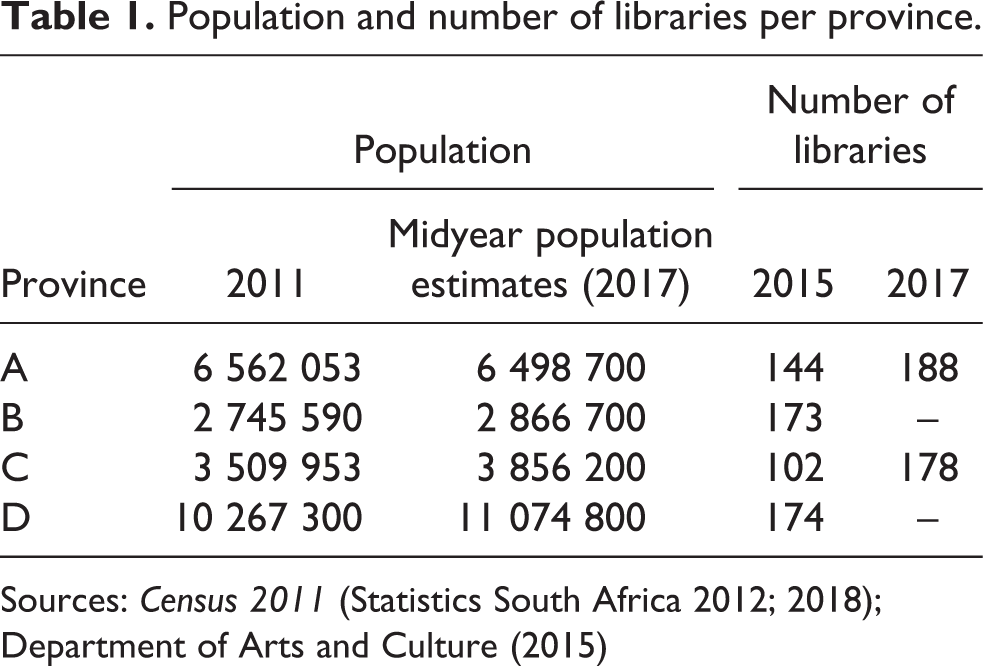
Sources: Census 2011 (Statistics South Africa 2012; 2018); Department of Arts and Culture (2015)
Bearing in mind that participating libraries were purposefully selected, the main criteria being the predominance of indigenous language speakers, it is noteworthy that the numbers of libraries seem to be disproportionate to population numbers. The implication is that a large number of indigenous language speakers might not have access to libraries. Nonetheless, it is also worth noting that continuous efforts are being made to address these past imbalances in library provision as confirmed by participants. For example, Participant A’s response attested to the ongoing endeavours to increase the number of libraries thus: We have about 205 scattered all over the province but the most active ones now I think [are] about 188. Others are small libraries like satellite
1
libraries in that 205 but the fully-fledged libraries are about 188. So far we have 178 [libraries] but that includes depots – libraries that are placed in hospitals, libraries that are in prisons and mines, and then we also now - since 2014 have been mandated by the Department of Arts and Culture to also establish what we call dual purpose libraries. By the end of this financial year we will have about 180 because there are libraries which are being built and will be completed by the end of the financial year that is by the end of March [2017]. The community should be able to walk to the library. It should not be further than 12 km. You know that is the walking distance…the longest walking distance that people can walk. However, it is a situation that is very difficult to actually implement. Right now we are trying because so far we’ve got one library per township. In the TBVC
2
states and homelands nothing happened there in terms of libraries. They were mostly in the sections that were part of the Republic of South Africa. So there, there was no service whatsoever. The service was only limited to the towns that were actually in the Republic, that were white mostly.
For example, Participant C described existing inequalities thus: In town alone, we’ve got three libraries…no it’s four…just in town - these are suburbs that I’ve just mentioned, but now other suburbs that are growing Northern suburbs, there’s nothing. There’s nothing and they have been asking for a library forever. In the townships, it’s worse. You know these shacks that keep on growing, that keep on mushrooming every now and again and again. There are no libraries.
Facilities
The second aspect of the research question focussed on available facilities.
Libraries provide a variety of facilities to communities. Participant A pointed out that libraries provide photocopying facilities for the community irrespective of whether they are registered members or not. The library provides space for users who would otherwise not have such facilities. The participant explained thus: Most of our users are in-house users, they come to the libraries and then they use material. I should think because sometimes others do not have proper addresses and so they prefer to go to the library and just use materials.
Elaborating on the positive contribution of the conditional grant towards the provision of library facilities, Participant A said: The National Library of South Africa through their conditional grant are providing Internet access so we were able to provide it to all the 205 libraries and…to enhance the broadband. Internet facilities enable people to access emails free of charge. We accommodate ICT in community libraries. ICT should form a very important part of our library function. We need to have Internet access in community libraries. We succeeded to provide Internet to all community libraries in our province and they’ve got free Internet access. With computers, you have to consider Wi-Fi. People come with their own devices and are able to active in the library. Our libraries are able to accommodate reading spaces. Yes, we started to say, when you build the library make sure that it’s got reading facilities because people want to come and sit and read in the library. Every library that we’ve built, except now we are trying to fast track, we do have tiny study libraries which don’t really have activity rooms, but your standard library has to have an activity room. When we open a library, there’s a big event and everyone is there. We tell people that this is your facility.
Funding
Funding appeared to be a challenge according to participants. The public and community libraries conditional grant (commonly referred to as the conditional grant) seems to have played a major role in enhancing access to libraries in various ways. Provision of free access to the Internet, staff employment, building new and revamping existing libraries were made possible by the conditional grant.
Participant A highlighted the financial injection that came through the conditional grant in the following words: In 2007 when we got the Community Libraries Grant we were able to do things. We were able to provide proper services or proper facilities because now we were able to employ more than 154 staff members because before that the Department couldn’t [employ]. Our progress will only be determined by availability of budget in the province. Currently it’s not a language that is talked about where you are going to be asking for money and get it. There are more pressing matters. Our provincial budgets are no longer as big. Funding is not a problem. We are very fortunate in this department, in this province because we have got a big allocation from Treasury Provincial Executive Funding to fund public libraries. We also have a conditional grant. We don’t use a lot of our conditional grant for staffing. We do have…we have been lucky our budget has never been reduced unlike [in] the other provinces.
The second research question was
b) To what extent do existing collections in public libraries in South Africa include indigenous knowledge?
In addressing this question, the following aspects were investigated: the scope of library collections in terms of content, format of library materials as well as languages in which materials were provided. Responses follow.
Scope of the content
Participant B1 described the scope of the collection thus: We have study guides for schoolchildren, most is science, mathematics…, school subjects. We usually do a group for human resource and business management. We also have fiction. You can find that most of the materials that we have in terms of content is not talking to them. This is why we have to be creative and find ways to respond to that. They give us classics. You know the books that we read, the set books that we were reading thirty years ago, so they reprint them and give them to us …we are still providing [foreign literature] obviously, because it’s popular. Everyone wants to read your John Gresham. They want Mills and Boon and they want these…but…we have to prioritise indigenous languages.
Formats of library materials
Examining the issue of the format of materials was informed by the researcher’s supposition that, given the reported poor reading culture among indigenous communities (as confirmed by participants), libraries should be providing materials in other formats to ensure inclusivity. Thus, in terms of format, libraries reported that collections come in a variety of formats. In addition to books, formats such as digital versatile discs (DVDs), compact discs (CDs) and electronic books (e-books) formed part of the collections of the selected libraries according to participants.
Responding to the question on formats, Participant B2 explained: We keep CD’s, DVD’s, especially the audio books. Now we are starting this one [the collection] of the E-books. In our library, we have a system that’s meant for the visually impaired. It’s a computerized system where you can use talking computers. Where computers actually talk to them. But, remember, there are different types of visually impaired - totally blind and the partially blind. That computer-based system is for the partially blind and then we’ve got readers for those who are completely blind because they just listen.
Languages of library materials
In terms of languages, the ideal situation is that library collections should be reflective of predominant languages in the communities. Responses seem to indicate awareness of the need to cater for local languages.
Participant A explained in terms of collection development that they accommodate different languages: When we buy books, we mix while focusing on the language based on that community.
However, Participant A1 voiced concern regarding the availability of indigenous language materials by pointing out that: There are very few writers in indigenous languages…. very few. They like to self- publish. And the books have to be reviewed…it goes through certain steps before it can pass to say: this is ready to be published…so we have those challenges. We can’t buy something that is not of quality. As a province, we have five official languages, which they say whatever you do, try and make sure that you cover these languages. I think it’s Afrikaans, English, Setswana then I think there is isiXhosa then the other one I can’t remember I think it’s Sesotho. In areas that have mining you find that there’s a lot more people with different languages although we have our main language as a province.
Raising concern about publishers’ reluctance to publish in indigenous languages participant B said: The publishing industry…I don’t think it’s kind to our poor, small self-publishing community. We accept material that is written in indigenous languages here except that there were problems. Problems in the sense that most of the material in indigenous languages is written by local writers who actually do not have enough money for publishing professionally. People who read [indigenous languages] are few but if you write that book in English, it is still going to sell. It can be sold from Giyani to Cape Town
3
. There’s a lot of Afrikaans literature though Afrikaners are smaller in population [numbers.] Although black people [in the province] are speaking Afrikaans, you know when it comes to reading people are not reading. Another thing is that speaking Afrikaans and reading Afrikaans is something different altogether. Though there’s a lot of Afrikaans material for reading it’s still being read by the language owners. Most of the books that we buy for children are in English and Afrikaans. Indigenous language books are translations, except for poetry. You know the first language that people…that most of the authors…that I’ve realised that they use, is English. Then after English then they translate into the different indigenous languages. That’s where we have a problem. And usually the problem with those translations is that they usually not according to the language spoken. Remember indigenous languages you get different ones spoken in different areas. You see. So whenever we actually look at their books we don’t agree with their translations… We are getting indigenous language material. We buy whatever is out there that meets our selection criteria in terms of the quality of printing and binding etc. but that’s not a lot to be honest. In terms of supply, there’s not much because some people who are in publishing they will say they will publish what will make money. They will publish what they will send to the Department of Education, you know for set work because if they publish a lot in indigenous languages who’s gonna buy it?
Finally, the paper sought to answer this research question
c) What challenges affect IK inclusion in public libraries in South Africa?
As already alluded to in the second research question funding was identified as a major challenge by participants. Funding is an essential resource which has a direct effect on service provision. Inadequate funding affects other resources such as infrastructure, staffing and library collections. Identified challenges are outlined next.
Funding
Explaining how lack of funding is affecting services, Participant A asserted: If we can get more funding to appoint staff or transfer monies to the municipalities to appoint people according to the Municipal Act it will be better…
Participant B described the challenge of funding thus: When functions are introduced - sometimes you find that the function is introduced but it’s not budgeted for. We had this re-configuration where the department, the Sport Section had to move to another department. We had problems in a sense that Sports was moved…and Sports you always have it with Recreation. They decided to keep Recreation in the department and only Sports moved. It didn’t go well - when they do the reconfiguration they will say budget has to go with function then the budget is going with the function but, this other function is a smaller part of that function and it gets left. The department has to find money within its own allocation; there’s not going to be new money coming… Departments experience budget pressures. Like now, we are doing adjustment budget. With adjustment budget we just….they have budget pressures and they want the [Library] department to contribute to that by giving eleven million from our already strained budget. [Although] in our province we haven’t really experienced a situation where our money has been taken away from us and used for other things, but yes we are seeing a situation where our mmm…., equitable share budget is shrinking, meaning now that the province has to carry most of the functions of the library services. I think a similar example will be of buying books. We used to have budget in the equitable share budget to buy books. Currently we are more dependent on the Conditional Grant. There is also another problem that causes us not to be able to address [provision of services] that is the fact that funds for libraries are becoming lesser and lesser. Because to build you need funds, you know, to appoint staff to manage that library you need funds and now every now and a gain funds are being cut. Besides the input from the community, we also look at the province - the picture of the province because we get numerous demands- I’ve got files this big of requests and we can’t give everyone a library.
Information and communication technologies ICTs
Although the provision of ICT was hailed as a positive move in improving access to information, concomitant challenges were also expressed.
Participant B had this to say: The one challenge is response time. The other challenge is our service providers because, we appoint the Internet service provider who will not be really managing how they are loading the data and whatever thing in the libraries. Then when you are out of data then you are in trouble with the politicians and mmm…. so it’s a bit of a nightmare. The catalogue…it’s an online catalogue but what we have noticed in the other libraries mmm…. when we were introducing this function…we have never gotten to a stage where all the books are bar coded so that they are all captured. Therefore, you will find that part of their collection is not in the system which creates difficulty when you have to fully automate the library. Automation is also affected by this inconsistency. Until we get our Internet connections 100%, we are going to have problems.
Staffing
Different employment conditions emerged as a challenge that affects services to communities. Pondering on how the library can deal with the situation of different employment conditions in order to improve services, Participant A surmised that one of the options would be to amend the Municipal Act and render libraries essential services. In words of the participant: Remember it is the mandate of the province [to provide library services] so we have to change the whole Act…we amend that…[to]say we are like nurses, police and ambulance people.
4
Attesting to the challenge of different employment Participant B said: The ones that are appointed by the province are appointed under the conditions of public service - then you bring in terms and conditions of service that are not the same. You bring someone who has been appointed under conditional grant it’s possible that they might be earning more than those that are being appointed by the municipality so, there are those challenges. In terms of the structure and the warm bodies that are currently in our, mmm…. provincial libraries ever since. So this is up to district libraries. Once we get to community libraries they belong to local…they report to local municipalities At the municipality, they are using the municipalities’ systems and structures and their grades are different. Librarians that are appointed [by municipalities] at a very low level. It’s not the low level according to that municipality, the level is okay. But in terms of the salary it’s really not market - related…you can’t keep professionals in those areas.
Poor reading culture among indigenous communities
Participants raised concern regarding reading culture among indigenous communities. Participant B made the observation: [Reading culture] it’s still not there in our communities. There is not a lot of reading mmm, books. I don’t know. I think people visit libraries very…the numbers I think are very minimum. We see it with a lot of Afrikaans books very read…especially your fiction. Afrikaans community they read as compared to our mmm…reading is still a big challenge. [Name of indigenous language] reading pattern is basically not there. Probably the only time that the book is read it’s when it’s a set work you know…it’s the learners that are using that book maybe at schools. There’s a lot of Afrikaans literature though Afrikaners are smaller in population and even though black people are speaking Afrikaans. But you know when it comes to reading, people are not reading. As library services we are transforming by promoting writing in [name of indigenous language] so that there can be more material in that language but then the usage of books comes back to not…there are low reading levels in our black communities. You’ll find that the most people who will want to use that library are the ones who will prefer English books.
Participant D also attested to the issue of low readership of indigenous materials in the following words: Another challenge is, as much as we are buying it, you find that your [name of indigenous language] books - if you go into any library - people are not reading them, which is a pity because we have really gone an extra mile to make sure that each and every library we cater for our indigenous languages. But maybe the people who use the library are young Model C
5
school children.
Conclusions and recommendations
Provincial library services have made strides in providing resources to facilitate access to information. The main focus in resource provision seems to be infrastructure such as multipurpose buildings for communities which attest to the intentional efforts towards making libraries accessible to communities. What is evident is the expansion of existing types of library services in their current form where the printed word predominates. Despite awareness of low readership among indigenous communities, libraries do not seem to take steps to understand community information needs and how best to meet them. Evidence of a poor reading culture among indigenous communities could be an indication of a gap in service provision. It is not easy to comprehend the logic of continuing to provide resources that are evidently only appropriate to a certain sector of the intended beneficiaries.
The installation of ICTs is another major boost in enhancing access to information despite the identified challenges. An aspect that has not been explored is how best to harness the ICTs to address needs of indigenous communities that have been historically marginalised.
Ranganathan’s principles of “every book its reader and every reader his/her book” (Ranganathan, 1988) is instructive in building library collections. There is a strong case for inclusion of IK because it seems to be an aspect that public libraries have not paid attention to. What measures have public librarians taken to address the information needs of communities where there is poor readership? What measures have they taken to determine reasons for poor library usage? Public libraries could be remiss in fulfilling their mandate of providing inclusive services if they neglect certain sectors of served communities on the basis of poor readership. While the expansion of library services is vital in facilitating physical access to libraries, equally important is the need to ensure that libraries as “growing organisms” (Ranganathan, 1988) adapt to changing and differing needs of their clientele. Content, formats and languages in which materials are provided should be indicative of the divergent user needs. To this end, targeted resources should be provided to ensure that IK - whose importance in the everyday lives of communities - can be made accessible.
Libraries need to be innovative and find ways of serving needs of their different user categories in line with their mission of inclusivity. Library facilities can be used as spaces for communities to share knowledge and intergenerational dialogue which can be captured for further dissemination and preservation as needed. Storytelling is a useful tool that can be leveraged in facilitating access to IK (Chisita, 2012). Involving communities in such ventures can have the ripple effect of increasing awareness of and usage of public libraries.
The availability of ICTs, especially the free access to Internet, is an important contributor to access of information for communities. The question to ask in this regard is whether other categories of users are experiencing the same level of service because of free access to the Internet. Libraries need to look beyond enabling access to the Internet and explore how they can further optimise ICT usage as a way of encouraging other user categories in the interest of inclusivity. For example, capturing of cultural events and activities by communities could enhance relevance of library services. Librarians can also benefit because through ICTs they can access the plethora of available knowledge to investigate best practices in facilitation of access to IK. This different focus might require reinvention and reskilling on the part of librarians in order to enable them to capture, organise and disseminate IK effectively.
Provinces need to comply with their constitutional mandate of providing public library services, therefore, allocation of resources towards this project is critical. Historically, municipalities have always provided library services, especially in areas formerly white localities, and some of them continue even under the new democratic dispensation. Although funding is still a major challenge, possibilities abound for facilitating access to IK in public libraries. Concerted efforts and a paradigm shift on how public libraries are viewed are essential ingredients on the part of provincial governments. It is through intentional and focussed provision of resources that access to IK can be enabled by public libraries.
