







Abstract
The future of journalism is being shaped by the convergence of technology and societal shifts. For indigenous language press in Africa battling to stay afloat amidst stiff competition from traditional media, the pervasive and rapidly encroaching digital transformation holds both opportunities and potential threats. Using a qualitative approach, this paper examined the implication of the shift to digital media for the future of the indigenous language newspaper in Africa and identifies opportunities for its sustainability within the framework of the theories of technological determinism and alternative media. The analysis indicates poor funding, shrinking patronage, and competition from traditional and social media as the major factors facing indigenous newspapers. It emerged that for indigenous language newspapers to thrive in the rapidly changing and technology-driven world they need to not only adapt to the digital revolution but also explore a business model that combines a futuristic outlook with a practical approach.
Introduction
Over the past couple of decades, indigenous language newspapers have emerged as a key newspaper type occupying a unique position in the African media space, in Nigeria in particular (Oyesomi, Salawu and Olorunyomi, 2017; Oyero, Oyesomi, Abioye, Ajiboye and Kayode-Adedeji, 2018). Indigenous language newspaper usually refers to a newspaper that delivers its content in a native language as opposed to colonial or second language such as English, French or Portuguese (Salawu, 2006). Indigenous newspapers are often limited to a specific geographic and linguistic area and known for their unfettered exhibition of local talents and culture as well as the unapologetic accommodation of oral tradition and cultural motifs in their reportage. Although indigenous language newspapers are distinct from other newspaper types in their total reliance on mother tongues in the construction and sharing of meaning, they have all the trappings of a conventional newspaper. As alluded to by Otto Groth, they have a continuous and organised structure, defined publication frequency of at least “once a week” providing timely content that is accessible and appeals to a “large, diverse segments of the society” (cited in Bittner, 1989: 22).
In the past, indigenous newspapers recorded huge circulations and occupied a prime position as primary sources of news for many. In recent years, however, newspaper readership has declined significantly. Stiff competition from digital media has forced many newspapers to innovate or die and as a result, many traditional newspapers are increasingly emphasising online presence as the gravitation to digital media intensifies. While digital transformation holds enormous opportunities especially in providing a broad range of accessible information, its adoption is fraught with some challenges particularly for indigenous language newspapers. For instance, to leverage digital media for producing and communicating information in indigenous language demands a high level of literacy in the indigenous language. There is also the problem of how to navigate through some of the pitfalls of digital technologies especially the symbolic aspects. Proponents of digital media often focus on its functionality and not much attention is paid to “the symbolic or persuasive aspects of digital media, of the emotional dimensions of our uses and interpretations of these media” (Buckingham, 2015). As Coleman (2010) observes “whenever and wherever individuals and groups deploy and communicate with digital media, there will be circulations, reimaginings, magnifications, deletions, translations, revisions, and remakings of a range of cultural representations, experiences, and identities” (p. 488). This is critical for a language newspaper embedded in the culture.
Several scholars (Akinfeleye, 1985; Coker, 1968; Daramola 2013; Duyile, 1987; Fasan, 2018; Folarin and Mohammed, 1996; Omoloso and Abdulrauf-Salau, 2014; Salawu, 2006, 2012) have documented the history and evolution of the indigenous language press. There is a consensus that the evolution of indigenous newspapers is intricately “interwoven with the history of the Christian religion” (Sobowale, 1985: 27) and the concerted efforts by the missionaries to not only educate their new African converts (Okpalike and Nwadialor, 2015) but also get the converted to read “and to beget the habit of seeking information by reading” (Daramola, 2013). Other studies have examined the contributions and potential roles of indigenous newspapers (Buthelezi, 2016; Onyenankeya and Salawu, 2018, 2019; Oyesomi et al., 2020;. wa Mberia, 2015), the business models of indigenous newspapers (Salawu, 2006 Salawu, 2006, 2012, (2013), and ubiquitous challenges of indigenous publishing (Adedayo, 2006; Daramola, 2013; Folarin and Mohammed, 1996; Kperogi, 2006; Onyenankeya and Salawu, 2019; Oyesomi, Onyenankeya and Onyenankeya (in press); Salawu, 2006; Sunday et al, 2018; Tanjong and Muluh, 2006; Vinck, 2006; Yusuff and Osunnuga 2018). However, very few studies have examined the challenge of digitalisation on the production and consumption of indigenous newspapers. The research focus is often narrow, mainly examining why indigenous newspapers are migrating online. That most indigenous newspapers are embracing digital media was clear, but why they did and the implications of this shift were not all too clear. This paper, therefore, asks, what is the implication of the shift to digital media for the future of indigenous language newspapers in Nigeria? How can the indigenous press leverage digital media to mitigate the social shift and remain sustainable? The overarching aim of the paper is to understand the role of and challenges confronting the sector and to articulate a new trajectory that will sustain indigenous language publications in the context of the digital media revolution. The findings of the study have important implications for indigenous newspaper publishers, communication researchers, technology experts and journalists involved in providing the editorial and virtual components of indigenous newspapers content.
The context
There exist scores of indigenous language newspapers across Nigeria, especially in the Southwest area that has been the locus of many indigenous language publications. Indigenous newspapers gained currency during the colonial era and received an impetus with the establishment of Iwe Irohin in 1859 by the European Christian missionary, Henry Townsend (Daramola 2013; Salawu, 2006). The various missionary societies that thronged the country in the 18th century embarked on aggressive educational programmes as part of their evangelistic and civilisation campaigns to educate their new African converts (Okpalike and Nwadialor, 2015). The campaign was intensive especially in the Yoruba speaking region of the country, such that as of 1842, there were already many people literate in the Yoruba language. The Yoruba language had evolved from being the exclusive medium of delivering sermons to become a prime pedagogical tool in mission sponsored educational institutions (Adegoju, 2008). In this era, indigenous language writing had begun to take root, such that church bulletins, gospel tracts and educational materials were being printed in the Yoruba language. By 1841, Samuel Ajayi Crowther, one of the earliest Yoruba Christian converts, had assembled an array of publications in the Yoruba language.
The indigenous language publications promoted by the missions, such as Iwe Irohin, were aimed at not only advancing the evangelism mission of spreading Christianity to unbelievers but also the large pool of Yoruba elite who were Christians and had developed considerable fluency in both English and Yoruba. Initially, the content of Iwe Irohin, comprising mainly church bulletins and related news, was tailored for Christian adherents. However, in subsequent years, it began to publish data about agricultural products like cocoa and cotton, as well as advertisements from government and local businesses (Daramola, 2013). The success of Iwe Irohin gave impetus to the establishment of other indigenous language newspapers across the country (Omoloso and Abdulrauf-Salau, 2014). From the southern axis emerged the Efik language newspapers, Unwana Efik and Obukpon Efik that operated between 1885 and 1892. It was during this period that Iwe Irohin Eko flourished in the Lagos colony. Another Eko-based Yoruba language newspaper, Eko Akete was launched in 1922 and published intermittently until its final demise in 1937 (Salawu, 2006).
In the early days, indigenous newspapers were particularly pivotal in the liberation struggle, providing a rallying point for nationalist expressions and defence of the indigenous people’s rights against the colonialists (Folarin and Mohammed, 1996; Olunlade, 2006). The emergence of indigenous language newspapers helped not only to capacitate locals in the printing business but also to birth a crop of journalists and entrepreneurs who went on to affect the society positively. Iwe Irohin was the forerunner of newspapers in Nigeria (Salawu, 2006; Sobowale, 1985). From its glory days in the late twentieth century to the present, indigenous language newspapers have been veritable sites for constructing and negotiating identity. In recent years, indigenous language newspapers have become the locus of the revival of the fast disappearing mother tongues and as a counter-public sphere.
Although the local language press continues to make significant contributions to the informational, socioeconomic, political and cultural life of the nation, it has been a chequered existence for many of the indigenous language newspapers. Except for Gaskiya Tafi Kwabo (“Truth is worth more than a penny”) established in 1937, all other indigenous language newspapers of that era have become extinct (Folarin and Mohammed, 1996). Unlike mainstream English newspapers, the longevity of indigenous language newspapers is relatively shorter (Salawu, 2006). The seeming inability of indigenous language newspapers to endure over time is not peculiar to Nigeria. Across sub-Saharan Africa, many once flourishing indigenous language newspapers have died or operate in a sporadic manner (Folarin and Mohammed, 1996; Salawu, 2006; Tanjong and Muluh 2006; Vinck, 2006).
Poor patronage, poor capitalisation, lack of capacity, stiff competition from traditional and social media, failure to leverage information and communication technologies and a lack of cultural pride among most Africans, have been identified as the root causes of the increasing collapse of indigenous language newspapers across Africa (Daramola, 2013; Folarin and Mohammed, 1996; Kperogi, 2006; Salawu, 2012; Tanjong and Muluh 2006; Vinck, 2006). Support for indigenous language newspapers in the form of actual purchase or advertisements has been comparatively low in contrast to traditional newspapers (Salawu, 2006). In the heydays of Iwe Irohin in the early 1860s, its circulation was estimated at 3000 (Daramola, 2013). Today, very few indigenous language newspapers could boast of such circulation figures (Ifeduba, 2012). The poor patronage is partly rooted in the poor reading culture and ethnography of the Nigerian society where everything local is despised including speaking in the mother tongues (Salawu, 2006). In the class-sensitive Nigerian society, using locally made products is perceived as unclassy or suited for the proletariat. Many educated Nigerians find it undignifying or unbefitting to purchase or place an advertisement in indigenous language newspapers (Salawu, 2006). This remains a major threat to the survival of indigenous language newspapers.
Adegoju (2008: 24) argues that the lack of interest in and poor patronage of indigenous newspapers may be due to the doubtful proficiency of the elite in the indigenous language. Yusuff and Osunnuga (2019) found that many young people and adults could not read the Yoruba language. As Belareba Ladan, a major stakeholder in indigenous language newspaper publishing, noted in a newspaper interview, “Nigerians, especially the youths, shy away from speaking our indigenous languages; they see it as ‘local and cursed’ rather than a form of identity and pride” (Mwantok, 2016). Indeed, diminishing literacy in indigenous languages is a manifest “lack of cultural pride among most Africans” (Salawu, 2012: 35), a predicament that afflicts many ethnic groups across Africa and one of the vestiges of colonisation. Unlike in the Christian missionary era in the 1880s and regional government in the early 1960s, when native language featured prominently in religious, educational and social activities, the use of local languages has taken a back seat even though successive National Policies on Education have always encouraged the teaching and learning of indigenous languages, particularly the three major languages (Igbo, Yoruba and Hausa). Over the years, the English language has come to displace the mother tongues at home, school and everywhere else. The corollary is the continued plunge in the literacy of indigenous languages. In the absence of a significant population who are proficient in and proud to engage in local languages, vernacular newspapers have continued to struggle with shrinking readership and patronage from businesses. Despite the seemingly bleak outlook, many indigenous language newspapers continue to spring up across the landscape after the structure and modus operandi of early newspapers and a few of them are available online.
Theoretical foundation
This paper is anchored on technological determinism because it provides a nuanced perspective on how technology implicates society. The theory assumes that technology defines the development of social values and structure in a society. It details the transformative impact of technology from the tribal to literate era, and the print to the electronic age (Griffin, 2010). The theory interrogates how and the degree to which technological factors depict human beliefs or actions. Proponents of technological determinism posit that transformation in technology is the overarching source for change in society. For instance, Marshal McLuhan suggests that media determinism, a form of technological determinism, shapes how individuals in a society think, feel, act, and how society operates as it moves from one technological age to another. In his 1964 seminal work, ‘Understanding Media: The Extensions of Man’, McLuhan posits, “The medium is the message”. In other words, the medium is a more influential and unequivocal determinant of human interaction and action than the content or message. This suggests that the medium shapes and controls “the scale and form of human association and action” (McLuhan 1964:9). However, critiques of technological determinism hold that technology at no time imposes itself on people. On the contrary, there is no obligation on the part of the technology to compel individuals to use it - it is a deliberate choice. Without question, the technology requires people to participate or involve themselves at some point or another, however, the choice of using the technology and experiencing its effects lies in the hands of human beings. Some scholars hold that technology itself is socially determined in which technology and social structures co-evolve in a non-deterministic, emergent process. In other words, the effects of any given technology depend mainly on how it is implemented (Adler, 2006).
While digital technologies hold great potentials for indigenous language newspapers, the responsibility to use the technology lies more on the journalist. The technological determinism theory is relevant in this work in that it helps to explain how technology, in this case, digital media, is influencing human thoughts and actions. Technology is seen as the dynamic force of culture in a society. The future of journalism is being shaped by the convergence of technology and societal shifts. The newspaper industry is no exception to this shift. The traditional method of generating, producing and distributing news is giving way to digital approaches. New media are not only an addition to existing media, but they are also new technologies and therefore do have a deterministic factor as well. For indigenous language press in Africa battling to stay afloat amidst stiff competition from traditional media, the pervasive and rapidly encroaching digital transformation holds both opportunities and potential threats.
Methodology
This paper utilised email interviews and questionnaire, op-eds or blogs to capture the perspectives, thoughts and suggestions of journalists and publishers of indigenous newspapers for where the industry stands and might go in the face of the digital challenge. For this paper, the population consists of indigenous newspapers across the country (see Table 1). Twenty-five structured email interviews were conducted with publishers and journalists of six indigenous newspapers. Interviewees were asked to comment on whether or not digital media has affected the production and consumption of indigenous language newspapers and how this impacts the future of indigenous language concerning readership and advertising revenue. Finally, the interviewees were asked to suggest how indigenous newspapers could leverage digital media to boost access, reach and revenue to remain sustainable. Data were analysed inductively using closely linked themes. The interpretation and discussion were anchored on three major themes - implications of the shift to digital media, leveraging digital media to mitigate the social shift and opportunities for sustainability. The sub-themes originate from three central themes.
List of selected indigenous language publications in Nigeria from inception till now.
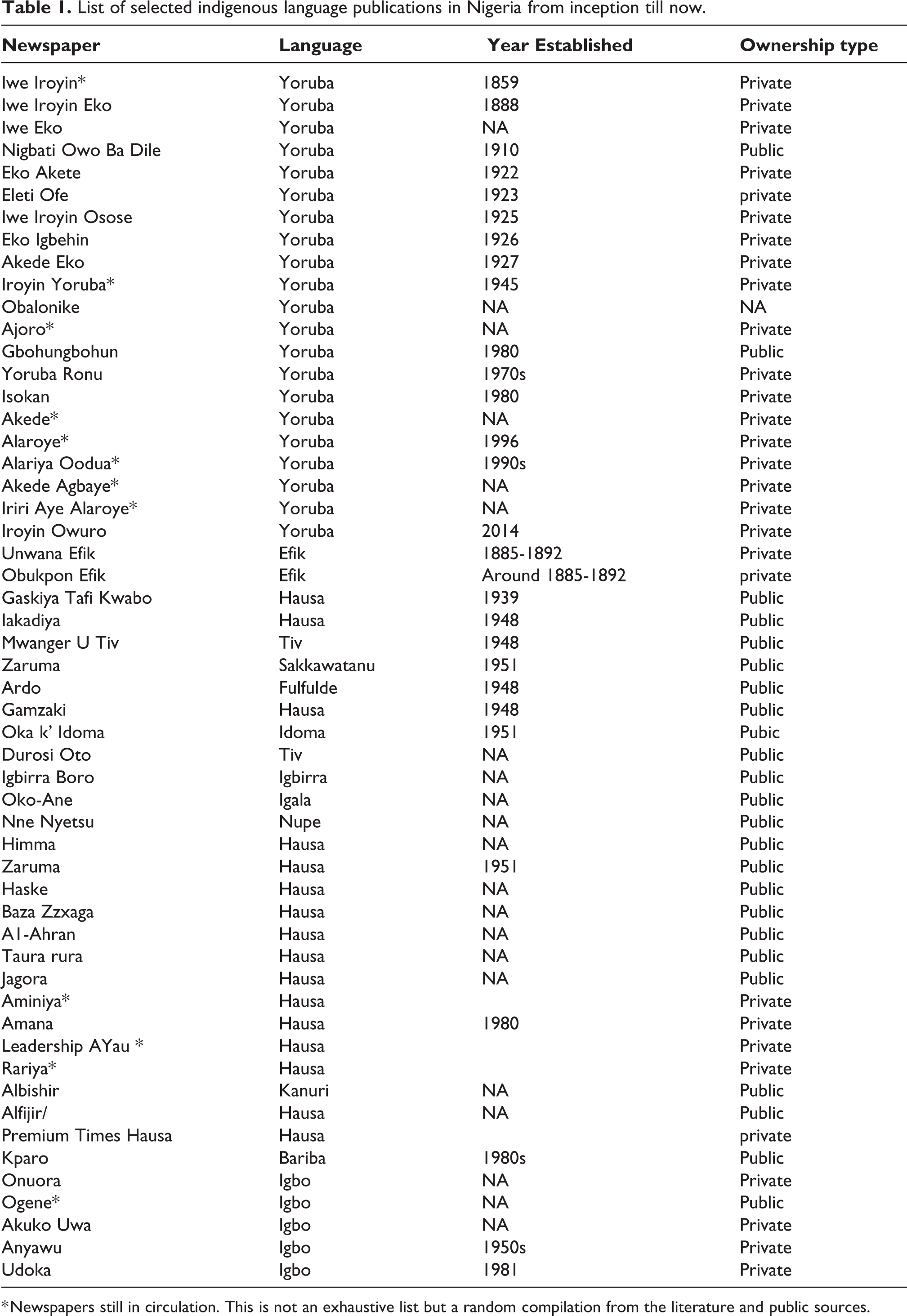
* Newspapers still in circulation. This is not an exhaustive list but a random compilation from the literature and public sources.
Results and discussion
Implications of the shift to digital media
Disruption of the media consumption patterns
Majority of the interviewees agreed that the media industry has witnessed a rapid change due largely to the emergence of digital media. There was a consensus among the interviewees, that the digital media has drastically altered the way readers consume indigenous language newspaper texts. One publisher admitted that although traditional consumers “mainly middle-aged men”, still purchase indigenous newspapers, sales have declined considerably. While he acknowledged that the current economic downturn, which has affected the purchasing power of readers, might be a plausible reason for the low sales, he insists a major factor is the increasing migration of many Nigerians including readers of indigenous language newspapers to the social media platforms such as Facebook, Twitter, and WhatsApp to access news. As of June 2020, there were over 143.7 million Internet subscribers on GSM enabled networks in Nigeria according to the Nigerian Communications Commission (NCC, 2020). Empirical evidence shows that with smartphones and other Internet-enabled devices, people can easily access a plethora of information including newspaper contents (Nwachukwu and Onyenankeya, 2017). Several studies indicate that many newspaper readers prefer the free online version which they can access through the Internet (Ekhareafor, Asemah and Edegoh 2013; Hassan and Azmi 2018; Mathew, Ogedebe and Adeniji 2013).
Production challenge
The migration of indigenous language newspapers to social media implicates production and distribution of indigenous newspapers. Majority of those interviewed acknowledged that indigenous language newspapers have had to adjust their production system to suit online platforms. As highlighted earlier the introduction of new communication technologies ultimately leads to disruptions in the way information, culture, identities are represented and interpreted (Coleman 2010: 488). One publisher agreed: “Like the traditional English language newspapers, we had to reimagine not only our layouts to allow for more pictures and other visual illustrations but also to develop strategies to drive traffic to our sites” (Publisher 1, Interview, May 30 2020). Majority of the publishers disclosed that these adjustments have been challenging given that new technologies are disruptive and continuously evolving. Besides, it requires creativity to design the appropriate tools to generate and sustain traffic to the newspaper site. This is even critical for indigenous language that is embedded in the culture. One of the journalists interviewed stated that the production team is constantly faced with the issue of media content: A major concern is the challenge of how to design a webpage that is social media compatible and accommodates the taste of the target audience especially, the upwardly mobile youths who are very active in the social media…What images, videos and sounds could be deployed to enliven readership without losing the symbolism embedded in the indigenous language. It is a tough call” (Journalist 3, Interview, June 22 2020).
Retooling and reengineering of systems and processes
The transformation to digital media requires a massive investment in new media technologies and the reengineering of the production process. It also requires the hiring of people with the requisite skillset to provide suitable content for the digital age. One of the interviewees admitted that the issue of capacity remains a major challenge. We do not have the people with the requisite knowledge and skills for proper digital media production and distribution. To recruit suitable personnel to accomplish digital publishing requires enormous resources. As you know, the newspaper business is capital intensive and many of us are poorly resourced, sometimes depending on the owners’ resources (Publisher 4, Interview May 14, 2020) I anticipate the struggle for survival is going to intensify. Already, we are struggling to retain the few journalists who understand the language because they are poorly paid and as a result, there is a high turnover of staff that migrates to greener pastures especially radio stations where they are hired to write or read the news (Publisher 2, Interview June 26, 2020).
Leveraging digital media to mitigate the social shift in society
Increasing access and reach
Majority of those interviewed agreed that indigenous language newspapers could leverage digital media platforms to shore up readership and revenue. Presently the circulation of many indigenous language newspapers is limited to the cities where they are published. Circulation to the rural areas is often limited thus denying potential readers the opportunity to purchase the papers. With digital media, the newspapers can increase access and reach existing and potential readers across the globe. There is already a large pool of Nigerians using Internet enabled devices (NCC, 2020; Nwachukwu and Onyenankeya, 2017) to access newspapers online (Ekhareafor, Asemah and Edegoh 2013; Hassan and Azmi 2018; Mathew, Ogedebe and Adeniji, 2013). One of the publishers interviewed agreed digital media provides platforms to reach a broad audience. Traditionally, our readers have been middle-aged and elderly men but going online, we can reach a wider audience, not just locally but on a global scale. I know for instance, that there is a large number of Yoruba speaking people in the UK and United States who can now access indigenous newspapers online. With social media, we can target the urban youth everywhere in the country (Publisher 6, Interview May 21, 2020). We recognise that many readers in the rural areas even in the cities may not have access to the Internet, because data is expensive and not many can afford data to access the newspaper online on a sustainable basis. Then, you have the issue of electricity, so for this class of readers, the hard copy could be the only option (Publisher 1, Interview May 30, 2020).
Boosting revenue
Hitherto indigenous language newspapers relied on sales and traditional advertising to generate revenue. However, over the years advertising revenue has been on a decline. The publisher of the Hausa language newspaper, Leadership Hausa, Mr Sam Nda-Isaiah, attributes the low shelf life of indigenous language newspapers to limited circulation and the lack of advertisements (PM News, May 16, 2017). In recent years, there has been a shift in corporate advertising that has seen many advertisers directing a huge chunk of their advertising budget to online advertising. There was a consensus among the publishers and journalists interviewed that migrating online could help boost advertising revenue. One journalist, while acknowledging the potential of digital media in revenue generation, insists many indigenous language newspapers are not appropriating this opportunity. Truly, digital media could provide new streams of advertising revenue but many indigenous language newspapers are unable to exploit the potentials of digital media for marketing and profit-making because of issues of capacity (Journalist 4, Interview 2020). It is a huge challenge; we do not just provide news and entertainment we have to devise ways to engage our readers and direct traffic to our sites in a professional manner. This requires engaging professionals familiar with online activities. The truth is that many indigenous language newspapers do not have the resources and technical know-how to fully operate online publishing (Journalist 10, Interview April 20, 2020).
Fashioning a new trajectory: Opportunities for sustainability
The question of how indigenous language newspapers can be sustained in the face of a plethora of challenges including declining sales, poor funding and competition from traditional and new media, elicited nuanced perspectives from interviewees. Prominent among the propositions made by the interviewees were the need for recapitalisation, reinventing the business model, government subsidy, crowdfunding and collaboration.
Recapitalisation
Majority of the indigenous newspaper publishers interviewed agreed that recapitalisation could be a potent tool to revitalise and position their newspapers to compete in the technology-driven society. However, the ownership structure of many of the indigenous language newspapers is characterised by a sole proprietorship. Many of the interviewees believe recapitalisation has the potential to not only diversify ownership patterns but also pave the way for injection of the fresh funds. One of those interviewed stated that: Injection of additional capital by current owners or fresh investors could help deepen the capital base of indigenous language newspapers and position them in good stead to not only invest in the recruitment of skilled and well-trained staff but also procure the requisite technologies to compete in the digital era (Journalist 12, Interview May 20, 2020).
Revisiting the business model
Currently, indigenous language press across Africa operates two organisational models – “mainstream” or independent model in which an indigenous language newspaper is owned and operated by an individual, family or corporate concern, and “subsidiary” model, where indigenous newspaper exist as the subsidiary of established traditional newspaper publishing in a second or colonial language (Salawu, 2015). Consistent with a previous study (Salawu, 2015), the majority of the interviewees agreed that both models have not been favourable to the indigenous language press. One of the journalists insists “the indigenous language newspaper that aspires to be a going concern and endure for the long haul needs not only a solid capital base but also strong operating structure capable of attracting investors” (Journalist 8, Interview June 20, 2020). Another holds that any financial reengineering that sees an uplift of the capital base through the pooling of resources would be beneficial to both mainstream and subsidiary type of indigenous language newspapers.
For instance, the pioneer indigenous language newspaper, Iwe Irohin, operated for only eight years – 1859-1867 before it ceased existing (Kayode-Adedeji, 2012). In 1945, an attempt was made to resuscitate the paper under the title Iroyin Yoruba but the project could not endure. However, in 2012 a group of journalists under the aegis of the Nigerian Union of Journalists, Ogun State Chapter successfully resuscitated Iwe Irohin (Kayode-Adedeji, 2012). A quarter of those interviewed believes the cooperative vehicle, used to revive Iwe Irohin, may be a veritable means which groups or societies may adopt to revive or revitalise moribund indigenous language newspapers. The successful revitalisation of Iwe Irohin according to one of the interviewees, “raises hope for not only a renaissance in indigenous language publications but in the viability of a cooperative ownership module” (Journalist 3, Interview June 14, 2020).
Some support the subsidiary management approach arguing that the model is amenable to resource sharing. The weakness of the subsidiary model, however, is that the secondary product often does not receive the same amount of attention or priority in the allocation of resources. For instance, when the media organisation faces a financial challenge the local language newspaper may be temporarily rested (Salawu, 2013). Additionally, in the event, that the main product encounters turbulent times and eventually stops appearing on the newsstand, the subsidiary product is likely to cease to exist. A good example is the Yoruba language newspaper Gboungboun, published by Daily Sketch Press Ltd, which ceased to exist when its parent company folded up. Similarly, Isokan, Amana and Udoka collapsed when the parent company, Concord ceased to operate. No matter the business model that indigenous newspapers operate, Mr Nda insists they must operate as a business if they are to be sustained.
Government subsidy
Majority of those interviewed advocated for local and state governments to create a special purpose vehicle to extend financial support or subsidies to indigenous language newspapers, given the low readership and the struggle for funds. Some of the interviewees maintained that indigenous newspapers should be seen as cultural assets deserving of preservation. According to one of the journalists, “Independent or publicly owned indigenous language newspapers should be treated as public trusts. This is more so as the newspapers play a significant role in enhancing literacy in indigenous languages” (Journalist 13, Interview May 30, 2020). The publisher of the Hausa language newspaper, Leadership Hausa, Mr Sam Nda-Isaiah, re-echoed this view, stating that indigenous newspapers “are the most consequential publications among the masses and they are strategic to national development’’ (PM News, May 16, 2017). These suggestions are not unprecedented. Gaskiya Tai Kwabo has survived over the years because of subvention and occasional injection of fresh capital from the regional government.
Interestingly, while all the state governments in Nigeria operates television and radio stations that broadcast in local languages, there exist little or no state-sponsored local language newspapers. Private individuals promote the bulk of indigenous language newspapers and they receive no subvention of any form. For instance, Alao Adedayo established the Yoruba language weekly, Alaroye (The Explainer) single-handedly, but due to poor finance, it could only publish few editions before it was rested. The second attempt to revive the paper failed because of lack of funds. Not until Adedayo was able to receive additional funding did the paper become sustainable. In an interview, Adedayo narrated the frustrating struggle to sustain the newspaper alone - “I stumbled four times to make Alaroye a success”, he stated (Vanguard July 8, 2017).
One of the interviewees suggested that the government at the national level could establish “a special purpose vehicle like the Media Development and Diversity Agency (MDDA) in South Africa to grant a subsidy to independent indigenous publishing outfits” (Journalist 3, Interview, June 22 2020). The MDDA was established by Act of parliament to foster skills development and capacity building. The agency provides grants for deserving media houses ostensibly to promote publishing and broadcasting of the country’s diverse indigenous languages. The South African model has proven to be a very pragmatic and actionable strategy and could be adopted by the various governments in Nigeria to provide financial support for local language newspapers. One publisher agreed, “A grant from the national or regional government could be a veritable avenue to not only shore up operations of these indigenous language newspapers but also ensure their sustainability” (Publisher 5, Interview July 10, 2020).
Crowdfunding and collaboration
Some of the interviewees suggested indigenous language newspapers adopt crowdfunding as a means of mitigating their funding deficiencies. Crowdfunding is a means of fund-raising in which a media organisation appeals to the public to contribute or donate towards its operations. The strategy has been tested and proven effective across the globe. Premium Times and The Cable are examples of media organisations leveraging on public support. The two media concerns regularly solicit for funds from the public to support investigative enterprise. While many of the interviewees are not opposed to the idea they insist the strategy is not sustainable. I believe many Nigerians will be willing to support calls for donations from indigenous language newspapers, especially as indigenous language newspapers are language and culture-centric. For instance, some well-meaning individuals have made occasional donations for our operations, so yea, it could work. However, I do not think it is sustainable ((Publisher 1, Interview May 30, 2020).
Providing a voice to the voiceless
Indigenous language newspapers provide space for the marginalised groups – those who cannot communicate in the dominant language, to participate in discursive interactions in the public sphere in a language in which they have linguistic competence to express themselves (Bamgbose, 2011). Majority of the interviewees believe indigenous language newspapers could be not only strong alternative media, but also platforms for a range of cultural representations, experiences, and identities. I think that if we position ourselves as the institutionalised arena for subordinate voices and remain steadfast in promoting our culture through our indigenous languages we will continue to remain relevant even in the face of the shift to new media (Publisher 2).
As alternative media, indigenous language newspapers not only facilitate grassroots participation but also, afford the ordinary people the leeway to articulate themselves in ways that best reflect their opinions and experiences (Chibita and Salawu, 2016). This is possible because the mediation of discourses is in mother tongues or indigenous languages. The challenge for the indigenous language newspapers, therefore, is how to leverage the digital media to expand the space for a multiplicity of views and a nuanced perspective of “common sense” from the common people with regards to norms, social values and identities, as against “dominant forms of common sense” (Bailey, Cammaert and Carpentier, 2008: 16) often peddled in mainstream media.
Reimagining the future
As evinced from the analysis, it is clear that while improved funding, capacity building especially in the area of language, journalistic and digital competence are essential in the continuous operations of indigenous language newspapers, their survival in the future would require a digital reimagining. Digital technologies have become pervasive occupying a central place in the way we articulate and experience our beliefs, culture and everyday life. Their application to journalism is increasingly removing barriers to truth discovery which traditional methods are ill-equipped to accomplish. As the results have shown, there is no gainsaying that the indigenous language press must leverage digital technology if they are to thrive in the digital age. For instance, South Africa’s IsiZulu language newspaper, Ilanga has continued to survive amid political and economic pressure because of its ability to adapt to new technology (Buthelezi, 2016). The adoption of the mainstream model of management has also helped Ilanga and Isolezwe in South Africa and Alaroye in Nigeria to remain relevant amid stiff competition from English language newspapers (Salawu, 2015). However, as majority of the interviewees acknowledge, simply migrating online or adopting and adapting to 21st-century digital technologies with 20th-century mentality will not suffice. There is a need for a holistic assessment of the future of the indigenous press because of the digital transformation. What is clear is that technological and scientific innovation is complex and volatile. For instance, digital technology is continuously evolving; sometimes the pace of development is faster than adoption. While some businesses, especially in Africa, are just adapting to the ‘Internet of things’, mobile technology is increasingly emerging as the future of business and social life. With an already circumscribed market, the challenge facing indigenous language newspapers is not how to stave off the migration to digital media but how best to exploit the shift to boost readership and advertising revenue. The process of recalibrating or reinventing indigenous language newspapers must first start with a critical appraisal of the business model that encompasses a rethinking of the overarching purpose of the indigenous language newspaper. The social media thrives on interactivity and this is already shaping the future of journalism. What has emerged from this study is that part of the appeal of the future indigenous language newspapers would be their ability to emplace feedback mechanism that not only allows meaningful interactivity but also engenders a two-way flow of information - where readers can provide input or content. To achieve this requires a rich pool of talent especially in the digital field, which the indigenous language newspapers must endeavour to attract.
As interviewees attest, the reimagined indigenous language newspaper must be one that strikes a balance between commercialisation and its primary role as a repository and custodian of linguistic and cultural heritage. As noted by Dragon and Tufte (2006) excessive commercialisation has the potential to commodify the indigenous language newspaper such that it will lose its essence of providing access to ordinary citizens. While indigenous language newspapers seek to attract advertising revenue this must not detract from their primary function as an alternative media providing information, mobilization and continuity to a group who may be precluded from conventional media because of language. Content also matters. Given their complete dependence on indigenous language in the construction and sharing of meaning, indigenous language plays a crucial role in identity negotiation. Therefore, in embracing digital media, indigenous language newspapers must endeavour to provide a reportage or content that reflects the oral tradition and cultural motifs of their readers.
Technology continues to evolve; the orchestrating paradigm shifts, but the focus and purpose of indigenous language newspapers must be consistently towards building a cohort of readers that stay with them for the long haul because they provide an arena for debate and discursive interaction on issues that concern them in a language that enables them to express their thoughts more profoundly. A good example is Ilanga that has maintained its essence as the institutionalised arena for the ventilation of Zulu history, culture, and social development (Buthelezi, 2016). Therefore, the reimagining of indigenous language newspapers must factor its future role in the preservation of local language. As highlighted earlier indigenous language newspapers have become the locus of the revitalisation of the endangered mother tongues, and this role is bound to intensify in the future. How they can incorporate digital media in realising this role will enhance their sustenance and social relevance. This is important because just as the media can standardise and reinforce language they can also vitiate it (Bamgbose cited in Mpofu and Salawu, 2019: 296). The indigenous language newspaper that will endure over time will be one that is not confined to satisfying narrow interests or dramatising unimportant community issues but one geared towards capacitating the people for effective participation in the national life. A good example of this is the Alaroye, which has become a platform for ideological contestations over political and social issues (Fasan 2018). Mpofu and Salawu (2019) argue that indigenous language newspapers must not only focus on addressing the specific needs and aspirations of the people but also be concerned with empowering and galvanising them to participate in national and international socio-economic programmes. This envisages a development-oriented indigenous language press that transcends the provision of information to promoting and galvanising the populace for change in their mother tongues.
Conclusion
This paper was guided by overarching questions: what is the implication of the shift to digital media for the future of indigenous language newspapers in Nigeria and how can the indigenous press leverage digital media to mitigate the social shift. The analysis indicates that indigenous newspapers are buffeted by a confluence of factors such as poor funding, shrinking patronage, and competition from traditional and social media. Despite the enormous challenges, the indigenous language newspapers have managed to carve a market niche. It was highlighted that indigenous language newspapers need to digitally reimagine their businesses to thrive in the rapidly changing and technology-driven world. It was acknowledged that indigenous language newspapers contemplating adopting digital technologies, including social media, would have to contend with not just the humongous amount required for digital media infrastructure development but also the shortage of talent with regards to the availability of individuals with the requisite digital and language literacy to remediate textual and symbolic expressions. It was suggested that a digital reimagining premised on a strong well-thought-out strategy driven by visionary leaders who are well primed to incubate change and anticipate the future and take the necessary risks, will help mitigate transformation shocks. It was highlighted that the indigenous language newspapers in Nigeria need to not only adapt to the digital revolution but also explore a model that combines a futuristic outlook with a practical approach. Repositioning or reinventing indigenous language newspapers must first start with a critical appraisal or reimagining of the current business model that does not provide the financial leverage for innovations.
