







Abstract
In this study, it is aimed to evaluate the electronic records management systems (ERMS) used in universities in the context of interoperability from a technical and organizational perspective. For this purpose, a survey was applied to the administrative staff of universities in Ankara, Turkey and 104 people participated in the survey. In the light of the data obtained, it was concluded that the records management procedures in universities are carried out in a distributed manner and are not gathered under a single unit. Official correspondence between institutions in universities is mostly carried out by registered electronic mail (REM). It was determined that while there are not many legal and technical obstacles to the interoperability of electronic records management systems, there are more organizational and administrative problems. Within the scope of the results, some suggestions have been made to university administrators and system developers. The study may guide universities in the transition and development stages to ERMS.
Keywords
Introduction
Public institutions frequently exchange information with each other. Regardless of whether the exchange of information is made physically or in electronic environment, it must be recorded and stored as records by the sending and receiving institutions. Since records are evidence of all business processes, records management is an important issue in organizations (Viegas et al., 2019). Today, records management processes have moved to the electronic platforms in most institutions. According to Özdemirci (2016), electronic records management systems (ERMS), which enable internal and inter-organizational correspondence to be carried out electronically, form the backbone of enterprise information systems that work in integration with other information systems in institutions. It is important that ERMSs are integrated with other internal systems as well as with other institutions’ ERMSs. It is not necessary for institutions to use the same system in order to share information electronically, but interoperability of systems and applications should be ensured. Besson et al. (2015) stated that the main requirement for using electronic records is interoperability. Interoperability, defined as the ability of two or more systems or processes to share each other’s information within the framework of common standards (European Public Administration Network, 2004), is extremely important for the successful execution of e-government services (Pardo and Tayi, 2007).
Ensuring interoperability between information systems requires the systems to work in an integrated technological manner with each other. However, providing technical infrastructure alone is not sufficient for interoperability in e-government services. The technical, semantic and organizational dimensions of interoperability should be considered together (Yazıcı and Özdemirci, 2019). The differences between public institutions arise at the organizational level as well as the technical level (Maroye et al., 2017). In this context, inter-organizational coordination is required for interoperability in e-government services. The coordination of e-government services in Turkey is provided by Digital Transformation Office of the Presidency of Republic of Turkey (Cumhurbaşkanlığı Teşkilatı Hakkında…, 2019). Although the coordination of digital transformation in the public sector is provided by a single institution, e-government services and records management processes in many institutions are carried out by distributed units. This situation prevents institutions from conducting studies in accordance with an interoperable e-government structure. Official correspondence between institutions in electronic environments is mostly carried out via registered electronic mail (REM) and in some institutions, with the protocol established by the parties, it can be performed directly by ERMS via web services without using REM (Yazıcı and Özdemirci, 2019). Dissemination of this practice is one of the most important issues to ensure interoperability in e-government services.
State efforts alone are not sufficient for the establishment and effective use of a national information sharing infrastructure. All public institutions, universities and private institutions should make an effort in this regard (Efendioğlu and Sezgin, 2007). One of the most important institutions that have a role in becoming an information society is the universities that are responsible for the production and distribution of knowledge (Tonta, 1999). In this study, specific to universities, the conditions under which electronic records are shared between institutions are examined. In this context, the interoperability of ERMS used by the universities in Ankara, capital city of Turkey, the organizational structure of the universities and the awareness level of the university staff on the subject were evaluated. Although the study analyzed the situation in universities of Ankara, it may also have an idea about the general situation in Turkey.
Related literature
When looking at the studies on interoperability in e-government services and ERMS in the literature, it is striking that the subject is mostly handled in a conceptual context. In these studies where the importance of interoperability is emphasized and the factors affecting interoperability are examined based on the literature, it has been determined that there are obstacles such as lack of technical infrastructure, lack of support from senior management, insufficient human resources, financial and legal problems, security and privacy problems, digital gap problem (Laskaridis et al., 2007; Sulehat and Taib, 2016). In other studies that present a conceptual assessment, requirements were determined and solutions were proposed for establishing an interoperable e-government structure and sharing electronic documents seamlessly between institutions (Pardo, Nam and Burke, 2012; Besson et al., 2015). In their study, Önaçan (2012) also concluded that in order to ensure interoperability within the public services in Turkey, public institutions should urgently structure an ERMS wih a REM integration, which is compatible with TS 13298 Electronic Records and Archive Management Systems Standard and e-Correspondence Technical Guide. Another study evaluating the current situation in Turkey regarding information sharing between institutions and interoperability based on the literature and the legislation emphasised the requirement that the regulations for interoperability should not be limited to technical issues only and that the protection of personal data should also be taken into account within regulations (Eroğlu, Çakmak and Külcü, 2016). In their study, Öztürk (2019) examined and evaluated the laws and regulations in place in Turkey regarding the electronic notification application and REM. As a result of the research, suggestions such as training on the subject, increasing the usage areas and imposing more obligations were presented. Another study which evaluated interoperability in ERMS in Turkey based on the literature and legislation, concluded that the techninal problems have been solved to a great extent but more research needs to be conducted in terms of awareness-raising. (Dişli and Külcü, 2019).
Although conceptual studies are very important in order to ensure interoperability and awareness in e-government services, it is also extremely important to identify the problems in practice and offer solutions. There are many studies in this context. While Postacı (2010) examined the interoperability technologies which could be used in Turkey’s e-government services and carried out an exemplary study, Çalık (2010) applied a survey in order to measure the institutions’ awareness regarding the topic. As a result of the research, it was revealed that awareness was not at a sufficient level and more studies should be carried out on this issue. In the study, the main problems related to interoperability were identified as lack of legal infrastructure, lack of any control mechanisms, coordination problems, lack of financial resources, and lack of expert personnel. Similarly, in studies conducted in Brazilian universities and Belgian public institutions, problems such as the lack of expert staff, lack of financial resources, legal uncertainties, resistance to change have been identified (Oliveira and Eler, 2017; Maroye et al., 2017). In various studies, model suggestions for interoperability have been presented as results of the researches. In their study, Van Staden (2011) created a conceptual model that provides a technical interoperability guide in order to ensure interoperability in e-government services in Namibia. While Kanagwa et al. (2018) suggested an SOA (Service Oriented Architecture) based e-government interoperability framework for Uganda, in the study of Viegas et al. (2019), a data model for records metadata was proposed in order to develop interoperable records management applications in Portugal. In another study, implementing a maturity model was suggested for the purpose of developing and implementing interoperable electronic records management systems in public institutions in Turkey (Yazıcı, 2019).
There are also studies in the literature evaluating countries’ e-government interoperability frameworks. One of them evaluated the Lithuanian e-government interoperability framework. As a result of the research, it was determined that the lack of a politically leading institution and the lack of communication between public institutions were the most important obstacles to interoperability and emphasis was placed on the importance of addressing the e-government interoperability framework in political, technical, organizational and semantic dimensions (Gatautis, Vitkauskaitė and Kulvietis, 2009). In another study, a worldwide survey was applied to create a comprehensive list of countries with e-government interoperability frameworks and it was concluded that there is an e-government interoperability framework in 46 countries, and that European and Asian countries have more interoperability frameworks compared to other continents (Lisboa and Soares, 2014).
Research method
In this study, it is aimed to evaluate the current situation regarding the compatibility of electronic records management systems in universities with technical interoperability, the organizational approach of universities and the awareness of the staff on the subject. In line with the aims of the study, the following questions were investigated. RQ1: Are records management processes carried out from a single unit in universities? RQ2: Can universities carry out their inter-organizational correspondence electronically? RQ3: Are electronic records management systems technically suitable for interoperability? RQ4: What problems are encountered in universities regarding interoperability? RQ5: Are university staff’s views on interoperability positive?
The sample of the study was limited to the universities in Ankara. Research permits were requested from 13 universities in Ankara. The following 9 universities using ERMS and which allowed the research were included in the study.

Other universities which were applied to, Ankara Yıldırım Beyazıt University, TED University, TOBB University and Bilkent University, could not be included in the study because they did not allow the research.
In the 9 universities included in the study, a questionnaire was sent to the administrative staff stationed in the Office of Personnel Affairs, the Office of Information Technologies, the Office of Library and Documentation, the Office of Administrative and Financial Affairs, the Office of Student Affairs, the Office of Strategy Development, the Office of Health, Culture and Sports, the General Secretariat and the Rectorate. The survey was conducted between May, 2018 and March, 2019. It was first sent to all offices electronically, and the offices which couldn’t be reached were applied the survey physically by going to the institution. 104 people participated in the study.
The questionnaire used in the study consists of 10 questions. Five of these questions are multiple-choice questions about units where records management procedures are conducted at the university. Findings from these questions are shown on Figure 1. Other questions are; a multiple-choice question to determine how the inter-organizational correspondence is conducted at universities, a question to participants evaluate the ERMS they use which prepared using the five point likert scale, a question to determine the problems that participants experience about interoperability which prepared using the 5-point Likert scale, two multiple-choice questions created to determine the positive and negative opinions of participants about interoperability. Each of the findings obtained from these questions is shown in a separate figure. The questions asked with the Likert scale are shown in triple form for clarity.
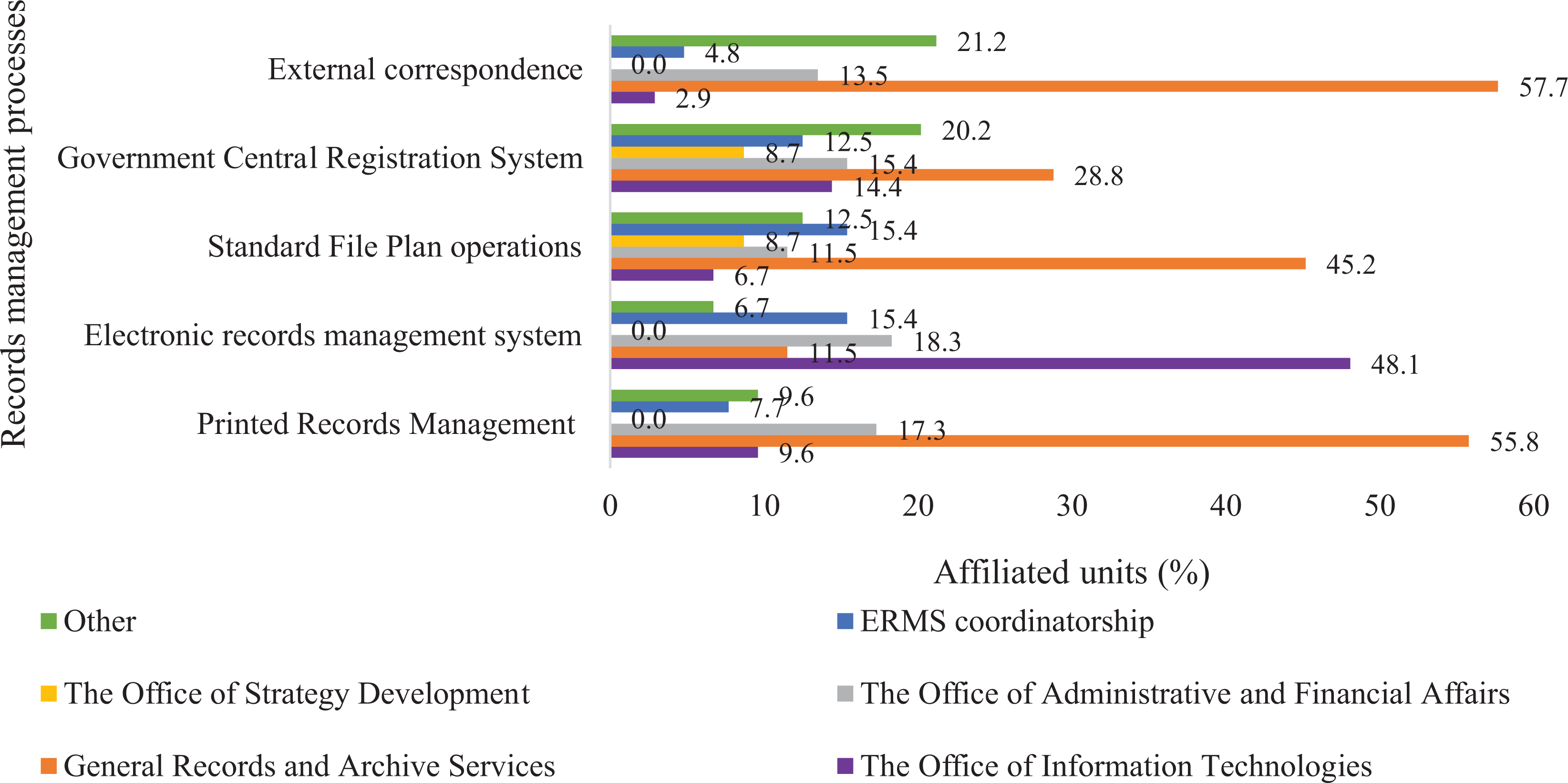
Units where records management procedures are conducted at the university.
The data obtained from the survey was arranged in Excel and findings based on frequencies and percentages have been presented by visualizing them. The results of this research are expected to assist universities in organizational structuring related to records management business processes, in-service training planning on the subject and in understanding the requirements of an interoperable ERMS.
Limitations
The main limitation of the study is that the lack of knowledge of the personnel participating in the survey about ERMS may cause misleading results on the findings.
Results
In this section, the findings obtained as a result of the survey applied to the personnel of the 9 universities participating in the study are interpreted. First of all, it was researched in which units the records management processes are carried out in the university (Figure 1). According to the participants, the responsible unit for ERMS is mostly the “the office of information technologies” (48.1%), while the other records management operations are mainly carried out under the responsibility of the “general records and archive services unit”. The responsibility for the ERMS coordinatorship in all work processes is lower than these units. External correspondence is mostly (57.7%) conducted under the responsibility of general documents and archive services units. The rate of those who state that they carry out external correspondence under the ERMS coordinatorship is very low (4.8%).
Figure 2 shows how correspondence between institutions is carried out in universities. 85.6% of the participants state that the records at the universities where they work are produced in the ERMS and sent to the other institution via REM. On the other hand, 30.8% stated that they print the records produced in ERMS and post it through the physical environment. According to 10.6% of the participants, universities send records to the other institution directly via ERMS.
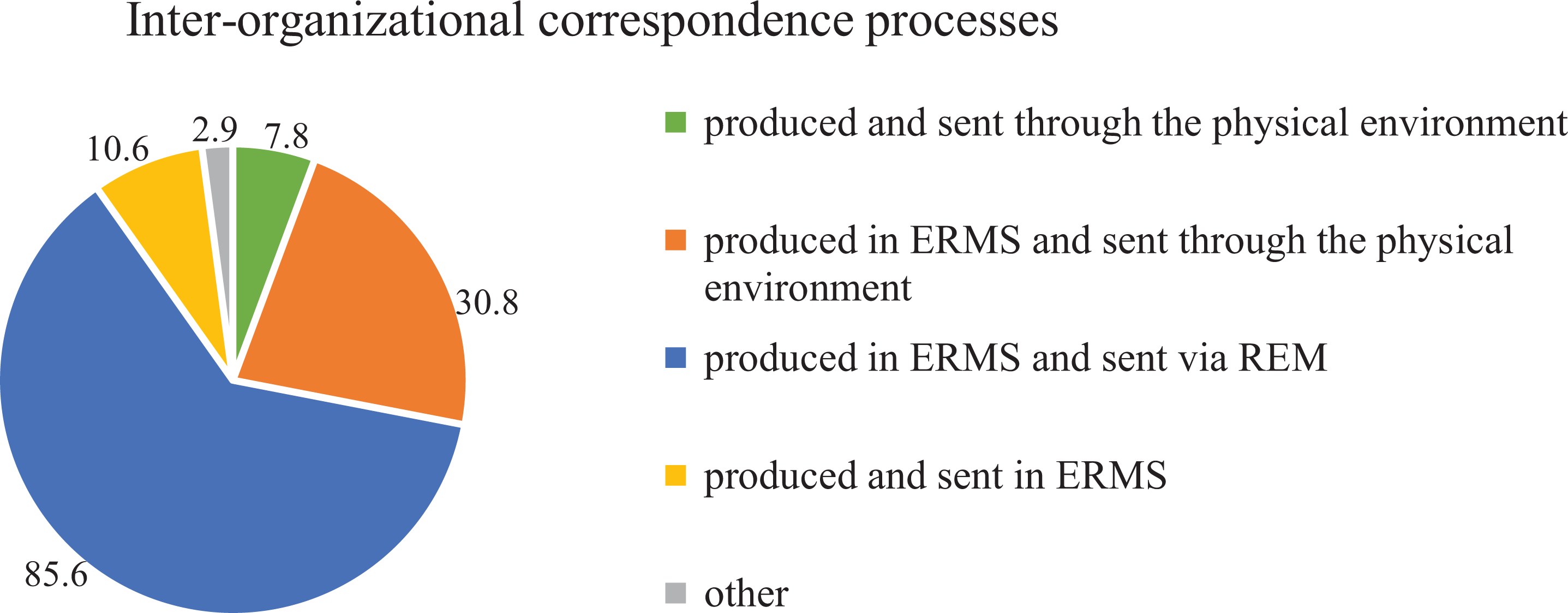
How the inter-organizational correspondence is conducted.
In Figure 3, the evaluations of the participants in the survey regarding the technical interoperability of the ERMS that they use in their universities are given. According to almost half of participants (48.1%) the ERMS they use are in good condition in terms of compliance with TS 13298 Electronic Records and Archive Management System Standard. However, a majority (44.2%) stated that they were undecided about the issue. In terms of interoperability with the ERMS of other institutions, it is seen that 44.3% of the participants evaluate ERMS well. While 44.2% of the participants stated that ERMS is in good condition in terms of interoperability with other systems in the institution, 35.6% of them evaluated it as negative. ERMS are generally seen to be in good condition in terms of working integratedly with the e-mail system of the institution (59.7%).
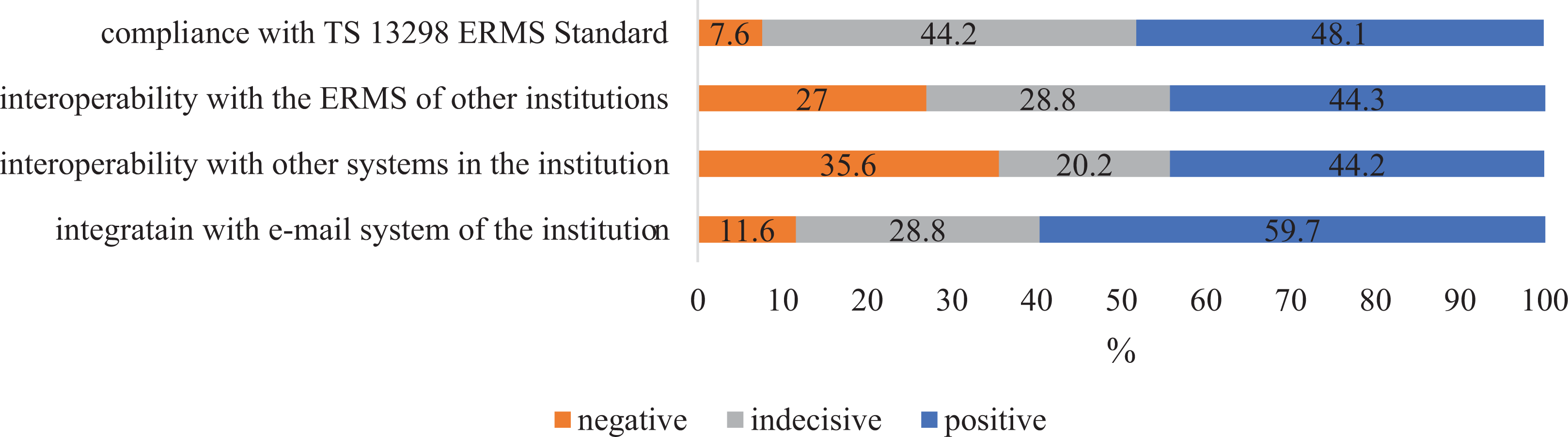
Evaluating the compatibility of ERMS for interoperability.
In Figure 4, the participants evaluated the problems they had about interoperability at their universities. Almost half of the participants stated that the incoming and outgoing records from the REM could not be opened, legal and technical infrastructure deficiencies, lack of coordination between units, and problems related to the REM integration were rare. However, there is a high number of those who are indecisive on these issues. According to 38.5% of the participants, there are many problems related to the lack of coordination between institutions and the lack of awareness regarding interoperability. The rate of those who state that there are too many problems with the lack of coordination between units is not few (32.7%).
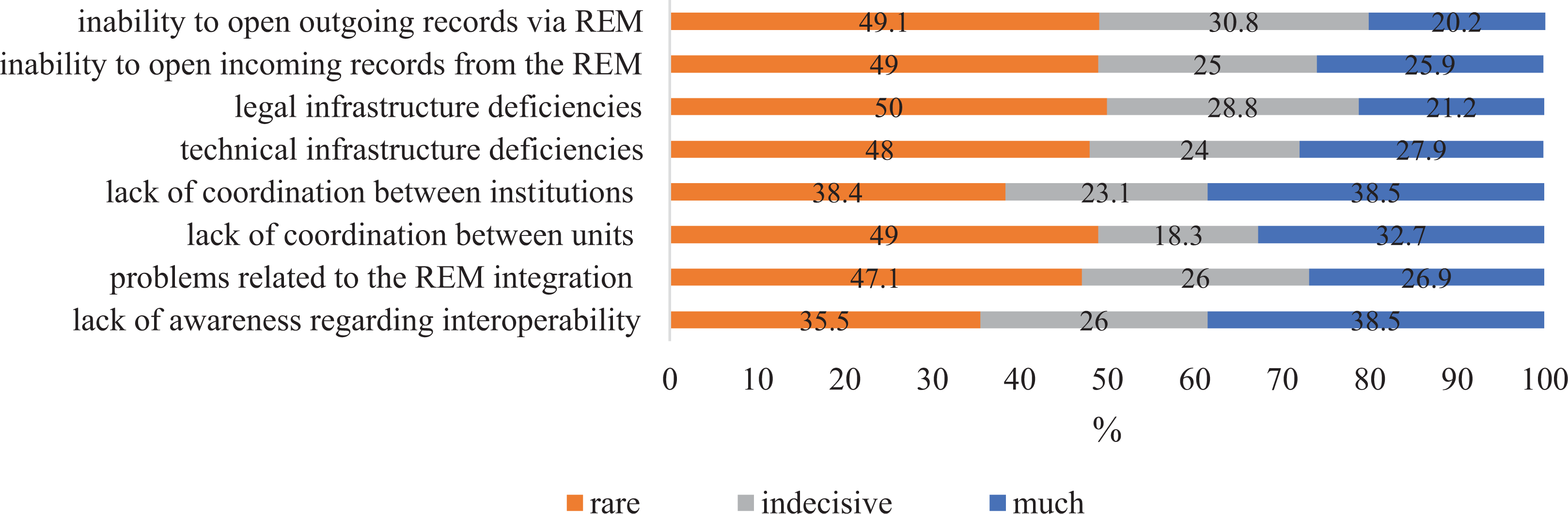
Evaluating the problems related to interoperability.
Figure 5 shows the participants’ views on the opportunities that interoperability will provide to organizations. At most (75%), faster execution of tasks is seen as an opportunity of interoperability. This is followed by an increase in efficiency in services with 66.3% and prevention of rework with 64.4%. Approximately 60% of the participants see the issues of increasing inhouse and inter-organizational interaction and ensuring inter-organizational coordination as an opportunity. According to about half of the participants, the fact that information sharing between institutions can be controlled and services carried out more transparently are opportunities of interoperability. More effective decision support system and effectiveness in terms of human resources are seen as opportunities by relatively few participants. Those who see the issue of increasing national and international cooperation as a result of interoperability remain at 30%.
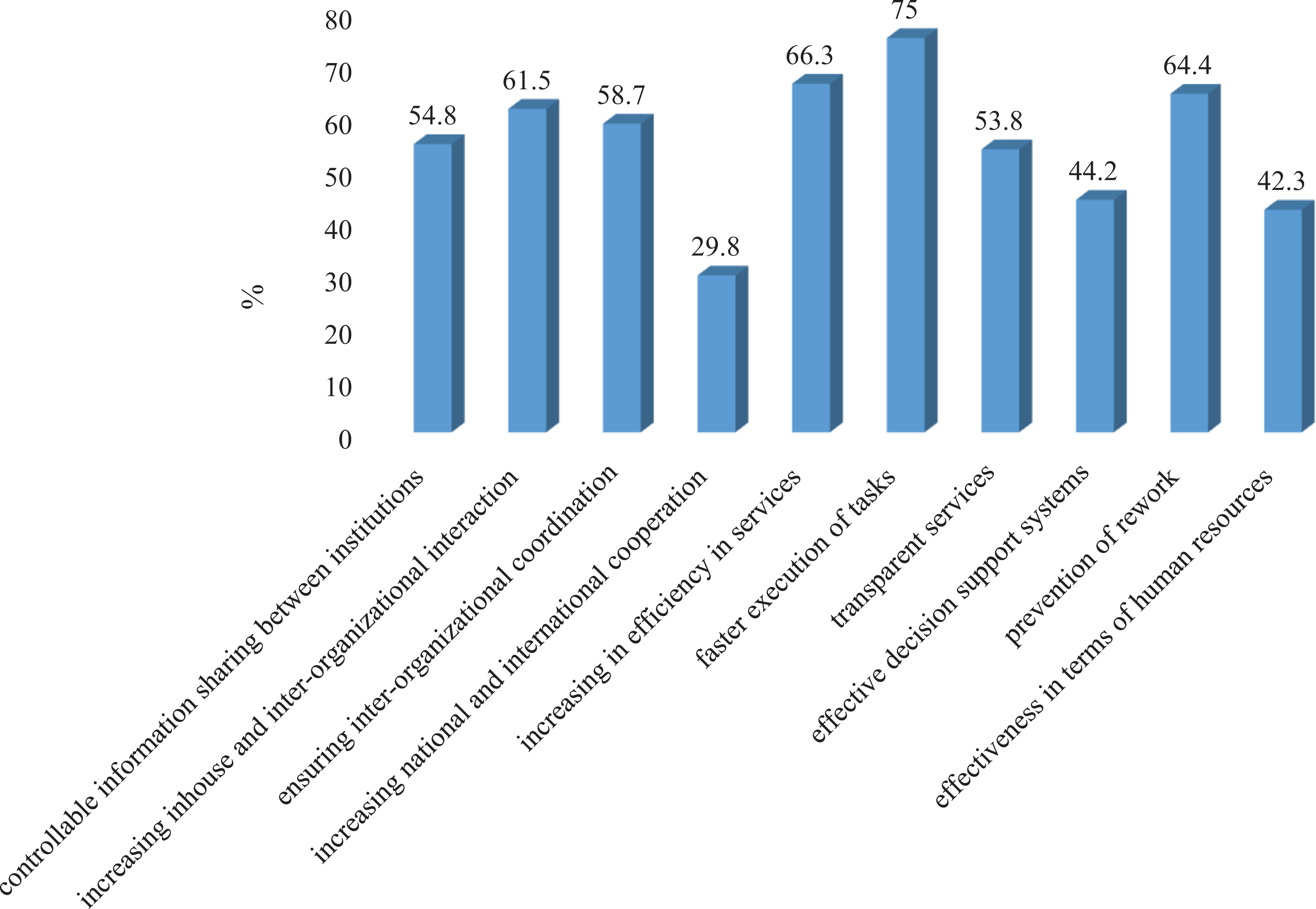
The opportunities which could be provided by interoperability.
The negative aspects that interoperability will bring to institutions are given in Figure 6. Half of the participants consider the issues of protection of personal data and the requirement for personnel to deal with the REM as negative effects of interoperability. 44.2% of the participants see the security problems, 37.5% the problems of the integration of the records recieved from the REM, and 31.7% the problems of the integration of the records sent from the REM as the negative aspects of interoperability. Those who thought that the problem of interoperability and cost would be a negative aspect remained at 10%. 12.5% of the participants stated that there would be no problems with interoperability.
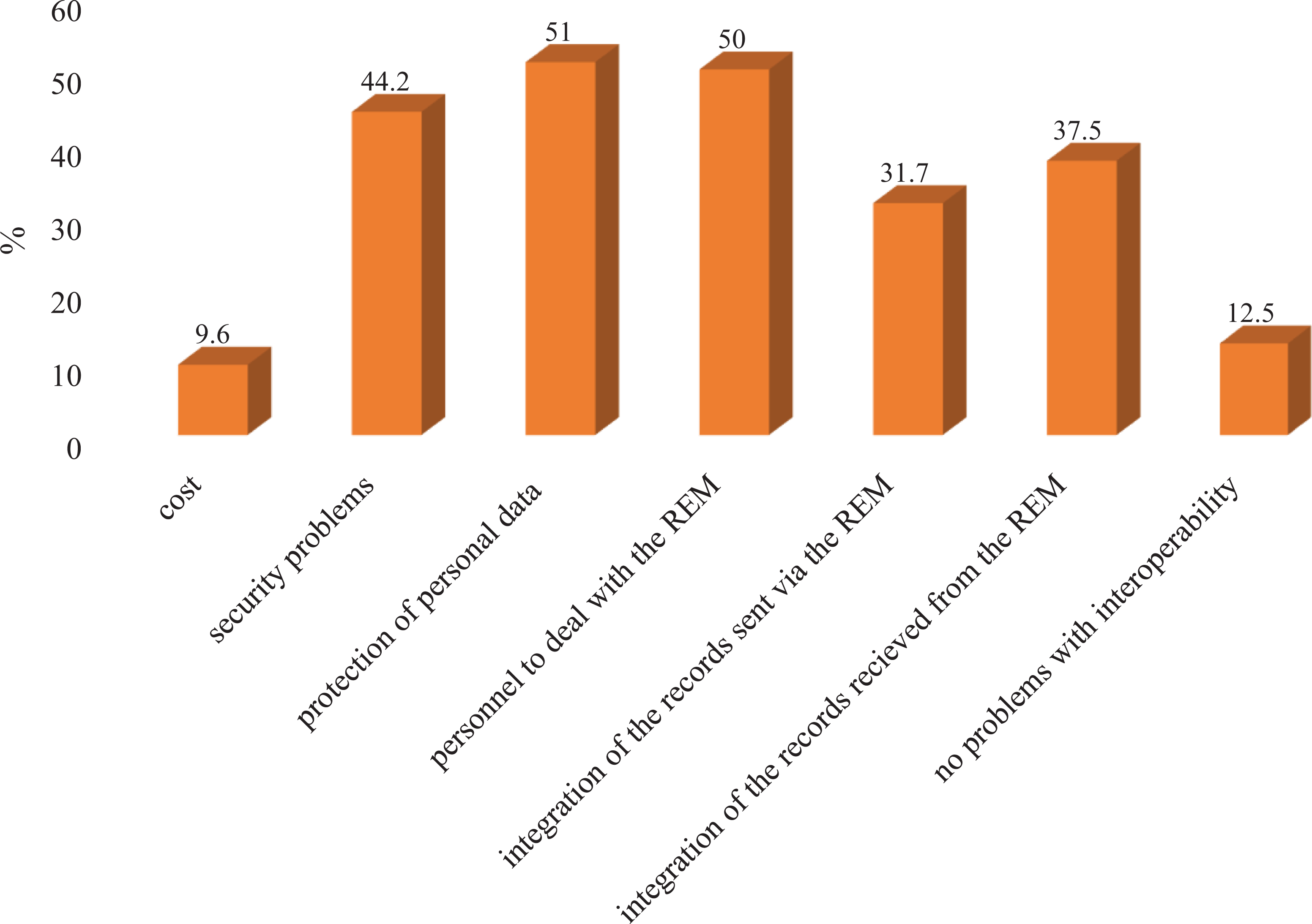
The negative aspects of interoperability.
Discussion of results
Within the scope of the study, 5 research questions were answered and the results were evaluated in support of the findings of previous studies. According to the results of research question (RQ1), responsibilities in records management procedures in universities are distributed among different units. While ERMS transactions in universities are mostly carried out under the responsibility of the office of information technologies, external correspondence is carried out under the responsibility of the general documents and archive services unit. It seems that the organizational dimension of interoperability is ignored. However, one of the basic conditions of ensuring interoperability is organizational interoperability, that is, ensuring coordination between business processes within the organization. Coordination deficiencies will continue unless all transactions related to records management are organized under a single roof. All records management operations and records management systems, including inter-organizational correspondence, should be managed from a single unit.
According to the results of the second research question (RQ2), correspondence between institutions is generally carried out over the REM. However, it has been revealed that a high number who print out the records produced in electronic environment and send them through physical means. According to the participants, those who send electronic records directly via ERMS with full integration are very few. However, it is known that in these universities, correspondence between institutions is carried out over REM and full integration cannot be achieved through ERMS. A misleading result was reached due to the fact that some staff did not have any knowledge about this subject. It is recommended to pay more attention to in-service training of the personnel on the subject. On the other hand, the execution of official correspondence between institutions through the REM system, which is a structure that is also integrated into the ERMS separately, causes integration problems. REM should be seen as a temporary solution, not a permanent one, to carry out official correspondence in an electronic environment. As Yazıcı and Özdemirci (2019) suggested, it should be ensured that official correspondence between institutions is carried out via web service and VPN, without using REM, by conducting protocols between the parties.
Within the scope of the third research question (RQ3), the technical compatibility of the ERMS used in universities for interoperability was investigated. According to the results, ERMS are average in terms of compliance with TS 13298 Electronic Records and Archive Management System Standard, interoperability with other systems in the institution and the e-mail system of the institution, and interoperability with the ERMS of other institutions. The high density of those who stated that they were indecisive on these issues suggests that the awareness of interoperability is low in universities. In addition, it is thought that the problems identified in Önaçan’s (2012) study regarding compliance with the TS 13298 Electronic Records and Archive Management System Standard have been largely resolved. In order for ERMS to work in integration with other systems and e-mail systems of the institution, these issues should be taken into account at the design stage of the system. The second and third research questions show that there are also deficiencies in the technical dimension of interoperability.
According to the results of research question (RQ4), which investigates the problems related to interoperability in universities, while the problems regarding the inability to open incoming and outgoing records from the REM, the deficiencies of legal and technical infrastructure, and the lack of coordination between units, the problems related to REM integration are encountered less, and it was determined that there were many problems in terms of the lack of coordination between institutions and lack of awareness regarding interoperability. There are also many who state that they are indecisive on these matters. These findings show that the organizational dimension of interoperability should be emphasized as much as its technical and legal dimension. In other studies on interoperability in e-government services in the literature, it is seen that the lack of technical infrastructure, legal problems, lack of financial resources, insufficient human resources, awareness problems, resistance to change, lack of support from the senior management, security and privacy problems and coordination problems are observed (Laskaridis et al., 2007; Çalık, 2010; Sulehat and Taib, 2016; Oliveira and Eler, 2017; Maroye et al., 2017). It is thought that the main problems that need to be dealt with after the legal and technical infrastructure are made suitable for interoperability are the lack of senior management support, the lack of expert personnel, and the low level of awareness and knowledge of the personnel. It is recommended that universities organize in-service trainings on this subject, and work to raise awareness on the subject, especially at management levels.
For the successful implementation of ERMS in the public sector, it is important to adopt the system at institutional and individual levels (Mosweu, Bwalya and Mutshewa, 2017). Therefore the opinions of ERMS users on the subject were also considered in the study. According to the last question of the research (RQ5), the opinion of university personnel is that interoperability would provide opportunities for the institution and not bring too many negative aspects. Personnel stated that interoperability would be most beneficial in terms of conducting duties faster, increasing efficiency in services and preventing rework. Increasing interaction between departments and institutions, ensuring coordination between institutions, information sharing between institutions becoming auditable, and conducting services more transparently are also seen as opportunities that interoperability will provide to institutions. Protection of personal data, the necessity of personnel to deal with the REM, security problems, problems related to the integration of incoming and outgoing records from the REM are evaluated as the negativities of interoperability. In their studies, Eroğlu et al. (2016) also emphasized the necessity of taking into account the protection of personal data in regulations on interoperability. It is thought that increasing the number of studies on this subject would be beneficial.
Conclusion and recommendations
It is extremely important that institutions be able to carry out their official correspondence completely electronically through interoperable ERMS, in order to achieve an effective digital transformation in the public sector. In this study, a survey was applied to the administrative staff of 9 universities in Ankara in order to determine the current status of the ERMS in terms of interoperability and the opinions of the university staff on the issue in universities, which have an important role in becoming an information society. According to the findings obtained from the survey, some technical and organizational deficiencies and problems have been identified regarding the interoperability of ERMS in universities. The results of the research are expected to shed light on the system developers in the development of ERMS through which official correspondence between institutions is carried out. In addition, it can guide university administrators in the selection of personnel who will carry out the records management procedures, the formation of the responsible unit and the purchasing of the system. In this context, some suggestions have been made to university administrators and system developers.
In order to establish an interoperable structure, it is important that the records management processes are carried out with all their components from a single unit. Employment of expert personnel in these units is deemed necessary for the correct and effective execution of business processes. Apart from these units, the personnel in all units using ERMS should be made aware of both the system and the legal issues related to ERMS. In addition, raising the awareness of the personnel about personal data and security issues will eliminate concerns in the use of the systems. After solving the problems related to the organizational dimension of interoperability, the technical and the legal dimensions should be considered. The systems must first of all comply with the legal regulations and the ERMS standard, and be integrated into the REM system. However, as mentioned previously, REM should be seen as a temporary solution and necessary works should be done to ensure that inter-organizational correspondence can be carried out via web services and VPN. Integration of the ERMS with other systems at the university should be considered as important as the inter-organizational integration of the ERMS.
This study represents the views and awareness levels of ERMS users about interoperability in universities. The study, although carried out specifically in universities of Ankara, may create a general impression about the current situation in Turkey. It may be used as a reference point in transition or development stages to the ERMS in the public sector. In further work, it is considered important to identify technical problems in interoperability by interviewing system developers or directly analyzing systems.
