







Abstract
The 21 authors of this study, 19 of whom are non-native English speakers, reflect on the barriers to publishing academic journal articles in top international journals. Each author responded to the same set of questions pertaining to educational (PhD) opportunities for emerging scholars, financial conditions for researchers, and challenges in publishing their work. Limited English language skills, lack of research funding, and different research topics were identified as the most significant barriers to publish in the journals. Recruiting volunteers or using electronic translations for accepted articles for journals, reducing software and subscription to academic journals costs, expanding journal scope, and providing guidance and collaboration across borders are possible measures to reduce the negative impact of the barriers.
Keywords
Introduction
Publication of scholarly research among students and faculty of library and information science programs around the world is important for establishing the prestige of these programs and their researchers. The accomplishment of publishing in a top journal within the discipline is not one to be quickly forgotten, particularly for researchers from developing countries, who have been historically disadvantaged due to a variety of factors such as economic situations, organizational support, and language barriers. In the important discussion of persistent inequities within the discipline of library and information science, perspectives of researchers from outside of developed countries, or the Global North (i.e. United States, Canada, Northern Europe), have largely been ignored. Those that have been written often suffer due to the exact system in which they are trying to critique and end up being published in less prestigious journals, where they are not seen by the intended readership of researchers, publishers, and developers in the Global North. This descriptive study represents the efforts of 21 researchers from the world's largest and most economically-diverse countries to identify and describe the barriers they face to publishing articles in top LIS journals and reflect on how individuals and entities in developed countries can serve as partners to create greater opportunity for all aspiring researchers within the discipline.
The impetus behind this paper is heavily influenced by Lund’s (2021) paper “Is academic research and publishing still leaving developing countries behind?” where the author discusses the systemic inequities in research that persist today. Specifically, Lund notes that language and cost barriers, differences in popular topics between developing nations (or, the “Global South”) and the developed nations in which most scholarly journals are published (the United States and United Kingdom especially), and a lack of international collaboration substantially disadvantage researchers and can be particularly discouraging for early-career researchers who might have hoped for a more equal playing field in Internet Age. The present paper, like Lund’s (2021) paper, encourages academia in the United States, in particular, to confront its “America First” policies and inequities. As the nation's research community engages in discussion about important movements and ideas like critical race theory, it is important to extend the discussion beyond simply the borders of these 50 states and consider how historical oppression and hegemony have impacted the capacity of LIS researchers in developing countries today to compete and publish in top journals within the field. The present study can serve as a starting point for discussions on how to begin to rectify these inequities, as it examines the unique challenges faced by researchers from outside of the American and North European research collective.
Literature review
It is widely accepted that academic research output in developing countries lags behind developed countries (Ameen, 2013). In 2001, the United States, the European Union countries, and Japan accounted for 78.3% of the world's published scientific research. Thirty-one of the world's 191 countries accounted for 98% of the academic citations, among which only China, India, and Iran were developing countries (Salager-Meyer, 2008). The difference was mainly due to the language barrier – English-speaking countries account for 5–9% of the world's population, but over 80% of the world's scientific papers are published in English-speaking academic journals (Montgomery, 2004). As noted by Vera-Baceta et al. (2019), 92.64% of the documents indexed in Scopus are in English, while 95.37% of the Web of Science documents are published in English. For scientists whose first language is not English, language barriers can prevent them from communicating the importance and relevance of their research, lack knowledge of written and unwritten rules for publication, and lack social communication competence (Gosden, 1992). Raitskaya and Tikhonova (2020) and Lund and Wang (2020) also noted that researchers who are not native English speakers are particularly susceptible to predatory publications. Most native speakers can tell, from the number of language errors in predatory publication invitations, that these are not legitimate journal invites. Non-native speakers, however, may not be able to discriminate these errors as easily.
Ameen (2013) also identified a poor research productivity and support culture at universities and limited education about research skills as significant themes. These themes differed substantially from those specified in Clapton's study and suggest some divide between the country that Clapton surveyed (the United Kingdom, a highly-developed country) and that Ameen explored (Pakistan, a developing country). Clapton (2010) looked at what barriers United Kingdom LIS professionals experienced in conducting and publishing research. Of 100 respondents to their survey, three-fourths noted that a lack of time was a significant limitation. About one-third said that they lacked the skill needed to publish, lacked the confidence to publish, or feared rejection by the editors. More minor concerns included lack of support from peers and/or employer. Similarly, Alzahrani (2011), Booth (2011), Smiljkovic et al. (2021), and Rai et al. (2016) found the most important themes to be a lack of time dedicated to conducting research, lack of encouragement to participate in research, lack of financial support for research, lack of research and publishing infrastructure, and a lack of adequate data to support decision-making.
Jain et al. (2021) note that the increase in journals that publish open access and require an article processing charge (APC) can become a barrier to researchers. This shift has expanded barriers to publishing in top journals. Even in cases where researchers from developing countries can pay smaller APCs, these costs can still be prohibitive, especially for early-career professionals. Shirazi (2011) identified other barriers, such as differences in politics, religion, and culture, that prevent researchers from publishing in international journals.
Some researchers have sought solutions for overcoming these barriers. Kapp et al. (2011) discuss the success of a scholarly writing workshop. As the authors note, it is often assumed that you can write well if you have a PhD, but the authors challenge this assumption. Even in native English-speaking countries, there are many poor writers. When the additional factor of limited English proficiency is added, then the challenge of writing a publishable manuscript is only compounded. Van Cleave et al. (2011) examined barriers to the production of Quality Improvement research based on workshops and interviews with experts. They identified several important factors, including the need to work with experts in research methodologies, increasing incentives to publish, improving and expanding research networks. Also, the mandatory requirement for publication in international journals is one way to overcome the barriers. For instance, in Vietnam, at least two articles published in international academic journals are required to obtain a doctorate, dramatically improving the country's research quality (Vuong, 2019).
In a recent study, Islam and Roy (2021) examined the number of LIS publications in SCOPUS and WoS from 1971 to 2020. They found only 266 publications are listed in the leading databases in fifty years period which is quite low even comparing to the neighboring countries. Bangladesh has two LIS journals namely ‘The Eastern Librarian’ and ‘Bangladesh Journal of Library and Information Science’ which are not listed in the SCOPUS. They have highlighted the barriers to publish and come up with some ideas to include these journals in the SCOPUS.
In a panel paper in the Association for Information Science and Technology (ASISandT) 2021, authors from seven countries lead a panel on conducting and publishing research in developing countries and focus the challenges and possible solutions. Under the two roundtable discussion with ASISandT SIG-III, ASISandT Africa Chapter and ASISandT South Asia Chapter, panelists confirmed that ‘the lack of a conducive research environment’ is the primary reason for publishing in the LIS discipline. All panelists come up with some list of activities e.g., create awareness on inequality, predatory journals, start building a global support system for LIS researchers in developing countries which can help the LIS researchers to publish in the leading LIS journals.
There remain significant gaps in our knowledge about the barriers faced by library and information science researchers. These individuals can face additional challenges due to the culture within and attitude towards the discipline, which is not considered with as great of esteem as many of the natural sciences. We also lack a global comparison of challenges faced, as most past studies focus on the experiences of researchers within one specific nation. These gaps limit our capacity to develop some unified plan of action.
Methods
The purpose of this study is to examine the barriers to producing scholarly publications among library and information science researchers globally. A multi-author review of research challenges, based on the experiences of researchers from around the world is presented. This type of multi-author review of research challenges is common, particularly in areas of emerging research concern or those that have been traditionally overlooked in research (Mijumbi et al., 2016; Shakhatreh et al., 2019).
The 21 authors of this article represent 11 countries from around the world: Bangladesh, Brazil, China, India, Indonesia, Iran, Mexico, Nigeria, Spain, United States, and Uganda. These countries represent 54% of the world's population and 60% of the population of developing countries (4.3 billion people). They also represent seven of the ten largest countries overall by population and seven of the eight largest developing countries. Out of 225 qualifying nations, the twelve countries represented have a mean gross domestic product (GDP) rank of 22 and median rank of 14 (range from United States at 1 to Uganda at 100); however, based on GDP Purchasing Power Parity (PPP) per capita – a measure of GDP per person relative to the cost of goods in that country – these countries have a mean rank of 113 and a median rank of 117 (range from United States at 15 to Uganda at 203). This illustrates that, by one standard, these countries can appear wealthy, but in the context of costs of goods and population size, tend to be relatively poor (which is not surprising, given that nine of the twelve are classified as “developing countries”).
The authors of this study represent a collection of masters and doctoral students/graduates, library professionals/librarians, lecturers, and tenure-track faculty in library and information science or related disciplines in these countries, invited to participate as coauthors based on their contributions to scholarly journals and geographic representativeness. This study was designed so that each author would have the same structured set of questions to answer but were given considerable flexibility in how they answer them and share their perspectives and experiences. This was done by each author in addition to contributing to the overall development, review, and approval of the manuscript. Our responses were collected over the course of May 2021. Responses were collected primarily via email before being transferred to a shared Google Sheets spreadsheet. Responses to these questions were analyzed and organized under appropriate headings in the findings section. The four question prompts are as follows:
What is your primary language (that you use at home)? Would you consider yourself to be proficient in English? How/where did you acquire English skills? Do library and information science schools in your country offer paid fellowships or some other funding support for PhD students? Are they adequate to cover your financial needs? What is the average annual (yearly) salary for a LIS researcher/faculty in your country? You can provide a rough estimate in local currency or US dollars. If you are not sure, just put “not sure”. What would you like to share about barriers to publishing in top journals in library and information science? Do factors like language and limited funding limit your ability to engage in research and publishing activities?
Findings
Language use and English proficiency
Language can be a substantial barrier to publishing in top scholarly journals. Virtually all top library and information science journals publish in English; however, only two of the 21 authors of this study (one of whom is a United States’ native) speak English as their primary or native language. Thirteen different primary languages are spoken among the 21 authors: Assamese (1), Bantu (1), Bengali (1), Chinese (3), English (2), Hausa (1), Hindi (2), Indonesian (1), Kannada (1), Persian (3), Portuguese (1), Spanish (3), and Yoruba (1). Most authors do consider themselves to be proficient in the English language (18 of 21 authors identify as proficient in speaking English). Proficiency standards can vary, but, in general, the idea of “proficient” was interpreted as having a strong enough grasp of the English language to read and write at a suitably advanced level to have a complete conversation with a native speaker. It does not necessarily mean proficient to the extent of being able to compose scholarly articles in the English language, though most authors have done so. English skills were primarily gained through schooling, particularly through college coursework.
English language proficiency is essentially a prerequisite for publishing in top scholarly journals within library and information science. Of the top 50 journals listed in the Library and Information Science category on Scimago Journal Rank (ScimagoJR, 2021), 49 of 50 (98%) publish only in English and 45 of 50 (90%) are published in either the United States or United Kingdom. Of the 87 journals listed either in the Information Science and Library Science or Library and Information Science category of the Social Science Citation Index, 77 (89%) publish only in English and 65 (75%) are published in either the United States or United Kingdom.
Phd funding and fellowships
Four countries generally provide sufficient funding for PhD students to pursue a degree in library and information science, or related fields, assuming a grant or graduate assistant position is received: The United States, Brazil, China, and Spain. In three additional countries, some funding may be supplied, but it is likely insufficient for students to subsist on: Bangladesh, India, and Mexico. In the four remaining countries – Indonesia, Iran, Nigeria, and Uganda – funding is rarely provided, if at all, and PhD students will need some other job in order to support themselves while earning their degree. In many cases, universities may have lecturer positions available, but these are not guaranteed positions and may not be located in the same university as the one in which the student is earning their degree.
Of course, “sufficient funding” is a subjective and relative term. Even in the United States, the sufficiency of funding for PhD students can be questioned. Many top-end universities offer around $20,000 per year, but the average is probably closer to $10,000, which is an amount that is not sufficient unless the student also takes out sizeable student loans or has another stream of income. This is true for positions in the other countries as well. Students may be able to scrape by, but are not “living well,” and are often compensated at levels that are not commensurate with the actual work they are doing relative to the amounts paid to tenure-track faculty. This experience was reported by several authors in discussing their knowledge and experience with PhD fellowships or graduate assistant positions.
Salaries for LIS faculty
Salaries for professors do, of course, vary depending on the type of faculty position (i.e. assistant, associate, full professor) and type of university/college in which one is employed, but Table 1 represents the best efforts of the researchers to collect accurate assessments of the typical salaries for professors in each of our home countries. In many of these countries, the typical salary is somewhere around the equivalent to $20,000 US dollars (which is about equal to what top doctoral-level graduate assistants may expect to make in the United States). However, some countries offer much less in terms of salary, such as Bangladesh, Brazil, and Nigeria, which average less than $10,000 US dollars per year. While cost of living certainly varies in these countries, certain expenses, like purchasing research equipment, international travel and conference participation, and purchases of large, imported goods often have the same cost regardless of country, and this fact excludes many researchers, particularly in the poorest countries.
Typical salary for faculty in local currency and USD.
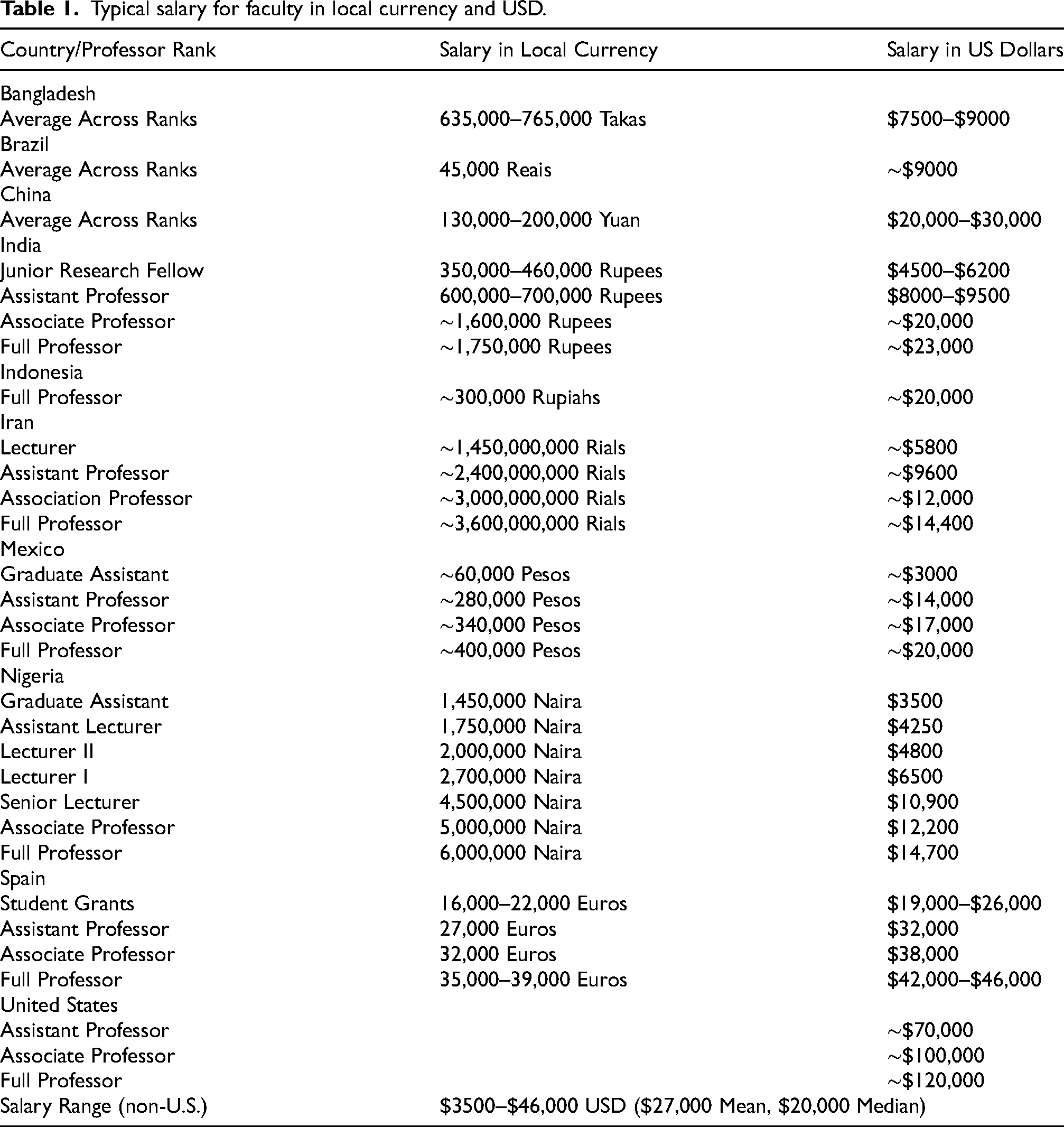
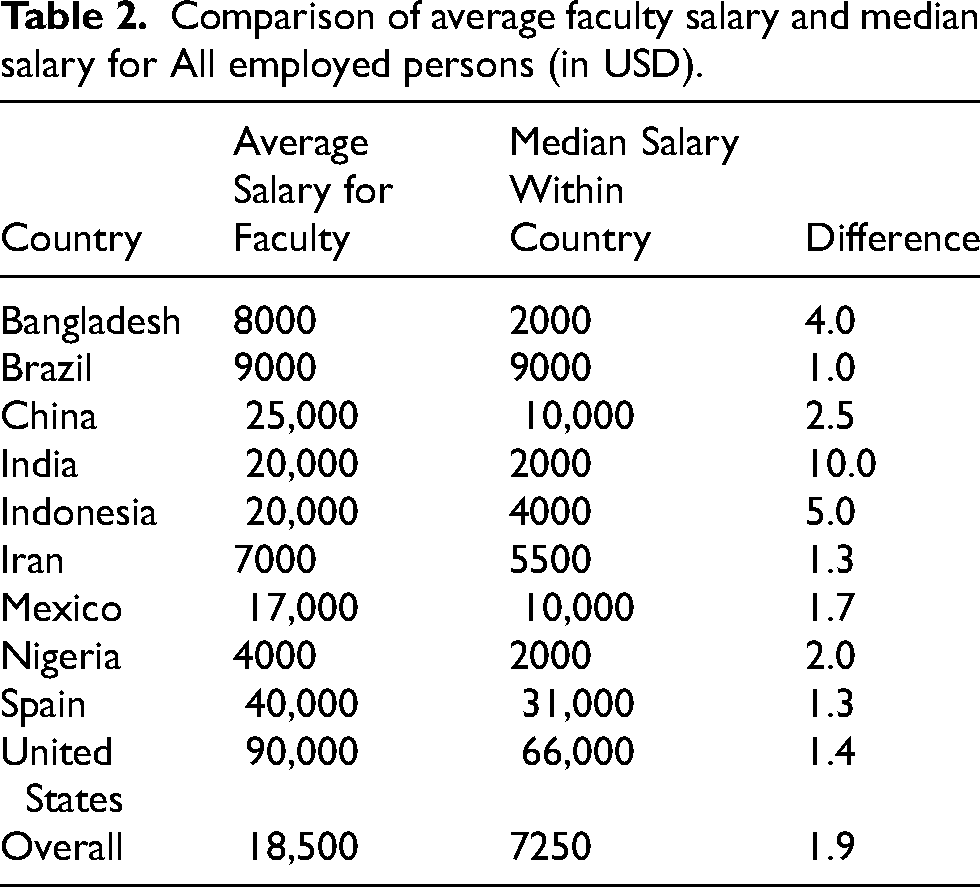
Table 2 compares the average salary for library and information science faculty members (based on Table 1) with the median salary for all employed persons in the country – based on data retrieved from the World Population Review (2021). The average faculty member makes about twice as much as the average for all employees across the countries compared. This disparity is actually the smallest in the most “highly-developed” countries (United States and Spain), and appears to be the largest in the three southeast Asian countries represented in this study (Bangladesh, India, and Indonesia). In each of those three countries, the starting salary for assistant professors may be much closer to the median salary within the country, but tenured positions (associate and full professors) make considerably more than junior faculty (assistant professors).
Comparison of average faculty salary and median salary for All employed persons (in USD).
To compare to the salaries of faculty in these countries, we collected information about the cost of various important research software: NVivo (qualitative analysis) costs $850 for an individual license, SPSS (quantitative) costs $99 per month, EndNote (citation manager) costs $250, Microsoft Office costs $50 minimum (depending on the version), Article Processing Charges for scholarly articles can cost anywhere from $500 to $3000, and language editing typically costs around two cents per word (or about $100 for a 5000 word article) and still does not ensure great quality of editing. If a researcher wanted a NVivo license, a 12-month SPSS license, an EndNote license, and a Microsoft Office license, it would cost $2350. For an assistant professor in the United States (who likely would not need to purchase these licenses out-of-pocket, because their university likely hold an organizational license), this $2350 would only represent 3% of the average gross salary. However, for most other countries in this study, this software would represent anywhere from one-third to one-half (or more) of their annual gross salary. This makes such purchases essentially impossible. Even for full professors in most countries, these purchases would represent well over one-tenth of their annual gross salary (excluding taxes).
Top barriers to publishing
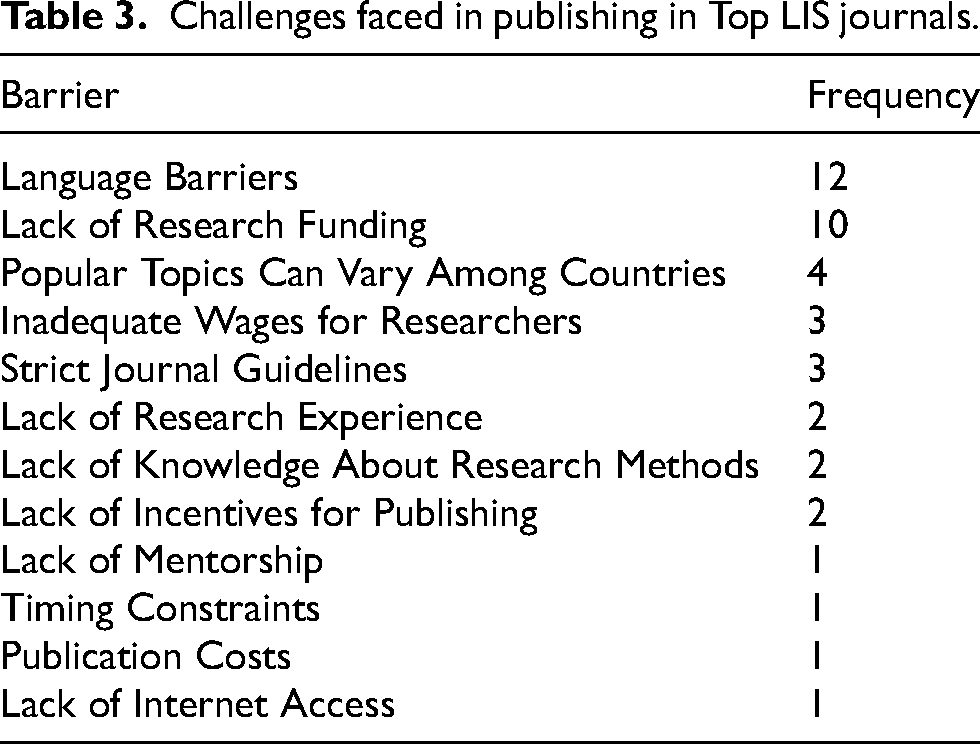
In this section, the complete comments of each author, with only minor edits to ensure consistency in voice and perspective, are included below, so that their important observations remain intact. However, Table 3 also includes a quantitative summary of the comments. These categories of comments and frequency counts were tabulated by two of the lead authors on the paper to illustrate the relative strength/frequency of each barrier.
Challenges faced in publishing in Top LIS journals.
Bangladesh
There are many factors that have caused challenges in my experience, including:
Access to subscribed e-resources e.g., journals, conference proceedings listed in SCOPUS and WoS. Lack of research culture inside and outside organizations Lack of scientific writing workshops Lack of essentials skills of English writing Limited research projects/ funding supports in the library field No mentoring facilities No incentives for publishing in good ranking journals Lack of Statistical Skills
Brazil
In my experience, one of the most difficult things for publishing research is that the structure of the scientific studies is different from country to country. For example, here in Brazil we are used to writing longer articles, which differs from US, short and strategic papers tend to be preferred. Another barrier is the specific terminology used within each area of knowledge, which require different ways of writing.
China
I have found that language differences can be a major barrier. Many Chinese researchers’ English is not adequate for professional writing. Also, reading and understanding reviewers’ comments may be difficult for Chinese researchers and make it challengingto provide satisfactory revisions to the manuscript and responses to reviewers. Also, topic selection can be problematic, as topics of interest can vary across countries.
Limited research experience levels can also be problematic. Articles published in Chinese core journals are mainly published by researchers from well-known universities. If not from one of those countries, there is basically no hope to publish. We do not know ways and methods to publish in top international journals.
English level and research funding indeed limit publishing articles in quality journals. LIS is a liberal arts major in China, which receives less research funding compared with science and engineering. Research funding is mainly concentrated in well-known universities. Therefore, scholars from non-well-known universities will form a vicious circle of publishing: non-well-known universities receive less research funding, leading to insufficient publish ability, then universities cannot rise in ranking, meaning that they will continue to receive less funding.
In addition to writing in non-native language, the biggest barriers to getting published in top journals are cultural differences in research background and a lack of knowledge of international journals. Language and limited funding will limit my ability to engage in research and publishing activities.
India
The most important barrier I have observed is not having a scientific approach to the research which is being performed. There is a lack of proper knowledge about research techniques. Limited funding and proficiency in language also hinders the research and publishing activities.
Funding is the major barrier for me to get published in top LIS journals. In India, LIS professors generally do not write grant proposals to get funding for projects. They usually do independent research, and similarly, all the PhD research programs are not funded by any organization. As a researcher, we have to pay on our own to access a particular software/tool or travel to another city/country to attend a conference and present our work or become a member of an association. We are not able to publish open-access in reputed international journals because of their high APC.
Language is the biggest lacunae for publishing in top LIS journals, because of non-English speaking academics and researchers, we are often asked to get language editing or proofreading properly. We often not find suitable persons or also find it financially difficult to avail the language editing facilities offered by third party service providers or publishers’ language editing support.
There was also no support from institutions or universities to do research unless research projects were offered by the University Grants Commission (UGC) or other research institutions. We have to motivate ourselves and find and incur financial resources of our own to do research work and subsequent publications.
Access to Scholarly Publications (journals) are also very much limited through centralized consortia-based subscriptions. Even today, researchers find it hard to access bibliographic databases such as Web of Science and Scopus. Very few universities provide access to bibliographic databases and journals based on the researchers requirements, so we have to resort to sources like Sci-hub and other academic social networking sites like ResearchGate to get the research articles.
We are aware of the technology, new things that are happening in the field of Library and Information Science. We have a problem in expressing the analysis or making a discussion of the findings. Language sometimes creates problems as we find problems in understanding some papers published in reputed journals. Funding opportunities are very limited in library and information science compared to other subjects like biotechnology, chemistry, or computer science.
Indonesia
Barriers I have experienced to publication in reputable journals are language and article content. However, for language issues, translators and proofreaders can still help.
There are several reputable journals in the library and information science field that are not paid (do not charge an article processing fee). The problem is waiting for a very long review process.
Iran
The factors inhibiting publishing in top journals are personal, organizational, and international. There are barriers imposed by institutional needs and by international expectations that cannot be met by researchers with limited resources.
Not mastering the English language is the most important obstacle I have experienced for Iranian LIS researchers. The results of a research conducted in one of the Iranian universities showed that there is a significant relationship between English language proficiency and the number of articles (Azami, 2010).
Another major barrier is accessing articles, as the cost is prohibitive. Often free versions of articles must be sought from the authors or websites.
Mexico
The main barrier is the language since many people do not have the knowledge to properly write a text in the English language.
Research work can be difficult for people who are constantly looking for a job; it is difficult affording the services of a translator to be able to publish research in journals in the English language. However, in the case of those professors-researchers who do have a stable job, they have the possibility of accessing a translation service provided by the university itself or, they can pay without problem for the services of an external translator since the income that on average a researcher perceives is sufficient for this.
There are numerous barriers, including:
Language is one of the main barriers that Mexican researchers face when publishing abroad. Our public schools offer English courses as part of the curriculum (at the elementary, middle and high school levels), however, the quality of the courses is very poor, which makes it difficult for students to acquire outstanding skills in language management. The costs of open access journals such as PLOS One are prohibitive for most Mexican researchers who do not have a full-time and indeterminate position in an institution. Salaries for temporary researchers are often low and universities do not normally offer funding to publish in these journals. An advantage that we researchers who work in the most prestigious universities in the country have is that we have access to specialized databases such as Scopus, Web of Science and Derwent Innovation Index. Likewise, researchers who belong to the National System of Researchers have access to Incites. This is not true of all researchers in other universities, though.
Nigeria
In my experience, there are strict criteria set by some top journals such as submission and editorial policies as well as other guidelines regarding English language writing styles (American or British). In addition, most top journals do not consider waivers and discounts to researchers from underdeveloped countries who are battling with limited funding.
Funding is a major limitation to publishing in top ranked journals. The credibility of the publishing outfit is another limitation. For instance, articles not published in academic/research institutions’ based journals or professional association journals are not acceptable in my place of work.
The barriers I have encountered to publishing in top journals in Library and Information Science include:
Poor research funding Poor knowledge about scholarly publishing Lack subscriptions to information resources in various research institutions Poor idea of collaboration Poor Internet connection Erratic electricity supply Poor knowledge of research Poor Compensation for research
Spain
We have to translate or write most of our work in English. When co-authors are not at ease with English writing we may need to pay for a professional translator. And even when writing from scratch in English, we may need an English native speaker colleague to review the work as a personal favor. About funding, it is also a barrier, as being beneficiary of a project grant is hard not only because of scientific reasons, but also excessive bureaucracy.
Uganda
Some of the factors I have identified as inhibiting publishing in Uganda are policies, language barriers, high illiteracy rate, piracy, lack of government support, lack of national policy on book publishing, limited capital, lack of a virile national publishing association among many other challenges. Language is not a major challenge in comparison to lack of funding, which impacts both scholarly endeavors and library services (Bushman et al., 2021).
Discussion
While most of this study's authors are proficient in English, at least to the point where they can coauthor a scholarly paper, it is not their primary language. This means that, in addition to acquiring the necessary research skills in order to get published (as all researchers in native English-speaking countries do), they must also gain proficiency in a secondary language, or pay exorbitant rates for a translation (and hope they are not ripped-off) just in order to be competitive in seeking a top venue for their work. Journals that are truly dedicated to supporting researchers from these countries with less or no English proficiency might hire or recruit volunteers who could assist with translation of accepted articles, while considering allowing electronically-translated (i.e. using Google Translate, which generally is quite accurate) versions of the manuscript for initial submissions (or some similar solution). Enhanced copyediting support for language may also be helpful. This does place greater work on editors and editorial boards, but it is certainly no more effort than is expected of authors now in having to learn a whole language just to publish their works in good journals.
Financing for students and faculty in LIS programs is also a major issue. Even in countries where the salaries for faculty are considerably higher than for the average worker in the country, the cost of research software and translation and proofreading services far exceeds what can be reasonably afforded. If developers and publishers are truly concerned about equity in access for researchers in all countries, they should consider offering reduced costs for software and subscriptions to scholarly journals and bibliographic databases, as previously suggested by Lund (2019; 2021) and Kirsop and Chan (2005). Certainly, some software and journals already offer these kinds of discounts, but many – if not most – do not. If researchers from poorer countries do not have access to analytical software like SPSS, then they must use free alternatives; however, the only quality, free alternative to SPSS is R or Python languages. This means that researchers from these countries are expected to learn yet another language just in order to perform the statistical analyses necessary in order to publish a quantitative paper in a top LIS journal (while LIS researchers from Research 1 universities in the United States have a university subscription to SPSS and need never even learn what those programming languages are).
As noted by Lund (2021), another unique challenge for researchers in countries outside of the American and Northern European influence relates to popular topics for research. For instance, in India and many other southeast Asian countries, bibliometrics is extremely popular, while in many African countries, library management topics tend to be popular. However, in the United States and United Kingdom, where most LIS journals are published, these topics are not particularly popular. There is a conflict between what early-career researchers are told to research (based on what is popular in their countries) and what they should research in order to actually be published in a top journal. One solution would be to say that the research culture and popular topics in Southeast Asia and Africa need to change to meet those of the United States and United Kingdom – a solution that further enforces these countries hegemonic influences over what constitutes “acceptable research.” A more amenable solution is for research journals to expand the scope of what research they accept, understanding that many researchers around the world want to publish in these journals due to their prestige and that it is not acceptable to determine the appropriateness of topics based only on what an American or British reader may be interested in. In fact, broadening of topics in journals may encourage readers in America and Britain to actually expand their own research in new and innovative ways.
Lastly, there is a clear lack of research mentorship and collaboration across international borders. Research faculty at universities may see it as their duty to mentor doctoral students within their school, but rarely do they see this obligation as extending to other researchers around the globe. Can research with researchers on the other side of the world be challenging at times – between the time, cultural, educational and language differences? Certainly. However, if this manuscript can be composed by over 20 authors from 12 different countries around the world, then clearly it is possible to execute successful international collaborations if reasonable effort is put forth. The researcher from a developed country can benefit from these collaborations by getting to learn more about new countries (kind of like a research pen pal) and expanding their understanding of the profession and research as a whole.
Further suggestions for practice
In order to improve opportunities for LIS researchers from developing nations, a broad, multinational coalition of dedicated researchers, publishers, and advocacy organizations is needed. All facets of the LIS research culture must be involved. At the level of publishers, it is necessary to revisit policies that reinforce Western hegemony in the publishing process. Top journals should not always select “top authors” for editor/editorial board positions because, for reasons enumerated in this paper, the top authors in any discipline skew towards researchers from Western nations. Having editors largely from Western or wealthy nations perpetuates the practice of only articles being accepted that conform to the Western perception of “interesting” and “important” topics. This is not dissimilar to how entertainment media in the West has largely been tailored to white audiences because most entertainment executives are white, American or British men, who find stories that mirror their own experiences and opinions most compelling (perhaps an unconscious, but nonetheless extremely harmful, bias). Publishers can also go farther to offer free language editing services for promising works.
LIS programs and academics can extend more funding opportunities for students from low-income countries. LIS programs in the United States have done well at recruiting students from some east Asian countries like China and South Korea, but these are also some of the wealthiest countries in that region. India, Bangladesh, Nigeria, Iran, Brazil, and Mexico (which borders the United States) contain approximately two billion people and are severely underrepresented in LIS programs in America. Many of the potential students from these countries would not be able to pay tuition at an American school, but this is precisely why they should be recruited and offered graduate assistant position as possible and warranted. Additionally, learning experiences that do not require leaving one's country should be explored, such as low-cost certificate programs offered through partnerships between institutions in developed and developing countries. For instance, a modified version of San Jose State University's “Gateway PhD Program” could be offered, where students may enroll at an institution in their home country but could learn from faculty and earn a degree from an American, Canadian, or British university.
Researchers from the Global North should look to the Global South for potential collaborators, using platforms like ResearchGate. The unique perspective that can be attained from a researcher who literally lives on the opposite side of the Earth can only benefit research quality. For those who learn through doing, research collaborations can be even more enlightening than formal education. These types of partnerships are mutually beneficial for all researchers.
Study limitations
There are a few limitations with the data collection for this manuscript, as only the experiences of the 21 authors are included and experiences can vary from person-to-person and university-to-university. Authors were not proportionally representative of the number of people or researchers in each country (e.g. there are more Nigerian authors than Chinese authors, even though Chinese has a larger population and more active researchers than Nigeria). These limitations, however, do not mitigate the relevance of the takeaways from the results. If anything, additional perspectives on barriers in the research process may have been missed, which would have only strengthened the findings and arguments made in this paper.
Conclusion
This study illuminates the barriers faced by researchers from around the world when working to publish in top library and information science journals. Nearly all of these challenges have nothing to do with the quality of the research or required workload. Instead, they are factors that researchers in universities in most developed countries like the United States, Canada, Australia, New Zealand, and North Europe do not have to ever concern themselves with: language proficiency, funding for basic research equipment/software, organizational support, alignment of research topics, and mentorship and collaboration. The fact that these are the barriers identified by these researchers illustrates a sustained pattern of inequity that has been largely ignored. In the drive to attain grant funding and sustain one's own research endeavors, LIS researchers in wealthy English-speaking countries can be hard to distinguish in their behavior from multinational corporations and politicians that benefit from the work of developing countries (readership and citation of their work) but ignore these individuals when it comes to actually taking tangible steps to improving their opportunities to participate and be competitive in the world of scholarly publishing. To begin to ameliorate these barriers, this paper has outlined important steps that researchers, publishers, developers, and funding sources from developed countries (“The Global North”) can do to expand opportunity for researchers from developing countries (“The Global South”). By building partnerships among researchers across these countries, we can not only enhance opportunity for all researchers, but also increase the overall quality and creativity of research and ideas within the discipline of library and information science.
Footnotes
Declaration of Conflicting Interests
The author(s) declared no potential conflicts of interest with respect to the research, authorship, and/or publication of this article.
Funding
The author(s) received no financial support for the research, authorship and/or publication of this article.
ORCID iDs

Supplemental material
Supplemental material for this article is available online.
Correction (December 2022):
Article updated to correct the affiliation of Jamilu Abdullahi in the “About the authors” section to “Jamilu Abdullah is a library employee at Abubakar Tafawa Balewa University, Nigeria”.