







Abstract
Community radio has gained traction with the grassroots in South Africa, especially subaltern groups excluded from the public sphere during the colonial and apartheid years. This paper argues that rural audience acceptance of and participation in community radio is closely associated with indigenous language, which invokes cultural affinity. The paper used a qualitative methodology within the framework of the theories of cultural affinity to interrogate community radio listeners in Northwest Province, South Africa, looking at how local languages might influence listeners’ preferences and interactions with the stations. The results suggest language was essential for listening in and participating in community radio programmes among those interviewed. Community radio provides listeners with the outlet, social and linguistic resources to evoke and express their cultural heritage and participate in national dialogues. It also offers subordinated communities the opportunity to deconstruct dominant frames of reference and representations of themselves and others.
Keywords
Introduction
Community radio generally refers to a radio station confined to a small geographic area and often supported by local listeners or social groups. The Media Institute of Southern Africa (MISA, 2003) describes community radio as radio owned, managed, and programmed by the people it serves. Here, the defining characteristics of community radio are ownership and participation. Community radio stations are distinct from other radio types in “their non-commercial status as broadcast outlets, their avowed policy of local community involvement in their programming, and the democratic organisation of their institutional procedures and practices” (Barlow, 1988: 81). This conceptualisation is consistent with AMARC-Europe's (1994:4) definition of community radio as a not-for-profit station, currently broadcasting to and serving the community in which it is situated while encouraging the involvement of this community in the radio.
Community radio resonates with the audience because it promotes participatory dialogue (Siemering, 2000). It provides rural communities with a platform to participate in a broad range of discussions and debates over issues that affect their lives (Madamombe, 2005; Onyenankeya et al., 2020). Although commercial radio also encourages dialogue, the involvement of rural listeners in such talks is often superficial as their engagement is only according to a prescribed format devoid of their input. Unlike in mainstream media, the audience of community radio are not passive receivers of information - they participate actively in arriving at the content (Al-hassan et al., 2011). The dialogue that ensues from participating in community radio programmes helps engage subaltern groups, and this form of engagement can reduce seclusion arising from marginalisation (Reed and Hanson, 2006).
Participation is essential for marginalised groups because they are often crowded out in mainstream media. For instance, in South Africa, like in most societies, mainstream media tends to serve the interest of the dominant group in society and frames public discourse from the perspective of this powerful minority (Bosch et al., 2018). This tends to exclude or muzzle grassroots voices in public discourses. Because community stations are oriented towards public service instead of profit, they are well-positioned to offer more inclusive participation in public deliberations and debates (Gaynor and O'Brien, 2017: 1).
As alternative media, community radio offers subaltern groups a veritable outlet to voice and advance their social values and deconstruct hegemonic frames of references and representations of themselves and others (Onyenankeya, 2021; Onyenankeya et al., 2020; Onyenankeya and Salawu, 2019b). Through community radio, marginalised groups are energised to bring about social changes in their communities (Day, 2009). The participation of community members in the production process creates a sense of belonging and increases the credibility of community radio content (Keogh, 2010). This may explain why some audience members perceive community radio stations as more ‘trustworthy’ even when faith in mainstream media is waning (Guo, 2012).
The ability of community radio to accommodate oral tradition is also a significant reason for its popularity, especially among indigenous communities (Onyenankeya and Salawu, 2019a). Community radio can gain traction with listeners in rural communities because of the unfettered display of indigenous talents and culture (Meadows et al., 2005). The widespread appeal of community radio, particularly in rural areas in Africa, can also be due to its affordability (Megwa, 2007). Unlike television, radio does not require sophisticated infrastructure to function. These days, most cell phones come with an inbuilt radio system making it possible for people to access radio, including community radio stations from anywhere they can pick the signals.
Community radio serves specific communities with individuals whose issues are aligned (Bello and Wilkinson, 2017: 3). According to the World Bank (2007), community radio can be a strong defender of the interest of the ordinary people and a potent weapon in monitoring and holding public officers accountable.
Community radio has proven to be an effective communication tool in development initiatives, especially in rural communities. It serves as a medium of education and disseminating critical information to illiterate and poor people (Fombad and Jiyane, 2019; Sharma, 2012). By providing information in a language that enables people to construct and share meaning competently, community radio can empower communities to build a democratic society. Several studies confirm that indigenous language media such as vernacular newspapers and folk theatre can contribute to rural transformation especially pro-environmental behaviour like water conservation (Onyenankeya and Salawu, 2018; Onyenankeya and Salawu, 2019b). As Tacchi points out, radio consumption can enhance and heighten the sociability of listeners (cited in Bosch, 2014: 902). It can also democratise and redistribute power (Wabwire, 2013).
Literature review
The connectedness of community radio and indigenous communities
Community radio has come to occupy a unique position in the South African “Mediapolis” (Silverstone, 2007: 31). Several studies have explored the contributions of community radio stations to the development and wellbeing of communities in South Africa (Megwa, 2007; Mersham, 1997; Siemering, Fairbairn and Rangana, 1998). In their examination of indigenous language radio, Onyenankeya and Salawu (2019a: 45) found that community radio provides a discursive arena for subaltern communities to negotiate and assert their belief systems or moral codes as well as counter hegemonic framing of their identities. Previous studies revealed that indigenous language newspapers are strong platforms for a range of cultural representations, experiences, and identities (Onyenankeya, 2021; Oyesomi et al., 2020). Other community radio projects have examined the multilingual nature of community radio (Van Rooyen, 2018), nature of participation, programming, and the production process in community radio (Bosch, 2014; Patil, 2014; Tsarwe, 2014). However, little is known about rural audience connectedness to community radio. Therefore, this article attempts to fill this gap by investigating the role of indigenous language in rural audience preference of and participation in community radio, mainly talk programmes.
The paper posits that the growing popularity of and participation in community radio, especially by indigenous communities, can be linked to the ease of access (Megwa, 2007) and the use of indigenous language (Onyenankeya and Salawu, 2019a). Language is particularly crucial as it engenders communicative action (Habermas, 1986), enabling individuals to engage in meaningful social discourse (Banathy and Jenlink, 2005; Fraser, 2014; Fromkin et al., 2018; Hughes, 2007). Language helps individuals make sense of their environment (Heidegger, 2008; Talley, 2014). According to Pavlenko and Blackledge (2004) language, provides the means to construct and negotiate identities. It invokes a feeling of cultural affinity and social connectedness.
Cultural affinity refers to a sense of attraction or a feeling of connectedness towards a particular people, culture, place, or something (Wregget, 2016). Theorists distinguish between two types of cultural affinity theories - "taste-based" and "common-bond" cultural theories. The taste-based cultural affinity theory states that people are more likely to have a natural “taste” for people of the same cultural background and prefer to receive messages or purchase goods and services from people similar to them. Becker (1971) describes this tendency as the 'economics of discrimination,' which manifests when buyers feel undecided. On the other hand, the common bond theory asserts that one can better judge members of the same group or race than those not (Bostic, 2002).
Cultural affinity contributes significantly to individuals’ decision-making process (Baumhofer et al., 2021; Swift, 1999). This is evident, especially in consumer behaviour (Howe et al., 1990 and Tollgerdt-Andersson, 1993), including food consumption (Baumhofer et al., 2021) and connectedness to nature (Petersen et al., 2019). Human beings are intrinsically social and desire to relate (Fiske, 2018). The family, friends, or the significant other often provide this social connection. Individuals can also gratify the need to relate by connecting to an imagined community (Fiske, 2004; McFarland et al., 2012) like community radio.
As a social platform, community radio evokes an imagined distant community where the audience reconnects and experiences a sort of mediated co-presence (Siapera and Veikou, 2013) and social connectedness. Mesquita et al. (2016) describe being connected to others or something like an emotional process underpinned by context, experiences, and culture. Therefore, if this proposition is valid, it is reasonable to argue that connecting to human beings and community radio are mediated by the same general social and psychological mechanisms, including cognitive, emotional, and behavioural processes (Petersen et al., 2019).
Within the indigenous population of South Africa, we can expect that community radio could be a popular medium for connection given that the radio content is in a language and culture congruent with the population and produced by local talents with shared cultural closeness or affinity (Meadows et al., 2005). Previous studies had established that indigenous language media were popular sources of information, ethnic identity negotiations, and catalysts for participatory democracy (Buthelezi, 2016; Onyenankeya, 2021; Onyenankeya et al., 2020; Oyesomi et al., 2020). Therefore, this paper asks, what is the utility of community radio to rural listeners? What is the role of the local language in community radio acceptance in South Africa? What kinds of affinity does language afford? In addition, does the use of local language empower participation in community radio programmes, mainly talk programmes? In this paper, Talk programmes include interviews, discussions, or current affairs shows in which listeners are invited to participate by calling in or sending text messages. Talk programmes are a common feature of community radio in South Africa.
The South African context
Radio is the most consumed media in South Africa today. In May 2018, the Broadcast Research Council of South Africa (BRC) reported that over 35.8 million South Africans representing 91% of the population, listen to local radio stations for an average of 3 h 43 min a day. It has not always been so. In 1937 when the South African Broadcasting Corporation (SABC) was established, it aired all programmes in English and Afrikaans, the then official languages (NAB, 2014), limiting access to those who could not speak the two languages. Besides, the SABC was firmly in the government's grip and became a critical state institution to create and consolidate the apartheid ideology. Its programmes and reportage served mainly to endorse and promote the white South Africans domination of economic, political, and cultural power (Milton and Fourie, 2015).
South Africa experienced over two and half centuries of colonization, nearly "a century of racial segregation [and] almost half a century of institutionalized apartheid" (Horáková, 2011: 109), leading to the limited platform for black people to participate in the socio-political, economic and cultural development of the country. At that time, the social and media landscape was characterised by "racial exclusion, with a white presence and a structured black absence" (Milton and Fourie, 2015: 181), in which hegemonic frames of references and representations underlined the black man's image in the public domain (Ackah, 2016).
The advent of democracy in 1994 liberalised the broadcasting space. Although the SABC remains responsible for public-service broadcasting in South Africa, the government no longer wields absolute control. The enactment of the Broadcasting Act of 1999, and the creation of the Independent Communications Authority of South Africa (ICASA) in 2000, further gave impetus to the democratisation of the airwaves. Creating a three-tier broadcasting system encompassing public, commercial, and community broadcasting types (Duncan in Louw and Milton, 2012: 271) opened a new vista for broadcasting in South Africa. The restructured radio system forged a national identity and gave voice to the voiceless, especially those previously excluded from the media space. The overarching aim of the regional and community radio stations was to correct the structured exclusion of blacks from the 'social and media landscape' (Milton and Fourie, 2015: 181). Presently, the corporation broadcast in 11 official languages with stations dedicated to South African Indian (Lotus FM) and San (XK FM) communities. The different radio types, including community radio, remain critical in constructing everyday life in post-apartheid South Africa (Bosch, 2018).
Today, community radio has gained widespread acceptance in South Africa, especially in rural areas where it holds a special place among the rural populace. Under the Independent Broadcasting Authority regulations, community radio in South Africa represents broadcasting that originates from and is controlled by community members to promote issues important to their needs and wellbeing (Duncan and Seleoane, 1998). There are over 200 community radio stations, including ethnic and religious stations scattered across the country's nine provinces, with an estimated six million people listening every day (Gondwe and Mavindidze, 2014). These listeners make up one-third of the total radio listenership in South Africa (Fombad and Jiyane, 2019).
There are variants of community radio in South Africa. The Audience Research Foundation (SAARF, 2014) classifies community radio into four significant groups. The first category comprises stations that focus on specific geographical areas or communities. The second group, usually located on university campuses, encompasses stations targeting the academic community. The third type is faith-based stations, including Muslim and Christian radio stations. The fourth category targets specific ethnic or cultural groups. While the first group often broadcast the common languages of its geographic spread. The fourth group tends to broadcast in the language of its target ethnic or cultural group. The defining characteristic of the regional and community radio stations in South Africa remains the programming in the indigenous languages of the region and local community where they operate. This programming is consistent with the mandate of the Broadcasting Act of 1999, which requires broadcast stations to “reflect the multilingual and diverse nature of South Africa by promoting the entire spectrum of cultural backgrounds and official languages in the Republic.”
Many regional and community stations are cultural-centric in their programming (Bosch, 2014) and continue to enjoy enthusiastic reception from the rural audience despite increasing encroachment from mainstream media and digital technology. For instance, in Northwest, where this study is set, there are over 24 community radio stations. The stations broadcast in the dominant language of the geographic and ethnic target of the audience. The three stations investigated broadcast mainly in the local Tswana language.
One of the significant offerings of community radio in South Africa is the talk programme. The three stations investigated offer interviews, discussions and current affairs talk shows that allow audience members to participate in critical debates and socio-political issues. Vaaltar Community Radio, for instance, offers 60% talk and 40% music to its Tswana-speaking listeners. Through the talk programmes, listeners are educated about public policy and provided a window to contribute or participate in discursive interactions.
Community radio allows communities at the margin to participate in social and political discourses (Baker, 2007; Barlow, 1988; Sussman and Estes, 2005), leading to the formation of public opinion (Bosch, 2010). This is possible because community radio stations use local language, which provides listeners with the social and linguistic resources to participate in public discourses.
Since the emergence of democratic rule, successive South African governments have been consistent in giving vent to indigenous languages, relegated in the centuries of colonisation and apartheid regime. In 1994, the country adopted a new language policy, which saw 11 languages designated as official languages. This includes English, Afrikaans, and nine indigenous languages isiZulu, isiXhosa, Ndebele, Northern Sotho, Sotho, SiSwati, Tsonga, Tswana, and Venda. Expectedly, most community stations use local language in their broadcast The nine indigenous languages have become a medium of communication and symbols of evoking and asserting ethnic and cultural identities (Onyenankeya and Salawu, 2019b).
Method
This study employed a qualitative methodology. However, some quantitative contextual data dealing with participants’ demographics, participation, and listenership patterns were presented in descriptive statistics - frequency tables. Data were gathered from community radio listeners from four randomly selected communities - Kopano, Ratlou, Taung, and Ikageng. Four stations were randomly selected from the list of stations located in the North-west Province of South Africa. They include Mafikeng Community Radio, Modiri FM, Vaaltar Community Radio, Bokone-Bophirima FM. The sampled population comprise female and male adults of different socioeconomic status. Ten participants were selected from each community using purposive sampling. Participants were chosen based on their self-identification as regular listeners of community radio stations and their experience and understanding of the subject being investigated. The questions asked were adapted from Pan and Kosicki; (1997) tested method. They covered four broad themes: community radio utility, the intensity of community radio use, the primary reason for choosing it, and the level of participation in talk programmes.
The interviews took place at participants’ residences at their convenience. In all, 40 semi-structured and structured interviews were conducted. Everyone that participated in the study owned a phone. There is widespread use of social media such as WhatsApp and Facebook among listeners of these stations, especially listeners between 18 and 35 years old. The radio stations investigated mostly receive messages from listeners through call-ins and text messages. The stations also carry out Vox pop occasionally. These appeared a dominant feature of radio listening among the audience of the sampled radio stations.
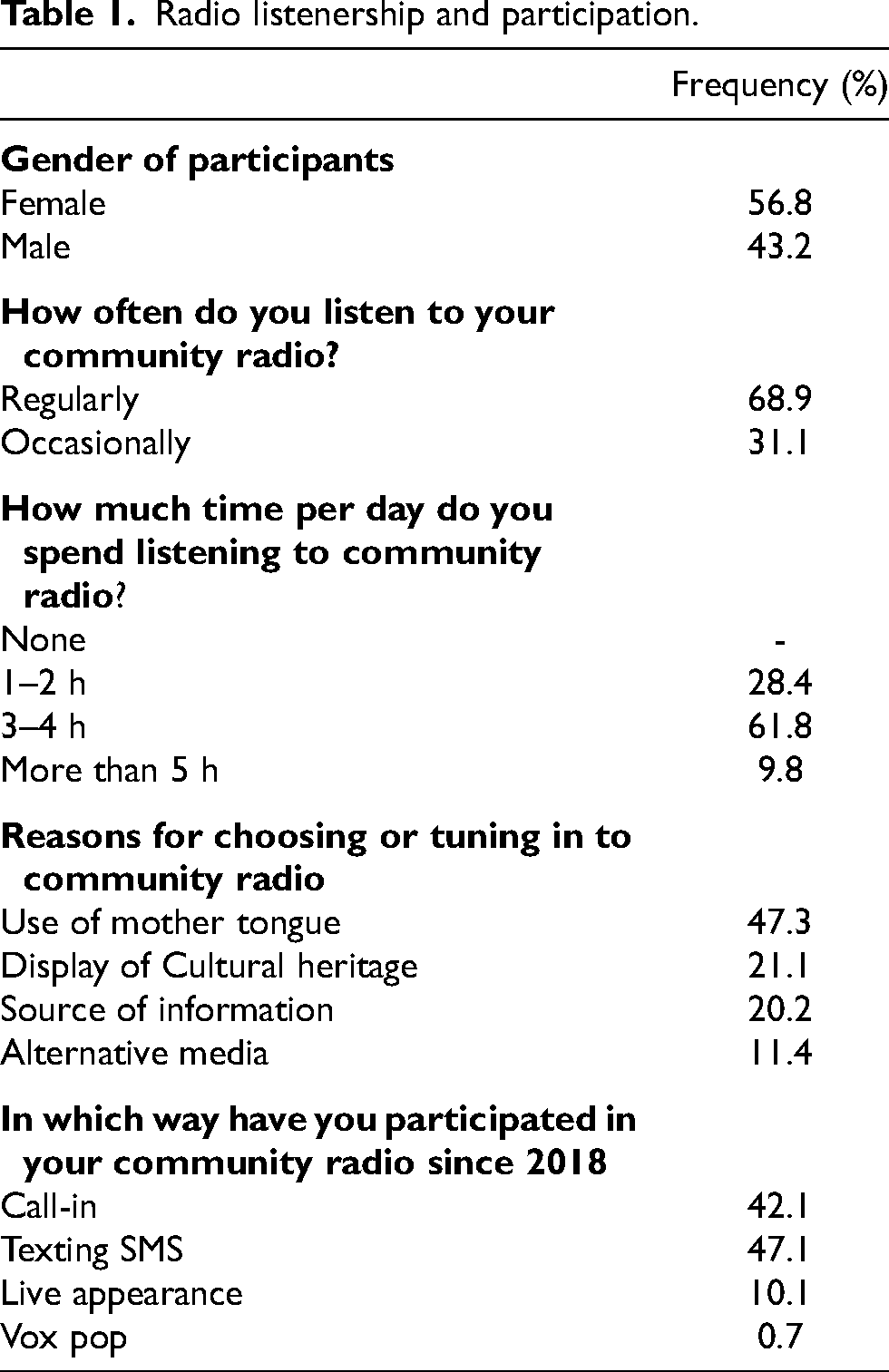
The interviews were transcribed and analysed inductively using closely linked themes as suggested by Braun and Clark (2006:83). Themes were identified at the “latent level” (Boyatzis, 1998) and directly related to the data themselves. The analysis was data-driven and went beyond describing the semantic content of the data to examine and interpret underlying thoughts. The analysis revolves around the following themes: cultural heritage, use of mother tongue; information source; alternative media. Table 1 describes some of the quantitative contextual data.
Radio listenership and participation.
Results
Frequency and intensity of community radio use
Responses from those interviewed indicate that community radio serves various purposes. The majority of participants interviewed (68.9%) stated that they listen to community radio regularly. When asked to say how much time they spend daily listening to community radio, the majority (61.8%) stated that they spend an average of 3–4 h a day listening to the radio, mainly in the morning and evening. This finding is comparable to a previous study that found average listenership duration to community radio to hover around three to four hours daily (BRC, 2018). As indicated by participants in the quotes below, the listening pattern appears to follow the daily routine of listeners. Most of the listeners are unskilled workers and low-level civil servants who have to leave early in the morning for work and return home in the evening: I listen to the radio in the morning from about 6 am to 7 am and around about 5 pm to 7 pm. After that, I have to watch my favourite Soapies on television. So let just say in all, I spend about 3 to 4 hours a day (Middle-aged man, Kopano).
I listen to the radio while preparing for work and on my way to and from work. I get home about half-past 5, and once I am home, the radio is off until morning (Young woman, Taung)
Reported reasons for choosing or tuning in to community radio
The overwhelming majority of the participants said the local language was the primary reason they preferred listening to community radio. Community radio serves as a significant source of information, providing a forum for a vicarious experience of cultural heritage and identity. It also offers an outlet for rural communities excluded from the mainstream media and public sphere to contribute to important issues and deconstruct the single narratives about themselves and their situations frequently circulated in mainstream media. Participants adduced four primary reasons for preferring or tuning in to community radio - the use of mother tongue, display of cultural heritage, information source, and access to voice.
Use of mother tongue
The preponderance of participants (47.3%) mentioned the community radio's use of their mother tongues as the main reason for choosing community radio. From the thread of interviews, broadcasting in the local language was an essential attraction for listeners across the community radio stations. The majority of participants stated that the delivery of news and talk shows in the local languages enhances the understanding of information makes it easy for them to contribute to the discussions on the radio stations:
Setswana is our mother tongue. That is what we speak in our townships and villages. That is why I listen to Mafikeng FM; they promote our language and culture. The more we speak our language, the more we can preserve it, and I thank the government for ensuring that radio stations use local languages (Elderly man, Ratlou). I can speak English and Afrikaans, but I prefer the news and talk shows in Tswana, my major attraction. I love the way Vaaltar Community radio presenters read the news (Young woman, Ikageng).
In BOPHIRIMA FM, they break the news down in a way you can easily understand. I love the banter between the presenters. I like it that we can express ourselves in our local language. Our people can join a discussion on the radio because we can speak in our language (Older woman, Taung).
The findings suggest that language plays a decisive role in rural listeners’ preference for community radio in South Africa. Rural listeners’ love for community radio stems from its ability to speak the grassroots language. Most participants stated that they prefer the news and information in their mother tongues. This is because many rural listeners are not fluent in the languages used in mainstream media. Therefore, community radio use of local languages in their programming helps bridge the language barrier and facilitate 'information access and use' (Fombad and Jiyane, 2019).
Participants see community radio as a culture curator and promoter by promoting local culture and talents. Many of those interviewed agreed that the use of local language help in preserving the indigenous languages and culture. There is a sense among participants that indigenous languages and cultural heritage are endangered. “Many of our children are not speaking our mother tongues, so it is important that community radio sustains the use of local languages,” said one participant. This sentiment was dominant among participants. This finding is consistent with previous research (Kalin and Peterson, 2000), which shows that indigenous language media plays an active role in language conservation.
Many participants acknowledged that community radio functions as a voice, a medium for those in the margins of society to express themselves and make their voices heard. One participant noted that access to voice was an important reason for the increasing preference for community radio in rural communities. “I love community radio because it provides unrestricted access to ordinary people to voice their concerns and tell their own stories in a language they understand” (Young man, Ratlou Taung). Other participants expressed similar sentiments across the sampled communities: I struggle with English, and I do not speak Afrikaans, but I am comfortable speaking Setswana. So, if it were only in those two languages, I would not call in. If I did, I might not express my views, as I will in my language (Middle age woman: Ikageng).
I speak good English and understand Afrikaans, but I will not participate in any public discussion on those colonial languages. That is why I listen and join Mafikeng Community Radio because they discuss issues in my language (Elderly man, Ratlou).
It is easier to discuss in our language. Sometimes we lack the word to express ourselves fully in English. Still, in Tswana, you can easily say what you mean. The person listening understands your words and body language because we Africans, our body language says a lot (Young woman, Taung).
Display of cultural heritage
Listening to traditional music and cultural programmes emerged as the two most essential functions of community radio for those interviewed. Many interviewed acknowledged that traditional music played on their community radio stations was a significant attraction. The participants also identified the promotion of indigenous culture and local artists as another factor that endeared their community radio stations. This is consistent with literature that shows that community radio popularity is associated with promoting local talents and culture (Kalin and Peterson, 2000; Meadows et al., 2005; Onyenankeya et al., 2020). The findings indicate that audience members use community radio to negotiate and assert cultural heritage or belonging. The majority of the participants stated that they experience nostalgia listening to traditional music on community radio - “It takes me back to my roots,” said one participant. In other words, listening to traditional music creates a sense of longing, a reawakening or connection to their cultural identity: One of the reasons I listen to Bokone-Bophirima FM is that they play our traditional music. Yes, they promote our culture. Anyone who supports my culture is one with me (Young man, Kopano).
Mafikeng FM always talks about our culture and promotes our local artists and traditional music, so to me, it is not just a radio station. I see it as a station for Tswanas. Sometimes when I listen to some discussions on the station, it feels like the typical traditional setting where people gather in front of their compounds to discuss some happenings around the community (Middle age woman: Kopano).
Many South Africans live in townships and housing settlements far removed from their homelands. Many were uprooted from their ancestral land during the apartheid era and settled in far-flung townships and other homelands with diverse cultural heritage. Therefore, listening to traditional music or engaging in social discourses in community radio provides a veritable platform to evoke a sort of "distant community" where the audience reconnects and experiences a kind of mediated co-presence (Siapera and Veikou, 2013). The attachment to ethnic music and indigenous language suggests that listeners are focused on negotiating their ethnic or cultural identity rather than national identity. This finding aligns with Ennaji’s (2005: 21) description of cultural identity as “the identity or feeling of belonging to a group …It is part of a person's self-conception and self-perception and is related to nationality, ethnicity, religion, social class, generation, locality or any social group that has its own distinct culture”.
Tuning in and listening to traditional music on community radio represent a crucial part of identity negotiation for the audience. Ting-Toomey (1999: 40) holds that identity negotiation is “a transactional interaction process, in which individuals attempt to evoke, assert, define, modify, challenge and support their own and others’ desired self-images." The finding concerning community radio's ability to enable cultural identity negotiation is consistent with a previous study (Bosch, 2014; Onyenankeya and Salawu, 2019b), which identified radio as an essential tool for the construction and negotiation of identity in South Africa.
Community radio as an information source
Coyer (2014) identifies an essential function of community radio as informing the community about a community problem. More than 20% of the participants stated that they choose community radio because it gives them access to information. Many of the participants interviewed say they got to know about events in their environment, such as murder, rape cases, and strikes, through their community radio. For many, the discussions of these societal issues on the community radio not only enrich their understandings but also help them to take actions to protect themselves and their family: I listen to Vaaltar FM to know what is happening in our community. They invite some people to talk about crime, unemployment, and diseases killing our people. So, we learn how to help ourselves (Middle age man, Kopano).
Mafikeng FM helps me know what is happening in our neighbourhood and country. It is the only place we can hear the news in our local language, Setswana. It also provides us with information on improving our conditions (Older woman, Ikageng).
I like Modiri FM because it provides us with regular information about what is going on in the country, especially in our municipality and neighbourhood (Middle age woman, Ratlou).
The finding is similar to past research that shows community radio as an effective communication tool for educating and disseminating information to poor and uneducated people in rural communities (Fombad and Jiyane, 2019; Onyenankeya and Salawu, 2018; Sharma, 2012).
Community radio as alternative media
About one-third of those interviewed stated that community radio serves as a medium to get their views “out there.” Those who held this view agreed that the voices of the rural poor do not reflect adequately in the national discourse. Many felt mainstream media tended to project one-sided opinions, usually of those in government and those considered knowledgeable in society. In general, participants saw community radio as a means of constructing their own reality or alternative narratives as opposed to the popular dicta peddled in commodified media outlets, which they believe, are accountable to the dominant economic group: Let us be honest without community radio; the big radio stations may never air people's views like us. In Vaaltar FM, people from the community are the ones who discuss our issues, not the so-called experts who do not live here and know nothing about our suffering (Young man, Ratlou).
If you listen to the city stations, even SABC stations, you hear mainly the voice of politicians, the so-called experts. They speak big words and confuse us with figures. They do not talk to us who suffer these crimes. They talk about unemployment, and they again use the city dwellers as if we do not exist So here in Modiri FM, our community members are interviewed, and we get the chance to speak and tell our own stories (Older man, Taung).
You often hear these privileged people enjoying their fathers’ wealth made by exploiting our resources, and people say we have an entitlement mentality. We are lazy. We are lazy. Black people are corrupt, and all such typical white people opinions of black people. So through the community radio station, we say no, we are not lazy. We want to work, farm. Give us the land (Middle-aged woman, Ikageng).
Ackah (2016) observes that the image of the Blackman in public sphere discourses continues to be defined by white gaze or ethnocentrism. Like in many African countries, the mainstream media in South Africa is yet to exorcise itself entirely from the hegemonic apartheid frame of references in the coverage of black South Africans. The predominant images of the black population in mainstream media remain those of poverty, crime, and violence. Community radio, as alternative media, offers the marginalised, misrepresented, and under-represented in the media and public sphere the platform to voice their ideas and construct "non-conformist and counterhegemonic representations” (Bailey et al., 2008: 7). Alternative media has the potential to build a counterhegemonic reality that completely contradicts mainstream media conventions and representations of reality (Patil, 2018: 8). This is possible because community radio uses indigenous language, which the people can communicate comfortably.
More than two-thirds of those interviewed admit that community radio offers the outlet to contribute to issues affecting their community and the nation at large in their mother tongue. Those who hold this view insist that access to a voice in mainstream media for rural communities is minimal because of poor second language mastery. For ordinary black South Africans emerging from a racially segregated media landscape (Fourie, 2015: 181), community radio represents a new era of inclusive access to the media – an opportunity to put across their views on many issues affecting their lives on the national stage. While community radio transmitters may be accessible to a few, they have allowed many remote African communities to voice their concerns, according to Madamombe (2005). This sentiment resonates with many of the respondents: I find Mafikeng Community radio exciting because they interview local people about local issues, not that someone will be in Pretoria or Gauteng (Johannesburg) and be speaking on behalf of the community. When they want to seek the people's opinion on some issues in those city stations, they always talk to the politicians and learned people. They do not come to us, and these people do not know what ordinary citizens go through (Middle age man, Kopano).
I like the fact that we can express ourselves in the media. During apartheid, you never get to hear the voice of a black man, but now on Vaaltar FM, our people can criticise government action or demand for things to be done right in education, health, or even waste collection (Older woman, Ratlou).
I regularly text my concern on issues affecting my communities. Almost all the comments have been aired. That can never happen in those big stations where most listeners have become mere consumers. So yea, Modiri FM is an important alternative channel for us to be heard (Young man, Taung).
Unlike in mainstream media, where the voices and ideas of the dominant group predominate public discourse, community radio attempts to provide access to voice for those in the margin of society, especially the previously disadvantaged. Ordinarily, these people would not have the opportunity to shape issues that affect their lives because of their location on the social ladder. This finding is consistent with past research, which has shown that community radio allows marginalised communities to partake in public discourses (Baker, 2007; Barlow, 1988; Sussman and Estes, 2005).
Participation in community radio
Although community radio can empower listeners, the findings showed that audience participation in community radio is limited. When it comes to participating in the production of talk programmes, for instance, more than three-quarters of those interviewed admitted they have never participated directly in content production or administration of community radio stations. Only two participants in Taung stated that they have participated in community radio operations. One of the participants, an older man, said he participated in the community AGM that elected the Board of Vaaltar FM. Another of the participants, a middle-aged female schoolteacher, stated that she was once involved in producing a talk programme on Vaaltar FM.
A participant in Ratlou indicated that many local community members are engaged in Modiri Community radio. "I know all the presenters and people who run the station. Most of them are from Ratlou and Tswaing," she said. This vitiates the argument of Guo (2012), which suggests that community radio credibility is enhanced when community members participate more in the production. When asked if they have participated in any talk programmes by either calling in or sending texts, most respondents stated that they have sent in texts or called in during a talk show. Only a few participants appeared live on community radio talk programmes, while participation through vox pop was insignificant. One-third of the participants attributed the programme schedule, congestion, and lack of talk time to their inability to participate in talk shows. I attempted to call in during a programme at Modiri FM, but I could not get through. I guess there were so many people trying to reach the station at the same time. I sent a text, but they did not read it out on air. Maybe they should have more lines to reach them (Young man, Kopano).
Eish, I had loved to call in, but one hardly has talk time, and the toll-free numbers are always busy (Middle age woman, Taung)
Discussion
As can be deduced from those interviewed, there appears a strong link between the use of indigenous language and audience preference for community radio. Because community radio content is in a language and culture congruent with the population or listeners, it is easy to arouse or invoke a sense of cultural affinity. As the results of this study show, there is a sense among listeners that community radio leans towards their cultural identity. As has been argued, cultural affinity contributes significantly to individuals’ decision-making process, especially in their preferences and behaviours (Howe et al., 1990; Swift, 1999; Tollgerdt-Andersson, 1993).
The use of local language emerged as the underpinning attraction – the primary reason listeners prefer community radio. The indigenous language evokes a feeling of cultural closeness. The finding of this study is consistent with previous research that identifies community radio as a symbolic or virtual community, where local language provides listeners with the social and linguistic resources to relive, bond, and ventilate their cultural identity and heritage, including normative beliefs (Onyenankeya and Salawu, 2019b:45).
As a critical identity identifier, language enables individuals to experience a way of life that connects them to a specific culture. The preponderance of interviewees maintains that indigenous language or mother tongue is crucial in constructing and negotiating cultural identity. Some scholars hold that the relationship between language and identity is mutually constitutive. For instance, Pavlenko and Blackledge (2004: 14) posit that language, or rather discourses embedded within it, provides the words and other symbolic means to construct and negotiate identities. Even when identity manifests in physical attributes or behaviour it is conveyed and construed through language (Hughes, 2007: 712). Therefore, language creates environments and defines cultures (Talley, 2014: 18).
Heidegger (2008) holds that language is the essence of man – in it, he can articulate his self-worth, make sense of his environment and let others into his inner world (Heidegger, 2008). This becomes even more poignant for South Africa, where dialectics over colonial and indigenous language is expected. Before the advent of democracy, English and Afrikaans were the dominant language for pedagogy, official transactions, and mainstream media in South Africa. This tended to circumscribe access to the media, especially for marginalised communities not fluent in the dominant languages.
Although community radio gives access to voice, this voice can only be expressed optimally in a medium that the community is familiar with and capable of using competently in communication. This is more so as radio is primarily conversational. Therefore, to participate in this conversation, one must have linguistic competence.
As the results indicate, indigenous language influenced audience participation in the community radio programmes, particularly talk shows. The majority of those who called in during live shows said their local language was instrumental to their participation. Those who hold this view insist the local language enabled them to be more reflective and expressive, thus engaging in constructive dialogue and mutual understanding.
Language is central in constructing meaningful dialogue, which community radio can facilitate. Banathy and Jenlink (2005: 4) describe dialogue as social discourse consummated through culturally and historically specific language. Language enables individuals to be reflective and engenders communicative action (Habermas, 1986).
When people communicate in their mother tongue, they can express their thoughts. This is because they know the language and possess the communicative competence for expressiveness. According to Fromkin et al. (2018), “when you know a language, you can speak and be understood by others who also know the language.”
Local language can give rural listeners and local groups the linguistic competence to participate in national discourse and publicly express themselves. Hughes (2007: 712) holds that the social discourses that occur at the macro-level in society and media help shape the reading of texts. This speaks to the ability of language to engender communicative action and mutual understanding (Fraser, 2014; Fromkin et al., 2018; Habermas, 1986).
Evidence from this study is consistent with the theory of cultural affinity, particularly taste-based theory, which asserts that people have a natural taste for something or someone from the same group or race. The audience prefers or leans towards community radio because people of the same cultural background produce the content or product. They see it as belonging to them.
The result shows that the perceived cultural connectedness significantly influenced participants’ acceptance of the sampled community radio stations. The development aligns with previous studies such as Baumhofer et al. (2021) and Swift (1999), suggesting that cultural affinity contributes significantly to individuals’ decision-making. The use of indigenous language further strengthens the relationship to community radio. Humans are social beings and desire to relate (Fiske, 2018). While the family, friends, or the significant other can provide this social connection, it appeared participants find community radio a veritable platform to connect. Here, community radio serves an imagined community (Fiske, 2004; McFarland et al., 2012), where listeners construct imagined identities. According to Bosch (2014), discourses that emanate from native language radio provide a “textured soundscape,” a sort of “symbolic homeland” (Strelitz 2002), where individuals can connect, construct and assert their self-identities. In other words, community radio represents a remote community where listeners can reconnect and experience a kind of mediated co-presence (Siapera and Veikou, 2013). The finding of this study suggests that community radio enables individuals to invoke a feeling of cultural affinity and social connectedness.
This work has shown that for underserved, under-represented, and often- misrepresented populations, who feel excluded from socioeconomic opportunities in the country, the question of belonging would be more poignant, especially as traditional media pays scant attention to issues that impact their lives. Mesquita et al., (2016) describe being connected as an emotional process supported by psychological and social factors such as culture. Community radio uses language, an essential cultural identifier, to connect with the audience. The indigenous language equips the audience with the social and linguistic resources to ventilate their opinions on national issues and evoke and express their ethnic identity, especially their cultural heritage (Onyenankeya and Salawu, 2019a). The results indicate that language is strongly associated with participants’ preference for and participation in community radio. As most participants adduced, language enables them to make sense of their environment and participate meaningfully in social discourse. This is consistent with previous studies that identified language as enabling communicative action (Banathy and Jenlink, 2005; Fraser, 2014; Fromkin et al., 2018; Hughes, 2007).
Conclusions
In this article, the overarching goal was to investigate the role of indigenous language in audience acceptance of and participation in community radio. The findings suggest that underserved rural groups, especially those linguistically isolated, seek relevant, culturally and linguistically appropriate information to live and thrive in South African society. This is because mainstream media pays scant attention to issues directly affecting local communities. The findings showed that community radio is widely accepted in rural communities, and language was the underlying reason for rural audience preference and participation in community radio. Language affords listeners cultural closeness - a feeling of being connected.
Community radio use of mother tongues in their programming encourages marginalised communities’ participation and support, creating a sense of belonging and ownership. The use of local language provides the listeners with the social and linguistic resources to participate in discourses and generate alternative frames of references and representations to counter-hegemonic images of themselves and others in the mainstream media and public sphere. The findings highlight the critical role of indigenous language in promoting active audience participation in community radio in rural settings. Simultaneously, community radio outlets can fulfil the crucial role of informing, educating, and engaging rural communities about critical issues that affect their lives.
While community radio offers rural residents a veritable platform to participate in the socio-political, economic, and cultural discourses regarding their local community and the larger society, it also affords them space to validate their self-esteem and deconstruct images and identities prescribed in hegemonic narratives. The audience can engage meaningfully on community radio because the medium of expression is the mother tongue, providing social and linguistic resources to articulate their essence. As noted earlier, language, or discourses within them, supply the terms and other linguistic means individuals and groups use to construct and negotiate identities. In other words, identity is mediated and interpreted through language.
The findings suggest that community radio is committed to providing relevant and culturally appropriate information and easing communication barriers for those who might be linguistically isolated. They appear more trusted because they can often capture the subtleties and nuances that mainstream media or general-purpose government communication campaigns cannot. This means that community radio occupies a unique position to assist local, regional and federal governments in improving outreach to underserved rural communities. With its interpersonal attributes, language, motif, and symbols that reflect a specific cultural group's lived experiences and perspectives, community radio can be an effective platform to negotiate attitudinal and behavioural changes around the issue of public interest The findings suggest that community radio can be a potent medium for information access, identity, cultural mediation, and connectedness. While community radio can facilitate grassroots participation, this participation is constrained by congestions or lack of talk time. Community radio can mitigate these limitations by providing more toll-free numbers and taking the radio to the people through the instrumentality of vox-pop.
Footnotes
Declaration of conflicting interests
The author(s) declared no potential conflicts of interest with respect to the research, authorship, and/or publication of this article.
Funding
The Indigenous Language Media in Africa (ILMA), Research Entity, North-West University, South Africa, supported this article, authorship, and publication.
