







Abstract
Models of information behaviour are one of the prominent features of Library and Information Science research. The purpose of this study was to synthesise models of collaborative information behaviour (CIB). More specifically, the study compares the complementarity and congruent aspects of the models with regard to conceptual relationships that describe CIB processes and activities. The synthesis also ascertains the contributions of the models in exploring new aspects of information behaviour. Six CIB models were purposively selected and studied. The review includes a meta-ethnographic approach. The approach comprises three stages: reciprocal synthesis, reputational synthesis, and line-of-argument-synthesis. The results suggest that despite being analogous, and complementary, the models are dissimilar and relatively lack analogical conceptualization of some of the concepts. The models have explored new contexts and dimensions of information behaviour that go beyond existing approaches and perspectives within LIS. From the synthesis, the potential for developing a taxonomy of CIB and collaboration is proposed.
Introduction
Models of information behaviour (IB) are one of the major contributions to Library and Information Science (LIS) research and practices. As early as the 1960s, researchers in LIS (Feather, 1967; Rubenstein et al., 1967; Voigt, 1961) laid a foundation for modelling information behaviour (IB). Ever since, researchers, through empirical and conceptual research, have developed different IB models (Ellis, 1989; Kuhlthau, 1991; Wilson, 1997, 1999). These models project different dimensions, scopes, and contexts of IB. In terms of focus, the models incorporate different aspects. Some are specific with limited scope (Ellis, 1989; Evans and Chi, 2008; Kuhlthau, 1991; Leckie et al., 1996; Spink and Wilson, 1999) while others are generic (Niedźwiedzka, 2003; Wilson, 1997). The models can be further classified in terms of the processes including sequential models (Kuhlthau, 1991) and non-sequential (Foster, 2004; Tabak and Wilson, 2012). The former category describes IB as a series of linear processes while the latter portrays IB as a non-linear process.
IB models are the simplification of complex information behavioural processes, practices, and activities (Savolainen, 2016, 2019) mainly presented in graphical and textual forms. These models are rich in concepts and constructs. Considering their richness in concepts, models have substantially contributed to the theoretical and conceptual growth in the field of LIS, particularly in terms of integration and expansion of new knowledge. The functions of models are numerous, inter alia, explain different IB phenomena and processes, and predict behavioural patterns (Bates, 2010). The models are also used as frames of reference and methodological tools in research, particularly in hypotheses and theories development (Järvelin and Ingwersen, 2012).
Over the last two decades, there has been increased research attention on collaborative information behaviour (CIB) (Far, 2019; Ndumbaro, 2016; Ndumbaro and Mutula, 2019; Reddy and Jansen, 2008; Shah, 2008; Yue and He, 2009). One of the consequential contributions of this trend is the emergence of models of CIB such as Shah (2008), Reddy and Jansen (2008), and Yue and He (2009). The models offer both a critique of traditional thinking and an alternative perspective to the understanding of IB. Conventional wisdom among proponents of CIB models is that traditional models explicitly ignore the collaborative aspect of human IB. Precisely, IB is portrayed by traditional models of IB as a set of processes and activities in which an individual information user interacts with information systems or sources to satisfy information needs (Saleh, 2012). Such a reductionist view of traditional models of IB forms the basis for emerging models of CIB. The models of CIB have been developed to provide a different, not necessarily new, perspective on IB.
Solitary models of IB focus on different states, processes, and behaviours of individual information user (Karunakaran et al., 2013). With this end in view, it is apparent that solitary models of IB (see. Ellis, 1989; Kuhlthau, 1991; Niedźwiedzka, 2003; Wilson, 1981, 1997) contextualise IB within individual information needs as emanating from individual-based information tasks. On the contrary, CIB models conceptualise IB as highly dynamic and interactive process (Ndumbaro and Mutula, 2019). According to these models, CIB involves not only the process of finding information to satisfy group information needs but also complex and dynamic interactions among users and between users and information sources or information systems. Such interactions are exemplified in processes such as collaborative information seeking, collaborative information processing, information sharing and exchange (Karunakaran et al., 2013) as well as group information grounding and sensemaking. IIB and CIB models are also distinguished based on simplicity and complexity parameters respectively. Unlike solitary models of IB, CIB models describe IB as a highly interactive process resulting from complex information needs (Karunakaran et al., 2010), and characterised by complex multidirectional interactions and dynamic communications (Paul and Reddy, 2010).
Despite a quantum leap in CIB studies and an increased number of CIB models, there has been little effort to systematically synthesise and compare these models. We have limited knowledge of the extent to which the models are comparable and complement each other (Kim, 2013). Also, there is a need to analyse CIB models and understand their theoretical and conceptual contributions to information research and practices. Such conceptual inquiry aims to enrich cumulative knowledge and further our understanding of CIB models’ conceptual and theoretical contributions. This study, therefore, synthesise key information behavioural concepts and processes presented in the models. Two key research questions are addressed by this study. How comparable are models of CIB? What are the contributions of CIB models in developing new aspects of information behaviour?
Methods and procedures
This study was undertaken in consonance with the tenants of the meta-ethnographic approach. This is a qualitative approach in which results from different related research are synthesised to build robust and comprehensive knowledge (Amend and Secko, 2012; Ke and Cheng, 2015). Meta-synthesis contributes to the advancement of new knowledge and a deeper understanding of similarities and differences in key assumptions, concepts, and theoretical approaches (Urquhart, 2011). According to Urquhart (2011) rationale for employing meta-synthesis in LIS is based on the problem of social contextualization of knowledge, epistemological uncertainty, and the constitutive nature of theories. These attributes affect the interpretation of knowledge from different dimensions, contribute to a lack of consensus among researchers, and create differences in theoretical perspectives respectively (Urquhart, 2011). Putting this in context, CIB models have been developed from different social contexts, using different theoretical lenses and research methods. Consequently, the models suffer from “social contextualization” as the empirical and theoretical findings which form the foundation of the models lack horizontal relationships. The meta-ethnographic approach has been widely discussed and used in the LIS domain (Jordan, 2013; Urquhart, 2011; Xie et al., 2020).
This qualitative ethnographic meta-synthesis offers a robust all-inclusive exposition of results from individual CIB models developed from different domains and contexts. Initially, a comprehensive search process was conducted to identify and retrieve emerging models of CIB. Search queries were formulated and reformulated. Subsequent searches were conducted using six authoritative online databases. The databases are Ebschost, Academic Search, DeepDyve, Google Scholar, ResearchGate, and SpringerLink. The databases were purposively selected because they contain comprehensive scholarly works from which different studies from LIS are included. A total of 11 models were identified and retrieved. The retrieved models are Evans and Chi's (2008) model of understanding social search, Shen's (2010) model of information seeking, Allen's (1997) integrated person-in-situation behavioural model, Arif et al. (2012) CIR model and Hertzum and Hansen's (2019) tentative model of CIS factors. The other models are Reddy and Jansen's (2008) model of CIB, Shah's (2008) CIS behaviour model, Yue and He's (2009) model of CIS behaviour in e-discovery, Prekop (2002) model of CIS, Blake and Pratt's (2006a) Model of information synthesis and Karunakaran et al. (2013) Model of CIB. Six out of 11 models were deliberately selected and studied (See Table 1).
A sample of CIB models.
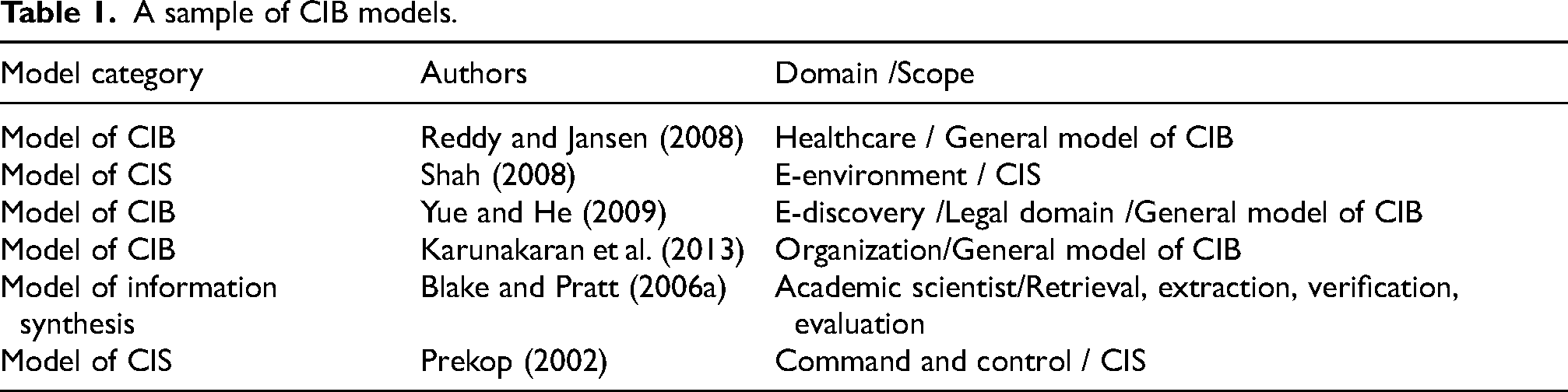
The selected models fit in well with the scope of the study. The intent was to analyse CIB models that focus on explicit collaboration where collaborators have shared goals in collaborating towards information behavioural practices. Four out of the five excluded models mainly focus on lower forms of collaboration which only entail shared focus rather than a shared goal. More specifically, Evans and Chi (2008), and Shen (2010) focus on social interactions during CIS. On the other hand, Arif et al. (2012) model focuses on searching and sharing information among tourists while Allen (1997) model focuses on personal and social factors influencing information needs. On the other hand, Hertzum and Hansen's (2019) tentative model of CIS factors was excluded because it is in its preliminary stage of development.
In terms of analysis, the three-stage meta-ethnographic approach comprises reciprocal synthesis, refutational synthesis, and line-of-argument-synthesis was used. The approach as proposed by Barnett-Page and Thomas (2009) was used to underpin the analysis of similar and conflicting aspects as well as the contributions of the models toward a new perspective in IB research and practices. Reciprocal synthesis identifies homogenous characteristics of the models while refutational synthesis explores models’ heterogeneity. The final stage of analysis involves a line-of-argument-synthesis. This stage develops higher-level knowledge of the contributions of the models in IB research and practices.
A Review of Models of Collaborative Information Behaviour
This review is by no means a comprehensive and extensive account of all aspects of CIB models. It only provides baseline information about the model from which a meta-analysis of the models can be done. Though the reviewed models focus on collaborative information behavioural processes in explicit collaboration contexts, they originated from different contexts and focus on different aspects.
Shah (2008) Model of Collaborative Information Seeking (CIS) Behaviour
Shah's (2008) CIS model depicts CIS behavioural processes and activities in an online setting. The model integrates four layers of information (content), collaborative tools (system), users, and, search results as core pillars of CIS. According to Shah (2008, 2010a), CIS is an intentional and interactive process in which individuals with shared information needs collaborate using traditional or collaborative tools to achieve personal and common information goals. Shah's (2008) model illustrates that CIS involves three stages: pre-negotiation, direction setting, and actual implementation. The stages are characterised by co-searching, Collaborative information retrieval (CIR), information organization, and use. Figure 1 illustrates CIS stages, processes, and activities as discussed in the model.
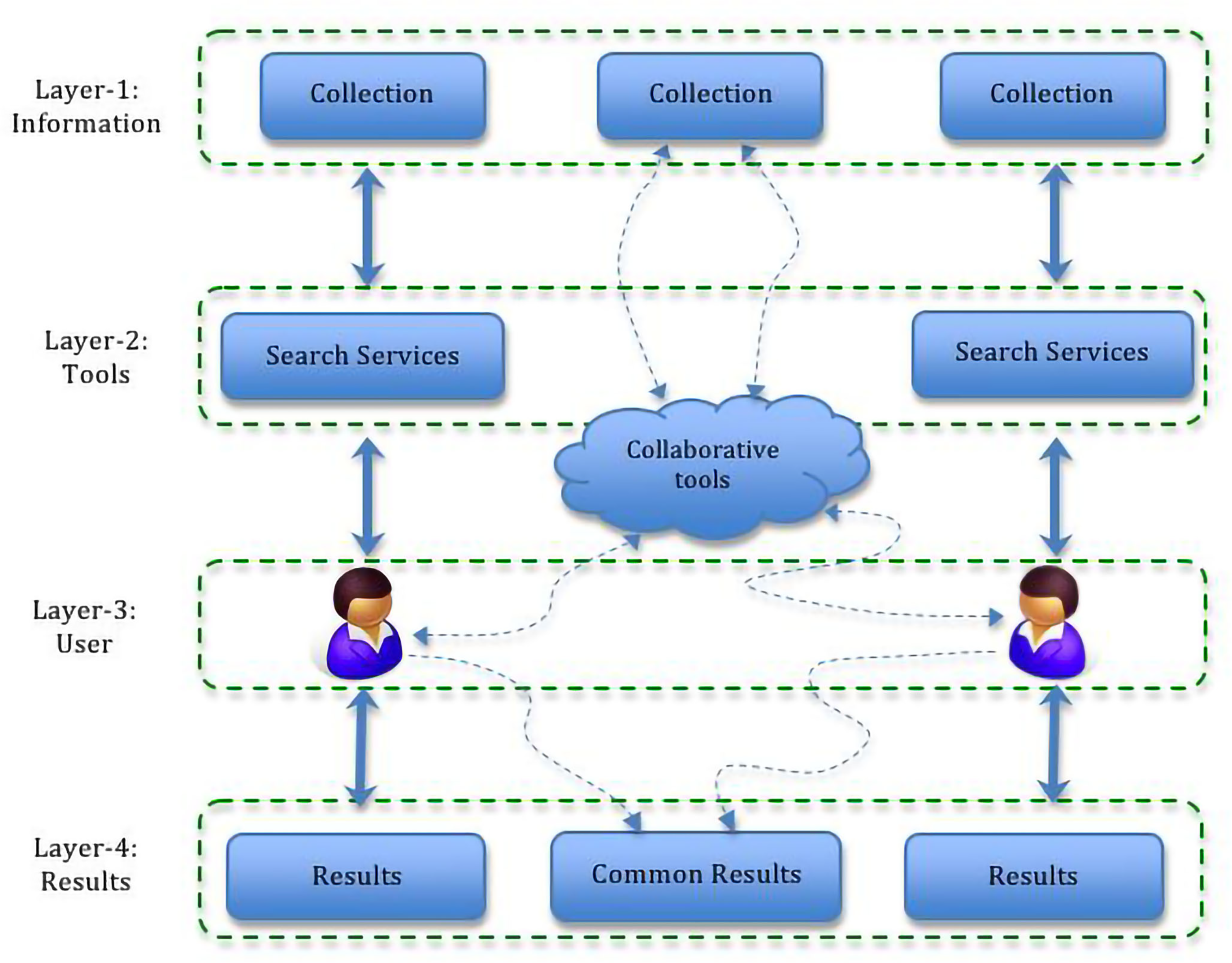
Shah's (2008) model of CIS (Source: Shah, 2008, 2010a).
The model stresses the reciprocal ties between information seeking behaviour and collaboration. Collaboration in CIS can be synchronous or asynchronous as well as, complementary or integrative. Shah's (2008) model of CIS is built on the foundation of the C5 model of collaboration that incorporates five levels of working together namely: communication, contribution, coordination, cooperation and collaboration (Shah, 2008). The alternation of these forms is largely attributed to temporal and spatial factors that are time and space, as well as task distribution and complexity factors. Shah's model depicts a typical CIS behaviour in an online environment where information searching and retrieval systems support CIS activities. One of the strengths of this model is that it has dual applications. It can be used to model CIS within information searching project and CIS from collaborative project (Shah, 2014). In terms of limitations, the model has limited scope and application. Besides CIS and precisely collaborative information searching, access and retrieval, the model cannot be used to describe other CIB processes such as collaborative information use and information processing, as well as collaborative grounding. The model can be used as the theoretical lens in human-computer interaction (HCI), collaborative information retrieval (CIR), CIS, and collaborative learning research. The model was further tested and expanded by Yue and He (2009) to include additional elements of user roles and division of labour.
Reddy and Jansen’s (2008) model of CIB
Reddy and Jansen (2008) present a non-linear model of CIB. This is a general model of CIB built from the medical domain's empirical inquiries. The model encapsulates the information environment as an all-encompassing concept through which CIB activities and processes take place. The information environment comprises behaviour, context of CIB, agents of the information, norms, and rules of interactions. Reddy and Jansen (2008) acknowledge that IB can either be individual or collaborative. The context comprises of phenomenon or situation which influences a shift of information behavioural processes and activities from individual to collaborative (Reddy and Jansen, 2008). A transition from individual information behaviour (IIB) to CIB is triggered by factors such as inaccessible and fragmented information, domain complexities, and complex information needs. IIB and CIB are differentiated by the level of complexity, the multiplicity of agents, and the degree of interactions (Ford, 2015). Figure 2 depicts the relationships among behaviour, context, and agents of the information within an information environment.
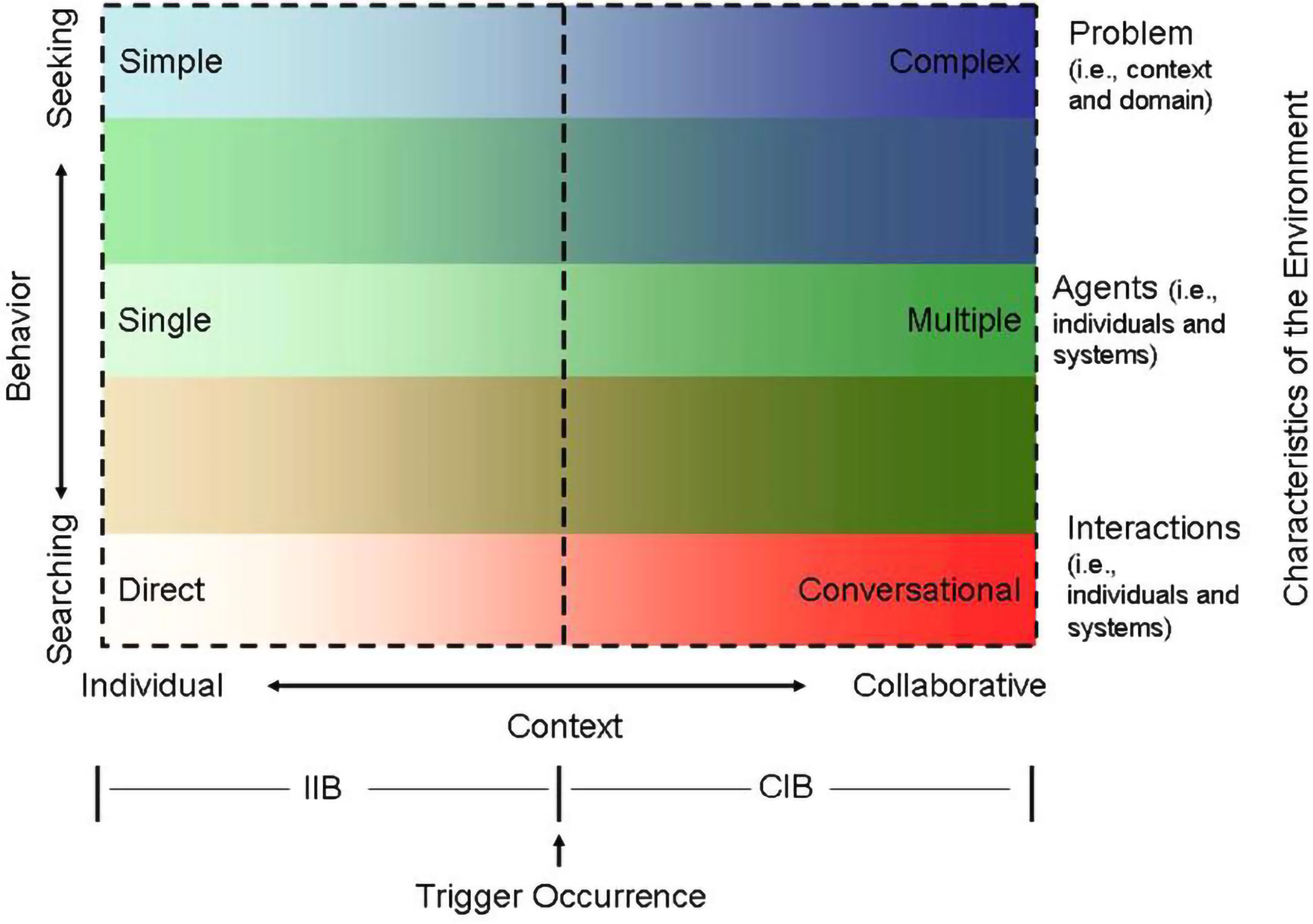
Reddy and Jansen's (2008) model of CIB. Source: Reddy and Jansen (2008).
With regard to the level of interactions, IIB and CIB are characterised by unidirectional or conversational interactions respectively. The model incorporates a spectrum of behavioural activities ranging from information searching to information seeking and use (Reddy and Jansen, 2008). Information seeking and information searching are treated as two distinct but closely related and hierarchical activities. The difference is that the former involves strategic maneuvering while the latter is tactical maneuvering includes (Ford, 2015). That is to say, information seeking involves the planning for obtaining information to meet an individual or group's information needs while information searching includes locating, interacting, and retrieving information to satisfy group or individual's information needs. The model also includes agents of information as a key component of CIB. The Agents are humans, information systems, and information sources. Despite originating from the medical domain, Reddy and Jansen's model of CIB is comprehensive as it includes a wide range of CIB aspects. Commenting on the comprehensiveness of the model, Reddy and Jansen (2008) hold that the model can be used in a wide range of environments as it is characterised by explanatory properties. Evidently, the model can be used to underpin studies on the factors that trigger individuals to engage in solitary and collaborative information behavioural activities.
Yue and He’s (2010) model of CIS behaviour in e-discovery
This is a domain-specific, multistage model of CIS behaviour that provides an analytical framework for studying CIB in civil litigations and investigations, commonly known as eDiscovery. The foundation of the model is on three aspects: collaboration types, collaboration levels and collaborative task complexity (Yue and He, 2009). The model conceptualizes CIS to include the exploration of collaborative tasks and information needs, information seeking, sharing, and use (Yue and He, 2009). According to this model, collaboration as one of the ingredients of CIS includes levels and types. In terms of types, CIS consists of integrative and complementary collaboration as well as synchronous and asynchronous collaboration (Yue and He, 2009). CIS is also characterised by communication, contribution, coordination, and cooperation as levels of collaboration. The levels of collaboration and intensity vary across each phase (Yue and He, 2009). Coordination and cooperation are more dominant at the exploration stage, while communication and contribution are dominant forms of collaboration during search processes. Yue and He's (2009) CIS model is illustrated in Figure 3.
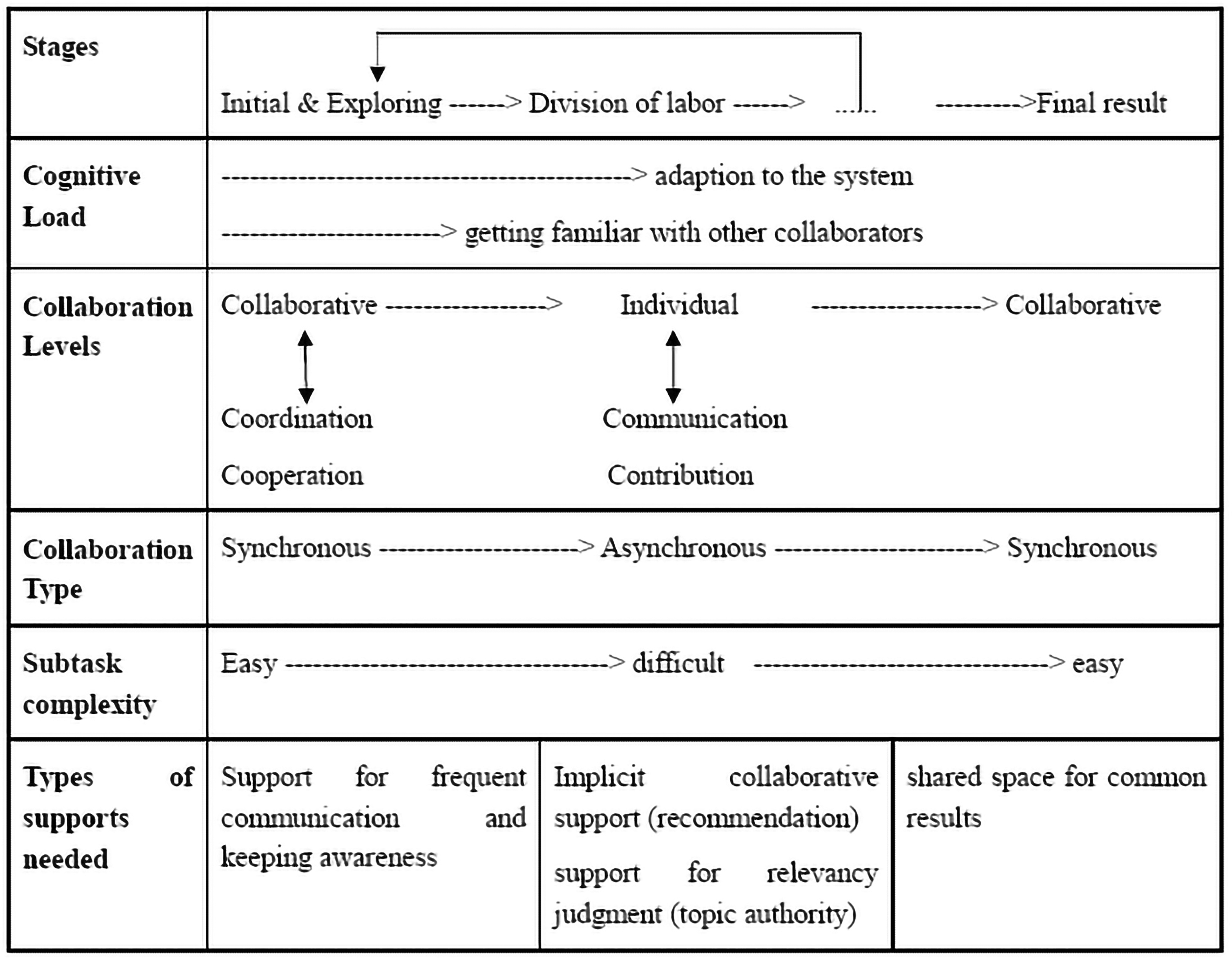
Yue And He (2010) CIS model.
The alternation between synchronous and asynchronous collaboration is associated with the need to create awareness and focus on one's own tasks. The model suggests a potential limitation on group working memory during CIS. Such limitation is described by Yue and He (2010) as “cognitive load.” This is a phenomenon in which efforts of group members to familiarize themselves with collaborative tools and pay attention to search history may contribute to the additional effort.
Karunakaran et al. (2013) model of CIB
This is a pseudo-linear, general model of CIB in an organisational context. Basically, the model is an extension of Reddy and Jansen's (2008) model of CIS (Ford, 2015). According to Karunakaran et al. (2010) CIB comprises micro and macro behavioural activities. On the micro level of CIB, CIS and collaborative information use are the dominant behavioural processes. In this model, CIS is depicted as a linear process that entails active or passive searching, retrieving, and sharing information. On the other hand, collaborative information use includes evaluation, synthesis, and actual use (Ford, 2015). Collaborative information use involves a physical, mental, and communicative act of incorporating information into the group's existing knowledge base in order to achieve a common goal (Karunakaran et al., 2013). The graphical presentation of the model is provided in Figure 4.
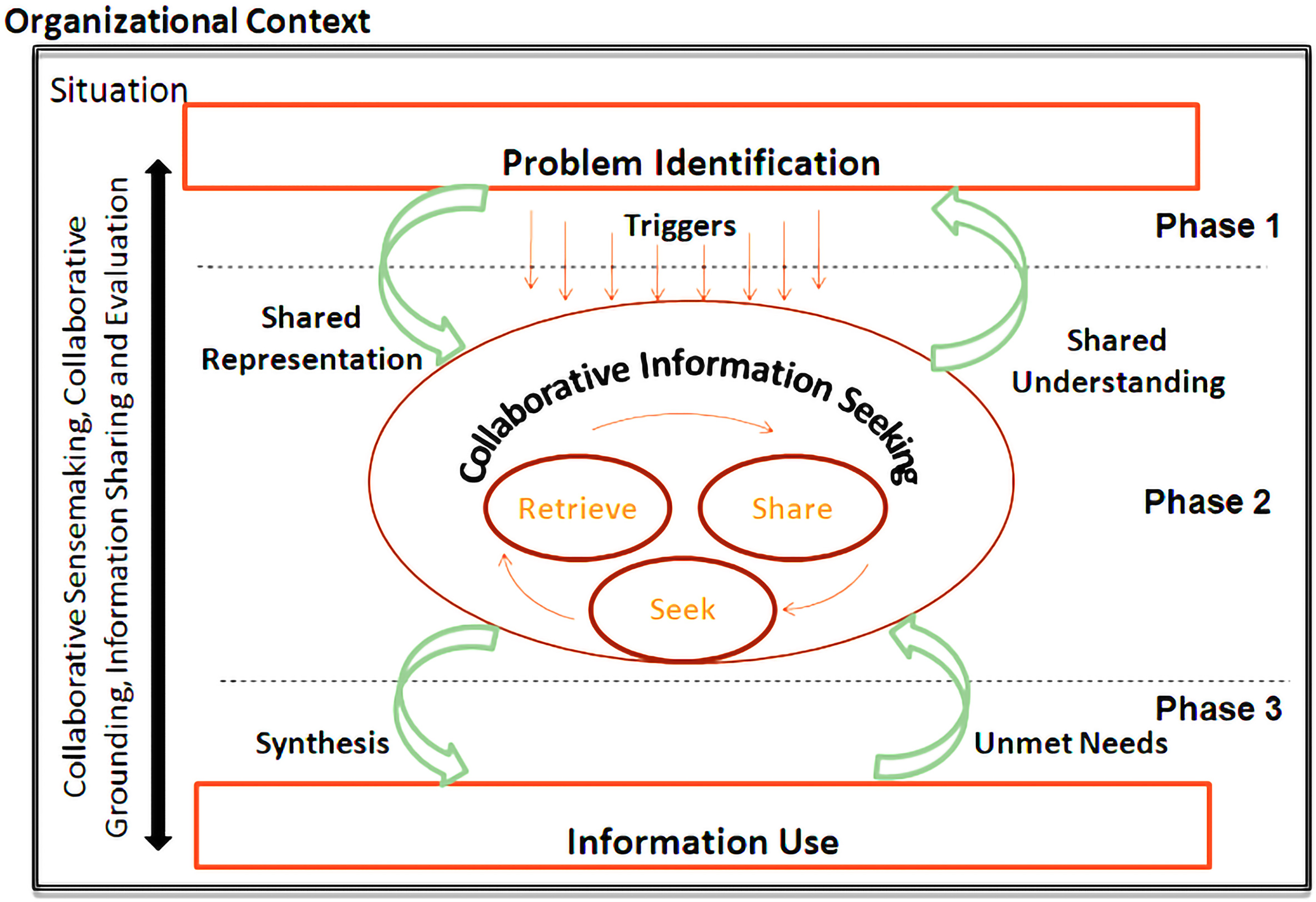
Karunakaran et al. (2013) model of CIB.
At the macro level, there are collaborative grounding, collaborative sense-making, information sharing, and collaborative evaluation (Karunakaran et al., 2013). One of the strengths of the model is that it has incorporated sensemaking at the collaborative level. Besides being internal cognitive and metacognitive processes, as well as the semantic mode and pragmatic sensemaking is inherently collaborative as it involves establishing an agreed meaning or common ground (Duffy, 2015). This is known as pragmatic sensemaking as opposed to semantic sensemaking which focuses on an individual's cognitive and metacognitive processes of thinking about what needs to be thought (Duffy, 2015). While other models of CIB incorporate different levels and types of collaboration, this model mainly focuses on the communication aspect of collaboration. Communication is regarded as an essential aspect of CIB that takes the form of individual conversation, verbal communication, and information sharing. It is undoubtedly that successful CIB requires more than effective communication. There must be effective equal contributions, coordination of efforts, and cooperation. This model has been criticised by Ford (2015) for ignoring the importance of intra-group social and psychological factors that influence CIB and its inability to model CIB of people in collaboration for quite a long period of time. Additionally, the fact that the model is embedded within an organization's work environment, and more precisely within hospitals’ work environment, the applications of the model to other contexts including, outside the information-intensive work environment is a subject of further scientific inquiry. This is also acknowledged by Karunakaran et al. (2013) who commented on the need to conduct further empirical studies in different settings.
Prekop’s (2002) model of CIS
Prekop (2002) is one of the early scholars to develop the CIS model. Drawing experience from the command and control (military) domain, CIS is described as activities, processes, and situations characterised by the context of information seeking processes, information seeking patterns, and distribution of information seeking roles among group members (Prekop, 2002). The term context has been used to include information-seeking roles, perspectives, gateway, and participants in the CIS. CIS contains multiple patterns including advertising information paths, information seeking by recommendation, and direct questioning. A relationship between the patterns of CIS and CIS roles is established and discussed. The model identifies seven distinctive roles in which individuals are assigned activities and responsibilities during CIS (See Figure 5).
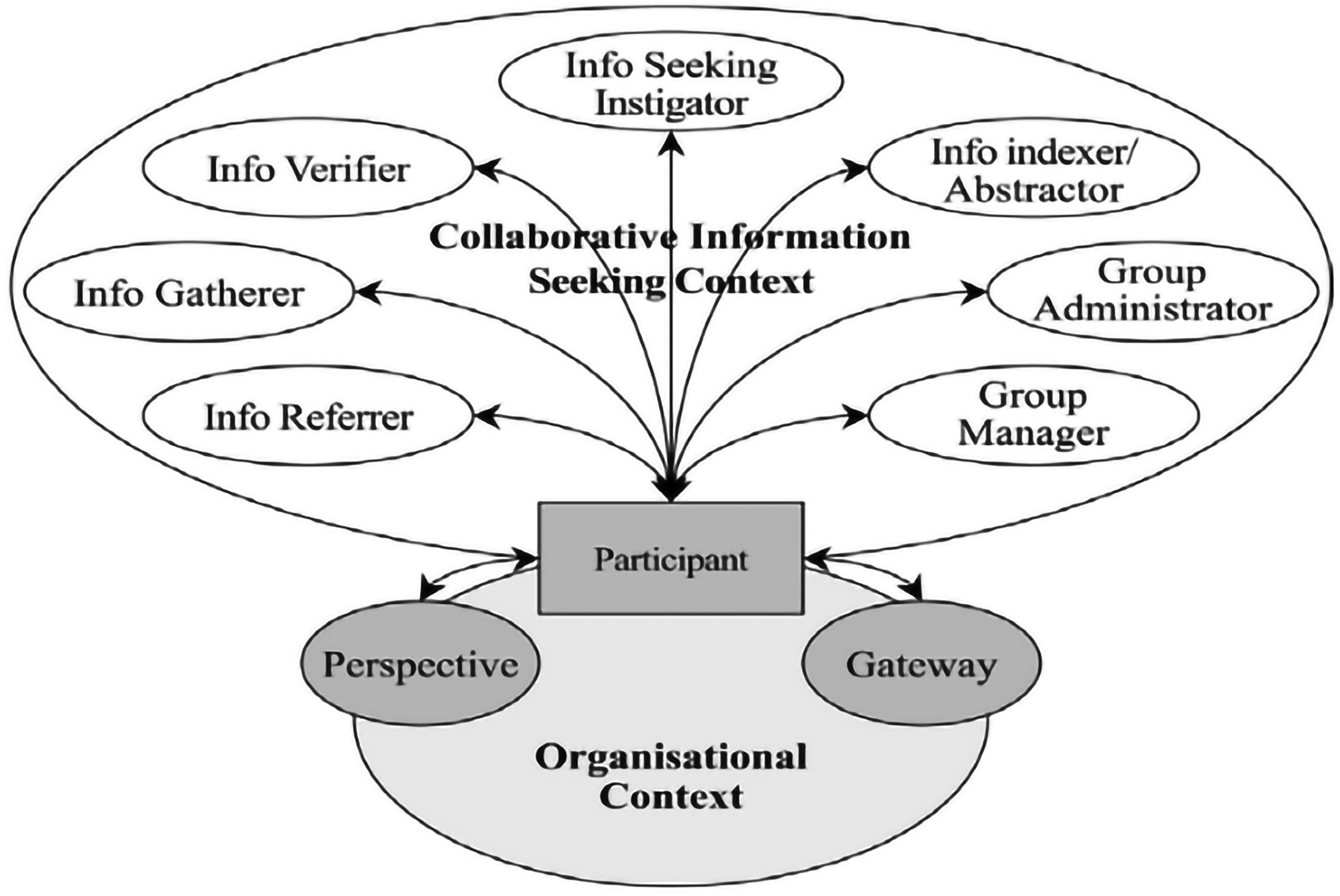
Prekop's (2002) model of CIS.
CIS is described as a form of normative behaviour in which participants’ interactions are guided by prescribed and implied rules and regulations. Such description of characteristics of CIS processes may not reflect CIS in a less dynamic and less formalised context. Evidently, the model portrays CIS as a highly specialized collaborative endeavour carried out in the command and control domain. Such a working environment requires a high level of coordination and communication. Interestingly, these two aspects of collaboration have not been explicitly discussed in the model. Notwithstanding these limitations, Prekop's (2002) model of CIS provides the best framework for studying the role of context and professional roles in shaping CIS behaviour within information-intensive and highly dynamic organizations. Prekop (2002) also commented on the practical implications of the model particularly in informing information systems design to support different CIS roles and interactions.
Blake and Pratt’s (2006a) Model of collaborative information synthesis
Blake and Pratt's (2006a) collaborative information synthesis model captures scientists’ information synthesis during information retrieval, extraction, verification, and analysis. Collaborative information synthesis involves assigning quality scores to the extracted and verified information. The model stipulates that collaborative information synthesis combines group members’ hypothesis projection construct and the context of information construct (Blake and Pratt, 2006b). The hypothesis projection includes group brainstorming, exploration of different options, and search terms construction. The context of information comprises a collection of facts from different sources.
Collaborative information synthesis entails information behavioural processes and iteration dimensions. The former includes search term formulation, modification, identification of appropriate search databases, and discussion of facts of extracted information. The latter is non-sequential in nature. Four critical tasks namely information retrieval, information extraction, information verification, and information analysis are essential aspects of information synthesis (Blake and Pratt, 2006a). Information retrieval task involves appropriate search strategy formulation, source identification, and domain experts’ consultations. The collaborative information synthesis processes are summarised in Figure 6.
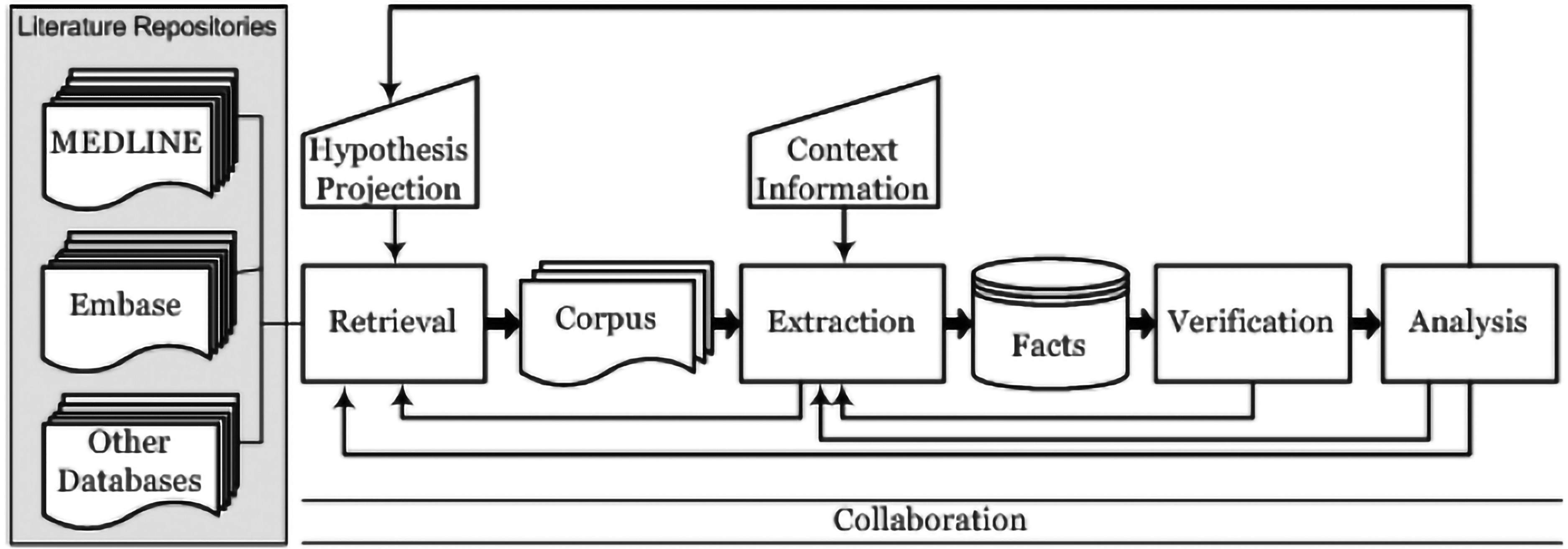
Blake and Pratt (2006a) model of information synthesis.
Collaborative information synthesis also includes the extraction of information provided by individuals in form of explicit or derived facts. During extraction, information is verified through comparison with original information sources (Blake and Pratt, 2006a). At this stage, communication and coordination are highly anticipated. Blake and Pratt's (2006a) model of information synthesis literally separates iteration from collaboration as two different processes while at the same time acknowledging that iteration involves collaboration. This model has been operationalized by Blake and Pratt (2006b) as the framework for information system development for supporting collaborative information synthesis activities.
Results
How comparable are CIB models?
A systematic analysis of models requires the use of a specific approach. The current analysis focuses on models’ congruent and contradictory aspects and their contributions to new dimensions of IB. The ontology pluralism distinguishes between concepts and constructs based on the level of abstraction. The former is at a lower level of abstraction while the latter is at a higher level. Regardless of their differences, concepts and constructs are the building blocks of CIB models. It follows, then, that, for the models to be categorical simplified representations of complex IB processes and activities they have to include concepts and constructs that are simple and coherent. This is not always the case, particularly when the usage of the concepts from different models is brought to scrutiny. Regardless of their alikeness, CIB models have also some differences. Because of the models’ epistemological differences, domains, social contextualization, and theoretical inclinations, in some instances, similar concepts have been conceptualized differently.
Within the context of this study, the models are in agreement that task complexity is one of the triggers that influence individuals to engage in CIB activities. However, it is evidently cognizant that there is less agreement on the dimensions and characteristics of task complexities. There are two major ways to describe the constituents of task complexities as exemplified by the models, though the two views seem to overlap across models. First, task complexity is viewed as an absolute objective phenomenon with attributes such as task requirements, task demands, and task components. This view is owed by Reddy and Jansen (2008) and Karunakarn et al. (2013). Karunakarn et al. (2013) assert that task complexity illuminates in the form of problem complexity which results in complex information needs. Other attributes of task complexity include a multiplicity of task procedures and task outcomes, task routines, and unusualness of information needs (Jansen and Reddy, 2008). Second, there is a subjective view of task complexity. The main idea underpinning this notion is that task complexity is a subjective reality perceived by collaborators, in this case, information users. Touching upon the issue of subjective task complexity and how it affects other components of CIB, one should take a cursory look at the relationship between perceived task complexity and triggers of CIB. In all, shared information need is related to a “wicked” problem characterised by the need for specialization (Blake and Pratt, 2006a; Shah, 2008), a lack of expertise (Karunakaran et al., 2010; Reddy and Jansen, 2008), fragmentation, and inaccessibility of information (Blake and Pratt, 2006a; Karunakaran et al., 2010; Reddy and Jansen, 2008). In view of this, the models portray subjective task complexity in the form of factors that motivate individuals to collaborate, perceptive ability to accomplish a task, and inadequate or inaccessible information.
The models are in congruence with the notion that shared information need is a precursor and a trigger for other CIB activities. Having shared information need motivates individuals to collaborate and diversify knowledge, experiences, skills, and perspectives during CIB endeavour. Though this analogical argument is shared across the models, there are also variations on how the concept is conceived and used. Karunakaran et al. (2013) see shared information need as “a gap” in one's knowledge base that has been transformed to the group level. Other models (Blake and Pratt, 2006a; Yue and He, 2010) demonstratively associate shared information needs with the initial stage of CIS and exploration (Yue and He, 2010) or the brainstorming and exploration stages during collaborative information synthesis (Blake and Pratt, 2006a).
A profusion of concepts has not only contributed to the vertical and horizontal expansion of concepts, but also a lack of clarity in some of the concepts. At the models’ detailed level, there is evidence suggesting a lack of universal conceptualization and usage of some of the concepts. Notwithstanding the fact that collaboration is embraced as one of the core pillars of CIB models along with information behaviour, the term is expounded as a concept of different recipes, including forms, levels, types, and usage. The plurality of collaboration is seen from perspectives such as levels of collaboration (Blake and Pratt, 2006a; Shah, 2008; Yue and He, 2010); patterns of communication, and interactions (Prekop, 2002; Reddy and Jansen, 2008). The other perspectives include types of collaboration based on synchronicity, explicitness, and levels of integration (Shah, 2008; Yue and He, 2010). Consequently, collaboration within the context of CIB occurs in a form of synchronous or asynchronous, explicit or implicit, and integrative or complementary respectively. While these variant concepts are definable, it remains clear that their usages within the models slightly overlap. Each model stresses particular aspects of collaboration. In some cases, the terms such as synchronous CIB (Karunakaran et al., 2013), asynchronous collaboration (Karunakaran et al., 2013; Yue and He, 2010), and synchronous communication have been used with no comparable definitions of the terms.
Though extensively used among the models, the term CIS lacks definable “DNA.” CIS is defined differently to include variant activities such as information retrieval, information searching, and information sharing (Karunakaran et al., 2010) or information access, information searching, retrieval, tagging and bookmarking, as well as organizing and use of information (Shah, 2008). According to Karunakaran et al. (2013) CIS includes searching, understanding, sharing, and using information while Prekop (2002) views CIS as information-seeking processes, patterns, and role distributions. CIS is also associated with other concepts such as social searching, co-searching, and co-browsing. Though CIS cannot be considered in isolation from other CIB processes, the inclusion of the processes such as information sharing and information use as attributes of CIS has made the term CIS more amorphous. More to the point, it is commonplace seeing information sharing assuming duo status as a micro and macro CIS and CIB activity respectively. This brings attention to the contestation of whether information sharing is a CIB activity characterized by strategic, directive, and social paradigmatic (Karunakaran et al., 2010; Prekop, 2002) or a means for creating awareness during CIB. While these conflicting views deserve a much lengthier discussion, however, one critical point warrants attention here. Whether seen at the micro level or macro level, information sharing practices cannot completely be equated to collaboration. Be that it may, information sharing activities may exist among individuals who do not have shared goals or even shared interests.
CIB models have brought to the spotlight five concepts of collaborative sensemaking (Karunakaran et al., 2010; Reddy and Jansen 2008), group awareness (Shah, 2008, shared representation, shared understanding (Karunakaran et al., 2010), and collaborative grounding (Reddy and Jansen, 2008). These concepts have their roots in different disciplines such as learning science, social psychology, and communication studies. Is evident at a glance one would expect to see either explicit hierarchical or non-hierarchical relationships among these concepts. The upshot is that the relationship among the concepts is rather not clear.
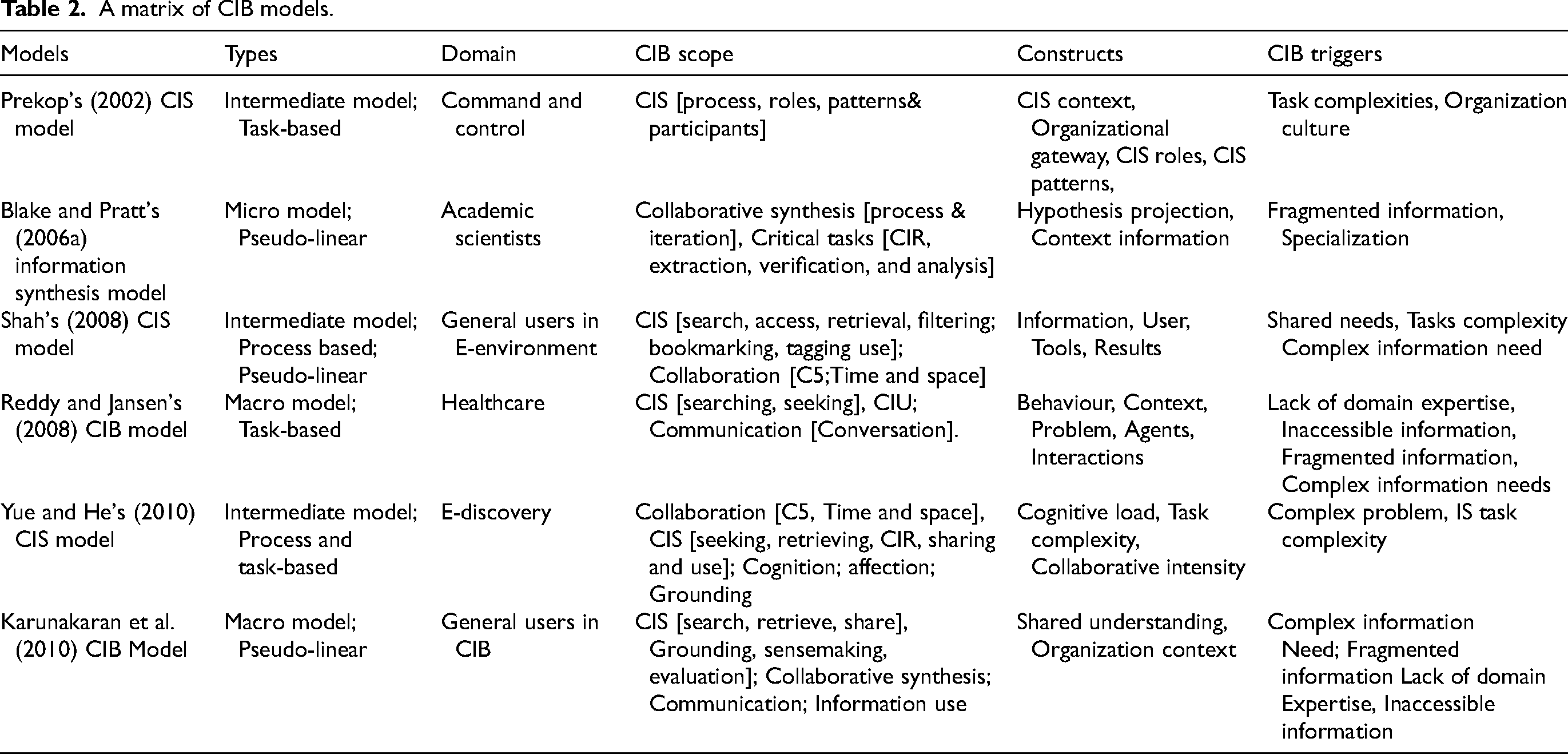
Karunakaran et al. (2013) have the opinion that collaborative grounding is the means through which shared understanding is constructed among group members. In the broader context, shared understanding is viewed as an outcome of collaborative grounding and shared representation. While it is acknowledged that shared representation stems from extrinsic processes such as conversation and communication, there is a somewhat lack of hierarchical relationship between sensemaking, shared representation, and collaborative grounding. Implicitly, the two models, Karunakaran et al. (2010) and Shah (2008) have included sensemaking trajectories and information filtering respectively as essential elements of collaborative sensemaking. Sensemaking trajectories are levels and motives for creating social awareness and activity awareness. Sensemaking involves sharing the outcomes of individuals’ cognitive processes of understanding different pieces of information. The key question remains how does individual sensemaking is transformed into collaborative sensemaking? (Table 2).
A matrix of CIB models.
What are the contributions of CIB models in developing new aspects of IB?
CIB models are expected to contribute to the conceptual and theoretical development of the LIS by developing new concepts and enhancing the clarity of the existing ones. This section deals with the contributions of CIB in developing new dimensions of IB. Before embarking on this, two issues need clarification right from the beginning. First, it is evident that collaboration in IB is not a new phenomenon. Implicitly, some elements of collaboration were incorporated in a few IIB models as well as research. Issues such as the roles of intermediaries during information seeking processes and interactions between information users and information providers were considered parts of IB (Maungwa and Fourie, 2020). Second, despite acknowledging the fact that people may help each other during IB activities, explicit collaboration was never regarded as an essential element of the IB pattern in the previous models and research.
In IIB research and models, a form of working together is limited to communication among agents in a form of giving, sharing, or exchanging information. On the contrary, CIB models have accentuated the fact that collaboration is an integral part of IB in which individuals interact in the process of sharing meaning, knowledge, and information resources to solve complex information-intensive problems. CIB models, extend our understanding of the role of collaboration in different information behavioural processes such as seeking, evaluating, sharing, and using information. The notion that information behaviour is inherently collaborative is openly embraced by these models though in different tones.
With a close look at the processes and activities included in CIB models, there is sensible evidence that the models have expanded the dimensions of IB research and practices. Models of CIB offer an alternative perspective that explores IB in new dimensions. It is clear that CIB models have first and foremost contributed to the cross-disciplinary pollination of ideas, concepts, and processes. This is partly a result of the amalgamation of constructs and concepts drawn from within and outside the LIS discipline. The models explored new aspects of IB in group dynamics such as reciprocal relationships, a high level of human interactions, and interdependence. Information behaviour has been redefined to include information-related activities that aim at taming complexities by bringing a diversity of experiences, skills, perspectives, and knowledge to address wicked information-related problems.
The models have enriched the meaning and scope of the contexts of IB. Depicted by these models is that collaborative information behavioural practices occur within multiple complex contexts. Four sets of contextual factors namely social factors, individual factors, group factors, and organizational factors largely influence CIB. Social context denotes a more dynamic, interactive, and complex setting in which information behavioural activities and processes take place. The context of IB is also enriched by individual, team, and organizational factors. Individual factors such as physical, social, and psychological characteristics; team factors such as location, permanence, members’ homogeneity or heterogeneity, and formality of interactions and organizational factors such as organization structure and culture, policies, processes, and procedures governing the organization form a network of complex contexts of CIB. In traditional models of IB, work task is among the contextual factors that shape individual IB. In CIB, task complexity is not only regarded as an aspect of context but also one of the triggers that initiate CIB activities. Attributes such as users’ division of tasks, the explicitness of collaboration, and synchronicity are essential elements of collaborative tasks. The models have established the association between collaborative levels such as cooperation, coordination, communication, and contribution with task stages, distribution of roles, and level of complexities.
In solitary models of IB, individual information users and information sources or systems are the units of analysis. It is indeed clear that CIB models have shifted the unit of analysis where human behaviour is analysed beyond the individual level to include group and organizational contexts. The new dimension conceives information behaviour as highly interactive, conversational, and unidirectional. The existence of other different levels of collaboration exemplifies this argument. Besides communication which facilitates awareness and shared understanding, CIB is also characterised by users’ contributions, cooperation, and coordinative efforts toward achieving a common goal. In reality, CIB involves an alternation between individual IB within a group and group IB.
Discussion
In this study, a comparison of CIB models has been conducted. A comparison is based on the models’ conceptual relationships and their contributions to IB research and practices. The synthesis has revealed some variabilities as well as similarities among the models. While there is less disagreement on what constitutes collaboration, different aspects of collaboration have been integrated into models. Though with different weights, the models embody collaboration with typologies, levels, and forms. It is commonplace for such differences as the models were developed from different social contexts and domains’ silos such as command and control, healthcare, academia, and legal litigations. The consequential effect of this is that even with general CIB models such as Reddy and Jansen (2008) and Karunakaran et al. (2010), the models focus on a particular dimension and typology of collaboration. None of the models incorporate all aspects of collaboration.
While there is evidence of conceptual preciseness, simplicity, and generality, there are also conceptual jigsaws and comparably a lack of “universality” in the usage of some CIB concepts. In light of the evidence, there are a lot of variations on some of the concepts that describe CIB activities and processes. These concepts include context, shared information need, CIS, shared representation, and collaborative grounding. The term context overlaps and intersects with a plethora of interrelated concepts. Previous studies have confirmed that the term context is one of the “hard-to-define” concepts in LIS (Courtright, 2007; Gaslikova, 1999). This is evident in CIB as well where the term has become more amorphous and elusive. Besides being defined differently, the term means anything that shapes CIB. The term has multiple uses to mean individual and collaborative IB dimensions (Reddy and Jansen, 2008), organization context (Karunakaran et al., 2010; Prekop, 2002), the temporal-spatial aspect of CIB (Shah, 2008), and formation environment (Reddy and Jansen, 2008). In their view, Reddy and Jansen (2008) associate the context of CIB models with the triggers that contribute to the transition from IIB to CIB.
The consensus that task complexity is both a characteristic of CIB and a trigger for individuals to collaborate in IB activities is noted. The models conceptualize tasks as a set of activities that involve mental and physical efforts to achieve predetermined results. It should be cognizant that even if all information work-related tasks are capable of being collaborative, not all work-related tasks require a collaborative effort. However, the models have some variations with regard to what constitutes task complexities. Task complexity is considered either a “perceived” or “real” phenomenon. The differences in how the models view task complexities are largely attributed to contextual differences from which the models originated. The fact that individuals in groups may have different perceptions of task complexity, may contribute to the subjective view of task complexity. Within the organizational context, collaboration is largely shaped by rules, norms, and formal structure. This makes individuals see task complexity as an objective phenomenon. One could see that objective task complexity is related to the existence of a shared understanding of task requirements, procedures, and expected outcomes.
In relation to task complexity, there is the concept of shared information needs. The results have shown that some models conceptualized shared information need as the group's knowledge deficiency refined by problem reformulation, and shared representation. The concept of shared information needs relates to the social construction paradigm and organization paradigm of information needs as proposed by Allen (1997). Within social construction information need, in this context, shared information need is shaped by context, situation, and roles (Ndumbaro, 2016). The organization paradigm of information need views group values, social structure, and norms as antecedents of information needs. This is largely related (Allen, 1997). There is a twist, however, when comparing this notion with the conceptions such as “wicked problem”, and “complex problem used in the models.” It is assumed that complex information problem results in complex information needs. A complex information need is not by itself a shared information need. But is not clear how shared roles, shared interests, or shared tasks are transformed into shared information needs. Even with the existence of shared perceptions about problem complexity, there should be other factors that transform these antecedents into shared information needs.
The results have indicated a lack of horizontal relationships in the usage of different terms. The terms include awareness, shared representation, collaborative grounding, information sharing, collaborative sensemaking, and shared understanding. Shah (2010b) holds that the term awareness makes sense if it referred to something. Hence, awareness of information needs, information sources, task activities, and information-related activities. It should be noted that awareness is more than cognitive or state of mind. While awareness is regarded as the result of verbal or non-verbal communication (Karunakaran et al., 2010), it is worth noticing that communication and contribution cannot be equated to awareness. as awareness is an outcome of effective communication. The collaborative grounding includes convention representation or social interaction, current representation, and shared previous events. This is to say shared representation facilitates collaborative grounding which in turn contributed to shared understanding. According to Clark (2006), collaborative grounding relates to how people exchange presentation, meaning, and understanding to create shared understanding. On the other hand, shared understanding is the total sum of the information known to all group members (Clark, 2006). It is evident from these conceptions that shared representation and shared understanding involve sharing of information and the existence of awareness respectively. It is also worth noting that, awareness can exist without shared understanding, but shared understanding cannot exist without awareness. The existence of shared understanding does not imply the absence of individual differences, viewpoints, or frames of reference as individuals can have multiple perspectives. Sensemaking should be viewed as an element of information behaviour that provides a frame of reference for studying interpersonal, intrapersonal, and group communication processes. Differences in sensemaking among group members make collaborative grounding an essential aspect of CIB.
As for the contributions of the models, it is worth to attest the fact that the integration of some aspects of human collaboration in IB models is not a new phenomenon. Some lower levels of collaboration had been implicitly incorporated into traditional models of IIB ever since. Processes such as communication, information exchange, information transfer (Wilson, 1981, 1997), information seeking by intermediaries, or human-mediated search (Maungwa and Fourie, 2020) were considered part of IB. Though these forms include individual interactions and communication during IB activities, they lack three critical ingredients of CIB; explicitness, reciprocal relationship, and mutual benefits. The models have introduced a new perspective that views IB as inherently, interactive, unidirectional, and collaborative. Unlike the traditional models of IB, models of CIB view IB as integrative or complementary (Prekop, 2002), as well as synchronous or asynchronous (Shah, 2008). Evidently, there are conceptual enrichment and introduction of new concepts in IB. Beyond the minimalist view of information sharing, in CIB information sharing is more than exchanging and communicating ideas, views, opinions, and expressions. Information sharing within the CIB context takes a social constructionist view in which individuals construct social realities, find meaning and make interpretations through social interactions, conversations, and contributions. The processes such as shared representation, collaborative grounding, collaborative synthesis, and shared understanding exemplify conceptual expansions in IB.
In traditional IB models and research, individual information user or system has been long used as the unit of analysis. The inclusion of multiple agents makes CIB processes more social and interactive. Granikov et al. (2021) have provided a comprehensive systematic review of the factors and outcomes of CIS. The identified outcomes partly relate to the new IB perspective introduced by the models. CIB has contributed to new cognitive, and behavioural aspects of IB. Some of these dimensions include CIB as collaborative knowledge construction, information sharing, creation of shared understanding, collaborative information filtering, and evaluation. All of these have made the term context to be more complex and harder to define. The context of CIB includes information users and their demographic characteristics, location, social influences, technologies, organization norms, culture and collaborative task characteristics. In terms of the relationship between information behavioural activities and the context of information behaviour, some of the models including (Reddy and Jansen, 2008) put much emphasis on contextual stability where context is defined as an objective reality that can be conceptualized independently of the activities of information users. Critics of this approach argue that such an objective view of the context of information behaviour has failed to explain variability in information practices among different actors within similar contexts (Courtright, 2007). Likewise, taking the context of CIB as stable and independent from CIB activities makes it difficult to establish a link between different contextual factors to particular information practices.
Conclusion and implications
Studies on the review of traditional models of IB are numerous. However, there is a lack of studies that compare CIB models. This study, therefore, addressed this gap. The synthesis opens up new insights by identifying diversities and common ground in models. CIB models were partly developed as the countermeasure to the theoretical gaps in modelling human information behaviour. The models have integrated and explored new contexts and dimensions of information behaviour that go beyond existing approaches and perspectives within LIS. It is axiomatic that these models have been built on the foundation of different dimensions of collaboration. As a result, the models complement each other as no single model of CIB comprehensively integrates all aspects of collaboration. Given the diversities of CIB models, there is relatively a lack of analogical conceptualization of concepts used in the reviewed models.
Models of CIB have provided an alternative for modelling human information behaviour from the group perspective. The current review was an essential preliminary stage in gathering baseline empirical for developing a general taxonomy for understanding CIB in different contexts and domains. This is to say, inconsistency and incongruence identified in the models need to be further addressed in future research by developing a comprehensive taxonomy of CIB. The framework will amalgamate concepts and constructs that intersect and describe CIB and collaboration processes in a more simplistic but comprehensive manner. To provide a more holistic view of CIB and comprehension, the framework should be built from the foundation of empirical and conceptual literature from LIS and beyond. Nevertheless, there is a potential for integrating CIB models with other models of human collaboration developed from other disciplines. Even with the inclusion of different dimensions of collaboration, the models have not fully embraced the many different dimensions of collaboration. These include goal-oriented such as functional and transformational collaborations and collaboration that focuses on the degree of complexity or duration such as multipolar and bipolar collaboration or long-term and short-term collaboration respectively.
