







Abstract
With the rapid development of internet technology and the gradually accelerating rate of information technology, library systems are progressively transforming into hybrid library systems that provide services from traditional and electronic means. For insightful planning toward a strong service to the community, there is a need to continuously evaluate the effectiveness of library services. Based on this requirement, the purpose of this study is to determine the criteria and their measuring indicators that can be used to evaluate the effectiveness of modern academic library services by reviewing related studies found in the literature, and then build a conceptual framework. A comprehensive literature review related to library service effectiveness was conducted to identify, determine and suggest scientific evaluation criteria for evaluating the effectiveness of academic library services. The study revealed that User Satisfaction, Collection Development, Management and Staff Contributions, Service Efficiency, and Accessibility, were the top key evaluation criteria used or cited in the related works. Three or more indicator categories for each criterion have been identified, and the measurable indicators consisted of Likert-type questions on a five-point rating scale that can be used to measure indicator categories. Finally, the conceptual framework for assessing academic library service effectiveness has been developed based on these criteria and their measurement indicators. The study has presented a framework of service effectiveness, including assessment criteria and measurement indicators that can be used to evaluate modern hybrid academic libraries.
Keywords
Introduction
The concept of effectiveness has become an essential topic in many disciplines, and effectiveness has become a key criterion for services evaluation. Studies on service effectiveness are desperately needed in the discipline of library and information science because it is a user-based service. Dr. S. R. Ranganathan, a librarian who has made a significant contribution to this area, presented “the five rules of library science” namely books are for use, every reader his or her book, every book its reader, save the time of the reader, and a library is a growing organism (Ranganathan et al., 2006). The concept of the effectiveness of library services is the common key criterion in these five rules. Therefore, a library service that performs well in comparison to other libraries in the environment in which it works can be said to be an effective library service (Glorieux et al., 2007). However, Ayob (2011) emphasizes that effectiveness is one of the metrics used to evaluate the performance of library services. The effectiveness of library services depends on several factors, including having information that is tailored to users’ needs, delivering effective library systems on time, meeting users’ specific needs, being simple to understand/use, and providing that information with polite and knowledgeable staff (Fabunmi, 2004).
An effective library can be defined as a library that achieves its objectives (Chandrashekara, 2014). It is a fundamental institutional criterion in assessing the effectiveness of library services. However, it is advisable looking beyond it from the library’s perspective and develop assessment strategies from the users’ perspective in order to assess service effectiveness (Johnson, 2014). Nejati and Nejati (2008) and (Einasto, 2009) define the effectiveness of library services as the discrepancy between patrons’ expectations and actual delivery of the services. Meeting the needs of library users is considered to be the foundation of an effective service (Zhao et al., 2002). Since the voice/response of the customer or user is the most critical factor in a service-based organization, it is important to consider the user's perspective when assessing the quality of the services offered by a library. Furthermore, Glorieux et al. (2007) define an effective library as one that performs well compared to other libraries given the context in which it functions. Although it is feasible to assess a library's state and level by comparing it to other library services, doing so as a measure carries the risk of producing inaccurate results. Although library effectiveness is defined variously, the user always expects the library to provide a valuable and humane service. To establish and maintain such a quality library service, the concept of effectiveness of library services must be attributed to the library system.
The academic library is an essential component that should be organized and administered to meet the information needs of students, faculty, and affiliated staff at a college, university, or other postsecondary educational institution (Levine-Clark and Carter, 2013). A hybrid library is one that delivers services partially electronically and partially physically. It has a physical space with resources and services that are both physical and digital (Handbook of Research on Managing Intellectual Property in Digital Libraries, 2018). Therefore, a library that maintains the physical/traditional and electronic resources and services associated with providing information requirements of higher education institutions designed specifically for the learning and teaching process and research can be described as a hybrid academic library. The library makes a significant contribution to the success of a higher educational institution. The use of libraries by students was found to be strongly correlated with higher academic achievement, hence maximizing academic excellence or academic success (Cox and Jantti, 2012; De Jager et al., 2018; Goodall and Pattern, 2011; Montenegro et al., 2016; Stone and Ramsden, 2013; Wong and Webb, 2011). The effectiveness of academic library services directly affects the efficiency of the educational institution. Therefore, academic libraries must illustrate that their resources and services are effective to assist staff and student research projects as well as student learning (Nimon, 2001).
Statement of the problem
Academic libraries have increased their digital resources recently to supplement traditional library services and enhance research, teaching, and learning (Joo and Yeon Lee, 2011). In hybrid libraries, there are new library services that try to integrate electronic information resources in addition to traditional library services (Breaks, 2002). Brophy (2001a, 2001b) suggests that new and effectiveness indicators be developed to reflect the twenty-first century. At a time when modern academic library systems are being transformed into hybrid library systems served by traditional and electronic services, there is a need to continuously assess the effectiveness of hybrid academic library services. However, the literature search observed that the prior literature presents a wide range of separate service effectiveness criteria and indicators for both traditional and electronic academic library services. Therefore, criteria and measurement indicators should be discovered in the literature, and a list of common criteria and measurement indicators should be established. Libraries need to critically examine the effectiveness of their services (Ayob, 2011; Abdallah and Bilal, 2015; Gyau et al., 2021; Hussien and Mokhtar, 2018; Xie et al., 2020). Continuous evaluation of services is critical to ensuring that academic libraries remain effective. Therefore, there is a need to develop a framework for evaluating the effectiveness of services of modern academic libraries, together with the gathering of assessment criteria and indicators. This will be able to fill the gap in the literature on academic library service evaluation criteria and indicators.
Aim and objectives
The present study aimed to confer with literature concerning library services to identify, determine, and suggest assessment criteria and indicators used to evaluate the effectiveness of academic libraries service. The specific objectives were to:
Be identify assessment criteria and indicators for existing academic library services. Develop a conceptual framework for assessing the effectiveness of academic library services. To establish the challenges faced by academic libraries in service provision.
Literature review
The effectiveness of library services is as essential as the contribution to the institution’s success, academic achievement, and research outcomes of the students and staff. Fernández Marcial et al. (2016) analyze library services using the top 10 universities in the Academic Ranking of World Universities (ARWU) and Times rankings. The results highlighted the relevance of library services to assist researchers in the leading universities in the rankings. The strength of library facilities and services has a positive impact on user outcomes and institutional achievement (Marilou, 2019). Traditional reference and information services have gradually moved away and opened up to the electronic world (Agosto et al., 2011). With the new technologies, new library services based on information and communication technology, such as internet library services, web-based resources, and information resources and sources through digital media were introduced (Khan, 2013). The digitalized academic library cannot replace the intellectual environment and experience of reading a book in traditional academic libraries, despite the fact that it offers simple access, electronic searches, and a wide range of related materials (Abbas and Faiz, 2013). Allen (2005) identifies the need for librarians to develop and constantly update their technical skills as academic libraries evolve into hybrid libraries due to the changing information needs of library users in the twenty-first century and the widespread use of information technology in higher education. Therefore, academic libraries should take steps to maintain hybrid services consisting of traditional library services and digital services that can meet the changing information needs of library users, and service effectiveness should be evaluated regularly.
The effectiveness of academic library services was evaluated in the 1990s using output indicators such as the number of items borrowed and the number of inquiries and answers received from the reference service (Kyrillidou, 2002). Nicholas (1996) argues that traditional library measurement indicators are no longer valid, and he presented a framework for evaluating information needs after investigating user information needs and the variations between their information requests. Furthermore, Nitecki (1996) states that academic library performance evaluations have required user-based criteria that include the customer perspective rather than traditionally used collection, terms of size and breadth of subject coverage, etc. Cullen (2001) emphasizes the significance of examining the effectiveness of academic library services from a user’s perspective. The way academic libraries create library services based on user needs, monitor track of user needs, and provide users information needs using a user-based approach determines how effective they are (Bamigboye, 2007; Kyrillidou, 2002; Pritchard, 1996; Song, 2009). However, decision-makers must try to gather measures from the library system using a wide range of perspectives (Nicholson, 2005). A study by Bawden et al. (2005) points out that there is still no accurate way to assess the quality and effectiveness of library services while highlighting the importance of a combination of old and new methods to provide valuable assessments.
Rowena Cullen and Philip Calvert did a study (1996) that identifies the criteria that affected the effectiveness of university libraries in New Zealand. Calvert (2008) has done an analytical study applying 99 indicators to measure effectiveness. These 99 measuring items cover all areas relevant to the evaluation of traditional library service effectiveness. Blixrud (2003) conducted a survey using the LibQUAL+Ô evaluation methodology to present service effectiveness evaluation measures. Majid et al.'s (2001) study explain the library effectiveness from the users’ perceptions of getting help from five of Malaysia's leading agricultural libraries. Wang and Shieh (2006) point out the dimensions that positively impact user perspectives on service effectiveness, while Ayob (2011) studies the strengths and weaknesses of library services from a researcher's perspective. Hussien and Mokhtar (2018) analyze the factors leading to user satisfaction in research library reference services, while Li (2006) explores key points that stimulate library user services in the digital age.
Considering these prior studies of a similar nature, Bawden and Rowlands (1999) develop a conceptual framework for digital libraries and Saracevic (2000) proposes a conceptual framework for the evaluation of digital libraries. Nicholson (2005) presents a conceptual framework that library management can use to consider multiple perspectives and make better decisions. Xie (2008) studies the relationship between the importance of digital library evaluation criteria and the actual evaluation. Chiou et al. (2008) propose a conceptual framework that, using a literature search and from Customer relationship management (CRM) perspective, informs the business marketing strategy of university libraries, while Hariri and Norouzi (2011) review the literature on digital libraries and user interfaces. Einasto (2014) compiles a list of qualitative criteria for analyzing e-service effectiveness. Lai et al. (2014) present an evaluation model based on relative weight and priority for the evaluation criteria for user interfaces in digital libraries. Different types and numbers of criteria specifying different terminology were chosen for each study related to the specific disciplines and environments.
Methodology
This study aimed to develop a conceptual framework for the effectiveness of services adapted to academic libraries. The development process was performed using instrument identification and then instrument confirmation stages, respectively. The study conducted an extensive literature review of textbooks, academic journals, conference proceedings, and web documents in an iterative manner to retrieve articles related to effectiveness evaluation literature of academic library services and similar intellectual organizations, as well as the case studies related to the effectiveness determinants of libraries. Each article found in the literature was carefully read by the authors, then assessed its significance and reported the findings. To find many more articles in university libraries that discuss performance assessment, the first step is the formulation of a search strategy to identify a list of terms used in the search papers. Table 1 shows the search terms and synonyms were utilized following formal and informal discussions with ten subject experts who were randomly selected. The experts included librarians and academics in the discipline of library and information science.
Search terms and synonyms.
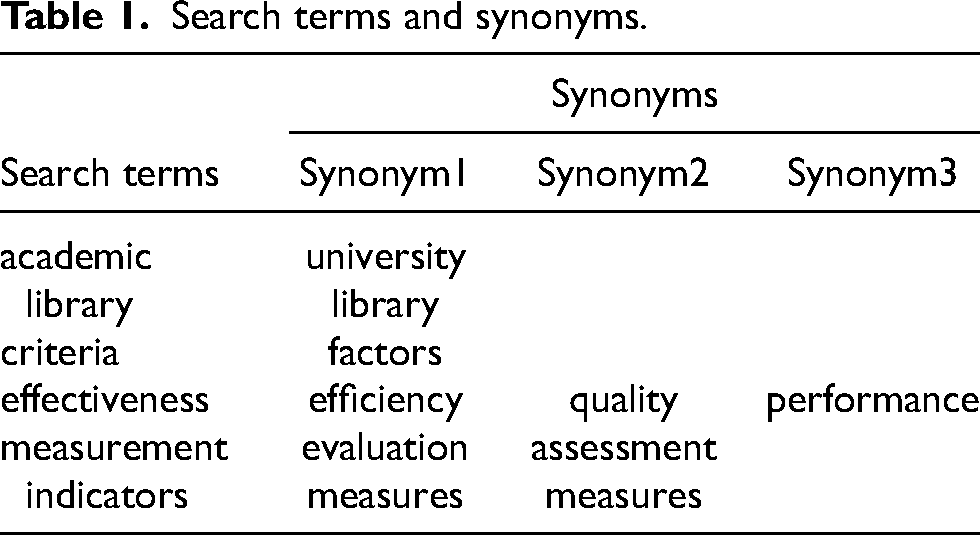
By combining search terms in online databases and search engines, 54 papers considered related to the scope of this research were looked up. For that, analysis of referenced, recommended, and similar papers were beneficial. 23 subject experts randomly selected, including librarians and academics of library and information science, participated in formal discussions to ensure the validity of the identified criteria and its measurement items. As a result, criteria and three or more categories of measurement indicators for each criterion were identified. A few measuring indicators that were not relevant to the context of the modern academic library were removed.
Findings
Multiple dimensions should be included in the measurement framework to evaluate the effectiveness of academic libraries considering all relevant aspects of service effectiveness. Ten key criteria and forty-five measuring indicators have been identified by studying the 54 papers numerous times while spotting commonalities.
Criteria and measuring items for assessing the effectiveness of the hybrid academic library services
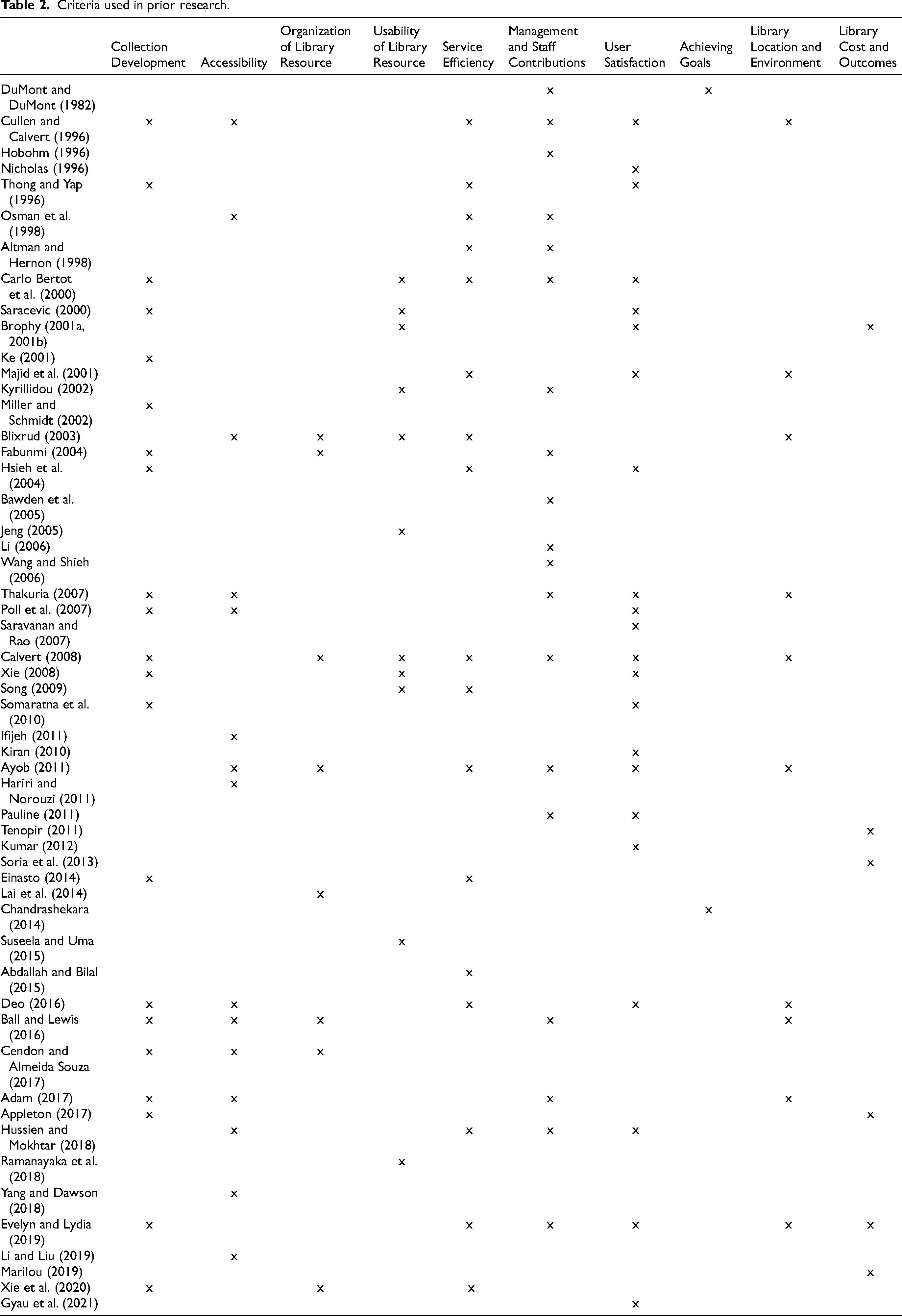
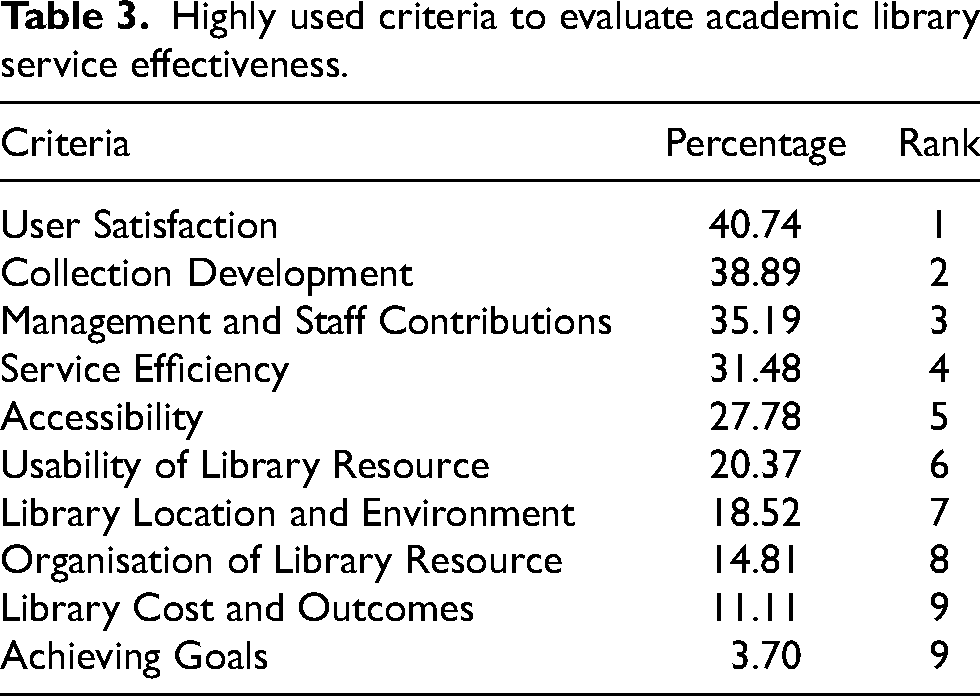
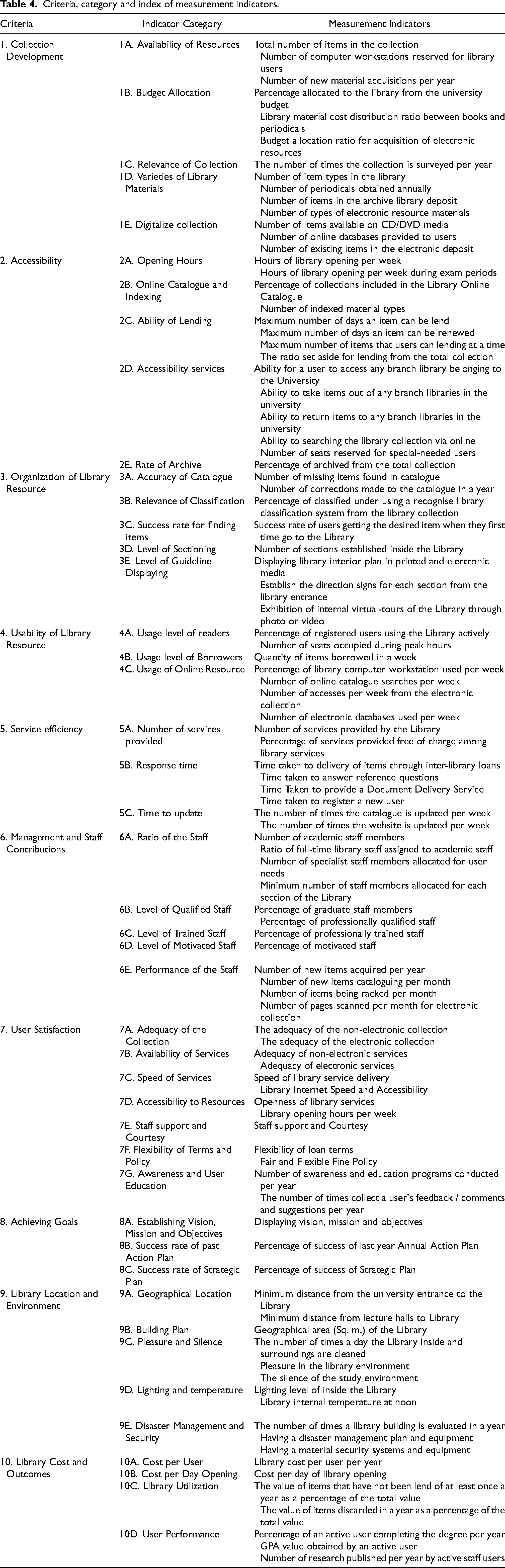
Table 2 shows the specific criteria extracted from the prior research. It uses columns to show the final set of criteria and rows to show the works in which they were proposed. The highly used criteria to evaluate library service effectiveness have been presented in Table 3 by considering the findings included in Table 2. According to Table 3, User Satisfaction, Collection Development, Management and Staff Contributions, Service Efficiency, Accessibility were the key five evaluation criteria mainly used or cited in the previous related works. Based on these criteria, the instrument items consisting of 25 statements that can be used to measure the identified criteria were observed. Figure 1 presented the proposed evaluation approach for library service effectiveness. Table 4 shows the measurement indicators, which consisted of Likert-type questions on a five-point rating scale ranging from ‘strongly disagree = 1’ to ‘strongly agree = 5’ to make the qualitative data quantifiable.
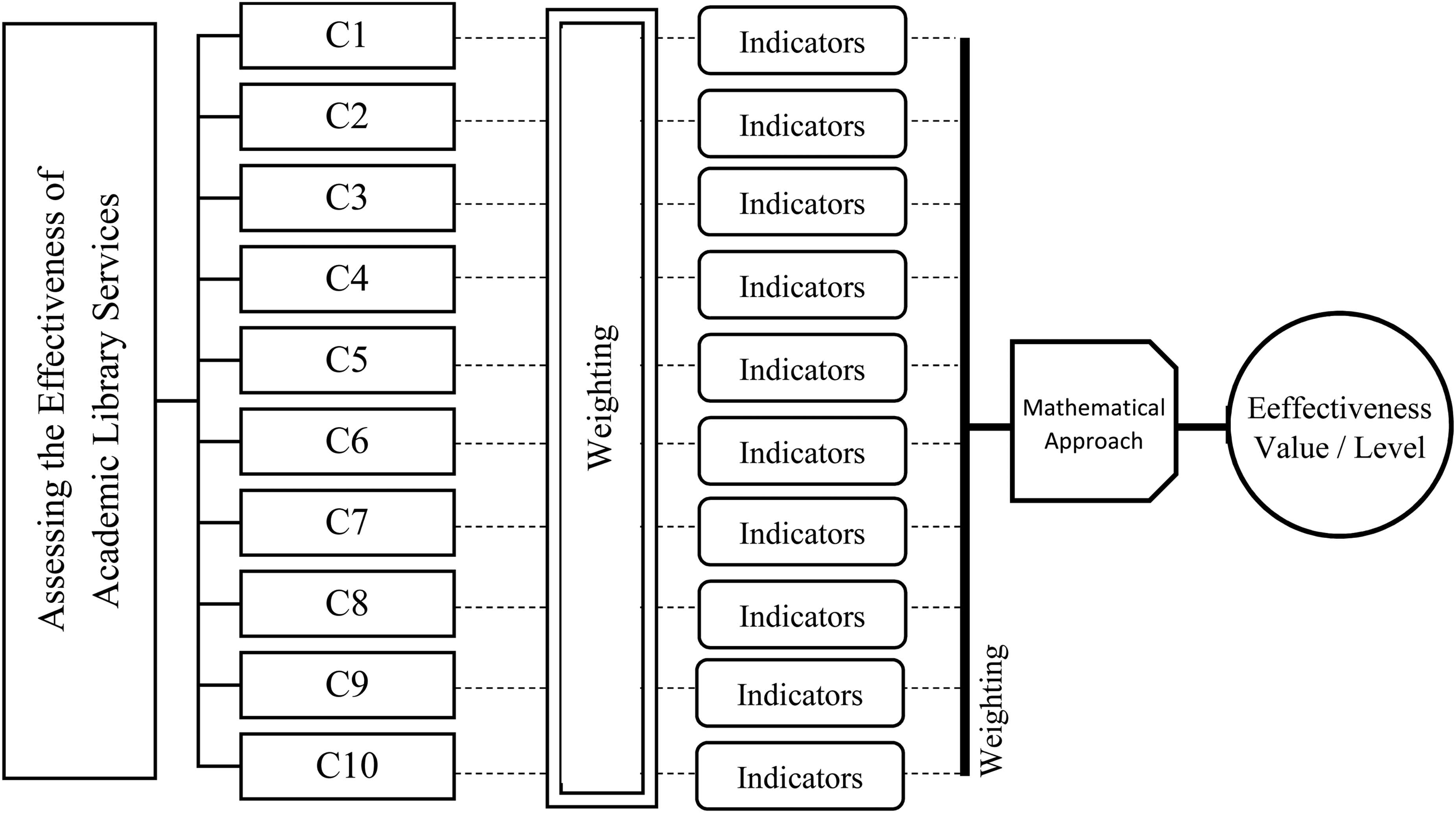
The conceptual framework for assessing the effectiveness of academic library services.
Criteria used in prior research.
Highly used criteria to evaluate academic library service effectiveness.
Criteria, category and index of measurement indicators.
Top five key evaluation criteria
Out of the ten criteria used by different authors to evaluate library service effectiveness from the prior research, the five key evaluation criteria can be summarized as follows:
User satisfaction
User satisfaction is a key determinant of a library's performance in terms of providing high-quality services, allowing for the identification and innovation of areas where library services need to be improved (Gyau et al., 2021). According to Thong and Yap (1996), user satisfaction plays a significant role when evaluating effectiveness of library services. Furthermore, the quality of service provided by the Library can be identified from the level of user satisfaction (Saravanan and Rao, 2007). However, Pauline (2011) states that the level of user satisfaction depended on the commitment of the library staff. Kumar (2012) points out that user satisfaction plays an important role when measuring library service quality and provides meaningful feedback, which can help to improve the services provided to users.
Thakuria (2007) declares that the availability of up-to-date information resources, the availability of facilities, access to information resources, the friendly staff, and the attractive appearance of the library could be used to measure user satisfaction levels. Majid et al. (2001) and Ayob (2011) discuss increasing user satisfaction by organizing user awareness programs and preparing virtual library tours and comprehensive user guidelines. Deo (2016) declares that the range of information sources available in the library: electronic sources, reference services, facilities and services, library opening hours, library environment, and library staff support would contribute to user satisfaction. Therefore, user satisfaction can be considered a key criterion that evaluates the quality of service and its viability, so it is essential to take feedback from users regularly.
Collection development
The library must have a fine collection to fulfill the needs of users (Adam, 2017; Calvert, 2008; Fabunmi, 2004, Poll et al., 2007; Saracevic, 2000). Deo (2016) argues the importance of having a wide range of existing information sources, while Thong and Yap (1996) express that the relevance and monetary value of the collection are more important than the size of the collection. Carlo Bertot et al. (2000) state that it is essential to consider the content of information rather than the size of the library collection, while Somaratna et al. (2010) and Einasto (2014) presents the significance of the existence of accurate, reliable, and relevant information.
Thakuria (2007) and Poll et al. (2007) highlight the benefits of an enriched and up-to-date library collection, and libraries should be in a capability to provide adequate printed and electronic resources to meet current user needs (Ball and Lewis, 2016). Ke (2001), Xie (2008), and Appleton (2017) examine the importance of electronic collection development with its qualities while Carlo Bertot et al. (2000), Miller and Schmidt (2002) highlight the importance of electronic library information services with adequate technological infrastructures. Further, Hsieh et al. (2004) point out that electronic collections such as CD databases, online databases, electronic resources, and video demand are the most demand sources among users. To provide an effective library service, information relevance, reliability, consistency, format, and up-to-date are the most critical aspects of the library collection while they may be in printed or electronic media (Calvert, 2008; Cendon and Almeida Souza, 2017; Einasto, 2014; Poll et al., 2007; Saracevic, 2000).
Management and staff contributions
The library staff has an unconditional responsibility to fulfill user needs by providing immediate services when requested (Wang and Shieh, 2006). Li (2006) explains that the development of high-quality information services would depend on the levels of staff contribution. Further, the indicators, namely, library staff behavior, courtesy, attitudes, and how staff help users, were used to assess library efficiency (Adam, 2017; Altman and Hernon, 1998; Ball and Lewis, 2016; Calvert, 2008; Carlo Bertot et al., 2000; Cullen and Calvert, 1996; DuMont and DuMont, 1982; Evelyn and Lydia 2019; Kyrillidou, 2002; Osman et al., 1998; Pauline, 2011). Fabunmi (2004) explains how staff who are aware of modern social needs could benefit from the service effectiveness, while Bawden et al. (2005) demonstrate the responsibilities of information specialists. According to Hobohm (1996), trained and motivated library staff can play a crucial role to increase service quality. Further, Ayob (2011) studies the contribution of library staff and the librarian's professional knowledge to service effectiveness, and Hussien and Mokhtar (2018) studies the methods by which librarians should respond to user requests. So, library staff's contribution and politeness, knowledge, and guidance will mainly affect the service effectiveness.
Service efficiency
Service efficiency means fulfilling service goals with the minimum amount of effort from both parties. According to Altman and Hernon (1998), users evaluate the efficiency of library services in terms of time and effort. Time and speed of obtaining a service mainly affect the service efficiency of a library, and libraries need to find innovative and sometimes radical approaches to meet ever-changing user needs (Blixrud, 2003; Calvert, 2008; Carlo Bertot et al., 2000; Deo, 2016; Einasto, 2014; Hsieh et al., 2004; Majid et al., 2001; Osman et al., 1998; Song, 2009; Thong and Yap, 1996). Calvert (2008) states that the required waiting time to obtain the specific service might affect the efficiency, while Cullen and Calvert (1996); Hussien and Mokhtar (2018) highlight the importance of reference services to efficiency, and Ayob (2011) express that the active inter-library loans service will increase the efficiency.
Accessibility
Accessibility is the degree to which a product, device, service, or environment is available to as many people as possible. Ifijeh (2011) declares, along with evidence that the users must have access without any barriers to the library may cause the success of the library services. Also, Cullen and Calvert (1996), Osman et al. (1998), Thakuria (2007), Poll et al. (2007), Hariri and Norouzi (2011), Ball and Lewis (2016), Deo (2016), Cendon and Almeida Souza (2017), Adam (2017), and Hussien and Mokhtar (2018) highlight the role of the accessibility criteria for evaluating the service effectiveness. More relevant content and more easily accessible information sources point to a better assessment of the overall effectiveness of digital libraries (Li and Liu, 2019). Therefore, it is important to provide free and open space for users to easily access library services through traditional and electronic approaches. Blixrud (2003) uses existing formats, access points, access times as measuring items to measure the accessibility while evaluating service effectiveness, while Ayob (2011) uses opening hours, book loan periods.
Other evaluation criteria
Except for the key five criteria, the five criteria were identified which were used by various authors to assess the effectiveness of the hybrid academic library services, and those can be summarized as follows:
Usability of library resource
Usability is considered the most important indicator of the performance and reputation of library services. It is an excellent indicator to find out the placement of library services, how good the collection is, and how it relates to the users. Positive attitudes to usability of library services and revisit rates can be increased effectively (Ramanayaka et al., 2018). Saracevic (2000) studies the evaluation of service quality in the human-computer interaction environment while Jeng (2005) discuss usability dimensions in evaluating digital libraries, commenting on usability as a multi-dimension that can be examined from multiple perspectives.
Library location and environment
Many researchers have explained the importance of considering library location and environment as one of its components in evaluating service effectiveness. They have used the location of the library, the nature of the buildings, the attractiveness, the building design, presence of controlled pleasure and silence, healthy lighting and temperature, well disaster management and security as measuring indicators to evaluate the library location and environment (Adam, 2017; Ayob, 2011; Ball and Lewis, 2016; Blixrud, 2003; Calvert, 2008; Cullen and Calvert, 1996; Deo, 2016; Evelyn and Lydia, 2019; Majid et al., 2001; Thakuria, 2007). Therefore, the library environment influences the effective service provided by a library.
Organization of library resource
The information organization has been highlighted by Xie et al. (2020) as a crucial factor in the evaluation of digital libraries from the perspectives of scholars and practitioners. Users will save time and effort when library resources and relevant information are maintained in a more accurate and disciplined manner; this is also one of five laws of Ranganathan's law. Further, service effectiveness depends on the time it takes to meet the user's needs (Ayob, 2011; Blixrud, 2003; Cendon and Almeida Souza, 2017; Lai et al., 2014; Xie et al., 2020). Therefore, the library material should be arranged to be easy to understand and use to meet users’ needs (Fabunmi, 2004). Calvert (2008) declares the importance of setting guidelines and keeping library material in the right place, while Ball and Lewis (2016) express that existing library resources should be appropriately organized to meet the diverse information needs of the users and need to guide the users by providing guidelines to get the required information in the required format.
Library cost and outcomes
Tenopir (2011) argues that the value of libraries should be evaluated based on research, teaching, and learning outcomes as well as the cost benefits of using library resources rather than just traditional assessment data. Soria et al. (2013) recommend assessing student learning or developmental outcomes in order to determine the benefits of using academic libraries. In order to establish academic library value, user academic achievements are crucial (Evelyn and Lydia, 2019). Furthermore, Brophy (2001a, 2001b) and Marilou (2019) point out that the contribution of the outcome in terms of cost in assessing the effectiveness of a library service is very high.
Achieving goals
The library should have an action plan to achieve its goal (Chandrashekara, 2014), and it should have a good vision, mission, and objectives and need to work accordingly. DuMont and DuMont (1982) took part in the goal typology and systems model for measuring the efficiency of libraries. Therefore, librarians need to have a constant understanding of the goals and objectives of their libraries.
Discussion, recommendations and further research
The effectiveness of library services has been widely discussed in the literature as an essential factor for the library's success and has only seen limited empirical studies in the academic literature. It has been observed that researchers have used various criteria and measurement indicators to evaluate service effectiveness. However, it can be seen that one item used by one researcher as an evaluation criterion has been used as a measurement indicator by another researcher.
Further, according to the literature, the effectiveness of traditional and digital library services was evaluated separately. No one considered both services as a single unit and assessed together. Therefore, evaluation of hybrid library service effectiveness was not well covered in the literature. Although implementing effective library services is challenging in its own right, maintaining and adopting a new service to meet users’ constantly changing needs is a seemingly difficult task. Evaluating the service effectiveness is perfectly geared to this task since it assists in identifying existing issues and developing ways in which to attack those problems.
There are two immediate contributions to this work. They have identified a set of key criteria that appears to help evaluate hybrid library service effectiveness from reviewing research papers, published articles, and views of experts, and determined evaluation criteria that have more frequency and occurrences in the related texts examined. Based on literature review, this study identified ten key criteria of the effectiveness: user satisfaction, collection development, management and staff contributions, service efficiency, accessibility, usability of library resources, library location and environment, organization of library resources, library cost and outcomes, and achieving goals in the context of library services.
The variety of names used by the authors also creates difficulty in determining a common term to group all the criteria. Furthermore, by creating one more name, even setting up common criteria can generate the same dismay over a different name for the criterion. Thus, for the name of the common criteria, the authors use a name preferentially used by any author to convey a complete sense. It is understood, for example, that “effectiveness” has a broader meaning than “productivity, consistency, fulfillment, quality or universality.”
The framework that includes ten criteria with related measurement indicator categories is shown in Figure 2. At the same time, Table 4 presents the measurable indicators that can measure indicator categories. These measurable indicators consisted of Likert-type questions on a five-point rating scale ranging from ‘strongly disagree = 1’ to ‘strongly agree = 5’ making the qualitative data quantifiable. Finally, the proposed conceptual framework for assessing the effectiveness of hybrid library services is shown in Figure 1. In the next phase of this research, the authors are planning to build a multi-criteria decision-making model based on the findings of this paper to empirically measure the effectiveness of academic library service quality.
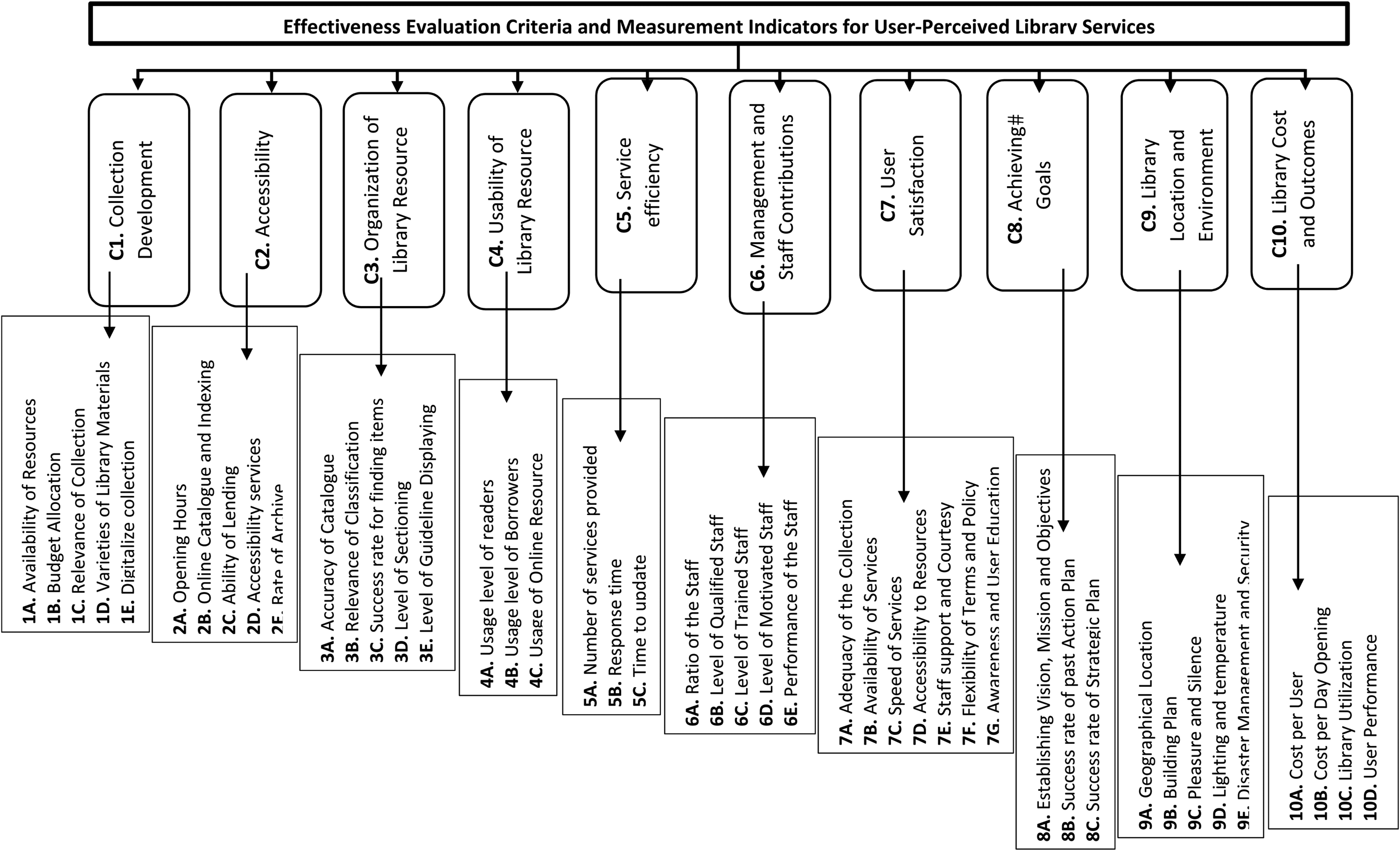
The framework of evaluation criteria and measurement indicators.
Furthermore, the results of the study provide a strong contribution to the literature on measuring the effectiveness of library services and further evidence that service effectiveness is an important factor in the user's selection to use the library. The effectiveness of library services also plays a critical role in a user's acceptance of library services. Service effectiveness is increasingly important as libraries compete in the constantly changing technological world. The development of measurement items to measure service effectiveness allows librarians to set standards by evaluating the effectiveness of their services and comparing them with their counterparts. Therefore, having valid and reliable instruments to measure service effectiveness is vital for libraries and users. The scientific evidence of the study gives a more helpful direction to the librarians on the more impactful service effectiveness factors that lead to successfully allocating their limited resources to create more successful and valuable services. Finally, Levi and Conrad (2008) posit that “There is no question in our minds that our systems are better because of the effectiveness testing we have performed, and that the end-users have benefited in direct, measurable ways”.
Conclusions
The prominent role of libraries and librarians in the academic environment depends on giving users access to resources and services and access to resources in print or digital media. However, more services need to be generated to match the user's needs. For that, hybrid services need to be expanded. Therefore, providing a service that can bring and retain users is a significant challenge in today's context. Effectiveness of academic library services is the key solution to overcome this challenge. A conceptual framework for assessing effectiveness of present academic library service is proposed after discussion with the literature to suggest criteria and measurement indicators that can be utilized to evaluate effectiveness of academic library services. The paper presents a cost-effective approach to assess the effectiveness in comparison to traditional, formal approaches. The authors believe that this research work will function as a reference point to further develop measurement frameworks to assess effectiveness of academic library services based on a survey of the library staff and users.
Research limitations
Although this study was systematically and methodically designed, we recognize that it has some limitations. First, only those criteria and measurement indicators that can be distinguished from those found by earlier researchers were taken into consideration but some significant earlier studies could not be accessed during the literature search. Furthermore, even though the names and definitions of the criteria and measurement indicators were analyzed in accordance with the guidance of experts to identify synonyms and homonyms, bias may still exist because of generalization from a very small group of experts in the field of library and information science in the university libraries of Sri Lanka.
Further research
To practically apply the suggested conceptual framework, further research is required. Utilizing multi-criteria evaluation methods may enhance the validity conceptual framework.
