







Abstract
This work aims at determining the factors that shape adoption and continued use of agricultural technology innovations by smallholder crop farmers in Benue State Nigeria. A structured interview schedule was used to collect relevant data. Method of analysis involves frequency counts and percentages. The result shows that factors relating to propensity to adopt are education, land size, access to credit, access to extension services and cost of innovation among others while the same factors apply for continued use of agricultural innovation except land size and gender. The extent of adoption of high yielding variety of crops, disease resistant varieties, and equipment for spraying, chemical fertilizer, pesticide, fungicide, insecticide and herbicide were very high. The extent of support on agricultural technology innovation was very poor. It is recommended that need assessment surveys be carried out before the introduction of agricultural technology innovation to guarantee adoption and continued use.
Introduction
Librarians are common fixture of many problems in the world today. The saying that librarians know something about everything supports this. The sad part is that they may be so common that their values, actual and potential as a resource are easily overlooked especially in developing countries of the world. The challenges of growing instability coupled with environmental degradation, water and energy crises, banditry and terrorist attacks, population growth, the impact of climate change and the need to reduce greenhouse gas emissions have attracted the attention of librarians. These challenges have brought many pressures to bear on Nigerian agriculture.
These challenges are combination of factors which have made population to outpace food production per capita which has been in decline; leading to increased food importation according to Delgado and Mellor (1984); World Bank, (2012); unpredictable and intractable drought, Gilbert and Reynolds (2008), European Commission (2016), food insecurity, Kralovec (2021), food import demand, Abdullahi (2021), depletion of resources, destruction of land, and sabotage of market access and supply, Riebe (2022) and high incidence of hunger and poverty.
Just as Freeman and Blomley (2018) and McCook and Phenix, (2006) stated that libraries as institutions and librarianship as a profession each with a long historical focus on social justice and human rights and are uniquely rooted in particular local communities so also are librarians growing concern for food insecurity and over importation of food in Nigeria. Library and information science scholars are trying do well to carry out research across disciplinary boundaries to build on issue of food insecurity and excessive food importation. Information is described as power. Obtaining information on adoption and continued use of agricultural technology innovations among smallholder crop farmers in Benue State Nigeria will help to understand the extent these farmers have been applying the introduced technologies to help ameliorate food insecurity and excessive food importation.
Considering the outcome of National Bureau of Statistics (NBS), (2005 and 2008) in national survey conducted between 2003 and 2004, half of Nigerian population (51.6 percent) lives below US$1 dollar per day and the relative national poverty incidence were found to be 54.4 percent. Presidential Economic Advisory Council (2021) noted that over 80 million Nigerians are classified as poor, with more than 50 percent multi-dimensionally poor While Nigeria Multidimensional Poverty Index (MPI) (2022) revealed that 63% of the people living within Nigeria; that is 133 million people are multi-dimensionally poor. It further stated that the MPI is 0.257, indicating that poor people in Nigeria experience just over one-quarter of all possible deprivation. These are forcing policy-makers, librarians and farmers to rethink the industrial and input-based method of agriculture thereby heightening the critical role of innovation to make agriculture more competitive and sustainable.
Innovation according to Kughur et al. (2015) is wide range and multifaceted social activities that embrace the entire continuum or chain of scientific research and technological development from the most basic laboratory investigations to the marketing of new products. It can be described as the process by which an invention is first brought into use. Innovations according to Organization for Economic Co-operation and Development (OECD) (2005) can be classified into product innovation, process innovation, and marketing innovation, entrepreneurial, and organizational or institutional innovation. Another classification according to Innovación para la cooperación técnica en el (IICA) (2013) includes institutional, social and technological innovation.
Technological innovation according to The Frascati Manual 2002 (OECD) (2002) comprises new or significantly modified technological products and processes, where technological novelty emerges, unlike improvements, from their performance characteristics. It includes small improvements that are small changes in the existing technology platforms that bring small benefits to customers, Nguyen et al. (2020), or technological breakthroughs that apply new technologies that are completely different from existing products (Chandy and Tellis, 1998; Herrmann et al. 2006; McMillan, 2010). Agricultural technological innovations therefore include all kinds of improved techniques and practices which improve the growth of agricultural output (Jain et al., 2009).
Contextually, agricultural technology innovations represent an umbrella term used to describe equipment, genetic material, farming techniques, and agricultural inputs that have been developed to improve agricultural operation. It does not have to be complex, but it has to be new, Freeman (1982) and should be aimed at achieving the desired objective. Agricultural technological innovation includes new ideas, machines, devices, scientific knowhow or improved practices that are developed, produced or used to market new or improved agricultural goods or services.
Ogebe et al. (2018) noted that, adoption of agricultural technology innovations by small scale farmers is indeed a significant and necessary component in agricultural development activities in Benue state. Be that as it may, Kieti et al. (2021) noted that transformational effects of digital platforms are largely missing in the agricultural sector, especially in sub Saharan Africa (SSA). This notwithstanding, Disrupt Africa, (2018) as cited in Kieti et al. (2021) stated that Kenya tied with Nigeria in having the continent's highest number of digital agriculture startups as active businesses. According to Maikasuwa and Ala (2013), the process of increasing the efficiency of agricultural production through agricultural modernization depends mainly on the extent to which farmers can adopt improved agricultural technologies into their farming operations.
According to Rogers (2003), adoption is a decision of “full use of an innovation as the best course of action available and rejection is a decision not to adopt an innovation”p177. Adoption can be described as a stage in which “a thing” is selected for use by an individual or organization. According to Walker (2008) adoption is a process that results in assimilation of a product, process, or practice that is new to the adopting organization. In other words, adoption has to do with the acceptance of a system as a way of doing things. Contextually, adoption is the decision to fully accept an innovation. The implication according to Damanpour and Schneider (2008) is that organizational members cannot use an innovation unless it has been adopted by the organization. Be that as it may, innovations are of little value until they have been put to use for the economic and social well-being of the people involved. This implies therefore that adoption of an innovation precedes their uses which give the actual advantages of the innovation. Adoption is the last step in a decision process to make full use of an innovation having considered that such will impact positively on the livelihood of the people involved. One can adopt an innovation but unforeseen circumstance can prevent him or her from using or continuing to use it. Equally too, attracting new customers (adopters) and retaining them are critical for the success of every innovation.
In smallholder farming, agricultural technologies are mainly used for personal or family needs and the cost of using them are borne mainly by the individual family farmers, so they perceive price as an important factor and evaluate it based on its benefits and costs. This implies that, smallholder agricultural technologies users play the dual role of technology users and service consumers. According to Obinne (1996), “the failure of farmers to accept and use improved technological packages has been the root cause of the backwardness in Nigeria's agricultural sector, despite the efforts made by research institutes, universities of agriculture and development agencies to introduce improved crop and livestock practices”p119.
The decision to accept or reject adoption of technology consists of several stages and involves sequence of thoughts and decisions. These include but not limited to stages such as awareness, interest, trial, evaluation and adoption. According to Mercer and Pattanayak (2003), adoption of new technologies normally involves two stages which include the decision to either adopt or not and the second which involves how much of the new technology to adopt. According to Odoemenem and Obinne (2010), adoption of innovation is affected by factors which are institutional in nature and include extension contact, amount and use of credit, cooperative membership. Shideed and Mohammed (2005) stated that adoption of a new technology is subject to its profitability, degree of risk associated with it, capital requirements, agricultural policies and socioeconomic characteristics of farmers.
Talukder (2012) noted that designing an effective approach for increasing end-user acceptance and subsequent use of innovation continues to be a fundamental challenge that has not always provided straight-forward solutions. Oladele, (2005) maintained that adoption of improved technologies will neither improve food security nor reduce poverty if barriers to their continued use are not overcome. According to Damanpour and Schneider (2008), organizational members cannot use an innovation unless it has been adopted by their organization. Likewise, individual smallholder farmers cannot use an innovation unless it has been adopted. Innovation use is affected by many other fundamental factors. Talukder (2012) was of the opinion that organizations need to provide facilitating conditions which include the extent and type of support provided to individuals that influence their use of the technology. Facilitating conditions according to the author are believed to include the availability of training, incentives and provision of support to individuals. Training, government support in form of incentives and provision of physical infrastructure can serve as measures of government support to smallholder farmers. Besides, according to World Bank Institute (2013), government plays a fundamental role in supplying the economic, social and institutional conditions that foster innovation through effective policies. The institute noted that government should do this through providing innovators with resources such as finances, services and knowledge to build suitable support system and strengthen the country's human resources through a sound educational system that runs from primary through higher education and vocational training among others. United Nations (2010) maintained that the capacity for technological innovation needs to be greatly enhanced in developing countries in order to strengthen national innovation and research and development capacity. Be that as it may, the question that comes to mind is, to what extent has government of the developing countries introduce and implement such policies?
While teachers are making effort to impart knowledge to student in the classroom, agricultural researchers are doing their best to improve agricultural production. There is often but overlooked need to investigate the smallholder farmers especially in the developing countries to ascertain the factors that influences them to adopt and continuously use agricultural technology innovation in their farming operation. This is the distinguishing posture and contribution of this study. Therefore, the specific objectives of this study are to determine the factors that shape the smallholder farmers propensity to adopt agricultural technological innovation in their farm; determine the extent of adoption of technological innovation in their farming operation; ascertain the factors that affect smallholder farmers’ continued use of agricultural technology innovation and ascertain the extent smallholder farmers receive support from stakeholders to foster agricultural technology innovation use in their farming operation.
Literature review
Farming operations are now experiencing radical change. It has been observed that traditional agricultural operations are now being replaced by modern system of farming. Various agricultural operations that were practiced some decades ago have been replaced with advanced technologies such as locomotive machines, sensors and information technology. The advancement in agricultural technologies made agriculture safer, efficient, and profitable and more environmental friendly. However Ruzzante et al. (2021) opined that adoption of many seemingly beneficial technologies remains low. The findings of the authors reveal that, on the average, farmer education, household size, land size, access to credit, land tenure, access to extension services, and organization membership positively correlate with the adoption of many agricultural technologies. This could be because many modern agricultural innovations are adopted more on larger farms, which cast doubt on the scale-neutrality of these technologies.
In a study to determine technology adoption and agricultural development in Sub-Saharan Africa (SSA) Nwachukwu (2017) used Ukum rural community, Benue State, Nigeria, as case study site which significantly represents other Nigerian-SSA farming communities. The findings reveal that the main factors significantly affecting adoption of technology include cultural values, institutionalized land tenures, cropland size, poverty, literacy level, technology complexity, agricultural extension services, age and sex. The results suggest significant correlation between literacy level, economic power and technology adoption: younger, more educated farmers with higher economic status tend to adopt new technologies; farmers with access to agricultural extension services and credit facilities were more inclined to adopting new technologies; women were found more disadvantaged in the male-centered, exclusionary land tenure practice.
In a bid to conceptualize a special form of digital platforms, Kieti et al. (2021) carried out a study to determine sources of value creation in aggregator platforms for digital services in agriculture with insights from likely users in Kenya. The findings revealed identified and prioritized value creation sources in an Aggregator Platform for Digital Services in Agriculture (AP4DSA) among practitioners implementing such a platform. These include the teams working on the nascent AP4DSA initiatives as well as similar initiatives likely to spring up across SSA countries. It equally revealed that focused attention to platform-wide efficiency, loyalty-centredness and platform inclusivity is bound to increase prospects of an AP4DSA. According to Welch, (1970); Wozniak, (1984, 1987); Krueger, (1993); Lleras-Muney and Lichtenberg, (2002), highly educated workers tend to adopt new technologies faster than those with less education. Wozniak (1987) concluded that education and information reduce adoption costs and uncertainty, thereby upholding the probability of early adoption.
According to Ameh and Andrew (2017), studies have shown that farm characteristics, household characteristics and institutional factors have a significant influence on the adoption of farming technologies. Danso-Abbeam et al. (2017) revealed that age of the household, level of experience, farm workshop attendance, the number of years in formal education, availability of labour, and extension contact influence the adoption of improved maize varieties. Schultz (1981) equally revealed that education is potential in improving farmer's capacity to ‘‘respond to new events in the context of risk”. Continuous investment in education among the farming community is crucial for many reasons. One of them includes increasing the ability of farmers to understand and make informed decisions about new technologies. Besides, Rogers (2003) stated that ‘‘earlier adopters have more years of formal education than do later adopters” and Feder et al. (1985), noted that ‘‘farmers with better education are earlier adopters of modern technologies”.
In their study to determine postharvest yam management in the Zabzugu district of northern Ghana, Gershon et al. (2016) reported that farmers who managed the postharvest losses were young, had formal education, and had fewer household members. Knight et al. (2003) using data from Ethiopia tried to determine the role of education in facilitating risk-taking and innovation in agriculture, the findings reveal that schooling positively influences adoption of modern inputs both directly and indirectly, through a reduction in risk-aversion. Education according to Schultz (1981) has long been hypothesized to influence adoption through increasing a farmer's ability to ‘‘perceive, interpret, and respond to new events in the context of risk”.
The study by Kaloi et al. (2021) revealed that adoption of System of Rice Intensification (SRI) increased with the age of the farmer, farm size, household size, credit access, farmer experience, access to extension services and distance from the canal. The importance of household size in adoption of agricultural technology is because of its proxy to labour availability which Feder et al. (1985) suggests is related to adoption of labour-intensive technologies. This is supported by Grabowski et al. (2016), who tried to determine adoption and disadoption of minimum tillage by cotton farmers in Eastern Zambia, using quantitative and qualitative data from Zambian smallholders. It was revealed that labour availability is the primary constraint in adoption of labour-intensive hand-hoe planting basins, while capital constraints limit the use of the more expensive ox-ripper.
In their study of farm diversity and heterogeneous impacts of system technologies on yield, income and poverty, Noltze et al. (2012) revealed that System of Rice Intensification (SRI) seemed to be adopted more on plots and by farmers with less than average yields. The findings equally showed that SRI is not more beneficial when compared to conventional flooding (CF) rice grown under favorable conditions and with the best management practices.
According to Ajah and Nmadu, (2012) and World Bank, (2013) in Jilito and Wedajo (2020) “much of the sustained agricultural growth necessary for poverty reduction and sustainable development comes from adequate and expanded improved agricultural inputs use like hybrid seeds, pesticides, insecticides, herbicides, fungicides, and inorganic fertilizer” p.2286. These calls to investigate the factors that affect continued use of agricultural technology innovations after it have been adopted by smallholder farmers. Tura et al. (2010) stated that “the literature on agricultural technology is limited on the issue of the continued use of an agricultural technology after it is adopted” P 1. As revealed by Feder et al. (1985); Sunding and Zilberman (2001), agricultural technologies have been mainly concerned with factors influencing adoption of new technologies. Tura et al. (2010) tried to bridge the gap by carrying out a study on adoption and continued use of improved maize seeds.
The findings of the author revealed that human capital (adult workers, off-farm work and experience in hiring labor), asset endowment (size of land owned), institutional and policy variables (access to credit, membership in cooperatives) all strongly influence farmers’ decisions to adopt improved maize varieties, while continuous use of the seed is influenced by the proportion of farmland allocated to maize, literacy of the household head, involvement in off-farm work, visits by extension agents, farmers’ experience, household, land size and fertilizer usage. In a study carried out to determine adoption and continued use of stone terraces for soil and water conservation in an Ethiopian highland watershed, Amsalu and De Graaff (2006) found that, adoption was influenced by farmers’ age, farm size, perceptions on technology profitability, slope, livestock size and soil fertility, while the decision to continue using the practice is influenced by actual technology profitability, slope, soil fertility, family size, farm size and participation in off-farm work.
According to Diederen et al. (2003), the extent to which farmers utilize agricultural technology and the speed at which they do so determines the impact of innovations in terms of productivity growth. The work of Olwande et al. (2009) revealed this as the authors tried to do analysis of smallholder farmers’ fertilizer use in Kenya. This is due to continued decline in agricultural productivity over the last decades and continued increase in poverty levels of smallholder farmers. The result shows that the proportion of households using fertilizer dramatically rose in the last decade while fertilizer application rates increased marginally. According to the author, fertilizer use in the drier agro ecological zones was below that of the higher agro ecologically potential zones, indicating higher risk involved and lower profitability of using fertilizer in the drier areas. Smaling et al. (2006), revealed that empirical evidence confirms that the trend in the use of inorganic fertilizer in Ethiopia is low and by far less than the world average of 100 kg per hectare for one year. This can imply therefore that most of the smallholder farmers if not assisted by government will find it difficult to use most of the agricultural technological innovation. This is because as outlined by Ogungbile and Olukosi (2001), the common characteristics of resource-poor farmers include stark poverty, illiteracy, malnourishment, financial inadequacies and low rates of return on their small investments.
Food and Agricultural Organization (2020) noted that “access to appropriate innovation, information and advisory services by smallholders and family farmers is a vital element in transforming agriculture and food systems and achieving the Sustainable Development Goals (SDGs)” p1. Smallholder farmers need to adopt, continue to use and foster agricultural technological innovation. Doornbos (2001) noted that farmers are faced with falling government support for the farm economy. Besides, as stated by Ton et al. (2015), funds that are specifically targeted to smallholder farmers are quite rare. This notwithstanding, government support enhances agricultural technological innovation use. Governments have a strong role to play in ensuring quality and inclusion, and making sure that appropriate innovation, information systems and advisory services are available and affordable to smallholder family farmers – especially those in remote areas, vulnerable groups, and women, FAO (2020). This makes it essential to have for instance; besides financial support for the formal research, and extension, support or grants for experimentation and innovation for and by smallholder farmers.
The Central Bank of Nigeria tried to bridge the gap, by introducing anchor borrower's programme. Ayinde et al. (2018) assessed Central Bank intervention on rice production in Kwara State, Nigeria. The findings revealed that Anchor Borrowers’ Programme (ABP) was a success because it improved paddy rice yield and also increased farmers’ income., but has its shortcomings such as late arrival of approval and disbursement of fund, average yield of about 3.9 tons per hectare was considered to be too low and the disparities in output per hectare among ABP beneficiaries clearly showed the relevance of the differences in intensities of implementation of rice subsector policies and the presence of technologies gaps among the beneficiaries. In the bid to assess the implementation modalities of the anchor borrowers’ programme in Nigeria, Coker et al. (2018) found that apart from some perceived benefits of the programme such as risk mitigation strategy incorporated into the model among others, there are other aspects of ABP implementation arrangements that are still unclear due to limited awareness of programme implementation arrangements, roles of stakeholders are overlapping, updated database are still an issue, credible monitoring and evaluation framework are lacking, while cases of elite capture was prevalent.
In their study to understand the adoption of a portfolio of sustainable intensification practices in Eastern and Southern, Kassie et al. (2015) revealed that in Ethiopia, Kenya, Malawi and Tanzania, the adoption of sustainable intensification practices were influenced by the reliance on government support such as provision of inputs, advisory and technical services.
From the work reviewed, little has been done or investigated on adoption and continued use of agricultural technology innovations among smallholder farmers. Works on the factors that shape the smallholder farmers propensity to adopt technological innovation in their farm, extent of adoption of technological innovation in smallholder farming operation, extent of smallholder farmers’ continued use of agricultural technology innovation and the extent smallholder farmers receive support from government to foster agricultural technology innovation use in their farming operation is still scanty. Therefore, this study provides a strong case of argument of using Benue State, Nigeria to generate information on adoption and continued use of agricultural technology innovations among smallholder farmers with a view of driving policy recommendations and filling the information gap.
Methodology
The study area
Benue State is located in the Middle Belt region of Nigeria, between Longitude 6031'E and 100E and Latitudes 6030'N and 8010'N (Benue State Agricultural and Rural Development Authority, BNARDA, 2005). The State shares boundary with Nassarawa State to the north, Taraba to the Northeast, in the south by Cross River, while in the North is Enugu, Ebonyi and Kogi State to the west. It has a short international boundary with the Republic of Cameroon around Kwande Local Government Area. Climatically, the State belongs to the Koppen's Aw climate group and experiences tropical wet and dry seasons. The rain falls for seven months from April to October with total annual amount ranging between 12,000–20,000 mm while dry season sets in November and ends in March (Nyagba, 1995). The choice of the state stems from its position as the nation's food basket and typifies what is common among many Nigeria/Sub Saharan Africa farming communities and also because of its rich and diverse agricultural produce which include yams, rice, beans, cassava, potatoes, maize, Soybeans, sorghum, millet and cocoyam. Benue State has a total land mass of about 33, 955Km2 with 23 Local Government Areas. Politically and agriculturally it is divided into three zones; Zone A, B and C with an estimated population of 4,219,244 people and 413,159 households BNARDA, (2005); National Population Commission, (NPC), (2006) while 2,144,043 (50.4%) are males and 2,109,598 (49.6%) are females, with a median age of 17 years (National Bureau of Statistics, (NBS), 2006).
Population/ sample/sampling techniques
The population for the study consists of all the smallholder farmers in Benue State. The sample was drawn from the three agricultural zones. The selection of the sample involved a multi-stage simple random sampling approach. The first stage involved a random selection of four Local Government Areas from each of the three agricultural zones of the State. The second stage involve a random selection of two towns from each of the twelve selected Local Government Areas while the third stage involves the selection of two villages from each town and the last stage is the selection of five households from the forty eight villages giving a total sample size of two hundred and forty (240) households that are smallholder farmers. The head of each household served as the key respondent.
Instrument for data collection
The instrument for data collection was structured interview schedule. The structured interview schedule was prepared in English and given to enumerators who were trained on how to conduct the exercise of data collection. They were responsible for interpreting the questions for the respondents and completing the schedule. The structured interview did not imply qualitative study nor mixed method form of data collection. The instrument was prepared in questionnaire form by the researcher but is called interview schedule because it is interpreted and filled by the enumerators. This according to Opara (2008) was handled as an interview schedule or non-self-administered questionnaire in situations where the farmers could not read or write English. The recent works that employed structured interview schedule is Fidelugwuowo (2021) and (2022). The structured interview containing fifty one (51) items was designed. It was divided into four clusters. Cluster one sought for information on the factors that shape the smallholder farmers’ propensity to adopt agricultural technological innovation. Cluster two sought for information on the extent of adoption of agricultural technological innovation in smallholder farming operation. Cluster three sought for information on the extent of smallholder farmers’ continued use of agricultural technology innovation and Cluster four sought for information on the extent smallholder farmers receive support from government to foster agricultural technology innovation use in their farming operation. The respondents were asked to select any of the possible responses as Very High Extent (VHE) – 5, High Extent (HE) - 4, No Extent (N) −3, Low Extent (LE) −2 and Very Low Extent (VLE) −1 for the factors on propensity to adopt, extent of adoption and extent of support for agricultural technological innovation. Then on the factors that affect smallholder farmers’ continued use of agricultural technology innovation, they were asked to select responses as Strongly agree (SA) - 5, agree (A) - 4, Neutral (N) - 3, disagree (D) - 2, strongly disagree (SD) - 1. For example, respondents were asked to rate the extent variables like access to extension services, gender, age of household heads, education, household size, cost of innovation, farm size, membership of farmer association, access to information, access to credit, complexity of innovation, perceived benefits of innovation, experience of household heads and land tenure system shape the smallholder farmers’ propensity to adopt agricultural technology innovation. The duration for data collection was four weeks.
Method of data analysis
Descriptive statistics were used to analyze the responses on the factors that affect smallholder farmers’ propensity to adopt and continuously use agricultural technology innovation in their farming operations. Data was analyzed using Statistical Package for the Social Sciences (SPSS Inc, Chicago, USA Version 21). The percentage responses on different items relating to factors on propensity to adopt, extent of adoption, continued use and extent of support for agricultural technological innovation were obtained.
Results
The results are contained in Tables 1, 2, 3 and 4 below.
The percentage response on factors that shape the smallholder farmers propensity to adopt agricultural technology innovation.
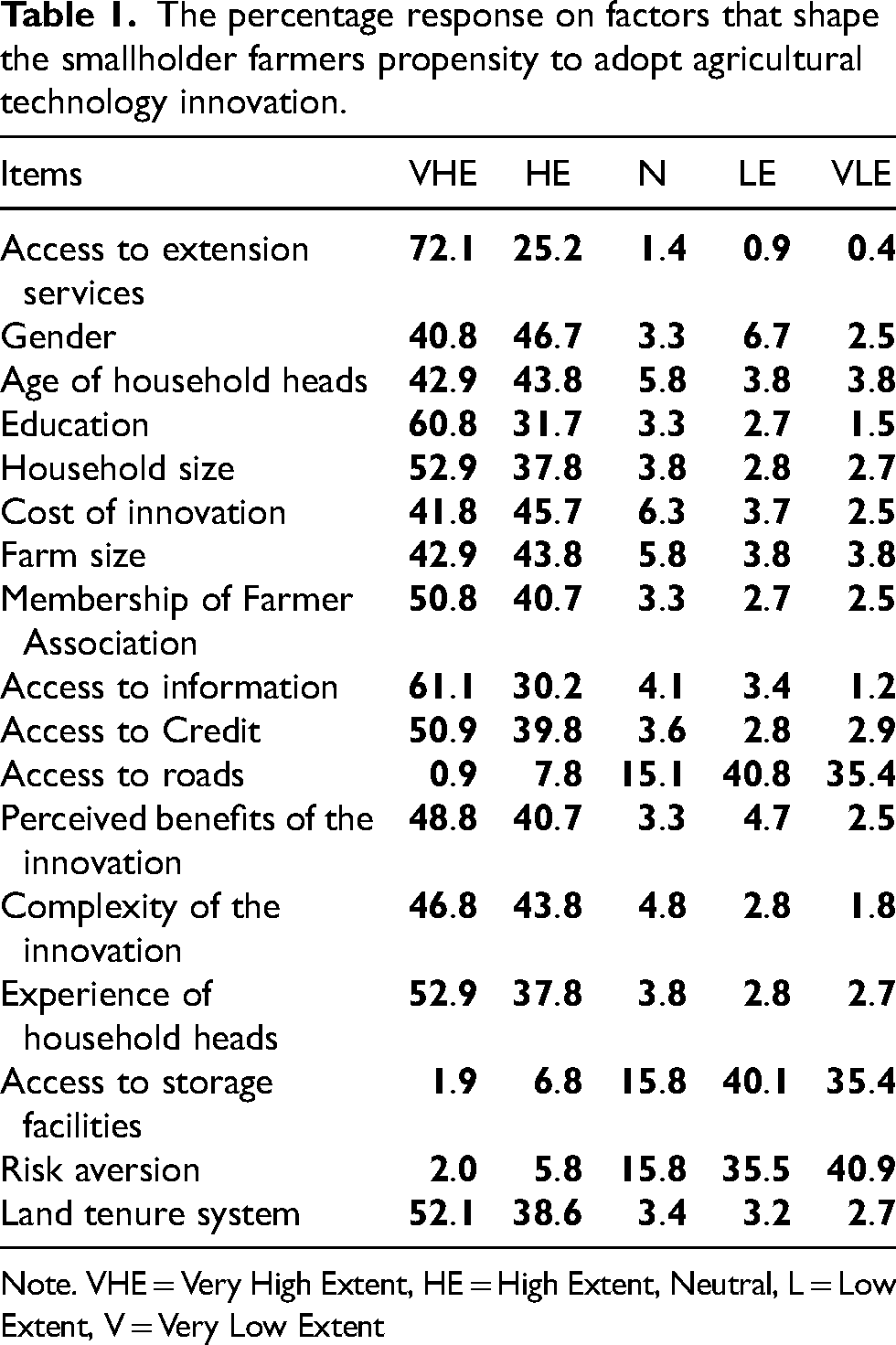
The percentage response on factors that shape the smallholder farmers propensity to adopt agricultural technology innovation.
Note. VHE = Very High Extent, HE = High Extent, Neutral, L = Low Extent, V = Very Low Extent
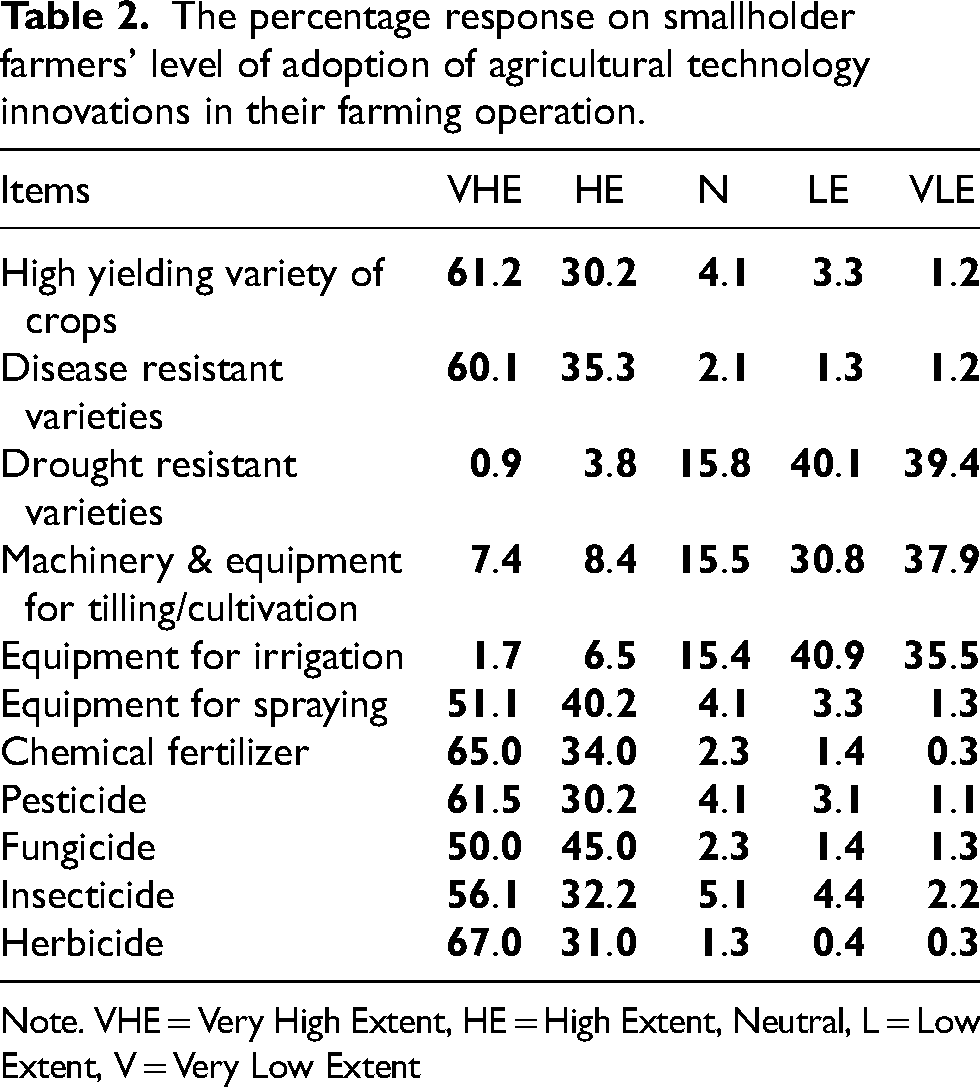
The percentage response on smallholder farmers’ level of adoption of agricultural technology innovations in their farming operation.
Note. VHE = Very High Extent, HE = High Extent, Neutral, L = Low Extent, V = Very Low Extent
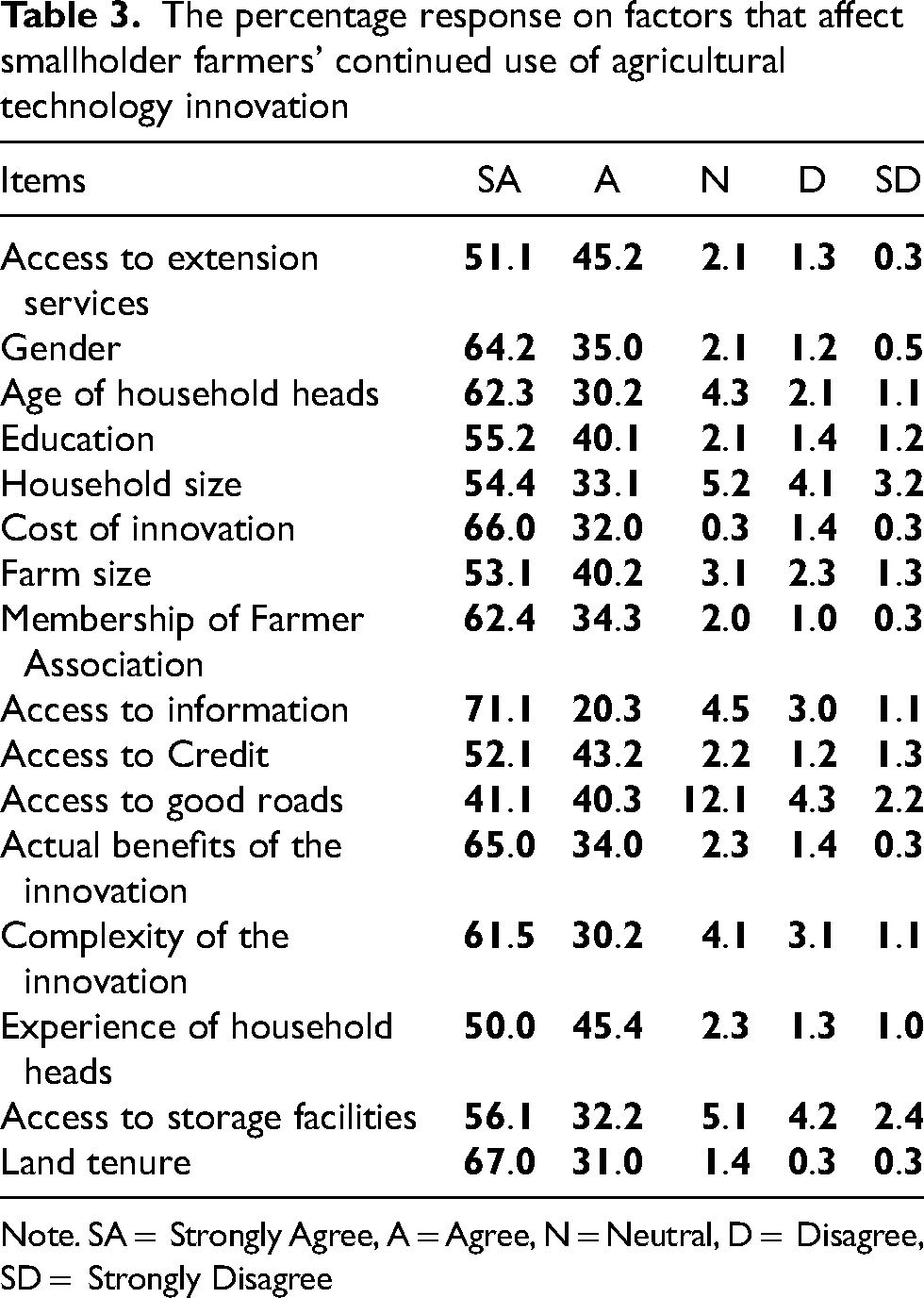
The percentage response on factors that affect smallholder farmers’ continued use of agricultural technology innovation
Note. SA = Strongly Agree, A = Agree, N = Neutral, D = Disagree, SD = Strongly Disagree
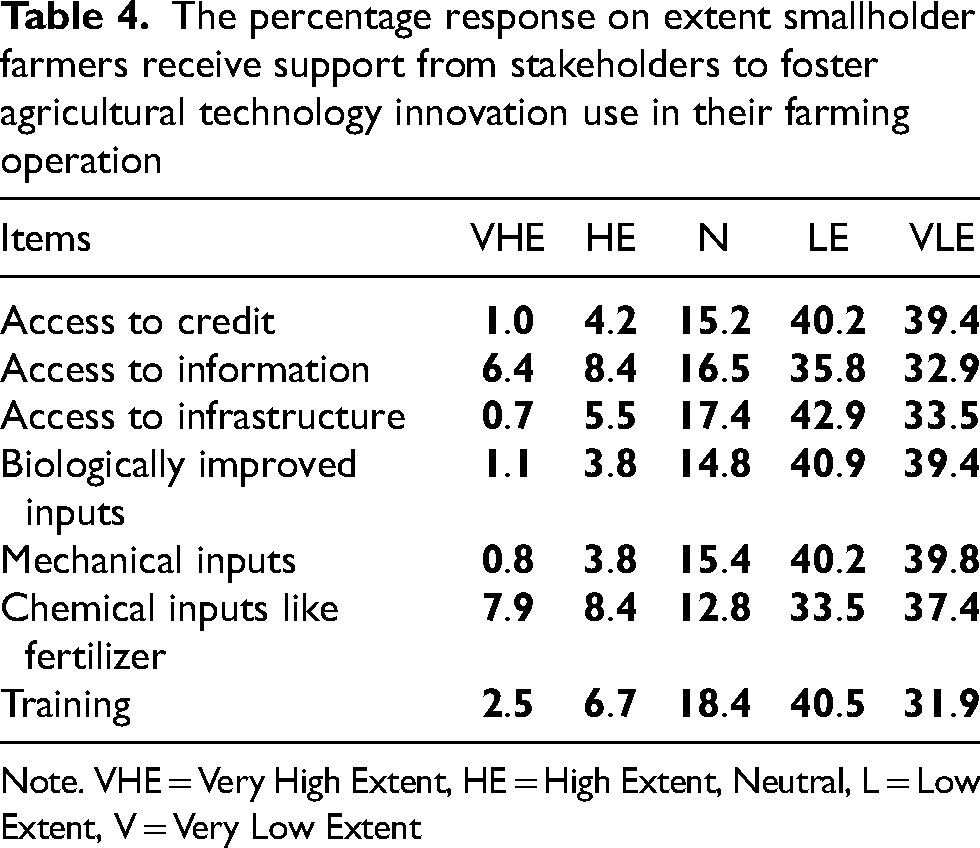
The percentage response on extent smallholder farmers receive support from stakeholders to foster agricultural technology innovation use in their farming operation
Note. VHE = Very High Extent, HE = High Extent, Neutral, L = Low Extent, V = Very Low Extent
The result from Table 1 reveals that the factors with a percentage score of above forty for “very high extent” in shaping the smallholder farmers’ propensity to adopt agricultural technology innovation are as follows: access to extension services, gender, age of household heads, education, household size, cost of innovation, farm size, membership of farmer association, access to information, access to credit, complexity of innovation, perceived benefits of innovation, experience of household heads and land tenure system while the factors with a percentage score of above thirty for “high extent” in shaping the smallholder farmers’ propensity to adopt agricultural technology innovation include; gender, age of household heads, education, household size, cost of innovation, farm size, membership of farmer association, access to information, access to credit, complexity of innovation, perceived benefits of innovation, experience of household heads and land tenure system. Apart from access to roads, access to storage facilities and risk aversion which have a percentage score of 40.8 and 35.5% for low extent and very low extent, every other factor rank below 7% for low extent and very low extent. The percentages responses for neutral were very minimal. The implication is that, there are many factors that need to be sorted out before smallholder farmers will be comfortable to access agricultural technology innovation. Be that as it may, they may be adopting agricultural technology innovation, but the degree may not be high or rather their output may be high enough to cushion the effect of food scarcity.
Table 2 revealed that the level of adoption of high yielding variety of crops, disease resistant varieties, and equipment used for spraying, chemical fertilizer, pesticide, fungicide, insecticide and herbicide were very high while drought resistance varieties, machine and equipment for tilling and equipment for irrigation was very low. The low level of adoption of machinery and equipment for tilling/cultivation could be as a result of small size of smallholder farmers’ holdings, which may be brought about by land tenure system. It can equally be as the result of the cost of the machines. It could be inferred from the result that Nigerian agriculture is basically rain fed because of low level of equipment for irrigation. One can assume that the modern equipment for spraying are being adopted by these smallholder farmers but it is equally good to mention that it could be nothing other than knapsacks though observation were not made. This could be assumed because since the level of adoption of machinery and equipment for tilling/cultivation was low, the farm land of the smallholder farmers may not enough to warrant higher equipment for spraying. Besides, the findings from table one revealed that the factors with a percentage score of above forty for “very high extent” in shaping the smallholder farmers’ propensity to adopt agricultural technology innovation include cost of innovation.
The result from Table 3 reveals that the factors with a percentage score of above forty for “strongly agree” in affecting smallholder farmers’ continued use of agricultural technology innovation above forty include access to extension services, gender, age of household heads, education, household size, cost of innovation, farm size, membership of farmer association, access to information, access to credit, access to roads, actual benefits of innovation, complexity of innovation, experience of household heads and land tenure system while the factors with a percentage score of above thirty for “agree” in affecting smallholder farmers’ continued use of agricultural technology innovation include access to extension services, gender, age of household heads, education, household size, cost of innovation, farm size, membership of farmer association, access to credit, access to roads, actual benefits of innovation, complexity of innovation, experience of household heads and land tenure system. The percentages response for neutral, disagree and strongly disagree were very minimal. This implies therefore that stakeholders in Nigeria agriculture have a role to play to improve continued use of agricultural technology innovation.
The percentage response on extent smallholder farmers receive support from stakeholders to foster agricultural technology innovation use in their farming operation on table one reveals the item for “very high extent” “high extent” and neutral was minimal while percentage response on “low extent” and “very low extent” were above thirty percent. The implication is that smallholder's farmers suffer a great deal in accessing agricultural technology innovation.
The finding on Table 1 revealed that education, size of land, access to credit, access to extension services, membership of farmer association, cost of innovation, age of household heads, complexity of the innovation, access to information, farm size, household size, level of experience and gender all contribute to a high extent the smallholder farmers’ propensity to adopt agricultural technological innovation while access to road, access to storage facilities and risk aversion all contribute to a low extent the smallholder farmers propensity to adopt agricultural technological innovation. The findings of this study corroborate with findings of Ruzzante et al. (2021), Danso-Abbeam et al. (2017), Ameh and Andrew (2017), Kaloi et al. (2021), Tura et al. (2010), Knight et al. (2003) and Nwachukwu (2017) who revealed that age of the household, level of experience, education, and extension contact influence the adoption of improved technology. The findings partly corroborate with Gershon et al. (2016) who reported that farmers who managed the postharvest losses were young, had formal education, and had fewer household members.
The fact that education shape smallholder farmer's propensity to adopt agricultural technological innovation have been upheld by Welch, (1970); Wozniak, (1984, 1987); Krueger, (1993); Lleras-Muney and Lichtenberg, (2002) who stated that highly educated workers tend to adopt new technologies faster than those with less education. It is as stated by Schultz (1981), that education influence adoption through increasing farmer's ability to ‘‘perceive, interpret, and respond to new events in the context of risk”. Besides, Feder et al. (1985), noted that ‘‘farmers with better education are earlier adopters of modern technologies” while Rogers (2003) stated that ‘‘earlier adopters have more years of formal education than do later adopters”. Just as Wozniak (1987) concluded, education and information reduce adoption costs and uncertainty, thereby upholding the probability of early adoption.
Household size being a factor that influences agricultural technology adoption has been upheld by Feder et al. (1985) who suggested that it is related to adoption of labour-intensive technologies. Household size is not only a factor in adoption of modern agricultural technologies but also in conventional method of farming. This is supported by Grabowski et al. (2016) who found that labour availability is the primary constraint in adoption of labour-intensive hand-hoe planting basins.
Feder (1982) divorced the idea that access to credit shapes adoption of innovation in all cases. The author argued that in the simplest case of a single divisible technology, lack of access to credit should not affect adoption. Ruzzante et al. (2021) stated that even households with very little cash will invest in technologies that provide high marginal returns. Be that as it may, Feder (1982) stated that in the case of two complementary innovations, improved varieties and tube wells, a lack of credit inhibits adoption of the lumpy (indivisible) investment (the tube well) which lowers the expected returns from (and discourages adoption of) the divisible technology.
In the case of size of land being a factor, Ruzzante et al. (2021) suggested that improved varieties may not be scale-neutral, as is generally believed. The authors noted that despite international recognition of the need to develop technologies appropriate for smallholders, larger farmers are still more likely to use the products of modern agricultural research. The implication is that most agricultural technology innovations targeted to smallholder farmers are most of the times more applicable to large scale farm. As their name suggest, they are smallholder farmers and a such should be treated in that way when it comes to agricultural technology production to make them use the technology to lift them up from the dungeon of small-scale production.
One should wonder why access to road and access to storage facilities do not affect smallholder farmers’ propensity to adopt agricultural technology but it could be that it is not directly attached to agricultural technology adoption. This could be that if there are access to extension workers and education, the propensity to adopt becomes within their reach. Likewise it is when they have bumper harvest that they start talking about storage facilities. Storage facilities could not be a factor when one does not yet have what to store.
Table 2 revealed the extent smallholder farmers adopt agricultural technological innovations in their farming operation. The table revealed that the most adopted agricultural technology innovation were chemical fertilizer, High yielding variety of crops, herbicide, disease resistance varieties, insecticide, fungicides and pesticides, equipment for spraying while there is low adoption of drought resistance, machinery and equipment used for tilling/cultivation and equipment for irrigation. The high percentage responses of these agricultural technologies adoption may be due to their wide diffusion which in itself results from a series of individual decisions to begin using the agricultural technology innovation. These decisions may be often the result of a comparison of the certain benefits of the agricultural technologies with the certain costs of adopting it. The low agricultural technology adoption as in the case of machinery and equipment used for tilling and equipment for irrigation may be circumscribed by land fragmentation which hinders farm mechanization and this has resulted to low production. Besides, Fadeyi et al. (2022) stated that smallholder agriculture in Africa is characterized by low production level which has been linked to the limited use of technologies.
Table 3 revealed that factors that affect smallholder farmers continued use of agricultural technology innovations to include actual benefit of innovation, access to extension services, access to credit, farm size, membership of farmer association, age of household heads, complexity of innovation, cost of innovation, experience of household heads and household size. The above variables constrain smallholder farmers’ continued use of agricultural technology innovation because it is the facilitating conditions that influence users’ propensity to continue using technology. The findings of this study corroborates with Tura et al. (2010) who found that asset endowment such as farmland allocated to maize, literacy of the household head, visits by extension agents, farmers’ experience and household land size were the factors that affect continued use of agricultural technology innovation and Amsalu and De Graaff (2006) who found that continued use is influenced by family size, farm size, was influenced by actual benefits of the innovation, farmers’ age and farm size. The finding shows that one may desire to continuously use agricultural technology innovation and may be constrained by many issues. The drivers of continued use of agricultural technology innovation are multi dimensional and multifaceted and may be rooted in unexpected shortfall of agricultural technological innovation introducers. While agricultural technology innovation introducers market them as a time-saving, labour-saving and yield-improving technology, smallholder farmers may have contrary experiences. This might be because many smallholder farmers lack sufficient technical support and encounter technological, social, institutional and economic challenges. These may also be coupled with unfulfilled expectations of the agricultural technology innovation. Therefore, these issues need to be settled to ensure continuous use of agricultural technology innovation already adopted to attain the height of its importance.
Table 4 revealed that smallholder farmers receive support on chemical inputs like fertilizer in less extent while access to credit, access to information, and access to infrastructure, biologically improved inputs, mechanical inputs and training in very low extent. Besides, according to Kassie et al. (2015), in Ethiopia, Kenya, Malawi and Tanzania, the adoption of sustainable intensification practices were influenced by the reliance on government support such as provision of inputs, advisory and technical services. The low support from government could be the reason smallholder farmers still complain of factors that drag them back from continuing to use agricultural technology innovation resulting to low agricultural production. Equally too, Food and Agricultural Organization (2020) noted that access to appropriate innovation, information and advisory services by smallholders and family farmers is a vital element in transforming agriculture and food systems and achieving the Sustainable Development Goals (SDGs). The introduction of anchor borrowers program notwithstanding, there is very low access to credit among the smallholder farmers. This could be that the program was targeted to rice farmers alone. Besides that, there were shortcomings such as late arrival of approval and disbursement of fund, there were aspects of ABP implementation arrangements that were still unclear due to limited awareness of programme implementation arrangements, roles of stakeholders were overlapping, updated database were still issues to be reckoned with, credible monitoring and evaluation framework were lacking and still cases of elite capture was prevalent.
Conclusion
Evidence has shown that the adoption and continued use of agricultural technology innovations by smallholder farmers has been linked to higher agricultural production, increased earnings, reduced poverty levels, improved nutritional status, and increased employment rate. But the findings of this study showed that the rate of agricultural technology adoption is shaped by a complex and dynamic interaction between the different factors revealed in the study. Some of these factors include education, land size, access to credit, access to extension services, membership of farmer association, and cost of innovation among others. It was equally revealed that most adopted agricultural technology innovation were chemical fertilizer, High yielding variety of crops, herbicide, disease resistance varieties, insecticide, pesticide, fungicides and pesticides, equipment for spraying. It was found that smallholder farmers’ continued use of agricultural innovation were affected by actual benefit of innovation, extension services, access to credit, farm size, membership of farmer association, age of household heads, complexity of innovation, cost of innovation, household size, experience of household heads and household size. The extent smallholder farmers receive support on agricultural technology innovation were very poor. The results provide perspectives and prospects to improve agricultural technology adoption and continued use in Benue state, Nigeria. The drive towards improving agricultural technology adoption and continued use among smallholder farmers can be achieved by formulating and implementing comprehensive policies that consider these dynamic relationships.
Policy recommendations
Based on the findings of this study the following policy recommendations are adduced to improve adoption and continued use of agricultural technology innovations among smallholder crop farmers:
First, prior to the introduction of agricultural technology innovation to smallholder farmers, the donor agents, government as well as all the stakeholders involved should carry out need assessment survey to determine its suitability. The result of the need assessment should be addressed before the introduction of the new agricultural technology innovation. This is to make sure that it fits into the local context of the smallholder farmers. According to Nhamo et al. (2014), if a technology does not fit into the local context of the smallholder farmer or if they do not perceive the advantages of using such technology, it might not be adopted or may have low adoption rate. Therefore, agricultural technology innovations should either be designed to meet the needs of the local smallholder farmers, or made to be adaptable to their needs.
Secondly, smallholder farmers should be trained on how to use agricultural technology innovation. Wanyama et al. (2016) in their study revealed that the slow rate of adoption was attributed to the lack of information available to the end-user smallholder farmers. This could be affected through programs such as field schools and training and visit extension systems.
Thirdly, there should be significant improvement in government support for the smallholder farmers in Benue state and Nigeria as a whole to encourage the adoption and continued use of agricultural technology innovation. Besides, Kassie et al. (2015) noted that in Ethiopia, Kenya, Malawi and Tanzania, the adoption of sustainable intensification practices were influenced by the reliance on government support such as provision of inputs, advisory and technical services. Stakeholders in agriculture, especially the government will be required to formulate and implement policies that encourage smallholders to adopt and continuously use agricultural technology innovations.
Furthermore, improving the availability, accessibility and affordability of access to credit (finance) can accelerate the adoption and continued use of agricultural technology innovation. Fisher and Carr (2015), Maliki et al. (2017), Oyinbo et al. (2019) revealed that due to the poor availability and accessibility of affordable finance, smallholder farmers in Africa are unable to effectively adopt new technologies. Access to credit is a major limiting factor that will need to be resolved in order to improve agricultural technology adoption and use among smallholder farmers in Benue state, Nigeria. This is because it has been identified as the basic foundation for successful technology adoption in Africa.
Limitations of the study and suggestions for future research
This study is limited by gender and education. It was difficult to reach some women because Muslim among them does not feel free to be identified. Gender has continued to an issue in agricultural sector in the developing countries, especially in area of farming. According to Anaglo et al. (2014), men and women continue to have differential access to agricultural resources despite the seemingly equal roles they play in agriculture in many developing countries. Though this has to do with information access, but the same problem applies when one want to obtain women's opinion in Muslim communities. Women folk, despite their dominance in agricultural activities in many developing countries were dominated in terms of getting their view in what concerns them.
The level of education of the rural farmers was also very low thereby causing some delay in explaining the contents of the structured interview which sometimes involved the use of vernacular. It should be recognize that extension services in developing countries are many at times inadequate, making educating the uneducated difficult. Apart from that, the institutional relationships between agricultural teaching and research and extension services are inadequate. All the same time, smallholder farmers need to air their views and access information at this digital age. Thus, education is the best option to accelerate giving out information among smallholder farmers and it facilitates the rural development by bringing the social and economic changes.
Study on how culture of certain people will be improved to pave way for acceleration of smallholder farmer view should be carried out. Study on how to improve extension agents to educate smallholders should also be carried out. An extension of this study should be carried out in other agricultural regions. A further study to identify some latent factors on adoption and continued use of agricultural technology innovations among smallholder crop farmers should also be undertaken.
