







Abstract
In today's technology-driven healthcare landscape, AI competencies are essential for medical students. This study assessed AI literacy and online information search (OIS) skills among 336 students from 12 public medical institutions in Sindh, Pakistan. The survey revealed strong AI literacy in areas such as hardware, software, data literacy, content creation, safety, and problem-solving, but students struggled with understanding AI errors. They also demonstrated sufficient behavioral, procedural, and meta-cognitive competencies in online information searching. A significant positive correlation between AI literacy and OIS skills was found, indicating that higher AI literacy improves students’ search abilities. These findings underscore the need to integrate AI-related skills into medical education to better prepare students for the evolving healthcare environment. The study offers insights for AI developers, AI vendors, medical educators, librarians, medical institution administrators, and policymakers on how they can play a significant role in enhancing AI literacy and search competencies in medical education.
Introduction
Artificial intelligence (AI) is permeating almost every sector associated with service providing and manufacturing of goods, i.e., agriculture, social media, marketing, banking, real estate, metrology, automobile production, medicine and health care providing defense, libraries, and education (Almatrafi et al., 2024; Chui et al., 2018; Gursoy et al., 2019; Kong et al., 2024; Kong et al., 2021; Laupichler et al., 2022; Mughari et al., 2024; Yetisensoy and Rapoport, 2023). Similarly, AI has a potential role in effective teaching, learning, and developing essential knowledge and competencies among students to participate in the technology-rich and AI-driven contexts to leverage business value. AI adoption increases students’ capacity for personal learning and growth (Faqih, 2023). Although AI has transformed the entire educational landscape by introducing a variety of modern tools and techniques for learning, the effective use of AI still requires students to have knowledge and competencies related to AI to understand the hardware and software, communicate with AI, and collaborate it with others as well as create and recognize AI-generated content, identify safety related issues, need-based customization of AI, AI problem-solving, information and data organizing skills (Kennedy, 2023). In response to this, AI literacy has emerged as a key “set of competencies that enables individuals to critically evaluate AI technologies, communicate and collaborate effectively with AI, and use AI as a tool online, at home, and in the workplace” (Long and Magerko, 2020, p. 2).
AI literacy is a relatively new and emerging concept. However, it is not distinct from data literacy, critical literacy, and information literacy, rhetorical literacy, technology literacy, social and functional literacy (Garingan and Pickard, 2021; Kajiwara and Kawabata, 2024; Mughari et al., 2024; Ng et al., 2021; Yi, 2021). Ng et al. (2023) recognized AI literacy as lower and higher-order critical thinking skills to understand AI processes that capacitate students to assess AI's fairness, accountability, transparency, safety, and ethics. Students need AI literacy to interact harmoniously with intelligent machines for learning and working collaboratively (Cetindamar et al., 2022; Kong et al., 2021; Laupichler et al., 2022). It makes students independent learners (Yi, 2021) and facilitates them in disciplinary core subjects learning (Casal-Otero et al., 2023). AI literacy modifies students’ attitudes toward adopting AI and its’ appropriate, protected, and ethical use (Kajiwara and Kawabata, 2024). It enables students to judge AI-generated content (Kong et al., 2021) and prepare them for future jobs (Long and Magerko, 2020; Ng et al., 2021; Southworth et al., 2023) to effectively contribute to society in this technological era (Kong et al., 2024). However, the potential role of AI and AI literacy has been recognized in redefining education to foster sustainable students’ academic, personal, and professional development and growth. Hence, researchers in Pakistan reported an embryonic stage of AI and AI literacy trends and its adoption for teaching and learning in academic institutions (Mughari et al., 2024). Therefore, an empirical investigation is needed to assess the perceived AI literacy among medical students in Pakistan and to enlighten the role of AI literacy in redefining Pakistan's medical and healthcare landscape.
Students need information to complete their assignments and homework and succeed in exams to meet academic standards. However, compared to the traditional environment, the retrieval of authentic, reliable, and valid information in a short length of time from dynamic online information resources requires students to have specific competencies (Çoklar et al., 2017; Tsai et al., 2012) to navigate online information using sophisticated tools and techniques. The prior studies recognized different online information search (OIS) competencies, allowing individuals to access the needed information online. For example, Evans et al. (2010) stressed that social tactics effectively gather information, including network and targeted asking and searching. However, Tsai and Tai (2003) proposed three three-dimensional structures that provide behavioral, procedural, and metacognitive strategies and further subdivided these three dimensions into seven subsets such as the (I) behavioral competency includes (a) disorientation that is defined as “learners’ self-awareness of their searching orientation,” and (b) control, which refers to “skills required for manipulating the Internet searching applications.” Similarly, (II) the procedural strategy consists of (c) trial and error that includes “skills in trying different search approaches” and (d) problem-solving, referred to as the “skills and commitment to overcome problems or frustrations resulting from searching.” Likewise, (III) the metacognitive strategies are composed of (e) purposeful thinking defined as “skills required for search process self-monitoring,” (f) select main ideas illustrating the “skills to identify key concepts of information searched from the Internet,” and (g) evaluation explained as the “skills to judge and organize information obtained from the Internet” (Tsai, 2009, p. 474). Searching for information online is an important phenomenon that has attracted many researchers assessing students’ OIS competencies globally. However, in the Pakistani context, the researchers mainly focused on students’ information-seeking and search patterns and behaviors (Haider and Ya, 2021; Khan and Khan, 2020; Tariq et al., 2018), and only a single reference emerged from the extensive search of literature assessing OIS skills among business students in Pakistan (Tariq et al., 2018). Therefore, the research merits an empirical study evaluating perceived OIS competencies among medical students in Pakistan. Similarly, the perceived significance of OIS competencies among students captured the wide attention of individuals and researchers to ascertain the factors that potentially predict students’ ability to search for information online. Some of the identified factors include information literacy, digital literacy, writing and reading skills, internet self-efficacy, ICT, technical and digital skills, and some personal variables, i.e., gender, age, level, and program of study (Atoy et al., 2020; Avcı and Yıldız Durak, 2022; Çoklar et al., 2017; Hahnel et al., 2020; Henry, 2005; Wu, 2014). These studies broadly demonstrated the connection between OIS competencies and AI literacy, including other literacies and technology skills. However, no research has empirically connected AI literacy and OIS competencies. Hence, the arguments justify the research examining the connection between AI literacy and OIS competencies among medical students in Pakistan.
Based on the ongoing arguments, it is ascertained that no study has empirically investigated the perceived AI literacy and online information search competencies among medical students in Pakistan. Likewise, research in the past has theorized a connection between students’ OIS competencies and AI literacy. Hence, the dearth of research justifies an empirical study measuring medical students’ perceived AI literacy, OISS, and the connection between students’ AI literacy and OIS competencies in Pakistan to propose AI literacy teaching and training to equip students with competencies to navigate online information confidentially and successfully. The unit of medical students was selected because medical science embraces AI for effective healthcare delivery and anticipates producing medical practitioners with sufficient knowledge and competencies related to cutting-edge technologies such as AI to deal with and diagnose medical complications and develop sophisticated solutions. The current research is designed to meet the following research objectives (ROs): RO1 – To determine the perceived AI literacy among Pakistani medical students RO2 – To assess the perceived online information search competencies among these students RO3 – To investigate the relationship between AI literacy, behavioral, procedural, and metacognitive competencies and, RO4 – To examine the effect of AI literacy on behavioral, procedural, and metacognitive competencies among medical students in Pakistan.
Related research and hypotheses development
AI literacy
However, AI literacy is an emerging concept. Hence, a significant body of literature has developed in the last few years that defines and explains AI, AI literacy, its’ dimensions/parameters for assessment, potential implications and portrays various frameworks and hindrances in the effective utilization of AI and AI literacy practices for teaching and learning (Chiu et al., 2024; Kong et al., 2024; Long and Magerko, 2020; Salhab, 2024). Similarly, considering the potential of AI and AI literacy, researchers and academicians assessed AI-related awareness, competencies, and AI literacy practices among individuals belonging to varied contexts, i.e., Laupichler et al. (2022) synthesized the published literature in the Scopus database, which found an infancy stage of AI literacy in academic institutions. Similarly, Sperling et al. (2024) explored and reviewed existing literature to identify AI literacy in teachers’ education. The study found that AI literacy was the topic of interest among researchers; hence, the research found a gap in evaluating AI literacy in teachers’ education. Likewise, Mughari et al. (2024) investigated the influence of AI literacy on librarians’ work performance, and Salhab (2024) analyzed teachers’ perspectives on AI literacy. For instance, the research examining the state of AI literacy among students to impart AI literacy includes the study of Eguchi et al. (2021), who initiated research on AI literacy among k-12 students in Japan, and Eguchi (2021), who conducted the assessment of AI literacy among students of grades 5 and 6. Druga et al. (2019) also described the essence of AI literacy for Kids’ learning. Su et al. (2023) in their study investigated AI literacy in early childhood education and depicted hindrances in imparting AI literacy among young students. Another qualitative study concluded that students face difficulties in problem-solving related to AI; they lack knowledge and understanding of AI, whereas students with a deep understanding of AI, perceived the usefulness of AI in work and tasks at the meta-level (Alamäki et al., 2024). Laupichler et al. (2024) in his study reported a positive attitude and understanding of AI use and practice and discrepancy skills among medical students. However, the research depicted a lower AI literacy among female medical students than their male counterparts. Lee et al. (2021) in his study reported the worth of hands-on training about AI for developing students’ attitudes and AI concepts. Adequate research exists in the available literature evaluating AI literacy among students at various primary, middle, secondary, undergraduate, graduate, and postgraduate levels; however, the population gap still lies as no investigation has undertaken the evaluation of AI literacy among Pakistan's medical students.
State of online information search (OIS) competencies and interconnected factors
Searching online information is a preferred first option among students to access various information sources in multimedia formats with minimal effort (Kose and Kocak, 2024). This triggered researchers’ interest in evaluating students’ OIS competencies and the factors that increase or predict their OIS competencies. Given this, Tariq et al. (2018) examined and revealed a satisfactory level of OIS skills among business students in Pakistan. Undergraduate students were better in evaluation, trial, and error, purposeful thinking, selecting main ideas, problem-solving, and controlling competencies in OIS (Çoklar et al., 2017). Zhu et al. (2011) also found high online information seeking among high school students. Ay and Erdem (2020) depicted a moderate online information searching strategy (OISS) level in their study. Kulaksız (2023) tested the praxeological learning approach for pre-service teachers and found that the model significantly increased pre-service teachers’ knowledge and online information-seeking strategy. Reisoğlu et al. (2020) depicted that university students’ OISS was not as anticipated. Tekedere and Göker (2023) revealed a high perceived OISS among students.
AI literacy and factors predicting online information search competencies
The perusal of research articulated various factors associated with OISS. In a research inquiry, Atoy et al. (2020) found that students’ information-searching strategies depend on their digital literacy skills. Kose and Kocak (2024) also studied and found that students’ digital literacy predicts their online information searching (OIS) competencies. Goal-oriented web searching experience, decision-making, and epistemological beliefs predict individuals’ OIS competencies (Çevik, 2015). Balamana (2016) depicted that regular metacognitive guidance affected OIS in locating valid, authoritative information and information analysis, evaluation, and decision-making while accessing information among individuals. Nursing students’ innovativeness had a positive and moderate connection with their online information-searching competencies in Turkey (Ozden et al., 2019). Gecer and Ira (2015) reported that students utilize advanced information search strategies to search for information in a web-based context. Likewise, several other personal, cultural, and socio-psychological factors influence OIS competencies among students (Kose and Kocak, 2024). While an empirical study does not explicitly evaluate the connection between AI literacy and OIS competencies, the available literature provides a broader association between AI technology, different types of literacy, and OIS competencies. For example, Çoklar et al. (2017) depicted that students’ information literacy (IL) was highly correlated with their OIS competencies, while Avcı and Yıldız Durak (2022) found students’ IL and digital technology skills were the strong predictors of their OIS strategy. Similarly, Tekedere and Göker (2023) exhibited that students’ digital literacy had a positive and significant connection with their OIS strategy. The results of Tsai et al. (2021) showed that students’ computational thinking literacy was correlated with their OIS competencies. Aesaert and Van Braak (2015) revealed that students had high technical ICT competencies about digital information searching. In their study, Curtis et al. (1997) found that medical practitioners use electronic databases and technologies to search for the needed information. Intelligent systems and ICTs assist in online seeking and searching for information (Puustinen and Rouet, 2009). Kawano (2000) emphasized the integration of information visualization technologies in search engines to help individuals in information search query formulation. Oranç and Ruggeri (2021) ascertained the role of voice command AI technology in searching and retrieving information. Asim et al. (2023) also asserted that AI-featured voice commands help individuals search and translate information contents. Ali et al. (2020) depicted that individuals use AI technology for information retrieval in Pakistan. Similarly, (Ali, 2024) described the power of ChatGPT for information retrieval.
Although these studies provided an understanding of the broader relationship between AI literacy, other types of literacies, and OIS competencies, there is still a notable knowledge gap for an empirical investigation focusing on AI literacy and OIS competencies among medical students in developing countries like Pakistani perspective. Therefore, this study intended to address the gap, following hypotheses thus postulated: H1 – AI literacy among medical students exerts a positive and significant effect on their behavioral competencies H1 – AI literacy among medical students exerts a positive and significant effect on their procedural competencies, and, H1 – AI literacy among medical students exerts a positive and significant effect on their metacognitive competencies
Methodology and procedure
Method
This research is primarily designed to evaluate the perceived AI literacy and OIS competencies and investigate the hypothesized association between the study variables. Considering the nature of this study and its focus on testing the hypotheses, the quantitative approach based on a survey method is deemed appropriate (Creswell, 2012). Similar survey techniques were also utilized by prior research assessing AI literacy in distinct contexts (Mughari et al., 2024). The survey questionnaire was composed of 51 items, i.e., 22 items on AI literacy, 25 items measuring OIS competencies, and 4 items concerning medical students’ personal information
Population, sample size, and sampling technique
The population of this study was comprised of 24 hundred medical students enrolled in 12 public sector medical institutions recognized by the Pakistan Medical and Dental Council (PMDC) and the Higher Education Commission (HEC) in Sindh, Pakistan. These 12 public sector medical institutions were selected due to their significant contribution in providing quality medical education, research, and healthcare support to the local community of Sindh, Pakistan. The researchers followed Krejcie and Morgan's (1970) proposed equation to draw the appropriate sample out of the selected medical population. The equation include S = d2⋅ (N−1)+X2⋅P⋅(1−P)X2⋅N⋅P⋅(1−P) and computed as:
N = 2400 total population
X2 = 3.841Chi squire (95%) confidence level with 1 degree of freedom
P = 0.5 assumed proportion for sample size
d = 0.05 (5%) assumed margin of error
Of 24 hundred enrolled medical students, the sample of 331 students was determined using Krejcie and Morgan's (1970) proposed sampling equation. Hence, the researchers distributed 336 questionnaires (28 questionnaires in each medical institution) among a total of 12 public sector medical institutions for unbiased representation of medical students in Sindh, Pakistan. The selected medical students were recruited through a convenient sampling technique due to the unavailability of student lists and their availability in medical institutions simultaneously.
Research instruments
AI literacy
A researcher should explore the prior literature to determine if an instrument exists, is validated, is reliable, and is aligned with the research objective (Mertens, 2010). Given this, an extensive search was made, demonstrating various instruments measuring AI literacy among individuals across various contexts (Biagini et al., 2024; Carolus et al., 2023; Laupichler et al., 2023; Wang et al., 2023). However, seven dimensions, i.e., hardware and software, two items; information and data literacy, three items; communication and collaboration, four items; content creation, two items; safety, four items; and three items measuring career competencies, in total 22 items developed by Kennedy (2023) was selected for this study. This scale was chosen because it addressed the critical parameters of AI literacy proposed by the UNISCO Digital Literacy Global Framework which was rooted in the Digital Literacy Theory by Gilster (1997). Acknowledging the theory, Kennedy (2023) incorporated the essential parameters of AI into the framework to guide individuals to not only develop the skill set but also critically assess and engage in AI technology by considering its’ contextual, social, and ethical implications. Moreover, the scale was apprised and selected due to its coherence, comprehensiveness, and conciseness, making it distinct from the other scales measuring AI literacy and an appropriate fit for the present research investigation. The studies in past varying populations also utilized a similar instrument measuring AI literacy and found the instrument suitable having a high reliability and validity (Mughari et al., 2024).
Online information search strategy inventory (OISSI)
The respondents’ online information search (OIS) competencies were evaluated through 3 dimensions, i.e., behavioral, procedural, and metacognitive competencies consisting of 25 items. These dimensions were further split into behavioral competencies, including disorientation, four items; control, four items; procedural competencies, three trial and error, three items; and problem-solving, 3 items. At the same time, metacognitive competencies comprised purposeful thinking 4 items, selecting main ideas 3, and evaluation of information 4 items designed by Tsai (2009) grounded in the Metacognitive Theory introduced by Flavell (1978). Tsai (2009) inspired and acknowledged the theory and designed the OIS competencies framework to assess OISS among students of diverse academic settings, making it a versatile tool for assessing OIS competencies in different contexts. Further, this scale was widely acknowledged by past studies such as Ay and Erdem (2020) and Çoklar et al. (2017). Adopting this scale allows for a rigorous examination of various dimensions of OIS competencies among medical students.
Reliability and validity of the measures
Before testing the hypothesized relationships, the validity and reliability of the measures were ensured. Standardized factor loadings, composite reliability (CR), and Cronbache's alpha (a) were calculated to establish the reliability. A value of 0.7 and higher is recommended for CR and a to meet the reliability assumption (Hair et al., 2019). A value of 0.3 and above for factor loadings indicates the item's correlation and reliability significance. However, the calculated CR and a way for AI literacy were 0.964 and 0.961, while the observed CR and a for OIS competencies were equal to 0.966 and 0.912. Similarly, observed factor loadings for both variables, i.e., AI literacy and OIS competencies ranged from 0.560 to 0.810 within the proposed thresholds in Tables 1 and 2.
Perceived online information search competencies.
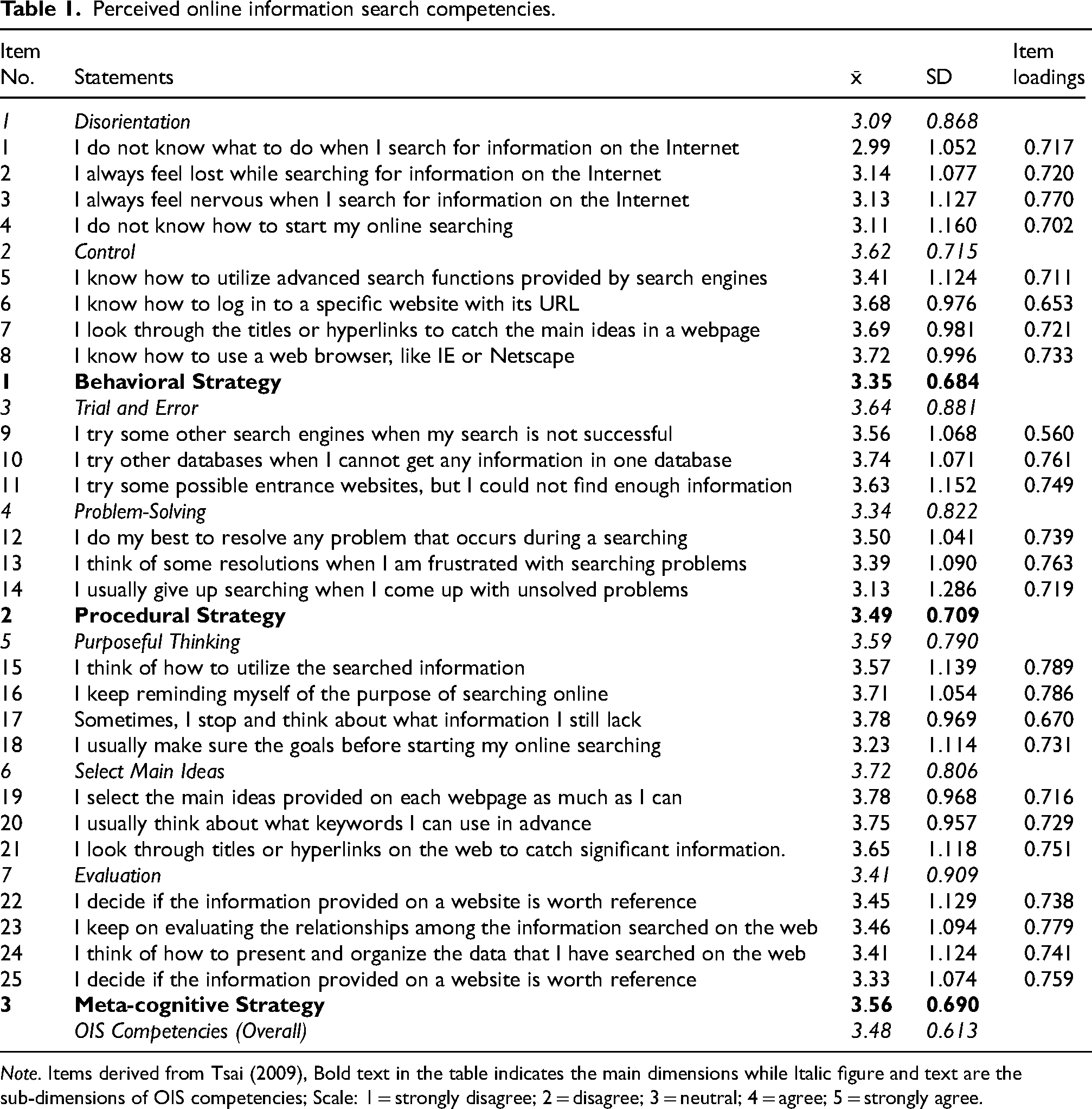
Note. Items derived from Tsai (2009), Bold text in the table indicates the main dimensions while Italic figure and text are the sub-dimensions of OIS competencies; Scale: 1 = strongly disagree; 2 = disagree; 3 = neutral; 4 = agree; 5 = strongly agree.
Validity and reliability statistics for the research measures.

Convergent and divergent validity
Similarly, the convergent and divergent validity of the measures was judged using average variance extracted (AVE). AVE is a vital statistic for convergent and divergent validity (Byrne, 2013). The cut-off value for AVE is suggested to be 0.5 and higher to determine whether the measures are valid. Likewise, Fornell and Larcker (1981) proposed that AVE's squire root (√) should be greater than the observed correlation between the variables to assume that the measures hold divergent validity. In this study, the performed AVE was recorded to be within the recommended range of 0.5 and higher for AI literacy and OIS competencies. Likewise, the √ AVE was also more significant than the observed correlation between the study variables 0.665** in Table 2, presenting the validity of both measures and allowing for further statistical computation.
Collection of the data and analyses
The researchers visited each selected medical institution in person to collect data by seeking permission from their competitive authorities. They distributed 28 paper-based printed questionnaires among students in each medical institution. The researchers requested the selected respondents to voluntarily participate in this research by assuring them of the anonymity, confidentiality, and usability of their given data for this research project. Of 336 (100%) distributed questionnaires, the researcher received 330 (98.21%) responses in return within four months, from March to June 2024. The collected questionnaires were carefully screened to identify if there was an incomplete, missing response. Confirming the suitability and completeness of the collected data, the researchers used a Statistical Package for Social Sciences (SPSS-25) and MS Excel worksheet for statistical calculations such as Cronbach's alpha (a), composite reliability and factor loading for reliability, average variance extracted for convergent and divergent validity, frequency (f) and percentage (%) for research participants’ demographic information, mean (x̄) and standard deviation (SD) to assess their perceived AI literacy and OIS competencies, the Pearson's product-moment (r) to assess the correlation and simple linear regression model (β) was applied to investigate the effect of AI literacy (predicting variable) on OIS competencies (response variable) among medical students under following headings:
Results
Demographics
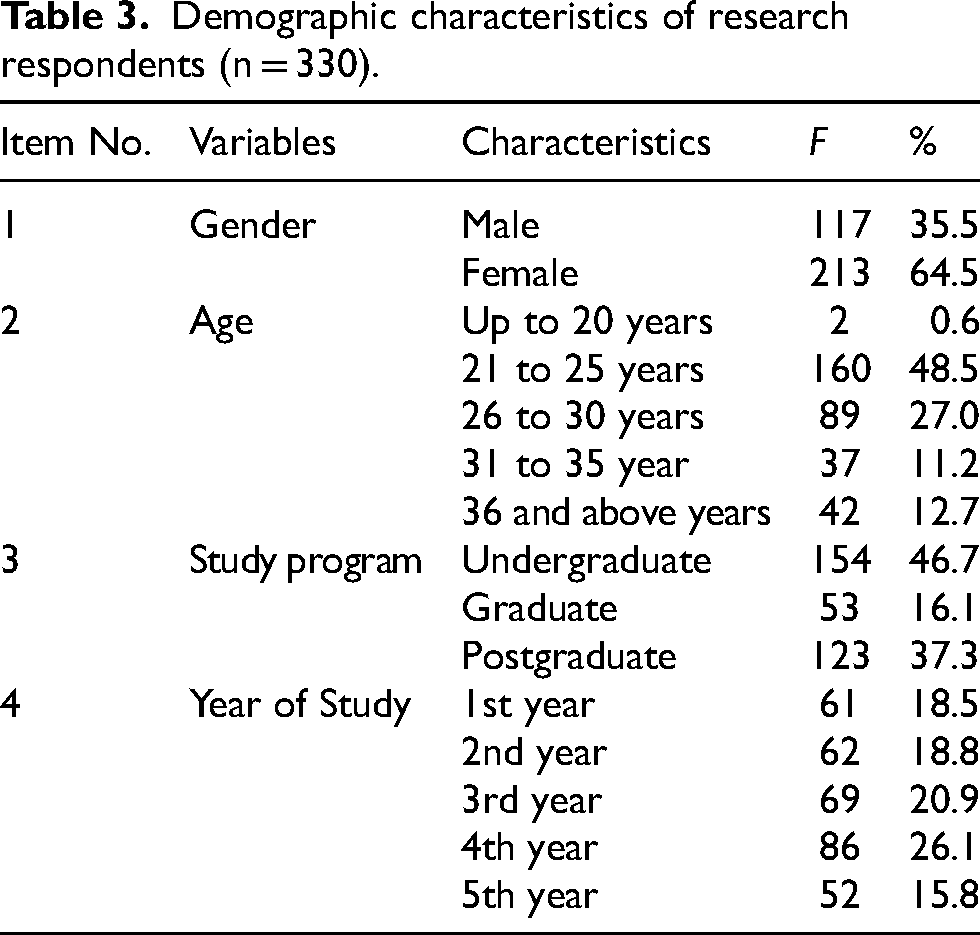
The demographic characteristics of the research respondents are exhibited in Table 3. Of 330, 117 (35.5%) male and 213 (64.5%) female medical students participated in this study. A large number of 160 (48.5%) students were between the age bracket of 21 to 25 years, followed by 89 (27.0%) 26 to 30 years, 42 (12.7%) 36 years and above, and only 2 (0.6%) students were up to 20 years old. 154 (46.7%) were pursuing their undergraduate studies in medical science, 53 (16.1%) graduated, and 123 (37.3%) were enrolled in postgraduate medical studies. Regarding their year of study, the majority of students had 4th year of their studies, followed by 69 (20.9%) had 3rd year, 62 (18.8%) 2nd year, 61 (18.5%) 1st year, and only 52 (15.8%) students had 5th year of their studies in medical sciences.
Demographic characteristics of research respondents (n = 330).
RO1 – perceived AI literacy
The medical students rate their perceived AI literacy on 22 statements using a five-point Likert scale of 1 to 5, demonstrating strongly disagree to strongly agree in Table 4. The cumulated mean (x̄) and standard deviation (SD) for perceived AI literacy revealed that these students perceived AI literacy was high x̄ = 3.35; SD = 0.828 as these medical students had the perspective of hardware and software (x̄ = 3.25; SD = 0.974), Information and data literacy (x̄ = 3.36; 0.944), communication and collaboration AI with others (x̄ = 3.46, SD = 0.953), content creation (x̄ = 3.28; SD = 0.991), safety (x̄ = 3.35; SD = 0.964), problem-solving (x̄ = 3.29; SD = 0.858) and career competencies (x̄ = 340, SD = 0.965). However, the item-by-item analyses indicated that these medical students responded neutrally to recognize output errors and inconsistencies (x̄ = 2.89, SD = 1.093).
Perceived AI literacy.
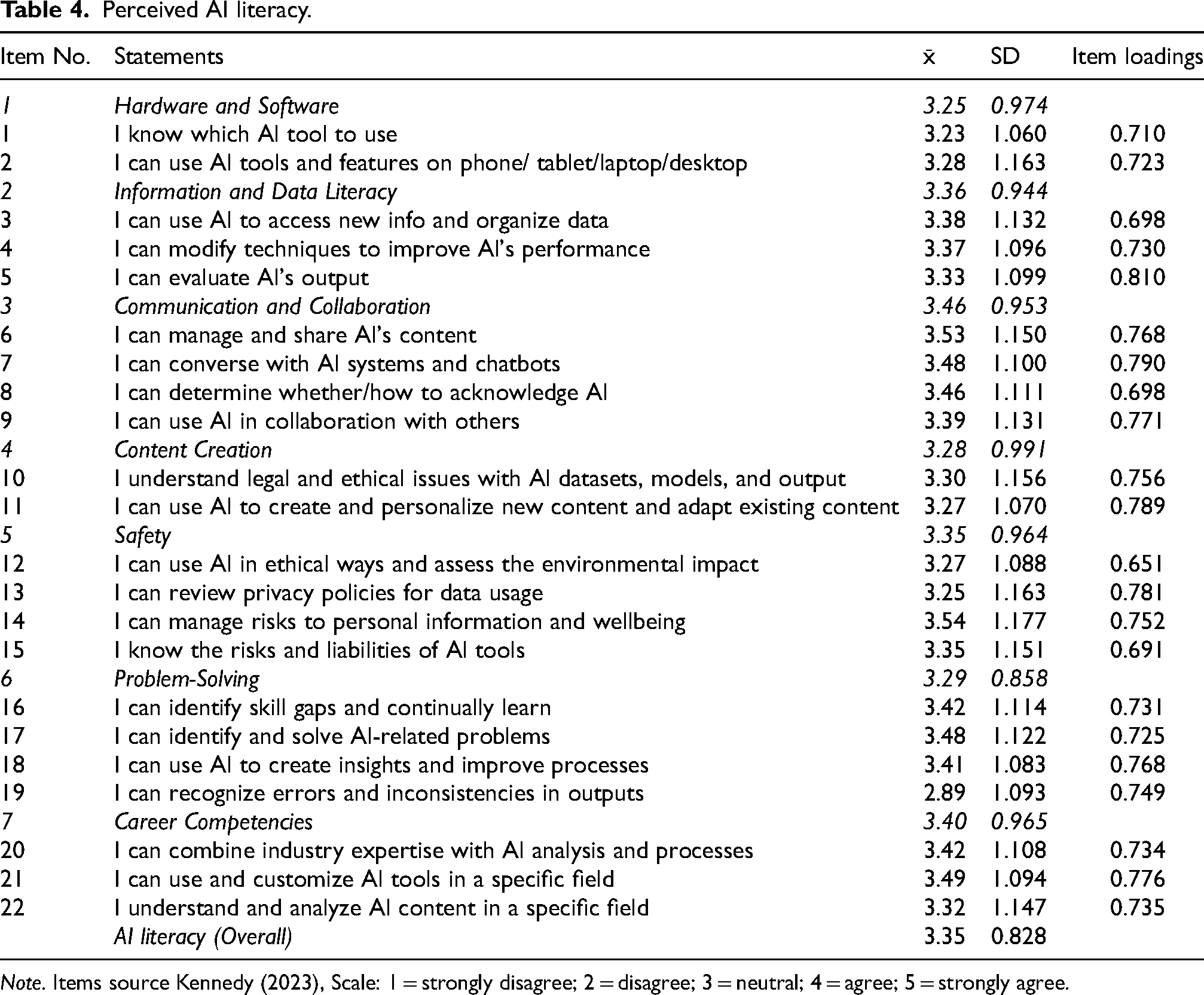
Note. Items source Kennedy (2023), Scale: 1 = strongly disagree; 2 = disagree; 3 = neutral; 4 = agree; 5 = strongly agree.
RO2 – perceived online information searching (OIS) competencies
The medical students opined that their perceived OIS competencies on 25 statements consisted of 3 main dimensions using a five-point Likert scale (e.g., 1 = Strongly Disagree to 5 Strongly Agree) in Table 1. The composite mean (x̄) and standard deviation revealed that these students’ perceived OIS competencies were high (x̄ = 348, SD = 613). Similarly, these students the perceived high behavioral strategy (x̄ = 3.35; SD = 0.684), Procedural strategy (x̄ = 3.49; SD = 0.709) and metacognitive strategies (x̄ = 3.56, SD = 690) of OIS competencies. Sub-dimension-wise analyses depicted that these students responded neutrally to all four statements related to the disorientation sub-dimension of the behavioral strategy of OIS competencies.
Validity and reliability statistics
RO3 – correlation matrix
The correlation between medical students’ AI literacy, behavioral, procedural, and metacognitive strategy of OIS competencies was examined using Pearson Product Moment (Pearson's r) in Table 5. The results indicated a positive and significant correlation between AI literacy and behavioral competencies, with r equal to 0.826**, procedural competencies observed to be r equal to 0.359**, and metacognitive competencies recorded equal to 0.747**.
Correlation matrix.
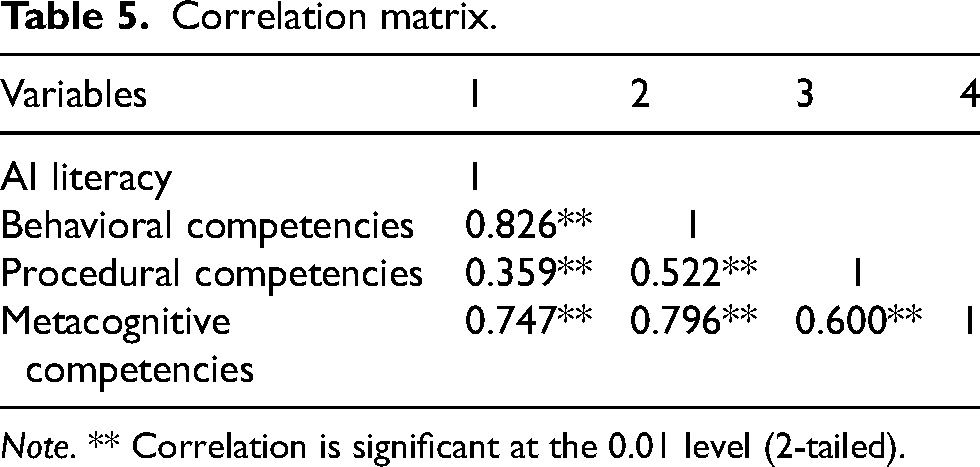
Note. ** Correlation is significant at the 0.01 level (2-tailed).
RO4 – effect of AI literacy on behavioral, procedural, and metacognitive competencies
A simple linear regression model was calculated to investigate the effect of AI literacy on behavioral competencies (H1), procedural competencies (H2), and metacognitive competencies (H3) among medical students. The AI literacy was regressed on behavioral competencies, which resulted in β = 0.826, P < 0.000, indicating a significant and positive effect of AI literacy on behavioral competencies with R2 equal to 0.683, which suggests that AI literacy 68.3%, explaining the positive change in student's behavioral competencies accepting H1 in Table 6. Similarly, the regression model employed to evaluate the effect of AI literacy on a procedural strategy revealed a significant and positive impact of AI literacy on students’ procedural competencies with β = 0.359, p < 0.000, with R2 = =0.129, which indicates that AI literacy causes 12.9% of positive change in procedural competencies confirming H2 (Table 6). Moreover, students’ AI literacy appeared to be a positive and significant predictor of their metacognitive competencies with β equal to 0.747, p < 0.000, and R2 = 0.558, which indicates that AI literacy of these students can positively change their metacognitive competencies by 55.8%. These results also confirmed the H3 (See Table 6).
Regression analyses.
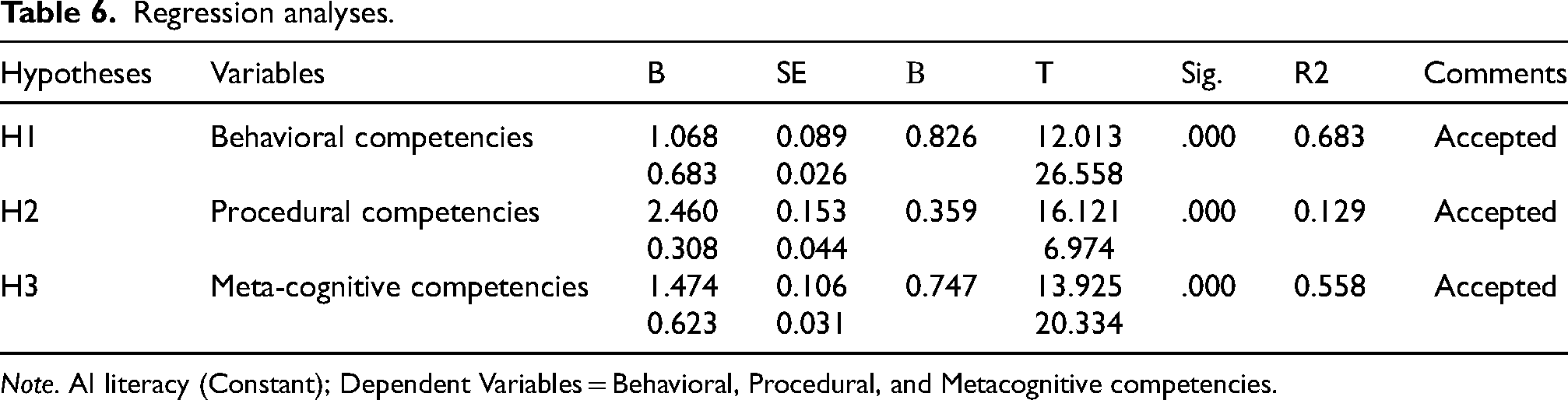
Note. AI literacy (Constant); Dependent Variables = Behavioral, Procedural, and Metacognitive competencies.
Discussion
The mean and standard deviation were performed to analyze the perceived AI literacy and OIS competencies among medical students in Pakistan. The results revealed that medical students had enough perspectives related to hardware and software about AI, they had information and data literacy, they were capable of communicating with AI and collaborating it with others, creating content through AI, understood safety related to AI, and career competencies such as customization of AI according to their needs. However, these students needed more AI problem-solving competencies, i.e., to recognize errors and inconsistencies in AI outputs. The findings about AI literacy provide insight to medical educators and librarians to strengthen students’ AI literacy for the effective execution of AI practices. However, the emergence of these medical students as AI literate is surprising as past studies found that AI literacy is an emerging concept and is at an embryonic stage in academic institutions in Pakistan and abroad (Asim et al., 2023; Laupichler et al., 2022; Mughari et al., 2024). Perhaps these medical students had learned about AI through practicing their information, digital, computer, or technology literacy, as AI literacy has a remarkable resemblance with such types of literacies (Diseiye et al., 2024; Ng et al., 2021; Wong et al., 2020). The notion is also supported by Anjum et al. (2022) and Mughari et al. (2023), who found high literacy competencies among university students in Pakistan. The respondents’ high perceived AI literacy could also be an overestimation of their perceived AI literacy, the Dunning-Kruger effect may be considered when verifying the results and future studies can investigate the phenomena by employing other methods. However, these findings align with the findings of Laupichler et al. (2024), who revealed adequate AI-related understanding among medical students.
Concerning the OIS competencies, the research found high behavioral, procedural, and metacognitive competencies among these medical students in Pakistan, except disorientation, a sub-dimension of behavioral competencies. Students with adequate OIS competencies start their search for information confidently, and they understand where they can find the information of their interest without feeling lost and nervous. Moreover, it appeared that these students search for information purposefully, apply different search queries, solely or collaboratively handle the search problems, control their online information search, select main ideas from their search, and evaluate the searched information to meet their information needs. These results are similar to those Çoklar et al. (2017) demonstrated in their study assessing OIS competencies among undergraduate students.
As assumed, the AI literacy of medical students had a positive and significant effect on their behavioral, procedural, and metacognitive competencies. These results must be corroborated with future research inquiries due to the novelty aligned with these findings. However, the existing research somehow supports these results such as Çoklar et al. (2017) and Tsai et al. (2012) asserted that searching for information online requires students to have knowledge and skills, and AI literacy is one of the critical competencies that empower students with the ability to use AI for search query formulation, compare multiple information resources, assist searching various databases and websites using advance searching techniques, troubleshooting when an error occurs during information search. Intelligent systems and technology assist individuals in seeking and searching for information online (Puustinen and Rouet, 2009). These results are logical because AI technologies, i.e., ChatGPT, Copilot, and other AI tools, help in searching for needed information. Oranç and Ruggeri (2021) have also reported that AI, such as Alexa voice commands, helps search and retrieve information. The findings of Asim et al. (2023) also support these findings, who stressed that AI voice command is essential for searching and translating information and other contents. Ali et al. (2020) endorsed these results by finding that individuals in Pakistan use AI-assisted technologies to locate, search, and retrieve information.
Conclusion and impact of the research
Based on the analyses, this investigation concluded that the medical students had a high perceived AI literacy and behavioral, procedural, and metacognitive competencies. Moreover, their AI literacy appeared to be a positive and significant predictor of their behavioral, procedural, and metacognitive strategy for OIS. This means that AI literacy can foster sustainable behavioral, procedural, and metacognitive online information search competencies among medical students. Theoretically, these findings filled the population and knowledge gap in the existing literature concerning the interconnection between AI literacy and OIS competencies among Pakistani medical students. Practically, these findings would surely lead medical educators in effective teaching and learning for the essence of AI in medical education. Moreover, the research findings provide insight to medical librarians to consider AI-related assistance and training to strengthen students’ AI literacy, allowing them to surf online for information from dynamic information resources to perform excellently in medical education and practice ahead. In this regard, medical librarians should collaborate with medical educators to deliver adequate AI-related knowledge and skills. Furthermore, these findings are vital for AI designers and developers in designing a users’ friendly AI interfaces, AI's integration with online databases and other resources, and for providing necessary training in this regard by considering AI challenges, social and academic ethics, security-related issues and privacy (Faqih, 2023). Additionally, these results are also insightful for the medical institutions’ administrators and policymakers to consider the integration of AI literacy courses into the medical curriculum regardless of undergraduate, graduate, and postgraduate medical studies to equip future doctors and healthcare providers with imperative knowledge and competencies for the cutting-edge technology so that they can perform with excellence and adapt themselves with rapidly transforming technology landscape.
Limitations and directions for future research
Despite the several strengths, this has some limitations that may be considered. Researchers often discourage the self-assessment method used in this research for being biased toward respondents’ honesty (Mughari et al., 2023; Mughari et al., 2024). Moreover, the research respondents’ AI literacy and OIS competencies appeared to be high, which could be their overestimation and may be deemed as the Dunning-Kruger effect (Schlosser et al., 2013) so future researchers may consider other methods i.e., a qualitative or mixed method to undertake the examination of both variables. Lastly, this research investigated the perceived AI literacy among medical students at the surface level, hence the gap still lies as there is a dearth of an in-depth exploration into what methods and techniques students utilize to critically evaluate the AI-generated (invent, hallucinated, unsupported, and inconsistent) information. The investigation in the future can extend the scope of the present study by including medical students from across the country or conducting the AI literacy investigation among different populations (e.g., engineering, business, or science students). Future research inquiries may also examine the relationship of AI with personality traits, creativity, innovation, task performance, and personal and psychological variables.
Footnotes
Authors’ note
Shahzeb Mughari (Librarian) is my second author for this study, as supported me in writing – review and editing and writing the initial draft of this study.
Declaration of conflicting interests
The author(s) declared no potential conflicts of interest with respect to the research, authorship, and/or publication of this article.
Funding
The author(s) received no financial support for the research, authorship, and/or publication of this article.
