







Abstract
The present research investigates how information literacy (IL) drives student engagement in Pakistan's higher-learning business institutions by examining its effect on student engagement. Data were collected via a survey-based questionnaire from 390 business students enrolled in thirteen Higher Education Commission (HEC) ranked business institutions, selected using non-proportional stratified sampling, and analyzed using SPSS-24. The analysis revealed high perceived information literacy and student engagement, encompassing academic, online, cognitive, social (with teachers peers), beyond-class, and affective engagement. Correlation analysis indicated a significant positive correlation between IL and student engagement, including their sub-dimensions. The results also demonstrated a significant positive effect of IL on overall student engagement. Theoretically, this study contributes to the literature by exploring the connection between IL and student engagement comprehensively. Practically, the findings highlight the importance of IL and offer insights for business educators, librarians, information professionals, and accrediting bodies in developing and integrating a need-based, credit IL course and time-to-time IL sessions across all levels of business education.
Introduction
Higher educational institutions aim to elevate students’ interpersonal skills (Abid and Akhtar, 2020), determination, retention, understanding, motivation, academic productivity, innovation, intellectual ability, optimism, interest in learning, enjoyment, achievement, and academic performance (Alrashidi et al., 2016; Alshuaibi et al., 2018; Appleton et al., 2006; Iqbal et al., 2021; Sattar et al., 2019; Zhoc et al., 2020). In a rapidly changing information landscape and educational environment, information literacy (IL) has emerged as a catalyst for educational change (Bruce, 2004). The Chartered Institute of Library and Information Professionals (CILIP) (2018, para 1) defined IL as “the ability to think critically and make balanced judgments about any information we find and use”. IL forms the basis for education at all levels and fosters students’ continuous growth for independent learning (Chanchinmawia and Verma, 2018) by producing enduring learners and analytical minds (Asiedu et al., 2020). It ensures students’ deep learning (Baji et al., 2018), plays a positive role in their transition from school to higher-learning academic institutions (Smith et al., 2013), and increases their cognitive skills (Bartol et al., 2018). Information literate students locate, organize, and use information effectively to satisfy their learning needs (Malanga, 2017). It empowers students with critical skills for independent lifelong learning (Salleh et al., 2011); assists them in completing their research projects, and academic programs, and helps them in recognizing job opportunities (Oo, 2020). IL equips students with essential learning skills that make them self-directed, independent, critical, and analytical learners. It also assists them in developing their confidence to participate in class activities and learning processes enthusiastically such as class discussion and presentation, and develops their positive attitude towards their teachers and peers for their academic growth and betterment. It also enhances their group learning capabilities, increases their urge to be regarded as the best student in their institution which makes them goal-oriented, and decreases their fear of failing in exams (De Meulemeester, 2013; Loo et al., 2016; Mughari et al., 2023; Naveed et al., 2023a, 2023b). Anderson and May (2010) and Conley and Gil (2011) also recognized IL as a higher-order cognitive ability that aids intellectual development. Similarly, Matteson and Farooq (2013) and Matteson (2014) found a close resemblance and correlation between IL and cognitive factors such as analysis and synthesis of information and knowledge, comprehension, evaluation, and application of knowledge. Nevertheless, despite the paramount significance of IL in student engagement, a comprehensive review of the literature by the authors revealed that an empirical study lacks the investigation into the intersection between information literacy and students’ engagement including various subsumes of students’ engagement such as academic engagement (AE), online engagement (OE), cognitive engagement (CE), social engagement with teachers (SET) and peers (SEP), beyond-class engagement (BE) and affective engagement (AFE) particularly in Pakistani higher learning business institutions.
Student engagement is a multidimensional meta-construct (Zhoc et al., 2019). Hu and Kuh (2002) defined student engagement as “the quality of effort students themselves devote to educationally purposeful activities that contribute directly to desired outcomes” (p. 555). Researchers in the prior literature labeled various interchangeable terms to define student engagement e.g., students’ cognition, emotion, behaviors, thinking, and feeling. Various student engagement models have also been devised by researchers in the literature to understand the factors affecting their success, school completion, and dropouts. These models include the two-factor model by Finn and Zimmer (2012), the three-factor model by Fredricks et al. (2004), and the five-factor model by Zhoc et al. (2019). However, this study adopted a five-factor model of student engagement as this model allowed researchers to comprehensively investigate student engagement by focusing on its broader sub-dimensions such as AE, OE, CE, SET, SEP, BE, and AFE. Academic engagement refers to “the observable behaviors that are directly related to the learning process (e.g., their time and effort spent in study)” (Zhoc et al., 2020, p. 841); online engagement is “students’ use of information technologies (including both the internet and other digital technologies) to support learning” (Zhoc et al., 2019, p. 224); cognitive engagement is defined as “the cognitive energy spent to learn, understand and master the knowledge” (Zhoc et al., 2020, p. 841); social engagement with teachers and peers refers to “the interaction with friends, peers, and teaching staff within the academic and social spheres of institutions” (Zhoc et al., 2020, p. 841); beyond-class engagement refers to “students’ involvement in navigating the social world within and beyond their university” (Zhoc et al., 2020, p. 842); affective engagement refers to “the feelings of involvement in the institution as a place and a set of activities worth pursuing” (Zhoc et al., 2020, p. 842). Despite the importance of student engagement in academics, there is a lack of comprehensive studies that support educators in enhancing student engagement both within and outside the classroom, including in online environments, particularly in a developing country's context.
Existing research exhibited a relationship of IL with a lot of other related variables such as student engagement, general learning, motivation, course-related satisfaction, class participation, building teacher-student relationships, developing cognitive strategies for learning, academic problem solving, and self-efficacy and learning engagement, emotions and cognitive engagement and recognition of self-directed opportunities (Aharony and Gazit, 2020; Dolničar and Podgornik, 2023; Li et al., 2023; Loo et al., 2016; Malenfant and Brown, 2017; Martin et al., 2010), albeit, the existing studies do not comprehensively represent the relationship of IL with students’ engagement’. Likewise, in the Pakistani context, an empirical study lacks examining the interconnection between IL and student engagement including its dimensions such as AE, OE, CE, SET, SEP, BE, and AFE. Therefore, the present study intends to explore the connection between these variables. The relationship between information literacy (IL) and various dimensions of student engagement can provide valuable insights for business educators, librarians, information professionals, and business education accrediting bodies. This understanding can enhance the effectiveness of IL in fostering student engagement in both academic learning and extracurricular activities. A proportion of business students was chosen for this study because they are motivated, self-directed, independent, disciplined, and invest time and money in their learning (Fish and Snodgrass, 2015). Additionally, the research findings will offer practical insights for business education providers, informing policy and practice related to IL in business institutions.
Research objectives
The present study intends to address the following research objectives (ROs):
Theoretical background
The theoretical framework of this study revolves around the key constructs central to this study. One pivotal construct is information literacy, anchored in the Information Literacy Self-Efficacy Scale (ILSES) developed by Kurbanoglu et al. (2006). Since its inception in 1974, information literacy has evolved within a body of literature encompassing various standards and models that define and elucidate individuals’ systematic and haphazard approaches to information and its effective utilization. The ILSES is grounded in Bandura's (1977) social cognitive theory, highlighting self-efficacy as pivotal in influencing motivation and behavior. This theory posits that individuals’ beliefs in their capabilities to perform specific tasks shape how they confront challenges, invest effort, and persist through difficulties. Kurbanoglu et al. (2006) adapted this concept to IL, underscoring self-efficacy's critical role in managing information effectively in a society increasingly saturated with information. The ILSE quantifies individuals’ confidence in executing these tasks, providing insights into their readiness for proficient information-seeking and utilization behaviors.
Another key construct addressed in this study is student engagement, drawing from the Higher Education Student Engagement Scale (HESES) developed by Zhoc et al. (2019). The theoretical foundation of HESES is rooted in engagement theory, as articulated by Miliszewska and Horwood (2004), which asserts that student engagement is pivotal for both academic achievement and personal growth. Engagement encompasses behavioral, emotional, and cognitive components, each contributing uniquely to the overall engagement process. Zhoc et al. (2019) expanded upon this tripartite model by incorporating additional dimensions that capture the multifaceted nature of engagement in contemporary higher education settings. Their scale includes metrics for participation in learning activities, interactions with peers and faculty, emotional investment, and the application of learning strategies, among others. This holistic approach aligns with the broader literature on student engagement, emphasizing the necessity of considering both in-class and out-of-class experiences in understanding and fostering student engagement effectively.
Review of literature and hypotheses development
Information literacy and student engagement
A large body of research has revealed that IL positively and significantly predicted various aspects of student engagement such as engagement in general, technology-enhanced learning, and general academic learning (Avcı and Ergün, 2022; Bergdahl et al., 2020; Kuh and Gonyea, 2015; Prior et al., 2016). Continuous delivery of IL instruction enhances students’ learning and engagement (Arnone et al., 2011). ACRL-based components of IL standards for higher education have an association with student engagement such as questioning and contribution in-class activities, presentations, collaborative project writing, preparing assignments, and discussing emerging ideas from learning (Mark and Boruff-Jones, 2003). Parsons and Taylor (2011) described the exemplary role of IL in shaping student engagement in learning. The use of library and library resources is significant in building students’ learning engagement (Cribb and Holt, 2012; Walsh, 2014). Gibson (2006) also discussed a connection between IL and students’ engagement. Research in the existing literature investigated the connection between IL and different aspects of student engagement. Hence, no study has examined the relationship of IL with student engagement holistically encompassing their AE, OE, CE, SET, SEP, BE, and AFE. Conclusively, this research postulates the following hypothesis:
This is the main hypothesis of the present study; and keeping in view the sub-dimensions of student engagement i.e., AE, OE, CE, SET, SEP, BE, and AFE, the following sub-hypotheses are framed out.
Information literacy and academic engagement
A plethora of literature has examined the individuals’ IL and its effect on certain phenomena regardless of contexts (e.g., academia, daily life, and workplace). However, the literature lacks empirical evidence for the connection between IL and academic engagement. In addition, some previous studies have conceptualized the association between IL and academic engagement. For instance, Kuh and Gonyea (2003) revealed an association between the frequent use of libraries, information resources, and students’ academic engagement. Gratch-Lindauer (2007, 2008) depicted a positive connection between IL and students’ writing, speaking, analytical & critical thinking, and learning. Mondschein (2007) explored that a problem-based approach to IL instruction impacted students’ active learning, class participation, and willingness for teamwork and discussion. Foelske (2014) also found a connection between IL and writing, and twenty-first-century skills. IL focuses on students’ deeper learning and overall academic development (Buchanan et al., 2016). Loo et al. (2016) revealed that IL in conjunction with flipped instructions increases students’ satisfaction, self-driven learning, class participation, and discussion enabling them to have self-directed opportunities. Students’ problem-based IL learning promotes their academic engagement (Mondschein, 2007). Students’ knowledge of information formats has a connection with their academic engagement (Martin et al., 2010). IL has a significant impact on student's motivation, academic and general learning, and on their course-related satisfaction (Malenfant and Brown, 2017). Based on the arguments, one can consider a relationship between IL and academic engagement. However, empirical research lacks support for the relationship between IL and academic engagement of business students particularly in the context of a developing economy like Pakistan. Therefore, the following hypothesis is developed:
Information literacy and online learning engagement
An increase in students’ IL improves their online learning (Chen et al., 2010). Robinson and Hullinger (2008) found a relationship between improvement in computer skills and students’ online class taking. Information literacy (IL) equips individuals with the skills to create and distribute content via social media and online communities (Mackey and Jacobson, 2011). According to Li et al. (2023), students’ IL, academic emotions, and self-directed learning are positively correlated and serve as predictors of their online learning engagement. Specifically, IL has a positive impact on students’ engagement in online learning (Li et al., 2023). Enormous studies with varied findings exhibited an association between IL and online learning excluding business students’ engagement in online learning tasks. Therefore, this study formulated the following hypothesis:
Information literacy and cognitive engagement
According to Anderson and May (2010), IL is recognized as a high-order intellectual skill (cognitive skills). Studies in the literature presented similarities between various dimensions of IL and cognitive engagement (Aharony and Bronstein, 2014; Keene et al., 2010; Reece, 2005). Aharony and Gazit (2020) conceptualized a connection between students’ information and their cognitive strategies. Cognitive engagement includes problem-solving and learning of complex ideas, and difficult skills (Avcı and Ergün, 2022). It is ascertained based on the research in the literature that theorized an association between IL and cognitive engagement. Hence, a piece of empirical evidence is needed to claim the relationship between IL and cognitive engagement among business students. In this regard the following research hypothesis is anticipated:
Information literacy and social engagement with teachers and peers
Information literacy creates students positive personal and social changes (Tewell, 2015), engages them in social subjects, and develops their capacity for questioning (Cope, 2010). Social engagement includes students’ relations with teachers and peers (Esposito et al., 2022). Likewise, IL enhances students’ sense of relationships with teachers, peers, and each other within academic and social belongings. However, no study has empirically examined the relationship between IL and social engagement with teachers, peers, and beyond-class engagement, especially in the context of business students. Therefore, the following hypotheses are proposed:
Business students’ information literacy has a positive and significant effect on their social engagement with teachers (H1d) and peers (H1e).
Information literacy and affective engagement
Research on student engagement identified affective engagement as emotional engagement (Alrashidi et al., 2016; Archambault et al., 2009) as it shares similar features related to students’ positive and negative sense towards academics (e.g., academic works, teachers, and classmates). Emotional engagement encompasses various emotions related to teachers, peers, trust, belonging, anxiety, and anger (Avcı and Ergün, 2022). IL helps students manage their emotions concerning academics, and it has the potential for students’ affective experiences (Matteson and Farooq, 2013). Based on these arguments, the following hypothesis is proposed:
Research methodology and procedure
This research intended to investigate the effect of information literacy on student engagement. A quantitative research method based on a cross-sectional survey was used to approach the intended participants for data collection. The survey method was used as it was useful to reach out geographically dispersed population (Creswell, 2012). The survey questionnaire comprised 62 items taking its ambit information literacy (28 items), and student engagement (28 items) with 4 items for each subsume of student engagement; however, 6 items were added for participants’ demographic profile
Population, sampling, and sampling size
The population of the current research was composed of approximately 20,000 business students enrolled in thirteen HEC-times-ranked business institutions in Pakistan. These business institutions were selected due to their dedication and expertise in business education in Pakistan. A sample of 384 students was determined through Yamane's (1967) sampling equation, however, it was decided to distribute 390 copies of the questionnaire (e.g., 30 in each business institution among the thirteen) to maximize the generalizability. The selected participants were approached through non-proportional stratified sampling.
Research measures
Information literacy (IL)
Research in the literature lacks a uniform measure to assess business students’ information literacy (Michalak and Rysavy, 2016). However, a large number of studies that assessed students’ IL adopted the Information Literacy Self-Efficacy Scale (ILSES) developed by Kurbanoglu et al. (2006). Therefore, the study in hand also adopted ILSES which is composed of seven dimensions related to students’ IL. The reason for utilizing ILSES was due to their reportedly high reliability (a = 0.92) which makes it reasonable to be used for students’ information IL assessment.
Student engagement (SE)
The measures related to student engagement were adopted from the Higher Education Student Engagement Scale (HESES) developed by Zhoc et al. (2019). Each subsume of student engagement consists of four items. The measure for student engagement was adopted due to their reasonable length of items, recency, and structure. Each item of student engagement was measured on a five-point Likert scale ranging from 1 to 5 denoting strongly disagree to strongly agree.
Reliability of the measures
The reliability of the measures was ensured through Cronbach's alpha (CA). The observed CA for ILSES was 0.871. The higher the CA value means higher the internal consistency and reliability of the measures (Mathews et al., 2019). Likewise, the composite reliability (CR) of the measures was observed as 0.954. Similarly, all the values of CA and CR for HESES were also in the acceptable range of threshold values as proposed by Hair et al. (2019) such as CA and CR for AE were 0.827 and 0.896, respectively; for OE, 0.840 and 0.886; for CE, 0.817 and 0.871; for SET, 0.814 and 0.891; for SEP, 0.803 and 0.831; for BE, 0.798 and 0.867 and for AFE, 0.776 and 0.821. However, the overall CA and CR for student engagement were 0.856 and 0.966, respectively.
Convergent validity
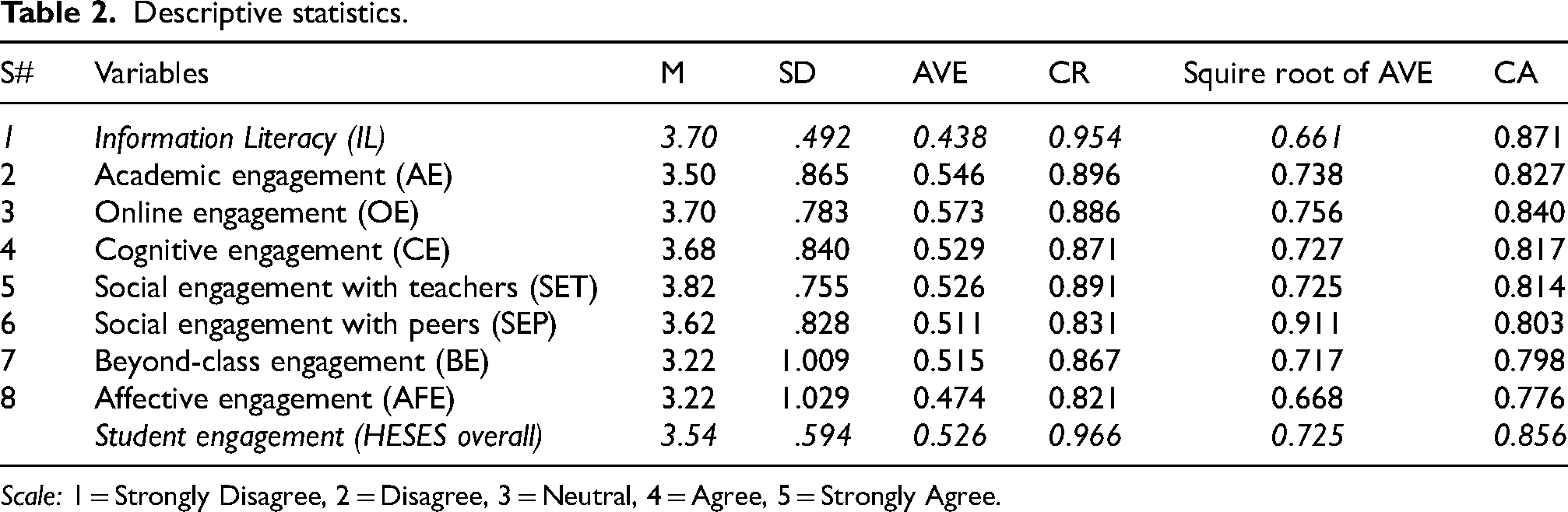
Average variance extracted (AVE) is a proposed test to determine the convergent validity of the measures. The threshold value for AVE nearer to 5 (if CR ≥ 0.7) is considered to be acceptable (Mughari et al., 2023). The AVE values for the ILSES and HESES demonstrated 0.438 and 0.526 which were nearer to the proposed value. Hence, the convergent validity of all the adopted measures is satisfactory (Table 2).
Discriminant validity
According to Fornell and Larker (1981), the square root of AVE higher than the correlation between variables demonstrates that the measure is discriminately valid. Table 2 exhibits that the square root of AVE for all the variables is higher than the correlation between the study variables i.e., IL = 0.661, AE = 0.738, OE = 0.756, CE = 0.727, SET = 0.725, SEP = 0.911, BCE = 0.717, AFE = 0.668 and overall, HESES = 0.725 demonstrated that measures are discriminately valid.
Data collection and analyses
The researchers personally visited each selected business institute with the permission of concerned authorities located in three provinces of Pakistan (Punjab, Sindh, and Khyber Pakhtunkhwa). The participants were assured of data confidentiality and anonymity and were requested to fill out the questionnaires voluntarily. Against a total of 390 copies of the questionnaire distributed, 385 (98.7%) complete usable responses were received during four to five months and analyzed through SPSS-24.
Results
Demographics
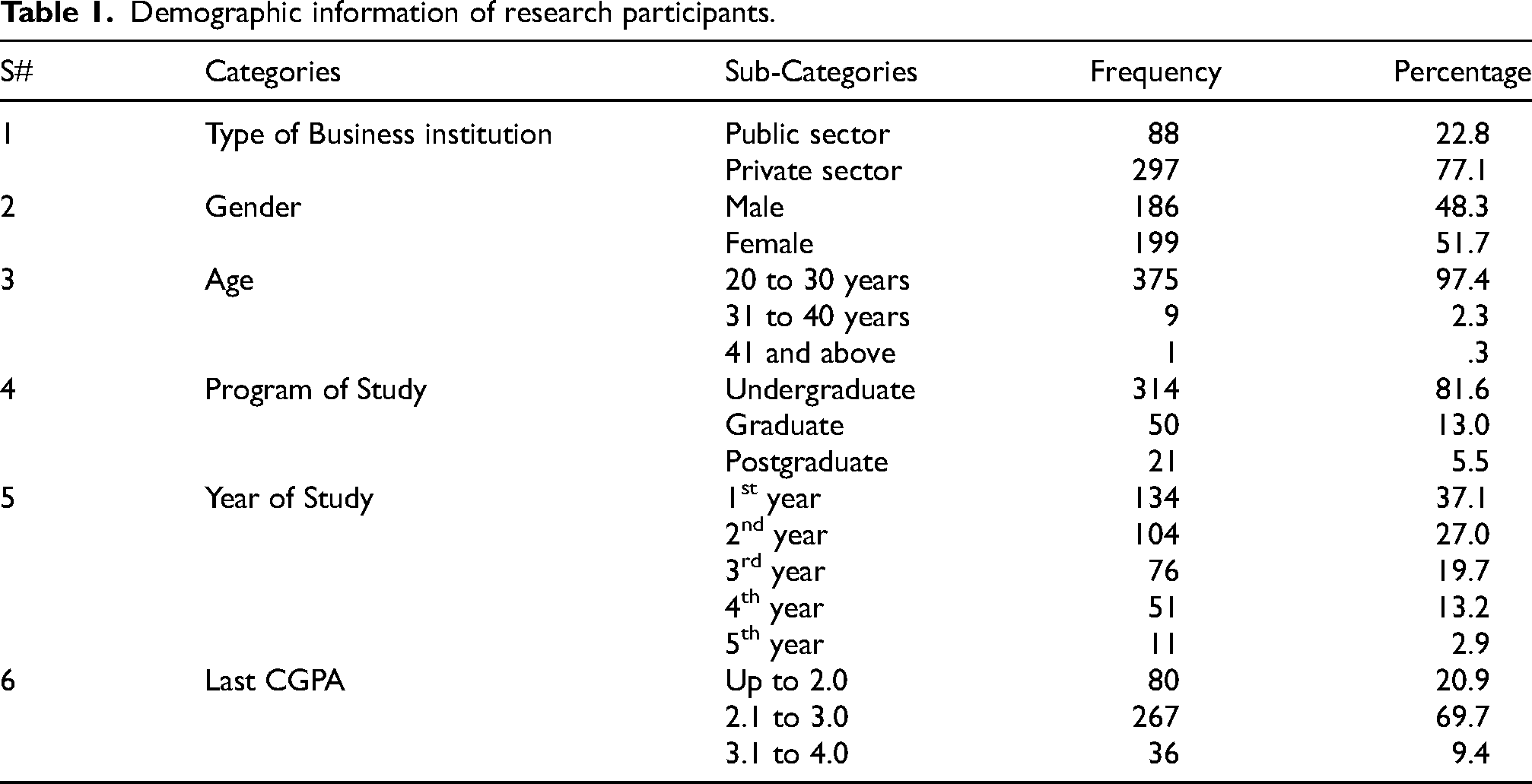
Research participants’ demographic information is summarized in Table 1. The results showed that 22.8% of participants were from public-sector business institutions, while 77.1% were from private-sector institutions. Gender distribution was nearly equal, with 48.3% male and 51.7% female participants. The majority of participants (97.4%) were aged 20 to 30 years. Most participants (81.6%) were enrolled in undergraduate programs, with 13.0% in graduate and 5.5% in postgraduate programs. Additionally, 69.7% reported a CGPA between 2.1 to 3.0 (out of 4.0 CGPA), while 20.9% had a CGPA of up to 2.0.
Demographic information of research participants.
RO1 (a, b) – Perceived information literacy and student engagement
The descriptive analysis showed a higher cumulated mean and standard deviation for all the study variables. This demonstrated that these students perceived high IL and they felt confident and competent to perform information tasks (M = 3.70, SD = .492). Most of the participants agreed on a set of student engagement, for instance, academic engagement (M = 3.50, SD = .865), online engagement (M = 3.70, SD = .783), cognitive engagement (M = 3.68, SD = .840), social engagement with teachers (M = 3.82, SD = .755), social engagement with peers (M = 3.62, SD = .828), beyond-class engagement (M = 3.22, SD = 1.009), affective engagement (M = 3.22, SD = 1.029) and student engagement (M = 3.54, SD = .594) (Table 2).
Descriptive statistics.
Scale: 1 = Strongly Disagree, 2 = Disagree, 3 = Neutral, 4 = Agree, 5 = Strongly Agree.
RO2 – Relationships matrix
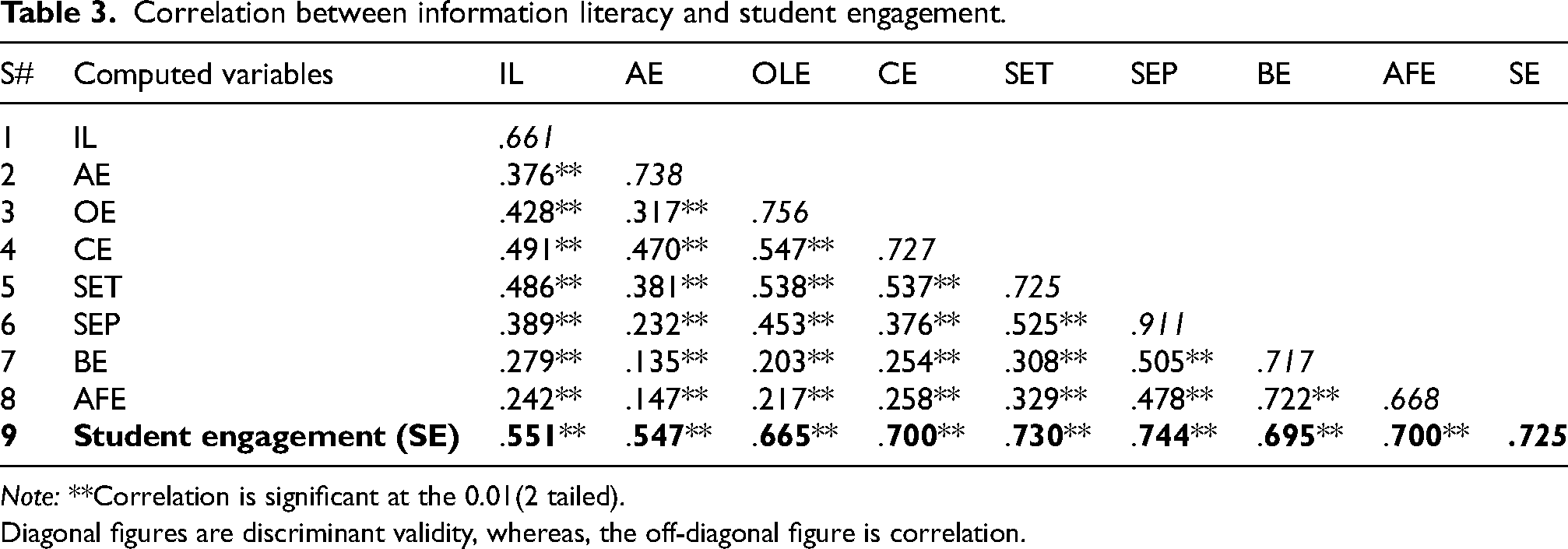
Pearson's product-moment correlation coefficient was performed to investigate the relationship between business students’ IL, AE, OE, CE, SET, SEP, BE, and AFE. The analysis showed that business students’ IL had a statistically significant and positive relationship with their AE (r = .376**) and OE (r = .428**). Likewise, IL also had statistically significant and positive relation with their CE (r = .491**), SET (r = 486**), SEP (r = .389**), BE (r = .279**), AFE (r = .242**). The IL skills of the business students were also positively and significantly correlated with overall student engagement (r = .551**) (Table 3). Moreover, the strength of correlation among variables was determined through Cohen’s (1992) proposed criterion. According to Cohen, (1992) who noted that an r > 0.10 refers to a weak correlation, an r > 0.30 is moderate, and an r > 0.50 strong correlation between variables. Here in this case, IL had a moderate relationship with AE, OE, CE, SET, and SEP, while BE and AFE had a weak association with IL. However, the composite variable of student engagement has a strong relationship with IL.
Correlation between information literacy and student engagement.
Note: **Correlation is significant at the 0.01(2 tailed).
Diagonal figures are discriminant validity, whereas, the off-diagonal figure is correlation.
RO 2 – Impact of information literacy on student engagement in higher learning business institutions
To investigate whether information literacy (IL) predicts student engagement, a regression analysis was conducted with IL as the predicting variable and various dimensions of student engagement as response variables.
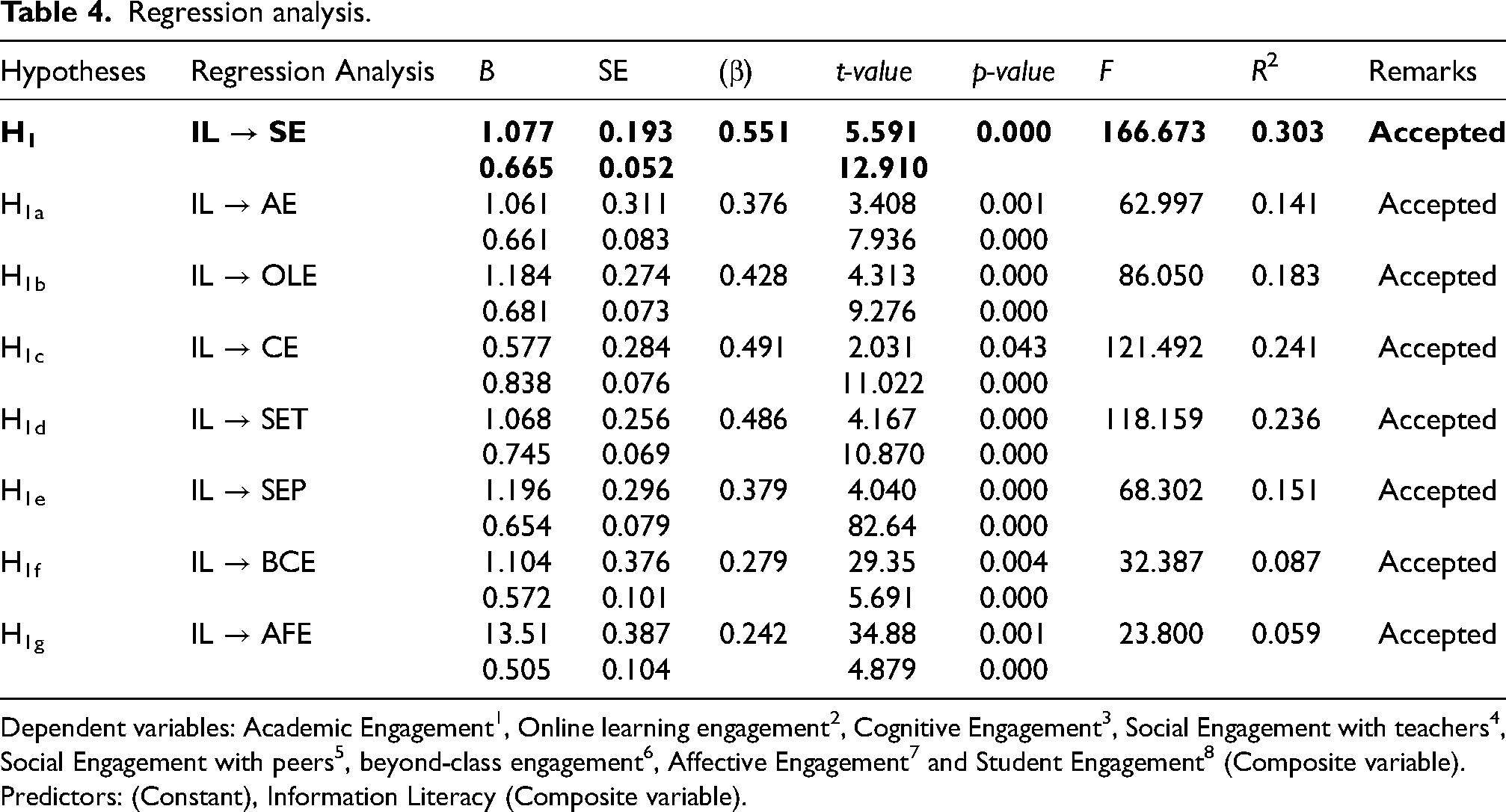
Considering student engagement as a composite variable, the regression results revealed a significant positive effect of IL on overall student engagement (F = 166.663, p < 0.000), with an R² value of 0.303, indicating that IL explained 30.3% of the variance in student engagement (β = 0.551, p < 0.001), thus supporting H1 (Table 4). Similarly, the IL was regressed on sub-dimensions of student engagement showing that IL significantly predicted academic engagement (F = 62.997, p < 0.000), with an R² value of 0.141, indicating that IL explained 14.1% of the variance in academic engagement (β = 0.376, p < 0.001). This result supported H1a, confirming that IL positively and significantly predicts AE. Similarly, IL had a significant positive effect on OE (F = 86.050, p < 0.000), with an R² value of 0.183, meaning IL accounted for 18.3% of the variance in OE (β = 0.428, p < 0.001), thus accepting H1b. CE was also significantly influenced by IL (F = 121.492, p < 0.000), with an R² value of 0.241, showing that IL explained 24.1% of the variance in CE (β = 0.491, p < 0.001), supporting H1c. Regarding SET, the regression revealed a significant positive effect of IL (F = 118.159, p < 0.001), with an R² value of 0.236, indicating that IL accounted for 23.6% of the variance in SET (β = 0.486, p < 0.001), thus accepting H1d. The analysis also demonstrated a significant positive effect of IL on SEP (F = 68.302, p < 0.001), with an R² value of 0.151, meaning IL explained 15.1% of the variance in SEP (β = 0.379, p < 0.001), supporting H1e. Furthermore, IL had a significant positive effect on BE (F = 32.387, p < 0.001), with an R² value of 0.087, indicating that IL explained 8.7% of the variance in BE (β = 0.279, p < 0.001), thus confirming H1f. Finally, AFE was significantly predicted by IL (F = 23.800, p < 0.001), with an R2 value of 0.059, meaning IL accounted for 5.9% of the variance in AFE (β = 0.242, p < 0.001), supporting H1g (Table 4).
Regression analysis.
Dependent variables: Academic Engagement1, Online learning engagement2, Cognitive Engagement3, Social Engagement with teachers4, Social Engagement with peers5, beyond-class engagement6, Affective Engagement7 and Student Engagement8 (Composite variable).
Predictors: (Constant), Information Literacy (Composite variable).
Discussion
An analysis of descriptive statistics revealed high perceived IL skills among higher-learning business students in Pakistan. The results further found that their AE, OE, CE, SET, SEP, BE, and AFE were also at high levels. The findings further revealed that these business students were confident and competent to perform information-related activities. However, these findings were unanticipated as a large number of previous studies depicted that there is no such provision for standardized IL policy, training, and liaison between faculty and academic librarians, and therefore, IL still may take longer to evolve in Pakistani educational institutions (Mughari et al., 2023; Naveed and Mahmood, 2021, 2022; Saadia and Naveed, 2024). Similarly, a study in recent past by Hussain et al. (2022) described poor IL among students of renowned academic institutions in Pakistan. A survey of IL among students of the Premier University depicted an average IL among students (Irfan et al. 2024). Safdar and Idrees (2021) and Rafiq et al. (2020) also depicted a low IL among under and postgraduate students and ill IL-related efforts by academic librarians in Pakistan. Likewise, perceiving the existing scenario by Shah et al. (2024), emphasized librarians to acquire subject, technology, leadership, managerial, research, instructional, and IL-related knowledge and competencies to perform as effective educators in academic learning. While the findings of increased confidence and competence among business students in information-related activities are unexpected given prior literature, these inconsistencies likely arise from differences in sample characteristics, changes in educational practices, methodological variations, or broader societal changes affecting students’ exposure to and proficiency with IL skills. These factors collectively highlight the dynamic nature of educational research and the importance of considering context-specific factors when interpreting study outcomes. However, it would be significant to unearth how these students gained IL in future research. These findings are aligned with the findings of Mugheri et al. (2023) who found high perceived IL in Pakistani business students.
The regression analysis evaluating the effect of IL on student engagement including all the sub-dimensions i.e., AE, OE, CE, SET, SEP, BE, and AFE revealed that IL positively and significantly predicts student engagement (H1). Certainly, IL is a blend of essential academic and interpersonal skills that motivate and enable students to wisely act in learning and social contexts. These skills result in a positive change in students’ academic engagement, online learning engagement, cognitive engagement, social engagement with teachers, social engagement with peers, beyond-class engagement, and affective engagement. Studies in the available literature addressed the connection of IL with different aspects of student engagement. Albeit, no comprehensive studies appeared that analyzed the relationship of IL with student engagement as a whole. Hence, these results need to be aligned with future research. However, these findings are partially echoed by those of Walsh (2014) who revealed that frequent use of libraries increased student engagement. Similarly, Cribb and Holt (2012) depicted that library usage significantly and positively enhanced students’ learning engagement. Likewise, Detlor et al. (2012) revealed that IL teaching had a positive influence on students’ psychological, behavioral, and learning outcomes. Similarly, Bergdahl et al. (2020) found a positive relationship between students’ digital skills and their technology-enhanced engagement.
The hypotheses testing for the effect of IL on subsets of student engagement depicted that business students’ IL has a positive impact on their academic engagement (H1a). The findings were anticipated as academic engagement requires some sort of information abilities, critical thinking, and problem-solving skills. IL evolves students’ skills and makes them capable to actively involved in class activities, completing their assignments, regulating their learning, and promoting their willingness to work (Loo et al., 2016; Sezer, 2020; Zhoc et al., 2019). The intersection between IL and academic engagement has been examined for the first time. Therefore, the discovery needed to be aligned further with more empirical studies. However, these results are partially echoed by the results of Heidari et al. (2021) who depicted that students’ digital competence (a sub-set of IL) positively and directly affected their academic engagement. Likewise, Feng et al. (2023) reported that students’ ICT self-efficacy had a positive effect on their learning engagement. Regarding online learning engagement, the inferential analysis revealed that IL has a significant and positive effect on online learning engagement (H1b). This finding was also anticipated as IL includes technology literacy and skills that empower students to surf online in a technological environment. IL as an integrated set of skills develops online learning attitudes among undergraduate and graduate students (Nakayama et al., 2008). Li et al. (2023) reported that students’ IL had a positive effect on their online learning engagement.
A closer look into the hypotheses testing also revealed that IL significantly and positively predicts cognitive engagement (H1c). These results were also expected as IL increases self-efficacy and curiosity and helps students develop learning strategies which is obviously a cognitive process (Aharony and Gazit, 2019). These findings got partial support from the findings of Matteson (2014) who reported a connection between information seeking and using with cognitive processes which include emotional intelligence and motivation. Likewise, IL significantly and positively explains social engagement with teachers (H1d) and student social engagement with peers (H1e). IL forms students’ social attitudes, and positive personal and social change and enhances their social engagement such as their relationship with teachers and peers (Cope, 2010; Esposito et al., 2022; Tewell, 2015). IL, in this regard, has a positive effect on students’ academic emotions and online learning engagement including their social engagement (Li et al., 2023). Studies in literature also supported that self-directed learning skills have a relationship with students’ academic emotions in negative and positive senses (e.g., students, teachers, and peer relations) (Kara, 2022; Schweder, 2020; Zhoc and Chen, 2016).
It also appeared that IL positively predicted students beyond class engagement (H1f). Despite the role of IL in academia, it also positively contributes to individuals’ other aspects of life including workplace and social life beyond academia. Similarly, researchers in literature also believed in IL instruction to empower students with the capacity to participate in communities, homes, and the global information economy beyond higher education learning (Gee, 2012; Kress, 2003; Mackey and Jacobson, 2005; McTavish, 2009). IL extends students learning beyond the academic spaces (Moreno-Morilla et al., 2021). These results are partially supported by the results of Moreno-Morilla et al. (2021) who found that digital and information literacy transforms students’ social and cultural lives in daily interactions. The analysis also depicted that IL has a positive influence on affective engagement (H1g). Obviously, information-seeking is a vigorous process and a subsume of IL that shapes students’ actions, thoughts, and feelings (Guo et al., 2014). Bilal (2005) also argued that students’ information-seeking and searching were related to their positive feelings, confidence, and enjoyment. Another study argued that individuals’ self-efficacy in certain phenomena, affects their overall behaviors such as their actions, and emotions (Bandura and Walters, 1977; Koul, 1999). Self-efficacy as a motivational construct influences students’ emotions and engagement (Gist and Mitchell, 1992).
Conclusions
This research concludes that business students perceived their information literacy (IL) to be high. Correspondingly, they exhibited high levels of AE, OE, CE, SET, SEP, BE, and AFE, and overall student engagement. Evidently, IL is a set of blended abilities that has the potential to enhance student engagement. It empowers students with the confidence to attend class, complete assignments, and study regularly on their own. It enables them to use different online mediums and platforms for information searching, motivates them to engage intellectually., It stimulates their intellectual abilities allowing them to enjoy academics and find satisfaction in their studies. Furthermore, IL fosters a positive attitude toward their teachers and peers improving their learning experience. It also encourages involvement in beyond-class activities i.e., extra-curricular, and strengthens their sense of belonging to an educational community. However, the means by which these students acquired their IL skills remain unclear. If students have overestimated their perceived IL abilities, this could lead to resistant behaviors toward continuous learning. Close monitoring of hypotheses testing revealed a significant positive effect of IL on overall student engagement, encompassing academic engagement, online engagement, cognitive engagement, social engagement with teachers and peers, beyond-class engagement, and affective engagement among business students in Pakistan. These findings underscore the importance of fostering accurate self-assessment of IL skills to promote continuous learning and enhance various dimensions of student engagement.
Implications
This research has some theoretical and practical implications. Theoretically, this research significantly contributed to the literature on the significance of IL for student engagement in academia as no research has evaluated the interconnection between IL and student engagement before this study specifically among business students from the South Asian region. From the practical perspective, this study paved a pragmatic insight for business educators, business librarians, information professionals, business education accrediting bodies (e.g., the National Business Education Accreditation Council and the Higher Education Commission), and other potential stakeholders in the effective design, development, integration, and execution of a need-based, credit IL course for business curriculum for all levels of business education including undergraduate, graduate, and postgraduate programs. Similarly, these business educators, librarians, LIS professionals, and other concerned stakeholders should undertake time-to-time IL sessions to implant a sustainable IL among business students to enhance their potential to practice knowledgeably, confidently, and competently in the information-rich ecosystem to meet market demands and value a business.
Limitations and future research directions
This study has some limitations that include: firstly, the use of a self-assessment method for IL and student engagement. This may be deemed as a limitation due to researchers’ critique for being biased towards research participants. Secondly, despite the availability of a large number of business institutions, this research conveniently recruited participants only from some selected business institutions. This may be considered as another limitation that confines the research's generalizability. Thirdly, the research found high perceived IL among research participants. However, the factors behind their self-perceived high IL remained still unclear, therefore Dunning-Kruger effect must be considered while interpreting the present study's results. Therefore, this research recommends that in the future the researchers may undertake an exploratory investigation to validate these results and determine how these students had learned self-efficacy in IL. A comparative study is also recommended which may comprise students from other South Asian regions having the same socio-economic condition for holistic findings.
Footnotes
Declaration of conflicting interests
The authors declared no potential conflicts of interest with respect to the research, authorship, and/or publication of this article.
Funding
The authors received no financial support for the research, authorship, and/or publication of this article.
