







Abstract
National digital transformation increasingly depends on governments’ ability to govern data as a strategic public resource across agencies, sectors, and administrative levels. This challenge is especially important in developing countries, where digital platforms, national databases, and online public services may expand faster than the institutional capability required to govern data coherently. Existing studies have examined open data, interoperability, metadata, stewardship, and public sector data governance, but these strands remain only partially connected in explaining how national digital data governance becomes workable under uneven institutional conditions. To address this gap, national digital data governance is conceptualized here as an institutional capability problem. The framework developed in the paper identifies five interrelated dimensions: strategic orientation and public value, implementation foundations, governance architecture, a national coordinating mechanism, and institutional conditions. Vietnam is used as an illustrative policy context, not as a formal empirical case study, because its recent digital reform agenda includes national digital transformation strategies, national databases, electronic identification, data sharing regulations, the National Data Center scheme, and the Law on Data 2024. The framework is used to examine how governance fragmentation may arise from weak alignment among strategic purpose, operational foundations, governance arrangements, coordinating mechanisms, and institutional conditions.
Keywords
Introduction
As digital transformation becomes embedded in public administration, governments increasingly need to govern data not merely as an administrative byproduct, but as a strategic public resource for service delivery, policy coordination, regulatory oversight, and public value creation (van Ooijen et al., 2019; World Bank, 2021). Data driven public sector reform depends on more than the accumulation of datasets or the deployment of digital platforms. It requires institutional arrangements through which information can be organized, shared, protected, interpreted, and reused in trusted ways across government (Janssen et al., 2020; OECD, 2021). This makes national digital data governance directly relevant to information development, because the developmental value of digital transformation depends on whether public information resources can be mobilized to strengthen administrative capacity, coordination, and legitimate public use (Bwalya and Mutula, 2016; Ziba and Kang, 2020).
The problem is sharper in developing countries, where digital identity systems, national databases, online public services, and sectoral platforms often expand under uneven administrative capability. Governance capacity often develops unevenly across agencies, sectors, and levels of administration, even as these systems become more central to public service delivery and policy coordination (Bwalya and Mutula, 2016; Ziba and Kang, 2020). Digital systems may therefore expand while authority remains fragmented, standards remain inconsistent, interoperability remains weak, metadata practices remain uneven, and accountability for data stewardship remains unclear (Gil-Garcia and Sayogo, 2016; Guijarro, 2007; Pardo and Tayi, 2007; Thomas et al., 2019). Under such conditions, national digital data governance becomes an institutional capability problem concerning how the state organizes public information resources under real development constraints.
Existing scholarship provides important insights into this issue, but the relevant debates remain partly fragmented. Research on open government data has clarified the importance of access, transparency, reuse, and data quality (Attard et al., 2015; Vetrò et al., 2016). Studies of interoperability and interorganizational information sharing have shown that public sector data exchange requires technical, semantic, organizational, and governance alignment (Gil-Garcia and Sayogo, 2016; Guijarro, 2007; Pardo and Tayi, 2007). Public sector data governance research has emphasized stewardship, accountability, quality management, trust, and decision rights (Abraham et al., 2019; Janssen et al., 2020; Thomas et al., 2019). Information development scholarship has also shown that digital reforms in developing contexts depend strongly on institutional support, governance conditions, and implementation capacity rather than on technology alone (Bwalya and Mutula, 2016; Lee and Lio, 2014; Ziba and Kang, 2020).
Despite these contributions, existing research does not yet provide a sufficiently integrated explanation of how national digital data governance becomes coherent in developing country settings. The gap is not simply that individual governance concepts are missing. Rather, the problem is that open data, interoperability, metadata, stewardship, coordination, and institutional capacity are often examined as separate concerns. This makes it difficult to explain how governments align strategic purpose, operational foundations, governance architecture, coordinating authority, and institutional feasibility into a workable national data governance capability.
To address this gap, national digital data governance is examined through an institutional capability framework for developing countries. The framework is used to interpret why national data governance may remain fragmented even when governments have adopted digital strategies, legal reforms, and major information systems. Vietnam is used as an illustrative policy context, not as a formal empirical case study. The Vietnamese context is relevant because it reflects a broader pattern found in many developing countries: strong national digital transformation ambition coexists with continuing challenges of interoperability, coordination, data sharing, stewardship, and implementation capacity.
The argument developed here links national digital data governance to institutional capability in developing countries. By connecting public sector data governance, interoperability, metadata, digital government, and institutional capability, the framework locates fragmentation across five capability domains instead of treating it as an isolated technical, legal, or organizational issue. For public managers, this structure helps separate different sources of reform weakness, including weak interoperability, unclear stewardship, limited coordinating authority, and uneven institutional conditions.
Literature and analytical gap
Information development and data as a public resource
A growing body of scholarship recognizes that data and information should be understood not merely as administrative byproducts, but as public resources that shape state capability, service delivery, policy coordination, and development outcomes. In digital government settings, this perspective shifts attention away from digitization as an end in itself and toward the broader question of how public institutions organize, govern, and use information to create public value. Data matters because information resources increasingly influence how states design policies, coordinate across agencies, monitor performance, and sustain public trust (van Ooijen et al., 2019; World Bank, 2021).
This perspective is especially relevant to information development scholarship. From that viewpoint, the core issue is not simply whether governments possess data, but whether they can organize information resources in ways that support inclusion, administrative effectiveness, coordination, and legitimate public use under real institutional constraints. Earlier information development research has shown that digital reforms in resource constrained contexts are shaped by governance conditions, implementation realities, and institutional support rather than by technology alone (Bwalya and Mutula, 2016; Lee and Lio, 2014; Ziba and Kang, 2020). This insight is important because it links digital transformation directly to broader questions of public information capacity in developing countries.
For developing countries, the challenge is often intensified by uneven institutional development. Information systems may expand rapidly through digital identity schemes, public service platforms, registries, and sector specific databases, while the institutional arrangements needed to govern them remain fragmented. Under such conditions, public value does not arise from data availability alone. It depends on whether institutions can define priorities, assign responsibility, maintain standards, and connect information use to broader development objectives. The literature on data as a strategic public asset therefore provides an important starting point, but it does not by itself explain how national digital data governance becomes coherent across fragmented public sectors.
Interoperability, metadata, and stewardship in public sector data governance
A second body of literature highlights the practical conditions under which information resources can be shared and reused across organizational boundaries. Research on open government data has shown that public value depends on accessibility, usability, trust, and the conditions of reuse, not publication alone (Attard et al., 2015; Vetrò et al., 2016). This work has been influential in demonstrating that information can support transparency, accountability, participation, and innovation. National governance also requires attention to controlled exchange across mixed information environments that include sensitive, restricted, and operational data.
This broader concern connects closely to the literature on interoperability and information sharing. Studies in this stream show that information exchange across government institutions depends on more than technical connectivity. It also requires semantic consistency, organizational coordination, standards adoption, and supportive governance conditions (Gil-Garcia and Sayogo, 2016; Guijarro, 2007; Henning, 2018; Pardo and Tayi, 2007). Metadata is especially important because discoverability, traceability, classification, provenance, and consistent interpretation all depend on the quality of the descriptive and structural information surrounding datasets. Where metadata is weak or inconsistent, digital systems may exist without producing reliable information exchange or usable integration across institutions.
A related stream of public sector data governance research places greater emphasis on stewardship, accountability, trust, quality, and responsible use. This literature shows that agencies may possess substantial volumes of data and still lack effective governance if roles are unclear, controls are weak, or quality management is inconsistent (Thomas et al., 2019; Thompson et al., 2015). Other work further highlights that responsible data use depends on governance arrangements that structure decision rights, stewardship responsibilities, access conditions, and accountability mechanisms (Abraham et al., 2019; Janssen et al., 2020).
Limits of existing governance frameworks
Although the literature offers valuable insights, existing approaches often remain partial when viewed from the perspective of national digital data governance in developing countries. Open government data research has clarified the importance of access, transparency, and reuse, but it is less well suited to explaining how states govern controlled exchange across diverse administrative and regulatory settings. Interoperability research has identified the operational importance of standards, metadata, and integration, but often focuses more on technical and organizational conditions than on broader national governance coherence. Public sector governance research has contributed important insights into stewardship, trust, and accountability, yet much of it remains anchored at the organizational level or within specific administrative settings rather than at the scale of the national information environment.
A similar limitation can be observed in policy oriented work. International organizations increasingly recognize data as a strategic public resource and emphasize the need for standards, access arrangements, capability, and institutional coordination (European Union, 2022; OECD, 2021; World Bank, 2021). These contributions are valuable because they show that governments are moving beyond narrow views of data as a technical asset. Even so, policy documents do not always provide a sufficiently analytical explanation of how governance coherence is built in practice, especially in developing countries.
Taken together, these strands illuminate important dimensions of national data governance, but they do not adequately explain how such dimensions are aligned at the national level under real development constraints.
Analytical gap and framework derivation
The preceding literature suggests that national digital data governance cannot be explained adequately through any single stream of research (Abraham et al., 2019; Gil-Garcia and Sayogo, 2016; Janssen et al., 2020; van Ooijen et al., 2019; World Bank, 2021). Public value and information development studies clarify why data matters for administrative capacity and development outcomes. Interoperability and metadata research explains the operational conditions that make data exchange meaningful across institutional boundaries. Public sector data governance literature highlights the need for stewardship, accountability, quality routines, and decision rights. Interorganizational information sharing research shows that cross agency coordination is necessary because data exchange rarely occurs automatically in fragmented public sectors. Institutional capability research further suggests that formal strategies and legal instruments may remain ineffective when administrative capacity, organizational readiness, and implementation discipline are weak.
These streams provide the basis for the framework developed in this article. Strategic orientation and public value are derived from the literature on data as a public resource and information development. Implementation foundations are derived from research on interoperability, metadata, and information sharing. Governance architecture is derived from public sector data governance and stewardship literature. The national coordinating mechanism is derived from studies of interorganizational coordination and whole of government alignment. Institutional conditions are derived from institutional capability and implementation oriented accounts of digital reform in developing countries.
The analytical gap addressed in this article is therefore not simply the absence of additional concepts. Rather, it is the absence of an integrated framework for explaining how strategic purpose, operational foundations, governance arrangements, coordinating mechanisms, and institutional feasibility are aligned into a workable national data governance capability. This gap is especially important for developing countries, where digital strategies, national databases, and legal reforms may expand faster than the institutional capability required to govern data coherently across the public sector.
Theoretical framing
Institutional capability as the analytical lens
This study adopts institutional capability as its central analytical lens. The reason is that national digital data governance cannot be explained adequately through strategy, regulation, technology, or administrative reform taken in isolation. Governments may adopt ambitious digital agendas, enact legal instruments, and invest heavily in platforms and databases, yet still fail to generate coherent governance across the public sector. What often determines the practical effectiveness of national digital data governance is whether the state possesses sufficient capability to align strategic intent, operational foundations, governance arrangements, and institutional practice over time (Bwalya and Mutula, 2016; World Bank, 2021; Ziba and Kang, 2020).
Viewing national digital data governance through the lens of institutional capability shifts attention from formal policy adoption toward the practical conditions under which governance becomes operational. It also emphasizes alignment across multiple dimensions instead of progress in any single domain alone. Within this view, information development becomes part of the broader problem of state capacity, because public institutions must govern information resources coherently, responsibly, and sustainably under real constraints. In developing countries, this perspective directs attention to uneven administrative capability, fragmented authority, and variable implementation discipline (Bwalya and Mutula, 2016; World Bank, 2021; Ziba and Kang, 2020).
National digital data governance is therefore understood as a state level capability for organizing public information resources in ways that support coordination, legitimacy, controlled exchange, and public value. The analytical emphasis falls not on the mere existence of data, platforms, or legal instruments, but on whether institutions can connect these elements into a coherent governance system. This orientation distinguishes the present study from approaches that treat data governance primarily as a technical, organizational, or compliance issue (Abraham et al., 2019; Janssen et al., 2020; OECD, 2021).
Deriving the framework dimensions from the literature
The five dimensions of the framework are derived from the analytical synthesis developed in the literature review. They are not intended as a universal checklist or a fixed sequence of reform steps. Each dimension captures a distinct capability requirement that appears repeatedly across the relevant literature but is often examined separately (Abraham et al., 2019; Gil-Garcia and Sayogo, 2016; Pardo and Tayi, 2007; van Ooijen et al., 2019; World Bank, 2021).
Strategic orientation and public value are derived from the literature on data as a public resource and information development, which emphasizes the need to connect data governance to broader public purpose (van Ooijen et al., 2019; World Bank, 2021). Implementation foundations are derived from research on interoperability, metadata, and interorganizational information sharing, which explains the operational conditions that make data exchange meaningful across institutional boundaries (Gil-Garcia and Sayogo, 2016; Guijarro, 2007; Henning, 2018; Pardo and Tayi, 2007). Governance architecture is derived from public sector data governance and stewardship literature, which highlights roles, responsibilities, quality routines, standards, accountability, and decision rights (Abraham et al., 2019; Janssen et al., 2020; Thomas et al., 2019; Thompson et al., 2015). The national coordinating mechanism is derived from studies of interorganizational coordination and whole of government alignment, which show that cross agency data exchange rarely occurs automatically in fragmented public sectors (Gil-Garcia and Sayogo, 2016; Pardo and Tayi, 2007). Institutional conditions are derived from institutional capability and implementation oriented accounts of digital reform in developing countries, which emphasize administrative capability, regulatory consistency, organizational readiness, and implementation discipline (Bwalya and Mutula, 2016; World Bank, 2021; Ziba and Kang, 2020).
This derivation provides the conceptual bridge between the literature review and the framework developed in the next section. The next section presents these dimensions as an integrated analytical framework for interpreting national digital data governance capability.
Scope, boundaries, and limitations of the framework
The proposed framework supports analytical interpretation and policy diagnosis, without serving as a formal causal model. It helps explain why national digital data governance often remains fragmented even when governments have adopted digital strategies, legal reforms, and major information systems. It is designed to support conceptual interpretation and policy diagnosis, particularly in developing country settings where institutional capability is uneven and governance coherence cannot be assumed (Bwalya and Mutula, 2016; OECD, 2021; World Bank, 2021).
This scope sets several boundaries. The framework identifies dimensions of governance capability without providing a quantitative scale for comparing countries. It also does not operate as a legal compliance template. Legal and regulatory arrangements matter, but the analysis is concerned with how governance coherence is built across institutions. DAMA based principles are used selectively as an analytical resource rather than as a prescriptive blueprint for state design (DAMA International, 2024). National arrangements may therefore vary in form, sequencing, and implementation pathways.
These boundaries clarify the scope of the framework. It explains governance coherence as a capability problem shaped by alignment across five dimensions. Statistical testing and universal institutional design are outside its scope. Instead, it offers a structured way to interpret governance fragmentation, diagnose where capability gaps may lie, and guide more precise discussion of reform priorities in developing countries.
On this basis, the next section presents the institutional capability framework for national digital data governance and explains how its dimensions are related within a broader model of governance coherence.
An institutional capability framework for national digital data governance
Overview and analytical logic of the framework
Building on the preceding discussion, this study proposes an institutional capability framework for national digital data governance in developing countries. The framework explains governance coherence as an alignment problem at the national level under uneven institutional capability. Its central claim is that national digital data governance does not emerge from legal reform, technical infrastructure, or policy ambition alone. Rather, it depends on the extent to which strategic purpose, implementation foundations, governance arrangements, coordinating capacity, and institutional conditions are aligned within a wider public sector system (Abraham et al., 2019; Bwalya and Mutula, 2016; Janssen et al., 2020; World Bank, 2021).
The framework differs from approaches that focus primarily on one dimension of the problem. It does not treat openness, interoperability, stewardship, or legal design as sufficient on their own. Instead, it explains governance coherence as the product of interaction across multiple dimensions that are often addressed separately in existing scholarship and policy practice. In this sense, the framework is designed to clarify why governments may have digital strategies, major information systems, and formal policy commitments, yet still experience fragmentation in the governance of public information resources (Attard et al., 2015; Guijarro, 2007; Thompson et al., 2015; van Ooijen et al., 2019).
The framework is used to identify where coherence may weaken across the national data governance system. It does not prescribe a single institutional design. Its role is to locate capability gaps across strategy, implementation foundations, governance architecture, coordination, and institutional conditions. In developing countries, progress often varies across sectors, administrative levels, and institutions, making such diagnosis necessary for locating capability gaps (Bwalya and Mutula, 2016; World Bank, 2021; Ziba and Kang, 2020).
Figure 1 presents the proposed institutional capability framework for national digital data governance. The figure places national digital data governance capability at the center of the framework and shows how it is shaped by five interrelated dimensions: strategic orientation and public value, implementation foundations, governance architecture, a national coordinating mechanism, and institutional conditions. This design emphasizes that the five dimensions jointly inform national data governance capability rather than operating as a strict linear sequence. Strategic orientation and public value define the public purpose of data governance. Implementation foundations provide the operational conditions for data exchange and reuse. Governance architecture structures stewardship roles, standards, accountability mechanisms, and data quality routines. The national coordinating mechanism supports cross institutional alignment. Institutional conditions shape whether governance arrangements can operate credibly and sustainably in practice (Abraham et al., 2019; DAMA International, 2024; Gil-Garcia and Sayogo, 2016; van Ooijen et al., 2019; World Bank, 2021).
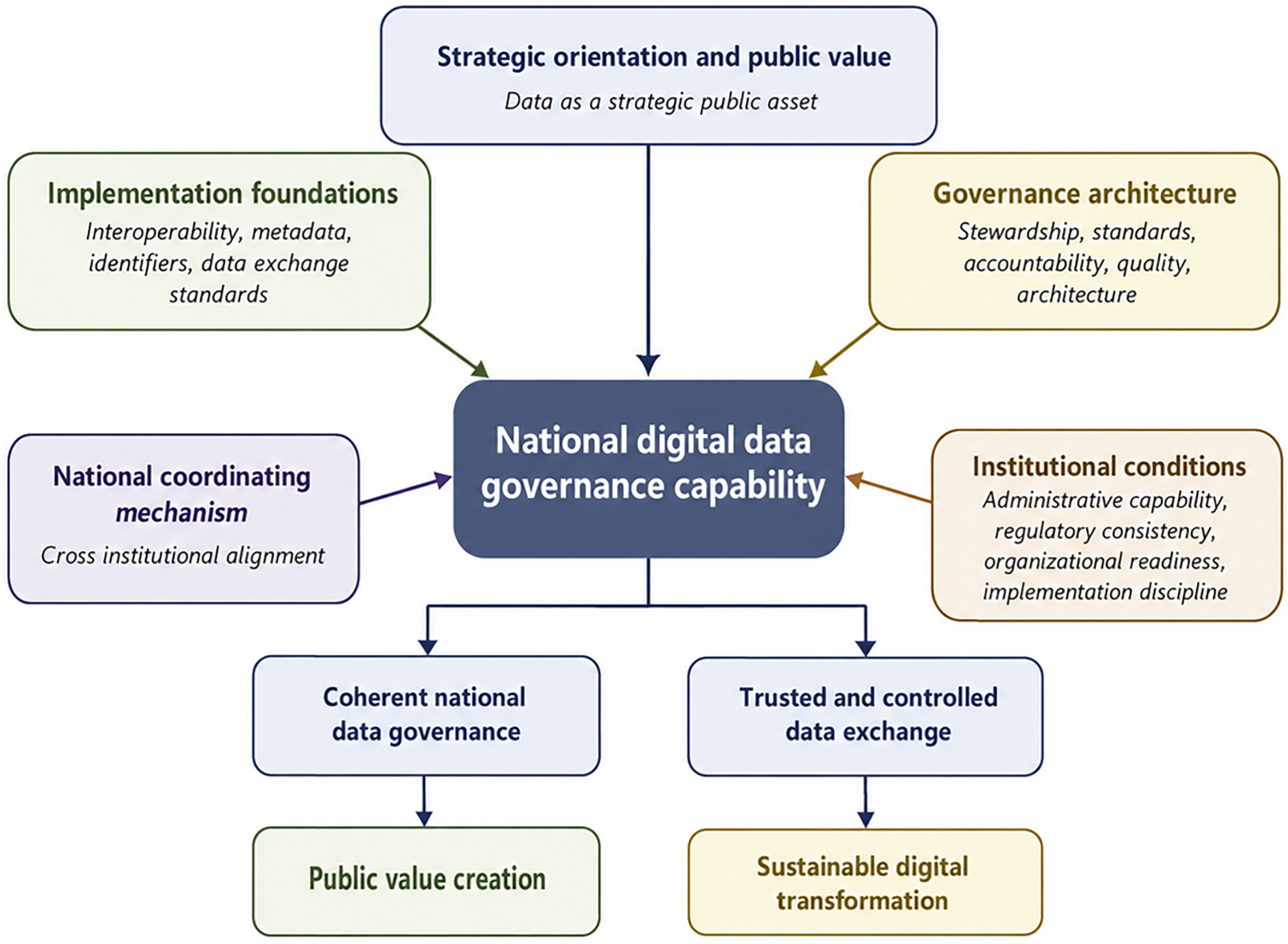
Institutional capability framework for national digital data governance. Source: Author's synthesis based on the literature reviewed in this paper.
The lower part of the figure indicates the expected outcomes of this capability: coherent national data governance and trusted and controlled data exchange. These outcomes are then connected to broader public value creation and sustainable digital transformation. The figure should therefore be read as an integrated analytical framework rather than as a procedural model. The figure highlights the dependence of governance coherence on alignment among institutional capability dimensions. Fragmentation may arise when one or more dimensions remain weak or poorly coordinated (OECD, 2021; van Ooijen et al., 2019; World Bank, 2021).
Table 1 defines the analytical components of the framework by linking each dimension to a core governance question, a diagnostic signal of weakness, and an expected governance function. The table synthesizes insights from the literature on data as a public resource, interoperability, public sector data governance, interorganizational information sharing, and institutional capability (Abraham et al., 2019; Gil-Garcia and Sayogo, 2016; Pardo and Tayi, 2007; van Ooijen et al., 2019; World Bank, 2021).
Analytical components of the institutional capability framework.
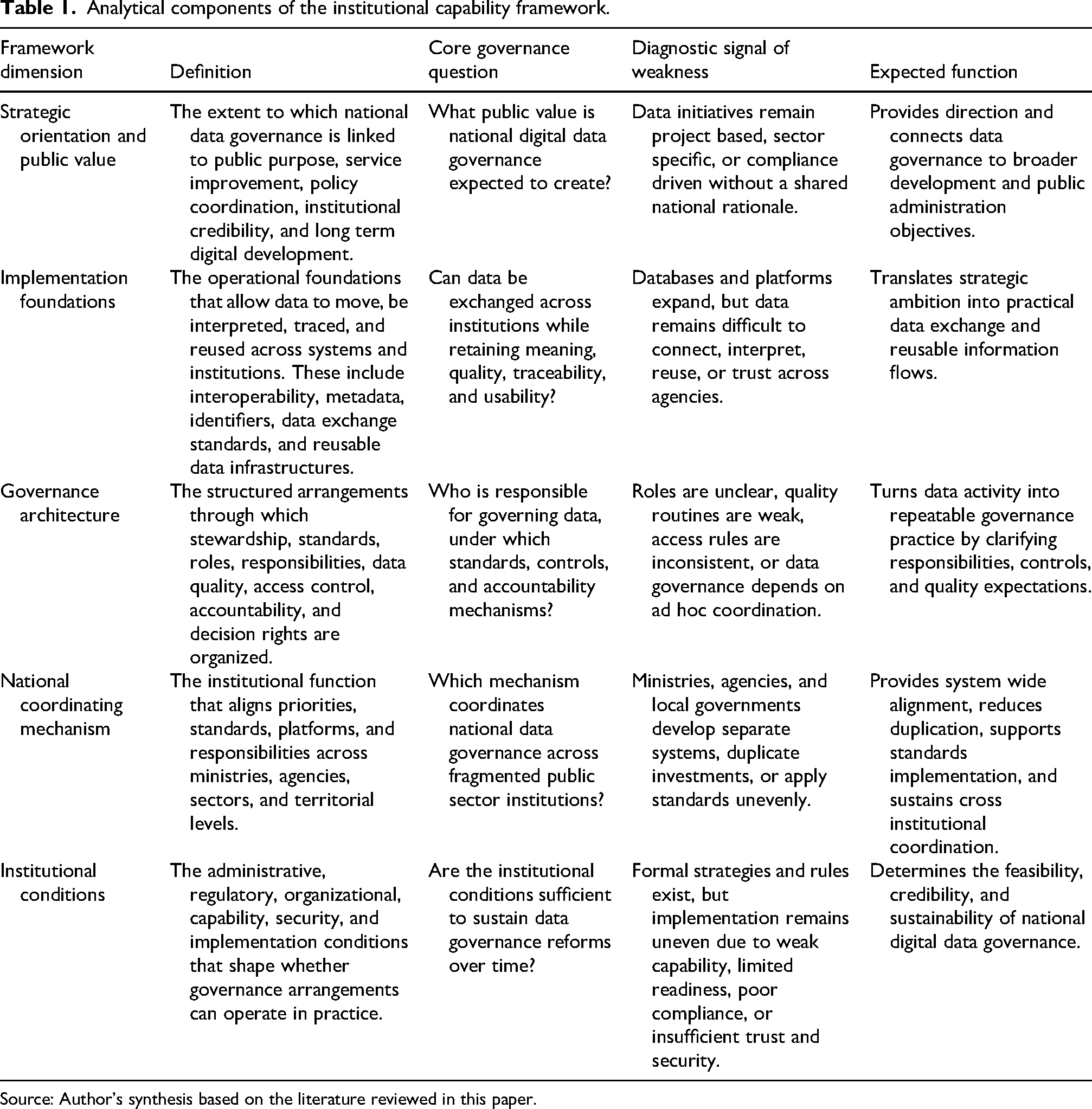
Source: Author's synthesis based on the literature reviewed in this paper.
Taken together, Figure 1 and Table 1 clarify the analytical logic of the proposed framework. Figure 1 presents the overall relationship among the five dimensions, the central capability, and the expected outcomes. Table 1 explains how each dimension can be interpreted diagnostically. Together, Figure 1 and Table 1 provide a basis for interpreting governance capability and diagnosing fragmentation in developing country contexts (OECD, 2021; World Bank, 2021).
Strategic orientation and public value
Strategic orientation and public value form the first dimension of the framework. This dimension defines why national digital data governance matters and what it is expected to achieve. In the present framework, national data governance is linked to broader public purposes such as service improvement, policy coordination, institutional credibility, and long term digital development. Governance arrangements are unlikely to become coherent without a shared public purpose (van Ooijen et al., 2019; World Bank, 2021).
Strategic orientation performs an integrating function. It helps connect otherwise fragmented data initiatives to wider state objectives and reduces the risk that digital reforms remain confined to isolated projects, sector specific platforms, or narrow compliance exercises. In developing countries, this is particularly significant because public institutions often face competing priorities, uneven capabilities, and strong pressure to expand digital infrastructure quickly. A clear strategic orientation can help ensure that data governance is understood not merely as a technical specialization, but as part of a broader effort to strengthen public administration and information capacity (Bwalya and Mutula, 2016; OECD, 2021; Ziba and Kang, 2020).
Strategic orientation alone does not produce governance coherence. A country may articulate ambitious goals for digital government and data driven administration without building the operational and institutional conditions needed to support those goals. For this reason, the framework treats strategic orientation as necessary but not sufficient. It provides direction, but governance coherence depends on whether that direction is translated into practical arrangements across the wider system (van Ooijen et al., 2019; World Bank, 2021).
Implementation foundations
Implementation foundations form the second dimension of the framework and refer to the operational conditions that allow data to move, be interpreted, and be reused across institutional boundaries. These conditions include interoperability, metadata, identifiers, data exchange standards, and reusable data infrastructures. National digital data governance cannot function effectively through policy declarations alone. It requires practical foundations that enable data exchange while preserving meaning, traceability, and usability in complex administrative environments (Guijarro, 2007; Henning, 2018; Pardo and Tayi, 2007).
Interoperability matters because public information is often produced across multiple systems, agencies, and levels of administration. Without sufficient compatibility in identifiers, classifications, and exchange arrangements, digital systems may expand without improving coordination or service integration in meaningful ways. Metadata is equally important because discoverability, provenance, semantic consistency, and responsible reuse all depend on the quality of the information that describes and structures datasets. In this sense, implementation foundations translate strategic ambition into operational possibility (Gil-Garcia and Sayogo, 2016; Guijarro, 2007; Henning, 2018).
In developing countries, digital systems may be introduced at different times, under different standards, and with varying degrees of institutional support. Under such conditions, the absence of strong implementation foundations can leave governments with growing volumes of data but limited capacity to connect and use information coherently. The framework therefore treats interoperability and metadata not as secondary technical matters, but as core conditions of governance capability (Bwalya and Mutula, 2016; Pardo and Tayi, 2007; World Bank, 2021).
Governance architecture
Governance architecture is the third dimension of the framework. It refers to the structured arrangements through which roles, responsibilities, standards, stewardship routines, accountability mechanisms, data quality practices, access conditions, and decision rights are organized across the public sector. National digital data governance requires more than the ability to exchange data. It also requires institutional arrangements that clarify who is responsible for governing data, under which standards, with what forms of oversight, and through which quality and accountability routines (Abraham et al., 2019; DAMA International, 2024; Janssen et al., 2020).
This dimension is grounded in the literature on public sector data governance and data management. Public sector data governance research shows that data governance is not achieved simply by collecting, storing, or exchanging data. It depends on clear stewardship responsibilities, decision rights, quality controls, accountability mechanisms, and trustworthy conditions for data use (Abraham et al., 2019; Janssen et al., 2020; Thomas et al., 2019; Thompson et al., 2015). DAMA based principles are used selectively in this framework because they provide a useful practical language for describing governance architecture, particularly in relation to data stewardship, data quality, metadata discipline, standards, and accountability (DAMA International, 2024). The purpose is not to transfer an enterprise data management model directly to the national level. Rather, DAMA based principles are used as a supporting reference to clarify the types of governance arrangements that become important when information resources are managed across many institutions.
Governance architecture distinguishes data activity from data governance. A country may generate, store, and exchange large volumes of data without establishing durable arrangements for stewardship, quality assurance, access control, and accountability. In such circumstances, information systems may remain dependent on ad hoc coordination, isolated leadership support, or short term project logic. The framework therefore treats governance architecture as a core dimension of institutional capability because it helps turn fragmented data initiatives into more stable and repeatable governance practice (Thomas et al., 2019; Thompson et al., 2015).
National coordinating mechanism
The national coordinating mechanism is the fourth dimension of the framework. This dimension occupies a central place in the framework because the other dimensions do not align automatically. Strategic intent, implementation foundations, and governance architecture may all exist to some degree, yet remain poorly connected across ministries, agencies, territorial levels, and sectoral systems. A recognized coordinating function is therefore needed to translate direction into system wide alignment (Gil-Garcia and Sayogo, 2016; OECD, 2021; Pardo and Tayi, 2007).
The coordinating mechanism should not be understood too narrowly as one fixed organizational form. In some contexts, it may take the form of a central data authority. In others, it may be exercised through a digital transformation agency, an inter ministerial body, or another hybrid institutional arrangement. What matters analytically is the coordinating role itself. The function of this dimension is to connect priorities, support standards implementation, reduce duplication, clarify cross institutional responsibilities, and sustain adjustment over time (Gil-Garcia and Sayogo, 2016; OECD, 2021; World Bank, 2021).
In fragmented public sector settings, coordination becomes central because institutions often operate under separate mandates, different standards, and uneven implementation capacities. Governance difficulties may persist even when strategic intent is clear, because ministries, agencies, and local authorities may implement data systems through separate priorities and technical arrangements. The framework therefore treats coordination as the hinge of governance capability. Without it, strategic direction may remain abstract, implementation foundations may develop unevenly, and governance arrangements may fail to operate as part of a coherent national system (Bwalya and Mutula, 2016; Gil-Garcia and Sayogo, 2016; Ziba and Kang, 2020).
Institutional conditions
Institutional conditions form the fifth dimension of the framework and capture the enabling or constraining context within which national digital data governance must operate. This dimension includes factors such as administrative capability, regulatory consistency, organizational readiness, implementation discipline, and the legitimacy of coordination arrangements. These conditions do not sit outside the framework as background context alone. They shape whether the other dimensions can function credibly and sustainably in practice (Bwalya and Mutula, 2016; Lee and Lio, 2014; World Bank, 2021). The dimension is particularly significant in developing countries, where digital transformation often advances unevenly across the state. Some institutions may possess stronger technical capacity, leadership support, or implementation experience than others.
As a result, governance reforms that appear coherent at the policy level may be implemented unevenly in practice. The framework draws attention to this issue by treating institutional conditions as a constitutive dimension of governance capability rather than as a secondary environmental factor (Bwalya and Mutula, 2016; Ziba and Kang, 2020).
This dimension helps prevent overly formal interpretations of governance reform. A country may adopt standards, establish governance roles, and articulate coordination mechanisms, yet still struggle if underlying institutional conditions do not support sustained implementation. Coherence therefore depends on both institutional design and implementation feasibility. Governance becomes more credible when institutional arrangements are matched to the capacities and constraints of the settings in which they must operate (Lee and Lio, 2014; World Bank, 2021; Ziba and Kang, 2020).
Expected outcomes and diagnostic value
When these five dimensions are sufficiently aligned, the framework suggests two immediate outcomes. The first is more coherent national digital data governance. Coherence here does not imply perfect uniformity across the state. Rather, it refers to an adequate level of consistency in strategic direction, standards, stewardship, coordination, and implementation practice such that governance becomes intelligible and repeatable across institutions. The second outcome is more trusted and controlled data exchange. National digital development requires information to move across boundaries, but it also requires that exchange to remain consistent with accountability, legitimacy, and responsible use (Janssen et al., 2020; OECD, 2021; van Ooijen et al., 2019).
These outcomes support broader public purposes. More coherent governance can strengthen service coordination, policy capacity, and institutional credibility. More trusted data exchange can support better administrative action while maintaining appropriate control over access and use. In this way, the framework links national data governance to wider concerns of public value and more sustainable digital transformation (van Ooijen et al., 2019; World Bank, 2021).
A diagnostic reading of the framework helps identify different sources of governance weakness. In one setting, the main problem may be weak implementation foundations despite strong policy ambition. In another, governance architecture may remain underdeveloped even where data infrastructure is expanding. Elsewhere, institutional conditions or limited coordinating authority may prevent otherwise sensible reforms from becoming durable practice. By making these distinctions visible, the framework provides a structured basis for interpretation and more realistic reform discussion (Abraham et al., 2019; Gil-Garcia and Sayogo, 2016; World Bank, 2021).
On this basis, the next section applies the framework illustratively to Vietnam in order to show how it can be used to interpret governance opportunities and constraints in a developing country context.
Illustrative application to Vietnam and implications
Vietnam as an illustrative policy context
Vietnam is used in this article as an illustrative policy context rather than as a formal empirical case study. The purpose of this section is not to test the proposed framework through primary data, systematic comparison, or causal inference. Instead, it shows how the institutional capability framework can be used to interpret national digital data governance in a developing country that is pursuing rapid digital transformation while continuing to build the institutional arrangements needed for coherent data governance.
Vietnam provides a relevant setting for this illustrative application because its reform agenda combines strategic digital transformation, national data infrastructure, legal change, and continuing coordination challenges. The National Digital Transformation Program and the Strategy for E Government Development toward Digital Government place digital government, digital economy, and digital society at the center of public sector modernization. The National Data Strategy to 2030 and the Law on Data 2024 further treat data as a strategic resource for administrative coordination, public service delivery, socioeconomic development, national competitiveness, and citizens’ interests. Other policy and legal instruments add concrete institutional and infrastructural detail, including the National Data Center scheme, regulations on data sharing and interoperability, the National Population Database, electronic identification, and cyberinformation security requirements (Government, 2020, 2023, 2024; National Assembly, 2015, 2023, 2024; Prime Minister, 2020, 2021, 2024). This combination allows the five framework dimensions to organize policy interpretation in a concrete developing country context.
Table 2 summarizes how key Vietnamese policy and legal documents are mapped to the five dimensions of the institutional capability framework. This table is used only to organize the illustrative application and does not constitute a formal empirical coding or case study protocol.
Evidence mapping for the illustrative application to Vietnam.
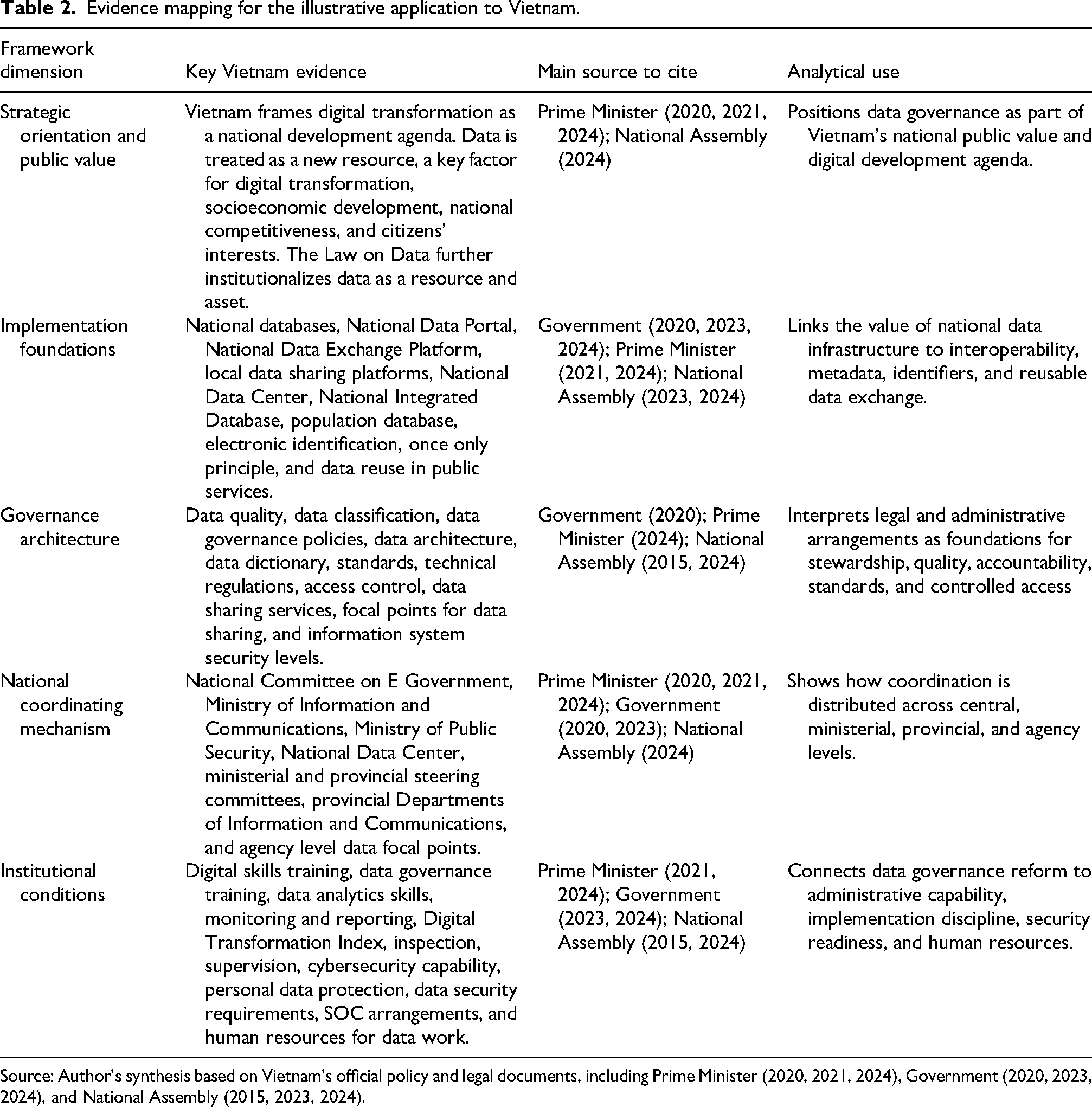
Applying the framework to Vietnam
Strategic orientation and public value
Vietnam's policy framework shows a clear strategic orientation toward treating data as a national resource for digital transformation. The National Digital Transformation Program frames digital transformation as a broad national development agenda linked to digital government, digital economy, and digital society (Prime Minister, 2020). The Strategy for E Government Development toward Digital Government further states that digital government should operate based on data and digital technology, and explicitly treats data as a new resource (Prime Minister, 2021). This orientation is developed more directly in the National Data Strategy to 2030, which defines data as a key factor for national digital transformation, socioeconomic development, national competitiveness, and citizens’ interests (Prime Minister, 2024). The Law on Data 2024 further institutionalizes this orientation by defining data as a resource and requiring the state to mobilize resources to enrich data and develop it into an asset (National Assembly, 2024).
These developments show that Vietnam's national data governance agenda is not framed only as a technical modernization effort. It is connected to public value creation, administrative modernization, service improvement, and state capacity. National data governance requires a shared public purpose. Without such orientation, databases, platforms, and digital services may remain fragmented across ministries, sectors, and localities. Vietnam's policy framework therefore illustrates the first dimension of the framework: national digital data governance requires a public value rationale that connects data to broader development and governance objectives.
However, the framework also suggests that strategic orientation is necessary but not sufficient. A country may recognize data as a public resource while still facing difficulties in translating that recognition into interoperable systems, shared standards, stewardship routines, and sustainable implementation. The Vietnamese context shows this tension between policy ambition and the operational conditions required for implementation.
Implementation foundations
Vietnam has developed several implementation foundations for national digital data governance. The National Digital Transformation Program identifies national databases, the National Data Portal, and the national data integration and sharing platform as important foundations for digital government (Prime Minister, 2020). The Strategy for E Government Development toward Digital Government further emphasizes the National Data Exchange Platform and local data sharing platforms as mechanisms for connecting and sharing data among ministries, sectors, and localities (Prime Minister, 2021). The National Data Strategy to 2030 strengthens this direction by setting targets for connected national and regional data centers, integrated national databases, data sharing through integration platforms, and reuse of administrative procedure data so that citizens and firms provide information only once in online public services (Prime Minister, 2024).
The Law on Data 2024 gives these foundations a clearer legal basis. It requires connected and shared data not to be collected again and specifies that national databases, sectoral databases, and other public information systems connect with the National Integrated Database through data sharing and coordination platforms, the national data integration and sharing platform, and ministerial or provincial integration platforms (National Assembly, 2024). The National Data Center scheme also gives concrete infrastructural form to this agenda by defining the center as a facility for integrating, synchronizing, storing, sharing, analyzing, exploiting, and coordinating data from state agencies (Government, 2023).
Vietnam's population data and electronic identification systems provide more specific examples of implementation foundations. The Law on Identification defines the National Population Database as a shared database containing digitized and standardized information used for state management and transactions by agencies, organizations, and individuals. It also requires this database to connect and share data with national databases, sectoral databases, the National Data Center, public service portals, and administrative procedure information systems (National Assembly, 2023). Decree No. 69/2024 on electronic identification links electronic identity accounts to information updated from the National Population Database, the civil status database, the identification database, the national immigration database, and other national or sectoral databases (Government, 2024).
These instruments illustrate the second dimension of the framework. Implementation foundations are not simply databases or platforms. They include identifiers, data exchange structures, shared code lists, master data, integration platforms, metadata practices, data sharing services, and mechanisms for data reuse. Decree No. 47/2020 on the management, connection, and sharing of digital data among state agencies is especially important in this respect because it defines operational concepts such as exchange data structures, data sharing services, shared classifications, and master data. It also identifies population, land, and enterprise data as foundational data for e government development (Government, 2020).
Vietnam has developed important technical and legal foundations for data sharing. Yet the framework directs attention to whether these foundations operate consistently across ministries, provinces, and sectoral systems. The value of national databases and data platforms depends on whether data can move across systems while retaining meaning, quality, traceability, and usability. Interoperability and metadata discipline therefore remain central to national digital data governance.
Governance architecture
Vietnam's recent data governance reforms also illustrate the governance architecture dimension of the framework. Governance architecture refers to the arrangements through which roles, responsibilities, standards, data quality, classification, stewardship, access control, and accountability are organized across the public sector. In Vietnam, this architecture is emerging through a combination of laws, strategies, technical frameworks, and platform rules.
Decree No. 47/2020 provides an early foundation for this architecture by requiring state agencies to manage data, govern data, ensure readiness for data connection and sharing, designate focal points for data sharing, comply with the Vietnam e government architecture framework, and conduct periodic assessment of data quality and data sharing readiness (Government, 2020). It also establishes the National Data Portal as both an open data access point and a support and monitoring point for interagency data sharing. In addition, it requires data sharing through published data sharing services and a centrally managed Data Sharing Service Management System.
The National Data Strategy to 2030 further develops this architecture by requiring regulations on standards, data connection and sharing lists, data quality management, a data governance framework, data architecture, and data dictionary components to be incorporated into future versions of Vietnam's e government architecture framework (Prime Minister, 2024). The Law on Data 2024 gives this architecture a stronger legal basis by establishing requirements on data quality, data classification, data governance policies, data standards, access control, secure data retrieval, and responsible use (National Assembly, 2024).
The National Data Center scheme adds an infrastructural and operational layer to this architecture. It requires standards for data architecture planning, classification of data by openness and sensitivity, and information security policies aligned with different access methods and exploitation rights (Government, 2023). The Law on Identification and Decree No. 69/2024 further illustrate governance architecture through centralized management of population and identity data, technical standards, mechanisms for correcting inconsistent personal information, retention rules for electronic identity records, and connection conditions for systems that seek access to the electronic identification and authentication system (Government, 2024; National Assembly, 2023).
These developments suggest that Vietnam is moving from general digital transformation ambition toward more structured data governance arrangements. They also illustrate why governance architecture is analytically distinct from implementation foundations. Implementation foundations enable data to be connected and reused. Governance architecture defines who is responsible, under what standards, with what access rights, quality controls, security requirements, and accountability mechanisms. The Vietnamese context therefore supports the framework's argument that data infrastructure alone does not create coherent national data governance unless it is supported by repeatable governance arrangements.
National coordinating mechanism
The Vietnamese context also illustrates the importance of a national coordinating mechanism. National digital data governance requires coordination across ministries, central agencies, local governments, sectoral systems, and platform operators. Vietnam's policy framework shows that this coordinating function is distributed across several institutional arrangements rather than concentrated in one single body.
The National Digital Transformation Program assigns the National Committee on E Government a role in advising on strategies, mechanisms, and policies, and in coordinating the implementation of the national digital transformation agenda. Ministerial and provincial steering committees are also expected to coordinate implementation within their own jurisdictions (Prime Minister, 2020). The Strategy for E Government Development toward Digital Government reinforces this multilevel arrangement by identifying the roles of the National Committee on E Government, the Ministry of Information and Communications, specialized information technology units in ministries, and provincial Departments of Information and Communications (Prime Minister, 2021).
Decree No. 47/2020 illustrates another layer of coordination by assigning the Ministry of Information and Communications responsibility for managing the national Data Sharing Service Management System and guiding inspection of data sharing activities. At the same time, ministries and provincial authorities are responsible for directing and inspecting data sharing within their jurisdictions, supported by agency level focal points for data sharing (Government, 2020). The National Data Strategy to 2030 adds a data specific coordination mechanism by requiring specialized information technology and digital transformation units in ministries and provincial Departments of Information and Communications to act as focal points for data development, and by requiring state agencies to appoint leaders responsible for data development (Prime Minister, 2024).
The Law on Data 2024 and the National Data Center scheme further clarify the coordinating role of the Ministry of Public Security and the National Data Center. The Law on Data assigns unified state management responsibility for data to the Government and designates the Ministry of Public Security as the focal agency for state management of data, except for data under the management of the Ministry of National Defense. Ministries and provincial authorities are required to develop databases within their mandates and coordinate with the focal agency (National Assembly, 2024). Resolution No. 175/NQ CP gives the National Data Center a concrete organizational role by placing it under the Ministry of Public Security and assigning it functions related to national data management, data coordination with ministries and sectors, shared data repositories, and policy support analytics (Government, 2023).
These arrangements illustrate why coordination is a core dimension of national digital data governance capability. Strategy, platforms, legal rules, and databases do not align automatically. Coordination is needed to reduce duplication, connect data sharing arrangements, clarify institutional responsibilities, and sustain implementation across administrative levels. Vietnam's experience also shows that coordination is not only a formal central mandate. It depends on distributed focal points, platform governance, ministerial and provincial responsibility, and escalation mechanisms when implementation problems arise.
Institutional conditions
The Vietnamese policy context also highlights the importance of institutional conditions. These include administrative capability, human resources, implementation discipline, regulatory consistency, organizational readiness, cybersecurity capability, and public trust. The framework treats these conditions not as external background factors, but as part of national data governance capability itself.
Several Vietnamese policy instruments recognize the need for capability building. The Strategy for E Government Development toward Digital Government includes requirements for digital skills and data analytics training for civil servants and public employees, as well as planning, monitoring, evaluation, and reporting across ministries and localities (Prime Minister, 2021). The National Data Strategy to 2030 emphasizes data related human resources, training in data governance, data analysis, data storage, data connection, and data sharing. It also links implementation monitoring to data development indicators in the Digital Transformation Index at national, ministerial, and provincial levels (Prime Minister, 2024). The Law on Data 2024 further addresses training, human resource development, supervision, inspection, and investment in the National Data Center and the National Integrated Database (National Assembly, 2024).
Institutional conditions also include security and trust. The Law on Cyberinformation Security defines cyberinformation security as the protection of information and information systems from unauthorized access, use, disclosure, interruption, modification, or destruction, with the aim of ensuring integrity, confidentiality, and availability (National Assembly, 2015). It also establishes information system security levels, risk assessment, monitoring, reporting, and responsible security units for state funded information systems. The National Data Center scheme requires strong cybersecurity, high availability, security checks before connection, and security monitoring arrangements. Decree No. 69/2024 requires connected systems for electronic identification to satisfy minimum security requirements and to define the scope and purpose of connection in written arrangements (Government, 2023, 2024).
These conditions are central to trusted and controlled data exchange. Vietnam's policy framework increasingly links data sharing with data quality, lawful use, personal data protection, cybersecurity, and controlled access. National data governance involves more than increasing the circulation of data. It requires the ability to share and reuse data under conditions that preserve security, accountability, legality, and public trust.
In Vietnam, the five dimensions help organize evidence on national strategy, shared data infrastructure, governance rules, coordinating institutions, and implementation conditions. Vietnam has developed several important policy, legal, and infrastructural foundations in strategic orientation, legal design, shared data infrastructure, population data, electronic identification, and data sharing regulations. At the same time, the framework suggests that governance coherence will depend on whether institutional conditions can support sustained implementation across ministries, provinces, platforms, and sectoral systems. The main challenge is to ensure that databases and regulations are matched by capability, coordination, stewardship, security, and implementation discipline.
Broader implications for developing countries and public managers
The Vietnamese illustration points to several issues that may also arise in other developing countries. National digital data governance should be approached as an institutional capability problem rather than as a narrowly technical or legal task. Digital strategies, national databases, data centers, and identity systems may create important foundations, but their developmental value depends on whether they are aligned with governance architecture, coordination mechanisms, and institutional conditions.
For public managers, the framework distinguishes several sources of fragmentation. In some settings, weak interoperability and metadata discipline may limit data reuse. In others, unclear stewardship, weak data quality routines, limited access controls, or fragmented coordinating authority may be more important. In still other cases, institutional constraints such as insufficient human resources, uneven administrative capability, cybersecurity weakness, or limited implementation discipline may prevent formal reforms from becoming routine practice.
For developing countries, the Vietnamese illustration suggests that national data governance may be better approached as a capability system. Databases and legal instruments provide foundations, while strategic direction, interoperability, metadata, identifiers, data sharing platforms, governance rules, coordinating institutions, and implementation capacity determine whether these foundations become routine administrative practice. Vietnam illustrates how these dimensions can be used to interpret a real policy context, while further empirical research is needed to evaluate how such arrangements operate in practice.
Conclusion
This paper has argued that national digital data governance in developing countries can be usefully understood as an institutional capability problem rather than only as a technical, legal, or administrative issue. As governments rely increasingly on data to support service delivery, coordination, regulation, and public sector modernization, the main challenge is not simply to expand digital systems or adopt new policy instruments. It is to build governance arrangements that allow information resources to be organized, shared, controlled, and used coherently across the state.
To address this issue, the paper developed an institutional capability framework structured around five functionally related dimensions: strategic orientation and public value, implementation foundations, governance architecture, a national coordinating mechanism, and institutional conditions. The analytical contribution of the framework lies in explaining governance coherence as a problem of alignment across these dimensions. This perspective helps clarify why countries may adopt digital strategies, establish major information systems, and enact new legal measures, yet still experience fragmentation in practice.
The analysis links national digital data governance to three bodies of work: information development, public sector data governance, and digital government research. It treats national data governance as part of the broader problem of public information capacity in developing countries. It also connects data governance, interoperability, metadata, stewardship, coordination, and institutional capability within a single analytical framework. This helps explain why national data governance may remain fragmented despite the presence of strategies, platforms, databases, and legal reforms. These points are conceptual rather than empirical. The policy relevance of the framework is developed further through the Vietnam illustration and the discussion of reform priorities below. Empirical testing and cross country validation remain tasks for future research.
Vietnam has been used in this paper as an illustrative policy context, not as a formal empirical case study. The case helps demonstrate how the framework can interpret a setting in which digital reform is advancing through national strategies, legal change, expanding data infrastructures, electronic identification, and the National Data Center scheme, while governance capability may still develop unevenly across institutions.
From a policy perspective, the framework helps distinguish whether fragmentation is rooted in weak interoperability and metadata, unclear stewardship and access controls, limited coordinating authority, or uneven institutional capacity. This diagnostic use is relevant for public managers because different sources of fragmentation require different reform priorities. Technical integration, data quality routines, stewardship arrangements, coordinating mandates, and implementation capacity cannot be treated as the same governance problem.
The framework remains conceptual and requires further empirical assessment. Future research could examine how the five dimensions operate across countries, sectors, or administrative levels through comparative case studies, expert based assessment, or country specific analysis of governance capability. Such work would help refine the framework and evaluate its applicability across a wider range of developing country contexts.
Overall, the paper suggests that the developmental value of digital transformation depends on institutional capability as much as on technology, infrastructure, and formal policy adoption. States need governance arrangements that allow public information resources to be organized, shared, controlled, and used coherently over time. National digital data governance, in this sense, can be understood as an important component of information development in the digital era.
Footnotes
Acknowledgements
The author gratefully acknowledges the institutional support of the University of Finance and Marketing for this research.

Ethical approval
Not applicable.
Informed consent
Not applicable.
Author contributions
Nguyen Thanh Quang: Conceptualization, Methodology, Formal analysis, Investigation, Writing original draft, Writing review and editing.
Declaration of conflicting interests
The author declares no potential conflicts of interest with respect to the research, authorship, and/or publication of this article.
Funding
The author disclosed receipt of the following financial support for the research, authorship, and/or publication of this article: This research is funded by the University of Finance and Marketing.
Data availability
Not applicable.