






Abstract
This work investigates the acoustic, electrochemical, and microstructural characteristics of aluminum alloy 6061 (AA6061) modified with zinc and tin to enhance sound attenuation. The effects of modifying the commercial aluminum alloy 6061 with the incorporation of Zn and Sn were analyzed for their impact on acoustic properties, electrochemical behavior, and microstructural changes. Zn and Sn incorporation alters the acoustic and electrochemical performance of AA6061. Tin was observed at the grain boundaries and zinc oxides were found in the aluminum grains. Young's modulus was determined using the impulse excitation technique. Zn and Sn block the formation of the aluminum oxide passive layer. Adding Zn and Sn into the AA6061 caused a slightly less negative cathodic potential with Zn than Sn.
Introduction
The study and development of metal alloys traditionally focus on manufacturing parts with specific and enhanced mechanical characteristics, such as high yield strength, creep resistance, and wear resistance. However, their application as acoustic insulators or acoustic attenuators has been limited.1,2 It is considered insulating when it absorbs acoustic waves and, in the case of humans, when it absorbs frequencies between 20 Hz and 20 kHz. 3 Looking for soundproofing or acoustic absorption is possible, depending on the specific needs. Acoustic insulation materials are typically polymeric foams or porous ceramics, which attenuate sound waves through pore-induced transmission or reflection reduction. 4 Among the commercially available products are paints, panels, foams, membranes, carpets, and putty (caulk, putty), among others. 5 The materials typically used include fiberglass, wool, drywall, wood, and composite materials. 6
Composite materials, such as polymeric matrix with metallic hollow spheres, 7 combine properties allowing acoustic insulation that depends on the amount of reinforcing materials present. In the case of metals, lead has been used for soundproofing, but the high cost and weight, together with environmental issues, restrict its application.
In the possible microstructural modifications, porosity is promoted, avoiding the propagation of the acoustic wave. The porosity can reduce sound transmission during the vibration of the solid material, giving rise to sound absorption. Another practice is incorporating different immiscible materials that interrupt the propagation of the wave through the material. On the other hand, integrating distorting elements of crystalline structure 8 has been another proposal in sound treatises. The use of dense and heavy materials as insulators has been proposed. 9
The presence of porosity allows a change in the propagation of the acoustic wave. Porous concrete, according to the concentration and size of aggregates, gives rise to a wide range of materials that can be used to modify sound absorption. 9 Sound absorption prediction models have been generated for various porous materials. 10 Therefore, an important parameter is the presence and amount of porosity. However, the internal pores of the material that are not interconnected can affect the determination of porosity with BET-type methods.
Islam et al. 11 reported insulating materials using polylactic acid (PLA) filaments in 3D printing alloys with a sound transmission loss of 48.27 dB at 1600 Hz, low insulating panel density, and a 43–71% porosity.
Composite materials used as sound attenuators or insulators have shown adequate performance. However, the reuse of the material presents drawbacks by generating waste that does not allow full reuse, promoting the formation of solid waste. The use of composite materials provides many alternatives for acoustic insulating materials, such as biocomposites based on alpha fiber and wood fibers, 12 ceramic compounds, exfoliated vermiculite, chrome sawdust, 13 industrialized wood composites applied in classrooms, 14 chips and beechwoods analyzed at frequencies of 50–1500 Hz for panels, 15 kenaf fibers or rice husks with a binder. 16 Also, there are studies on metamaterials in sound mitigation applications. 17
The availability of material data for various applications is of vital importance. Dunne et al. 18 generated and made available predictive models of airflow resistance and acoustic material properties database to design spaces. However, evaluating the performance of materials with acoustic properties is required. Among the techniques used to measure the degree of isolation, an option is to use microphones to acquire data simultaneously since it considers two types of sounds: broadband or noise. 19 Researchers have used impedance tubes. 16 Tao et al. 20 present different methods of sound propagation simulation, seeking to concentrate information on techniques and materials recently used in noise control.
Aluminum alloys and foams have been investigated for acoustic attenuation. 21 Current research deals with different shapes.22,23 Notoriously, the open-cell aluminum foam has attracted much attention, but there are also aluminum foams with close-cell 24 and semi-open cell. 25 The open-cell aluminum foam has a low absorption coefficient in the low and medium frequency bands.26,27 The sound dissipations are mainly Helmholtz resonant or viscous and thermal losses with or without air-gap backing, respectively. 28 Using composites improves sound absorption in the medium frequency band. 29
Some studies show Al-Sn foaming behavior30,31 and Al-Zn foams. 29 The ternary Al-Sn-Zn system can noticeably decrease the liquidus temperature, favoring the foam expansion with large amounts of Zn, but without changing the surface tension, that Sn can significantly reduce, positively impacting the foam stabilization. 30
The impulse excitation technique (IET) is a method to evaluate the acoustic and elastic responses of materials under particular shape and test conditions.31–34 The resonant frequency damping analyzer (RFDA) allows to determine Young's Modulus, Shear Modulus, Poisson's Ratio, and resonant frequency. 35 This type of test has been used to evaluate metals, 33 alloys, 36 polymers, 32 ceramics, 37 semiconductors, 34 and composites.31,38 Chen et al. 36 studied the Young's modulus of steel under straining using an RFDA. Also, Young's modulus of a metal-ceramic composite was analyzed using the RFDA by Wȩglewski et al.. 38 Nonetheless, rather than just providing an option to determine mechanic properties, RFDA can significantly contribute, as shown by Reichert et al., 39 following the corrosion in refractories using the RFDA to correlate the frequency curves with the corrosion mechanism.
The combination of Mg and Si in the AA6061 balances ductility and strength, providing adequate mechanical properties, obtained with the precipitation hardening process that leads to the phase Mg2Si.40,41 The AA6061 shows adequate corrosion resistance due to the formation of a stable oxide layer. The Mg and Si content generally maintain this protective layer. Nonetheless, in chlorine-rich environments, Mg can make the alloy more susceptible to pitting around the Mg2Si particles caused by the difference between the electrochemical potentials of the phases in close proximity, establishing micro-galvanic cells within the alloy, potentially leading to localized corrosion. The combined effects of these elements generally contribute to a well-balanced alloy with strength, workability, and corrosion resistance for a wide range of applications.
In this work, the effect of incorporating zinc and tin into an aluminum alloy 6061 (AA6061) is analyzed, promoting the formation of different phases that change the mechanical, acoustic, and electrochemical behavior of the alloy that can be reused or recycled.
Experimental
The alloys were prepared with duplicates considering the following proportions by weight 90%Al + 5%Zn + 5%Sn (Al0.9Zn0.05Sn0.05), 85%Al + 10%Sn + 5%Zn (Al0.85Zn0.1Sn0.05), and 85%Al + 5%Sn + 10%Zn (Al0.85Zn0.05Sn0.1). The alloys were prepared by melting a 6061 aluminum (it will be designated only as Al in the modified alloys), the zinc and tin in the form of an ingot with a purity of 99.9% in a Felisa muffle at 800 °C in a silicon carbide crucible. Degasser and flux were incorporated with stirring and slag removal. Green sand molds were made by pouring the molten mixture. Test tubes were obtained from this material for the different characterization techniques.
The samples had a superficial treatment considering two types of etching, Keller and Weck. Metallography was performed in a MEIJI metallographic microscope, considering 100× and 400× for imaging. A scanning electron microscope was used to obtain the microstructure at 250x,15Kv, and composition mapping (EDS). The hardness of the alloys was obtained with a Shimadzu HMV-G20 microdurometer with a load of 0.1 N. The density was determined geometrically by considering the manufacture of samples for the different characterizations.
The modulus of elasticity was determined with the ITC technique using a RFDA, IMCE brand (Genk, Belgium). The ASTM E1876-22 42 and ASTM C1259-21 43 standards for rectangular samples were followed, considering the width/length ratio of 0.250 (Figure 1(a)). A brass plate was used as a reference for calibrating the device.

(a) RFDA for determination of Young's modulus. (b) Design of the reverb tube. (c) Constructed setup of the reverb tube.
The design of a reverberation tube was carried out following the specifications of the ISO 10534-2:2001 standard (Figure 1(b) and 1(c)). 44 Stainless steel was considered for the body of the prototype, two microphones with separation between them were included in determining the slight changes in sound intensity and a digital sound meter was incorporated, acquiring the dB, a frequency interval of 20 Hz to 20 kHz with the same sound intensity, additionally, the temperature and humidity of the environment (outside the chamber) that is acquired immediately after incorporating the sample in the corresponding section are recorded. The prototype was manufactured according to the design, allowing the study of 4.38 cm in diameter and 1.4 cm thick circular specimens. Samples of 6061 and 6061 modified alloys were analyzed.
Electrochemical measurements were performed in a Gamry Interface 1000™ potentiostat/galvanostat/ZRA using a corrosion cell with an exposed area of 2 cm2, NaCl 3.5 wt% as an electrolyte, graphite as a counter electrode, and Ag|AgCl as a reference electrode. The open circuit potential (OCP) was measured for 1 h and electrochemical impedance spectroscopy (EIS) measurements were performed at open circuit potential frequencies from 100,000 Hz to 1 Hz with an amplitude of 10 mV. Tafel plot was performed using a scan rate of 10 mV/s from an initial potential of −0.3 V vs. OCP to a final potential of 0.6 V vs. OCP, and the final potential was −0.3 V vs. OCP. The corrosion rate was determined by Tafel slopes using Equation 1.
45
Results and discussion
Microstructural analyses of AA6061 modified with Zn and Sn
Mg and Si in the AA6061 significantly enhance the mechanical properties because of the Mg2Si precipitates. On the other hand, the Zn and Sn addition is expected to form a second phase, rich in tin in the interdendritic aluminum alloy spaces and a more homogeneous distribution of Zn. When there are more of any of these elements, they could tend to increase with the presence of promoting the formation of a
The alloys present hardnesses that were different from what is theoretically expected. The three alloys have a lower density of about 40%. Only the alloy Al0.85Zn0.1Sn0.05 decreases by about 11%. The generation of porosity promotes part of the density reduction. The density reduction was 23% for the Al0.85Zn0.1Sn0.05 alloy, while the other two alloys only reduced between 7 and 10% in density concerning the expected density. When porous alloys are present, there is no continuity in the transmission of stress, which promotes the sliding of atoms or planes of atoms in the material. The mechanical properties decline by reducing the area to carry out the strain transmission. However, the highest variation occurred in the materials with the slightest change in density, that is, with less formation of porosity, which is attributable to the distribution of elements in the alloy. Table 1 shows the hardness of the aluminum alloys.
Hardness of AA6061 and modified aluminum alloys.

The alloy considers the liquid mixture of aluminum, zinc, and tin. All three materials have properties that limit the solubility of components in each other. According to the equilibrium diagrams, 49 there is Al-Sn and Sn-Zn insolubility and Al-Zn partial solubility close to 1.1 wt% at room temperature. It is expected that part of the zinc is dissolved in aluminum and most of it forms a second phase by presenting a different crystalline structure (hP and FCC, respectively). On the other hand, tin and aluminum have an FCC structure but with a different number of atoms per unit cell, which promotes insolubility between them.
The metallographies of the manufactured alloys were made. Through the etching, it was possible to observe the distribution of phases where it is possible to identify the formation of dendrites derived from the solidification of aluminum alloy. The most significant amount of aluminum is found in the large clear zone and the phases rich in tin and zinc are distributed in the interdendritic spaces. It is observed that Figure 2(a) has a larger grain and a little precipitate of alloying elements. Figures 2(b) and 2(c) show that the precipitates in the alloy can be more clearly observed. Figures (b) and (c) show a higher content of precipitated phase and dark-colored phase limits in the metallography. With the number of precipitates, Figure 2(b) has a higher amount of precipitate, an increase in hardness being feasible considering that it contains a higher zinc content. The ASTM grain size is approaching 1, which implies an average grain size of about 230 μm. The grain size allows the material to have high malleability and low stiffness. The presence of phase limits promotes a change in sound transmission, generating shock fronts.
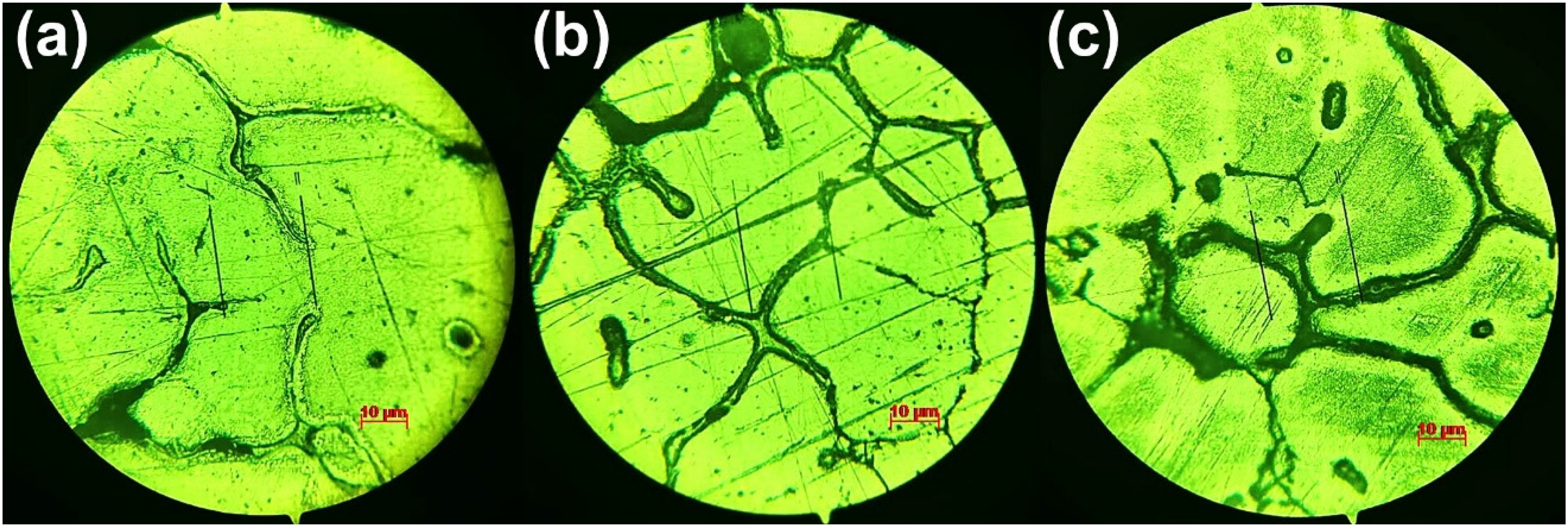
Metallographic images of aluminum alloys at 400x. (a) Al0.9Zn0.05Sn0.05, (b) Al0.85Zn0.1Sn0.05, (c) Al0.85Zn0.05Sn0.1.
Derived from the difference in crystalline structure, among other parameters, the SEM images show tin segregation towards the interdendritic spaces without its dissolution in aluminum (Figure 3). On the other hand, zinc is distributed throughout the sample without presenting a specific concentration in any preferential phase (Figures 3(i-d), (ii-d), (iii-d)). It is possible to observe the presence of oxygen in the entire piece due to the natural oxidation of aluminum exposed to the environment, forming aluminum oxide and forming zinc oxide (Figures 3(i-e), (ii-e), (iii-e)). The presence of the oxides can provide a protective effect in the case of aluminum oxide. This was less favorable for zinc oxide since this oxide does not function as a protective layer by allowing oxygen permeation through the formed oxide. The micrographs show a mapping of elements considering Al (Figures 3(i-b), (ii-b), (iii-b)), Sn (Figures 3(i-c), (ii-c), (iii-c)), Zn (Figures 3(i-d), (ii-d), (iii-d)), and O (Figures 3(i-e), (ii-e), (iii-e)) when having the samples exposed to the environment.
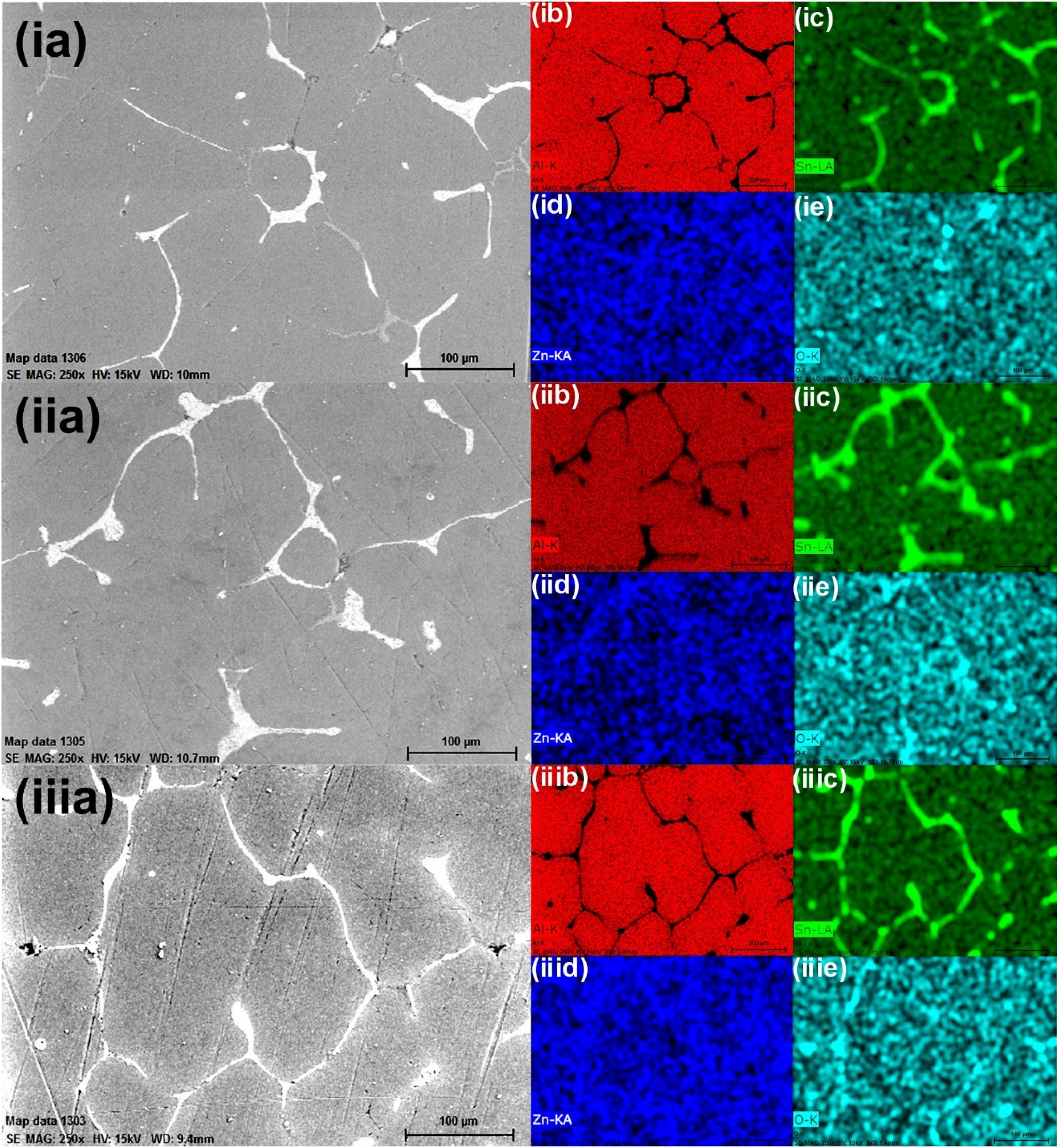
SEM analyses for the three alloys (i) Al0.9Zn0.05Sn0.05, (ii) Al0.85Zn0.1Sn0.05, and iii) Al0.85Zn0.05Sn0.1. The EDS analyses with mapping of the distribution of elements: (a) Al, (b) Sn, (c) Zn, and (d) O at 250× with 15 kV.
Acoustic analyses of AA6061 modified with Zn and Sn
Using RFDA, Young's modulus of the specimens was obtained considering the analysis of regular pieces with close apparent roughness. It was observed during the test that the variation of the force of the impact applied to the specimen did not alter the obtained results.
Figure 4 shows the behavior of sound within the material. In subsection (a), brass has a longer damping since the stable state occurs after 1.2 s. In subsection (b), the Aluminum alloy 6061 reached its steady state at 0.3 s. The same happened for the alloy Al0.85Zn0.05Sn0.1 and the alloy Al0.9Zn0.05Sn0.05. In the case of part (c), the time to reach its stable state was about 0.25 s.
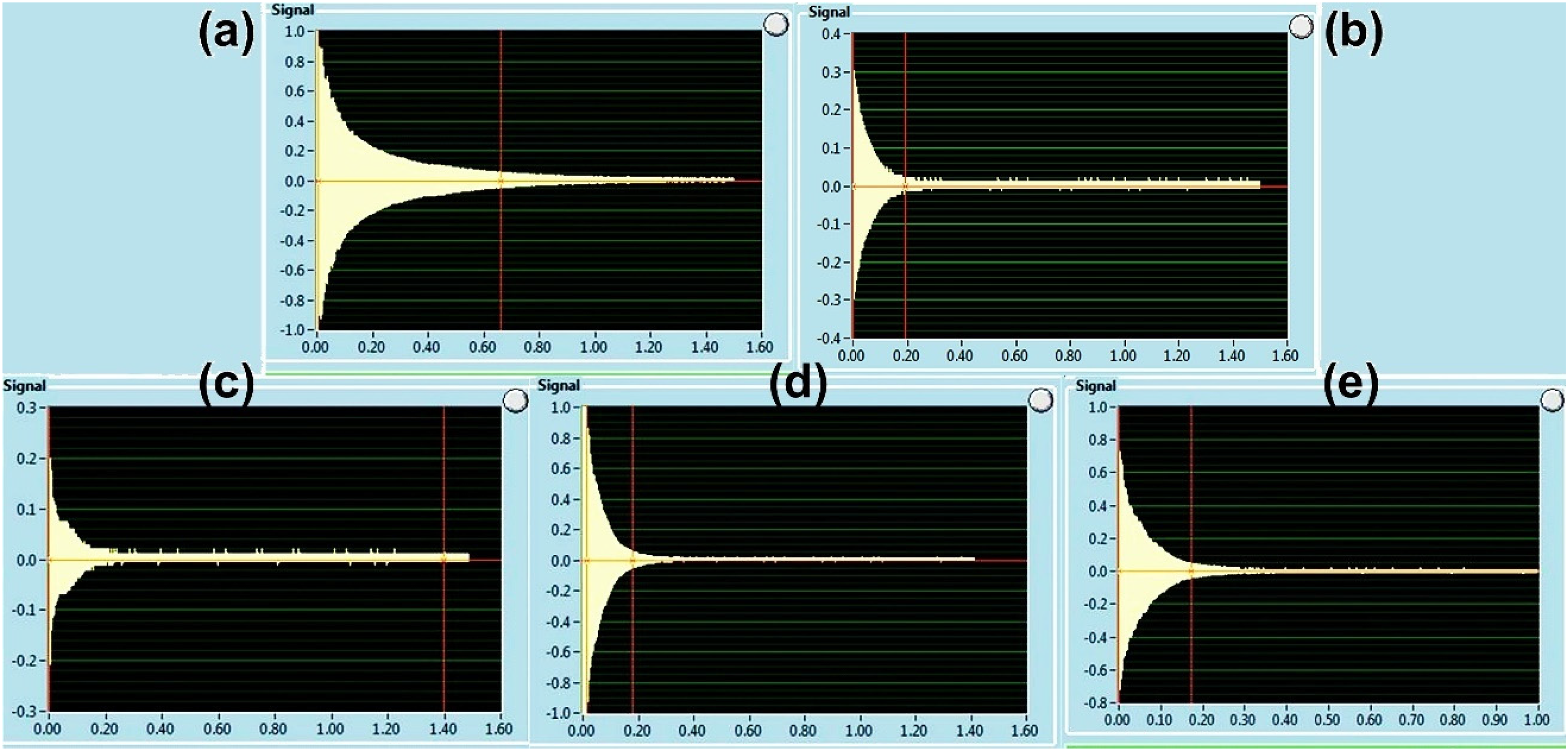
RFDA's vibration attenuation images were used to determine Young's modulus (X-axis in seconds). (a) Brass, (b) Al 6061, (c) Al0.85Zn0.1Sn0.05, (d) Al0.85Zn0.05Sn0.1, and (e) Al0.9Zn0.05Sn0.05.
It can also be observed that the modulus of elasticity is a function of the damping. That is, for example, the brass that the time to reach its stable state is higher than 1.2 s, its modulus of elasticity is 103.26 GPa, in the case of the alloy Al0.85Zn0.1Sn0.05, having a time of about 0.25 s, is 59.04 GPa. Table 2 shows higher damping of the acoustic wave.
Modulus of elasticity obtained using the RFDA method.

Table 2 shows the results of the RFDA test, obtaining the modulus of elasticity (Young's modulus) for the different samples. Incorporating zinc and tin reduces the modulus of elasticity, as expected. However, the variation ranges from 4 to 22%, which is lower than the expected theoretical module. This promotes higher ductility and shock absorption.
Figure 5 shows the behavior between the sound wave frequency and the decibels produced. The sound remained between 90 to 95 dB at frequencies from 0 to 4000 Hz. Later, the decibel level decreased as the frequency increased, stabilizing at 30 dB with frequencies above 16000 Hz. On the other hand, it can be observed that there was a decrease in the decibel level of sound at frequencies of 20, 50, 300, 450, 500, 950, 1300, 1800, 2000, 2100, 3100, 3500, 3800, 4500, 5500, 9000, 15500, 16000, 18500, 19000, and 19500 Hz, which vary from 1.5 to 20%. At 450 Hz, the sound attenuation levels were 8.69, 18.51, 14.79, and 20.68% for the alloys Blue (Al0.85Zn0.1Sn0.05), Purple (Al0.85Zn0.05Sn0.1), Orange (Al0.9Zn0.05Sn0.05) Sn ingot, Green (Al0.9Zn0.05Sn0.05) Sn powder, respectively. The impact of the presentation of tin was observed considering the form of powder and ingot. The results of the two materials in this test are shown since Young's modulus had minimal changes. For 500 Hz, the attenuation in the respective materials was 9.47, 9.78, 11.34, and 10.72%. For 950 Hz, the sound attenuation was 4.68, 5.46, 5.36, and 5.56%, respectively. For 1300 Hz, the decibel level reduction was 13.35, 17.56, 16.51, and 19.56% for the Blue, Purple, Orange, and Green alloys, respectively.
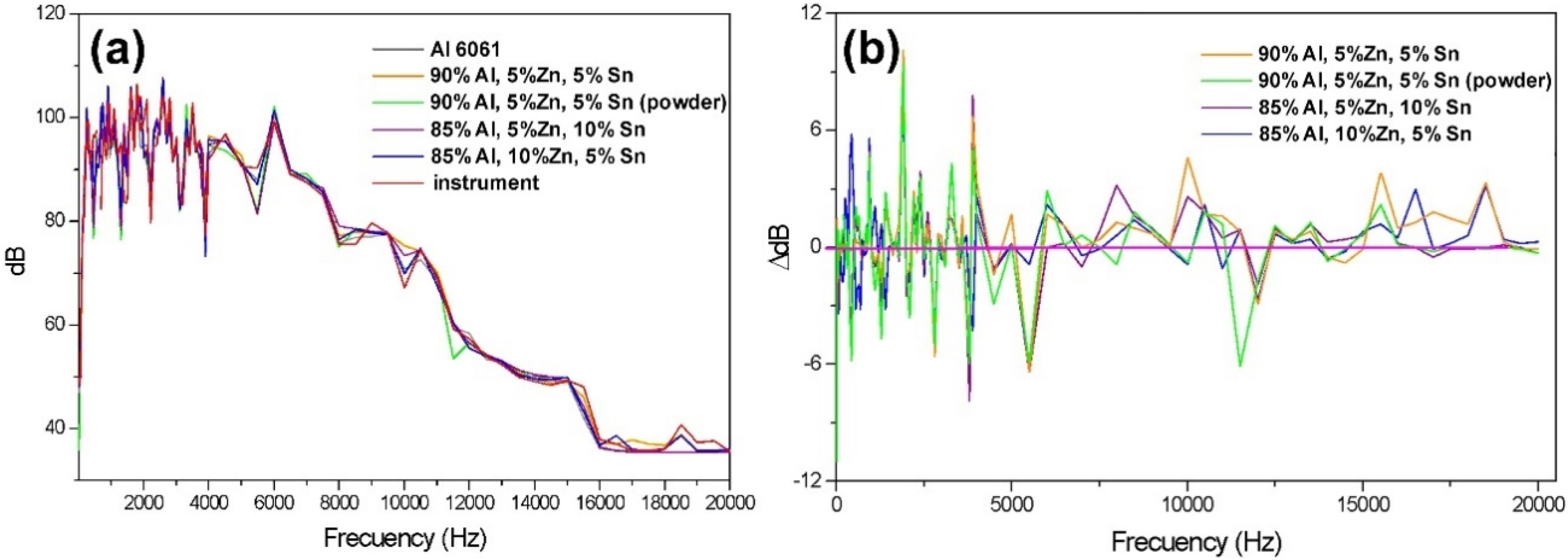
(a) Frequency vs. dB scanning using the reverberation tube for the different samples. (b) Frequency vs. dB change scanning using the reverberation tube, considering the Al6061 as the reference signal.
Figure 5(a) shows the frequency scans for different samples, eliminating the effect of the Al6061 alloy. Figure 5(b) shows the changes in dB showing the effect of incorporating Zn and Sn, with the highest effects for sound transmission being the sample Al0.9Zn0.05Sn0.05. On the one hand, Young's modulus does decrease, but it does not have the highest variation in this mechanical property. Therefore, an alloy Al0.9Zn0.05Sn0.05 could be used if sound damping is required. If higher impact absorption is required, the Al0.85Zn0.1Sn0.05 alloy could be used.
Electrochemical analyses of AA6061 modified with Zn and Sn
Nowadays, the sole adequate behavior for the intended application is not enough for the viability of using one or another material. Aluminum is prone to corrode in the presence of chlorine, causing pitting in located zones. Even considering that an Al2O3 thin layer protects the surfaces, there are some zones with defective passive layers causing anodic potentials susceptible to initiate localized corrosion. This could cause catastrophic failure of in-service pieces without signs of active corrosion because of changes on a small surface area by drilling holes.
Three test types were conducted to evaluate the susceptibility of the aluminum alloys to corrode in chlorine aqueous solutions: open circuit potential (OPC), cyclic potentiodynamic polarization (CPP), and electrochemical impedance spectroscopy (EIS).
The open circuit potential measurements are shown in Figure 6 and were used to evaluate the oxidation or passivation behavior of the material in a corrosive medium without the application of external potential. The results show that the aluminum alloys modified with Zn and Sn present more negative potential values than the Al 6061 matrix, which may be caused by an increase in the number of phases precipitated in the alloy. 50 These delay the formation of the passive aluminum oxide film and favor the formation of cathodic sites.
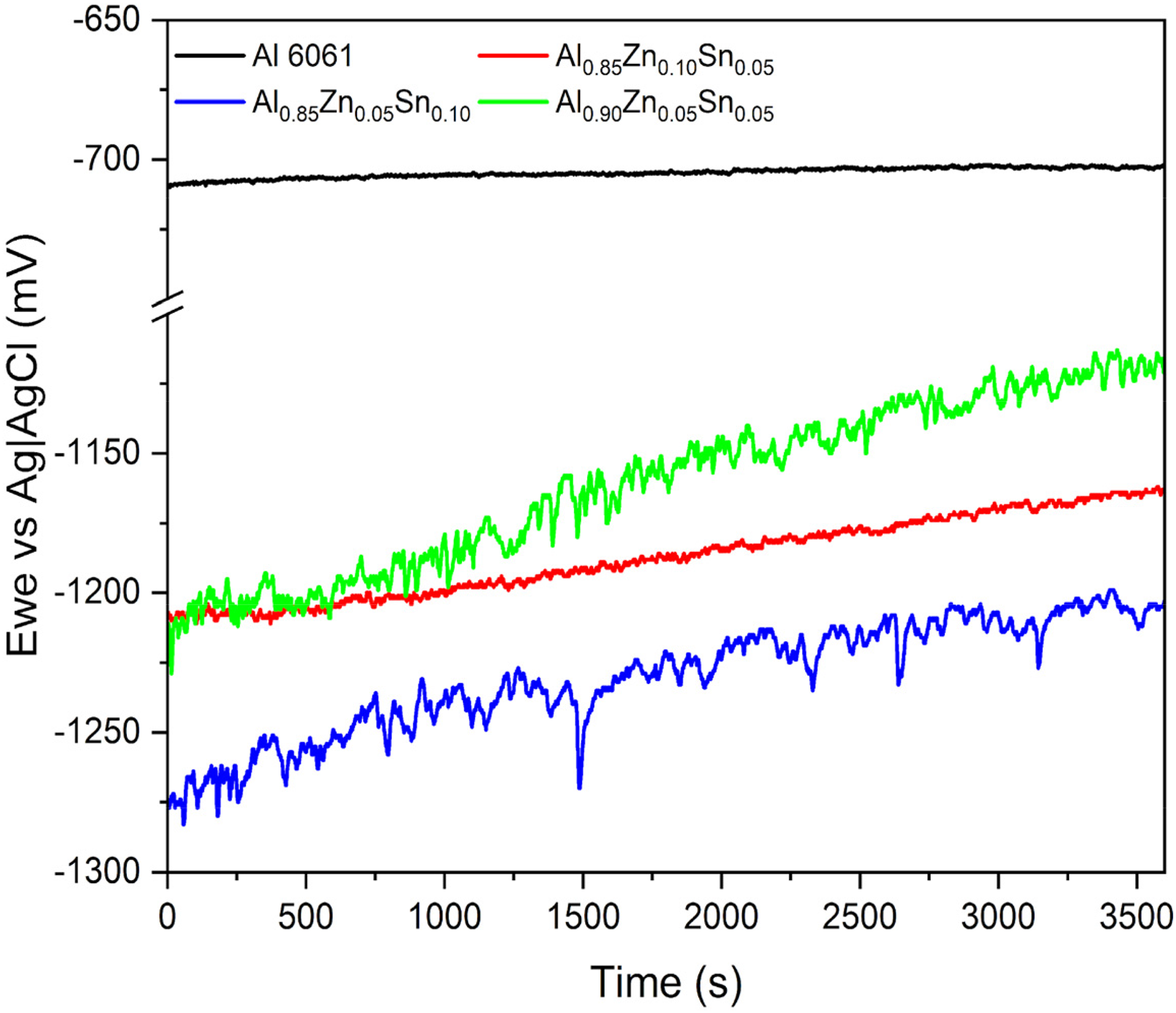
OCP measurements of aluminum alloys in NaCl 3.5%.
The aluminum 6061 matrix presents a constant OCP at −705 mV vs. Ag│AgCl. This behavior indicates the formation of a passive layer on the surface, which delays corrosion. On the other hand, the presence of Sn and Zn causes more negative OCP values and no stability. Failures in the passive layer can cause this and indicate a higher corrosion tendency. 51 Zn caused a slightly less cathodic potential than Sn. Al0.85Zn0.1Sn0.05 alloy was more stable than the others, even compared to the Al0.9Zn0.05Sn0.05 alloy, which has more aluminum to provide a passive layer.
The effect of the addition of Sn and Zn on the OCP of aluminum is independent of its position in the periodic table or the standard potential of these elements individually. It has been shown that its effect is unpredictable and can change the potential of the aluminum alloy in both directions. 52
The cyclic potentiodynamic polarization results are shown in Figure 7. Aluminum 6061 presents an increase in current density (J) in the reverse scan, which forms a positive hysteresis loop. This is caused by failures in the continuity of the passive layer of aluminum oxide and localized corrosion at high potentials. 53 In the case of alloys with the presence of Zn and Sn, the current density of the reverse potential is overlaid with the direct potential. This results from a discontinuous passive layer owing to the presence of Zn and Sn. Therefore, there is less alteration on the surface between the start of the potential scan and the application of the reverse potential, which causes similar values of current density.
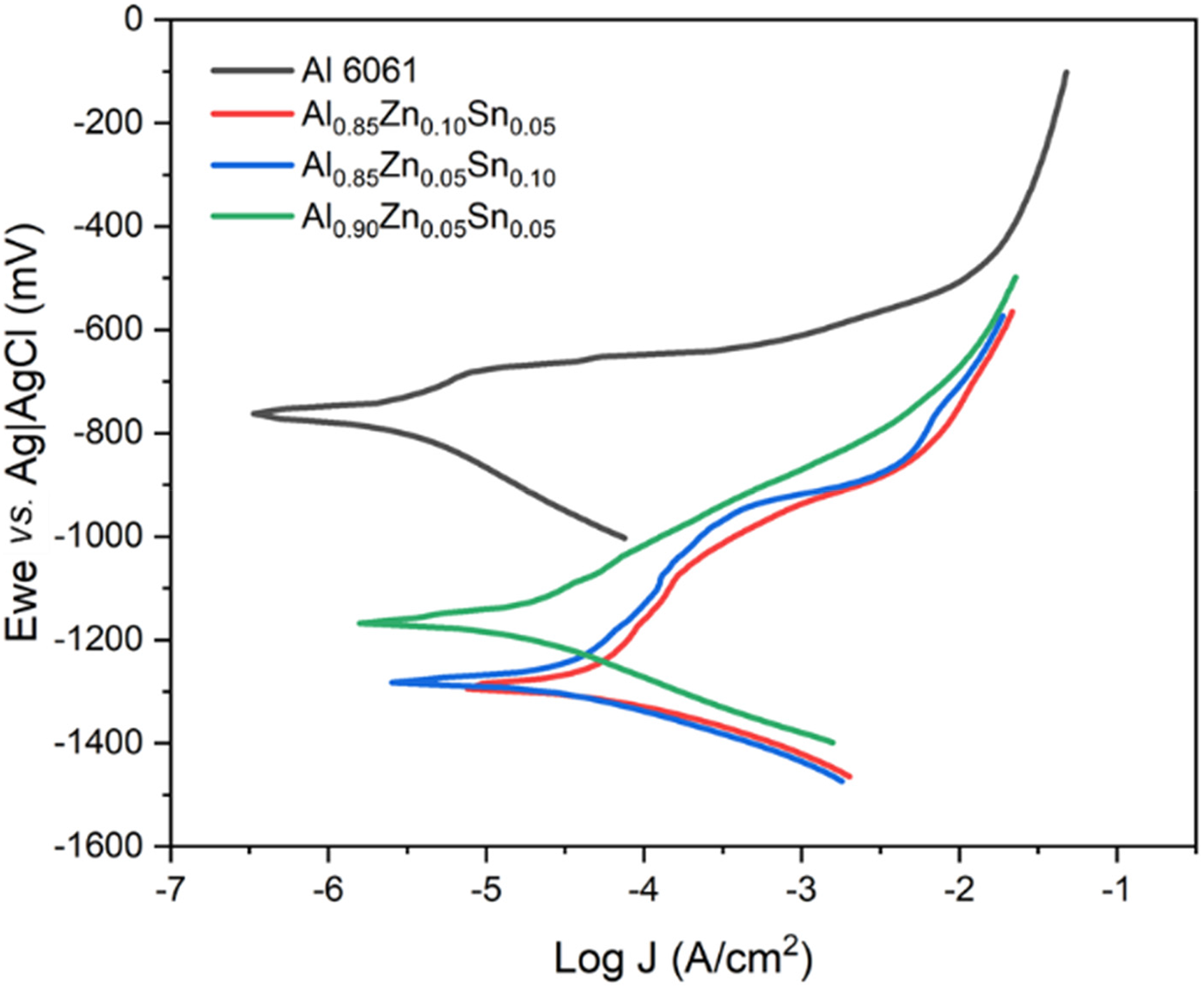
Tafel plot of aluminum alloys in NaCl 3.5%.
The Tafel slopes were calculated to obtain an approximate value of the corrosion rate (Table 3). The corrosion potential (Ecorr) of Aluminum 6061 has a value of −723.55 mV, similar to values reported in the literature for this alloy.54,55 The presence of Zn and Sn causes the displacement of Ecorr to more negative values, close to 1200 mV, for the three modified samples. This indicates a change in the magnitude of the anodic and cathodic reactions since the decrease in corrosion potential is related to higher anodic activity (higher corrosion) and a decrease in the activity of the cathodic reaction. 56 The corrosion current (Icorr) increases in alloys with 85% aluminum; this is attributed to a higher transfer of electrons between the electrode and the electrolyte, caused because, at that concentration, aluminum is not capable of forming a continuous layer of aluminum oxide that functions as a passive layer. Due to this, the alloy Al0.90Zn0.05Sn0.05 is the one with less tendency to corrosion and has a lower corrosion rate, lower Icorr, and a more positive corrosion potential. This increase in Icorr is proportional to the increase in the corrosion rate 57 obtained. The aluminum 6061 modified with Zn and Sn has a higher tendency to corrosion than the Aluminum 6061 matrix.
Tafel slopes results for Al6061 and three alloys.

Figure 8 shows the formation of a capacitive semicircle in the electrochemical impedance spectroscopy results. The diameter of this semicircle becomes considerably smaller in alloys with the presence of Sn and Zn. This is attributed to the fact that electrons flow more easily in these samples, representing a lower corrosion resistance, the same trend observed in CPP and OCP.
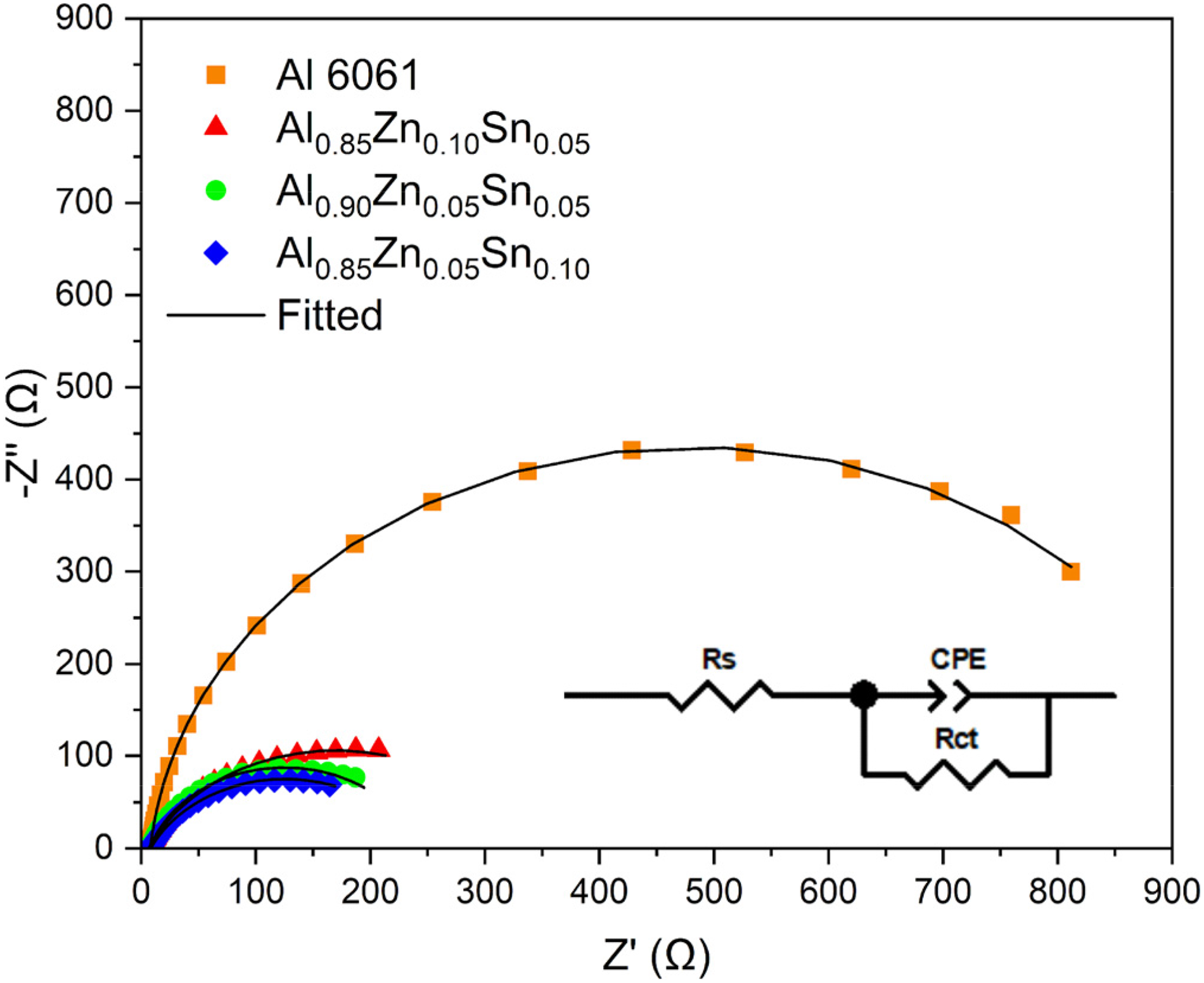
EIS measurements of aluminum alloys in NaCl 3.5%.
Equivalent circuits are a simplified representation of the electrical system and the electrochemical processes that occur at the studied interface. From the Nyquist diagram shown in Figure 8, equivalent circuit fits were made to the impedance spectra obtained using the ZView 2 software. The equivalent circuit used is a three-component system that has been widely reported for aluminum,58–61 inserted in Figure 8. It is composed of the electrolyte resistance (Rs), a constant phase element (CPE) attributed to the electrochemical double layer and the charge transfer resistance (Rct). The latter is directly proportional to the corrosion resistance.
Table 4 shows the values for each component in the equivalent circuit. The resistance to charge transfer decreases in the samples with the presence of Zn and Sn. The Rct results for the samples modified with Zn and Sn present the same trend as those obtained by Tafel, where the corrosion resistance decreases with respect to the decrease in aluminum concentration. This is attributed to the fact that these elements prevent the formation of the aluminum oxide film that forms naturally in this material 62 and can function as a protective barrier. Since this barrier is not present, the formation of cathodic sites, in which corrosion begins and spreads, is favored. Because of this, the Al0.90Zn0.05Sn0.05 alloy is the least prone to corrosion.
Equivalent circuit results from EIS for Al6061 and three alloys.

Conclusion
Acoustic attenuation is usually associated with hollow structures such as open-cell aluminum foams. It was observed that AlZnSn trimetallic has a significative sound attenuation when measuring Young's modulus compared to other materials. This study proposes this type of material for structures intended to reduce noise.
Modifying the 6061 alloy with zinc and tin favors the precipitation of a second phase rich in tin, generating phase boundaries. Aluminum forms a dendritic structure, causing the second phase in the interdendritic spaces. The distribution of zinc in the alloy was homogeneous, varying with the theory that indicates an insolubility between zinc and aluminum at room temperature.
There was a modification of mechanical properties, making it possible to deform the Al/Zn/Sn alloy by applying a small impact force such as that used with the RFDA small hammer. It was possible to have sound attenuation at different frequencies that can be applied to specific situations that generate sounds at frequencies that promote physiological damage to humans. A shorter time to sound attenuation was observed when comparing AA6061 and brass with aluminum-modified alloys.
Since the sole adequate behavior for the intended application is not enough for the viability of using materials. Also, aluminum is prone to corrode in the presence of chlorine, causing pitting without signs of active corrosion that could cause failure of in-service pieces. So, three electrochemical techniques were used to evaluate the samples: OIC, CPP, and EIS. According to electrochemical measurements, Zn and Sn prevent the production of aluminum oxide passive layers. When Zn and Sn were added to the AA6061, the cathodic potential was somewhat less negative with Zn than with Sn. Nyquist diagrams display smaller, more readily conductive semicircles, corresponding to reduced corrosion resistance. Cyclic potentiodynamic polarization of AA6061 with Zn and Sn reveals that the current densities of the reverse potential were superimposed with the direct potential and the corrosion currents increased.
The AA6061 aluminum alloy with zinc and tin additions is proposed as a material for sound attenuation applications. These alloys maintain a relatively low density, advantageous for lightweight acoustic panels. Their adequate thermal conductivity aids in managing heat, allowing for combined sound and thermal insulation. Economically sourced Zn and Sn could potentially lower material costs. Additionally, these alloys possess adequate formability, enabling the creation of complex shapes and designs necessary for custom acoustic and thermal applications. They can be effectively combined with other materials, such as polymers, foams, and wood, to enhance acoustic performance. The properties of these alloys can be fine-tuned during processing to meet specific acoustic requirements. Like most aluminum alloys, AA6061 with zinc and tin is highly recyclable, supporting circular economy and sustainability principles. Despite a decrease in corrosion resistance, those benefits make AA6061 with zinc-tin a viable alternative for specialized applications in acoustic engineering.
Footnotes
Acknowledgments
The authors are grateful for the financial support granted by the Tecnológico Nacional de México through project 8096.20-P. Also, the authors express gratitude to Guillermo Eduardo Mejía Hernández, Juan Carlos Méndez Méndez, and Jesús Guerrero Orduña for their technical assistance.
Author contributions
Declaration of conflicting interests
The authors declared no potential conflicts of interest with respect to the research, authorship, and/or publication of this article.
Funding
The authors disclosed receipt of the following financial support for the research, authorship, and/or publication of this article: This work was supported by the Tecnológico Nacional de México, (grant number 8096.20-P).
