







Abstract
Nanostructured thermal barrier coatings (TBCs) enhance thermal insulation in advanced gas turbines, enabling higher operating temperatures and increased power output. These coatings support the deposition of high-quality thin films, even on substrates with intricate geometries. This process ensures precise film composition and structure control, improving the coating's performance and longevity. In this review paper, the effect of nanostructuring on TBC performance is thoroughly reviewed and discussed in terms of microstructural transformations, phase stability, degradation mechanisms, thermal conductivity, and interface stability when subjected to working conditions. A significant challenge in TBC durability is oxidation-induced weight gain with an associated increase in failure mechanisms’ occurrence rates, which affects long-term performance. Comparative kinetic studies indicate that the coating of nanostructured yttria stabilized zirconia compared to the micron-sized coatings shows much lower weight gain. The superior oxidation resistance and reduced mass accumulation of nanostructured YSZ coatings are demonstrated by their lower parabolic rate constant (Kp) of 3.36 × 10⁻⁷ mg2 cm−4 s−1, compared to 6.23 × 10⁻⁷ mg2 cm−4 s−1 for micrometer-sized coatings. Additionally, increasing the nanostructure loading to approximately 8% unmelted nanoparticle matrix content enhances thermal cycling life, thereby extending the longevity of TBCs. This paper reviews the development of nanostructured TBC design and achievements and challenges for extreme high-temperature gas turbine applications.
Introduction to thermal barrier coatings (TBCs)
Thermal Barrier Coatings (TBCs) are advanced materials that protect components exposed to extreme heat and harsh operating conditions. When applied to turbine blades, vanes, and other high-temperature components, these coatings are essential to extending life and improving the performance of gas turbines. 1 TBCs are heat-resistant layers that protect materials like gas turbine blades from high temperatures, erosion, and corrosion. 2 Using thermal barrier coatings (TBCs) has allowed for higher turbine entry temperatures (TET), the temperature of the gases entering the turbine. TBCs permit turbines to withstand higher TETs to increase efficiency and performance. Furthermore, adhesion, uniformity, and durability are also stated to be improved via surface modification techniques, i.e., magnetron sputtering under operational conditions. Thermal Barrier Coatings (TBCs) are essential in high-temperature applications, as shown in Figure 1, which visualizes the structural characteristics of TBCs.
Zirconia (ZrO2), yttria-stabilized zirconia (YSZ), and many other ceramic-based compounds are thermal insulation materials that behave as dielectrics with minimal phonon conductivity. These materials have low thermal conductivity, which reduces heat transfer rates and erosion. 3 To improve thermal stability, resist thermal cycling, and decrease thermal conductivity, yttria-stabilized zirconia (YSZ) is chosen. Moreover, adding 8 wt.% yttria (8-YSZ) stabilizes the high-temperature tetragonal phase of zirconia and improves the performance of thermal barrier coatings.4,5
Magnetron sputtering is the best method to deposit NiCrAlY-based bond coats because of its variables that we can alter to achieve specific coating composition, structure, excellent coating adherence, nanocrystalline grains, superior mechanical strength, etc.6,7 Magnetron sputtering is a highly adaptable physical vapor deposition technique that has now been applied to synthesize nanostructure TBCs. In general, when comparing the magnetron sputtering technique with the conventional thermal spraying techniques, the former offers better microstructure, improved interface bonding, and superior thermal and mechanical performance of the coated layer. 8 However, magnetron sputtering is not a unique method of depositing a thick TBC layer (>5 μm) needed for effective thermal insulation. It is not a substitute but a complementary method to reinforce bond coat properties, oxidization resistance, and created microstructural characteristics. Although APS and EB-PVD are primarily employed for the thick coating deposition, sputtering offers reasonable grain structure, adhesion, and porosity control, enhancing overall TBC performance. 9
The bond coat comprises nickel-based superalloys such as Inconel or Hastelloy, adding Cr, Al, Y, and other elements. This bond coat is intended to partially address the problem of different thermal expansion coefficients of the TBC layer and the blade metals. To enhance oxidation resistance, aluminum is added to the bond coat. Aluminum oxidizes to form a thin Al₂O₃ layer (TGO) that initially acts as a barrier and gradually increases to 10–13 wt.% over time. The Al2O3 layer plays a vital role in TBC operation, blocking extra bond coat oxidation and protecting the top coat. While aluminum is very effective in this role, its use in the bond coat presents challenges for the future operation of gas turbine engines (GTEs), as the top coat is susceptible to corrosive salt attack.10,11
Bond coats sputtered on the substrate are important in curtailing TGO growth and, consequently, the TBC durability. Sputtering can deposit highly dense and uniform NiCrAlY or Pt-Al layers with better oxidation resistance and adhesion at the interface. As a result, it prevents early spallation and improves long-term performance under thermal cycling conditions. Nevertheless, the composite benefits of sputtered coatings are overcome by the fact that these coatings are usually thin (<5 μm) and often used in combination with APS or EB – PVD to provide sufficient thermal insulation.6,9
Although magnetron sputtering cannot replace conventional methods of full-scale TBC deposition, the method offers a desirable means of producing coatings with superior adhesion to current TBCs and improved oxidation resistance. Research has shown that when APS or EBPVD topcoats are combined with sputtered bond coats, this system possesses significantly enhanced mechanical and thermal properties. Thus, the synergy between sputtering and other deposition methods for optimized coating performance is a good match for mitigating TGO growth, reducing strain tolerance, and thermal cycling degradation.12,13 EB-PVD offers improved strain tolerance and controllable microstructure, although it lacks cost-effectiveness and scalability, especially for coating complex geometries. However, the highly refined nanostructure inherently produced by EB-PVD is still challenging to achieve, which may limit the potential of nanostructured TBCs from fully exploiting their benefits. In contrast, APS is cheaper for deposition with higher deposition rates and can coat complex-shaped parts efficiently. Although APS coatings generally have higher porosity and lower strain tolerance than EB-PVD coatings, further process optimization is necessary to improve insulation properties at acceptable levels of mechanical integrity. Thus, hybrid approaches utilizing APS or EB-PVD methods and sputtered bond coats effectively enhance TBC's overall performance. 14 This limitation becomes much more critical when nanostructured TBCs are targeted, where the ability to control grain size and porosity plays a key role in obtaining what is needed. Even today, Electron Beam Physical Vapor Deposition and Air Plasma Spraying continue to dominate Thermal Barrier Coating fabrication. However, both methods struggle to keep pace with increasing modern gas turbine requirements. However, pushing operating temperatures higher for increased efficiency and emission reduction 15 creates this gap. Elevated temperatures, however, subject TBCs to increasingly aggressive thermomechanical stresses and exceed the thermomechanical permissible spacing, thus causing TBC coating properties and deposition technology advances.
High-temperature degradation mechanisms of future TBCs, such as sintering, phase destabilization, and erosion, must be resisted. 16 As a result of sintering, the layer densification, which results in high thermal conductivity, invalidates the coating. It also can lead to negative performance through phase transformations within the ceramic top coat. Resistance to erosion and foreign object damage is also necessary because premature coating failure can result from these factors. 15 However, with conventional EB-PVD and APS techniques, consistency and reliability of the coating microstructure in such demanding environments need to be built up. TBCs in a gas turbine engine are subjected to harsh mechanical conditions in the operating environment, mainly due to thermal cycling. 13
Research has explored hybrid approaches to address these concerns where sputtering is combined with APS or EB-PVD. Sputtered bond coats can minimize thermal expansion mismatches between the topcoat and substrate, improving mechanical integrity and longer operational life. This study aims to highlight the role of sputtering in optimizing the TBC system rather than serving as a complete replacement for traditional deposition techniques. 14
Superalloys, exhibiting superior high-temperature strength and creep resistance, form the backbone of these engines. However, even these metallurgical marvels require protection from modern turbines’ extreme temperatures and harsh environments. This need has led to the development and application of Thermal Barrier Coatings, acting as strategic enablers for further advancements in gas turbine technology.17–19 The material's hardness and elastic modulus properties were evaluated at the nanoscale to accomplish that. On the contrary, this method provides the sample-indenter contact area estimation according to the indenter geometric theory; however, the inconsistency/difference of the actual geometry may cause inaccuracy in the characterization of all anticipated properties/mechanical characteristics. As for what arc size can influence stiffness and modulus, these moduli may be derived from intrinsic material properties or load-displacement curves. The marble-based composite will be discouraged from exploiting its high structural potential due to the lumps of mechanical properties intrinsic to the sensing at the nidus of indentation. Therefore, the primary function of this work is a two-fold process: an analysis of the mechanical properties of the top coating applied via the plasma spray deposition compared to the one subject to the isothermal oxidation and gauging their evolution during the indentation using the same technique that was previously applied.20–23 Magnetron sputtering holds immense potential for depositing NiCrAlY bond coats, offering several advantages over conventional methods. Its ability to tailor coating composition and structure allows for optimized performance. In contrast, its inherent characteristics, such as outstanding coating adherence, nanocrystalline grain structure, higher density, and superior mechanical strength, enhance coating durability and resistance to demanding operating conditions. 24 Due to their high-temperature operation capability, gas turbines are in demand. To increase their efficiency, it is vital to improve TBC. The fabrication of nanostructures is a hopeful means of producing new TBCs. In the past, nanostructured zirconia-based Thermal barrier coatings coated using the APS have been a matter of comprehension. Improved bonding strength was shown in nanoscale thermal barrier coatings. The nanostructured thermal barrier coatings enhanced high-temperature thermal shock resistance due to the bimodal microstructure of nanozones and another pore source connected to the nanozones. 25
Nanostructured magnetron sputtered TBCs for aviation gas turbine blades
The deposit of nanostructured thermal barrier coatings through the magnetron sputtering technique has significant potential to improve the performance and efficiency of gas turbine engines in the aviation sector. Such coatings have very fine grain sizes and possess quite different microstructures; such coatings provide enhanced possibilities of having better thermal stability, lower coefficient of thermal conductivities, and better resistance towards degradation mechanisms than conventional TBCs. 26
Advantages of nanostructured magnetron sputtered TBCs
Magnetron sputtered nanostructured thermal barrier coatings have shown critical advantages for aviation gas turbine blade applications that improve engine performance and efficiency. The unique characteristics of nanostructured materials and the control exhibited by sputtering are combined to afford these benefits. Magnetron sputtering deposited nanostructured TBCs are a promising technological means of improving the performance and efficiency of aviation gas turbine blades. This technology provides lower thermal conductivity, improved adhesion strength, and precise control over coating characteristics that increase engine efficiency, increase operating temperatures, and increase component lifetimes. Because nanostructured TBCs deposited by magnetron sputtering will continue to be a key part of developing more efficient and durable gas turbines, the demand for them will only grow as the demand for aviation propulsion systems increases.
Enhanced Thermal Stability Lower Thermal Conductivity Improved Resistance to Sintering
The enhanced thermal stability of these coatings in high-temperature regimes is due to their nano-structural nature. Fine grain size and increased grain boundary density effectively inhibit grain growth, which would usually be promoted at elevated temperatures, as well as phase transformations. This enhanced stability translates to a longer service life for turbine blades operating under extreme conditions, as confirmed by studies demonstrating the superior performance of nanostructured TBCs at high temperatures. The nanostructured nature of TBCs represents a significant advancement in high-temperature materials technology. As the demand for higher operating temperatures and increased engine efficiency continues to drive innovation in the aerospace industry, nanostructured TBCs will undoubtedly play an increasingly vital role in enabling the next generation of high-performance gas turbine engines.27,28
Nanostructuring emerges as a key strategy for significantly reducing the thermal conductivity of Thermal Barrier Coatings, thereby enhancing their insulating properties and improving the overall performance of high-temperature components. This enhancement stems from the microstructural modifications induced by nanostructuring, primarily the increased density of grain boundaries within the coating material. These grain boundaries act as scattering sites for phonons, the primary carriers of heat energy in crystalline materials. When phonons try to pass through into the nanostructured material, they encounter more scattering sites, beating up their flow and reducing coating heat transfer efficiency. Since this phonon scattering effect causes a lower overall thermal conductivity, thermal insulation is improved. This enhanced insulation is important for protecting the underlying metal components from extreme heat, running the engine at higher temperatures, thus increasing engine efficiency and reducing thermal stress to component life.29,30
Sputtered Nanostructured Thermal Barrier Coatings possess remarkable sintering resistance, a key feature in preventing loss of desirable properties and long-life operation in high-heat applications. When particles of a material become sintered at elevated temperatures, it also densifies, grows grain, and changes the microstructure of the coating. Excessive sintering, however, is detrimental to the TBC performance, and a controlled degree of sintering can be beneficial, especially for enhancing coating adhesion. The densification of the microstructure can increase thermal conductivity, but it also undermines the strain tolerance and, thus, the capability of the coating to withstand thermal stresses. Imparting this sintering resistance to nanostructured TBCs depends on the sputtering deposition process. The precise coating of the microstructure provides fine grain size and highly controlled porosity by sputtering. The fine grain size limits the driving force for sintering because diffusion distances for atoms to migrate and bond are extremely small. Furthermore, the controlled porosity decreases sintering by limiting the contact area of particles, thereby preventing the formation of large-scale diffusion paths. Maintaining nanostructured TBC's desirable properties for extended periods fundamentally depends on this inherent resistance of nanostructured TBCs to sintering. Unlike conventional TBCs, nanostructured TBCs do not experience sintering-induced degradation. They maintain their lower thermal conductivity, superior mechanical properties, and enhanced phase stability, resulting in consistent performance and extended service life. Nanostructured TBCs can withstand sintering, making them a promising approach for eliminating sintering in applications where extended exposure to high temperatures is inevitable, including, for example, in aviation gas turbine engines and advanced power generation systems.31,32
Literature survey
Thermal barrier coatings (TBCs) are extensively used in gas turbines and other high-temperature applications to improve thermal insulation, oxidation resistance, and durability. Researchers have extensively studied TBC oxidation mechanisms, coating microstructure, and advanced deposition techniques to improve its performance under extreme environments. In nuclear applications, diffusion barrier coatings are also important; the effects of these coatings in enhancing oxidation resistance and mechanical stability in nuclear fuel claddings are addressed. This section categorizes the literature into three primary key areas:
TBCs for high-temperature applications, Diffusion barrier coatings for nuclear applications, and Advances in coating deposition techniques.
Thermal barrier coatings (TBCs) for high-temperature applications
TBCs are significant in gas turbines and aerospace engines as they help resist severe thermal cycling and oxidation stress. Oxidation mechanisms of TBC and how they impact durability have been studied by several. A comprehensive review of oxidation mechanisms in TBCs was published by Roy et al., 33 where they illustrated how TGO formation and bond coat adhesion influence coating longevity. Microstructure effects on oxidation resistance in MCrAlY coatings, a common bond coat material, were studied by Zhao et al., 34 who showed that deposition methods could significantly affect performance.
Phase stability and sintering of TBCs have been investigated through modifications of the material composition. A Pt-Al protective film on YSZ TBCs designed to resist CMAS (calcium magnesia alumina silicate) corrosion, the primary source of degradation, was proposed by Wang et al. 35 According to their findings, Pt-Al films can massively improve CMAS resistance without deteriorating thermal cycling life, although the softening of platinum at high temperatures is an issue. Researchers have studied the improvement of composite TBC thermal cycling durability. Functionally graded YSZ-Al₂O₃ coatings were analyzed by Ramesh et al. 36 as a scenario in which a gradual compositional transition reduces thermal stress (better thermal cycling resistance) between the layers. Their work points out the advantages of multi-material coatings in enhancing the TBC performance under high-temperature conditions.
It has also been the effect of coating thickness and bonding strength on TBC performance. As stated by Wang et al., 37 TBC thickness, bonding strength, and thermal cycling life have a relationship in which thicker coatings provide better thermal insulation. However, inferior quality bonding strength leads to decreased lifespan. Therefore, to ease this problem, they fabricated a gradient NiCoCrAlY/YSZ coating using a synchronous dual powder feeding method, providing better bonding and oxidation resistance. To further improve corrosion resistance, it was shown by Ali Raza et al. 38 also examined how the porosity and the corrosion resistance of HVOF coating deposition can depend on oxygen flow rate and spray distance. They show that to tune the TBC properties for better durability, it is important to control process parameters. Meng et al. 39 also investigated the effect of various superalloy substrates (K38, N5) on the oxidation behavior of nanocrystalline coatings. They confirmed that substrate selection is an important influencing factor for coating performance.
Moreover, composite coatings have been introduced to improve the TBC properties further. PS-PVD 7YSZ TBCs were modified with Al2O3 by Zhang et al., 40 showing that additions of Al2O3 help enhance oxidation resistance and coating reliability in the harsh operating environments of turbine components.
Diffusion barrier coatings for nuclear applications
Diffusion barrier coatings are essential in nuclear reactors because they improve mechanical stability and prevent oxidation; TBCs, on the other hand, focus on thermal insulation. Chromium coatings on zirconium alloy fuel claddings, an important component of nuclear reactors, have been investigated by Li et al. 41 Using radio frequency magnetron sputtering, they show that a 6 μm Cr coating greatly enhances oxidation resistance in steam at 1200°C. A chromium oxide stable layer blocks oxidation, improving mechanical strength and corrosion resistance.
Li et al. 42 further researched (Cr/CrN) multilayer coatings deposited on Zr—4 alloy, proving their excellent oxidation resistance under extremely harsh conditions (1200°C steam exposure). Based on their results, the authors learned more about the oxidation mechanisms and how layered structures can improve durability in nuclear fuel claddings.
Peng et al. 43 have also studied the role of oxygen addition to NiCrAlY coatings and found that oxygen-containing coatings contain nano-crystalline Y2O3 structure and better wear and hardness resistance at high temperatures. They find that microstructural engineering can improve diffusion barrier performance in nuclear environments.
Advances in coating deposition techniques
Coating deposition techniques have a high influence on performance and durability of TBCs and diffusion barrier coatings. Substrate temperature, deposition method and layering strategy to investigate how they affect the mechanical properties have been investigated by researchers. In addition, it is observed by Verma et al. 44 that coating hardness and Young's modulus are affected significantly by substrate temperature, with the higher values of mechanical properties reaching their maxima at 500°C as a result of a dense microstructure.
The hardness of Al2O3-Ta2O5 multilayer coatings was investigated by Zhang et al., 45 and hardness variation was shown with layer structure; however, the elastic modulus was constant (145–155 GPa). Kadam et al. 46 further investigated how spray angle variation in air plasma sprayed 8YSZ coating directly impacts porosity, hardness, and roughness, thus emphasizing the significance of precise process control in TBC fabrication. Simulation techniques have also been employed to optimize coating design. Finite Element Modeling (FEM) was used by Price et al. 47 to assess hardness variation within multilayer coatings. It showed that FEM may be utilized as a predictive tool in optimizing coating performance. For example, Solovyev et al. 48 investigated how residual stress is formed in YSZ electrolyte films. They found that with optimized deposition modes, stress is reduced, allowing for a more stable coating.
In their works, Kurian et al. 49 compare the different coating processes, i.e., atmospheric plasma spraying and laser cladding, to be suitable for industrial applications. Their study highlighted how the coating method affects possible microstructure, porosity, and adhesion strength of TBC and diffusion barrier.
The fabrication of nanocrystalline coating by magnetron sputtering has been widely explored. Uniform thickness control in the sputtering deposited nanocrystalline coating has been emphasized by Wang et al. 50 as a method to achieve favorable coating properties. For aerospace applications, Lin et al. 51 used titanium alloys to apply thermal barrier coatings while using reactive pulsed DC magnetron sputtering as a scalable technique.
Reactive pulsed DC magnetron sputtering recently proved to be a promising way of depositing high-performance TBCs. Its high deposition rates and scalability make it suitable for aerospace applications, as mentioned by Lin et al. 52 Various control parameters of the stoichiometry, the microstructure, and the adhesion properties are being improved to optimize this technique for next-generation coatings.
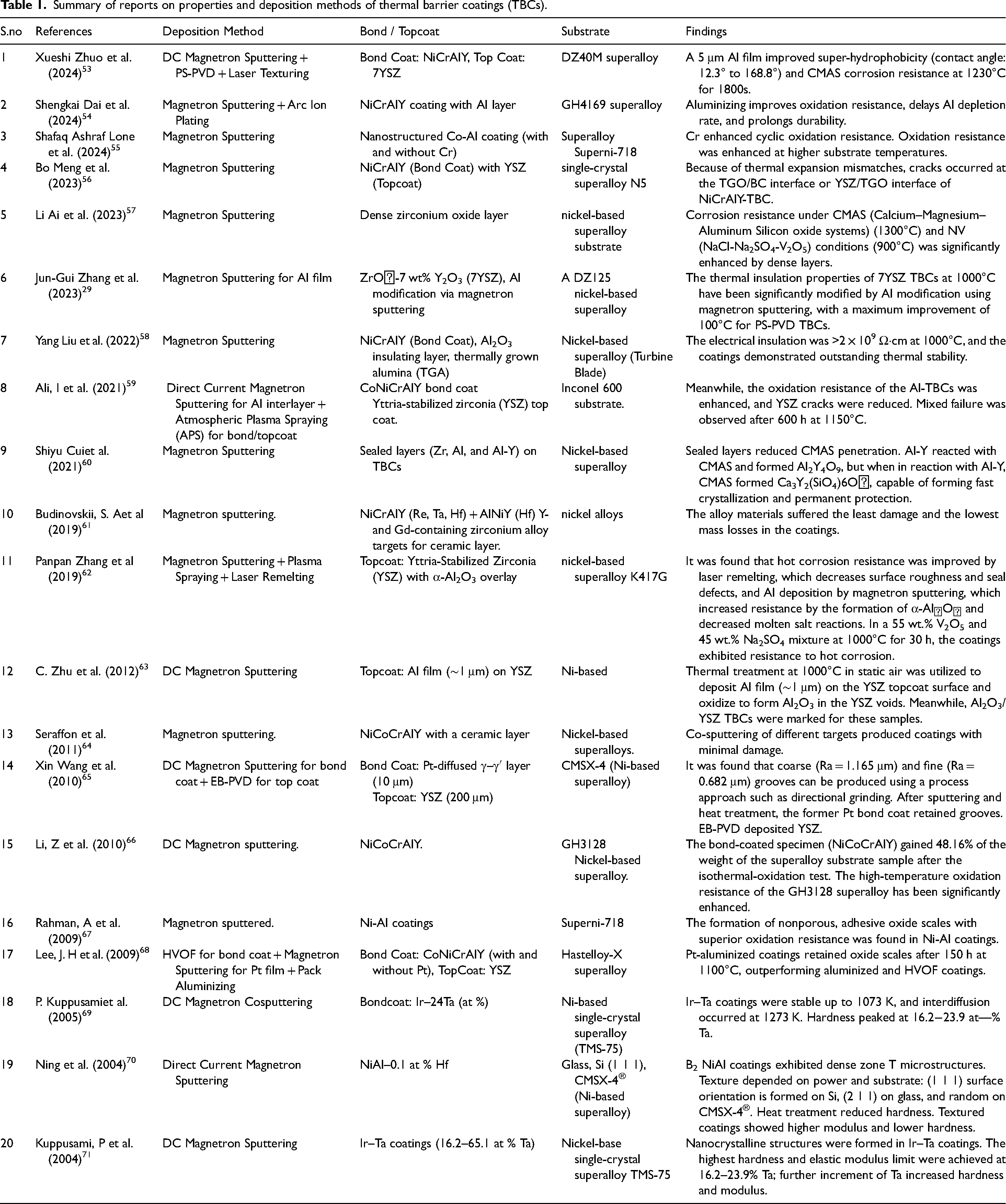
Table 1 shows how the studies summarized advanced TBC properties and performance over various substrates and deposition methods for magnetron-sputtered thermal barrier coatings (TBCs). Important findings demonstrate the enhanced oxidation resistance, thermal stability, and protection against corrosion due to dense ceramic layers and bond coats. For example, Al modifications were shown to improve CMAS corrosion resistance and super-hydrophobicity by Zhuo et al. (2024), and Dai et al. (2024) achieved more excellent durability with aluminized NiCrAlY coatings. Zhang et al. (2023) and Liu et al. (2022) demonstrated thermal insulation and electrical resistivity improvements through dense layers and insulating coatings. While these advancements are promising, little information currently exists regarding the coating's long-term stability and longevity under actual service conditions on a global scale. The findings in Table 1 identify the key influential factors on TBC performance and provide directions for future research to optimize TBC applications in extreme environments.
Summary of reports on properties and deposition methods of thermal barrier coatings (TBCs).
This review highlights a critical gap in magnetron-sputtered nanostructured thermal barrier coatings (TBCs) because of the absence of real-world test samples to test the long-term stability under actual service conditions. However, such coatings exhibit good wear resistance and excellent properties in a laboratory environment. However, today, test methods neglect the complex and aggressive conditions in applications such as gas turbines or jet engines. However, this gap between laboratory simulations and actual applications limits the development of durable and efficient TBCs and points toward the need for testing methods that represent realistic operating conditions.
Long-term stability and overall performance of nano-structured TBCs
Since these coatings must be used at high temperatures for applications in gas turbines and aerospace engines, the strength and the overall performance of the TBCs fabricated by the magnetron sputtering techniques must be studied for longer durations. Magnetron sputtering can control the deposition process, controlling the deposited layer's thickness to provide uniform thickness and microstructure coatings. 72 These characteristics are critical for guaranteeing the dimensional stability of the TBCs during their thermomechanical fatigue exposures in high-temperature environments and thermal cycles without considerable deterioration. However, certain circumstances can turn TBCs into a problem, i.e., thermal expansion mismatches, oxide growth, and phase transformations, for example, can undermine the intended shielding function. 73 The general stability of TBCs (Figure 2) under such a response depends on the microstructure and composition resulting from magnetron sputtering. For example, the ability to adjust deposition rate, temperature, target material, and gas flow rates raises the ability of the coating to resist cracking, spallation, and sintering.
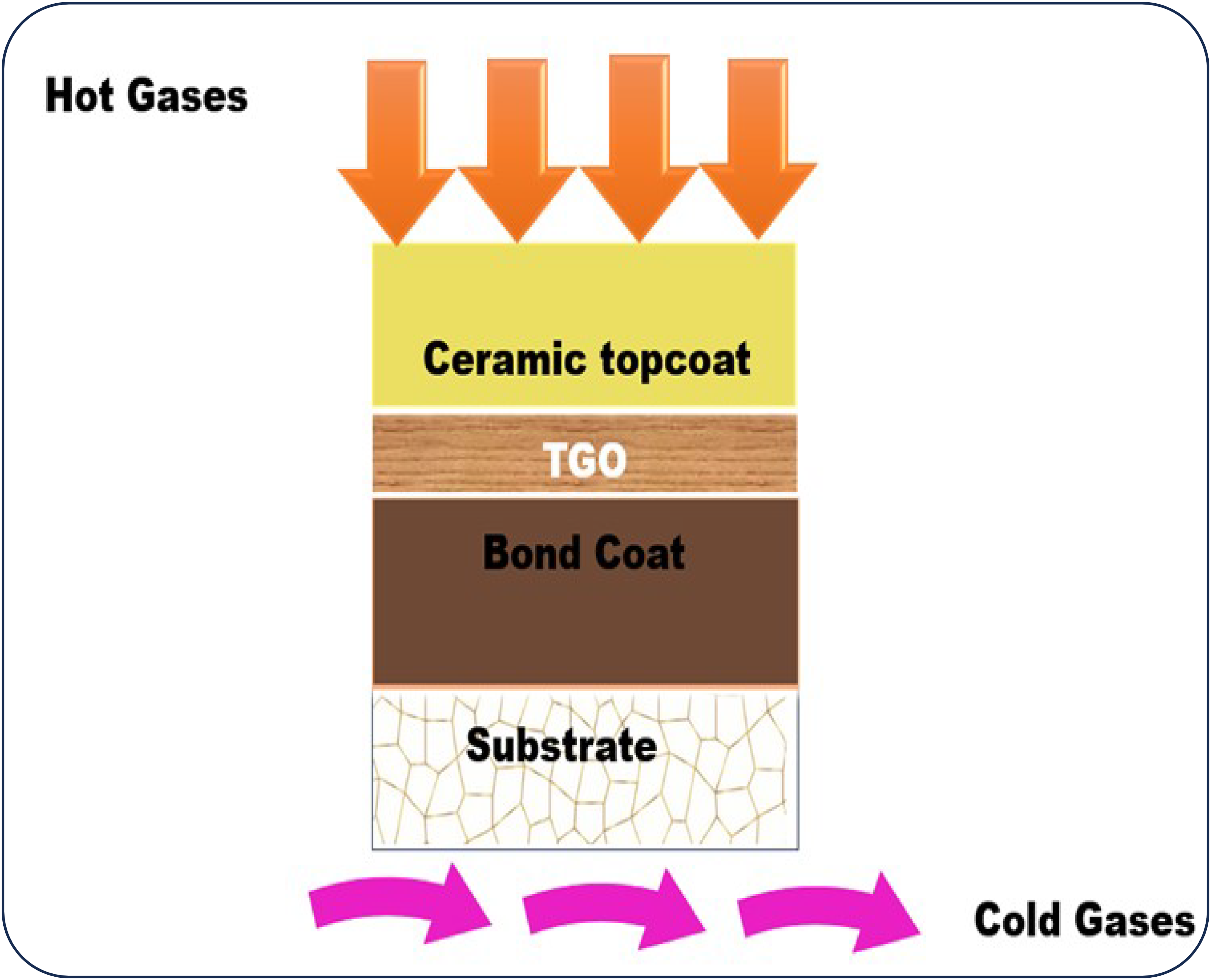
Visualization of thermal barrier coatings.
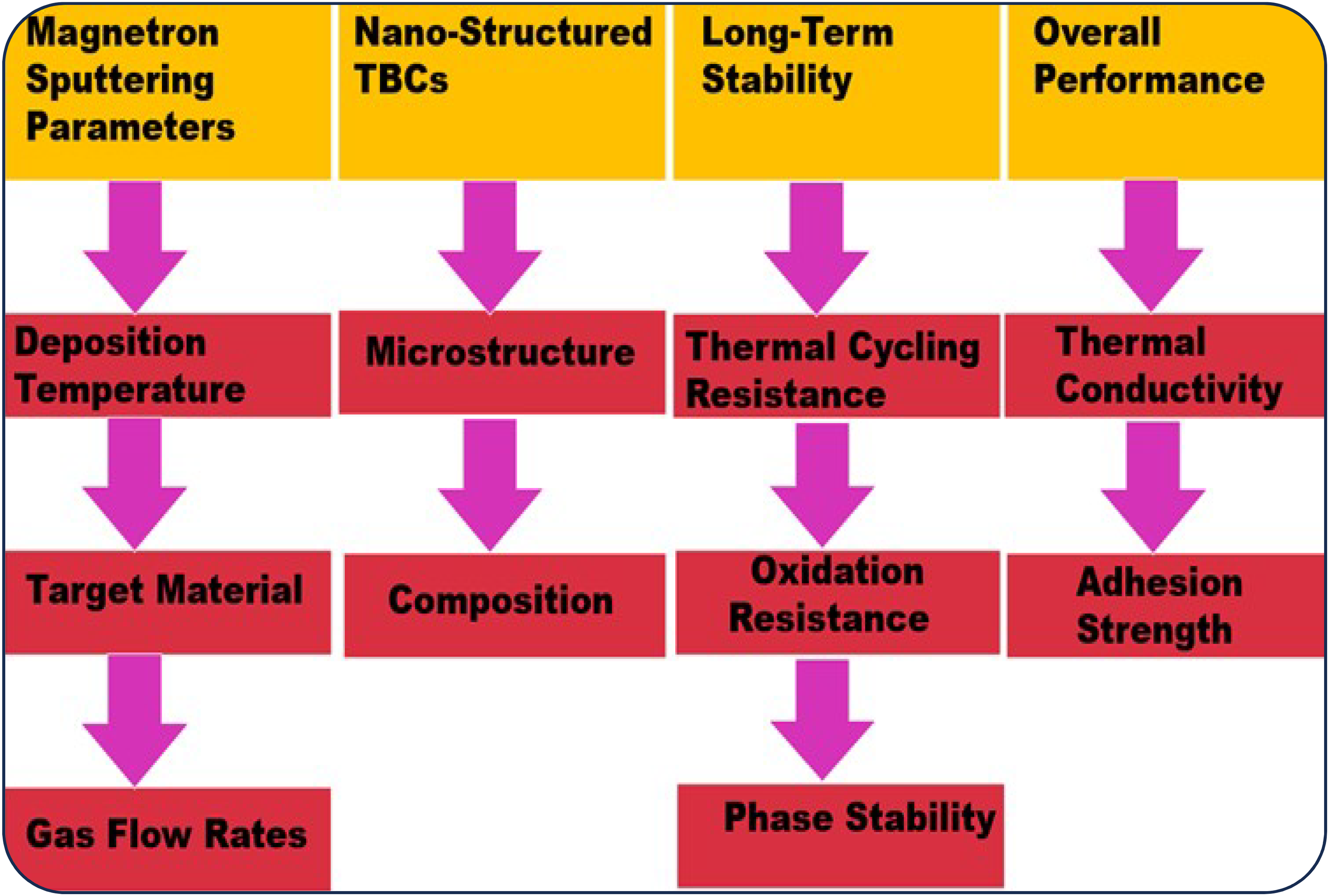
Flowchart illustrating the long-term stability and general performance of nanostructured thermal barrier coatings (TBCs) deposited by magnetron sputtering.
Significance of nanostructured TBCs
Nanostructured thermal barrier coatings represent a significant leap in high-temperature material technology, offering enhanced performance and durability compared to their conventional counterparts. This advancement stems from the precise engineering of their microstructure, specifically the significant reduction in grain size to the nanometer scale. Conventional TBCs, with their larger grain sizes, often exhibit limitations in demanding high-temperature environments. These limitations are a higher susceptibility to cracking and spallation under thermal cycling and increased thermal conductivity that reduces the effectiveness of retaining the substrate in its insulated state. The refined grain structure of nanostructured TBCs addresses these limitations. This is because a piece with a smaller grain size but a few to hundreds of nm increases the order of magnitude grain boundary density in the coating. However, grain boundaries in these nanostructured TBCs significantly increase their properties. The increased density of grain boundaries in ceramics has the first effect of serving as a barrier to phonon transport, phonon's primary heat conduction mechanism in the material. The carriers of the heat energy (phonons) approaching the nanostructured TBC face more extensive interfaces at the grain boundaries, resulting in increased scattering. The look of the coating from this scattering effect impedes heat transfer effectively. It prevents the coating from efficiently transferring heat to its interior, lowering its thermal conductivity and improving its insulating nature.
TBC performance can be injured during sintering: it increases thermal conductivity and decreases strain tolerance. Because the nanostructured TBCs have an inherently finer grain structure, it effectively retards the sintering process. It thus preserves the desirable microstructure and properties of nanostructured TBCs for long periods, even when subjected to extreme operating conditions. The development of nanostructured TBCs represents a remarkable development in materials science. Engineered in this way, researchers have now managed to enhance its thermal insulation, strain tolerance, and even sintering resistance, necessary for their use in growing more demanding high-temperature applications.74,75
Compositional considerations
Yttria-stabilized zirconia (YSZ) is still widely reviewed as a material for thermal barrier coatings (TBCs) because of its low thermal conductivity, reasonable expansion, and chemical stability for high-temperature applications. Better performance of a coating is crucially dependent on the enhancement of these properties through surface modification.
An extensive review of the surface modification of YSZ using rare earth oxide dopants to enhance sintering resistance and phase stability under extreme conditions is present in the existing research. Moreover, there has been extensive research on alternative materials that include gadolinium zirconate (lower thermal conductivity), lanthanum zirconate (better thermal expansion compatibility), and hafnium oxide (superior stability and corrosion resistance) for advanced coatings.76–78
Bond coat (BC) determines TBC layers’ structural integrity and surface performance. Good adhesion, oxidation resistance, and thermally grown oxide (TGO) (α-Al2O3) formation insulates and protects the substrate from being eroded. Nevertheless, the degradation of the TGO under prolonged high-temperature exposure is well known, and measures to improve coating durability via surface modification are essential.79–83
Variations in grain boundaries, porosity, and interface properties of nanostructured thermal barrier coatings (TBCs)
Grain boundaries
Nanostructured coatings distinguish themselves from conventional coatings through their significantly reduced grain sizes, typically falling below 100 nanometers. This shift to the nanoscale realm profoundly alters material behavior, primarily due to the increased dominance of grain boundaries. Often overlooked in larger-grained materials, these interfaces take center stage at the nanoscale, dictating a wide array of properties. This transition to nanostructured configurations gives rise to many unusual and often desirable characteristics, enhancing performance across various metrics compared to their micron-sized grain counterparts. 84 (Badea et al., 2023) elaborate on the benefits of nanostructured YSZ, highlighting the role of finer grain size in reducing thermal conductivity and enhancing resistance to sintering. The increased density of grain boundaries in these materials acts as scattering centers for phonons, hindering heat transfer. 85
Enhanced grain boundary density
Nanostructured coatings have a high density of grain boundaries because of the reduced grain size. An increased grain boundary is a plus, as it not only impedes heat transfer but also helps to improve thermal insulation properties. 86 Nanostructured TBCs often have controlled porosity. The porous, defective, layered microstructure reduces intrinsic thermal conductivity. Porosity contributes to mechanical compliance and thermomechanical compatibility during thermal expansion. TBCs can exhibit various pore morphologies, including interlamellar pores, microcracks, and nanopores. (Badea et al., 2023) investigates the role of interlamellar porosities in the bond coat, suggesting that controlled porosity can enhance TGO distribution without compromising overall performance.87,88 Nanostructured coatings are characterized by their remarkably small grain sizes, which directly translates to a significantly higher density of grain boundaries than their conventional, larger-grained counterparts. This abundance of grain boundaries creates a unique internal structure that profoundly impacts the coating's properties. A high density of grain boundaries is highly desirable for achieving exceptional thermal insulation. i.e., in the form of vibrations called phonons, heat travels through materials like a wave. When these phonons encounter a grain boundary, they are scattered, and their movement is disrupted. With a higher density of grain boundaries acting as scattering points, heat flow through the nanostructured coating is significantly impeded, resulting in enhanced thermal insulation. Nevertheless, the influence of grain boundaries goes beyond purely due to their thermal properties. It also affects the optical behavior of these coatings. As a result, optical scattering occurs due to the increased density of interfaces. When the coating is in contact with the exiting light, it becomes a maze with grain boundaries in which the light scatters out into many directions. Therefore, the high density of grain boundaries within nanostructured coatings has multiple roles in influencing their thermal and optical behavior. This unique characteristic creates exciting possibilities for preparing coatings with tailored properties for different applications. 88
Thermal insulation benefits
TBCs generally provide improved thermal insulation, strain compliance, and lower thermal conductivity than conventional TBCs. To reconcile conflicting data, further research is needed to improve predictive modeling. 83 For the past decade, zirconia nanostructured TBCs, long a focus of research interest, have drawn much interest for their superior performance versus the conventional TBC. This interest results from the excellent improvements observed in other properties. Nanostructured zirconia TBCs have great wear and tear resistance and perform better for longer under harsh operational conditions. TBCs must have the ability to withstand rapid temperature changes without degradation. In this area, nanostructured zirconia has proved to be particularly beneficial. TBCs’ primary function is thermal insulation, and nanostructured zirconia enhances performance by providing lower thermal conductivity, thus improving efficiency. The strong TBC and underlying material bond are essential for longevity. Nanostructured zirconia exhibits high bonding strength, ensuring reliable performance. By reducing heat transfer, nanostructured zirconia TBCs contribute to lower operating temperatures and increased component lifespan. The defining characteristic of a successful Thermal Barrier Coating lies in its ability to impede heat flow effectively. This is precisely where nanostructured zirconia TBCs excel, boasting significantly lower thermal conductivity than their conventional counterparts. This exceptional characteristic stems from the unique arrangement of atoms within their structure. These advancements highlight the potential of nanostructured zirconia TBCs to revolutionize high-temperature applications, paving the way for more efficient and durable systems.89,90
Enhanced adhesion strength
The performance and longevity of thermal barrier coatings are critically dependent on their ability to adhere firmly to the underlying substrate. This adhesion demands high-temperature applications where the coatings are subjected to significant thermal and mechanical stresses. A key factor influencing adhesion strength is the microstructure of the TBC, particularly at the interface between the coating and the substrate. 83 (Kim et al., 2014) highlights the importance of Finely granulated coatings, characterized by small grain sizes, which offer a larger interfacial bonding area than coarse-grained coatings. This increased interfacial area allows for more bonds to form between the coating and substrate, resulting in enhanced adhesion strength. In addition, well-controlled porosity in the coating can improve the coating further. Mechanical interlocking between the coating and substrate can be augmented by a certain degree of porosity, enhancing the delamination resistance. The importance of bond coat structure in TBC performance is well-documented. Tailoring the microstructure of the bond coat, particularly at the nanoscale, can significantly influence adhesion strength. For example, creating a nanostructured bond coat with a high density of grain boundaries can promote adhesion by providing sites for mechanical interlocking and increasing the diffusion path for detrimental species that can weaken the interface. Hence, optimizing the microstructure of TBCs, including grain size, porosity, and bond coat structure, is crucial for achieving robust adhesion and ensuring the long-term reliability of these coatings in high-temperature applications. 91
Magnetron sputtering and its utilization for nanostructuring
Magnetron sputtering is a method that can be used to shape nanomaterials on a nanoscale. This method physically places material atoms onto a substrate surface using a magnetically enhanced plasma through magnetron sputtering. Magnetron Sputtering with Gas Aggregation Sources: Many gas aggregation sources, e.g., cluster sources with gas aggregation (GAS), can be integrated with magnetron sputtering devices. Through this approach, nanoclusters and nanoparticles can be deposited on the surface. Thus, by controlling the deposition conditions, which include gas pressure, sputtering power, or aggregation conditions, the investigators could modify the size and distribution of the nanostructures. 92
Magnetron sputtering is a highly effective PVD method, particularly well-suited for depositing thin layers of any material on a substrate surface. 93 Figure 3 The Magnetron sputtering utilizes strategically positioned permanent magnets beneath the target material to create a magnetic field. This field confines electrons near the target surface, causing them to follow helical paths along the magnetic flux lines instead of escaping into the chamber. This confinement, known as magnetron confinement, significantly increases the ionization efficiency of the sputtering gas due to the higher density of electrons and their increased collisions with gas molecules. As a result, magnetron sputtering operates effectively at lower pressures than conventional sputtering while achieving higher current densities, faster sputtering rates, and a more stable plasma.48,94
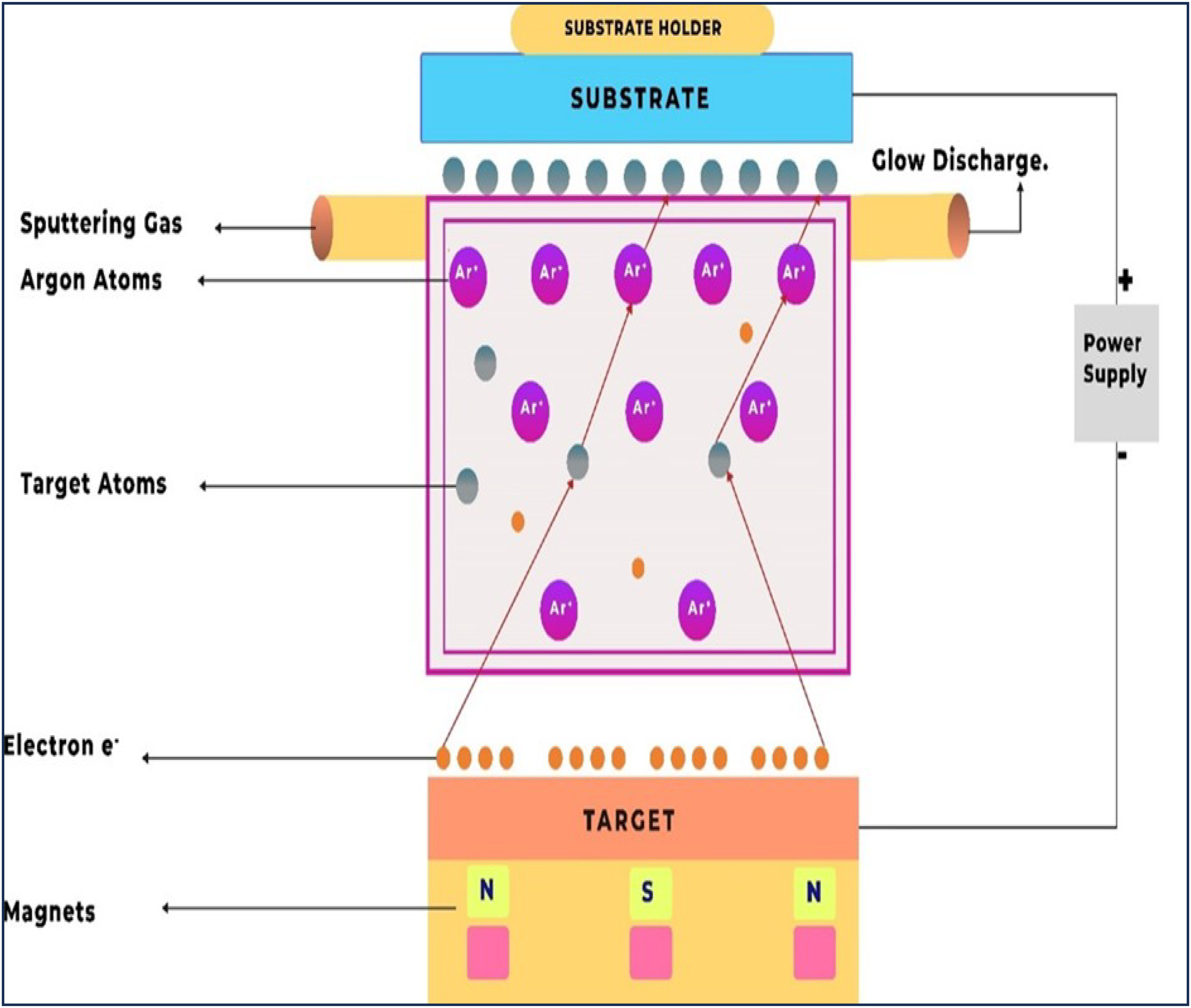
Shows the components of a magnetron sputtering setup.
Pulsed magnetron sputtering
Magnetron sputtering with pulses implies modulation of the sputtering power in a pulse-like manner. This pulsing can accurately manage the deposition, resulting in well-adhered nanostructures, reduced defects, and controllable porosity. The periodic bombardment may result in nanosized patterns on the surface. Pulsed magnetron sputtering has gained significant traction as a powerful deposition technique, particularly for dielectric materials in various applications. This method presents a compelling alternative to conventional direct current sputtering (dcMS) by effectively addressing a critical challenge inherent to dcMS: the frequent occurrence of arc events at the target surface, especially when depositing insulating materials. Essentially, uncontrolled discharges called arcs can impede the deposition process because they produce defects in the deposited film and inconsistency in film properties.
This problem is resolved by PMS, which employs a pulsed DC power supply instead of the continuous voltage bias DCMS. In this case, the voltage applied to the target material alternates rapidly between a high (in the pulsed sputtering sense) negative voltage during which sputtering occurs and a low (or zero) voltage ‘pulse-off’ time.95,96
High-power impulse magnetron sputtering
HiPIMS is one of the most advanced technologies based on the principle of magnetron sputtering operating in a pulse regime at high power levels. However, it is very beneficial to this technique as it provides easy regulation of the energy of sputtered particles, which has promising implications for film properties and nanostructuring capabilities. Proven as a technique for producing nanostructured films with better adhesion and unique surface morphologies, HiPIMS. Thin films with exceptional properties are created by high-power impulse magnetron sputtering, a powerful deposition technique. HiPIMS, on the other hand, like most ionized physical vapor deposition (IPVD) processes, uses short, high-power pulses to produce a highly ionized plasma, unlike conventional magnetron sputtering, which uses a continuous current. As a result, a thicker plasma with higher ion concentration results in several advantages in thin film deposition.
Chromium oxide (Cr2O3) is particularly suited for depositing materials using HiPIMS. As a result of the high HiPIMS ionizing rates and increased substrate ion bombardment, the material's ionization rate is also elevated. The coating, however, is effectively compacted (with a denser coating and more uniform coating) because of this bombardment. As a result, Cr2O3 films deposited using HiPIMS show better adhesion to the substrate than films deposited by conventional technique. It is also seen that the pulsed nature of HiPIMS allows for precise control of the energy of ions impacting the substrate. The tailoring of the microstructure and properties of the film requires this controllability. The pulsing parameters are adjusted, enabling the film's grain size, crystallinity, and stress to be controlled to optimize the film for a particular application. For example, in the case of Cr2O3, HiPIMS deposits films with improved mechanical properties (i.e., increased hardness and wear resistance), which are desirable for protective coatings in severe environments.97–99
Multilayer deposition
Nanolayered coatings can be made because magnetron sputtering processes allow different materials to be deposited simultaneously. With varied thicknesses and composition of individual layers and deposition techniques, scientists from nano to engineering scale can create and customize the nanostructures with targeted functionality, including enhanced mechanical or thermal performance. 100 Multilayer Deposition using Magnetron Sputtering: Insights from TiAlN/TaN Coatings provides a detailed look into producing multilayer coatings, specifically TiAlN/TaN, using DC magnetron sputtering. While not focused on thermal barrier applications, the principles and techniques highlighted offer valuable insights into multilayer deposition. The study emphasizes the advantage of multilayers over monolayers. By alternating TiAlN and TaN, each with its properties, the resulting coating surpasses the limitations of either material alone. This is analogous to how TBCs use layering for thermal and mechanical benefits and achieve nanoscale layer thicknesses, which are crucial for influencing properties at that level. This aligns with the growing importance of nanostructuring in TBCs for improved performance. While the materials differ, the underlying principles of using magnetron sputtering to create controlled multilayers with enhanced properties are transferable to TBC fabrication. Understanding the influence of deposition parameters on coating characteristics is crucial for tailoring TBCs to specific thermal and mechanical demands. 101
Ion bombardment in enhancing nanostructure growth and adhesion in magnetron sputtering
A widely used technique to deposit thin films through magnetron sputtering, but typically, there needs to be an extra level of control to obtain the optimal nanostructured deposition and adhesion. Here, we show that incorporating ion impingement, or ion beam bombardment, provides a powerful method to tune these properties during deposition. Energetic ions introduced by ion bombardment strike the growing film and influence its structure and adhesion. Surface diffusion and, thereby, roughness density of the nanostructure is promoted by energy transfer from these ions imparting to surface atoms. This is an increase in density, and increased density means fewer defects and better mechanical properties.
In addition, the deposited material's crystalline orientation can also be modified by ion bombardment. Promoting the growth of some preferred crystal orientations is possible by selectively bombarding the surface with ions of given energies and angles. Crystallographic texture control is crucial for tailoring the properties of the film, with the different orientations having very distinct behavior. Ion bombardment also offers benefits for adhesion. This energetic ion can turn into nucleation sites on the substrate to reinforce the bonding between the film and the substrate. In addition, the ion bombardment induces interface intermixing to enhance adhesion. We demonstrate the versatility of incorporating ion impingement in magnetron sputtering to enhance nanoscale growth and adhesion. It is possible to make films with higher quality and more tailored functionality by fine-tuning the film density, crystalline orientation, and adhesion properties by controlling the energy, angle, and species of the bombarding ions. 102
Nanostructure formation through substrate biasing in magnetron sputtering
Achieving desired material properties requires control of the growth and arrangement of nanostructures during thin film deposition. Magnetron sputtering offers a versatile platform for this purpose, but fine-tuning the process through thickness substrate biasing offers an extra dimension of control, particularly over the growth speed and nanostructure formation. Applying a bias voltage to the substrate while depositing the film changes the energy of the impinging particles, ions, and atoms. The negative bias attracts positively charged ions, which strike the substrate, increasing their energy. This energetic bombardment helps promote adatom mobility on the surface to give denser films and larger grain sizes. Conversely, a positive bias can attract electrons to reduce the impinging particles’ total energy, altering growth dynamics. In particular, substrate biasing is particularly valuable for nanostructure formation because it permits control of film growth speed. The deposition rate is optimized by carefully adjusting the bias voltage to facilitate specific nanostructure formation. Consider the example that a lower growth rate could be preferred to achieve highly ordered and aligned nanostructures, while a higher growth rate could be beneficial for a more random or porous morphology.
In addition, substrate biasing can alter the nucleation and development processes of the nanostructures. Bias voltage affects the substrate surface with modified energy, which may influence where and how nucleation sites form. Nanoscale processing is therefore ruled by this, determining their final nanostructures’ size, shape, and arrangement. We conclude that substrate biasing during magnetron sputtering is a powerful means to manipulate film growth speed and nanostructure formation.103,104
Gas mixture control
The gas composition adjustment will impact the nanoarchitecture of the coating during the magnetron sputtering. The researchers then modify the composition of the reactive and inert gases, leading to the nanoparticle size, structure, and morphology they select. 105 These approaches exhibit how magnetron sputtering can synchronize with different techniques based on nanostructuring at the nanoscale. Magnetron sputtering has great precision and flexibility, which allow the expansion of nanostructured materials with predetermined and controllable properties for multiple applications. The nanostructuring methods are crucial to getting the required properties of TBC, which are produced through the magnetron sputtering technique. Properly implementing these methods depends on a thorough understanding of deposition parameters, such as the substrate temperature, power sputtering degree, and the nature of the gas composition. 106
Substrate temperature and importance
The deposition substrate's temperature governs nanostructure nucleation and growth during magnetron sputtering. TBC can generate expected crystalline phases and morphologies by regulating substrate temperature, therefore significantly affecting TBC's thermal and mechanical properties. A lower substrate temperature limits adatom mobility, resulting in smaller grains and potentially amorphous phases. While this might seem detrimental, it can be advantageous for specific applications. For instance, finer grain structures can enhance strain tolerance, improving the coating's resistance to cracking under thermal cycling conditions. 107
The impact of sputtering power on nanostructure formation in magnetron sputtering
In thin film deposition, magnetron sputtering is a versatile and powerful technique. Within this process, sputtering power emerges as a critical parameter, wielding significant influence over the formation of nanostructures and, consequently, the final properties of the deposited material. Sputtering power dictates the rate at which ions bombard the target material, liberating atoms that travel toward the substrate to form the thin film. As sputtering power increases, the number of atoms released towards the substrate by sputtering increases as well. The flux is thus increased, and examining its consequences for nanostructure formation is both important and challenging.
First, it can make the film grow faster or the deposition rate higher. This might seem purely advantageous. However, a rapid growth rate could preclude the formation of the highly ordered nanostructure. For example, atoms that need to spend more time than they have before the surface starts to grow away will not have time to settle into a fixed ordering, and so a less organized or more amorphous structure will result. Secondly, the energy of arriving atoms is regulated by the sputtering power. More energetic atoms reaching the substrate often come with higher power. This extra energy can be used for surface diffusion, so atoms may be free to move and find more stable configurations. For example, it can imply larger grain sizes, different crystal orientations, or even the formation of novel phases. However, as with anything, overly high sputtering power can damage, too. However, it may enhance substrate heating and thus change conditions needed for the desired growth. In addition, highly energetic ions can sputter the growing film, where atoms from the film are knocked out by incoming ions and interfere with the deposition itself. 108
The impact of gas composition on nanostructure growth in magnetron sputtering
The growth and properties of nanostructured thin films grown by magnetron sputtering greatly depend on gas composition. The sputtering process and the interactions between the plasma, the sputtered atoms, and the growing film depend on gas and composition choice. Different gases have different sputtering efficiencies against a given material. This sputtering yield directly drives the deposition rate, measuring how efficiently a gas ion sputters atoms off the target. For example, many materials have higher yields of sputtered heavier gases, such as argon, than lighter gases, like nitrogen. Within the sputtering chamber, the gas becomes a partially ionized plasma of ions, electrons, and neutral atoms. This plasma includes parameters such as density, temperature, etc. Its composition determines its qualities. Finally, these plasma characteristics modulate the energy and directionality of the ions bombarding the target, ultimately deciding the properties of the deposited film. The choice of gas may result in its inclusion in the growing film. Depositing compound materials such as nitrides or oxides is exciting. For example, we can introduce nitrogen gas during the sputtering of a metal target and thus get a metal nitride film. The reactive gas partial pressure becomes a critical control knob for tuning the stoichiometry and properties of the deposited compound, with the stoichiometry of the deposited compound not fixed during the thin film growth. 108
Factors influencing long-term stability of nanostructured TBCs
Sintering and grain growth
A critical challenge for the long-term stability of nanostructured thermal barrier coatings at high temperatures is the phenomenon of sintering and grain growth. Nanostructured TBCs, characterized by their fine grain size, possess a higher volume fraction of grain boundaries. While these boundaries contribute to the desirable low thermal conductivity of the coating, they also represent high-energy regions that drive sintering at elevated temperatures. During sintering, the refined grains in the TBC begin to coalesce, increasing average grain size. This process is driven by reducing surface energy as the total grain boundary area decreases. They showed that sintering can densify the coating initially, but excessive grain growth is detrimental to thermal insulation. Thermal conductivity increases at grain sizes as the density of grain boundaries decreases and phonon scattering drops. The thermal conductivity of the TBC is increased, giving the TBC less ability to prevent excessive heating of the underlying substrate, and such excess heat could ultimately result in premature TBC failure. Sintering and grain growth in nanostructured TBCs can be mitigated using several strategies. This sintering process leads to:
Increased thermal conductivity
The thermal conductivity of YSZ nanocoatings is highly dependent upon the material's grain size. The thermal conductivity increases with increasing grain size. The role of grain boundaries in phonon scattering is responsible for this phenomenon. The significant carriers of heat energy in crystalline material such as YSZ are phonons or quanta of lattice vibrations. An interface, grain boundaries, exists between regions of different crystallographic orientations. Such boundaries scatter phonons and break the smooth heat flow through the material. Grains with smaller sizes have more grain boundaries in a coating. It reduces phonon scattering and is thus detrimental to increasing efficient heat transfer and low thermal conductivity. On the contrary, fewer grain boundaries are made possible by larger grains. The increased thermal transport through the coating results from phonons moving more easily with fewer interfaces to stop them.
According to Bai et al. (2014), this effect is also affected by unmelted nanoparticles embedded in the coating. Since these nanoparticles are much smaller than the surrounding nano/micro-grained domains, they also lead to a higher density of interfaces. Enhanced phonon scattering can balance the rise in thermal conductivity due to increased grain growth. However, unmelted nanoparticles’ grain size and distribution in the coating process must be controlled. Control over these thermal properties is, therefore, key to tailoring nanocoatings of YSZ for particular applications.91,109 Schulz et al. address the thermal conductivity problems of electron beam-physical vapor deposition TBCs. This focuses on microstructure, grain size, and porosity as key specifiers of thermal conductivity. By these microstructural features having control during the deposition, the authors suggest it is important. microstructure, including grain size and porosity, in dictating thermal conductivity. The authors suggested that controlling these microstructural features during deposition is crucial for achieving the desired thermal properties. 110
Sintering's impact on hardness and strength
Sintering is a fundamental step in material consolidation but can also result in a trade-off in desirable properties. Particularly, the process often decreases hardness and strength, affecting the material's mechanical performance. Sintering occurs; materials are heated to high temperatures, which aids in densification and grain growth. Grains will pass through a series of stages, ending when particles fuse and grains increase in size, decreasing the total area of grain boundaries. However, these boundaries are critical in their way, too. They serve as barriers to the movement of the dislocations; defects that let materials deform under stress. Dislocation movement with fewer boundaries becomes easier, resulting in a reduction of the hardness and strength.
In addition, sintering tends to remove pores and increase density, but it also deleteriously degrades strength. Sometimes, the cracks are hindered by pores, which act as obstacles. Though useful for density and possibly other properties, removing them leaves a more homogeneous, possibly more susceptible to crack propagation and fracture, microstructure. Thus, careful control in the sintering process has been necessary for the desired properties, such as density and mechanical strength. For a desired microstructure that, in turn, gives a desired balance of properties for the particular use, parameters such as temperature and time must be optimized.111,112 (Notably, Karaoğlanlı et al., 2016) examines how high-temperature oxidation affects ceramic top coat properties Figure 4, particularly hardness. The study reveals a clear trend: After oxidation, hardness values increase, and the effect increases with time and temperature. The phenomenon is attributed to the sintering effect during the oxidation process. The constituent particles diffuse and coalesce to form a densified coating as the coating is subjected to high temperatures. The densification process through sintering increases the material's hardness, resistance to indentation, and deformation. The sintering occurs under the high-temperature oxidation environment, further strengthening the ceramic top coat and decreasing sensitivity to mechanical stress and wear.
112
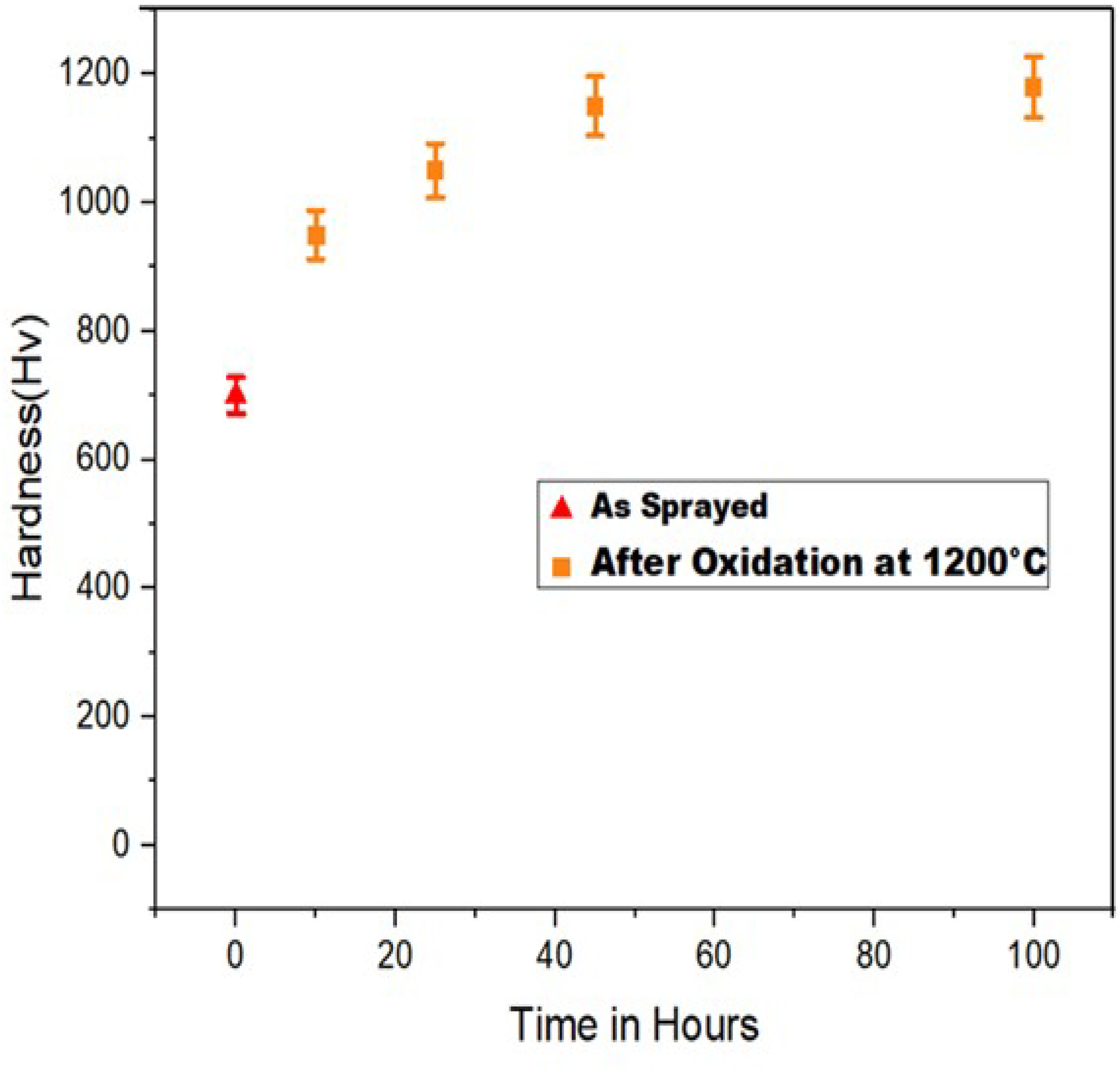
Oxidation time dependence of hardness evolution of the ceramic top coating on the TBC system. 114
Increased susceptibilities to cracking
The relationship between grain size and a material's mechanical properties is well-established in materials science. Generally, smaller grains contribute to increased strength and toughness, while larger grains correlate with lower strength and increased susceptibility to cracking. This principle also holds for thermal barrier coatings, where the grain size of the ceramic top coat, often composed of yttria-stabilized zirconia, significantly influences its resistance to thermal stress cracking. An increase in grain size within the YSZ top coat implies that individual grains are larger, reducing the total grain boundary area. Grain boundaries, the interfaces between adjacent grains, act as barriers to crack propagation. Cracks can be deflected or arrested, and energy can be dissipated well before catastrophic failure. But as the grains get larger, the spacing between these crack-arresting boundaries gets larger. For this reason, crack initiation in the larger-grained material occurs with less resistance, and the coating becomes susceptible to thermal stress cracking.
Additionally, larger grains are in accommodating strain. Given thermal cycling, the coating layers have a severe mismatch of thermal expansion coefficients; this generates much stress. These stresses can be more accommodated with smaller grains, shorter diffusion distances, and more remarkable plasticity. Conversely, larger grains can crack more easily under the same thermal stresses. Ultimately, this increased susceptibility to cracking in larger-grained YSZ coatings becomes delamination and spallation. Under cyclic thermal loading, once initiated, cracks can propagate, separating the top coat from the underlying bond coat, a process called delamination. When cracks coalesce and the delaminated area grows, delaminated areas can detach completely from the substrate, a failure mode known as spallation.85,115
Initial grain size and sintering behavior
The sintering behavior of a material depends strongly on the initial grain size of the material. The basis for this dependence is that the relation between grain size and surface energy is a fundamental material property dictating material stability. Surface energy is the energy present at the material's surface compared to the bulk. Their higher surface area to volume ratio inherently means that smaller grains have higher surface energy. The system is driven by this excess energy to minimize its overall energy state, which is the same thing that happens in sintering the elevated temperatures during sintering-induced diffusion and mass transport of the materials. The high surface energy of smaller grains catalyzes these processes. One way to think of what this surplus energy is doing is that atoms at the grain boundaries attempt to rearrange themselves to take on more stable configurations; this type of grain migration results in densification of particles packing closer together and grain growth. Small grains join to make large ones.
Thus, smaller initially grain-sized materials have a higher driving force for sintering and are more prone to grain growth. This phenomenon is especially relevant for nanostructured materials, whose initial grain size is extremely small. Achieving high density is advantageous but at the risk of uncontrolled grain growth that can degrade desirable properties of the nanostructure. Therefore, understanding and controlling the initial grain size and sintering behavior is crucial to achieving the required material properties and application performance. 116 The study presented by (Hong Z. et al., 2007) is on nanostructured yttria stabilized zirconia coatings deposited by air plasma spraying. In the as-sprayed condition, the researchers report achieving a mean grain size of about 42 nm. They also emphasize that to minimize grain growth during deposition, grain growth would be controlled to some degree in such coatings at elevated temperatures. 117
Oxidation and corrosion
One of the disadvantages of exposure to rough ambient conditions, including high temperatures, is the oxidation of the bond coat.
Oxidation of the bond coat
The oxidation of the bond coat, a critical process in the performance and longevity of thermal barrier coatings, leads to the formation of a thermally grown oxide layer. This protective yet inherently brittle layer presents a paradoxical challenge in TBC design. While the TGO layer, primarily composed of alumina (Al2O3) in MCrAlY bond coats, serves as a vital barrier against further oxidation of the underlying bond coat and substrate, its brittle nature makes it susceptible to cracking under the significant thermal stresses induced by the inevitable mismatch in thermal expansion coefficients between the ceramic top coat, bond coat, and substrate. This susceptibility to cracking can ultimately lead to two primary failure modes: spallation, the detachment and loss of the ceramic top coat, exposing the underlying layers to the harsh operating environment, and delamination, the separation of the ceramic top coat from the bond coat, compromising the thermal insulation properties of the TBC and reducing its effectiveness in protecting the underlying component. The growth rate, morphology, and mechanical properties of the TGO layer, all of which significantly influence the TBC's lifespan, are influenced by factors such as bond coat composition, operating temperature, and thermal cycling, making the understanding and control of these factors crucial for developing more robust and longer-lasting TBCs.91,118 Zhou et al. This research investigates the role of internal oxidation in the failure of air plasma-sprayed TBCs with a double-layered bond coat. The study demonstrates that while a certain degree of internal oxidation can benefit adhesion, excessive internal oxidation can lead to a thick, non-uniform TGO layer, increasing the susceptibility to cracking and delamination. 119
Corrosion of the ceramic top coat
The degradation under hot corrosion conditions is also an issue with the ceramic top coats in thermal barrier coatings (TBCs), e.g., the YSZ and CSZ layers. It has been shown in previous studies that hot corrosion can cause the formation of cracks around the bond coat; nanostructured Al2O3/CSZ composite coatings were demonstrated to spall after prolonged exposure to hot corrosive environments, suggesting that such degradation mechanisms could potentially impact the coating's lifetime. While this work is focused on thermal cycling behavior, the learning from the hot corrosion studies can offer more insight into the overall challenges for TBCs in extremely high-temperature environments.16,32 Studies have demonstrated superior hot corrosion resistance of ceria-stabilized zirconia coatings compared to yttria-stabilized zirconia coatings. Furthermore, the incorporation of nano-alumina has been shown to enhance the hot corrosion resistance of CSZ at elevated temperatures (e.g., 1050°C) in the presence of corrosive salts like V2O5 and Na2SO4. This improvement is attributed to forming a dense nano-alumina layer that effectively acts as a barrier, hindering the infiltration of molten salts into the CSZ layer. Consequently, Al2O3/CSZ composite coatings have exhibited the highest resistance to hot corrosion. The addition of nano-alumina also appears to influence the mechanical response of the coating to hot corrosion. The more minor increase in elastic modulus observed in nanostructured Al2O3/CSZ composite coatings, compared to unmodified CSZ, suggests that the presence of nano-alumina may limit the formation of detrimental phases like monoclinic zirconia, YVO4, and CeVO4, which can contribute to coating degradation.32,91
Thermal stress and fatigue
Thermal stress is a critical factor governing the performance and durability of thermal barrier coatings, especially in the context of nanostructured YSZ TBCs, as investigated in the study.
90
Understanding the origins and impact of thermal stress is paramount for developing robust and long-lasting TBC systems. The primary source of thermal stress in these coatings arises from the mismatch in coefficients of thermal expansion among the YSZ top coat, the metallic bond coat, and the substrate. During thermal cycling, a process inherent to the operating conditions of TBCs, these CTE mismatches generate significant stresses within the coating system. This is particularly pronounced during rapid heating and cooling associated with thermal shock, where the layers expand and contract at different rates, inducing substantial internal stresses. The paper highlights that these thermal stresses can lead to various failure mechanisms, ultimately compromising the integrity and effectiveness of the TBC:
This study points out the necessity of controlling thermal stress to improve the durability of nanostructured YSZ TBCs. Although it does not describe precise mitigation options, it does show that in the case of YSZ top coating, the microstructure of the deposit, in particular grain size and porosity, can influence its capacity to accommodate thermal stresses. The coating may be given a finer grain size and controlled porosity, which will improve strain tolerance and help it better resist the stresses induced by thermal cycling.105,120 The work presented by the authors involves modeling and analyzing thermal fatigue failure induced by delamination in TBCs. The authors observe that interface delamination occurs during heating and cooling cycles, simulated using laser heating and induced by acoustic emission. They have also presented work on the detrimental influence of thermal cycling and the value of nondestructive evaluation techniques for delamination behavior.
75
Oxidation kinetics of YSZ coatings
Long term performance of YSZ coatings depends on their oxidation resistance. The authors investigated this corrosion rate and kinetic behavior in micrometer-sized and nanostructured YSZ coatings. A kinetic study of the three samples of each coating type was performed, and the results are presented in Figure 5. It was found that coating type significantly affects oxidation behavior. A comparison of oxidation rates showed that the nanostructured YSZ coating had a substantially lower reaction rate than the micrometer-sized YSZ coating, demonstrating a significant improvement in oxidation resistance. The growth rate kinetics were parabolic for both coating types, indicative of diffusion-controlled oxidation. This behavior suggests that the rate-limiting step of the oxidation process entails transporting oxygen ions via the coating. The parabolic rate constant (Kp), which quantifies the oxidation rate, can be determined using the following equation.
121

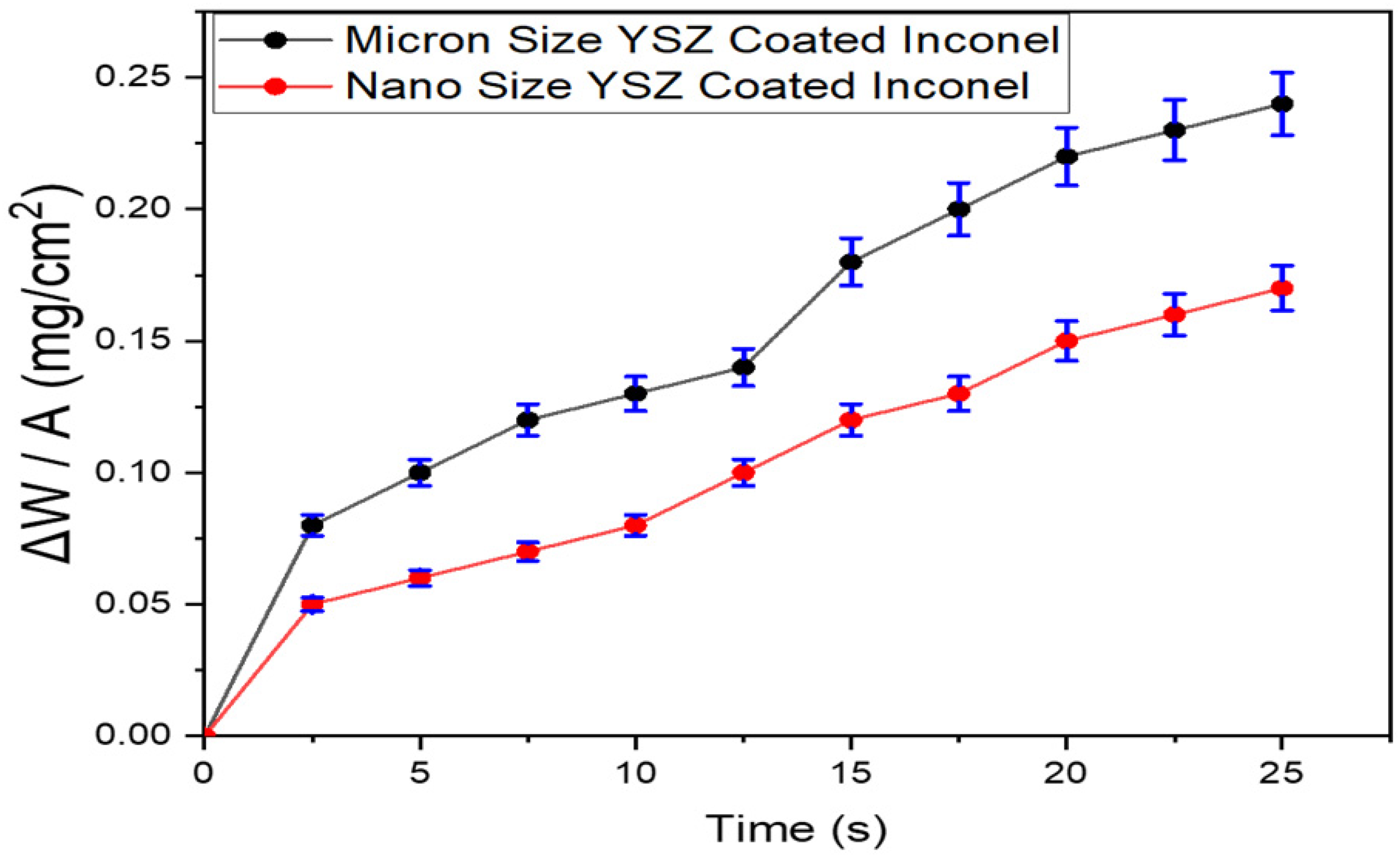
The figure shows the kinetic behavior of nanostructured and micrometer-size YSZ-coated specimens. 121
Weight gain data obtained from the kinetic study was used to calculate parabolic rate constants (Kp). The calculated Kp values for the micrometer-sized and nanostructured YSZ coatings were 6.229 × 10⁻⁷ mg2 cm−4 s−1 and 3.360 × 10⁻⁷ mg2 cm−4 s−1, respectively. This result demonstrates a significant reduction in the parabolic rate constant for the nanostructured YSZ coating, indicating its superior oxidation resistance compared to the micrometer-sized coating. 121
Performance evaluation of nanostructured thermal barrier coatings
Thermal cycling of nanostructured thermal barrier coatings
Figure 6(a) shows the thermal cycling lives and temperature drops of three coatings with different amounts of unmelted nanoparticles. The test materials are sorted into three categories: N1 (ordinary TBC with 4% unmelted nanoparticles), N2 (nanostructured TBC with 8% unmelted nanoparticles), and N3 (hybrid TBC with 11% unmelted nanoparticles). The most extended thermal cycling life for coating N2 was obtained, with coating N2 surviving 260 thermal cycles until top coat wrinkling occurred and spallation at the top coat/bond coat interface. Compared with N1, that is an 86% improvement, compared with N3, it is a 30% improvement. This high performance of N2 is due to its weight-optimized 8% unmelted nanoparticle content, which increases the coating toughness, strain tolerance, and resistance to cracks while preserving the structural integrity.
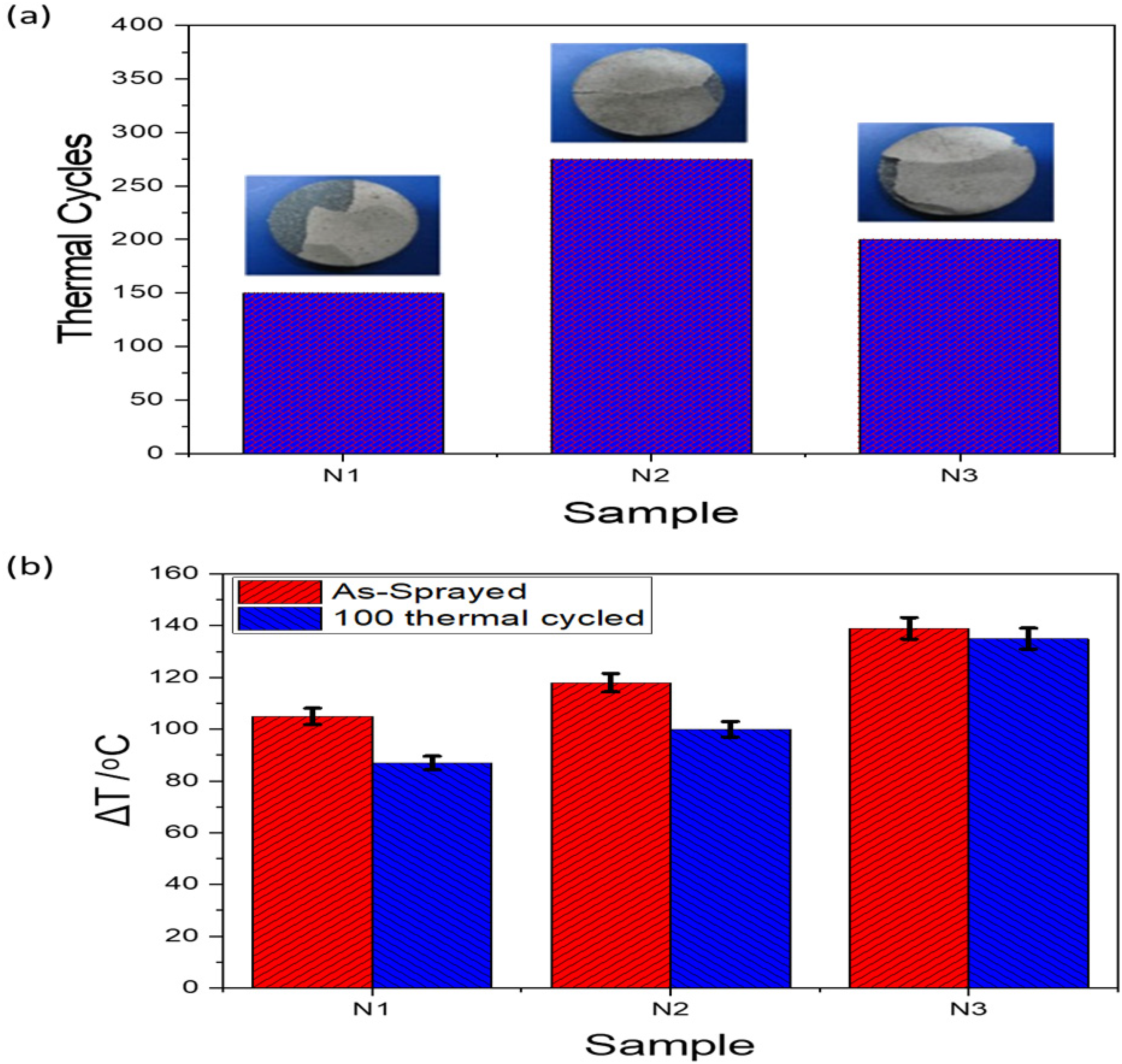
Thermal cycling lives and temperature drop observed in various coatings. 109
However, N1 life under thermal cycling was less than that owing to its lack of nanoscale features to arrest cracks and accommodate strain. However, contrary to this, N3, with a higher concentration of unmelted nanoparticles, possesses decreased interlamellar bonding and hence loses much durability compared to N2. 109 Based on the analysis of Figure 6(a), the measured porosity values of N1, N2, and N3 were 2 ± 0.2%, 2 ± 0.7%, and 6 ± 0.5%, respectively, which pointed out a significant porosity reduction after 100 cycles caused by sintering effects. Reduced porosity increases densification and mechanical strength but can negatively impact strain tolerance and thermal cycling performance. This is because to be a crack arrester, it must possess a certain level of porosity, thus serving as a toughening agent for the coating. To intensify these benefits, however, one should carefully control unmelted nanoparticles.84,109
The excessive amount of unmelted nanoparticle content leads to its disruption of lamellar continuity, as this causes weak points at interlamellar boundaries that will detrimentally serve as crack initiation and propagation sites. As shown in Figure 6(b), N3, with 11% (the highest content) of unmelted nanoparticles, exhibits a more significant temperature drop than the cases of N1 and N2. Specifically, these data demonstrate that nanoparticles improve thermal insulation, but the concentration of nanoparticles must be optimized to avoid degradation of mechanical integrity. The best thermal cycling life for a nanostructured TBC is obtained from experimental data for approximately an unmelted nanoparticle content of 8% in N2. 109
Oxidation and degradation mechanisms in thermal barrier coatings
Metallic components operating in high-temperature environments, e.g., gas turbine engines, are protected by thermal barrier coatings. Despite their excellent thermal insulation and oxidation resistance, the long-term performance of TBCs depends inextricably on the highly nonlinear interplay of many degradation mechanisms. The first part of this section looks into the key factors that influence the degradation of TBC, which are the bond coat's oxidation, the effect of thermal mismatch stresses, and hot corrosion. defense against oxidation is the bond coat, which typically consists of an MCrAlY or Pt aluminide layer. A protective oxide scale, comprised mainly of alumina (Al2O3), is formed on the bond coat surface when the material is exposed to high-temperature oxidizing environments. 119 Factors such as bond coat composition, temperature, and surrounding gas atmosphere influence the effectiveness of this available oxide scale in preventing further oxidation. For example, increasing temperature increases oxidation kinetics, possibly accelerating oxide growth and promoting defect formation. In the same way, other reactive species in the gas environment can alter the oxidation mechanisms and the stability of the oxide scale. TBC systems add complexity and stress due to the large thermal mismatch between the ceramic top coat, bond coat, and substrate. Repeated thermal cycling can cause the ceramic top coat to crack and spill, especially because the stresses are so high. These stresses lead to cracks in the bond coat, which create the path for oxygen to reach the substrate, accelerate oxidation, and compromise the integrity of the TBC. In addition, molten salt deposits commonly present in gas turbine environments induce hot corrosion and add to the degradation of TBC. Hot corrosion is an accelerated oxidation of metallic materials in molten salts, forming nonprotective, porous oxide scales. It is necessary to understand the interplay among these degradation mechanisms, oxidation of the bond coat, thermal mismatch stresses, and hot corrosion, to develop means of enhancing TBC durability. Future research is needed to develop bond coat compositions with superior oxidation resistance and reduced sensitivity to thermal mismatch stress, to study novel TBC architectures that provide minimal stress concentrations and protection against cracking and spallation, and to consider mitigation strategies for hot corrosion of TBC systems. 119
Hot corrosion
This section, focusing on hot corrosion as an external factor, is the successor to the previous section that has addressed inherent degradation mechanisms in TBC. Hot corrosion refers to accelerated material degradation occurring at elevated temperatures (but well below the material melting point) in molten salts, e.g., sodium sulfates. (Na2SO4) Alternatively, vanadates (V2O5) are commonly found in the combustion environment. Several adverse effects of these molten salt deposits on the TBC surface were caused. They can first dissolve the protective alumina scale on the bond coat and expose the underlying metal to secondary oxidation. Second, the molten salts can produce a corrosive environment that produces non-protective porous oxides that erode further. Finally, molten salts can find their way through cracks, reaching the bond coat and substrate. Due to the infiltration, corrosion can degrade the TBC's structural integrity by accelerating at the interface. The dependence on salt composition, temperature, and surrounding gas atmosphere determines the severity of hot corrosion. For example, salts containing vanadate are usually more aggressive than sulfate-based salts. In addition, hot corrosion rates are temperature dependent; as the salts become more fluid and reactive with temperature, the rate increases. Even the gas surrounding the atmosphere, the salt, can affect its chemistry and corrosivity. Strategies to mitigate hot corrosion in TBCs include the development of corrosion-resistant coatings, appropriately selecting operating conditions, and using protective coatings. Developing bond coat compositions or applying additional protective layers with enhanced resistance to molten salt attack is the primary focus of the research. Formation and deposition of corrosive salts can be minimized using changing operating parameters (e.g., fuel composition, combustion efficiency). Furthermore, a barrier against molten salt deposition and infiltration into the TBC can be provided by coating the TBC surface with specialized coatings. Knowing how to limit hot corrosion mechanisms and the most effective mitigation strategy is important for the long-term performance and reliability of TBCs in demanding high-temperature applications. A comparative study of hot corrosion of bare and Cr/Co–Al coated superalloy samples in a cyclic molten salt environment (40%Na2SO4–60%V2O5) for up to 100 cycles. 122
Strategies for enhancing long-term stability of nanostructured TBCs
However, nanostructured TBCs have a more excellent performance prospect regarding their application, but the main problem is whether these kinds of TBCs can remain stable in the long run. Here are some strategies to enhance their durability and reliability:
Optimizing coating microstructure
Controlled grain size and morphology
Microstructures with refined grains, as a rule, possess superior mechanical characteristics, including enhanced hardness and wear resistance. This improvement stems from the increased grain boundary area inherent in fine-grained structures. Grain boundaries are barriers to dislocation motion, the primary mechanism of plastic deformation in materials. With a higher density of grain boundaries, dislocation movement is hindered, leading to increased strength and hardness. Furthermore, refined grain structures exhibit enhanced resistance to high-temperature sintering. Sintering, the process of material densification at elevated temperatures, is often accompanied by grain growth. This grain growth can harm mechanical properties, as larger grains offer less resistance to dislocation motion. Fine-grained microstructures, with their inherently smaller grain size, effectively impede grain growth during sintering, preserving their desirable mechanical properties at high temperatures. Controlling grain size and morphology manipulation during coating fabrication is paramount to achieving optimal performance. Techniques like controlled cooling rates, severe plastic deformation, and adding grain refiners during deposition can be employed to tailor the microstructure. By carefully controlling these parameters, it is possible to engineer coatings with superior mechanical properties and enhanced resistance to high-temperature degradation, ultimately leading to improved performance and extended service life in demanding applications. 123
As revealed by SEM, the morphology of CeO2 coatings on Superni-718 exhibited a dependence on the concentration of cerium acetate in the deposition bath. The coating displayed uniform, small spherical grains at 0.1 Min (Figure 7(a)). Increasing the concentration to 0.2 M (Figure 7(b)) resulted in a mixture of small spherical and rod-type grains. The coating shown in (Figure 7c), needle-like grains at the highest concentration of 0.3 M. Cross-sectional SEM analysis (Figure 7d) of the 0.3 M sample indicated a coating thickness of approximately 4 μm. EDS analysis confirmed the presence of cerium within the coatings. 124 Lóh, N. Jet al. It focuses on two-step sintering, a technique used to achieve fine-grained ceramics. The authors describe how this method allows for densification while limiting grain growth, resulting in improved mechanical properties. This technique has implications for fabricating TBCs with tailored microstructures. 125
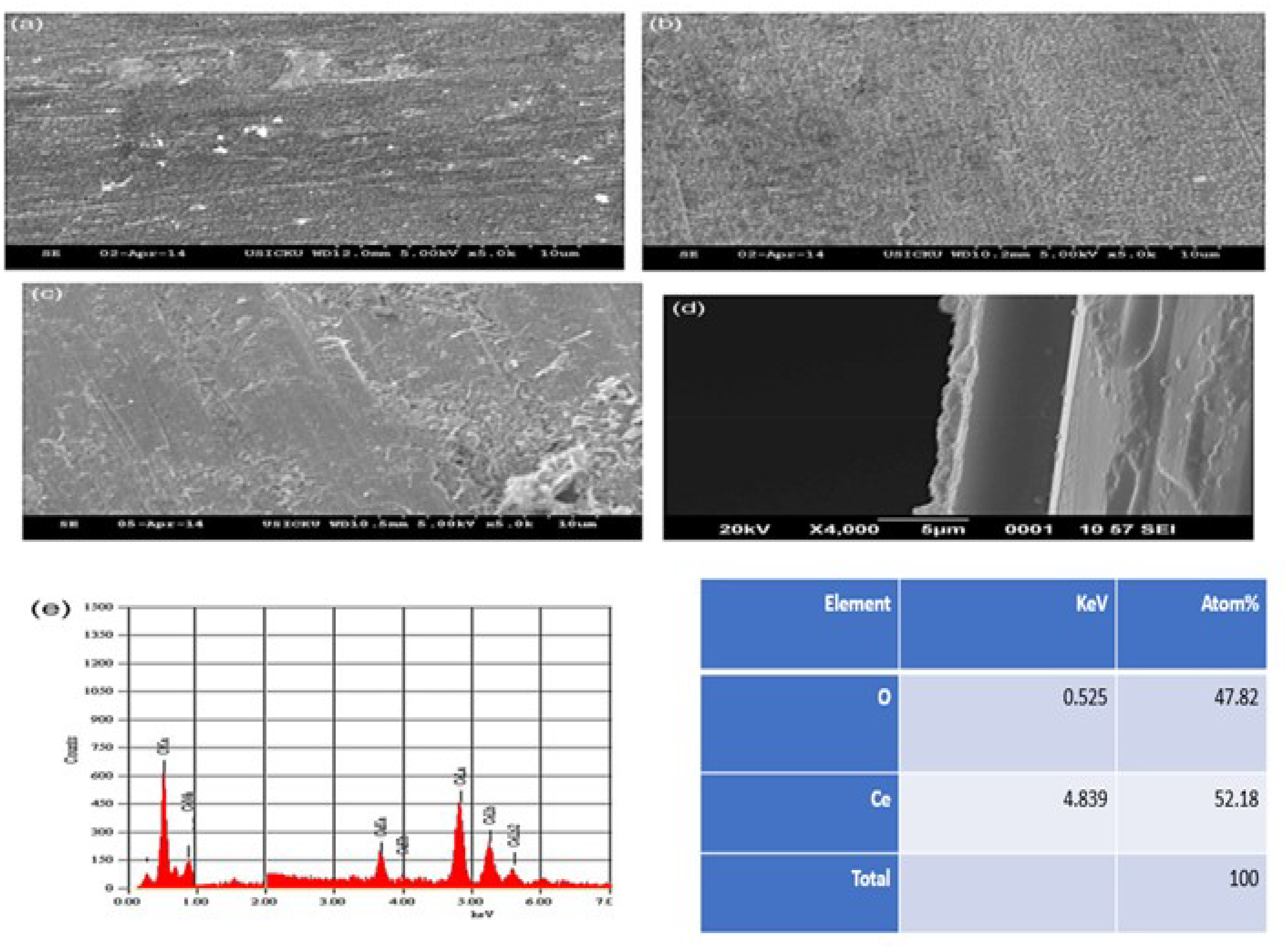
SEM surface morphology of CeO2 coatings deposited on a superni-718 substrate with varying cerium acetate concentrations: (a) 0.1 M, (b) 0.2 M, and (c) 0.3 M. (d) Cross-sectional SEM micrograph of the CeO2 coating deposited with a 0.3 M cerium acetate concentration on a Superni-718 substrate. (e) EDS spectra were obtained from surface and cross-sectional analysis of the CeO2 coating on the Superni-718 substrate to confirm cerium's presence. 124
Optimized pore size and distribution
The size and distribution of pores within a coating significantly influence its mechanical and thermal properties. Smaller, uniformly distributed pores are generally desirable for enhancing both the hardness and insulation efficiency of the coating. A dense microstructure with minimal porosity contributes to increased hardness. Tiny, homogenous pores obstruct crack propagation, forcing cracks to follow a more tortuous path. This increased crack path length requires more energy to propagate the crack, effectively increasing the material's resistance to fracture and improving its hardness. 126
Phase composition, stability, and alloying
Ceramic coatings’ phase composition and stability are crucial in determining their high-temperature performance. Alloying, specifically the incorporation of stabilizing agents like rare earth oxides, presents an effective strategy for enhancing these characteristics. When introduced into the ceramic matrix, rare earth oxides act as stabilizers by preferentially segregating to grain boundaries and inhibiting grain growth. This stabilization effect arises from the larger ionic radii of rare earth elements compared to the host cations in the ceramic lattice. These larger ions at grain boundaries increase the energy required for grain boundary migration, hindering grain growth and maintaining a finer, more stable microstructure. The reduced grain growth from adding rare earth oxides translates into improved resistance to sintering at high temperatures. Specifically, high-temperature sintering is generated by mass transport, inducing desirable properties in the material that are undesired in the microstructure.
Multi-phase composites: Better performances are obtained, and better adhesion and durability of the ceramic coating are achieved by introducing phases of the ceramics with various characteristics of hardness, chemical stability, thermal shock resistance, fracture toughness, and other parameters. Padture, N. Pet al. Investigated the phase stability of ceramic thermal barrier coatings, which is crucial for their performance in high-temperature applications. Alloying with stabilizing agents, particularly rare earth oxides, has significantly enhanced this stability. These stabilizing agents effectively inhibit sintering and mitigate detrimental phase transformations at elevated temperatures when incorporated into the ceramic matrix. This stabilization mechanism helps maintain the TBC's structural integrity, thermal insulation properties, and oxidation resistance, ultimately prolonging its operational life.127,128
Developing novel coating architectures
Innovative coating architectures offer significant potential for enhancing performance and durability in demanding applications. Two promising approaches that have garnered considerable attention include:
Multilayer designs
Multilayer coatings, featuring alternating layers with distinct characteristics, offer several advantages over conventional single-layer coatings. The interfaces between these layers act as barriers to crack propagation, deflecting or arresting cracks and preventing them from propagating through the entire coating thickness. This enhanced crack resistance translates into improved coating toughness and durability. Moreover, the strategic arrangement of layers with different thermal expansion coefficients can effectively mitigate thermal stresses generated during thermal cycling. By tailoring the thermal expansion mismatch between layers, thermal stresses can be distributed more evenly, reducing the likelihood of coating delamination or cracking. Multilayer designs also offer enhanced oxidation resistance. Incorporating layers with high oxidation resistance, such as alumina or zirconia, can protect the underlying substrate from high-temperature oxidation. These layers act as diffusion barriers, hindering the inward diffusion of oxygen and the outward diffusion of metal ions, thereby slowing the oxidation process.129,130
Microstructurally graded structures
Microstructurally graded coatings, characterized by controlled variations in grain size, porosity, or phase composition across the coating thickness, create desirable property gradients. This approach allows for tailoring specific properties in different coating regions to meet specific functional requirements. For instance, a coating could be designed with a fine-grained, dense surface layer for enhanced hardness and wear resistance, gradually transitioning to a coarser-grained, more porous layer underneath for improved thermal insulation. This graded microstructure allows the coating to withstand both mechanical wear and high temperatures effectively. The ability to tailor properties spatially controlled makes microstructurally graded coatings particularly attractive for applications involving complex geometries and severe operating conditions. 131
Utilizing protective overlayers
Oxidation-Resistant coatings
Utilizing thin, successive layers composed of alumina (Al2O3) or silica presents a highly effective strategy for significantly enhancing thermal barrier coatings’ oxidation resistance at elevated temperatures. These materials, renowned for their exceptional thermodynamic stability and inherently low oxygen permeability, function as robust diffusion barriers, effectively mitigating oxygen ingress to the underlying substrate. In contrast to single-layer depositions, this layered approach provides a more tortuous diffusion path for oxygen, further impeding its penetration and enhancing the coating's protective capabilities. The inherent redundancy of multiple layers ensures that even in the event of a crack in a layer, subsequent layers continue to provide a robust defense against oxidation, preventing catastrophic failure. This strategic material design effectively extends the lifespan of components operating in demanding, high-temperature oxidizing environments, contributing to enhanced reliability, prolonged service life, and improved overall system performance. 131 These protective coatings work to good advantage here in excluding contaminants such as oxygen and other reactive species, increasing the thermal barrier coating system's overall life and functional efficiency. 132
Environmental barrier coatings
It is intended to shield the TBC from particular aggressive environments, including exposure to molten salts or other compounds containing sulfur that contribute to deterioration and early failure of the TBC coating. These are selected to withstand the corrosive species in the operation environment to ensure the TBC remains continuously functional.130,133
Tailoring material composition and properties
Novel TBC materials
TBC materials exhibit superior high-temperature behavior, enabling elevated operating temperatures and extended service life. Rare-earth zirconates and hafnates have a combination of properties that address the limitations of conventional TBC materials. These materials, characterized by their high melting points, low thermal conductivity, and excellent chemical stability, demonstrate significant potential for next-generation TBC applications. Their crystal structures, often incorporating rare-earth elements like yttrium and lanthanum, contribute to their remarkable thermal properties. Rare-earth elements can also enhance phase stability, mitigating detrimental phase transformations at high temperatures and improving performance and durability.
The development and implementation of these advanced TBC materials represent a significant step towards enabling higher operating temperatures in gas turbines and other high-temperature applications. This advancement translates directly into improved fuel efficiency, reduced emissions, and enhanced overall performance. As research continues to unveil the full potential of rare-earth zirconates and hafnates, we can anticipate their increasing adoption in demanding thermal barrier coating applications. New materials have better thermal and environmental stability characteristics and improved capabilities against phase transformations and sintering at high temperatures.134–136
Doping and alloying
It is possible to enhance the stability of the TBC material and raise the resistance to sintering or phase transformations and environmental impact by adding dopants or alloying elements. For instance, TBC material might be yttria-stabilized zirconia in which doping by yttria maintains the stability of the tetragonal phase of the material at high temperatures and hinders phase transformations that are disastrous to the coating properties. Clarke, D. R et al. (2005) prime example is yttria-stabilized zirconia, a widely used TBC material. The incorporation of yttria as a dopant effectively stabilizes the tetragonal phase of zirconia at high temperatures, preventing detrimental phase transformations that can lead to coating failure. This stabilization mechanism maintains the TBC's thermal insulation properties and longevity.137,138
Bond coat optimization
The bond coat is also very important in TBC stability because it provides the top coat with the necessary bond to the substrate. The compatibility of bond coat materials, the right choice of composition, and the optimal microstructure will reduce interfacial reactions, increase adhesion, and increase the durability and service life of the surface coating. Thus, the proper design of the bond coat and its properties are crucial for maintaining the nanostructured TBCs’ service life and efficiency in severe high-temperature conditions. 139
Challenges in ensuring long-term stability and performance of nanostructured thermal barrier coatings deposited by magnetron sputtering on superalloys
While nanostructured TBCs hold immense promise for enhancing the performance of superalloys in high-temperature applications, several key challenges must be addressed to ensure their long-term stability:
Substrate-Coating interdiffusion and oxidation
Challenge: In superalloys, more than one diffusible element can enter the TBC plate and the substrate at high temperatures and erode the coating. Such interdiffusion can cause the generation of brittle intermetallic compounds, the formation of beneficial elements, and accelerated oxidation.
Mitigation: Create an incoherent TBC and superalloy interface by establishing diffusion barrier layers, optimizing coating composition to reduce interdiffusion, and investigating new materials that will form a superalloy system with slow diffusion rates.
Thermal expansion mismatch and residual stresses
Challenge: Thermal expansion coefficients of TBC and superalloy substrate are generally different, and high residual stress could be developed during thermal cycling of the component, thus leading to coating crack formation, delamination, and early failure.
Mitigation: When designing TBCs, incorporate specific CTEs for the designed TBCs about the superalloy substrate, employ functionally graded layers to avoid high levels of stress concentration regions, and design deposition techniques that result in few levels of residual stresses.
Phase stability and sintering at high temperatures
Challenge: The TBCs nanostructured can grow grains and phase transformations. This sintering under high temperatures raises the thermal conductivity and stress tolerance and causes the loss of their valuable properties.
Mitigation: Restoring chemical composition changes, investigating the development of new materials for TBCs with higher service temperature and more stable phase, and regulating the deposition process specifically regarding grain size and shape.
Reproducibility and scalability of deposition processes
Challenge: Obtaining the desired and repeatable properties in nanostructured TBCs deposited by magnetron sputtering can be problematic because of the essential dependence of the process on such parameters as deposition pressure, target material, and substrate temperature.
Mitigation: Ensure tight control of deposition processes, strictly exercise quality control, and consider other methods, such as high-impulse magnetron sputtering, to improve deposition reproducibility and scalability.
Future research directions: long-term stability and performance of nanostructured thermal barrier coatings deposited by magnetron sputtering on superalloys
While magnetron sputtering shows promise for depositing nanostructured thermal barrier coatings on superalloys, several vital areas warrant further investigation to fully realize their potential for enhanced performance and durability in high-temperature applications:
Long-term oxidation and corrosion resistance
Investigating the evolution of the TGO layer: Long-term studies are needed to understand the growth kinetics, phase stability, and adhesion of the thermally grown oxide layer in nanostructured TBCs under realistic operating conditions. This includes examining the influence of coating architecture, residual stresses, and environmental factors on TGO behavior. Exploring novel bond coat compositions: Research into new bond coat alloys with improved oxidation and corrosion resistance at elevated temperatures is crucial. This includes investigating high-entropy alloys, diffusion barriers, and compositions tailored for specific operating environments.
Evaluating performance under thermal cycling
Systematic studies are needed to assess the impact of thermal cycling on the microstructure, adhesion, and overall performance of nanostructured TBCs. This includes understanding the role of thermal expansion mismatch stresses and developing strategies to mitigate their detrimental effects.
Microstructure control and stability
Tailoring nanostructure for enhanced properties: Further research is needed to optimize the deposition parameters of magnetron sputtering to achieve precise control over the nanostructure of TBCs. This includes tailoring grain size, porosity, and phase distribution to enhance thermal conductivity, mechanical strength, and strain tolerance properties.
Understanding and mitigating sintering effects
Investigating the sintering behavior of nanostructured TBCs at high temperatures is crucial to ensure long-term microstructural stability. This includes exploring strategies to inhibit grain growth and densification, such as doping with refractory elements or employing multilayered architectures.
Advanced characterization techniques
In-situ monitoring of coating degradation: Implementing advanced characterization techniques, such as in-situ X-ray diffraction and high-temperature microscopy, will provide valuable insights into the real-time degradation mechanisms of nanostructured TBCs under operating conditions. Developing non-destructive evaluation methods: Research into non-destructive evaluation techniques, such as acoustic emission and thermography, is essential for assessing the integrity and remaining life of TBCs in service.
Future scope of long-term stability and performance of nanostructured thermal barrier coatings deposited by magnetron sputtering on superalloys
Thus, this review has stressed that enormous possibilities are hidden in synthesizing the nanostructured TBCs using magnetron sputtering techniques; however, a severe lack of research will describe how it performed at a larger scale. Moving forward, research efforts should prioritize these five key steps:
Towards predictive performance modeling
Formulate the fully incorporated material properties, microevolution, and degradation equations with large scale alongside the best empirical TBC lifetime under actual working conditions. Advanced data analytics based on machine learning proposes another data approach for experimental and simulation data analysis to form a base for the predictive modeling of TBCs and their optimizations.
Closing the testing gap
They must create and use tests and conditions that mimic realistic, superimposed environmental stresses such as high temperature, thermal cycling, corrosive atmospheres, and mechanical loads in practical usage. This also involves forming material characterization techniques and test protocols, the addendum of which focuses on magnetron-sputtered nanostructured TBCs.
In-situ monitoring and characterization
Implement and apply state-of-the-art methods like synchrotron X-ray diffraction, Raman micro-spectroscopy of coatings, and thermogravimetric analysis in the testing of coatings for in-situ monitoring of degradation process in real-time. This will give information on microstructural development, phase transformations, and degradation processes at service conditions.
Exploring novel material systems
Further research and improvement of new TBC materials with higher temperature performance, including rare earth zirconates, hafnates, and high entropy oxides. Research the possibility of using multilayered and functionally graded designs to increase the efficiency and reliability of TBCs.
Conclusion
In this review, we examined the key factors that will affect the long-term stability of nanostructured thermal barrier coatings, focusing on coatings deposited through magnetron sputtering. One of the most prominent results is the necessity of more representative testing methods. Significant advances have been made in materials design and deposition approaches, but predicting performance in the real world is still challenging. Current procedures for testing materials often do not copy the combined effects of high temperature, thermal cycling, corrosive environments, and mechanical stresses that high-performance materials experience during use, as in the case of gas turbines and jet engines. Differences exist between tests conducted in an idealized laboratory environment using coatings compared to those in-services where the thermal gradients, corrosive environments, and synergistic effect of thermal and mechanical loads can be excellent. This demonstrates the necessity of multifactor testing protocols. We need research to develop testing rigs that are more representative of real-world operating conditions. This includes long-term testing with realistic thermal and mechanical loading, exposure to relevant corrosive types, and advanced in-situ monitoring techniques. Complete testing becomes crucial in developing next-generation TBCs characterized by improved durability and reliability under high-temperature operation.
Footnotes
Declaration of conflicting interests
The authors declared no potential conflicts of interest with respect to the research, authorship, and/or publication of this article.
Funding
The authors received no financial support for the research, authorship, and/or publication of this article.