






Abstract
In this study, a multi-step synergistic process combining chemical etching, hydrothermal deposition and stearic acid modification was proposed for the corrosion protection needs of aluminium alloys in marine environments, and micro- and nano-composite superhydrophobic coatings (STZ) were successfully constructed on the surface of aluminium bases. Scanning electron microscopy, EDS, and XRD confirmed the presence of zinc oxide particles with micron-level rough structures on the coating surface. Contact angle testing showed a static contact angle of up to 156° and a rolling angle of less than 5°, which is consistent with superhydrophobic properties. Electrochemical tests showed that the corrosion current density of the STZ coating was three orders of magnitude lower than that of the untreated substrate, and the charge transfer resistance was significantly higher, confirming a significant increase in corrosion resistance. After 400 linear abrasion cycles, the coating retained 70% of its hydrophobic properties. In self-cleaning tests, the rate of contaminant adhesion was reduced by 75% compared to the untreated substrate.This process provides a feasible solution for the long-term protection of aluminium alloys in harsh environments.
Introduction
Aluminium alloys are widely used in the marine and aerospace industries1,2 due to their light weight (density 2.7 g/cm³), high specific strength (>200 MPa/(g·cm³)), and excellent cost-effectiveness.3,4 However, their high chemical reactivity leads to corrosion problems that severely limit their service life. It is estimated that global economic losses due to metal corrosion account for approximately 4–5% of gross domestic product (GDP),5,6 making the development of efficient protective technologies imperative. Superhydrophobic coatings can block corrosion media contact by forming a Cassie-Baxter gas film barrier, 7 but existing processes such as laser microtexturing and fluorosilane modification (biotoxicity grade IV) 8 have significant drawbacks in terms of cost and environmental impact.
In recent years, fluorine-free low-surface-energy modification strategies have emerged as a research hotspot. 9 For example, Mamgain et al. 10 used electroplating technology to prepare a zinc/zinc oxide coating modified with tetradecanoic acid on a copper surface, achieving a contact angle of 163° and a polarisation resistance of up to 99,230 Ω·cm², demonstrating the potential of fatty acid-based modifiers. Another study 11 used polypropylene/myristic acid (PP/MA) to assist in the electrodeposition of a rose-shaped copper coating on an aluminium surface, increasing the contact angle to 148° and significantly improving the substrate's corrosion resistance. Additionally, the long-term stability of superhydrophobic coatings on metal copper substrates is still limited by insufficient interfacial bonding strength, 12 and research on direct modification of aluminium alloys can also be referenced.
Stearic acid (SA) is an ideal modifier for aluminium alloy surface engineering due to its non-toxicity, low cost, and strong bonding ability. 13 Studies have shown that the carboxyl groups of SA can form chelate bonds with metal oxides, 14 and its long-chain alkyl groups can significantly reduce surface energy. Li et al. 15 utilised SA to modify cerium oxide coatings to achieve self-healing functionality, demonstrating SA's advantages in enhancing interfacial stability. However, how to directly combine SA with the aluminium alloy-ZnO system while avoiding epitaxial transition layers and maintaining lightweight properties remains an unsolved challenge.
ZnO nanoparticles possess a large direct bandgap (3.37 eV), excellent chemical and thermal stability. 16 are non-toxic, and exhibit good wear resistance and UV protection, making them a nanomaterial with broad application prospects. 17 Existing studies have successfully achieved the directed growth of ZnO nanorods on aluminium alloy substrates via low-temperature hydrothermal methods, 18 However, ZnO nanoparticles exhibit strong adhesion to hydroxyl groups, 19 and simply hydrothermally depositing ZnO nanoparticles on the aluminium alloy surface to construct micro-nano composite structures does not achieve superhydrophobicity; instead, it further increases the surface hydrophilicity of the aluminium alloy. Therefore, the surface of the aluminium alloy after hydrothermal deposition must be modified to reduce its surface energy, thereby imparting superhydrophobicity.
Inspired by this, this paper proposes a method for preparing a superhydrophobic coating that is adaptable, fluorine-free, and has good stability and corrosion resistance. This is achieved by chemically etching a 7075 aluminium alloy substrate to construct a micro-nano structure, then using a hydrothermal method to extend ZnO particles on the surface of the micro-nano structure to further improve the density and stability of the microstructure, and finally using stearic acid for low surface energy modification to obtain a superhydrophobic coating with good performance. The surface morphology of the superhydrophobic coating was observed using scanning electron microscopy (SEM) images, energy-dispersive X-ray spectroscopy (EDS) surface energy spectra, and X-ray diffraction (XRD) phase analysis. Additionally, electrochemical tests, mechanical stability tests, and self-cleaning tests were conducted to measure the performance metrics of the coating. Through observation and comparison, the process preparation method for the superhydrophobic ZnO composite coating with the best corrosion resistance was selected.
Materials and methods
Materials
In this study, 7075 aerospace aluminium alloy (size 15 × 15 × 2 mm3) was selected as the matrix material. Chemical reagents included: zinc acetate dihydrate ((CH3COO)₂Zn-2H₂O, purity ≥ 99.0%, Sinopharm Chemical Reagent Co. Ltd); copper chloride dihydrate (CuCl₂-2H₂O, analytical purity, Xilong Science Co. Ltd); anhydrous ethanol (CH₃CH₂OH, purity ≥ 99.7%, Aladdin Biochemistry Technology); sodium chloride (NaCl Ltd); sodium hydroxide (NaOH, purity ≥ 96%, Tianjin Komeo Chemical Reagent Co.) All reagents were used directly without further purification, and the experimental water was deionised water.
Methods
The experimental procedure is shown in Figure 1. After pre-treating the aluminium plates with sandpaper sanding and alcohol cleaning to ensure a flat and clean surface (Al(B)), the STZ coatings were constructed by a three-step method: firstly, the aluminium plates were immersed in 0.2 M CuCl₂ etching solution (6.82 g /200 mL of distilled water) for 3 min to obtain a roughened surface (Al(B)-E); then, the aluminium plates were treated in a mixed solution containing 0.04 M Zn(CH₃COO)₂ (1.468 g) and 0.1 M NaOH (0.8 g) in a mixed solution of NaOH (0.8 g) for 30 min at 90°C in a hydrothermal reaction to generate the ZnO structure (Al(B)-EH); the specimens were then impregnated in 0.01 M stearic acid ethanol solution (0.568 g dissolved in 200 mL of anhydrous ethanol) for 30 min at 90°C, and the hydrophobic modification was completed after drying at 80°C under vacuum (Al(B)-Etching Hydrothermal & Surface-modification, where S denotes special low-surface-energy treatment [EHS]). To investigate the effect of concentration and time, 0.02 M (Al(B)-EHS1) and 0.03 M (Al(B)-EHS2) Zn(CH₃COO)₂ solutions were used for a fixed hydrothermal time of 30 min, and the optimal concentration of 0.04 M was determined by extending the hydrothermal time to 60 min (Al(B)-EHS3) and 90 min (Al(B)-EHS4). The preparation parameters and performance characterisation data of the specimens at each stage are shown in Tables 1 and 2, which systematically reveal the regulation of the coating morphology and functional properties by process variables.To ensure the accuracy of the experimental data, three parallel samples were prepared for each experimental group, and the test results were taken as the average value ± standard deviation.

Flowchart of the preparation of the experimental protocol.
Scenarios by group.

Al(B)-EHS itself and variants.

Characterization
In this study, the surface morphology of nine sets of specimens of Al(B) series was systematically characterised using a Thermo Scientific Phenom Desktop scanning electron microscope. The surface chemical composition was quantitatively analysed for elements by Aztec X-Max 80 Energy Dispersive Spectrometer (EDS).The surface phase structure was analyzed qualitatively using a BRUKER X-ray diffractometer (XRD). Wettability was measured using a DSA100 contact angle measuring instrument and a precision contact angle measuring system: 5 μL of ultrapure water was precisely dropped onto the sample surface, and the shape of the water drop was recorded using a high-speed camera system. Auto Computer-Aided Design (CAD) and ImageJ software were then used to analyse the images and obtain contact angle data.
Electrochemical corrosion measurements were performed using a three-electrode configuration (CHI660E potentiostat, Chenhua Instruments, China). Samples served as the working electrode (1 cm² exposed area), with platinum mesh counter electrodes and Ag/AgCl reference electrodes connected via epoxy-insulated leads. The electrolyte consisted of 3.5% NaCl aqueous solution. Polarization curves were acquired under potentiodynamic conditions, and Tafel extrapolation was employed to derive critical parameters including corrosion potential and current density.All tests are repeated three times to ensure accuracy.
The mechanical stability of the coating was quantitatively evaluated by the linear abrasion method: the specimen was placed on the surface of 800-grit sandpaper, and after applying 100 g of normal load, the reciprocating circular motion was carried out at a rate of 0.05 m/s (a single stroke of 10 cm), and the change in the contact angle was measured after every 50 cycles to characterise the hydrophobicity decay law. The self-cleaning performance was verified by comparative experiments: STZ coated specimens and Al(B) were immersed in graphite powder dispersion (simulating pollutants), and the differences in surface pollutant adhesion were observed by SEM after the same period of time. All experimental procedures were maintained under temperature-controlled conditions (25 ± 1°C), with triplicate measurements conducted to validate reproducibility.
Results and discussion
Exploratory experiments
As shown in Figure 2, etched Al(B)-E and hydrothermally treated Al(B)-EH exhibit superhydrophilic behavior (contact angles <5°), with Al(B)-EH approaching complete wetting. In contrast, stearic acid-modified Al(B)-ES demonstrates hydrophobic characteristics (contact angle ≈142°).The hydrophobicity of Al-B-ES is due to the carboxyl groups in stearic acid replacing the hydrophilic hydroxyl groups on the surface of Al(B)-E. In addition, the -CH2 and -CH3 groups in stearic acid reduce the surface energy of Al(B)-E. 20 The reaction products of stearic acid with the aluminum substrate fill in the rough structure created by etching, forming a composite microstructure. The rough structure's surface energy reduction and partial refinement significantly transformed Al(B)-ES into a hydrophobic surface.

Average values of surface static contact angles for five groups of samples, Al(B), Al(B)-E, Al(B)-EH, Al(B)-ES, and Al(B)-EHS.
The surface of the aluminium substrate (Al(B)) polished by sandpaper polishing and ethanol cleaning was flat and free of macroscopic defects (Figure 3(a)-(b)). The chemical etching treatment (Al(B)-E) induced the formation of micron-sized irregular etch pits on the surface (Figure 3(c)-(d)), while the hydrothermal reaction (Al(B)-EH) prompted the deposition of ZnO nanoparticles within the etch pits, with a significant increase in the surface roughness (Figurre 3(e)-(f)). After stearic acid modification (Al(B)-ES), the surface becomes smoother (Figurre 3(g)-(h)). The surface of the Al(B)-EHS sample exhibits a dense distribution of white particles (Figure 3(i)-(j)).

SEM images of Al(B), Al(B)-E, Al(B)-EH, Al(B)-ES, and Al(B)-EHS. Figures (a) Moreover, (b) are Al(B); Figures (c) and (d) are Al(B)-E; Figures (e) and (f) are Al(B)-EH; Figures (g) and (h) are Al(B)-ES; Figures (i) and (j) are Al(B)-EHS.
The EDS spectrum shows the elemental composition of different samples. The peak intensities of oxygen and zinc can be used to evaluate the deposition of zinc oxide. Figure 4(b) and (d) shows that the characteristic peaks of Zn and O elements are highlighted in the elemental detection map of the Al(B)-EHS surface. Combined with the image of zinc elements in (e), it can be concluded that the white particles are zinc oxide particles.
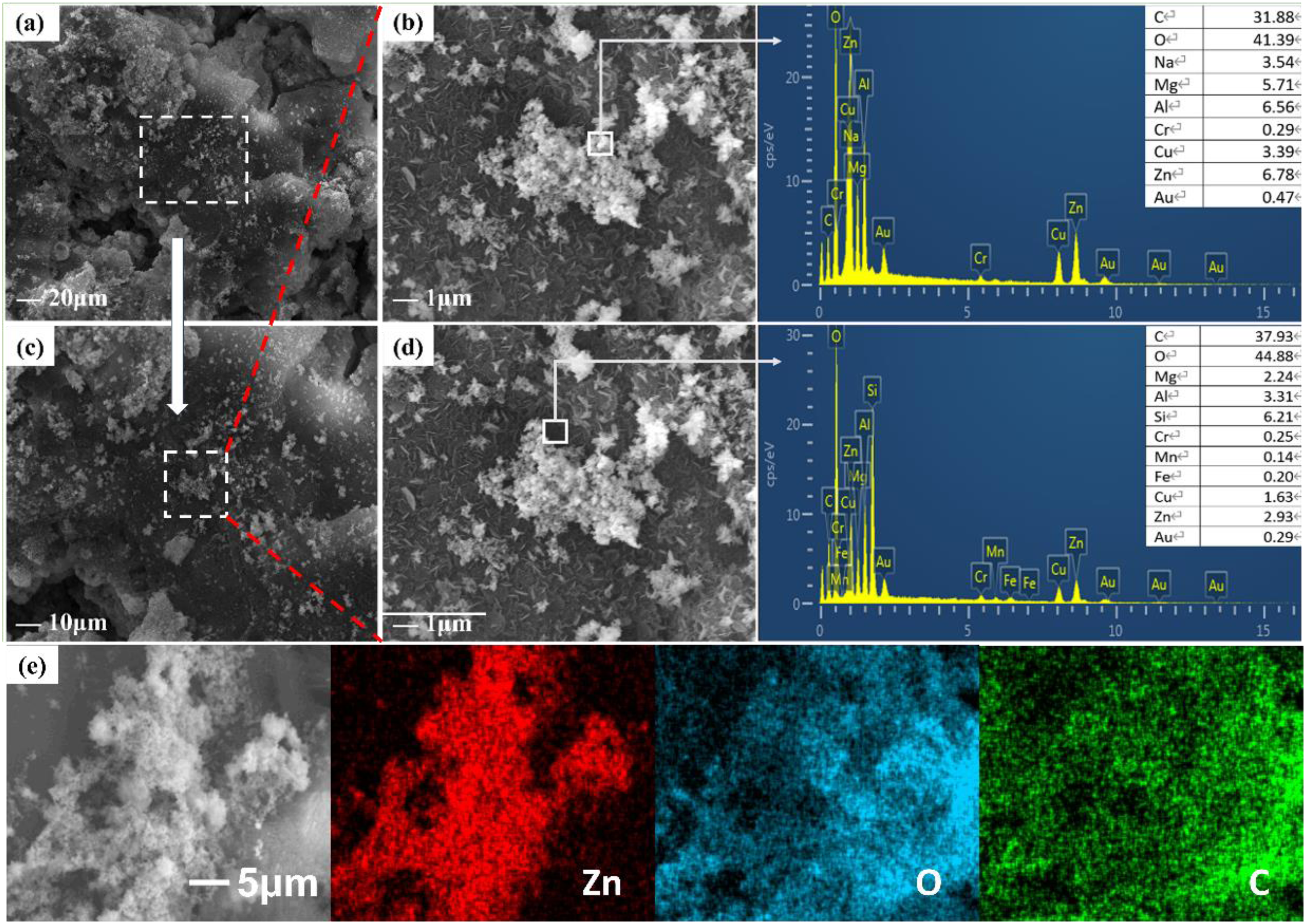
EDS spectrum of Al(B)-EHS surface.
Analysis of the experimental results showed that the Al(B)-EHS surface has superhydrophobic properties with a contact angle of about 153°. During the stearic acid modification process, the ZnO nanoparticles on the Al(B)-EH surface continued to grow, and the stearic acid passivated the grain surface and reduced the agglomeration of the ZnO nanoparticles, 21 which led to a more homogeneous distribution of the ZnO nanoparticles. The synergistic effect of the two—the formation of the composite structure combined with stearic acid modification—jointly facilitates the formation of the STZ superhydrophobic coating.
The electrochemical test results (Figure 5 and Table 3) indicate that the corrosion current density of the etched Al(B)-E samples is significantly higher than that of Al(B), which is attributed to surface roughening. According to the kinetic principle of electrochemical corrosion, the positive shift of corrosion potential reflects the weakening of corrosion tendency, while the decrease of corrosion current density directly characterises the slowing down of corrosion rate. 22 Comparison of different modified specimens: Al(B)-EH specimens exhibit higher corrosion potentials and lower corrosion current densities than Al(B)-E specimens through the covering effect of ZnO particles on the surface; although Al(B)-ES specimens are hydrophobic, their corrosion potentials are similar to those of Al(B)-E specimens, and their corrosion current densities are only reduced by one order of magnitude. Notably, the Al(B)-EHS specimen showed a significant positive shift in corrosion potential and a three orders of magnitude reduction in corrosion current density compared to the substrate due to the synergistic effect of the superhydrophobic coating (STZ) and ZnO, which was attributed to the synergistic enhancement of the physical barrier effect of the superhydrophobic interface and the corrosion inhibition of ZnO. The study confirms that the composite surface engineering strategy can significantly enhance the corrosion resistance of aluminium alloys.
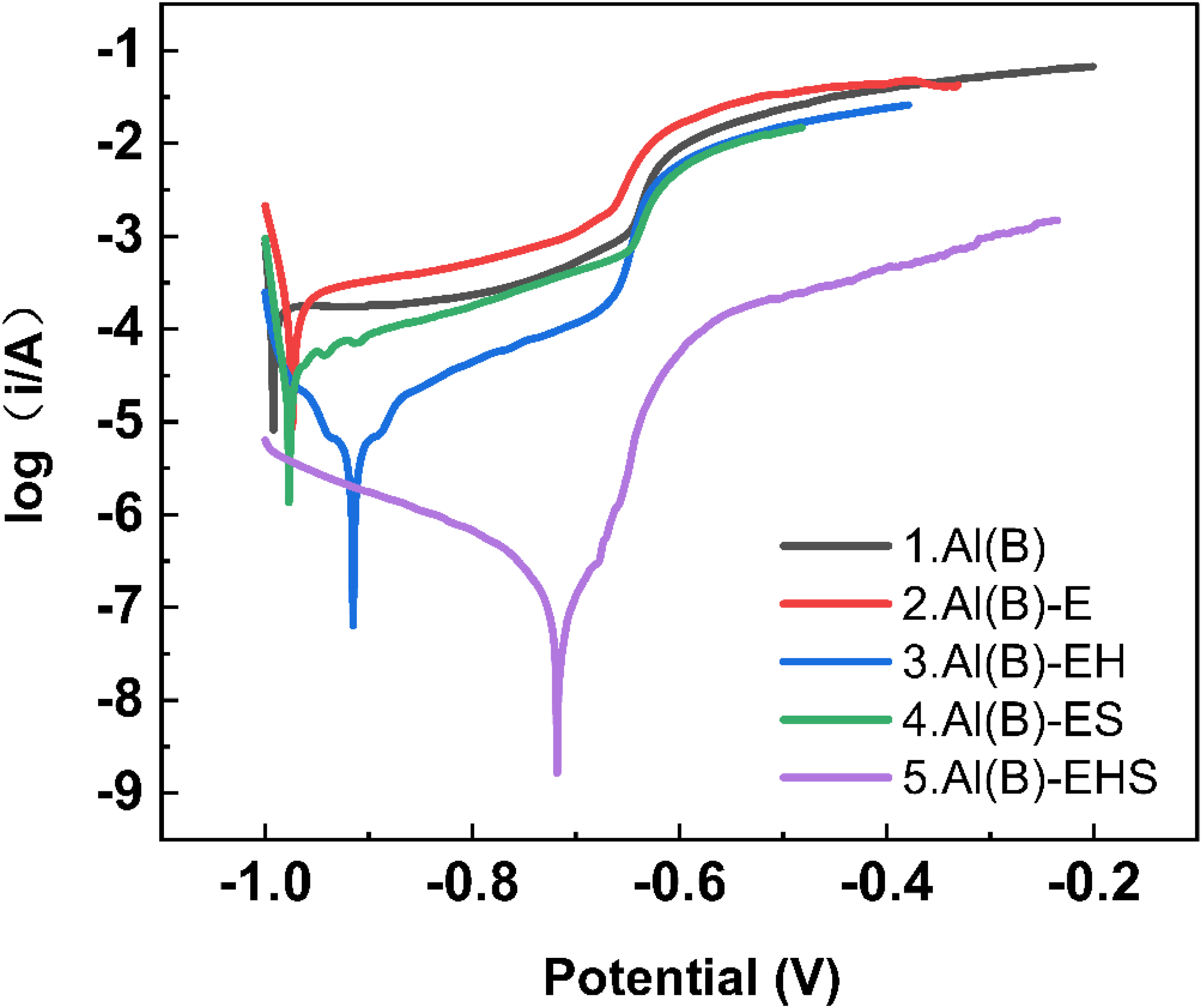
Polarisation curves of five groups of samples, Al(B), Al(B)-E, Al(B)-EH, Al(B)-ES, Al(B)-EHS.
Ecorr and icorr values of Al(B), Al(B)-E, Al(B)-EH, Al(B)-ES, Al(B)-EHS.

Reaction solution concentration optimization
As demonstrated in Figure 6, the surfaces of all three samples exhibit superhydrophobic properties. Among them, the contact angle of the Al(B)-EHS2 surface is more significant than that of the Al(B)-EHS surface. Conversely, the contact angle of the Al(B)-EHS1 surface is smaller than that of the Al-B-EHS surface. The rolling angles of all three are 3° ± 0.5°. The hydrophobicity of the STZ coating is optimal at a zinc acetate concentration of 0.03 M.

Mean surface static contact angles of three groups of samples, Al(B)-EHS, Al(B)-EHS1, Al(B)-EHS2.
As illustrated in Figure 7, the SEM images of Al(B)-EHS,Al(B)-EHS1, and Al(B)-EHS2, reveal significant differences in their structural composition. The number and density of ZnO particles on the surface of Al(B)-EHS1 are less pronounced than those of Al(B)-EHS2 and Al(B)-EHS. On the contrary, the surface morphology of Al(B)-EHS2 and Al(B)-EHS are very similar. This finding suggests that the concentration of the Zn(CH3COO)2 reaction solution affects the surface morphology of the coatings and that an increase in the concentration of (CH3COO)2Zn increases the amount of ZnO within the coatings and results in a more uniform distribution.
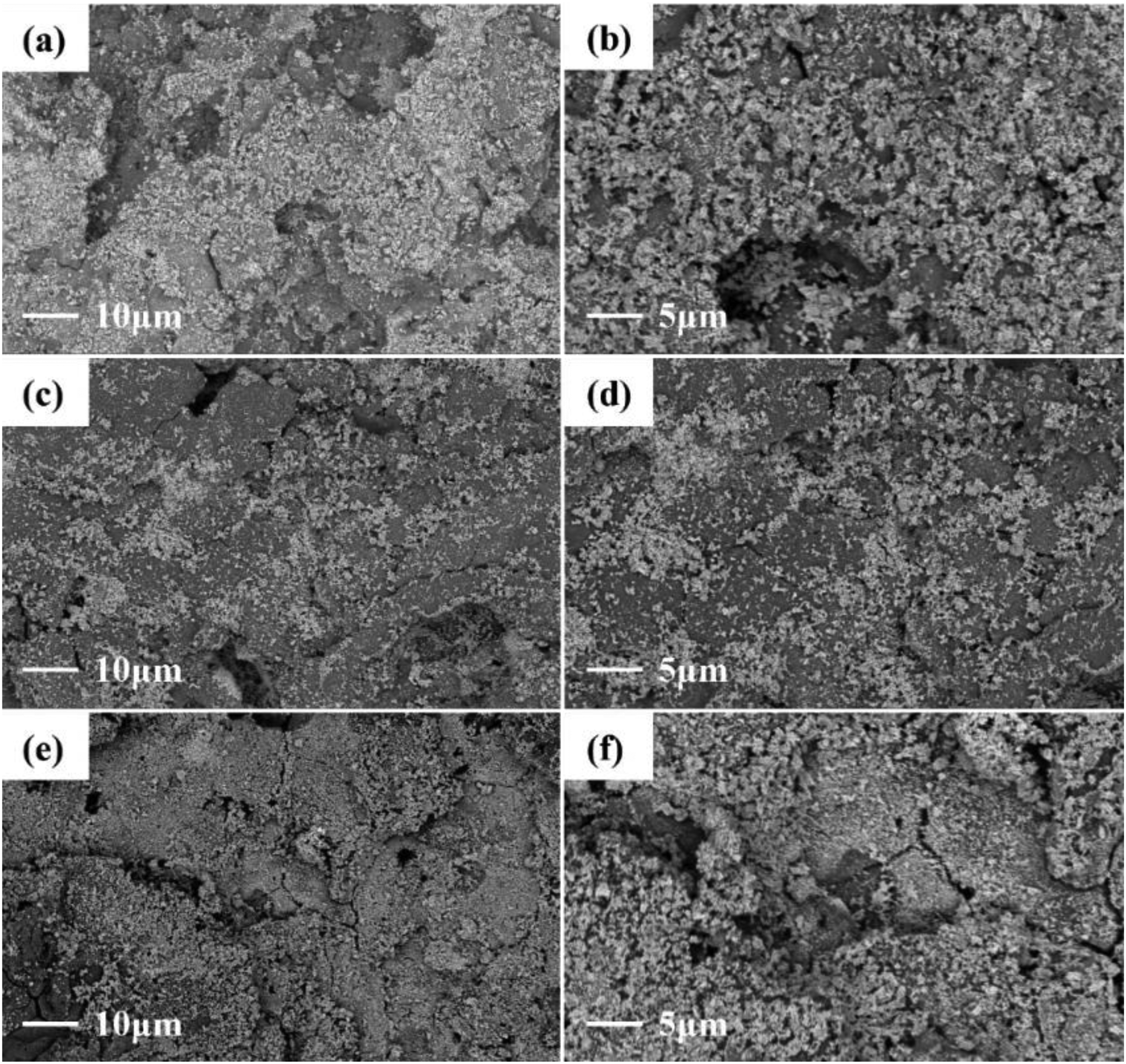
SEM images of three samples of Al(B)-EHS, Al(B)-EHS1, and Al(B)-EHS2 samples (a), (b) are Al(B)-EHS; (c), (d) are Al(B)-EHS1; (e), (f) are Al(B)-EHS2.
The polarisation curves of the three samples, Al(B)-EHS, Al(B)-EHS1 and Al(B)-EHS2, are illustrated in Figure 8, and their corrosion potentials and corrosion current densities are summarised in Table 4. The experimental results show that all three samples exhibit anodic passivation characteristics, with Al(B)-EHS2 having the highest corrosion potential and the lowest corrosion current density (on the order of 10−⁸ A/cm²), indicating the best corrosion resistance. Combined with the surface morphology analysis (Figure 7), it can be seen that the ZnO nanostructures were transformed from sparse particles to dense layered stacking as the concentration of zinc acetate increased from 0.02 M (Al(B)-EHS1) to 0.03 M (Al(B)-EHS2), which significantly enhanced the surface roughness and corrosion barrier effect. This phenomenon is consistent with the ZnO morphology regulation law reported by Peng et al., 23 confirming that optimising the precursor concentration can synergistically enhance the hydrophobicity and corrosion resistance of the coating.

Polarisation curves of Al(B)-EHS, Al(B)-EHS1, Al(B)-EHS2.
Ecorr and icorr values of Al(B)-EHS, Al(B)-EHS1, Al(B)-EHS

Hydrothermal reaction time optimization
As demonstrated in Figure 9, the contact angle measurements for Al(B)-EHS2, STA-Al(B)-EHS3, and Al(B)-EHS4 are highly similar. All three samples exhibit comparable contact angles of 156° (±1°). The rolling angles are all less than 3°. The contact angle curves demonstrate that the duration of the hydrothermal process exerts minimal influence on the superhydrophobic properties of the sample surfaces while maintaining a constant (CH3COO)2Zn concentration, yet it continues to promote such properties.

Mean values of surface static contact angles for three groups of samples Al(B)-EHS2, Al(B)-EHS3, and Al(B)-EHS4.
Figure 10 shows that with the prolongation of hydrothermal time (Al(B)-EHS2 to EHS4), the ZnO particles gradually fill the micro-pits on the surface of the substrate, and the surface roughness is significantly reduced. Among them, Al(B)-EHS2 still retains obvious pit, while EHS3 and EHS4 show flat surfaces due to the dense coverage of ZnO, indicating that the time parameter optimises the coating morphology by modulating the growth kinetics of ZnO crystals instead of simply increasing the deposition amount.

SEM images of three samples of Al(B)-EHS2, Al(B)-EHS3, Al(B)-EHS4.
The prolongation of the hydrothermal time promotes the Ostwald ripening process 24 of the ZnO crystal nuclei: dispersed nanoparticles are formed in the initial stage (30 min, EHS2); orientation attachment occurs in the middle stage (60 min, EHS3) (preferential growth in the [001] direction); and ultimately (90 min, EHS4) the ZnO crystals are formed due to Al(OH)₄ − to -Zn²+ interfacial adsorption inhibits axial growth, triggering multidirectional branching to form flower-like structures (Figure 10 (g)-(h)). This anisotropic growth originates from the lowest surface energy of the polar face (002) of ZnO crystals, which promotes one-dimensional extension in the [001] direction (the growth rate is 3.2-fold higher than that in the <100> direction), whereas OH- released from the Al substrate modulates the Zn²+ diffusion path via electrostatic interaction, inducing three-dimensional lamellar assembly.25–27
Figure 11(a) shows the XRD patterns of the samples under four different conditions. The pattern of 1 is annotated with the typical diffraction peak positions of Al(B)-E, corresponding to the (111), (200), (220), and (311) crystal planes, respectively. The patterns for 2/3/4, corresponding to S4, S3, and S2, also exhibit diffraction peaks corresponding to crystal planes, indicating that the aluminium alloy matrix has a very high purity. In the pattern for 2, in addition to the diffraction peaks of the aluminium alloy, characteristic diffraction peaks of ZnO (marked with *) are also observed, indicating that zinc oxide was successfully deposited on the surface of the aluminium alloy under these conditions. Meanwhile, no obvious characteristic peaks of zinc oxide were observed in the spectra of 3 and 4, indicating that the deposition of zinc oxide was less under these conditions.

(a) XRD, (b) polarisation curves of Al(B)-EHS2, Al(B)-EHS3, Al(B)-EHS4 samples.
Figure 11(b) and the data in Table 5 indicate that the corrosion potential values of the three samples are similar. The corrosion current density value of Al(B)-EHS4 is lower than that of the other two groups of samples, confirming that extending the hydrothermal reaction time to 90 min can effectively enhance the corrosion resistance of the coating. The experimental results demonstrate that when using a 0.03 mol/L zinc acetate solution for hydrothermal reaction, as the hydrothermal time increases, the amount of surface zinc oxide deposition increases, and both hydrophobicity and corrosion resistance are improved. The resulting Al(B)-EHS4 samples exhibit the best overall performance.
Ecorr and icorr values of of Al(B)-EHS2, Al(B)-EHS3, Al(B)-EHS4.

Mechanical stability and self-cleaning
As demonstrated in Figures 12 and 13, the contact angle of Al(B)-EHS4 was observed to vary during the mechanical stability assessment. The specific values of this variation are detailed in Table 6. As demonstrated in Figurre 13, under the experimental conditions, the Al(B)-EHS4 samples transitioned from a superhydrophobic state to a hydrophobic state following 10 abrasion cycles. However, it was determined that more than 400 wear cycles were required for the coating to transition from the hydrophobic to the hydrophilic state. After 400 friction and wear tests, the hydrophobic performance decreased by 30%.This finding indicates that while the superhydrophobic structure of Al(B)-EHS4 could not be fully stabilised during the abrasion process, it exhibited remarkable hydrophobicity retention capability, with the surface maintaining its hydrophobicity even after approximately 400 abrasion cycles.

Twelve sets of sample wear charts.

Plot of Al(B)-EHS4 contact angle with the number of wear times.
Measured contact angle of Al(B)-EHS4.

As shown in Figure 14, the anti-fouling performance of Al(B)-EHS4 and Al(B) was compared. At the start of the experiment, both surfaces were in a clean state. Both were simultaneously immersed in an aqueous solution coated with graphite ash. The Al surface was covered with a large amount of contaminants. In contrast, after being removed from the solution, the Al(B)-EHS4 surface remained bright and clean, with no traces of contamination. By statistically analysing the contamination levels, it was found that the proportion of the contaminated area on the STZ-coated surface relative to the total area was reduced by 70% compared to the Al(B) surface. This result indicates that the STZ coating possesses significant anti-fouling capabilities. The experimental results confirm that the STZ coating exhibits notable anti-fouling efficacy.

Test plots of antifouling properties of samples (a), (b), (c), (d), (e) for Al(B); (f), (g), (h), (i), and (j) for Al(B)-EHS4.
Conclusions
In this study, STZ coatings were successfully constructed using a multi-step synergistic method. The flower-like micro-nanostructures were constructed by hydrothermal deposition of ZnO particles on etched aluminum plates, and then the surface of the substrate was modified with stearic acid. The STZ coatings were found to have good superhydrophobicity and corrosion resistance. The best performance of the STZ coatings was found at a concentration of 0.03 M zinc acetate solution and a hydrothermal time of 90 min with controlled variables during the experiments. The hydrophobicity of the coating after 400 wear cycles is attributed to the multistage synergistic construction of the composite structure, which enhances the stability and durability of the STZ coating. In addition, thanks to the universality of zinc oxide particles, STZ coatings can be realized on many alloys, and their green and non-fluorinated preparation method makes STZ coatings very promising for applications.In everyday life, areas such as handrails, metal buttons, and handles that are subject to prolonged friction and wear, as well as waterproof covers, mobile phone metal frames, and other metal instrument housings that require cleanliness, are all excellent applications for STZ coating. It also holds significant reference value for marine metal corrosion protection.
Footnotes
Acknowledgments
This work was supported by the National Natural Science Foundation of China [grant number: 52365025, 52465066 and 52405198], the National Natural Science Foundation of jiangxi Provinces of China [grant number: 20243BCE51074, 20232BAB214046 and 20232BAB204040], Ganpo Talent Support Program-Youth Talent Nurturing Program (2024QT10) and the National Natural Science Foundation of Chongqing City of China [grant number: 2024NSCQ-MSX3737, 2024NSCQ-MSX3731 and 2024NSCQ-MSX1273].
Declaration of conflicting interests
The authors declared no potential conflicts of interest with respect to the research, authorship, and/or publication of this article.
Funding
The authors disclosed receipt of the following financial support for the research, authorship, and/or publication of this article: This work was supported by the National Natural Science Foundation of China [grant number: 52365025, 52465066 and 52405198], the National Natural Science Foundation of jiangxi Provinces of China [grant number: 20243BCE51074, 20232BAB214046 and 20232BAB204040], Ganpo Talent Support Program-Youth Talent Nurturing Program (2024QT10) and the National Natural Science Foundation of Chongqing City of China [grant number: 2024NSCQ-MSX3737, 2024NSCQ-MSX3731 and 2024NSCQ-MSX1273].
