







Abstract
Copper plating technology is of great importance in the electronics industry, especially in printed circuit board (PCB) and integrated circuit manufacturing. As the market demand for high-performance, highly integrated electronic devices continues to grow, electroplating copper processes are confronted with a series of technical challenges. This paper systematically reviews the classification, functional characteristics and action mechanisms of inhibitors, accelerators and levelers during the electrodeposition process. It focuses on analyzing the individual mechanisms of key additives such as polyethylene glycol (PEG), bis(3-sulfopropyl) disulfide (SPS) and chloride ions (Cl−) in optimizing the coating structure by regulating interfacial adsorption configuration, inducing preferred crystal orientation and refining grain size. On this basis, the synergistic interaction mechanisms of additives in the PEG-Cl−-SPS ternary system and other multi-component systems are discussed in depth, revealing how dynamic competitive adsorption and alternating “inhibition-acceleration” structures synergistically regulate the microstructural evolution of copper deposition. Finally, from the perspective of structural optimization, the breakthrough directions of superfilling technology, the design strategies of novel polymeric additives and the future development trends of intelligent regulation of process parameters are summarized, aiming to provide theoretical basis and technical support for the further optimization of copper electroplating technology.
Introduction
Copper has good electrical conductivity, ductility and thermal conductivity, which makes it the “infrastructure metal” of modern society, from the microscopic chip to the macroscopic building and energy system, all of which are inseparable from copper. Copper plating is a process of reducing copper ions to metallic copper through an electrolysis reaction. In the plating bath, copper salts such as copper sulfate and copper chloride dissolve and dissociate to release copper ions, which migrate toward the cathode under the driving force of an applied electric field and are ultimately reduced to form a continuous copper coating on the cathode surface. Copper plating technology in the printed circuit board (PCB) manufacturing and semiconductor packaging occupies a central position, and is the key process to achieve high-density interconnections and microvia filling. As electronic products become increasingly miniaturized and highly integrated, copper electroplating technology is facing higher requirements, especially in terms of superfilling, inhibiting hole formation, and regulating plating properties.1–6
During the copper electrodeposition process, the important roles of electrolytes include providing a source of copper ions, maintaining ionic balance, controlling the deposition rate, and regulating the quality of the plated layer. After the development of cyanide, pyrophosphate and sulfuric acid systems, the acid copper sulfate plating system has become the most important component of the copper plating system. However, the quality of the copper layer plated only by the basic components is far from the desired goal in the acid copper sulfate plating system. Through the formulation of organic additives such as inhibitors, accelerators and levelers, the Cu deposition process can be effectively regulated to achieve uniform plating and improve the structural reliability of interlayer connections.7,8 Organic additives are pivotal to the copper electroplating process, and a diverse array of functional additives has been developed for this purpose.9,10 By modulating the electrochemical behavior of the plating system, these additives enhance the uniformity of copper deposition, improve the quality of fill in microstructures, and govern the growth dynamics of the deposited copper layer throughout electrodeposition.11–15
In PCB manufacturing, copper plating technology has undergone an evolution from conventional direct current (DC) plating to new DC plating, with the core objective always being to enhance the uniformity and hole-filling effect of the plated areas (including holes and blocks, etc.).3,16 The use of additives not only optimizes the brightness and densification of the plated layer, but also effectively inhibits the formation of holes, thus improving the electrical properties and reliability of the product.17–20
In the field of semiconductor packaging, copper plating technology is widely used to fill through-silicon vias (TSV) interconnection technology for three-dimensional chip interconnections.1,4 In TSV filling for semiconductor packaging, thiourea additives are adsorbed on the TSV sidewalls through sulfur-containing groups in the molecules to form a hydrophobic adsorption layer. This hydrophobic adsorption layer acts as a barrier, impeding the reduction and deposition of copper ions on the TSV sidewalls and thus selectively suppressing copper growth along the vertical side surfaces. Meanwhile, due to the concentrated electric field and lower additive concentration at the bottom of the TSV, copper ions are preferentially reduced there. This mechanism enables bottom-up superfilling, ensuring a void-free TSV structure with uniform and dense copper deposition. 1 In addition, by optimizing additive combinations, such as the combined effect of sodium polydithiobispropane sulfonate (SPS) and polyethylene glycol (PEG), a pore-free superfilling effect can be achieved.2,13,15 The optimization of defect-free structures in three-dimensional vias through coupling effects represents a key manifestation of the enhanced structure-tuning capability of multi-component systems.
However, the optimization of copper electroplating processes still faces many challenges, including the complexity of the additive mechanism, the sensitivity of the process parameters, and the multiple demands on the coating properties.18,19,21,22 Focusing on the theme of “the effects of individual and synergistic interactions of copper electroplating additives on microstructural control”, this paper systematically reviews the working mechanisms of inhibitors, accelerators and levelers during electrodeposition, with emphasis on analyzing how they optimize the microstructure and macroscopic properties of the coating by regulating electrocrystallization behavior, crystal orientation and interfacial adsorption structure. Through in-depth analysis of the coupling mechanisms of multi-component systems such as PEG-Cl−-SPS, the regulation pathways of additive cooperative interactions on the laws of structural evolution are revealed, providing theoretical support for the development of high-performance copper electroplating processes.
Classification, mechanism and structure-property relationships of copper electroplating additives
Based on their functional characteristics, copper electroplating additives are commonly divided into three groups: inhibitors, accelerators, and leveling agents, each exerting a unique influence on the plating process. These additives regulate the deposition behavior of copper ions to achieve precise control of the morphology and performance of the plated layer.
Chloride ions (Cl−)
Cl− plays multiple roles in the copper plating process, including acting as an electronic bridge to facilitate the reduction of Cu2+, and as an anchoring point for inhibitors. 23 Cl− can co-adsorb onto the copper surface with PEG and SPS to form PEG-Cu2+-Cl− and SPS-Cl− complexes, thereby modulating the deposition behavior of Cu.24,25 As a core bridging ion, it not only undertakes the structural regulation function under individual action but also provides interfacial sites for multi-component coupling, serving as a key link connecting the behavior of single components and their coupling effects, and directly influencing the crystal orientation and density of the deposited coating. 23
It has been shown that the presence of Cl− can promote the stepwise discharge reaction of Cu2+. XRD and XPS experiments have confirmed that CuCl is present in the Cu layer when only Cl− is present in the plating solution, and its content increases with the increase of Cl− concentration. This phenomenon can be mechanistically explained as follows: during the reduction of Cu2+, Cl− ions adsorb onto the electrode surface to create a “chlorine bridge” structure, which lowers the activation energy required for Cu2+ to be reduced to Cu+, thus facilitating the formation of CuCl and its co-deposition with copper atoms. The accumulation and coverage of the inert CuCl phase on the surface of the copper deposit reduces the electrochemical activity of the electrode, with higher CuCl contents leading to more pronounced suppression of surface reactivity. 26 This process is suggested to affect the crystalline integrity and defect density of copper deposits by regulating reaction pathways and intermediate products, which may represent a key mechanism of microstructural control by Cl− acting alone.
Cl− concentration plays a critical role in determining the filling quality of electroplated copper. A well-tuned Cl− concentration can notably enhance the superfilling performance of TSVs, whereas elevated Cl− levels often result in voids or other filling imperfections.23,27,28 The regulation of concentration is thought to optimize the adsorption coverage and coordination strength of Cl−, achieving targeted improvement of the coating's uniformity and compactness, which reflects the intrinsic relationship among concentration, mechanism and structure.
Inhibitors
Inhibitors function by adsorbing onto the electrode surface, where they suppress the reduction of copper ions, thereby enabling precise control over the deposition rate and the resulting morphology of the copper coating. Common inhibitors include PEG and polyethyleneimine (PEI), etc.
PEG, as an inhibitor in the copper plating process, inhibits the deposition of Cu mainly by forming an adsorption layer with Cu2+ through hydrogen bonding.11,12 It has been shown that the inhibition mechanism of PEG involves the formation of its complex with Cu+-Cl, which significantly reduces the reduction rate of copper ions. 29 In the presence of Cl−, the adsorption of PEG in copper-plating solutions is enhanced, and the range of its adsorption and detachment potentials is broadened. This stems from the difference in the mode of PEG adsorption. In Cl− free solutions, PEG adsorbs as PEG-Cu2+ and PEG-Cu, which are attached to the cathode surface mainly by van der Waals and electrostatic forces. In contrast, in solutions containing Cl−, PEG adsorbs primarily in the form of PEG-Cu2+-Cl− and PEG-Cu+-Cl−. The difference in the adsorption morphology of PEG has been reported to influence the uniformity of interfacial inhibition. This, in turn, affects the grain arrangement and compactness of the coating. These observations reveal a possible causal relationship among adsorption structure, deposition behavior and coating structure.
A deeper understanding of how Cl− modulates the adsorption configuration comes from molecular-level investigations. Feng et al. 14 found that the cooperative action of PEG and Cl− promoted the formation of PEG-Cu-Cl− complexes in acid copper plating solutions by surface-enhanced Raman spectroscopy (SERS) technique. Based on the spectral data and Hartree-Fock calculations, two three-coordinated Cu+ center models have been proposed, whose core difference is reflected in the position of Cu and PEG chain association (shown in Fig. 1). Figure 1 shows that both PEG-Cu-Cl complexes share the same Cu-O₂-Cl coordination core, but differ significantly in the chemical environment of the coordinating oxygen atoms and the coordination geometry of the PEG chain. Combined spectroscopic observations and theoretical computations have revealed that these complexes are Cu+-centered and adopt a trigonal coordination geometry, where Cu+ binds to two oxygen atoms from PEG and one Cl− to form stable coordination entities. A prominent peak at 260 cm−1 in the SERS spectrum was assigned to the Cu-Cl stretching vibration, which aligns closely with the calculated vibrational frequency of 265∼267 cm−1 from theoretical modeling, thus directly confirming the presence of the Cu-Cl bond within the complex. Furthermore, the intensity of PEG's characteristic C-O-C stretching peak at 850 cm−1 increased markedly in the presence of these complexes, indicating that Cl− ions facilitate PEG adsorption via a “bridging” mechanism.30–37 The stability of this coordination structure is believed to determine the compactness and durability of the adsorption layer, which serves as the molecular basis for PEG to homogenize the coating structure, thus providing a plausible mechanism for coating structure refinement.
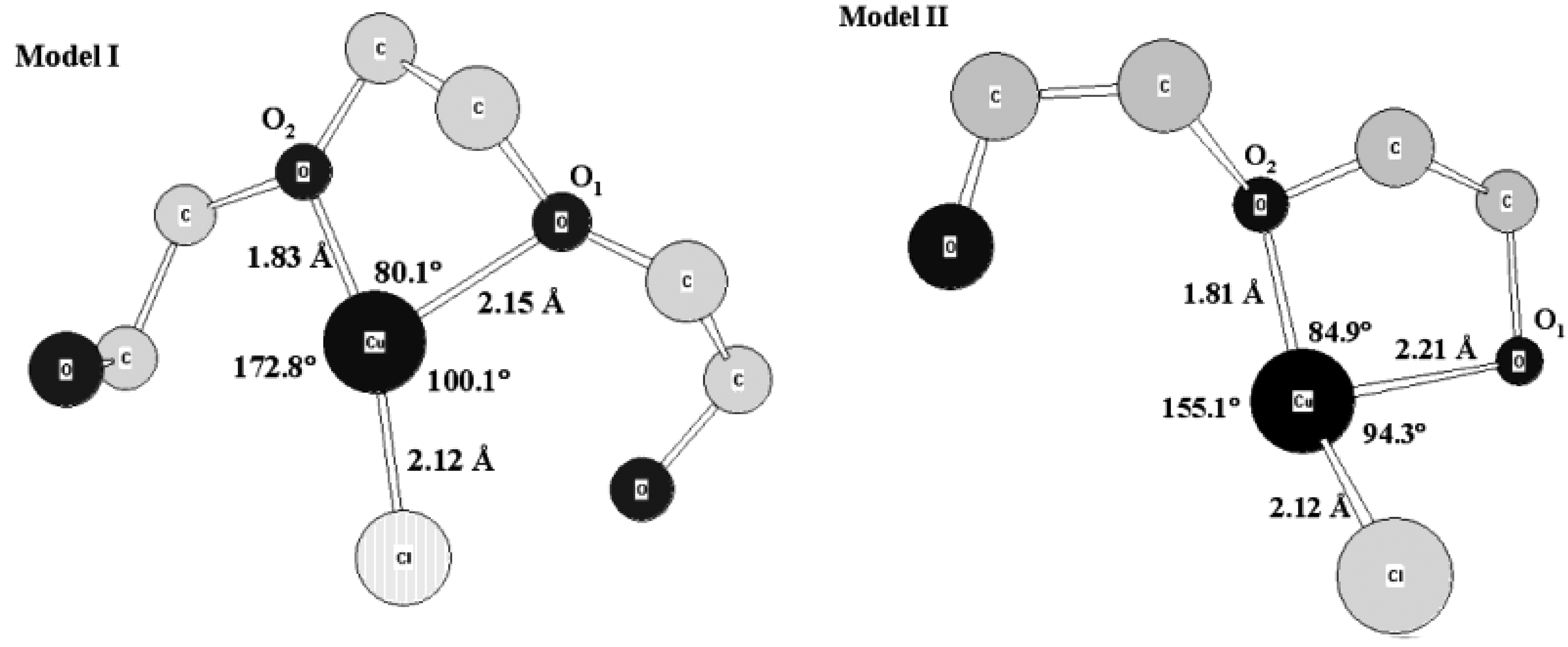
Structural models of two PEG-Cu-Cl complexes. Model I: Cu atoms are bonded to two ether oxygen atoms and a chlorine ligand of PEG; Model II: Cu atoms are bonded to an ether oxygen atom and a hydroxyl oxygen atom and a chlorine ligand of PEG. 14 .
The mechanism of PEI is significantly different from that of PEG. On the one hand, PEI realizes the deactivation regulation of SPS accelerator, due to its unique charge characteristics and molecular structure. 13 PEI is positively charged after protonation, and forms an ion pair with negatively charged SPS through electrostatic attraction, which directly destroys the orderly adsorption of SPS on the cathode surface; at the same time, the polymer chain of PEI forms an adsorption layer on the cathode surface, which uses a spatial site-blocking effect to block the contact of SPS with the active site, and PEI amino group can weakly coordinate with the sulfur atom of SPS to weaken the interaction between SPS and Cu+, resulting in SPS cannot play the role of accelerating. This mechanism regulates adsorption competition through charge matching, avoids local over-deposition caused by the accelerator, optimizes the flatness structure of the coating, and explains the structure leveling mechanism from the perspective of interfacial interactions.
On the other hand, PEI can also synergize with sodium 3-mercapto-1-propanesulfonate (MPS) to achieve copper deposition inhibition. 29 During the electroplating process, the amino group in the PEI molecule and the S- produced by the ionization of the MPS sulfhydryl group, together with Cu+, form a stable [PEI-Cu-MPS] ternary complex. This ternary complex adsorbs onto the cathode surface via electrostatic forces, creating a physical barrier. The barrier impedes the diffusion of copper ions to the cathode and also restricts the surface diffusion of copper atoms, thereby suppressing grain growth. Consequently, this mechanism effectively reduces the copper deposition rate and contributes significantly to the overall inhibitory effect. This reveals the cooperative control of the structure by multi-component coupling effects.
Accelerator
Accelerators promote the reduction reaction of copper ions to improve the deposition rate, mainly used in the need for rapid deposition. Common accelerators include SPS and MPS.
SPS and MPS acceleration is closely related to the presence of Cl−. Both of them can co-adsorb with Cl− and significantly enhance the acceleration effect.38,39 Among them, the combined influence of MPS and Cl− can significantly reduce the reaction resistance, thus accelerating Cu deposition 25 ; SPS molecules can displace PEG from its adsorbed sites on the copper surface, thereby accelerating copper deposition and playing a critical role in enhancing the quality of the final copper coating.40,41 Furthermore, Cl− ions not only function as an electronic bridge to facilitate the reduction of Cu2+, but also strengthen the adsorption of both SPS and MPS on the cathode surface. Zhong Qin et al. 42 found that the promotion of Cu electrodeposition in the CuSO₄-H₂SO₄ system was more significant when SPS and Cl− acted together than that of Cl− alone. The adsorption of accelerators mediated by Cl− has been proposed to enable spatial regulation of the deposition rate, prevent aperture closure, and optimize the deep via filling structure, illustrating a potential mechanism for the precise regulation of three-dimensional structures by coupling effects.
SPS accelerates Cu deposition mainly by catalyzing the reduction reaction of Cu+. Research has demonstrated that the acceleration efficiency of SPS is dependent on both its concentration in the plating bath and the specific type of inhibitor present.30,38 In an electrolyte containing PEG, SPS is able to accelerate Cu deposition by transforming PEG from an inhibited state to a non-inhibited state. 30 This displacement mechanism is thought to play a key role in achieving a dynamic “inhibition–acceleration” equilibrium, and may govern the uniform deposition structure of the coating, thereby constituting a central kinetic mechanism for structure modulation through cooperative additive interactions.
Additionally, existing studies have confirmed that SPS molecules possess weak chemical and electrochemical activity within the typical potential window of copper electrodeposition. Their accelerating effect mainly originates from the electric field-induced cleavage of disulfide bonds in SPS, producing two molecules of the active species MPS. The model presented in Fig. 2 visually illustrates this process. The sulfhydryl (-SH) group of MPS molecules adsorbs on the Cu electrode surface, while the sulfonic acid (-SO₃H) group faces toward the electrolyte. The anchored MPS acts as a molecular bridge for electron transfer, effectively promoting the delivery of electrons from the electrode to Cu2+ in the electrolyte, accelerating the reduction of Cu2+ to metallic Cu, and ultimately facilitating the overall copper deposition process. 6
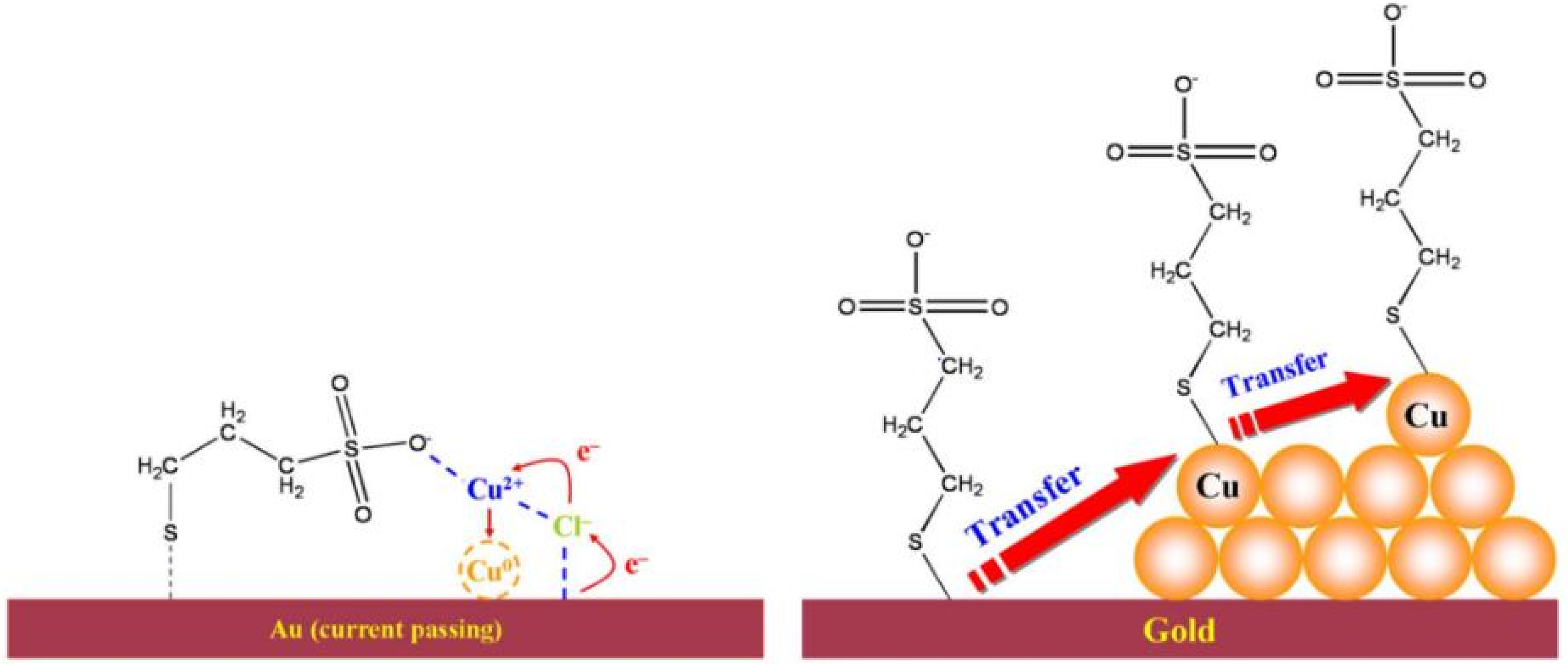
Schematic diagram of the mechanism of SPS. 6 .
Leveling agent
Leveling agents exhibit preferential adsorption on the raised regions of the electrode surface, where they suppress copper deposition, thereby achieving a planarized and uniform coating. Common leveling agents include 2,2’-dithiodipyridine (DTDP) and sodium thiazolidinedithiopropane sulfonate (SH110).
The equilibrium structural diagrams of DTDP molecules adsorbed on the copper surface after optimization, i.e., the side view (Fig. 3(a)) and the top view (Fig. 3(b)), were simulated using molecular dynamics (MD) simulation method in Fig. 3. First, from the side view, it can be seen that the DTDP is almost parallel affixed to the Cu surface, indicating that the DTDP can provide the π-electrons on its own pyridine ring and the lone-pair electrons of the heteroatoms to the metallic Cu, so that the DTDP can be tightly adsorbed on the surface of Cu. Secondly, from the top view, it can be seen that the structure of the adsorbed DTDP molecules cover a certain area of the Cu surface. This parallel adsorption configuration can effectively reduce the contact area between the Cu2+ in the plating solution and the Cu surface, and thus impede copper deposition. This suggests a strong bonding ability between DTDP molecules and Cu surface, i.e., the DTDP molecules can be adsorbed closely and parallel to the Cu surface. Through their multiple active sites, DTDP molecules form robust bonds with the Cu surface, ultimately producing an excellent leveling effect. 43 The parallel adsorption structure of DTDP enables precise coverage of protrusion sites, realizing targeted optimization of surface flatness, and reveals the relationship between the leveling mechanism and structural evolution from the perspective of adsorption configuration.
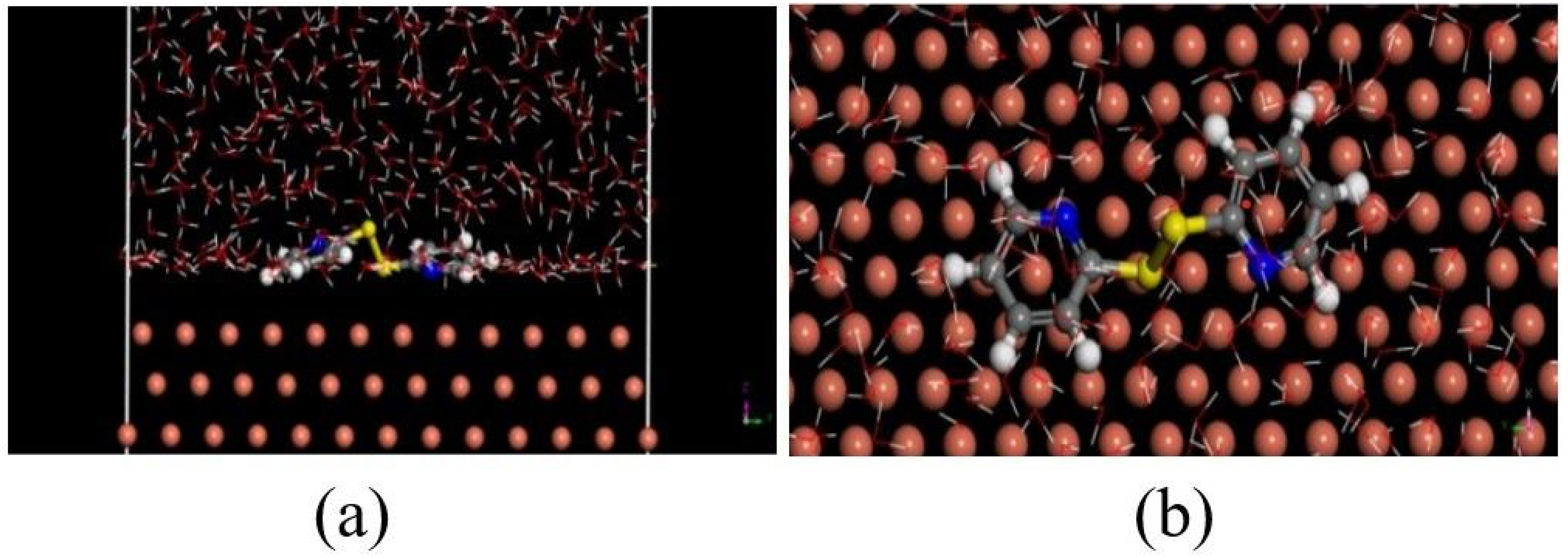
Equilibrium structural diagrams of DTDP molecules adsorbed on the Cu surface, i.e., (a) side view and (b) top view. 43 .
Xiao Ning et al. 44 studied the influence of different leveling agents on the surface micro-morphology and the hardness of electroplated copper layers, respectively, by using a metallographic microscope and a Vickers hardness tester, and characterized the electrochemical behaviors of leveling agents in the copper deposition process by the chrono-potentiometric method, finally screened out the optimal leveling agent for electroplated hard copper and explored the cooperative action among the used several leveling agents and found that the joint action of SH110 and tetrahydrothiazolothione (H1) could significantly increase the micro-hardness and surface flatness of the plated layer. The coupling of levelers can simultaneously optimize the surface flatness structure and mechanical property structure, achieving multi-dimensional enhancement of the coating and reflecting the comprehensive enhancement of structure and properties via functionally complementary synergies.
The structure-tailoring ability of levelers is reflected in their “reverse modeling” of the micro-morphology on the electrode surface. DTDP covers high-energy crystal planes through parallel adsorption, inhibits local deposition, and forms a flat interface. SH110 enhances the hardness and flatness of the coating through its combined effect with H1. These levelers reconstruct the adsorption layer structure on the electrode surface via steric hindrance and electronic effects, thereby realizing the regulation of the macroscopic flatness of the deposited coating.
Regulating law of additives on crystal orientation
In electrochemical deposition, additives regulate the crystallographic orientation of copper deposits by modifying the interfacial adsorption behavior, ion transport kinetics, and thermodynamics of electrocrystallization, which ultimately leads to the control of crystal growth direction, preferred orientation, and grain arrangement.45,46 Within this regulation pathway, the combined action of sulfur-containing accelerators and chloride ions is particularly prominent: under high current density conditions, the joint influence of the two components can induce a fully preferred orientation of the (220) crystal plane in the copper deposit. This is because sulfur-containing functional groups can preferentially adsorb onto the high-energy surfaces of copper crystallites, effectively reducing the surface energy barrier of the (220) plane and enabling this crystal plane to gain a significant growth advantage during electrocrystallization, thereby realizing the directional regulation of crystal structure. 47
On this basis, the crystallographic orientation also exhibits a coordinated response to external field conditions. Variations in current density can trigger the transformation of the preferred orientation in copper deposits, which essentially arises from the competitive growth between different crystal planes in terms of growth rate and growth direction. Additives can adjust the competitive relationship among crystal planes and achieve precise control of the crystal structure in cooperation with current density, thus forming a multilevel regulation mechanism of “external field conditions - interfacial interactions - crystal structure”. 28
When multiple additives are used in combination, the ability to regulate crystal orientation is further enhanced through coupling effects. Cationic auxiliaries form a three-dimensional network structure on the cathode surface via electrostatic interactions, providing directional deposition sites for copper ions; inhibitors form stable complexes with the bridging assistance of chloride ions, adjusting the reduction overpotential of copper ions; meanwhile, chloride ions enhance the interfacial adsorption strength of sulfur-containing additives and promote the two-step single-electron reduction of Cu2+ (Cu2+ + e− ⇌ Cu+, Cu+ + e− ⇌ Cu). The cooperative modulation of nucleation and growth by multiple components can simultaneously optimize the crystallographic orientation and grain size of the deposit, representing a typical mechanism for the directional optimization of crystal structure driven by additive coupling. 34
From the nature of electrocrystallization, all the above regulations ultimately converge on the modification of nucleation behavior and crystallization mode. In an acidic copper sulfate system, the ternary combination composed of inhibitor, accelerator and chloride ions presents a significant promoting effect on copper electrodeposition, and such promotion is intensified with the increase of accelerator concentration. This ternary system can markedly increase the nucleation number density of copper, leading to a characteristic of three-dimensional instantaneous nucleation at the initial stage of electrocrystallization, which gradually transforms into a progressive nucleation mode as the electrodeposition proceeds. Characterization methods including cyclic voltammetry (CV), linear sweep voltammetry (LSV), chronoamperometry (CA), electrochemical impedance spectroscopy (EIS) and scanning electron microscope (SEM) have confirmed that the elevation of polarization potential can further enhance the promoting effect of this system on electrodeposition. The variation of nucleation density and crystallization mode directly determines the compactness and uniformity of the coating, indicating that the regulation of electrocrystallization mechanism is a key factor governing the macroscopic structure and service performance of the deposit. 42
Effect of structural optimization on the enhancement of deep plating capability
Throwing power, also known as equalizing power, refers to the ability of copper ions to deposit uniformly in deep holes or grooves of complex geometries (e.g., PCB through holes, blind holes) under specific plating conditions. Tailoring the molecular structure of additives is a key strategy for improving the deep-plating performance of electroplated copper in complex geometries. Chen Yang et al. 19 achieved more than 80% of even plating capability of copper layer in through-hole plating with a thickness-to-diameter ratio of 6.4:1.0 by optimizing the plating bath structure and the plating solution composition. Wang Song 48 developed copper plating additives for PCBs with high aspect ratios, and investigated the effects of additive type, structure, and concentration on deep plating capability. Lei Kewu 20 developed an acidic copper plating brightener tailored for vertical continuous plating processes, achieving 70% throwing power under the cathodic current density of 3.5 A/dm2, the test sample plate thickness of 2.0 mm and the hole diameter of 0.3 mm. Zhou Chaohua 49 investigated the effect of additives on the deep plating capability for the copper plating process of high density interconnect multilayer boards. Fengjuan Zhu et al. 50 examined in detail the electrochemical properties of a through-hole copper plating additive consisting of sodium polydithiopropane sulfonate, polyethers, and quaternary amines by electrochemical testing methods, and found that the additive has a good deep-plating capability. The enhancement of deep plating capability is essentially to realize uniform deposition in three-dimensional space by regulating the interplay of “electric field distribution-substance transport-interfacial reaction”. This technological breakthrough has directly promoted the progress of high-density electronic packaging, three-dimensional micro-nano manufacturing and other fields. This breakthrough represents one of the core competitive of modern precision plating processes.
Multicomponent additive systems and optimal formulation for copper electroplating
Based on the structural regulation by individual components, this section focuses on the synergistic enhancement of coating structure via multi-component coupling effects, reveals the intrinsic relationship between coupling mechanisms and microstructure improvement, and achieves comprehensive conceptual analysis and mechanistic summarization.
PEG-Cl-SPS ternary system
In the copper plating process, PEG-Cl−-SPS ternary system is one of the most widely researched and applied additive combinations, and its excellent cooperative performance can significantly improve the quality and performance of copper plating and thus it plays a key role in many fields such as electronics and machinery. This ternary system serves as the core model of the present work: Cl− acts as the bridge, PEG provides the primary inhibition, and SPS realizes directional acceleration. The coupling of the three components achieves a refined coating structure characterized by “uniform inhibition - directional acceleration - defect-free filling”, making it the most typical system for improving structure and properties driven by additive cooperation.
Experimental evidence indicates that Cl− facilitates the adsorption of PEG and SPS on the cathode surface, thereby amplifying the functional performance of these additives. The dynamic competitive adsorption among PEG, Cl−, and SPS is governed by applied potential, additive concentration, and molecular characteristics. Cl− is preferentially adsorbed on the active sites of the Cu surface, facilitating charge transfer and the subsequent adsorption of PEG and SPS. PEG forms a physical barrier via weak hydrophobic interactions, while SPS anchors preferentially at high-current-density regions through chemical adsorption and displaces part of the Cl−, forming a cooperative adsorption layer with PEG. As a result, Cl− promotes uniform nucleation at low potentials, SPS suppresses dendrite growth at high potentials, and PEG balances the roles of Cl− and SPS through its steric hindrance effect. This composite adsorption layer governs the copper deposition rate and crystal orientation, resulting in planarization, densification, and high via-filling efficiency.
From a kinetic perspective of the electrodeposition process, the PEG-Cl−-SPS ternary system can change the reaction path and rate control steps of copper deposition. Without additives, deposition is mainly controlled by diffusion or electrochemical reactions. Through the cooperative action of the three components, the diffusion and electrochemical reaction rates become more balanced, enabling uniform and orderly copper deposition that yields a flat, bright, and dense coating. Representative surface morphologies obtained with this ternary system are shown in Fig. 4.
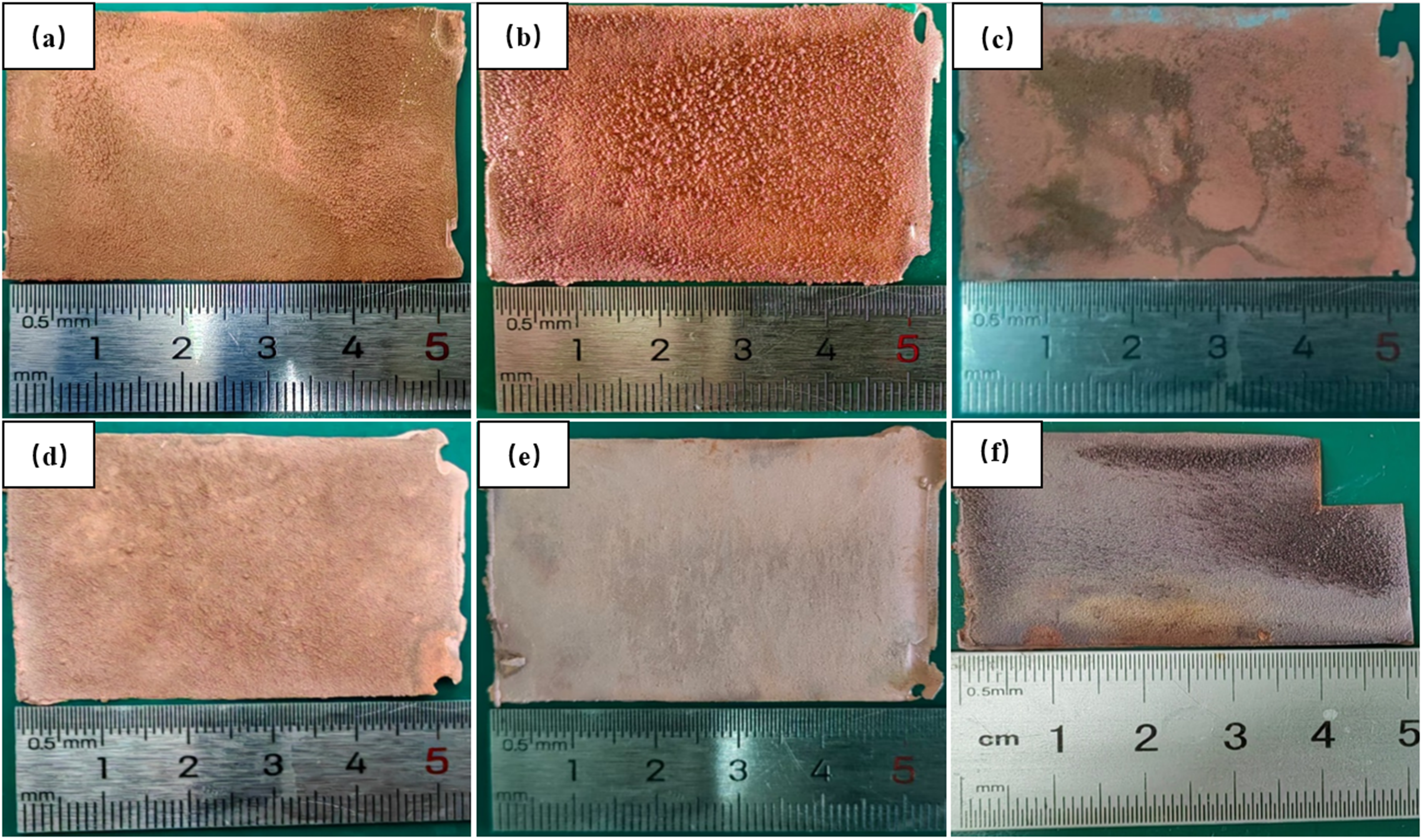
Surface morphology of the PEG-Cl−-SPS ternary system with a fixed PEG concentration of 1.0 mg/L and Cl− concentration of 0.1 mmol/L under different SPS concentrations: (a) 2, (b) 4, (c) 6, (d) 8, (e) 10, and (f) 20 mg/L.
Other multivariate systems
Beyond the well-established PEG-Cl−-SPS ternary system, advances in electroplating technology have led to the development of a range of multi-component additive systems, each tailored to address the unique requirements of copper plating in diverse industrial applications.
a. PEG-JGB-BPS system: The PEG-JGB-BPS system is a new type of multifunctional system developed on the basis of PEG-Cl−-SPS system, in which JGB is a kind of cationic surfactant, and BPS (bis(3-sulfopropyl) disulfide) is a sulfur-containing brightener. Due to their positive charge, JGB molecules tend to adsorb onto the cathode surface. This adsorbed layer effectively regulates the migration and deposition of copper ions, promoting a more uniform distribution on the cathode surface. At the same time, JGB can also form a joint adsorption with PEG to enhance the leveling effect. BPS, as a brightener, demonstrates effects analogous to SPS, but shows better brightening effect and leveling ability at high current density. The PEG-JGB-BPS system enhances the uniformity of interfacial charge distribution through the cationic character of JGB, while BPS exerts local inhibition in high-current-density regions, thereby realizing the coupled regulation of “current density-adsorption structure”.
This system has significant advantages in PCB plating. In the PCB plating process, due to the complexity of the lines and uneven current distribution, it is difficult to ensure the uniformity and consistency of the plated layer with the traditional system. The PEG-JGB-BPS system can effectively improve the current distribution through the regulating effect of JGB on copper ions and the inhibiting effect of BPS in the high current region, obtaining a plating layer with uniform thickness, brightness, and smoothness to meet the requirements of PCB fine line plating.51–56
b. PAG-Cl−-MPS-TPS system: The PAG-Cl−-MPS-TPS system is a multifunctional system developed to meet the needs of high-speed plating, and PAG (polypropylene glycol block polyethylene glycol) exhibits superior molecular design flexibility compared to PEG, which can be better adapted to different plating conditions. Both MPS and TPS (tetramethylenedisulfotetramine) are sulfur-containing additives. MPS can refine the grain and improve the densification of the plating layer, while TPS has excellent brightening effect and leveling performance.
55
The PAG-Cl−-MPS-TPS system enhances the stability of the adsorption layer via the flexible segments of PAG, while MPS and TPS jointly control grain size and surface gloss. Although the coating improvement pathways of these systems vary, they all follow the unified regulation logic of “interface structure-deposition behavior-coating performance”.
In the high-speed plating process, the short plating time and high current density require high performance of the additives, and the PAG-Cl−-MPS-TPS system can form high-quality copper plating layers in a short time through the cooperative action of the components, with PAG providing a stable adsorption layer, Cl− enhancing the adsorption stability of the additives, and MPS and TPS respectively regulating grain growth and surface brightness. The system has been successfully applied in large-scale industrialized production, such as continuous plating production lines, which can increase the plating efficiency by more than 30%, and ensure that the quality of the plated layer meets the standard requirements.23,32,47,55
c. Environmentally friendly multiple systems: Driven by increasingly stringent environmental regulations, eco-friendly multi-additive systems have emerged as a critical research focus. These systems predominantly comprise natural polymer compounds and eco-friendly additives as core components. For example, the multifunctional system is composed of chitosan, sodium lignosulfonate, and an environmentally friendly sulfur-containing brightener. Chitosan is a natural polysaccharide with good biocompatibility and adsorption properties, which can form a protective film on the cathode surface and play a dispersing and stabilizing role; sodium lignosulfonate is a lignin derivative with excellent dispersing and complexing ability, which can prevent the agglomeration of copper particles and stabilize the plating solution; the eco-friendly sulfur-containing brightener can ensure the brightening effect and reduce the pollution of the environment. Environmentally friendly multi-component systems achieve the dual goals of environmental protection and coating quality improvement through green adsorption, complexation dispersion, and mild acceleration, reflecting the coupling design strategy under the trend of green development.
This eco-friendly multifunctional system can not only achieve a good plating effect, but also significantly reduce the difficulty and cost of plating wastewater treatment.
Principle of optimal proportioning
The optimal ratio of additives is the key to realize high-quality copper plating. The core of the optimal ratio lies in matching the strength of additive interactions to maximize structural optimization. It represents the practical translation of the main research theme from mechanism to application, embodying the design philosophy of “mechanisms guiding formulations, and formulations serving structure”. Wang Xu et al. 27 determined the optimal concentrations of the PEG-Cl−-SPS system through orthogonal experiments: Cl−:50∼70 mg/L, PEG-10000:200–300 mg/L, SPS:8–11 mg/L. This ratio was able to achieve up to 91.7% hole filling rate while ensuring the uniformity and reliability of the plating layer. 21 This ratio balances the inhibition and acceleration intensities, realizing a high-quality deposit structure with void-free filling, which serves as a direct engineering application of coupling strength matching.
Further optimization studies revealed that when the concentration of Cl− was 60 mg/L, PEG-10000 was 250 mg/L, and SPS was 5 mg/L, the deep plating capacity could reach 112.9%, and the plated layer had good thermal shock resistance. 21 Qian Ma et al. 22 optimized the dosages of SPS, PEG-10000, MX-86 and SQ-5 by orthogonal experiments, and found that the deep plating capacity of through-hole plating with an aspect ratio of 8∶1 could reach more than 90% when SPS:20 mg/L, SQ-5:0.5 g/L, PEG-10000:0.2 g/L, and MX-86:20 mg/L. These studies provide important references for the selection of additive ratios in actual production.
Challenges and limitations
Despite significant progress having been made in understanding the action mechanisms of electroplating copper additives, the field continues to face multifaceted core challenges. Firstly, at the level of mechanistic understanding, substantial controversies persist regarding the specific modes of action of additives. The coexistence of competing theories such as the Curvature Enhanced Accelerator Coverage (CEAC) model and the Convection-Dependent Adsorption (CDA) model indicates that a universally applicable theoretical model capable of unifying complex phenomena has yet to be established. The CEAC model proposes that accelerator species accumulate preferentially on curved surfaces with higher surface energy, thereby driving bottom-up filling through curvature-induced coverage enhancement. In contrast, the CDA model contends that accelerator adsorption is controlled by convective mass transport, generating a concentration gradient along the via depth that governs the filling behavior. These divergent perspectives highlight the ongoing debate over whether surface curvature or convective transport predominantly determines additive distribution during superfilling. Secondly, at the level of research paradigms, existing mechanistic studies are largely based on idealized conditions and remain inadequate in describing additive behavior under real-world industrial conditions–such as dynamic additive degradation, by-product accumulation, and complex flow field disturbances during continuous production—resulting in a significant disconnect between academic understanding and industrial requirements. Thirdly, at the level of engineering application, inherent trade-offs often exist among multiple performance objectives, including void-free filling of high-aspect-ratio structures, strong leveling effects, and high mechanical properties, making it difficult to simultaneously achieve optimal performance within a single system. Although environmentally friendly additive systems have attracted considerable attention, their comprehensive performance still lags significantly behind that of traditional systems, limiting their industrial adoption. Finally, at the methodological level, current research remains predominantly phenomenological, with a weak understanding of quantitative structure-property relationships for additives and with multiscale modeling and predictive capabilities not yet fully established, leaving additive development still heavily reliant on empirical trial-and-error. Addressing these challenges will be key to advancing electroplating copper technology toward a more scientific and precise direction.
Future trends and prospects
Breakthrough direction of the superfilling process: The study of additive mechanism has significantly promoted the development of high-density interconnect technology, especially in the superfilling process, where important breakthroughs have been made. Studies have shown that by optimizing the additive combination, such as the cooperative effect of PEG, chloride ions, and SPS, a hole-free superfilling effect can be achieved.2,17 In addition, studies on the failure mechanisms of additives have provided new perspectives for process optimization, such as the effect of different degradation paths of PEG at the anode and cathode on the filling behavior. 53 The process optimization of through-hole copper plating, as the main way to achieve interlayer conduction in multilayer PCBs, is of great significance for the miniaturization and intelligent development of electronic products, and its quality directly affects the electrical reliability and service life of electronic products.5,16
Design strategies for novel polymer additives: Looking forward, the design strategy of new polymer additives will focus more on the precise control of molecular structure and functional optimization. By synthesizing polymers with specific functional groups, the solubility and adsorption properties of additives in electroplating solutions can be significantly improved. 46 In addition, using MD and quantum chemical calculations, the adsorption behavior and catalytic mechanism of the additive molecules on the copper surface can be understood in depth, thus guiding the design of novel additives. 43
Intelligent regulation of process parameters: With the progress of intelligent manufacturing technology, intelligent regulation and control of process parameters will become the main trend of future development. Through real-time monitoring and feedback control, key parameters in the plating process, such as current density, temperature, and additive concentration, can be optimized to improve plating quality and efficiency. 48 For example, online evaluation and regulation of additive performance can be realized using EIS and open-circuit potential-time curve analysis. 50 In addition, prediction models based on big data and artificial intelligence can more accurately predict and optimize the plating process, reduce experimental trial-and-error costs, and improve production efficiency and product consistency. 49 Studies have shown that the corrosion mechanism of Cl− during copper electrodeposition has an important influence on the regulation of process parameters, and the application of these techniques will promote the development of electroplating processes towards a more efficient and environmentally friendly direction.57–60
Future research on copper electroplating additives will focus more on structure-oriented molecular design and process regulation. Through quantum chemical calculations and molecular dynamics simulations, a quantitative relationship model between additive molecular structure, adsorption behavior, and coating performance will be established, enabling the transition from empirical ratio optimization to rational structure design. Meanwhile, combined with in-situ characterization and intelligent control technologies, real-time monitoring and dynamic regulation of interfacial structures during electroplating will be realized, promoting the development of copper electroplating technology toward high precision, high reliability, and greenization.
Conclusions
This paper systematically reviews the mechanisms of inhibitors, accelerators, and levelers, and reveals the core principle that additives cooperatively improve the microstructure and macroscopic properties of coatings by regulating interfacial adsorption configurations, inducing preferred crystal orientation, and refining grain size. Current studies have reached the following consensus: the coupling effect of additives is essentially driven by interfacial structure regulation. As structural anchors, chloride ions provide the structural basis for the functions of inhibitors and accelerators. PEG forms an ordered adsorption barrier through the generation of PEG-Cu-Cl− complexes, achieving grain refinement and densification. SPS induces localized acceleration by anchoring specific crystal planes, enabling the regulation of preferred crystallographic orientation. Levelers reconstruct the electrode surface via selective adsorption, realizing reverse modeling of macroscopic flatness. Among multi-component systems, the PEG-Cl−-SPS ternary system is the most representative. Acting as structural anchors, Cl− enhances the inhibitory adsorption of PEG, while SPS induces localized acceleration by displacing PEG, forming a dynamically competitive adsorption structure with alternating inhibition and acceleration. This guides bottom-up copper filling and yields a coating microstructure with fine, densely packed grains. The regulation pathways of additives for coating microstructure improvement can be summarized at three levels: controlling adsorption configurations at the molecular level, directing growth competition at the crystal plane level, and achieving selective deposition in three-dimensional space. Future research should deepen the quantitative modeling of the relationships between additive molecular structure, adsorption behavior, and coating performance, promoting the leap of copper electroplating technology from empirical formulation to rational structure-oriented design.
Footnotes

Author contribution(s)
Declaration of conflicting interests
The authors declare that they have no known competing financial interests or personal relationships that could have appeared to influence the work reported in this paper.
Funding
The authors disclosed receipt of the following financial support for the research, authorship, and/or publication of this article: This study was supported by the introduction High-Level Talent Research Support Program of Shenyang Ligong University (Grant 6030108183), the Basic Scientific Research Project of Liaoning Provincial Department of Education (Grant JYTQN2023052), the Future Industry Frontier Technology Project in Liaoning Province (Grant 2025JH2/101330141) and supported by the Special Fund for Basic Scientific Research of Undergraduate Universities in Liaoning Province (Grant SYLUGXRC23).