






Abstract
This study systematically compares the transition from superhydrophobic surfaces (SHS) to slippery liquid-infused porous surfaces (SLIPS) and evaluates their dynamic resilience under severe multiphysical environmental stressors. Hierarchical silica-based coatings were fabricated and subsequently infused with PFPE lubricant. While SHS exhibited high initial water repellency, they rapidly deteriorated under pressure, shear, and prolonged exposure due to the instability of trapped air. In contrast, SLIPS maintained exceptional wetting stability across all extreme conditions, including sustained hydrostatic pressure, long-term thermal aging (155 days at 65 °C), and continuous high-speed water-jet impacts corresponding to a cumulative impact energy estimated to be equivalent to approximately three years of rainfall exposure, representing a conservative hydrodynamic fatigue scenario. Mechanistic analysis reveals that the multiscale architecture functions as a robust capillary reservoir, enabling continuous lubricant confinement that suppresses contact line pinning and resists shear-induced partial failure. Finally, while demonstrating the functional superiority of capillary-confined liquid interfaces for durable coatings, this study also acknowledges the environmental challenges associated with persistent fluorinated chemicals (PFAS), thereby highlighting the necessity of transitioning toward sustainable, fluorine-free SLIPS for future real-world applications.
Keywords
Introduction
Superhydrophobic surfaces (SHS) have received considerable attention because of their outstanding water repellency, low liquid adhesion, and self-cleaning capability, which arise from the combination of hierarchical micro/nanostructures and low-surface-energy chemistry. 1 Since the emergence of bioinspired SHS, these surfaces have been widely investigated for applications in infrastructure, transportation, energy systems, and biomedical devices.2–5 Their ability to reduce drag, delay icing, and minimize contamination highlights their potential for improving operational efficiency and durability under demanding environmental conditions.6,7
Despite these advantages, the practical implementation of SHS remains challenging. Their performance relies on the stability of the trapped air layer that maintains the Cassie–Baxter state. Under external perturbations such as hydrostatic pressure, shear flow, droplet impact, and prolonged liquid exposure, the trapped air can collapse, leading to liquid penetration into the surface texture and an irreversible transition to the Wenzel state.8,9 Consequently, water repellency deteriorates and liquid adhesion increases significantly. These limitations have motivated the development of slippery liquid-infused porous surfaces (SLIPS), which replace trapped air with a lubricating liquid to create a stable liquid–liquid interface.10,11
SLIPS were originally introduced as pressure-stable omniphobic surfaces capable of maintaining liquid repellency under conditions where conventional SHS fail. 12 Subsequent studies have focused on improving lubricant retention and interfacial stability through optimized surface architectures and lubricant selection. Hierarchical porous structures have been shown to enhance lubricant storage and reduce lubricant depletion, 13 while chemically inert and high-viscosity perfluoropolyether (PFPE) lubricants provide improved chemical stability and long-term durability. 14 As a result, SLIPS have demonstrated promising performance in anti-icing, drag reduction, corrosion mitigation, biofouling prevention, and liquid-handling applications.15–18
Nevertheless, maintaining long-term wetting stability under multiphysical environmental stresses remains a critical challenge. Lubricant depletion, mechanical erosion, shear-induced displacement, and thermal aging can progressively degrade the performance of lubricant-infused surfaces during extended operation. Therefore, developing robust architectures capable of retaining lubricant while preserving interfacial functionality is essential for practical deployment.
Recent studies have highlighted the importance of capillary confinement in enhancing lubricant stability. Hierarchical and nanostructured surface architectures can function as lubricant reservoirs, enabling capillary-driven lubricant redistribution and reducing lubricant loss under external stresses. 19 These findings demonstrate that surface morphology plays a decisive role in determining the long-term durability of SLIPS. However, previous investigations have primarily focused on individual durability aspects, such as lubricant retention, anti-icing performance, or flow stability, whereas systematic studies evaluating the transition from air-supported SHS to lubricant-mediated SLIPS under multiple environmental stressors remain limited.
In this work, SLIPS were fabricated by infusing a high-viscosity PFPE lubricant into hierarchical silica-based structures. The resulting multiscale architecture acts as a capillary reservoir that promotes lubricant confinement and redistribution under external perturbations. The wetting behavior and durability of the surfaces were systematically evaluated under hydrostatic pressure, sustained pressure loading, long-term thermal exposure, and dynamic water-jet impact conditions. By directly comparing the failure mechanisms of SHS and SLIPS, this study provides new insights into the transition from air-mediated to lubricant-mediated interfaces and establishes practical design principles for developing durable liquid-repellent surfaces for real-world engineering applications.
Materials and methods
Materials
Precipitated silica nanoparticles (Ultrasil 7000 GR, specific surface area ∼175 m2 g−1, Evonik Industries) were used as the primary nanostructuring agent to generate hierarchical surface roughness. Xylene (dimethylbenzene) served as the solvent, and 1H,1H,2H,2H-perfluorodecyltriethoxysilane (FDTS) was employed as a fluoroalkylsilane coupling agent for surface functionalization. Poly(vinylidene fluoride-co-hexafluoropropylene) (PVDF-HFP) was used as a polymer binder, while poly(methyl methacrylate) (PMMA, Sigma-Aldrich) was incorporated to enhance mechanical robustness. Acetone (analytical grade, Merck) and butyl cellosolve (2-butoxyethanol) were used as solvents and co-solvents.
For lubricant infusion, a perfluoropolyether (PFPE) oil (Fomblin Y-HVAC 140/13, kinematic viscosity ∼1508 cSt) was selected due to its low vapor pressure in the range of ∼10−4 to 7 × 10⁻¹² torr at 20 °C, chemical inertness, and high viscosity, which are favorable for long-term lubricant retention under reduced pressure and elevated temperature conditions.
Preparation of SHS and SLIPS samples
SHS were fabricated via chemical functionalization of silica nanoparticles followed by spray coating. Briefly, 1.0 g of silica particles was dispersed in 20 mL of xylene, and 0.4 mL of FDTS was added. The mixture was magnetically stirred at room temperature for approximately 72 h to ensure sufficient grafting of fluoroalkyl groups, forming a stable suspension of approximately 1 wt%.
Separately, a polymer binder solution was prepared by dissolving PVDF-HFP at 10 wt% in acetone under continuous stirring at 45 °C for 30 min. To improve dispersion and coating uniformity, butyl cellosolve (approximately 1 vol% of the total formulation) was introduced as a co-solvent. In addition, PMMA (approximately 2 wt% of the total formulation) was incorporated to enhance the mechanical robustness and adhesion strength of the coating layer. These concentrations were selected based on our previously reported coating formulation, where the incorporation of PMMA and co-solvent additives improved structural integrity, coating uniformity, and durability without adversely affecting the wetting performance of the resulting surfaces. 20
The functionalized silica suspension was mixed with the polymer solution at a PVDF-HFP:SiO2 mass ratio of 1:2 and further homogenized at 45 °C for 30 min. The resulting coating solution was deposited onto glass substrates via spray coating and dried under ambient conditions for 24 h, yielding SHS films with hierarchical micro/nanostructures.
For the preparation of SLIPS, ∼2 mL of PFPE lubricant was applied onto the SHS substrates at 40 °C to enhance infiltration. The lubricant spontaneously wicked into the surface structures via capillary forces. The samples were maintained at 40 °C for 24 h to ensure complete impregnation, followed by cooling to ambient conditions. The resulting SLIPS exhibited enhanced lubricant retention due to the combination of hierarchical roughness and high-viscosity lubricant, which is known to improve stability under multiphysical environmental stresses. 21
Characterization of SHS and SLIPS samples
Surface morphology and topography
Surface morphology and nanoscale topography were characterized using atomic force microscopy (AFM, Nanosurf EasyScan 2) operated in non-contact mode with an ACL-A cantilever (AppNano). Random areas (50 × 50 μm2) were scanned, and root mean square (RMS) roughness values were extracted using Gwyddion software. The AFM analysis enabled quantification of surface roughness before and after lubricant infusion, providing insight into the smoothing effect of the lubricant layer and its role in stabilizing the interface by reducing surface asperities. 22
Microscale morphology was examined using scanning electron microscopy (SEM, FEI Quanta 400, 25 kV). The SLIPS samples could be directly imaged without significant evaporation due to the ultra-low vapor pressure of the high-viscosity PFPE lubricant (∼10−12 torr), which remains stable under SEM vacuum conditions (∼10−8 torr). 23
Wetting properties of the coatings
Static and dynamic wettability were evaluated using water droplets. Water contact angle (WCA) measurements were performed with 2 μL droplets placed at multiple locations on each surface and analyzed using an optical goniometer (Dataphysics OCA-15EC) with drop-shape analysis software. 24
Sliding angle (WSA) measurements were conducted using 10 μL droplets on a tilting stage, where the inclination angle was gradually increased until droplet motion occurred. Measurements were performed in both clockwise and counterclockwise directions to account for potential surface anisotropy. These tests enabled systematic comparison of the wetting performance between SHS and SLIPS.
Durability tests
Durability tests were conducted to evaluate pressure stability, thermal resistance, and mechanical robustness. All experiments were performed with five independent replicates to ensure reproducibility.
Results and discussion
Surface morphology and topography
Microscale morphology via SEM
The surface morphology of SHS and SLIPS coatings was examined using SEM, as shown in Figure 1(a–b). The SHS surface (Figure 1(a)) exhibits a hierarchical porous architecture composed of interconnected microscale cavities of approximately 5–20 μm, decorated with nanoscale silica aggregates. This multiscale roughness promotes air entrapment, enabling the Cassie–Baxter wetting state and high apparent contact angles. However, the open and loosely packed structure renders the trapped air mechanically unstable, making it susceptible to collapse under external pressure or shear. 26

Field-emission SEM micrographs of (a) SHS and (b) SLIPS samples reveal their hierarchical surface architectures across multiple length scales. The SHS exhibits a highly porous morphology composed of densely packed primary and secondary silica nanoparticles interconnected by the PVDF-HFP polymer matrix, forming micro–nano hierarchical roughness essential for air trapping. In contrast, the SLIPS surface displays a smoother and more consolidated structure, where the porous microcavities are conformally infiltrated and sealed by the fluorinated lubricant layer.
In contrast, the SLIPS surface (Figure 1(b)) shows a smoother and more uniform morphology following lubricant infusion. The PFPE lubricant infiltrates and occupies the hierarchical pores, partially masking surface asperities and forming a continuous liquid overlayer. Despite this smoothing effect, the underlying porous structure remains preserved and functions as a capillary reservoir, enabling lubricant confinement and redistribution under external perturbations.27,28
This morphological transition reflects a fundamental shift in interfacial physics—from an air-mediated interface in SHS to a lubricant-mediated liquid–liquid interface in SLIPS. While SHS relies on compressible air pockets that are prone to collapse, SLIPS replaces them with an incompressible lubricant phase, thereby suppressing liquid intrusion and mitigating Cassie–Wenzel transitions. 29
Nanoscale topography via AFM
Nanoscale topographical characteristics of the SHS and SLIPS coatings were further examined using AFM, as shown in Figure 2. The SHS surface exhibits pronounced peak–valley features with a high root-mean-square (RMS) roughness of 1253 ± 251 nm, reflecting significant micro/nano heterogeneity. After lubricant infusion, the SLIPS surface shows a substantial reduction in RMS roughness to approximately 631 ± 86 nm, corresponding to an approximate 50% decrease. This reduction is attributed to the infiltration of PFPE lubricant into surface asperities, which effectively levels sharp features and minimizes height variations. The lubricant conforms to the hierarchical structure rather than forming a completely planar film, resulting in a hybrid interface composed of solid roughness and liquid coverage. At the nanoscale, capillary forces promote the formation of a continuous lubricant film, while at the microscale, the lubricant partially fills re-entrant cavities, preserving structural integrity.
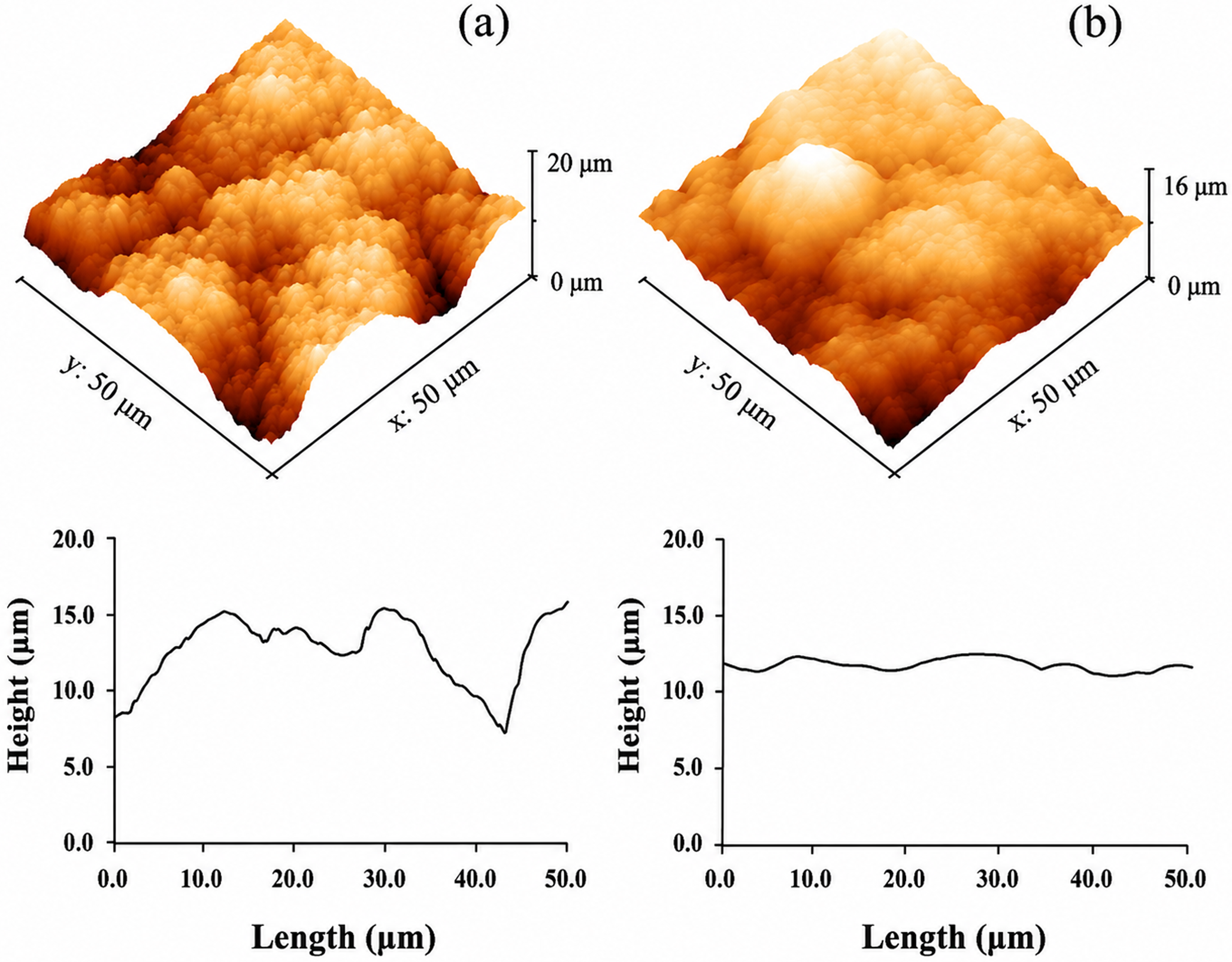
AFM three-dimensional color-mapped topographies and their corresponding cross-sectional line profiles were obtained by scanning representative 50 × 50 μm2 regions of the surface coatings for (a) SHS and (b) SLIPS samples.
From a functional perspective, the high roughness of SHS facilitates air trapping but introduces instability under external perturbations. In contrast, the smoother and lubricant-infused SLIPS surface minimizes contact line pinning and enhances interfacial stability. These observations are consistent with previous studies showing that lubricant infusion suppresses extreme roughness and stabilizes wetting behavior. 30
Wetting properties of the coatings
The wettability of SHS and SLIPS coatings was evaluated using water contact angle (WCA) and sliding angle (WSA) measurements (Figure 3). The SHS exhibits a high WCA of 160.6° ± 0.5° and a low WSA (<3°), indicating a stable Cassie–Baxter state with minimal solid–liquid contact. This behavior arises from the hierarchical surface roughness, which effectively traps air and reduces the contact fraction between the droplet and the solid surface. 31
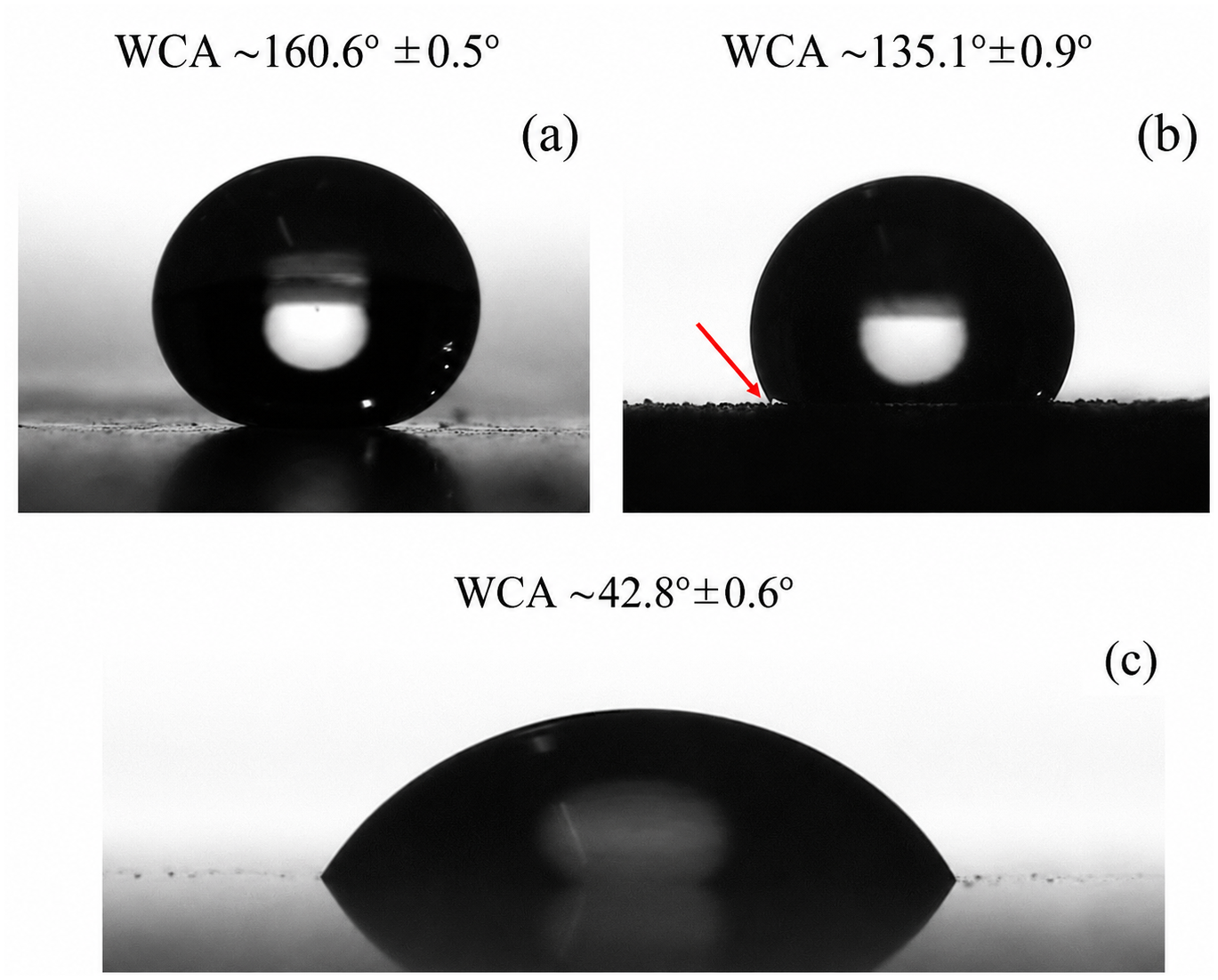
Static wetting behavior of (a) SHS, (b) SLIPS, and (c) bare glass surfaces. The thin lubricant layer, indicated by the red arrow in (b), forms an annular wetting ridge localized at the droplet base near the three-phase contact line. The wetting ridge remains confined to the contact region and does not extend over the droplet surface, confirming a non-cloaking state characteristic of stable lubricant-infused porous surfaces (SLIPS). For comparison, the bare glass substrate exhibits a hydrophilic WCA of 42.8° ± 0.6°, indicative of complete wetting behavior.
In contrast, the SLIPS surface exhibits a lower WCA of 135.1° ± 0.9° but maintains a low WSA of 6.1 ± 0.4°, indicating enhanced droplet mobility. The reduced apparent contact angle is attributed to the replacement of the solid–air interface with a lubricant–liquid interface. Despite the lower WCA, the presence of the lubricant layer minimizes contact-line pinning, allowing droplets to slide easily.
Although an annular wetting ridge was observed at the droplet perimeter, no evidence of complete lubricant cloaking was detected, as no spreading lubricant film covered the droplet surface. The wetting ridge remained localized near the three-phase contact line and did not extend over the droplet, confirming a true non-cloaking state. This behavior indicates that the interfacial energy balance does not favor spontaneous lubricant spreading over the water droplet. 32 The observed wetting ridge nevertheless confirms stable lubricant confinement within the hierarchical surface texture, where the multiscale silica architecture acts as a capillary reservoir for the infused PFPE lubricant. Such behavior is consistent with previously reported capillary-retention mechanisms that suppress lubricant depletion and enhance interfacial stability in lubricant-infused surfaces. 33
For smooth lubricant-infused surfaces, the apparent contact angle (θY) can be described using Young's equation based on interfacial tensions.34,35


Durability tests
Hydrostatic pressure resistance
The pressure-dependent wetting behavior of SHS and SLIPS coatings was evaluated, as shown in Figure 4. At ambient conditions of 0 bar, SHS exhibits a high WCA of approximately 160° and a low WSA below 10°, confirming a stable Cassie–Baxter state. As the applied pressure increases to 1.0 bar, the WCA decreases slightly from approximately 160° to 150°, indicating that the trapped air pockets remain partially intact.
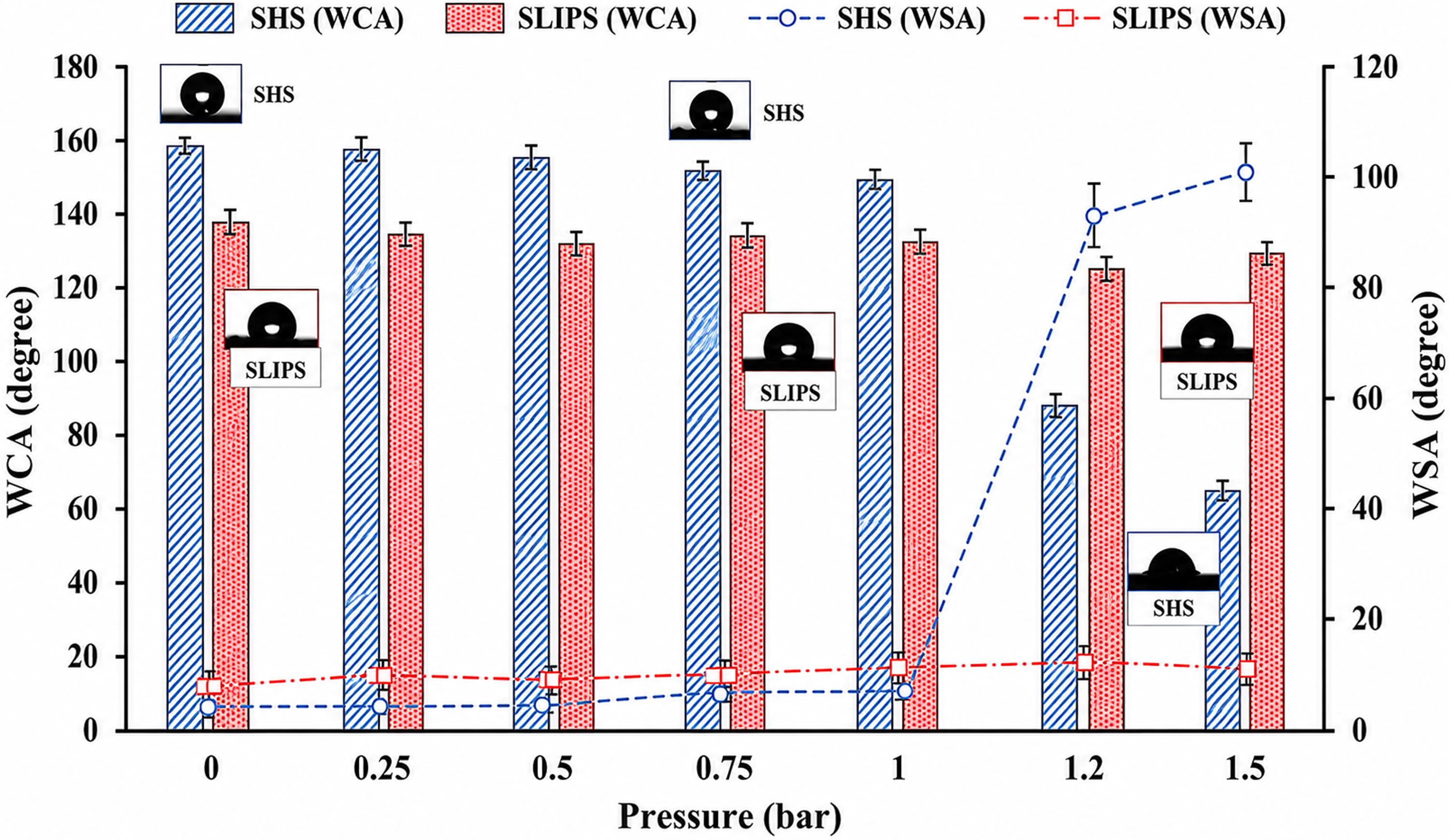
Variations in the wetting characteristics of SHS and SLIPS surfaces are presented as a function of the applied static pressure after 20 minutes exposure, showing the evolution of the WCA and the WSA.
However, beyond a critical pressure of approximately 1.2 bar, a sharp transition occurs, where the WCA decreases to about 90° at 1.2 bar and further drops to about 65° at 1.5 bar, accompanied by a significant increase in WSA to values exceeding 90°. This abrupt change indicates a Cassie–Wenzel transition, where hydrostatic pressure destabilizes the air layer and drives liquid infiltration into surface asperities. 37 Once the Wenzel state is established, the system becomes energetically unfavorable to revert, resulting in irreversible wetting degradation.
In contrast, SLIPS exhibits markedly enhanced pressure stability. The WCA remains nearly constant at approximately 135° ± 2° across the entire pressure range from 0 to 1.5 bar, while the WSA remains low at approximately 10–15°, indicating suppressed pinning and stable droplet mobility. This behavior arises from the lubricant-mediated interface, which replaces compressible air pockets with an incompressible liquid phase confined within the hierarchical structure.
From a mechanistic perspective, the stability of SHS is governed by the Laplace pressure of trapped air, which can be exceeded under external loading, leading to collapse. In contrast, SLIPS maintains interfacial integrity through capillary-confined lubricant, which redistributes under pressure and forms a continuous liquid–liquid interface. The multiscale roughness further enhances this effect by acting as a capillary reservoir, preventing lubricant depletion and sustaining functionality under elevated pressure. 38
Sustained pressure durability
The time-dependent stability of SHS and SLIPS coatings under sustained hydrostatic pressure was evaluated at a constant pressure of 1.0 bar, as shown in Figure 5. The evolution of WCA and WSA over time provides insight into progressive wetting failure.
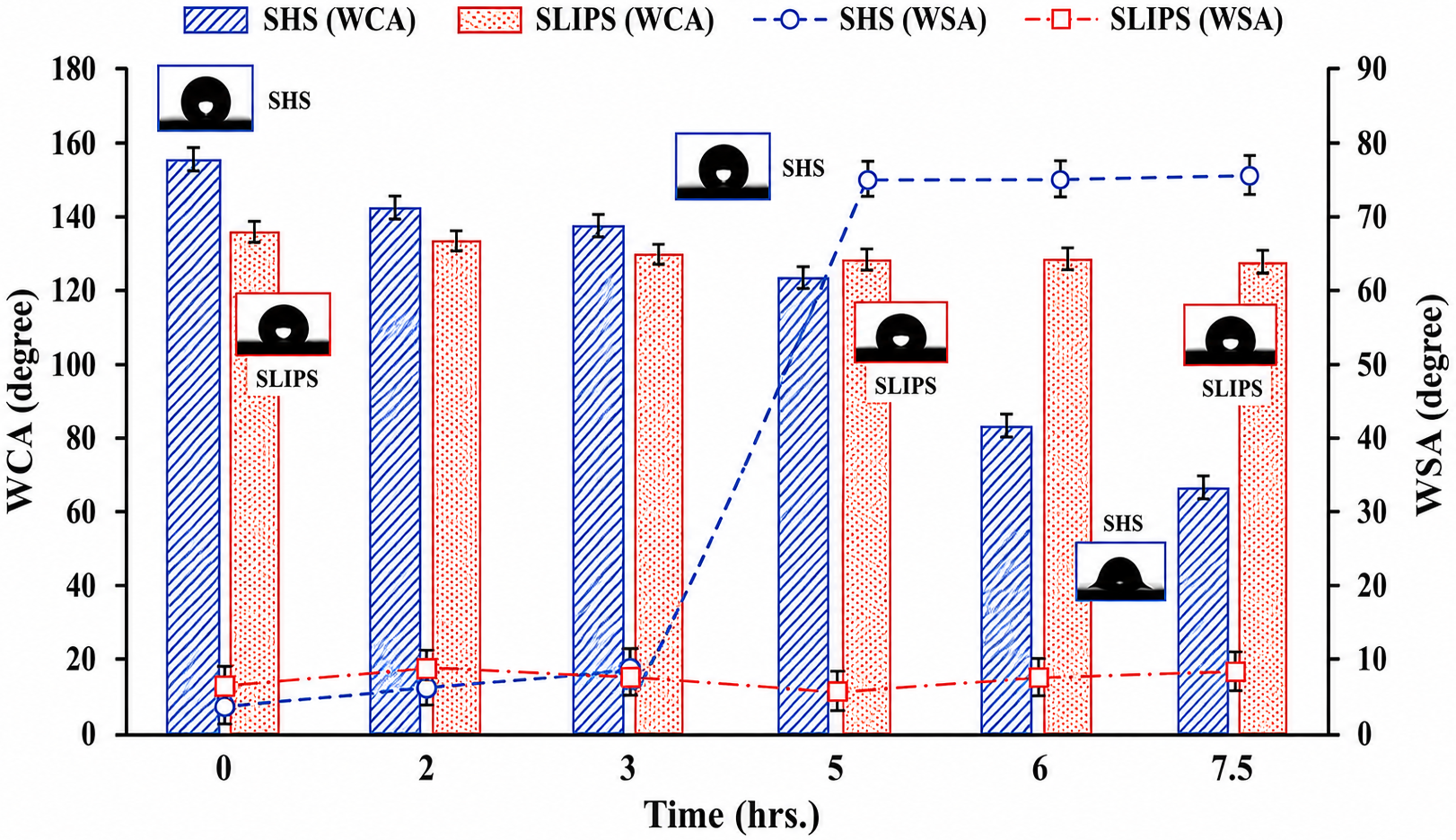
Evolution of wetting parameters of SHS and SLIPS surfaces under stable static pressure of 1.0 bar, illustrating changes in WCA and WSA.
At the initial stage of 0 h, the SHS exhibits a high WCA of approximately 155° and a low WSA below 10°, indicating a stable Cassie–Baxter state. However, as exposure time increases, gradual degradation is observed. After 5 h, the WCA decreases to approximately 125°, accompanied by an increase in WSA to about 75–80°, indicating the onset of partial liquid infiltration. With further exposure, the WCA decreases to approximately 85° at 6 h and further to about 65° at 7.5 h, while the WSA remains above 80°, confirming a progressive and irreversible transition toward the Wenzel state.
This behavior indicates that even under subcritical pressure, prolonged exposure can destabilize the air layer. The trapped air pockets are gradually displaced over time, leading to continuous liquid infiltration into the porous structure and irreversible loss of water repellency. This highlights a key limitation of SHS, where stability is governed not only by pressure magnitude but also by exposure duration.
In contrast, SLIPS exhibits significantly enhanced stability under sustained pressure. The WCA remains relatively constant at approximately 130–135° throughout the entire testing duration from 0 to 7.5 h, with only minor fluctuations. More importantly, the WSA remains consistently low at approximately 10–15°, indicating minimal contact line pinning and sustained droplet mobility.
This time-independent stability arises from the lubricant-mediated interface. Unlike trapped air, the infused lubricant is incompressible and remains confined within the surface micro/nanostructures through capillary forces and interfacial affinity. The lubricant dynamically redistributes under pressure, maintaining a continuous liquid–liquid interface and preventing direct solid–liquid contact.
Furthermore, the hierarchical structure acts as a capillary reservoir that enhances lubricant retention and delays depletion. This self-adaptive behavior enables SLIPS to resist gradual liquid infiltration and maintain interfacial integrity over extended periods. 39
From a mechanistic perspective, the key difference lies in the temporal evolution of interfacial stability. In SHS, the air cushion progressively diminishes under sustained pressure, leading to time-dependent failure. In contrast, SLIPS maintains a stable and adaptive interface due to lubricant confinement and redistribution.
Thermal durability under elevated temperature
The long-term durability of SHS and SLIPS under elevated temperature was evaluated at 65 °C over 155 days, as shown in Figure 6. Both surfaces exhibited stable wetting behavior throughout the entire testing period, with no significant deterioration observed.
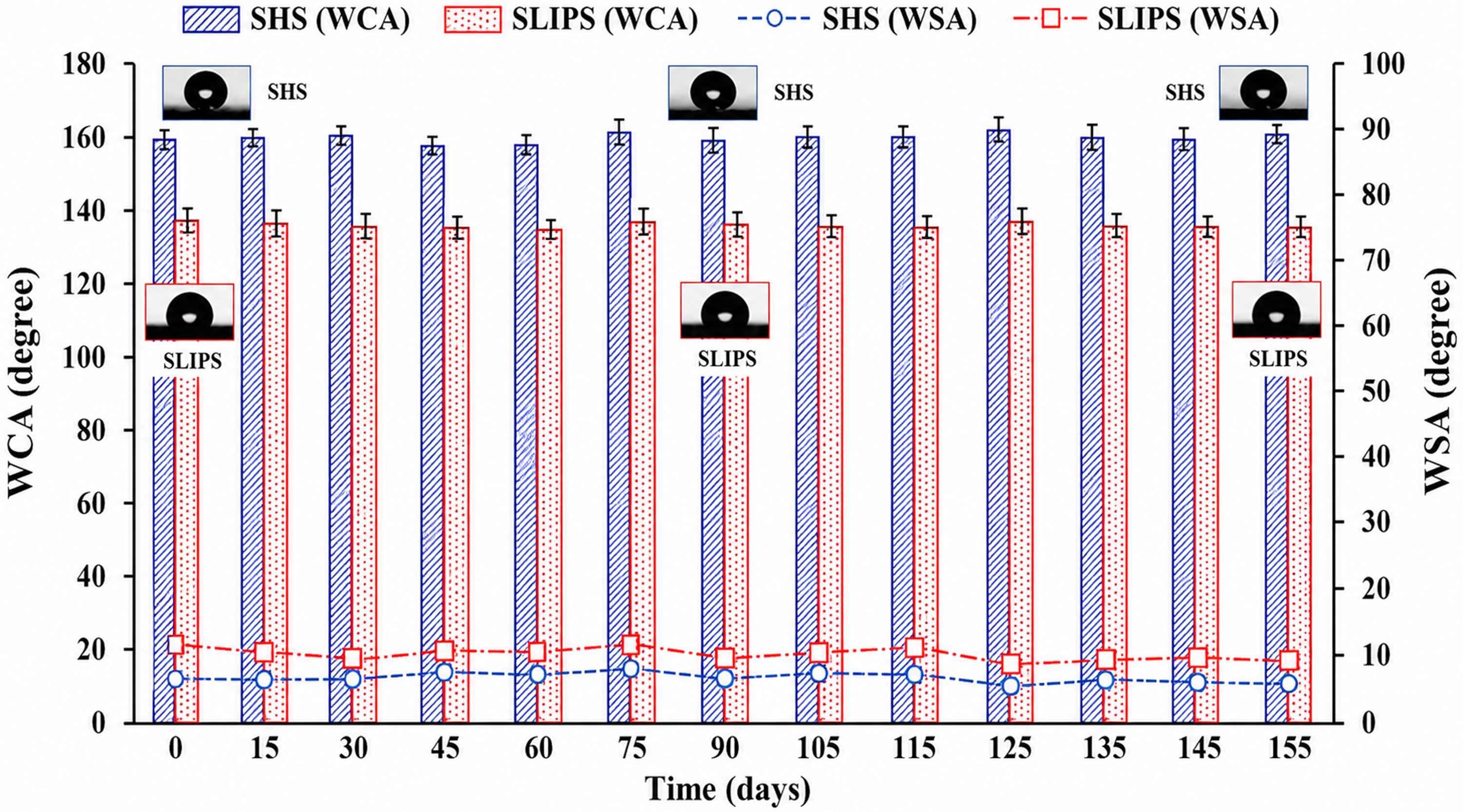
The temporal evolution of the wetting behavior of SHS and SLIPS surfaces during 155 days of exposure at an elevated temperature of 65 °C is presented through plots of the WCA and WSA.
The SHS maintained a consistently high WCA in the range of approximately 158–162°, while the WSA remained low at about 5–10°, indicating the preservation of a stable Cassie–Baxter state even after prolonged thermal exposure. No evidence of structural collapse or transition to a Wenzel state was observed.
Similarly, the SLIPS demonstrated excellent thermal stability, with WCA remaining nearly constant at approximately 133–138° and WSA consistently below 10°. The sustained low sliding angles indicate that the lubricant layer remained intact and effective in maintaining droplet mobility over extended durations.
The thermal stability of both systems can be attributed to their structural and material characteristics. In SHS, the hierarchical roughness and low-surface-energy coating remain sufficiently robust to resist thermal degradation at moderate temperatures. In SLIPS, the high viscosity and ultra-low vapor pressure of PFPE lubricants suppress evaporation and enable long-term lubricant retention, thereby preventing depletion—a commonly reported failure mechanism in lubricant-infused systems. Although no direct viscosity measurements were performed in this study, PFPE lubricants have been widely reported to exhibit low volatility and relatively stable rheological behavior within this temperature range, 40 which is consistent with the sustained wetting performance observed throughout the 155-day exposure period.
Water-jet impact durability
The resistance of SHS and SLIPS coatings to dynamic shear and impact forces was evaluated using a water jet erosion test, as shown in Figure 7. The variation of WCA and WSA with increasing jet velocity provides insight into interfacial stability under hydrodynamic impact.
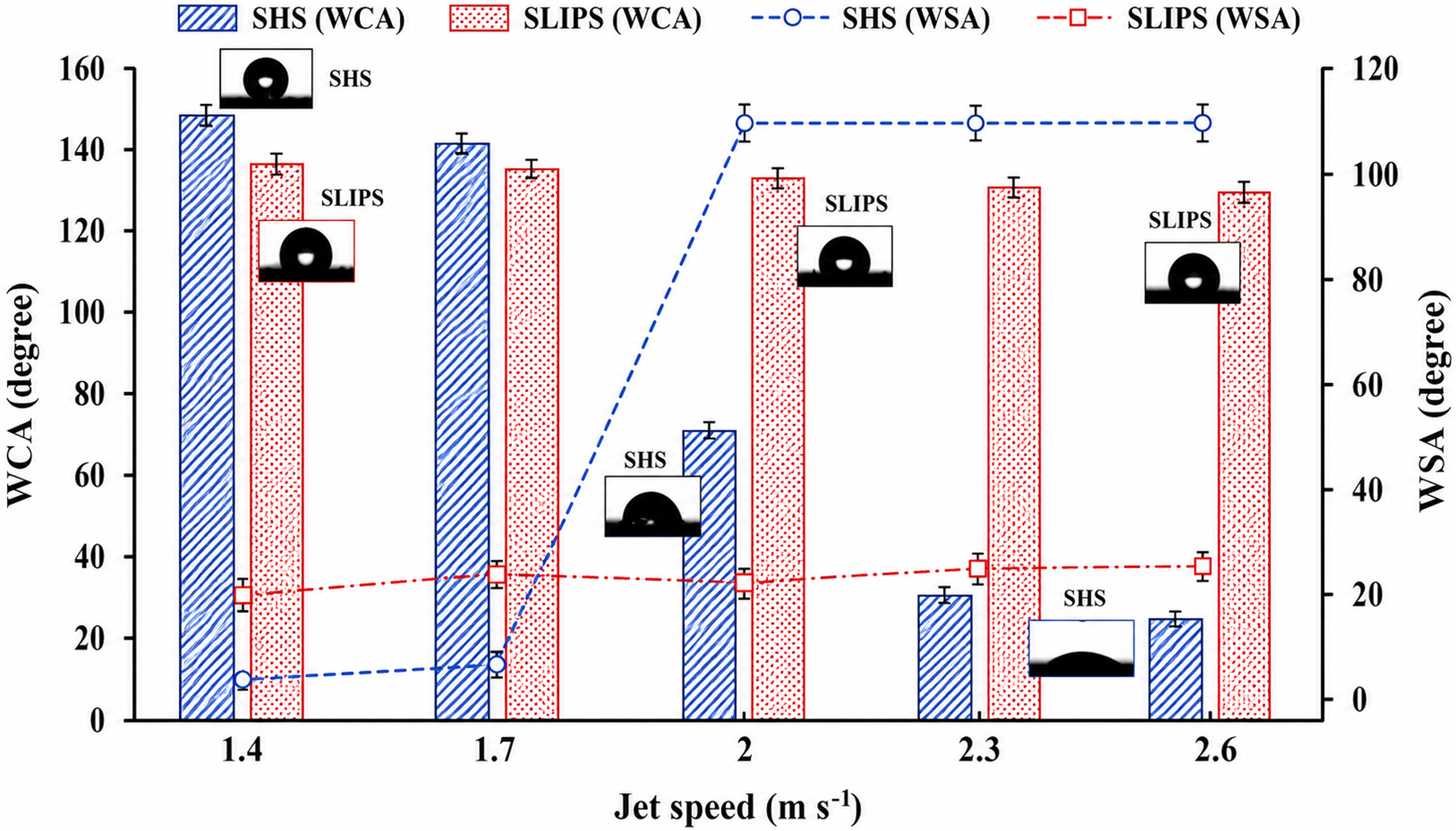
The evolution of SHS and SLIPS wetting characteristics is illustrated through variations in the WCA and WSA after 15 minutes of exposure to water jets at different impact velocities (1.4–2.6 m s−1), corresponding to dynamic pressures in the range of approximately 0.01–0.05 bar.
At low jet velocities of 1.4–1.7 m s−1, SHS maintains a high WCA of approximately 145–150° and a low WSA below 10°, indicating preservation of the Cassie–Baxter state. However, a critical transition occurs at a velocity of approximately 2.0 m s−1, where the WCA decreases sharply to about 70° and the WSA increases to approximately 100°, indicating severe wetting degradation. At higher velocities of 2.3–2.6 m s−1, the SHS completely loses its water-repellent behavior, with WCA decreasing further to about 30° and WSA remaining above 100°, confirming a full transition to the Wenzel state.
This rapid deterioration is governed by the increase in dynamic pressure, which scales with the square of jet velocity, as described in Equation (3). As the impact pressure exceeds the capillary pressure sustaining the air pockets, the trapped air collapses, leading to liquid penetration into the porous structure. Repeated jet impingement further induces cumulative mechanical damage, including erosion of surface asperities and reduction of hierarchical roughness, accelerating wetting failure. Such velocity-dependent erosion and fatigue behavior are well documented in droplet impact systems. 41
In contrast, the SLIPS surface exhibits significantly enhanced resistance to water jet impact. Across the entire velocity range of 1.4–2.6 m s−1, the WCA remains relatively stable at approximately 130–135°, while the WSA remains low at approximately 30–40°, indicating preserved droplet mobility and minimal pinning. No abrupt wetting transition is observed, even at the highest tested velocity.
The superior performance of SLIPS can be attributed to the lubricant-infused interface, which fundamentally alters the interaction between the impacting jet and the surface. The lubricant layer acts as a viscous, self-adaptive buffer that dissipates impact energy and prevents direct solid–liquid contact. Additionally, the interconnected multiscale porous structure functions as a capillary reservoir, enabling continuous lubricant replenishment through capillary-driven redistribution. This mechanism suppresses both liquid penetration and mechanical erosion, thereby maintaining surface functionality under high shear conditions. The observed durability is further supported by previous studies demonstrating the effectiveness of capillary-confined lubricants in resisting external mechanical stresses. For example, lubricant-infused nanowire architectures have been shown to maintain lubricant retention under substantial mechanical stresses through capillary-driven confinement mechanisms. 33 In the present work, the durability assessment was extended to continuous hydrodynamic erosion conditions. Notably, the multiscale SLIPS maintained stable wetting performance under continuous high-speed water-jet impact, corresponding to a cumulative impact energy equivalent to approximately three years of rainfall exposure. This result provides further evidence that capillary-confined lubricant layers can effectively withstand dynamic environmental stresses without undergoing catastrophic wetting transitions.
To quantify the severity of the applied conditions, the cumulative impact energy was estimated using a rainfall equivalence model:

Overall, the combined results from morphological, wetting, and durability analyses consistently demonstrate that the transition from SHS to SLIPS leads to a fundamental change in interfacial behavior. While SHS relies on air entrapment within hierarchical structures to achieve high initial hydrophobicity, its performance is highly sensitive to pressure, time, and dynamic impact due to the instability of the air layer. In contrast, SLIPS exhibits enhanced stability across all tested conditions, owing to the formation of a lubricant-mediated interface that reduces pinning, suppresses wetting transitions, and maintains droplet mobility. The multiscale porous architecture plays a dual role by providing surface roughness and acting as a capillary reservoir that stabilizes lubricant retention under external perturbations. These findings highlight that the improved performance of SLIPS originates from the synergistic interaction between structural design and lubricant confinement, which together enable resistance to multiphysical environmental stresses.42–44
Although the PFPE-infused multiscale SLIPS demonstrates exceptional durability under multiphysical stresses, the reliance on fluorinated compounds—specifically the fluoroalkylsilane (FDTS) and the PFPE lubricant—raises important environmental and health considerations. Fluorinated chemicals, belonging to the class of per- and polyfluoroalkyl substances (PFAS), are highly persistent “forever chemicals” with known risks of environmental accumulation and potential toxicity.45,46 Furthermore, the end-of-life disposal of such materials remains a critical challenge, as landfilling can lead to PFAS-containing leachates, while thermal destruction often requires stringent treatment conditions to minimize the formation of hazardous byproducts. 47 These concerns are particularly relevant for applications involving direct human contact, such as biomedical and food-processing systems. Therefore, to align with sustainable development goals, future research should focus on environmentally benign fluorine-free SLIPS. The development of biocompatible or biodegradable lubricants and surface modifiers represents a promising pathway toward the sustainable deployment of durable liquid-repellent coatings. 48
Conclusions
This study demonstrates the transition from air-supported SHS to SLIPS and systematically evaluates their stability under multiphysical environmental stresses. By integrating hierarchical silica roughness with PFPE lubricant infusion, a robust liquid-repellent interface was successfully established.
The results show that SHS exhibits superior initial repellency, with a water contact angle of approximately 160°, but suffers from instability under hydrostatic pressure and dynamic shear due to the fragile nature of the trapped air layer. In contrast, SLIPS maintains stable wetting performance, with water contact angles in the range of 130–135° and consistently low sliding angles across all tested conditions, highlighting the intrinsic advantage of lubricant-mediated interfaces.
Importantly, both SHS and SLIPS demonstrate excellent thermal stability at 65 °C over 155 days, indicating that thermal degradation is not the dominant failure mechanism. Instead, hydrostatic pressure and dynamic shear are identified as the critical factors governing wetting failure. Under these conditions, SHS undergoes irreversible Cassie–Wenzel transitions, whereas SLIPS preserves interfacial integrity due to the presence of a confined lubricant layer.
Mechanistically, the superior durability of SLIPS arises from the replacement of the air-mediated interface with a liquid–liquid interface that is inherently more stable under external perturbations. The interconnected multiscale porous structure acts as a capillary reservoir, enabling lubricant retention and continuous redistribution under stress. This self-adaptive behavior suppresses lubricant depletion and mitigates failure mechanisms such as evaporation and shear-induced loss, which are widely reported limitations in SLIPS systems. The findings demonstrate that capillary-confined lubricant interfaces offer a more robust pathway than air-mediated interfaces for developing durable liquid-repellent coatings under realistic environmental conditions.
Under dynamic impact conditions, SLIPS exhibits strong resistance to erosion and maintains functionality even under conditions equivalent to long-term environmental exposure. This performance is attributed to the lubricant layer, which acts as an energy-dissipating barrier that reduces direct solid–liquid contact and minimizes pinning.
Overall, this work establishes a clear design paradigm for durable liquid-repellent surfaces based on the transition from air-supported to lubricant-confined interfaces, combined with multiscale structural engineering and low-volatility lubricants. These findings provide practical guidelines for the development of robust coatings for anti-fouling, anti-icing, self-cleaning, and other applications requiring long-term performance under challenging environmental conditions.
Footnotes
Acknowledgements
This research was funded by the Fundamental Fund (Project Code: 210306) of the Thailand Science Research and Innovation (TSRI), Ministry of Higher Education, Science, Research and Innovation (MHESI), Thailand, allocated to the Department of Technology and Digital Science, Department of Research and Development of Halal Food Product, Faculty of Science and Technology, Fatoni University. The authors gratefully acknowledge the financial support.

Author contribution(s)
Funding
The authors disclosed receipt of the following financial support for the research, authorship, and/or publication of this article: This work was supported by the Fundamental Fund (FF), Thailand, (grant number 210306).
Declaration of conflicting interests
The authors declared no potential conflicts of interest with respect to the research, authorship, and/or publication of this article.