Abstract
Combining citations and network analysis, this study examines information flows between 10 European elite newspapers from 2000 to 2009 and identifies this network’s most central actors, sub-groups and structural features. At the same time, the article contributes to the literature with an alternative and network approach to the study of the European public sphere. Results indicate that The Times and The Guardian are the most quoted by other foreign newspapers, while the top monitors of information are The Guardian and El País. A longitudinal analysis of structural network metrics indicates a less dense but more inclusive information exchange that can be interpreted as sign of a qualitative transformation of the European communication space in the direction of a horizontal integration.
Keywords
Introduction: Transnational information flows in Europe
The study of information flows between media sources from different countries explores the dynamics underlying transnational communication spaces. There is no prevalent and accredited methodology for gathering data about transnational information flows, but there is a rather consolidated research literature that focuses on the interaction among European mass media within the context of study of a European public sphere (EPS). For example, Castells (1997) sees the emergent Euro-state not only as a political-economic zone but, by virtue of privileging its network character (the so-called Euro-matrix), also as a specific kind of communicative space.
In the current literature, there are three main aspects of the EPS and each involves a different theoretical angle and methodological approach: the attention of national media to EU politics, the Europeanization of national media and the communicative exchange between national public spheres.
The first approach focuses on the attention of national media to EU politics and issues. Typically, studies in this mode are based on content analysis methods that measure EPS by frequency of words that refer to EU affairs as proxy indicators of salience in European mass media, usually newspapers or television reporting (Gehards, 2002). The most common result in this approach is that European news is dwarfed in comparison with national and regional issues (Machill et al., 2006). In terms of longitudinal trends, Meyer (2002) reports some increase in media attention towards European affairs during the 1990s with some important distinctions on the nature of media reporting. Interestingly, several studies seem to indicate that there is rather little variation in terms of national media attention on European issues. The dominant themes being discussed and reported in national media seem to vary little across the EU (Medrano and Gutierrez, 2001; Meyer, 2002; Sievert, 1998). The conclusion of this kind of research is that there is no EPS to speak of, in a meaningful sense, given the low salience of European issues in mass media, although the significance of the European dimension has increased slightly over the 1990s.
The second approach focuses on the Europeanization of national media (Koopmans, 2004; Risse, 2003; Trenz, 2004). Studies of this kind are less pessimistic about the EPS and concentrate on analysing media reporting on particular European issues, such as the debate over EU enlargement, the Lisbon Treaty, BSE, etc. (Koopmans and Erbe, 2004). On European issues, differences across Europe are not particularly large, demonstrating a similar level of attention, and more importantly several European themes are framed in rather similar ways across national media, leading to similar interpretative schemes and structures of meaning (Eder, 2000; Eder and Kantner, 2000; Van de Steeg, 2000).
The third approach – the most relevant for this study – focuses on the communicative exchange between public spheres. Important within this approach is the notion of ‘transnational public spheres’ as formulated by Fraser (2007) in terms of discursive arenas and communicative circuits that ‘overflow the bounds of nations and states’ (Fraser, 2007: 7). Other applications of this idea of transnational public spheres include the ‘Islamic public sphere’ or the ‘diasporic public spheres’. Fraser (2007) has argued that until recently notions of the public sphere have been conditioned by a Westphalian political imaginary; in other words, they are framed in terms of bounded communities with their own territorial state.
Approaches of this kind are not limited by the level of normativity of the definition of European public sphere they rely on. 1 As argued by Risse (2003: 7–8), the traditional approach to the EPS so far has been an essentialist position. Rather than entities awaiting discovery, public spheres and communities of communication emerge through social practices and interactions. Europe is not an exception, it is unjustified to assume that European integration and institutions automatically lead to the emergence of a transnational public sphere. Bruggemann and Kleinen-von Konigslow (2009: 29) have argued in favour of differentiating between ‘vertical’ and ‘horizontal’ Europeanization. Vertical Europeanization denotes a process of paying closer attention to Brussels, while horizontal Europeanization stands for communicative linkages between different member states.
Koopmans and Erbe (2004) argue that there are two distinct forms of horizontal integration: a ‘stronger form’ in which ‘actors from one country explicitly address, or refer to actors or policies in another member state’ (Koopmans and Erbe, 2004: 104); and a ‘weaker horizontal integration’, in which media cover debates in other member states. In order to investigate both forms of horizontal integration, the empirical focus is on communication flows and ‘the relative density of public communication within and between spaces’ (Koopmans and Erbe, 2004: 104). A horizontal process of Europeanization can be studied in several ways. One theoretical and empirical possibility is in the form of information flows in terms of inter-media observation and reference. Erbe (2005) distinguishes between four types of mechanism practised by the media: (1) formal cooperation between media outlets; (2) inter-media observation, invisible to their audience and not explicit; (3) inter-media reference as news sources, in this case visible and explicit to their audiences; and (4) press reviews, in which media sources and personalities are acknowledged as political actors in their own right and they quote each other’s opinions (see Le Bart, 2004; Scherer and Vesper, 2004). Erbe (2005) argues that all four types of linkages should be empirically studied so as to better understand the ways in which the media arena is interlinked.
This study presents a novel and complementary approach to the study of information flows across Europe, focusing on inter-media references as news sources and combining citation and network analyses. A network analysis of European newspapers based on citations is an empirical attempt to highlight interlinkages among European media and might contribute methodologically to the study of a ‘weak’ form of European horizontal integration. A similar attempt was carried out by Peters (2005) that focused on comparing the density of communication flows within and outside the EU boundaries, and which found that no significant difference was present. The aims of this study are, first, to map out the network of information flows among elite newspapers of several European countries and their longitudinal evolution; second, to contribute to the methodological debate on how to investigate a weaker form of horizontal integration in the European communicative space. In order to do so this study combines two methodologies – co-citations mapping and network analysis – in order to identify the most central newspapers and their roles in the information flows across five European countries (the UK, France, Spain, Germany and Italy).
Methodology
Studying information flows requires a multi-method approach, using two different methodologies, one for data gathering and organization, and one for data analysis. The first methodology has been widely applied in bibliometric studies to study ‘knowledge flows’. In this field of study, citations of patents and scientific articles are used as a means to identify knowledge flows across institutions and geographical areas such as regions or countries. Citations are considered as ‘ties’ and therefore as evidence of knowledge flows (Jaffe et al., 1993; Narin et al., 1997). Moreover, relational data obtained from citation analysis are used to measure the level of integration between actors, institutions or regions.
The other methodology implemented in this study is social network analysis. According to Wasserman and Faust (1994), social network analysis is based on the assumption of the importance of relationships among interacting units. A social network perspective encompasses theories, models and applications that are expressed in terms of relational concepts or processes. According to Scott (1992), social network analysis has emerged as a set of methods for the analysis of social structures, methods that are specifically geared towards an investigation of the relational aspects of these structures. One of the most important uses of network analysis is the identification of the ‘most central’ units in a network. Derived from social network analysis and also part of the inspiration for this study, is the tradition of hyperlink analysis. Hyperlink structures are likely to be designed, sustained, or modified by website creators to reflect their communicative choices and agendas (Jackson, 1997; Park, 2002; Pirolli and Card, 1999).
Combining the methodology of citations analysis and network analysis, this study analyses citations networks between elite newspapers across a 10-year period (2000–2009). Recent availability of electronic databases of newspapers articles allows fairly efficient co-citation queries and thus enables the building of citation matrices for newspapers. Data since 2000 were available for five countries – the UK, France, Spain, Germany and Italy – and for a total of 10 newspapers (counting weekday and Sunday sister editions together): The Guardian/The Observer, The Times/The Sunday Times, Le Monde, Le Figaro, El País, El Mundo, Sueddeutsche Zeitung, 2 Die Welt/Welt am Sonntag, La Repubblica and Corriere della Sera.
The underlying rationale is that citations are the basis for an indicator of attribution of attention by the citer to the cited because they are an outcome of a process of monitoring, selecting and reporting. In this sense, citations are the web links of traditional texts. In the limited space available in a newspaper, a citation is a conscious choice that implies attention and monitoring of its source. One might argue that building matrices of co-citations is a relatively crude measure because the qualitative nature of a citation remains unspecified. In other words, what is not considered is the context and with what judgement a newspaper cites another one. However, this is a trade-off between an issue- specific analysis but with limited scope and a ‘bird’s eye’ view of the information flows, and opting for a higher volume of ties among actors and a wider range of data in terms of newspapers, countries and years. Nevertheless, even though a citation is not qualified by a value judgement, it is still an outcome of a process of monitoring, selection and reporting that implies attention from the citer to the cited. An example is when a newspaper writes ‘At first sight, as Le Monde said, it looks rather like “a battle between two old men over an institution that is itself dissolving into ridicule” ’ (The Guardian, 26 November 2003). A network based on this activity is a valuable object of study in the context of European horizontal integration of mass media.
Hence, the research questions addressed in this study are: Which are the most central newspapers and what are their network roles? What can the longitudinal evolution of this network tell us about information exchange in Europe? More specifically, has the network’s density and clustering increased or decreased in recent years?
Data collection and corpus building
Using citations as relational data enabled a network representation of information flows among the selected European newspapers to be conducted for each observation period. In order to be considered valid, a citation had to appear in an article’s text. Press reviews were excluded; in other words, only citations within articles were counted. For every observation period, each newspaper’s database was accessed to obtain citations of all other newspapers. Subsequently, data were organized in several adjacency matrices of co-citations.
Data were obtained mainly from the Lexis-Nexis electronic database of International National Newspaper Articles. The search of the Lexis-Nexis database was carried out using search strings 3 in the form of Boolean operators, built in filters and manual checking of the accuracy of results. Furthermore, in the collection of citations, The Times and Sunday Times, The Guardian and The Observer, and Die Welt and Welt am Sonntag were linearly aggregated for homogeneity respectively. For the newspapers Repubblica, Corriere della Sera and Sueddeutsche Zeitung, data were obtained from newspapers’ own digital databases because of the lack of coverage in Lexis-Nexis for years prior to 2007. The selected elite newspapers were: The Guardian/The Observer, The Times/The Sunday Times, Le Monde, Le Figaro, El País, El Mundo, Sueddeutsche Zeitung, Die Welt/Welt am Sonntag, La Repubblica and Corriere della Sera. Three criteria were applied for selecting newspapers, with a particular emphasis on data availability and access that restrained this analysis to five countries and 10 newspapers: first, the availability and access of electronic databases of articles of the past 10 years; second, elite newspapers were selected since they are national newspapers of public record and with the highest circulation possible; and third, the study aimed to have for each country, two newspapers of different political orientation so as to test politically based transnational alliances.
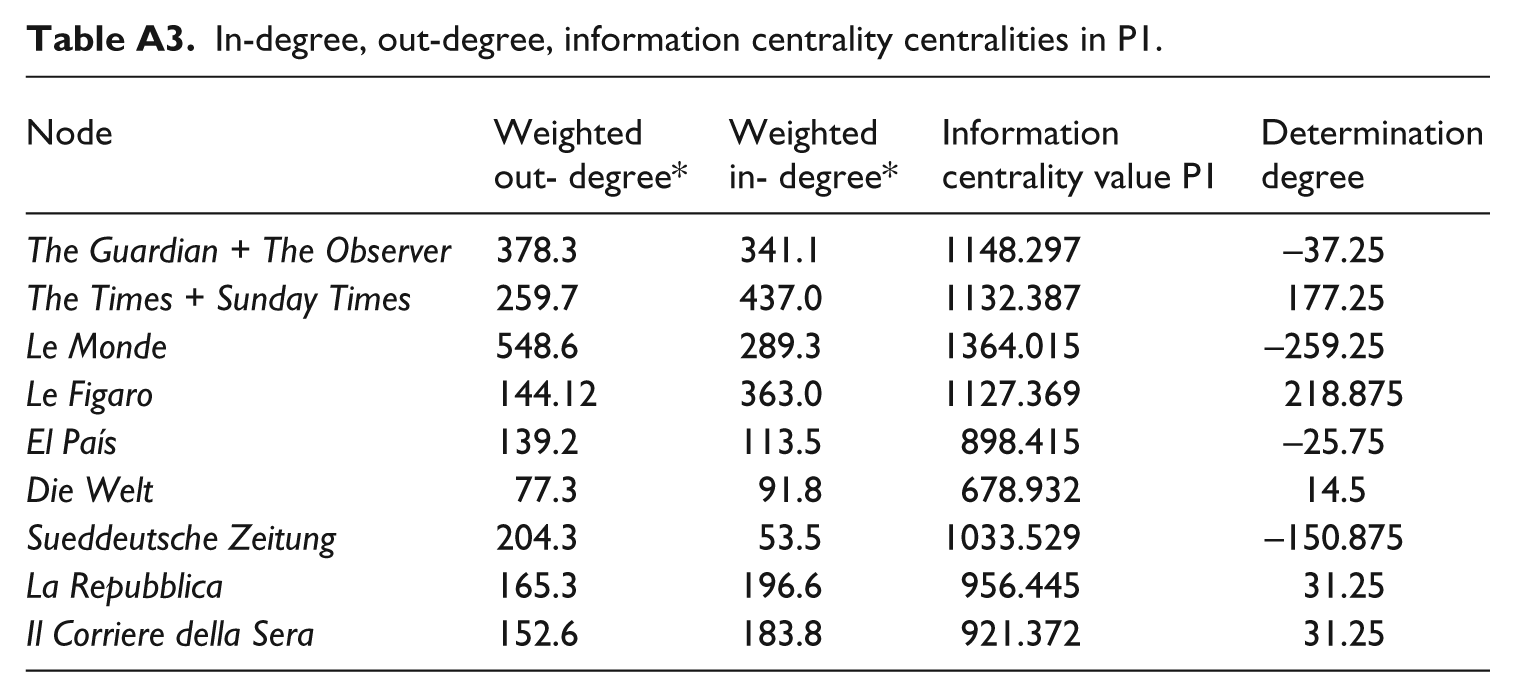
The time frame analysed ranges from January 2000 to January 2010 giving a total of 10 years. The corpus was organized into five observation periods, each containing all article citations for two years: P1 = 2000 and 2001; P2 = 2002 and 2003; P3 = 2004 and 2005; P4 = 2006 and 2007; P5 = 2008 and 2009. Data for El Mundo were not available for the years 2000–2001 (see Annex Table A3 for the network metrics of P1) and therefore the cumulative network was computed for P2 to P5 (2002–2009). The rationale behind having two years for each observation period was to have adjacency matrices dense enough to enable meaningful network metrics computations and at the same time to retain sufficient detail for a longitudinal analysis.
Matrix procedure
Adjacency matrices were constituted for each corpus using citation data obtained. Such a matrix represents a graph with n nodes as an n by n matrix, where the entry at (i, j) is 1 if there is an edge from node i to node j, or zero if there is not. Weights of ties in each matrix represent the citation occurrences. In addition, separate matrices were created through grouping newspapers by political orientation resulting in two matrices, a progressive and conservative one (progressive: The Guardian + The Observer, Le Monde, El País, Sueddeutsche Zeitung and La Repubblica; conservative: The Times + The Sunday Times, Le Figaro, El Mundo, Die Welt and Corriere della Sera). The final step was to transform all matrices in dataset formats for software packages Ucinet and Agna in order to compute network metrics.
Analysis
In this study, several network metrics are interpreted as indicators of different roles in the information networks. Thus, the ‘in-degree centrality’ 4 of a newspaper is considered a measure of its ‘importance’ or ‘prestige’ because a newspaper with a higher in-degree centrality develops many ties as many actors (other newspapers) seek direct ties to it. In the context of a citation matrix, to receive a tie means to be cited; hence in-degree centrality is interpreted as an indicator of importance as source of information. Conversely, out-degree centrality 5 stands for the number of ties (citations) that a newspaper establishes to other actors. Hence, out-degree centrality is an indicator of a newspaper’s information monitoring activity.
Once in- and out-degree centralities are available, it is possible to obtain a ‘determination degree’ measure. The determination degree 6 of an actor is the difference between its reception and its emission degrees relative to the number of all other actors in the network. Thus, the determination degree allows newspapers to be classified as producers and consumers of information. In addition to degree-based measures, this study includes ‘information centrality’, 7 which is a non-directional network metric. According to Stephenson and Zelen (1989) there is no reason to believe that communication between a pair of nodes takes place only on the shortest paths linking them (or geodesic path, where geodesics are defined to be locally the shortest path between points in the space). Hence, information centrality is an indicator of how information might flow through many different paths, weighted by strength of tie and distance. Computing information centrality for each actor reveals how much an actor has control over the flow of information within a network. Hence, a higher information centrality value means that an actor plays the role of information ‘gatekeeper’.
This study also analyses a number of structural network metrics, such as density, a centralization index, a factions analysis and lambda set partitions. These indicators reveal structural features of the obtained networks. The weighted density of a network is the sum of all edged values divided by the number of all possible edges in that network. That is, with valued data, density is defined as the average strength of ties across all possible ties and refers to the degree of connectedness of a network. A network centralization index is an indicator of the degree of inequality or concentration in the distribution of flow centrality among actors of a network. It indicates the shape of the information flow among actors. Factions analysis served the purpose of identifying sub-groups within the overall network using a bottom-up approach – in other words, without superimposing any pre-selected grouping. Following a decomposition approach, on the other hand, a lambda set partitions analysis identifies a ‘backbone network’, one that if removed would cause the collapse of the network.
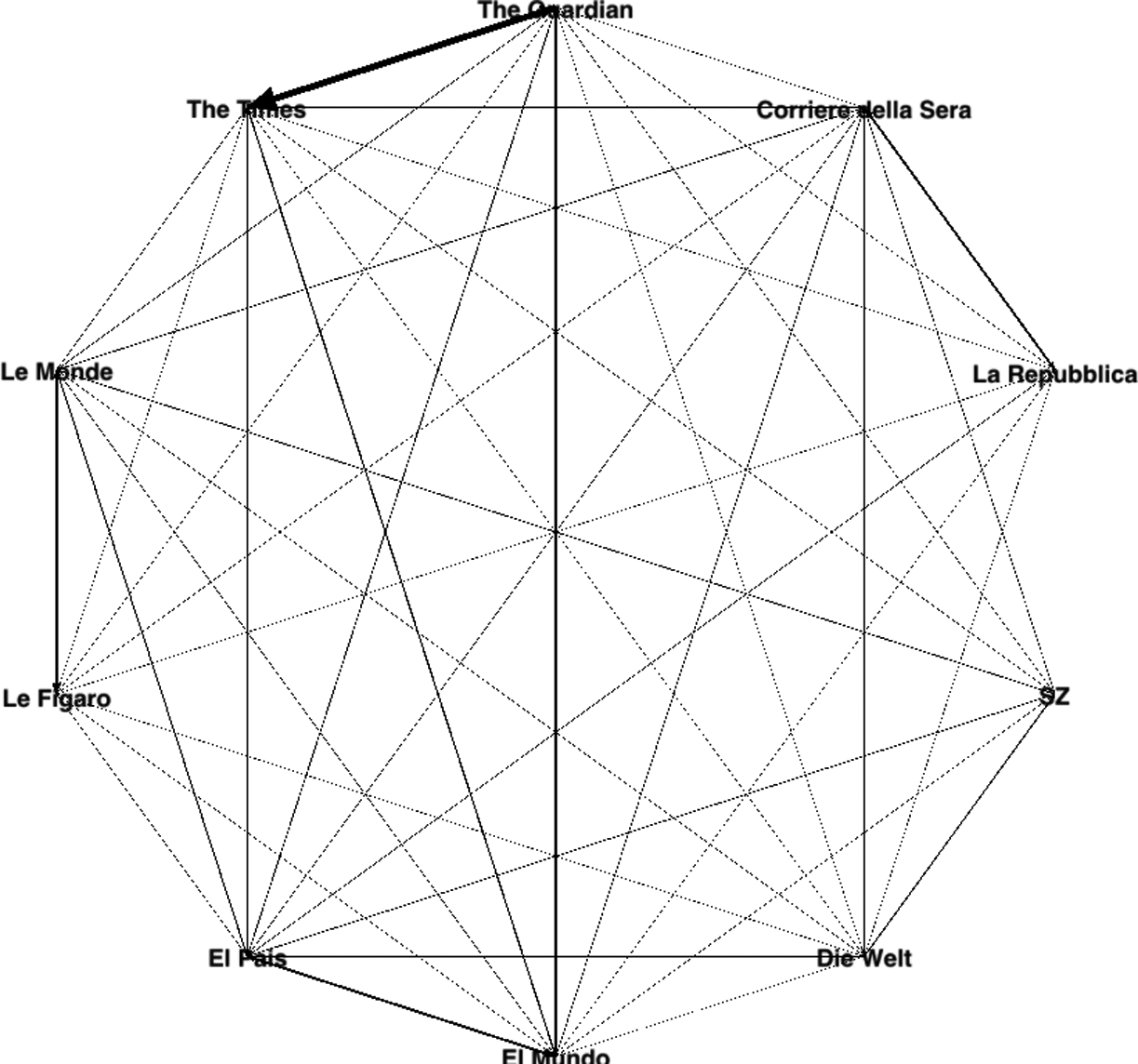
Visual representation of newspapers network, thickness of links stands for their weights.
Cumulative network
This section presents an analysis conducted on a ‘cumulative network’ constituted by a linear aggregation of adjacency matrices of each observation period (Table 1). As noted earlier, data for El Mundo were not available for the years 2000–2001 and therefore the cumulative network was computed for P2 to P5 (2002–2009) or eight years of data (Figure 1). The same actor level network metrics were computed both for each observation period and the cumulative network. Specific to this cumulative network were factions and lambda set partitions analyses.
Cumulative frequency of citations across newspapers.
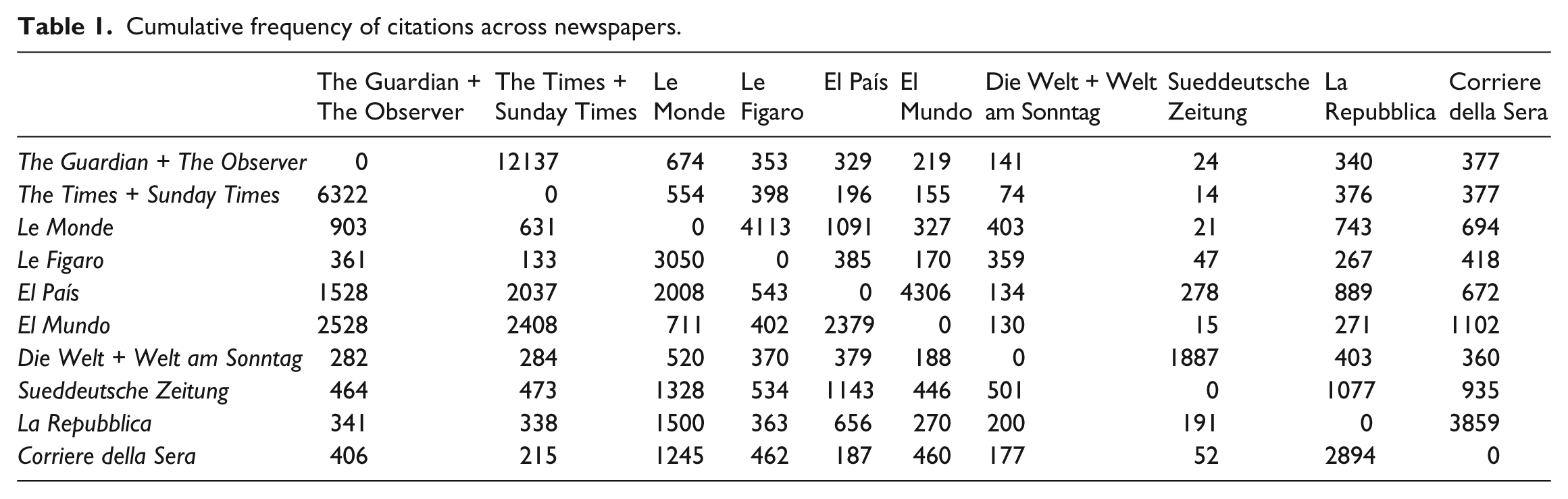
The density of the cumulative network is of 942.8 citations. That is the average strength of ties among newspapers. The network centralization index (or the degree of concentration in the distribution of flow between centralities among the actors) is fairly low (16.5%). The network centralization index indicates an inclusive network, not concentrated in only a few actors, in which the information exchange is evenly distributed among all actors.
Table 2 reports the most relevant network metrics values 8 for each newspaper, calculated from the cumulative adjacency matrix. The two most important newspapers (in-degree centrality) are the British newspapers The Times and The Guardian, with Le Monde following. The two top monitors of information (out-degree centrality) are The Guardian and El País.
Network metrics for the cumulative network: in-degree, out-degree, determination degree and information centrality.
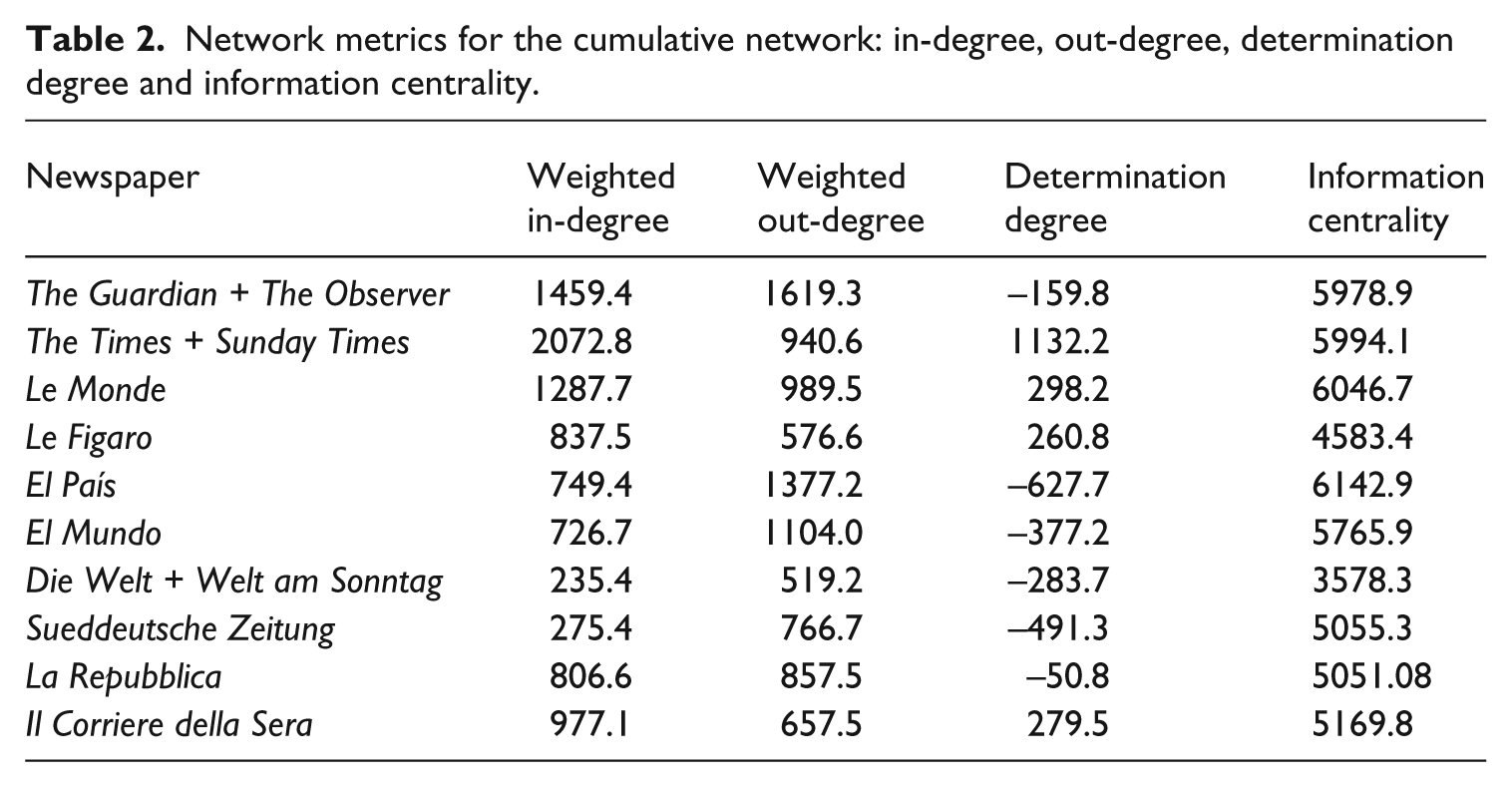
Considering the overall activity of each actor, measured by determination degree, the picture is different. Determination degree can have both positive and negative values. In the context of this study a positive value indicates dominance (being quoted) and a negative value, consumption (quoting). 9 The biggest producer of information is The Times, followed by Le Monde; both are highly cited but citation of other newspapers is below average. The top consumers are El País and Sueddeutsche Zeitung, which are actors that cite frequently but are not much cited by others.
Identifying actors with the highest information centrality values allows for the identification of the information gatekeepers, or those that have control over the flow of information within a network. Le Monde and El País are the newspapers with the highest overall values of information centrality and therefore they are regarded as the main information gatekeepers. Between being producers and consumers of information, their network positions allow them to reach and spread information across the network better than any other newspaper. There can be several determinants of this privileged position: successful strategic alliances with other newspapers, and complementarity with other news organizations, etc. The topic is interesting as a subject of a separate study but is outside the aims and scope of this article.
Sub-networks
In this section I analyse groups of newspapers within the cumulative matrix applying two approaches, one bottom-up and one top-down. First, a bottom-up strategy is adopted in two analyses, one that focuses on factions and another on lambda set partitions. The first technique recognizes factions emerging from the cumulative matrix. The second reveals the lambda set partitions. This considers whether there are certain connections in the network that, if removed, would result in a disconnected structure and therefore in the collapse of the network. Subsequently, using a top down approach, the cumulative co-citation matrix was divided into two matrices defined by the political orientation of each newspaper, grouping them as conservative or progressive.
Factions are groupings that have a high density of ties within a group and low between groups. The results identified two significant factions as the optimal solution (Annex Table A1). The identification of factions within the matrix led to the following group assignments: group 1, Le Monde, El Mundo, Sueddeutsche Zeitung, La Repubblica and Il Corriere della Sera; group 2, The Guardian, The Times, Le Figaro, El País and Die Welt. The results show two factions that are different compared to the groups that one would expect, if political affiliation was to be significant as a grouping variable. In other words, factions are established among newspapers according to factors other than similar political views.
Following a decomposition approach, a lambda set partitions analysis identifies sets of relationships that, if disconnected, would greatly disrupt the flow of information among all actors. Results indicate that the ‘backbone network’ within the overall network is constituted by the ties between The Guardian, The Times, El País, El Mundo and Le Monde (Annex Figure A3). Their network relationships are very dense and structurally important for the overall network, hence removing these nodes from the network would interrupt the overall flow of information. One explanation for this ‘backbone network’ of strong ties might be that these newspapers are complementary in terms of covering different language areas. The British newspapers are a reference in the Anglophone area, while El País pays much greater attention to Latin and South America. Le Monde has a long tradition of particular attention to Africa. The fact that the backbone network might capture the traditional newsgathering capability of newspapers and therefore the role of British, French and Spanish newspapers in different world areas accounts for the sheer volume of citations that the backbone newspapers have. However, it does not account for the network centralities and roles so far discussed. For example, both El País and the British Guardian are also active overall monitors of other European newspapers. In addition, relationships between newspapers’ emerging groups as shown in the faction analysis do not support the interpretation of results solely in terms of newsgathering capacities. Unless the citations are qualified by topic, it is impossible to have a complete picture of the reasons behind the citations patterns. Such refinement will be a challenge given the large number of articles. Further investigation is required on these newspapers and their market strategies so as to identify the reasons behind such strong ties.
From a different perspective, using top-down analysis, the cumulative adjacency matrix can be redesigned in two matrices, one including all the politically progressive newspapers and another with the conservative ones (Annex Table A2). Thus, the two networks obtained are datasets for further analysis. Considering the overall activity of progressive newspapers, in other words their determination degree, Le Monde and The Guardian are the most prominent actors as producers of information, while El País and Sueddeutsche Zeitung are the top passive actors. Le Monde and El País have the highest values in terms of information centrality, which means they have an important role as ‘gatekeepers’ over the flow of information within a network. The weighted density (d = 774.4) of the progressive network is higher compared to the conservative network (d = 432.1), meaning that the former is more connected and ties are stronger than in the latter. In the conservative network, the most important newspaper is The Times, while the biggest consumer of information is the Spanish El Mundo. The same two newspapers also have the top values of information centrality, and hence they are at the centre of information flows, although with different roles.
In conclusion, a bottom-up approach to identifying sub-groups in the network reveals two factions that are not organized according to political orientation. However, taking into consideration the progressive–conservative grouping, the progressive network is more cohesive than the conservative one, thus indicating a higher tendency to monitor and cite each other. The Guardian, The Times, El País, constitute the most important sub-network and with El Mundo and Le Monde, they are at the core of the information flow of the overall network.
Longitudinal analysis
The next step was to analyse adjacency matrices for each observation period. The same network metrics computed for the overall matrix were applied to define actor level and structural properties of each network. Hence, this section presents the results of a longitudinal analysis of in-degree 10 centrality, out-degree centrality, 11 determination degree, information centrality and network density.
Observation period P1 (2000–2001) was analysed first. The Times had the highest value of in-degree centrality followed by Le Figaro and The Guardian. These are the newspapers that were cited most frequently by other newspapers and therefore are the most important and largest producers of information. Le Monde had the highest out-degree followed by The Guardian and The Times and therefore they are the top monitors of information (Annex Figure A1). Considering the overall communication activity of each actor and using their determination degree as an indicator, the top producer of information was The Times followed by Le Figaro, while the top consumer was Le Monde followed by Sueddeutsche Zeitung. P1’s network is considered separately from the other observation periods’ networks because data were not available for El Mundo, and therefore this network is structurally different (one less node and relative links) and not longitudinally comparable with the other obtained networks. The remaining observation periods are comparable because datasets are complete for all newspapers.
The data indicate a remarkable stability for the top newspapers in terms of importance. Across all remaining observation periods, The Times is the most important newspaper followed by The Guardian and Le Monde. Data on out-degree values between 2002 and 2009 (P2–P5) show that in later years (P4 and P5) The Guardian was the top monitor of information with the highest out-degree values, while in P2 (2002–2003) Le Monde played this role (Annex Figure A2). In the period in between (P3–P4, 2004–2007), El País was also a top monitor of information. Out-degree centrality changed more than in-degree, across time. There is a prolonged decrease for Le Monde from 2002 (P2) to 2009 (P5) in terms of importance as a monitor of information. From 2002 to 2007, El País constantly became a more significant monitor of information, dropping slightly in the last period. Conversely, in the last two periods, The Guardian and The Times increased their role as monitors. Again, there could be many reasons for such variance. For example, a decreased monitoring activity of a newspaper might be due to a larger focus on national news. This could be the case for Le Monde and Le Figaro, considering that in those years France witnessed a large number of important national events, including the presidential elections of 2007.

Parallel plots of longitudinal trends of determination degree values across observation periods and newspapers.
Having obtained in-degree and out-degree values, the next step was to compute the determination degree of each actor to determine dominant and passive actors. Figure 2 reports longitudinal results for all 10 newspapers. Overall, The Times and Le Monde are highly dominant newspapers, although both had a slight decrease in the last period observed. El País and Le Figaro show an upward trend in recent years, while between 2002 and 2009 all other newspapers are remarkably stable.
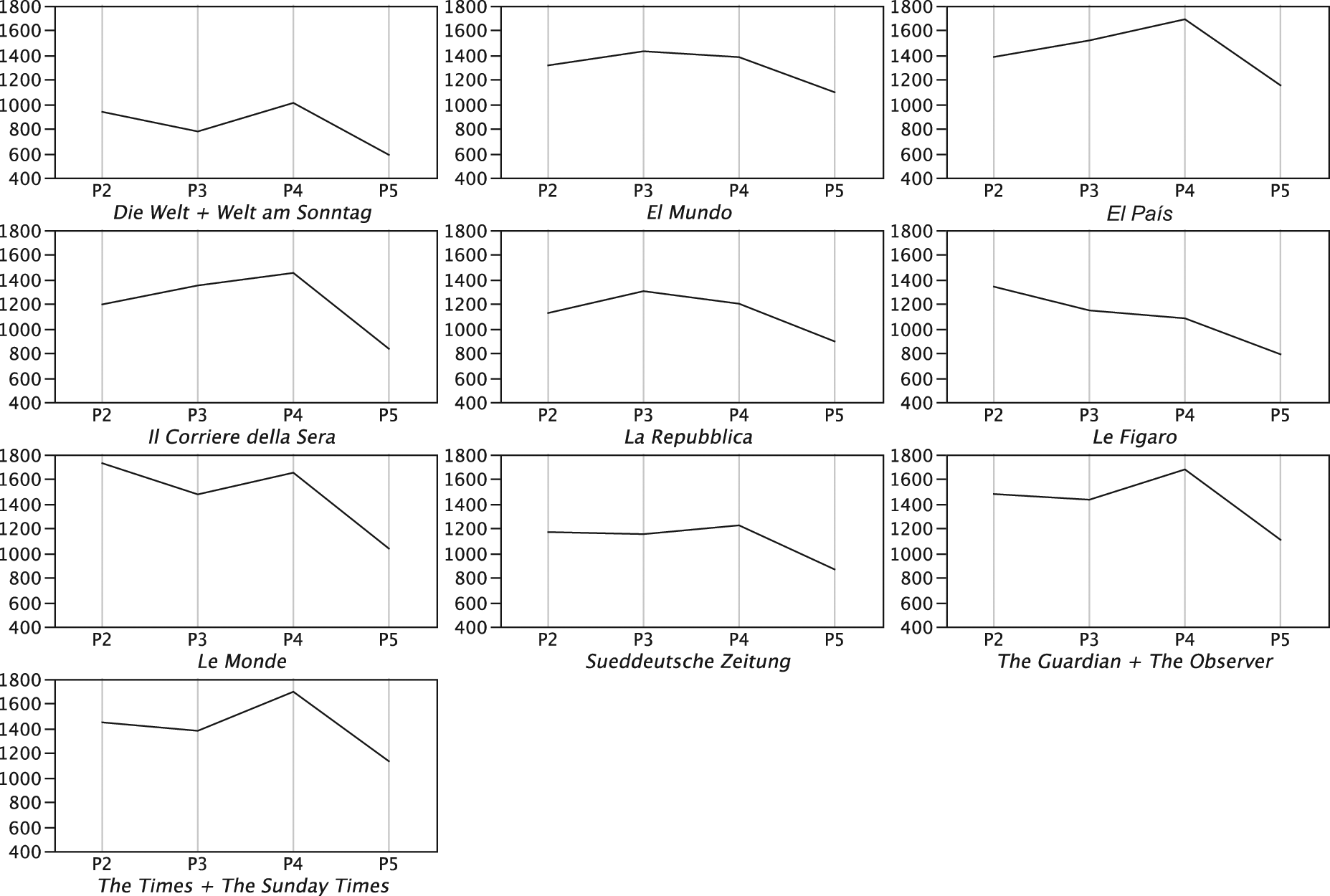
Parallel plots of longitudinal trends of information centrality across observation periods and newspapers.
Finally, information centrality was computed to have a not degree-based centrality measure and a non-directional network metric. In this case, an actor with a high information centrality is at the centre of information flow regardless of its direction (citing or being cited). In the case of P1, not directly comparable to all other observation periods, Le Monde, followed by The Guardian and The Times, had the highest level of information centrality. Figure 3 reports longitudinal trends of information centrality values across remaining observation periods, starting from P2 to P5. The general trend across each newspaper is of a diminished information centrality in the last period, P5. The interpretation of this finding is that in later years the information flow is less clustered and this explains an overall decline in information centrality. This is evidence of a more even and widespread information exchange among European newspapers. An interpretation that is confirmed by another network metric: the network centralization index, discussed in the next section.
Structural features
Using valued data, network density is defined as the average strength of ties across all possible ties and is considered as the degree of connectedness of the newspapers’ network of citations. Thus, it assumes the meaning of the degree of information exchange in the overall network. A higher or lower level of network density can be interpreted as a measure of more or less horizontal integration across European newspapers.
Network density was in P2, 242.5; P3, 227.3; P4, 248.5; and in P5, 224.4. The weighted density for the observed P1 was 229.9, but it is not comparable with the other periods, as mentioned previously. Differences across observation periods were statistically significant. 12 Clearly the data available cover the years 2000–2009 but comparable data before this time frame are not available. Comparing observation periods on their weighted densities: the results indicate a lower density in the last observation period. The implication of this decrease in density of ties is less information exchange among the selected European newspapers. A constant increase of density would be evidence of an increasing intra-European information flow supporting the idea of a horizontal integration across European media. Density did not increase but the network centralization indicator is more supportive of a process of European horizontal integration. The network centralization is lower in the later years (P1, 22%; P2, 29.7%; P3, 14.4%; P4, 16.3%; P5, 9.7%). This measure is complementary to network density and indicative of how inclusive or less concentrated a network is. In the last years, the data show a decrease in the network centralization index value, indicating a more inclusive network than in previous years. Network centralization index is an indicator of the quality of the information exchange and shows that information flows are less concentrated on a few newspapers and more widespread across all actors. This is supported by the drop in information centrality for each actor in P5 (shown previously).
Conclusions
This study has identified a network of information flows based on monitoring and references among several elite European newspapers, and it reveals their network roles, the structural feature of the network and the longitudinal evolution of both. The methodology applied for studying information flows can enrich the debate on the inter-media references as a proxy for a weaker form of horizontal integration among European media (Koopmans and Erbe, 2004). Results indicate that The Times and The Guardian are the most quoted by other newspapers. The top monitors of information are The Guardian and El País, closely followed by Le Monde. The Times is also the leading producer of information, followed by Le Monde; these are highly cited but the citation of other newspapers is below average. The top consumers are El País and Sueddeutsche Zeitung. Two newspapers played the role of information gatekeepers, Le Monde and El País. A factions analysis of the overall network identified two subgroups that suggest precise strategic alliances among newspapers regardless of the political orientation of each newspaper. However, considering ties among progressive and conservative newspapers, the former sub-network is denser than the latter.
Longitudinal results showed a considerable stability in the values of in-, out- and determination degree and therefore of associated network roles. Trends in information centrality values indicate a tendency to convergence in recent years, suggesting a reduction in the role of individual actors as ‘gatekeepers’. Network density is lower in recent years, indicating a less intense flow of information between European newspapers. However, the network centralization index is also lower in these years, suggesting a more inclusive network and therefore a more evenly distributed information exchange among newspapers. Thus, network-level data indicate a less dense but more balanced network of information flows among European newspapers that can be interpreted as a signal of a qualitative transformation of the European communicative exchange. This finding informs about the qualitative aspects of horizontal integration, rather than only the quantitative aspects expressed by network density.
Monitoring levels of cohesiveness, integration and intensity of interactions in the information flows between European newspapers should be one of a set of indicators based on different methodologies applied to the study of the communication exchange and horizontal integration in Europe, as suggested by Erbe (2005), and should therefore include other types of inter-media linkage activities, such as press reviews. A useful follow-up to this study would thus be to include other national newspapers from additional European countries and possibly more newspapers for each country, resulting in a more comprehensive network. However, limitations in retrieving newspapers articles from digital archives are still an obstacle. And, indeed, the limitation of this study consists in having data for five countries and 10 newspapers. Yet, as databases are frequently improved, the hopes are that it will be possible in the near future to include a wider range of actors and perform further analysis. The methodology used in this study can be applied to track initiators of a particular topic among European newspapers. It should be feasible to identify the most central newspapers across several European countries on a given issue and their role in longitudinal terms.
In conclusion, a network approach to studying the horizontal integration between European mass media outlets in terms of information flows is beneficial and complementary to the current content analysis and qualitative methodologies. This study presents an example of one dimension of the European communication transnational exchange that can be empirically explored and can contribute to current methodological and theoretical debates on the European public sphere.
Footnotes
Funding
This research received no specific grant from any funding agency in the public, commercial or not-for-profit sectors.
Notes
Annex
In-degree, out-degree, information centrality centralities in P1.
| Node | Weighted out- degree* | Weighted in- degree* | Information centrality value P1 | Determination degree |
|---|---|---|---|---|
| The Guardian + The Observer | 378.3 | 341.1 | 1148.297 | −37.25 |
| The Times + Sunday Times | 259.7 | 437.0 | 1132.387 | 177.25 |
| Le Monde | 548.6 | 289.3 | 1364.015 | −259.25 |
| Le Figaro | 144.12 | 363.0 | 1127.369 | 218.875 |
| El País | 139.2 | 113.5 | 898.415 | −25.75 |
| Die Welt | 77.3 | 91.8 | 678.932 | 14.5 |
| Sueddeutsche Zeitung | 204.3 | 53.5 | 1033.529 | −150.875 |
| La Repubblica | 165.3 | 196.6 | 956.445 | 31.25 |
| Il Corriere della Sera | 152.6 | 183.8 | 921.372 | 31.25 |