






Abstract
Recent analysis of interactions and relations between media, individuals and organizations is commonly based on the notion of mediatization. Research in journalism and media studies, political studies as well as business studies has explored mediatization as prevailing transformation influencing communication activities of individuals as well as organizations. In the field of organizational studies an increasing interest has been paid to the mediatized settings in which organizations conduct their activities. But despite the growing interest we still lack a sufficient understanding of the inner dynamics of these processes. Contemporary research often focuses on the effects of mediatization and, therefore, relatively little is known about how agents are involved in the creation, maintenance, reshaping and interruption of the institutional properties of mediatization. This article seeks to examine the dynamics of mediatization and how it is shaped, reproduced and reshaped through activities of individual corporations. The aim of the article is to show how mediatization evokes processes of skilful and purposeful activities of actors involved in the creation, maintenance and disturbance of the shared rules, norms and practices that guide organizations in their effort to deal with media-related issues. The article, therefore, goes beyond examining the media activities of individual organizations as a result of mediatization, and focuses on these activities as a constituent of the processes in which mediatization is reconstructed and enacted. The analysis is based on a study of 13 Swedish publicly listed corporations and their media activities. The material was collected through in-depth semi-structured interviews and participant observations.
Introduction
Recent analysis of interactions and relations between media, individuals and organizations is commonly based on the notion mediatization (Couldry, 2008; Livingstone, 2009; Lundby, 2009). Research in journalism and media studies (e.g. Asp, 1986; Hjarvard, 2008; Olsson, 2009), political studies (Altheide, 2004; Cook, 1998; Strömbäck, 2008) as well as business studies (Kjaer and Slaatta, 2007; Pallas and Strannegård, 2010; Raviola, 2010) and sociology (e.g. Rodder, 2009; Schulz, 2004) has explored mediatization as a prevailing transformation – alongside marketization, scientification, individualization and others – influencing communication activities of individuals as well as organizations.
In the field of organizational studies an increasing interest has been paid to the mediatized settings in which organizations conduct their activities (Engwall and Sahlin-Andersson, 2007; Kjaer, 2006). A number of studies have pointed out the importance of media for organizational legitimacy and reputation. Others picture the media as having a central part in legitimizing new organizational structures (Pollock and Rindova, 2003). In these cases the media are addressed as constituting and framing the environment in which ideas about the ways organizations should organize and carry out their activities are created, carried, exchanged and evaluated (Alvarez et al., 2005). The impact and importance of the media – not least in their institutional form – is, thereby, evident not only with respect to single organizations but also in relation to entire fields or populations of organizations (Frenkel, 2005; Fujiwara-Greve et al., 2006).
Despite the growing interest, we still lack a sufficient understanding of the inner dynamics of mediatization. Contemporary research often focuses on the effects of mediatization and, therefore relatively little is known about how agents are involved in the processes of creation, maintenance and disturbance of the institutional properties of mediatization, that is to say the taken-for-granted ideas, norms and beliefs about what mediatization is, its rationales and how it is pronounced in different parts of society.
In this article we seek to examine the dynamics of mediatization and how it is shaped, reproduced and reshaped through activities of individual organizations. Thus, mediatization, it will be argued, has to be understood as a process that is constantly reinvented, reshaped and redefined in ongoing interactions between those representing it, those being exposed to it and those adopting it (see Kepplinger, 2007; Strömbäck, 2008). Thus, we aim for a perspective where the properties of mediatization are institutionally defined at the same time as these properties are subjected to interpretations and negotiations between the different parties (cf. Czarniawska and Sevón, 1996; Djelic and Sahlin-Andersson, 2006; Jepperson, 1991; Lawrence et al., 2009).
The aim of the article is to show how mediatization evokes processes of skilful and purposeful activities of actors involved in the creation, maintenance and disturbance of the shared rules, norms and practices that guide organizations in their effort to deal with media-related issues. The article, therefore, goes beyond examining the media activities of individual organizations as a result of mediatization, and focuses on these activities as a constituent of the processes in which mediatization is reconstructed and enacted (see Hartmann, 2009). The analysis is based on a study of 13 Swedish publicly listed corporations and their media activities. The material was collected through in-depth semi-structured interviews and participant observations.
The article is organized as follows: first, we introduce a perspective on mediatization as being recreated and altered by interactions between actors who are subjected to it. In the section to follow we illustrate how such interactions unfold in a context of media activities of major Swedish corporations. The material illustrates how the mediatization is dealt with on the basis of idiosyncratic interests and strategies of the corporations studied. Informed by actor-oriented organizational research on institutionalization/de-institutionalization, we then analyse how the corporations not only perform their media activities as partial response to the pressures of mediatization, but also how they actively seek to influence and reshape these pressures. Finally, we suggest a conceptual model where the dynamic of mediatization is addressed as bounded to the purposive efforts of actors being exposed to it.
Mediatization in organizations
Mediatization has proven to be a conceptualization with extensive applicability, making it possible to understand and explain communication activities in a vast number of settings. It holds true for politics but also for business. The latter is shown by Jonsson et al. (2009) when they point out that the way the media monitor and scrutinize a corporation is of great importance to understand its legitimacy and reputation. But as much as it forms the setting for one corporation, it influences the legitimacy and reputational status of other corporations populating the same environment or sharing attributes such as name, organizational forms or products. Similarly, the studies conducted by Rindova and her colleagues regard the media as having a central part in legitimizing new organizational structures (Pollock and Rindova, 2003) or shaping corporate reputation (Rindova et al., 2005).
In this context mediatization has to be understood in relation to changes in how corporations are monitored, covered and represented by media. As argued by Fredriksson (2010), Fredriksson and Grafström (2011), Grafström (2006), Tunstall (1996) and others, the media have changed the overall attitude towards corporations. The type of content, its character and the amount of the material the media produce illustrate this development nicely. For example, it has become more frequent for general as well as specialized business papers to present their material from a perspective of individual companies and with focus on dramatic conflicts and power plays (Kuronen et al., 2005; Petrelius, 2008; Pettersson and Leigard, 2002) and infotainment (Altheide, 2004; Thussu, 2008). But it is more than a change in content; it is also a proliferation of the institutional and technological modus operandi (see Hjarvard, 2008). The (business) media have become professionalized and more explicit in articulating their working routines, needs, technologies, etc. (Czarniawska, 2011; Raviola, 2010).
Parallel to this development corporations have further prioritized their communication with external stakeholders and here media are given a prominent position (Cornelissen, 2008; Goodman, 2001; Pallas and Fredriksson, 2011). The gravity of media influences on contemporary corporations and the necessity of being media literate are mainly expressed through increased responsibilities of corporate communication departments and their public relations offices (Goodman, 2008; Pallas, 2007). However, media-oriented communication is not only given the highest priority in corporations, it is also heavily influencing other types of communication including crisis communication, internal communication, marketing communications and industrial communication (Carroll, 2011; Hallahan, 2010). Media have become an essential aspect of all forms of communication between corporations and stakeholders.
This is in turn backed by changes in the composition of corporate boards and senior management teams where media issues are often represented by heads of these departments (Fredriksson, 2008; Pallas, 2007). Moreover, there is a tendency to employ well-reputed journalists and communication experts for these positions (Seitel, 2004; Sinaga and Callison, 2008). By this, corporations have become an essential component in the process of mediatization as they are involved in the co-shaping of the institutional settings that permeate their interactions with the media.
Mediatization and institutional work
The expansion of business journalism and corporate media work points towards the necessity for a closer examination of the micro-dynamics of mediatization. An approach where adaptation, innovation, collaborations and interactions are at focus, helps us to understand the process in which mediatization is enacted based on practices, rules and technologies that transcend a particular collaborative relation and become widely used (see Barley and Tolbert, 1997; Lawrence et al., 2002). In line with this, Lawrence and Suddaby (2006) introduced the notion institutional work; whereby they identified a number of practices that actors employ in their attempts to create, maintain or disturb institutions (see also Lawrence et al., 2009). They suggested that individuals and/or organizations are involved in routinized activities and dependent on resources available in specific institutional contexts. Thus, although the actors’ work is intended to shape the processes, by which a specific institution is created and implemented, this does not mean that these actors are autonomous or independent of the very context that constrains their activities.
According to Lawrence et al. (2002) meso-level institutional forms have three important dimensions: (1) collaborative arrangements and structures; (2) depth and scope of the interactions; and (3) information flows. It is in terms of these three dimensions that collaborating partners create processes and practices from which proto-institutions emerge, which may eventually acquire the status of fully-fledged institutions. They are characterized by what Lawrence et al. (2002) describe as a high level of involvement and high institutional embeddedness. A high level of involvement refers to the internal dynamics of interactions, and is associated with deep and well-developed relations among the participants, close partnership arrangements and bilateral information flows. Embeddedness, on the other hand, refers to the extent to which collaborating partners are connected with broader settings such as networks or fields. This means that the way in which individual corporations relate to and handle mediatization is institutionally embedded. Further and crucially, it is held that interactions between corporations and the media alter mediatization through evolving processes, rather than through radical and fundamental disturbances (cf. Johnson et al., 2000; Schneiberg and Clemens, 2006; Pallas and Fredriksson, 2011). Thus, mediatization is, as any other part of social order, continually reconstituted and recreated in encounters between actors at a variety of levels – individual, organizational, field or entire society.
Accepting and adapting such a neo-institutional view leaves us with the need to re-examine the nature of mediatization as inseparable from active and interest-driven activities, responses and strategies of actors being exposed to it. In other words, by paraphrasing the French neo-institutionalist Bernand Leca, we can argue for the importance of agency as an essential property of mediatization as a form of institutional change without denying the importance of its institutional characteristics. ‘By this we can move beyond the conceptualization of [mediatization] as something one-way and investigate the dialectical interplays between actors’ actions and institutional embeddedness’ (Leca, 2006: 643).
Material and method
The material used in this article is collected from a study of 13 Swedish publicly listed corporations. The selection of corporations was based on their perceived ability to contribute actively to forming and framing the institutional conditions of their work with the media. The corporations were assessed as possessing the authority, the expertise and position in the Swedish market to influence their own specific media engagements and the general perception of their activities. In this context two criteria were used: (1) size in terms of revenue and number of employees and (2) exposure in the Swedish media. Following the FTSE Global Sector Index used by the Stockholm Stock Exchange in 2002, 50 corporations – the five largest from each sector – were contacted regarding their possible participation in the study. Thirteen of these agreed to provide the necessary material about their media activities. These corporations represented seven industry sectors, ranging from consumer discretionaries to materials. In size, turnover and number of employees, these corporations were among the 50 largest companies listed on the Swedish Stock Exchange during the period 2002–2006. With regard to media attention, the 13 corporations figured frequently among the 30 companies commanding the most media attention of all publicly listed corporations in Sweden between 1998 and 2008 (Affärsdata, 2009; Observer/Cision, 2009).
The material in this article rests on 45 in-depth semi-structured interviews. The interviewees included nine directors of corporate communications, five senior public relations/media managers, eight members of senior management teams, 13 PR officers from the corporate communication departments and a number of PR/media experts and consultants who worked closely with the corporations studied. The semi-structured interviews lasted between 30 minutes and two hours and they focused on the specifics of the practice of media relations.
The material used in this article also includes an extensive description of corporate media activities based on six months of observation. The observations covered three days a week over a three-month period with two of the examined corporations. Such a design was able to cover the daily work of the corporate communications practitioners as well as the short-term variations in the interaction patterns between the media and the corporations (cf. Barley, 1990; Barley and Tolbert, 1997). The observations were recorded in a diary form and later, together with the interview notes, transcribed into thematically coherent accounts covering the three dimensions of interactions suggested by Lawrence et al. (2002), namely, the collaborative arrangements and structures, the depth and the scope of the interactions and information flows.
The Swedish case
The relationship between media and corporations is relatively close and well established in Sweden. Several studies have shown that the media tend to pay more attention to a relatively small number of – often major – companies, rather than showing equal interest to all (see Grafström et al., 2006; Kjaer and Slaatta, 2007). Moreover, Sweden and other Scandinavian countries are often characterized as ‘the democratic corporatist model with historical coexistence of commercial media and media tied to organized and political groups, and by the relatively active but legally limited role of the state’ (Hallin and Mancini, 2004: 18).
From an organizational point of view, Sweden and other Scandinavian countries have proved to be relatively homogeneous with respect to institutional, structural and professional conditions underlying business–media interactions, which make them particularly interesting in studying the dynamics of different institutional processes (Ainamo et al., 2002; Kjaer and Slaatta, 2007; Slaatta, 2003).
Corporate media work – a versatile practice
Corporate media activities are conducted through a continuous series of interactions, although focus and results vary. The interviews and the observations reveal that the interactions between the corporations and the media vary on four different aspects:
Formality – formal vs informal interactions.
Time frame – short- vs long-term.
Content – standardized and current issues vs unforeseen and sensitive issues.
Setting – settled vs temporal arrangements
These counts are analytically derived and they illustrate dimensions (i.e. a continuum) rather than categories with fixed values. That is to say, the interactions between the two parties are arranged as more or less formal/informal not formal or informal and so forth.
Corporate media interactions as conformation and maintenance
Formal corporate media interactions are characterized by a tendency towards visible involvement in the work of the media. That is to say, the interactions and corporate structures supporting the work with the media occur at the forefront of the corporations concerned, which in turn is open to all media channels and their representatives. This is, for example, demonstrated by corporate websites functioning as a first-level contact through which much information is accessible. The role, position and characteristics of corporate media units constitute another example. These units – almost exclusively a part of corporate communication departments –exploit all the technological and organizational means available to make their organizations available to the media. This also includes their efforts to involve other corporate functions to accept and support the units’ media activities.
By way of organizing press meetings and media conferences, seminars, industry meetings and so forth, corporations establish formal settings where the interactions with the media take place. To support smooth interactions corporations also offer ‘corporate training courses’ with journalists, covering their activities. Here, the journalists and corporate representatives can learn about each other’s preferences and working routines. The interactions are preoccupied with establishing organizational, relational and professional arrangements that can support the production and distribution of official material. This is the case especially when the material concerns low priority (in terms of publicity) activities such as marketing events or corporate involvement in low profile activities. In this context the idea is to ascertain that this type of material is available to the media in an appropriate manner, i.e. readily accessible and in a format well adapted to the current production processes. These interactions are characterized by reliance on the lower-level corporate media staff rather than on members of senior management. As the former lack authority to act outside their areas of responsibility, corporations’ formal media interactions are somewhat limited. For this reason, there is no attempt to reorganize the organizational arrangements for the way the companies work with the media and media-related issues.
In some cases, formal interactions go beyond the coverage of low priority and short-term material as one head of corporate communications at a major financial institute explains:
Of course you can manipulate the media and create favourable short-term publicity. But as the media have to consider the expectations of their audiences, the long-term coverage has to be based on stories and pieces of news that are interesting and thus worthwhile from a publisher’s point of view, i.e. in accordance with overall preferences for an industry or for broader societal issues.
It might, for example, be a question of media material related to issues relevant not only to the companies themselves, but also to the sector they are a part of, such as deregulation of the energy sector, national health issues, etc. Additionally, information about environmental and sustainability issues is another example of material that is included in formal interactions with the media. In these situations corporations and the media tend to establish and follow organizational structures supporting exchange of such long-term oriented material. Regular media meetings and updates and specific conferences organized by third parties are just a few examples of settings where the media and companies interact both in order to produce specific materials and to create common understanding and agreement about what material is to be focused on in the longer run. A vice president of corporate communication at a major financial institute argued in this context that:
The content of tomorrow’s newspaper is very much a matter of chance and opportunity that arise between the company and the media. But in the longer perspective of months and years, the patterns of coverage are relatively stable as regards the issues and the companies that are considered interesting, and the way in which they are understood. As a corporate communicator your job is to work on the ‘general boundaries of interpretations’.
At times, however, there is a need for temporal and more flexible contacts between the corporations and the media. In a context of unforeseen and turbulent events like accidents and scandals, the corporations and the media have to challenge or break with the prevailing structures and routines for standardized interactions. An illustrative example here is a company being accused of corruption in one of its foreign markets. The accusation turns out to be false, but during the week the media paid attention to the issue, the company and the media worked out a very specific way of dealing with each other. Particular spokespersons were appointed to deal with the case and the company created web-based platforms, in order to provide the media with the required – although highly edited – information. These temporal structures and arrangements were dissolved when the case was closed.
Corporate media interactions as challenges and modifications
With the informal type of activities, the interactions with the media move beyond organizational boundaries. Whereas formal interactions mainly focus on supporting production and distribution of official material, informal activities are used for influencing the way the media interpret and use corporate material that is of importance to the corporations. In this context, short- or long-term ambitions also lie behind the corporate media interactions.
In the more immediate context, the corporate media activities tend to be rather reactive. This means involving senior PR managers who, due to their personal relations with the media, play an active part in influencing how, and by whom, the corporate material would be received and interpreted. This is particularly important in responding quickly to and influencing the publication of sensitive or secret information such as the release of a quarterly report or appointment of a new CEO. Moreover, these interactions are accompanied by fairly flexible and ad hoc organizational structures, which means that the corporations can adjust their production and distribution of material to the specific needs of the media. The head of media relations at a major construction company states:
It is always better if you can arrange to meet specific journalists before the issue goes public. Especially if it’s a case of releasing or commenting on important issues, you need to talk to someone you can trust.
One example of short-lived organizational structures that are relatively well protected from the public spotlight concerns activities that can evolve into serious issues but are not yet publicly known. Coverage of negotiations between a labour union and one of the studied companies was such a case. The media were aware that a premature coverage could eventually harm the negotiations, so all parties agreed upon keeping low profile throughout the whole process. However, the company was continually meeting with selected journalists and updating them on the progress of the negotiations. In this context a head of corporate communications established a working group that was responsible for dealing with the media. The group included among others a corporate lawyer, a public affairs professional and the director of the human relations department.
As these relations with the media and the short-term organizational arrangements do not extend beyond the context of specific topics or events – that is to say they are activated only when the companies are seeking to handle immediate media issues – the effects of these informal activities remain relatively short-lived.
Under other circumstances informal interactions with the media are geared to develop long-term engagements. Generally speaking, when important and sensitive corporate issues – such as long-term financial commitment (e.g. initial public offering), major restructuration, internationalization or general societal and environmental issues – are at stake, the direct involvement of the public relations staff is still important. However, in this type of situation, personal relations are supported by organizational and collaborative arrangements – both inside and outside the corporations. The head of sustainable development at one of the companies comments on his work with the media:
I believe that [at the company] there are two ways of treating the media. On the one hand, we apply a ‘strategic’ approach that aims in the short-term to maintain and defend the positive picture that we enjoy in the media. On the other, there is the long-term job of building and refining the public image of our [CSR] issues. Everyday media activities are handled by the corporate communications people. … Long-term relations with the [professional] media channels are then my department’s concern, and this includes work with a number of external partners and not only the media.
To better understand long-term informal corporate media activities, we need to take a look at the people that are mostly involved in these activities – the heads and directors of corporate communications. Looking at the corporate communications departments as a whole it is obvious that these are well represented in the group management teams or board of directors. Alongside other corporate and staff functions such as finance, human resources and legal issues, corporate communications’ function is supporting the work of the CEOs and the group management teams and connecting it with the rest of the organization and its external stakeholders. In contrast to the media professional, the curricula vitae of the heads of corporate communications are more heavily oriented towards managerial experience and expertise, albeit not necessarily including media-related work. The professional requirements thus emphasize the strategic rather than the operational focus of their media experiences. The head of corporate communications at a major industrial company describes how he sees his own media work:
The task of the corporate communications director is to see to the communications elements in all the strategic decisions made by the group management. This also includes the work with media.
Similar comments about the necessity of understanding the strategic context of corporate-media activities also appeared in other interviews. One example is a director of corporate communications at a large pharmaceutical company, who remarks on his professional background:
The background of the people running corporate communications is generally much the same. Most of them, I believe, are business administrators or engineers, which can be explained by the need to understand not only the various communications aspects, but also the nature of the products and services provided by the companies.
This comment is in line with the observations, where we have seen how corporations actively use their memberships in professional PR and communication associations, cross-ownership of specialized media and sponsoring of events to introduce norms and values that reflect company-specific views of media production. Thus, rather than being interested primarily in impacting the media through the content and form of specific material, the corporations are engaged in activities leading to adjustments in relational, organizational settings through which they seek to influence the media’s perceptions of their own organizations. Here, the companies are trying to change not only the understanding specific journalists or media have about their organizations, but also the very working routines and general preferences used by the media in gathering and interpreting the corporate material.
Reproductions and alliterations in corporate–media interactions
As shown in the previous sections, the formal interactions focus mainly on the organizational and relational settings promoting routinized production and distribution. These interactions appear in standardized and formalized contexts such as press conferences, and are concerned with shared interests such as the regular and ‘smooth’ production of material concerning products or current business commitments. In terms of direct conflict, the interactions are quite low-key. In fact, the empirical findings suggest that company–media interactions are guided by shared expectations and performed in well-organized settings via formal open communication channels. In this respect, the companies and the media are geared to maintain, or gradually adapt, the content being produced or the settings in which the two parties are interacting with each other.
The informal interactions, on the other hand, are concerned with more extensive alterations compared with the marginal changes affected by formal interactions. In the short term, this impact – mainly stemming from the senior communications and media managers and their close relations with the most important media – is mainly aimed at coverage about sensitive financial or organizational issues. There is also an interest in introducing flexibility into the formal company–media relations, for example offering the press exclusive access to specific items of information; in this way, companies hope to have more control over the material as finally reported. In the long run, the companies’ interactions with the media are aimed at retaining active and extensive influence over the content and formulation of material concerning financial and general societal issues raised by the media – but this time mainly by way of influencing the general attitude of the media towards the companies and their activities and the overall norms and values guiding the process of media production.
Thus, the interactions between the companies and the media observed in this study include activities that range from negotiating form and content of the immediate coverage, to reshaping the very settings that enable such reporting. Further, the study suggests that the companies are able to transfer the results of such interactions to their relations with other media. Such ability is based on the overall character of the locally developed media practice, whereby specific interactions are interconnected and directed towards desirable ends.
Thus, the interactions between corporations and the media are preceded or succeeded by interactions and negotiations concerning similar or related topics. That is to say, the interactions between the companies and the media do not only concern one issue at a time, and neither are they isolated from other media-related activities or issues. Moreover, the interactions can include organizational arrangements for the companies’ interactions with the media, or general norms regarding the way the two work with one another.
Collaboration and innovation in corporate–media interactions
In the context of formal interactions, corporations and the media employ and combine a variety of practices in organizing the way they work with one another. In the course of their interactions, they are involved in negotiating the working routines and norms relating to journalistic characteristics such as the conception of newsworthiness – i.e. what to include in a press release and how to write it – or the way to conduct interviews and organize press meetings. At the same time, the companies are pursuing other and often diverging views and preferences concerning their own media activities. For example, when it comes to the handling of environmental and social issues or how best to issue general financial information such as quarterly and annual reports, the companies are partly guided by various ideas stemming from the practices adopted by other parts of their own organizations or by third parties elsewhere. Moreover, the educational background and media training of the companies’ communications managers, or regulations from the Stockholm Stock Exchange regarding the material to be included in the companies’ media material, also illustrate the kind of input whereby a variety of non-journalistic professional norms and values help to shape the characteristics of the interactions between corporations and the media. Thus, the two parties develop a joint local practice by combining – rather than radically changing or adapting – the various standardized elements in the way business media are produced.
The character of informal interactions, on the other hand, is not so much evidence of adjusting the prevailing ideas about how the companies and the media relate to and deal with each other. Rather, it is an illustration of the way the companies seek to introduce an element of flexibility and innovation into the routines and rules governing their interaction with the media. Informal interactions thus allow the actors – mainly by way of their close personal contacts and collaborative arrangements – to improvise or circumvent the formal rules, while still acting in accordance with professional behaviour accepted by both parties. In other words, in certain situations the companies and the media can agree to ‘follow the rules by not following the rules’. For instance, revealing parts of a quarterly report in advance actually violates the prevailing practice, but could still be regarded as permissible professional conduct.
These two observations suggest that besides the companies viewing the media as producers and distributors of content to which they have to adapt and react, i.e. seeing themselves and the media as protagonists struggling for control over the form and content of the material, the interactions between the two parties also have elements of collaboration and innovation. Thus, as a result of the linked interactions, personal relations and variety of organizational structures between the companies and the media, we can observe the emergence of a co-constructed arena – or a practice – where the two sides can adjust to and deal with each other in specific situations or contexts, as well as with respect to their future encounters.
Discussion: Mediatization enacted
As previously noted, corporate media activities are conducted through a continuous series of interactions with a diverse set of practices. These could be organized around five aspects (formality, time frame, content, setting and aim) and in Figure 1 we summarize our material by highlighting frequently used practices in the intersection between them.
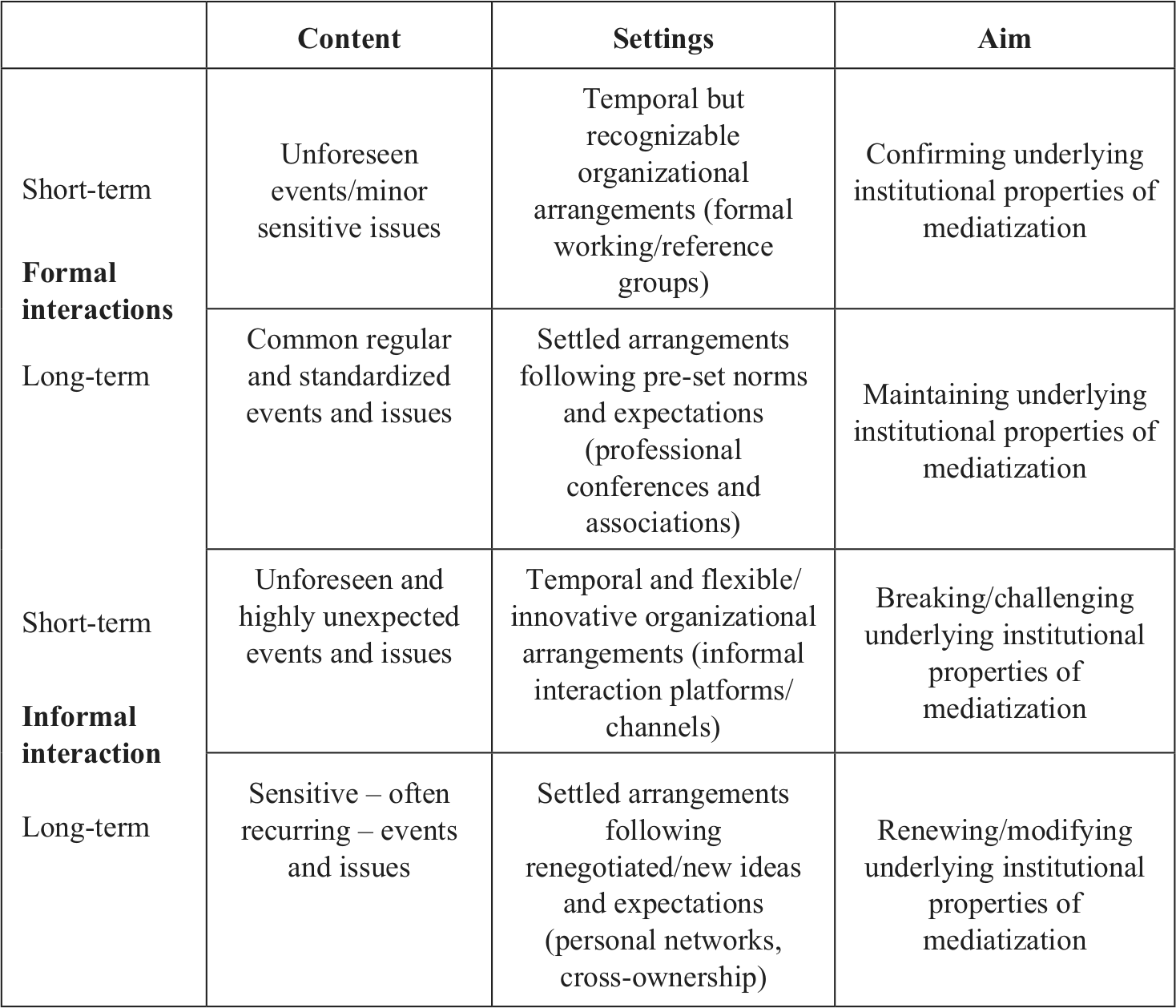
Characteristics of corporate media work enacting mediatization.
This article began with an assumption that the way corporations deal with the media has three components: the character of the material that is exchanged, the depth and scope of corporate media relations and the organizational and collaborative arrangements hosting these relations. The way these three evolve is not independent from the influences the parties exercise on each other, neither is it a process that is free from existing norms, values and priorities. In order words, the way the studied corporations interact with the media is closely tied to the specific interests and intentions of both parties. It also includes the institutionally defined expectations and regulations of how their interactions should be conducted and organized. This process has been previously described in terms of corporate media work (Pallas and Fredriksson, 2011), where organizations maintain, challenge or reshape the institutionally derived ideas about how to conduct media-oriented activities.
Returning to the question concerning the dynamics of mediatization, we can now use the insights from this study and the concept of corporate media work to tie the purposive and strategic interactions between organizations and the media to the way mediatization is both constitutive to – but also enacted by – these interactions. Not only are the interactions between organizations and the media embedded in prevailing structures, norms and ideas that govern their mutual understanding of each other’s work, they are also a part of the processes that lead to redefinition of the underlying values and properties of these conditions.
The interactions illustrated in this article involve negotiations relating to the character of corporate media activities that transcend the context of individual items or specific relations between two parties. That is to say, the corporations and the media are involved in interactions connected with interests, values and activities that also guide general interaction patterns and the general character of media production.
The results indicate that the nature of interactions between companies and the media is complex and multifaceted, and characterized by ‘embedded agency’ (Seo and Creed, 2002; Thornton and Ocasio, 2008). The media and the companies alike are located in contexts of structures, norms and ideas that constrain and enable their actions. The dynamics of mediatization are by similar reasoning placed in local organizational contexts where organizations and the media influence each other on a basis of prevailing institutional logics as well as their embedded interests. Instead of one party (the media) controlling and managing the other party’s behaviour and actions (by way of introducing normative principles, ideas and technologies), the present article shows that all parties are involved in continuous mutual negotiations about the way media production should – in a given moment but also in the long run – be organized and carried out. In these interactions, organizations are to a great extent incorporating the dominant ideas and norms about the way the media operate. At the same time, media organizations adjust their activities to the specifics of individual organizations. As a consequence, the interactions contribute to the formation of shared norms and practices not only locally but also at the level of prevailing institutional forms – i.e. mediatization.
Thus, mediatization is to be seen as a process within which organizations and the media actively relate to each other not only on the basis of the prevailing institutional ideas, practices and technologies, but also with a more or less explicit ambition to alter these ideas, practices and technologies. Mediatization is, therefore, subjected to strategic and skilful efforts to institutionalize the local solutions that have been developed between organizations and the media (see Pallas and Fredriksson, 2011). Even if our study has not explicitly focused on the transformation of the institutional properties of mediatization per se, we would like to argue – supported by extensive findings and insights into neo-institutional theory – that the observed corporate interactions with the media bear witness to dynamics that transcend the interests and intentions of organizations beyond the immediate outcome of their dealings with other actors, to include the influences of these dealings on broader social practices (DiMaggio, 1988; Lawrence and Phillips, 2004; Lawrence and Suddaby, 2006). Thus, our study opens the way for more systematic and longitudinal examinations of the effects individual interactions between the media and actors in different parts of society have on the way mediatization is constructed and enacted.
Footnotes
Funding
This research received no specific grant from any funding agency in the public, commercial, or not-for-profit sectors.