







Abstract
On 1 January 2013, Germany and Finland made the switch from the traditional broadcasting licence fee tied to television-set ownership to a compulsory excise duty collected from all citizens, households and places of business. This article compares the changes in these countries’ public service media funding arrangements on the basis of John Kingdon’s ‘multiple streams’ framework of public policy-making which, to date, has been rather neglected in studies of media policy-making processes. Drawing on the analysis of policy documents and interviews with policymakers and other stakeholders involved in the respective processes, we investigate how the actual reforms materialized, which other possibilities were neglected and why this has been the case.
Keywords
Introduction
In all Western liberal democracies that feature public service media (PSM) systems, financed entirely or in part by licence fees, public funding is a political and, overall, contentious issue. During the last decade, public service broadcasters have increasingly embraced the Internet and the new opportunities it opens for service delivery – hence the shift from public service broadcasting to PSM (Bardoel and Lowe, 2007). However, the branching out of PSM organizations onto new distribution platforms, niche channels and websites has prompted a new wave of complaints, with newspaper publishers and other private content providers beyond the broadcasting sector expressing fears that state aid may be used excessively to fund the online activities of PSM organizations. Across Europe, there are continuing demands from commercial stakeholders and other interest groups for a narrower PSM remit and more widespread access to licence-fee funds, aiming to hinder PSM expansion on the Internet. Since the early 1990s, private media companies and media industry lobbyists have relied increasingly on the European institutions in their attempts to curb the role of PSM in the digital age, filing several complaints to the European Commission that addressed the funding of public broadcasting services and their ‘unfair competitive advantages’. As a consequence, the decisions of the European Commission with regard to state-aid rules, together with the case law jurisprudence of the European Court of Justice, have for their part shaped the development and debate over the future remit of European PSM (Harcourt, 2005; Michalis, 2007).
Arguably, the structural bias of the European Union (EU) towards market liberalization has to some extent eroded national capacities to promote public welfare goals in media policy, undermining the EU member states’ prerogatives in the field of culture, which include PSM (Kaitatzi-Whitlock, 2005; Venturelli, 1998). The governance and funding of PSM organizations are thus subject matters torn between conflicting interests and often contradictory expectations. On the one hand, policymakers and PSM organizations face new demands of accountability and efficiency in their expenditure of public money. On the other hand, PSM organizations are expected to remain independent of political powers and retain enough latitude to adapt to the changing environment and new technologies (Bardoel and d’Haenens, 2008; Lowe and Berg, 2013; Papathanassopoulos, 2007; Syvertsen, 2003; Tracey, 2013).
With regard to the licence fee, one of the most crucial challenges is that the link between the provision of PSM content and services and reception via the television device has become obsolete. The implications for PSM funding are obvious. Should the broadcasting licence fee remain bound to the television set, the increasing number of viewers who rely on computers and mobile devices would no longer be obliged to pay, in which case PSM organizations would risk being marginalized. As Collins et al. (2001) put it, they would ‘be consigned to a ghetto at the margins of the market, filling the gaps disdained by profit-maximising broadcasters’ (p. 8). According to Nissen (2006), there are therefore three options for PSM funding: first, expanding the basis for collecting the licence fee to all types of receiving devices; second, abandoning the licence fee; and, third, changing the licence fee to a compulsory ‘excise duty’ collected from all households and citizens (p. 43). Some countries in Europe, for example, Sweden, have chosen the first option by extending the fee to all devices equipped to receive television broadcasts, while others, such as the Netherlands, have abandoned the fee in favour of direct state budget funding. Both Germany and Finland, the two cases examined in this article, have chosen the third option. In both countries, on 1 January 2013, the traditional broadcasting licence fee tied to the ownership of a television-receiving device was replaced by an ‘excise duty’ collected from all households/citizens and places of business/companies, irrespective of any device. In both cases, the reforms have been major media policy issues with significant implications for the relationship between the state, the market, PSM system and licence-fee contributors.
In this article, we compare the recent changes in the German and Finnish PSM funding arrangements on the basis of John Kingdon’s ‘multiple streams’ framework of public policy-making, first developed in 1984 and re-issued in 2003 (Kingdon, 2003). The article thus offers a new interpretation of the domestic events. After introducing the basic features of the two countries’ PSM systems, and our theoretical framework, methodology and research material, we present two case studies of the respective PSM funding reforms. The concluding section compares the two policy processes and offers a brief outlook.
PSM in Germany and Finland
Germany and Finland both feature a consensual political system and have a strong tradition of public service broadcasting (Nielsen and Linnebank, 2011: 19). The key German and Finnish PSM organizations, the Consortium of Public-Law Broadcasting Institutions of the Federal Republic of Germany (ARD), Second German Television (ZDF) and Yleisradio (YLE), generate between 82.5 and 96.1% of their total income from public funding (see Tables 1 and 2). In both countries, the relationship between public funding and broadcasting output that conforms to the basic ideas of a public service remit (here conceived as news, information, arts/humanities/sciences, education and religion) approximately correlates (O’Hagan and Jennings, 2003: 43–45). Furthermore, the annual amount that domestic licence-fee contributors paid for PSM before the funding reform came into force (€215.76 in Germany and €252 in Finland) was approximately equivalent. Key contrasts between the two cases arise from the size of the countries and their domestic media markets, the difference between the federal German and the centralized Finnish political system, and distinct domestic regulatory traditions.
Financing of the German public media sector 2007–2011.
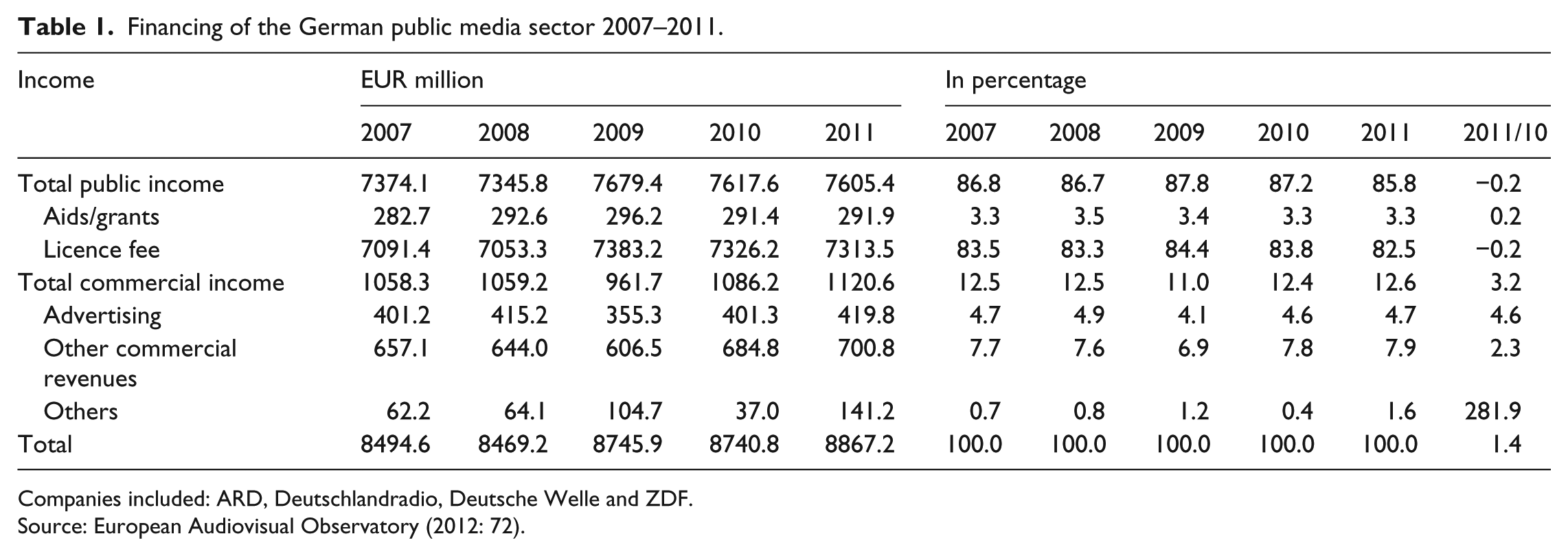
Companies included: ARD, Deutschlandradio, Deutsche Welle and ZDF.
Source: European Audiovisual Observatory (2012: 72).
Financing of the Finnish public media sector 2007–2011.
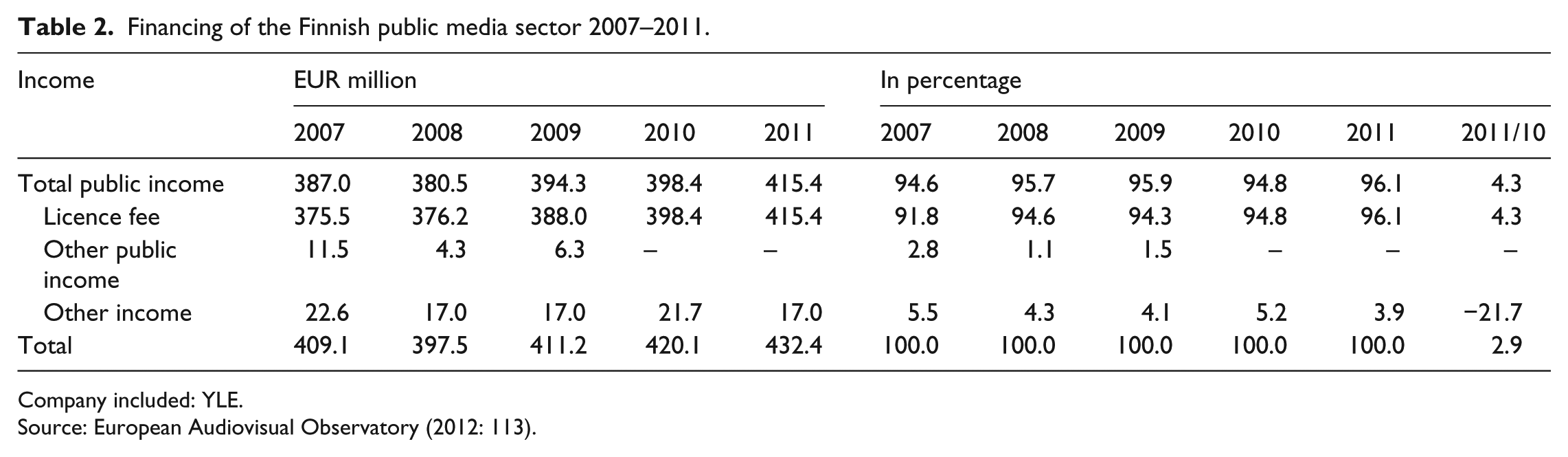
Company included: YLE.
Source: European Audiovisual Observatory (2012: 113).
There are two key PSM organizations operating in Germany: ARD and ZDF. 1 They operate the joint channels KiKA (children’s programmes) and Phoenix (current affairs, politics and documentaries), are involved in the channels 3Sat and Arte and provide a bouquet of digital programmes each (Gibbons and Humphreys, 2012: 122). Both have prominent Internet presences and their content is available on miscellaneous online platforms. In 2012, the combined television-viewing share of ARD, ZDF, the ARD Third Channels, the ZDF digital channels, KiKA and Phoenix was 41.1%. The ARD has 23,000 employees and the ZDF has a staff of 3600. On the other hand, YLE, the national Finnish PSM organization, has four national television channels, six radio channels, 25 regional radio programmes and a prominent Internet presence (see Herkman, 2009; Karppinen et al., 2011). YLE channels take around a 44% share of television viewing and a 52% share of radio listening (Finnpanel, 2012). The number of employees working for YLE is around 3000.
Having briefly outlined the PSM systems in the two countries under study, we now move to the theoretical framework underlying our comparative analysis.
Kingdon’s policy streams framework
The policy streams framework was developed by John Kingdon in 1984 as a means to understand public policy agenda-setting. According to Kingdon, policy-making is not a unidimensional, coherent and linear process. Instead, there are three separate streams of actors (policy entrepreneurs) and processes, called ‘problem’, ‘policy’ and ‘politics’ streams. It is a central political accomplishment to get people to see a condition as a problem. The problem stream accordingly refers to the conditions, which are interpreted as problems requiring attention. Before a problem can reach the decision agenda, decision makers must be given at least one constructive solution, often worked out in advance within the administration, the scientific or other policy communities. The policy stream, then, consists of the alternative ‘solutions’ developed by specialists in various policy communities. There are many of them floating in the ‘primeval soup’ (Kingdon, 2003) of possible policy alternatives and competing for attention. Policy solutions are incubated and recombined over the years in policy communities. But then, in the politics stream, which refers to macro-political issues such as election results, changes of administration, interest group campaigns or changes in public opinion, something happens which makes one solution more applicable than the others.
A central assumption of Kingdon’s model is that the three streams often develop largely independently from each other, according to their own set of interior dynamics, so that change within one stream may occur independently of change in the others. But when all three streams converge (a problem is recognized, a solution is available and the political climate is positive for change), a window of opportunity opens, which facilitates policy change. Kingdon (2001) notes that a window of opportunity is open for one of two reasons: either a problem is pressing, verging on a crisis, and that creates an opportunity for people to advocate their solutions to it, or the political stream changes, and the advocates take advantage of their open window to push their proposals. (p. 332)
Four possible window types are discernible from Kingdon’s work and we will turn to these in our comparative analysis:
Routinized political windows, in which institutionalized procedural events dictate predictable window openings;
Discretionary political windows, in which the behaviour of individual political actors leads to less predictable window openings;
Spillover problem windows, in which related issues are drawn into an already open window;
Random problem windows, in which random events or crises open unpredictable windows (Howlett and Ramesh, 2003: 137).
Kingdon’s framework was originally based on the American political system, though it has been used, for example, to assess the politics of privatization in Britain and Germany (Zahariadis and Allen, 1995) and the political reform process in Eastern Europe (Keeler, 1993). So far, the framework has been rather neglected in studies of media policy-making processes (see Jääsaari, 2013).
In this article, we use Kingdon’s framework as an analytical lens (Zahariadis, 2007: 86) for identifying forces and patterns of behaviour in each policy-making case study, allowing for a comparison of similarities and differences between the two cases and their contextual factors. We investigate how the actual reforms towards an excise duty materialized, which other possibilities were neglected and why this has been the case.
Methodology
In terms of research material, our comparative analysis relies on qualitative analyses of official documents and legal opinions, such as the Kirchhof (2010) report and the Lintilä working group report (Ministry of Transport and Communications [MINTC], 2009), media coverage, other secondary sources with regard to the reforms and semi-structured interviews with policymakers, broadcasting officials and industry representatives in both countries (n = 16). With regard to the latter, the original ‘wish list’ of informants was further developed using a snowball sampling method. The interviews were analysed, focusing on meaning, by means of a thematic qualitative analysis (see Smith, 1995). The informants were granted anonymity. As is often the case when carrying out elite interviews, some of the people who wished not to be interviewed pointed to useful secondary sources and gave helpful comments.
The PSM funding reform in Germany
ARD and ZDF are, for the most part, funded by the licence fee. In addition to their licence-fee income, since the mid-1950s the ARD broadcasting corporations have generated funds from advertising. The ZDF has been co-financed by advertising since it went on air in 1963. 2 In 1968, the Federal Administrative Court transferred the right to make decisions about the level of the licence fee to the Länder, detaching it from the Postal Administration. The first increase of the television licence fee occurred in 1970. By then, it had already become clear that the settlement process, involving 11 Länder governments and parliament, jeopardized the independence of public broadcasting from state interference, as determined by constitutional law. As a consequence, in 1975, the heads of the Länder governments set up the Commission for Ascertaining the Financial Needs of the Public Broadcasting Corporations (KEF), which plays an important role in the process of settling the broadcasting licence fee and whose position vis-a-vis the Länder was substantially strengthened in 1997 (see Meier, 2008; Priebs, 2004).
Following the multiple streams model, in the following we investigate how the reform of the licence-fee-funding mechanism materialized into policy through the convergence of the problem, policy and politics streams. With regard to the problem stream, there were several key issues at stake. Most important was the anachronism that the fee was bound to the possession of a receiving device. Virtually, all key actors concerned agreed that due to convergence and technological development, this link fails to reflect the legal and technical realities. Beyond that, another factor was the public attitude to the licence fee. In particular, the Gebühreneinzugszentrale (GEZ), which monitored the possession of receiving devices and collected the fee, was highly unpopular (see Klimmt et al., 2006). 3 Furthermore, there were mounting concerns about free-rider problems. The cities of Berlin, Frankfurt/Main, Munich and Stuttgart had licence-fee contributor rates between just 76.9 and 78.5%, diverging substantially from rural areas (KEF, 2009: 228). Last, due to demographic trends and changed habits of media use under the old regime and fee level, ARD and ZDF expected a squeeze of about €1 billion by 2020 (Potschka, 2011: 116).
In October 2006, when the reception of television services via the Internet was still inadequate, at the conference of the heads of the Länder governments in Bad Pyrmont, it was agreed upon an interim solution which, from 1 January 2007 onwards, made ‘new receiving devices’ (computers and mobile phones with access to the Internet which, until then, were exempt from the fee) subject to the (reduced) radio fee. At the same time, the Broadcasting Commission of the Länder, coordinated by Hans-Dieter Drewitz and, since 2009, Harald Hammann, both from the state chancellery Rhineland-Palatinate, was given the task of searching for alternative models of PSM funding (Potthast, 2013: 461).
One key task concerning this matter fell to the Länder working group ‘Future of the Licence Fee’, which was composed of the heads of the media law/media policy divisions of the state chancelleries (Rundfunkreferenten) and had already been installed in February 2000. Since 2004, it has been chaired by Nils Jonas Greiner, head of the subject division ‘media law’ at the state chancellery of Thuringia. 4 Drawing on its assessment of international PSM funding models, as early as in 2001, the working group ‘Future of the Licence Fee’ had identified eight possible models for future PSM funding from the ‘primeval soup’ of possible policy alternatives. Four of those envisaged forms of taxation, which were abandoned relatively early (though tax solutions were also raised at various stages later on in the process) since these are politically most unpopular, and did not conform to the ideal of broadcasting freedom as specified by the Federal Constitutional Court. Apart from that, all forms of taxation failed to ensure constant future income for the PSM organizations. The remaining options were a levy per individual (Bürgerabgabe or Pro-Kopf-Abgabe, as, later on in the process advocated by the Liberal Party), changing the funding mechanism towards a home or household fee (Beitragsmodell), maintaining the link between receiving device and fee liability (Geräteabgabe) and further developing the old licence-fee system (modifizierter Status Quo). Concepts such as pay-TV or the economists Beck and Beyer’s (2009) idea of an open Rundfunkfonds modelled after the British Public Service Publisher (see Helm et al., 2005) were excluded from the outset since these diverged too extensively from the present system.
The options were narrowed by, first, excluding the possible policy solution to maintain the link between receiving device and fee liability, which was regarded as unfeasible. The next model abandoned was the levy per individual. This model was deemed socially unfair and it would have meant excluding businesses from fee liability, which was politically not opportune. Since all actors involved agreed that one overriding goal of the reform was to maintain the current total amount of licence-fee income, this policy alternative disappeared from the agenda. Only two models remained: the change of the funding mechanism towards a home or household fee, and a further development of the old licence-fee system (Eicher, 2012: 615). The working group ‘Future of the Licence Fee’ discussed these models with ARD and ZDF, whose internal working group ‘Broadcasting Fee Law’ (Rundfunkgebührenrecht) was in charge of the negotiation on behalf of the PSM organizations. One of the key policy entrepreneurs concerning this matter was the in-house counsel Hermann Eicher (ARD). The actors involved then gradually agreed upon the household fee model. 5 Reasons for this were that only the household fee made monitoring the possession of receiving devices obsolete. Beyond that, everybody deeply involved in the policy process was well aware how difficult the reform is to accomplish. The household fee was regarded as the more far-reaching change.
ARD, ZDF and Deutschlandradio commissioned several legal opinions with regard to the household fee, including those from the law professors Hans Jarass (2007), Armin Dittmann (2009) and Hans-Peter Bull (2010), which brought more planning reliability. However, as one interviewee remarked, the PSM organizations were still looking for ‘one prominent and inviolable name’. ARD, ZDF and Deutschlandradio thus commissioned another legal opinion about the future financing of public service broadcasting from the distinguished lawyer and former judge of the Federal Constitutional Court (1987–1999) Paul Kirchhof. His legal opinion was delivered in 2010. Kirchhof’s key recommendation was to abandon the device-dependent licence fee and to make each household and place of business the site of fee imposition (Potschka, 2012: 219). Kirchhof proposed to maintain the fee at the 2009 level and, to increase public acceptance, recommended that ARD and ZDF abandon their revenues from advertising and sponsorship. The Kirchhof report was driven by the ideal of simplification, allowing for only very few exceptions from the rule. Kirchhof stressed that the implementation of his recommendations would ensure an approximately equivalent total licence-fee income and take the system to a safe haven, addressing concerns that the model could be classified as a new form of state aid by the European Commission (Kirchhof, 2010). In a closed session, Kirchhof explained his model to the heads of the Länder governments, winning their support.
The politics stream involves actual decision-making processes. With regard to PSM funding, this is a complex process since broadcasting in Germany is regulated by a web of many different pieces of legislation. In 1986 the Federal Constitutional Court had approved the dual broadcasting system. Subsequently, in the first version of the Interstate Broadcasting Treaty, enforced on 1 December 1987, the heads of the Länder governments reached agreement about common terms and conditions, laying down the legal status of broadcasting. The treaty covers a wide range of issues, including PSM funding. In many instances, it translates EU specifications into national law. To date, the treaty has been amended 15 times. Only the newest amendment, passed by all Länder parliaments, is the legally binding working text (see Hammann, 2009). 6
In December 2010, the heads of the Länder governments agreed on the 15th Amendment to the Interstate Treaty on Broadcasting and Telemedia which deals with the new licence-fee model. One interviewee from the media law/media policy divisions of the state chancelleries remarked, ‘We had one window of opportunity and this was in fall 2010’. Envisaging a 12-month ratification process, the scheduling of diverse Länder and the upcoming Bundestag elections opened this one small routinized political window. It was expected that the reform would be unpopular and, if not in fall 2010 due to the upcoming election campaigns, no agreement could have been reached at all. During 2011, the treaty was ratified by the 16 Länder governments. Reflecting on the incredible complex process, one informant called it a ‘miracle’ that the reform was, indeed, successfully steered through. According to several interviewees, the reform was only possible because there were relatively few actors involved. The Broadcasting Commission of the Länder and the Länder working group ‘Future of the Licence Fee’ operated in relative isolation from the outside world, although the reform was intensively discussed with the PSM organizations and some industry stakeholders (i.e. representing the hotel business) advocated their positions vis-a-vis the Länder politicians in charge. Other stakeholders, for the most part, only became directly involved in the process after political agreement was reached. 7
This happened within the politics stream, where Kirchhof’s model faces pressures from a realpolitik orientation. Traditionally, the public largely remains neglected in German media policy-making and, although there are civil society initiatives against the fee such as the open online petition Abschaffung der GEZ with more than 136,000 signatories, these had no direct impact on policy-making. Currently, legislative authorities and the PSM organizations debate exemptions from the universal applicability rule and changes to the mechanism of calculating the fee on a sliding scale, according to the number of employees in places of business. In parallel, there are ongoing evaluations with regard to how the reform affects business and industry, the churches and local municipalities. 8 Unsurprisingly, various complaints have been filed against the fee and it is expected that the Federal Constitutional Court will deal with the reform in a future decision. However, due to their commissioning of legal opinions, ARD and ZDF have taken solid ‘precautionary measures’, particularly with regard to private households. Still, according to an evaluation by the KEF from December 2013 as a consequence of the funding reform, the PSM organizations are expected to receive a budget surplus of €1145.9 million for the period 2013–2016, equalling 3.7% of the total licence-fee income. The KEF (2013) has therefore, for the first time ever, recommended to reduce the current amount of the monthly fee by €0.73 to €17.25 from 1 January 2015 onwards.
The PSM funding reform in Finland
YLE has been funded primarily by the licence fee throughout its history (radio licence fee from 1927 and a television licence fee from 1958). 9 YLE itself is not allowed to run advertising or sponsoring, but it did receive additional funding from a share of commercial broadcasting revenues until 2007. From the late 1950s to the 1980s, YLE first rented airtime on its channels to the commercial broadcaster MTV and, after the introduction of commercial television channels, the commercial companies with a broadcasting licence continued to pay a percentage of their annual turnover to YLE as a special public service levy. These levies were eventually dropped in 2007 in response to the lobbying of commercial broadcasters. After this, the funding of YLE has relied solely on the licence fee, which created a deficit that forced YLE to slim down its operations (see Ala-Fossi, 2012). Leading up to the eventual political agreement on the PSM funding reform, in late 2011, the funding of YLE was the most debated media policy issue in Finland for several years. As in the German case, we analyse here the policy process and the window of opportunity that led to the reform in terms of the problem, policy and politics streams.
In terms of the problem stream, the need for reforming PSM funding had been recognized for some time. Since the early 2000s, there were mounting commercial and political pressures on YLE concerning its status and funding (see Nieminen, 2010). The feasibility of the licence fee as a source of funding was questioned on several grounds, including declining revenue, the problems of tying the licence fee to the ownership of a television set, free-rider problems, practical difficulties of collecting and monitoring the fee and the perceived unfairness of the flat fee for economically disadvantaged households. However, in absence of better alternatives and strong objections to such alternatives as advertising or direct budget funding, as several informants remarked, the licence fee was long accepted as the ‘least bad’ option for PSM funding (see also MINTC, 2004).
According to the multiple streams model, before a perceived problem can reach the agenda of actual political decision-making, it must pass through the policy stream, understood as the process where the bureaucratic processes and the policy community of various specialists and experts specify the solutions and alternatives from which a political choice is to be made. While various models had already long been discussed within the policy community, a key role in working out practicable policy recommendations fell to the so-called Lintilä working group, named after its Chairman, the Centre Party Member of Parliament (MP) Mika Lintilä. The Lintilä working group was set up by the Ministry of Transport and Communications in February 2008 and delivered its final report in April 2009 (MINTC, 2009). 10 Following the tradition of pragmatic and consensual politics that has been typical of Finnish media policy (Jääsaari, 2007), the composition of the group included all parliamentary parties and also industry experts (but no civil society representatives). After reviewing various alternatives, including the old licence-fee system, direct budget funding, levies from commercial operators as well as market-based advertising and subscription models, the working group made an unanimous proposal about a new ‘public service media fee’ that was to be paid from the beginning of 2011 by all households, regardless of television ownership or other technical equipment. Additionally, the group proposed minor amendments to the wording of YLE’s public service remit and its monitoring. Reflecting policymakers’ pragmatism, one public official interviewed during the process noted that ‘there is no need for more lobbying or public debate – it’s just about making a decision and moving on now’.
However, it quickly became evident that the fate of the PSM reform was not just a matter of technocratic problem-solving. Instead, it became entangled with broader macro-political developments, in Kingdon’s terms the politics stream, including electoral tactics, interest group campaigns and changes in public opinion. Initially, it was widely expected that the government would follow the unanimous proposal of the working group and send a new Act on YLE to Parliament in 2009 (Ala-Fossi and Hujanen, 2010; Nieminen, 2009). However, the process soon ran into political trouble. The Lintilä working group was originally appointed by the conservative-led government that had come to power after the 2007 elections. The Minister of Communications of the National Coalition Party, Suvi Lindén, initially supported the media-fee proposal, only to make a U-turn a few months later to announce that she would not bring the proposal to Parliament, essentially postponing the reform until after the 2011 parliamentary elections.
The decision was initially defended by referring to the widespread public criticism of the new tax and disagreements in Parliament, but evidently the decision of Lindén also stemmed from the desire to connect the funding decision to a broader change in the parliamentary control of YLE, which incidentally was one of the key demands of the media industry. Furthermore, even personal dynamics between individual politicians and political figures, such as Mikael Jungner, who was replaced as the Director-General of YLE in 2010 only to become the Party Secretary of the Social Democratic Party, clearly contributed to the culmination of the disagreements around YLE. In any case, it became clear that there were differences of opinion not only between parties but also within the government. This rift then opened an opportunity for individual politicians and parties to improve their position in the upcoming elections by turning against the increasingly unpopular reform and proposing their own models. This turn of events can be interpreted as a discretionary political window, where the decision of an individual politician led to further openings for stakeholders to exert influence on the process.
A major factor in this was a public campaign, not to mention heavy private lobbying waged by the commercial media (coordinated by the Federation of Finnish Media Industry and the country’s biggest media company, the Sanoma Group), who had already stepped up their criticism of YLE’s programming policy from the mid-2000s (see Nieminen, 2009). In terms of Kingdon’s model, this can also be interpreted as a spillover problem window, or an opportunity for the industry to draw related issues, such as the monitoring and remit of YLE, into an already open political window.
In the debate that followed the publication of the Lintilä working group report, the commercial media industry demands included a narrower definition of the PSM remit, especially in the online environment; the establishment of a new external body to monitor PSM; and funding from direct taxation that would place broadcasting in the same boat as all other public services. The industry also bitterly contrasted the increasing struggles of the commercial media sector with YLE getting ‘bags of money thrown at them and free hands to do whatever they wish with public money’, as one industry interviewee put it. The coordinated campaign by newspapers that propagated the views of the media industry contributed to the fact that public opinion was largely critical of the new media fee (Ala-Fossi, 2012: 41). This was reflected, for instance, in the opinion polls commissioned by newspapers and in a number of Facebook groups opposed to the proposal, the largest of which had over 100,000 members (Ala-Fossi and Hujanen, 2010: 18). However, their value as indicators of declining public support for PSM more generally is questionable, given other surveys that have confirmed high levels of trust in the Finnish PSM organizations (see Karppinen et al., 2011).
Ultimately, it was not until the end of 2011 that the parliamentary groups and the new Social Democratic Minister of Communications, Krista Kiuru, finally announced a new agreement on PSM reform. In the compromise, which passed into law in 2012 and took force on 1 January 2013, the original media-fee proposal was amended to a ‘YLE tax’, a type of excise duty linked to personal income and levied from each adult, rather than household, over a certain income level, regardless of television ownership. 11 A separate, two-threshold system was also set up for businesses and organizations based on their turnover. 12 This new agreement was presented as being more socially equitable compared to the previously planned ‘media fee’ (MINTC, 2011). As a result of the reform, the funding of YLE increased from €432.4 million in 2011 (see Table 2) to around €500 million. It will be reviewed annually to correspond to the rise in cost level. The new law also includes minor amendments to the wording of YLE’s public service mission, while the monitoring and supervision of YLE is essentially left unchanged – against the wishes of the commercial media industry.
Comparing the two policy processes, conclusion and outlook
In both Germany and Finland, the key policy entrepreneurs prepared the reforms over many years. In Germany, eventually a routinized political window was seized. This window opened in fall 2010. In Finland, the actual reform towards a ‘YLE tax’ resulted from seizing a discretionary political window. A key difference between the two processes lies in the involvement of non-governmental policy entrepreneurs, though no civil society campaigns played a role in either case. In Germany until 2006, the preparation of the reform took place within the Broadcasting Commission of the Länder and the working group ‘Future of the Licence Fee’. ARD and ZDF also played important roles. Most industry- and other stakeholders entered the process very late after core agreements between politicians and PSM organizations had been reached.
In Finland, following the domestic tradition of consensual policy-making, the Lintilä working group was appointed by Parliament and composed of party representatives and industry experts. Due to party-political reasons, political strategy and industry lobbying, the implementation of the working group’s recommendations was postponed. After serious contention between the key actors concerned, eventually another, more acceptable, model was found. On the other hand, the process also opened up exceptional political cleavages, both within political parties and between public and private media. The future effects of these conflicts on the status of YLE and on the consensual tradition of media policy-making in Finland remain to be seen.
Regarding the influence of the EU and broader European debates, it can be argued that both reform processes followed a largely national policy-making traditions and the arguments were mostly nationally framed, confirming that broadcasting policy still continues to be mostly under the competence of member states. However, in both cases, the EU specifications and debates did have at least indirect influences on the reforms. Both reforms were widely considered advantageous for ARD, ZDF and YLE, solidifying the PSM organizations’ financial position.
Each theoretical model has strengths and weaknesses and the challenge for researchers is to utilize suitable approaches as applicable (Theodoulou, 2013: 124). With regard to this study, we found Kingdon’s (2003) multiple streams framework, in combination with Howlett and Ramesh’s (2003: 137) distinction between four types of policy windows, useful. In both countries, the level of PSM funding will remain a contested issue, as will the definition of the public service mission, especially in regard to new online services. Societal acceptance of PSM is a necessary prerequisite for the future of PSM. In Germany, not least, the far-reaching critique of the budgetary surplus in December 2013 reflects an increasingly critical tenor across the political spectrum vis-a-vis the present PSM system, its commitment to transparency and the amount of funding which flows into it. Similarly, in Finland, the contestation over the annual increase of the YLE tax according to the consumer price index has continued to feature many familiar anti-PSM arguments. However, another window of opportunity for a major reform would require another coalescence of problem, policy and politics streams, which, as we have seen, is rare and immensely difficult to seize.
Footnotes
Funding
This research received no specific grant from any funding agency in the public, commercial or not-for-profit sectors.