






Abstract
Election coverage has a tendency to frame politics as a strategic game, to increase the role of journalists as interpreters of issues and events and to include a conflict frame, and thus indicating increased mediatization. However, political news research outside of the election indicates that news media are less independent from political actors. Drawing on literature on mediatization, media interventionism, political news journalism, news framing and source use, the purpose of this article is to empirically investigate whether election coverage is representative of other political journalism in terms of degree of mediatization. The study is based on a systematic comparison of three content analyses using the same coding schedule and procedure from coverage of the Financial Crisis 2008, the Election Campaign 2010 and routine political news coverage 2012 in Sweden. The main conclusion from this study is that mediatization of media coverage is substantially influenced by the specific context of the news.
Introduction
Mediatization has become an important concept in political communication during the last decade, referring to a process in society where media have become increasingly influential (Meyer, 2002). The influence of media is described by the way news media independently process and present political information, employing media logic as opposed to political logic, and how political actors adapt to this media environment (Altheide, 2013; Mazzoleni, 2008). A sign of increasing mediatization is thus political news journalism characterized by media interventionism that entails news shaped by journalists rather than by politicians (Esser, 2008). Contemporary election news coverage has a tendency to frame politics as a strategic game rather than to focus on political issues, to increase the role of the journalists as interpreters of political issues and events and to include a conflict frame (Aalberg et al., 2012; Patterson, 1994). These patterns in election news coverage indicate increased mediatization of political journalism where media logic rather than political logic governs news media coverage. However, political news research outside of the election campaign indicates that news media is less independent from political actors and tend to rely heavily on official sources and perspectives (Althaus, 2003; Bennett et al., 2007; Entman, 2004; Lawrence, 2010; Wolfsfeld and Sheafer, 2006).
The degree to which news media content is mediatized can be indicated by the degree of media interventionism in news coverage and can be expected to vary across time and space (Esser, 2008; Strömbäck and Dimitrova, 2011; Zeh and Hopmann, 2013). It is thus conceivable that the degree of mediatization varies between election coverage and non-election coverage, and furthermore that assumptions made about the mediatization of political news based on election coverage research cannot be taken for granted. Consequently, the mediatization of political news should ultimately be regarded as an empirical question requiring empirical research.
Against this background, the purpose of this article is to add nuance to political news journalism research by comparing election news coverage with other types of political journalism, focusing on how news media cover politics and the degree of media interventionism. More specifically, this article will conduct a comparative analysis of Swedish news coverage during three different time periods being: the Financial Crisis 2008, the Election Campaign in 2010 and a period of routine political news coverage in 2012. The study is based on a systematic comparison of three different content analyses using the same coding schedule and coding procedure. The study aims at answering the question if and to what degree election news coverage is representative for non-election political news. Or in other words, if and to what extent election coverage differs from other types of political news coverage in terms of media interventionism and degree of mediatization.
Mediatization and media interventionism
Mediatization has become an important concept for understanding the impact of media in modern society, widely defined as a process where the media increase their influence at the expense of other actors in society (Altheide, 2013; Meyer, 2002). The key aspect of mediatization in political communication is that news media constitutes the most important source of information and communication channel concerning politics in contemporary society. However, the process of mediatization should be understood as a multidimensional concept that takes place on different levels of analysis, according to Strömbäck (2008, 2011). Accordingly, four dimensions are identified: the first is concerned with the extent to which the media are the most important source of information and channel of communication, the second with the degree of the media’s independence from political institutions, the third dimension with the degree to which media content is governed by political or media logic and the fourth with the degree to which political actors are governed by political or media logic (Strömbäck, 2008; Strömbäck and Esser, 2009; Strömbäck and Dimitrova, 2011).
The notion of media logic, important in the mediatization process, can be understood as the way media interpret and cover politics. It includes how news material is organized, style of presentation, focus or emphasis on behaviour and so on (Altheide, 2013). Essentially, media logic is distinct from political logic since it entails that media are guided by their own logic and needs, and not by political actors’ logic and needs (Mazzoleni, 2008; Meyer, 2002). Thus, as the media become more independent of political actors and institutions, news content and coverage of politics will be increasingly shaped by media’s own standards and newsworthiness. Focusing on the third dimension of mediatization, that is, the degree to which media content is governed by media logic as opposed to political logic, puts the notion of media interventionism at the centre. Research regarding the third dimension suggests that media logic trumps political logic through media interventionism, since media interventionism can shape and reshape politics as it is covered by news media (Esser, 2008). Media interventionism refers to the discretionary power of the media as they play a formative role in shaping news content (Blumler and Gurevitch, 1995). Political journalism can thus be increasingly active and independent of political actors when producing news, and journalists can be professionally motivated to increase their influence and control over news stories (Esser, 2008). For example, media interventionism is recognized in election campaigns when journalists act independently by setting the agenda and describing issues and events from their own perspective. News coverage reflecting journalistic independence limiting politicians’ influence thus implies media coverage governed by media logic. Hence, indicators of media interventionism in media coverage can act as an indicator of the degree to which media content is mediatized (Strömbäck and Dimitrova, 2011). By analysing news media coverage of politics, changes along the third dimension of mediatization can be identified.
It is important to emphasize that mediatization, as a dynamic process of increasing media influence, cannot be regarded as a deterministic and linear development. Rather, the degree of mediatization is expected to vary across time and space (Strömbäck and Dimitrova, 2011; Zeh and Hopmann, 2013). Accordingly, the political and media setting of different countries is expected to affect the degree of media interventionism (Blumler and Gurevitch, 1995), a proposition analysed in comparative election news coverage (see, for example, Esser, 2008). Presumably, there are a number of additional factors that shape the process and the degree of mediatization in a particular media and political setting. Notably, a growing body of literature argues that specific news-reporting contexts can entail different news dynamics (Lawrence, 2010; Shehata, 2010; Wolfsfeld and Sheafer, 2006). Implicitly, this literature suggests that different independence norms are a function of the conditions of the news context. Furthermore, some scholars argue that manifestations of media independence are not commonly recognized in non-election news especially during certain crisis and that political journalism is characterized as compliant with political logic rather than media logic (Bennett et al., 2006; Entman, 2004). Thus, the journalistic use of independence strategies as framing and selection of sources appears to be reflective of the news context. This leads us to ask whether different contexts of news coverage within one national news culture furthermore can affect the degree of media interventionism and thus media independence from political actors. However, the degree of mediatization has so far mainly been researched in election news contexts. It is conceivable that the degree of media interventionism varies between election coverage and non-election coverage, and furthermore that assumptions made about the mediatization of political news based on election news research cannot be taken for granted. Consequently, the mediatization of political news should ultimately be regarded as an empirical question requiring empirical research.
Indicators of mediatized political news
The mediatization of political news entails that media content is governed by media logic rather than political logic, and can be indicated by media interventionism where journalists are in control of news making (Esser, 2008; Strömbäck and Dimitrova, 2011; Zeh and Hopmann, 2013). Recent research on political news journalism hints at increasing media power where news media play an active and independent role in shaping election news content and coverage (Strömbäck and Kaid, 2008). A vast body of literature in political communication suggests that election news coverage has an increasing tendency to frame politics as a strategic game, to elevate the role of journalists as interpreters of political issues and events, to include a conflict frame and to include a variety of voices limiting politicians’ dominance as sources. These characteristics in news framing and source use can thus act as indicators of mediatization of political news journalism. Hence, the next section will present these two dimensions of media independence: first framing and journalistic style, and second, source use in news stories.
First of all, the framing of politics as a strategic game is regarded as pervasive in election campaign coverage distinguished by game framing rather than issue framing (Aalberg et al., 2012; Strömbäck and Kaid, 2008). The increase of strategic framing indicates that news media has moved away from descriptive and issue-oriented coverage towards news stories focusing on the performance of politicians and parties, the competition and the tactics to win the political game. Journalists try to be in control of news stories by framing politics and the political game as strategic (game frame) rather than reporting on the political issues and events (issue frame) promoted by political actors. Instead of being spun by political strategists in the election campaign, journalists can uncover these strategies by reporting on them and ‘by focusing on the strategic aspects of the political game, political reporters maintain an apparent stance of both independence and objectivity’ (Aalberg et al., 2012: 164). Consequently, news coverage dominated by strategic framing is regarded as a manifestation of media independence from political actors due to an alternative journalistic perspective in the news. Moreover, news coverage dominated by issue framing is regarded as less independent media due to the straight reporting of political events, issues and policies.
Another key feature of election coverage is the use of the conflict frame that emphasizes the conflict related aspects of an issue or an event (Patterson, 1994). The conflict frame thus refers to the focus on disagreements and divergence between individuals, groups, institutions or other conflicting parties in news stories. Conflict framing is consistent with most research on prominent news values in general since conflict is regarded as an important criterion for selection of news. It can also be expected that conflict framing is prevalent in election coverage in particular due to the conflicting nature of an election. The predominance of the conflict frame in political news is not only due to the news value factor but can furthermore be regarded as an independence strategy for journalists. By using the conflict frame, a journalist can stay objective while telling both sides of a story, as well as include oppositional voices and thus mark independence from different actors in the news.
Research regarding the prevalence of interpretative journalism has furthermore revealed that journalistic interpretation occurs frequently in election reporting and in some cases making issues secondary (Patterson, 1994; Strömbäck and Kaid, 2008). The increase of interpretative election coverage is argued to be a significant change in political news content over the last decade, since ‘interpretative journalism is conceptualized as entailing a greater emphasis on the “meaning” of news beyond the facts and statements of sources’ (Salgado and Strömbäck, 2012: 145). Interpretative styles of coverage are also linked to journalistic independence in the news process. In descriptive journalism, the journalist acts as an observer, whereas interpretative journalism requires journalists to also analyse. The rise of interpretative political news is thus believed to empower journalists as they acquire more control over the content. Furthermore, Patterson argues that interpretative election coverage increases strategic framing (Patterson, 1994). To sum up, strategic game framing, conflict framing and interpretative coverage characterize election news journalism governed by media logic rather than political logic and opens up the question whether this holds true for other types of political news coverage as well.
News sources and the information they provide journalists with are widely acknowledged as important in the shaping of news content (Cook, 2005; Gans, 1979). Based on Bennetts indexing theory, which regards official voices as more newsworthy and also as main constructors of news frames, there exists a considerable amount of research on which stories and voices receive most news coverage. According to this research, official political actors are the most prevalent voices in the news and political actors trigger most political coverage (Bennett et al., 2007; Entman, 2004; Lawrence, 2010; Shehata, 2010; Wolfsfeld and Sheafer, 2006). It is also argued by Dimitrova and Strömbäck (2012: 609) that ‘the impact of sources would be especially important during election campaigns when political actors compete even more intensely than usual for control over media messages’. The competitive nature of the election campaign not only influences the use of politicians as sources but also the use of journalists as a source category in news stories. Research has pointed out the increased use of journalists’ own analysis and perspectives in election coverage (Patterson, 1994).
In addition to official political actors and journalists, experts in different topics are becoming another important source category used in election news coverage. The use of experts as sources can indicate an effort by journalists to include a wider range of voices in news framing since experts are often used to comment on current issues, events and so on (Lawrence, 2010). In other words, experts as campaign consultants or economic professionals can provide news stories with knowledge and a perspective that challenges political dominance. Ordinary citizens constitute an important part in the democratic process and a crucial audience for the news media. Hence, citizens are regarded as an important source category even though they are not as dominant since they do not have the same news value as official actors (Dimitrova and Strömbäck, 2012). Journalists tend to include citizens as commentators to political issues, events, policies and performance of politicians in order to include the publics’ views and opinion in news coverage.
The use of different strategies to mark independence and integrity by journalists in the news production as expressed in election news reporting is regarded as a distinctive feature of modern and professional journalism (Blumler and Gurevitch, 1995; Cook, 2005). However, empirical research of non-election news coverage has concluded that journalists tend to show less independence since they rely and report on official political actors’ perspectives (Bennett et al., 2006; Shehata, 2010; Wolfsfeld and Sheafer, 2006). For example, the practice of using a game frame was not very common in routine press coverage (Shehata, 2010), the press displayed a surprising scarcity of source use in political debates outside of the election (Wolfsfeld and Sheafer, 2006) and media declined to challenge government framing despite opposing evidence in the major political crisis of torture accusations in the Abu Graib Scandal (Bennett et al., 2006). In sum, these empirical results indicate that the proposition of political news journalism characterized by media independence does not hold in news-reporting contexts different from the election campaign. Thus, systematic comparison of empirical evidence from routine coverage, crisis coverage and election coverage is required to add nuance to the proposition of mediatization of political news journalism.
Swedish political news journalism
From a media system perspective, Sweden is typically considered a democratic corporatist country with strong journalistic professionalism and high levels of newspaper circulation that attract large audiences from broad segments of the population (Shehata and Strömbäck, 2011). However, due to developments, the present Swedish media system can generally be described as reflecting classical liberal ideas of the press as an independent and monitoring ‘fourth estate’, (Nord, 2008; Strömbäck and Nord, 2008). The newspaper market historically developed as a party press, but it is now independent from political parties and increasingly market-oriented. Accordingly, political journalism in Sweden has for a long time been guided by professional principles of objectivity and impartiality as well as strong general support for the watchdog function of the media.
The national media in Sweden pay a great deal of attention to political news, especially during election campaigns. Even though election news have become more strategic, Swedish political news coverage is still regarded as rather serious and issue focussed (Strömbäck and Nord, 2008). Due to increased media competition and 24-hour news production, political commentary such as news analysis and journalists interviewing journalists in coverage has become more prevalent. Research studying election coverage in Sweden thus suggests that news stories are becoming increasingly game-framed and interpretive. At the same time, sources representing influential groups in society have a substantial influence over the media agenda, and journalists rely heavily on trustworthy and powerful sources in the newsgathering processes (Shehata, 2010). Nevertheless, according to Strömbäck and Nord (2008), journalists tend to have the final say regarding the framing and presentation of news and therefore play a crucial role as editorial gatekeepers maintaining a strong position in the battle for the political agenda.
The differing empirical research findings concerning the journalistic style, the framing of political news and the use of different sources in different case studies in Sweden raises the question whether election news characteristics are representative for political news journalism outside of the election in terms of mediatization. This leads to the following research questions:
RQ1. In which way and to what extent does journalistic generic news framing in election news coverage differ from crisis coverage and routine coverage?
RQ2. In which way and to what extent does the prevalence of interpretative journalism in election news coverage differ from the prevalence in crisis coverage and routine coverage?
RQ3. In which way and to what extent does source use in election news coverage differ from crisis coverage and routine coverage?
Methodology and data
Following the main research question, regarding the representativeness of election news coverage for other types of political news in terms of degree of mediatization, this study employs a comparative research design. By comparing the journalistic style, media framing and use of sources in different contexts in the same media setting, we can investigate how and to what extent election coverage differs from crisis coverage and routine coverage. The different news contexts selected for analysis are three different cases of political news coverage: national election news coverage, crisis news coverage and routine news coverage. These three cases represent political news contexts that vary in comparison with election news.
The method used in each case of the study is a quantitative content analysis of four daily newspapers. The unit of analysis was full news stories, which is the most widely used methodology and approach in research on news content (Esser et al., 2012). The selection criteria in the content analyses were that the news story must make reference to political candidates, parties or institutions as well as the financial crisis (in the content analysis of the news coverage of the financial crisis). In order to obtain comparable data, all three content analyses were conducted in the same way using the same code schema. In terms of media outlets, the content is drawn from four main national newspapers, Aftonbladet, Expressen, Dagens Nyheter and Svenska Dagbladet. The first two newspapers are daily tabloids and the second two are daily quality papers, all of them with large circulation. A time-period of 3 weeks was selected in all the cases.
The three different cases of news coverage selected for the study were: first, the news coverage of the financial crisis as it erupted in 2008 covering a 3-week period from 15 September to 5 October 2008, including 382 news stories. Second, the national election news coverage in 2010 covering the last 3 weeks before the election from 30 August to 19 September, including 860 news stories. Third, a period of routine news coverage during a constructed 3-week period consisting of randomly selected days in 2012, including 193 news stories. This period was constructed in order to avoid selecting a period with news coverage dominated by a crisis or an event with an important political impact and in order to grasp routine news coverage.
Measurements
Building on research for conceptual definition and previous empirical studies, the framing variables used in this study were generic frames rather than issue-specific news frames. The use of generic frames increases the possibility of comparing framing in different contexts as well as in cross-national comparative settings (De Vreese, 2005). More specifically, the news stories were coded as dominated by either a political game frame or issue frame (De Vreese, 2010; Dimitrova and Strömbäck, 2012). Whether a news story was coded as dominated by a game frame depended on whether the story focussed on the strategy or tactics of politics, winning or losing elections or politics in general; the battle for voters or the so-called horse-race, politicians or parties standing in polls and the images of politicians or the politician as persons rather than their political policies. The dominance of an issue frame was dependent on whether the news story focussed on policy issues, problems and solutions; descriptions of politicians’ or parties’ stance or statements about substantive political issues; implications or impacts of political decisions and legislations or real-world problems with implications for politics. Furthermore, to investigate framing, the news stories were coded as dominated by a conflict frame if they included a conflict between different opinions or if critics towards an opinion or a suggestion were explicitly covered. Finally, all news articles were coded as either dominated by a descriptive or interpretive journalistic style.
When coding sources in the news stories, a number of different source categories were defined and included in the content analysis. The categories used in this study were as follows: politicians (elected officials or candidates running for election), ordinary citizens (those who get to speak as ordinary people and not due to any position in a party or organization), journalists (people identified as working for the media exempt the reporter covering the story) and experts (people with comprehensive or authoritative knowledge in the subject of the story as political consultants, leaders of organizations/companies and researchers). A source was coded as present when defined as an individual with a directly attributed quote, statement or fact in the news story. The number of sources included in a news story was also coded.
Two trained coders completed the coding of the financial crisis news coverage and the national election news coverage. One trained coder coded the third data set, the normal news coverage. To test for reliability, one test for each content analysis was conducted. In all, 10% of all the units were randomly selected and recoded. First, the intercoder test for the election news content displayed an overall reliability of 0.86 (Holsti). Second, the financial crisis intercoder reliability test showed an overall reliability of 0.92 (Holsti). Third, the intracoder reliability test of the routine news coverage showed an overall reliability of 0.88 (Holsti).
Results
Before turning to the main question of election news characteristics and their representativeness of other political news in terms of degree of mediatization, some descriptive data will be presented. The three content analyses in this study included 193 news stories in the routine period, 860 stories in the election and 382 stories in the financial crisis coverage. Clearly, newspapers in Sweden pay a great deal of attention to the election, producing almost four times more news stories in comparison to the routine news period. It is also evident that the financial crisis received significant news coverage. While the tabloid press accounts for the increase in news stories during the election campaign, the quality press makes up the increase of news stories in the financial crisis when compared to the routine news coverage. These results are in line with previous research claiming that different types of newspapers cover political news in different ways. The results also expose differences between tabloid and quality press when it comes to framing of news, pervasiveness of interpretative journalism and use of sources in news coverage (see Table 1 for results). However, the differences between tabloid and quality press are consistent over the three different contexts and should thus be regarded as an underlying factor influencing framing and source use and not in focus in this study.
News frames and journalistic style in three news reporting contexts.
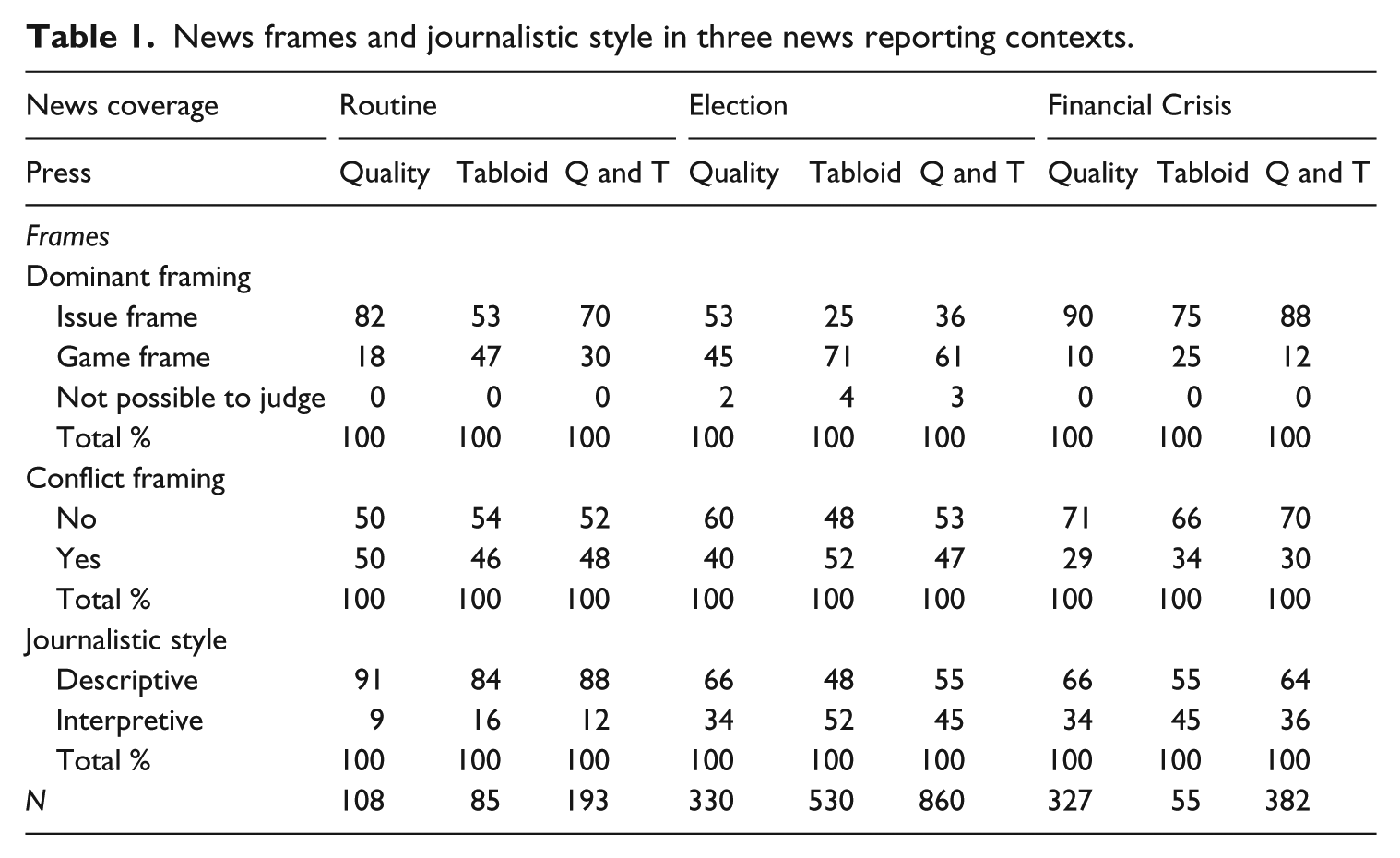
The first research question concerns the framing of political news in media content. The results confirm that the strategic game frame is used more frequently than the issue frame in election coverage. Use of strategic game framing is significantly more common in election news, making up for 61% of stories, than in routine news coverage with 30% strategy framing. In comparison, financial crisis coverage displays the least amount of strategic framing. These findings support the notion that election news focusses on the game rather than the issues in politics, but more importantly, these findings clearly show that election news differs from other political news. Thus, election coverage is more likely to use strategic framing and is in this respect not representative for all types of political news reporting. In other settings, there is still a dominance of issue framing. The results furthermore suggest that journalists to a greater extent exercise their independence in election contexts by introducing alternative perspectives in the news stories by focusing on the strategic aspect of the political game (Table 2).
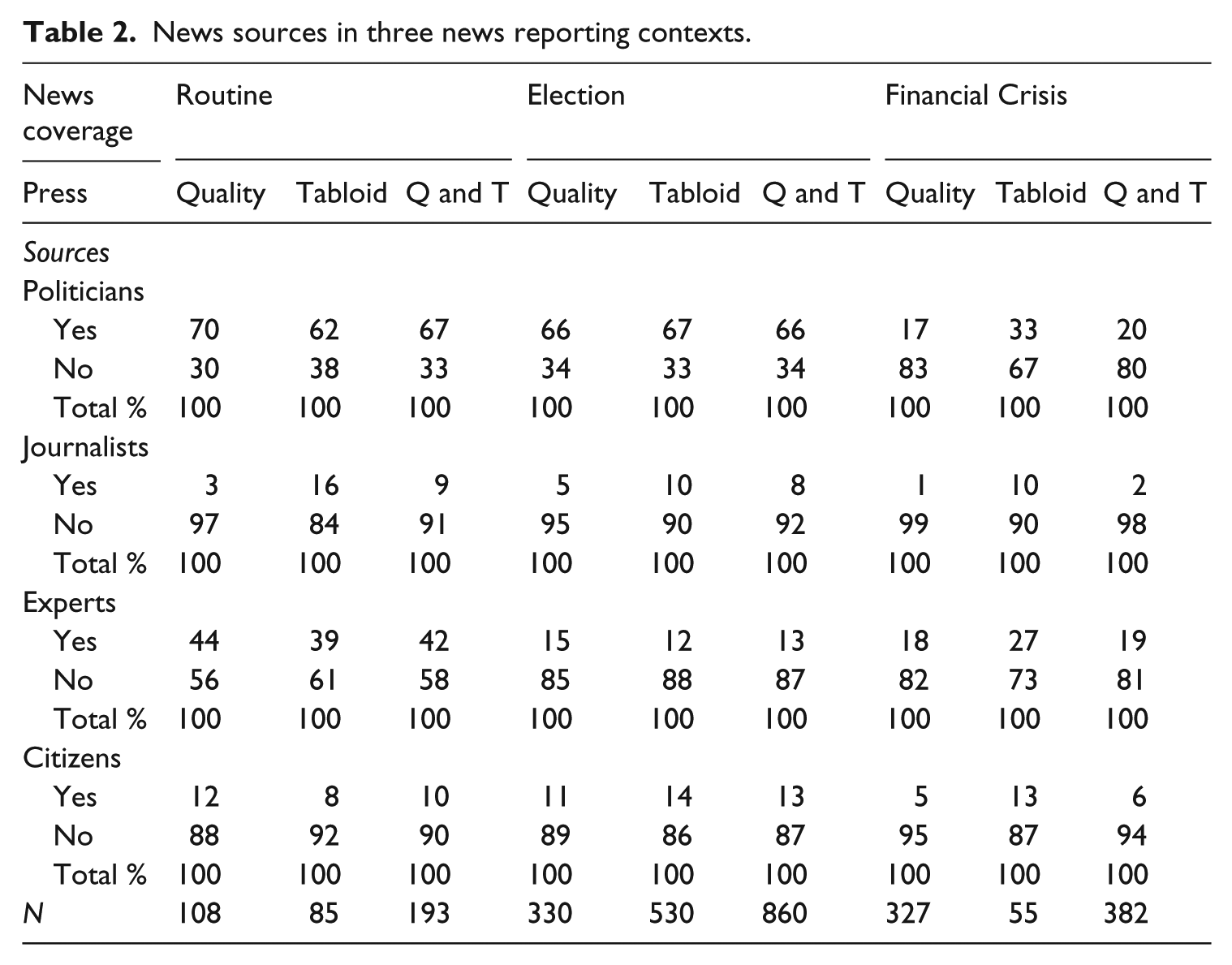
News sources in three news reporting contexts.
Turning to the frequency of conflict framing in political news coverage, results reveal a rather consistent use of the conflict frame. Here, the results show that election news include a conflict frame in 47% of stories, routine coverage in 48% and financial crisis coverage in 30% of stories. The frequent use of conflict framing in election and routine news stories indicates that journalists use independence strategies to stay objective by telling different sides of a story in political news.
Next, attention is directed at the second research question regarding journalistic style. The prevalence of interpretative versus descriptive journalism in election news coverage is consistent with expectations of issues almost becoming secondary in election news. The results show that 45% of stories are interpretative in election news. Financial crisis coverage displays 36% interpretative coverage. In contrast, routine news coverage only includes as little as 12% interpretative news stories. Thus, the prevalence of interpretative journalism characterizing election news coverage is not representative for all political news as it is distinctly less frequent in routine coverage. The findings point to journalists acting as observers when covering routine, whereas journalists in election coverage and financial crisis coverage additionally are required to analyse. The analytical freedom for journalists presupposed in interpretative news content is also perceived as empowering journalists (Table 3).
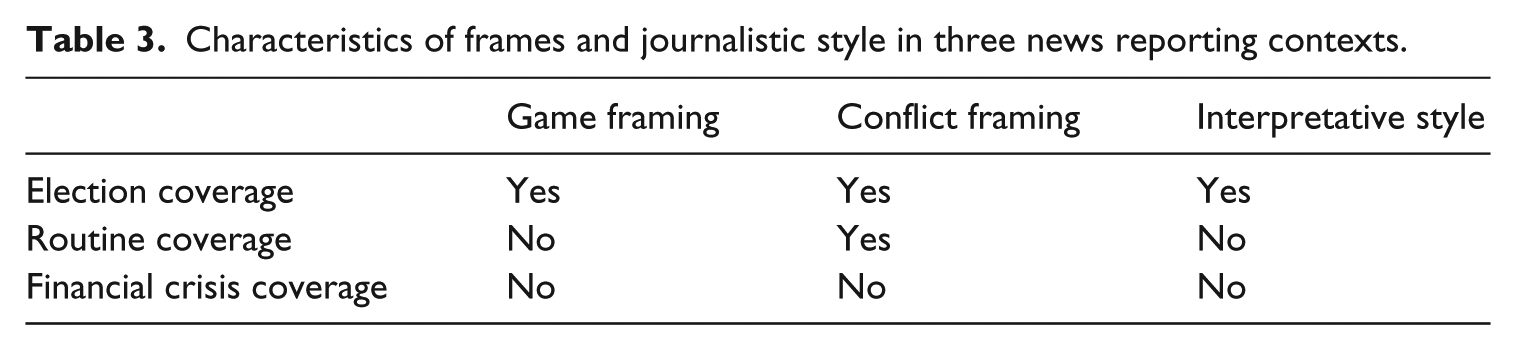
Characteristics of frames and journalistic style in three news reporting contexts.
Focusing on the third research question concerning use of different sources, the frequency of source categories will be examined in the three different cases of news coverage. The source categories included in the study are politicians, journalists, experts and ordinary citizens. Examining the inclusion of different sources is also a way of investigating whether news media reflect various voices in their coverage. The expected dominance of political actors is supported in election news as well as in routine news but not in financial crisis coverage. Political actors are present in 66% of election, 67% of routine and 20% of financial crisis stories. The paucity of politicians in financial crisis content is predictable since news coverage deals with both politics and finances.
The expectation of journalists as an important source category was neither supported in the election news context nor in any of the other news contexts. On the contrary, ‘media practitioner’ was the least used source in all types of news stories ranging from 8% in election coverage to 9% in routine coverage to only 3% in financial crisis coverage. Thus, the expectation of a high frequency of journalists interviewing other journalists is not observable in the media. When examining journalists as sources, the results show that election coverage is rather similar to other political news. Furthermore, the use of experts in election coverage is surprisingly low at 13%, in comparison to routine coverage with 42% of the stories including experts. Inclusion of experts is regarded as a strategy for journalists to include knowledge and perspectives challenging political dominance and expected in election news. Financial crisis coverage includes experts in 19% of the stories making politicians and experts equally frequent in that case. Hence, election news differs from other political news due to the least inclusion of experts as voices in the news stories. The results for inclusion of ordinary citizens were as follows: 10% in routine news, 13% in election news and 6% in financial crisis news. The lack of variance between the contexts suggests that ordinary citizens are included in news stories as part of a journalistic practice not influenced by the context.
In summation, election news coverage clearly differs from other types of political news coverage in terms of media independence and thus degree of mediatization. The findings suggest that political news coverage is influenced by the political context, and different events are characterized as follows. First, election news coverage is characterized by predominately game-framed news, a high frequency of journalistic interpretative style and also high frequency of conflict. Second, financial crisis coverage is characterized by predominantly issue-framed news, low levels of conflict framing and focus on descriptive style of news. Third, routine news coverage is characterized by a journalistic descriptive style, dominated by issue-framed news but with a high frequency of conflict framing. Thus, the results suggest that different contexts entail differences in the use of independence strategies by journalists.
However, the use of different sources is rather similar across the different contexts, only the use of politicians in financial crisis news and the use of experts in routine news diverge. These results indicate that journalists’ raw material as source information is much the same in different contexts and most probably based on journalistic routines and decisions on whom to include in the news-making process.
Discussion and conclusion
The overall purpose of this study was to add nuance to political news journalism by comparing election news coverage with other types of political news in terms of journalistic interventionism and the degree of mediatization in news media coverage. The study carried out a comparative analysis of news coverage in three different contexts within the same media system, namely, the Financial Crisis 2008, the Election Campaign 2010 and a period of routine political news coverage 2012 in Sweden. Based on previous research, election news coverage indicates political news journalism characteried by increasing mediatization where media logic rather than political logic governs media content (for an overview, see, Kaid and Strömbäck, 2008: 424). However, non-election news research often claims that news media are less independent from political actors and actually tend to rely heavily on official sources and perspectives (Althaus, 2003; Bennett et al., 2006; Entman, 2004; Wolfsfeld and Sheafer, 2006). The take of this study is, thus, that it is conceivable that the degree of mediatization varies between election and non-election coverage and that assumptions made about mediatization of political news based on election news cannot be taken for granted.
The cross-contextual perspective revealed differences and similarities across the different political news contexts concerning framing and source use in Swedish news media. The study demonstrates that election news coverage is notably different from other political news coverage especially in terms of framing. In summary, the results display that election journalism is more likely to frame politics as a strategic game and to allow journalists to use an analytical voice due to an interpretative style. Conversely, financial crisis coverage and routine coverage are significantly more likely to focus on substantive issues and be much more descriptive in journalistic style. Overall, the results clearly indicate that different contexts entail differences in the use of independence strategies by journalists and different opportunities for political dominance. However, the use of different sources is rather similar across the different contexts with political actors as the most dominant source category in all three contexts. These results indicate that journalists’ raw material for news, as sources, is similar in different contexts and probably explained by journalistic selection routines and decisions.
Nevertheless, these findings definitely indicate that election news coverage in Sweden is not representative for all political news journalism in terms of media interventionism and the degree of mediatization. The proposition of increased media independence based on election news research is thus limited by empirical evidence of a more reactive journalism in non-election news coverage. Non-election coverage is considerably more focussed on political issues and provides a more descriptive style of news, indicating media content governed by political logic rather than by media logic. The empirical findings of this study are thus in line with the process-oriented description of mediatization, suggesting that the degree of mediatization is dependent on a variety of factors and varies over time and space (Zeh and Hopmann, 2013). Accordingly, this study proposes a more nuanced picture of the mediatization of political news journalism in which the degree of mediatization is dependent on the context of news reporting and the use of independent strategies varies between different events.
The results furthermore suggest that, news reporting is guided by different dynamics in different contexts. Differing journalistic norms, routines and practices could be a function of specific circumstances of political journalism. News reporting in the election context suggests journalism guided by an independence ideal that plays out in coverage (Esser, 2008). The election as an important democratic process may emphasize the expected role of journalists as being politically unbiased and non-partisan. It can also be argued that election reporting is a portable and transferable concept with independence strategies ready to be used by any journalist or media (Lawrence, 2010). The pattern of increasingly mediatized election coverage across various political and media settings (for an overview, see, Strömbäck and Kaid, 2008) hints at journalism guided by a specific election dynamic. In contrast, everyday routine political coverage suggests journalism highly influenced by political actors. Journalists are less inclined to present interpretations and to use the game frame indicating the use of independence strategies in news reporting. Thus, routine coverage of politics seems to reflect a common news reporting dynamic where journalists tend to be more reactive than proactive (Shehata, 2010). Finally, news reporting during a crisis suggests journalism trying to make sense of an event and thus allowing various voices to be heard in news stories. However, the dynamics of an unexpected crisis also entails that journalists’ independence, manifested in framing, can be heavily limited as there are no predetermined reporting patterns or concepts to follow (Bennett et al., 2007).
The main conclusion from this study is, thus, that mediatization along the third dimension, focusing of media content, is substantially influenced by the specific context of the news coverage. Mediatization of political news journalism may be moderated not only by national journalism cultures or national political communication cultures but also by different news reporting contexts such as the election campaign. Future research should further investigate how different circumstances can result in different dynamics guiding news reporting. This type of research would necessitate different combinations of research designs and methods focusing on journalistic norms and practices as well as ‘behind-the-scenes’ interactions between journalists and different sources.
Footnotes
Funding
This research received no specific grant from any funding agency in the public, commercial or not-for-profit sectors.