







Abstract
This article examines the changes to employment regulation in Portugal during the sovereign debt crisis and assesses their impact on collective bargaining in manufacturing. The changes were wide-ranging and had a negative immediate impact on the process and outcome of bargaining. While this is consistent with the experience of other EU member states in similar circumstances, the changes in Portugal continued the pre-crisis path of reform. Despite significant corrosion and weakening of collective bargaining, there were also signs of resilience. Nevertheless, prospects for a renewed regulatory role for collective bargaining still appear uncertain. We offer some explanations for the distinctive experience in Portugal.
Introduction
Following Greece and Ireland, in April 2011 Portugal became the third European Union (EU) member state to request financial assistance. In May, it was granted a €78 billion loan by the EU, the euro area member states and the International Monetary Fund (IMF). This required the commitment to a 3-year programme of fiscal consolidation and structural reforms laid out in a memorandum of understanding (MoU). The latter prescribed a set of detailed fiscal consolidation and structural measures, including labour market reforms to relax employment protection, to make working time more flexible and to decentralize collective bargaining.
Research has already shown that the changes to labour law in Southern European countries during the crisis have undermined multi-employer bargaining arrangements (Marginson, 2014; Rocha, 2014). In Portugal, the sharp decline in the number and coverage of collective agreements concluded between 2009 and 2013 suggests that the impact of the crisis has been severe and comparable to that in Greece, Ireland, Spain and Romania (Marginson, 2014; Marginson and Welz, 2014; Schulten and Müller, 2014). However, many issues are still not well understood. First, the literature tends to assume a strong association between the measures adopted under the adjustment programmes and the deterioration of collective bargaining, but the decline in bargaining in Portugal started before the programme. Therefore, this association in Portugal may not be linear, so closer inspection is needed. Second, the extent to which the decline in new collective agreements has affected the overall coverage of bargaining is not very clear. There are now data indicating that the decline in overall bargaining may be lower than previously thought (Addison et al., 2015; União Geral de Trabalhadores (UGT), 2014). We must therefore examine this evidence to understand these decentralization trends and their implications under the new legal framework. Finally, while it is already known that the pressures of the crisis and the legal changes had a negative impact on employment and wages (Rocha and Stoleroff, 2014), there is not much research on how the new legal framework in Portugal affected the regulatory capacity of employers and unions. We aim to address these gaps in existing research and thereby enable a better understanding of the process of adoption of the labour market measures in Portugal, their substance and their impact on collective bargaining and its outcomes.
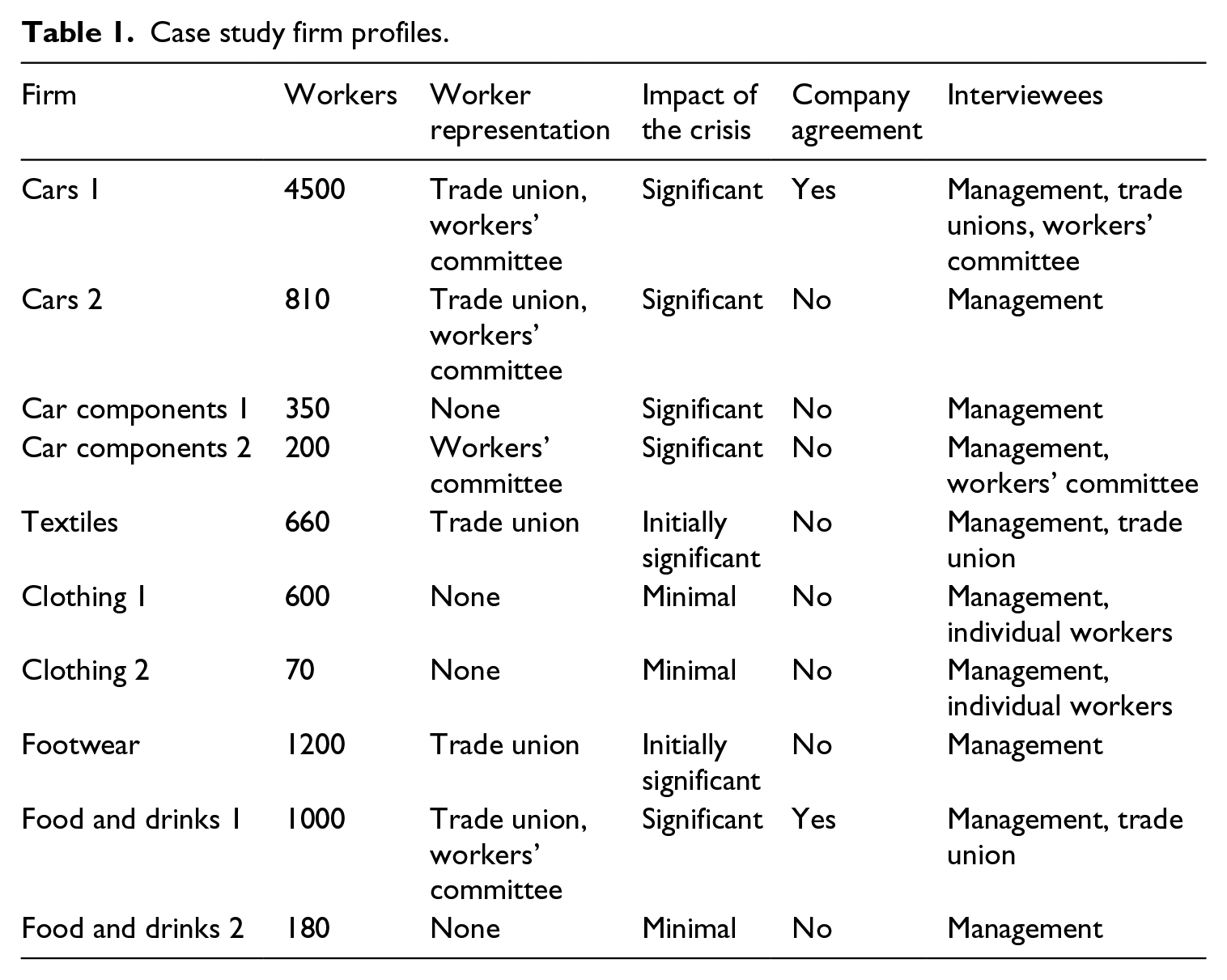
In addition to a systematic review of the regulatory framework and institutional context of collective bargaining, we draw on 30 interviews with representatives from employer and union organizations at the national, industry and firm level, conducted by the authors between April and August 2014. Those at the firm level took place in 10 plants in three manufacturing industries: metal and automotive, textiles and footwear, and food and drinks. These are the largest manufacturing sub-sectors in employment terms, were under varying degrees of pressure during the crisis (strongest in metals and automotive) and differed in the level of labour intensity and in the level of unionization (traditionally higher in metals than in the other two). The companies were selected with the aim of achieving a group of cases that would be sufficiently diverse to represent the range of employment relations issues facing manufacturing companies in Portugal during the crisis. Therefore, they differed in size, in the presence of union and non-union structures and in whether they had a company agreement. Their names are withheld for the sake of anonymity, but a summary of their features is shown in Table 1. The interview data were complemented with industry and firm collective agreements and quantitative data from government and union sources.
Case study firm profiles.
The next section sets the context of the reforms with an outline of the key features and trends in Portuguese employment relations before the crisis. This is followed by an analysis of the process and substance of the labour market changes. We then focus on their impact on the process, structure and outcome of collective bargaining. The concluding section assesses the significance of the changes in Portugal in a broader European perspective.
Industrial relations and collective bargaining before the crisis
The legacy of the right-wing authoritarian regime, the political turbulence of the revolutionary period and the democratic transition of the mid-1970s still mark Portuguese employment relations (Barreto and Naumann, 1998). The low-trust adversarial climate, the tradition of state intervention and a politicized and divided labour movement are part of this heritage (González and Figueiredo, 2015; Sousa, 2009). Protective employment legislation is founded on a comprehensive set of social and employment rights enshrined in the 1976 Constitution that was conceived in the post-revolution aspiration for the construction of a socialist society (Barreto and Naumann, 1998).
Subsequently, the traditionally adversarial industrial relations were becoming less so, with a decrease in strike activity (Dornelas et al., 2006) and an increase of understandings reached between the social partners and the government in macro-level concertation. Tripartite agreements focused initially on incomes policies, but, as social concertation consolidated in the 1990s and 2000s, their content shifted to broader areas of employment, social security and collective bargaining (Royo, 2002). Social dialogue and tripartite agreements have had an important role in facilitating change in social and employment policy. However, as central confederations have limited authority to transpose the agreements reached at central level into collective bargaining, social concertation has lacked capacity to orient change in the workplace consistent with the decisions reached at national level (Dornelas et al., 2006). Another limitation is that the Confederação Geral dos Trabalhadores Portugueses (CGTP), the largest and more radical of the two union confederations, although engaging in social dialogue has often refused to sign tripartite agreements (Campos Lima and Artiles, 2011). Yet, there had been progress in achieving macro-level agreements with the CGTP just before the crisis. In 2005 and 2006, along with the UGT, the more moderate and concertation-oriented union confederation, it signed two bilateral agreements with the employers’ confederations – one on vocational training and another on collective bargaining – and a tripartite agreement in 2006 for a phased increase in the national monthly minimum wage to €500 by 2011 (Naumann, 2013). The latter was to be breached during the crisis and the minimum was frozen at €485 between 2011 and 2014.
Collective bargaining in Portugal has been dominated by industry-level bargaining, but with low levels of coordination and articulation (European Commission, 2004). There is only limited centralization because the fragmentation of both unions and employers’ associations results in bargaining authority being distributed among multiple organizations in each sector (European Commission, 2004). Company agreements are rare, but in some sectors (fishing, warehouses, transport and communications) they cover a significant proportion of workers (Dornelas et al., 2006). Articulation between levels of bargaining has remained very low despite being legally possible since legislation in 2003 (Ramalho, 2013). These features result in a relatively weak system of bargaining, with only limited capacity for effective regulation. Many provisions in collective agreements merely repeat legal norms, and there are implementation gaps between collective agreements and workplace practice, especially with regard to working time and the nature of the employment contract (Dornelas et al., 2006). Nevertheless, and despite the relatively low union density – which fell sharply in the 1980s and is now below 20 percent (Sousa, 2011) – the coverage of collective bargaining has remained high with estimates before the crisis varying between 65 percent (European Commission, 2013) and 92 percent (Naumann, 2013). This resulted from legal extensions of industry agreements and ‘after-effect’ rules whereby expiring agreements remained valid until renegotiated (Naumann, 2013; Ramalho, 2013). However, these rules started to be challenged, as it was claimed that they inhibited the renegotiation of agreements, and the representativeness of the negotiating bodies was questioned (Comissão do Livro Branco das relações Laborais (CLBRL), 2007; Sousa, 2011). Other trends before the crisis included employers’ demands for greater flexibility over dismissals, working time and overtime rates. However, the social partners on both sides remained generally comfortable with sectoral bargaining and the legal extension of agreements (Dornelas et al., 2011). Employers’ demands for flexibility were partly addressed by the 2003 Labour Code, which unified the different aspects of employment law into a single act and introduced major changes to labour regulation and collective bargaining. These changes, which were at the time strongly contested by the unions, represented a turning point in the logic of collective bargaining and influenced the developments observed during the crisis. The substance and the effects of those developments are discussed below, together with an analysis of the legal changes introduced during the crisis.
Macro-level developments during the crisis
The process of reform
The process of change in Portugal differed somewhat from other countries undergoing parallel reforms or subject to assistance programmes. Key differences include the greater involvement of the social partners and the role played by the Constitutional Court (Tribunal Constitucional) in setting boundaries to austerity and deregulation. The social partners were involved from the outset. During the negotiation of the MoU, the Troika consulted the union and employers’ confederations; the employers and UGT pressed for the integration of the measures proposed in a tripartite agreement concluded 2 months earlier (Campos Lima, 2011). The MoU integrated many of these proposals but went further, particularly by widening the possible grounds for dismissals and advocating restrictions to the extension of sectoral agreements. The implementation of the MoU by the right-wing coalition government involved renewed, albeit tense, consultations with the social partners. Despite several protests and a joint general strike, the government and all the social partners except the CGTP signed a new Tripartite Agreement in January 2012, paving the way for the revision of the Labour Code. However, social dialogue deteriorated throughout 2012 and 2013 as the social partners on both sides accused the government of disregarding commitments made in the tripartite agreements. These breaches included suspending the extension of collective agreements, unilaterally introducing new rules and prioritizing budget consolidation over measures to stimulate growth and to address unemployment (Távora and González, 2014).
On five occasions, the Constitutional Court ruled against government austerity policies and labour market reforms that had been prescribed by or that went beyond the MoU. These included cuts to pensions and public sector wages and legislative changes that curtailed collective bargaining. In response to calls from the EU authorities, the possibility of integrating public deficit and debt targets in the Constitution was debated in 2010 and 2011, but the prevailing view was that these were not the fundamental matters that should guide economic and social policy (Távora and González, 2014).
The substantive measures
The changes to labour law introduced in Portugal under the adjustment programme were consistent with the EU policy of budget consolidation and internal devaluation. As stated in the MoU, the measures were designed to align wages to firms’ productivity through organized decentralization. However, many of the measures prescribed by the MoU had already been included in a tripartite agreement that preceded the request for financial assistance. Also, an important process of reform to labour law had already started with the 2003 Labour Code, which introduced a number of innovations including flexible working time regimes and changes to collective bargaining. These involved eliminating the principle that collective agreements could only set more favourable conditions than the legal standards and restricting the obligatory ‘after-effect’ rule. However, many collective agreements included clauses reproducing this legal norm, thereby specifying that they would remain valid until a new agreement was reached, and these ‘successive renewal clauses’ were not affected by the 2003 legislation. The 2009 Labour Code, which continued the reforms to collective bargaining, enabled the expiration of successive renewal clauses and clarified the legal after-effect periods. Should any of the parties request the expiration of an agreement, its after-effect period would be 18 months, whereas successive renewal clauses would have the maximum duration of 5 years. This Labour Code also introduced a new mechanism to supplement existing provisions for voluntary and compulsory arbitration: ‘necessary arbitration’ could be requested by either side in the specific case of the expiration of a collective agreement. The new Code also granted bargaining powers to non-union representative structures in companies with more than 500 employees, although this still required trade union autorization. On the other hand, the 2009 Code partly reinstated the favourability principle, ring-fencing a range of areas which collective agreements could not derogate from the law. These included ‘personality rights’ (such as freedom of expression and opinion, personal integrity, privacy of personal and family life, protection of personal data, prohibition of unjustified surveillance), equality and non-discrimination, protection against unilateral wage reductions, working time limits and employers’ information obligations.
The changes to collective bargaining following the MoU were to a great extent a continuation of these reforms. The 2012 revision of the Labour Code reduced the size threshold required for non-union structures to be able to conclude company agreements from 500 to 150 workers, but kept the requirement of a union mandate. Moreover, although previous legislation had already enabled clauses articulating agreements at different levels, the 2012 Code specifies that sectoral agreements can contain clauses delegating matters of functional and geographical mobility, the organization of working time and compensation to lower levels of bargaining. At the same time, a new decree-law created a Centre for Labour Relations to provide data and technical support for the parties to collective bargaining. Most controversially, the government introduced representativeness criteria for the extension of industry agreements, requiring signatory employers’ associations to represent firms employing at least 50 percent of the workers of the industry to which the agreement applies. While most of the legal changes had been subject to consultation with the social partners and had been included in the Tripartite Agreement signed in January 2012, these criteria were imposed unilaterally. After protests by the social partners, these rules were relaxed in 2014, with alternative criteria of at least 30 percent of the affiliates of the signatory employers’ association being small and medium-sized enterprises (SMEs). Given that 99.9 percent of Portuguese firms are SMEs (Instituto Nacional de Estatística (INE) 2012), this means that extensions of sectoral agreements are formally possible in practically all cases. Other legal changes in 2014 were less favourable, making it possible to suspend collective agreements for economic reasons and reducing the after-effect period from 18 to 12 months and the validity of successive renewal clauses from 5 to 3 years. The measures also extended to other wage determination processes: as noted above, the national minimum wage was frozen, breaching the 2006 tripartite agreement.
Another area of change was working time flexibility and the compensation for overtime work. The 2012 Labour Code continued reforms initiated in 2003 introducing different regimes of working time flexibility, including time accounts in 2009. In particular, it introduced individual and group time accounts, which could be negotiated directly between employers and employees within firms: a departure from the previous regime which required time accounts to be set by collective agreement. The same legislation reduced by half the premium for overtime work, suspended for 2 years the norms in existing collective agreements setting higher rates and ruled that after the 2-year suspension, the collectively agreed values that had not been adjusted were to be reduced by half. The Constitutional Court revoked the restriction on collective bargaining on these matters beyond the 2-year period. The government subsequently extended the suspension period by 5 months until the end of 2014. The new Code also abolished an entitlement to compensatory rest after overtime work and overruled dispositions in collective agreements that provided that entitlement, but again the Court overturned the restrictions on collective bargaining on this matter. The same happened with the abolition of collectively bargained entitlements to extra annual leave rewarding workers with low absenteeism. In addition, the 2012 Code facilitated the reduction or suspension of work (lay-offs) by firms in economic difficulties but increased the protection of the workers affected through restrictions on their dismissal. Finally, the changes to working time regulations also included the abolition of four national public holidays.
Employment protection legislation is the one area that had not previously been subject to major reform, mainly because of union opposition. This changed dramatically during the crisis; following the MoU, individual dismissals were facilitated and severance pay was substantially reduced. Compensation was reduced from 30 to 20 days’ pay and then to 12 days per year of tenure. The situations in which dismissals could be justified were extended and the requirements eased, particularly in cases of job extinction and worker unsuitability, although this was partly overturned by the Constitutional Court.
In sum, except for employment protection legislation, most of the changes introduced during the crisis were a continuation of previous reforms. Among those that were less consistent with that path, most had a temporary effect, either by design (the minimum wage freeze and the suspension of collectively agreed rates for overtime pay), because of subsequent changes (the restrictions to the extension of sectoral agreements) or because of Constitutional Court rulings (the restrictions on collectively agreed overtime pay).
Micro-level effects
The impact on the structure of bargaining
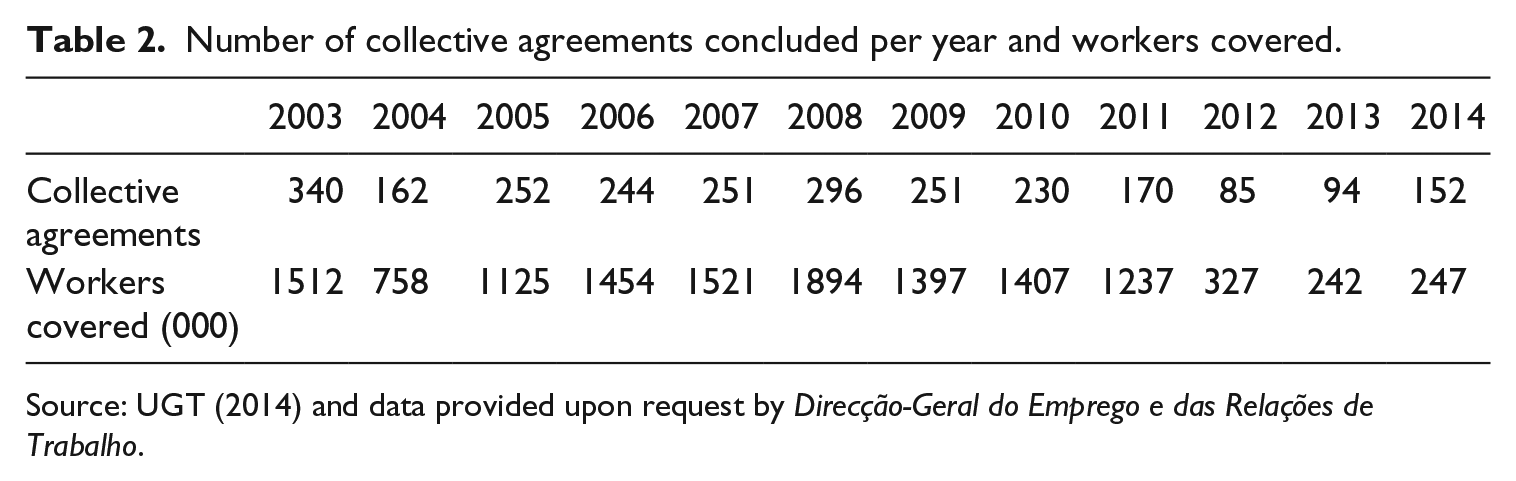
There was a dramatic decline between 2008 and 2012 in the number of collective agreements concluded in the private sector (from 296 to 85) and the workers covered by these (from 1.9 million to 243,000) (UGT, 2014, 2015). Although the number of company agreements declined, their proportion of the total rose from 33 to 46 percent. The trend started to reverse in 2013, when number of collective agreements rose to 94, and to 152 in 2014; but this did not translate into significantly increased coverage, mainly because the increase primarily involved company agreements, which for the first time accounted for more than half of all agreements. The decline in coverage between 2008 and 2013 also reflected fewer extensions of sectoral agreements: from 137 in 2008 to only 17 in 2011, 12 in 2012 and 9 in 2013 (UGT, 2014). The relaxation of the conditions for extensions in 2014 was associated with an increase to 16 in 2014 (data provided by Direcção-Geral do Emprego e das Relações de Trabalho (DGERT)).
Although these data indicate a decentralization trend during the crisis, they should be interpreted with caution since they refer to agreements concluded during the crisis and do not include workers covered by valid pre-existing agreements. Most comparative research relies on the same type of data, and as a result, there has been some misrepresentation of the decline in the overall coverage of collective bargaining in Portugal. For example, Schulten and Müller (2014: 102) report that bargaining coverage in Portugal declined to 34 percent, whereas a Eurofound report (Campos Lima, 2014) estimated that 1.5 million workers in 2012 and 1.6 million workers in 2013 were not covered by a collective agreement. However, as these figures are inferred from the decline of new agreements, they do not take into account that workers not covered by new agreements may still be covered by existing agreements. There is recent evidence that the number of workers covered by valid agreements remained largely stable throughout the crisis. A study by Addison et al. (2015) that relies on employer data collected by the government (Quadros de Pessoal and Relatório Único) reports that private sector workers covered by a new or existing collective agreement declined only modestly, from 91.5 percent in 2010 to 89.2 percent in 2012. This is consistent with the UGT (2015) data for 2014, showing that the coverage of all valid collective agreements was still above 89 percent in 2013.
Between the publication of the 2003 Labour Code and the end of 2014, only 35 collective agreements expired (UGT, 2014 and DGERT data for 2014). No data are available for the number of workers affected, but according to interviewees from both employer and union confederations, they were not many. Also, some of the collective agreements which expired were replaced by new ones, as in metalworking and car manufacturing, where the sectoral agreements with CGTP unions expired but UGT unions reached new agreements with the employers’ associations and these were extended to cover most employees in these industries. Although since 2003 the law allowed agreements to expire, this only happens if one of the signatories requests it, and the after-effect limits apply only then. Interview data with the central employer and union confederations show that while the new rules were used to pressure unions in negotiations, employers have been reluctant to let agreements expire in the face of significant union resistance, even when they are keen to introduce major changes to previously agreed terms. In the perspective of the interviewees from both sides, this is because they see collective bargaining as beneficial for both parties and because neither wants to jeopardize a relationship that is in both their interests.
Continuity and change
The decline in the number of new agreements started before the crisis, as shown in Table 2. There was a sharp fall between 2003 and 2004, a gradual increase until 2008, another decline until 2012 and then a slight recovery. These figures suggest that the decline in bargaining was not just caused by the changes imposed after the involvement of the Troika, although these may have added to the pre-existing problems.
Number of collective agreements concluded per year and workers covered.
Source: UGT (2014) and data provided upon request by Direcção-Geral do Emprego e das Relações de Trabalho.
Indeed, in explaining the present bargaining difficulties, social partner interviewees tended to start their accounts with the 2003 Labour Code. At the time, it was widely believed that collective agreements should be allowed to expire, given pervasive views that existing agreements were not fit for purpose. It was also widely believed that trade union resistance was preventing the modernization of work organization. According to interviewees from both employers’ associations and UGT, although collective agreements were renewed and republished, the main changes had long been restricted to wage updates and other pecuniary matters. Much of the content had remained the same, in many cases since the 1970s and 1980s. The exceptional circumstances of the revolutionary period were favourable to labour, enabling the introduction in collective agreements of a number of ‘rights’ that unions had since been reluctant to forgo. Yet in the meantime, many norms had become outdated because they had either been revoked by subsequent legislation or had been overtaken by changing workplace practice. The interviews revealed that the issues that had been most contentious were working time flexibility and overtime pay. The latter had reached very high levels (up to three times the normal rate) which had been secured upon the understanding that overtime work should be discouraged for work-life balance reasons and used only in exceptional situations. However, being one of the relatively few flexibility strategies available to employers, regular overtime had gradually become a widespread practice in manufacturing and overtime pay, given low manufacturing wages, had become an important part of many workers’ earnings. Thus, lowering overtime pay or reducing opportunities for overtime work through working time flexibility would reduce their wages. This explains unions’ resistance to agree to any changes unless, as explained by the UGT interviewee, these were compensated by increases in basic pay or other pecuniary benefits. Yet in the view of the CGTP, sectoral agreements have never prevented company adjustments and the real purpose of employers’ demands for flexibility has always been to reduce labour costs. In this perspective, union concessions on matters of overtime pay and flexibility would only reinforce a model of low added value that was against the national interest and no longer sustainable.
The interviews provide little evidence that employers had ever considered offering pecuniary compensation in return for working time flexibility and reduced overtime pay. While this helps in understanding the bargaining difficulties even before the crisis, as the economic situation deteriorated the unions’ concern with protecting wages started to give way to the need to secure the survival of businesses and protect jobs. Also, with increasing risk that existing agreements would expire, unions were under pressure to make concessions in order to reach new agreements. These pressures were reinforced by the new legal framework allowing time accounts to be individually negotiated in the workplace unless they were regulated by an applicable collective agreement. Despite the increased incentives for unions to reach agreements with employers, other factors created new risks and disincentives for the parties to conclude agreements. The statutory cut in overtime pay, suspending existing norms in collective agreements, was implemented, but for a long period there was uncertainty because of the appeal to the Constitutional Court. After its decision in favour of the temporary suspension, there were doubts whether this period would be extended and what would happen after that. This created dilemmas in negotiations because the degree to which newly negotiated overtime pay rates would benefit either of the parties would depend on those future unknown circumstances. In addition, the restrictions to extensions also created disincentives to sectoral bargaining on the employer side. The employers’ associations in textiles and footwear refused to sign agreements, claiming that negotiating wage increases that would not be extended would mean exposing their associates to unfair competition from non-affiliated firms and encouraging the disaffiliation of current members.
At company level, the economic crisis itself appeared to increase industrial conflict and bargaining difficulties, especially where there were redundancies, although among the firms studied there were also cases of increased worker cooperation. In these cases, workers were concerned to help the firm overcome the crisis, avoiding bankruptcy or (further) redundancies. However, the cuts to overtime pay exacerbated workplace conflict, as unions and workers viewed them as a breach of existing collective agreements. Industrial action against overtime pay were widespread during the crisis.
Although the proportion of company agreements has increased, the absolute numbers are still below those of 2008. Notwithstanding the increased legal scope for workers’ committees to sign company agreements, the interviews reveal no tendency for these opportunities to be used. This is mostly because this still requires a mandate from the unions, which are generally averse to providing this. Despite the new mechanism introduced in 2009, arbitration continues to play practically no role in resolving industrial disputes: according to the interviewee from UGT, there were only two arbitration processes completed in the last 10 years (see also Ramalho, 2013). The interviews also revealed that articulation clauses between agreements at different levels, legally possible since 2003 and further encouraged by the 2012 legislation, are hardly ever used. Finally, despite the creation of the Centre for Labour Relations in 2012, there were few indications in the interviews in 2014 that it was effective or indeed even existed.
Impact of the reforms on bargaining outcomes
Although overall bargaining coverage has remained largely stable, a major consequence of the decrease in new agreements was that a large proportion of workers did not benefit from bargained wage increases during the crisis. AMECO and OECD online data indicate that while nominal wages did not decrease in Portugal as it happened in other countries, most notably Greece, they stagnated during the crisis years and real wages decreased. Eurofound (2014) and UGT (2014, 2015) report a decline in bargained real wages in 2011 and 2012, while Rocha and Stoleroff (2014) show that average increases in bargained nominal wages declined from 3.1 percent in 2008 to 1.4 percent in 2012. In addition, the study by Addison et al. (2015) reveals that in 2012, 86 percent of workers experienced real wage decreases and 76 percent experienced nominal wage freezes. These developments can be to a great extent explained, as those authors also notice, by the significant decline in new agreements, by the restrictions on extensions and by the freeze in the national minimum wage. In addition, the cuts to overtime pay, and new working time flexibility regimes that reduce employers’ needs for overtime work at premium pay, also contribute to the explanation.
The responses of the social partners to the legislative changes during the crisis varied considerably from sector to sector and, on the union side, between the UGT and CGTP unions. UGT unions acted pragmatically and sought agreements with employers’ associations that incorporated time accounts within some boundaries and that provided some protections for workers. Some reduced overtime pay but to levels that were still higher than the new legal rates. In contrast, most CGTP unions continued to oppose time accounts and refused to reduce overtime pay. As a result, in a number of sectors, CGTP collective agreements expired, while the UGT increasingly reached agreements with the employers’ associations. Although the CGTP has a higher membership base in manufacturing, the collective agreements now applying in industries such as chemicals, metal and car industries have mostly been concluded by UGT unions. However, the UGT has also faced difficulties in recent years in reaching agreements in sectors such as chemicals, where no wage increases have been bargained at sectoral level. Textiles, clothing and footwear are rather exceptional, in that the CGTP federation for the sector has taken a more pragmatic approach than most CGTP organizations. Nevertheless, this sector also faced severe blockages during the crisis, mostly because the employers’ associations resisted wage increases that would not be extended to non-affiliated firms. After a 3-year blockage, an agreement was signed only in July 2014 and involved only one of the six employers’ associations though the others followed in 2015, in the context of the relaxation of extension rules. The effect of the bargaining blockages in these industries was exacerbated by the minimum wage freeze since pay in these industries is often so low that the national minimum wage regularly exceeds the bargained rates for most workers (Távora and Rubery, 2013). Consequently, pay increases for workers in these industries became mainly dependent on managerial prerogative.
The legislative changes also reinforced managerial unilateralism with regard to overtime pay and working time flexibility. The case studies revealed a number of situations of non-compliance with collective agreements. In metal manufacturing, some companies had their own working time flexibility arrangements (both ad hoc and regular) that were at odds with the sectoral framework. One clothing firm paid overtime at basic rates without any premium, thereby breaching both the sectoral agreement and the law. While deficits in the implementation of collective agreements have long been a feature of Portuguese industrial relations (Dornelas et al., 2006), under adverse economic circumstances and growing unemployment, workers became more compliant and less likely to challenge managerial authority. Yet, the new collective agreements reached in metal and car manufacturing regulating time accounts reduced the implementation gap because they regulated time banks, which had already been introduced in many firms.
Discussion
The sovereign debt crisis in Portugal saw intense labour market reform, but this continued, although somewhat disrupting and accelerating, a process that was already in motion. While the reforms initiated in 2003 had been strongly contested by the unions, the bilateral and tripartite agreements signed in 2005 and 2006 involving even the more radical sections of the labour movement had signalled a growing consensus on the need for reform and how this was to be achieved. However, the outbreak of the crisis and the intervention of the Troika enabled the government to implement measures that the unions had previously considered unacceptable.
Instead of leading to greater bargaining dynamism and organized decentralization as intended, the reforms created contradictory pressures and exacerbated pre-existing blockages. The case of manufacturing industry suggests that in Portugal, the resulting disorganization and decentralization of bargaining were manifest not so much in an increase in company agreements, as it happened in some other troubled EU member states, but in the growth of individualized arrangements and a reinforcement of managerial unilateralism.
Decentralized firm-level responses outside the scope of sectoral bargaining shifted a disproportionate share of the burden of the crisis from employers to workers, who experienced greater employment insecurity and falling real wages. However, despite the heavy social costs of the measures, the extent to which they contributed to increased company adaptability and competitiveness is contested. Many argue that while wage freezes and job cuts may help troubled firms return to profit, this reinforces a cost-minimization competitive strategy that does not lead to long-term sustainable growth. In the short term, it depresses domestic demand more than it increases exports and consequently also constrains growth in non-export sectors (OECD, 2014; Rocha and Stoleroff, 2014; Schulten and Müller, 2013).
Many of the reforms in Portugal were similar to those undertaken in other European countries in parallel circumstances, namely, the weakening of sectoral bargaining, the general decentralization trends and the reinforcement of managerial prerogative (European Trade Union Institute (ETUI), 2015; Marginson and Welz, 2014). However, while the breadth of the changes was similar, affecting most areas of employment regulation, their depth was less: for example, the minimum wage was frozen rather than cut, sectoral bargaining was constrained but not abolished, firm-level representative bodies still required a trade union mandate in order to sign agreements and the changes to the after-effect only apply upon request of one of the parties. Their impact also appears somewhat less severe, both on the structure of bargaining and also on its outcomes: a decrease in new agreements but not in overall bargaining coverage and, despite falling real wages, nominal wages did not decrease as observed elsewhere. Therefore, despite significant erosion, the system may be at a lower risk of collapse. This less pronounced impact may be explained by the greater input of the social partners, which allowed some continuity with the previous path of reform and a more incremental change process. In addition, the specific role played by the Constitutional Court in setting boundaries to deregulation also helps in understanding the less radical path of change in Portugal during the crisis. The exercise of this role was only possible because the Court’s decisions are guided by a constitutional text oriented by strong social-democratic values that have not so far been constrained by the introduction of constitutional fiscal rules.
Rather than being a ‘frontal assault’ to multi-employer bargaining (Marginson, 2014), the reforms in Portugal can also be interpreted as a form of state interventionism designed to impose immediate wage restraint when attempts to achieve the same goal through organized decentralization appeared ineffective in the short term (see also Addison et al., 2015). Still, this process exposed some of the weaknesses of the bargaining system, including its reliance on institutional protections that can be withdrawn at the government’s discretion. Moreover, it had significant consequences for the regulatory capacity of the actors. At national level, despite the initial involvement of social partners in the adoption of the measures, the government progressively increased unilateralism, which reduced their ability to influence subsequent decisions on labour market policy. Furthermore, government interventionism interfered with the autonomy of bargaining and its outcomes, particularly with regard to overtime pay. In addition, the reforms to collective bargaining initiated in 2003 led to a gradual shift in regulatory capacity from unions to employers and intensified in the context of the crisis. Even if some of the reforms (such as the changes to the after-effect rules) could facilitate the renewal of agreements and potentially reduce implementation gaps, they have significantly weakened unions. As the threat of expiration of agreements pressures unions to make concessions, the question of how to avoid the deterioration of employment standards of workers in each bargaining round remains a major challenge.
The shift of regulatory capacity in favour of employers took place both at the sectoral level because the changes weakened unions’ bargaining power and aggravated divisions within the labour movement and, at company level, because they reinforced managerial prerogative. Some of the individual employers in our study welcomed the reforms, but for the majority of Portuguese firms (non-unionized and small), the changes may have little practical effect. As employers’ selective compliance with the collective agreement has remained largely unchallenged, there have long been high levels of managerial discretion (Stoleroff, 2014). However, developments during the crisis suggest that for larger firms, more often unionized, unilateralism in labour market policy reform and lower union capacity to regulate employment through sectoral bargaining may result in the long run in even greater workplace adversarialism.
Overall, the reforms undertaken during the crisis have led to the weakening of social dialogue and collective bargaining at all levels. Despite recent signs of economic recovery, the end of the adjustment programme, the lifting of some of the most disruptive measures and a tentative growth of bargaining activity, a return to previous levels and the prospects for a renewed role for collective bargaining in labour market regulation appear highly uncertain. Yet at the end of 2015, a new government led by the Socialist Party took office, raising hopes of a more supportive environment for collective bargaining and social dialogue.
Footnotes
Declaration of Conflicting Interests
The author(s) declared no potential conflicts of interest with respect to the research, authorship, and/or publication of this article.
Funding
The author(s) disclosed receipt of the following financial support for the research, authorship, and/or publication of this article: The research was funded by the European Commission, DG Employment, Social Affairs and Inclusion, ‘Industrial Relations and Social Dialogue’ (VS/2013/0409).