







Abstract
Chief executive officers as representatives of their companies are increasingly the focus of attention from both the public and the media. The head manager represents the company and in some cases even personifies it. The growing exposure of chief executive officers has turned some of these individuals into celebrities and media stars. Some studies have shown that the image of the chief executive officer is closely linked to that of the company. However, the presentation of chief executive officers in media coverage has received little research interest. The present study aims to fill this research gap by conducting a content analysis of two German newspapers and one magazine published from July 2013 to June 2015 to assess chief executive officer press coverage. We focus on the personalization of chief executive officers in corporate coverage by deriving six frames which show that chief executive officers are presented very differently in the media, for example, as an individual or a representative of the company.
Introduction
Managers of organizations are increasingly the focus of attention from both the public and the media (Nessmann, 2007; Zerfaß et al., 2016). Companies’ chief executive officers (CEOs) play a major role in this development, as they represent a company both internally and externally (Eisenegger, 2010). In some cases, the CEO stands for the company and even personifies it (Park and Berger, 2004). The growing exposure of CEOs has turned some of these individuals into celebrities and media stars (Useem, 2001; Walker, 1998). Mark Zuckerberg (Facebook) or Bill Gates (Microsoft) are examples of this phenomenon. Studies have shown that the image of the CEO is closely linked to that of the company (e.g. Gaines-Ross, 2000; Sauerhaft and Atkins, 1989). Corporate communication is therefore interested in presenting a positive image of the company’s CEO in the media (Sandhu and Zielmann, 2010), because the company’s leader is increasingly important to the coverage of the company as a whole. This development provides both opportunities and risks for companies. A likeable and charismatic CEO can help to strengthen the reputation of the company. Thus, the CEO helps to define the image of the organization (McGrath, 1995). However, a company can also suffer a decline in reputation in the case of misconduct by the CEO (Eisenegger, 2010).
The personalization of corporate coverage and the presentation of CEOs in the media, in contrast to political coverage, has rarely been investigated. For example, few studies have considered the ethical dimensions of CEO conduct in the media, the influence of personalized corporate coverage on reputation, or comparisons of coverage about CEOs in the dominant media in the United States (e.g. Brettschneider and Vollbracht, 2011; Hannah and Zatzick, 2008; Park and Berger, 2004). The question of how CEOs are portrayed has not been adequately answered by existing work.
The present study aims to contribute to filling this research gap. The study examines how German print media report on CEOs. Drawing on related work in the field, we begin by presenting a theoretical background to develop an adequate definition of personalization in relation to corporate reporting. With the help of this definition and a typology of personalization, we derived our research questions. We conducted a content analysis of German print media using a framing analysis to show how CEOs are presented in corporate reporting.
Theoretical background
Causes and conditions of personalization
There is an ongoing change in journalists’ selection and presentation mechanisms (Eisenegger and Schranz, 2013). The terms associated with this development include infotainment, tabloidization, and personalization (Bentele and Fähnrich, 2010). The trend towards this person-focused mediation of journalistic content has intensified since the 1990s and with the establishment of cable news (Eisenegger and Schranz, 2013; Imhof, 2010). In both television and print, the personalization phenomenon has become increasingly popular because of the emergence of new formats such as interviews, portraits, storytelling, and celebrity reports (Bentele and Fähnrich, 2010). Journalists use the focus on persons rather than specific issues as a stylistic device to reduce complexity (Eisenegger and Schranz, 2013; Szyszka, 2010).
These developments are closely related to medialization, a concept that describes the development of the logic of the mass media advancing into different societal areas and transforming them (Mazzoleni and Schulz, 1999; Strömbäck, 2008; Strömbäck and Esser, 2014b). Medialization thus ‘refers to a social change process in which media have become increasingly influential in and deeply integrated into different spheres of society’ (Strömbäck and Esser, 2014a: 244). The adaptation of media logic by other systems also leads to an increased use of personalization by companies as part of their communication work. In doing this, the goal of the companies is to gain a good reputation (Bentele and Fähnrich, 2010; Eisenegger, 2010). The management of reputation, and therefore of the images the public holds of the company, is a driving force behind public relations efforts (Hutton et al., 2001; Park and Berger, 2004).
The structural change of the public and the changes in the selection and presentation mechanisms have, under the influence of medialization, led to an increase in the use of personalization (Eisenegger and Schranz, 2013). Political and economic players try to position their messages and ideas in the media to reach their audiences. One way of achieving this is to use personalized messages. Journalists also use personalization to convey complex messages in a simple manner that is easy to understand. In the following section, we look at the role of personalization in news coverage to arrive at a definition of personalization as a basis for this study.
Personalization in (corporate) news coverage
The origin of almost all views on personalization as a news media phenomenon goes back to news value research, which is one of the most discussed approaches in communication studies (Brighton and Foy, 2007; Eilders, 2006). Features that are related to an incident are interpreted by journalists, who use specific criteria to decide on the selection, scope, and position of a news story (O’Neill and Harcup, 2009). Thus, journalists assign meaning to the features based on these selection criteria (Harcup and O’Neill, 2016; Kepplinger, 2008). Features that contribute to journalists considering an incident worthy of publication (i.e. give an incident news value) are called news factors. Personalization is one of these news factors which drive journalists’ news selection. Based on news value research, personalization in media coverage has often been studied in the field of political communication. Regarding media coverage, studies such as McAllister (2007), Shenhav and Sheafer (2008) and Adam and Maier (2010), have shown a growing personalization. However, other analyses have not identified such a trend (Kriesi, 2012; Van Aelst and van Mierlo, 2003; Wilke and Reinemann, 2001).
Even if personalization in the economic sphere has played a minor role to this point, it has gained importance in recent years. Imhof (2010) provided an explanation for the long-lasting disinterest in personalization research in the field of public relations, claiming that the person as a social unit is hardly regarded in public relations research because the very core of the field’s definition is about dealing with the public (Grunig and Hunt, 1984). Others have argued that personalization has not yet been defined or differentiated sufficiently (Adam and Maier, 2010; Bentele and Fähnrich, 2010). As in politics, a growing trend towards personalization is observed in the economy and in coverage of economic issues (Park and Berger, 2004). In this development, the CEO is regarded as the company’s face and representative to the public (Guthey and Jackson, 2005).
However, personalization is not only found in news media, but also in the communication of organizations and companies. The common consensus of all the definitions of personalization is that people are placed at the forefront of communication. Scherer (2002) has described this development exclusively as a medial phenomenon, whereas Holtz-Bacha et al. (1998) have included organizations and the public as originators of personalization. A definition that seems to be essential and close to the findings of political communication research has been presented by Eisenegger (2010: 13). He described personalization as a phenomenon through which the person becomes the pattern of organizational matters in organizational self-presentation, in the external representation of the organization in the media, or in the audience’s perceptions of the organization. Brettschneider and Vollbracht (2011) distinguished between three forms of personalization: (1) personalization of a company’s media coverage (medial), (2) personalization of a company’s public relations (strategic), and (3) personalization of the stakeholders’ perceptions (receptive).
The present study focused on how a person (in our case, the CEO) becomes the pattern of organizational matters. With a concentration on the media portrayal of CEOs, our focus is on the external representation of organizations in the media. We chose to focus on CEOs, since companies are often externally represented by their formal leaders (Zerfaß et al., 2016). In personal relations (PR) practice and research, ‘CEO communication’ is an important field, the relevance of CEO communication and positioning is widespread in professional and academic literature (i.e. Bendisch et al., 2013; Brettschneider and Vollbracht, 2011; Sohn et al., 2009; Zerfaß et al., 2016).
Therefore, we first ask the following question:
RQ 1. Which CEO-related interpretative patterns exist in the corporate reporting of leading German media, and which features characterize these patterns?
Typology of personalization
In addition to providing a definition of personalization, Eisenegger (2010) designed a comprehensive personalization typology. This typology distinguishes between two basic types of personalization: subject personalization and object personalization (Eisenegger and Schranz, 2013). The distinction is based on the assumption that individuals in communication processes either take the position of the active speaker (subject) or represent the object of the communication (Eisenegger, 2010).
Eisenegger (2010) further distinguishes between four dimensions of subject personalization. These results form two axes: the role of the speaker (organizational representative vs private individual) and the content of the speech (official standpoint vs private opinion). Eisenegger’s typology of subject personalization can be transferred to any role carrier and, accordingly, can be applied to the CEO (see Figure 1).
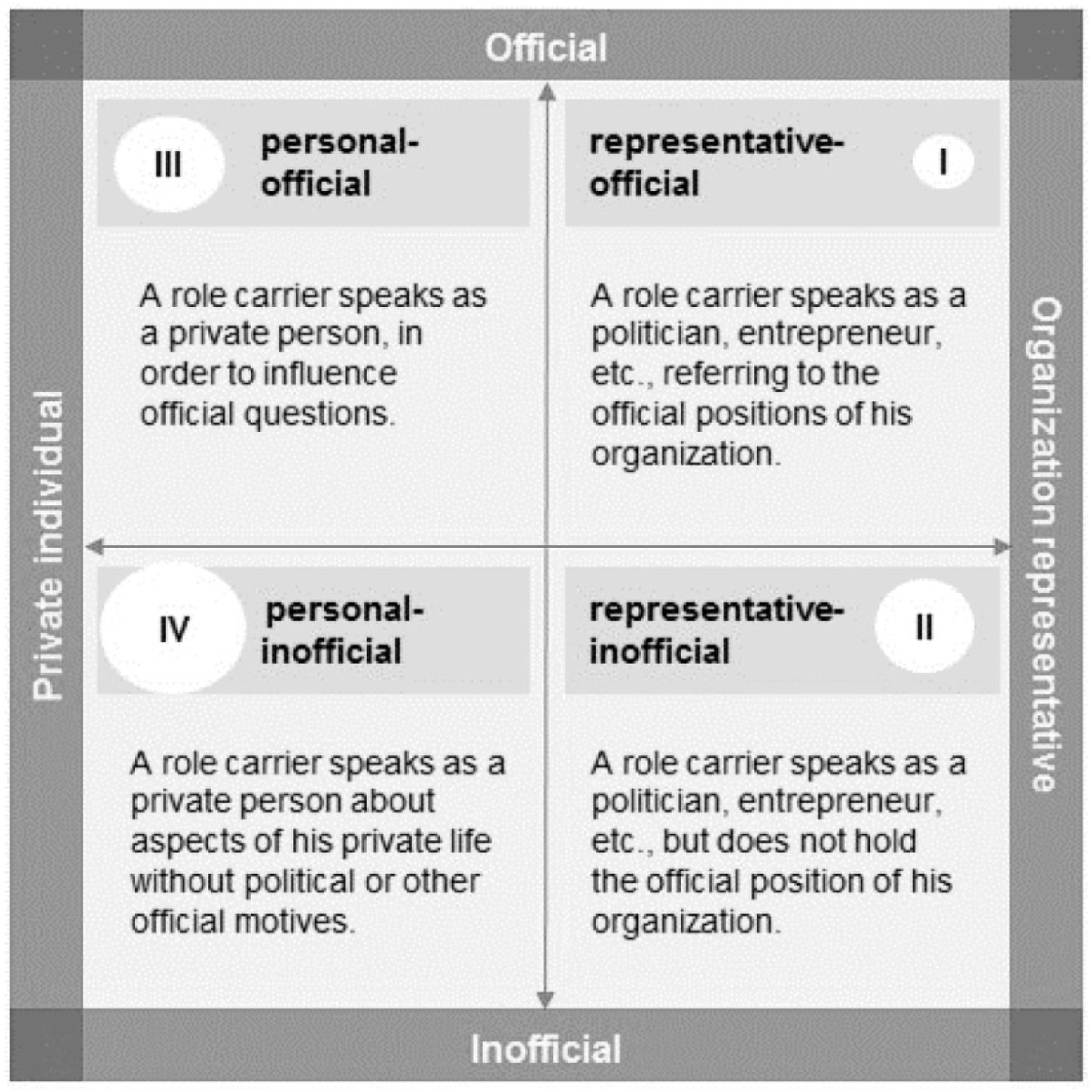
Subject personalization (see also Eisenegger, 2010; Eisenegger and Schranz, 2013).
Whereas people are active speakers in the condition of subject personalization, they represent the target of communication in object personalization. Generally speaking, two types of object personalization can be distinguished. One focuses on personal characteristics that are remote from the professional role (Gabriel and Brettschneider, 1998), whereby intimate and private characteristics of the actor are placed strongly in focus. The other type highlights professional characteristics such as competence or leadership, which are closely linked to the professional role (Lass, 1995).
The characteristics assigned to the two forms of object personalization cannot be clearly distinguished (Eisenegger, 2010). Because all characteristics are relevant to the reputation of the company, Eisenegger bases object personalization on a three-dimensional reputational approach. This approach is derived from the three-world concept based on Habermas’ (1985) theory of communicative action. The overarching question is how the individual (in our case, the CEO) can fulfil his or her system-specific role. Each of these worlds (the objective world of truth, the normative world of the good, and the subjective world of the beautiful) has its own claims that actors must meet (Eisenegger and Imhof, 2009; Habermas, 1985). Thus, the CEO acts in the mode of cognitive-functional personalization, normative-social personalization, or expressive-charismatic personalization (Eisenegger, 2010; Eisenegger and Schranz, 2013). Figure 2 summarizes this typology of object personalization and the criteria for assignment to its categories.
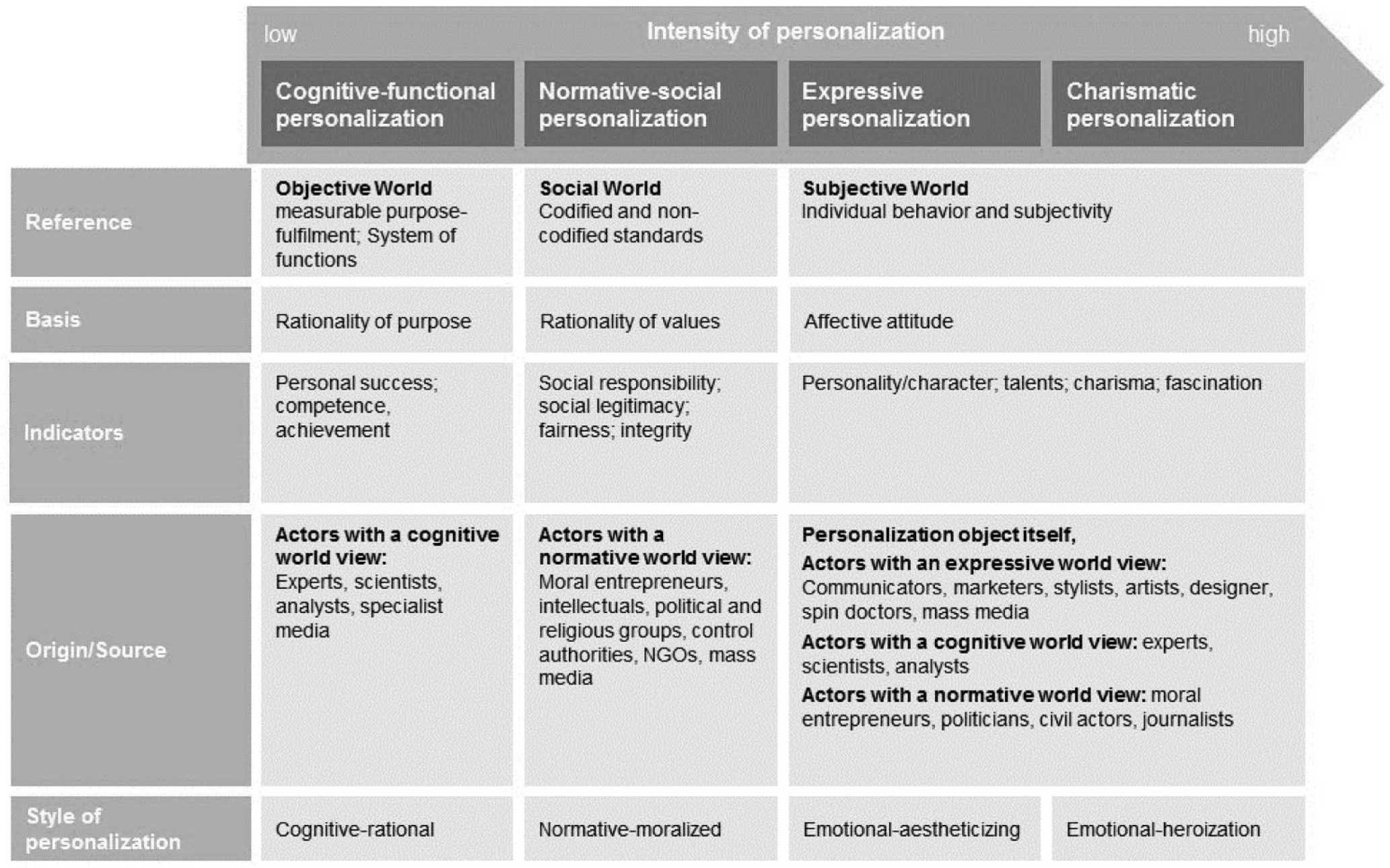
Object personalization (see also Eisenegger, 2010; Eisenegger and Schranz, 2013).
Eisenegger’s typology is helpful in order to understand the different forms of personalization and provides a structure for them. However, to the best of our knowledge, this typology has not been used for analysing different CEO-related patterns in corporate coverage. Therefore, we posed the following questions:
RQ 2. Can the personalization patterns be assigned to Eisenegger’s modes of object personalization? If so, which ones?
RQ 3. What do the personalization patterns say about the intensity of the personalization of corporate news coverage?
To ensure that the definition of personalization could be operationalized, we take advantage of the structural parallels to the concept of framing (Matthes, 2007a; Matthes and Kohring, 2008). Consequently, personalization in corporate reporting was defined as a phenomenon in which the CEO becomes the medial interpretative pattern for organizational issues. This includes a CEO-related adjustment of responsibility and a characterization of the CEO based on function-related, personal, or ethical characteristics, as well as on specific expectations linked to his or her role (Hayward et al., 2004; Szyszka, 2010). Furthermore, an assessment of the evaluative tone of the phenomenon was added (Brettschneider and Vollbracht, 2011; Park and Berger, 2004).
Framing and frame analysis
The key idea of framing is that strategic actors, journalists, and audiences do not simply reflect reality. According to Matthes (2007a, 2007b, 2014) frames can be understood as horizons of meaning created by actors, who highlight certain information and positions, and hide others (selection and salience). The framing approach focuses on the emergence, dissemination, and alteration of frames, which are placed on a theme and focus on a specific topic. Accordingly, this approach deals with the genesis, alteration, and effects of frames at the levels of communicators, media content, and recipients.
Frames can be located at various points in the communication process. Matthes and Kohring (2004) distinguished four points where frames can occur: (1) the communicator, (2) the journalist, (3) the media content/text, and (4) the recipient. By mutually influencing each other, the types of frames are part of a dynamic process (Matthes, 2014). The framing approach is thus suitable for analysing and describing the entire communication process, which is why it is also referred to as a bridging concept (Matthes, 2014: 12). In this study, we investigated media frames because we examined how CEOs are presented in the media. Media frames are described exclusively in terms of the content of the media and have mostly been analysed using content analysis (Matthes and Kohring, 2004; Semetko and Valkenburg, 2000; Simon and Xenos, 2000).
For the analysis of media frames, Entman proposed the following definition, which still characterizes the understanding of framing in the field of communication science (Matthes, 2014). The definition is also used in the present study: To frame is to ‘select some aspects of a perceived reality and make them more salient in a communicating text, in such a way as to promote a particular problem definition, causal interpretation, moral evaluation and/or treatment recommendation’ for the item described. (Entman, 1993: 52; italics in original)
Method
Analysis and sample
This study examined the framing of media coverage centred on CEOs in two elite German newspapers and one elite German magazine. Elite newspapers were selected because they set the agenda for non-elite newspapers (Carpenter, 2007). To determine the frames in media coverage about CEOs, we selected articles from the elite national newspapers Frankfurter Allgemeine Zeitung (FAZ) and Sueddeutsche Zeitung (SZ), and the weekly elite news magazine Der Spiegel. With this selection, both conservative and left-oriented opinion were covered, as SZ has a moderately left-oriented editorial line and FAZ is directed primarily towards an economics-oriented clientele (Mast, 2012). All coverage on companies listed in the German leading index DAX30 at the time of the investigation (1 July 2013–30 June 2015) was examined. We used three different databases (F.A.Z.-BiblioNet, SZ LibraryNet, and Nexis) to select all articles that mentioned the name of the company and its CEO with the help of keywords (name of the company and the corresponding CEO). Only CEOs who were in office or appointed at the time of publication were included in the selection. From the 513 articles identified, we drew a sample of 75% of the articles (following Wilke and Leidecker, 2009). We began coding with the oldest article in a medium, coded the first three articles and excluded the fourth. We proceeded chronologically within the medium by excluding every fourth article. This was done for all three media outlets analysed. The final sample thus comprised 386 editorial contributions.
Of the 386 articles examined, nearly 45% were published in SZ, 43% in FAZ, and 11% in Der Spiegel. The majority of the articles (88%) were published in the economics section. Fact-based reports were by far the most widely used form of representation (58%). This was followed by commentaries or columns (19%) and features (11%). References to CEOs were most frequently related to the strategic planning or financial development of the company (16%), and coverage of a change in CEO (14%) was also important.
Operationalization of the media frames
The frame elements were operationalized using Entmans (1993) definition of framing, in an approach similar to that used by Matthes and Kohring (2008), Kohring et al. (2011) and Matthes (2007b). Operationalizing media frames in this way meant that we did not take the frame as a whole (and thus the complex) interpretation pattern of a text. Rather, we considered its individual elements. In this way, the content validity could be ensured and a standardized method of capturing the frames was possible (see Kohring et al., 2011). Underlying frames were identified using a dimension-reducing method. This approach was chosen because it allows reliable coding as well as the detection of new, unknown frames and the possibility to analyse large amounts of text (Matthes and Kohring, 2004).
To combine personalization with framing, the above definition and Eisenegger’s personalization typology were used for operationalization. We developed a system of categories that are displayed in Figure 3. The category of problem definition includes the subcategories of topic, cause for reporting, context of CEO presentation, style of object personalization, importance of CEO in the article, dimension of subject personalization, sources, and tendency of the statement. The category of causal attribution includes the subcategories of affected individual, consequences, types of consequences, and responsible actor as well as CEO-related causes. The category of moral evaluation includes the basic tone, and the category of treatment recommendation includes a recommended course of action. In addition to these categories, which describe the content coded in the articles, we established formal categories. These include the date and length of the article, section, style, and author.
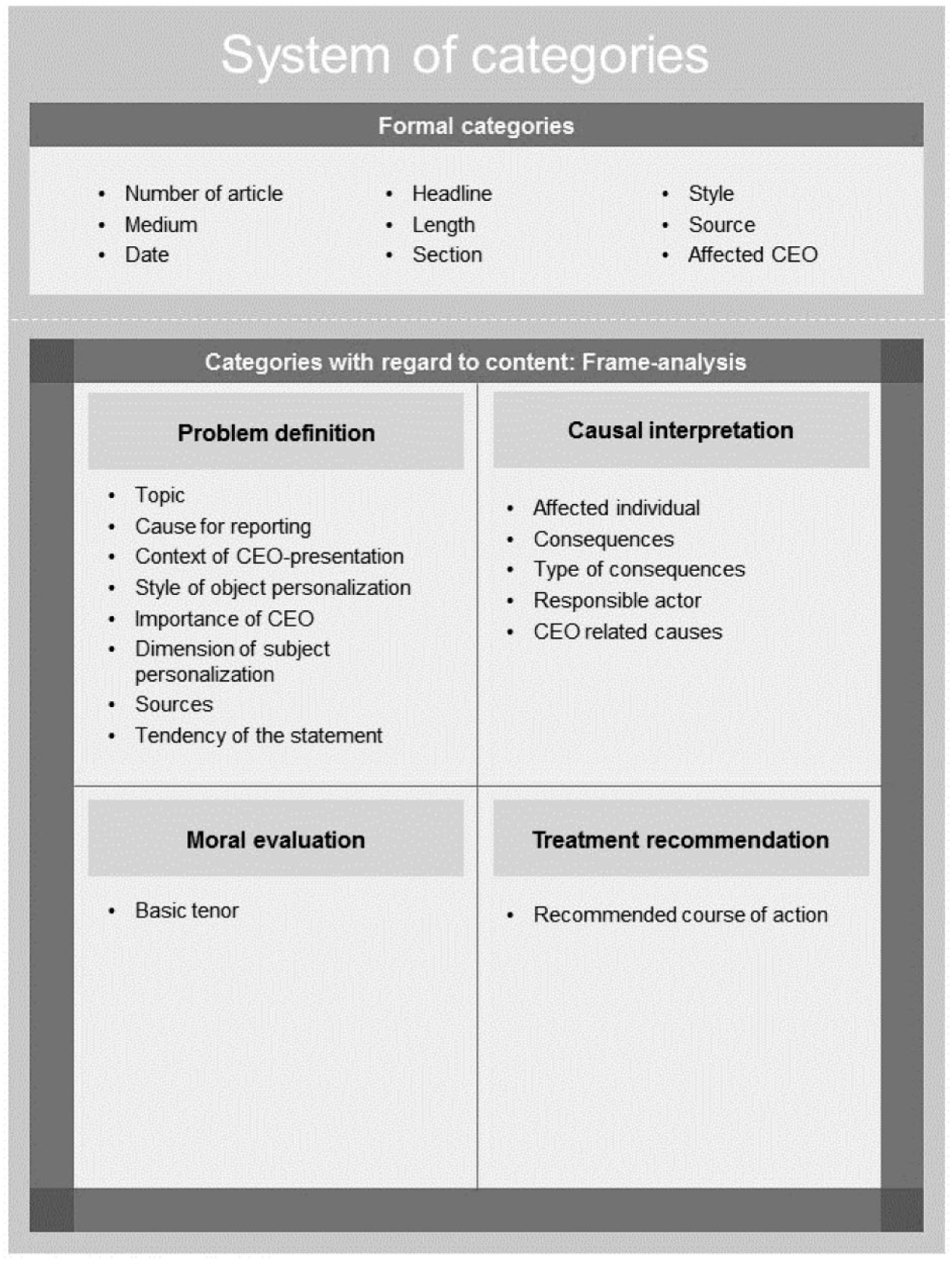
System of categories.
Because the coding was carried out by a single coder, we checked for intracoder reliability using Holsti’s (1969) method. Although there is no set level for the required reliability coefficient (Früh, 2011), the coefficients should be close to 1 for the formal categories and at least .75 for the content categories. Vogelgesang and Scharkow (2012) have proposed a target value of over .85. In the present study, the coefficients for the formal categories ranged from .92 to 1. For the content categories, the coefficients ranged from .80 to .96. Therefore, all of the requirements were met.
Results
Data analysis
Hierarchical cluster analysis was used to identify the frames. We used Ward’s (1963) method, which is a procedure for creating hierarchical groups made up of mutually exclusive subsets that are based on similarity. It can be applied to nominal data as a fusion method and has already been used successfully in other framing studies (Matthes and Kohring, 2004; Wessler et al., 2016). The squared Euclidean distance was chosen as a measure of heterogeneity.
Before conducting the hierarchical cluster analysis, we eliminated missing and outlying data. Categories containing very few cases contribute little to the formation of clusters. Where possible, we combined such categories to create new categories 1 (Matthes and Kohring, 2008). We also removed all variables that were present in only a few cases, 2 because including too many variables can affect the results of the analysis (Kohring et al., 2011; Matthes and Kohring, 2004). Because the variables had different ranges, the dataset was transformed by recoding all variables into binary variables (Matthes and Kohring, 2008). After cleaning the dataset, 66 of the original 95 dichotomized variables were included in the analysis.
To avoid extreme and anomalous values distorting the frames, the dataset was checked for outliers with the help of a cluster analysis using the single-linkage fusion algorithm and the Jaccard similarity coefficient. In this way, we identified eight clusters. Seven of these were identified as outliers, and the corresponding cases were removed from the dataset, reducing it to 379 cases. To determine the final number of clusters, we used the elbow criterion and the dendrogram (Matthes and Kohring, 2004), which indicated a six-cluster solution. To ensure that this cluster solution was valid, we also calculated cluster solutions for five and seven clusters using the Ward method and tested them for interpretability (Matthes and Kohring, 2004). To assess the homogeneity of the clusters, F-values and t-values were calculated. A comparison of the F-values shows that the six-cluster solution contains the greatest number of homogeneous groups.
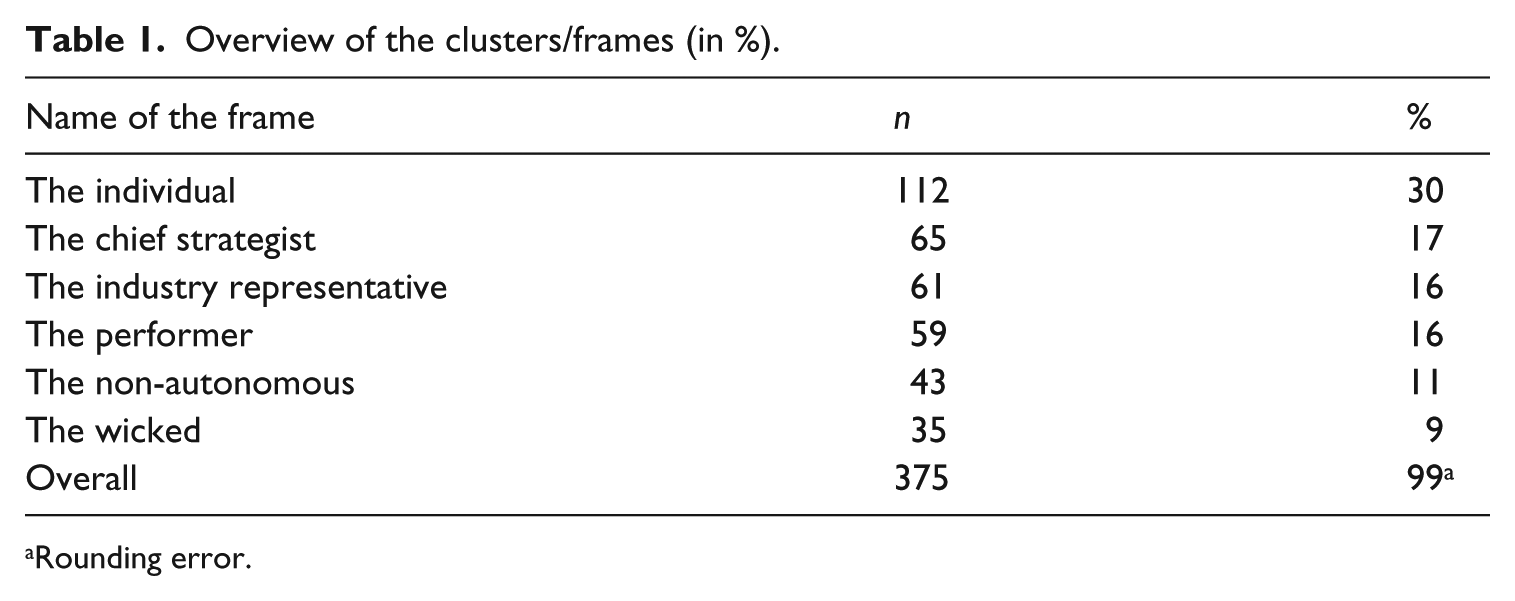
To determine which variables were characteristic for each cluster, we compared the mean values of the variables. Values that were particularly high compared with other variables were interpreted as characteristic of the relevant frame. In addition, the t-values were considered. In this way, it was possible to determine which variables were overrepresented and which were underrepresented in the clusters. Variables with a positive t-value were interpreted as particularly typical for the cluster, and variables with a negative t-value were interpreted as untypical. In this way, the six clusters were interpreted as media frames. The frame ‘the individual’ is the most common frame with 30%, followed by ‘the chief strategist’ with 17% and ‘the industry representative’ as well as ‘the performer’ with 16% (see Table 1). All frames are described briefly in the following section.
Overview of the clusters/frames (in %).
Rounding error.
Framing of CEOs
The individual (n = 112)
This interpretation pattern is based on individuality. In the context of a change of top management, the old CEO and the new CEO are portrayed and compared based on their individual traits and personal skills. The resulting images are shaped by different sources with different opinions. Overall, however, the tone is rather positive, and the CEOs themselves are often cited. In addition to the personal style of the interpretation pattern, unofficial comments dominate in this frame. An emotional-aestheticizing personalization style is dominant. The individual was the largest cluster found in this investigation, with a total of 112 articles.
The chief strategist (n = 65)
In this frame, the CEO is the main speaker and uses his or her statements to stage himself/herself as a rational corporate leader. In doing so, the CEO looks back on the company’s previous financial development and announces the strategy going forward, which also has some effects on the employees. No evaluation of the CEO takes place. This cluster consisted of a total of 65 articles.
The industry representative (n = 61)
Here, the CEO speaks for the whole industry and uses media attention to articulate his or her messages. Therefore, he or she often uses the following pattern: The framework conditions of business are endangering the industry. As the CEO of the company and an industry representative, I am already taking care of this by taking a position here; now it is time for politics to act.
These messages are wrapped into a personal language style. Although the CEO influences the interpretive pattern decisively, a rather negative to balanced image of him or her arises. In terms of size, this cluster was similar to the frame of the chief strategist, comprising 61 articles.
The performer (n = 59)
This personalization pattern is all about performance. The performance and therefore the success of the company depend on the work of the CEO as its top decision maker. In the coverage, success and expectations are analysed and derived from the role of the CEO. Performance assessment hardly takes place. If the author of this type of article reveals his or her sources, shareholders get a chance to speak and share a positive view. With a total of 59 articles, this cluster was neither particularly large nor small.
The non-autonomous (n = 43)
This personalization pattern is not about the CEO himself/herself. Instead, his or her position in the company is central but can also be occupied by other people. Here, the CEO is not a powerful decision maker. Rather, he or she has to follow the directives of the supervisory board and the shareholders, putting his or her own destiny in their hands. In spite of this passivity, journalists and other sources judge the CEO negatively. This cluster was based on 43 articles, making it the second smallest one.
The wicked (n = 35)
In this interpretation pattern, the CEO is judged very negatively. This occurs because, contrary to the other interpretative patterns, a moral dimension is more important as the basis for evaluation. The moral shortcomings of the CEO are revealed and judged by supervisory authorities and public prosecutors, with personal and legal consequences. In the present study, this pattern of personalization was strongly influenced by reporting on legal events and trials referring to Deutsche Bank. With 35 articles, it builds the smallest cluster.
Additional information about the frames (e.g. in which media they appear) can be found in Table 2. The individual is the most used frame in the SZ (36%) and FAZ (24%), while the most used frames in Der Spiegel are the wicked and the performer (26% each). Those two frames are quite rare in the two newspapers. Regarding the style of the articles, the frames are used in, results show that in news reports, all frames appear more or less equally. The same goes for features, with a little tendency to the individual (32%) and the chief strategist (20%). For portraits, however, there is a clear tendency towards the individual with 78%. The same is the case for glosses with 100% of the articles using the individual, although we need to take into account that there were only four glosses coded in total. For commentaries, there is a tendency towards the individual as well (40%), followed by the performer with 20%.
Additional information about the frames (in %).
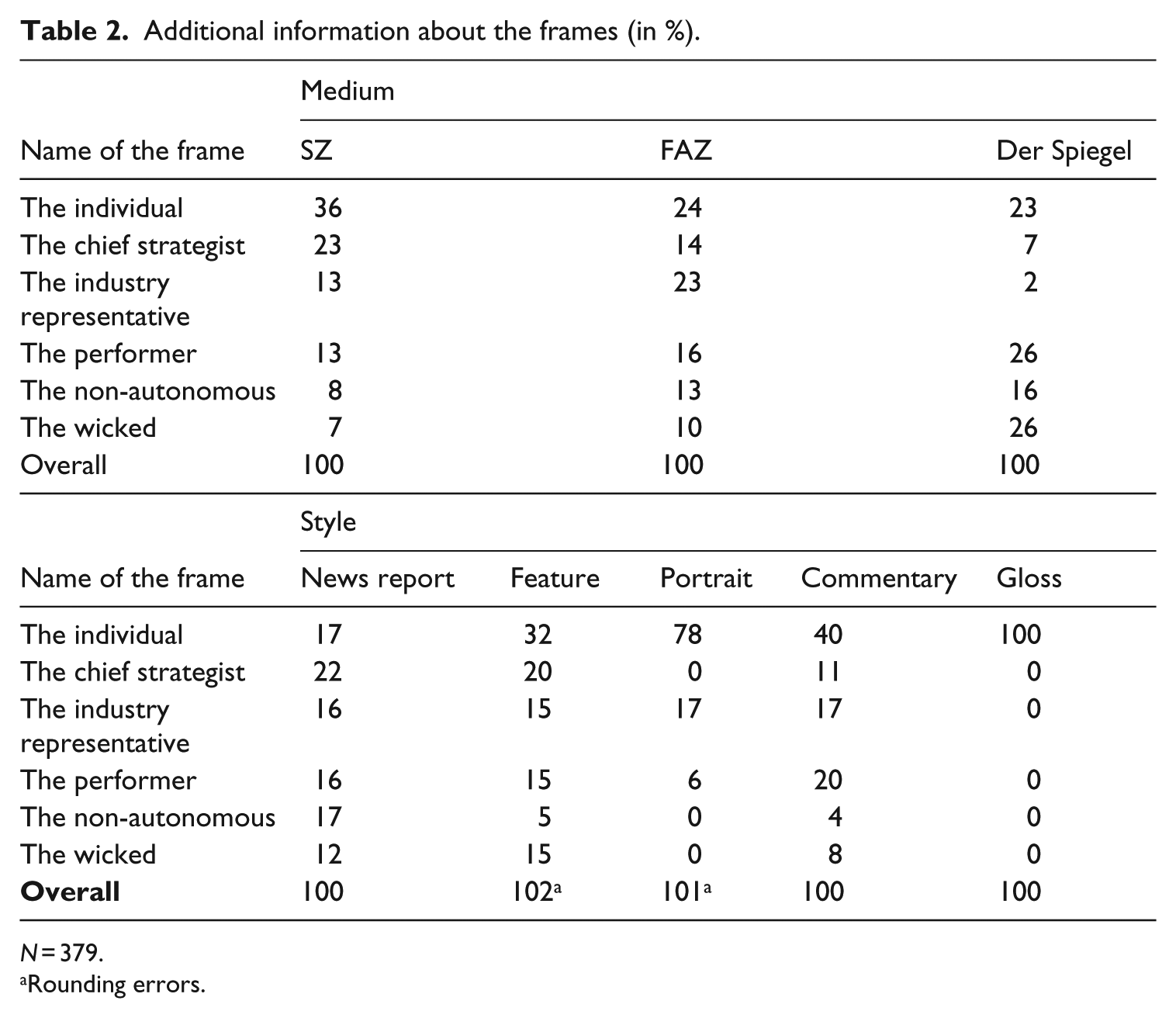
N = 379.
Rounding errors.
Personalization patterns and intensity of personalization in the frames
Regarding the intensity of personalization in the different patterns, the six frames vary. Whereas there were hardly any direct or indirect quotations in the interpretations of the performer, the wicked, the individual, or the non-autonomous, the frames the chief strategists and the industry representative contained long speeches given by the CEOs. Therefore, in the first four frames, object personalization is more pivotal; in the last two frames, subject personalization is essential. If the CEO spoke frequently in the frame, he or she shaped the personalization pattern through his or her own words, suggesting a high personalization intensity. If no speech is granted to the CEO, the opinions of other actors in the interpretation pattern dominate, and the personalization intensity can be classified as low.
The performer can be assigned to Eisenegger’s cognitive-functional mode of object personalization. In this case, the CEO is presented in his functional context. The focus is on his performance and competence as a CEO. The cognitive-rational personalization style prevailing in this frame can also be understood as a further indicator of the cognitive-functional mode of object personalization.
Assigning the non-autonomous to a mode of personalization is more difficult. Although in this pattern the CEO is also functionally involved as a role carrier, the articles containing this frame did not focus on the CEO’s actions or his professional qualities. In this frame, the CEO is not represented as a responsible party, but merely as an affected actor. Furthermore, the use of both cognitive-functional and normative-functional sources in this personalization pattern makes judgments about the CEO difficult. The frame contains references to a cognitive-functional personalization, but these are diluted by other features. Therefore, this frame cannot be assigned to only one personalization mode.
The individual frame presents the CEO on the basis of knowledge and personal qualifications. The focus is on characterizing the CEO, which also includes the presentation of his or her individual career and personal experiences. The interpretive pattern of the individual is also characterized by a language style that suggests sympathy with the CEO. Furthermore, the emotional-aestheticizing personalization style underlines the thesis that the pattern of the individual corresponds to Eisenegger’s expressive personalization.
In contrast to the findings for the individual, the personalization pattern of the wicked fits into the category of normative-social personalization. The CEO is not judged based on his or her individuality, but on his or her compliance with social norms and values. The CEO is introduced into the pattern by a moral context, and the CEO’s behaviour is predominantly assessed as illegitimate. This judgement is made by normative-functional sources, and the personalization style is normative-moralizing. The interpretive pattern of the wicked can be assigned to Eisenegger’s normative-social personalization.
The chief strategist can also be assigned to one of Eisenegger’s modes of object personalization. Although this is one of the two personalization patterns that are strongly influenced by subject personalization, a trend towards cognitive-functional personalization can be observed. Thus, both a functional integration and a description of the CEO in terms of professional characteristics are given.
Placed in a functional context, the industry representative goes beyond the mere representation of the company. Although the CEO represents his or her company’s interests in this interpretation pattern, he or she presents himself/herself not only as the face of the company, but as the face of the entire industry. Subject personalization has a strong impact on this personalization pattern. Consequently, no particular mode of object personalization can be identified.
The difficulties that we experienced during the assignment process suggest that Eisenegger’s object personalization typology falls short of being able to classify the empirical results obtained in this study. One reason for the difficulty of this assignment is that the typology contains indicators for only object personalization, not subject personalization. As the interpretation of the frames has shown, the number and extent of CEO quotations play an important role in the analysis of personalization. If a large share of the speech is granted to the CEO, he or she makes a significant contribution to the interpretation pattern. Consequently, to determine the intensity of the personalization for the identified frames, and thus to make a general statement about the way personalization is shaped in the investigated media, subject and object personalization should be considered in an integrated manner.
Discussion
This study aimed to analyse the portrayal of CEOs in corporate reporting. We reviewed the concept of personalization and combined it with framing. For the analysis, both theoretical perspectives and empirical research on personalization were considered. To this point, there has been no consistent, agreed-upon procedure for the analysis of personalization. Although the concept has gained importance in public relations research, different approaches exist alongside one another. A common conceptual understanding, which would also inform the empirical investigation, could not be identified. Therefore, we drew on the literature on personalization in political communication research and on a personalization typology developed by Eisenegger (2010). With this background, we developed a definition of personalization that comprehensively characterizes the personalization of corporate reporting as a CEO-related interpretive pattern.
Conceived as a frame analysis, the present study offers an approach for analysing and connecting all of the reference points for personalization (medial, strategic, receptive). This study applied the approach to research on media personalization, following the call in public relations literature for a more intensive analysis of personalization in the context of medialization (Imhof, 2010). Future studies can apply this framing approach as a bridging concept for the analysis of personalization in public relations or the personalization of stakeholders’ perceptions. In this way, the present work contributes to the holistic investigation of the phenomenon of personalization in public relations research.
A hierarchical cluster analysis revealed six frames that characterize the corporate coverage of German stock index (DAX30) CEOs in the analysed elite media. These frames can be defined as personalization patterns. The analysis has shown that the personalization of corporate reporting includes a wide range of different faces and that previous personalization typologies fall short. For this reason, we combined both subject and object personalization (Eisenegger, 2010) to describe the frames. Classification of the personalization patterns has shown the personalization intensity of the investigated articles to be quite profound. Thus, personalization in corporate reporting varies in the investigated media, with different personalization patterns having different personalization intensities. However, strong personalization patterns are dominant: The personalization patterns of the individual, the chief strategist, and the industry representative comparatively show a high personalization intensity and dominate the reporting on CEOs in the investigated media, accounting collectively for 63% of all articles examined. Consequently, there is a strong focus on CEOs as leaders who are presented as individualists, planners, or spokespeople for a whole industry. This might take away the focus of the media from the companies they stand for and towards the highest representative of the company himself/herself. If the CEO has a good reputation, his or her company might benefit from this by presenting the CEO with a high personalization intensity and therefore achieve that the CEO’s reputation is attributed to the company. It may also benefit the company if the CEO can be cited; two of the most used frames (the chief strategists and the industry representative) contained long quotation parts provided by CEOs.
This conclusion is accompanied by some limitations. First, the results of the present study are only valid for the selected media during the investigation period and therefore cannot be generalized. To examine the persistence of the identified patterns of personalization, further research is needed. Second, we did not take the type of event into account, in which the analysed articles are grounded in. Companies may have different strategies depending on the event their CEO appears in – for example, the company’s annual general meeting (AGM), a home story, or a talk show. Therefore, the type of event may also influence how the CEO is presented in the media. Overall, the approach of combining a content analysis with a cluster analysis, as performed in this study, has proven to be suitable for research on personalization and provides a suitable basis for further studies. Nevertheless, the method of hierarchical cluster analysis also has some disadvantages (e.g. varying results depending on the selection of the distance measure and the algorithm).
Longitudinal studies could be a promising research design for taking into account medialization as a framework phenomenon. Additional types of media should also be included in the sample to reveal both overlapping and media-specific personalization patterns. The framing approach could play an important role in linking different fields of research on personalization, as it offers the possibility to combine strategic, journalistic, media, and recipient framing.
Personalization patterns with a high degree of subject personalization provide a favourable channel for strategic personalization and thus offer CEOs an important opportunity to position themselves in a broad public. The results of this study support the idea that personalization is a relevant phenomenon for companies and their CEOs, as well as for journalists and the media. However, our results do not provide any reason to regard personalization as an oppression of personal freedom. Rather, personalization should be recognized as the opportunity to gain stakeholders’ attention in an efficient manner.
Footnotes
Funding
The author(s) received no financial support for the research, authorship, and/or publication of this article.