







Abstract
New media journalism has perturbed traditional reporting not only in mainstream-modern societies but also within religious-cum-insular communities. Focusing on the Jewish ultra-Orthodox community in Israel and in light of web journalists’ continuous struggle with leading clergy and an apprehensive public, this study grapples with the question, ‘How do ultra-Orthodox web journalists view their work mission as information brokers for an enclave culture?’ The study gleaned from 40 in-depth interviews with web journalists and discussions with community web activists. Results uncovered three major schemata that drive their praxis: (1) Communal-Haredi, (2) Western-Democratic and (3) Journalist Ecosystem. Findings suggest a rising archetype of fundamentalist web journalism that rests its professional ethos on writers’ practice, rather than on formalized training or communal dictums. Web journalists were found to strongly identify with their community, yet, often unintentionally, also act as a secondary form of authority and harbingers of change.
Keywords
Introduction
Over the past two decades, widespread use of the Internet has disrupted long-standing modes of news distribution and knowledge sharing. The rise of new media journalism has shaken the foundations of traditional reporting not only on a global scale and in democratic societies but locally and within religious-cum-insular communities as well. A case in point is the steep rise in Jewish ultra-Orthodox (Haredi) news websites over the past 10 or so years. This trend has continued apace despite a succession of rabbinic bans against these providers since 2009. In the past, fundamentalist clergy maintained a uniform public sphere by tightly monitoring their communities’ discourse. However, the current proliferation of web-based news outlets threatens both the integrity of this expanse and the leadership’s authority. Against this backdrop, we will grapple with the following question: How do Haredi web journalists view their calling as information brokers for an enclave culture? Addressing this question promises, among other things, to enhance our understanding of analogous developments in other faith-based communities.
Religious webmasters and online reporters produce content that strikes a balance between a handful of seemingly incompatible goals: attracting users, digitally representing their community and adherence to its ethics and mores. To borrow Bourdieu’s phrase, Haredi writers construct a ‘field of knowledge’ that suits the tenets of online journalism (Deuze, 2005) to religious strictures. This study delves into contemporary media outlets that are helping fundamentalist societies tap into heretofore suppressed repositories of information. While research has already been conducted on the ultra-Orthodox print press (Caplan, 2006; Cohen, 2012), the sector’s online journalism warrants a closer look.
Online journalism: Definitions, categories and scope
Before expounding on its Haredi branch, let us set the study within rudiments of online journalism. A commonly accepted taxonomy of this field distinguishes between Internet editions of print newspapers, commercial web outlets (e.g. Huffington Post, Drudge Report), non-profit media and information organizations (e.g. ProPublica, FactCheck.org, Wikileaks) and individual bloggers (Benkler, 2011). While some researchers aggregate all these categories under the broad heading of ‘online journalists’ (Benkler, 2011), others draw a distinction between various forms of web-based information sharing. In the process, they highlight the innovative formats and functions that undergird new media. Accordingly, Dutton (2009) views the emergence of information networks as a fifth estate. Besides providing journalistic social criticism, Dutton observes that these networks assume functions that are generally identified with the other three estates (e.g. peer-to-peer exchange and independent political action). Unlike the top-heavy established press, he adds, the new media is characterized by a wide array of players.
In his seminal study, Deuze (2005) lists several attributes that set online journalism apart from the ‘old’ media: hypertextuality, interactivity, and multimediality (cf. Schejter and Tirosh, 2014). Technological improvements seem to substantiate Deuze’s assertions. For instance, contemporary video streaming has expanded the multimediality of online journalism, and the embedded nature of news reporting in social networks epitomizes the interactivity of the fifth estate.
Against this backdrop, online journalism can be viewed as an independent branch of the press. The cost of publishing online news is relatively low, and the medium’s audience has long surpassed the circulation of even the largest print newspapers (Hargreaves, 2014). It is no wonder, then, that information providers are locked in a heated struggle for market share (Boczkowski, 2010).
Some thinkers contend that this turn of events will significantly improve the public’s access to information. Similarly, the new media will optimize individual’s freedom of expression in the public arena. What is more, no authority will be able to force its ideas on the populace or block the spread of alternative views (Shirky, 2009). In this democratic utopia, the power to interpret and present reality shifts from the media to active citizens. Conversely, several researchers have discerned a row of ideological, psychological and economic-cum- infrastructural restraints on the online press’ ability to distribute variegated information to broad readership (Boczkowski, 2010; Mullainathan and Shleifer, 2005). Given their relevance to the topic at hand, we will concentrate forthwith on ideological barriers.
The most formidable ideological hurdles to such openness are societies with different conceptions of journalism. In non-Western, insular and/or monitored communities, the ideological perception of the journalist’s role differs from the Western-liberal outlook. Non-Western-oriented regimes allocate substantial resources to controlling the press. Moreover, these communities’ apprehension of Western cultural ideologies and their main standard-bearer – the free press – is innate to their populace, the local media included, and thus shared by information providers and the masses. Therefore, these societies, such as China, Russia and Arab countries, along with insular communities, like the Amish and ultra-Orthodox, which have meagre means but similar positions, employ alternatives to the Western-liberal journalism model (Brown, 2013; Hafez, 2002; Lagerkvist, 2010; Michelson, 1990, Pasti, 2005). Furthermore, not all journalists in these societies are familiar with Western journalistic principles, and even those who are deem large portions of this creed as irrelevant to their own enterprise.
As demonstrated by Amin (2001) and Michelson (1990), media outlets in these societies often have no airs of objectivity, and the ideological leanings of both journalists and their readers are a fait accompli. Moreover, the reporters’ autonomy is either limited or non-existent. Even the impetus towards dispatch, which animates Western journalism and its 24-hour news cycle (Deuze, 2005), is highly constrained, as most pieces must await the approval of sanctioned censors or are never published.
Another formidable obstacle to democratic advances ushered in by new media is the ‘echo chamber’ effect. This hindrance is unrelated to the nature of a particular group. Readers generally gravitate towards information providers that espouse similar worldviews. In turn, new media outlets, possessing the technological means to know what the readers like, give them more of the same. This self-sustaining loop seals off alternative views and amplifies, and so radicalizes, the endorsed sentiments (Mullainathan and Shleifer, 2005; Pariser, 2011).
Ultra-Orthodoxy, new media and modernity
Although fundamentalist communities and religious enclaves may appear to be monolithic and exceedingly conservative, they have always interacted with and have been swayed by surrounding cultures (Stadler, 2009). Its adherents’ proclaimed traditionalism aside, fundamentalism is a quintessentially modern phenomenon (Eisenstadt, 2000). A case in point is fundamentalist groups’ selective legitimation of modern concepts and practices, including the use of technology (Golan, 2015). Despite the perceived necessity of partitioning themselves from the outside world, devotees must comprehend ‘modern’ ideologies for the sake of effectively resisting and so intermittently embrace them.
Our case study is Israeli ultra-Orthodox Jewry’s complex negotiations over Internet use. This sector has been described as a fundamentalist ‘enclave culture’ that instils piety by enforcing rigid boundaries. However, scholars have pointed to chinks in this seclusion, as Haredis are increasingly involved in civic life and the workforce (Stadler, 2009; Zicherman, 2014). It bears noting that Orthodox Jewry does not constitute a single cohesive unit but is an umbrella term for Jewish communities that aspire to traditional lifestyles (cf. Don-Yihya, 2005) governed by Halakha (Jewish law). Divergent histories, migrations and conventions have resulted in sub-groups with a fair share of unique practices and authority structures. In Israel, Orthodoxy’s main strands are Religious-Zionists, devout Sephardim, Lithuanians (Mitnagdim) and Hasids. Owing to their traditional Halakhic approach, the last three groups are widely referred to as Haredis or ultra-Orthodox. Needless to say, their leaders firmly reject modern values (Stadler, 2009).
Since the 1990s, Haredi authorities have been warning their flock that owing to the uninhibited access to free-wheeling secular and licentious content provided by the web, it is a gateway to sin (Golan and Campbell, 2015; Tsarfaty and Blais, 2002). In their estimation, the cyber realm is liable to spawn a breach of the religious–secular divide that will ultimately eradicate ultra-Orthodox piety. In consequence, Haredi authorities toil to restrict the Internet to vocational uses.
These warnings are not restricted to secular platforms. In 2009, prominent rabbis signed and issued a ban against ultra-Orthodox news websites and their advertisers. This edict can be viewed as a rearguard action on the part of the Haredi elite as these websites were beginning to dominate more and more of the Haredi public discourse. By de-legitimizing these emergent outlets of communal information, the rabbis hope to retain their ascendant status. The rabbinic pressure indeed led to the termination of several outlets (e.g. haredim.co.il). Two sizable players (bhol.co.il and kikarhashabat.co.il), inter alia, continued to operate, but went out of their way to appease the leadership. For example, management dismissed senior staff members and has cautiously weighed its steps from that point onwards. Correspondingly, the establishment ratcheted up its surveillance of the ultra-Orthodox new media for a couple of months and shored up the protocols regulating online forums.
Despite the sweeping rabbinic objections, filtering technologies (software, Internet service providers (ISPs) and other digital means) and the like made inroads among ultra-Orthodox surfers during these years. By allaying the concerns of many devotees, such tools laid the foundations for a rise in Haredi Internet usage.
In 2012, a rabbinical injunction against smartphones was circulated among ultra-Orthodox yeshivas (Jewish seminaries for males). Furthermore, the authorities held iPhone-smashing ceremonies and promulgated edicts forbidding the use of hand-held devices for accessing Facebook, Twitter and other web content (http://www.jdn.co.il/news/46076, retrieved 15 January 2017). That same year legions of Haredim attended a rally in New York against Internet use, thereby closing ranks with their coreligionists in Israel.
Since the turn of the millennium, scholarly interest in the ultra-Orthodox web use has grown, especially in all that concerns online trends (Caplan, 2001; Horowitz, 2001). The Internet offers a window onto social interactions within the inveterately closed Haredi enclave (Tsarfaty and Blais, 2002). This desire for segregation is manifest in the community’s policies and discourse on the perils of modernity (Lev-On and Shahar, 2011). In light of these fears, ultra-Orthodox web designers and surfers are compelled to justify their use of the Internet (Barzilai-Nahon and Barzilai, 2005; Livio and Weinblatt, 2007). In addition, several leading rabbis are trying to influence online norms in the hopes of preserving their long-standing authority.
A handful of scholars have reiterated the fact that most Haredis indeed strive to uphold traditional values. That said, some community members view online activity, particularly forum discussions, as a social niche that enables them to, say, work out personal problems, advance women’s rights and at times criticize the public conduct of rabbis (Baumel-Schwartz, 2009; Lev-On and Shahar, 2011). In investigating the relation between ultra-Orthodox websites and the community at large, the above-cited researchers emphasize questions of social control, sources of authority and communal boundaries (cf. Campbell and Golan, 2011). Earlier scholarship focused on Haredi perceptions of technology and Internet use. Conversely, this study accepts that web use has its niche among Haredi crowds and examines how religious webmasters suit their platform to the targeted audience. As we shall see, in so doing, they straddle the fence between keeping ultra-Orthodox legitimacy and supplying modern crowd demands.
Methodology
Most of the article’s findings were gleaned from 40 in-depth interviews. These insights were corroborated by a longitudinal ethnographic study that we conducted between 2008 and 2015, which included visits to Haredi news bureaus in Jerusalem, Beit Shemesh and Bnei Brak. These organizations ranged widely in size from a three-person online outlet working out of their personal private residence to media institutions occupying standard offices with scores of employees. Moreover, we corroborated the findings from this study by holding informal conversations with more ultra-Orthodox reporters in Israel and the United States.
Alternatively, discussions and interviews were held with an assortment of ultra-Orthodox users, such as yeshiva students, rabbis and outreach emissaries. In addition, we conversed with other relevant factors, including Haredi bloggers, tablet application entrepreneurs, video producers and avid web surfers in general.
Ranging from 45 to 90 minutes, interviews were held in website offices, coffee shops, and private homes or via the telephone, email, Skype, and Google Hangouts. Needless to say, the venues depended on the interviewees’ personal preferences and comfort level. The sessions revolved around three topics: (1) the web journalist’s background and training, (2) his or her worldview and relation to the brick-and-mortar community and (3) the writer’s sources of influence and perceived impact on readers. In each interview, we also discussed the subject’s attitude – religious or otherwise – to technology and online practices.
While the lion’s share of this study draws on information from interviews, for the sake of contextualizing our findings, we also acquainted ourselves with the websites themselves, not least the services on offer; the sites’ rules concerning online behaviour; and their language and design. The case studies were selected on the basis of user traffic and informant suggestions. Popularity and scope were key factors in some of our decisions, while lesser known sites were recommended to us by informants.
The interview transcripts and website data were imported into Atlas.ti mixed-method software. Employing categorization techniques (cf. Strauss and Corbin, 1990), the analysis was divided into Marshall and Rossman’s (2011) four stages: data organization; generating categories, themes and patterns; testing emergent hypotheses; and searching for alternative explanations. The coding process drew heavily on Glaser and Strauss’ (2009) principles. For the sake of reliability, two independent researchers scrutinized the data. Thereafter, we compared and discussed the two sets of categories that were obtained from each analysis (Marshall and Rossman, 2011). Differences in interpretation of findings between our independent researchers were settled through dialogue, thereby attaining a high inter-rater reliability level (Olesen et al., 1994).
Findings
Over the course of our fieldwork, we discerned three major, and often conflicting, schemata that are negotiated by web journalists:
The Communal-Haredi schema – balancing codes of professional journalism with the community’s mores;
The Western-Democratic schema – moulding contemporary reporting ideals into a new media activism that befits the ultra-Orthodox world;
The Journalist Ecosystem schema – integrating the online Haredi journalism creed with select attributes of the mainstream Israeli press and local ultra-Orthodox print outlets.
In fact, these impulses ultimately drive their praxis.
The Communal-Haredi schema
Haredi web journalists strive to bolster their communal standing. To this end, their vocational creed is tailored to the stringent ethical codes of their ‘imagined publics’ (Litt, 2012) and religious authorities. This goal is evident in our interviewees’ strategies for coping with the community’s de jure and de facto attitudes towards the Internet.
The ultra-Orthodox establishment’s approach to the sector’s online reporters primarily stems from their historical outlook on the electronic media at large, particularly websites. Despite the leadership’s partial toleration of Internet use (above all for livelihood needs), our informants claim that its view of news sites was and largely remains negative. This outlook has seeped into all the community’s official bodies, not least those charged with the most supervised areas of Haredi life – education and the family – and on down to the average devotee. The following account of a veteran ultra-Orthodox writer attests to the poor communal standing of web journalists: Even today …, I hide my job. I mean the kids, enrolled at a prestigious ultra-Orthodox school, know that dad works for a news website, but if they told that to their teacher, I’d be petrified. (November 2014, personal interview)
A younger writer explained the ‘low ranking’ of web journalists in the matrimonial market: The truly worthy man studies Torah. If you don’t, at least engage in profitable business. But a journalist? What? You write, but you don’t write religious texts? It lowers your match-making status. Even Haredi women that are willing to settle for a man with a job [rather than a full-time yeshiva student] want someone who is on firm footing, part of the establishment. (August 2014, personal interview)
In other words, a web reporter is hardly the most desirable catch for a prospective bride (cf. Lehmann and Siebzehner, 2009).
Their dubious standing aside, the majority of web journalists claim to be respectful towards and compliant with the dictates of the clerical elite. Be that as it may, there are several documented instances of critical online coverage of prominent rabbis. This ambiguity surfaces in the following excerpt from an interview with a senior editor:
Were there reports that elicited angry responses?
Sure!
Who was angry? Readers? The clergy? Perhaps both?
Mainly the readers. The clergy usually deal with us in a hushed manner; I mean, when something we post rattles them, they contact us discreetly. If they insist, we usually oblige. We never go after the sages. After all, I always presume that the sages are on a higher level than me. (June 2014, personal interview)
Keeping the sector’s luminaries out of the media crossfire was indeed one of the preconditions for allowing the Haredi news sites to resume their commercial operations following the above-mentioned injunction against web use in 2009. Moreover, the sites’ owners promised to ratchet up supervision over audience reactions and forums, which had drawn the brunt of the establishment’s ire. In return, the leadership tacitly guaranteed to lay off the websites. The journalists we spoke to have accepted this modus vivendi. More specifically, they distinguish between factors that are within the bounds of criticism – speakers, public relations people, the sages’ retinues and ultra-Orthodox parliamentarians – and those that are virtually untouchable – the grand rabbis.
Unfavourable coverage of both Haredi personages and sensitive internal episodes usually triggers a backlash against the offending outlet from both the community elite and the masses. Given the overall dissatisfaction of Haredi leadership with the sector’s new media, the standing of web journalists is rather tenuous. Be that as it may, interviewees boasted that the community – even its upper echelons – implicitly acknowledges their clout. For instance, a reporter boasted his website’s arrangement with Ger, the largest Hassidic court in Israel, and the court of Aharon Shteinman, the most influential Lithuanian rabbi: Even though Ger has Hamodia, and Shteinman has Yated Ne’eman [the two leading Haredi print newspapers], when they want something to reach the entire Haredi public, not just their own people, they send it to us. (November 2014, personal interview)
While diligently refraining from publicly supporting or cooperating with websites, the leading rabbis have nevertheless developed strategies for circulating information via these outlets. According to a young editor, The rabbis put an X on [i.e., have proscribed] the entire internet, but it’s an unclear X. I’ll tell you why … Every rabbi has a speaker. They have really bought into the system. The speakers, the functionaries, whoever is in their orbit, will call up our writer and say ‘Listen, the rabbi is going to be here and there; photograph him, do [this or that] for him’. (September 2014, personal interview)
Lest the public view them as cyber-friendly, the rabbis deal with online news providers through a back channel. In essence, their speakers and functionaries work with the websites in the very same way they interact with sanctioned newspapers.
In light of their ambivalent status, Haredi web journalists make a concerted effort to convey to their readers that they are part and parcel of mainstream ultra-Orthodoxy. To this end, they publish stories on the dangers of the Internet and buttress the sector’s consensus on a wide range of topics, like Haredi integration into the workforce at large.
As we can see, the Communal-Haredi imperative helps mould the online journalists’ praxis. While adhering to the community’s norms and displaying reverence for its highest authorities, the sites under review still manage to constantly stream information sought-after by ultra-Orthodox web surfers and so demonstrate their relevance to the Haredi public.
The Western-Democratic schema
As opposed to these local-cum-communal motives, the Western-democratic schema refers to the web journalists’ affinity for ‘modern’ reporting ideals. Our interviewees avowedly champion a Western-liberal journalistic ethos while retaining their ultra-Orthodox worldviews and enclave-centric orientation. For instance, an editor of a Haredi news site, while generally taking pride in side-stepping controversial issues, also accentuated his commitment to the Western ethos of communal service and the Western impetus towards dispatch: The stated interest of the Haredi public is by and large Haredi issues. They are more interested in this than the ongoing brawls between Netanyahu and his ministers. Q: If so, why do you still publish articles on this very topic? A: Because we are a news outlet. A news outlet without live updates on everything is not really a news outlet. (January 2014, personal interview)
This account dovetails neatly with Deuze’s (2005) characterization of journalism as an objective, autonomous, ethical and timely public service. Although current affairs from ‘outside the enclave’ are not a popular subject among his readers, web reporters have an obligation to furnish such essential public information.
A prime objective of Western-liberal journalism is holding the establishment accountable to the public (Dutton, 2009; Hargreaves, 2014; Whitten-Woodring and James, 2012). Accordingly, Haredi sites take pride in their proactive coverage of mishamshim. Literally public servants, the term mishamshim essentially refers to the circle of functionaries and activists that surround distinguished rabbis. These ‘courtiers’ schedule the appointments of ‘the generation’s luminaries’. In their capacity as gatekeepers and knowledge brokers, they occasionally influence the rabbis’ decisions – halakhic or otherwise (Zicherman, 2014). Dissatisfaction with some of these elements had been rustling in ultra-Orthodox society for years, but was kept under wraps, so that there was no change in mishamshim’s behaviour. According to one senior editor, the advent of the Haredi news sites ushered in reform: ‘The functionaries have understood that from now on, there is no mechanism that filters what the public knows of their doings. They must pay attention to the public, not only to their rabbi’. Put differently, ultra-Orthodox news sites have redirected Western journalistic monitoring activities from the government to communal spheres of influence.
The majority of our interviewees went out of their way to explain how they advance solutions to pan- or local Haredi problems by embracing the journalistic ethos of public service: exposing impropriety and leveraging their power to exert pressure on both state authorities and community leaders. We asked one online journalist whether her enterprise was making a difference, to which she replied, All the time, usually by enabling people to talk about topics they haven’t discussed in the past. Everything. Be it marital relationships or sexual abuse of children. I think it’s difficult to overemphasize how important it is that more and more people are consuming [new] media and use it to share such information. (July 2014, personal interview)
By virtue of its ability to expose pertinent information, investigative reporting is considered a taproot of Western journalism. This public service has been enhanced by, inter alia, online citizen journalists in war zones (Bengtsson, 2013) and digital activists from organizations like Wikileaks (Benkler, 2011). As evidenced by the following screenshot (Figure 1) of a modest website, the Haredi new media has embraced these values:
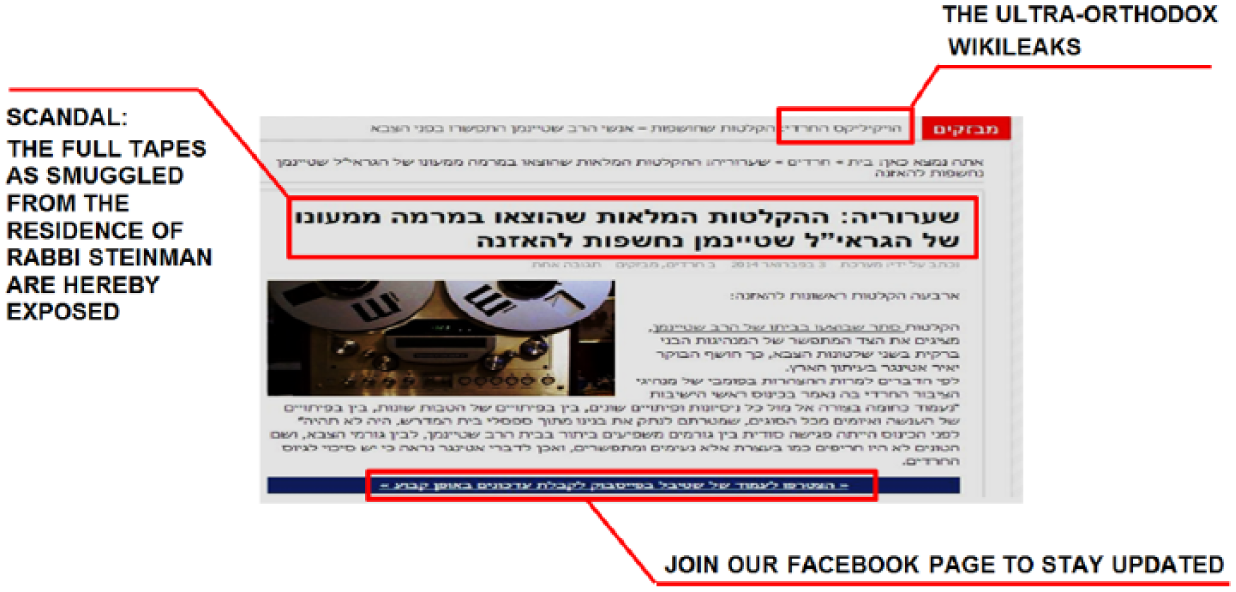
Homepage of online news website (February 2014).
In this example, secretly taped private negotiations between a distinguished rabbi and members of parliament over the controversial issue of ultra-Orthodox military conscription were divulged to the public.
To summarize, owing to the Western-democratic impetus, the modern Western ideal of journalism has profoundly affected the practice and worldview of online Haredi reporters, inspiring them to scrutinize communal authorities and break news stories. While riling up the ultra-Orthodox street masses, these exposés occasionally draw the wrath of both senior clergy and laypersons alike.
The Journalistic Ecosystem schema
This schema motivates the journalists under review to appraise themselves through the lens of the other media outlets in their surroundings, especially those of mainstream Israeli society and the local Haredi print media. The most notable outlook presented by interviewees was to castigate the mainstream press for its glut of raunchy and violent stories. According to a veteran writer, countering the danger that such content poses to the faithful is a raison d’être of the sector’s news sites. ‘In essence’, he claimed, they were ‘established in order to provide an alternative for the Haredi web user. If not for [site name omitted to avoid exposure], a Haredi surfer would surf in Ynet, would surf in Walla. 1 And what would he encounter there …?’ (personal interview, September 2014). Put differently, the journalist underscores the importance of ultra-Orthodox online news sites as a reasonable substitute for the bawdy secular outlets or, as some interviewees put it, ‘a lesser evil’, for a pious yet curious public.
Our informants also stressed the ethical superiority of their work compared to mainstream sites. A topic that repeatedly came up in our interviews was the avoidance of lashon ha-ra (libel). The religious meaning of this concept differs from its interpretation under Israel law, as Halakha considers even the public dissemination of factual news items that harm a person’s reputation as libel. From this standpoint, then, gossip falls under the heading of libel. All our interviewees claimed that there is a gross imbalance in the secular press between ‘the public’s right to know’ and an individual’s right to privacy, which is egregiously tilted to the side of the former. As one senior editor told us, ‘non-Haredi journalists always see the public’s “right to know,” as more important than anything else including someone’s right to privacy. A grave injustice is being committed here, and it is halakhically inappropriate to boot; it’s a moral outrage!’ (personal interview, September 2014). Abiding by the tenets of their faith, he contends, Haredi journalists painstakingly attempt to find the right balance between refraining from lashon ha-ra and safeguarding the public’s right to know. Even when publishing a credible story, there is an obligation to limit the damage to a family. By virtue of this juggling act, our interviewee concluded, the ultra-Orthodox reporters are morally superior to their secular peers.
Surprising as it may be, Haredi web journalists also expressed admiration for certain aspects of the mainstream Israeli press. For instance, a senior editor lauded a left-of-centre daily newspaper: I can’t take away Haaretz’s standards … I think it’s the media outlet with the highest standards in Israel. I am extremely right wing in my views, yet even regarding political stories and the like, despite its known and clear slant, it is still very professional. I definitely want to reach that level of quality control, okay? (August 2014, personal interview)
Succinctly put, the informant distinguished between Haaretz’s politico-ideological leanings and its ‘professional’ attributes. This step enabled him to view this newspaper as a paragon of excellence without adopting its worldview.
Another facet of the mainstream Israeli press that a few ultra-Orthodox reporters envied is the sheer size of its operations, audience and impact. A young female editor qualified the achievements of her own online paper: ‘Insomuch as you are a site that does bring all the content in real time and readership grows, look at yourself and look at Ynet. You have a ways to go’ (September 2014, personal interview). Many of the reporters intimated a sense of inferiority vis-à-vis their mainstream rivals that stems from the meagre exposure and relative negligibility of Haredi websites.
The other major strand of players in our case study’s ecosystem is the ultra-Orthodox print media. This branch of the press – the dailies and, to a lesser extent, the weeklies (Cohen, 2012) – laid down roots and earned communal legitimacy as organs of the Haredi establishment (Michelson, 1990). However, most of our informants vociferously questioned the merits of this cachet. From their vantage point, these outlets are excessively institutionalized, to the point of serving as a mere public relations arm of the elite. One young editor went so far as to say that these periodicals are not worthy of the term journalism: I’m not talking about the Haredi print press because that’s not journalism. It’s merely a bunch of papers that carry press releases and the like. It isn’t truly journalism, in my opinion. It is very problematic, for there are plenty of ultra-Orthodox writers that are both PR specialists and community consultants for corporations. In fact, they have a [vested] interest in the topics that they cover and never offer a disclaimer or anything of the sort. (August 2014, personal interview)
According to a senior editor of a weekly magazine with an online presence, The major daily newspapers are affiliated with the [Haredi] political parties. Every denomination has its own newspaper. I see this as a form of the Soviet [newspaper] Pravda, where everyone merely renders what they want and conceals what they don’t. (September 2014, personal interview)
The last two journalists are clearly striving for independence and objectivity. In so doing, they draw a sharp contrast between serving the public and catering to a narrow interest group. For instance, they and other interviewees lambasted the Haredi print media’s regurgitation of unmediated information from public relations people, such as news releases of Hasidic courts. However, as opposed to the mainstream press, which tends to focus on business people and politicians, the Haredi sites place the spotlight on their community’s leadership.
Be that as it may, a number of the informants have a more apologetic attitude towards, and perhaps esteem for, the Haredi print media. They want to emulate the legitimacy of topics and writing style of the latter, ‘only with videos and photos’. The following exchange with an editor-in-chief of a news site illuminates this approach:
So your goal is to create a news website that is as ‘clean’ as the printed dailies?
A ‘clean’ site. People want to know what’s happening; people do not want to see smut, listen to smut, and add smut to all they know. (May 2015, personal interview)
By adopting practices of their offline counterparts, a handful of the websites are evidently signalling their affiliation with the central Haredi stream. A case in point is this passage from an ‘About’ page of the Jewish Daily News: ‘JDN’s editors happily leave off tens of sensational disclosures and reports that may get us high ratings and broad exposure, in order to sanctify our greatest goal –
In sum, our findings point to a ‘journalistic ecosystem’ imperative that compels ultra-Orthodox web writers to reflexively keep abreast of various other Israeli news outlets. Their rebuke of Western journalism aside, they are impressed, albeit with reservations, with several elements of its feats, such as Haaretz’s lofty professional standards. In a similar vein, our interviewees have an ambiguous attitude towards the ultra-Orthodox print media. Similar to the community’s established dailies and weeklies, the websites under review modify content to suit their audience’s palate. On the other hand, the journalists grasp these papers as subservient mouthpieces whose values counter the new media ethos.
Towards a model of fundamentalist web journalism: Discussion and conclusion
Whereas online journalism’s disruption of the mainstream print media has been well documented (Boczkowski, 2010), its impact on religious communities, particularly from a social and communicative standpoint, has yet to attract much scholarship. This article enhances our understanding of how web reporters affiliated with fundamentalist and religious-cum-insular communities view their enterprise. In addition, the Haredi case sheds light on many other analogous groups’ epistemology of the media. Diasporic communities, ethnic minorities and the like are all developing semi-autonomous media spheres through, inter alia, the local press and online social networks. A case in point is the Amish (Brown, 2013) or Filipino diasporic communities (Kama, 2008). All of these groups lean on various sources of information to engender a mediated sense of community. Put differently, these outlets help cultivate a sense of civic pride that encourages member participation. By introducing their readership to broader trends and adapting them to the norms of their own particular collective, web journalists re-socialize their insular audience and bridge the divide between the latter and the surrounding, majority culture. By dint of comprehensive fieldwork and an analysis of the Haredi case, we discerned three major schemata that shape Haredi web reporters’ self-perception and underpin their activities: the Communal-Haredi, the Western-Democratic and the Journalistic Ecosystem imperatives.
On this basis, we aver that the professional codes and ethos of the ultra-Orthodox online press are mostly the outgrowth of its journalists’ experience, rather than formal training or communal dictums. The three identified schemata can be applied to different work contexts that journalists encounter.
As the schemata show, online Haredi journalists are simultaneously pulled in different directions.
The argument can be made that whereas secular news outlets in Israel are guided by a Western-democratic creed (while some more high-brow and others more tabloid-like; cf. Caspi, 2011), ultra-Orthodox print newspapers are chiefly motivated by communal ideals (Michelson, 1990). The plethora of Haredi news websites run the gamut between these two poles and are attuned to their journalistic ecosystem.
With respect to Haredi online writers, and conceivably for other religious online writers, both new media and faith-based impulses factor into their occupational discretion. The literature points to interactivity, multimediality, abundance and mobility as distinguishing features of new media (Schejter and Tirosh, 2014). These properties not only impact user experience but also transform the core enterprise of online journalism, not least its editorial and technological dimensions. For instance, reporters are increasingly targeting ‘quantified audiences’ – a strategy which necessitates a deep understanding of their readers and a greater reliance on metric-reporting techniques (Ananny, 2014; Vu, 2014). In Making Online News, Domingo (2008) illustrates how the 24-hour news cycle goads writers into constantly updating their websites. Other contributors to the said anthology discuss how multimedia takes advantage of the inherent strengths of words, sounds, pictures and videos (Brannon, 2008). As evidenced from our fieldwork revelations, these developments also apply to the ultra-Orthodox new media.
As members of a devout community with monastic tendencies, the journalists under review try to suit their reporting to denominational mores. Correspondingly, they endeavour to remain true to their individual belief systems. In the Haredi world, though, new media is often associated with transgression. Researchers have indeed highlighted ultra-Orthodox concerns with increased exposure to secular messages (Horowitz, 2001) and indecent content, like pornography and gambling, due to the Internet’s meteoric rise. In consequence, Haredi reporters wilfully forego ‘scoops’ and closet news items for the sake of complying with Halakhic injunctions against slander. Building on Weberian theory, scholars can perhaps mark an affinity between the religious beliefs and professional ethos of devout journalists. In any event, Judaism clearly serves as a filter through which Haredi writers distil their socio-occupational pursuits. As outlined in Figure 2, their work ethos is laced with both religious and new media ideologies:
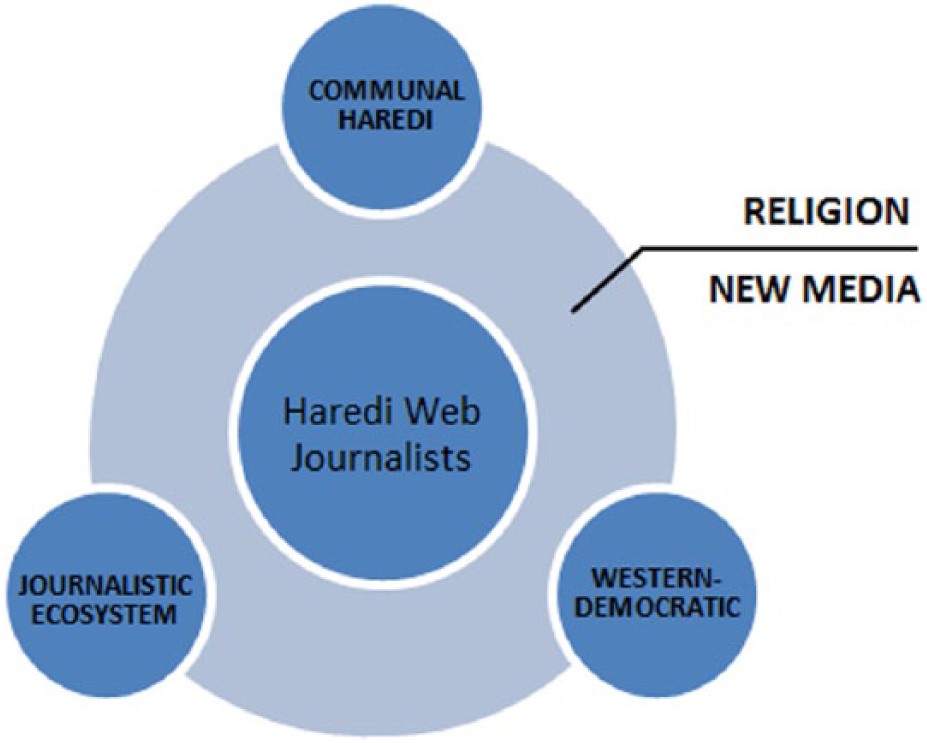
Influences on the professional ethos of Haredi web journalists.
Ultra-Orthodox reporters indeed strive for professional legitimacy, but our findings suggest that this is not a prime catalyst. Group values (religious, communal, etc.) are deeply internalized so that the Communal-Haredi impetus has an outsized effect on their practice. As social actors, the journalists are able to balance the quotidian, concrete demands of their job with the constraints of their religious worldview and community’s imagined imperatives. In other words, they identify, first and foremost, with mainstream ultra-Orthodoxy and integrate its prevailing mind-set into their occupational creed, thereby exhibiting what Goffman (1961) refers to as low role distance.
These insights shed light on the professional evolution of the Haredi new media. Although ultra-Orthodox writers rarely acquire formal journalistic training, they are preoccupied with ethical issues that pertain to their job. This suggests that ultra-Orthodox web journalism is gradually becoming a professional occupation. In our estimation, all three of the above-mentioned schemata come to bear on this development. Our informants’ religious background constitutes a strong moral base, which is reinforced by lessons gleaned from the more-established Haredi print press. Correspondingly, the new media ethos undergirds their social and communicative actions. In short, the reporters selectively garner religious and Western-democratic principles. Moreover, they emulate various practices of news outlets in their surroundings. These inputs contribute to their journalistic autonomy, clout and social status (cf. Davidson, 2013). At one and the same time, these reporters continue to navigate the obstacles and affordances of their rigid insular society.
In an effort to cope with the vicissitudes of a changing world, fundamentalist communities take pains to fortify the walls around their enclave. As adherents of ‘dynamic conservatism’ (Eisenstadt, 1952), these groups keep close tabs on technological advances. In response to these developments, they tweak their own institutions while continuing to abide by the community’s stringent codes. It appears as though this encounter between modernity and tradition has given rise to a new breed of ethical guardians. With respect to the ultra-Orthodox world, these sentries include online journalists that toil to safeguard and bolster the enclave by reining in the web’s secular ideology (Campbell and Golan, 2011). While shoring up their communities’ fundamentalist lifestyle and belief system, these journalists, often unintentionally, re-negotiate the community’s boundaries, challenge its hierarchy and introduce new means of communication at one and the same time.
Footnotes
Acknowledgements
The authors wish to thank the editors and anonymous reviewers for insightful comments. In addition, deep gratitude is offered to Roei Davidson for his sharp comments on earlier junctures of this study and also to Avi Aronsky for his exceptionally reflective aid in editing this manuscript.
Funding
The author(s) disclosed receipt of the following financial support for the research, authorship, and/or publication of this article: This work was supported by the I-CORE Program of the Planning and Budgeting Committee and the Israel Science Foundation (grant no. 1716/12) as well as a Marie Sklodowska-Curie grant funded by the European commission for research and innovation.