






Abstract
This study examines attention-giving behaviours across social media platforms during the 2025 Norwegian parliamentary elections, focusing on X, Instagram, TikTok and Bluesky. Utilizing a platform-comparative, actor-centric approach, we conducted a quantitative content analysis of hashtagged activity, specifically analyzing @ messages to identify the types of users who send and receive such messages. Our findings reveal distinct genres of political communication ecosystems, with Instagram emerging as the most active platform for @ messaging. The study highlights the evolving landscape of political communication, suggesting the need for strategic adaptation by political actors to platform-specific dynamics. These insights contribute to understanding the complexities of modern political communication ecosystems and the role of social media in shaping public discourse.
Introduction
Concepts such as hybrid media systems (Chadwick, 2017), media ecosystems (Anderson, 2016; Esser and Pfetsch, 2020), disrupted (Bennett and Pfetsch, 2018) or dissonant public spheres (Koc-Michalska et al., 2023) all seem to point in the same direction with regards to opportunities for public communication – the channels through which opinions can be expressed are growing ever-more plentiful. From a normative point of view, such a multitude of possible agoras for public debate can indeed be positive for increased societal engagement. At the same time, this plethora of platforms makes keeping abreast with public debate if not impossible then at least increasingly complex and difficult.
The multiplicity of outlets discussed above appears to fit nicely within what is sometimes referred to as the fourth era (Klinger et al., 2022) or age (Bennett and Pfetsch, 2018) of political communication. Expanding on the three ages of political communication initially suggested (Blumler and Kavanagh, 1999), Blumler (2016) posits that in order to account for the increased ‘complexity, multiplicity, variety and cross-currents’ (2016: 28) a fourth age should be added. Indeed, authors have suggested that we have entered an ‘era of social media’ (Enli, 2017: 52) and that platforms such as Twitter, Instagram and TikTok play increasingly important roles in political communication processes (Sorensen, 2023). Vaccari and Valeriani (2021) remind us that ‘[i]n the span of a decade, social media have moved from the periphery to the centre of political communication ecosystems in Western democracies’ (2021: 234). Relatedly, Esser and Pfetsch (2020) suggest that while ‘new players’ such as the mentioned platforms contribute to greater diversity as discussed above, a continuously evolving cast of platform actors might also result in ‘a disintegration of what was left of a national public sphere’ (2020: 341).
Starting from the concept of political communication ecosystems (Anderson, 2016; Esser and Pfetsch, 2020), the work presented here adopts a platform-comparative, actor-centric approach to political communication, presenting an analysis of the types of actors who communicated with each other on four different social media platforms during the 2025 Norwegian parliamentary election. Our efforts thus speak to what different types of actors take part in public communication across platforms.
Comparing hashtagged activity across X, Instagram, TikTok and Bluesky, we contribute to the need for cross-platform comparative studies of online political communication as identified by several authors (e.g., Haßler et al., 2024; Scharlach et al., 2023). Specifically, we present a quantitative content analysis to study the senders and receivers of posts directed to specific users by means of the @ character across the mentioned platforms. With our platform comparative design, the efforts presented here we are able to shed light on what types of users gain attention across platforms by being addressed in this way. Conversely, our approach also allows for insights into the types of users who participate by mentioning others, thereby amplifying (Zhang et al., 2017) their respective presences across platforms.
Literature review
Attention in political communication ecosystems
Each social media platform carries with it not only its own technical architectures (Bossetta, 2018) or affordances (Scharlach et al., 2023) – they are also likely to differ with regard to the types of actors that populate them (Hargittai, 2018). Indeed, Pfetsch (2023) suggests that the dissonant public spheres resulting from the developments discussed above are characterized by ‘a multitude of sounds and voices’ (2023: 346) and that ‘[n]ew actors – such as influencers, citizen journalists, political entrepreneurs and activists […] may receive much more attention and clicks than traditional party elites’ (2023: 347). As such ‘non-institutional actors’ (Gustafsson and Larsson, 2025: 2) become more visible across platforms such as those studied here, understanding the composition of types of actors who give and receive attention across these platforms becomes important. Here, we draw inspiration from Anderson's (2016) work on news ecosystems and Esser and Pfetsch's (2020) subsequent conceptualization of political communication ecosystems. Esser and Pfetsch suggest that ‘boundaries of political communication ecosystems can be drawn in two ways’ (2020: 342) – geographically or thematically. Given the differing characteristics of each platform as alluded to above and as will be dealt with in more detail later, we suggest here that each platform can also be studied as ecosystems of their own – ecosystems that, viewed together, can indeed make up a larger geographically or as is the case here, thematically demarcated ecosystem. The need to further investigate such ‘social media ecosystems’ (Gil de Zúñiga et al., 2020: 591) has been introduced above. Here, we approach this by studying the ways that the actors in these ecosystems – such as ‘political actors, media actors and civic actors’ (Esser and Pfetsch, 2020: 342) give and receive attention on each platform. In their outline of political communication ecosystems, Esser and Pfetsch (2020) draw on Wiard (2019) who similarly emphasizes the heterogeneous nature of the actors involved and who suggests that such actors relate to each other following ‘coopetitive’ logics, blending ‘cooperation and competition’ (Wiard, 2019: 7) as they ‘vie for attention’ (Esser and Pfetsch, 2020: 343).
Such attention, then, can be understood and operationalized in the online context in different ways. For instance, individual posts can reach higher levels of visibility by being liked, commented or otherwise engaged with (Bene et al., 2022), playing into the network media logics (Klinger and Svensson, 2015) that guide post popularity across platforms. Here, we focus on the use of the @ character coupled with a specific username as a ‘basic indicator of social media interaction’ (Pineda et al., 2022: 1143) or indeed as the ‘primary interactive affordance’ (Hemsley et al., 2018: 3) of social media. While the precise ways in which the @ character is utilized to ‘tag’ other user can vary within and indeed between platforms – consider Twitter retweets, replies, mentions and more recently quotes – the @ character appears to have remained a key indicator of ‘referential behavior’ (Hemsley et al., 2018: 6) across platforms also beyond Twitter (Ekman and Widholm, 2017). While we recognize that pairing the @ character with user names will probably come with different meanings for different users, viewing the @ character as having ‘functional equivalence’ (Heft et al., 2023) of interaction and attention-giving across platforms does not seem unreasonable – especially when undertaking platform-comparative work such as presented here.
As for who receives this attention, Jungherr (2015) presented systematic literature review of Twitter use in election campaigns and found that ‘nontraditional actors appear to have very strong presence in political publics on Twitter’ (Jungherr, 2015: 79), suggesting that at least for a comparably early period on this particular platform, attention was enjoyed by heterogenous sets of users. At the same time, studies reporting on specific contexts or indeed elections found that most attention was given to established actors, such as politicians or political parties (e.g., Blach-Ørsten et al., 2017). With these findings being based primarily on Twitter, we are interested in finding out what types of users emerge as receiving attention across all studied platforms. Thus, we ask: RQ1: What types of users receive the most attention by means of @ messages across the four studied platforms?
Platform expectations
Based on the discussion above, we opt for the view of each studied platform as its own political communication ecosystem, each ‘characterized by competitive and cooperative information flows between political actors, own means of communication, news media organizations, social media platforms and members of the public’ (Esser and Pfetsch, 2020: 345). While such an approach fails to consider more overarching tendencies, the adopted comparative method more clearly allows us to delve into any possible platform differences as suggested in the introduction. With ecosystems such as those studied here being both competitive (in that multiple actors seek attention) and cooperative (in that actors are provided with such attention by being given various forms of engagement, such as by means of the @ character), the following section reviews previous, similar research and presents a series of hypotheses regarding supposed differences between the studied platforms.
Starting with Instagram, we draw on the increase of popularity that the image-based platform has seen in Norway in recent years, placing it as second-only to Facebook in terms of daily use (Ipsos/MMI, 2025). Taking this general popularity of Instagram into account, we thus expect that it will be the most frequently used with regard to @ characters within the hashtagged data studied here: H1: Instagram will be more used for @ messaging than all other studied platforms.
Beyond this assessment of the general use levels, we expect certain types of users to employ Instagram when it comes to engaging in the ways studied here. Specifically, much like Twitter became a hotspot for political actors such parties and individual politicians (Russmann and Svensson, 2016), so do we expect the visual turn in social media in general (Leaver et al., 2020) and in online political communication in particular (Haßler et al., 2024) to make its mark on the online prioritizations of political actors. This seems especially likely given the professionalization of campaigning and indeed of the parties themselves that has become evident over the last decade. Indeed, Klinger et al. (2022) remind us that ‘[p]olitical parties invest in professional communication departments, employ external PR strategists, and work directly with social media platforms to optimize their messages’ (Klinger et al., 2022: 269), and we thus expect established, parliamentary actors with more resources at hand to construct, execute and sustain online campaigning to have prioritized Instagram for engaging by means of the @ character over the other studied platforms. H2: Parliamentary political actors will be more active in sending @ messages on Instagram than on other platforms.
Of course, we expect this draw towards visual social media to be distinguishable not only in relation to Instagram, but also for more novel platforms such as TikTok (Widholm et al., 2024). Comparably later work on the use of social media at the hands of political actors have chiefly found what are often referred to normalization tendencies, suggesting that ‘well-established major parties’ (Jungherr, 2015: 74) grow more frequent in their use of platforms over time. However, when platforms are new, research has suggested that smaller, less established actors emerge as early adopters (Gueorguieva, 2008). Indeed, Gibson and McAllister (2015) propose that services like those studied here have been seen as ‘throwing a lifeline to less advantaged minor parties’ (2015: 532). This appears to hold true especially with regard to the interactive mode of use studied here – smaller parties have been pointed to as more likely to adopt an ‘interactive paradigm of campaigning’ (Koc-Michalska et al., 2016: 332). Based on these tendencies and suggestions evident in the literature, we expect smaller, non-parliamentary political actors to have prioritized TikTok for engaging by means of the @ character over the other studied platforms. H3: Non-parliamentary political actors will be more active in sending @ messages on TikTok than on other platforms.
Next, for X – previously known as Twitter - this particular platform was once seen as an especially important part of the hybrid media system (Jacobs et al., 2020), use at the hands of citizens (Ipsos/MMI, 2025) and political actors (Larsson, 2024) alike has dwindled during recent years. While this decline is likely due to the introduction and popularization of other social media services, research also suggests that the platform at hand appears to be especially marred by dark politics (Nai and Maier, 2024), abrasive styles of communication (Oz et al., 2018) and an increasing dominance of far-right political actors (Gustafsson and Larsson, 2025). Based on these developments, our fourth hypothesis reads as follows: H4: Rightwing political actors will be more active in sending @ messages on X than on other platforms.
While the discussion above showed that the platform currently known as X has changed in recent years, it was viewed in a rather different light during its nascent years. Bekafigo and McBride (2013) pointed to the potential for democratic rejuvenation supposedly inherent in the specified platform, while Yang and Kim (2017) discussed ‘Twitter's power-leveling potentials’ (2017: 233), where ‘non-professional users’ (Bruns and Highfield, 2013: 672) could join political debates and discussion – for instance, by means of the @ characters as studied here. Remembering that ‘[t]echnologies and platforms that were once popular will eventually become obsolete’ (Gagrčin and Butkowski, 2023: 4), other platforms have taken the place of Twitter – platforms where some of the same rhetoric regarding potential for political participation is being aired. At the time of writing, one such platform that is starting to receive attention from researchers, journalists and pundits is Bluesky. For instance, Meraz (2024) suggested that Bluesky has promised a Twitter-like experience, while Salloum et al. (2025) pointed out that ‘Bluesky is emerging as a rapidly growing venue for substantive political communication’ (2025: 12). With media attention devoted to Bluesky as the new Twitter in the Norwegian context during the months preceding the election (Borgersrud, 2024), we ask: RQ2: What types of users emerge as senders of @ messages on Bluesky?
Method
The case of Norway
Largely mirroring the overall northern European context, the Norwegian social media landscape is characterized by steadily decreasing citizen use of the X platform, coupled with increasing use of Instagram (Ipsos/MMI, 2025). As has been alluded to above, Bluesky and TikTok were comparably novel platforms at the time of the election, and so our design allows for the comparison on relatively older and newer social media services. While the study presented here does not take its starting point in specific actors and their uses of social media in relation the election, a series of such relevant actors can be expected to yield influence over the events that took place on election day (8 September 2025). Perhaps most obvious would be the nine parties with seats in the Stortinget parliament – but given the aforementioned role of social media for outsider parties we should also expect to see such actors emerge (as discussed in relation to H3). While political debates and discussions as practiced by prominent political figures are sometimes heated (Alstadheim et al., 2025), Norway has largely avoided the kind of polarization that has become somewhat common across other democratic countries.
Data collection
Collecting social media posts based on hashtags related to the theme of interest for the study performed is an established approach within online political communication studies (e.g., Heft et al., 2023). With researcher access to the APIs previously offered by platforms dwindling, other modes of data collection – such as scraping - are often deemed necessary (Pearson et al., 2024). For the study at hand, scrapers made available through Apify (Luscombe et al., 2021) were used. Table 1 provides insights into these specific scrapers.
Scrapers used for data collection.
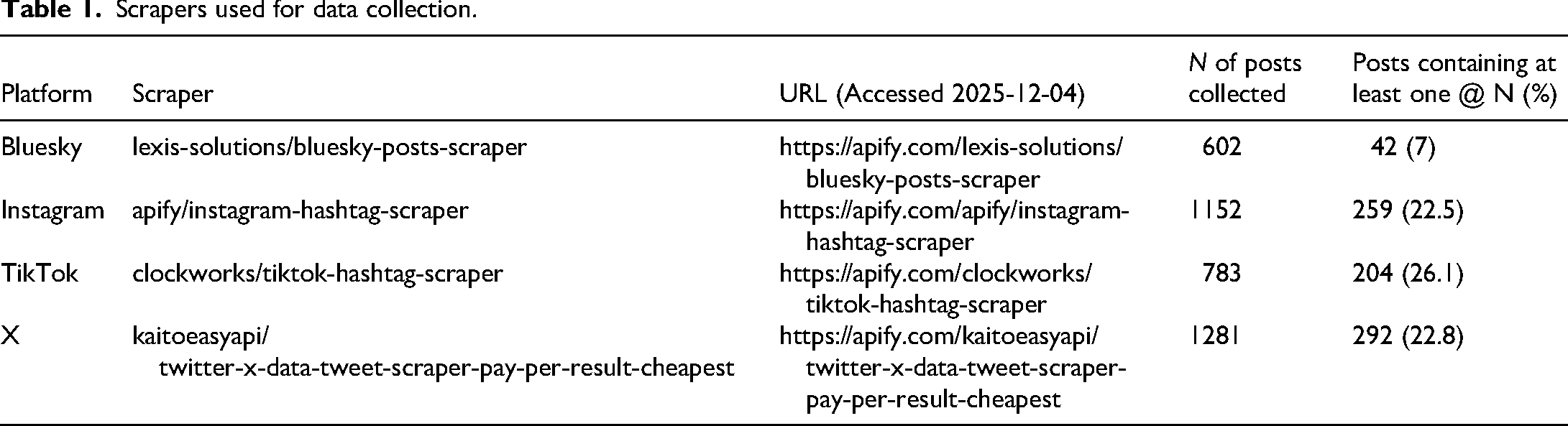
The scrapers mentioned in Table 1 were ran three times each day (morning, noon and night) in the period from 2025-08-01 until and including the election day 2025-09-08, capturing hashtagged activity during the most intense election period (Haßler et al., 2024; Klinger et al., 2022). Inspired by previous, similar scholarship (Jungherr, 2014; Robinson and Enli, 2022), focus was placed on the hasthags #valg25 and #valg2025 (‘valg’ being Norwegian for ‘election’). During the collection process, samples of collected posts were inspected to identify any other hashtags that could be of specific relevance for the election. This process suggested no other election-specific hashtags were used to prominent degrees, and focus was left on the previously mentioned hashtags. Once data collection had been completed, a series of data cleaning efforts were undertaken to remove duplicate posts and to otherwise harmonize the posts a combined dataset suitable for analysis.
Data analysis
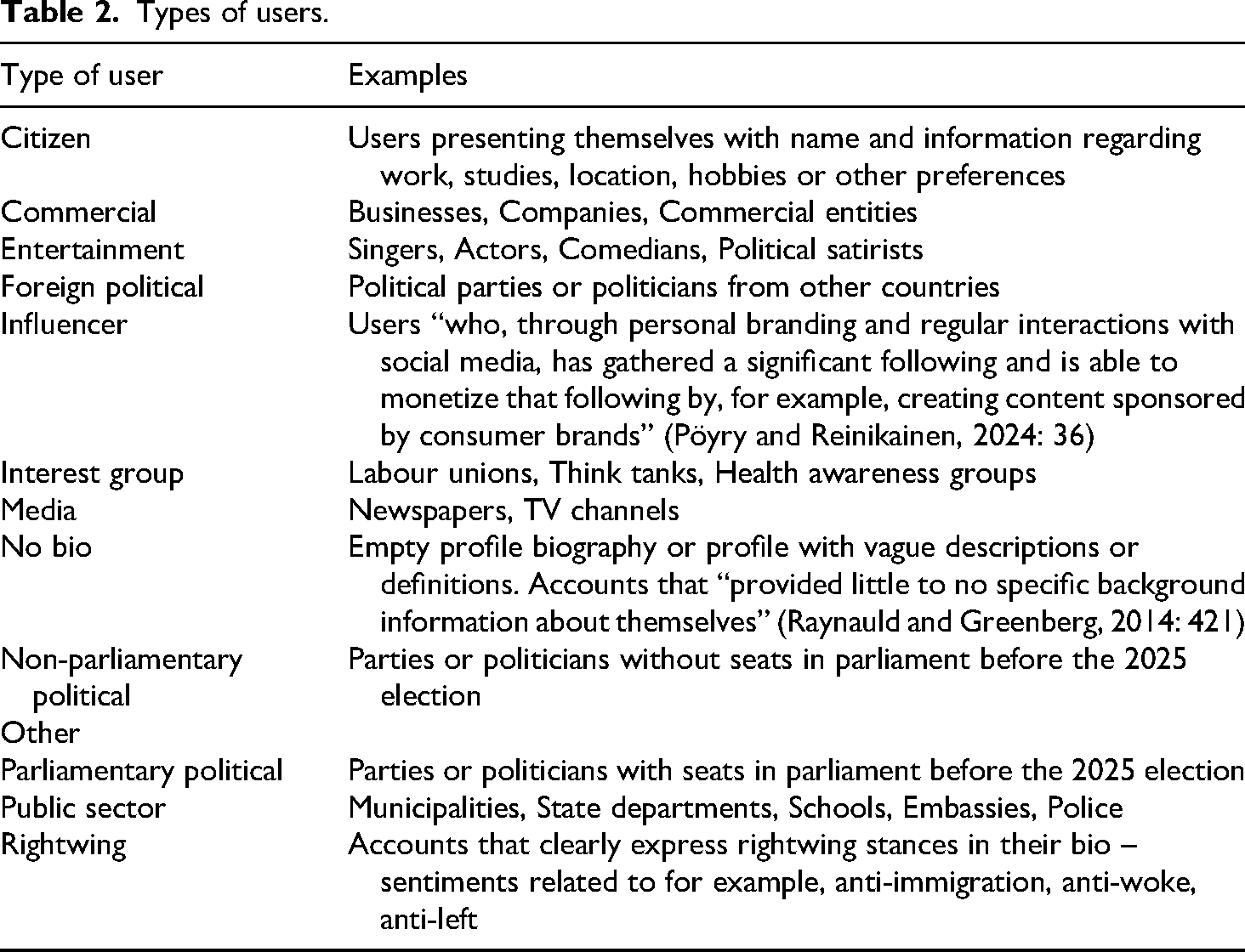
Users on the sending and receiving ends of @ messages were classified according to a categorization scheme that built on previous, similar research (Robinson and Enli, 2022; Skogerbø and Larsson, 2021) as well as on iterative efforts when users that did not fit in the scheme appeared in the data. Table 2 provides insights into the categories used for both senders and receivers.
Types of users.
As each post could theoretically contain multiple @ characters followed by separate addressees, each instance of the @ character was the starting point for what were effectively two sets of units of analysis – senders of @ messages on the one hand, and receivers on the other. For instance, a message sent by a hypothetical user_1 reading ‘hello @user_2 and @user_3’ was considered as two units of analysis – user1 addressing user2, and user1 addressing user3. Starting from the N of posts containing at least one @ (please refer to Table 1), the final data set with all pairings of senders and receivers amounted to a total of 1590 posts (N of pairings for Bluesky = 66, Instagram = 674, TikTok = 335 and X = 515). Reliability was assessed by having a second coder assess a random 10% sample of senders and receivers (a total of 318 posts). Using Krippendorf's α, reliability was gauged at .77 for senders and .88 for receivers, suggesting satisfactory levels of reliability (Lombard et al., 2002).
Results
We start by looking at the degree to which @ characters were used across the four studied platforms. Figure 1 presents the means and standard deviations of @ characters per post per platform.
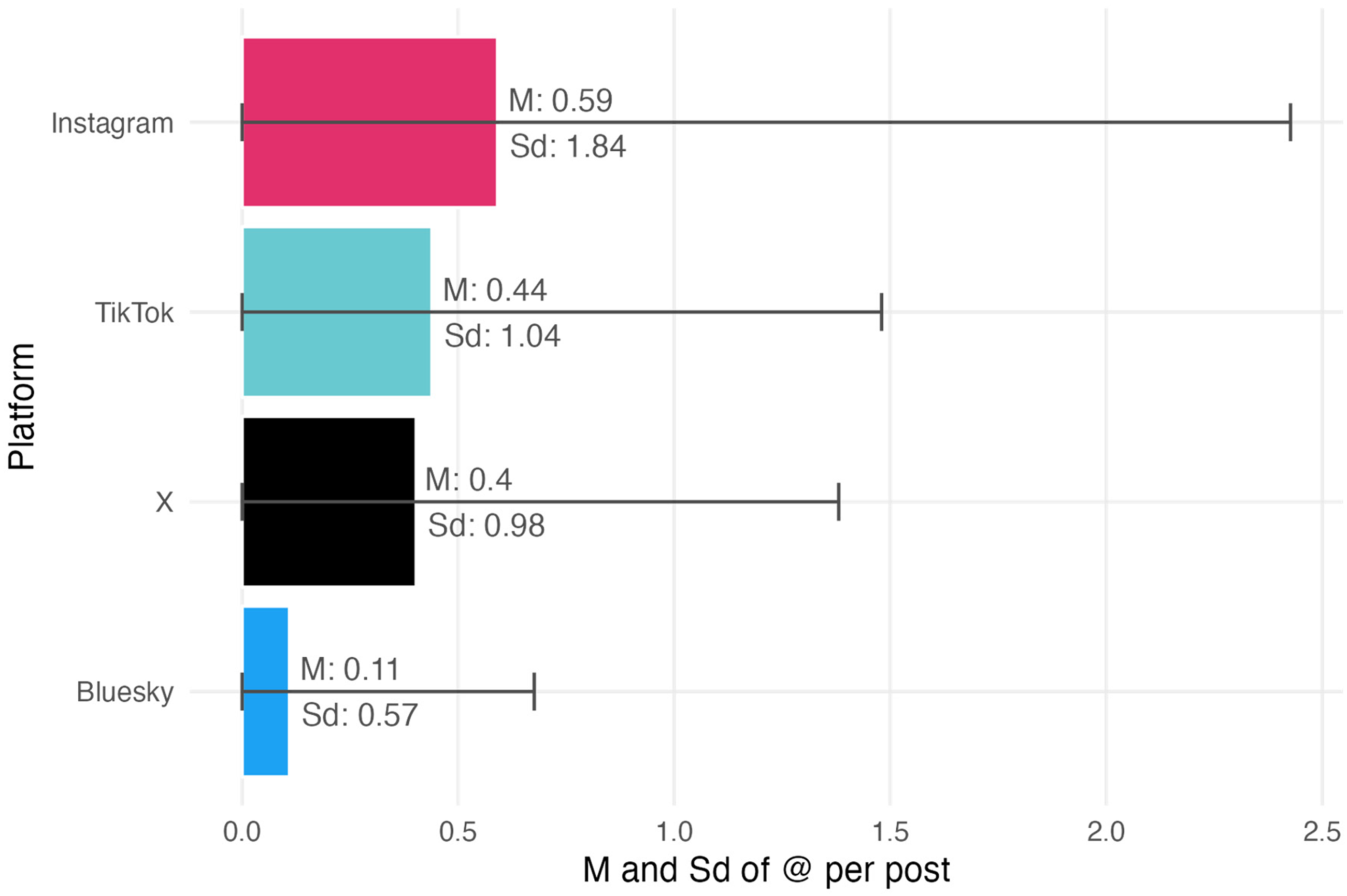
Mean and standard deviation of @ tagging per post on Bluesky, Instagram, TikTok and X. N of posts for Bluesky = 602, Instagram = 1152, TikTok = 783 and X = 1281.
The means reported in Figure 1 suggest that within our studied hashtags, Instagram (M = 0.59, SD = 1.84) was the platform most clearly characterized by use of the @ character. Testing the differences between the means reported suggests that this observation holds true – a Kruskal‒Wallis test was significant (χ2 = 23.01, df = 3, p < .001) suggesting similarly significant differences between the four means. Post-hoc testing utilizing Dunn's test showed that while the previously mentioned mean for Instagram was significantly higher than all other means (p < .001 across all comparisons), no significant difference could be discerned between TikTok and X (p = .596). Finally for these means, the statistic reported for Bluesky (M = 0.11, SD = 0.57) emerged as significantly lower than the means reported for the other three platforms – a finding that is indeed clearly mirrored in Figure 1. In sum, these findings support H1, which suggested that Instagram would be used more for @ messaging than the other platforms.
Next, we turn our attention to the result from the content analysis and focus first on the types of users that were active across platforms by means of sending @ messages.
Figure 2 details the relative distributions of types of users who were active in the sending of @ messages across the four studied platforms. As reported in the caption, testing to assess the strength of association between what is essentially two nominal variables – platform and type of user – resulted in a Cramér's V of .44. While interpretations of this measurement vary based on a series of different factors, common guidelines for understanding V suggest that this should be considered a medium to strong relationship between the variables (Cohen, 1988). With this statistical association in place, we can relate back to the idea of political communication ecosystems and suggest that at least for the senders studied here, the platforms appear as somewhat different from each other.
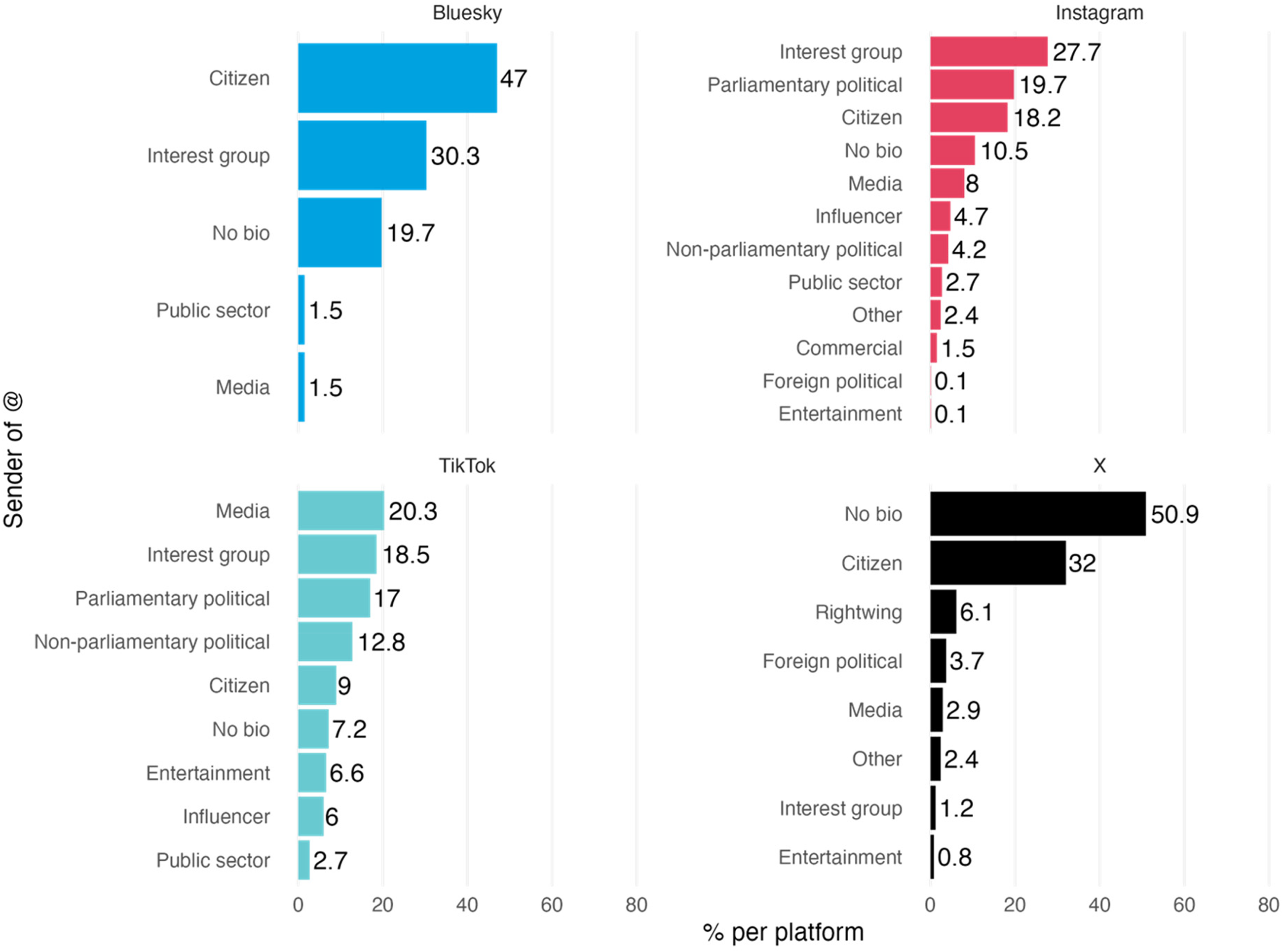
Senders of @ across Bluesky, Instagram, TikTok and X. χ2, df = 36, p < .001, Cramér's V = .44. N of posts for Bluesky = 66, Instagram = 674, TikTok = 335 and X = 515.
We can first point to the distributions reported for Bluesky, visible in the upper left-hand corner of Figure 2, suggests a dominance of Citizens (47% of all @ provided by this group) and Interest groups (30.3%). Interestingly, no political actors – parliamentary or non-parliamentary – appear to have been active in this regard here. Thus, our second research question, asking what types of users emerge as senders of @ messages on Bluesky, receives a clear answer as visible in Figure 2.
While the distributions regarding provided @-tags on Instagram suggest a sizeable amount of Citizens (18.2%) partaking also on this platform, the bars showed in the upper-right hand corner suggest what could perhaps be referred to as a more professionalized distribution – at least among the highly active users. Indeed, with Interest groups (27.7%) and Parliamentary political actors (19.7%) being responsible for close to half of all provided @ tags, the Instagram ecosystem appears to have different characteristics than the Bluesky variety. With regards to the latter of the mentioned actor groups, we can see that they were indeed more active in this regard on Instagram, lending support to H2.
For TikTok, the distributions (visible in the low left-hand corner of Figure 2) suggest an ecosystem somewhat similar to the one emerging for Instagram. With Media actors (20.3%), Interest groups (18.5%) and Parliamentary political actors (17%) being responsible for over half of the @ messages provided, TikTok does indeed appear to have been characterized by actors engaging with sending @ messages as representatives of some larger organization or entity. Another interesting tendency for TikTok is that this platform features the highest percentage of @ messages provided by Non-parliamentary political actors (supporting H3). While our current research design does not allow for any deeper insights regarding why these actors appear to have been especially active on this platform, a working assumption could be that they are trying to reach or at least to be visible for the relatively younger user group associated with TikTok.
For X (lower right-hand section of Figure 2), this platform must be seen as rather different when compared to the others. For X, anonymous No bio accounts are responsible for about half (50.2%) of the @ messages provided, followed by Citizens (32%) and Rightwing actors (6.1%). For Rightwing actors, this category is only present among senders on X – a finding that taken together with the overall distribution for the platform formerly known as Twitter would appear to say something about how the political communication ecosystem on this platform appears to have developed. This finding also supports H4, which suggested that rightwing actors would be more active on X than on other platforms.
Finally for senders, we filter our data in order to take a closer look at the two categories detailing activity undertaken by Norwegian political actors – Parliamentary and Non-parliamentary. As these types of actors were found only on TikTok and Instagram, Figure 3 is focused on these two platforms.
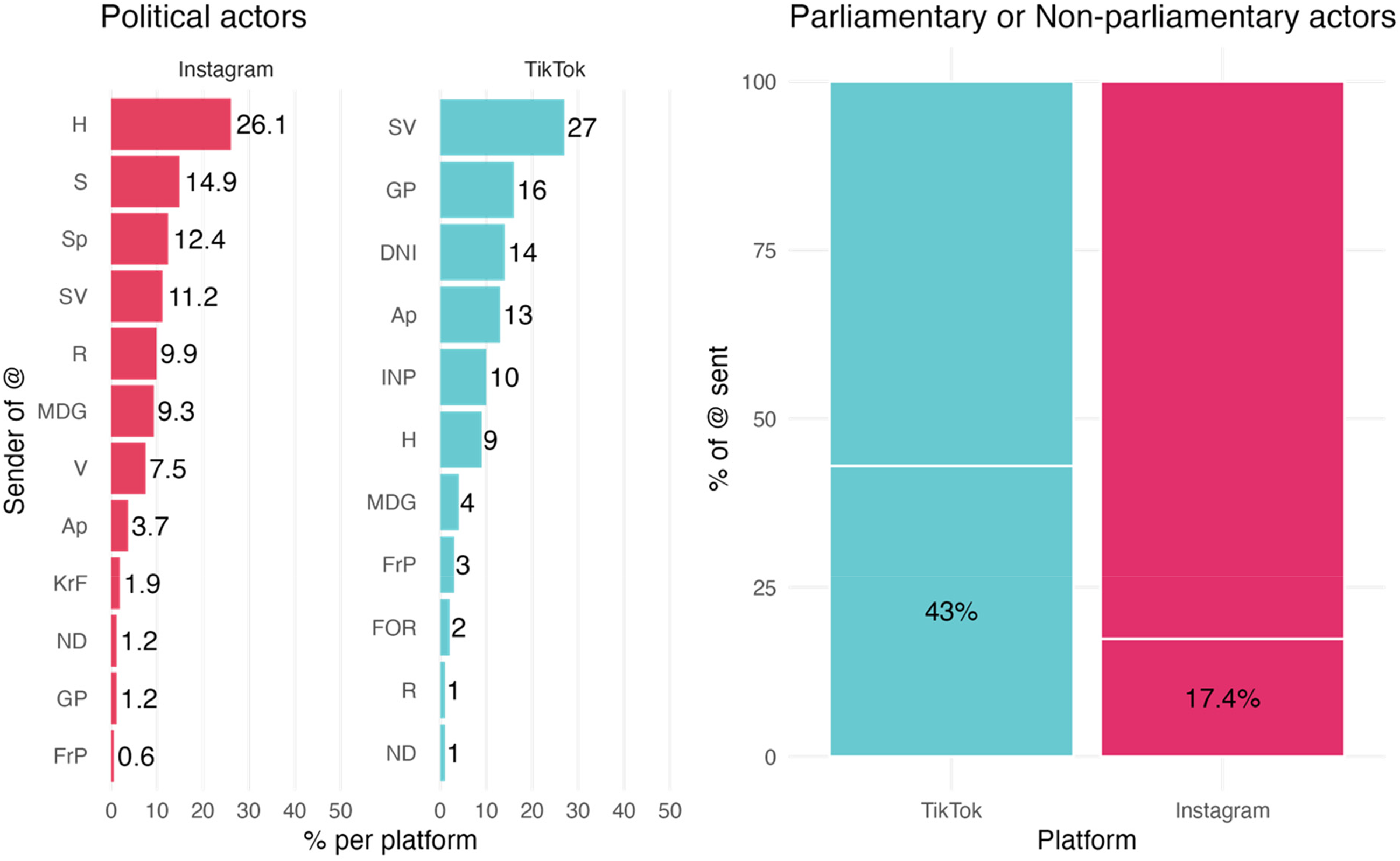
Political actor senders of @ across Instagram and TikTok. Political actors (left-hand side): χ2 = 180.96, df = 30, p < .001, Cramér's V = .29. Parliamentary or non-parliamentary actors (right-hand side): χ2 = 202.38, df = 4, p < .001, Cramér's V = .25. N of posts for Instagram = 161, TikTok = 100.
Compared to the Cramér's V measurements reported in relation to Figure 2, the same statistics provided in relation to Figure 3 are decidedly more modest. The left-hand side of the figure provides more details to the finding reported for TikTok above ‒ namely that TikTok was more employed by non-parliamentary actors than Instagram. For Instagram, while parliamentary parties like the Conservatives (H, 26.1%), the Centre Party (Sp, 12.4%) and the Socialist Left Party (SV, 11.2%), the non-parliamentary Sentrum Party (S, 14.9%) were comparably active on the platform at hand.
For TikTok, we see that while the aforementioned SV party (27% of all @ sent by political actors on this platform) and the governing Social Democrats (Ap, 13%) are among the top users, non-parliamentary actors such as the Generation Party (GP, 16%), the Norwegian Industrial Party (DNI, 14%) and the Norwegian Industry- and Business Party (10%) are making clear marks in this regard. This difference in platform prioritization between parliamentary and non-parliamentary actors that was first discovered in Figure 2 is even more clearly shown in the right-hand side of Figure 3, depicting the overall share of @ messages sent by non-parliamentary actors on TikTok (43%) and on Instagram (17.4%).
Moving on to the receivers of @ messages within the studied hashtags as dealt with in our first research question, Figure 4 provides insights into the distributions of types of actors including (left-hand side) and excluding (right-hand) parliamentary and non-parliamentary actors.
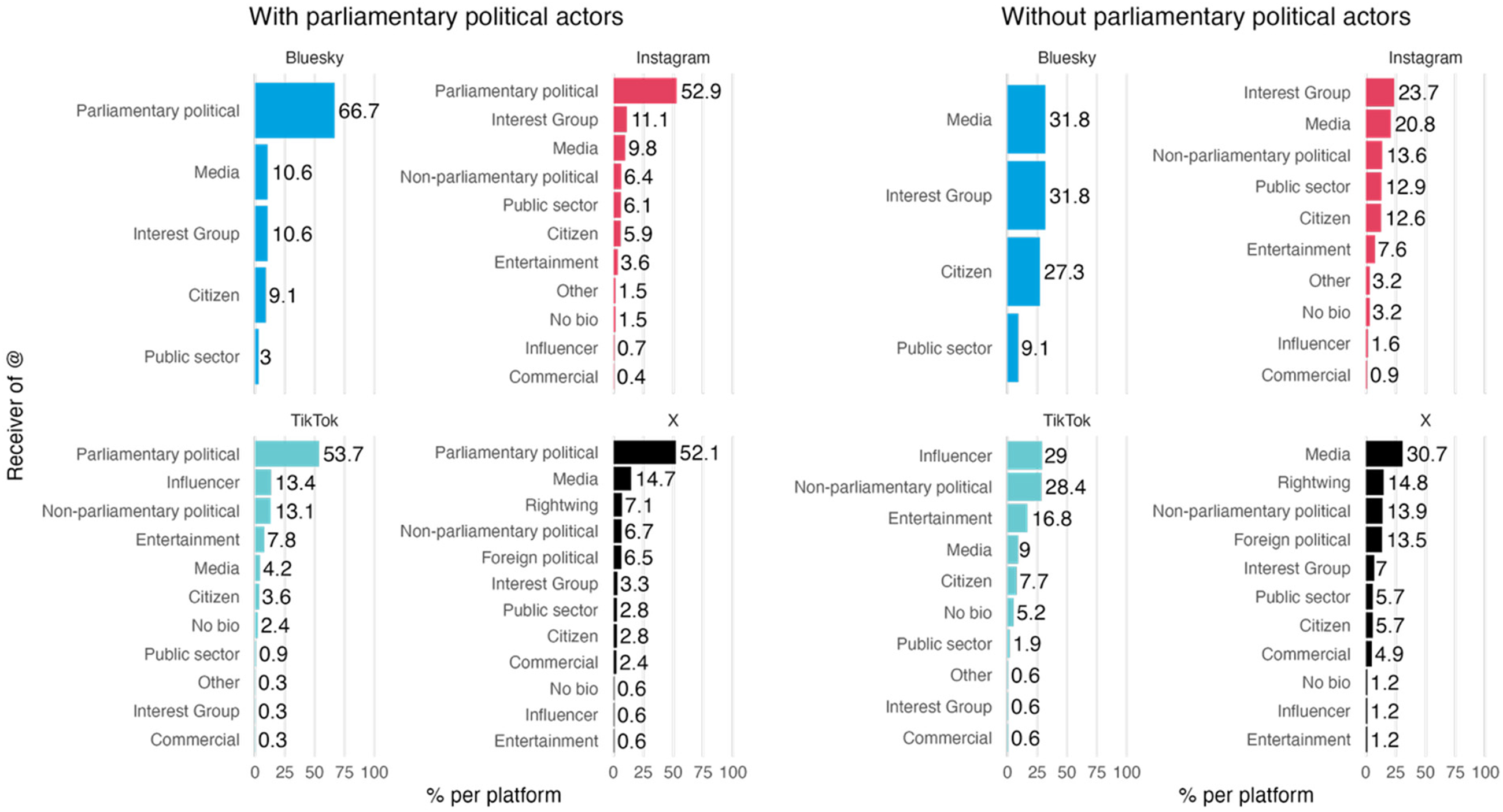
Receivers of @ across Bluesky, Instagram, TikTok and X. With parliamentary political actors (left-hand side): χ2 = 454.55, df = 36, p < .001, Cramér's V = .32. Without parliamentary political actors (right-hand side): χ2 = 449.02, df = 33, Cramér's V = .51.
Inspecting the left-hand side of Figure 4, the results presented show that across all platforms, parliamentary political actors receive the most attention as defined here. However, as this type of actor received over half of @-tags on Bluesky (66.7%), Instagram (52.9%), TikTok (53.7%) and X (52.1%), the Cramér's V result of .32 nevertheless suggests a medium-sized relationship between the platform and the distribution of receivers. As such, there appears to be considerable variation of user distribution across the platforms - even if parliamentary political actors dominate. Adopting a more explorative approach and investigating this tendency a bit further, the right-hand side of Figure 4 filters out the parliamentary political actors. Cramér's V for these distributions was reported at .51. Assessing these filtered distributions we can note some tendencies. First, both Bluesky [top types of users receiving are Media (31.8%) and Interest group (31.8%)] and Instagram [top types of users receiving are Interest group (23.7%), Media (20.8%) and Non-parliamentary political (13.6%)] emerge as featuring professional user groups among their top recipients of @ messages. These tendencies appear in somewhat of a contrast to TikTok, where the user type Influencer (receiving 29% of all @-tags) is found at the top, followed by non-parliamentary political (28.4%) and entertainment (16.8%). Such contrasting trends are seen also for X, where Media actors dominate (30.7%) and where the Rightwing (14.8%) category of recipients makes its only appearance in this analysis. In sum for RQ1, while parliamentary actors are most present in terms of receiving @ messages, our more exploratory efforts presented above has shed light on what could be considered as a sizable undercurrent of other types of users enjoying attention on the studied platforms. In sum, the results for both senders and receivers of @ messages suggest that each platform features specific distributions in these regard – giving credence to differing political communication ecosystems.
Discussion
While Twitter has for a long time been considered as one of the most important arenas for public deliberation, the findings presented in Figure 1 suggest a clear shift in this regard. At least for the Norwegian case under scrutiny here, Instagram has taken over in terms of the sending of @ messages. Furthermore, with the means reported for TikTok and X emerging as statistically insignificant from each other, the aforementioned shift between these political communication ecosystems becomes even clearer. Such changes reflect the challenges faced by professional communicators – within the political sphere or not – as they must not only adapt to the characteristics of each platform; they must also develop a keen sense of when the focus should change from one platform to another. Indeed, how quickly can professional communicators pick up on such changes – and how can we grasp the processes they adopt in order to update their efforts and their approaches to fit with each individual ecosystem? Future research might be able to shed light on such issues, perhaps starting from the findings presented here.
For senders, the distributions reported in Figures 2 and 3 clearly suggest a composition of users making up distinctive ecosystems – each characterized by different genres of users as discussed above. However, we can also point to certain commonalities across platforms. For instance, Figure 2 shows that Interest groups are either the most common sender or in second place across all platforms save for X. Such a dominance would seem to indicate monitoring activities between interest groups seeking to raise attention for their specific themes. If competing interest groups are present, so will others follow suit. Indeed, much like political actors engage in monitoring (McGregor, 2020), it does not seem unlikely that other professionals approach these platforms or indeed ecosystems in similar ways.
Finally for senders, Figure 3 suggests particular attention should be paid to TikTok with regards to political actors. Here we see that non-parliamentary actors mainly focus on the mentioned platform when compared to the others. The results thus suggest that TikTok has taken the place of previous social media platforms that have been used by comparable underdogs to reach possible supporters and indeed positions. The use of novel platforms by comparably small actors thus continues (Gibson and McAllister, 2015; Koc-Michalska et al., 2014) – even though the platforms of course change.
Figure four provided us with an overview of the types of actors that received the most attention across the four studied ecosystems. Given the context for the study at hand, it was not surprising to see parliamentary political actors came out on top across all platforms. By filtering out such actors, we again can discern distinct sets of receivers across the four platforms. Of note here is the activity undertaken in this regard on X – a platform where @ messages are indeed being sent, but where we can expect that those on the receiving end are not necessarily taking part. To be precise, while the bulk of parliamentary actors still have accounts on the specified platform, these accounts are not necessarily active. For instance, at the time of the election, the Social Democrats (https://x.com/Arbeiderpartiet) had not updated their account since 2023. Indeed, platforms such as those studied here are likely to come and go. The question is, then, how should actors such as those studied here handle accounts on platforms where activity for whatever reason has dwindled or become undesireable? For governmental actors, simply removing the accounts might not be a suitable option given the need to keep public records of their activities. At the same time, keeping the accounts while not maintaining any activity might give the users still present on the platform an illusion of presence on behalf of the account owners. As the number of platforms on which political actors are expected to have a presence increase, so will issues like these become tangible for researchers as well as for practitioners.
The work presented here has drawn on suggestions from previous scholarship and presented insights into the characteristics of political communication ecosystems as they emerged on four social media platforms during the 2025 Norwegian elections. While our efforts here go some way in detailing how political communication differs across platforms or indeed ecosystems, the study has limitations that need to be addressed. First, while the practice of studying hashtags is an established one, such an approach will not be able to capture the total amount of activity undertaken in relation to the phenomenon under investigation. User practices of including hashtags may change as unwillingness to make content public, visible or shared increases (Doroshenko and Tu, 2022). Second, while the categories used for the classification of senders and receivers of @ messages were derived from previous, similar literature, we cannot be certain that the employment of other classifications principles could have yielded somewhat different results. Hopefully, the results emanating from the coding scheme used here can be of interest for future employment – as well as for possible refinement. Third, although the study presented here has provided useful insights into attention-giving behaviour across social media platforms in a political communication context, the approach featured in the paper at hand has not detailed the precise contents of the scrutinized messages. Future research might find it suitable to somehow integrate such analyses in combination with the degree to which interactive features are used. Finally, while viewing each platform as an individual political communication ecosystem has yielded interesting insights into what does indeed differentiate them, the detailed view featured here nevertheless misses out on more overarching, systemic perspectives. That being said, our findings are hopefully of relevance not only to those interested in platform comparative aspects – but also to those who find it more suitable to take a more macro-oriented approach to political communication ecosystems. For those subscribing to the latter approach, the differentiated view presented here can hopefully serve as a starting point for further inquiry.
Footnotes

Funding
The author received no financial support for the research, authorship and/or publication of this article.
Declaration of conflicting interests
The author declared no potential conflicts of interest with respect to the research, authorship, and/or publication of this article.