







Abstract
This study investigated second language distribution of Chinese connectives by tallying responses on a mini-discourse completion test taken by English-speaking learners with different language learning backgrounds and at different proficiency levels. The results showed that an underuse pattern underlay practically all Chinese connectives as a result of learners’ attention distributed among the three layers of language (i.e. semantic-lexical, syntactic-structural, and discourse-textual layers). The underuse of Chinese connectives, especially for obligatorily paired ones, was moderated by learners’ heritage language background and increased proficiency. Even though Chinese connectives’ syntactic position/obligatoriness effect was not evinced, learners demonstrated sensitivity to the cognitive complexity of semantic relationships marked by connectives, producing more connectives to signal more cognitively complex relationships in general. Meanwhile, the cognitive complexity of connectives seemed to have a threshold effect that beyond a certain level, the excessive cognitive load imposed on learners diminished their use of connectives. This study sheds light on the understanding of Chinese connectives as a multifaceted discourse grammar in second language acquisition.
Keywords
I Introduction
With the advent of the field-changing concept of discourse competence (Canale, 1983; Celce-Murcia et al., 1995), mastering cohesive devices to construct and enhance the local connectedness of discourse has been considered essential in second language (L2) development. Since then, L2 learners’ use of cohesive devices and its determinants have been studied extensively (e.g. Crossley and McNamara, 2012; Crossley et al., 2016). As part of this trend, L2 Chinese researchers embarked on this topic from various theoretical perspectives, investigating the learning difficulties and development of lexical substitution, ellipsis, and topic-comment chain. However, the phenomenon of connectives remains underexplored, and the only available studies of L2 Chinese learners’ use of connectives have been conducted using corpus-based approaches (e.g. Cao, 2013; Yang, 2013). As such, the connectives examined are limited to a few individual, most frequently used connectives, such as yīnwèi ‘because’, suǒyǐ ‘so’, érqiě ‘also’, and dànshì ‘but’, leaving it an open question how learners employ less frequently used connectives in the form of correlatives, such as zhǐyǒu … cái ‘only if … then’, zhǐyào … jiù ‘as long as … then’, and jíshǐ … yě ‘even though … still’. Furthermore, these studies have yielded conflicting results regarding the L2 distribution of certain Chinese connectives.
Despite the conflicting results, researchers have coincided in explaining their findings with recourse to very few factors, such as negative cross-linguistic influence. This seems to arise from the narrowed research scope, and more crucially, the oversimplification of Chinese connectives as an isolated feature from discourse context, neglecting the influence of Chinese connectives’ own linguistic characteristics and their interaction with other linguistic cues in the discourse. Rather, Chinese connectives are discourse-oriented and interrelated with other linguistic cues in various layers of language (CN Li and Thompson, 1981). Chinese connectives’ discursive nature also renders their acquisition more susceptible to learners’ language learning backgrounds and proficiency levels. This study aims to achieve a more comprehensive understanding of the L2 distribution of Chinese connectives by probing the suppliance rate of 12 pairs of Chinese connectives in English-speaking learners’ responses on a mini-discourse completion test and examining its influencing factors, including learners’ attention to different layers of language, language learning background, proficiency level, Chinese connectives’ syntactic position/obligatoriness in a pair, and cognitive complexity.
II Chinese connectives
Before delving into Chinese connectives, it is imperative to understand the differences in sentence type between English and Chinese. Traditionally, the definition of the English sentence type is based on the notion of coordination and subordination. In English, a sentence is compound if it contains two or more coordinate clauses; a sentence is complex if it consists of a matrix clause and at least one subordinate clause. However, Chinese does not make such a distinction between compound and complex sentences but distinguishes between them based on independent clauses. Specifically, a Chinese compound sentence (fùjù复句) contains two or more independent clauses that are syntactically complete in isolation and not structurally embedded in or embedding any other clause (Yuehua Liu et al., 2001; Tsao, 1990; Xing, 2001). Compared cross-linguistically, Chinese compound sentences correspond to coordinate compound sentences and adverbial complex sentences but not complex nominal and relative sentences in English. In the following examples, Sentence (1) is considered a compound sentence in Chinese but an adverbial complex sentence in English; Sentence (2) is regarded as a complex sentence in both English and Chinese, because a clause is structurally embedded in another one.
(1)
Because my car broke down, I have to walk to work today.
(2) wǒ zhīdào tā hěn cōngming
我知道他很聪明。
I know he very smart
I know that he is very smart.
Therefore, semantic relationships between the clauses in a Chinese compound sentence can cover not only coordinate, adversative, and selective relations (as in English compound sentences), but also causal, conditional, and concessive relations (as in English complex sentences) (Yuehua Liu et al., 2001; Xing, 2001). Chinese connectives refer to a collection of grammatical cohesive devices that are employed to convey these semantic relationships for the sake of discourse coherence. As Sentence (1) shows, the pair of underlined Chinese connectives yīnwèi … suǒyǐ ‘because … so’ is used to construct inter-clausal cohesion between the two clauses and thus enhances local textual coherence by signaling the cause-and-effect relationship between the two clauses.
One of the unique features of Chinese connectives is that they often seem to occur in pairs in an ordered fashion as correlatives. In fact, Chinese connectives can be ordered along a continuum of co-occurrence. At one end of the continuum, some connectives are fixed and obligatory in pairs, and the occurrence of one half of a pair requires the co-occurrence of the other half, such as zhǐyǒu … cái ‘only if … then’ and zhǐyào … jiù ‘as long as … then’ (Yun Liu, 2008; W Zhang and Qiu, 2007). At the other end, some connectives are flexible and optional in pairs, so that one connective has the potential to form a pair with another, but the occurrence of one does not necessitate the appearance of the other. For instance, the connective dōu ‘still’ in the pair wúlùn … dōu ‘no matter … still’ may not necessarily demand the optional connective wúlùn ‘no matter’ in the first clause if a lexical item expressing universal inclusiveness, such as měi ‘every’ and suǒyǒu ‘all’, is used as a substitute for the connective wúlùn ‘no matter’ to satisfy the semantic requirement of that clause. Such examples can also be found (1) in the pair jìrán … jiù ‘since … then’, where jiù ‘then’ can be substituted by lexical items expressing definiteness, such as yīdìng ‘definitely’ and kěndìng ‘certainly’, and (2) in the pair chúfēi … fǒuzé ‘unless … otherwise’, where chúfēi ‘unless’ can be replaced by lexical items implying some degree of speculation, such as kěnéng ‘possibly’ and yīnggāi ‘should’. Furthermore, some so-called second connectives in a pair, such as suǒyǐ ‘so’, dōu ‘all/still’, yòu ‘and’, and dànshì ‘but’, tend to occur singly without the first one (Yuehua Liu et al., 2001; Xing, 2001; W Zhang and Qiu, 2007).
III L2 distribution of Chinese connectives
Studies of the distribution of connectives in L2 English learners’ production have yielded mixed results. Some studies found the overuse of connectives by L2 learners (e.g. Bolton et al., 2003; Crewe, 1990; Dueñas, 2009; Field and Oi, 1992; Milton and Tsang, 1993), whereas others reported underuse (e.g. Granger and Tyson, 1996). Additionally, the distribution of connectives in L2 English may differ according to learners’ first language (L1) background (Reid, 1992), the type of connectives (Narita et al., 2004), or the analytical techniques adopted (Chen, 2006). In contrast to the large quantity of studies on connective distribution in L2 English, few studies have been conducted in L2 Chinese (Cao, 2013; Yang, 2013), yielding divergent results as well.
Yang’s (2013) study strongly supported the overuse hypothesis. Yang examined the use of connectives in written summaries of the lesson contents presented in the textbook Reading into a New China (RNC) by three fourth-year undergraduate students learning Chinese as an L2 in the United States. Comparing the use of connectives found in the students’ written summaries with those in RNC, Yang discovered that the learners tended to overuse those connectives that were frequently used in RNC, including adversative connectives dàn/dànshì ‘but’ and kě/kěshì ‘but’, additive connectives érqiě ‘also’, and causal connectives yúshì ‘thus’, yīnwèi ‘because’, and suǒyǐ ‘so’. Also, they did not use connectives as widely as RNC, indicating that L2 Chinese learners had a smaller available repertoire of connectives at their disposal than native Chinese speakers.
Cao’s (2013) study revealed that the distribution of connectives may be a function of their syntactic position in a sentence. In 280 compositions written by beginning L2 Chinese learners, Cao calculated the relative frequencies of four causal connectives, yīnwèi ‘because’, suǒyǐ ‘so’, rúguǒ ‘if’, and wèile ‘for’, in the sentence-initial position (connective + sentence 1, sentence 2), the sentence-medial position (sentence 1, connective + sentence 2), and the paired position (connective 1 + sentence 1, connective 2 + sentence 2). Learners showed a clear preference for using them in the paired position (46%) and the sentence-medial position (40%) over the sentence-initial position (14%). A comparison of these data with those taken from native Chinese speakers showed that the learners overused all four connectives in the paired position (e.g. yīnwèi + sentence 1, suǒyǐ + sentence 2) and yīnwèi ‘because’ in the sentence-medial position but underused all four connectives in the sentence-initial position (e.g. wèile + sentence 1, sentence 2) and suǒyǐ ‘so’ in the sentence-medial position.
IV Influencing factors
Due to the limited connectives examined in these two studies, both authors focused mostly on causal connectives for interpretations of their findings. For the overuse of the pair yīnwèi … suǒyǐ ‘because … so’, Cao (2013) identified three causes: its transparent form–function mapping, the default cause-first result-second sequence of clauses, and the ease of memorization as a formula. Yang (2013), however, attributed it to the pedagogical emphasis placed on the co-occurrence of the two connectives. For the overuse of individual connectives suǒyǐ ‘so’ (Yang, 2013) and yīnwèi ‘because’ (Cao, 2013) in the sentence-medial position, Yang and Cao both claimed that L1 transfer was the primary driving force. For instance, the English word so, usually translated as suǒyǐ in Chinese, “is often used as a filler in spoken English by some speakers, even when no cause is provided in the sentence(s) following so”, which led English-speaking learners to overuse suǒyǐ ‘so’ in L2 Chinese (Yang, 2013: 81). In interpreting the underuse of causal connectives in the sentence-initial position, Cao maintained that the writing tasks in her study required fewer sentences beginning with causal connectives, because sentence-initial causal connectives did not fully serve the function of linking the propositions in the sentence being written with the known propositions in previous sentences.
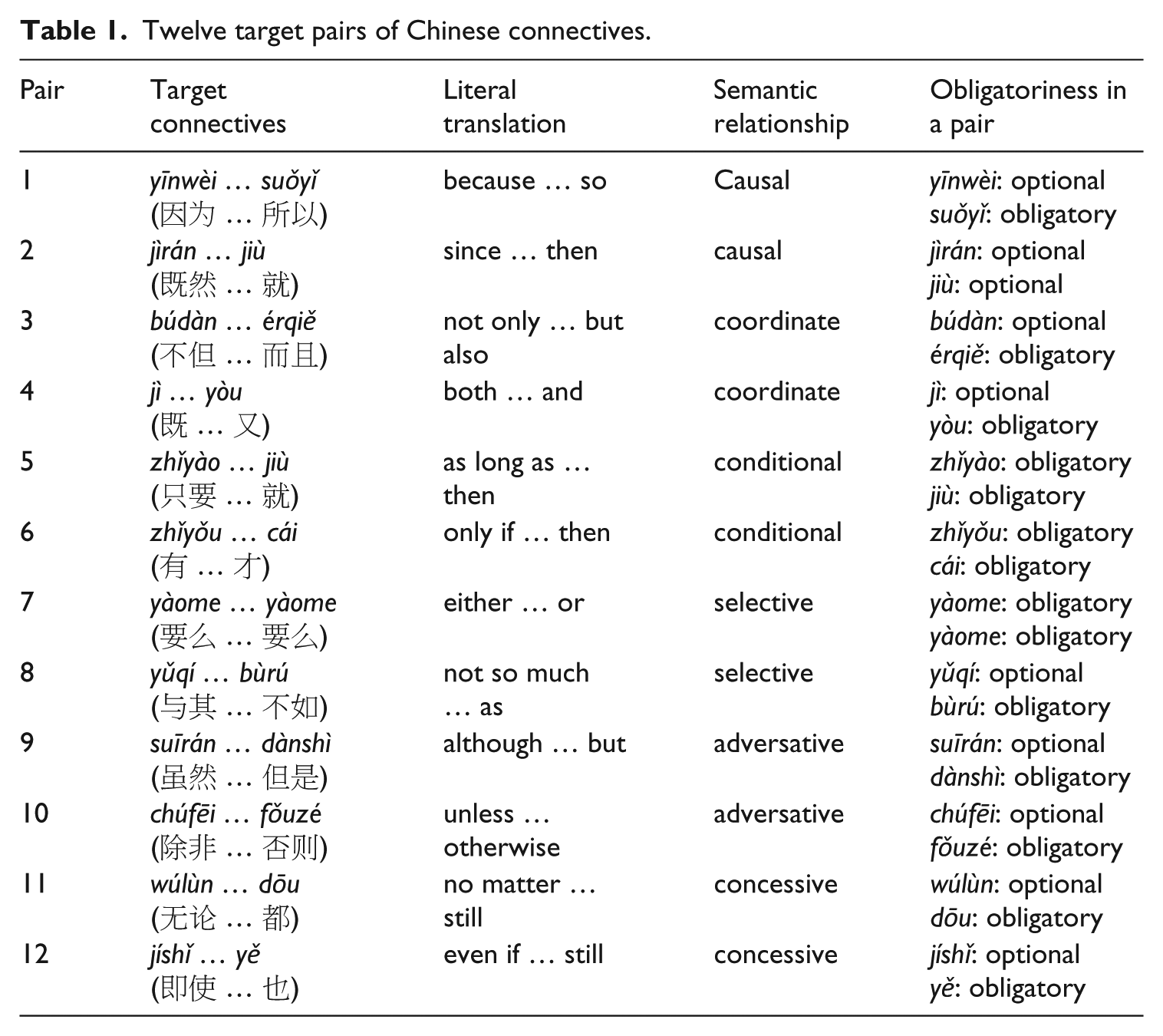
Relying solely on one type of Chinese connectives (i.e. causal connectives) and viewing Chinese connectives as an isolated feature from discourse context cannot paint a full picture of the L2 distribution of Chinese connectives and its influencing factors. Missing from the literature are (1) how learners’ attention affects Chinese connectives’ distribution in relation to the interaction between connectives and other discourse cues, (2) how learners’ language learning background and proficiency level influence the distribution of Chinese connectives, and (3) what roles Chinese connectives’ syntactic position/obligatoriness in a pair and cognitive complexity play in their distribution. To address these issues, the present study involves 12 pairs of Chinese connectives that signal a variety of semantic relationships and examines their distribution in view of L2 learner-related factors (i.e. learners’ attention, language learning background, and proficiency level) and Chinese connective-related factors (i.e. syntactic position and cognitive complexity). Table 1 lists the 12 target pairs of Chinese connectives, together with their literal translations and expressed semantic relationships (Yuehua Liu et al., 2001; Shao, 2007; Xing, 2001). 2
Twelve target pairs of Chinese connectives.
1 Attention
Language assigns different degrees of salience to its layers (Talmy, 2008), and as such, L2 learners’ attention is differentially allocated over the layers of language (Robinson et al., 2012; Schmidt, 1990, 1993). For instance, L2 learners favor meaningful lexical items over nonmeaningful grammatical markers (VanPatten, 1990, 2015). Learners’ attention also exerts an influence on L2 acquisition of discourse features, which can be exemplified by L2 Chinese learners’ lack of awareness of some idiosyncratic constructions in Chinese discourse, such as topic-comment sentences (FH Liu, 2015; Yuan, 1995), flexible word order (Li, 1999; Wen, 1994), and null elements (Jin, 1994; Polio, 1995). This influence can be more profound because discourse features are more subtle and opaque in nature (Jarvis and Pavlenko, 2008; Ortega, 2009). Furthermore, negative cross-linguistic influence and limited ultimate attainment may arise if L2 learners’ learned selective attention in L1 leads them to disregard cues that might otherwise be noticed and thus blocks the subsequent learning of the unnoticed cues in L2 (Ellis, 2006a, 2006b, 2008; Ellis and Wulff, 2015). For instance, Ellis and colleagues showed that previously L1-learned selective attention to adverb cues or verbal inflection cues led to the blocking effect on the learning of the other type of cues in L2 temporal reference acquisition (Cintrón-Valentín and Ellis, 2015, 2016; Ellis and Sagarra, 2010a, 2010b, 2011; Ellis et al., 2014).
Connectives are no exception to the influence of L2 learners’ attention to different layers of language (e.g. Zufferey et al., 2015). Attention to the semantic-lexical layer may lead L2 Chinese learners to use alternative lexical items, which have more concrete semantic meanings, in place of substitutable optional connectives, which possess comparatively vague procedural meanings; L1-learned selective attention to the syntactic-structural layer may facilitate English-speaking learners’ production of Chinese connective pairs that have English equivalents, such as búdàn … érqiě ‘not only … but also’ and yàome … yàome ‘either … or’, and hinder their production of those pairs that have no English equivalents; and attention to the discourse-textual layer may underlie L2 Chinese learners’ use of all Chinese connectives due to the possible lack of discourse awareness for enhancing textual cohesion and coherence through connectives as a cohesive device.
2 Heritage language background
Relying on an acceptability judgment task, L Zhang (2014) tested Chinese heritage and foreign language learners’ implicit knowledge about the usage of Chinese paired connectives. In the task, two grammatical and two ungrammatical test items were created for each pair of connectives, with four categories of errors related to the usage of correlative connectives embedded in ungrammatical items (i.e. misplacement of connectives, mismatched pairs of connectives, absence of obligatory connectives, and order-reversed pairs of connectives). Based on close examination of the participants’ judgments, Zhang concluded that although foreign language learners outperformed heritage language learners in the categories of absence of obligatory connectives and order-reversed pairs of connectives, heritage language learners generally had more solid, sophisticated implicit knowledge of Chinese connectives. As with the comprehension of Chinese connectives, learners’ heritage language background is expected to play a positive role in the production in this study.
3 Proficiency level
Based on the performances of 64 American learners of Chinese at four different instructional levels on a standardized oral proficiency test, Ke (2005) discovered that the acquisition of Chinese connectives 3 fell into a linear progressive pattern. That is, the learning of Chinese connectives correlated with the improvement of learners’ proficiency level. As pointed out by Ke (2005), this pattern was found among less advanced learners. However, within the context of advanced L2 French acquisition, Zufferey and Gygax (2017) found that in learning the causal and confirmative relations conveyed by the French connective en effet, advanced German learners neither distinguished the two different functions (i.e. causal and confirmative relations) mapped on the same form (i.e. en effet), nor did they appear sensitive to the necessity to explicitly mark confirmative relations, indicating that the specificities of form–meaning mappings in connectives remain elusive to learners with high L2 proficiency. Considering both pieces of evidence, the co-development of learners’ general proficiency and connective acquisition may decrease or cease towards the more advanced stages of L2 development.
4 Syntactic position/obligatoriness in a pair
As mentioned previously, some Chinese connectives are optional or substitutable in a pair. These connectives are mostly, if not entirely, the first in the pair and occupy sentence-initial position. Eight out of twelve target pairs in this study are such cases (see Table 1). One example is the connective búdàn ‘not only’ in the pair búdàn … érqiě ‘not only … but also’, denoting an additive relationship. It is often omitted, especially when an interlocutor has no intention of emphasizing this additive relationship by using both connectives in the pair. From the perspective of input frequency, a linguistic form with a higher token frequency becomes more entrenched in language acquisition (Bybee and Hopper, 2001; Ellis, 2002, 2012). Following this logic, the relatively frequent absence of búdàn ‘not only’ in the pair renders the linguistic form of individual connective érqiě ‘also’ highly strengthened in learners’ cognition, leading them to omit búdàn ‘not only’ in their production. Hence, this study hypothesizes an underuse of optional connectives in sentence-initial position but no underuse of obligatory connectives in sentence-medial position by L2 Chinese learners.
5 Cognitive complexity
In general, connectives have a procedural, not conceptual meaning. In other words, they are thought to lack concrete semantic or propositional content; however, they impose a semantic or coherence relationship between the clauses or discourse units they link (Brinton, 1996; Fraser, 1999; Schourup, 1999). Thus, connectives’ cognitive complexity stems from the semantic relationship they impose on discourse. Grounded in two primitives (positive vs. negative relations and additive vs. causal relations) in Sanders et al.’s (1992, 1993) cognitive theory of coherence relations, researchers found a cognitive complexity hierarchy of coherence relations based on the misuse and frequency of connectives in child language development: positive additive/positive causal < negative additive < negative causal/conditional/concessional (< means is less complex than) (Bloom et al., 1980; Evers-Vermeul and Sanders, 2009; Sanders and Noordman, 2000; Spooren and Sanders, 2008). Given that the more complex the semantic relationship, the more cognitive resources learners use to explicitly mark the semantic relationship through connectives (Spooren, 1997; Spooren and Sanders, 2008), L2 Chinese learners’ use of connectives in terms of the six types of semantic relationships in this study may follow a general pattern: coordinate/causal/selective > adversative/conditional/concessional (> means is more frequent than).
V Research questions
Bearing these influencing factors in mind, five research questions are formulated as follows:
Do L2 learners prefer to use alternative lexical items over substitutable optional connectives (i.e. wúlùn ‘no matter’, jiù ‘then’ paired with jìrán ‘since’, and chúfēi ‘unless’)?
Do L2 learners use Chinese connectives in the pairs that have English equivalents (i.e. jìrán … jiù ‘since … then’, búdàn … érqiě ‘not only … but also’, jì … yòu ‘both … and’, yàome … yàome ‘either … or’, and yǔqí … bùrú ‘not so much … as’) as frequently as native Chinese speakers and underuse those in the pairs that have no English equivalents?
How do L2 learners’ language learning backgrounds and proficiency levels affect their use of Chinese connectives?
Do L2 learners underuse or overuse the optional connectives in sentence-initial position (i.e. the first connectives in a pair) and the obligatory connectives in sentence-medial position (i.e. the second connectives in a pair)?
Do L2 learners use more cognitively simple connectives (i.e. coordinate/causal/selective connectives) than cognitively complex ones (i.e. adversative/conditional/concessional connectives)?
VI Method
1 Participants
This study involved a total of 400 participants, consisting of a native Chinese speaker (NS) group, a heritage language learner (HL) group, a high-level foreign language learner (HFL) group, and a low-level foreign language learner (LFL) group. The NS group had 210 members, consisting of 199 college students in a Chinese university and 11 Chinese instructors in two American universities. The NS group was included in this study as a methodological aid to justify the effectiveness of test instruments, to provide information about the suppliance rate of Chinese connectives in native norms, and to establish data-supported criteria for the obligatory and optional use of Chinese connectives (Granger, 2012).
The remainder of the participants were 190 L2 learners of Chinese enrolled in ten universities across the Midwest and the Mid-Atlantic regions of the United States, a Canadian university, and two study-abroad programs in China. They had finished at least one semester of Chinese language instruction at the college level when they participated in this study. Of these 190 learners, 57 were identified as heritage language learners and thus included in the HL group, because they spoke Mandarin Chinese or its dialects, such as Southern Min and Cantonese, with one or both of their parents at home or started learning Chinese before puberty 4 ; and 133 were foreign (non-heritage) language learners, of which 128 spoke English as their native language, and five were bilinguals in their childhood, with English as their dominant language and Tibetan, Hindi, Marathi, Korean, and Japanese, respectively, as their other language. These 133 foreign (non-heritage) language learners were further divided into two proficiency levels: the HFL group consisted of 47 foreign language learners who had not only finished more than four semesters of formal Chinese instruction at the time of the data collection but also scored above average on 12 filler items of the tests taken by the foreign language learners in a larger research project; the LFL group comprised the other 86 foreign language learners. According to learners’ self-reported external standardized proficiency test scores, the HFL group’s proficiency level approximately corresponded to Intermediate High and Advanced levels on the ACTFL Oral Proficiency Interview scale, whereas the LFL group clustered around Intermediate Low and Mid levels. Table 2 presents the participants’ demographic information.
Participants’ demographic information.
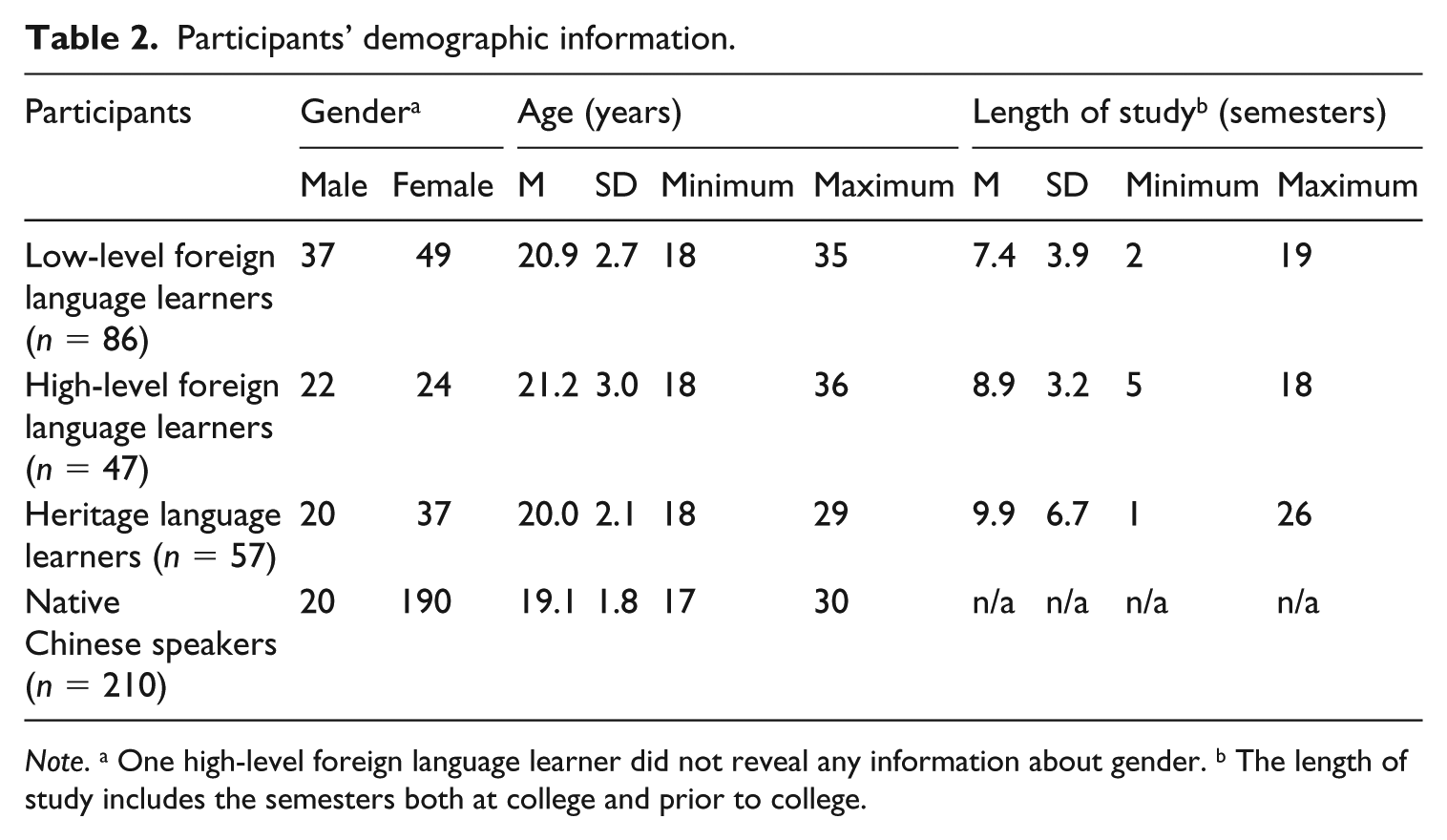
Note. a One high-level foreign language learner did not reveal any information about gender. b The length of study includes the semesters both at college and prior to college.
2 Test instrument
The present study forms part of a larger research project (Lu, 2017) and draws its data from the mini-discourse completion test as one of the two instruments in the larger project. In each item of the test, the participants were required to complete an omitted clause in a three-clause discourse, in which one of the two connectives in a target pair was embedded in one of the two given clauses (as shown in Appendix 1). The purpose of constructing three-clause discourses in the test items was to create contexts adequate for eliciting target connectives yet delimited to restrict the scope of potential responses in consideration of the polysemy of some connectives.
In the test, each connective in a target pair was measured by one item, totaling 24 items. Additionally, six filler items were generated to distract the participants’ attention from the focus of the test items. The filler items took exactly the same format as that of the test items but contained no Chinese connectives in the two given clauses. To further disguise the purpose of the test, a randomization procedure was implemented. The 24 test items were first equally divided into two sections (A and B), one section containing 12 test items on one of the two connectives in each of the 12 target pairs, and the other section containing 12 test items on the other of the two connectives in the pairs. The six filler items were then equally and randomly assigned to the two sections. Finally, all the items in both sections were randomized. Table 3 shows a visual layout of the test instrument.
Layout of the test instrument: Mini-discourse completion test.
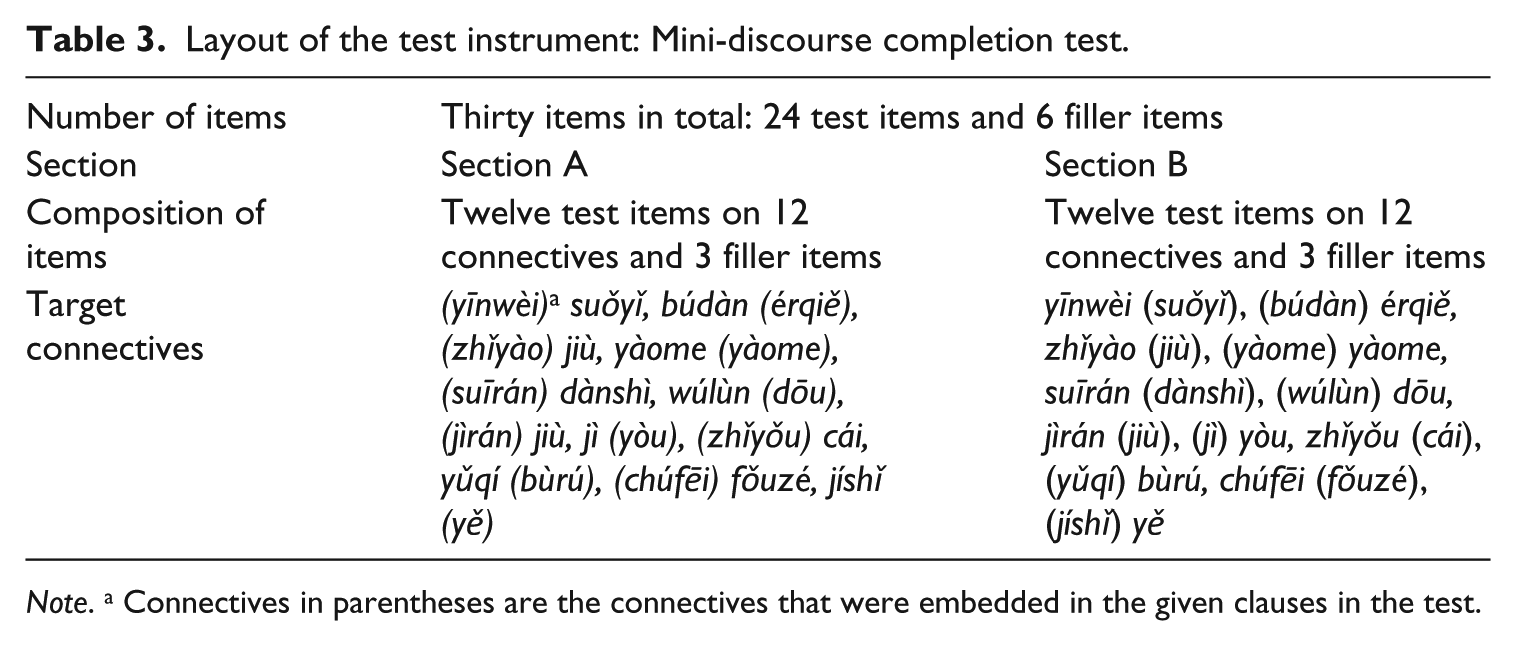
Note. a Connectives in parentheses are the connectives that were embedded in the given clauses in the test.
The construction of all the test items was based on five criteria. First, the semantic relationships between the clauses in the test items were culturally universal. For instance, a test item that was intended to assess the relationship between a necessary condition and its result was carefully constructed so that the relationship would not be perceived as a relationship between a sufficient condition and its result by L2 learners. Doing so eliminated any confusion or misunderstanding caused by cultural and ideological differences. Second, the subject matters described in the test items were thematically common. To reduce the participants’ cognitive load, the subject matters were selected from introductory chapters and sections of the most extensively used Chinese language textbooks in the United States (i.e. Integrated Chinese Level 1 and Chinese Link Level 1), including school life, leisure-time activities, traveling, eating, and shopping. Third, the language that the participants encountered in the test items was authentic, comprising natural conversations or speech that native Chinese speakers would normally use in daily life. Fourth, the lexical difficulty of the test items was reduced to a minimum. To make the words used to construct the test items accessible, they were strictly chosen from two vocabulary sources targeting L2 learners of Chinese: the Chinese Proficiency Test (HSK) Graded Vocabulary 1–3 level (Hanban, 2010) and the most frequent 500 words in A frequency dictionary of Mandarin Chinese: Core vocabulary for learners (R Xiao et al., 2009). The English translation was also provided if:
the word belonged to level 3 of the Grade Vocabulary in the HSK but was not included in the most frequent 500 words in the dictionary;
the word ranked from 301 to 500 in frequency in the dictionary but was not included in level 1–3 of the Grade Vocabulary in the HSK; or
the word exceeded the vocabulary range covered in the introductory levels of the extensively used Chinese textbooks, such as Integrated Chinese Levels 1 and 2 and Chinese Link Levels 1 and 2.
Fifth, the syntactic complexity of the test items was tightly controlled within a low level. Difficult syntactic structures, such as ba-construction, passive construction, and comparative sentence structure, were excluded from the test items; all the clauses in the test items followed the so-called canonical SVO word order in Chinese.
3 Data collection
In the larger research project, all participant groups went through the same data collection procedure. They were asked to finish a demographic survey first, then the mini-discourse completion test, and finally another test. The participants were given 30 minutes to finish the mini-discourse completion test, which was administered in a pencil-and-paper format under supervised conditions. When providing their constructed responses to the test items, the learners who were enrolled in first- and second-year Chinese courses were allowed to use the Pinyin System (Romanized system for Mandarin Chinese) to substitute for any Chinese character that they did not know how to write, given that writing Chinese characters often poses challenges to learners, especially those with low proficiency. However, they were not allowed to use any electronic devices or smartphone applications to assist them in completing the test. The two sections of the test (A and B) were sequentially alternated among participants, because this alternation helped diminish the practice and fatigue effects that would otherwise impact the results.
4 Coding
The NS group’s data were coded first to provide information about the suppliance rate and obligatoriness of the target connectives. The NS group’s responses on the test were coded according to whether they used connectives, and if they did, whether they used the target connectives or their interchangeable equivalents, otherwise, what lexical items, if any, they used in a patterned manner to manifest the semantic relationships required in the test items. In establishing the criteria for optional and obligatory connectives, a connective was categorized as obligatory if the connective and its interchangeable equivalents were used in more than 90% of the NS group’s responses and identified as obligatory in a naturalistic native speakers’ corpus (W Zhang and Qiu, 2007); otherwise, the connective was categorized as optional (see the rightmost column in Table 1 for results).
The learners’ data were then coded categorically into:
no use, where no target connective or its interchangeable equivalent was used in the response, but any lexical item that signaled the same semantic relationship as the target connective was recorded in the absence of that connective;
correct use, where the target connective or its interchangeable equivalent was used; and
misuse, where the connectives and their intended semantic relationships were inappropriate in the context or unacceptable according to the established criteria based on the NS group’s data.
These three categories were mutually exclusive and exhaustive. The researcher and an intercoder independently coded the learners’ responses and reached a high level of consistency in assigning the codes (Cohen’s κ = .97, p < .001), with discrepancies resolved by discussion.
5 Analysis
To answer the research questions, frequencies of no use and (correct) use of each connective as well as frequencies of lexical item uses in the context of the substitutable connectives were tallied in the LFL, HFL, HL, and NS groups, respectively. With the frequency data pertinent to the use of each connective, the LFL, HFL, and HL groups were first compared with the NS group and then among themselves, using six Pearson Chi-square (χ2) tests. To control for the family-wise Type I error in performing multiple pairwise Pearson Chi-square (χ2) tests for each connective, the alpha level for each test was lowered to .01 instead of setting it at the normal value of .05. All the analyses were conducted with R statistical packages (R Core Team, 2015).
VII Results
Research question 1
Research question 1 examines the preference for either substitutable optional connectives (i.e. wúlùn ‘no matter’, jiù ‘then’, and chúfēi ‘unless’) or their alternative lexical items. In addition to the three substitutable optional connectives, many of the L2 learners were found to substitute obligatory connective zhǐyǒu ‘only if’ with lexical items denoting a definite speculation, such as yīdìng ‘definitely’ and bìxū ‘necessarily’. Appendix 2 shows the percentages of these four substituted connectives and their equivalents versus the lexical items in lieu of connectives employed by the NS, HL, HFL, and LFL groups. In choosing between connectives and lexical items to express semantic relationships, the NS group exhibited a clear tendency towards connectives rather than lexical items. In contrast, L2 Chinese learners, including all HL, HFL, and LFL groups, used more lexical items than connectives, except chúfēi ‘unless’. As shown in Appendix 3, Pearson Chi-square (χ2) tests revealed that the HL, HFL, and LFL groups used significantly more lexical items instead of connectives in the wúlùn ‘no matter’-, zhǐyǒu ‘only if’-, and jiù ‘then’-clauses compared with the NS group; however, the three groups did not differ from the NS group in using connectives versus lexical items in the chúfēi ‘unless’-clause. Comparisons among the HL, HFL, and LFL groups showed that regardless of language learning background and proficiency level, they performed similarly in the suppliance of all four connectives versus lexical items to express semantic relationships.
Research question 2
Research question 2 examines the distribution of connective pairs that have English equivalents (i.e. jìrán … jiù ‘since … then’, búdàn … érqiě ‘not only … but also’, jì … yòu ‘both … and’, yàome … yàome ‘either … or’, and yǔqí … bùrú ‘not so much … as’) and those that do not. Appendix 4 lists the frequencies of no use and use of connectives by the NS, HL, HFL, and LFL groups. As can be seen in Appendix 4, the NS group frequently used the obligatory connectives érqiě ‘but also’, yòu ‘and’, yàome ‘either’, yàome ‘or’, and bùrú ‘as’, and optionally used jìrán ‘since’, jiù ‘then’, búdàn ‘not only’, and yǔqí ‘not so much’, but tended not to use optional connective jì ‘both’ in a pair. Pearson Chi-square (χ2) test results on the suppliance rates of no use and use of connectives among NS, HL, HFL, and LFL groups are reported in Appendix 5. The results revealed that in comparison to the NS norms in using the pairs that have English equivalents, all groups of L2 learners significantly underused all the obligatory connectives (i.e. érqiě ‘but also’, yòu ‘and’, yàome ‘either’, yàome ‘or’, and bùrú ‘as’) as well as two paired optional connectives (i.e. jìrán ‘since’ and jiù ‘then’); the HL group significantly underused the optional connective búdàn ‘not only’; and the HL and LFL groups significantly underused the optional connective yǔqí ‘not so much’. An exception to the general pattern of underuse was that all groups of L2 learners overused connectives, including misused connectives, in the jì ‘both’ slot. The results also revealed that L2 learners underused all the pairs that have no English equivalents.
Research question 3
Research question 3 investigates how the learners’ language learning background and proficiency level affect the use of Chinese connectives. As presented in Appendix 5, the target connectives fell under three categories with respect to the learners’ language learning background and proficiency level:
The learners’ heritage language background made a difference, especially when comparing the HL group with the LFL group. The HL group used yīnwèi ‘because’ and búdàn ‘not only’ less frequently, but they used zhǐyào ‘as long as’, jiù ‘then’ paired with zhǐyào ‘as long as’, cái ‘then’, first yàome ‘either’, second yàome ‘or’, chúfēi ‘unless’, dōu ‘still’, jíshǐ ‘even if’, and yě ‘still’ more frequently at a statistically significant level.
The learners’ proficiency level made a difference, especially when comparing the HFL group with the LFL group. The HFL group used yòu ‘and’, jiù ‘then’ paired with zhǐyào ‘as long as’, cái ‘then’, bùrú ‘as’, chúfēi ‘unless’, fǒuzé ‘otherwise’, and dōu ‘still’ more frequently at a statistically significant level.
The learners’ language learning background and proficiency level made no difference in the use of the connectives suǒyǐ ‘so’, jìrán ‘since’, jiù ‘then’ paired with jìrán ‘since’, érqiě ‘but also’, jì ‘both’, zhǐyǒu ‘only if’, yǔqí ‘not so much’, suīrán ‘although’, dànshì ‘but’, and wúlùn ‘no matter’.
Research question 4
Research question 4 considers whether the optional connectives in sentence-initial position and the obligatory connectives in sentence-medial position are overused or underused. From the results in Appendix 5, the L2 learners generally underused the connectives in sentence-initial position in comparison with the NS group. However, besides the above-mentioned connectives búdàn ‘not only’ and jì ‘both’, there were two additional exceptions: the HFL group’s use of optional connectives yīnwèi ‘because’ and yǔqí ‘not so much’ did not differ from that in the NS group. The L2 learners unanimously underused the connectives in sentence-medial position.
Research question 5
Research question 5 probes the influence of cognitive complexity on the distribution of Chinese connectives. Within the simple connective category (i.e. coordinate/causal/selective connectives) and the complex connective category (i.e. adversative/conditional/concessional connectives), the frequencies of no use and use by the L2 learners were calculated (no use of simple connectives was 1,341, use of simple connectives was 939, no use of complex connectives was 1,250, and use of complex connectives was 1,030; see also Appendix 4). A Pearson Chi-square (χ2) test revealed that the cognitively complex connectives were used significantly more than the cognitively simple connectives by L2 learners (χ2 = 7.40, p = .007, ϕ = 0.04).
VIII Discussion
1 Underuse of Chinese connectives
The goal of this study is to investigate the L2 distribution of Chinese connectives and delineate its influencing factors. The results clearly demonstrate that compared with native Chinese speakers’ norms, English-speaking learners with different language learning backgrounds and proficiency levels underuse virtually all Chinese connectives. The sole exception to this underuse pattern is that learners overuse connectives in the jì ‘both’ slot. A close examination, however, indicates that the frequency of connective use in the jì ‘both’ slot by L2 learners accounts for a marginal proportion (HL = 17.5%; HFL = 17.0%; LFL = 17.4%), similar to the cases in other underused connectives. Given that native Chinese speakers seldom use jì ‘both’ (5.7%), the significant result of overuse by L2 learners shown in the statistics of the comparison with native Chinese speakers should not be regarded as excessive use in practice.
Comparisons of Phi coefficients (effect sizes) in the Pearson Chi-square (χ2) tests show that the underuse of obligatory connectives in sentence-medial position within the pairs that have no English equivalents (e.g. fǒuzé ‘otherwise’ and yě ‘still’) and even obligatorily paired connectives that do have English equivalents (e.g. yàome … yàome ‘either … or’) is mainly more pronounced among L2 Chinese learners, and that this underuse seems overwhelming and long-lasting (e.g. for fǒuzé ‘otherwise’, NS vs. HL Phi coefficient ϕ = .88, NS vs. HFL Phi coefficient ϕ = .81; for yě ‘still’, NS vs. HL Phi coefficient ϕ = .66, NS vs. HFL Phi coefficient ϕ = .82). 5
Despite these findings, the underuse pattern applies to all Chinese connectives, regardless of their syntactic positions in a sentence, obligatoriness in a pair, cognitive complexity, whether they have English equivalents or not, and learners’ language learning background and proficiency level. This study’s finding about omnipresent underuse of connectives seems to contradict those of previous studies showing that underuse is only related to certain categories of connectives (Narita et al., 2004) or connectives in certain positions (Cao, 2013), and that L2 learners of Chinese overuse connectives (Yang, 2013), including paired causal connectives (Cao, 2013). These disparities may be attributed to the different methodologies adopted by the present study (i.e. controlled elicitation task) and the previous studies (i.e. free production task).
2 Influencing factors
In this study, the ubiquity of Chinese connective underuse is congruent with the hypothesized influence of English-speaking learners’ attention to three different layers of language. Within the semantic-lexical layer, lexical items, compared with connectives, have more concrete semantic meanings and thus can more directly express the semantic relationships required in discourse. For this reason, learners tend to utilize lexical items rather than connectives to construct coherent discourse whenever the lexical items are at their disposal, as in the cases with wúlùn ‘no matter’, jiù ‘then’, and zhǐyǒu ‘only if’. It is worthwhile to note that such a substitution pattern also extends to the obligatory connective zhǐyǒu ‘only if’. This suggests that learners’ preference for semantic meanings over procedural meanings permeates all connectives, thus partially explaining the underuse of obligatory connectives as well. However, when the semantic relationship in discourse is too opaque and difficult to process and encode even in lexical items, the relative percentage of lexical item use is low, as found in the chúfēi ‘unless’ slot. In other words, the rather high cognitive complexity imposed by chúfēi … fǒuzé ‘unless … otherwise’ restrains learners from comprehending the meaning of the discourse and consequently producing pertinent lexical items to express such meaning (Evers-Vermeul and Sanders, 2009; Spooren and Sanders, 2008).
L1-learned selective attention to the syntactic-structural layer is the principal reason for the conspicuous underuse of certain obligatory connectives in the pairs that have no English equivalents. Because obligatorily paired connectives in Chinese can merely be expressed by single connectives in English, learners may erroneously perceive that a single connective would suffice and therefore omit the other in the pair that is syntactically required in Chinese. As Sentence (3) shows, English-speaking learners are extremely likely to drop the obligatory connective fǒuzé ‘otherwise’ in their responses to the chúfēi ‘unless’-clause (the learner’s response is underlined).
(3) wǒ zuì xǐhuan chī nǐ zuò de fàn le, chúfēi zhè shì nǐ zuò de, *
我最喜欢吃你做的饭了,除非这是你做的,*
I most like eat you cook NOM
6
food SFP, unless this is you cook NOM,
I like the food you cook the most. Unless it was you who cooked this,
Admittedly, structural differences between Chinese and English connectives induce L2 Chinese learners’ underuse of obligatorily paired connectives (e.g. Cao, 2013). However, this factor fails to fully explain the underuse of optional connectives or paired connectives that have English equivalents. The underuse of the obligatory connective yàome ‘either’ in yàome … yàome ‘either … or’ is illustrated in Sentence (4) (the learner’s response is underlined). A more pervasive yet hidden driving force behind the underuse of all Chinese connectives lies in learners’ limited discourse competence to use connectives to manifest the semantic relationships between clauses for the purpose of cohesion and coherence (Zufferey and Gygax, 2017). Lack of attention to the discourse-textual layer hinders English-speaking learners from employing sufficient connectives, thus falling far short of native norms in generating a cohesive discourse.
(4) míngnián wǒ xiǎng qù zhōngguó, *
明年我想去中国,*
next year I want go China,
I want to go to China next year.
As for syntactic position effect, the frequency-based account postulates the underuse of optional connectives in sentence-initial position and the adequate use of obligatory connectives in sentence-medial position. Seemingly, the results in this study partially verify this postulation; however, the severe underuse of highly frequent, obligatory connectives in sentence-medial position casts doubts on the frequency-based account. A more plausible explanation would be that the effect of syntactic position/obligatoriness is nullified or overridden by that of learners’ attention to the three layers of language.
With the development of general proficiency, L2 learners use certain connectives more frequently. These connectives either occur less commonly in daily conversations than in formal written texts (e.g. chúfēi ‘unless’ and fǒuzé ‘otherwise’) or are polysemous words with multiple functions besides the clause-connecting function (e.g. yòu ‘and’, jiù ‘then’, cái ‘then’, dōu ‘all/still’). Advanced learners, with their greater exposure to formal written materials, have more opportunities to acquire those connectives that appear less commonly in aural modalities. In the polysemous words, the clause-connecting function is not the most frequent and prototypical one in their form–function mappings, and thus is acquired later than other functions by L2 learners of Chinese (Lu and Ke, 2018). Therefore, it takes time for learners with low proficiency to progress from one-to-one to one-to-multiple form-function mapping (Andersen, 1984, 1990) and to use the clause-connecting function of those polysemous words more often.
L2 learners’ heritage language background takes effect in the way that heritage language learners use optional connectives (i.e. yīnwèi ‘because’ and búdàn ‘not only’) less frequently but obligatory connectives (i.e. zhǐyào ‘as long as’, jiù ‘then’ paired with zhǐyào ‘as long as’, cái ‘then’, first yàome ‘either’, second yàome ‘or’, dōu ‘still’, and yě ‘still’) more frequently than foreign language learners. The less use of optional connectives and greater use of obligatory connectives by heritage language learners seem to suggest that they receive a large quantity of authentic input that helps them learn the obligatory paired usage of Chinese connectives and identify which connectives are possibly optional (see also L Zhang, 2014), the input that is responsible for heritage language learners outperforming foreign language learners in all kinds of linguistic knowledge and skills (Kondo-Brown, 2005; Montrul, 2011; Y Xiao, 2006). However, without such exposure to authentic input outside of class, foreign language learners are prone to follow what has been taught in class, which usually emphasizes the co-occurrence of the two connectives in a pair, such as yīnwèi … suǒyǐ ‘because … so’ and búdàn … érqiě ‘not only … but also’. This pedagogical practice may also explain why foreign language learners use more optional connectives yīnwèi ‘because’ and búdàn ‘not only’ than heritage language learners (Cao, 2013; Yang, 2013).
The connectives in which the effects of language background and proficiency level cannot be observed fall into two camps. One consists of suǒyǐ ‘so’, érqiě ‘but also’, and dànshì ‘but’, which are the first ones to be acquired among all connectives (Lu, 2017). It is very likely that all learners have already mastered these three easiest obligatory connectives at the very beginning stage of their interlanguage development, showing no differences in using these easiest connectives at subsequent stages. The other includes optional connectives (i.e. jìrán ‘since’, jì ‘both’, yǔqí ‘not so much’, and suīrán ‘although’) and those that can be substituted by alternative lexical items by L2 learners. Taken together, these phenomena would potentially indicate that L2 learners’ language learning background and proficiency level may not have a sweeping effect across the board, but cause different connectives to undergo distinctive patterns (see Ke, 2005; L Zhang, 2014; Zufferey and Gygax, 2017).
Contrary to the expected reverse correlation between connectives’ cognitive complexity and production rate, this study reveals that L2 learners produce more cognitively complex connectives than cognitively simple ones. One intrinsic characteristic of connectives is that their cognitive complexity governs the degree to which they are explicitly used. This is so because more complex semantic relationships involve more unexpectedness or unpredictability in discourse coherence and hence require more explicit marking through connectives as signposts to lead the way through the semantic complexity in discourse (Hoek and Zufferey, 2015; Hoek et al., 2017). This characteristic of connectives can be substantiated by the native Chinese speakers in this study utilizing significantly more connectives to mark cognitively complex semantic relationships (χ2 = 270.29, p < .001, ϕ = 0.23). L2 learners may have developed the sensitivity to this intrinsic property of connectives, thus producing more cognitively complex connectives than cognitively simple ones.
Nonetheless, taking into consideration that the most underused connectives (e.g. zhǐyǒu … cái ‘only if … then’, chúfēi … fǒuzé ‘unless … otherwise’, and jíshǐ … yě ‘even if … still’) remain the most cognitively complex connectives, the boosting effect of connectives’ cognitive complexity on L2 learners’ production rate may be overturned towards the complex end of the connectives’ cognitive complexity continuum. Perhaps the cognitive complexity of the most complex connectives, among other factors, adds a further hindrance to the use of these connectives by L2 learners. Collectively, cognitive complexity may stimulate the use of connectives up to a threshold level above which the use decreases as the cognitive complexity of connectives increases to impose an undue high cognitive load on L2 learners (Hoek et al., 2017; Spooren and Sanders, 2008).
IX Conclusions and pedagogical implications
This study examined the distribution of Chinese connectives in L2 learners’ production through the lens of paired usage. Due to their linguistic characteristics and discursive nature of interactivity with other linguistic cues, the L2 distribution of Chinese connectives is determined by multiple intertwined and interaffected factors. Of these factors, learners’ attention exerts a more profound influence on the underuse of all connectives, to the extent that it may take priority over the syntactic position/obligatoriness effect. In particular, learners’ attention is not indistinguishably summoned across all layers of language, but varies depending on the differing degrees of salience attached to Chinese connectives and other discourse cues (Ellis, 2008; Gass et al., 2003; Talmy, 2008). Learners’ language learning background and proficiency level become more relevant in the suppliance of obligatorily paired connectives, for the simple reason that heritage language learners or advanced foreign language learners are privileged with high-quality input to fine-tune their knowledge about paired connectives. Generally, L2 learners’ use of connectives is encouraged by connectives’ internal property of overtly marking cognitively complex relationships. However, there seems to be a threshold effect of cognitive complexity on the use of connectives (see discussion in Hoek and Zufferey, 2015; Hoek et al., 2017; Spooren and Sanders, 2008).
Accordingly, effective instruction about Chinese connectives should involve form-focused techniques (e.g. textual enhancement) or consciousness-raising tasks to increase Chinese connectives’ salience as well as frequency and retune learners’ attention to different layers of language so as to facilitate intake of Chinese connectives in the input (Hernández, 2008, 2011). Additionally, pedagogical intervention should carefully consider L2 learners’ language learning backgrounds and proficiency levels. It should incorporate authentic reading materials and scaffolded writing tasks into the teaching of less frequent connectives, and language input ought to be saturated with prototypical exemplars of connective use in the instruction about polysemous connectives, so foreign or low-proficiency learners gain more exposure to and fuller control over these connectives. While the pedagogical implications drawn from the findings seem to advocate strengthening the paired usage of obligatory connectives for the purpose of training learners not to underuse them, a caveat is that instruction should be implemented with caution to guard against the overuse of Chinese connectives, especially those commonly used in learners’ free written production (see Cao, 2013; Yang, 2013). After all, how the use of connectives in L2 Chinese is affected by task features and can be facilitated by classroom interventions remains unknown and merits future empirical research.
Supplemental Material
Appendix_1-5 – Supplemental material for L2 distribution of Chinese connectives: Towards a comprehensive understanding of a discourse grammar
Supplemental material, Appendix_1-5 for L2 distribution of Chinese connectives: Towards a comprehensive understanding of a discourse grammar by Yuan Lu in Second Language Research
Footnotes
Appendix 1. Excerpts from mini-discourse completion test.
1. 他很喜欢他的狗, ____________________________,都会带着它。
he very like his dog, ____________________________, all will take it
He likes his dog very much. ____________________________, he will take it along.
2. 他是这门课的老师,只有他同意(agree)了, ____________________。
he is this course teacher, only if he agree SFP, _________________________
He is the teacher of this course. Only if he agrees, ____________________ .
3. 明年我想去中国,____________________________,要么去旅游。
next year I want go China, ____________________________, or go touring
I want to go to China next year. ____________________________, or I will tour the country.
4. 我和他是老朋友,他只要有时间,___________________________。
I and he are old friend, he as long as have time, ____________________________
He and I are old friends. As long as he has time, _______________________ .
5. 我最喜欢吃你做的饭了,除非这是你做的,_______________________。
I most like eat you cook NOM food SFP, unless this is you cook NOM, __________________________
I like the food you cook the most. Unless it was you who cooked this, __________.
Acknowledgements
I would like to express my deep gratitude to the anonymous Second Language Research reviewers and the editor Professor Roumyana Slabakova for their valuable comments, and to Dr. Chuanren Ke, Dr. Helen Shen, Dr. Lia Plakans, Dr. Timothy Ansley, Dr. Paula Kempchinsky, Dr. Yumiko Nishi, and Dr. Carol Severino for their guidance and feedback in every phase of this study. I also wish to thank the program directors and students in the participating Chinese language programs for their assistance with this study.
Declaration of Conflicting Interest
The author(s) declared no potential conflicts of interest with respect to the research, authorship, and/or publication of this article.
Funding
The author(s) disclosed receipt of the following financial support for the research, authorship, and/or publication of this article: This research was partially supported by grants from Stanley Graduate Awards for International Research, T. Anne Cleary International Dissertation Research Fellowship, and Post-Comprehensive Research Awards at the University of Iowa.
Notes

References
Supplementary Material
Please find the following supplemental material available below.
For Open Access articles published under a Creative Commons License, all supplemental material carries the same license as the article it is associated with.
For non-Open Access articles published, all supplemental material carries a non-exclusive license, and permission requests for re-use of supplemental material or any part of supplemental material shall be sent directly to the copyright owner as specified in the copyright notice associated with the article.
