







Abstract
This study builds on prior research on second language (L2) Spanish psych verbs, which has centered on morphosyntactic properties, by examining their syntactic distribution, which relies on lexical semantic knowledge. The fact that certain forms are licensed for some verbs, but not others, is the result of an underlying lexical semantic difference across verb classes, represented here as a difference in formal feature strength. To fully acquire the relevant grammatical distribution, L2 learners must successfully acquire (i) licensing restrictions on argument structure and (ii) underlying lexical semantic representations of individual verbs. Three groups of L2 learners (n = 66) and a group of native Spanish speakers (n = 19) completed two judgment tasks (one with aural stimuli and one with written stimuli) which presented object experiencer psych verbs in multiple argument structures. Results show that advanced L2 learners are largely sensitive to the distribution tested here; however, while they have acquired relevant licensing restrictions, they may associate fixed feature settings with verbs that allow variable feature settings. These results are consistent with predictions made by the Feature Reassembly Hypothesis and highlight the role of lexical semantic features in second language acquisition.
I Introduction
Psych verbs, or verbs denoting a mental or emotional state (e.g. love, hate, fear) (Belletti and Rizzi, 1998), are often considered a coherent class as they express unique semantic and syntactic properties cross-linguistically (Belletti and Rizzi, 1988; Grimshaw, 1990; Iwata, 1995; Landau, 2010; Pesetsky, 1995; Ruwet, 1972). Consequently, psych verbs are of great interest to linguists and Spanish psych verbs in particular have been the focus of numerous studies of second language acquisition (SLA; e.g. Gómez Soler, 2014, 2015; Kanwit and Quesada, 2018; Montrul, 1998, 2001; Rubio, 2001; Quesada, 2008; VanPatten and Cadierno, 1993; VanPatten and Sanz, 1995; White et al., 1999). Object experiencer psych verbs are of particular interest due to their unique syntax–semantics mappings which differ from that of standard transitive verbs. In Spanish, object experiencer verbs appear with both accusative and dative experiencers. Notably, there is a large and productive group of object experiencer psych verbs in Spanish (Class II) which allow either an accusative or dative experiencer, as in (1a–b), while a much smaller group (Class III) allows only the dative, as in (2a–b) (Parodi-Lewin, 1991).
(1) a. Los temblores asustan a Juan. The earthquakes. ‘Earthquakes frighten Juan.’ b. A Juan le asustan los temblores. ‘Earthquakes frighten Juan.’ (2) a. * Las manzanas gustan a Juan. The apples. ‘Juan likes apples.’ b. A Juan le gustan las manzanas. ‘Juan likes apples.’
Previous research on second language (L2) Spanish psych verbs has centered on the acquisition of morphosyntactic properties of these two classes. The most common finding across these studies is that dative experiencers present an acquisitional challenge for first language (L1) English learners due to the complex morphological expression of the dative argument (e.g. Gómez Soler, 2014; Kanwit and Quesada, 2018; Montrul, 1998; Quesada, 2008; VanPatten and Cadierno, 1993; VanPatten and Sanz, 1995). However, this body of research does not directly address how L2 learners come to acquire the distribution of object experiencer psych verbs in Spanish, particularly the syntactic alternation of the experiencer which is allowed with Class II verbs, but not Class III. How does a non-native learner ascertain that certain verbs allow both forms but other verbs allow only one of these, and further, which verbs belong to each group? As Whong-Barr and Schwartz (2002) write about the dative alternation, ‘from a limited set of data in the input, the language acquirer must somehow determine, in the absence of negative evidence, which verbs allow the alternating syntactic forms and which ones do not’ (p. 581). This is precisely the case with object experiencer verbs in Spanish. Learners are exposed to input that contains both accusative and dative experiencers and must determine that some verbs allow both and others allow only the dative, as well as which lexical verbs pertain to each class.
The present study examines whether L1 English/L2 Spanish learners at different proficiency levels have acquired this distribution by employing two judgment tasks: one with aural stimuli and one with written stimuli. Working under the theoretical assumption that lexical semantics drives syntactic structure (following Jackendoff, 1990; Levin, 1993; Levin and Rappaport Hovav, 1995; Levin and Rappaport Hovav, 2005), it is assumed that the syntactic distribution under investigation is determined by lexical semantic differences, expressed here as formal (interpretable) features.
In this case, the lexical semantic feature [+/–change of state] determines the structural differences that obtain across verb classes. A [+change of state] feature setting licenses the accusative experiencer, while a [–change of state] feature setting licenses the dative experiencer. Class II verbs display variability in the sense that they allow either a [+change of state] or [–change of state] feature setting, resulting in the licensing of both accusative and dative experiencers. In contrast, Class III verbs maintain a fixed [–change of state] feature setting, resulting in the licensing of only dative experiencers. Considering the two verb classes in tandem, this licensing pattern results in an asymmetric syntactic distribution which presents an acquisitional challenge for L2 learners (see Table 1). To fully acquire this syntactic distribution, L2 learners must successfully acquire (i) licensing restrictions on argument structure and (ii) the underlying lexical semantic features associated with individual verbs.
Syntactic distribution of Class II–III verbs.

Under the Feature Reassembly Hypothesis (FRH) (Lardiere, 2008, 2009), this knowledge (of licensing restrictions and semantic features) is central to questions pertaining to L2 syntax. The FRH claims that it is not feature accessibility that drives successful L2 acquisition, but the reassembly of features. This hypothesis predicts that universal semantic features are available to L2 learners in adulthood; however, they may be linked differently to lexical items cross-linguistically. Consequently, certain features that are instantiated in the L1 may need to be redeployed in the L2 based on language-specific conditions. These predictions are relevant to the current study as the [+/–change of state] feature forms part of the L1 system, but must be redeployed in L2 Spanish as it maps differently onto lexical items and produces licensing patterns distinct from the L1.
The next section elucidates the role of ‘change of state’ and its conceptualization as a formal feature. This is followed by a comparison of the relevant aspects of psych verbs in Spanish and English. Section III reviews prior studies of Spanish psych verbs in SLA. Section IV presents the study itself, including the experimental design and the results of two judgment tasks with stimuli presented in contrasting modes (aural vs. written). The final two sections include a discussion of the findings of this research and brief conclusions.
II Object experiencer psych verbs and [+/–change of state]
1 Spanish
As shown prior, Class II verbs in Spanish license accusative and dative experiencers, while Class III verbs license only the dative experiencer. This syntactic distribution is the result of an underlying lexical semantic distinction between these verb classes, represented here as a difference in feature strength. Following lexicon-driven approaches to argument structure (e.g. Jackendoff, 1990; Levin, 1993; Levin and Rappaport Hovav, 1995; Levin and Rappaport Hovav, 2005), and assuming that lexical semantic features 1 found within lexical entries determine the projection of argument structure, I propose that the accusative and dative experiencer forms are licensed by a [+/– change of state] feature. 2 Following Dowty (1979), if a change of state is true at any interval i, it follows that it is false at the initial part of i, but true at the final part of i. In the case of psych verbs, this corresponds to a change in the mental/emotional state of the experiencer. ‘Change of state’ has previously been used as a descriptor, or, in some cases, as a label for a particular class of verbs (see Montrul, 2000, 2001, 2016). The notion of change of state has often been associated with psych verbs, with Miglio et al. (2013) describing psych verbs as those that ‘express specific mental states, changes of state, or psychological processes’ (p. 268). In the case of Spanish, it has specifically been associated with accusative experiencers. Landau (2010), for example, noted a distinction between the accusative and dative uses of the Class II verb enojar (‘to anger’), in which an accusative object (as in 3a) ‘undergoes a change of state that happens to be mental’, while the dative object of the same verb does not undergo this change (3b) (Landau, 2010: 17).
(3) a. María lo enojó a Juan. Maria cl. ‘Maria angered Juan.’ b. Este tipo of comentarios le enojan a Juan. That type of comments cl. ‘That type of comments anger Juan.’ (Landau, 2010: 17; Franco, 1990: 120)
Here, ‘change of state’ is conceptualized as a formal semantic feature ([+/–change of state]) which is associated with a particular lexical item. In principle, this could be manifested with a fixed setting (either [+change of state] or [–change of state]) or a variable [+/–change of state] setting. As we have seen, Class II verbs in Spanish are characterized by a variable [+/–change of state] feature setting, licensing an alternation between the accusative experiencer form (4a) and the dative experiencer form (4b), while Class III verbs have a fixed [–change of state] feature setting and license only the dative experiencer (examples 5a–b). In the case of the variable feature setting with Class II verbs, the feature setting in a given utterance is determined at the phrasal level based on context. For example, (4a), which entails a [+change of state] setting, implies that the noise causes a change in Juan’s emotional state, in which he becomes bothered. In contrast, (4b), which entails a [–change of state] setting, suggests that music bothers Juan more generally, without implying an instance of change.
(4) a. El ruido molesta a Juan. The noise. ‘The noise bothers Juan.’ b. A Juan le molesta el ruido. ‘The noise bothers Juan.’ (5) a. * El café gusta a Juan. The coffee. ‘Juan likes coffee.’ b. A Juan le gusta el café. ‘Juan likes coffee.’
This contrast gives way to an additional argument structure alternation licensed by [+/–change of state] which is observed in Class II verbs – a possessor attribute factoring alternation with a possessor subject (see Dixon, 1989; Levin, 1993; Van Oosten, 1980, 1986), which obtains when an attribute/activity of a possessor is the cause of a psychological state. In this alternation, the cause of a change of state can be expressed in two ways: (i) with the possessor and its attribute expressed as a single subject DP, as in [los chistes de Juan (‘Juan’s jokes’)] in (6a); or (ii) with the possessor expressed as a subject DP [Juan] while the attribute – in this case, [sus chistes (‘his jokes’)] – is expressed as the object of a preposition, as in (6b). In contrast, this variation is not observed in the dative experiencer form (conditioned by a [–change of state] feature setting) as the possessor is not a cause when found in this structure. In this case, the possessor and attribute can be expressed as a single subject DP, as in [los chistes de Juan (‘Juan’s jokes’)] in (6c), but cannot be separated, as in (6d).
(6) a. Los chistes de Juan molestaron a María. the jokes of Juan bother.3.pl.pret dom Maria ‘Juan’s jokes bothered Maria.’ b. Juan molestó a María con sus chistes. Juan bother.3.sg.pret dom María with his jokes ‘Juan bothered Maria with his jokes.’ c. A María le molestaron los chistes de Juan. prep Maria dat.cl bother.3.pl.pret the jokes of Juan ‘Juan’s jokes bothered Maria.’ d. * A María le molestó Juan con sus chistes. prep Maria dat.cl bother.3.pl.pret Juan with his jokes ‘Juan bothered Maria with his jokes.’
This alternation further illustrates the restriction on the syntactic behavior of Class III psych verbs, as shown in (7a-d). As Class III verbs are always [–change of state], they do not appear with an accusative experiencer, so both accusative forms (7a–b) are disallowed by Class III verbs. As above, with a dative experiencer, there is no observed variability in the syntactic expression of a possessor and its attribute, so it is possible to express the possessor and attribute together as a subject DP with a dative experiencer (7c), but they cannot be separated (7d).
(7) a. * Los chistes de Juan gustaron a María. b. * Juan gustó a María con sus chistes. Juan like. ‘Juan liked Maria with his jokes.’ c. A María le gustaron los chistes de Juan. ‘Maria likes Juan’s jokes.’ d. * A María le gustó Juan con sus chistes. ‘Juan liked Maria with his jokes.’
The syntactic distributions outlined here, including both the experiencer alternation and the possessor attribute factoring alternation, are the focus of the present study and constitute the syntactic forms that are included in the experimental tasks that will be presented in Section IV.
2 English
In English, object experiencer psych verbs appear with accusative experiencers, as in (8); however, unlike Spanish, English lacks dative experiencers. 3
(8) The news surprised John. the news.
This cross-linguistic distinction results in an important difference in terms of the distributions under investigation here. In Spanish, we assume that accusative experiencers are licensed by [+change of state], while dative experiencers are licensed by [–change of state]. In the absence of the dative experiencer form in English, we might assume that all object experiencer verbs are [+change of state], licensing the accusative experiencer. This is in line with Pesetsky’s (1995) proposal that the subject of object experiencer verbs in English is a causer, contrasting with the semantic role of the object of subject experiencer verbs, which he argues is a ‘subject of emotion,’ lacking a causal relationship with the experiencer, as in (9).
(9) a. John worried about [the television set]. [ b. [The television set] worried John. [ (Pesetsky, 1995: 57)
This is also consistent with English–Spanish comparisons made by other researchers, including González (1998). In the following examples, note that the accusative experiencer form is used in English as an equivalent of the accusative ([+change of state]) in Spanish in (10a), while the accusative is avoided in (10b) as an equivalent of the dative ([–change of state]).
(10) a. El payaso sorprendió a las niñas. ‘The clown surprised the girls.’ b. A las niñas les sorprendió la noticia. ‘The news was surprising to the girls.’ (González, 1998: 160)
Arad (1998), however, suggests that object experiencer psych verbs in English can have three possible interpretations – agentive, eventive, and stative – which are determined by the presence or absence of two properties: an agent, and, crucially, a change of state. The agentive reading is characterized by both an agent and a change of state, the eventive reading by a change of state (but no agent), and the stative by neither an agent nor change of state. Of particular importance for a feature-based account, Arad proposes that individual verbs display different patterns in relation to these interpretations. Some verbs, like concern, allow only the stative reading, as in (11). Others, like surprise, allow an agentive or eventive reading, while some, like frighten, allow all three readings, as in (12a-c).
(11) This problem concerned Nina. (stative) (12) a. Nina frightened Laura deliberately/to make her go away. (agentive) b. Nina frightened Laura unintentionally/accidentally. (eventive) c. John/John’s behavior/nuclear war frightened Nina. (stative) (Arad, 1998: 205–206)
This implies that the accusative experiencer form in English can be licensed by both [+change of state] and [–change of state], and, moreover, that individual verbs can display a fixed [–change of state] feature setting (as in concern), a fixed [+change of state] feature setting (as in surprise), or a variable [+/–change of state] feature setting (as in frighten). Based on these data, while the semantic feature [+/–change of state] is undoubtedly a part of the English grammar, it is not relevant to object experiencer verbs in the same way that we observe in Spanish. Consequently, the FRH would predict that, for successful acquisition of object experiencer psych verbs in Spanish, this feature must be redeployed by the L2 learner, who must determine both novel licensing patterns and individual verb settings from the input.
III Spanish psych verbs in SLA
Previous studies examining object experiencer psych verbs in L2 Spanish have focused on the morphosyntactic properties of these verbs. These studies have commonly examined the use (or lack) of dative clitics (Gómez Soler, 2014; Kanwit and Quesada, 2018; Montrul, 1998; Quesada, 2008), the use of the preposition a (Quesada, 2008; Kanwit and Quesada, 2018), subject (theme) – verb agreement (Gómez Soler, 2014; Kanwit and Quesada, 2018; Quesada, 2008), and word order (Gómez Soler, 2014, 2015). All of these studies employed tasks with written stimuli, whether administered on paper or by computer, and the majority were judgment tasks, with the exception of Montrul (1998), which included an interpretation task and a preference task. This body of research has found that dative experiencers are particularly difficult for L1 English learners due to the complex morphological expression of the dative experiencer as well as the ‘reverse’ syntax–semantics mappings (Gómez Soler, 2014; Kanwit and Quesada, 2018; Montrul, 1998; Quesada, 2008; VanPatten and Cadierno, 1993; VanPatten and Sanz, 1995). As it relates to the latter, this research suggests that L2 learners, particularly at lower proficiency levels, tend to interpret dative experiencers as subjects (Montrul, 1998; Kanwit and Quesada, 2018).
Very limited research has addressed the grammatical distribution of syntactic forms in object experiencer psych verbs. Gómez Soler (2015) tested the acceptability of the antipassive se construction in Class II–III verbs. The antipassive se is considered grammatical for Class II, but not Class III verbs (see Franco, 1990; Franco and Huidobro, 2003, 2008), as in (13–14). In this case, L2 learners at all proficiency levels overaccepted this form with Class III verbs, where it should be disallowed. This suggests that learners are not sensitive to this particular syntactic restriction on object experiencer psych verbs; however, Gómez Soler suggests that this result may be attributed to the fact that the antipassive se can be easily confused with the reflexive anaphoric se, which is allowed by both verb classes (see Franco, 1990), as in (15–16).
(13) Juan se preocupa (por sus padres). Juan se worry.3.sg (about his parents) ‘Juan is worried (about his parents).’ (14) * Nadie se importa (sobre la política). class iii No one se care.3.sg (about politics) ‘No one cares (about politics).’ (Gómez Soler, 2013: 158–61) (15) María se enfadó (consigo misma). class ii Maria se get angry.3.sg.past (with herself) ‘Maria got angry at herself.’ (16) María se encanta (a sí misma). class iii Maria se love.3.sg. (prep herself) ‘Maria loves herself.’ (Gómez Soler, 2015: 640)
Rubio (2001) tested the alternation of clitics in accusative and dative experiencers with Class II verbs from a pedagogical perspective, comparing processing instruction vs. traditional grammar instruction in teaching L2 learners that the accusative pronoun la is used transitively while the dative pronoun le is used intransitively, as in (17–18). He reported that only processing instruction had a significant effect on the acquisition of the form-meaning relationship based on clitic use.
(17) A mi madre le preocupa mi situación. To my mother 3s- ‘My mother worries about my situation.’ (18) No quiero preocuparla. No want-1s worry-3s- ‘I do not want to worry her.’ (Rubio, 2001: 136)
To date, no L2 Spanish studies (that the author is aware of) have examined the syntactic distribution under investigation here which involves both classes of object experiencer verbs (with full experiencer DPs). Further, to date, these findings represent L2 learner performance on written tasks only. There are no studies on L2 psych verbs which examine L2 learners’ response to aural stimuli. This type of data can provide additional information about L2 learners’ knowledge of psych verbs and contribute more generally to our understanding of how L2 learners perform on tasks with diverse stimuli modes, as prior research has found that L2 Spanish learners perform better on more explicit tasks, like (untimed) written judgment tasks, vs. implicit tasks, like oral imitations and timed tasks (see Bowles, 2011). Consequently, the current study builds upon our prior knowledge of L2 Spanish psych verbs by examining the acquisition of a broader syntactic distribution of object experiencer verbs as well as by including independent tasks with written and aural stimuli.
IV Study
1 The learning task and hypotheses
The primary goal of this study is to determine whether L1 English/L2 Spanish learners are sensitive to differences in syntactic behavior among object experiencer psych verbs which are licensed by the semantic feature [+/–change of state]. Previous research suggests that dative experiencers present a particular acquisitional challenge for L1 English speakers as they are uninstantiated in English and involve complex case-marking patterns in Spanish. In contrast, accusative experiencers in Spanish are structurally nearly identical to their English counterparts. Consequently, if we consider the L2 learning task strictly from a perspective of acquiring the two constructions, SLA hypotheses assuming L1 transfer would predict successful acquisition of accusative experiencers, regardless of whether they assume full (e.g. Schwartz and Sprouse, 1996) or partial (e.g. Hawkins and Hattori, 2006; Tsimpli and Dimitrakopoulou, 2007) UG accessibility, while only full-access accounts would predict successful acquisition of dative experiencers.
However, the learning task is arguably more complex when we consider the grammatical distribution of available structures across object experiencer psych verbs more broadly, rather than simply the availability of the structures within the linguistic system. This distribution requires knowledge of (i) general licensing restrictions associated with the relevant structures and (ii) semantic feature settings associated with each verb. This knowledge is referred to by Lardiere (2005, 2008) as pertaining to morphological competence – ‘the knowledge of precisely which forms “go with” which features’ (Lardiere, 2008: 109). Morphological competence includes knowledge of relevant factors (phonological, morphosyntactic, semantic, etc.) that condition the syntax as well as the ability to differentiate obligatory vs. optional contexts.
The FRH (Lardiere, 2008, 2009) argues that the complexity of the factors that condition the syntax, the complexity of features themselves (or feature constellations), and the degree to which they differ from features employed in the L1 can play a role in the difficulty of feature reassembly. It is predicted that more complex conditions, complex feature constellations, and features that differ significantly from those employed in the L1 will be more difficult for L2 learners. According to Hwang and Lardiere (2013), ‘more difficult’ can be operationalized as ‘appearing at higher levels of proficiency, if at all’ (p. 67).
While the syntactic distribution under investigation here involves only a single feature, there is a crucial difference in terms of feature settings, in which Class II verbs display variability, while Class III verbs do not. In the case of Class II verbs, it is not only the meaning of the verb (encoded in its lexical semantic features), but also interpretation of the verb’s interaction with participating arguments that determines which structures obtain grammatically. In this sense, the [+/–change of state] feature applies at the phrasal level (like [+/–telicity], for example). Previous research suggests that features applying at the phrasal level are inherently more complex and therefore increase difficulty of the reassembly of features for L2 learners (Guijarro-Fuentes, 2012). The learning task, then, seems more straightforward for Class III verbs, which are always [–change of state], while Class II verbs allow a variable feature setting, meaning that contextual information must be taken into account to determine the feature setting in a given environment. Overall, the variability in feature setting in the case of Class II verbs versus the fixed setting of Class III verbs presents a complex distribution of grammatical licensing for learners to acquire in the absence of negative evidence in the input.
Accordingly, the following hypotheses are presented:
Hypothesis 1: L2 learners at higher levels of proficiency will display greater sensitivity to the grammatical distribution of object experiencer psych verbs.
Hypothesis 2: L2 learners will display greater sensitivity to the grammatical distribution of Class III verbs (which have a fixed feature setting) than Class II verbs (which display optionality).
A secondary objective of this study is to examine differences in the performance of L2 participants when faced with linguistic input in written vs. aural form. As all previous studies on psych verbs in L2 Spanish have utilized tasks with written stimuli, this study is innovative in its use of two independent judgment tasks – one with aural stimuli and one with written stimuli. Research suggests that foreign language classroom learners are more comfortable with written tasks and often find listening tasks more difficult, as listening requires them to ‘segment speech, identify words, and parse what they hear’ (Kissling, 2018: 653). As all L2 participants in this study are classroom learners, they are more accustomed to written tasks and, particularly in the case of lower proficiency learners, have most likely been exposed to psych verbs in the forms presented here exclusively in a classroom setting. (Higher proficiency learners, in contrast, may have been exposed to more aural input via experiences outside the classroom). This leads to the third hypothesis:
Hypothesis 3: L2 learners will perform better (i.e. display a greater sensitivity to grammatical distributions) when faced with written stimuli vs. aural stimuli, in correlation with proficiency level (i.e. lower proficiency learners will display greater differences across stimuli modes).
2 Participants
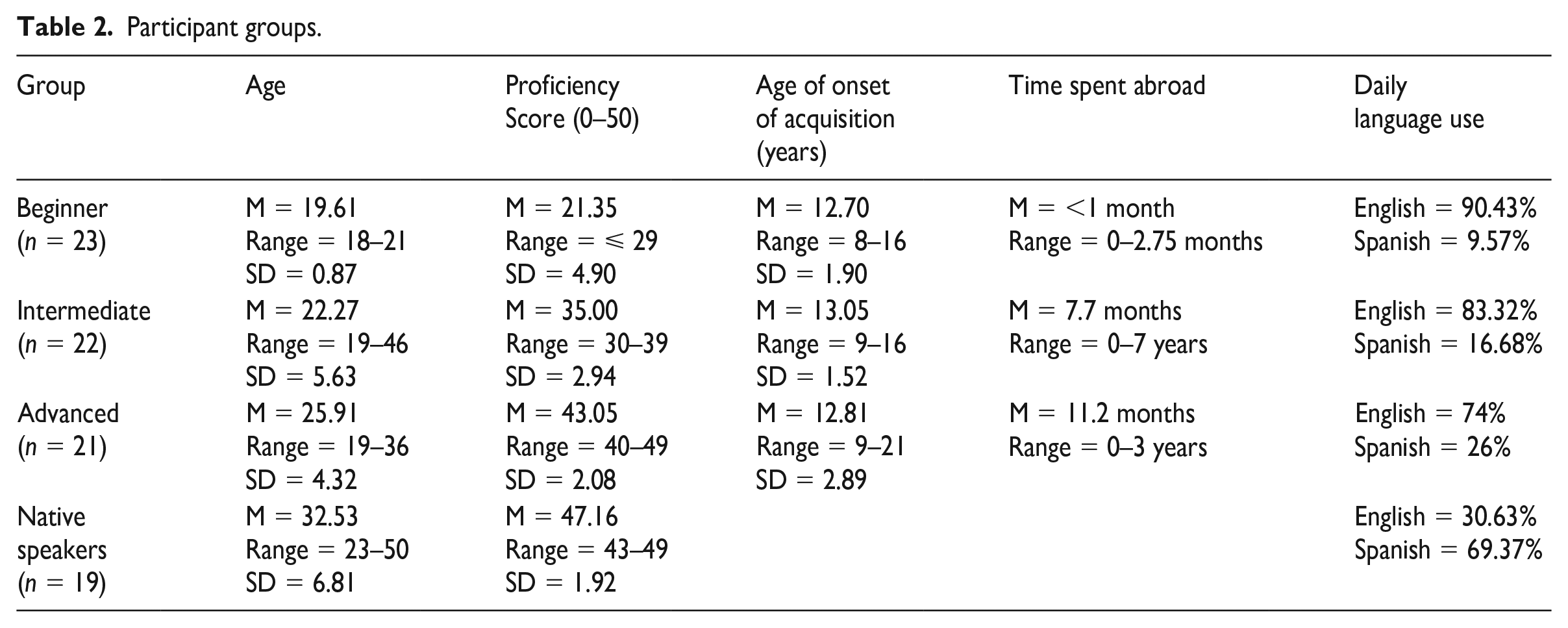
Three groups of L1 English/L2 Spanish learners and a group of Spanish native speakers (NSs) were recruited from two large public universities in the United States. L2 learners were grouped based on their performance on the DELE proficiency measure (see Table 2). 4 As the L2 learners in this study were principally exposed to Spanish through language courses and study abroad programs in diverse countries, NSs of various Spanish dialects were recruited to represent this variation. 5 The data reported here comes from NSs from Argentina (n = 1), Colombia (n = 7), Mexico (n = 2), Puerto Rico (n = 2), and Spain (n = 7). All NSs were living in the US at the time of participation (mean = 2.76 years living in the US) and consequently were proficient in English to some degree, but all reported Spanish as their dominant language, and, as a group, the NSs also reported more use of Spanish on a daily basis, while all of the L2 groups reported more daily use of English.
Participant groups.
3 Procedure
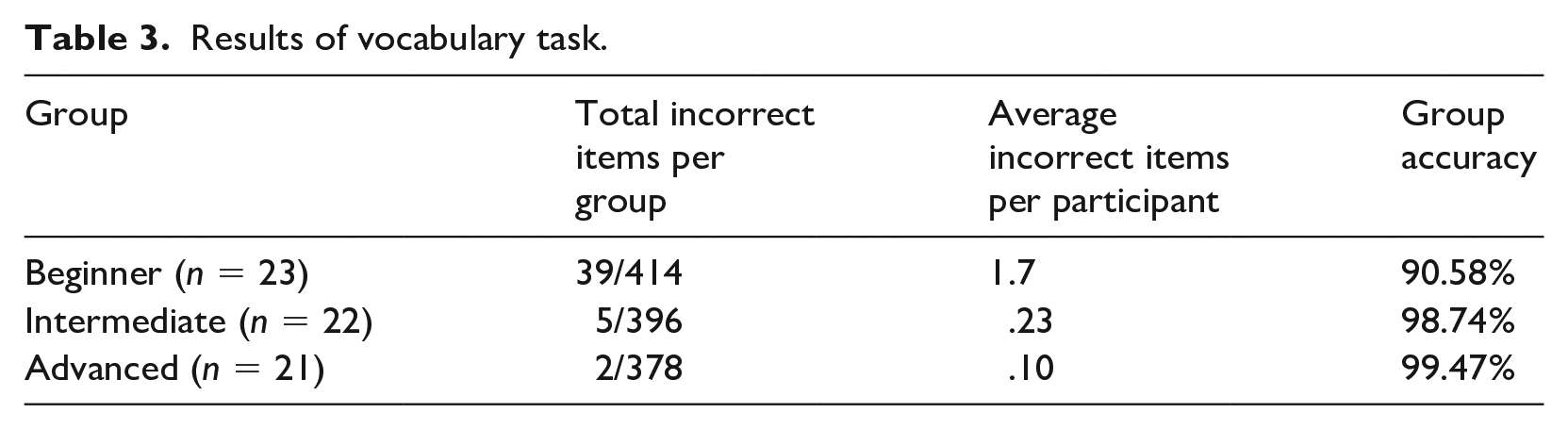
All participants completed two experimental tasks, 6 followed by the DELE, and a background questionnaire. The entire study was completed via Qualtrics during a single supervised laboratory session. 7 After completing the judgment tasks and the DELE, L2 participants also completed a vocabulary task designed to establish whether they were familiar with the verbs used in the experimental tasks. The vocabulary task contained eighteen multiple-choice items in which they were presented with a Spanish verb in its infinitival form and asked to select its English equivalent. Results are presented in Table 3. The data collected from individuals who answered incorrectly for a particular verb were not included in the data analysis, for that particular verb only. For example, if a participant was not able to select the English equivalent of the verb sorprender (‘to surprise’), that participant’s data for items with the verb sorprender in both tasks was excluded. This ensured that the data analysed represents only the cases in which participants were familiar with the meaning of the verb.
Results of vocabulary task.
4 Tasks
Participants completed two judgment tasks: Task 1 with aural stimuli and Task 2 with written stimuli. 8 The same lexical verbs were used in both tasks (see Table 4). In order to maximize the chances that each verb would be familiar to L2 learners, all of the verbs chosen fall into the top 5,000 most frequently occurring words in Spanish based on a corpus of 20 million words containing written data from Spain and Latin America and transcriptions of oral data from 11 dialects (Davies, 2006). The dative and accusative experiencer forms were presented in both judgment tasks. While this study seeks to build upon prior research by contributing data collected from a task with aural stimuli, presenting items in equivalent conditions across tasks further allows for the results to be compared to determine if participants respond similarly to data present in aural vs. written form. By comparing their performance across stimuli mode, we gain a more complete picture of their sensitivity to the distributions under investigation and also reveal potential task effects.
Verbs used in Tasks 1 and 2.
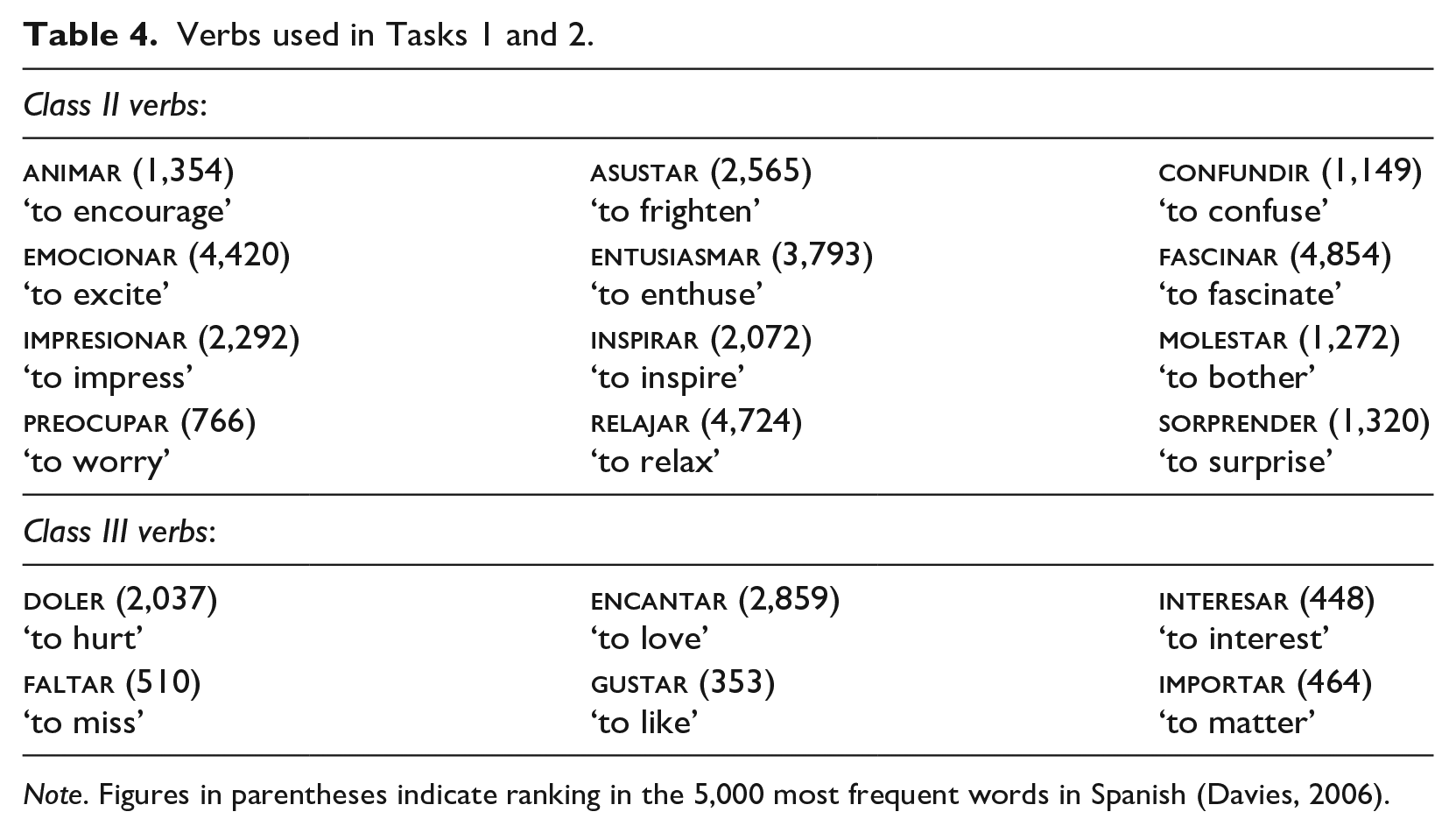
Note. Figures in parentheses indicate ranking in the 5,000 most frequent words in Spanish (Davies, 2006).
a Task 1
Task 1 was designed to examine participants’ knowledge of the grammaticality of Class II–III verbs in the accusative and dative experiencer forms. Recall that both forms are grammatical with Class II verbs, which allow a [+/–change of state] feature setting, while the accusative experiencer form is ungrammatical with Class III verbs, which are [–change of state]. Table 5 contains sample items from each condition. As shown here, verbs appeared in present tense, all experiencers were [+singular, +animate] (e.g. Jessica) and all subjects were [+singular, –animate] (e.g. la tarea ‘the homework’). Each of the structures was presented in its canonical word order; this is particularly relevant for the dative experiencer form, which was presented with a preverbal experiencer.
Task 1: Sample items and distribution.
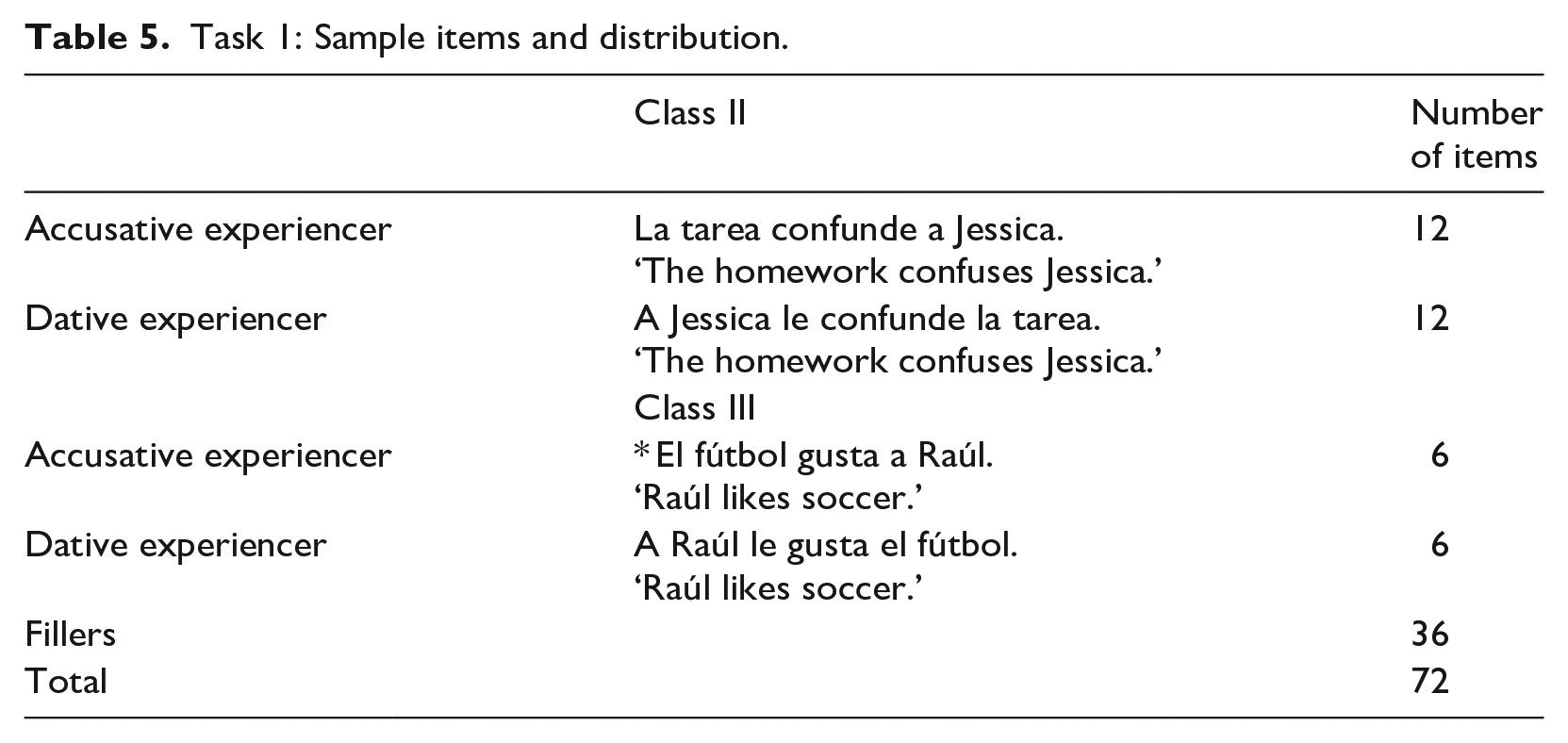
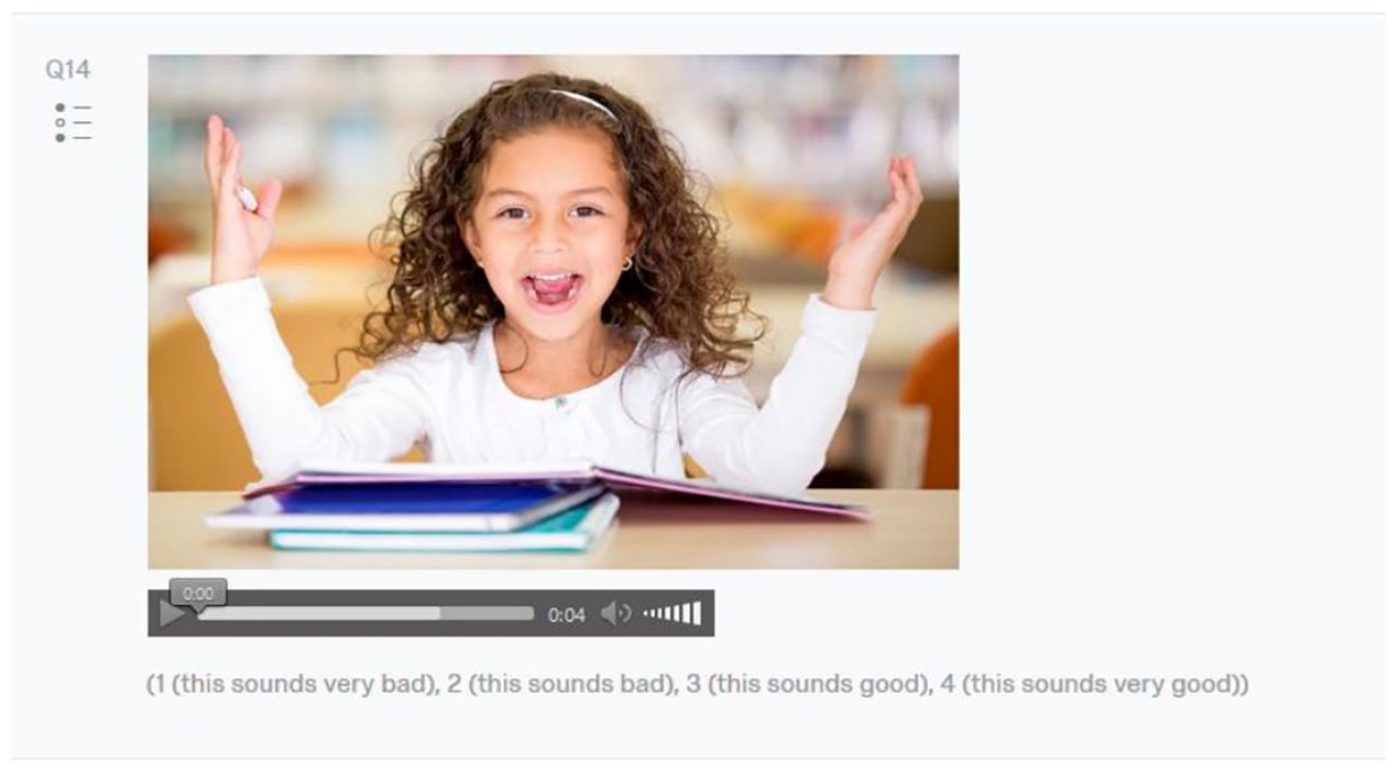
Items were randomized and presented as aural stimuli in the form of audio recordings completed by a female native speaker from Colombia. Each aural stimulus was presented with a graphic – see (19) – selected to evoke a general context consistent with the meaning of the verb. Participants were instructed to listen to the sentence and indicate its acceptability on a 1–4 Likert scale (1 – this sounds very bad, 2 – this sounds bad, 3 – this sounds good, 4 – this sounds very good). Participants completed four practice items before beginning the task. The practice items contained two grammatical sentences and two ungrammatical sentences (with errors of subject–verb agreement).
(19) 
b Task 2
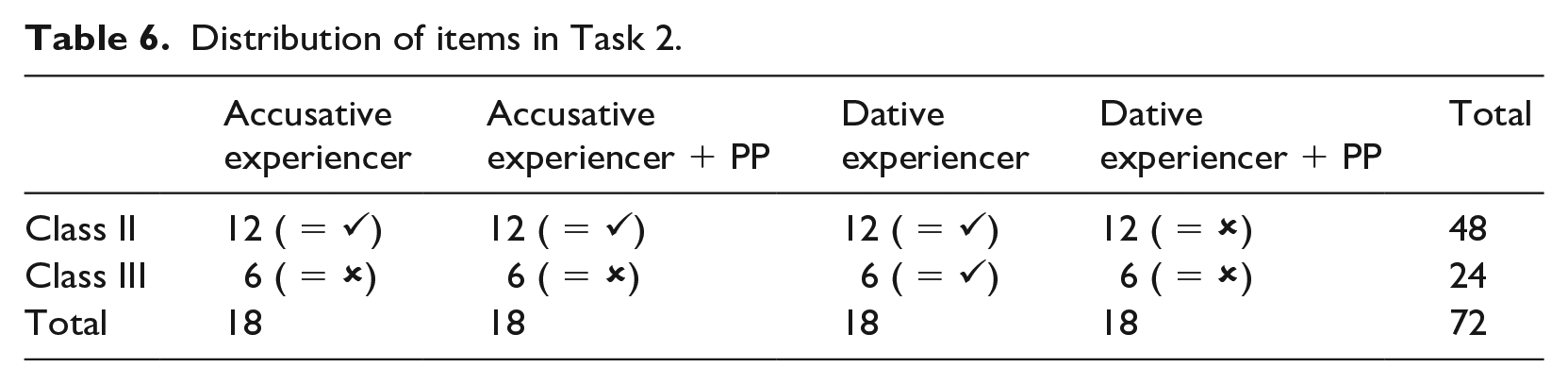
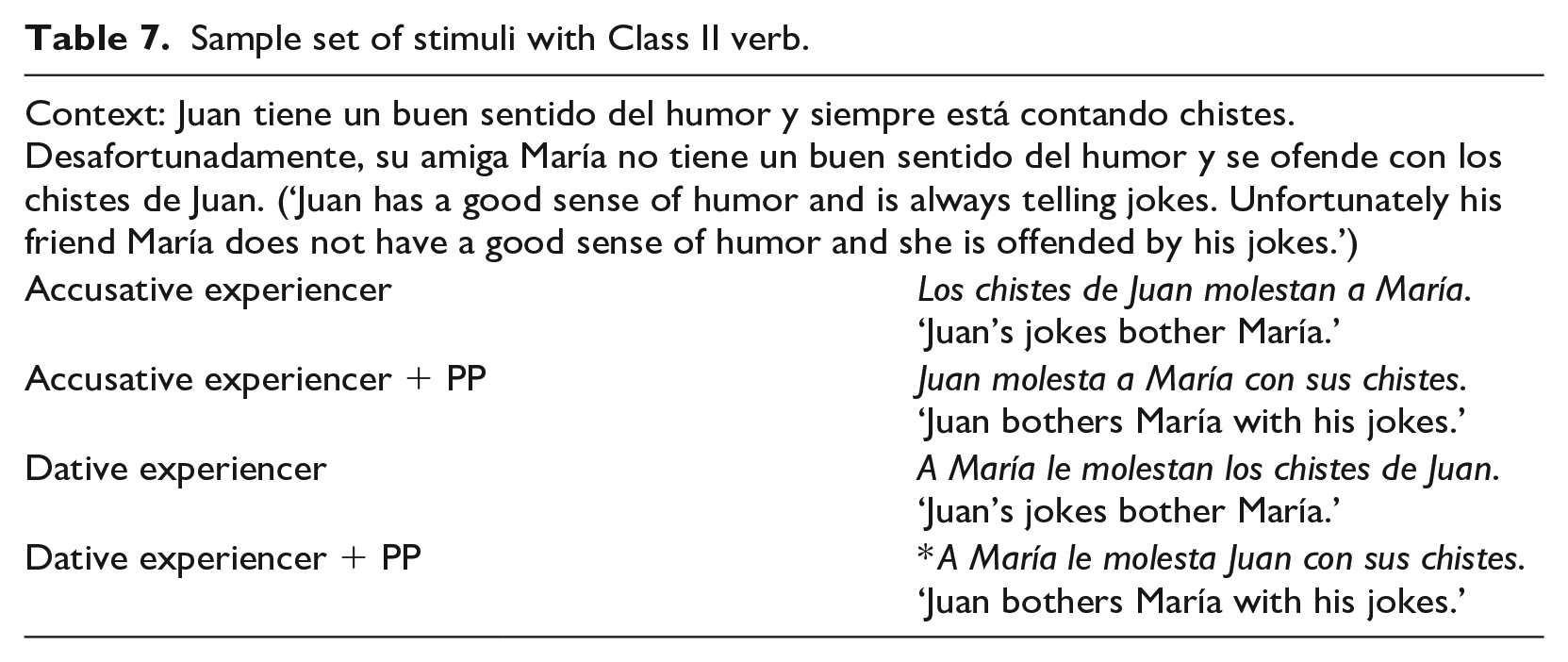
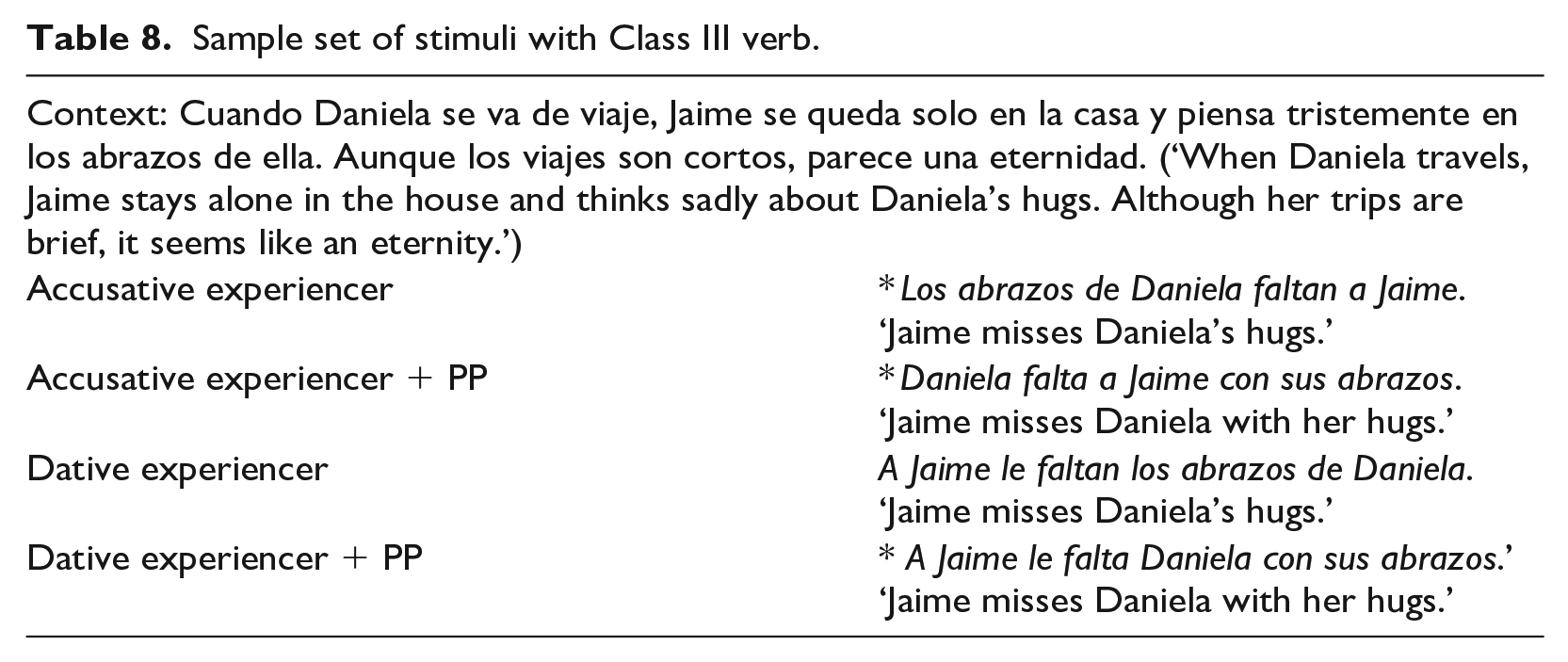
Task 2 was designed to examine participants’ knowledge of the grammaticality of the syntactic forms associated with the possessor attribute factoring alternation (see Tables 6–8). 9 Participants were presented with a written context, followed by a written item. One context was developed to correspond to the four contrasting forms for each verb. 10 Complete sets of items with Class II and Class III verbs are given in Tables 7 and 8. As shown, all verbs appeared in the present tense, all experiencers were [+singular, +animate] (e.g. María), all possessors were [+singular, +animate] (e.g. Juan), and attributes were [+plural, –animate] (e.g. los chistes ‘the jokes’). Stimuli were randomized and participants were instructed to read the context and sentence and rate the item on the same 1–4 Likert scale. Like in Task 1, participants completed four practice items before beginning the task. The practice items contained two grammatical sentences and two ungrammatical sentences (with errors of subject–verb agreement).
Distribution of items in Task 2.
Sample set of stimuli with Class II verb.
Sample set of stimuli with Class III verb.
5 Results
a Task 1
All statistical analyses were conducted with SPSS 27 (IBM, 2020). Likert scale responses (1–4) were entered into a mixed-effects linear regression with fixed effects of Group (Beginner, Intermediate, Advanced, Native speakers), Verb Class (II, III), and Argument Structure (accusative experiencer, dative experiencer), with random intercepts for participants and items. The model returned significant effects of Group (F(3,83.406) = 4.256; p = .008), Class (F(1,31.987) = 8.367; p = .007) and Argument Structure (F(1,31.983) = 86.371; p = .0001) and significant interactions of Group*Class (F(3,2846.157) = 33.809; p = .0001), Group*Argument Structure (F(3,2845.305) = 41.572; p = .0001), Class*Argument Structure (F(1,31.983) = 34.056; p = .0001), and Group*Class*Argument Structure (F(3,2845.305) = 7.128; p = .0001).
Pairwise comparisons reveal whether each group made a distinction based on the grammatical distributions under investigation here. In the case of the accusative experiencer form (see Figure 1), we expected a contrast of acceptance with Class II verbs vs. rejection with Class III verbs. NS, Advanced, and Intermediate group results display this distinction (all p-values <.001); the Beginner group does not (p = .104). 11 Comparisons across groups also reveal notable differences. The ratings of the NS group for Class II verbs with an accusative experiencer were significantly higher than all L2 learner groups (all p-values <. 001), but there were no significant differences across L2 learner groups (all p-values = 1). For Class III verbs, the ratings of the NS group did not differ from the Intermediate or Advanced groups (all p-values ⩾ .368), while mean ratings of the Beginner group were significantly higher than the Advanced and NS groups (all p-values ⩽ .016).
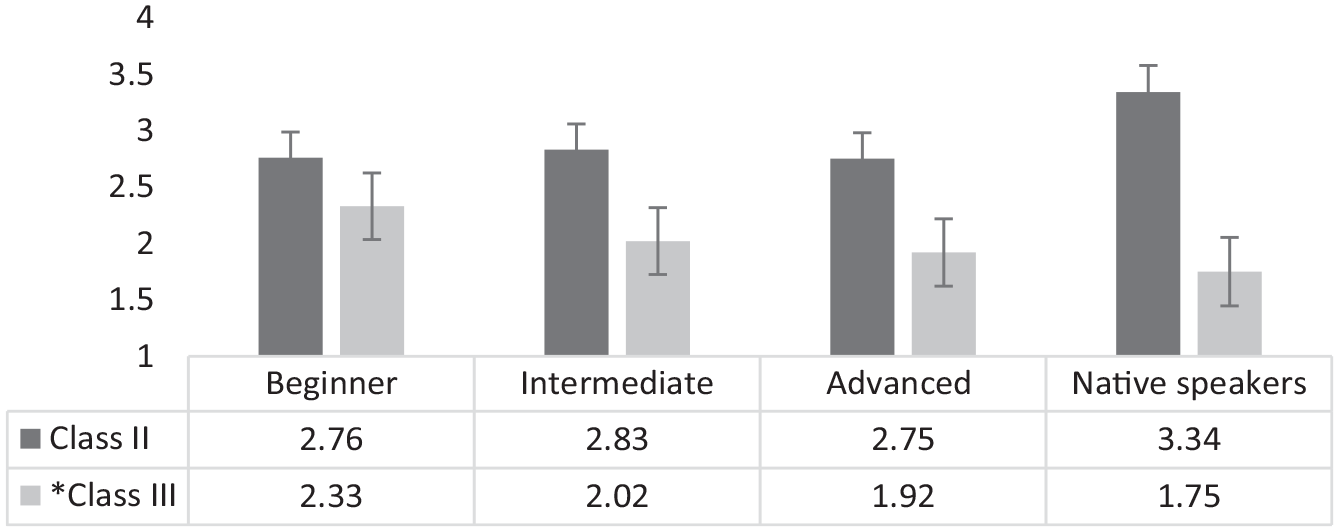
Task 1: Mean ratings for accusative experiencer.
In the case of the dative experiencer (see Figure 2), no contrast was expected, as both verb classes allow dative experiencers. This was borne out in all groups except the Beginners, whose ratings for Class III were significantly higher than Class II (p = .024). Comparing groups, the data reveal that NS mean ratings for Class II verbs did not differ from the Advanced group (p = 1), while the mean ratings of the Beginner and Intermediate groups were significantly lower than the Advanced and NS groups (p <.001). For Class III verbs, the mean ratings of the Intermediate and Advanced groups were not significantly different from the NSs (all p-values ⩾ .232), while the mean ratings of the Beginner group were significantly lower than the NS and Advanced groups (all p-values ⩽ .008).
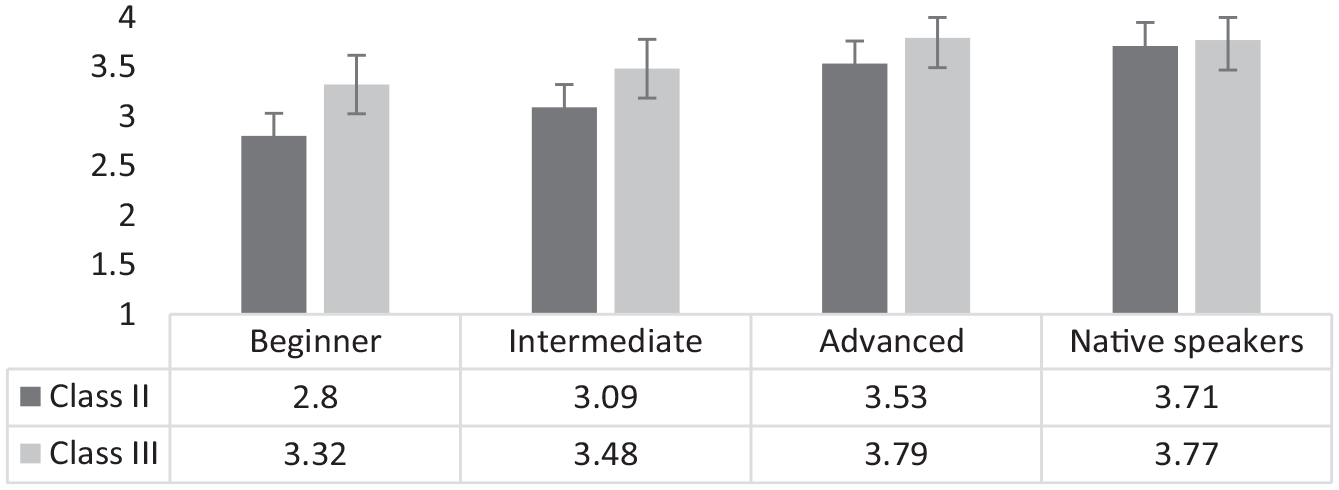
Task 1: Mean ratings for the dative experiencer.
b Task 2
Task 2 responses were also entered into a mixed-effects linear regression with fixed effects of Group (Beginner, Intermediate, Advanced, Native speakers), Verb Class (II, III), and Argument Structure (accusative experiencer, accusative experiencer + PP, dative experiencer, dative experiencer + PP), with random intercepts for participants and items. The model returned significant effects of Verb Class (F(1,60.136) = 111.342; p = .0001) and Argument Structure (F(3,64.072) = 112.056; p = .0001) and significant interactions of Group*Class (F(3,5772.454) = 66.437; p = .0001), Group*Argument Structure (F(9,5771.309) = 38.691; p = .0001), Class*Argument Structure (F(3,64.072) = 31.783; p = .0001), and Group*Class*Argument Structure (F(9,5771.309) = 8.150; p = .0001).
In the case of the accusative experiencer form (see Figure 3), as in Task 1, we expected a contrast between acceptance of Class II verbs vs. rejection of Class III verbs. This was borne out in the data for all groups (all p-values ⩽ .032). Across groups, for Class II verbs with accusative experiencers, the ratings of the NS group were significantly higher than all L2 learner groups (all p-values <.001), with no differences among L2 learner groups (all p-values = 1). In other words, while the L2 groups made a statistical distinction between verb classes, their ratings for Class II verbs in this condition were just above chance, while the NSs clearly accepted (3.66/4.00) Class II verbs, which are grammatical in this condition. For Class III verbs, Beginner ratings were significantly higher than Intermediate and Advanced groups (all p-values ⩽ .032), but there were no significant differences between the NSs and the L2 groups (all p-values = 1).
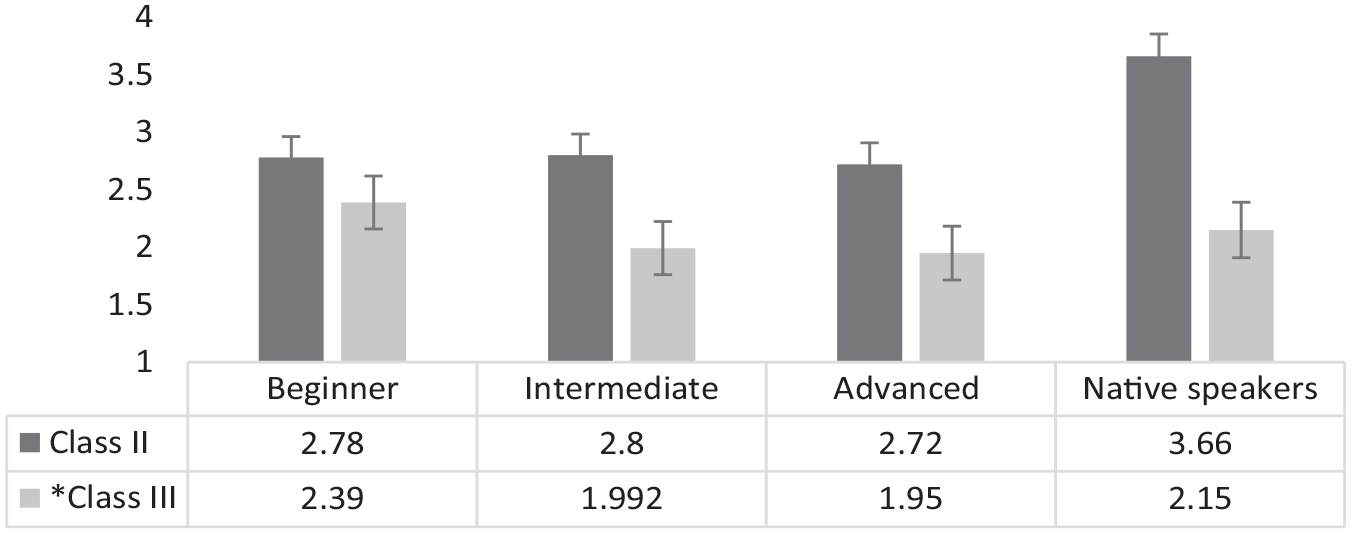
Task 2: Mean ratings for accusative experiencer.
Mean ratings for the accusative experiencer + PP form are shown in Figure 4. Like in the previous condition, we expected a contrast between acceptance of Class II verbs and rejection of Class III verbs. In this case, all groups displayed this contrast (all p-values ⩽ .001). Across groups, the NS group ratings for Class II verbs were significantly higher than all L2 learner groups (all p-values ⩽ .001), with no significant differences among L2 learner groups (all p-values = 1). With Class III verbs, the ratings of the Beginner group were significantly higher than all other groups (all p-values ⩽ .016), with no other differences across groups.
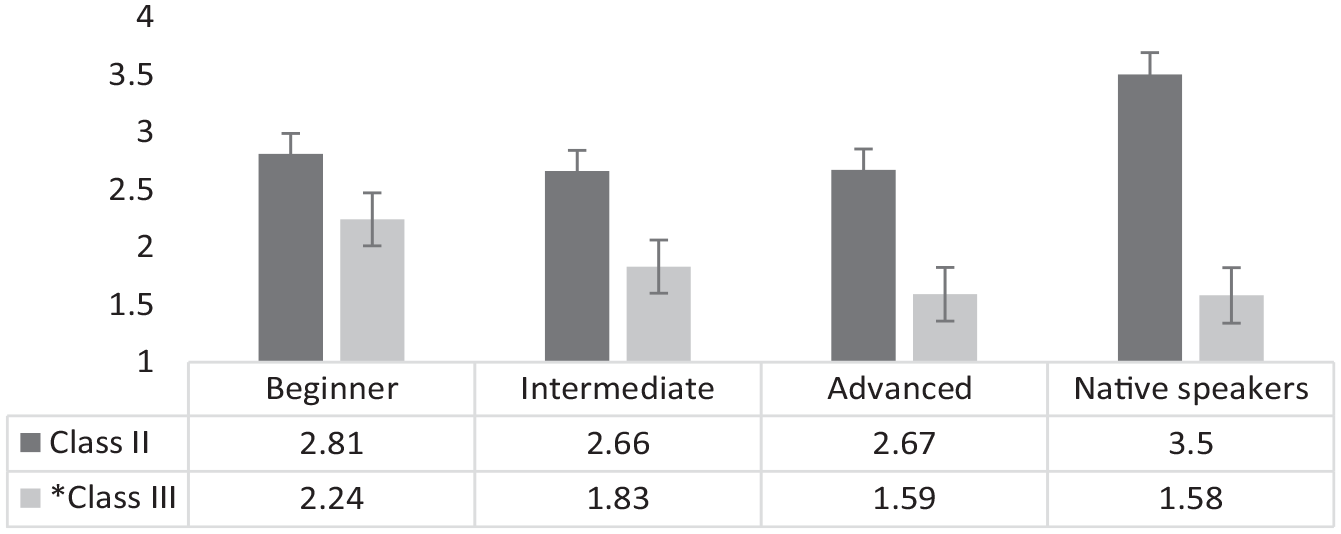
Task 2: Mean ratings for accusative experiencer + PP form.
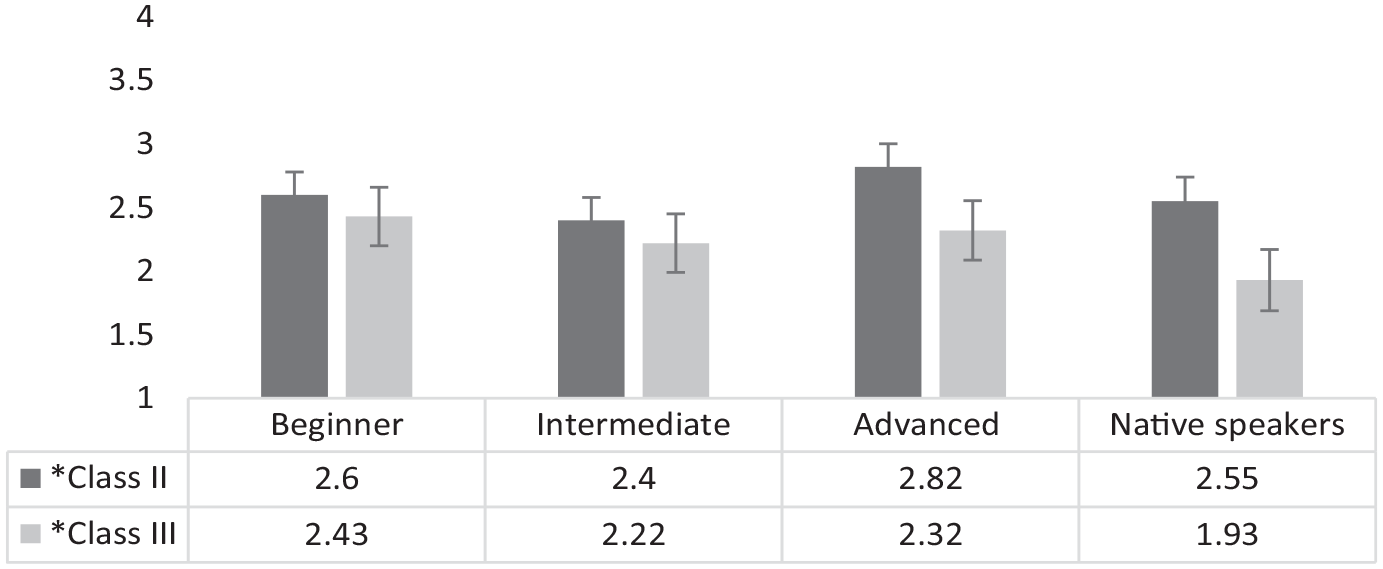
Mean ratings by group for the dative experiencer form are shown in Figure 5. Like in Task 1, no contrast was expected across verb classes and none of the groups made a significant distinction across verb class (all p-values ⩾ .304). Group comparisons reveal that for Class II verbs, Beginner group ratings were significantly lower than all other groups (all p-values ⩽ .016) and Intermediate group ratings were significantly lower than the NS group (p-values ⩽ .016). With Class III verbs, Beginner group ratings were significantly lower than all other groups (all p-values ⩽ .016), but the other groups did not differ.

Task 2: Mean ratings for dative experiencer.
Finally, Figure 6 shows the mean ratings for the dative experiencer + PP form. As this form is universally disallowed by the grammar, we expected this form to be rejected across the board. The data reveal that while the Beginner and Intermediate groups did not display a contrast across verb types (all p-values = 1), the Advanced and NS groups did display a contrast here, giving significantly higher ratings to Class II verbs (all p-values ⩽ .016). Across groups, the ratings for Class II verbs differed only between the Intermediate and Advanced groups (p = .016), while the only difference across groups for Class III verbs was between the NSs and the Beginner group (p = .016).
Task 2: Mean ratings for dative experiencer + PP form.
c Comparison of Tasks 1 and 2
As noted prior, the accusative experiencer and dative experiencer forms were included in both tasks, which provides an opportunity to compare the results of items presented in different modes: via aural stimuli in Task 1 vs. written stimuli in Task 2. 12 Data from equivalent conditions in Tasks 1 and 2 were combined and Likert scale responses (1–4) were entered into a mixed-effects linear regression with fixed effects of Group (Beginner, Intermediate, Advanced, Near-native, Native speakers), Stimuli mode (aural, written), Verb Class (II, III), and Argument Structure (accusative experiencer, dative experiencer), with random intercepts for participants and items. The model returned significant effects of Group, Verb Class, and Argument Structure (all p-values < .001), but there was no significant effect of Stimuli mode (F(1,64.017) = 1.644; p = .204.
There was a significant interaction across all four variables (Group*Stimuli mode*Verb Class*Argument Structure) (F(9,5773.327) = 3.685; p < .001); however, pairwise comparisons of equivalent conditions per group across the two modes did not reveal any significant differences. In other words, neither L2 learners nor NS participants responded differently to these forms when presented in aural vs. written form. Recall that in Task 1, which was administered first, participants saw an image on the screen and listened to a recording. At no point during Task 1 were the participants exposed to the verbs or experimental items in writing. This comparison confirms that the participants in all groups responded similarly to comparable items whether they were listening to them or reading them.
V Discussion
1 Hypotheses
The purpose of this study was to assess participants’ knowledge of patterns of grammaticality licensed by the [+/–change of state] feature. The first hypothesis predicted that L2 learners at higher levels of proficiency would display greater sensitivity to the grammatical distribution of object experiencer psych verbs. This was evidenced in the data. All L2 groups displayed sensitivity to the expected contrasts across verb classes, with one exception. In Task 1, for accusative experiencer items, the Beginner group did not make a clear (i.e. statistical) distinction between Class II verbs, which license accusative experiencers, and Class III verbs, which do not. In addition, there were numerous intergroup differences between the L2 groups. In Task 1, the Beginner group ratings for Class III verbs in the accusative (unlicensed) were significantly higher than the Advanced and NS groups. Similarly, in Task 2, the Beginner ratings for Class III verbs in the accusative + PP form (unlicensed) were significantly higher than all other groups. Participants with lower proficiency also consistently underaccepted verbs of both classes with dative experiencers. In Task 1, the Beginner and Intermediate ratings were significantly lower than the Advanced and NS groups for Class II verbs with dative experiencers, and the Beginner ratings were lower than the Advanced and NSs for Class III verbs. Likewise, in Task 2, the ratings of the Beginner group were lower than all other groups for verbs of both classes with dative experiencers.
This hypothesis was based on the predictions of the FRH (Lardiere, 2008, 2009); namely, that the reassembly of features is more difficult for L2 learners when faced with more complex conditioning factors, particularly when these differ from the L1. As noted in Section IV, although this distribution involves only a single feature, it must be redeployed from the L1 to determine the licensing patterns of the relevant forms in the L2. At the same time, the asymmetric nature of this distribution results in a complex acquisitional task – learners must acquire both general licensing restrictions and the semantic feature settings associated with each verb. The results presented here suggest that the L2 learners at higher levels of proficiency have generally been successful, while learners at lower levels of proficiency have not fully acquired the necessary licensing restrictions and feature settings.
The second hypothesis predicted that L2 learners would display greater sensitivity to the distribution of Class III verbs (which have a fixed feature setting) vs. Class II verbs (which display variability). This was also evidenced in the data. In both tasks, L2 ratings were significantly lower than those of the NSs in all accusative conditions with Class II verbs. In contrast, with Class III verbs, the ratings of the Advanced L2 group did not differ from NSs in any condition. Recall that learners need to acquire both general licensing restrictions as well as feature settings on individual verbs in order to successfully distinguish patterns of grammaticality. The fact that the Advanced learners accepted Class III verbs in dative conditions in a target-like way and did not overaccept them in accusative conditions suggests that they have acquired the appropriate licensing restrictions; namely, [+change of state] licenses the accusative, while [–change of state] licenses the dative. Their less target-like performance in accusative conditions with Class II verbs suggests that they may not have fully established the variable [+/–change of state] feature setting on these verbs, and, in some cases, may associate Class II verbs with a [–change of state] setting.
The FRH provides the most elucidatory framework for these results, as it not only highlights the prominence of features in the acquisition process, but takes into account the conditions under which features are expressed and the complexity of those conditions (Lardiere, 2008, 2009). This nuanced approach can also account for individual-level variation even in highly advanced L2 learners. In this case, aggregate data suggested that the Advanced L2 learners were less target-like in specific conditions. A closer analysis of the data identified clear differences across participants, with a subset of the Advanced group performing like the NSs in some or all of the accusative conditions with Class II verbs, suggesting that some of the Advanced participants had fully established the feature settings on individual verbs, while others had not. This will be discussed further in the next section as it relates to the role of linguistic input.
The third hypothesis predicted that L2 learners would perform better when faced with written stimuli vs. aural stimuli, in correlation with proficiency level (i.e. lower level learners would display greater differences across stimuli modes). This was not evidenced in the data. As described in the previous section, pairwise comparisons of equivalent conditions per group across tasks showed no significant differences, revealing that the L2 learners did not perform differently when faced with stimuli in different modes. This is a novel finding, as prior studies have not explicitly examined the role of stimuli mode in judgment tasks. While it has been suggested that L2 Spanish learners perform better on explicit vs. implicit tasks (Bowles, 2011), and these labels are often associated with written vs. oral tasks, respectively, those oral tasks typically include oral production or oral imitations. In this case, both tasks were untimed judgment tasks, which are typically considered more explicit, with the difference being the mode of presentation of the stimuli. This results is, perhaps, encouraging, as it suggests that these L2 classroom learners were equally capable of parsing aural vs. written input. In future research, it would be beneficial to examine this with timed tasks and/or different task types.
2 Input, frequency, and instruction
As predicted, L2 learners at higher proficiency levels displayed a greater level of sensitivity to the syntactic distribution tested here, which requires knowledge of both general licensing restrictions as well as specific feature settings. Sufficient linguistic input is necessary in both respects. In a general sense, we know that sufficient input (in terms of both quantity and quality) is essential to the acquisition of an additional linguistic system (Rankin and Unsworth, 2016; Rothman and Slabakova, 2018). However, the input necessary to establish general licensing restrictions and that required to determine specific feature settings can be conceptualized differently. In the case of licensing restrictions, L2 learners must derive from the input that [+change of state] licenses accusative experiencer forms, while [–change of state] licenses dative experiencers. In the case of feature settings, L2 learners must be exposed to sufficient input of an individual lexical verb to determine its feature setting (either variable [+/–change of state] or [–change of state]). It is likely that learners at higher proficiency levels have been exposed to greater input of both types, thus facilitating acquisition.
Although it is difficult to quantify linguistic input, the higher proficiency participants tested here were arguably exposed to greater input due to their time spent abroad in Spanish-speaking countries. Advanced participants reported having spent an average of 11.18 months abroad in Spanish-speaking countries, while participants in the Intermediate group reported an average of 7.69 months, and participants in the Beginner group less than one month (.89) on average. We can assume that participants who spent more time in Spanish-speaking countries were exposed to more (overall) linguistic input in the L2 as well as more naturalistic input, as compared to the lower proficiency learners who, having spent less time abroad, probably received most of their input in the L2 classroom. This difference in input quantity and quality likely contributed to the success of the Advanced participants (and, to a lesser extent, the Intermediate groups) in establishing the relevant licensing restrictions.
As noted above, however, in the case of feature settings, L2 learners specifically need exposure to input of individual verbs. The fact that the Advanced learners (along with all other L2 groups) consistently rated accusative experiencers with Class II verbs significantly lower than the NSs suggests that they may associate some Class II verbs with a [–change of state] feature setting rather than a variable [+/–change of state] feature setting. A closer look at the results by individual verb reveals that the tendency to associate Class II verbs with [–change of state] favored particular verbs. For example, fascinar (‘to fascinate’), entusiasmar (‘to enthuse’), and preocupar (‘to worry’) received particularly low ratings in accusative experiencer forms among Advanced L2 learners, potentially due to associating them more with dative experiencers. These results highlight the important role of lexical semantics in the acquisition process. Once licensing patterns are established in the grammar, the grammaticality of these forms is a natural reflex of each verb’s underlying syntactic representation. As such, successful acquisition of the grammatical distribution is dependent on acquiring the lexical semantics (i.e. relevant feature settings) of each individual verb. It is to be expected, then, that this may occur at different stages of acquisition for different verbs, depending on how much exposure learners have had to each individual verb.
Consequently, lexical frequency is also a relevant aspect of linguistic input. Although it is impossible to measure an individual learner’s exposure to any given lexical item, frequency may help us predict which verbs a learner is more likely to encounter in the input. In this case, all of the verbs were classified by Davies (2006) as within the top 5,000 occurring words in Spanish (see Section IV). In the case of the three Class II verbs rated differently by Advanced participants, we might predict this is due to low lexical frequency. This is the case for fascinar, ranked at 4,854, and entusiasmar, ranked at 3,793, while preocupar, ranked at 766, is more frequent, according to this measure. Lexical frequency may also play a facilitative role in the case of verbs which appear more frequently in the input. In the case of Class III verbs, gustar (ranked at 353) is notoriously frequent, especially in the L2 Spanish classroom. The individual verb results indicate that items with gustar were, in fact, given more target-like ratings (as compared to other Class III verbs in the same conditions) by all L2 groups. In most cases, this also held true for encantar, which, although rated lower in frequency by Davies (2006), at 2,859, is also taught frequently along with gustar in the L2 classroom.
Classroom instruction should also be taken into consideration in light of these results, as all of the L2 participants were classroom learners at one of two universities. Of particular relevance here are the approach to teaching psych verbs in the Spanish classroom and the input provided via instructional materials. Object experiencer psych verbs are commonly referred to in the classroom as ‘verbs like gustar’ and they are taught explicitly at various levels, beginning in the earliest period of instruction. The fact that the results presented here reveal that L2 learners at all levels were quite successful in identifying the grammatical and ungrammatical uses of the verb gustar is undoubtedly attributed to this instruction and the frequent use of the verb gustar in the classroom. At the same time, it is also likely that L2 learners’ tendency to associate Class II verbs with [–change of state] was influenced by classroom instruction in which both Class II and Class III verbs are grouped together as ‘verbs like gustar’ and presented with dative experiencers. For example, in ¡Anda! Curso elemental (Heining-Boynton and Cowell, 2012), the textbook used for first and second semester Spanish courses (at the time of testing) at the universities attended by these participants, ‘verbs like gustar’ include both fascinar (‘to fascinate’) and molestar (‘to bother’). Both of these are Class II verbs, which license both accusative and dative experiencers; however, they are presented exclusively with dative experiencers in the textbook. This can be linked to the finding within these data that even the Advanced L2 participants associated fascinar with dative experiencers.
Finally, some limitations of the study must be acknowledged. As noted in Section IV, Task 2 did not incorporate filler items, as the experiment was already quite lengthy; however, this may have increased the degree of metalinguistic knowledge used by participants. Along the same lines, participants saw the same context four times within Task 2 (see note 10). In addition, while the comparison of results by mode revealed no significant differences, suggesting that participants responded similarly to items in the same condition across tasks, it is important to note minor differences across tasks – namely, the minor structural difference in items across tasks (see note 12) and the fact that items in Task 1 were presented with a visual context while items in Task 2 were presented with a written context.
VI Conclusions
This study examined syntactic patterns of object experiencer psych verbs dependent on the lexical semantic feature [+/–change of state] in L2 Spanish, innovating in its incorporation of insights from lexical semantics. The acquisition task was framed in light of the Feature Reassembly Hypothesis (Lardiere, 2008, 2009), which argues that the L2 learning task involves reassembling existing features from the L1 and posits that this may be complicated by complex language-specific conditions (such as the optionality observed in the variable [+/–change of state] feature setting of Class II verbs). The results confirmed hypotheses predicting that (i) L2 learners at higher proficiency levels would display greater sensitivity to the overall grammatical distribution and (ii) L2 learners would display greater sensitivity to the distribution of Class III verbs, but did not support the hypothesis that (iii) L2 learners would perform better when faced with written (vs. aural) stimuli. The subtle differences in the results of the Advanced group (vs. the NS group), suggest that L2 participants acquired relevant licensing restrictions, but may have associated Class II verbs with a [–change of state] feature setting rather than a variable feature setting. This finding is consistent with the predictions of the FRH and highlights the role of lexical semantics in L2 acquisition and the effects of feature setting variability on the acquirability of L2 syntax.
Footnotes
Acknowledgements
I would like to extend many thanks to David Stringer and Rex Sprouse, who provided guidance and feedback on this project through various stages. I received valuable feedback from audiences at Indiana University, the University of Iowa, and Evolving Perspectives on Advancedness: A Symposium on Second Language Spanish at UMN. I am also grateful to the anonymous Second Language Research reviewers and Editor for their helpful comments. Finally, thank you to Gillian Lord and Judy Shoaf for assistance with data collection, to Diana Arroyo for contributions to the methodology, and to Mike Iverson for advice on statistical analyses. Any remaining errors are my own.
Declaration of conflicting interests
The author declared no potential conflicts of interest with respect to the research, authorship, and/or publication of this article.
Funding
The author received no financial support for the research, authorship, and/or publication of this article.
