







Abstract
Previous studies on bilingual children have shown a significant correlation between first language (L1) and second language (L2) morphological awareness and a unique contribution of morphological awareness in one language to reading performance in the other language, suggesting cross-linguistic influence. However, few studies have compared advanced adult L2 learners from L1s of different morphological types or compared native speakers with advanced learners from a morphologically more complex L1 in their target-language morphological awareness. The current study filled this gap by comparing native English speakers (analytic) and two L2 groups from typologically different L1s: Turkish (agglutinative) and Chinese (isolating). Participants’ morphological awareness was evaluated via a series of tasks, including derivation, affix-choice word and nonword tasks, morphological relatedness, and a suffix-ordering task. Results showed a significant effect of L1 morphological type on L2 morphological awareness. After accounting for L2 proficiency, the Turkish group significantly outperformed the Chinese group in the derivation, morphological relatedness, and suffix-ordering tasks. More importantly, the Turkish group significantly outperformed the native English group in the morphological relatedness task even without accounting for English proficiency. Such results have implications for theories in second language acquisition regarding representation of the bilingual lexicon. In addition, results of the current study underscored the need to guard against the comparative fallacy and highlighted the influential effect of L1 experience on the acquisition of L2 morphological knowledge.
Keywords
I Introduction
The study of morphology in second language (L2) development has a long history dating at least from the early well-known studies on morpheme order acquisition (e.g. Bailey et al., 1974) through to the present. More recently, generative studies have considered the role of functional features and morphology as a ‘bottleneck’ (Slabakova, 2014), in part because this component of the grammar is one of the areas where language variation is accounted for; abstract syntactic features (e.g. tense, aspect, number agreement, and grammatical gender) must be created anew in the L2 or ‘reassembled’ from the first language (L1) to new phonological or null morphemes in the L2 (e.g. Lardiere, 2000; 2007; White, 2003: Chapter 4). Thus, inflectional morphology in particular has been recognized as especially challenging in second language research. Less intense focus has been given to derivational morphology in the theoretical L2 literature in part because derivation is not considered part of the syntactic computational system, but rather more lexical. Nevertheless, evidence exists that derivation must also be part of the computational system, and the balance of storage and processing in morphological processing of derivations varies with productivity cross-linguistically (e.g. Bertram et al., 2000). In contrast, in the pedagogically oriented literature, derivations relating lemmas, lexemes, and word families have always been very important (e.g. Nation, 2001).
In the literature on L2 morphology, the development of L2 morphological awareness is one area of both theoretical and pedagogical interest, given the unique contribution of L2 morphological awareness to L2 literacy development (e.g. Kieffer and Lesaux, 2008; Ramírez et al., 2010, 2011; Wang et al., 2006). Several studies have already shown that bilingual children’s L2 morphological awareness is influenced by the morphological characteristics of their L1 (e.g. Ramírez et al., 2010, 2011). Much less attention, however, has been paid to L2 morphological awareness of advanced adult learners from L1s of different morphological types, especially L1s with complex morphology. It remains to be seen whether effects of L1 morphology persist in advanced adult L2 learners, or whether L2 morphological awareness of advanced learners is mainly determined by L2 experience, which may overshadow the effects of L1. The outcomes of such research are important in developing pedagogical interventions that are motivated by sophisticated linguistic analysis as advocated by generative SLA (GenSLA) researchers (e.g. Marsden and Slabakova, 2019; Whong et al., 2013). Part of this research involves investigating what aspects of language reach explicit awareness that can be manipulated to make them available to learners’ abstract grammatical processors, assuming that explicit knowledge and abstract grammatical competence are different kinds of knowledge (Schwartz, 1999; Sharwood Smith and Truscott, 2014).
The current study contributes to this research program by considering the whole L1 experience of morphology by advanced adult learners from different L1 morphological types in their awareness of L2 derivation. More specifically, our research questions address how experience processing an L1 with regular and productive morphology in inflection and derivation (Turkish) or a language with almost no morphology at all (Chinese) affects awareness of derivational morphology in L2 English. At the same time, by comparing advanced Turkish learners of English and native English speakers, we aimed to examine whether advanced L2 learners from an agglutinative L1 (Turkish) could outperform native English speakers in English morphological awareness. Thus, this article is based more on broad typological studies (e.g. Eckman, 2010) and insights by Jackendoff (2002a, 2002b) on cross-linguistic variation in productive morphology rather than any specific formal or functional theory of language. We consider this to be the appropriate level of analysis for the current study.
The article is organized as follows. We first outline the conceptualization of morphological typology and morphological complexity and provide examples from the languages that we are considering. We then review the notion ‘morphological awareness’ and the psycholinguistic literature that demonstrates its effect on processing, comprehension, and learning. Previous studies documenting cross-linguistic influence on morphological awareness were then reviewed. Subsequently, we report on an experiment examining the effect of L1 morphological type on awareness of derivational morphology in L2 English. We conclude by reflecting on the implications of the study for research in L2 derivational morphology.
II Literature review
1 Morphological typology and morphological complexity
Descriptive typological linguistics has classified languages into different morphological types, based on degree of synthesis and degree of fusion (Aronoff and Fudeman, 2011; Haspelmath and Sims, 2010; Hippisley and Stump, 2016; Sapir, 1921; Spencer and Zwicky, 1998). Along the dimension of degree of synthesis, which encodes the extent to which a language uses morphology to express individual meaningful elements together in one word, languages range from analytic to synthetic (Aronoff and Fudeman, 2011; Haspelmath and Sims, 2010; Hippisley and Stump, 2016; Sapir, 1921; Spencer and Zwicky, 1998). Analytic languages (e.g. English) use comparatively less morphology than other languages. English has a limited number of prefixes and suffixes to derive new words and a very small number of overt inflectional suffixes (eight in total) to encode grammatical information. Extreme analytic languages are isolating languages (e.g. Chinese), which have almost no derivational morphology and express grammatical information (inflection) by the use of ‘free’ morphemes. Examples of isolating morphology in Chinese are in examples (1) and (2). Note that in (1) and (2) there is no singular–plural verb agreement and no tense. The morpheme le (了) is perfective, either with a past time adverbial (1) or a future time adverbial (2b).
(1) 昨天 张三 和 李四 去 了 北京。 Yesterday Zhang San and Li Si go ASP Beijing ‘Yesterday Zhang San and Li Si went to Beijing.’ (2) a. 张三 明天 去 北京 吗? Zhang San tomorrow go Beijing [question particle] ‘Is Zhang San going to Beijing tomorrow?’ b. 他 不 去 了。 He not go ASP ‘He will not go.’ (= ‘He has decided against the trip.’, not ‘He did not go.’)
In contrast, synthetic languages make use of extensive morphology such that words usually contain more than one bound morpheme. Within the synthetic language type, there are fusional languages and agglutinative languages. They differ in the degree of fusion of morphemes within words, i.e. how segmentable into separate morphemes a complex word is (Aronoff and Fudeman, 2011; Haspelmath and Sims, 2010; Hippisley and Stump, 2016; Sapir, 1921; Spencer and Zwicky, 1998). Fusional languages (e.g. Spanish) are characterized by words in which the morphemes are fused together phonologically. Often, no clear boundary between morphemes is discernible and no one-to-one correspondence between morphemes and meaning elements is identifiable. For example, the -o in habl-o (‘I speak’) in Spanish includes the three meaning elements ‘first person’, ‘singular’, and ‘present tense’. English has only one such remaining morpheme: the third person singular present tense -s.
Unlike fusional languages, agglutinative languages (e.g. Turkish) are characterized by words that contain concatenated affixes, with a one-to-one correspondence between affix and meaning, and complex interactions of morphology and syntax (e.g. Kabak, 2007; Kornfilt, 2013). Examples of regular inflection and derivation in Turkish are in (3) and (4) from Kornfilt (2013: 340) showing not only agglutinative morphology but also allomorphy in voicing ([t], [d]) and vowel harmony ([ü]/[i]).
(3) dün saat beş -te Hasan kahve iç -iyor -du yesterday o’clock five -ABL Hasan coffee drink -PROG -PAST ‘Yesterday at five o’clock Hasan was drinking coffee.’ (4) Hasan ödev -in -i dün bitir -ecek -ti Hasan assignment -3rd SG -ACC yesterday finish -FUT -PAST (fakat bitir -e -me -di) (but finish -Abil. -NEG -PAST) ‘Hasan was going to finish his assignment yesterday (but was not able to).’
Note that each morpheme suffix contains one meaning component, e.g. progressive -iyor and past -du in (3). The form of the past tense marker -du in (3) appears as -ti in (4) due to the voicing agreement with [k] and the front vowel harmony with [e]. The third person singular in Turkish is a null morpheme, but other person markers are suffixes outside tense, e.g. first person definite past is -m (for a full paradigm of person markers, see Kornfilt, 2013: 338). In Turkish, 20% of words consist of at least five morphemes (Haspelmath and Sims, 2010), and one Turkish word can express what would need to be expressed by an English phrase, secondary clause, or even a whole sentence (Hippisley and Stump, 2016). Example (5) is one Turkish word expressing the meaning of a whole English sentence (Beard, 1995: 56).
(5) Avropa -lı -laş -tır -ıl -a -mı -yacak -lar Europe an ize -CAUS -PASS -POT -NEG -FUT/PART -PL -dan -sın -ız -ABL -2nd -PL ‘You (all) are among those who will not be able to be caused to become like Europeans.’
Jackendoff (2002a, 2002b) argues that in analytic languages such as English, many frequent words will be stored in both their inflected and derived forms. For English, this claim is supported by experimental research (Alegré and Gordon, 1999). However, Jackendoff (2002b) mentions Turkish specifically, noting that the normal inflectional process must be computational outside the lexicon, because the sheer number of possible combinations precludes storage. Presumably, computational processes also apply to the rich derivations in Turkish. It is this aspect of Turkish morphology – the great extent of creativity outside the lexicon – that may contrast with analytical languages such as English and Chinese and which may influence even sensitivity to the internal structure of L2 English derived words.
Quantitatively measuring the morphological complexity of different languages is a more recent approach to typological work in morphology (De Clercq and Housen, 2019). Morphological complexity falls along two dimensions (Anderson, 2015). One dimension of morphological complexity relates to the complexity of the overall system, which concerns the inventory size of morphological elaboration in a language, the number of affixes in a word, and principles governing morphological combination (Anderson, 2015). The other dimension concerns the complexity of exponence in the realization of individual elements, the complexity of paradigms of lexemes, and allomorphy (Anderson, 2015). The morphological systems of Chinese, English, and Turkish differ in morphological complexity along the dimension of the complexity of the overall system, such that Turkish has the largest inventory size of morphological affixes and the largest number of affixes in a word, and Chinese has the smallest, with English in between. They do not differ much along the dimension of complexity of exponence, with their form–meaning mappings being overwhelmingly one to one. Therefore, in this article, we use morphological complexity and morphological type interchangeably to refer to the morphological differences among Chinese, English, and Turkish, since those languages mainly differ in only one dimension of morphological complexity, namely, the complexity of the overall system. Nevertheless, the objective of the current study was not to examine a general effect of L1 morphological complexity on L2 morphological awareness, as we did not aim to investigate the effect of the complexity of exponence due to the overwhelmingly one-to-one mappings in all languages that were included in the study.
2 Morphological awareness and its effect on processing, comprehension, and learning
Knowledge of derivational morphology involves three different aspects, i.e. relational, syntactic, and distributional (Tyler and Nagy, 1989). Knowledge of relational morphology is the ability to recognize that two words share a base morpheme, and the understanding that words sharing a base morpheme also share some aspects of meaning (Apel, 2014; Berthiaume et al., 2018; McCutchen et al., 2008; Tyler and Nagy, 1989). For example, it is the knowledge that ‘teacher’ and ‘teach’ are morphologically related but ‘corn’ and ‘corner’ are not. Knowledge of syntactic morphology is the knowledge that ‘derivational suffixes mark words for syntactic categories’ (Tyler and Nagy, 1989: 649). For example, it is the knowledge that ‘warmth’ is a noun because of the nominalizing suffix -th. Knowledge of distributional morphology is the awareness that there are selectional and phonological constraints on the concatenation of stems and suffixes (Tyler and Nagy, 1989). For example, it is the knowledge that -or attaches to verbs (e.g. ‘actor’) but not to nouns.
Morphological awareness is the ‘awareness of the morphemic structure of words’, and the ‘ability to reflect on and manipulate that structure’ (Carlisle, 1995: 194). Subsumed under the superordinate term ‘morphological knowledge’, morphological awareness generally refers to more conscious or explicit offline use and awareness of morphological information, whereas morphological processing (the narrow definition) refers to online processing of morphological information, which is implicit, tacit, or less conscious (Bowers et al., 2010). There is, though, not necessarily an easy and clear boundary between the two (Nagy et al., 2014). In the literature, explicit morphological awareness is usually evaluated via off-line tasks such as the derivation task (Carlisle, 2000), which asks participants to produce the derived form of a given word to complete a sentence. Automatic and implicit morphological processing is mainly approached through online tasks such as masked priming lexical decision tasks (e.g. Clahsen et al., 2010) in which participants are not consciously aware of the manipulation of morphological relationships between the prime and the target.
Within the L1 literature, morphological awareness has consistently been shown to facilitate the ability to define morphologically complex words and the reading or decoding of derived words (e.g. Carlisle, 2000; Carlisle and Katz, 2006; Goodwin et al., 2013; McCutchen et al., 2008; Singson et al., 2000) and contributes to reading comprehension and development in elementary years through college level education (e.g. Deacon and Kirby, 2004; Kirby et al., 2012; Kuo and Anderson, 2006; Mahony, 1994; Nagy et al., 2006). L2 studies also show that L2 morphological awareness makes a unique contribution to L2 word reading and reading development (Deacon et al., 2007; Kieffer and Lesaux, 2008, 2012a, 2012b; Lam et al., 2012; Ramírez et al., 2010, 2011; Saiegh-Haddad and Geva, 2008; Schiff and Calif, 2007; Wang et al., 2006). Moreover, the unique contribution of L2 morphological awareness to L2 reading comprehension seems to be generalizable across different L1–L2 backgrounds, e.g. Chinese–English (Lam et al., 2012), Spanish–English (Kieffer and Lesaux, 2008, 2012b; Ramírez et al., 2010, 2011), Filipino–English or Vietnamese–English (Kieffer and Lesaux, 2012b).
With L2 morphological awareness uniquely contributing to L2 literacy development, it is theoretically and pedagogically important to examine whether there is an effect of L1 morphological type overall on L2 morphological awareness. L2 learners who speak an L1 that makes extensive use of morphology may have a predisposition to be aware of the morphemic structure of L1 words. Such increased sensitivity may lead to higher awareness of the morphemic structure of L2 words compared to L2 learners whose L1 has limited or little morphology. Were such an effect of L1 morphological type found, differential amounts and depth of L2 morphological instruction could be designed to better cater to the needs of L2 learners from different L1 morphological types.
3 Cross-linguistic influence of morphological awareness
A growing number of studies have suggested cross-linguistic influence in morphological awareness in bilingual children. Evidence mainly comes from two strands of research. One strand of evidence lies in the significant correlation between L1 and L2 morphological awareness scores (Hayashi and Murphy, 2013; Ramírez et al., 2010; Schiff and Calif, 2007; Zhang, 2013). The other strand of evidence comes from the demonstration of a cross-language relationship between morphological awareness and reading comprehension (Ramírez et al., 2010; Saiegh-Haddad and Geva, 2008; Wang et al., 2006, 2009). This research has shown a unique contribution of morphological awareness in one language to word reading or reading comprehension in the other language, either from L1 to L2 (Ramírez et al., 2010; Saiegh-Haddad and Geva, 2008), or from L2 to L1 (Wang et al., 2006, 2009). The cross-language influence of morphological awareness seems generalizable across various L1–L2 backgrounds, e.g. Chinese–English (Wang et al., 2006, 2009; Zhang, 2013), Spanish–English (Ramírez et al., 2010), Japanese–English (Hayashi and Murphy, 2013), Hebrew–English (Schiff and Calif, 2007), or English–Arabic (Saiegh-Haddad and Geva, 2008).
Nevertheless, the above two sources of evidence regarding cross-language influence of morphological awareness is not as direct as when native speakers and L2 learners of different L1 backgrounds (especially in terms of morphological background) are compared in the same study with regard to their morphological awareness in the target language. Few studies so far (Koda, 2000; Zhang, 2019; Ramírez et al., 2011) compared different L1 groups in their L2 morphological awareness. Among such studies, Zhang (2019) investigated effects of L1 orthography in L2 morphological awareness in adult L2 learners, while Koda (2000) and Ramírez et al. (2011) compared L2 morphological awareness of L2 learners with different L1 morphological characteristics.
Zhang (2019) compared L2 Chinese (logographic; isolating) morphological awareness of L1 English (alphabetic; analytic) and L1 Thai (abugida; isolating) speakers in morpheme recognition, morpheme discrimination, compound structure analysis, and compound structure discrimination. Chinese, English and Thai are morphologically similar, but they differ in their orthography. Results showed that the L2 groups did not differ in morpheme recognition and morpheme discrimination. Instead, L1 orthography significantly affected L2 Chinese compound awareness, which was attributed to Thai participants’ higher sensitivity to inter-word segmentation due to L1 print experiences (less transparent word boundaries in Thai than in English).
With regard to the two studies so far that compared the L2 morphological awareness of L2 learners from L1s of different morphological characteristics (Koda, 2000; Ramírez et al., 2011), Koda (2000) targeted adult learners of English as a second language (ESL), whereas Ramírez et al. (2011) examined child learners of L2 English. Koda (2000) compared the L2 English morphological awareness of L1 Chinese (isolating) and L1 Korean (agglutinative) ESL learners in a separability judgment task in which participants performed intraword structural analysis, i.e. deciding whether a word could be decomposed into different parts. Koda (2000) found that the Korean speakers were more efficient in performing intraword structural analysis of structurally less salient real English words, which was attributed to ‘a procedural variation in morphological processing in their respective L1s’ (Koda, 2000: 310). The two L2 groups did not differ in their intraword structural sensitivity, i.e. accuracy of intraword structural analysis, ‘suggesting that such sensitivity is largely unaffected by differences in L1 processing experience’ (Koda, 2000: 311). However, although Korean is agglutinative and English is analytic, Korean and English morphological systems are still ‘structurally and functionally comparable’ (Koda, 2000: 305). It remains to be seen whether L2 learners from an L1 with even more complex morphology (e.g. Turkish) might exhibit significantly higher L2 morphological awareness than other L2 groups.
In contrast to Koda’s (2000) finding of no significant effects of L1 morphology on L2 intraword structural sensitivity, Ramírez et al. (2011) provided evidence for an effect of L1 morphological characteristics on L2 morphological awareness. Ramírez et al. compared monolingual English speakers and L1 Chinese and L1 Spanish child learners of L2 English in English derivational and compound awareness. Spanish shares many similarities in derivational morphology with English, whereas Chinese makes little use of derivations. With regard to compounding, Chinese and English share many similarities, whereas Spanish makes relatively little use of compounding, with opposite headedness of compounds as compared to Chinese and English (e.g. windshield
Regarding participant profiles, previous studies on cross-linguistic influence of morphological awareness mainly focused on bilingual children. To the best of our knowledge, Koda (2000) was the only study that aimed to investigate an effect of L1 morphology on L2 morphological awareness in adult L2 learners. The adult L2 participants in Koda’s (2000) study had varying levels of English proficiency: the vocabulary and reading scores of TOEFL ranged from 7 to 25 and from 8 to 28, respectively, for the Chinese participants, and from 15 to 26 and from 7 to 28, respectively, for the Korean participants. The large range of English proficiency of participants in Koda’s (2000) study left open the question whether there was an effect of L1 morphological type on L2 morphological awareness in advanced adult L2 learners.
Although few studies have compared advanced adult L2 learners from different L1 morphological types in their L2 morphological awareness, results from previous online morphological processing studies of advanced adult L2 learners have hinted at the probability of an effect of L1 morphological type on L2 morphological awareness. First, offline L2 morphological awareness has been shown to influence online L2 morphological processing in advanced adult L2 learners after controlling for language proficiency (Deng et al., 2016, 2017). L2 learners with higher morphological awareness have a greater tendency to automatically decompose morphologically complex words online, similarly to native speakers (Deng et al., 2016, 2017). Deng et al. suggested that L2 learners with higher morphological awareness might be more inclined to explicitly analyse morphologically complex words into separate morphemes during reading, which, with practice, could contribute to more native-like automatic online decomposition of morphologically complex words. Second, previous L2 studies have yielded an effect of L1 morphological characteristics on online processing of L2 morphology in advanced adult L2 learners, both for inflections (Dowens et al., 2010; Jiang et al., 2011) and for derivations (Dronjic, 2013; Rehak and Juffs, 2011). It has been found that for online processing of specific L2 morphemes, advanced adult L2 learners that have a corresponding morpheme in their L1 (i.e. congruent learners) behave in a more native-like manner than incongruent learners. These two lines of findings indicate that advanced adult L2 learners from different L1 morphological types might differ in their offline L2 morphological awareness.
The questions of a possible effect of L1 morphological type on L2 morphological awareness could also be approached via comparisons between native English speakers and L2 learners with an agglutinative L1 morphology. Comparisons between advanced L2 learners and native speakers are common practice in the L2 psycholinguistic literature. The assumption is that native-like performance and/or competence is the ‘highest’ possible level for L2 learners in a linguistic task, i.e. native speakers outperform non-native speakers in linguistic tasks in the target language. Strikingly, recent evidence, although scarce, suggested that L2 learners could outperform native English speakers in the processing of the target language at the phonological level due to L1 experience (e.g. Chang, 2016; Chang and Mishler, 2012; Cooper et al., 2002). Few studies so far, however, have provided evidence for an ‘advantage’ of L2 learners over native speakers at the morphological level. It remains to be examined whether advanced L2 learners will go beyond the native level of morphological awareness. A potential advantage of L2 learners over native speakers in morphological awareness most likely exists in advanced L2 learners from an L1 with complex morphology (e.g. Turkish). Were advanced Turkish learners of L2 found to go beyond the native level in English morphological awareness, such finding would suggest that L1 morphological type has an effect on L2 morphological awareness and that L1 experience could remain influential at highly advanced stages of L2 acquisition.
III The current study
The current study evaluated a native English (analytic) group and two L2 English groups of typologically different L1s (Turkish and Chinese) in a set of off-line English morphological awareness tasks. 1 The first objective was to investigate advanced adult L2 learners to determine whether L1 Turkish-speaking learners of English, with extensive computations in inflection and derivation in the L1, would have higher awareness of English derivation than L1 Chinese-speaking learners with isolating L1 morphology. The study is a new contribution because the L1s represent two extreme cases of morphological type in terms of morphological complexity of the overall system. The second objective was to compare native English speakers and L2 learners from a morphologically more complex L1 (agglutinative Turkish) in their target-language morphological awareness to explore whether L2 learners could outperform native speakers in the language domain of morphology. The choice of participant groups also excluded the possible confounding factor of cognate status, because English, Turkish, and Chinese belong to different language families that share neither vocabulary nor word formation processes.
The following research questions were addressed:
Do Turkish-speaking (agglutinative) learners of L2 English outperform Chinese-speaking (isolating) learners in English morphological awareness?
Do Turkish-speaking learners show any evidence of heightened English morphological awareness compared to native English speakers?
IV Method
1 Participants
Forty-two native Turkish speakers (mean age: 29.10 years; range: 21–47 years; 1st quartile, i.e. Q1: 25.25; 3rd quartile, i.e. Q3: 30.75; 25 males) and 50 native Chinese speakers (mean age: 21.64; range: 18–29; Q1: 19; Q3: 24; 13 males) were recruited. Fifty native English speakers (mean age: 18.54; range: 18–22; Q1: 18; Q3: 19; 21 males) participated for comparison and to validate materials. All native English participants were undergraduate students enrolled in an introductory psychology course at a large US university and participated in the study for course credit. All the Chinese participants and 36 out of the 42 Turkish participants were either undergraduate or graduate students enrolled at the same US university or a nearby large US university in the same city at the time of testing (the remaining six Turkish participants were highly proficient English speakers recruited from the locality). Participants reported no language or hearing problems and had normal or corrected-to-normal vision. Each of the L2 participants received monetary compensation for their participation in the study.
2 Materials
a Morphological awareness measures
Participants’ morphological awareness for derivations was evaluated by multiple measures that have been employed in the previous literature. The rationale for including multiple morphological awareness measures was two-fold. First, multiple measures were included to increase reliability (Gilbert et al., 2014; Kuo and Anderson, 2006). Second, through multiple measures, the investigation of all three different aspects of knowledge of derivational morphology as classified by Tyler and Nagy (1989), i.e. relational, syntactic, and distributional, was possible. The five measures employed in the current study included a derivation task (Carlisle, 2000; Kraut, 2015), an affix-choice word task (Mahony, 1994; Singson et al., 2000), an affix-choice nonword task (Mahony, 1994; Singson et al., 2000), a morphological relatedness task (Mahony et al., 2000), and a suffix-ordering task (Friedline, 2011).
The derivation task, adapted from Carlisle (2000) and Kraut (2015), required production of the derived form of a given base word to complete a carrier sentence. For example, in the carrier sentence ‘My sister is always __’, the correct answer was ‘helpful’ for the prompt ‘help’. Because participants needed to provide the correct answer that fitted the required syntactic category, the derivation task tapped knowledge of syntactic morphology (McCutchen et al., 2008; Tyler and Nagy, 1989). There were 12 items in this task, with a maximum raw score of 12. The internal consistency estimate of reliability of the derivation task as measured by Cronbach’s alpha (Cronbach, 1951) was .64, which was the standardized alpha statistic based on the correlations (Falk and Savalei, 2011).
Materials for the affix-choice word and nonword tasks were adapted from Mahony (1994) and Singson et al. (2000). The affix-choice word task required selection of one out of four given real word options to complete a carrier sentence consisting of real words in order to make a correct sentence. For example, in the carrier sentence ‘John wants to make a good __ on his date’, the four choices were: ‘a. impressive’, ‘b. impressionable’, ‘c. impression’, and ‘d. impressively’. The sole correct choice was ‘c. impression’. The affix-choice nonword task resembled the affix-choice word task and asked participants to choose which of the four given suffixed nonword options fit in with a carrier sentence consisting of real words. The affix-choice nonword task provided a context where participants could not rely upon lexical memory to make a decision. Rather, they had to have the sensitivity to suffixes themselves in order to be able to segment the pseudo-suffixed nonwords into a ‘stem’ and a ‘suffix’. For example, when participants were given four choices (‘a. genilify’, ‘b. genility’, ‘c. genilification’, and ‘d. geniliar’) for a carrier sentence ‘They __ their house every year’, the correct choice was ‘a. genilify’. According to Nagy et al. (2006: 138), ‘a correct response indicated understanding of grammatical information carried by suffixes independently of their semantic content.’ Similar to the derivation task, the affix choice word and nonword tasks tapped knowledge of syntactic morphology. There were 26 items each in the affix-choice word and nonword tasks, each with a maximum raw score of 26. The Cronbach’s alpha statistic was .71 and .78 respectively, for the affix-choice word and nonword tasks.
The morphological relatedness task adopted the word relations test stimuli from Mahony et al. (2000) to examine participants’ sensitivity to morphological relations among words (Berthiaume et al., 2018). Participants decided whether the words in each pair were related to each other, i.e. whether one word came from the other word. Participants were given two word-pair examples ‘happy vs. happiness’ and ‘cat vs. catalogue’ with corresponding explanations: . . . ‘happy’ and ‘happiness’ are related. ‘happiness’ comes from ‘happy’ . . . ‘cat’ and ‘catalogue’ are not related. ‘Cat’ has nothing to do with ‘catalogue’ and it is just by accident that the words start with the same letters.
The morphological relatedness task thus tapped knowledge of relational morphology (Apel, 2014; Berthiaume et al., 2018; McCutchen et al., 2008; Tyler and Nagy, 1989). The morphological relatedness task had overall 20 items, with a maximum raw score of 20. The Cronbach’s alpha was .77.
The suffix-ordering task was built upon the correct and incorrect ordering conditions of the lexical decision task in Study 1 of Friedline (2011). Words in the correct and incorrect conditions were created by combining a highly frequent base with two derivational suffixes of either correct or incorrect ordering. Participants were asked to decide whether a given string of letters was an English word or not. For example, ‘painfulity’ is not a word, but ‘adaptability’ is a word. This test examines participants’ knowledge of the selectional constraints of English suffixes. Therefore, the suffix-ordering task tapped knowledge of distributional morphology (McCutchen et al., 2008; Tyler and Nagy, 1989). There were 44 trials in total, 22 words (having correct suffix ordering) and 22 non-words (having incorrect suffix ordering), with a maximum raw score of 44. The Cronbach’s alpha was .85.
b Proficiency measure
Significant gains in morphological knowledge have been found with an increase in language proficiency (Kraut, 2015); therefore, language proficiency was included as a covariate in the current study. As vocabulary size has been deployed in the literature as a broader measure of proficiency and ability for L2 learners (e.g. Roche and Harrington, 2013), all participants were evaluated with regard to their vocabulary size as a measure of proficiency via LexTALE (Lemhöfer and Broersma, 2012).
The LexTALE test is an online (www.lextale.com) standardized 5-min vocabulary test, which is a valid predictor of vocabulary knowledge and correlated with general English proficiency (Lemhöfer and Broersma, 2012). The test consists of 60 critical trials (40 words and 20 nonwords) and 3 warm-up trials not included in score calculation. Participants are asked to decide whether each item is an existing English word or not, by clicking on either ‘yes’ or ‘no’ on the screen. Participants’ LexTALE score is calculated by averaging the percentages of correct responses for words and for nonwords in order to correct for the unequal numbers of words and nonwords (Lemhöfer and Broersma, 2012).
c Language history questionnaire
Participants completed a language history questionnaire, which was adapted from a subset of questions in Li et al. (2014) and distributed via Qualtrics. The purpose of the language history questionnaire was to collect the demographic information of participants, including age, sex, education, native language, country of birth, language used by teachers for instruction at each educational level, and beginning age and years of learning of all languages, as well as self-ratings on reading, writing, listening, and speaking for each language. The questionnaire was also used to verify the eligibility of the participants. L1 Chinese participants who reported speaking Turkish (or vice versa) would be excluded from the study. No L2 participants were excluded based on the questionnaire.
3 Procedure and scoring
Each participant was tested individually. The sequence of testing for the different measures was (1) morphological awareness measures, and (2) the English proficiency measure, and (3) the language history questionnaire. The testing order of morphological awareness tasks was (1) derivation, (2) affix-choice word task, (3) affix-choice non-word task, (4) morphological relatedness and (5) the suffix-ordering task. Items within each task were randomized for each participant, and each participant received all items within each task. There was no time limit for the different measures.
Scoring of all morphological awareness tasks apart from the derivation task was quite straightforward: each participant’s score was an overall accuracy score, i.e. the percentage of correct responses. In the scoring for the derivation task, following Kieffer and Lesaux (2008), participants’ spelling errors on the stem or suffix due to a typo or ignorance of phonological alternations were not penalized, in order to avoid confounding of variation in spelling with that in morphological awareness. However, answers of only simple words, derived words from a wrong stem, or derived words from the correct stem but with a wrong suffix, were coded as incorrect. Two independent raters coded the answers that were not exact correct responses in the derivation task. The inter-rater reliability was 0.97. Answers that received inconsistent coding were crosschecked and further discussed and coded upon mutual agreement between the raters.
V Results
Table 1 shows the descriptive statistics of scores of each language group in the LexTALE test and the morphological awareness tasks (see Figure 1 for visualization). The English group had significantly higher LexTALE scores than the Chinese (t = −10.930, p < .001) and Turkish (t = −7.556, p < .001) groups, and the Chinese group had significantly lower LexTALE scores than the Turkish (t = 2.888, p < .01) group. Two generalized (logit) linear mixed-effects models for each awareness task were fit in R (R Core Team, 2019) using the lme4 package (Bates et al., 2015) on the accuracy of each trial for each participant (binomial: either correct or incorrect). The fixed effects of one model included only the predictor variable of participants’ L1, and that of the other included L1, LexTALE, and the interaction between L1 and LexTALE. The predictor variable L1 was dummy coded, with the Turkish group as the reference group, in order to compare the Turkish group with the Chinese group and to compare the Turkish group with the English group. The random effects for all models included the random intercepts for subjects and items. The model results 2 (including the estimate, standard error, z value, and p value) of each morphological awareness task are presented in Table 2.
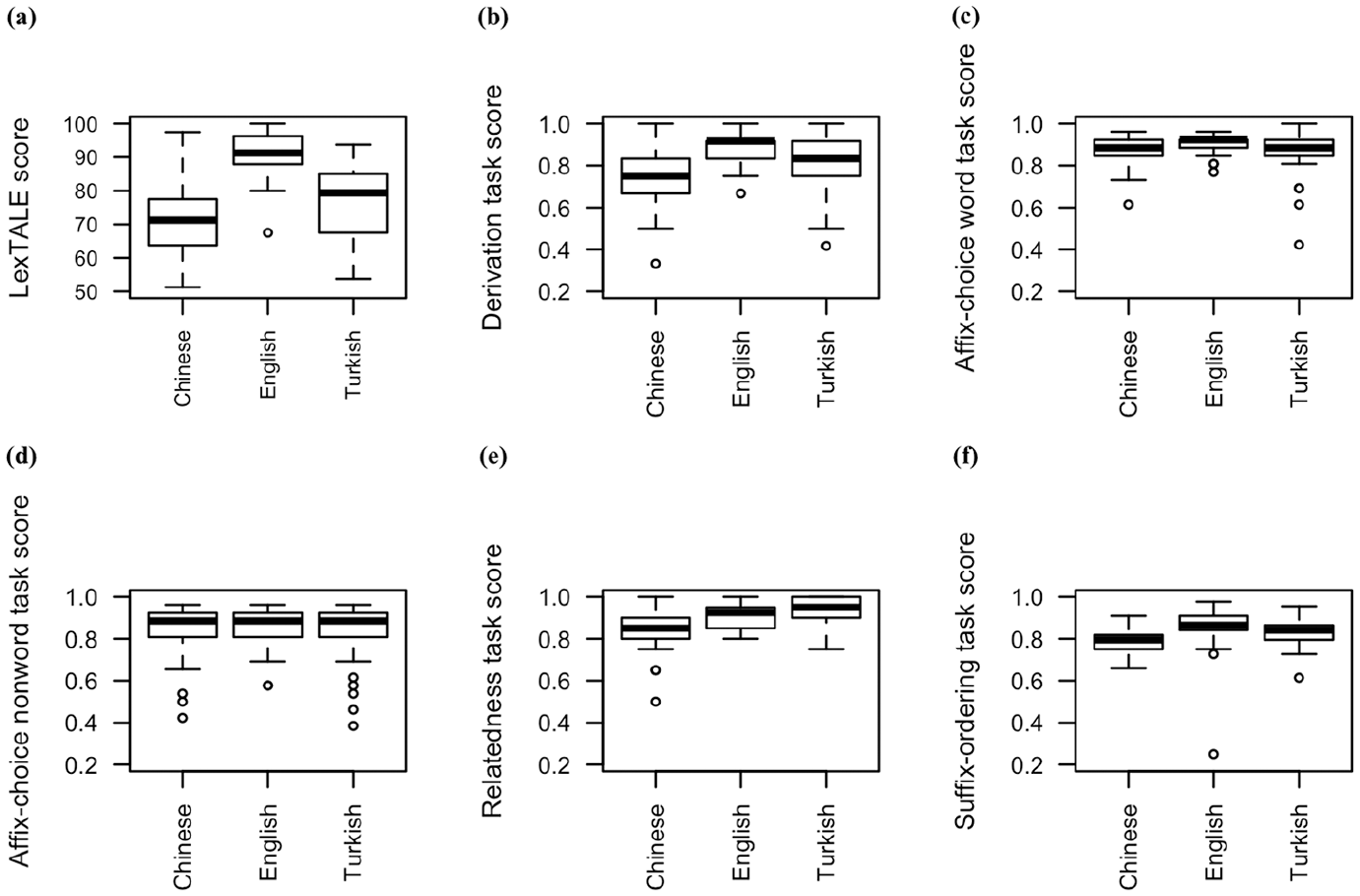
Boxplots of participants’ LexTALE and morphological awareness scores across language groups.
Means and standard deviations of overall accuracy scores (percentage) of each language group in each morphological awareness task and the LexTALE test.
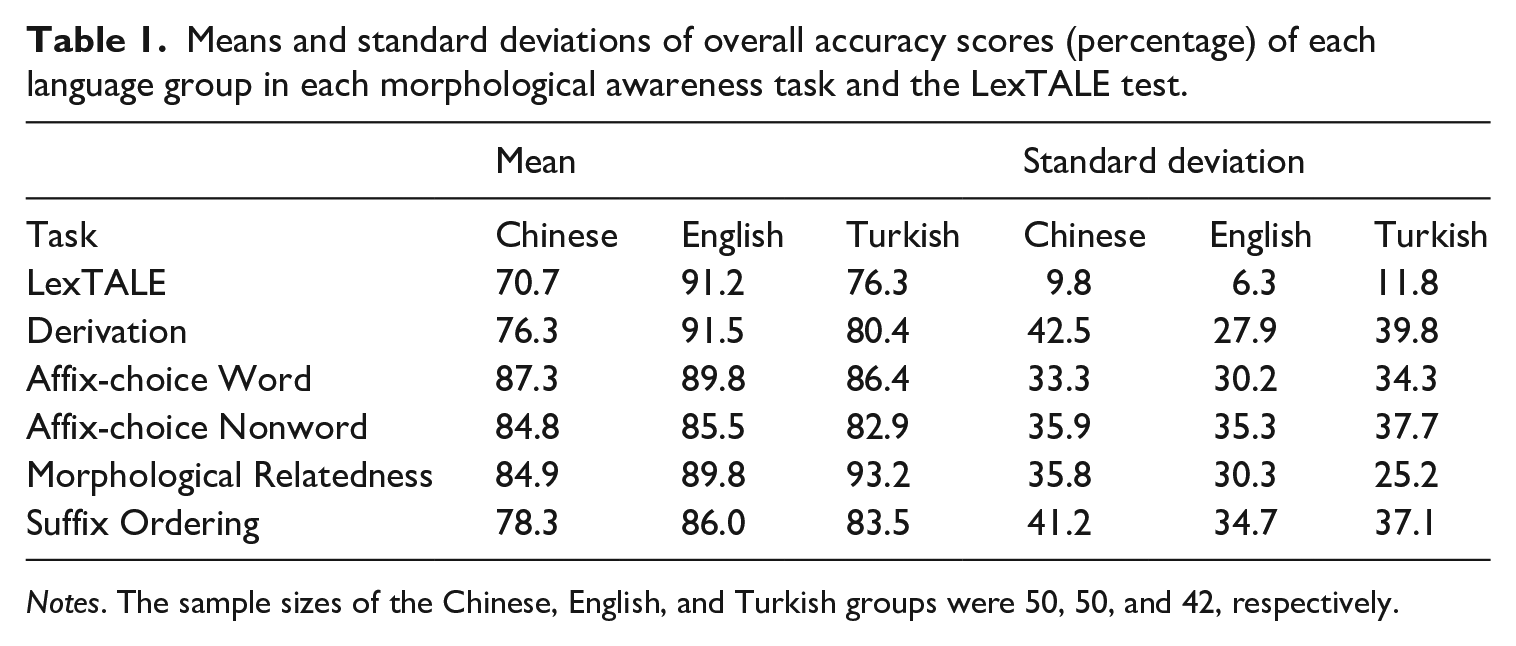
Notes. The sample sizes of the Chinese, English, and Turkish groups were 50, 50, and 42, respectively.
Results of the generalized linear mixed-effects models without and after accounting for LexTALE for each morphological awareness task.
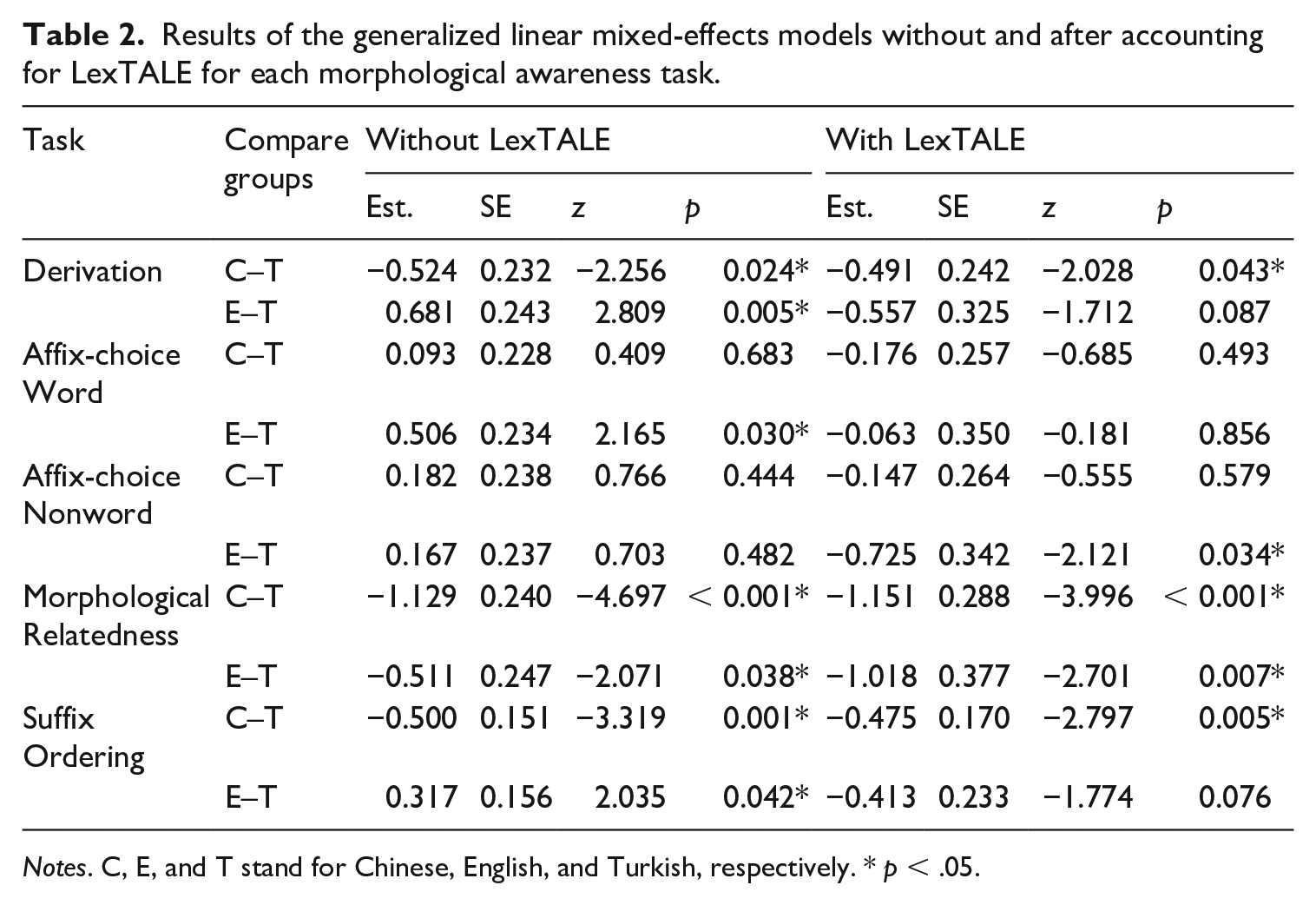
Notes. C, E, and T stand for Chinese, English, and Turkish, respectively. * p < .05.
For each morphological awareness task, model comparisons (log-likelihood ratio tests) of the models with vs. without LexTALE consistently showed that the models with LexTALE significantly improved model fit, suggesting that English language proficiency significantly contributed to English morphological awareness. Statistical analyses revealed different patterns of results across tasks. Without accounting for language proficiency, only the affix-choice nonword task showed no significant group differences, either between the Chinese group and the Turkish group (z = .766, p > .05) or between the Turkish group and the English group (z = .703, p > .05). All the other tasks, in contrast, showed group differences in one way or another without accounting for language proficiency. When language proficiency was accounted for, only the affix-choice word task revealed no significant differences between the Chinese group and the Turkish group (z = −.685, p > .05) or between the Turkish group and the English group (z = −.181, p > .05).
With regard to the comparison between the Chinese group and the Turkish group, results showed that the Turkish group generally outperformed the Chinese group both with and without accounting for L2 proficiency, as demonstrated in the derivation task (z = −2.028, p < .05; z = −2.256, p < .05), the morphological relatedness task (z = −3.996, p < .001; z = −4.697, p < .001) and the suffix-ordering task (z = −2.797, p < .01; z = −3.319, p < .001). The consistent advantage of the Turkish group over the Chinese group in those tasks after accounting for language proficiency constitutes evidence for an effect of L1 morphological type on L2 morphological awareness.
In terms of the comparison between the English group and the Turkish group, without controlling for LexTALE, the Turkish group performed worse than the native English group in the derivation task (z = 2.809, p < .01), the affix-choice word task (z = 2.165, p < .05) and the suffix-ordering task (z = 2.035, p < .05), but such group differences became non-significant after accounting for LexTALE (z = −1.712, p = .087; z = −.181, p > .05; z = −1.774, p = .076).
Interestingly, however, in the morphological relatedness task, the Turkish group significantly outperformed the English group both without and after accounting for LexTALE (z = −2.071, p < .05; z = −2.701, p < .01). In the morphological relatedness task, only 4 out of 50 (8%) English participants, but 12 out of 42 (28.57%) Turkish participants achieved the highest possible score. According to the cut-off of 15% (Lim et al., 2015; Terwee et al., 2007), it could be concluded that the Turkish group performed at ceiling but the English group did not. The advantage of the Turkish group over the English group in the relatedness task even without accounting for language proficiency provided evidence for an advantage of the Turkish group over the native English group in the relational aspect of English morphological awareness.
VI Discussion
The current study was among the first studies to compare advanced adult L2 learners from extreme L1 morphological types in their off-line L2 morphological awareness and to compare native speakers and advanced L2 learners from a morphologically more complex L1. We employed a series of morphological awareness tasks, including a derivation task, an affix-choice word task, an affix-choice nonword task, a morphological relatedness task and a suffix-ordering task. Results showed some differential patterns of group differences across tasks. We will first discuss the possible differences among tasks that led to the differential patterns of group differences, and then focus our discussion on the comparisons between groups.
The differential results across tasks may be attributed to three aspects of differences among tasks. First, the tasks differ in their demand on participants’ vocabulary size or language proficiency. The affix-choice nonword task was the only task, out of all tasks, that did not require knowledge of the ‘stem’ or the whole word but had to be completed using knowledge of English suffixes. In contrast to the affix-choice nonword task, all other tasks were more dependent on vocabulary size and language proficiency. Participants had to know the derived words in order to complete the derivation task; those who did not know the derived word might be reluctant to make a guess and generate a derived word online that was novel to them. Similarly, participants had to know the words in the affix-choice word task to make the correct choice so as to complete a meaningful sentence; they had to know the two words in the morphological relatedness task to make the decision of whether one came from the other; and they had to know the target word in order to make a correct lexical decision in the suffix-ordering task. In such tasks, more group differences were evident, partly due to language proficiency differences across groups, as can be seen from the different results without and after accounting for language proficiency. For example, in the affix-choice word task, there were significant differences between the English and the Turkish groups when language proficiency was not accounted for, but after accounting for language proficiency, no significant group differences were found. Such results suggested that the differences between the English and the Turkish groups in the affix-choice word task arose from their group differences in language proficiency and that the affix-choice word task was dependent on language proficiency.
Second, the tasks differed in the mental operations (Berthiaume et al., 2018) required for participants to complete them. Most importantly, as has been pointed out by Berthiaume et al. (2018), tasks vary regarding whether the mental operations ‘can be said to be truly related to morphological knowledge’ (Berthiaume et al., 2018: 78). Berthiaume et al. (2018) concluded that out of all morphological awareness tasks in the literature, derivation and decomposition tasks are the only tasks that are ‘purely morphological’ (Berthiaume et al., 2018: 78). They claimed ‘derivation and decomposition are the two mental operations at the heart of every morphological task’ (Berthiaume et al., 2018: 79), which seems to suggest that they believe all morphological tasks to involve mental operations that are morphological in nature. On the contrary, we argue that researchers need to carefully consider whether the morphological awareness tasks could be completed via a whole-word lexical route instead of a morphological route (Baayen et al., 1997; Baayen and Schreuder, 1999). It is questionable whether performance in morphological awareness tasks that could, in theory, be completed using a whole-word strategy truly reflects morphological awareness. We believe morphological analysis is obligatory in the derivation task, the affix-choice nonword task, and the morphological relatedness task. In contrast, we remain skeptical that the mental processes in the affix-choice word task involved obligatory morphological decomposition. In the affix-choice word task, participants could select the correct answer based on lexical memory of the whole word regarding its syntactic information. The fact that there were no group differences after accounting for language proficiency in the affix-choice word task was consistent with such a possibility that all participants relied on whole-word lexical memory to complete the task. Similarly, in the suffix-ordering task, participants do not necessarily activate their morphological knowledge because participants were asked to make a lexical decision and they could (in theory) rely on lexical knowledge of target words as a whole. Nevertheless, in the context of the current study, the Turkish group outperformed the Chinese group after accounting for language proficiency in this task, which suggested that the group differences between the Turkish and the Chinese groups could not be attributed to language proficiency only. In addition to language proficiency, L1 morphological type had to partially (at least) explain the group differences as well. The contribution of L1 morphological type to group differences between the Turkish and the Chinese groups beyond language proficiency meant that participants employed their morphological knowledge in completion of the suffix-ordering task. In other words, our results suggested that there was indeed involvement of morphological analysis in the suffix-ordering task in the current study.
In relation to the task differences in mental operations are the task differences in the implicitness/explicitness of participants’ use of morphological knowledge. It is important to note that the definition of morphological awareness as explicit or conscious awareness in the literature (e.g. Carlisle, 1995) focuses more on the process of using morphological knowledge (Berthiaume et al., 2018) than on the process of acquiring/learning morphological knowledge. With regard to the process of acquiring/learning morphological knowledge, the knowledge of L1 morphemic structure of words is, to a large extent, implicitly acquired, except for some occasional morphological instruction in the classroom (for a review of studies on the effects of L1 morphological instruction on literacy skills, see, for example, Bowers et al., 2010). With more experience in reading and writing during the school-age years, most students start to think about language, which contributes to a reorganization of implicit knowledge to more explicit morphological awareness (Carlisle, 2004). In contrast, the learning of L2 morphological knowledge may entail a larger extent of explicitness. Adult L2 learners may receive additional explicit morphological instruction in the classroom during the teaching of reading comprehension or vocabulary. The extensive English tests that adult L2 learners have received during their high school and college years in their home country may also include question items (e.g. error correction tasks, multiple choice tasks) that explicitly draw their attention to affixes within words.
With respect to the process of using morphological knowledge, as revealed in the morphological awareness tasks in the current study, the nature and the procedures of a specific morphological task determines the implicitness/explicitness of the use of morphological knowledge. The derivation task, the affix-choice nonword task, and the morphological relatedness task drew participants’ attention to the suffixes and morphological relations between words, and their use of morphological knowledge, as a result, could be categorized as more explicit and conscious than implicit and unconscious. On the other hand, the use of morphological knowledge in the suffix-ordering task may be more implicit.
Third, the tasks differed in the aspect of morphological awareness tested. The derivation task and the affix-choice word and nonword tasks tapped knowledge of syntactic morphology, the morphological relatedness task tapped knowledge of relational morphology, and the suffix-ordering task tapped knowledge of distributional morphology (McCutchen et al., 2008; Tyler and Nagy, 1989). The Turkish group showed a higher level of knowledge in relational morphology than the English group (as demonstrated in the morphological relatedness task) even without accounting for language proficiency, but equal levels of knowledge in syntactic morphology (as demonstrated in the derivation task and the affix-choice word and nonword tasks), and distributional morphology (as demonstrated in the suffix-ordering task) after accounting for language proficiency. Such results mean that compared to the English group, the Turkish group was more sensitive to relations between morphologically related words of the same stem. The Turkish group was better than the Chinese group in relational morphology (as demonstrated in the morphological relatedness task), and distributional morphology (as demonstrated in the suffix-ordering task) after accounting for language proficiency. The Turkish group outperformed the Chinese group in the derivation task, but not the affix-choice word and nonword tasks. As the derivation task and the affix-choice word task rely more on language proficiency, we believe the affix-choice nonword task to better reflect knowledge of syntactic morphology. Therefore, we conclude that the Turkish and the Chinese groups did not differ in knowledge of syntactic morphology.
Interestingly, there were no group differences between the Chinese group and the Turkish group and between the Turkish group and the English group in the affix-choice nonword task without controlling for language proficiency. Such findings suggested that advanced L2 learners in the current study have attained a native level of understanding and sensitivity regarding grammatical information of English derivational suffixes, i.e. knowledge of syntactic morphology (McCutchen et al., 2008; Tyler and Nagy, 1989). Even though the advanced L2 learners still had not achieved an expert (native) level of language proficiency, in a task that was independent of lexical knowledge, advanced L2 learners could very accurately identify the pseudo-suffixes in the nonwords, retrieve from memory the grammatical information carried by the ‘suffixes’, and infer the syntactic category of the nonwords based on the identified ‘suffixes’.
The results of the current study thus provided further evidence for effects of L1 morphological type on off-line L2 morphological awareness in advanced adult L2 learners. L2 learners from a morphologically more complex L1 demonstrated higher morphological awareness than L2 learners from a morphologically isolating L1. Specifically, the Turkish group, from an agglutinative system, had higher L2 English morphological awareness in relational morphology and distributional morphology than the Chinese group after controlling for language proficiency. The L1 Turkish learners of L2 English have command of an L1 that has extensive derivational and inflectional morphology. More importantly, the entrenched and transparent L1 Turkish representations and processing routines that are required for derivations and inflections that vary with vowel harmony (Durgunoğlu, 2006; Kornfilt, 2013) gave them a predisposition to analyse and manipulate the internal structure and forms of complex words to a measurably larger extent than the Chinese participants with isolating L1 morphology. When analysing L2 English words, the Turkish participants were influenced by their implicit processing routines in L1 word structure and became more attentive to the morphemic structure of L2 English words, thereby demonstrating greater sensitivity than the Chinese participants.
Our findings of effects of L1 morphological type on L2 morphological awareness in advanced adult L2 learners complement studies finding such effects in bilingual children (Ramírez et al., 2011) and added to previous literature on cross-linguistic influence of morphological awareness (e.g. Ramírez et al. 2010, 2011; Wang et al., 2006, 2009). Moreover, the effect of L1 morphological type on L2 morphological awareness of derivations in advanced adult L2 learners found in the current study is consistent with previous studies finding L1 influence in the online processing of L2 inflections (Dowens et al., 2010; Jiang et al., 2011) and derivations (Dronjic, 2013; Rehak and Juffs, 2011).
One additional interesting finding of the current study was an L2 group from a morphologically complex L1 outperforming native English speakers in knowledge of relational morphology. The Turkish group, even without accounting for language proficiency, nonetheless outperformed the native English group in their knowledge of the morphological relations between stems and derived words, suggesting an advantage of an L1 with (regular) complex morphology in awareness of morphological relations between L2 words.
This study has implications for theories in second language acquisition regarding the representation of morphologically complex words in the bilingual lexicon. Morphological processing studies in the L1 and the L2 psycholinguistic literature employ online measures to tap automatic processing of morphologically complex words, which could provide evidence for representation in the mental lexicon. Some of these studies have shown that L2 learners may not decompose morphologically complex words online to the same extent as native speakers (e.g. Clahsen et al., 2010). In contrast to native speakers’ automatic decomposition of morphologically complex words into morphemes during lexical access, L2 learners’ lexical access may rely more heavily on whole-word processing. Such findings have led to the conclusion that L2 learners tend to store morphologically complex words as whole units in the mental lexicon, in contrast to native speakers’ morphologically organized mental lexicon. As has been revealed, higher morphological awareness contributes to more automatic decomposition during online morphological processing in L2 learners (Deng et al., 2016, 2017). The higher awareness of morphological relations in the Turkish group than the English group found in the current study suggests the possibility of Turkish learners of L2 English representing morphologically complex words as decomposed morphemes in the mental lexicon to an even larger extent than native English speakers. In other words, our findings indicate a likelihood that the mental lexicon of Turkish learners of L2 English could be more morphologically structured than even native English speakers. For the Turkish learners to arrive at such knowledge, native language processing of morphology in the L1 must have influenced L2 processing, suggesting that abstract grammatical competence is available for L2 acquisition.
Such a finding would be consistent with Jackendoff’s (2002a, 2002b) suggestion that languages will vary in the extent to which words are stored with and without decomposed morphology. In this case, Turkish decomposition of inflectional morphology: suffixes of (negation)–tense–person marking faciliated knowledge of English derivation. Thus, it is morphological typology, specifically, the computational aspect of Turkish, rather than any specific morphological computation (derivation vs. inflection), that underlies the superior performance of the Turkish speakers. The continuing availability of this computational component for learning English derivational morphology is consistent with GenSLA approaches that assume abstract grammatical competence remains available, but not necessarily in precisely the same way as they were used in the L1 as proposed by Bley-Vroman (1983).
The current study found a significant contribution of both L1 morphological type and L2 language proficiency to L2 morphological awareness, which is similar to Yamashita’s (2002) Mutual Compensation model. L2 learners from a morphologically complex L1 are very likely to need lower L2 language proficiency than L2 learners from a morphologically isolating L1 to achieve the same level of L2 morphological awareness. For L2 learners from a morphologically complex L1, L1 processing routines required for both inflection and derivation are able to compensate, to a certain extent, for low L2 proficiency. For L2 learners from a morphologically isolating L1, the disadvantage brought by L1 processing habits in L2 morphological awareness could be compensated, to a certain extent, by higher L2 proficiency. Moreover, the advantage of the Turkish participants over the Chinese participants in relational and distributional morphology after accounting for language proficiency and the advantage of Turkish participants over even native English speakers in relational morphology seem to suggest that for the domain of L2 morphology, L1 experience might persist and still be influential even at highly advanced stages of L2 acquisition.
The result of the Turkish group outperforming native English speakers in relational morphology is one of a few rare examples of L2 participants outperforming native speakers in second language acquisition studies. Together with previous studies finding an L2 advantage over native speakers in target-language phonology (e.g. Chang, 2016; Chang and Mishler, 2012; Cooper et al., 2002), the results of the current study highlighted the need against comparative fallacy (Bley-Vroman, 1983; Dekydtspotter et al., 2006). ‘Native-like proficiency’ is not always the ‘highest level’ in an L2 task. L2 learners, when imbued with relevant L1 knowledge and processing routines, can indeed outperform native speakers. Specifically, in this case, native speakers of English were not the most ‘aware’ of derivation due to the fact that even inflected complex morphemes are stored as unanalysed chunks for frequent words (e.g. Alegré and Gordon, 1999). Thus, native speakers of English do not develop as complex routines for processing of English derivations as Turkish speakers do.
Some may argue that the Turkish group outperforming native English speakers might stem partially from ceiling effects in the morphological relatedness task (such that the Turkish group performed at ceiling). However, with ceiling effects in the Turkish group in the morphological relatedness task scores, the ability to detect an effect of the predictor variable(s) was compromised. Even with a compromise due to the ceiling effect in the Turkish group, the statistical model having the morphological relatedness task score as the dependent variable and L1 as the independent variable still showed a significant difference between the Turkish and the English groups. Therefore, we can be confident that the statistical significance of the L1 effect did not derive from ceiling effects.
There are several limitations in the current study. First, the current study compared the Chinese and Turkish groups in their L2 English morphological awareness of derivations. It was methodologically impossible to compare the two groups regarding their L1 morphological awareness of derivations, since Chinese makes little use of derivations. As compounding is a more prevalent morphological word formation process across languages, future studies could compare different L1 groups of advanced adult learners in both their L1 and L2 compound awareness. Correlations between their L1 and L2 compound awareness would provide further support for cross-linguistic influence of morphological awareness in advanced adult learners. Second, the languages included in the current study differed only in one dimension of morphological complexity. Therefore, the results of the current study do not suggest a general effect of morphological complexity. Future studies could explore whether L2 learners from L1s that differ only in the dimension of exponence also differed in their L2 morphological awareness.
VII Conclusions
This study was among the first attempts to examine the effect of L1 morphological type on L2 morphological awareness for highly advanced adult L2 learners in a series of morphological awareness tasks. The study showed that an acquired attention to affixation due to L1 computations in inflection and derivation could transfer to L2 derivation. By comparing native speakers and L2 learners of L1s with contrasting morphological type, this study has shown a significant advantage of an L1 with complex morphology, to the extent that L2 learners from a morphologically more complex L1, even with significantly lower proficiency in the target language, could outperform native speakers in knowledge of relational morphology. Such results have implications for theories in second language acquisition regarding the representation of the bilingual lexicon. In addition, the finding of L2 learners outperforming native speakers in the relational aspect of morphological awareness is a contribution to the scant literature findings where L2 learners show an advantage over native speakers and highlighted the need to guard against the comparative fallacy in which native-like performance is the ‘highest’ possible level in an L2 task.
Footnotes
Acknowledgements
This work was based on part of Zhaohong Wu’s dissertation work at the University of Pittsburgh, USA. We would like to thank the three anonymous Second Language Research reviewers and the journal editor for their invaluable comments on this article. We are also grateful to the participants for their time.
Declaration of conflicting interests
The author(s) declared no potential conflicts of interest with respect to the research, authorship, and/or publication of this article.
Funding
The author(s) disclosed receipt of the following financial support for the research, authorship, and/or publication of this article: This work was supported by the MOE (Ministry of Education, China) Project of Humanities and Social Sciences (20YJC740069).
