







Abstract
Greek and Spanish are two languages that display a similar subject distribution with unergative/unaccusative verbs, but different word orders with focused subjects (SV in Greek and VS in Spanish). Here we consider subject–verb word order in second language (L2) Greek and L2 Spanish in order to test the Interface Hypothesis (IH). To this end, we report a word-order selection task, with a Greek and a Spanish version. The two versions of the task were administered to L2 intermediate and advanced learners and native speakers of Greek and Spanish. The results show that the first language (L1) Spanish learners of Greek approximated more closely native word orders than the L1 Greek learners of Spanish. For the Spanish learners of Greek, the advanced group performed at ceiling, while the intermediate group performed native-like only with unergatives in neutral and direct interrogative subject-focused contexts. On the other hand, for the Greek learners of Spanish, the intermediate group failed in all contexts, while the advanced group performed native-like with unaccusatives in neutral contexts. This asymmetry between L2 Greek and L2 Spanish reveals that the L1–L2 combination determines the learners’ performance, and this is unexpected under the IH.
Keywords
I Introduction
This study aims to examine subject–verb word order in the acquisition of second language (L2) Greek by first language (L1) Spanish learners and L2 Spanish by L1 Greek learners, a phenomenon understudied in the literature for this bidirectional language combination (but for L1-Greek–L2-Spanish, see Lozano, 2006a, 2006b; and for L1-Spanish–L2-Greek, see Giannakou and Sitaridou, 2022). Our goal is to determine whether similarities and differences between Greek and Spanish regarding subject position with specific verb classes (unergative SV / unaccusative VS) have an effect on L2 performance and thereby put to the test the Interface Hypothesis (IH). Most L2 studies examine overt/null subject distribution, and word order phenomena are often neglected in the framework of the IH (for L2 Greek, see Amvrazis, 2012; for L2 Spanish, see Domínguez and Arche, 2014; Hertel, 2003). Thus, we examine with this particular language combination the extent to which language and interface nature determine L2 word order acquisition.
The article is organized as follows. Section II presents the IH and summarizes previous work on subject position in L2 Greek and L2 Spanish, pointing out similarities and differences between the two languages. Section III presents the predictions of the IH and the methods for our study. Section IV presents the results, and Section V includes a discussion of the results and our conclusions.
II Background
1 The Interface Hypothesis: Versions and alternatives
According to Tsimpli and Sorace (2006), the syntax–semantics interface involves formal properties and operations within syntax and Logical Form (LF) and the syntax–pragmatics interface involves pragmatic conditions determining appropriateness in context. The syntax–pragmatics interface reflects a ‘higher’ level of language use in which properties of language and pragmatic processing are integrated. This distinction is the basis of the initial version of what is known as the Interface Hypothesis (IH-1): IH-1 (after Tsimpli and Sorace, 2006): Formal properties involving the syntax–semantics interface are unproblematic to acquire in L2 grammars compared to the vulnerable properties integrating syntax with the higher level of pragmatics.
In other words, formal properties are fully interpreted at the LF interface (see Tsimpli and Dimitrakopoulou, 2007) and are more accessible to L2 learners than the syntactic-pragmatic properties. The empirical domain that Tsimpli and Sorace (2006: 655) examined was focalization. Sorace and Serratrice (2009) proposed an updated version of the IH (IH-2) that took into consideration processing limitations in bilingual acquisition: IH-2 (Sorace and Serratrice, 2009: 200): Processing limitations in bilingual speakers may be responsible at least for some of the difficulties attested at the interfaces, especially the ones requiring the coordination of syntactic and contextual information, while internal interfaces may be expected to be less sensitive to processing limitations because they involve mappings between formal properties of the language system alone.
Sorace (2011, 2012) also refers to a ‘hierarchy of computational difficulty’ (to define) from the more to the less taxing mappings. 1 In particular, Sorace et al. (2009) examined the acceptability of Italian pronominal subjects in [−topic shift] and [+topic shift] contexts, while Serratrice et al. (2009) examined the grammaticality of Italian plural NPs in specific and generic contexts. In both studies, participants were English–Italian and Spanish–Italian bilingual children, as well as monolingual Italian children. In Sorace et al.’s (2009) acceptability judgment task, both bilingual groups were more tolerant of redundant overt subjects in [−topic shift] contexts and accepted more null subjects in [+topic shift] contexts than monolinguals. However, pronoun reference played a role, as it was easier for both groups to avoid an ambiguous null pronoun in [+topic shift] contexts than a redundant overt pronoun in [−topic shift] contexts. In Serratrice et al.’s (2009) judgment task, the English–Italian bilinguals accepted more infelicitous bare plural NPs in both specific and generic contexts than the Spanish−Italian bilinguals. Crosslinguistic influence and semantic context seemed to play a role in bilingual preferences. In fact, the results showed that the IH-2 did not systematically predict the performance of bilinguals at the syntax–semantics or at the syntax–pragmatics interface. The nature of mappings did not create categorical delay or facilitation in the processing of interface phenomena.
Against this background, Rothman (2009) argued that pragmatic delays are eventually overcome, so that pragmatic features are eventually acquired in an L2: ‘Problems at the syntax–pragmatics interface are not permanent’ (Rothman, 2009: 956). Rothman examined the distribution of null/overt subjects in felicity judgment tasks. The language combination was L1-English–L2-Spanish, two languages that differ with respect to the expression of null subjects. Two experimental (intermediate, high advanced) groups and a control group of Spanish natives participated. The results indicated that the intermediate group did not differentiate between felicitous and infelicitous subjects, as they overaccepted both overt and null subjects, still showing no transfer from their L1. However, the advanced learners performed native-like, suggesting that, overall, syntactic-pragmatic problems are overcome as proficiency level develops, against the predictions of the IH. The same conclusion was reached by Donaldson (2011a, 2011b) in his studies on dislocation.
Slabakova et al. (2012) extended Rothman’s (2009) claims against the IH, as follows: ‘Learners at more advanced proficiency levels will demonstrate knowledge of both the syntax and discourse-appropriateness as well as the semantic constraints on the grammatical elements’ (Slabakova et al., 2012: 328). In their study Slabakova et al. (2012) examined L1 English and L2 Spanish, two languages that differ with respect to left dislocation: English, unlike Spanish, lacks clitics and clitic left dislocation (CLLD) constructions and allows only one preposing element that receives focal stress. The results of a felicity judgment task they carried out indicated that the learners at all levels were sensitive to the semantic constraints restricting the relationship between discourse antecedent and dislocate in CLLD. The near-natives also showed native-like knowledge of the syntax–discourse appropriateness of the clitic-doubled constructions, although the intermediate learners did not achieve full acquisition. Regarding focus fronting, all groups tended to reject the infelicitous structure, and a clear developmental trend was found, with the near-natives already performing successfully.
White (2011) also argued that the predictive power of the IH is questionable, as experimental studies do not confirm that the external syntax–pragmatics interface constitutes the main locus of L2 difficulties. Her main claim is that the interfaces are not categorically problematic or unproblematic for language learners, so that it is inappropriate to classify interface properties as inherently ‘easy’ or ‘difficult’ to acquire in an L2. In a similar vein, Montrul (2011) argued that the internal syntax–semantics interface is not always unproblematic, so that it is unclear how the syntax–pragmatics interface is more complex than the syntax–semantics interface.
2 Previous work on L2 Greek and L2 Spanish
For the languages examined in this article, L2 Greek and L2 Spanish, there is relatively little work on subject distribution as background to our study (for L2 Greek, see Giannakou and Sitaridou, 2022; for L2 Spanish, see Lozano, 2006a, 2006b). Most studies have examined monolingual Greek (see Fotiadou et al., 2020; Giannakou and Sitaridou, 2020) or the bilingual combination L1-Greek–L2-English (see Prentza and Tsimpli, 2013; Tsimpli et al., 2004; for Greek as a heritage language, see also Daskalaki et al., 2019). Only Giannakou and Sitaridou (2022) have examined the combination L1-Spanish–L2-Greek, in a study looking at null and overt subjects in topic-continuity and topic-shift contexts. Their results showed no overextension of the scope of overt subject pronouns, and null subjects were found to be mostly felicitous, except for some cases of ambiguity. On a topic closer to the one in our study, Amvrazis (2012) investigated word order alternations in L1 English upper-advanced learners of L2 Greek. His results indicated that the effects of verb class and definiteness determined learners’ judgments on preverbal and postverbal subjects, while they performed native-like at the syntax–discourse interface.
Lozano (2006a) also studied subject position at the interfaces in L2 Spanish by L1 Greek learners. He confirmed deficits at the syntax–discourse interface at higher competence levels, but convergence with native grammars at the lexicon–syntax interface. In contrast, Hertel’s (2003) study provided empirical evidence to the effect that L1 English learners of L2 Spanish at high competence levels showed native-like mastery of subject position at the syntax–pragmatics interface but diverged from target patterns at the lexicon–syntax interface.
In the domain of verbal typology, Montrul’s (2005) results showed that the advanced learners performed native-like with both unergative and unaccusative verbs. Domínguez and Arche (2014), on the other hand, claimed that all L2 groups presented syntactic deficits which affected the lexical-semantic properties of verbs, so that incomplete command at the interfaces was not limited to the pragmatic domain. In summary, the literature indicates that it would be an oversimplification to claim that all lexical-syntactic properties are readily acquired in L2, while all syntactic-pragmatic properties are subject to permanent vulnerability. The variability of the results also motivated our bidirectional study.
3 The position of subjects in Greek and Spanish
Greek and (Peninsular) Spanish are two null subject languages that allow the omission of overt subjects and the production of postverbal subjects in neutral contexts (for Greek, see Spyropoulos and Philippaki-Warburton, 2001; Spyropoulos and Revithiadou, 2009; for Spanish, see, amongst others, Fernández-Soriano, 1999; Ordóñez, 2007). However, Greek and Spanish present different word order patterns in answers to broad focus (i.e. neutral) questions (for Greek, see Alexiadou, 2006; and for Spanish, see Leonetti, 2014): Greek allows SVO and VSO alternations (1), while Spanish requires SVO in this context (2). Therefore, with this information structure, word order is more flexible in Greek than in Spanish (see Roussou and Tsimpli, 2006).
(1) Ti sinevi? what happen.3 ‘What happened?’ a. O Janis efaje tin banana. the. ‘Janis ate the banana.’ b. Efaje o Janis tin banana. eat. ‘Janis ate the banana.’ (2) ¿ Qué pasó? what happen.3 ‘What happened?’ Juan comió el plátano. Juan eat. ‘Juan ate the banana.’
Greek and Spanish also present differences in word order distribution in answers to narrow (i.e. informational) focus questions. Greek allows only SVO (3), while Spanish requires VOS (4). In Greek, informational focus occupies the initial position, while in Spanish it occupies the final position (for Greek, see Roussou and Tsimpli, 2006; for Spanish, see Zubizarreta, 1998; Büring and Gutiérrez-Bravo, 2001). A focused subject in both cases carries the main stress or prosodic prominence of the sentence (for Greek, see Alexopoulou and Baltazani, 2012; for Spanish, see Face, 2001).
(3) Pjos efaje tin banana? who eat.3 ‘Who ate the banana?’ the. ‘Janis ate the banana.’ (4) ¿ Quién comió el plátano? who eat.3 ‘Who ate the banana?’ Comió el plátano eat. ‘Juan ate the banana.’
Some recent experimental studies employing judgment and production tasks have found that, in some varieties of Spanish, focus can also remain in situ (in non-final position) if marked prosodically (for Argentinean Spanish, see Gabriel, 2007, 2010; for Mexican Spanish, see Hoot, 2012, 2016; for Mexican and Chilean Spanish, see Leal et al., 2019; for Andean Spanish, see Muntendam, 2009, 2013; for some non-standard varieties of Peninsular Spanish, see Vanrell and Fernández-Soriano, 2013). Thus, in those varieties the canonical SVO order is acceptable as in (5), if the main stress is shifted to the preverbal focused subject (see also Casielles-Suárez, 2004; Olarrea, 2012).
(5) ¿ Quién compró el periódico? who buy.3 ‘Who bought the newspaper?’ Juan buy.3 ‘Juan bought the newspaper.’
Regarding verb class, Greek and Spanish share the unergative/unaccusative split in word order that requires the SV order with unergative verbs but accepts only VS with unaccusative verbs in pragmatically neutral contexts (for Greek, see Alexiadou and Anagnostopoulou, 2004; for Spanish, see Eguren and Fernández-Soriano, 2004), as exemplified in (6) and (7).
(6) a. O Janis milai me tus filus tu. (unergative) the. ‘Janis speaks with his friends.’ b. Xthes irthe o Janis. (unaccusative) yesterday come.3 ‘Yesterday Janis came.’ (7) a. Juan habla con sus amigos. (unergative) Juan speak.3 ‘Juan speaks with his friends.’ b. Ayer vino Juan. (unaccusative) yesterday come.3 ‘Yesterday Juan came.’
However, in some experimental studies (see Amvrazis, 2012), the Greek natives accepted subject inversion with unergative verbs in acceptability judgment tasks, showing that the unergative/unaccusative distinction is not so strictly related to a fixed word order. In example (8) from Greek the locative argument occupies the preverbal position, and the subject remains in postverbal position (see Alexiadou, 2011).
(8) S’ afto to ergostasio dulevun poli ergates. in.this the factory work.3 ‘In this factory a lot of workers are working.’
Regarding intransitivity and informational focus, Greek requires SV and Spanish accepts only VS with both verb classes in answers to narrow focus questions. As in transitive verbs, the two languages also differ with respect to the placement of focus with intransitive verbs. In Greek focus features are checked in a higher position, namely in preverbal position, while in Spanish they are checked in a lower position, namely in postverbal position (Roussou and Tsimpli, 2006). For the position of focused subjects with intransitives in Greek and Spanish, see examples (9) and (10).
(9) Pjos milai me tus filus tu / irthe sto xorjo? who speak.3 ‘Who speaks with his friends/came to the village?’ a. the. ‘Janis speaks with his friends.’ b. the. ‘Janis came to the village.’ (10) ¿ Quién habla con sus amigos / vino al pueblo? who speak.3 ‘Who speaks with his friends/came to the village?’ a. Habla speak. ‘Juan speaks with his friends.’ b. Vino come.3 ‘Juan came to the village.’
Amvrazis (2012) observed that the Greek natives accepted preverbal subjects with unergative verbs and postverbal subjects with unaccusative verbs even in informational focus contexts. In this case, verb class seemed to take precedence over information structure, so that it is not impossible for unaccusative subjects to be focalized in their base position, implying that the lexical-semantic properties of intransitives condition the discursive properties of the structure (see Alexiadou, 2011). For SV and VS alternations with focused subjects in Greek, see examples (11) and (12).
(11) Pjos tilefonise? (unergative) who call.3 ‘Who called?’ the. ‘Janis called.’ (12) Pjos bike stin taksi? (unaccusative) who enter. ‘Who entered the class?’ Bike enter. ‘Janis entered.’
If we take into account the SV(O) and VS(O) alternations with transitives and intransitives in neutral focus contexts in Greek and the fixed SVO with transitives, SV with unergatives and VS with unaccusatives in Spanish, we may conclude that Greek is a superset language with respect to Spanish in neutral contexts (see Margaza and Gavarró, 2020). This is also the case in informational focus contexts, in which Greek allows both SV and VS with some verbs (unaccusatives), but Spanish only allows VS. If Spanish is the subset language with respect to Greek, in the sense that Greek allows more word order options than Spanish in most of the contexts examined, should transfer occur, we may expect this to have consequences for L2 acquisition, if the L2 learners of the two languages show different preferences for subject distribution under the influence of their L1 Greek or L1 Spanish.
III The study
1 Predictions
The aim of this study is to examine subject position with unergative/unaccusative verbs in L2 Greek and L2 Spanish in the context of the IH. Our main goal is to examine word order in a bidirectional study, as our study includes both L1-Spanish–L2-Greek and L1-Greek–L2-Spanish combinations, compared to Lozano (2006a, 2006b), which only considered L1-Greek–L2-Spanish. Taking into consideration the two IH versions above, we observe the extent to which Spanish and Greek learners show subject position mastery in neutral and focus contexts in their L2s. The predictions of the hypotheses entertained are as follows:
Hypothesis 1: According to the IH-1/IH-2 (as well as Lozano’s 2006a work), L2 learners will select the felicitous subject positions with unergative/unaccusative verbs in neutral contexts in which the syntax–semantics interface is involved, while they will show non-native subject–verb distribution in focus contexts in which the syntax–pragmatics interface is involved. 2
Hypothesis 2: If Rothman’s (2009) and Slabakova et al.’s (2012) claim that problems at the syntax–pragmatics interface may be eventually overcome at higher competence levels is correct, the advanced learners may attain native-like patterns in focus contexts, while temporary difficulty may be found at lower competence levels. Slabakova et al. (2012) further claim that the syntax–semantics interface can be mastered at higher competence levels, in which case the advanced learners will have no problems with subject position with intransitives in neutral contexts.
2 Method
Regarding the methodology for testing the IH, Sorace (2011) claimed that both offline and online tasks can provide information about the resources available to speakers. In this study, we apply offline tasks that examine knowledge of subject distribution with unergative/unaccusative verbs at the syntax–semantics and syntax–pragmatics interfaces. We have designed a written task that allows for better control of the context in relation to verb class and word order conditions than an online task. Contextualized written tasks have been widely used in research studies on L2 acquisition (see, amongst others, Hertel, 2003; Lozano, 2006b), so the use of this task type permits a comparison of the results of previous studies with our own.
a Experimental design
To examine the predictions above, a word order selection task was designed for the two languages with the aim of testing subject position relative to the verb in various contexts. In each version of the task (Greek version, Spanish version), the participants had to select the felicitous word order in a given linguistic context. The experimental conditions included sentences with intransitive verbs (unergative and unaccusative) in three different contexts: (1) a pragmatically neutral context, (2) a pragmatically marked context, with subject focus in direct question–answer pairs, and (3) a pragmatically marked context with subject focus in indirect question–answer pairs. The task consisted of 60 experimental items, 20 for each of the three experimental conditions, plus 10 fillers. 3 The motivation for the three conditions is driven by the IH: word order in neutral contexts will be determined by the syntax–semantics interface, while in pragmatically marked contexts will involve the syntax–pragmatics interface.
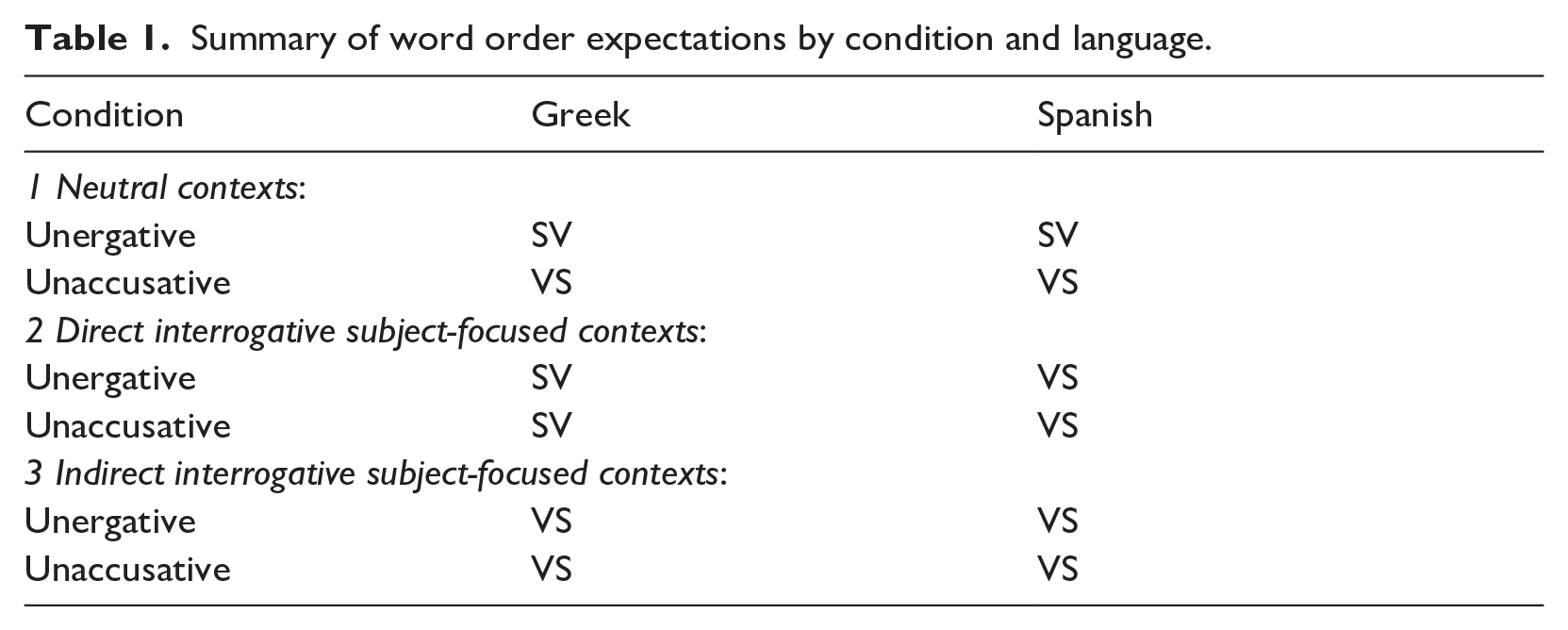
The pragmatically neutral context in Condition 1 involved, both in the Greek and the Spanish version, declarative sentences with unergative verbs (10 items) and unaccusative verbs (10 items); according to the literature, the felicitous word order is SV with unergatives and VS with unaccusatives in both Greek and Spanish. 4 This is illustrated in (13) and (14) with unergatives. The participants were asked to choose a relative order of subject and verb; here (a) and (b), respectively. The neutral declarative context calls for the preverbal subjects o diefthindis and el jefe (‘the boss’) with the unergative verbs milao and hablar (‘speak’). The order in which subject and verb appeared in each item was randomized in the task.
(13) Otan piga sto grafio, ____ ____ me tus sinaderfus mu. when go.1 (a) o diefthindis (b) miluse the. ‘When I went to the office, the boss was speaking with my colleagues.’ (14) Cuando fui al despacho, ____ _____ con mis colegas. when go. (a) el jefe (b) hablaba the boss speak.3 ‘When I went to the office, the boss was speaking with my colleagues.’
It is generally assumed that subject position is conditioned by syntax in a broad focus question like What happened? while subject position in answer to a question such as Who shouted/arrived? – which triggers a narrow focus response – is conditioned by the syntax–pragmatics interface; this second context type was targeted in Condition 2. In subject-focused contexts the felicitous word order is VS with both intransitive verbs in Spanish but SV in Greek (see Roussou and Tsimpli, 2006). Again, the items were counterbalanced for verb type (10 unergative, 10 unaccusative). This condition is exemplified in (15) and (16) for Greek. The direct questions with Pjos? (‘Who?’) require the subjects i simathites mas (‘our classmates’) and i gonis mas (‘our parents’) to be preverbal with the unergative trexo (‘run’) and the unaccusative pijeno (‘go’) in the corresponding answers.
(15) Den kseris pjos ine sto sxolio ke rotas: Pjos not know.2 trexi stin avli? I files su apandun: _____ _______. run.3 (a) i simathites mas (b) trexun the. ‘You don’t know who is at school and ask: Who is running in the schoolyard? Your friends answer: Our classmates are.’ (16) O aderfos su den exi katalavi pjos exi the. figi, j’afto se rotai: pjos exi leave. pai stin paralia? Esi tu apandas: ____ _____. go. (a) i gonis mas (b) exun pai the ‘Your brother has not realized who has left, so he asks you: Who has gone to the beach? You answer him: Our parents have.’
In contrast to Greek, in Spanish, the SV order is unacceptable in these contexts (Eguren and Fernández-Soriano, 2004). In examples (17) and (18) from Spanish, the direct question with ¿Quién? (‘Who?’) elicits sentences with the postverbal focused subjects los compañeros de clase (‘the classmates’) and nuestros padres (‘our parents’) with the unergative correr (‘run’) and the unaccusative ir (‘go’).
(17) No sabes quién está en la escuela y preguntas: ¿Quién not know. corre en el patio? Y tus amigas responden: ____ ____. run. (a) corren (b) los compañeros de clase run. ‘You don’t know who is at school and ask: Who is running in the playground? And your friends answer: Our classmates are.’ (18) Tu hermano no se ha enterado de quién your brother not ha salido, así que te pregunta: ¿Quién ha have. ido a la playa? Y tú le contestas: ____ ____. go. (a) han ido (b) nuestros padres have. ‘Your brother has not realized who has left, so he asks you: Who has gone to the beach? And you answer him: Our parents have.’
Condition 3 examined subject position with 10 unergatives and 10 unaccusatives in subject-focused contexts of indirect question–answer pairs, which are pragmatically marked. Examples (19) and (20) are taken from the Greek version of the task. In these embedded contexts, the subjects enas simathitis (‘a classmate’) and i ergates (‘the workers’) are postverbal with the unergative fonazo (‘shout’) and the unaccusative ftano (‘arrive’), respectively. The SV order is infelicitous in indirect interrogative focused structures in Greek with all verb types (Alexiadou, 2011).
(19) I Ageliki rotise pjos fonaze sto mathima the. ton mathimatikon ke i files tis apandisan oti ___ ___. the. (a) fonaze (b) enas simathitis shout.3 ‘Ageliki asked who was shouting in the math class and her friends answered that a classmate was shouting.’ (20) Den kseris pjos lipi, j’afto rotas pjos exi not know.2 ftasi ke o aderfos su apandai oti ___ ___. arrive.3 (a) exun ftasi (b) i ergates have. ‘You don’t know who is missing, so you ask who has arrived and your brother answers that the workers have arrived.’
Examples (21) and (22) are taken from the Spanish version of the task, and again only VS is felicitous (Eguren and Fernández-Soriano, 2004): in embedded contexts, both with the unergative gritar (‘shout’) and the unaccusative llegar (‘arrive’) the subjects un compañero (‘a classmate’) and los obreros (‘the workers’) are postverbal.
(21) Ángela preguntó quién gritaba en la clase de matemáticas Ángela ask.3 y sus amigas contestaron que ____ _____. and her friends answer.3 (a) gritaba (b) un compañero shout.3 ‘Ángela asked who was shouting in the math class and her friends answered that a classmate was shouting.’ (22) No sabes quién falta, así que preguntas quién ha not know.2 llegado y tu hermano responde que ____ _____. arrive.3 (a) han llegado (b) los obreros have. ‘You don’t know who is missing, so you ask who has arrived and your brother answers that the workers have arrived.’
Based on the linguistic literature, our expectations on word order in the three conditions are given in Table 1 for both Greek and Spanish.
Summary of word order expectations by condition and language.
b Participants
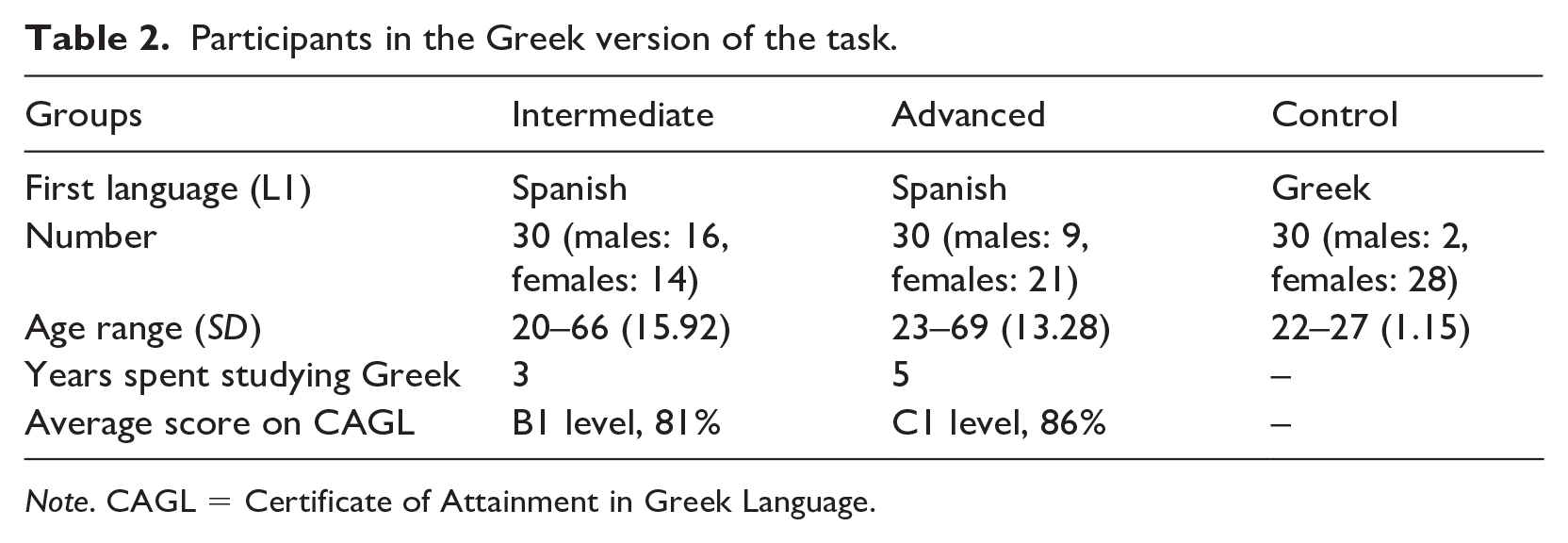
A total of six groups participated in our study, each consisting of 30 participants (total: 180). In the Greek version of the task, two experimental groups were examined: a group of intermediate learners and a group of advanced learners, both Spanish L1–Greek L2. The control group consisted of native Greek speakers, all of them students at the University of Patras. At the time of the experiment, the L2 groups were attending a Greek course for four hours a week at the School of Greek Language in Madrid. Both L2 groups had recently taken the examination for the Certificate of Attainment in Greek Language (CAGL). The average scores of the intermediate students on B1 and the advanced students on C1 exams are shown in Table 2, along with other descriptive data.
Participants in the Greek version of the task.
Note. CAGL = Certificate of Attainment in Greek Language.
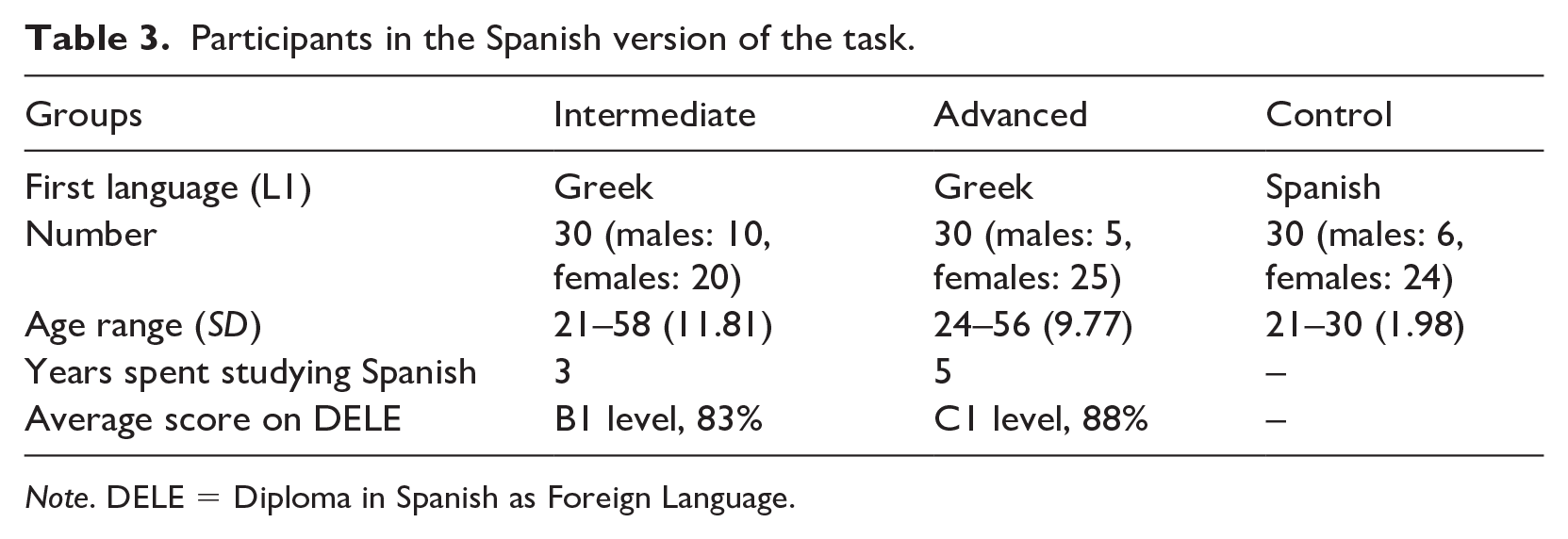
In the Spanish version of the task, participants also included two experimental groups – one intermediate and one advanced – and one control group. The L2 groups consisted of Greek L1–Spanish L2 learners taking classes in Spanish for four hours a week at Athens University’s Institute of Foreign Languages, while the Spanish natives were students at the Universidad Autónoma de Madrid. The two L2 groups had recently taken the examination for a Diploma in Spanish as Foreign Language (DELE). The average scores of the intermediate learners on B1 and the advanced learners on C1 exams are shown in Table 3, with other descriptive data.
Participants in the Spanish version of the task.
Note. DELE = Diploma in Spanish as Foreign Language.
c Procedure
All participants were tested individually in a quiet room in their language schools or universities. They were informed about the general goals of the research and, after giving their informed consent, answered a 10-minute questionnaire on paper about their dominant language, knowledge of L2 Greek or Spanish and results on official L2 language exams. Then they were given the respective experimental version of the task, also on paper, together with instructions about how to carry it out by indicating what they thought was the correct order of the two elements (a) and (b). They did that by filling in the blank spaces left in the sentence for it to be complete. The instructions were illustrated using an example with felicitous word order. They then proceeded to complete the task. If at any time participants requested further clarification, it was provided. Completion time of the experimental task for all participants was under 40 minutes.
d Coding and statistical analysis
In the two versions of the task the responses consisting of a subject and an intransitive verb were classified as SV or VS according to the word order indicated by the participant. Averages were also measured for each individual and coded in SPSS (version 28, 2021) to perform the non-parametric Mann–Whitney and Wilcoxon tests. Data type and sample type played a role in the selection of non-parametric statistics. In this case, non-parametric statistics were chosen for categorical or ordinal data, allowing comparisons between heterogeneous samples (see Warren, 2018). Non-parametric tests were also applied to small-size samples (n ⩽ 30) to give reliable measurements (see Corder and Foreman, 2009). The Mann–Whitney test was used to establish significant differences between independent paired groups of L1 speakers (control group) and L2 learners (intermediate or advanced group), to see to what extent the L2 learners converge to the target grammar. The Mann–Whitney test measures the effect of the independent factor Group (intermediate, advanced, control) on the dependent factor Word Order (SV, VS) in a given context. We also compared the performance of L1 speakers of Greek and Spanish to substantiate the similarities and differences between the two languages. The interactions between Verb Class (unergative, unaccusative), Word Order and Group were checked by performing the Wilcoxon test in each condition.
IV Results
Each version of the word order task yielded a total of 5,400 responses (1,800 from each group). The responses to the distractors were excluded from the analysis.
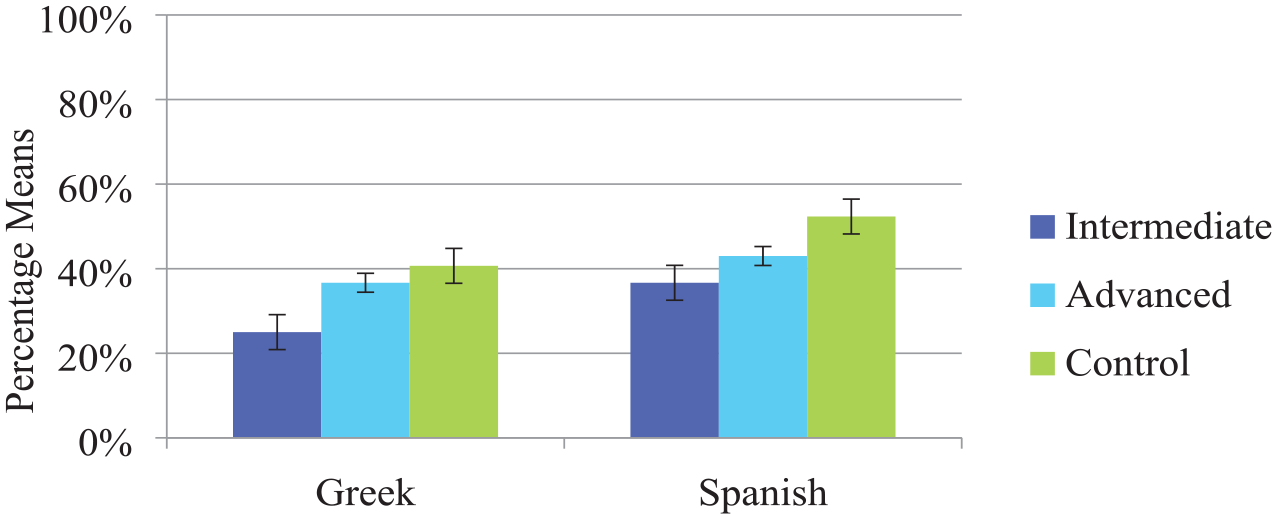
The descriptive results for Condition 1 appear in Figure 1 for unergative verbs. Here all groups showed a high preference for the felicitous SV order. Regarding unaccusative verbs, the descriptive results appear in Figure 2. The finding here is that postverbal subjects are found more often than with unergatives, although not as often for the natives as the linguistic literature reported above would make us expect.
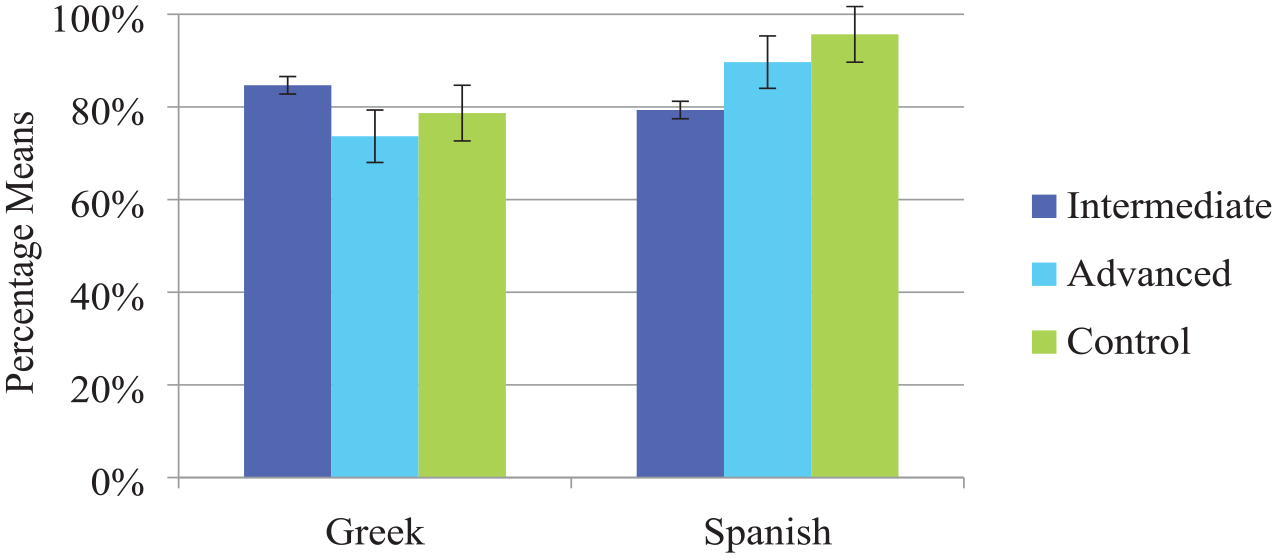
Preverbal subjects with unergative verbs in neutral contexts.
Postverbal subjects with unaccusative verbs in neutral contexts.
Statistical tests were applied to measure the difference between the L1 and L2 groups. In Condition 1 for L2 Greek, the Mann–Whitney test showed no statistical differences between the L1 and L2 groups in the case of unergative verbs, but the differences were significant between the intermediate and control groups (U = 227.000, p = .003 with Bonferroni correction) in the case of unaccusative verbs (the difference between the advanced and the natives was not significant). In L2 Spanish, on the other hand, the Mann–Whitney test indicated significant differences between both the intermediate and control groups (U = 213.000, p < .003 with Bonferroni correction) and the advanced and control groups (U = 291.000, p = .03 with Bonferroni correction) in the case of unergative verbs, but only for the intermediate and control groups (U = 265.500, p = .018 with Bonferroni correction) in the case of unaccusative verbs. The Wilcoxon test indicated an interaction between Verb Class, Word Order and Group in all L2 cases, as the intermediate (Greek: Z = −2.792, p = .005; Spanish: Z = −3.292, p = .001) and advanced groups of both L2s (Greek: Z = −1.965, p = .049; Spanish: Z = −4.719, p < .001) presented significant differences in word order between unergative and unaccusative verbs.
We now turn to the conditions with pragmatically marked contexts. The descriptive results for Condition 2 for unergative verbs appear in Figure 3; here the point of reference is the felicitous option in each language. The L2 Greek learners approached the rates of the control group in the case of the felicitous SV, while the respective groups of L2 Spanish diverged from native preference for VS, and rather chose SV, as they do in their L1 Greek.
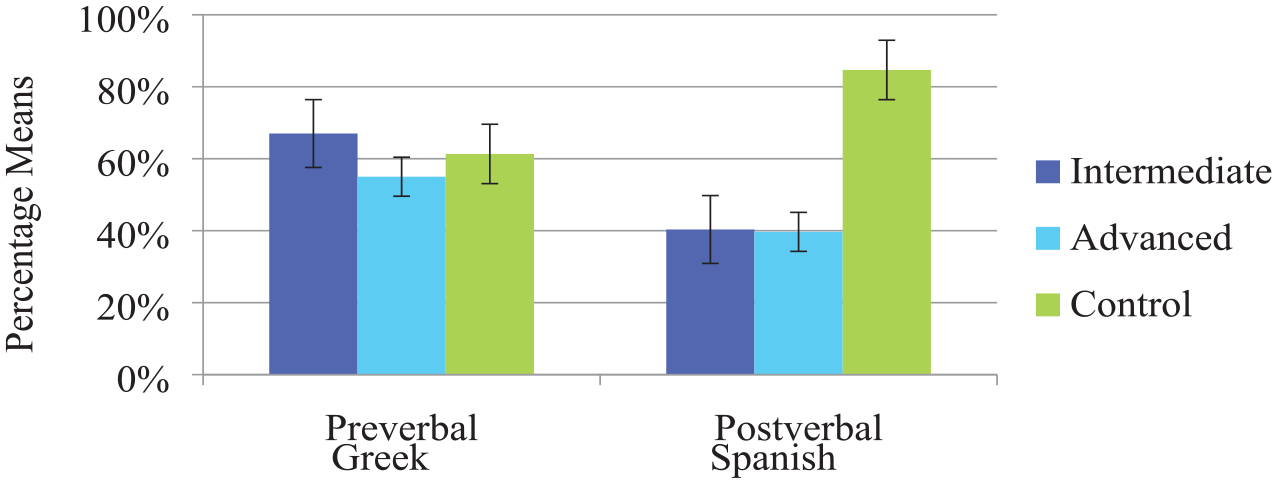
Subjects with unergative verbs in direct interrogative subject-focused contexts.
Regarding unaccusative verbs, the percentage means of all groups appear in Figure 4. Here the preferred option of both Greek and Spanish is the order VS. While this is expected for the native speakers of Spanish, it is not what the literature on the Greek natives (Roussou and Tsimpli, 2006) would make us expect.
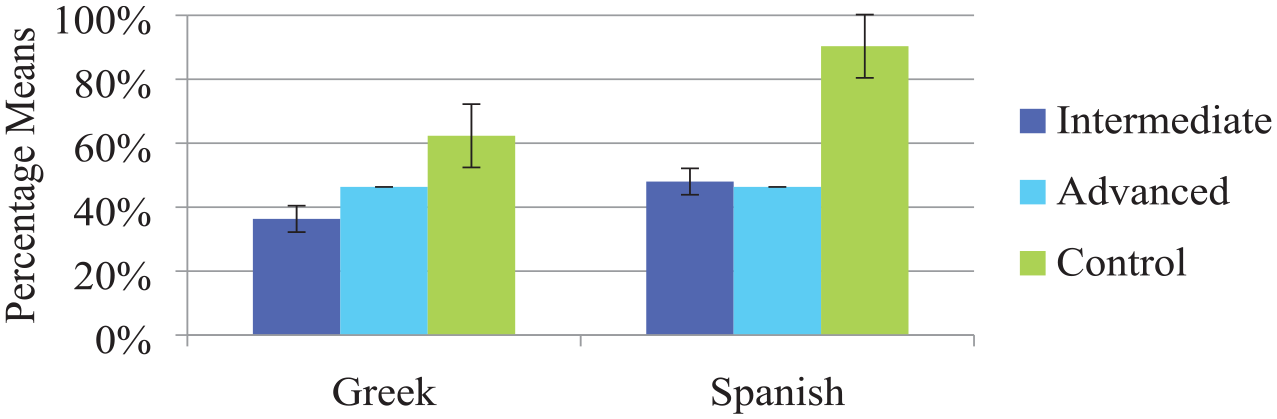
Postverbal subjects with unaccusative verbs in direct interrogative subject-focused contexts.
In the statistical analysis of the results for Condition 2, for L2 Greek, the Mann–Whitney test indicated non-significant differences between the L1 and L2 groups with unergative verbs, but the differences were significant between the intermediate and control groups (U = 284.000, p = .039 with Bonferroni correction) with unaccusative verbs. In L2 Spanish, οn the other hand, the differences were statistically significant for the two verb types for both the intermediate and control groups (unergative: U = 126.000, p < .003; unaccusative: U = 140.500, p < .003 with Bonferroni correction) and the advanced and control groups (unergative: U = 133.500, p < .003; unaccusative: U = 150.000, p = .003 with Bonferroni correction). The Wilcoxon test also confirmed an interaction between Verb Class, Word Order and Group for the advanced group of Spanish (Z = −2.862, p = .004), as their performance with unergative and unaccusative verbs was significantly different, but not for the intermediate group, nor for the L2 Greek groups.
In Condition 3, the descriptive results for unergative verbs appear in Figure 5, and those for unaccusative verbs appear in Figure 6. In this pragmatically marked context (subject-focused contexts of indirect question–answer pairs) the results are similar for unaccusatives and unergatives: the native speakers of Greek and Spanish chose the VS option, but only the advanced L2 learners showed a trend towards target word order.
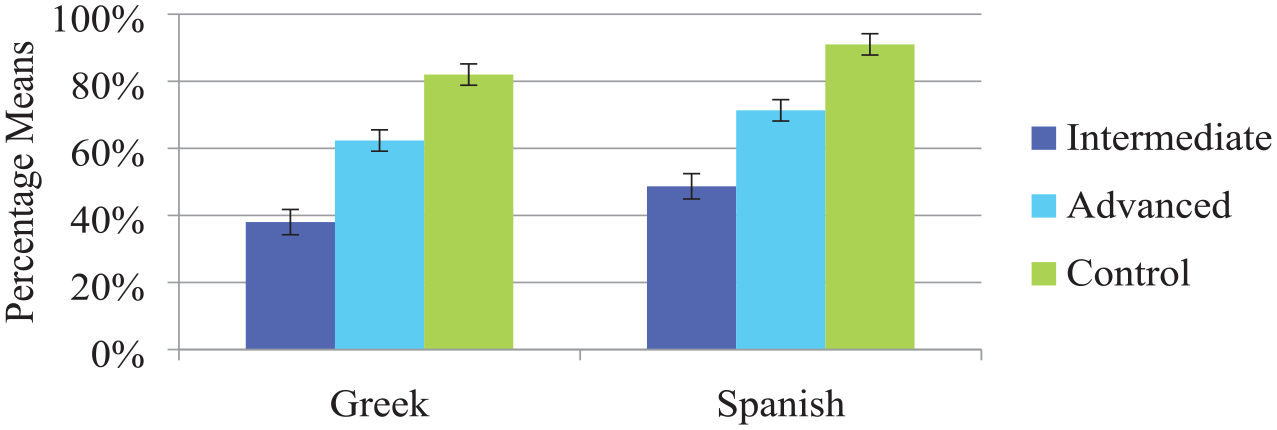
Postverbal subjects with unergative verbs in indirect interrogative subject-focused contexts.
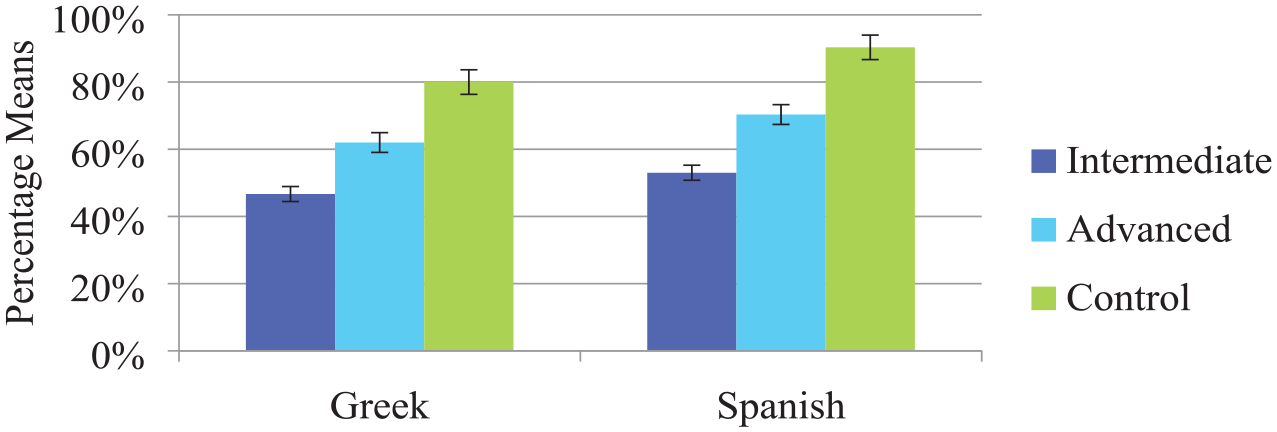
Postverbal subjects with unaccusative verbs in indirect interrogative subject-focused contexts.
For L2 Greek, the Mann–Whitney test indicated significant differences between the intermediate and control groups (unergative: U = 185.500, p < .003; unaccusative: U = 191.500, p < .003 with Bonferroni correction), but not for the advanced and control groups. In L2 Spanish, though, the statistical differences were significant for both the intermediate and control groups (unergative: U = 92.500, p < .003; unaccusative: U = 103.000, p < .003 with Bonferroni correction) and the advanced and control groups (unergative: U = 206.500, p < .003; unaccusative: U = 271.500, p = .018 with Bonferroni correction). In this case, the Wilcoxon test revealed no significant interaction between Verb Class, Word Order and Group in the performance of the L2 groups of Greek and Spanish.
Since, based on the linguistic literature, we found some unexpected performance on the part of the natives, we compared the L1 Greek and L1 Spanish groups in the three conditions examined. In Condition 1 for neutral contexts, the differences between the L1 Greek and L1 Spanish speakers were significant for both unergative (U = 70.500, p < .001) and unaccusative verbs (U = 276.500, p < .009) in the Mann–Whitney test. Not only was the performance different for Greek and Spanish, it was also the case that subjects were very often preverbal with unaccusative verbs, against the expectations in the L1 Greek and Spanish literature. In Condition 2 for direct interrogative subject-focused contexts, the statistical differences between the two L1 groups were also significant (unergative: U = 98.500, p < .001; unaccusative: U = 201.500, p < .001) in the Mann–Whitney test, thus Language played a role in Word Order preferences. The difference in this context between the two languages is expected according to the literature, but the native speakers of Greek chose VS with unaccusatives more often than expected. Finally, in Condition 3 for indirect interrogative contexts, there was no effect of Language on Word Order selection with unergative and unaccusative verbs. Overall, Greek and Spanish present similar rates of postverbal subjects in Condition 3.
V Discussion and conclusions
Our results show that the Greek and Spanish natives differed with respect to subject distribution with intransitives in neutral contexts: in Greek the VS order was possible with unergatives more often than in Spanish, and the SV order was also preferred with unaccusatives in Greek more often than in Spanish. Our results are consistent with Amvrazis’ (2012) findings in which the Greek natives allowed postverbal subjects with some unergative verbs, although in other studies unergatives and unaccusatives are considered to pattern as SV and VS respectively (see Alexiadou and Anagnostopoulou, 2004). In our study, the Spanish natives produced the order VS in both direct and indirect interrogative subject-focused contexts, while the Greek natives alternated between SV and VS in direct interrogative contexts, depending on verb class, 5 and this is at odds with the claims of Roussou and Tsimpli (2006).
Turning now to the L2 learners, in L1-Spanish–L2-Greek, the advanced group achieved native-like behaviour in all types of contexts. Competence level was relevant because the intermediate group performed worse than the advanced group but attained target-like patterns with unergatives in neutral and direct interrogative subject-focused contexts, showing verb class and focus type effects. In L1-Greek–L2-Spanish, the intermediate group diverged from the native group in all neutral and subject-focused contexts, while the advanced group attained target subject distribution only with unaccusatives in neutral contexts. Our results were not consistent with Lozano’s (2006a) findings where all L1-Greek–L2-Spanish groups achieved native-like word order in unergative/unaccusative contexts, showing a high-level command of the syntactic-semantic properties of intransitive verbs. However, Lozano’s (2006a) advanced groups did not reach native rates with focused subjects.
As noted above, there is a difference in performance between our learners of Greek and Spanish, though their knowledge of the respective L2 is similar in terms of their L2 exam scores and how long they have been studying. It is noteworthy that the advanced learners of Spanish failed in almost all contexts, while the advanced learners of Greek did not. Even the intermediate learners of Greek performed better than the advanced learners of Spanish in two cases. This result is similar to what Margaza and Gavarró (2020) found in their study of null and overt subject distribution in L2 learners of Greek or Spanish. Our results are summarized in Table 4, where the cases marked with + imply that the learners performed significantly differently from the native speakers.
Summary of results: Differences with respect to natives.
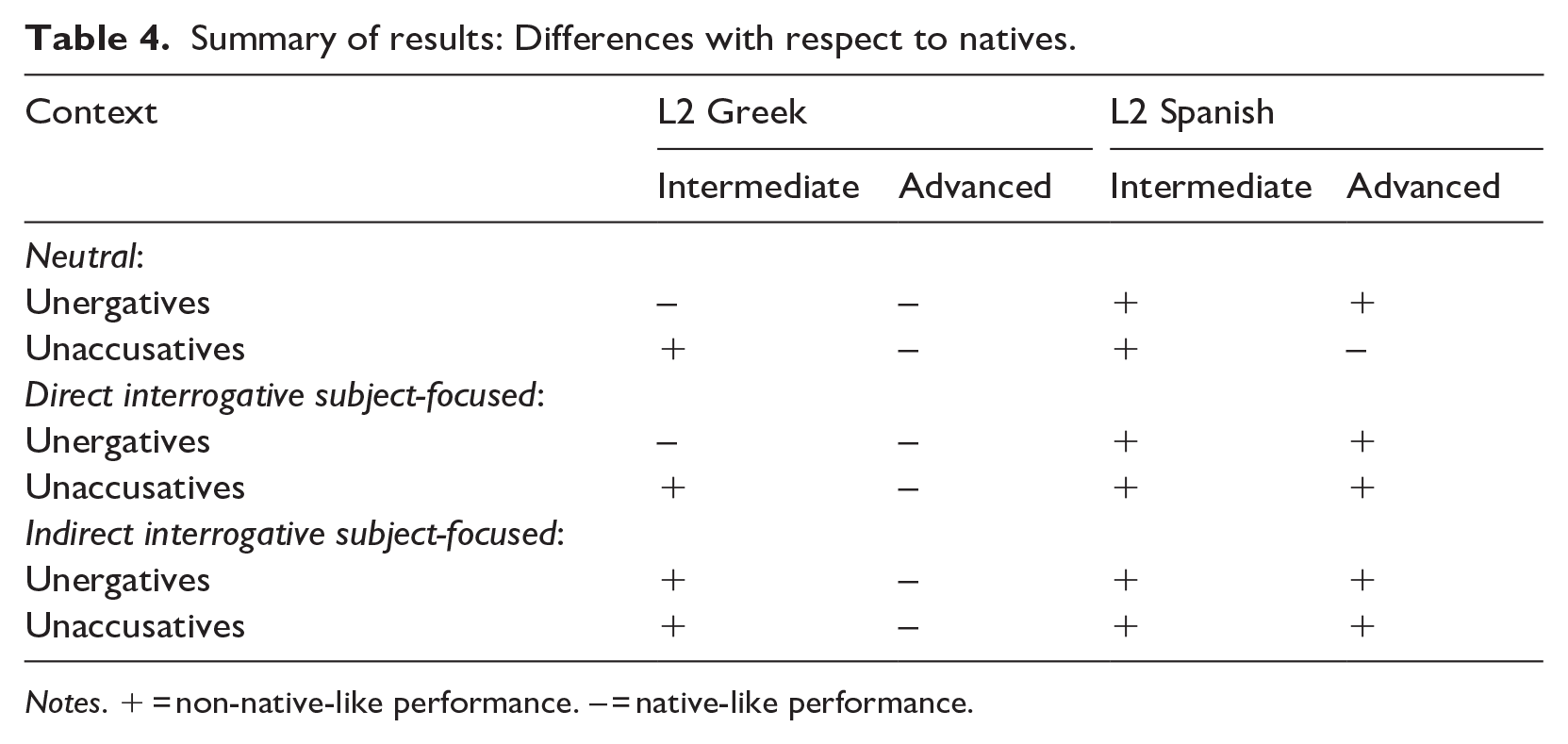
Notes. + = non-native-like performance. – = native-like performance.
If we consider our results against the predictions formulated in Section III.1, we see that the intermediate L2 Greek group showed non-native performance in four out of six cases, confirming problems with both syntactic-semantic and syntactic-pragmatic word orders with unaccusatives, except for unergatives in Conditions 1 and 2. This result contradicts the IH-1 and IH-2, which predict acquisition difficulties only at the syntax–pragmatics interface (if we accept that the IH may include intermediate levels). On the other hand, the advanced L2 Greek group attained native-like performance with both verb classes in all contexts, regardless of the interface. Their behaviour runs contrary to the IH-1/IH-2 for the syntax–pragmatics interface and is consistent with Rothman’s (2009) claim that acquisition may be successful at higher competence levels and Slabakova et al.’s (2012) argument that full command of both the syntax–semantics and syntax–pragmatics interfaces is possible. For L2 Spanish, the intermediate group had problems with subject position with both intransitives in all interface contexts. The advanced L2 Spanish group also presented non-target performance in five out of six cases, confirming difficulties with both interfaces, against the IH-1/IH-2 predictions. Divergence from native-like subject distribution cannot strictly be taken as evidence against Rothman’s (2009) or Slabakova et al.’s (2012) claim for final mastery of an L2, since our participants are not at the highest level of proficiency.
The above results were unexpected under the IH, which we aimed to evaluate with a new language combination and empirical domain. In fact, the results seen here depended on language combination, as the advanced L2 Greek group performed better than the advanced L2 Spanish group at the same interface domains. Thus, the results showed that the L2 affected learners’ performance in the contexts examined, even in cases where the L2 learners displayed similar competence levels. L2 Greek was native-like at both the syntax–semantics and the syntax–pragmatics interfaces at higher competence levels, while L2 Spanish remained non-native not only at the syntax–pragmatics interface but also at the syntax–semantics interface. The Greek natives accepted SV/VS alternations in some contexts where the Spanish natives selected one option (mostly VS), so that the learners’ variation was closer to native-like patterns in L2 Greek but not in L2 Spanish. This pattern was also attested at lower levels of competence, as in some cases the intermediate L2 Greek group performed well. Following Margaza and Gavarró (2020), if we assume that Greek is the superset language with respect to Spanish, in the sense that Greek allows both SV and VS orders in contexts in which Spanish allows only one word order, then the Spanish learners of Greek are more likely to select one of the possible word order options of Greek, while the Greek learners of Spanish, if transfer is active, may alternate between SV and VS, which is acceptable in their L1 but unacceptable in Spanish.
Although fleshing out an alternative account of L2 delay(s) is beyond the scope of this article, it is worth noting that, in L2 Spanish, all the cases (3/6 for the advanced, 4/6 for the intermediate) of non-native performance (+ in Table 4) in neutral and direct interrogative focused contexts could be attributed to transfer from the L1, Greek. In neutral contexts, the unaccusative/unergative split is not as rigid in Greek as it is in Spanish. In focused contexts, the default word order in Greek is SV, while in Spanish it is VS; this happens with both unergatives and unaccusatives in direct interrogative subject-focus contexts (though the Greek natives show a higher preference for VS with unaccusatives than expected). The L2 learners of Spanish appear to overgeneralize the order of direct questions to indirect questions (something that transfer in itself would not lead us to expect).
Overall, the results of our word order selection task show that the IH does not accurately predict the performance of the L2 learner groups. The IH-1/IH-2 for the syntax–pragmatics interface fared well here for both experimental groups of L2 Spanish and the intermediate L2 Greek group, but not for the advanced L2 Greek group, which attained full command of subject position at both interface levels, favouring Rothman’s (2009) and Slabakova et al.’s (2012) predictions. The results clearly point to the impact of the properties of the L1 on the L2. Although the IH is an influential hypothesis in the field of second language learning (and also in bilingualism studies), our results converge with other studies on L2 acquisition (for L2 Greek, see Amvrazis, 2012; Giannakou and Sitaridou, 2022; for L2 Spanish, see Clements and Domínguez, 2017; Domínguez and Arche, 2014; Hertel, 2003; Lozano, 2018) in questioning its empirical adequacy.
Footnotes
Acknowledgements
The authors wish to thank all the students of the Universities of Athens and Patras, Greece, and the Universidad Autónoma de Madrid, Spain, who participated in the experimental task of this research. They also wish to thank the editor and the two anonymous reviewers of Second Language Research for their comments and suggestions. Any remaining errors are the authors’ responsibility.
Declaration of Conflicting Interests
The authors declared no potential conflicts of interest with respect to the research, authorship, and/or publication of this article.
Funding
The authors received no financial support for the research, authorship, and/or publication of this article.
